Sherritt’s Two Power Plants in Cuba Were Key to Solving the Blackout

The Canadian power plant contributed about 816 gigawatt-hours in 2024 to the national electricity system and allowed the reconnection of the thermoelectric plants.


The multiple deficiencies of the western power plants cause the Boca de Jaruco to be overloaded when the connection is established

14ymedio bigger14ymedio, Havana, 20 March 2025 — The gas power plants of the Canadian mining giant Sherritt in Boca de Jaruco (Mayabeque) and Varadero (Matanzas) were key pieces in returning electricity to Cuba during the most recent blackout. Without those two supports, the precarious frame of thermoelectric plants, stations and generators that the authorities call – not without irony, after four disconnections in less than six months – the national electrical system (SEN) would not have returned to the ring.

For businessman William Pitt, from whose family Fidel Castro confiscated in 1960 several properties with mining value, the data has a personal connotation: “We are contributing to the illumination of Cuba with the theft of our mines,” he tells 14ymedio. The Government pays Sherritt for the electricity production of the Jaruco and Varadero plants with minerals extracted from the confiscated mines in the east of the country.

Pitt, who has continuously denounced the plunder of Sherritt and its properties by the Cuban State, also underlines the fact that Cuba depends on a foreign company to solve a serious energy crisis like the one that occurred on March 14, when the disconnection of the SEN was announced. This “significant” dependence was admitted by the company in its annual report: Sherritt contributed about 816 gigawatt-hours (GWh) to the SEN in 2024. continue reading

The scourge of Boca de Jaruco is the Guiteras itself, because of the frequency with which it breaks down

Thanks to the Boca de Jaruco, Pitt points out, it was possible to start the western system. However, the multiple deficiencies of the western power plants – the most important in Cuba is the Antonio Guiteras, in Matanzas – cause the Boca de Jaruca to overload when the connection is established and its disconnection mechanism is activated. It is an automatic strategy “to prevent the plant from being damaged,” he adds.

The scourge of Boca de Jaruco is the Guiteras itself, due to the frequency with which it breaks down. Its disconnection in fact, caused the December blackout. Pitt does not rule out that the damage to other power plants in the area, such as the Mariel or Santa Cruz del Norte – usually mentioned in the litany of breakdowns reported by the Electric Union (UNE) – contributes to the overload.

A similar situation affects the Sherritt plant in Varadero, indispensable to start the eastern section of the SEN. If the Guiteras is the one that affects the reconnection of the West the most, it is the Felton plant, in Holguín, that fulfills that disastrous role in the East.

Sherritt does not come to the aid of the regime out of solidarity, Pitt warns. Every megawatt, every start-up maneuver, every solution comes with a price that Cuba pays in minerals, since it lacks money to pay off its debts. “Sherritt has had to resort to extracting even more minerals from the mines of Moa (Holguín) without having to pay the Government extra and thus considers those minerals as partial payment of Cuba’s debt. But that’s not enough.”

Every megawatt, every starting maneuver, each solution comes with a price that Cuba pays in minerals

Pitt, who claims that Castro’s maneuvers against his family wrecked the Cuban mining sector, does not lose sight of the historical roots of the situation: the nickel and cobalt that Sherritt extracts from Moa, and with which the regime negotiates, belongs to his family. It is “mineral stolen from mines that belong to my sisters and me,” he asserts.

The regime is not the only one that goes through a financial squeeze. Sherritt, as reflected between the lines of its annual report, is “on the verge of bankruptcy,” according to Pitt. The company is facing, says the businessman, an “unsolvable problem” at the end of this month, when it holds its shareholders meeting.

“The fall in the price of nickel and cobalt in the world market, together with the economic and political conditions that exist in Cuba, have caused Sherritt losses year after year.” Faced with this scenario, shareholders will have to vote for the best solution to get rid of the financial disaster in the next two years.

The initiatives that have so far been useful, such as the Cobalt Exchange – a pact that allows the exploitation of mines as a means to compensate for the Government’s million-dollar debt – or the improvement of some of its facilities, are not enough to avoid bankruptcy, Pitt says. “We have not been able to get Cuba to pay,” he explains, and with Sherritt’s constant support for Energas – its Cuban partner – and from blackout to blackout, the debt continues to grow.

“Sherritt’s directors recognize very well the possibility that the company will dissolve and cease to exist”

“Sherritt’s directors recognize very well the possibility that the company will dissolve and cease to exist, and they are desperately trying to invent some way to avoid bankruptcy. Not being able to do so with profits from its businesses, the directors have decided to prolong Sherritt’s corporate life by extending the payment schedule,” Pitt explains.

The company itself has the obligation to pay off a debt of 220 million dollars before 2026. Through a complicated restructuring mechanism, its managers hope to be able to extend the deadline until 2031.

It is just a “patch,” explains the businessman, and its success depends on factors that are not in the hands of Sherritt, such as global prices for nickel and cobalt. Or an even more difficult panorama to predict: the future of Cuba.

Translated by Regina Anavy

____________

COLLABORATE WITH OUR WORK: The 14ymedio team is committed to practicing serious journalism that reflects Cuba’s reality in all its depth. Thank you for joining us on this long journey. We invite you to continue supporting us by becoming a member of 14ymedio now. Together we can continue transforming journalism in Cuba.

Silence of Cuban Authorities in the Face of the Spread of Hepatitis A in Havana

 In the municipality of Diez de Octubre, the infection has especially affected children.

Image of a hospital waiting room in Havana / 14ymedio

14ymedio bigger14ymedio, Juan Diego Rodríguez, Havana, 23 March 2025 — A “huge” package of cookies and a bottle of carbonated soda – in addition to a lot of insistence – was what it took for Luis to get the hepatitis A reagents he needed to diagnose his children “appear” in a hospital in the municipality of Diez de Octubre, in Havana. In recent weeks, the disease has spread silently through the capital, affecting mainly children, without the Public Health authorities saying a single word.

A cart-pusher by profession, Luis’ trips throughout the municipality have allowed him to notice the expansion of the disease. In the very building where his children live in Lawton, he explains, all the children were infected at the same time.

Nadia, a resident of Luyanó, has noticed with concern the same thing in her neighborhood. Her children attend a nearby high school, and a few days ago they began to show symptoms of the disease: nausea, weakening, fatigue, abdominal pain and loss of appetite. They are not the only ones, she warns: “Half the school has been sick with the same thing.” continue reading

Trying to counteract precarious health care, parents have learned to detect symptoms on their own. “I asked a doctor friend for advice and, because of my children’s symptoms, she diagnosed them with hepatitis. However, she made it clear to me that without reagents to confirm it in a laboratory it is still a conjecture,” she explains.

“She herself told me that they’re not even sure if what they are treating in the hospitals is hepatitis or not, because it inflames the liver as well as the pancreas,” she claims. The lack of a clear diagnosis, she continues, is very dangerous. “A neighbor my daughter’s age was not diagnosed in time. They thought it was only a stomach ache, and by the time they realized, her feces were almost white.”

A solution that people often resort to, she says, “is to pay ’on the left’ some laboratory technician to do the analysis”

A solution that people often resort to, she says, “is to pay a laboratory technician ’on the left’ to do the analysis. I know of people who have paid 1,000 pesos, because if you wait for supplies in the hospitals, you’ll never get tested. As soon as you arrive they are already telling you that there are no reagents.”

Nadia is a regular customer of Moraima, a woman from Matanzas who comes several times a week from the municipality of Jagüey Grande to Havana to sell tamarind pulp. A few days ago, as soon as they set foot in the Santos Suárez neighborhood, customers surrounded her, and her bottles of tamarind paste “flew away.”

The woman had never had such a successful sale, and, when she inquired, there was only one reason: “there are many people with hepatitis, and tamarind and fruits in general relieve symptoms.” As she explains, in the absence of medicines and better foods such as quality fruits and vegetables – rarely within the reach of Cubans – doctors prescribe infusions with tamarind stems and sweets with tamarind syrup.

Hepatitis A has not been reported in the official media since January, when Escambray published an article on the number of cases detected in Sancti Spíritus throughout 2024. In total, 1,080 diagnoses were made, and at the beginning of this year there was still an upward trend.

“For a fairly long period – about 10 years – Sancti Spíritus did not report an increase in cases like the current one, because there were many measures for other diseases that weakened the presence of hepatitis A. Today that cycle has been broken in our environment, and we do have to talk about an increase in cases if we compare it to previous years,” clarified a doctor interviewed by the local newspaper.

The authorities also recognized that the figures could be below the actual number of cases

Authorities also recognized that the figures could be below the actual number of cases due to people refusing to go to hospitals.

So, to prevent the spread of the disease, the doctor recommended to keep control over all the food and water that is consumed, especially with regard to hygiene and, in general, “clean up all the piles of garbage and micro-dumps to avoid environmental pollution.”

Hepatitis does not seem to be the only epidemic in Havana. Norberto, a doctor from Camagüey who traveled to the capital for a couple of weeks to take a course, tells this newspaper that brucellosis is also circulating. “It is a disease that cows transmit to humans through milk,” explains the health worker, although there are variants that occur in dogs and pigs that can also infect humans, although it is unknown which one is present in the city.

In January, Adelante warned about the increase in cases of brucellosis – of low incidence in the population – in Camagüey. According to the media, the cases could be related to the sale of pork and beef, in addition to dairy products, and the symptoms are similar to those of other diseases such as dengue fever. “In the case of the indirect route of contagion, there is transmission through contaminated food like raw milk, cheese from unpasteurized milk, and raw and poorly prepared meats,” he added.

To avoid both brucellosis and hepatitis, hygiene and the selection of foods with little chance of being contaminated are important factors

To avoid both brucellosis and hepatitis, hygiene and the selection of foods with little chance of being contaminated are important factors. However, for Nadia and Luis, both pieces of advice seem to allude to situations that escape their hands.

According to the cart driver, the healthy foods to which Cubans have access are limited, either because of the high prices or because “they are not found in the markets.” Nadia, for her part, says her effort to keep her environment clean is not always enough. Near her house, on Tejas Street, “there is a burst pipe that takes up a whole block. The people who live there are constantly surrounded by that dirty water and bad smells,” she says.

The proliferation of garbage dumps on every corner of the neighborhood is another thing that worries her, as she is aware that contaminated water and accumulated garbage are a breeding ground for disease: “I don’t know how we’re still alive.”

Translated by Regina Anavy

____________

COLLABORATE WITH OUR WORK: The 14ymedio team is committed to practicing serious journalism that reflects Cuba’s reality in all its depth. Thank you for joining us on this long journey. We invite you to continue supporting us by becoming a member of 14ymedio now. Together we can continue transforming journalism in Cuba.
Trump Revokes ‘Parole’ for Cubans, Haitians, Nicaraguans and Venezuelans From April 24

In the document prepared by the Department of Homeland Security, it is argued that this program is “incompatible with the foreign policy objectives” of the current Administration.

Many Cubans benefited from the ’humanitarian parole’ program / Mario Vallejo

14ymedio bigger14ymedio, Havana, 21 March 2025 — Donald Trump’s government has set a date for the revocation of the temporary protection status known as Humanitarian Parole. It was implemented by the Biden Administration and benefited more than 530,000 Cubans, Haitians, Nicaraguans and Venezuelans. It will terminate on April 24, when the resolution signed by the Department of Homeland Security will be applied. The official announcement will be published on March 25 in the Federal Register and will take effect 30 days later.

The rule indicates that people who have Humanitarian Parole and do not have a legal basis to stay in the United States after the end of the permit must leave the country before the date on which their parole ends.

The Humanitarian Parole Program, approved by Biden, favored the legal arrival in the United States of 110,240 Cubans, Haitians (213,150), Nicaraguans (96,270) and Venezuelans (120,760). The latest data published by the federal agency recorded 110,970 travel authorizations for Cuban citizens.

The document argues that this migration program “no longer represents a significant public benefit” for the United States and is “incompatible with the foreign policy objectives” of the Trump Administration. continue reading

The text was published this Friday in the Federal Registry, the official newspaper of the US Government

The text was published this Friday in the Federal Registry, the official newspaper of the US Government, in which rules, regulations and other statements from federal agencies are disclosed. It will be officially published on March 25, the day the measure will come into force.

Last January, a few days after Trump assumed the presidency, a memo was leaked, indicating how the officials of the Immigration and Customs Control Service (ICE) could proceed with the expulsion of some 1,400,000 people who arrived in the country under one of the asylum programs created by the previous Administration, including the Humanitarian Parole Program.

Trump believes that both the Humanitarian Parole and other programs under the CBP One appointment application were never legal, so those who came to the U.S. through them should be expelled, an anonymous source from National Security told The New York Times.

The idea of these programs, as Biden Government officials explained at the time, was to grant beneficiaries a legal entry to the United States so that they could then take advantage of other immigration programs such as Temporary Protection Status (TPS) or asylum.

The document argues that this immigration program “no longer represents a significant public benefit” for the United States

This new decision, therefore, leaves people who are currently in the country with Humanitarian Parole in legal limbo, while waiting for their immigration processes to be resolved.

This is the case of many Cubans, who entered with this program and are waiting to receive permanent residence under the Cuban Adjustment Act. However, in mid-February, the Administration ordered a freeze on the applications of migrants who arrived in the United States under these mechanisms during Biden’s mandate.

The decision affects the majority of Cubans who have arrived in the last two years. According to a memorandum from the United States Citizenship and Immigration Service (USCIS) to which CBS News had access, officials will no longer be able to process petitions for this and other benefits if they are requested by migrants who arrived under the policies of the previous administration.

The news network also reported that the authorities decided to paralyze all requests because cases of fraud were taking place. In order to avoid this, they are expected to improve investigation procedures and thus reduce “concerns related to national security and public safety.”.

Translated by Regina Anavy
____________

COLLABORATE WITH OUR WORK: The 14ymedio team is committed to practicing serious journalism that reflects Cuba’s reality in all its depth. Thank you for joining us on this long journey. We invite you to continue supporting us by becoming a member of 14ymedio now. Together we can continue transforming journalism in Cuba.

The Cuban Prime Minister and Foreign Minister Tour Africa in Search of Political and Economic Support

Despite opposition rejection in South Africa, Bruno Rodríguez managed to renew a cooperation agreement that was very beneficial to Havana.

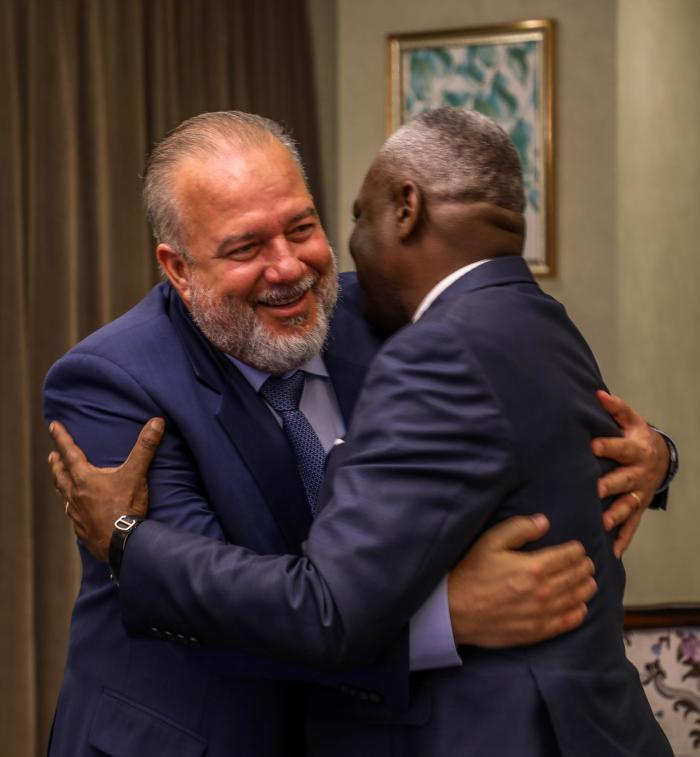
The Cuban Prime Minister embraces the President of the Republic of Congo, Denis Sassou Nguesso / Estudios Revolución

14ymedio bigger14ymedio, Havana, 19 March 2025 — Cuban Prime Minister Manuel Marrero hugged Denis Sassou Nguesso, President-for-life of the Republic of Congo. “It has been a historic visit, very exciting, a reunion between two governments and sister countries,” he said on Tuesday when closing a day of meetings in Brazzaville, the country’s capital. The Congolese did not want to be left behind: “No matter how long the night is, the sun will shine for the Cuban people.”

“We are very satisfied, and we believe we have met the objectives to raise economic and trade relations to the same level as policies,” added the Cuban leader, trade being the central issue. Marrero had previously met with his counterpart, Anatole Collinet Makosso, and the delegations of both countries agreed to update the “potentialities for cooperation, strengthen collaboration in public health, technology, science and innovation, training of human resources, tourism development, culture; and the development of the hydrocarbon sector,” among other collaborations.

The Congo, like the rest of Africa, has been negotiating, although, as usual, it is not yet clear for what or how. The Cuban Prime Minister is in Africa on a trip that continues tomorrow to Namibia and Equatorial Guinea. He is accompanied by an important entourage, which includes the Minister of Public Health, José Ángel Portal Miranda; the Deputy Minister of Foreign Trade, Déborah Rivas Saavedra; and the Director General of Bilateral Affairs of the Ministry of Foreign Affairs, Carlos Miguel Pereira Hernández. continue reading

The independent press has focused on the fact that Marrero has included his wife in the delegation

The independent press has focused on the fact that Marrero has included his wife in the delegation, although it is worth remembering that Yadira Ramírez Morera is the communication director of the Ministry of Tourism, a department that also seeks agreements in Africa.

Yesterday, Marrero, along with the Congolese prime minister, paid tribute at the mausoleum of Marien Ngouabi, the fourth president, who played a role in African liberation struggles. Marrero also laid a floral offering in front of the monument dedicated to the former president of the country, Thomas Sankara, a revolutionary leader nicknamed the “African Che Guevara.”

The show does not end there, since Bruno Rodríguez Parrilla, Minister of Foreign Affairs, is doing his own African tour, which began on Friday, March 14, in Burkina Faso. Rodríguez commemorated the 50th anniversary of diplomatic relations between Cuba and Burkina Faso, the same as he did in Ethiopia, where he held meetings with the authorities and emphasized “Cuba’s will to strengthen cooperation” in these times of crisis.

In Ghana, the Cuban Foreign Minister also made the obligatory floral offering, in this case to the Marxist Kwame Nkrumah, “founding father of the Ghanaian nation and symbol of African unity,” in the words of Prensa Latina. Rodríguez took the opportunity to recall on his X account that the Pan-African leader was the first in the region to meet with Fidel Castro.

For decades, the Island has sent doctors to Ghana, and there was a controversy years ago over a speech that clashed with the official position

“I participated in a meeting with the Solidarity Movement with Cuba, graduates from our country and Cubans living in Ghana, as part of my official visit. I thanked everyone for their support for our country and their invariable solidarity with the Cuban people,” the foreign minister said in another post. For decades, the Island has sent doctors to Ghana, where there was a controversy years ago over a speech that clashed with the official discourse of the Island’s authorities.

In 2018, the then Deputy Minister of Health Marcia Cobas complained that the Government of Ghana had a debt with Cuba of. 4.7 million dollars, an amount accumulated for at least eight years. “It’s not fair,” the official said during a visit in which, according to local media, she deplored that attitude and said that even poorer countries, such as Chad, paid on time.

Two weeks ago, in an episode of State TV’s Round Table program aimed at praising the work of medical missions in the face of Washington’s new sanctions, the Government argued that only countries “that have a little more economic solvency” pay. “There are 25 countries where the missions are still totally free, because they have no resources to contribute to Cuba. We remain there with 25 cooperation agreements that do not generate a penny,” they claimed in contradiction with that demand.

Rodríguez’s most important meeting, however, was in Pretoria, where he met with the Minister of International Relations and Cooperation, Ronald Lamola “to promote bilateral relations.” It is another of the meetings of which no detail has been revealed, because in the relations of the Island with African countries there is always some gain for Cuba that takes time to become public.

This is the case for the beginning of the Kgala cooperation plan, a new suit in the old disguise known as Project Thusano, a military agreement between Cuba and South Africa that was in force between 2015 and 2025, through which, according to the opposition, Cuba earned 1.7 billion rands (93.6 million dollars) in “irregular” expenses. Among the best known cases of that agreement is Cuba’s sale of Heberon Alfa R for the coronavirus crisis, whose purchase was made by Defense without the required authorization by Health. At the beginning of covid-19, Cuba believed the virus was a bacteriological weapon, and in that operation alone, the Island pocketed almost two million dollars, which would have been 17 million if the purchase had been completed.

The Democratic Alliance (an opposition group in South Africa) recalled this week that an audit revealed that “the cost of maintaining and repairing military vehicles through Cuban suppliers was 2.8 times more expensive than if local mechanics had been used.”

In addition, 136% more was invested in medical training on the Island than it would have cost in South Africa, which did not translate into better knowledge since only 28% of students passed the validation exam afterwards.

In January of this year, when Thusano expired, the creation of Kgala was announced. “Despite the attempt of the Department of Defense to rethink the project with a new name, the reality remains the same: an expensive and politically motivated operation that is a complete waste of South African resources,” argues the organization, which has asked the Government to paralyze it.

Translated by Regina Anavy

____________

COLLABORATE WITH OUR WORK: The 14ymedio team is committed to practicing serious journalism that reflects Cuba’s reality in all its depth. Thank you for joining us on this long journey. We invite you to continue supporting us by becoming a member of 14ymedio now. Together we can continue transforming journalism in Cuba.

A US Congressman Asks Immigration To Deport More Than 100 Cubans With Links to the Regime

“It is absolutely reprehensible how agents of the murderous Castro regime have manipulated our immigration laws to infiltrate our country,” said Republican Carlos Giménez

Tomás Emilio Hernández Cruz, the former Cuban agent arrested on Wednesday by the US authorities /ICE

14ymedio bigger14ymedio/EFE, Madrid/Miami, 20 March 2025 — Carlos Giménez, a Republican congressman of Cuban origin, asked the Department of Homeland Security (DHS) to immediately investigate and deport more than 100 people who reside in the United States and have alleged links to the Castro regime.

In a letter sent to DHS Secretary Kristi Noem, the Republican said that these individuals represent “a threat to national security.”

Giménez provided a list with more than 100 names of people he considers “previously supported the brutal policies of the Castro dictatorship and have taken advantage of US immigration laws to enter our country,” he said in a statement on Thursday.

These agents of the Cuban regime must be identified, investigated and deported immediately, stressed the congressman, born in Cuba and one of the most recognized faces against the Castro regime in southern Florida in continue reading

recent years, as mayor of Miami-Dade County between 2011 and 2020.

“It is absolutely reprehensible how agents of the murderous Castro regime have manipulated our immigration laws to infiltrate our country,” he said.

Giménez said that he will continue to work closely with the DHS to identify agents of regimes from Cuba, Venezuela and Nicaragua

Giménez, who represents a district with a large Cuban and Hispanic population in South Florida, highlighted the arrest of Tomás Emilio Hernández Cruz by Immigration and Customs Enforcement (ICE) on March 14. He was identified as a “member of Cuban intelligence in several high-level positions abroad,” after an investigation carried out based on inconsistencies detected in his immigration application.

Giménez said he will continue to work closely with the DHS to identify agents of regimes from Cuba, Venezuela and Nicaragua.

The recent measures of the US Government to restrict the arrival of foreigners, and especially the draft that the New York Times made public six days ago – where Cuba appears on a “red list” of countries whose citizens cannot enter the United States – has concerned Cubans, even those who already reside in the country legally.

The fear is that, if it becomes an executive order, the measure will prevent Cubans with a residence permit from returning to US soil if they travel outside the country. The draft doesn’t mention this, however, and specialists are trying to calm the community.

Translated by Regina Anavy

____________

COLLABORATE WITH OUR WORK: The 14ymedio team is committed to practicing serious journalism that reflects Cuba’s reality in all its depth. Thank you for joining us on this long journey. We invite you to continue supporting us by becoming a member of 14ymedio now. Together we can continue transforming journalism in Cuba.

Up to 3,000 Euros in Cuba for a False Certificate To Obtain Spanish Nationality

The Diocesan Archive of Ourense reveals that due to the existence of this black market, they have been forced to ensure that documents bear the signature of the vicar.

A line of Cubans in front of the Spanish embassy in Havana / 14ymedio

14ymedio bigger14ymedio, Madrid, 21 March 2025 –“There are more and more people from Ourense on the streets of Havana or on Ribadavia Avenue in Buenos Aires. They are Ourensanos who don’t know Ourense, who have never stepped foot on the Couto or Marcelo Macías.” This is how the program En Portada, on the local channel of Ourense, Telemiño, began this Thursday. It revealed that there is a black market in Cuba for false birth certificates to prove Spanish origin and request nationality in accordance with the Democratic Memory Law. The price reaches 2,000 or 3,000 euros for a document whose real version costs 10,000 euros.

Pablo Cid, in charge of the Diocesan Historical Archive, said that every day they receive 30 to 50 emails requesting information about birth, marriage or death certificates of those interested in finding out if they have an ancestor from Ourense. “On weekends the number goes down a little, but from one day to the next we still leave with our inbox empty, and the next day we arrive and there are 40 emails, mainly from Cuba, Argentina and some from Mexico. Well, there are many from Miami, but because of the issue of Cuba,” he says.

In 2024, 500 new Ourensanos registered in the census of Spaniards abroad thanks to the nationalization obtained through this law. In addition, the archive resolved 20,000 requests for information. It can be assumed that more Galician citizens will emerge thanks to the Democratic Memory Law, whose application period began in 2022 and closes in October of this year.

In 2024, 500 new Ourense citizens registered in the census of Spaniards abroad thanks to the nationalization obtained through this law

According to data from the Centro de Descendientes de Españoles Unidos, more than 200,000 people have already received the passport, to which must be added more than a million people, including the 300,000 Cubans continue reading

involved in the process. But Pablo Cid left a disconcerting fact in his speech yesterday: Cuba is the only country in which the black market of certificates has such a considerable volume that it has reached the ears of the Historical Archive, which has been asked to take extraordinary measures.

“For any country in the world, documents sent bearing the stamp of the Archive and the signature of the director are enough for them to be valid. But since one month ago, birth certificates coming from Cuba are required to carry the signature of the vicar. At first we didn’t know why, but then we discovered that they were falsifying the documents,” Cid revealed. “There was a massive influx of forged certificates, and they decided to make it more difficult. Someone told me that any Cuban can buy a false one for 2,000 or 3,000 euros.”

The archivist commented that the queries that arrive at the archive are very diverse and refer to ancestors who allegedly left Galicia at the end of the 19th century, for whom it is impossible to find anything. Or they ask about people known only by name, and finding something is statistically impossible or the results ambiguous. Most attempts come, of course, from countries “with problems.”

Among them, he says, are Venezuela and, of course, the Island. “Cuba is one of those that is always in the ranking, because the economic and political situation encourages the population to leave.” Those invited to the program, including an economist and a journalist, addressed an issue that was”unthinkable” for them 10 or 20 years ago: the increase in population in a province that has been depopulated for decades.

Ourense, the only one of the four Galician provinces without sea access, is the least populated and the one with the lowest per capita income, so the participants on En Portada considered it very positive that the population would increase and contribute to the maintenance of the State. In addition, they defended the right of immigrants to be welcomed as Spaniards were when they emigrated.

“I am one of those who think that we have emigrated to other countries for years, if not decades and centuries. Now we find that in those countries, which used to work better than Spain, there are problems. And I think it is fair to return to the groups that are there and that have an interest in moving to our country the same opportunity that they gave us at the time,” said economist and professor José Ángel Vázquez Barquero.

“And I think it is fair to return to the groups that are there and that have an interest in moving to our country the same opportunity that they gave us at the time”

Pablo Cid, who spoke at length about the complexity of some inquiries, was also asked about the worst things he has seen in this work, among which, scams aside, he spoke of the discomfort generated by the fact that there are companies and lawyers “taking advantage of the situation to make money” even if it is legal. The archivist, who says that the process of obtaining a document costs 10 euros, said that among the workers of the institution there is an internal joke about “adding a zero” when the request comes from this type of company, charging 200 or 300 euros for the procedure. “We do the work, but the money goes somewhere else,” he smiles.

The broadcast gave half an hour to discussing the programs of the Xunta de Galicia to attract emigrants and the job possibilities that exist in the province of Ourense and the region. But many of those new Spaniards may never leave for Spain but may find another value in their passport, such as a mobility that a Cuban passport will never give them.

Translated by Regina Anavy

____________

COLLABORATE WITH OUR WORK: The 14ymedio team is committed to practicing serious journalism that reflects Cuba’s reality in all its depth. Thank you for joining us on this long journey. We invite you to continue supporting us by becoming a member of 14ymedio now. Together we can continue transforming journalism in Cuba.

In the Midst of Cuba’s Crusade Against Drugs, the ‘Chemical’ Comes to the Streets of Havana

“They don’t eat breakfast, they don’t eat lunch, they don’t eat anything, they just stuff themselves with that, it doesn’t lead to anything good.”

With some effort, a young man is picked up in Fraternity Park in Havana / 14ymedio

14ymedio bigger14ymedio, Juan Diego Rodríguez, Havana, 19 March 2025 — A prisoner to his convulsions, a young man tosses on the ground, amid guttural screams, while he hits himself with fury. He has a scratched face and sores on his hands. “Watch him, that’s the químico [chemical],” the witnesses exclaim, recognizing a scene that is no longer exceptional in Cuba. So much so that it does not happen only in marginal territories, but also in the heart of cities. In this case, in Havana’s Fraternity Park, a step away from the Capitol, in the middle of this Wednesday morning.

“I know that boy, he’s twenty-years-old. He spends the day there sitting on a bench with a small group, asking people for money,” the worker of a nearby place tells this newspaper. “They don’t have breakfast, they don’t eat, they don’t feed themselves, they just get into that, which doesn’t lead to anything good.”

Another neighbor aware of the situation corroborates that the young man is a regular consumer of synthetic cannabinoids, known on the Island as “el quimico” – the chemical. “He takes it up to nine times a day,” he says, but they had never seen him like that. “It does give him fits, but not as strong. And it’s scary, because you can see that he could do anything under the effects.” continue reading

The police try to dissuade him from approaching the boy and threaten to put those who take out their cell phones to take photos into the patrol car

Faced with a crowd of people, the police try to dissuade people from approaching the boy and threaten to put those who take out their cell phones to take photos into a patrol car. Minutes later, not without effort, between an agent, a guard and two other men, they manage to carry the still trembling body to a private red Lada to take him to a hospital, whose name they don’t give.

The event coincides with the most recent crusade of the Cuban Government against narcotics, the “Third Exercise of Prevention and Confrontation of Illicit Drugs,” which began on Sunday the 16th and will end on Saturday the 22nd. The objective, the official press said, is “to reach the neighborhood with preventive and confrontational actions, to work on community factors, to raise the perception of risk and the rejection of drugs, and to achieve greater participation of the family in the education and protection of their children.”

Among the actions that the authorities say they will develop are establishing controls on the roads, making “prophylactic preventive interventions in 57 educational centers,” carrying out “checks on the production and storage systems of medicines and other substances,” holding debates and talks, but also, according to the official State newspaper Granma, executing show trials.

This same Wednesday, Canal Caribe reported that such a trial took place in Havana for “alleged crimes associated with illicit drugs,” although it does not specify when or how many were prosecuted. In the same report, Xiang Fong Zamora, president of the First Criminal Chamber of the Provincial Court, recalled that in 2024, “more than 92%” of defendants tried for acts related to drug trafficking were sentenced to prison.

The media reports that a trial took place in Havana for “alleged crimes associated with illicit drugs,” although it does not specify when or the number of defendants

The figure was given by the Ministry of the Interior itself: more than 1,100 people went to jail last year for that reason. Likewise, in 2024, 1,051 kilos of drugs were seized in Cuba, mostly cocaine, in addition to marijuana, methamphetamine and cannabinoids. Most were detected on the sea. There alone, the police seized 844.13 kilos (619.72 of cocaine, 222 of marijuana and 2.3 of hashish) in 133 actions. There were also nine stings in which 37.5 kilos of drugs were seized.

In Holguín, the “Exercise” seems to focus more on prevention. As Iris Cosella Torres, a provincial Mental Health official, said this Tuesday to the newspaper Ahora!, “they will arrive in the neighborhoods, fundamentally, to promote protection factors and in this way contribute to achieving greater participation of the family in the education and guarding of their children against drugs.”

In her speech, the official recalled, without referring to him by name or surname, that “the Historical Leader of the Revolution prioritized the fight against drugs, for which he instituted almost at the end of 1958 Provision No. 6 of the Civil Administration of the free territory, which provided for the total elimination of the consumption of any substance that was against the well-being of the people.”

This is one of the many fallacies spread by Fidel Castro, especially lacerating given the involvement of high authorities of the regime in the international trafficking of narcotics, and the outcome of Case 1/89, which ended in the execution of General Arnaldo Ochoa and three other high military officials, on July 13, 1989.

Translated by Regina Anavy

____________

COLLABORATE WITH OUR WORK: The 14ymedio team is committed to practicing serious journalism that reflects Cuba’s reality in all its depth. Thank you for joining us on this long journey. We invite you to continue supporting us by becoming a member of 14ymedio now. Together we can continue transforming journalism in Cuba.
US Partially Restores Funding for CubaNet, Cubalex and Some Other Organizations

The International Republican Institute was able to retain only five of its 95 programs funded by the State Department and USAID.

Archive photograph of former USAID employees and supporters in Washington, D.C. / EFE/EPA/Shawn Thew

14ymedio bigger14ymedio, Havana, 19 March 2025 — The United States Department of State restored part of the financing that it had frozen weeks ago for independent Cuban media and non-governmental organizations, according to the Nuevo Herald on Wednesday, after confirmation with several sources related to the issue.

The newspaper CubaNet, dean of the independent press, was notified that a subsidy that financed its operations was no longer canceled, according to Roberto Hechavarría, director of the digital media which was founded in 1994, speaking to the American newspaper.

Likewise, the legal organization Cubalex and the NGO Outreach AID to the Americas were also informed by the State Department that a program related to part of its financing, previously canceled, had been newly approved.

Both institutions linked to Cuba, however, have had to reduce their teams and will not have all the budget that was approved before the current Administration suspended all aid distributed through the United States Agency for International Development (USAID). continue reading

Sources related to the federal decision confirmed to the Nuevo Herald that the International Republican Institute was able to retain only five of its 95 programs funded by the State Department and USAID. These are all projects related to Cuba and Venezuela, including one that supports political prisoners on the island. They also indicated that the Democratic National Institute could only retain a couple of contracts related to Venezuela.

For his part, José Jasán Nieves, director of El Toque, said that the National Endowment for Democracy (NED), an independent organization that receives funding from the US Congress, notified them of the disbursement of funds already committed, “but they still aren’t talking about reactivating the suspended programs.” The federal government released part of the previously frozen money after a lawsuit by the Foundation against the State Department.

Last year alone, according to the report prepared by tycoon Elon Musk at the request of President Donald Trump after the shutdown of USAID, the expenditure to “rebuild the Cuban media ecosystem” was one and a half million dollars. It is an infinitesimal part of the agency’s total budget of about 60 billion dollars annually, but it represents a substantial part of the spending of several independent media, which try to compensate for the propaganda of the Cuban regime with plural information.

In addition, dozens of Cuban organizations working for human rights, free enterprise and freedom of expression were benefiting from these funds.

Secretary of State Marco Rubio stated last February that some USAID programs will be exempted from the freeze on funds. “Every dollar we spend, every program we finance must be aligned with the national interest of the United States, and USAID has a history of ignoring that and deciding that, somehow, they are a global charity separate from the national interest,” he said.

Translated by Regina Anavy

____________

COLLABORATE WITH OUR WORK: The 14ymedio team is committed to practicing serious journalism that reflects Cuba’s reality in all its depth. Thank you for joining us on this long journey. We invite you to continue supporting us by becoming a member of 14ymedio now. Together we can continue transforming journalism in Cuba.

At the Agroindustrial Fair, Cuba Seeks Foreign Investors for Its Ruined Agriculture

An article in ‘Granma’ describes the bleak outlook for the sugar harvest in Guantánamo province.

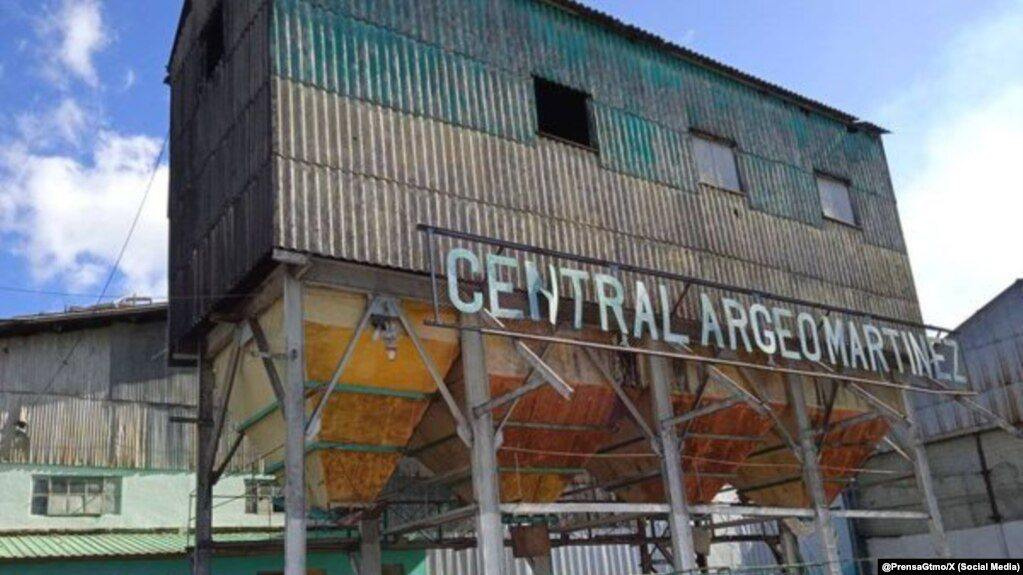
Argeo Martínez is the only sugar mill in the east of the country that joined the campaign this year / Prensa Guantánamo

14ymedio bigger14ymedio, Havana, 18 March 2025 — The International Agroindustrial Food Fair of Cuba began this Monday in Havana, at a time when national agriculture is experiencing a deep crisis and desperately needs foreign investors to revive production. Proof of this is an unusual article by the State newspaper Granma that describes the bleak panorama of the harvest in the eastern provinces and bears a title that says it all: With such ingenuity and effort, where’s the harvest?

In the eastern zone, the Argeo Martínez sugar mill is the only one that has assumed the grinding (there are only 14 throughout the country this year), but its entry into the campaign was late, and after the appearance of other “inconveniences,” the delays have accumulated. From the beginning, the mill was far from reaching the 26,000 tonnes of sugar it achieved in 2014. For this year, the plan is one fourth as much, and with a deadline of March 25, they already owe 700 tonnes.

This translates into thousands of tonnes of cane not being processed, according to the mill’s administrator, due to rain and other obstacles.

The raw material “reached the conveyor belt with a delay of up to 90 hours and was often burned”

According to Granma, the raw material “reached the mill with a delay of up to 90 hours and was often burned,” which the person in charge of the harvest in Guantánamo – where the mill is located – justifies with the poor state of the fields: “In some seedlings there is pica pica,” a plant that stings the skin of the cane cutters and which it is better not to approach,” says the continue reading

newspaper.

Other plants have also invaded the oldest plantations, neglected for two and a half years. Cutting them down, the article argues, would demand too much effort on the part of the macheteros, so it is decided to burn the field,* and only the blackened cane remains standing. “The scientific literature states that the burning of cane fields affects biodiversity and the ecosystem, reduces the natural fertility of soils and reduces the quality of the raw material,” the media emphasizes.

The same was alleged by Deputy Prime Minister Jorge Luis Tapia Fonseca in his visit to Argeo Martínez last week, when he asked for “more discipline” on the part of the employees: “What kind of harvest can be obtained from a burnt cane that arrives late to the conveyor belt?” he scolded.

The director also “saw railroad cars waiting too long to be unloaded, and he knew – from the record – that there was cane in the field waiting to be transported, a sign of discontinuity in the flow of raw material to the mill,” says the media.

To this are added the failures, unforeseen stops, problems in the boilers, “disorders here and there in the 162-year-old ’rheumatic’ colossus”

Granma also highlights “other causes and bad luck” that delay the transport to the mill. “The humidity on the ground has risen, and many times, because of it, the cutting and lifting slow down. The mud makes it difficult and sometimes prevents the cane from arriving on time, which takes away its freshness,” emphasizes the administrator of Argeo Martínez

Added to this are failures, unforeseen shutdowns, boiler problems, “disorders here and there in the 162-year-old ’rheumatic’ colossus” whose ailments can no longer be corrected with temporary patches.

However, some workers take responsibility for the failure with voluntarism and promise a better future for the harvest. The administrator believes that the next plantings “will give more sugar.” Until now, the yield was 5.79 tonnes of sugar for every hundred tonnes of ground cane, but “in recent days that index exceeds 6.50,” which managers see as a “good symptom.” And they assure: “we will get to eight.”

“At first glance it seems impossible,” predicts Granma, which attributes to the mill a “gypsy curse disguised as interruptions and inefficiencies, which has haunted them year after year for more than a decade.” If it is achieved, it is thanks to the “efforts of the operators and the workers.” And it clarifies: “The good, the bad and the regular of the current sugar campaign in the Upper East depends on this sugar mill, the only one working in Guantánamo.”

For years, each sugar campaign has been worse than the previous one, and, in 2024, the Island reached its lowest point. Barely 160,000 tonnes were produced, less than half of what was achieved a year earlier, when 350,000 were reached. Last year, Cuba also imported more sugar than it produced for the first time.

Sugar is just one product of those presented – all in a similar state – by Cuban agriculture to companies in Spain, Italy, Panama, Chile and Brazil, and to the 46 firms from 20 countries visiting the Agroindustrial Fair. Currently, according to official data, the country imports 80% of the food it consumes, including 100% of the products in the basic family basket.

*Translator’s note:  Burning the cane field eliminates the grass and makes it easier to cut at the base of the plant.

Translated by Regina Anavy

____________

COLLABORATE WITH OUR WORK: The 14ymedio team is committed to practicing serious journalism that reflects Cuba’s reality in all its depth. Thank you for joining us on this long journey. We invite you to continue supporting us by becoming a member of 14ymedio now. Together we can continue transforming journalism in Cuba.

Electricity Returns in Havana and Now There Is No Water

A power deficit of 1,300 MW is forecast for today as more tankers carrying oil and fuel continue to arrive.

The Luyanó neighborhood has been without water for more than a week / 14ymedio

14ymedio bigger14ymedio, Havana, 18 March 2025 — After the collapse last Friday of the national electricity system (SEN), electricity is not the only thing missing for Cubans. In Havana, the image of elderly people carrying buckets or pushing wheelbarrows with water containers has become frequent. In some neighborhoods, the supply cycle was interrupted by the total blackout, and, since then, “not even one drop of water” has reached homes.

This is the case of Luyanó, in the municipality of Diez de Octubre, where the neighbors who talked to 14ymedio assure that they have been “more than a week”, since Monday, March 10, without water. Normally, they say, the service works every other day. The options to overcome the shortage range from appealing to the kindness of neighbors with wells to going to relatives with reservations to be able to bathe or cook.

In Nuevo Vedado, where the editorial staff of this newspaper is located, the situation is similar. “I only have a small reserve left, and I hope that this afternoon there is enough water in the building’s cistern to be able to pump it into a container,” says a resident in the area. continue reading

“I had to go to the Hermanos Ameijeiras hospital on Monday. and there were nurses complaining that they had not been able to wash their uniforms”

I had to go to the Hermanos Ameijeiras hospital on Monday, and there were nurses complaining that they had not been able to wash their uniforms because they still had no power in their homes,” adds the neighbor, worried about the hygiene of the employees who are exposed to diseases and infections. In the center, despite now having electricity, “the servers were down and there was no network,” she adds.

According to an article published yesterday in the State newspaper Granma, the “greatest complexity” with the water supply is in the capital. Interviewed by the official media, José Antonio Hernández Álvarez, director of Water and Sanitation in the province, explained that water service would not be available until “the afternoon-night of Wednesday” if the supply is restored.

“The stability in the pumping systems begins about 72 hours after being energized, in this case after the reconnection of the national electrical system, which collapsed last Friday,” Granma added.

The weekend of total blackouts has reminded many of the obstacles they faced at the end of the year, when the SEN suffered three power outages in three months. In Holguín, on the other side of the island, Manuel still laments that most of the food he had refrigerated ended up in the trash. “We had to bring food to my wife’s grandmother, who lives in the countryside about five kilometers from the city, because everything went bad,” he says.

He explains that this week everything has returned to the usual “normality,” at least in Havana. “The blackouts are now scheduled and will happen as before. But in the countryside it takes two hours and more to turn on the power, taking the programming schedule as a reference,” he says.

The image of elderly people carrying buckets or pushing wheelbarrows with water containers has become frequent in Havana / 14ymedio

As of this Monday, and despite the fact that many Cubans continue to suffer the consequences of the total blackout of the weekend, the Electric Union began again to broadcast its usual report. For this Tuesday, the deficit is forecast at 1,300 megawatts, a number that has become standard in recent months and that represents almost half of the Island’s demand.

The situation is barely alleviated by the tankers that arrive on the Island and take time to distribute the tons of oil they bring. “It took the Corossol about 120 days to unload its precious cargo of urgently needed fuel,” Texas University expert Jorge Piñón told this newspaper about the ship loaded with 650,000 barrels of diesel that had been circulating around the Island since November before docking at the port of Matanzas on March 3.

The same is repeated, says the specialist, with the Marlin Aventurine, which has been waiting to unload in the operational part of the Matanzas Supertanker Base since March 5. On the horizon, with an expected arrival in Matanzas on April 1, he explains, there is another ship approaching, the Marlin Ammolite, with an estimated 330,000 barrels of fuel from France. “Does Cuba have a problem in the storage capacity in its logistics chain or a financial problem?” asks Piñón, who emphasizes that these three tankers “do not come from Mexico, Russia or Venezuela, where there would not be any kind of delay for payment reasons.”

They are all, for the moment, questions: “Is it Cuba who is paying in cash for the fuel in these three tankers? Or is it a third party, Russia or Venezuela, that is the counterparty through a credit to the supplier?” Not counting the freight, the expert estimates these three tankers carry fuel worth 85 million dollars.

Meanwhile, unit 6 of the Renté thermoelectric plant, in Santiago de Cuba; the 2 of Felton, in Holguín; the 6 of Mariel, in “maintenance in Artemisa; as well as the 3 of Santa Cruz del Norte, in Mayabeque; the 3 and 4 of Cienfuegos, and the 5 of Renté are out of the game.

Another 435 megawatts are not available in thermal generation, he says without offering explanations. And, finally, 42 distributed generation plants are not working due to lack of fuel, affecting another 176 megawatts.

Translated by Regina Anavy

____________

COLLABORATE WITH OUR WORK: The 14ymedio team is committed to practicing serious journalism that reflects Cuba’s reality in all its depth. Thank you for joining us on this long journey. We invite you to continue supporting us by becoming a member of 14ymedio now. Together we can continue transforming journalism in Cuba.

Radio and Television Martí Operations Are Paralyzed, Its Employees on Administrative Leave

“We are at home and they have kept our salaries until they decide what they are going to cut and what stays,” says a worker at the entity.

The media, active since 1985, seeks to promote democracy and the free flow of information in Cuba

14ymedio bigger14ymedio, Havana, 16 March 2025 — On Saturday, all employees of Radio and Television Martí were put on administrative leave, after a decision by the Trump administration to temporarily suspend the operation of the entity. The media, active since 1985, which seeks to promote democracy in Cuba, has been practically paralyzed.

“They sent us home, but our salaries will continue until they decide who will be cut and who stays,” said an employee who works in the digital division of Martí News. “We hope that this is only temporary and that everything will return to the way it was before, for the good of Cubans,” said the source, who preferred to remain anonymous.

The workers were notified of the temporary suspension of their activities through an email that reached their mailboxes on March 15. According to the electronic message, those affected will not only keep their salary for the time being but will also receive all their benefits until further notice.

The pause of Radio and Television Martí has come just one day after Trump signed an executive order to begin dismantling the United States Agency for Global Media (USAGM). The entity in turn manages the Voice of America, Radio Free Asia, Radio Free Europe/ Radio Liberty, Middle East Broadcasting Network and Open Technology Fund.

Initially, the Office of Cuba Broadcasting (OCB), which oversees the Martí group with its radio, television and news website about the Island, was not included in the list of media. But this Saturday, the relief of its employees turned into deep concern after receiving the announcement of the group’s administrative leave. continue reading

During the day, the digital platform has continued to publish news but at a much slower pace than before. Readers have also perceived a drop in the use made by the website of press agency images, given that this week the cancellation of USAGM’s contracts with Reuters, AP and AFP was announced.

The decrease in the services of these agencies has caused Radio and Television Martí to have fewer photos, videos and other materials about the reality of the Island, which they used in their coverage and transmissions. According to the CaféFuerte website, the company has “about 100 workers between federal employees and contractors. Of the 46 professional employees registered on the federal payroll, all receive salaries above $100,000 per year.”

An internal source had assured this newspaper that they were not afraid that the Trump administration intended to close the Martí group

Last month, however, workers felt confident in the continuity of the project. An internal source had assured this newspaper that they were not afraid that the Trump Administration intended to close the Martí group.

“Elon Musk walks like a child with a torch in his hand burning left and right and causing concern among federal employees, a group of people who thought their jobs were secure. In the case of Martí, we are in one of the best moments in our history, with numbers that show how well we are doing our work: we exceed one million followers on Facebook; we have millions of views on our social networks from Cuba, and we are expanding audiences on the Island,” he stressed at the time.

Founded 40 years ago on May 20, Radio Martí was for several decades one of the few unofficial sources of information about the Island. In 1990, Television Martí came to light, which can barely be seen inside Cuba, where the radio signal also suffers from strong interference in several parts of the country.

The existence of the stations popularly known as “los Martí” has caused friction between the Cuban and US governments. Havana frequently demands that Washington eliminate transmissions, as happened during the diplomatic thaw led by Barack Obama and Raúl Castro from December 2014.

But the stations have suffered attacks not only from the regime. They experienced an intense controversy after a report commissioned by the federal government that revealed irregularities in the information management of certain topics.

One of its directors, former Miami mayor Tomás Regalado, resigned in September 2019, after a scandal involving his son, also an employee of the entity, who, allegedly, manipulated a news story about the popular riots in Nicaragua.

Translated by Regina Anavy

____________

COLLABORATE WITH OUR WORK: The 14ymedio team is committed to practicing serious journalism that reflects Cuba’s reality in all its depth. Thank you for joining us on this long journey. We invite you to continue supporting us by becoming a member of 14ymedio now. Together we can continue transforming journalism in Cuba.

What Isn’t Broadcast on Cuba’s Radio Ciudad Del Mar

The sound engineer, apparently removed from all official propaganda, also receives requests not to broadcast certain “controversial opinions.”

In recent years, with the intensification of the crisis, controls on the station’s employees have also increased / 14ymedio

14ymedio bigger14ymedio, Julio César Contreras, Cienfuegos, March 17, 2025 — A few weeks ago Adriano resigned from Radio Ciudad del Mar, the local station in Cienfuegos where he had worked as a sound engineer since his college graduation. The decision cost him, especially because of the uncertainty of not knowing if he was going to find another job that he would enjoy as much. But he tells this newspaper that he does not regret putting a stop to what was happening inside the medium: “No one has the right to think for me or put words in my mouth.”

Working on the radio was not a dream he had as a child, but as a teenager, when he became interested in the work of Radio Ciudad del Mar, located in a two-story house in front of the Cienfuegos boardwalk. He was not so attracted to talking on the programs as to doing them himself, taking care of the music and sounds, and after graduating from Physical Culture he managed to sneak into the station.

However, with the work of a sound engineer, apparently far from all official propaganda, also came requests not to give certain “controversial opinions.” “The time came when it was impossible to broadcast one’s real thoughts or give opinions different from what is established on social networks and in the studio itself,” he says. continue reading

“The time came when it was impossible to broadcast one’s real thoughts or give opinions different from what is established on social networks and in the studio itself”

For Adriano the threshold of the door of Radio Ciudad del Mar marked the border between two different realities. Inside, the team and especially the announcers, “are continuously forced to broadcast news that is very distant from reality.” Outside, in the street, “we face criticism from listeners who call us liars or say we gloss over things that are serious. We find ourselves locked between what we’re supposed to say and what we experience daily as part of society.”

“It is very difficult to work in a place where anything that we do must have the approval of those from above. Creativity is subordinated to an institutional methodology, which in turn is subordinate to the orders from Havana,” explains the young Cienfuegan, who admits that, although surveillance is general, some people are more controlled than others. In the case of broadcasters, “the censorship is constant and comes from advisors, assistants and program directors. Whatever is minimally problematic is crushed by editorial policy, which is actually a straitjacket,” he says.

In recent years, with the intensification of the crisis, controls on the station’s employees have also increased. At the same time, Adriano adds, there are the practical problems: How do you broadcast without power? How do you record a program in a closed studio without air conditioning? How do you work without microphones, with old computers and sound equipment from decades ago?

“No one imagines how suffocating it is to work besieged by blackouts. The station’s generator does not support the equipment and air conditioners at the same time,” says the sound engineer, who reveals the tricks they used in the station to evade the suffocating heat. “While a program was running, we were bathed in sweat. Sometimes we played two or three songs in a row to have a few minutes to go out and catch the cool air that comes from the bay,” he confides.

“Sometimes we played two or three songs in a row to have a few minutes to go out and catch the cool air that comes from the bay” / 14ymedio

When a complaint was made to the superiors for not being able to connect the air conditioners or because the equipment was now too old and needed a replacement, “the response of the National Radio Directorate was always the same: there are no resources and the country faces a complex situation.”

This situation is also to the detriment of the audience, which is already diminished by the emergence of alternative means of information, more truthful, faster and which consume less of the public’s time. “If serious surveys were conducted at the station to evaluate audience levels, it would show that most people even prefer social networks to the radio to get information. In theory, the programming is designed for different audiences, but in practice it is very far from pleasing popular tastes,” he says.

As he explains, the station broadcasts live programs until ten at night. “From that time on, everything that is heard is recorded and, it must be said, it is not consistent with the demands of the early morning. Thus, an important segment of the population is lost, which deserves spaces capable of attracting the attention of radio subscribers,” he argues.

For a while, when Adriano saw several colleagues leave the radio to work in other state or private-sector centers, the question of whether he should leave worried him. The “thing,” he says, was having to choose between doing what he likes with a salary that does not reach 4,000 pesos – it depends on the number of programs that are made – along with constant surveillance, or giving priority to his discomfort with the censorship and a better pay.

But a month ago, when he learned that his wife was pregnant again, the indecision cleared up. However, Adriano assures that he did not leave the station just to ensure the family economy but that the pregnancy was only a catalyst. Between proposals to cut down to the least “subversive tone” and the frustration of not being able to do his job with quality, his departure from Radio Ciudad del Mar was “inevitable.”

Translated by Regina Anavy

____________

COLLABORATE WITH OUR WORK: The 14ymedio team is committed to practicing serious journalism that reflects Cuba’s reality in all its depth. Thank you for joining us on this long journey. We invite you to continue supporting us by becoming a member of 14ymedio now. Together we can continue transforming journalism in Cuba.

After a Sleepless Night Due to a Blackout, Cubans Go Out To ‘Hunt’ for Scarce Food

Not even a police baton are able to prevent people from speaking loudly and badly against the government. 

Tension is more abundant than oxygen among the food stalls, punished by the midday sun of Havana / 14ymedio

14ymedio bigger14ymedio, José Lassa, Havana, 15 March 2025 — The lack of enthusiasm of the three policemen who watched the Guanabacoa fair this Saturday, settled on their motorcycles, does not deceive anyone: they too have had a difficult night. For anyone’s nerves and body, an early morning of total blackout is devastating. Even so, you have to go out to look for food, and no matter how slim the pickings are, you have to take advantage of it.

The motorcycles come and go around the stalls, and the officers – two young men in blue and an older one in the army’s olive-green uniform – continue to watch over the transactions. But be careful. With a night like this Friday, not even a police baton is able to prevent many insults from being hurled loudly against the Government.

The blackout also has an amplifying effect on the general annoyance. If every weekend prices go up and pocketbooks lose power, after a night without sleep everyone wakes up in a bad mood. Customers are tense, and sellers are uncomfortable; those who listen are upset, but no one can think of what to do or what pill to resort to. continue reading

Two young policemen in blue and an older one in the olive-green uniform of the Army watch over the transactions / 14ymedio

A concern runs through the crowd: with the total blackout, the last reserves of liquefied gas in homes will have to be used. When what they have saved is used up, they will have to go back to using charcoal. The bread, increasingly compact and hard, is sold for 200 pesos in Guanabacoa, and only the rich – if that word makes any sense in Cuba – can afford to buy a bag from a street vendor.

The tension is more abundant than oxygen among the food stalls. The noonday sun is punishing; last night it was the mosquitoes and the blackout. One of the policemen wakes up and walks around the food fair. Fleeing from the sun as if he were a vampire, he soon returns to the comfort of his motorcycle.

Several kilometers away, in Luyanó, people also wake up hungry. The most desperate ride their bicycles up and down the street, hunting a seller. The bakery door is closed. Bad sign. A messenger explains that the bakeries in La Víbora – another Havana neighborhood – closed yesterday and they asked him to collect about 600 bags of bread.

“It was the only thing that could be done before the arrival of the blackout, and I have already sold everything,” he says, before continuing with his wheelbarrow on Arango Street.

The electronic equipment at the sugar mills had their own blackout. 

Dodging the power cut and saving the equipment has become a macabre sport in Cuban homes, and there is not always luck. “You have to have everything disconnected when the current comes back on so that things don’t explode,” a housewife from Cienfuegos tells this newspaper. “In my house an air conditioner and a microwave oven have already bit the dust.”

When hunger presses, everyone looks for what they can, and no one has to remind the dumpster divers. About to dive into the trash, an old man pushes the bags away from the top to see if it’s worth exploring further. Like those lined up in Guanabacoa or pedaling under the Luyanó sun, his clothes are threadbare and his face full of wrinkles. They are emblematic of a country where the goal is to survive. Living will be for another day.

Translated by Regina Anavy

____________

COLLABORATE WITH OUR WORK: The 14ymedio team is committed to practicing serious journalism that reflects Cuba’s reality in all its depth. Thank you for joining us on this long journey. We invite you to continue supporting us by becoming a member of 14ymedio now. Together we can continue transforming journalism in Cuba.

The General Blackout in Cuba Continues, With a Few Islands of Light

Technicians face difficulties in resolving a “complex situation”

There are hardly any vehicles or people in the streets of Luyanó / 14ymedio

14ymedio bigger14ymedio, Havana, 16 March 2025 –The few lights that were on in Havana at sunset this Saturday looked more like phantoms in a cemetery than a capital city. From the Loma de la Cruz in Guanabacoa, where a reporter from this newspaper photographed the dark panorama, a few lights marked the port area and the Naval Hospital, privileged – like the hotels – for having their own generators.

At dawn this Sunday, darkness still dominated part of the city. The neighbors “go crazy looking for ice because their food will spoil,” a resident in the Luyanó neighborhood told this newspaper. Those who do not have their own generator have also faced difficulties cooking and, in many cases, the water supply has been suspended. “There are hardly any people on the streets and no cars,” the woman says.

According to the Unión Eléctrica (UNE), it has been possible to connect some areas of several Havana municipalities, but, as this newspaper verified, the restoration of electricity service in homes has been unstable and has been interrupted on several occasions. In the neighborhood of Nuevo Vedado, where the newsroom of 14ymedio is located, only some ministries and official entities have electricity.

At the end of Saturday, Lázaro Guerra, who from his position as UNE director has become a bearer of bad news for Cubans, assured that the UNE had managed to connect a “broad system of islands” from Matanzas to Holguín and that it began with Energas Varadero. The west and east were in a “complex situation,” he said. In the case of the first, the failed entry of the Energas Boca de Jaruco plant had slowed down the connection on several occasions.

Saturday’s dark sunset in Havana, photographed from the Loma de la Cruz in Guanabacoa / 14ymedio

This plant, managed in collaboration with the Canadian Sherritt, is the main link in the synchronization and conformation of the so-called microsystems in the western region, with which power is then brought to continue reading

the thermoelectric plants Antonio Guiteras (Matanzas), Mariel (Artemisa) and Santa Cruz del Norte (Mayabeque).

“We have the floating power plant in Havana (the Turkish patana works with fuel oil), which is delivering a level of electricity here in the capital, and we are looking for alternatives to be able to reach the most important generation centers, such as Mariel’s,” added the engineer, who said that the “problem has a solution,” although it may take time. “Microsystems are in themselves weak systems, and there is always the possibility that something can happen and involve a delay or a setback.”

Outside the capital, in Pinar del Río and Artemisa, some small islands are responsible for giving electricity to “vital centers,” Guerra added. During the last failures of the SEN, which coincided with the passage of Hurricane Rafael through Artemisa, this province was the most affected and the last to recover electricity.

As for the eastern provinces, the manager explained that microsystems had been established in Guantánamo, Santiago de Cuba and Granma, but none had been able to connect to the main Matanzas-Holguín network. This Sunday, units 5 and 6 of the Nuevitas thermoelectric power plant were integrated, and unit 1 of Felton, in Holguín, managed to enter the national electrical system (SEN) during the early hours.

The authorities have not dared, nor did they do so in the three total blackouts of October, November and December, to predict a date for the SEN’s restoration, but the cancellation of classes at the universities confirms that the situation is expected to extend at least until Monday. In a statement on Saturday night, the Ministry of Higher Education postponed the entry of national and foreign scholarship students to residences until further notice.

The authorities have not announced anything for other education levels, although some local governments have delayed the entry of students in pre-university scholarships pending the reconnection of the SEN.

In the three previous national blackouts, the UNE began by reactivating microsystems – powered by large generators that use fuel oil or diesel – and interconnecting them to bring power to the thermoelectric plants. Every time the SEN has collapsed, like last Friday, the authorities allege lack of fuel to keep it afloat. On this occasion, however, the shortage of fuel oil or diesel is difficult to justify.

A few weeks ago, two diesel-loaded tankers entered Cuban ports, the Marlin Aventurine from France with 340,000 barrels, and the Corossol from Rotterdam, with 650,000 barrels. In addition, the Akademik Gubkin arrived with 790,000 barrels of high-quality Russian oil to be processed in Cuban refineries.

Translated by Regina Anavy

__________________

COLLABORATE WITH OUR WORK: The 14ymedio team is committed to practicing serious journalism that reflects Cuba’s reality in all its depth. Thank you for joining us on this long journey. We invite you to continue supporting us by becoming a member of 14ymedio now. Together we can continue transforming journalism in Cuba.

Cuba Delivered Poor Quality Medicines to Mexico at the Wrong Time for More Than Two Million Dollars

Cuban pharmaceutical company Neuronic Mexicana benefited from Birmex laboratories, revealed the Superior Audit Office of the Federation.

Birmex staff receiving the batches of medicines in their warehouses / Birmex

14ymedio bigger14ymedio, Ángel Salinas, Mexico City, 14 March 2025 — The laboratories of Biologicals and Reactives of Mexico (Birmex) – the state company responsible for buying and distributing medicines, and controlling their quality – covered up during fiscal year 2023 the payment of 46,695,400 Mexican pesos (2,348,358 dollars) to the Cuban-Mexican pharmaceutical company Neuronic for medicines that did not meet the quality standards required by Mexico.

The payment set off alarms during a Superior Audit of the Federation (ASF) of Birmex, which showed that some drugs did not comply with the requirements and that others were not even those requested by the Institute of Health for Welfare (Insabi), an institution created by the Government of Andrés Manuel López Obrador that operated from 2020 to 2023.

In August 2023, Neuronic – which, with the permission of the Cuban regime, manages the salaries that Mexico pays to Cuban doctors who carry out missions in Mexico – was also favored by Birmex with a payment of 5,880,398 dollars, a source from the Health sector told 14ymedio. The reason: “contracts” for unspecified activities that took place between 2022 and 2023.

The audit, published last February, also yielded other significant figures: Birmex delivered to Neuronic, two years ago, 1,334,500 Mexican pesos (more than 67,000 dollars) as payment for 7,395 containers of 20 ampoules continue reading

of aminophylline, a drug for asthma and shortness of breath, and 1,181 containers with 10 bottles of fluorouracil, which is used in cancer treatments.

A tour of the warehouses of Birmex, the company in charge of buying and distributing medicines / Birmex

According to the investigation, the lots were delivered after the agreed deadline, which carried “a penalty of 160,100 pesos that was not covered.”

By contract, Neuronic also had to deliver to Birmex 30,203 packages of pilocarpine, 158,031 of atropine, 1,900,290 of chloramphenicol, 208,864 of diclofenac, 1,130,857 of prednisolone and 192,099 of cisplatin, drugs for a whole range of treatments. To guarantee delivery, Mexico gave the Cuban-Mexican company 23,258,500 pesos (more than a million dollars).

However, the audit found that the batches of chloramphenicol, pilocarpine and atropine delivered by Cuba – where all these medicines are missing – “do not correspond to the codes and descriptions that were required by Insabi.” Nor are they listed in the National Compendium of Health Input, an index of drugs endorsed for use in Mexico. This absence caused “several rejections by health institutions,” they said.

Another irregular deposit from Birmex to Neuronic was one of more than 15 million pesos (almost 700,000 dollars) for 10 batches of medicines that did not meet the requirements of the Federal Commission for the Protection against Health Risks (Cofepris), and that were still not rejected by the state.

Birmex warehouses also hold batches of the Cuban Abdala vaccine. / Birmex

The Government of Mexico has favored Neuronic again and again. The National Council for Humanities, Science and Technology (Conahcyt) awarded it $7,427 three years ago for a pharmacokinetic project for early detection of Alzheimer’s in rats.

In March 2022, Conahcyt received notification about four payments for other projects of the Cuban-Mexican company. It released the money on September 27 of that same year. For the so-called “validation of the production process and preclinical tests with CNEURO-120” – the drug intended for early detection of Alzheimer’s – $3,439 was paid. Later, as part of that same project, $15,037 was delivered and, in another phase of the investigation, another $4,028.

Other anomalies were detected in the course of the audit. In fiscal year 2023, Neuronic was not the only company that, having caused losses to Birmex, was protected by its managers. In the same situation are the company Almacenaje y Distribución Avior, which paid 819,630,000 Mexican pesos (more than $41 million), and Farmacéuticos Maypo, which paid 152,533,000 pesos (almost $8 million).

List of drugs purchased by Birmex from the Cuban-Mexican pharmaceutical company Neuronic. / ASF

Translated by Regina Anavy

____________

COLLABORATE WITH OUR WORK: The 14ymedio team is committed to practicing serious journalism that reflects Cuba’s reality in all its depth. Thank you for joining us on this long journey. We invite you to continue supporting us by becoming a member of 14ymedio now. Together we can continue transforming journalism in Cuba.