
Every Man for Himself, Blackouts are Growing in Cuba and so is the Market for Generators

Since August 15, Cubans are allowed to import up to two power generators without commercial purposes. (CMKX Radio Bayamo/Facebook)

14ymedio bigger14ymedio, Havana, 16 August 2022 — “Noiseless and efficient,” according to the text that accompanies the photo of a power generator that, for about $4,000, promises to exorcise the demon from the blackouts. The most precious status symbol on the Island is a device that keeps appliances running when the government cuts off the power. Only surpassed by a plane ticket to emigrate.

The energy deficit, due to the poor state of the thermoelectric plants and the lack of fuel, has plunged Cubans into darkness. In large areas of the country, electricity appears for only a few moments, not exceeding ten hours of service per day. Cooking, cooling off or being able to drink a glass of cold water depend on running devices that invariably need power.

Since August 15, with the easing of customs measures, Cubans can import up to two generators with a maximum power of 15,000 watts without commercial purposes. The duty payment may vary depending on the capacity of the device and whether the traveler brings in other goods that are also taxed, but that small opening has been enough to trigger the market for generators.

Ibrahim has been traveling to Panama for six years to import household appliances. “The pandemic almost put me out of business because I couldn’t travel for some time, but now I’m back on track,” he tells 14ymedio. “The most profitable thing right now is to bring in generators, because people are desperate and pay well for them. If you don’t have a generator, you don’t have quality of life.”

Those who don’t have the resources to buy one appeal to ingenuity: blades of a fan that are driven by pedaling a bicycle, improvised beds in the doorway or on a terrace to take advantage of even the smallest breeze in the early hours of the morning, and the traditional hand fan that serves to refresh the skin and scare away mosquitoes are just some of the ways, but they are only palliative and barely calm the discomfort. continue reading

Living in the Havana neighborhood of Nuevo Vedado, Ibrahim’s clients are middle-income people, often with families abroad who can help them with their expenses and who don’t want to go through the blackout without being able to turn on at least one fan, a rice cooker or a television. “I haven’t left Cuba yet, and I already have six orders for generators.”

“The most in demand right now are those that use both gasoline and propane, because there’s no guarantee that one of the two can always be bought. Diesel ones also have their market,” he explains to this newspaper. “The problem is that now it has also become a problem to get the fuel, so buying the device doesn’t end the problem,” he admits.

Among Ibrahim’s clients are families who seek to ease domestic life during power outages but also some entrepreneurs. “I have people who can’t afford to lose power because valuable merchandise will spoil, or they’ll lose a lot of money because they can’t work.” As an example, he mentions “informal shrimp and lobster sellers,” in addition to a home beverage business that sells its products online and promises them “always cold.”

The prices vary. Ibrahim sums it up: “For every watt I generate you pay me a dollar. But if it’s a powerful generator of more than 4,500 watts, I can provide it, and there are discounts that make the price cheaper. If, in addition, the client wants it to be home-delivered, that can be arranged.”

But it’s not all a matter of money when it comes to acquiring one of these devices that saves you from darkness and heat. “My brother has been insisting that I buy one for a long time, but I live on a street where everyone is a big gossip,” laments Juan Carlos, a resident of the city of Alquízar. “If, in the middle of a blackout, the only house that is illuminated is mine, people will start talking.”

Juan Carlos runs a modest business selling fresh cheese and yogurt. Most of his business is informal, and he’s afraid to keep his lights on when the neighbors can’t even see their hands. “The least  that can happen is envy, and the worst is the thieves, who might think I have a lot of money because I have a generator.”

The theft of these devices is becoming more frequent. “In the early hours of the morning they took the generator that we had secured behind a padlocked fence,” a resident of El Vedado, who managed to use her generator for only a few weeks, explains to this newspaper. “It was wonderful, although a little noisy,” she says. “We never filed a complaint with the police because we had bought it on the black market.”

Ibrahim doesn’t want to import a generator for his family. “My thing is to make money to get my wife and my two children out. If I have to spend that time fanning myself with a piece of cardboard, I’ll do it.” In advance, he already knows what devices  to bring to the island in the first days of September. The classified ad he has put in several places shows a large generator, with wheels  and accompanied by a phrase: “Sleep all night without worrying about blackouts.”

Translated by Regina Anavy

____________

COLLABORATE WITH OUR WORKThe 14ymedio team is committed to practicing serious journalism that reflects Cuba’s reality in all its depth. Thank you for joining us on this long journey. We invite you to continue supporting us by becoming a member of 14ymedio now. Together we can continue transforming journalism in Cuba.

Cuban Experts Say the Pollution Levels of the Matanzas Fire are ‘Low’

Remains of the fire at the Supertanker Base of the port of Matanzas (Cuba). (EFE/Ernesto Mastrascusa)

14ymedio bigger14ymedio/EFE, Havana, August 22, 2022 — The serious fire at the Matanzas Supertanker Base threw out “low” levels of pollutants, the Cuban authorities told the official press on Sunday.

Oscar García Martínez, delegate of the Ministry of Science, Technology and the Environment in Matanzas, said that the main effects are “air quality, as in any fire” and that the measured levels “do not compromise human health.”

The accident, which began on August 5 and lasted almost a week, claimed the lives of 16 people, some of them young people who were undergoing compulsory military service, and injured 146, 17 of whom are still hospitalized.

“Everything indicates that what happened in the fire  doesn’t seem to have compromised any aspect for the future,” García Martínez said without showing exact figures. The Government expects to have an environmental impact assessment by September. Scientific research, the official said, continues. “If we know anything new, we will inform you,” he told the newspaper Girón. “If any indicator is altered, we will analyze it and follow up on it.”

The specialist said that the samples taken in Matanzas Bay, near the industrial area where the disaster occurred, “corroborate visually that there is no damage right now.” continue reading

He pointed out that “we had never experienced a spill (of crude oil) associated with a fire,” and research on its effects covers aspects related to soil, agricultural production and traces in livestock milk — a series of elements to ascertain the real magnitude of the impact of the fire, the largest recorded on the island.

This analysis stage, planned for two months, could be extended up to two more years with other parameters, “to reassess soil, vegetation and food chains,” he added.

Although he considers that “the danger has already passed,” because the focus that caused the increase of pollutants such as sulfur dioxide, nitrogen oxide, carbon monoxide, among other substances, in the atmosphere “disappeared,” he estimates that the emanations are in the usual range in Matanzas.

Four of the eight tanks of the storage base, the largest facility of its kind in Cuba for receiving and storing crude oil, burned completely, causing explosions, flares of hundreds of feet and a curtain of smoke that reached neighboring provinces such as Mayabeque and Havana, located more than 60 miles to the west.

Translated by Regina Anavy

____________

COLLABORATE WITH OUR WORKThe 14ymedio team is committed to practicing serious journalism that reflects Cuba’s reality in all its depth. Thank you for joining us on this long journey. We invite you to continue supporting us by becoming a member of 14ymedio now. Together we can continue transforming journalism in Cuba.
General Blackout in Havana Due to an Alleged Breakdown in a High Voltage Line

Havana was almost in complete darkness, seen from Nuevo Vedado on Thursday night. (14ymedio)

14ymedio bigger 14ymedio, Havana, 19 August 2022 — A power outage left all of Havana in the dark on Thursday night. Shortly after 9:00 pm and neighborhood by neighborhood, the Cuban capital went out, with a few exceptions: Diez de Octubre, San Miguel, Cerro, Central Havana, Old Havana, Beach, Marianao, Boyeros. From the 14th floor of the editorial office of this newspaper, the panorama was as impressive as a satellite image of North Korea at night.

Not even government offices, such as those located in the Plaza de la Revolución, nor emblematic places, like the Capitol, La Cabaña or El Morro, were lit. And areas where, until now, they hadn’t taken away their power, such as neighborhoods near hospitals, were also without electricity.

Around 10:00 pm, the Electric Union of Cuba (UNE) communicated what all Havanans knew: that a large part of the municipalities in the capital were “affected without electricity service.” Likewise, it clarified that “this impact on electricity service” was not related to “the energy deficit and scheduled blackouts” and that the causes were being investigated. The UNE had no idea what had happened, and that was very worrying. continue reading

Under normal conditions, a technician knowledgeable about the energy system explains to 14ymedio, the electricity company has a way of knowing in real time where a breakdown happens and, therefore, what caused it.

“However,” he ventures to say, “if the three sources of power in Havana are turned off, they have no way of knowing where the breakdown is or what happened, because if everything goes down, everything goes out.” And he says: “Something serious, but really serious, happened there.”

Once service was restored, two hours later, the UNE said that the problem had been due to “a breakdown in the 110 kV [kilovolt, high voltage] lines, which affected several substations that feed an important part of the city.”

The explanation didn’t satisfy the citizens’ suspicion. Sources for this newspaper also reported blackouts in Varadero, Matanzas and Santiago de Cuba.

“I don’t remember a blackout of this magnitude without a hurricane,” said a concerned neighbor in Central Havana, where you could hear the distinctive racket of children playing outside the tenements and buildings.

Comments on Telegram in response to the brief statement of the UNE were limited, but some managed to express their indignation. “Everyone to the street! Cuba is one big block of poverty,” said the user Dama Bautista.

In fact, from the isolated screams in the middle of the night, it was inferred that many habaneros had their pots and pans ready to bang on in the midst of the darkness. Luyanó was the only place where, so far, some neighbors have carried out a protest, as reported in videos on social networks.

From the black beret patrols [Army Special Forces] that sources from San Antonio de los Baños report to this newspaper having seen “looking for a road to Havana,” it’s understood that the fear of a saucepan demonstration in the capital was spreading among the authorities.

Before that happened, and while crazy rumors about the leaders’ flight from the country began to circulate on social networks, around 11:00 pm the light returned.

Translated by Regina Anavy

____________

COLLABORATE WITH OUR WORKThe 14ymedio team is committed to practicing serious journalism that reflects Cuba’s reality in all its depth. Thank you for joining us on this long journey. We invite you to continue supporting us by becoming a member of 14ymedio now. Together we can continue transforming journalism in Cuba.
Nicaragua Sends a Ship with Food to Cuba

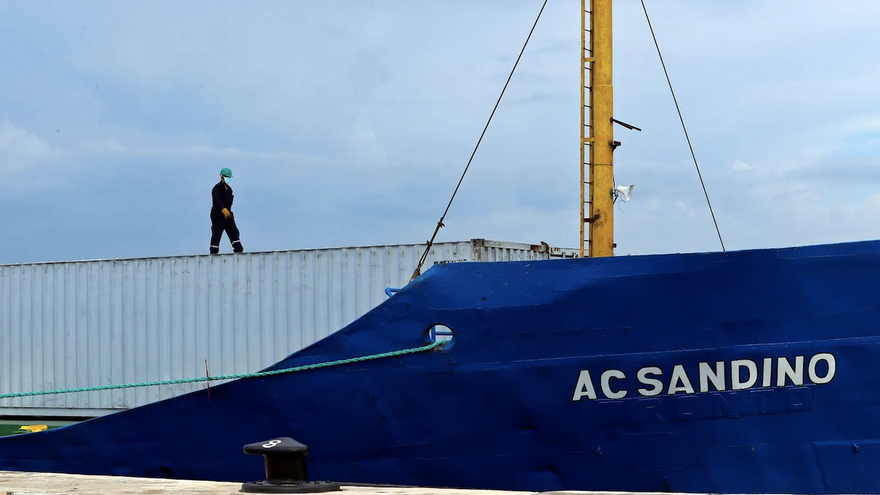
Archive image of the Nicaraguan ship AC Sandino, sent this Thursday to Cuba. (EFE/Ernesto Mastrascusa)

14ymedio biggerEFE (via 14ymedio), Managua, 19 August 2022 — The Government of Nicaragua announced on Thursday that it sent a ship with food to Cuba, as an act of solidarity “with Cuban families.”

The ship Augustus C. Sandino, with a Nicaraguan flag, weighed anchor in the early hours of Thursday from the river port Arlen Siu, in the Autonomous Region of the South Caribbean (RACS), and headed to the Island, said the Executive Branch in a press release. Nicaraguan authorities expect the Sandino to arrive next Monday at the port of Mariel (Artemisa), about 30 miles from Havana.

This is the second shipment of aid granted by Nicaragua to Cuba so far in 2022, and the fifth since the street demonstrations of July last year on the island due to the lack of food and medicine, which has reached unprecedented levels. continue reading

The Government of Nicaragua didn’t give details about the type or quantity of food sent to Cuba this Thursday. In previous shipments, Nicaragua gave Cuba rice, beans, oil, coffee and other goods.

The governments of Nicaragua and Cuba have had close relations during the times when former Sandinista guerrilla Daniel Ortega ruled the country, first from 1985 to 1990, and then from 2007 up to the present.

Nicaragua and Cuba are part of the Bolivarian Alliance for the Peoples of America (ALBA), led by the Island regime and chavista Venezuela.

Translated by Regina Anavy

____________

COLLABORATE WITH OUR WORKThe 14ymedio team is committed to practicing serious journalism that reflects Cuba’s reality in all its depth. Thank you for joining us on this long journey. We invite you to continue supporting us by becoming a member of 14ymedio now. Together we can continue transforming journalism in Cuba.

The Old Cheater and the Suspicious Guajiro Negotiate the Crisis in Cuba

This Thursday morning an old woman rehearsed an apology for taking a pound of rice without paying from the improvised point of sale located in the park on Carlos III and Belascoaín streets. (14ymedio)

14ymedio bigger14ymedio, Juan Diego Rodríguez, Havana, 18 August 2022 — With a paper cup in his hand, a man with a tanned face approaches those who pass through Havana’s Central Park. “My daughter suffered an accident yesterday and I need to buy her medicines,” he explains. He has been repeating the same story for years, which he seasons with more lurid details as the economic crisis worsens. A few feet away, a shaved-ice seller cursed because he had been paid with a five-peso bill as if it were 500 pesos. This very common counterfeiting swindle is due to the recent arrival of high-denomination banknotes whose colors resemble lower-value banknotes.

Upon hearing this story, the colleague who helped him push his  cart also took the opportunity to talk about the scam he suffered in transfers through his mobile phone, which cost him his whole telephone balance. “You can’t trust people; they say one thing and then try to stab you in the back,” he said.

The feeling of mistrust spreads everywhere, and the most notorious scams of the Special Period are again recounted with fear. From steak made from a carpet to pizza with condoms masquerading as cheese, the urban legends of street fraud return in force to everyday conversations.

But beyond these milestones of deception, the small scam or apparent naivety is the one that’s most widespread on the Island.

This Thursday morning an elderly woman rehearsed an apology for taking a pound of rice without paying from the improvised point of sale located in the park on Carlos III and Belascoaín streets. “Mijo, give it to me and I’ll go right away to the ATM and bring you the money,” the lady repeated several times, but the merchant didn’t buy it. “Go and come back with the 50 pesos and then I’ll give you the rice,” the farmer responded categorically, adding in a lower voice: “I may be a guajiro but I’m not stupid.”

The deception also spreads to private cafes: snacks that show a slice of ham only on the outside but inside are empty, and presumed natural juices that are sold at exorbitant prices and are actually artificial concentrates mixed with water. However, the champion pickpocket is still the State: meat slices that don’t even have the memory of animal origin but continue reading

are marketed at the price of gourmet food, all-inclusive tour packages where you have to take a glass with you because in hotels they don’t have the packaging to serve drinks, and an internet access service, among the most expensive in the world, which barely guarantees a few hours.

The corner scammer justifies his villainy by pointing to the constant economic crimes committed by the ruling party. He himself is a victim of voracity and state inefficiency. “My old lady, if she goes to the cashier now to get money, she will return tomorrow because there’s a blackout and they’re out of service,” joked another customer from the point of sale on Carlos III Street. The crisis can lead to scams but, at the same time, it’s noticeable that people are more suspicious and don’t allow themselves to be scammed so easily.

Translated by Regina Anavy 

____________

COLLABORATE WITH OUR WORKThe 14ymedio team is committed to practicing serious journalism that reflects Cuba’s reality in all its depth. Thank you for joining us on this long journey. We invite you to continue supporting us by becoming a member of 14ymedio now. Together we can continue transforming journalism in Cuba.
What’s Going to Happen with Cuban President Diaz-Canel’s Foreign Exchange Market?

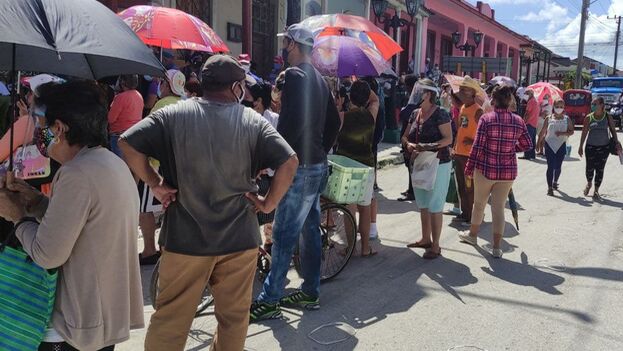
Cubans spend inordinate amounts of their time waiting in lines, while supplies run out before their turn comes. (14ymedio)

14ymedio bigger14ymedio, Elías Amor Bravo, Economist, 18 August 2022 — It’s difficult to answer this question. With the dollar in the informal market above 130 pesos and rising, Cubans see with concern how access to the currency that allows the purchase of basic necessities and services, which are not accessible in national currency, becomes increasingly complicated. And to curb these fears, the Ministry of Economy and Planning has decided to publish on its website a note that it says is “explanatory” but that confirms how clueless the leaders of the Cuban economy are on all these issues.

If a caveat is allowed to be introduced from the first moment, the informative note says that “the foreign exchange market is the space where foreign currency is bought and sold, which allows the national currency and foreign currencies to be connected” and well, here the first “technical” error occurs when affirming that the market is a space.

It’s not true. Economic science says the opposite. It’s not a physical space, it’s something else. To associate the market with a spatial and even temporary reference is to trivialize something that operates so that millions of decisions by economic agents, expressed in terms of supply and demand for all products and services, reach a simultaneous balance that leaves everyone in a better position. And it’s not necessary for it to have any “physical space.”

Then the equilibrium price of this market, somewhat different from the price of malanga or yam, which establishes the exchange rate between the different currencies and the national currency, depends, as in any market, on the position of supply and demand for foreign currency. As the ministry’s note points out, in this market, “the providers of currency are export companies, foreign visitors, recipients of remittances and other agents who receive foreign currency, while the demand comes from agents of the economy who need to import, travel abroad or who require foreign currency for other purposes.”

I certainly don’t get their accounting. Does the ministry really believe that these are the only providers and demanders of foreign currency? They fall short and leave out more than 80% of operators. In this market, if demand exceeds supply, the exchange rate of the national currency will fall, and vice versa. continue reading

But really, the exchange rate market is much more than that, and Cuban communists don’t seem to be clear in their note about the true meaning of the exchange rate, which is nothing more than the factor that establishes a relationship between the value of the national economy and that of other, foreign economies.

They talk about the connection of the productive agents with the outside world, both for their needs for input through imports and for the sale of their production through exports. But there is much more to that relationship between internal and external supply than these commercial issues, and not taking them into account is another big mistake. For example, access to financial and capital markets is a matter of primary relevance and doesn’t appear anywhere in the note.

The recommendation, therefore, is that rather than taking into account supply and demand, attention must be paid to a series of variables and indicators that influence the determination and evolution of the relative prices, which are the exchange rates.

And to do this, an exchange rate policy must be designed that is related to and, at the same time, serve the achievement of the rest of the objectives of the national economic policy. The question is, does anyone know what those objectives are and what is supposed to be achieved? We’re in bad shape.

There are few things that are true in the ministry’s note, but one of them, perhaps the most obvious, is to recognize that the market and its exchange rate have an influence on all the prices of the economy. But the influence is much more than that, and as is being seen in Cuba, its greatest effect on prices is inflation, which is pushed upwards, unfairly, depending on the access to foreign exchange by different sectors of the population.

But, in turn, rising inflation deteriorates the exchange rate; therefore, the interdependence between the two poses a danger to achieving exchange-rate stability and controlling inflationary pressures. What came first, the chicken or the egg?

While Cuban communists try to find the answer, the conclusion is that when an exchange market is inefficient and doesn’t function properly, it generates distortions that prevent the fulfillment of the aforementioned objectives, limiting productive capacity, economic growth and development of the country. They should get to work as quickly as possible.

As for the legal or illegal access referred to in the informative note,  of economic agents to foreign exchange, offering security, confidence and transparency, there is a clear commitment to putting an end to the only market that has worked since the entry into force of the Ordering Task* (and therefore, the foreign exchange market), which is the informal one, which began exchange services as soon as the Central Bank, bank branches, official exchange offices and airport offices stopped doing so. Aggression towards the informal market is a real threat that can pose an eventual repression of people engaged in these activities, which would not only be unfair, but also inefficient. Who is going to sell dollars in Cuba?

The note insists on the need to create and develop an official exchange market for the Cuban economy, but this is counterproductive, since it doesn’t seem necessary to remind government leaders that this market already exists. It was defined with a fixed official exchange rate of 1X24 and entered into force on January 1, 2021, with the beginning of the ordering task (it was one of the measures included).

Therefore, recreating what has already been created is a meaningless double back that should be translated into reality, which is none other than assuming the failure of the first launch and announcing this second, which looks like it won’t end well. For now, the regime begins to operate only with an exchange rate, which they say is “economically substantiated” but only for foreign exchange transactions and at only one address for the purchase of foreign currency. The sale is neither there nor is it expected.

The note attributes to the foreign exchange market two functions that, at this point, look like a chimera. The first is to ensure that the national currency allows access to all the goods and services of the economy, and to this end, dollarization is eliminated. This is a difficult issue as long as the regime itself continues to support and encourage the stores that sell in MLC [freely convertible currency].

The minister declared in the national assembly that 70% of the country’s monetary circulation moves in Cuban pesos, while the remaining 30% do so in MLC. Returning to stability positions from these levels can be much more complicated than it seems. Dollarization and stores in MLC are a business for the regime that will hardly change.

The second function is to ensure macroeconomic balance. This is the one sensible thing contained in the information note, but we are very afraid that it’s quite impracticable. The note says that progress must be made in reducing the fiscal deficit and monetary issuance. Perfect, what prevents the communists from lowering the deficit of 11% of GDP reached in 2021, more than double that of 2019?

There is no COVID-19 cost that justifies an expansion of spending of this magnitude, whose objective, as seen, has been to sustain GDP growth by 1.3% in the budgeted sector, while productive activities remained inert.

The note also refers to other functions, such as an alleged resizing of the state sector based on greater efficiency and effectiveness of public spending, and the control of wages without productive support, excessive profits and payments to private individuals, among other factors. It’s hard to believe that the foreign exchange market can be used for all this, but if they say so, let them do it, because it’s necessary to put order as soon as possible in an economy that doesn’t work.

The note concludes by pointing out that the ultimate goal should be to constitute an exchange market for the entire economy with a single exchange rate that guarantees the connection with foreign currencies of the national currency. In fact, this scenario, described in these terms, has not been presented in Cuba in a stable way since 1959.

Before that date, it should be remembered that the dollar and Cuban peso were on parity; that is, they were quoted at the same value. The same regime that started in 1959, which is still in power in 2022, makes no presence of facing this issue.

And they recognize that the implementation of the foreign exchange market is only a small part “of a much larger scaffolding, where no isolated measure alone will bring satisfactory results.” I totally agree. Once again, the lyrics seem well written, but then, as in so many other times, the music is out of tune. What a pity. The foreign exchange market will be another problem in a not very long time.

*Translator’s note: The “Ordering Task” (tarea ordenamiento) is a collection of measures that include eliminating the Cuban Convertible Peso (CUC), leaving the Cuban peso as the only national currency, raising prices, raising salaries (but not as much as prices), opening stores that take payment only in hard currency which must be in the form of specially issued pre-paid debit cards, and a broad range of other measures targeted to different elements of the Cuban economy.   

Translated by Regina Anavy 

____________

COLLABORATE WITH OUR WORKThe 14ymedio team is committed to practicing serious journalism that reflects Cuba’s reality in all its depth. Thank you for joining us on this long journey. We invite you to continue supporting us by becoming a member of 14ymedio now. Together we can continue transforming journalism in Cuba.

Wide Deployment of Cuba’s Repressive Forces Fails to Prevent Another Protest in Nuevitas

Protesters warned that if the electricity was cut off again, they would take to the streets again. (Screen capture)

14ymedio bigger14ymedio, Havana, 20 August 2022 — For the second day in a row, this Friday night and during part of the early hours of this Saturday, the residents of Nuevitas, Camagüey, returned to the streets in protest over the long blackouts. The demonstration in the neighborhood of Pastelillo was repressed by the police, who arrested and struck several participants. The following videos were broadcast live.

Banging on pots and pans [a cacerolazo] and shouting “turn on the current, asshole,” “freedom,” “hey, police dickhead,” and “we don’t want more misery,” dozens of people demanded that the electricity be restored. The images show numerous police and military vehicles coming close to the demonstrators and the police attacking some of them, including at least two little girls who reported being beaten by uniformed personnel.

The demonstrators also shout “the people, united, will never be defeated” and say that several plainclothes police were in the crowd. “Those are children, they’re children,” one of the women who protests screams when the police attack a group marching down the street.

https://www.facebook.com/watch/?v=480359123491476

“All day the town filled with Black Berets [Army Special Forces], who passed by slowly in their vehicles on every street to intimidate us,” says a young protester who prefers anonymity. “They thought that by scaring us we wouldn’t go into the street, but we had already told them that if they took away our light again, we would protest again.”

“They also cut off our Internet for several hours, which is why there are many people who haven’t yet been able to publish their videos of the repression. The plainclothes policemen began to throw stones at people, and that made people angrier,” he explains. “Neighborhood Number 1 also took to the streets,” he adds. continue reading

According to another netizen, the police focused a spotlight on the entrance bridge to Pastelillo to “blind the demonstrators” and try to control the situation. “And they stoned the crowd, the ground was covered with stones,” he said.

https://www.facebook.com/watch/?v=439220921498997

In a video posted on YouTube, several neighbors are seen arguing heatedly with a policeman and another man who apparently identifies himself as a “secretary” of the Communist Party. Residents say that “in Havana they don’t cut off the power like they do here” and the official responds that with the protests “what Nuevitas is doing is an embarrassment.”

“It’s true that the police came to attack people here,” says a resident. “Did they come today to look good?” asks a woman who describes the assault on an 11-year-old girl. “You may have a generator in your house but we don’t. We’re stubborn,” adds a man who has “two children who can’t sleep.”

This protest comes a few hours after hundreds of people took to the streets in that same Camagüey city in a demonstration not seen in Cuba since July 11, 2021.

Text: #Urgent | #Share – This Friday’s demonstration in #Nuevitas for the #apagones [blackouts], was repressed by the police who arrested and beat several participants, according to videos broadcast live or recorded from the place. [Note: The little girls screaming in the video — striped shirt and red shirt — in a video recorded shortly after this one described what happened to them and showed their injuries.]

The protest, as observed in numerous videos shared on social networks, was massive, illuminated by the flashlight of cell phones and motorcycle headlights, and accompanied by banging on pots and pans, horns, clapping and shouted slogans.

According to what residents of Nuevitas told 14ymedio, the demonstrators went to the headquarters of the local Communist Party, a building that was illuminated in the middle of the darkness of the power outage, and there they cried out: “If you remove it again, we go to the streets again,” “we want freedom” and the traditional “the people, united, will never be defeated.”

Although the police arrived, “They practically couldn’t do anything, because it was a sea of people.” Immediately, he says, they turned on the power. “They were afraid of us,” the source said.

https://www.facebook.com/watch/?v=384937147045935

To respond to the popular protest, the regime organized a march on Friday, with Cuban flags, photos of Fidel Castro and the old slogan Pin pon fuera, abajo la gusanera,* a slogan that gained strength in 1980 during the Mariel Boatlift and that was used against Cubans who decided to leave the country.

In the official counter-march, an official said that Nuevitas had  the “heart and balls” to defend the Revolution.

*Translator’s note: Get out! Down with the worms!  

Translated by Regina Anavy

____________

COLLABORATE WITH OUR WORKThe 14ymedio team is committed to practicing serious journalism that reflects Cuba’s reality in all its depth. Thank you for joining us on this long journey. We invite you to continue supporting us by becoming a member of 14ymedio now. Together we can continue transforming journalism in Cuba.
To the Cry of ‘The People Are Tired’ Nuevitas Registers Largest Protest in Cuba Since 11 July 2021

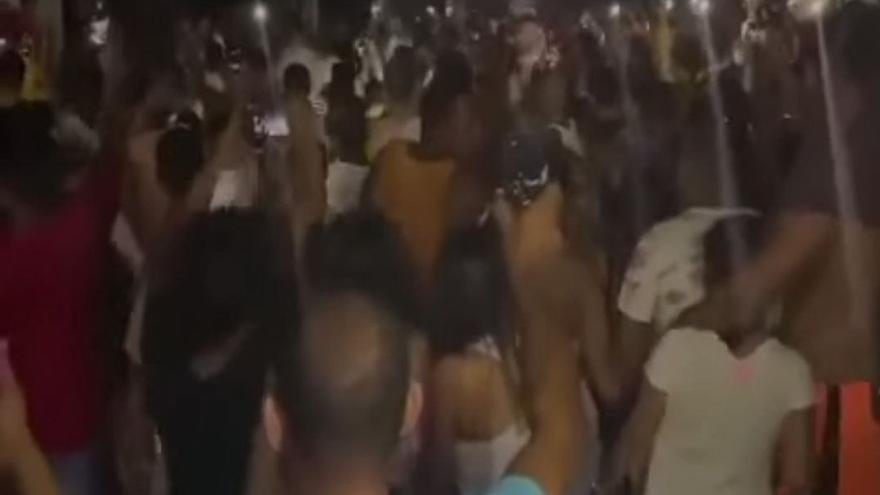
Massive night demonstration in the early hours of Friday in Nuevitas, Camagüey. (Captura/Facebook)

14ymedio bigger14ymedio, Havana, 19 August 2022 — Hundreds of people took to the streets early this Friday in Nuevitas, Camagüey, in a demonstration not seen in Cuba since July 11, 2021.

The protest, as seen in numerous videos shared on social networks, was massive, illuminated by the flashlight of cell phones and motorcycle headlights, and accompanied by banging on pots and pans, horns, clapping and shouted slogans.

Along with the cries calling for an end to the blackouts – “turn on the current, dickhead” — shouts of “freedom” and “homeland and life” also resonated. Some citizens yelled that irreverent slogan repeated on July 11 — “hey, you police dickhead” — and others, also like that Sunday last year, sang the national anthem at the top of their lungs and in unison.

“Díaz-Canel, singao*, the people are cansao*,” the Camagüeyans also chanted, thus adding a new slogan to the expression of popular discontent.

According to what resident of Nuevitas tell this newspaper, the demonstrators went to the headquarters of the local Communist Party, a building illuminated in the midst of the darkness of the power outage, crying out: “If they cut the power again, we will throw ourselves into the streets again,” “we want freedom” and the traditional “the people united, will never be defeated.”

The police arrived at the scene, says one of the participants in the protests, but “they practically couldn’t do anything, because this was a sea of people.” Immediately, he says, they turned on the power. “They’re scared of us,” he adds.

The demonstration in Nuevitas occurred shortly after the return of electricity to Havana, which was almost completely in the dark for two hours due to an alleged breakdown in a high voltage line, according to the Unión Eléctrica de Cuba.

Despite the indignation in Havana, only some residents of Luyanó banged on their pots and pans before power was returned. continue reading

Places are being added to the map of night protests over the blackouts, which the NGO Justicia 11J estimates at more than fifty since the scheduled power cuts began in mid-June, and for which, the legal platform said, there are about thirty people under arrest.

In Nuevitas, Luyanó, San Antonio de los Baños, Güira de Melena, Santa Clara, Cienfuegos, Santiago de Cuba and Pinar del Río they know one thing well: if they protest, the light returns.

*Translator’s note: In English,”Díaz-Canel you motherfucker, the people are tired” loses the rhyme.  

Translated by Regina Anavy

____________

COLLABORATE WITH OUR WORKThe 14ymedio team is committed to practicing serious journalism that reflects Cuba’s reality in all its depth. Thank you for joining us on this long journey. We invite you to continue supporting us by becoming a member of 14ymedio now. Together we can continue transforming journalism in Cuba.

Cuban Composers of “Patria y Vida” — Homeland and Life — Will Receive the Medal of Freedom

The duo Gente de Zona flanking Yotuel Romero, in a scene from Patria y Vida. (Yotuel/YouTube/Captura)

14ymedio biggerEFE (via 14ymedio), Miami, August 16, 2022 — The composers of the song Patria y Vida will be recognized with the Medal of Freedom that will be awarded to them by the Latino Composers Hall of Fame (LCHOF) at the welcome gala for its new members, which will be held on October 13 in south Florida.

This new award created by the LCHOF will end up in the hands of Yotuel Romero, Beatriz Luengo, Descemer Bueno, Luis Manuel Otero Alcántara, Maykel Castillo Osorbo, Alexander Delgado, Randy Malcom Martínez and DJ El Funky, the composers of the song, which became an anthem for the opposition inside and outside Cuba.

The song, which was the soundtrack for the popular protests of July 11, 2021, has received, among others, the Latin Grammy Award for Best Song of the Year.

The Medal of Freedom will be one of the La Musa awards that will be presented at the LCHOF ceremony, which will take place at the Hard Rock Hotel in Hollywood, south Florida, and they will also celebrate their tenth anniversary, as announced on Monday by Billboard magazine.

The LCHOF, based in Miami Beach, will welcome its new members, including the Dominican, Johnny Ventura, who died in July of last year and who, posthumously, will join this room that brings together and pays tribute to the great figures of Latin music. continue reading

The other distinguished people in this year’s event will be the producers, Desmond Child and Rudy Pérez, both founders of the LCHOF, as well as the composer, Tony Renis.

The ceremony will also recognize the Mexican, Emmanuel, who will receive an award for his artistic legacy, and the Puerto Rican, José Feliciano, who will receive the Song of All Time award for his immortal theme Feliz Navidad.

Manuel Alejandro, from Spain, and the Venezuelan, Elena Rose, will be among the musicians awarded at the gala, as well as the executives of the music and entertainment industry, Gustavo Menéndez, Walter Kolm and Eddy Cue.

According to Billboard, the gala will be hosted by the Peruvian-American actress and singer, Isabela Merced, and artists such as Emilio and Gloria Estefan, José Feliciano, Draco Rosa, Erika Ender, La India, Luis Figueroa, Yotuel and Gente De Zona, among others, will perform.

As in previous years, the composers selected this year to be part of the Latino Composers Hall of Fame have been chosen from a group of nominees by a committee of figures and leaders of the music industry.

Translated by Regina Anavy 

____________

COLLABORATE WITH OUR WORKThe 14ymedio team is committed to practicing serious journalism that reflects Cuba’s reality in all its depth. Thank you for joining us on this long journey. We invite you to continue supporting us by becoming a member of 14ymedio now. Together we can continue transforming journalism in Cuba.
A Nostalgic Tour of the Closed Hotels in a Havana Without Tourists

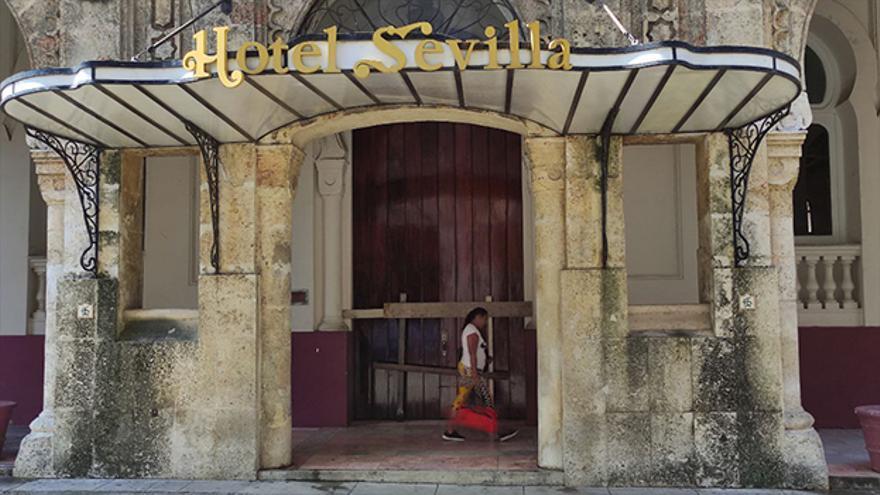
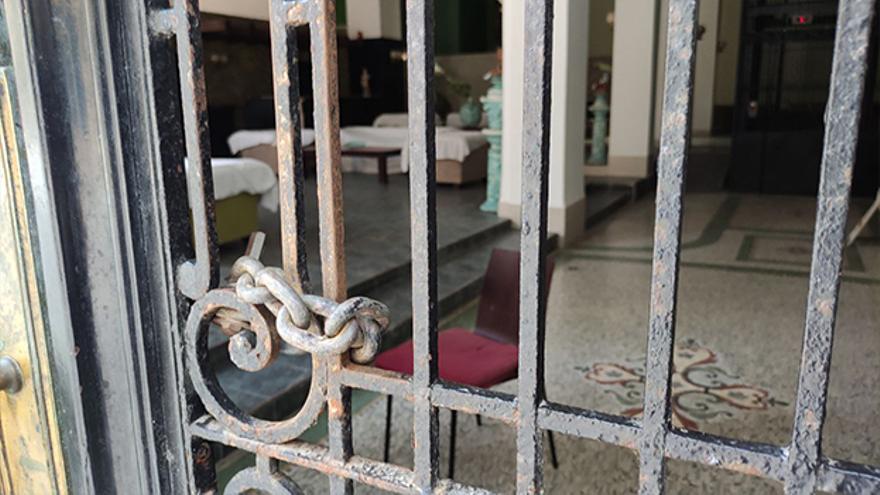
A crossbar keeps the doors of the Hotel Sevilla completely closed. (14ymedio)

14ymedio bigger14ymedio, Juan Diego Rodríguez, Havana, 20 August 2022 — I walk up and down Obispo, the main street in the historic center of Old Havana that has been, for decades, a commercial and tourist artery of unparalleled importance on the Island. Now, the main hotels located on that street are closed and without visitors, a situation that extends to other areas once full of people with sunglasses and souvenir sellers.

With its large central courtyard and stately entrance, the Florida hotel offered a colonial experience in Old Havana, close to the nearby bars and restaurants. But after the pandemic, its doors didn’t reopen, and now it seems like an empty shell that the custodians are trying to preserve from deterioration.

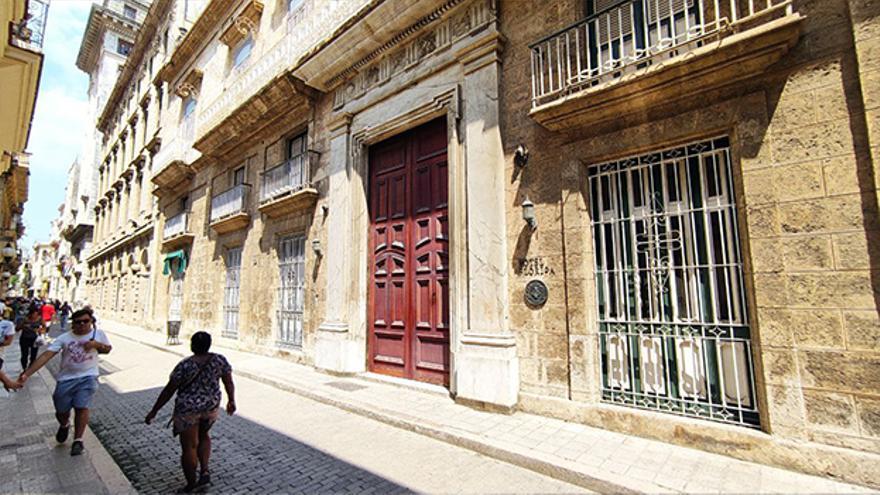
Nearby, the Ambos Mundos hotel attracted travelers last August under the magnetism generated by the American writer Ernest Hemingway, who stayed in one of its rooms. But neither on its extensive terrace on the fifth floor, nor in its colorful lobby nor in the old elevator are the voices of guests heard anymore. The place is also “temporarily closed” by thick chains at the entrance of the mythical building.

The employees of the Armadores de Santander hotel, on Luz street, pounce on clueless passers-by, no matter if they are foreigners or Cubans, to pressure them to have lunch. It’s the only way to guarantee a tip, however small it may be. And if the would-be future diner refuses to read the menu, he can earn a couple of insults. continue reading

With humility, the custodian of the once-imposing Telegraph hotel has heard that “they plan to open it soon, perhaps in October, but who knows.” Another worker, on his knees next to the service door, confesses to praying “to the eleven thousand virgins” for the hotel’s prompt reopening.

The doors of the famous Hotel Sevilla — where the protagonist of the novel Our Man in Havana is recruited to be an agent of the British secret service — are blocked by a strong crossbar. The shops of the commercial arcade, which communicates with the establishment through a gate on Prado Street, are open. The gate, of course, is closed, and a Creole “spy” guards it.

Another complete closure, with sticks used as crossbars to immobilize the door, is the Plaza hotel, still majestic on its corner of Zulueta street, guarded by Virtudes and Neptuno. For its part, the Gran Hotel Bristol, located on Teniente Rey a few feet from the Capitol, is still waiting for its opening, announced with great fanfare by the authorities.

Covered furniture and a chain on the door of the Ambos Mundos hotel. (14ymedio).

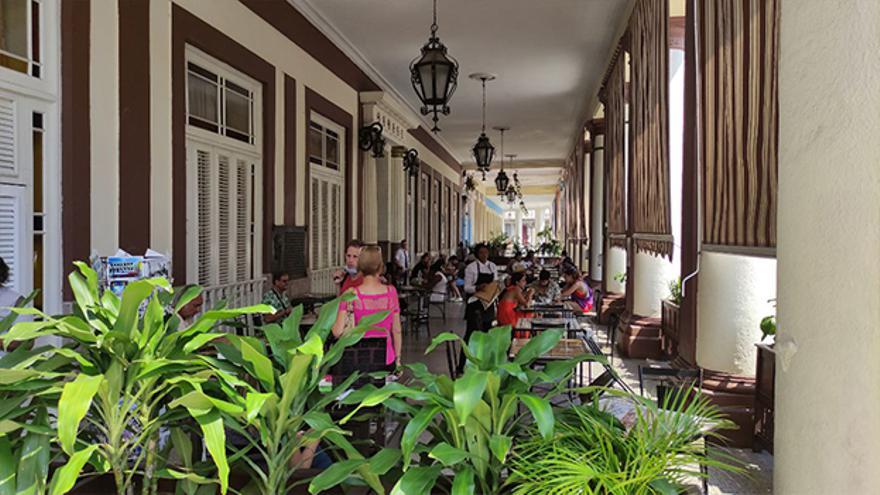
In another hotel colossus, the Inglaterra, the clientele is in search of lunch at any price. But there are no tourists, only Cubans: a bad sign for the waiters who hope for a tip.

Also on Prado, the Parque Central hotel awaits in vain the arrival of sweaty and hungry foreigners. The restaurant staff sees time go by extremely slowly and arranges the suitcases of some customers, who are leaving very soon.

The Deauville hotel, on Galiano and San Lázaro, has not reopened since its closure due to the COVID-19 pandemic in March 2020. Through its windows, a brigade of workers was observed this week repairing the entrance. Asked about the date of reopening of the establishment, someone who looked like the construction manager limited himself to making a gesture with his hand while venturing: “At least until next year, I think.”

The luxurious Paseo del Prado hotel, recently acquired by the Canadian firm Blue Diamond, is open but “uninhabited.”  The company’s aggressive campaign to get hold of different establishments on the Island contrasts with the calamitous state of tourism. The same goes for the Packard, where you can see few guests in the lobby and just two foreigners in the “infinity pool.”

After the pandemic, the doors of the Florida hotel didn’t reopen. (14ymedio)

No traveler enjoys staying at the Manzana Kempinski hotel, which is open but under repair. The noise of cranes and excavators makes the summer bitter for customers, who also don’t enter the very expensive boutiques on the ground floor of the building.

Businesses that fed on tourists staying in Old Havana have also closed. Café París, on the corner of San Ignacio and Obispo, is in absolute silence. This place, where the songs of the Buena Vista Social Club were repeated all day like a stuck record, hasn’t returned to toasting with its “baptized” drinks of distilled rums, and nor is there work for the musicians, who earned endless tips under its roof.

Some boys joke that in La Mina [The Mine] “nothing is exploited anymore.” In better times, the restaurant workers lived up to its name by excavating the pockets of tourists. It’s said that serving drinks on that corner of Obispo and Oficios Street was a guarantee of ascending two levels in social class. Some bartenders literally became millionaires by dispatching watered-down mojitos and low-alcohol cuba libres.

Indispensable in the national cartography of alcoholism, La Bodeguita del Medio looks more like a deadly dump than the gastronomic legend it was. A brief reading of its menu, with pork at 1,050 pesos and Cuban-style lobster at 700, is enough for the customer to opt for fasting.

It’s better to go to La Vitrola, a private restaurant whose terrace expands onto the Plaza Vieja. But not even all tourists dare to eat there, where the combination of several monthly salaries — for a Cuban — is not enough for a lunch.

Some hotels that are still open offer lunch service to Cubans and foreigners. (14ymedio)

If the body demands at least one sip of coffee, it won’t be possible to go to El Escorial, whose employees devour their food while playing with their cell phones. Once he gives up on decent food, the necessary infusion and the unfindable cigar, the hungry pedestrian will stumble upon the less touristic circles of Havana’s hell: the killer money changers of Cathedral Square, the dying pigeons on San Francisco, the horde of taxi drivers with improvised carriages, and the foreign exchange sellers, who complete the fauna of the historic center.

There is no choice but to abandon the area, where the remains of the past of a sparkling, effervescent, tropical city are fading. It’s a Havana that exists only in old photos and in the silhouette of its closed hotels.

Opposite them, suspiciously, rise the construction of luxury hotels that doesn’t stop, like the brand new Grand Aston or the so-called Torre K, highly criticized by the specialists. The origin of the funds for these works, carried out by the Gaesa military conglomerate, remains opaque.

Translated by Regina Anavy

____________

COLLABORATE WITH OUR WORKThe 14ymedio team is committed to practicing serious journalism that reflects Cuba’s reality in all its depth. Thank you for joining us on this long journey. We invite you to continue supporting us by becoming a member of 14ymedio now. Together we can continue transforming journalism in Cuba.
In Artemisa, Cubans Mobilize Against the ‘Off-Again On-Again Current’

These demonstrations join the many that have already occurred in recent days in several places on the island, such as Santa Clara, Bejucal, Holguín, Cienfuegos, Santiago de Cuba and Pinar del Río. (Captura)

14ymedio bigger14ymedio, Havana, 18 August 2022 — If Cubans have learned anything since the Government began to apply the scheduled power outages, it’s that if they protest, the light returns. This happened on Wednesday night, when the pounding on pots and pans [the cacerolazo] occurred again in San Antonio de los Baños and Güira de Melena, both in Artemisa.

In San Antonio, resident sent this newspaper a video — which is an almost completely black screen with brief flashes of light — in which you can hear the noise in the middle of the darkness, and the usual shouts of “turn on the power.” The protest lasted about half an hour, until the light was turned on, around nine at night.

“The electricity should have returned at 8:00 at night, but at 8:20, it still wasn’t on. They turned it on because of the protest,” says a resident in this Artemiseña city, which on 11 July 2021 was the first to take to the streets.

“In the Hospital zone, they protested until the lights came on, and then they didn’t take the power away” explains a man, referring to the demonstration the night before, when neighbors of that area and other neighborhoods took to the streets. “But they don’t want to give the same hours to us, and it’s not fair,” he laments indignantly.

In neighboring Güira de Melena, a resident confirmed to 14ymedio that a similar protest took place on Wednesday night in the city center, the fourth in less than a week. “Today it has been extreme with the power; they turned it on at half past eight after five hours, and so far they have turned it off it four times,” said this source, which ironically calls it the “off-again on-again current.” continue reading

Sancti Spíritus joined the protests this Wednesday, a city until now ‘conformist’ — that is going along with the regime — despite being one of the most punished by the blackouts, among other things for being one of the first where these measures were decreed.

On Wednesday night, a collaborator of this newspaper heard the conversation of the policeman who was in charge of the guesthouse in Sancti Spíritus that is dedicated to the cadres of the Communist Party. The agent told his interlocutor that there had been a demonstration, and that they were sending him the photos of some people “they had detected” at the protest.

From this conversation it was inferred that State Security had been alerted that there would be a protest in front of that official building and that, thanks to the cacerolazo, they turned on the light immediately, before the scheduled time.

These demonstrations join the many that have occurred in recent days in several places on the island, such as Santa Clara, Bejucal, Holguín, Cienfuegos, Santiago de Cuba and Pinar del Río.

As a result, according to Justice 11J, a total of 57 people have been arrested, 33 of them still in police custody. The legal platform, created to follow up on the hundreds of defendants after the demonstrations of July last year, has registered about 60 protests on the island over power cuts since June 14.

On Wednesday, in addition, “all citizens tired of being trampled on” in Holguín were urged to demonstrate against “this abusive regime.” “When the authorities appear and try to stop us, let’s unite more than ever; no one falls out during the march, no one gets in a patrol car, no one abandons anyone,” says an anonymous text disseminated through private messaging channels. It’s not known, so far, if the call was successful.

Anyway, the inhabitants of the island are fed up with this situation and are outraged by the crazy solutions proposed by the official websites. The Electric Union of Havana asked Cubans through a post on Telegram to save electricity when the power is on. “The rest of the customers in other blocks would be very helpful at this time if they save and decrease the amount of time the customers of block 4 are affected,” they wrote.

In the face of this, Cubans sharpen their ingenuity. A resident of Luyanó, for example, told this newspaper that when the light goes out in her “block,” a neighbor of the adjacent building, which now  belongs to another demarcation, “gives me an extension cord when she has light so that I can connect a fan.” When she is the one who has electricity, she does the same with this neighbor. “Solidarity between the blocks,” she jokes.

Translated by Regina Anavy

____________

COLLABORATE WITH OUR WORKThe 14ymedio team is committed to practicing serious journalism that reflects Cuba’s reality in all its depth. Thank you for joining us on this long journey. We invite you to continue supporting us by becoming a member of 14ymedio now. Together we can continue transforming journalism in Cuba.
Through a Traffic Ticket, the Mexican Police Discover a Coyote Taking Seven Cubans to the United States

The group of seven Cubans, one woman and six men, were handed over to Migration. (Captura)

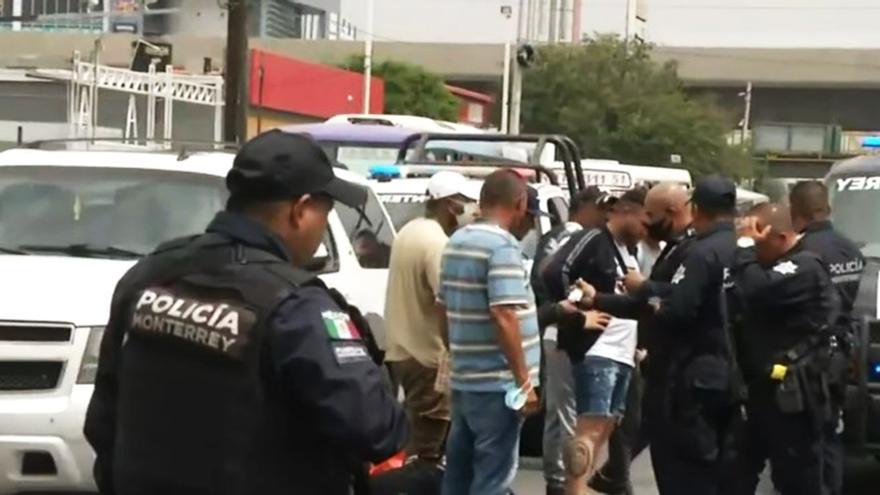
14ymedio bigger14ymedio, Ángel Salinas, Mexico, 18 August 2022 — Police from the Mexican municipality of Monterrey arrested a coyote on Wednesday, who had charged seven Cubans 21,000 pesos ($1,050) to take them in a van to the state of Coahuila, from where they planned to cross the Rio Grande to reach El Paso, Texas.

The smuggler, identified as José Ascencio, was stopped for driving a van with polarized glass, which is cause for a fine, according to state traffic regulations. “When he was arrested, the driver left the van but couldn’t avoid the inspection, exposing a woman and six men of Cuban nationality,” Officer Cerón, of the municipal police, told 14ymedio.

Authorities from the National Institute of Migration (INM) took charge of the Cubans, who couldn’t verify their legal stay in the country, so they were transferred to a migration center. They will have a safe conduct pass to leave the country within 20 days, and if they’re arrested again they will be deported.

“They opened an investigation on the driver for smuggling and human trafficking, and the Prosecutor’s Office Specialized in Migration Affairs will follow up on the case,” explained the municipal police.

The van with the Cubans was intercepted on Bernardo Reyes Avenue, in a marginal area of the state of Nuevo León, where the passage of migrants predominates due to the proximity to the Central Bus Station and several hostels. This point is three hours from Coahuila.

According to figures from the Migration Policy Unit of the Ministry of the Interior, 8,496 migrants were detained in Nuevo León, including 325 Cubans, in the first half of the year. These people are locked up at the Zozaya immigration center, in Guadeloupe, a site that has been denounced for human rights violations, extortion and threats by immigration agents. continue reading

The Cubans, Claridad Falcón Roque, Adrialys Caamaño Domínguez, Alejandro Lázaro Falcón Roque, César Mulet Marrero, Brian Michel Tasé Duarte and Dianet Ruiz Herrera, who spent more than a month in Zozaya, were released after paying about $1,000, although they had an amparo* granted by a judge.

The inconsistent treatment against Cubans in immigration centers has been a constant in the government of Andrés Manuel López Obrador. This newspaper received a complaint about the arbitrary detention of a family from the Island in the state of Puebla.

Yenisleidy Hernández Sánchez, Maikel Presno Sosa and their two sons, Eimis and Maikel Andrew, were imprisoned for more than a week at the immigration center, said lawyer José Luis Pérez Jiménez. “It’s evident that this is a violation of the human rights of detainees and Article 111 of the Migration Law,” since the agents imposed on them the payment of 10,000 pesos for their release, which is not stipulated in any immigration rule.

The irregular transfer of Cubans is encouraged by the Migration Unit, which has delayed the delivery of transit visas for up to 30 days. Some, such as in the state of Chiapas, are being deceived with the delivery of a humanitarian visa in the municipalities of Unión Juárez, Tuxtla Chico and Suchiate, near the border with Guatemala.

But the reality is that, since July, the only document that Migration is granting is a transit visa, which guarantees a regular stay for 30 days.

*Translator’s note: An amparo is a decree guaranteeing constitutional protection of rights.  

Translated by Regina Anavy

____________

COLLABORATE WITH OUR WORKThe 14ymedio team is committed to practicing serious journalism that reflects Cuba’s reality in all its depth. Thank you for joining us on this long journey. We invite you to continue supporting us by becoming a member of 14ymedio now. Together we can continue transforming journalism in Cuba.
The Cuban Government Identifies Four Young People in Military Service Killed in the Matanzas Fire

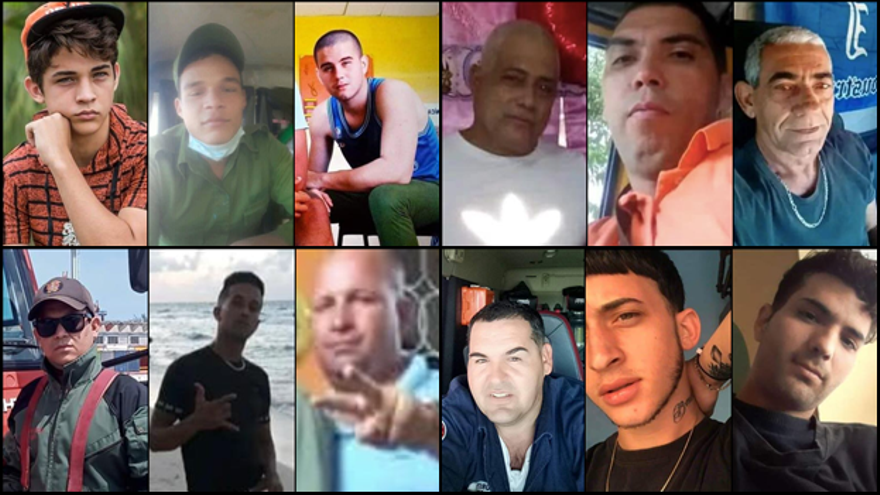
The authorities have released a list with their names and photos. (Collage)

14ymedio bigger14ymedio, Havana, 18 August 2022 — On Thursday, and without giving details about the age and exact function of the 14 men who died on August 6 in the explosion of one of the tanks set on fire in Matanzas, the Cuban authorities identified the victims.

Faced with the silence of the Government since the accident occurred, family and friends identified some of the deceased on social networks and independent media. But only today has the official Cuban press released a list with their names and photos, but without their ages; at least four of them were recruits of active military service.

The young people going through military service, described as soldiers by the official newspaper Granma, are: Leo Alejandro Doval del Prado, Adriano Rodríguez and Fabián Naranjo Nuñez, from Matanzas, and Michel Rodríguez Román, from Mayabeque.

Leo Alejandro Doval del Prado, 19, had been presumed dead by his aunt Yunia Doval and other relatives. “I don’t love you as a hero, my boy, I prefer you as a coward!” Doval wrote on Facebook. “I have always admired your values, and we, your family, know that you are not one of those who run, without imagining that today I would prefer you to have fled. I would feel the same pride if you came home now saying that suddenly you became cowardly, rebellious, defiant and got off the fire truck, because in the end, you would not be one of them.” continue reading

Days ago, official journalists mentioned Michel Rodríguez Román, 20, among the deceased, but then deleted the information. Resident in the municipality of Santa Cruz del Norte, Mayabeque, he was serving in Fire Command number 3 of Juan Gualberto Gómez airport in Varadero.

Another of the deceased is Fabián Naranjo Nuñez, initially also identified in his relatives’ posts on social networks. The young man, of unknown age, did his military service in the same fire command. “We don’t know anything about this boy. Please, if anyone sees him in any of the hospitals, let us know,” Yanelys Naranjo González wrote on Facebook.

The Cuban authorities concluded on Wednesday that it’s “impossible to identify absolutely” the bone remains found in the fire area. Jorge González Pérez, president of the Cuban Society of Forensic Medicine, pointed out that — despite the fact that they cannot undergo a DNA test due to the degree of calcination — they believe that the fragments correspond to the 14 missing people.

In this group there are also Pablo Ángel López Martell, Rolando Oviedo Sosa, Osley Marrante Guerra, Luis Ángel Álvarez Leyva, Andy Michel Ramos, Osmany Blasco Sosa, Raciel Martínez Navarro, Diosdel Nazco, Areskys Quintero and Luis Raúl Aguilar Zamora.

González Pérez said that it’s also impossible to know if each of the 14 groups of bone remains belong to each of the 14 missing separately.

In addition to these victims, two deaths had already been reported, firefighters Juan Carlos Santana Garrido, 60, and  Elier Correa, 24 years old.

The last report of the Ministry of Public Health on the accident records, in addition to the deaths, 130 injured people, of which 18 are still hospitalized and 112 discharged.

Translated by Regina Anavy

____________

COLLABORATE WITH OUR WORKThe 14ymedio team is committed to practicing serious journalism that reflects Cuba’s reality in all its depth. Thank you for joining us on this long journey. We invite you to continue supporting us by becoming a member of 14ymedio now. Together we can continue transforming journalism in Cuba.
Faced with the Difficulties of Life, Santeria Spreads in Cuba

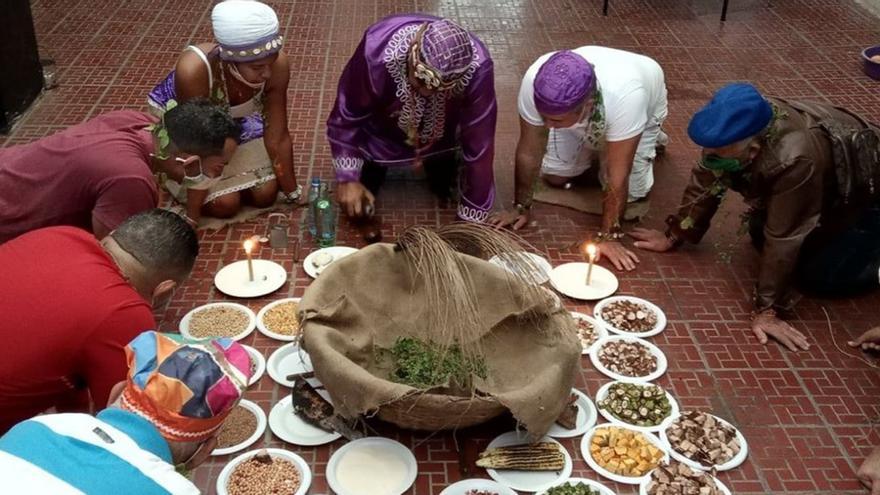
As happened in the Special Period, religion regains a kind of “anesthetic” status on the Island. (Yoruba Cultural Association)

14ymedio bigger14ymedio, Havana, Juan Izquierdo, 17 August 2022 — Like a young fortune teller or a sorcerer out of A Thousand and One Nights, in Omar’s memory are rites, spells, stories and words, mixed in ancient languages. Talkative, with toasted skin and wide-open eyes, he lives among books and sacred objects of the the Regla of Ocha.*

Omar has tried to understand Santeria from practice, respect and rationality. Devoid of fanaticism and open to dialogue, there are few people in Santa Clara — a city that’s a labyrinth of beliefs — with whom you can talk so seriously about the Afro-Cuban religious universe.

“Although I warn you,” he says, “that I will only talk about Ocha, because Palo Monte and abakuá, also of African origin, are two topics in which I have no life or book experience.”

In this conversation with Omar, I’m trying to learn why Cuban celebrities and politicians are so interested in Santeria and what the “state of health” of this religion is on the Island. It’s continually intriguing that there are pro-government factions and “independent” babalawos [high priests] who predict the government’s imminent fall.

Politics, religion, fear, honor among initiates, superstition, the usurpation of ritual elements by State Security to frighten dissidents… the list of topics would exhaust the serenity of a reasonable interlocutor. But Omar is patient, like an elderly sorcerer, and he begins to look for the causes of the problem.

“The Afro-Cuban religion is everywhere,” he says. “It penetrates jargon, gestures and imagination; it molds national beauty, and even gives shape to the worst in Cubans, in a process where many elements are replaced by others of disturbing origin.”

“The first sign of this ‘mess’,” Omar explains, “can be found in what someone called the baby boom of the babalawos in the eighties and nineties.” This boom occurred thanks to Miguel Febles (1910-1986), a santero who “reduced” the rigorous controls to be initiated into the religion. continue reading

The center of consecration of a babalawo is the “foundation,” an orisha or fetish on which the ceremony is performed. Before Febles, the number of foundations was very small, and to initiate a new babalawo the fetish had to be loaned or rented, often from one city to another.

“Febles relaxed the rigor for delivering the fetish,” says Omar, “in favor of the economic capacities of those who intended to receive it. That guaranteed an arithmetic growth in the number of consecrations.”

The babalawo had traditionally been formed according to criteria very similar to those of Freemasonry: he must be heterosexual, “wise,” a good son, father and husband, with availability to advance in the study of religion. But, after the reform of Febles, that ideal was blurred, and “people of a very diverse nature began to be consecrated, among whom were many foreigners, thugs, pimps and people from different professions.”

Santería, practiced in a more or less orthodox way by many Cubans, also faces the mass exodus experienced by the Island. (14ymedio)

The Special Period and the new millennium brought more changes to the Regla de Ocha: initiations became more expensive, a process of commodification began — monetary benefit rather than spiritual profit — and santeros immersed themselves in a kind of “success model.” Not to mention the “invention” of orishas to attract tourists who were looking for an “exotic” and Creole religion.

“In this new dynamic,” Omar laments, “people ask for three fundamental things: solving love problems with witchcraft or sorcery; spiritual cleansings to improve personal luck; and magical protection to deal with justice.”

He adds that “the hazardous living conditions faced by Cubans condition the search for security on the esoteric level, precisely because they want to control the chaos that is experienced daily through the intervention of magic.”

Omar refers, not without discomfort, to Cuban artists who have made Santería a kind of “seal.” “Luna Manzanares became iyawo [an initiate of Santeria] during Fidel Castro’s pharaonic funerals,” he says, “knowing that an iyawo is prohibited from participating in funeral activities or entering cemeteries.”

“Kimiko and Yordi made their most famous video, El Campeon [The Champion], dressed as iyawos, even though they knew that in their state it’s taboo to take photos or appear in a video. But these artists did nothing more than reproduce what Chacal and Yakarta had done at other times, and many others. Today the timberos celebrate with musical themes their access to the most misogynistic and exclusive cult of Ifá, according to the trend that Adalberto Álvarez began when he became a babalawo.”

Omar doesn’t speak of the “approach” of the leaders of the Communist Party to Santeria, considered as an “unofficial religion” by the Central Committee, nor about the “saints” attributed to Díaz-Canel and other government figures. “I had no idea that elements of the Ocha, such as animals, were used to threaten or scare dissidents. That amazes me!” he says, when asked about the dismembered birds in the doorways of several opposition houses.

“But don’t be fooled,” Omar warns, “the visibility of the practice has nothing to do with its good conservation.”

As happened in the Special Period, religion once again acquires a kind of “anesthetic” status on the island in the face of the difficulties of life. People pray, look for answers, trust the “beyond” and consult all kinds of divinatory mechanisms to know how much longer they have to “resist.”

On the other hand, the Government has made every effort to assimilate and organize, according to its parameters, the religious panorama of the island. Entities such as the Council of Churches of Cuba and the Yoruba Cultural Association have an agenda defined by State Security, according to a recent report by the organization Prisoners Defenders, based in Madrid.

Santería, practiced in a more or less orthodox way by many Cubans, faces not only the internal division and infiltration of the G2, but also the mass exodus that the island is experiencing. The response given by babalawos and their believers to this phenomenon and their rigor or flexibility in the new rites, celebrated beyond the Island border, will largely determine the survival of this religion, which has several centuries of antiquity and tradition in Cuba.

*Translator’s note: La Regla de Ocha combines the Yoruba religion, Catholicism and Espiritismo, which allows communication with ancestors through prayer. The saints of Regla de Ocha are called orishas.

Translated by Regina Anavy

____________

COLLABORATE WITH OUR WORKThe 14ymedio team is committed to practicing serious journalism that reflects Cuba’s reality in all its depth. Thank you for joining us on this long journey. We invite you to continue supporting us by becoming a member of 14ymedio now. Together we can continue transforming journalism in Cuba.
Andy Garcia’s Family Denounces That the 11J Political Prisoner is ‘in Poor Health’

Andy García Lorenzo was sentenced to four years in prison in a trial held on January 10 in Santa Clara. (Facebook/Roxana García Lorenzo)

14ymedio bigger14ymedio, Havana, 17 August 2022 — Andy García Lorenzo, one of the protesters imprisoned on July 11, 2021 in Santa Clara, “is in poor health and hasn’t received the medical care he needs,” his sister Roxana García Lorenzo reported on social networks. The young man is isolated in the infirmary of El Yabú, the labor camp where he is serving his sentence, on the outskirts of the municipal seat of Villa Clara.

“We don’t know if it’s something he ingested,” García Lorenzo clarified in a live broadcast. On August 13, Andy had “more than six consecutive episodes of vomiting and diarrhea in less than half an hour,” according to the family, after receiving a call from Andy on Wednesday.

After presenting these symptoms, the other inmates “began to yell at the guards to help him and they were ignored” for a half hour. The young man at that time was inside one of the dormitories, and only after two hours was he taken to a hospital.

“He said that his mouth twisted, his tongue went backwards, he was short of breath, and he didn’t have the strength to get up,” said García Lorenzo. “All this was not reported to the family; we just heard about it now, and it happened a few days ago.”

The political prisoner “hasn’t eaten for two days,” he told his family, “not because he is plantado*” on a hunger strike, but because “the diet he was given isn’t enough” to prevent him from getting sick again. “And we family members aren’t even allowed to bring the medicines or the food” he needs.

García Lorenzo also reported that his brother no longer has rehydration salts and has not been given medication in prison. “He was in the infirmary, and no one even asked him how he was doing. He was put in the ambulance by the inmates themselves,” since no prison worker helped him. continue reading

“Andy told me that it was the closest moment he has been to death, that it felt like he was really going to die, and even we didn’t know anything,” the young woman said.

García Lorenzo said that his brother “is innocent and shouldn’t be in prison. His life is in danger.” He also said that the young man “has a family that will stand up for him.”

What happens to Andy is going to have “a political cost,” he warned, “because we aren’t going to shut up.” He added that his family is tired of “so much misery, so much repression and so much mistreatment.”

Andy García Lorenzo, 24, was sentenced to four years in prison on January 10, along with 15 other protesters who took to the streets on July 11, 2021. The prosecutor proposed an initial sentence of seven years in prison for public disorder, contempt and assault.

After an appeal made at the end of May, Andy was “temporarily released,” pending “continuing to serve his sentence in a labor camp. Despite the joy of the moment, the García Lorenzo family understood that their struggle for Andy’s freedom was far from over. A few days later he was arrested in the street, while traveling with his father on a motorcycle, and transferred to El Yabú.

Since he was arrested, his family has been one of the most active in the defense of the July 11 political prisoners and has repeatedly denounced the harassment they have suffered from State Security.

*Translator’s note: Plantados [literally ’planted’] are the “immovable” political prisoners who refuse to participate in rehabilitation programs of political education and manual labor. They are usually given the harshest punishments.  

Translated by Regina Anavy

____________

COLLABORATE WITH OUR WORKThe 14ymedio team is committed to practicing serious journalism that reflects Cuba’s reality in all its depth. Thank you for joining us on this long journey. We invite you to continue supporting us by becoming a member of 14ymedio now. Together we can continue transforming journalism in Cuba.