The Party Approves Guidelines on the Rights of Cubans / Laritza Diversent

Although the word freedom was absent, 12.7% of the guidelines approved by the Communists, for the five years 2011-2015, referred to the human rights of Cubans

Laritza Diversent

The Communists clarified, before beginning the process of discussing the draft guidelines, that these would cover only economic and social policy, but they pushed through reforms that affect the exercise of human rights on the island.

Cuba has been a member of the Human Rights Council of the United Nations from 2006 to 2012. In February 2008 the state signed the International Covenants on Civil and Political Rights and on Economic, Social and Cultural Rights. At present, they have not been ratified.

Of the 313 guidelines approved, 40 are directly related to human rights, which represent 12.7%. Most of them, 36, are grouped in item number 6, under the heading “Social Policy” and generally refer to economic and cultural rights: health, education, employment, wages, social security, etc.

The remaining 4 are related to civil rights, specifically property and freedom of movement. Although with respect to this last one there was only a statement of good intentions. The Communists would consider a policy that allows Cubans living on the island to travel as tourists. This possibility does not mean the elimination of entry and exit permits.

The ideologues of Marxism-Leninism warned that they would not allow the concentration of ownership in the non-state sector. The conference, described as historic, had raised expectations inside and outside the island, about the possibility of making purchases of cars and homes on the island.

Although there was talk of updating the economic model, there are few changes. The system will continue based on the socialist ownership of all the people of the basic means of production. However, Cubans have no legal means to control the government, when it makes use of common goods.

The State, however, decides how its citizens have to use their personal property. It has the economic freedom to create and manage companies, but allows its citizens only to operate individually, by self-employment, described by many as the economy of small shops.

Although it touched on but did not recognize the theme of human rights, the reforms were not significant. Cubans continue to have, as their only option, the possibility of owning one single home. They need state approval to exchange, lease, donate or sell it. Nor can they predict how long they will have to ask permission to leave or enter their own country.

Translated by Regina Anavy

June 10 2011

Logic, Absurdity and Socialism in Cuba / Laritza Diversent

Logic passed through Cuba. He was curious about how socialist democracy worked, but full of doubts. He asked everyone he saw, and only Absurdity could give an answer. “Why have the decisions of a political party been so decisive in the life of an entire people?” was Logic’s first concern.

“The Sixth Communist Congress,” Absurdity began his explanation, “discussed the final draft guideline of economic and social policy of the Party and the Revolution, to update the Cuban economic model and ensure the continuity and irreversibility of socialism.”

“The continuity of socialism as a system must be decided by all the citizens,” interrupted Logic. “So why does a political party of nearly 800 thousand members decide the issues to be discussed and what should or should not be reformed? Were they elected by the people”? he asked.

“The Party does not participate in the elections, but it’s the driving force of the State,” answered Absurdity. “In this country we have made it clear that we will defend ourselves, if necessary with arms. Only socialism can overcome difficulties and preserve the gains of the revolution,” Absurdity affirmed.

“Does this mean that the Communist Party has more power of decision than the National Assembly, the body that represents and expresses the will of 11 million Cubans”? Logic inquired. “Don’t look at it like that,” replied Absurdity. “Look at it as the Party of the people.”

“So Cubans themselves decided to require permission to enter and leave their own country, and that only foreigners could have private businesses on the island, and that their own involvement in the economy would be limited to running tiny little stands and kiosks?” asked Logic. “Yes, it’s so,” said Absurdity. “We all decided to sacrifice ourselves for the Revolution and Socialism.”

Logic continued investigating. “As I have understood, now the National Assembly must transform into law the decisions adopted by the Communist Congress,” he commented. “Yes, that was the recommendation of the Party,” reaffirmed Absurdity. “So the Party commands and the Assembly obeys, without asking the people?” Logic asked.

“In fact, Cubans were consulted about the guidelines. For your information, they were analyzed by a little more than 8 million participants, and 3 of them spoke in the debate, a real lesson in democracy,” Absurdity commented.

“But you just told me that the Party isn’t a body elected by the people,” Logic again interrupted. “So in order for there to be institutions, there has to be a referendum. Logistically a popular referendum is a waste of resources, which, in the historic moment we are experiencing, we cannot assume.”

“To our historic leaders, it seemed more necessary to invest such efforts in a parade where we showed our military arsenal to our enemies. Many are those who want to destroy the Revolution and socialism, so only they have the experience to decide what is best for all,” explained Absurdity.

“This is democracy?” Logic asked in amazement. Absurdity frowned and looked cross. Logic understood that he shouldn’t continue asking questions. Something told him that he never would understand Absurdity’s explanations, much less his reasoning, about how socialism worked in Cuba.

Translated by Regina Anavy

May 30 2011

Havana: Hookers a la carte / Iván García

When Roman, a tall, skinny guantanamero, who has spent three years living clandestinely in Havana, feels a burning sexual desire, he plans his binge.

After working 12 hours selling trashy textiles and pirated tennis shoes in a street fair on Galiano, which brings him daily earnings between 20 and 30 dollars, he goes to the small room he keeps rented for 40 dollars a month in the San Isidro shantytown. He bathes and shaves. He puts on a bright pair of jeans and pours a strong, cheap cologne over his whole body.

To accelerate his libido, he takes half a capsule of Viagra, sold on the black market for a dollar each. Earlier, in a cafe near the Casa de la Música in Central Havana, he calmly drank five or six ice-cold bottles of Bucanero beer.

After a bit, the whores start to congregate. There are two ways to deal with the hookers in local currency. Either wait for them shamelessly to come to you to make their offers, or by that universal body language of prostitutes, you see what vibe they’re presenting.

It’s all easy. Sex-hungry men like Roman already know the pimps for many prostitutes. There is something for everyone. And prices. You can have a quickie for two dollars in the bathroom of the cafe where you’re drinking beer, or in a dark corner of the many dilapidated buildings in Havana, they will suck you till you finish. Always with a condom in place.

If you want something different, you have the option of hookers a la carte. Black, white or mulatta. Equally, you can have two on your arm, to make a picture of lesbian love. If you pay extra, you can take them home. In that case, the pimp asks you “please don’t abuse them or give them drugs.”

At any time of day in that kilometer of Havana geography that includes Chinatown from Zanja Street up to Central Park, a legion of kids have a trained eye to spot the guys who are looking for hookers.

Osvaldo, a young mulatto who spends several hours in the gym every day, is one of those who lives off his women. He has six working for him. “I live by my pinga (penis). That’s what God gave me. A good cock and the power of seduction. I was once arrested for pimping. But this is a business that lets you make money without getting your hands dirty. Now the police are less strict. And I work without much pressure. The ideal thing is to hook up yumas (foreigners) with my girls. But there are now many Cubans with money, and they are more generous than foreigners,” he says while scanning the scene.

There are also independent hookers, like Julianna. She doesn’t have a pimp. “All the money I make is for me. I have to take care of my sick mother, who suffers from nerves, and a 5-year-old son. After 8 pm I pay a woman to take care of them both and I go into the ‘fire’ (the street). I do well,” she says. The only thing she asks is that the guy be good looking and bathe before having sex. “Oh, and to not be stingy.”

Dedicated to the “meat market” (prostitution), several houses in Central Havana are for rent. Some are comfortable and air-conditioned homes, which typically charge five dollars an hour. Others are true joints. Hot, humid rooms that look more like the cache of a terrorist than a place to fornicate.

These shacks charge a dollar an hour. They are preferred by Cubans with few resources. Roman, who turns over money every month to his mother and three children in Guantanamo, would rather pay for a cheap room.

All the hookers carry condoms. Some even keep in their bag in a sharp awl or a Swiss army knife recently sharpened. “It’s that sometimes the guys get nasty or will not pay or try to give us a beating,” says Tatiana, one of the hookers swarming around Monte Street.

By nightfall, the prostitutes have multiplied. The pimps drink rum in the bars and parks nearby, while their women are “working” outside. Specialized police in their black uniforms with their German shepherds don’t even see them. There are so many prostitutes it’s frightening.

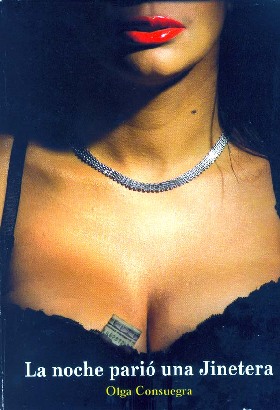
Photo: Cover of the book, The Night Gave Birth to a Hooker (2006, publisher Manati, Dominican Republic), by Olga Consuegra, writer and screenwriter based in Santo Domingo. In the book, 22 Cuban prostitutes in the Dominican Republic recount how they started hooking in Cuba. Today they are known by Dominicans as “imported hookers”. The only man interviewed is the owner of a brothel.

In a review published in the Journal of the Americas in December 2006, journalist Luis de la Paz wrote: “Many have college degrees (veterinary, engineering), [and are] professionals in different fields. All left Cuba for a better life and in most cases continued in the ancient craft. So they were not led into prostitution by their status as migrants, but were brought to this task by the tyranny that rules Cuba, that has made prostitution into a way to survive, something which, unfortunately, is not deeply discussed in the book.”

Translated by Regina Anavy

May 26 2011

Rain Has Arrived in Havana / Iván García

Photo: Josh Michtom, Flickr

The habaneros were screaming for it. After 9 months of a fierce drought, where water-laden clouds kept moving around the city, and the dams and reservoirs had gone to code red, the rain appeared.

Now, when the month of May leaves us, the longed-for spring showers made themselves present. Children and teens in shorts, barefoot and shirtless enjoyed the first serious rain of the season

Some adults also joined the party. And worried. Water reserves in Havana reach only 18%. And added to that, more than 60% is lost every night because of leaks in the whole capital. The alarming shortage made the water authorities give a new turn of the screw in the distribution of the precious liquid in the capital.

In most neighborhoods of Havana, on alternate days, usually after 8 pm at night, potable water is distributed to the population. In the old part of town there are places where running water has never reached the tap.

There are houses with pipes thick with magnesium and garbage. Nemesio, a resident of Laguna Street in the marginal and largely black suburb of San Leopoldo, has forgotten the last time he took a shower.

In these places, the birthplace of prostitutes and swindlers, the “pipers”, as they call those who handle the “pipes” or tank trucks, often make a lot of money. A family in a three-story tenement, with some resemblance to a U.S. prison from the mid-20th century, pays up to $20 for the “piper” to fill their water tanks.

In these parts, water has its price. Types who came from the east of the country who live underground in Havana, charge 4 dollars to fill up a 55-gallon tank. And believe me, there’s enough work. With the first rains of May, people breathed a sigh of relief.

“We now need it to rain every day for two months, in order to take the bad away,” says a santera. Like her, there are many people afraid of the vagaries of time. The news from the north and south is frightening. Murderous tornadoes in the U.S. and endless rain in South America. As if to show that the world is upside down.

In Arroyo Arenas, municipality of La Lisa, west of the capital, there was an intense local storm, which dropped hail the size of lemons. The rains of May also brought thunderous lightning, and because of deficiencies in drains and sewers, the streets were flooded.

But that’s not important. Habaneros were clamoring for rain, so the dams and the water table are overflowing. We’ll see if these showers alleviate the African heat.

The showers of May have returned a smile to residents and authorities. Let the water continue. Let Havana become Macondo.*

Translator’s note: Macondo is a fictional town created by Gabriel Garcia Marquez. It suffered a four-year rainfall.

Translated by Regina Anavy

May 28 2011

The Official Press, a Sedative for Change / Laritza Diversent

By now we’re used to the newspaper Granma, which excessively highlights one piece of news and omits another. Of course, it’s the official organ of the government and the Communist Party, which owns it and therefore decides what is reported and how. However, it’s difficult to accept the fact that the media is used to propagate the culture of fear and repression.

Looking for information on receiving satellite signals and antennas, I found in the Official Gazette of the Republic, which publishes Cuban laws, one order of the Executive Committee of the Council of Ministers (CECM) and two from the Ministry of Information and Communications (MIC) regulating the issue: Resolutions Nos. 98 and 99 from 1995, and Decree No. 269 of 2000.

The rules consider it a violation to import, manufacture, sell or install equipment, antennas, accessories and other devices for receiving radio communications from space, among which are included television signals, as well as broadcasting them.

The regulations provided for administrative fines of 1000 pesos for individuals and 10 to 20 thousand for companies. However, several newspaper articles from Granma informed the public that the fines were 10 to 20 thousand pesos, without specifying. The figures applied by MIC inspectors, at their discretion, could be for either an individual or a company.

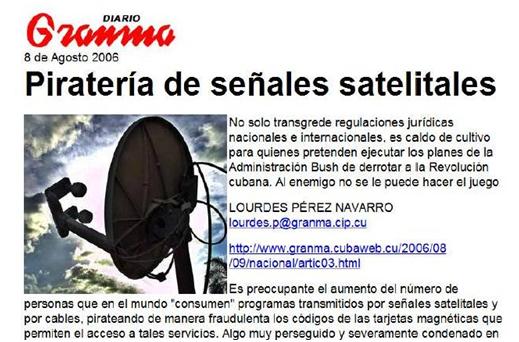
The most characteristic work of Granma was the article entitled “Piracy of Satellite Signals” by the journalist Lourdes Pérez Navarro, in August 2006. The reporter revealed how, inside the island, the illegal broadcasting of foreign television programs was developed, the national standards that they violated and their harsh punishments.

According to the journalist, the customers for the business of broadcasting foreign television signals receive “spaces with an avalanche of commercial propaganda that displays the appearance of capitalism, anti-Cuban messages and even pornography.”

She even gave a political-ideological touch to the matter. “In the case of Cuba, part of the programming that is received in this way contains destabilizing content, which is interventionist, subversive and which calls, increasingly, for carrying out terrorist activities,” she said.

Three years later, through those alien television signals, Cubans watched as Amaury Pérez acknowledged that in Cuba “there is no freedom to have an antenna” and ” … thousands of justifications for not having Internet.”

They picture Pérez saying on Cuban television, “I have an antenna” like he did on the program “To the Point” from the television network Univisión, during his trip to Miami in the last quarter of 2009.

The singer admitted having brought it in from Mexico. “… I installed it even though it was one of the larger ones, not so small. At that time nobody had any idea about the antenna, but I … television for me is very important,” he said. Amaury did not say whether he had permission to use the service. What is certain is that he could see it in Cuba thanks to the illegal reception of signals.

Pérez Navarro claimed that “the broadcasting of satellite programs, technically known as a multipoint distribution system through microwave,” was authorized as a telecommunications service with a limited character.

In other words, in Cuba, only expressly authorized companies can distribute and enjoy the service, people who are given permission by the MIC to be users. The journalist also omitted that the service was coded and intended mainly for tourism and the diplomatic corps.

Pérez Navarro usually covers the “Issues of Law” section in Granma. The article also reported that the piracy of signals “… violates agreed-upon international regulations of usage” and commits “a chain of crimes and administrative violations, which call for severe sentences under various laws and judicial norms.”

She masterfully exposed all the crimes involved in the case. She began with smuggling, which carries penalties of up to 3 years’ imprisonment and fines between 15 and 50 thousand pesos. According to the reporter, tourists and Cubans living abroad were bringing receivers and cards into the country, in violation of customs laws.

“We have detected that another way to own antennas has been the pilfering of such equipment or accessories from persons authorized to provide the service,” she said. In this case, she warned that this was committing the “crime of theft or robbery with force” and another of receiving stolen property, for whoever acquired these things on the black market.

She mentioned other crimes: “illegal economic activities,” by providing the service without a license, aggravated by the use of materials from the black market. “Speculation or monopolization” by purchasing merchandise for resale, and “Damage,” when “electric and telephone poles are disabled or transmission is broken by relocating the cables.”

She also warned that administratively there are “heavy fines and confiscation for the transgressors….The broadcasting of satellite programs requires a license granted by the agency of control and supervision of the Ministry of Information and Communications, an entity that has inspectors with the full authority to impose fines and confiscate equipment when violations are detected.”

In her article she quoted verbatim the contravention referred to in the articles of Decree-Law No 157 of 1995, another of the rules governing the matter, which states that “the amount of the fines to be imposed … shall be determined by the Minister of Information and Communications.” But she distorts the information when she gives the figure for the amount of the fines, as set forth by Resolutions 98 and 99 of that Ministry.

“A fine could be imposed of from 10 to 20 thousand pesos in national currency, or its equivalent at the official exchange rate in convertible currency, besides other administrative confiscation as an additional measure without the right of compensation or any payment,” Pérez Navarro said in her article.

She further reported that “according to Decree Law No. 99, inspectors are empowered to raise said fine up to half of the maximum (10 thousand pesos more), which could mean imposing financial penalties of up to 30 thousand pesos.”

For the finishing touch, she said: “For some, the illegal distribution of satellite television programs has become a form of unjust enrichment, which comes under Legislative Decree 149 of 1994, and they will be deprived by means of confiscation of substantial possessions that do not correspond to their perceived salaries and that they cannot justify.”

Pérez Navarro finished her report stating that “the work of persuasion of the masses” was essential “to eradicate this practice at once to support authorities charged with enforcing regulations for those who with absolute irresponsibility violate the law.”

I confess that my mouth fell open, with Pérez Navarro’s report. That regulatory clarification did not promote the observance of the law, but rather the culture of fear and repression among Cubans. I won’t dedicate even a single sentence to denounce the MIC and its inspectors, for violating the law and defrauding the public. Not to mention that to do its work they violate the citizen’s right to a home, a constitutional right.

The official press knows they have the power to dictate what is right or wrong, what to see, hear and read, and who to obey, through the dissemination of information. However, it doesn’t dare question the politics of exclusion and repression that ithe government implements through its socialist legality, for the people it promised to serve. In other words, it’s the sedative of change.

Translated by Regina Anavy

May 6 2011

The Internet is a Question Mark in Cuba / Laritza Diversent

Cuban civil society is looking forward to what will happen in July when the network structure of the island is connected to to the fiber optic cable that came in early February to Cuba from Venezuela. The event, which will multiply by 3,000 the speed of data transmission, also helped the government admit its fear of individual use of the virtual tools of information.

In 1996, Cuba was officially connected to the Internet, but the government made ​​clear, legally, its policy towards full access to the services the network provides. Since then, the “network of networks” is centrally managed by Empresa de Telecomunicaciones de Cuba SA (ETECSA) and operated by state institutions specifically authorized by the Ministry of Informatics and Communications (MIC).

Beginning in the year 2000, the Cuban government implemented, legally and technologically, an infrastructure that allows it to control access by Cubans to the Internet, through a hierarchical network of state agencies, identified as providers of “Public Services of Internet Access.”

That same year, a common international access point to the network (NAP) was legally established, ensuring that all international outgoing Internet traffic was sent from that connection. In that way, it was assured that the interconnections between national users of the Internet were routed through the national transmission media.

At the end of January 2011, the Cuban government announced the sale of the foreign shares in ETECSA, and also the purchase, at 706 million dollars, by RAFIN, a Cuban company owned by brothers Raúl and Fidel Castro. The possession of most of the shares lets them control the principal provider of the public service of data transmission.

The providers of Public Services of Internet Access cannot accept requests for installation by persons not duly authorized by the MIC. However, the regulations governing the activity requires them to accept as users “all natural or legal persons who want it.” However, the same laws have a proviso. Providers offer their services “without more limitations than those imposed by the laws in force in the country.” Since 1996, the Cuban government declared that “access to computer networks of global reach shall have a selective character” and “will have to be approved by the Interministerial Committee” composed of five ministers and chaired by the head of the MIC.

Among other legal obligations, these providers “are required to define the authorization of persons and entities that require the use of national or international Internet access services,” including “remote access from home or anywhere in the country, as well as from abroad.” They also have a duty to report the number of users with full access to the Internet, those with e-mail accounts and their IP addresses. Also required are the number of computers that access the network from places of residence and publicly. A supplier who fails to comply with the regulations of the MIC may lose its operating license.

In 2004, the Cuban government designated the “Internet Zone” to the spaces in hotels, post offices, cybercafes, etc, which provide navigation services over the Internet and email to the public costing between 1.50 and 10 convertible pesos (CUC) for one hour of access to the Web. In 2008, it completely regulated service in these centers, after Raúl Castro announced that Cubans could receive services in hotels, and authorized the sale of computers in the retail foreign currency market.

From that moment, the alternative Cuban blogosphere began to develop, currently composed of about 40 blogs critical of the government, belonging to a group of citizens, mainly young people who update their sites from hotels, embassies or with the help of relatives and friends abroad .

Providers must also block “access to sites whose contents are contrary to social interests, ethics and morals, as well as the use of applications that affect the integrity or security of the state.” One of the works of the Interministerial Commission created in 1996 was to ensure that the information “is reliable, and that it is obtained in line with ethical principles, and does not affect the interests or security of the country.”

The Cuban government is mainly concerned that the new generation of dissidents uses Twitter, Facebook and other online social networks. These sites were used to organize digital protests earlier this year that led to several revolutions in the Middle East.

Last March, the newspaper Granma announced, according to statements by Justice Minister Maria Esther Reus, that “Cuba will adjust the existing legal rules to the decisions taken as a result of the Sixth Congress of the Communist Party of Cuba,” held April 16 to 19.

Motivated by the advent of fiber optic cable to Cuba, the deputy minister of MIC, Jorge Luis Perdomo, referred to the development of the first Telecommunications Act to regulate the sector and to “promote order” in the services it encompasses. The progress in technological development that was represented with the arrival of the fiber optics cable to the island was overshadowed after State Security considered the “network of networks” as the new “battlefield”–a cyberwar–and the official media demonized the use of communication equipment.

Faced with these developments, there is no doubt that the future of the Internet in Cuba has a question mark hanging over it.

Translated by Regina Anavy

Navigating the Internet is Expensive, Slow and Risky for Cubans / Iván García

In the year 2000, in a long, narrow cubicle of the National Capitol, the present seat of the Ministry of Science, Technology and Environment, an Internet service at 5 dollars per hour was authorized. At that time 5 dollars was a little more than half the minimum wage in Cuba. The service was agonizingly slow. Its main use was for email. If you were lucky, you could get some world news.
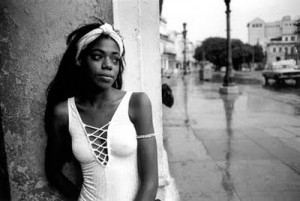

Sending photos was a real pain. Beginning in 2008, all Cuban citizens could log onto the Internet from Havana hotels for a fee ranging from 6 convertible pesos (CUC), about 8 dollars, to 10 CUC (12 dollars) for one hour of navigation.

The connection is still slow but better than that of the Capitol building. Now, with the arrival in February 2011 of the famous underwater cable linking Cuba with Venezuela, Ecuador and Bolivia, in a bizarre digital entente that people in the street called Alba.net, the speed of data transmission has improved qualitatively.

But it’s nothing to write home about. In an hour you can transfer photos and some small video that does not exceed 40 megabytes. Anyway, before you upload photos and videos, you must compress them on your computer at home because you run the risk of using up your hour of connection time without being able to upload the material.

That is, by paying in hard currency you can get on the information highway. That’s the good news. Let’s look at the bad. Virtually speaking, Cuba is an island split in two. Outside Havana, Cubans are not allowed to connect to the Internet in tourist facilities that have that service.

You have to show your passport. Just ask the troop of hard-working independent journalists from the central and eastern provinces about the difficulties they have in posting their stories and articles. In Santiago de Cuba, you can get into the Hotel Santiago, although at times the hotel security makes it impossible. People who live in Havana are “privileged.”

The other major problem is the high cost, which makes it practically impossible for most reporters and bloggers without an office. Not all independent reporters earn money for their writings in Cuba. And those who do receive between 25 and 100 convertible pesos per month, barely enough to let them survive.

Most connect to the Internet once a week in one of the two places provided in the United States Interests Section (USIS), next to the Havana seawall. A service that not only is offered to dissidents: intellectuals sympathetic to the regime also connect from there. Other dissidents do so in western embassies like the Netherlands, Sweden, Poland or the Czech Republic, which offer two hours a week free.

Connecting to the Internet is the biggest problem with alternative reporting in Cuba. And from what I can see, it’s going to get worse. The picture doesn’t look good.

According to reliable information, a crippled Internet service is being designed, scheduled for commercialization in late 2011. A kind of Intranet, where users can access only local sites and others that the government considers not harmful to its interests. This one would have access to international mail like Yahoo or Gmail.

There is talk that the installation of a DSL line by ETECSA would cost 150 convertible pesos (170 dollars), and the transmission rate would be more than 120 kilobytes, nearly double the current one. The amount would be paid monthly, according to the number of hours. It’s a feasibility study.

We’ll see what the leaders decide. The tide of events in north Africa keeps them on tenterhooks. The Castros recognize the mobilizing force of the Internet and the social networks. And they fear it. It would not be unrealistic to think that when the Internet – or the Intranet – is commercialized on the island, the virtual police will come later, in the style of China. The same or worse.

The other issue of concern, big concern, is an information law that the ideological Talibans have kept in the drawer. If implemented, it would be an appendix to Law 88, the gag law, the same that led to the imprisonment of 75 dissidents in the spring of 2003. It has been leaked that said law will regulate and penalize the use of the Internet. Tools like Facebook or Twitter, or any use that the Castro government does not consider appropriate, could lead to a criminal penalty. Let’s hope they won’t lower the boom.

The fears of the regime and the restrictions, in addition to restricting a handful of civil and political liberties, are dynamiting the future of a generation that also was born in Cuba under the domination of the @.

Some hotels and prices

In the Hotel Saratoga an hour costs 10 CUC (12 dollars). For two hours you pay 15 CUC, more advantageous. You have Wi-Fi for 24 hours. Three PCs offer service from 8 am to 5 pm. If you go with your laptop and a card previously purchased from the hotel, you can connect at any time.

In the Central Park Hotel one hour costs 8 CUC (10 dollars). Five hours cost 35 CU (40 dollars), which comes out to 7 CUC an hour. The connection is between 60 and 80 kilobytes.

The fastest connection is in the Melia Cohiba. The speed can reach 120 kilobytes. One hour costs 10 CUC if you use the terminal in the hotel. If you want Wi-Fi, you have to pay 12 CUC (15 dollars).

In almost all the hotels in Havana the price fluctuates between 8 and 10 CUC per hour for the Internet. The speed has improved. But not enough to upload large files or videos.

In Old Havana there are hotels where cards cost 6 CUC an hour, but the connection is very bad. They also use a software called Avila, which is rumored to be a spyware program that copies your email account or the password for your blog.

Translated by Regina Anavy

May 9 2011

Hookers, an Anonymous Society / Laritza Diversent

Photo: Marco Paolluzo

On February 25, in a human-trafficking case, the Las Tunas Provincial Court recognized in Judgment No. 92 that the young Cuban women “were blinded in the presence of foreigners, seeing in them the possibility of wearing stylish clothing and shoes, and the ability to visit historic sites.”

The trial resulted in penalties for seven residents of Las Tunas, five of them for illegally renting space in their homes to an Italian citizen, who had sex with five young women (including two 16-year-olds and one 18-year old), between 2005 and 2010. The age of the other two was not mentioned.

The initial indictment was for a crime of procurement and human trafficking, although only three of those involved were convicted. The rest were fined for “illegal economic activity.” The owners, who were tried by the administrative clerk, were also punished with the confiscation of their homes.

Those involved were arrested in late March 2010. In August, the authorities found in the province of Granma the body of a 12-year-old girl, apparently murdered. In connection with this incident, three Italian citizens were arrested along with at least 12 residents in the eastern territory of the country.

After the discovery of the body, the authorities unleashed a major operation in Bayamo, which was concentrated on city residents who rented their homes to foreigners. Most of the houses were confiscated.

The preliminary investigation did not mention the Italian citizens arrested just two weeks after the crime or the girl’s links with foreigners. However, popular versions of the facts indicate that the child visited a rented house where they were holding a party with foreigners, and there she consumed high amounts of alcohol and drugs.

In June 2000, the Committee for the Elimination of Discrimination against Women called on the Government of Cuba to expand official programs so that Cubans could achieve economic independence and, thereby, eliminate the need to resort to prostitution.

Ten years later, in June 2010, the United States reaffirmed Cuba as a country where people are trafficked. Earlier, in 2003, the U.S. government had included the island on the black list for “not meeting minimum standards for eliminating trafficking in persons and not making significant efforts in this regard.” And it suggested that Cuba is “a source of children subjected to trafficking, especially for commercial exploitation within the country.”

For its part, the Committee for the Elimination of Discrimination against Women also recommended that the Cuban government analyze the causes of prostitution and the results of preventive and rehabilitative measures taken, in order to make them more effective.

The legislation in force in Cuba provides special protection to children under 14 years against the crimes of procurement and human trafficking. After that age, the same laws govern as those for adults.

Cuba actively prosecutes prostitutes, mostly young ones, under the criminal offense of pre-criminal dangerousness. In the majority of cases, for their rehabilitation, they are confined to correctional work farms. Criminal liability is acquired on the island at age 16.

Laritza Diversent, Diario de Cuba

Translated by Regina Anavy

April 30 2011

Memories of a Retired Prostitute / Iván García

After preparing a very cold tamarind juice, she sits on the sofa. “Go play, I want to talk about things a little girl shouldn’t hear,” she tells her 11-year-old daughter.
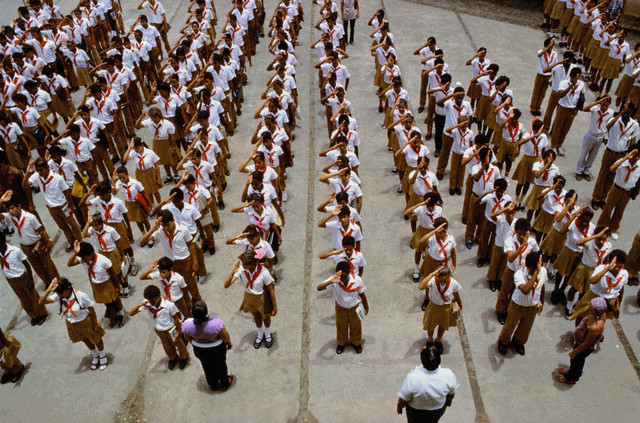


An enormous cat, old and almost blind, by instinct, with one jump makes itself comfortable on its owner’s lap. While she strokes the feline, Yolanda, 46, begins to tell her story about being a hardened whore.

“In the mid-’80’s, after quitting school after an abortion for an unwanted pregnancy, I went with a group of friends to hang out on the malecón. We used to bring a bottle of rum, and several of us decided to get dollars from the tourists.”

It was precisely in that epoch that the term “jinetero” (“jockey”, literally) was born. The first “jineteros” of Fidel Castro’s revolution were young people in search of the dollar, then prohibited by Cuban law.

“Our business was to get fulas (dollars). Later, Africans who were studying in Cuba got us a lot of stuff. Jeans, tennis shoes and shorts, that we sold on the black market. A good business. Earnings tripled, but it was risky. If the police caught you, you could spend four years behind bars.”

At that time, she was a curvy mulatta who could stop traffic. “When I walked by, all the men would turn their heads and foreigners would proposition me. I just wanted to have fun, dance and eat in restaurants forbidden to Cubans. Having hard currency was prohibited by law, the same as staying in or hanging around tourist hotels,” remembers Yolanda.

“The first time I went to bed with a gringo (foreigner) I was 21. He asked me how much it would cost for the night and I told him to give me whatever he wanted. After making love we went to the hotel shop, and the man, a Canadian tourist, bought me clothes, cosmetics and electrical appliances.”

The Canadian put two 100-dollar bills between her breasts. After that night, Yolanda was determined to make money from her well-shaped body. “I liked to fuck (screw), and besides, at the end of the day I made good money. It was worth the trouble to take up prostitution.”

In a worn book she has listed the names of all the foreigners with whom she had sexual relations. “There are more than 100 men and some 50 women. Those were the days, parties, drugs and loads of sex,” she recalls as she strokes the old cat.

Her advantage, she explains, was in hooking for herself. Never in a group. Nor did she work for any pimp. “I invested the money in buying a house and helping my mother. I was married twice. The first time to a Mexican, the second to a Belgian. But I never got used to being away from my people. I missed them a lot. From the malecón to the flirtatious comments in the streets.”

She always returned to Havana. When the men no longer turned their heads at her passing, she knew she had to hang up her shingle. And she got together with a harmless, affectionate master baker who treats her like a queen.

Of that period only memories remain. “In those times of need, given the number of women in search of money, girls of 12 and 13 years were induced to go to bed with guys who could have been their grandfathers, for 20 or 30 dollars. Previously, a high-class hooker would not fuck for less than 100 dollars.”

The cat, bored and hungry, jumps from her lap and goes off to a corner of the patio. Yolanda follows it with her eyes and sums up her existence.

“I had a good time. I went places I never could have gone if I had been a simple worker. I traveled to different countries. I tried good cocaine and shopped in expensive stores. I have three daughters, but I don’t want them to be hookers. I want them to study and be good professionals,” she says, and she gets up to prepare the family dinner. She has no regrets. “I was a party girl. And life took away the party.”
Translated by Regina Anavy

April 30 2011

Academic Fraud: An Ingrained Evil In Cuba / Iván García

Photo: Corbis Images

Yuliesky, a high school student, doesn’t have the slightest concern about examination week. Certainly his scholarly learning is zero. Swinging nights at discotheques and hot parties are a substitute for studying.

But at zero hour, his parents give money discretely to certain teachers, and they let him blow off the exams. Either way, Yuliesky has an extensive bag of tricks to pass the exams.

“It’s true that you can’t bribe all the teachers with a 20-CUC bill (=19 dollars). So I use other tricks. I record the possible answers in an Mp3 file and copy them onto a cellphone. Another technique is that a colleague who finishes first sends me the exam answers by SMS. Only I have to be careful that the teacher doesn’t see me. And I’m an expert at that,” brags Yuliesky.

If in high school and university there are frequent, shocking cases of academic fraud, imagine what happens in night schools, where those who work or have left school try to get into 9th or 12th grade.

If you have money, you’re assured of passing all the exams. It’s easy. You pay 5 “chavitos” (4 dollars), and the teacher will pass you on the exam,” pointed out Eddy, a second-semester student at a school located in Lawton, on the outskirts of Havana.

Fraud in Cuban schools is a deep evil, almost endemic. And on a greater or lesser scale it’s been happening since 1970. The massive fraud scandal involving teachers from the René O. Reiné college-prep school in the Havana neighborhood of La Vibora still lives on in memory.

In primary and secondary schools, students don’t have to be looking for a teacher’s inattention to copy the exam from their desk-mate. “Several times a teacher would enter the classroom and whisper the answer to you,” remembers Fernando.

According to Anselmo, a professor who is now a hotel porter, “There was enormous pressure on teachers to meet the parameters dictated by the Ministry of Education. If you had many students who repeated a grade it was not seen well. Teacher quality was measured by the percent of students who passed the grade and by high scores. These were the foundations of what came later. We lived the motto of having the best education in the world. And for the sake of everyone having a high educational level, fraud was not combated. On the contrary.”

For 40 years, academic fraud has been a virus that exists throughout the island, even in the universities. “But to a lesser extent. There is more rigor and better teachers. I remember that a teacher caught me copying and said, ‘What does it solve? You will have a title, but you will be a mediocre professional all your life. It was a lesson,” remembers David, an architect.

In general, students who systematically cheat or bribe their teachers to pass exams don’t reach the university. And if they do, they drop out.

Like Rosa, who left a career in philosophy in her second year. Used to copying and paying for exams, the difficulty of a university degree was too much for her. Nor was she able to retain the new information. Now, while she waits outside the Habana Libre for a Canadian tourist who will pay her 50 dollars for sex, she regrets it.

Translated by Regina Anavy

April 2 2011

Alan Gross or the Political Chess Game between Cuba and the US / Iván García

Photo: Alan Gross with his wife and two daughters.

The contractor Alan Gross, 61, remains in jail. Raúl Castro’s government definitively sentenced him to 15 years. The Gross case was shrouded in mystery and uncertainty. And it brought back the Cold War era.

After 15 months in a cell and in legal limbo, the judge handed down the sentence. Something similar happens to other foreign prisoners in Cuba, like the Spanish businessman Sebastián Martínez. In Cuba, it’s “normal” to come before a court one year after the day of your detention. Or more.

Some analysts thought that the criminal penalty of the American Jew, accused of creating parallel computer networks without the regime’s authorization, would be a few years. Many even bet that he could be on a Boeing headed home.

But the Castro brothers have a large collection of tricks up their sleeve. They are unpredictable. And they usually always do just the opposite of what logic dictates. Anyway, the case of the gringo contractor can be read in different ways.

The good news for the Gross family is that there’s no need to panic. Cuban prosecutors can easily condemn you to a torrent of years, but then, from international pressure, rationality and political negotiations behind the scenes, you can return to your country a few months after being condemned.

Alan Gross is a useful piece in this new game of political chess with the United States. He always has been. The anti-Castro fighters who fought in the Bay of Pigs and the CIA’s spies were exchangeable products.

In 1961, after the 72-hour victory at the Bay of Pigs, Fidel Castro exchanged most of the captured enemy combatants for baby food and powdered mashed potatoes.

Something similar happened with certain spies of the U.S. special services. Even the mortal remains of the U-2 pilot shot down during the tense days of the Cuban Missile Crisis in 1962 were a war trophy to be traded for political gain.

The Castros are more interested in imposing fear on local opponents and condemning them for many years than in outside adversaries. Yet, in the case of internal dissidence. they will haggle with Western powers if they see political gains in return.

Gross will be behind bars until a good proposal appears from the White House. The brothers are always open to listening to offers. Let’s make some.

A major political carrot would be to exchange Gross for the five spies from the 11 members of the Wasp network who were captured in 1998, considered “national heroes” by the regime. It has been a public pledge that Fidel Castro has failed to accomplish. Now time passes, and death subtly lurks around the comandante.

Gross was like an angel fallen from heaven. If Obama and Clinton have a real interest in the contractor, they could consent to exchange him for the 5 spies; this is more or less the logic of Castro I. You can also negotiate with new measures of economic flexibility for Cuba. And since the elder Castro often plays hardball, why not exchange him for their star spy, Ana Belén Montes, who infiltrated the CIA and was sentenced to 25 years?

The U.S. government, equally adept at business and political trade-offs, considers its options. The ball is in the White House’s court. It’s up to Obama to move it.

Translated by Regina Anavy

March 16 2011

Alan Gross, an Old, Deceived and Sick Gringo / Iván García

Photo: AP. Alan Gross arrives at court surrounded by guards.

The saga of espionage used by the government of Cuba against U.S. contractor Alan Gross, 61, could end in the coming days when the prosecutor announces the final penalty.

Gross’s trial, with the prosecution asking for 20 years in prison, was adjourned pending sentencing on Saturday, March 5, at the 10th of October Court of Justice, situated in Havana’s most populous municipality.

The official press released a simple statement which reported that “U.S. citizen Alan Gross acknowledged that he had brought into the country computer equipment and satellite dishes to form parallel networks, which are not authorized by the government. ”

It said that Gross was provided all the legal safeguards stated in the Cuban Constitution and that he admitted having been deceived by the company he works for, Development Alternatives, contracted by the State Department, and by the Department of State itself.

According to the report released by the Cuban state media, the contractor complained of economic losses and family hardship during his 15 months of imprisonment on the island.

In parallel with the case of the Jewish contractor, State television announced on Monday, March 7, a new chapter of denunciations of actions by the U.S. against Cuba, and that on this occasion it will stress the satellite communications, precisely what happened to Gross, and will provide “hard evidence” of Washington’s interference.

Anyway, despite the regime’s gibberish about the Gross case, it wouldn’t be unreasonable to think that the penalty could be waived or greatly reduced from the 20 years requested by the prosecutor.

While the fate of a gringo, old and sick, and according to him, deceived, depends on the good will of the government of Raúl Castro, in the back room a new wave of spies is being cooked up. In addition to submitting photos and videos of the American’s activities in Cuba, they will take the opportunity to try to discredit to the utmost the opposition, independent journalists and the local blogosphere.

A threatened and even more discredited dissidence would make it nonviable as a catalyst for future popular unrest.

The real enemy of the Castros is not Gross. The American is nothing more than a good currency of exchange. It’s not bad for negotiating with the Yankees. Or as a political show. Little more.

Translated by Regina Anavy

March 8 2011

Laritza Diversent Weighs In on the Conviction of Alan Gross

Interviewed for Radio Martí, and in a first reaction to the sentence of 15 years in prison authorized by a court in Havana for the U.S. contractor Alan Gross, lawyer and independent journalist Laritza Diversent said the crime – if it existed – didn’t deserve such a penalty.

Diversent explained that the act of distributing equipment to connect to the Internet does not attack the independence and security of the Cuban state, and, therefore, he could have been given a less severe sentence.

The blogger also said that the stipulation in Law 88, the “Gag Law,” could have been used for a lighter sentence, as it took into account that whoever distributes equipment of any kind from the United States or private entities shall be punished with a fine.

According to Laritza, the purpose of harshly punishing a U.S. citizen was, before all else, a fact that has political significance, since it further constrains the deteriorating relations between Washington and Havana. And she thought the sentence could serve several purposes.

One could be the intention of exchanging the contractor for the five Cuban spies imprisoned in the United States. Another would be to give an “exemplary lesson” to people and institutions around the world who try to help the nascent civil society on the island, said Laritza Diversent from Havana.

Translated by Regina Anavy

March 13 2011

Message from Ena Lucía Portela / POLEMICA: The 2007 Intellectual Debate

Dear Reynaldo González:

In the middle of the little avalanche of e-mails that have been stirred up by Luis Pavón’s return to the stage, I have respectfully read your views. I am writing just to let you know that I fully agree with you, with every one of your words. Only in place of “mistakes,” for elegance rather than being obvious, I would put “criminal acts,” which of course continue and will remain so long as they are not openly and publicly recognized as such, with absolute transparency, which I fear will not happen under the present circumstances of our country.

I take this opportunity to tell you that what caught my attention — although not much, to tell the truth — was that in Cubavision’s program, This Day, on Dec. 19, they didn’t include among the important events anything more or less than the birthday of José Lezama Lima. Was it also a coincidence? I don’t think so.

Nor do I believe that our deplorable television (the same that showed mutilated versions of Philadelphia and The Kiss of the Spider Woman, and that glorious spot to alert us to the dangers of drugs and harmful substances that turn young people into homosexuals, the same television that has never broadcast a single image of the gay pride demonstrations taking place in other parts of the world, the same that indulges in jokes all the time, or rather promotes the worst kind of homophobia, among other insults), is a being apart from our culture. No, it isn’t. Come on, at this stage of life we’d have to be very naive to believe that. As our Desiderio says in his magnificent and very timely article, Symptoms of what?, let’s ask ourselves about the causes of things; these dirty tricks, to put it gently, are signs of … something. And not precisely of something good.

Dear RG, I thought first about sending you this little message in private, just for you, partly because I’m not used to screaming in public and partly because you and I, if memory serves correctly, know each other personally and… Well, I was afraid maybe you would misinterpret me. But then I thought that if one is to express support and solidarity with someone who shouted, he shouldn’t do it quietly. So I’m sending copies to others. I hope you don’t mind.

Cordially,

Ena Lucía Portela

Translated by Regina Anavy

January 2007

Message from Loly Estévez / POLEMICA: The 2007 Intellectual Debate

Respected colleagues:

I have learned, by email, about part of the exchange of opinions stirred up by the appearance on the Cuban TV program “Imprint” about Luis Pavón and Jorge Serguera, interviewed in “The Difference.” I don’t know the contents, and now I’m actually in Spain invited by the Ateneo “Jovellanos” de Gijón. I confess my surprise when I saw in some of the messages I received that Quesada’s appearance on “Open Dialogue” several months ago was equated with the mentioned “events.” I explained to two friends who asked me about it that this was a program designed to assess the five years of work on the program, and that it included a previously recorded opinion about Quesada in his capacity as adviser to the Directorate of Programming for Cuban TV, as the Manager of “Open Dialogue” and other programs.

The fact that the emergence of Quesada several months ago was linked to refer to a matter that was specific and technical, with the inclusion of Luis Pavón in a space dedicated to people with an intellectual work accepted as capable of making a mark, and with Jorge Serguera’s presence and statements in “The Difference” didn’t seem too strange to me.

What does surprise me and motivates me to write these lines is that the Secretariat of UNEAC endorsed a Declaration where he admits sharing “the righteous indignation of a group” on three television programs and mentions “Open Dialogue” first, which automatically implicated him in “expressing a tendency outside the cultural policy that has guaranteed and guarantees our unity”; in the valuation of the Presidency of the ICRT that “in its conception and execution they committed serious errors” and in the “stupidity” that they can be exploited to harm the Revolution. I wonder if they took the time to review the “Open Dialogue” that they so “generously” describe. Before giving an opinion – and publishing it – you have to investigate.

As director and founder of “Open Dialogue,” I affirm that for six years we’ve been off the air with respect to Cuban culture and its protagonists. Our daily feeds are not the award for its category received by the program at the First National Festival of Cuban television with the theme “Where is the newest trova?”; nor the Special Prize awarded by the critics at the Second Festival (2006) for the space devoted to “cultural criticism in the media”; our difficult struggle for the complex task of making Cuban television breathe, thanks to viewers who respect us and personalities who, by their means and zeal for collaboration, turn up in our studio to give us the prestige of their presence and words. There have been National Awards from different specialties, experts on plenty of categories, officials of the culture and the media, established artists and intellectuals, and artists who will be the stars of the future.

I declare that I’m happy to have been for 27 minutes of my life together with people whose existence and work guarantee culture and unity.

I didn’t mention names not to incur oblivion, but I suggest that those officially charged with “assessing” and “declaring” and those who would exercise their right to give an opinion request criteria about “Open Dialogue” from people like Reynaldo González and Miguel Barnet (they themselves have been invited to the program). those who managed to turn into a work of true imprint the time of regret that a period that now is symbolized in Luis Pavón caused them.

I suggest that we don’t mix that which – like oil and vinegar – will end where it belongs according to natural and social laws.

I suggest that we don’t state that the outrage is only from “a group,” but that we remember Hemingway and his tip of the iceberg.

I suggest that the cycle of conferences scheduled for the singular and penetrating Desiderio Navarro be united with the voice of Dr. Isabel Monal, who along with Fernando Martínez Heredia (and other Marxist-proof mediocre, opportunistic and superficial people) might remind us how much the so-called “real socialism” cost us, like ignoring the concepts of Antonio Gramsci; or the time that Lenin devoted to the cultural debate with the poet Mayakovsky; or artistic achievement in the Paris of the avant-garde and not in the Moscow of the October Revolution of the talents turned away by the ignorance and irresponsibility in terms of cultural politics that followed Lenin in the then-besieged and admired Soviet Union.

I suggest, above all, that we don’t pretend to put an end to a necessary debate. From such discussion light is born: this was taught me by my mother, a woman raised in an Asturian home among the prejudices of the first half of the twentieth century, who was a volunteer teacher, a founder of the CDR and the FMC, and who decided to marry a Gallician immigrant, known as “Idiot” for his communist and trade-union militancy, in the days when Machado assassinated labor leader Enrique Varona.

I thank those who have read me to the end. And those who continue giving their opinions.

See you soon.

Loly Estévez

January 22, 2007

Translated by Regina Anavy