Message from Leonel Brito / POLEMICA: The 2007 Intellectual Debate

I am writing to you at the wrong time perhaps, but better late than never, as the well-known adage says. The monastic life I have been leading in one of the programs of the Battle of Ideas has dramatically separated me from my usual contacts with the cultural world; hence the controversy unloosed around the disgraceful appearance of several of those responsible for cultural policy of the “black decade” and not the “Five-year Gray Period,” as Desiderio Navarro has shown lucidly in his “In medias res publica,” has come to me late.

I am young (barely in my twenties), and in part I’m responding to Arturo Arango’s just claim that it would be alarming if those of my generation didn’t participate in this outrage, even though we didn’t experience this atrocious and horrifying process, because, as Oscar Llanes says, the exclusion of our presence now would just reproduce, consciously or unconsciously (we don’t know), those repressive methods of silencing and marginalization, known in all its shapes and sizes. It’s time to talk, comment, discuss this issue, as forbidden as other issues were in those years.

Consider, for example, that those names (Luis Pavón, Jorge Serguera and others) are now heard by us for the first time. So I think, along with many young people who don’t want under any circumstances to suffer a second helping of pavonato (remember that second helpings are never good), that it hasn’t been pure coincidence that such a consecutive appearance of those sinister characters, directly or indirectly responsible for making lives and work so miserable for many intellectuals who championed pluralistic thought, as should happen in a truly democratic society that is responsive to its citizens.

Take into account, especially, the epic and apologetic television show with which they were presented. And not only was it a lack of the most basic ethics, and now I’m not talking about that humanist ethic that “pavonates” us before the world and ourselves, but it was also an aggression impervious to most of those who lived during that time, whether intellectual or not, (family, friends and people in general), who had to suffer forms of dogmatism, opportunism and the distortion of a certain ideology, manipulated to the limit, forms which are still new to many of us.

Publicly praising people who were involved in such barbarity leaves no room for the slightest doubt in today’s political and social context. It’s not only a symptom or a syndrome, in the words of one of the debaters, it’s without ghosts or pathological elaborations a very clear announcement of what might happen in an increasingly uncertain future, and that these, and new and worse, processes could repeat themselves. So it seems to me fair and irrevocably necessary, this protest you started. You can count on the support of the youngest, of those who begin their walk down a path that can be abruptly cut off, and we are not willing to submit, not for our parents, nor for ourselves.

Leonel Brito

Translated by Regina Anavy

January 2007

When Will Change Reach Cuba? / Iván García


Like a soap opera, the marches and riots in Tunisia and Egypt were followed in Cuba by people committed to the future of their country, like the opposition, independent journalists and bloggers. Those citizens wishing for political and economic changes saw on TV the biased opinions of local experts, and they listened on short-wave radio to the news coming from Cairo.

In the halls of power, leaders analyzed the reports with growing concern and long faces. They took note. Another autocracy was going under. Without the mass media or military strategists to bail them out. The central role of events in Egypt was played by the people, made desperate by poverty and demanding freedom. A disturbing message for the Creole leaders.

Spontaneous popular movements have unpredictable effects. The Castros know this better than anyone. They have an efficient intelligence apparatus that gives them daily reports on the state of popular opinion in the island, which is certainly very tense. But still, they have room to maneuver.

For a number of Cubans, what happened in Egypt was a distant symphony. Mired in that vicious circle of getting food or repairing the roof before hurricane season arrives, they paid little attention to the Egyptian drama and its hundreds of dead and wounded.

When they think about the future, that part of the population doesn’t see itself protesting in a public square. The future, they say, is to live in a decent house, to have breakfast, lunch and dinner every day. And if they don’t connect with a US visa, to be able to travel to other countries.

Now, with the carrot of expanding self-employment held out by the government, they believe they may have an opportunity to change their fate. Of course, when it comes time to protest, they weigh fear, logic and the human factor, receiving a broadside of punches by riot troops or a bullet ending their lives. The spark that could ignite a possible revolt on the island has yet to be struck.

The Castros know that the situation in Cuba has all the ingredients for mass protests. There are similarities that scare them. The same desperation that drove millions of Egyptians to march to Tahrir Square is something that Cubans experience firsthand.

When will change arrive? In what form will it come? Popular revolts, or a slow and controlled transition from power? Predicting the future is complicated. Havana is not Cairo.

But in Cuba, definitely, democratic reform will happen. When a majority decides it. Meanwhile, uproars are seen only about buying potatoes or beer in bulk.

Translated by Regina Anavy

February 16, 2011

Between Saying and Doing… / Laritza Diversent

The scene opens with several friends sitting on any corner of Havana. They are talking, rather shouting, while passing a bottle from hand to hand. They are heatedly arguing about how bad it is out there; no one contributes a solution for a better way of getting by, and they conclude that the best way is to leave here for “…over there…?…” One of them comes up with a plan of escape. His friend listens to him quietly, takes him away from the group and brings him to a park, where they sit. He tells him:

Kid, when you’re depressed, don’t vent your frustrations in public. You don’t know who is who, you’re looking for trouble. Don’t say you’re going to take the boat to Regla to get the fuck out of here … or that you’re going to bomb the fucking Council of State so all the old people die! … watch out! They can punish you for illegal departure or for terrorism, which is worse. Remember the three black guys they shot for the same thing in 2003 … (His buddy doesn’t let him finish.)

Pal, that’s fucked. You know that when I have a couple of drinks I start talking shit…! But why, I’m not doing anything wrong. “Look innocent,” as they say here. “It’s a long way from words to action.”

I know, but your thinking is dangerous, and if someone hears you, he can steal the idea and develop it, and then accuse you of being the intellectual author, an accomplice or an instigator. Take my advice: in this country, to talk out loud about what you think or your hidden desires is risky. People will always listen and even give you rope, but at the moment of truth they will deny having eaten the cake and will throw you aside like someone to be shunned. I know that rum removes the pain, but I repeat, look, it’s not a joke, be very careful. He says this while insistently waving his index finger.

But how will they find out what I said?

Don’t be naive! For the courts, evidence from secret operations is sufficient. In this country informants multiply like fish in the sea. This is not like the CSI Las Vegas crime scene, where they need physical evidence to incriminate you. Here, just for moral conviction, you can get 20 years.

Don’t exaggerate, he says, with disbelief.

Be careful, you who go all the way to Mariano to get cheaper liquefied gas. Imagine the police stopping you and taking you in and pulling out your criminal record. All the fines for disorderly conduct, every time you pissed in the park after two drinks, arguing with an old Communist. These people have no solution, they’re eating dirt and will continue until “he” dies. But when you ask them to open their mouths, they talk your arm off. That’s a duty for them.

I know, pal, but they get on my nerves, he concludes with resignation.

As I was saying, here they know everything and at the same time know nothing. They get you angry, they can think that you’re doing something to destroy a strategic objective of the Revolution. I’m not trying to scare you; I’m just warning you. He again waves a finger in his face, while he looks to see if anyone is listening.

If that were the case, they would put everyone in jail. Do you know how many people are crazy to leave this country, or to blow up all this shit? No, and that’s not all. How many would kill themselves with bombs and everything, so that Cuba’s problems would disappear?

Don’t you know the story about the guy in the bodega who said he’d dreamt he killed Fidel? They sentenced him to not dream any more. Pal, there are thousands who think like you, but there are more who speak in whispers.

The curtain comes down; the show is over.

Translated by Regina Anavy

February 14 2011

Love in Times of Crisis / Iván García

The half-empty pockets, the threat of unemployment and lack of a future don’t prevent Cubans from celebrating “sacred” events on the national calendar, like Mother’s Day, the second Sunday of May. Or the Day of Lovers, on February 14.

“You always ‘invent’ (find a solution), even though you have little money. You have only one life, and you have to try to enjoy it,” says René, 43, a waiter. You always break open the piggy bank on Valentine’s Day, and the celebration depends on your savings. “Last year I took my wife to dinner at a restaurant, and then we made love in one of those private homes that are rented out to couples.”

In 2011, the small change from René’s savings will reach only far enough to take his wife to a paladar and then to a nightclub. Still, he’s luckier than Luis Orlando, 18, a student. “I just connected with a jevita (girl), and all I can give her is some perfume, a bottle that was a gift to my mother, who didn’t like the scent and gave it to me.”

Perfumes and colognes figure among the most popular gifts on the island for the Day of Lovers. Also soaps, talcum powders and creams. “A Cuban can skimp on food, but he’s got to have soap, deodorant and lotion to put on after a bath,” says Emelina, 62, a homemaker.

This is a long-standing habit. Before 1959, branches of famous brands like Revlon, Max Factor, Avon and Helena Rubinstein were established in Cuba. And there were two large businesses that made beauty and home products, Crusellas and Sabatés. Later,the revolution clumped together the production of cosmetics, perfumes and toiletries in the Suchel firm, which today is part of Suchel-Camacho, a joint venture with Spain

“Once my husband appeared with a pressure cooker and I almost threw it at his head,” says Marina, 35, a clerk. “And I don’t like it either when they give me underwear. The best gift a man can give a woman that day is a box of chocolates or a bouquet of flowers.”

Philip, 46, a businessman, is romantic like that. He has hired an actor and a pianist, for a mini-recital in the living room of his large residence. “It will be a surprise for my wife. The reading of poems to music will last one hour. Then there will be a catering service that I hired, with a buffet first. And dinner with a bottle of Spanish wine.”

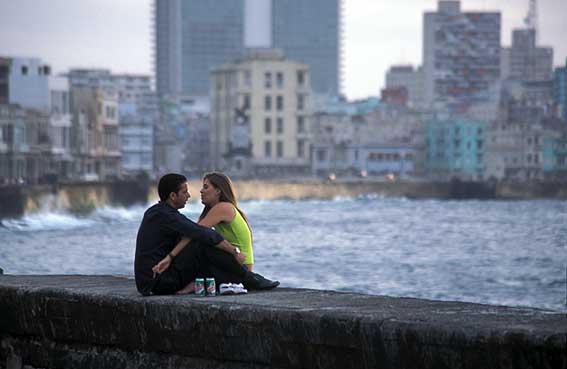
For those who can’t afford these luxuries, there’s always the wall of the Malecón. It’s free, on the Day of Lovers. And every day of the year.

Translated by Regina Anavy

February 13 2011

Private Businesses and Suspicions Flourish in Cuba / Iván García

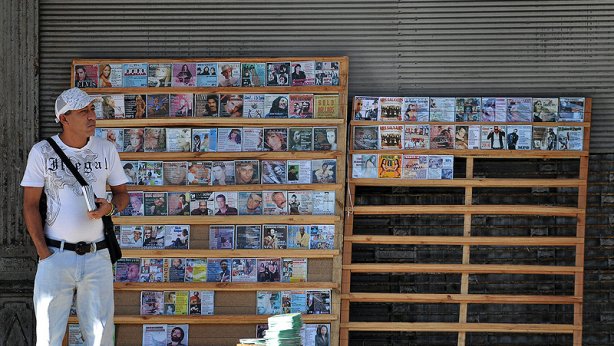
Photo: EFE. A Cuban sells "burned" (pirated) CDs and DVDs on a street in Havana.

You already see hundreds of stalls selling CDs and videos. Good-natured, calm señoras who offer a wide range of religious articles and, in any Havana doorway, from one day to the next, a snack bar with fast food emerges.

When in October 2010 they authorized the expansion of self-employment, people took their time.

There were — and still are — doubts, because of the typical ups and downs of the orthodox policies of the government of the Castro brothers, who, when they feel the rope tightening around their necks, open their hands; but when they can breathe a little political and economic oxygen, they vigorously pursue those who engage in private business.

It’s not ancient history. In 1994, Fidel Castro reluctantly allowed people to work for themselves, following some advice discreetly whispered in his ear by the Spanish adviser Carlos Solchaga, sent in haste by Felipe González to stop the meteoric fall of an economy that had lost 35% of its gross domestic product. Then thousands of small private businesses appeared on the island.

It was the plank that saved Cuba from sinking back into the Stone Age. It’s enough to recall that in the ’90’s, blackouts lasted 12 hours a day. Due to malnutrition, exotic diseases such as optic neuropathy and beriberi emerged.

At that time, a dollar was exchanged for 120 pesos. A pack of cigarettes cost 100 pesos. A pound of rice, 80 pesos or more. An avocado could be as much as 120. And an awful bottle of rum, in order to get drunk and forget the hardships, was 150 pesos.

Those were hard years, with real hunger, when many people lost a lot of weight and even teeth. To stop the impending famine, along with military strategists, the State designed the zero option: huge pots, where trucks with armed guards would hand out rations for each block.

But blood did not flow to the river. Thanks, among other factors, to the stampede of 120,000 people who threw themselves into the sea in 1994, after having instigated, on August 5, a resounding popular protest for the authorization of the exodus, which permitted the pressure-cooker, on the point of exploding, to find some relief.

The other factor was the opening up of self-employment. Gradually, from 1994 to 2000, nearly 200,000 workers took out licenses, and businesses of all kinds sprouted. From opening a quality paladar (private restaurant) like La Guarida, where Queen Sofia of Spain dined, to rescuing smaller businesses like selling punch, repairing shoes or renting out clothing for quinceañeras and weddings.

Another determining factor was the emergence of more than 200 businesses with mixed capital. These pockets of capitalism led to the advent of new technologies and innovative methods of accounting and business administration.

Most significantly, what allowed that flowering was the legalization of the U.S. dollar in July 1993. Every year, remittances enter the government coffers of over a billion dollars, becoming the first industry of the country in terms of profits. Remittances, along with the development of tourism, allowed Fidel Castro to stay afloat.

Another plank of salvation was the emergence of an important character for Cuba: Hugo Chávez. The Bolivarian comandante became a godsend for Castro. By bartering oil for doctors or sports trainers, he sold black gold to the island at bargain prices.

This allowed the old guerrilla to return to fantasizing about the Latin American revolution and the fall of the “Yankee empire.” Evo Morales, Rafael Correa, Daniel Ortega and Lula da Silva, from a safe distance, joined the red orchestra. From that point on, Castro didn’t need entrepreneurial types who would make money on their own.

Living without state supervision creates a spirit of political and economic liberty that really bothers the spheres of power. Hundreds of controls, sanctions and excessive taxes were established to discourage self-employment.

And it worked. By 2008, the number of self-employed had declined to 50,000. Castro I made a miscalculation. Before handing over power to his brother in 2006, he failed to discern that despite the Venezuelan oil and entente with fellow revolutionary compañeros in Latin America, Cuba’s economic crisis still was not out of the woods, due to a system that barely functions.

On top of that, the experts’ numbers were not reliable. Apparently, the Cuban economy grew each year like an Asian tiger. And Castro thought he had won the battle. He sent a group of foreign investors back home and tried to recover the monolithic power he always liked to exercise.

But the numbers lied. Cuba was shipwrecked, and the global crisis which appeared in 2009 made it evident. Now General Raúl Castro must put out the fire while trying to establish new rules of the game. Trying to win over distrustful capitalists, with some backward investment laws, which don’t provide sufficient guarantees. Losing money is not welcome in times of trouble.

Unclenching the fist and allowing people to go into business was necessary to cushion the blow of more than 1,000,000 workers sent into unemployment. Many Cubans on the street were suspicious. At first they measured their steps. Given the urgent need to raise cash and try to live better, they jumped into the ring.

The owners of the private restaurants, those who rent rooms and private drivers, among others, gripe about exorbitant taxes. But they know that it will always be better to work for themselves than to work for the government at a ridiculous salary.

Relatives abroad, mostly in the United States, have come forward to help with the private businesses. Most of the owners of new private restaurants have received monetary support from their families in other countries, in order to open a business that requires a minimum investment of $5,000.

In this tenuous winter of 2011 in Cuba, those who invest in small private businesses continue to have doubts and fears about how the government will react when they start to make money.

They hope that Raúl Castro will be different from his brother.

If he isn’t, they are praying they can recover the money invested before the General decides to change policy. Like a mouse dodging the cat.

Translated by Regina Anavy

February 4 2011

Fleeing the Cold, European Tourists Travel to the Island / Iván García

Photo: Robin Thom, Flickr

John, 49, is a clever womanizer from Marseilles, who, besides fucking as many hookers as he can, always keeps an eye out for business. Several times he’s tried to start a little business in Cuba.

But he always ends up splitting hairs. The lengthy and incomprehensible legal procedures and limited legal safeguards end up discouraging him. The Frenchman, an habitual vegetarian, usually spends from three to four months in Havana, fleeing his country’s cold and stress.

While he examines possibilities for investing money, he has a blast, although he gripes about the lack of nightlife in the city, the loads of shortages and the absurd laws. Every day he’s irritated by the expense of an Internet connection and the poor quality of the wine on sale in the habanero markets. On the other hand, he appreciates the hospitality of the Cubans, “something that has been lost in France, where neighbors don’t even say hello.”

Every night, for just $35, he puts a young woman with hard flesh in his bedroom. Then he lounges around as much as possible. In 2011 he would like to set up a small company that would give him certain benefits and a good excuse to spend more time making love in the tropics, drinking rum and knowing people who aspire to live in a different society.

Alberto also flees the harsh winter in Europe. He’s 35, from Madrid, and is taking his first steps in cinema. He also is fascinated by the Cubans and the island’s climate. This Spaniard is not traveling in search of whores, or to bask in the warm sun of Varadero.

Alberto is an idealist and a freethinker, convinced that Cuba deserves better luck. He hates Fidel Castro because of Franco in Spain. “Fuck, we know what a dictatorship is like.” He hopes to make several documentaries. While preparing the script, he gets to know people and reads about local history.

They are two sides of one coin. John thinks only about going to bed with black women and doing profitable business with the Castro brothers’ government. And Alberto, who’s particularly fond of the island, is more interested in its democratic future.

Where the Gallic hedonist and the Spanish altruist agree is that they both touch down in Havana, trying to avoid the harsh European winter. Once on the island, each goes about his business.

Translated by Regina Anavy

February 9 2011

Hope for Possible Legalization of Buying/Selling Cars and Houses / Iván García

In this spring of 2011, we wait expectantly for the announcement of new measures to allow Cubans to buy and sell cars and houses.

It’s likely that during the sessions of the Sixth Congress of the Communist Party of Cuba in April, they will abolish the absurd prohibitions in force that forbid Cuban citizens from buying or selling a home or car.

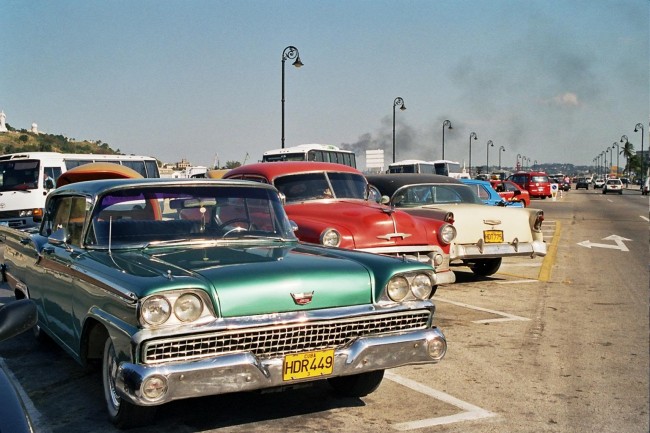
On the black market, buying and selling cars and houses is one of the most lucrative businesses, which has produced unreal profits. An old Ford car, late 40’s in good condition, can cost up to $30,000, twice the cost of an apartment with three bedrooms and 90 square meters.

Evelyn, 54, who sells houses in Havana illegally, is one of those who think that when this type of buying and selling is legalized, prices could fall.

“A good house could be quoted between $80,000 and $100,000. Maybe more. It will depend on the interest shown by foreigners involved with prostitutes and those Cubans living abroad who wish to acquire housing for their relatives on the island. The signs in the underground market indicate that a significant number of people would throw themselves into buying homes because of the housing shortage in the country,” predicts Evelio.

If housing prices soar, car prices could hit bottom. “It’s not possible that a relic of the twentieth century from General Motors is sold today for $40,000. Or that a mediocre car, like a Russian Lada, costs more than $20,000. It’s crazy. If the state begins to sell cars that are modern and economical, even at outrageous prices and for large profits, the speculative bubble in car sales would decline sharply,” said Joseph, 43, who for two decades has been involved in buying and selling old US-made cars.

In the meetings that are taking place these days in neighborhoods and workplaces, to analyze and discuss the guidelines for the future economic and social policies that Raúl Castro’s government will apply at the Sixth Congress, the most discussed points are the disappearance of the ration card and the authorization to buy and sell homes and cars.

Another topic discussed a lot is the abolition of the country’s entry and exit permits for Cubans, which confers on the regime unlimited power, to be used as a reward or punishment, when authorizing foreign travel. According to reliable sources, this topic will not be discussed in the short term.

What’s really hoped for, I repeat, is the repeal of laws that prohibit buying and selling of houses and cars. At the starting gate, after the gun goes off, there will be foreigners or people who travel frequently living in Cuba.

Heinz, a Swiss man who often visits the island to chase skirts, is considering buying one or two floors when the government gives permission. “In my country an apartment costs about 200,000 francs. Here, I think that one in good condition wouldn’t go over $60,000 dollars. Anyway, in Cuba the laws are very complicated, especially if they allow foreigners to purchase property from the natives. If it’s not authorized, it wouldn’t be worth it to buy a house in the name of another person. There are many dishonest people in Cuba,” he says smiling.

It’s also likely that the business of buying and selling homes won’t suddenly blossom. Some 62% of residences in Cuba are in fair or poor condition. Moreover, there aren’t enough houses. Quite the contrary.

It’s common to have three different generations living under one roof. Young couples have no privacy. And many resort to countless inventions, such as building a loft (half-way to the ceiling) or improvising room dividers.

Either way, there are great expectations about possible state permission to buy and sell houses and cars. In a country fenced-in by so many prohibitive measures, repeals are always very welcome. Although few benefit from them.

Translated by Regina Anavy

February 4 2011

Messages from José Rojas Bez / POLEMICA: The 2007 Intellectual Debate

Dear Desideri,

Receive once more a warm embrace from this friend “beyond the capital.”

I welcome your fair challenge to the title of “GROUP” being applied to the large and diverse number of participants in the current debate, and the last paragraphs, about our “culture of spectacle” (and their “controls”), motivate me even more.

But I wanted to make an observation. Knowing you for years (you and your work), I know that this is a lapse in the editing when you talk about “the important ones.” It’s worth clarifying that we are all equally important as human beings and potential “contributors” although not equally “known”or “influential.” Let’s avoid falling into the trap that we criticize; thanks to the mass media and other “promotions” we don’t always properly know the best, and very often – this is the more serious! – the worst are too highly “ranked.”

You confirm my reasons, already stated, that the problem is not a “Pavón” nor a “Five-year gray period,” simplifications that, although well-observed, can serve as “symptoms” (“indices,” “icons” and “symbols”) in order to know and reject so many, innumerable “Pavóns” and “Pavonas” and “problems” from yesterday, today and tomorrow (since I don’t think they can be solved from one moment to another – I wish!), but that – poorly brandished – they can serve to focus excessively on the problems over two or three peculiarities and circumstances. Let’s prevent this error! continue reading

In my previous email I pointed out three or four among the possibly infinite number, including those of education and, of course, the media, with their manipulations, open doors to mediocrity and opportunism, and the mistrust of the depth, sincerity and culture that is not the “aesthetic of superficiality.” Although it’s a universal problem – and apart from the fact that another’s wrong act doesn’t justify your own – the “Pavóns,” structures, conditions and uses – especially the “uses “- have worsened it among us. I’m glad you insist on that. What a great topic for a broad debate “shirtless”! (Would it solve anything, I wonder?) I am sending you here an article where not long ago I suggested reflections from the universal to the personal about that. ).

Since it’s very brief, I’m attaching it, so you can take a look when you finish your “current emergency reading.”

Sincerely, Rojas Bez

Another message from José Rojas Bez to Juan Antonio García Borrero

Your email worries me doubly.

I am struck, first, by the double or repeated mistake of seeing only the critic Colina as “sensitized.” I’m glad that Gustavo has now clarified for you that there were others who were “sensitized” even long before Colina, from the very beginning, like Luciano and Frank. I say “before” because of a simple chronological order and not to highlight differences in sensitivity nor anything else, but to point out that, having followed the debate, you should already have “noticed” others.

But you fall back into the mistake, since it’s not “also” Luciano, Frank and Gustavo, but also Rojas, from the very beginning of the debate, along with others (Marrón, Manuel García,…) that I suppose you don’t know as well, but I think you do, because they’re not members of the Association (not everyone is, nor are all not). I hope you haven’t forgotten that I am also critical (and an old acquaintance of yours as the founder of our Association and from even earlier). Or that our youngest friend Gustavo has misinformed you without wanting to. Well, this is teasing.

What happens is that many “film critics” are interested not only in movies, but also even more in Culture and Society. Above all in Culture, Spirituality and Society, and we don’t focus on our “sensitivity” nor on our participation in film (in parentheses, neither does Colina), nor on our being in essence “film critics.” Perhaps because of that you didn’t notice it well.

The second concern: Will you be imbued with excessive relativism? Won’t you have a little more definition? The ending of your letter leaves me with that worry.

Don’t you know that there is critical thinking within the island, which doesn’t need “to be brought into the light” to make itself real for you (and others) because it DOES exist, though it’s not the most widespread officially, and though it can always, and SHOULD BE, enriched by you, and many, many more … even off the island … Is it contempt, folly or another mistake about the above? Remember that you criticized the critics who believe themselves to be “the navel of the world.” You amaze me when you say, for example:

“I know you’ve written all this with the pressure of the ‘hot debate’ and that you’re sharper than what you show in this specific email. I invite you therefore to think more calmly and, of course, to remain critical, inside and out, up and down, in the capital or the province, when it’s with honesty and love for Cuba and Culture.”

Finally, I am not opposed to any meeting of critics, as someone has suggested. Why not, except for the practical problems of cost and schedule? No discussion or reflection is bad. Now is fine, always when it’s not converted into an “elite” or special group, but always merged into the COLLECTIVE DEBATE, of all and for the good of ALL, though, as the Film Critics Association, we should accentuate, emphasize the problems of film.

Sincerely, your old friend, the equally old friend, old critic and film researcher and old exerciser of opinions, not just about film.

Rojas Bez

Message from José Rojas Bez to Desiderio Navarro

I just got your message of righteous disapproval, along with that of other friends and colleagues who, logically, seem to be multiplying.

First of all, I have established that I’m joining a protest that is so just.

However (and here come the “buts”), I regret that such energy is deployed only now and that we have not shown it before (myself included, of course, in the criticism) on countless occasions.

Is the “Pavón” case a symptom, or rather a syndrome?

It’s a syndrome that has never been absent although sometimes it’s more hidden than at others.

I speak to you from a province (typically conservative and exclusionary), and I want to remind you that, if Havana has always been, by obligation and not by mere desire, more permissive and pseudo-liberal than the rest of the country… then imagine the rest that are removed from the best ministers and the best intentions, and in the hands of the local “fates.”

Many Pavóns (even female ones, of course, not to be sexist and also to recognize that some females have the ability to take advantage of the rostrum and others get close to power to “make themselves felt,” to impose themselves like Pavón) have never ceased to exist. Nor have their associations, like opportunism, suspicion and laudatory phraseology beyond work and serious achievements.

Either way, I insist on my criticism (and self-criticism) that we have never made protests nor proposals that are as energetic and collective on numerous issues involving the nation and culture, including the causes (first and second), and not simply the third with the most visible and skin-deep effects.

There is, among countless possible examples, to not get further away in time, that larger problem of the implications of the dismantling of our historic sugar industry, not only for the economy, but also for the life of the villages, communities and other spiritual areas related to that industry.

What about everything that has generated tourism and its managers, the new “status” and “culture” well above being a worker in other areas, which reproduces bourgeois behavior … in this case with State budgets and risks?

But let’s refer to the strictly “cultural.”

How many times do we use that “anti-Pavón” energy to suggest lower expenses and damages in everlasting manipulations to absorb information, and demand more criticism and analysis or, same thing, less triumphalism? Or when Customs seizes political books sent from outside by colleagues for our information, denying us the right to read and judge them on our own?

And what about the opportunistic, distorted views of our history and our heroes, like that pitiable image of Martí (actually anti-Martí), increasingly official and enthroned, of a democratic Marti – popular, “pre-Marxist”? Or the poor little guy, the immature Martí, who had not yet seen the light of Marxism, remaining in the “pre”! What reader of Martí could ignore that he not only knew about Marxism and socialism, but he also did not approve, in the most truly Cuban tradition, that of Father Félix Varela, Agramonte, et al, and he was not a simple pre-university student!?

Brave, the editor (not the writer) who published essays about Martí’s idealism or the fruitful influence of idealism on Martí!

And neither did we protest so much when the mentioned Father Varela was left offensively without the “Father” because, they said, he was a patriot and great “in spite of” being religious.

Brave, the editor (not the writer) who published some essay claiming that the patriot and the man of faith were inseparable, and the more faith the bigger he was!

And how difficult it was to publish essays related to biblical books (of course, when it was to praise them or give them merit) even if on a strictly literary level!

Let’s not forget, by the way, how only an atheist education (not secular, which would have been okay, but aggressively atheistic) was maintained for decades.

When, among thousands of possible examples, we so angrily demanded for years that they publish Dulce Maria Loynaz, and that such an illustrious creator, like many others, let’s say Lezama Lima himself, were “non-existent” in our programs and textbooks on Cuban literature?

Okay, esteemed (and also admired Desiderio, since we owe a lot to your informative work and diffusion of high culture), let’s cry out against Pavón and all the Pavóns, male and female, but the two or three examples given among a possibly infinite number remind us that it’s not a question only of a Pavón or some other individual and circumstance, from that time and before, up to the present year.

Receive, as always, my warmest hugs.

Rojas Bez

Translated by Regina Anavy

January 2007

Cuba, We Who Are About to Die Salute You / Ángel Santiesteban

From Reporters Without Borders

So Orlando Zapata gave himself up with the only weapon he had. Guillermo Fariñas then went to the edge of the abyss, from where it is assumed there is no return, but his spiritual energy carried him and brought him back; besides, the fight is not over, that was only one chapter. Both Zapata and Farina are examples to follow.

Cuban bloggers have endured intimidation, arrests and kicks. And yet it seems little to us if we compare it to the infinite pleasure of communicating, delivering opinions for those who prefer silence out of the fear of retaliation.

The agents of the political police understood that they’re clumsy. Although they continue to engage in physical aggression, now they walk a fine line. They have set in motion the machinery of their means of communication and counterintelligence. Yoani Sánchez was the first, then the blogger Diana Virgen García.

Just around the celebrations of July 26, 2009, the most important holiday of the regime, I was arrested. My ex-wife, after four years of separation and having a relationship with a senior police officer named Pablo, the superior of the Sector Chiefs of the municipality of Plaza, went to the police station at Zapata and C, and accused me of rape. Luckily, at that time I was far from the place that she chose for the false accusation. I was with friends who served as witnesses in the presence of my current partner.

The officer who notified me about the case told me that my ex suffered from a mental disorder, and it was possible she would have to be admitted to a psychiatric hospital. He said that after making the complaint, he explained to her that she would have to take it to Legal Medicine to corroborate that she really had been raped: it was the only way to present such an atrocity before a trial. She refused. Then she showed a medical document where she was diagnosed with an injury to her ear, and a picture of some marks behind it, such as scratches. The officer let her know that in order for the document to be found valid, she had to return to the doctor with a policeman he would assign to her. She also refused to consult the doctor. Regarding the photo, the officer insisted it would be valid only if it had been taken by police specialists, but as there were no visible marks, it didn’t make sense that experts would appear.

Then my ex rescinded the above allegations and said that she was accusing me of stealing some family jewels. The officer began to ask her for a description, to later corroborate it with her family and friends, so they could guarantee that the jewels were really hers, and to compare them with some photo where she was wearing them. She again refused.

She then asked, as if playing a children’s game, that they take another statement, about my stealing money in several currencies, CUCs, dollars and euros, whose total sum barely surpassed $100.

The officer who assisted me could demonstrate to her, with several witnesses, where I was at the time declared by my ex, while she couldn’t present any witnesses or evidence that would incriminate me.

The officer said I could go without imposing any injunction on me. A month later, I passed about sixty meters from my ex. The next day she tried to accuse me of harassment, but they did not accept the complaint

Fifteen days later, at the place where my ex lived, at dawn, there was a short-circuit in some wires near a bush of dry leaves, and a fire broke out. The firemen took more than an hour to arrive. The neighbors had warned them about the power failure and that an accident could happen. My ex was not at home, but the next day, when she appeared, it was at the police station, and she accused me of attempted murder.

However, several caretakers for neighborhood businesses at the residence saw no one near the place; in fact, it’s nearly three meters high and there are two locked gates that the firefighters had to break down.

Twenty-four hours later I was summoned by the police, and witnesses showed where I was at the time of the fire. And they agreed to let me leave. Then, a senior official insisted that I would have to post a bond of 1,500 pesos. Obviously, it was not by chance that days before I had received an invitation to the Festival of the Word in Puerto Rico, signed by the writer Mayra Santos-Febres. With the imposition of the bond my leaving the country was prevented, along with the possibility of being able to communicate with the international media.

Days later they changed the police officer on my case. The new one was announced as Captain Amauri, and in a short time, he was apprised of all the imaginary complaints for which the prosecutor requested more than fifty years in prison.

There was an alleged witness. I don’t know if it was a matter of one complaint in particular or all of them, but the fact is that the day they began the cross-examination, he shouted that they couldn’t force him to testify against me, that he did not know me.

On leaving the police station, the alleged witness presented himself at my house and before my neighbors explained what actually happened. He videotaped the confession.

Then, last July 25, I was summoned to the station because the alleged witness, the only one they could manipulate, had made a complaint against me of threats: “coercion” to not testify against me. They held me for 18 hours without food or water. Only when Castro’s speech for the celebration of the assault on the Moncada barracks was finished did they release me, without the alleged victim having appeared.

I came home and copied 100 CD’s of the confession of the “witness” and delivered it to the police and to whatever media of disclosure exists in this country, although they don’t function. And like the gesture that quiets the orchestra, there was silence.

Today the authorities don’t know what to do with me. They have a totally manipulated trial where the court rejected my witnesses. They know that I have the video where the witness points out the manipulation, the promises and the pressure on him to testify against me.

That’s the way things are. I remember a school friend, who loved Cuban literature, who asked me, days before I started to post on my blog, if I was prepared to face the devastating machinery of the system. I was silent for a while. I thought about the urgent need to communicate about my environment and social problems. I replied that I was not naive, that I knew how far they could go, and I remembered Martí and Lorca.

I must admit I never thought the Cuban political police were so twisted. I never imagined I would get involved in such disgraces. Anyway, it’s always one step more to freedom. The desperation of the system is a symptom of fatigue.

Translated by Regina Anavy

February 9 2011

Thoughts on Fidel’s “Words to the Intellectuals” and other texts / POLEMICA: The 2007 Intellectual Debate

– From Josefina de Diego –

I confess that I didn’t remember the full text known as “Words to the Intellectuals,” delivered by Fidel Castro on June 30, 1961, at the National Library to a group of intellectuals. I think that, like many people, the only thing I remembered from the text was his famous declaration of principles, “Within the revolution everything, against the Revolution, nothing” which, without doubt, sums up the essence of the document.

In the debate that is taking place at this time among a group of people – not only by intellectuals – by e-mail (which limits, of course, a larger participation), they started asking questions about a number of problems, past and present, of national culture, upon the surprising reappearance of three officials – simple executors of a cultural policy drawn and guided by the highest leadership of the country, who, in the decade of the ’70s, were at the forefront of major cultural institutions: former Lt. Luis Pavón (President of the National Council for Culture, 1971-1976), former commander Serguera Papito (director of Cuban Television, 1966-1973) and Armando Quesada, who, among other things, was responsible for destroying the Cuban theater during those years. These functionaries were former military officers who had been part of Raul Castro’s team. Given the current situation in the country, in which the Minister of the Armed Forces has assumed the leadership of the government, many thought that the “resurrection” of Pavón, Serguera and Quesada was a sign that there would be a return to the past.

During the “reign” of these gentlemen, a veritable witch-hunt was unleashed in the country against gay writers and artists; books were censored (the “Padilla case,” 1971), what was called “ideological deviations” (having long hair, wearing blue jeans, listening to the Beatles and other groups and singers not well-regarded by the government, having “wrong sexual preferences,” professing any religion, etc.) were severely punished; the poet and novelist Jose Lezama Lima, who died in 1976, was condemned to an intellectual silence, etc.

Although the persecution worsened in these five years, it had started in the early ’60s (censorship of the film, P.M.; UMAP; charges against Padilla and Arrufat in 1968; the destruction of the collection of poems by Delphin Prats, Lenguaje de mudos (1968); the banning on radio and television of broadcasts about artists who had gone abroad, they began purging the country’s universities, etc.) and this would continue, with different nuances, sometimes more, sometimes less, until today. continue reading

Examples abound: the censorship in the artistic movement of the late ’80s, the relentless criticism of the film Alicia en el pueblo de Maravillas (1991); the imprisonment of María Elena Cruz Varela (1993); criticism of the film Guantanamera (1997, at a meeting in the Palacio de las Convenciones, after Eliseo Alberto, co-screenwriter of the film and author of the book, informed against me, he won the Alfaguara Novel Prize), the impossibility of mentioning writers and artists living abroad who don’t have a position that is “comfortable” for the system, the “disactivation” (no longer belonging to UNEAC) of the writer Antonio José Ponte upon finding out that he was part of the editorial board of the magazine Encuentro (2002), the jailing of poet Raúl Rivero and others for the crime of expressing their opinions openly, although they were accused of being “enemy agents” in hasty trials (2003); the censorship of documentaries and critical short films, like the recent case of Monte Rouge (2005), etc.

Pavón, Serguera and Quesada disappeared from the cultural “landscape” in 1976 when the Ministry of Culture was founded and started a new stage that, no doubt, wished to correct the mistakes and tried to foster an environment of trust and respect, which was achieved in many ways. To reappear in the final months of 2006, thirty years later, in three different programs on Cuban television. Those who suffered firsthand the injustices committed during those years reacted angrily, with good reason, and decided to show it through the limited space of email.

The controversy has transcended national borders, many Cubans living abroad have expressed their views. Others – inside and outside – want the debate to include other key issues (a justified demand since, as the economists of the nineteenth century including Karl Marx, said, “the economic base defines the superstructure,” from where it naturally follows that we must seek answers about the culture in the economy). Unfortunately, some use abusive language, bring out the “dirty laundry” and tarnish a discussion that could and should be deep, serious and inclusive of all opinions.

The tone of the debate has ranged from complex and measured analysis to actual attacks, furious and unpleasant. I think for the good of all and the country, it would be advisable that we all try to listen with tolerance and respect to each other’s opinions. In a country where for years the only prevailing view has been the official standard – with very limited space for debate – it’s not easy to develop a balanced dialogue, without offense or impassioned responses.

In the “Declaration of the Secretariat of UNEAC,” insufficient and misguided for many – no one understands why it was drafted like that, if they had plenty of time to write something more elaborate and consistent with everything that had been proposed – it states: “Cultural policy reflects Martí; it’s the anti-dogmatic, creative and participatory policy of Fidel and Raúl, founded on ‘Words to the intellectuals,’ and irreversible.” Alfredo Guevara also endorses this statement. And this is the point I want to analyze.

In the first place, Fidel defined the cultural policy in his words. Raúl Castro had nothing to do with it, among other things, because it’s not his specialty. The fact that his name is added to the declaration of UNEAC responds to the current situation, not to his actual participation in its development. The meeting with the intellectuals came two months after the Bay of Pigs invasion, in an extremely difficult time for the Revolution, with strong and real threats from the United States and a huge political tension that would peak in October the next year. The main topic of discussion, according to Fidel himself, was freedom of expression.

No one questions the form, just the content, and it sets out clearly a disturbing indictment: he who has doubts is not a true revolutionary. I think, with all due respect, this approach is not correct, not true, and it’s this criterion that led to a series of injustices against artists. It generated an official thinking that was rigid, narrow and reminiscent of the excesses and mistakes of the Soviet Union beginning with the era of Stalin. Why could a revolution that had the support and love of the majority of the population not allow dissent? It would have been healthier for the system to allow the free exchange of ideas, because, undoubtedly, the Revolution, with all its social and economic achievements, would be victorious in this battle. But it chose the path of rigidity, and that path led to an abyss of frustration and injustice.

What calls my attention is the beginning of his speech, where Fidel propounds that:

“That is, the benefits, both material and cultural, were designed to be enjoyed by protagonists and contemporaries of the Revolution. The writers and artists would be living their moment of fulfillment, they were granted the right to be free, a right won with weapons in a just struggle. But those who mistrusted, who had different opinions, were automatically ‘out of the game’. In the cultural supplement Lunes de Revolucion, founded in 1959, the writers who belonged to the Grupo Origenes were harshly criticized, by Catholics, the bourgeois and those who were apathetic. Didn’t these writers feel marginalized from the revolutionary process? Weren’t they made to feel guilty for doubting and having philosophical ideas that were different from those of the successful revolution? Wasn’t the moment of ‘now and for the men of this time’ meant for them”?

But in the end, Fidel affirms the opposite and asks for the ultimate sacrifice:

“Gentlemen, would it not be better to think about the future? Are we to think that our flowers will wilt when we are planting flowers everywhere? When we are forging these creative spirits of the future? And who would not change the present, who would not change even their own present for that future? Who would not change his, who would not sacrifice his for the future? And those who have artistic sensibility, don’t they have the disposition of the fighter who dies in battle, knowing that he dies, that he ceases to exist physically to fertilize with his blood the road of triumph for those like him, his people? Think of the soldier who dies fighting, sacrifices everything he has, sacrifices his life, sacrifices his family, sacrifices his wife, sacrifices his children. For what? For us to do these things. And those who have human sensitivity, artistic sensibility, don’t you think it’s worth making the necessary sacrifices? But the revolution is not asking sacrifices of creative geniuses; on the contrary, the Revolution says: put this creative spirit in service of this work, without fearing the work will be cut short. But if one day you think your work may be cut short, say: it’s well worth it to have my personal work cut short in order to do work like what we have before us.”
One of the topics discussed was the censorship of the documentary made by Sabá Cabrera, P.M. It was considered harmful for the people because it presented scenes of night life in Cuba, at the end of 1960, that were not found, according to the standards of the senior ICAIC functionaries, at the height of the moment being lived by the country. Fidel talks about the documentary, although he confesses that he has not seen it.

I think in the context of the times, as I said, in the midst of difficult situations in which the Revolution needed to consolidate itself, an inflexible and cautious policy was justified, and that the approach of “against the Revolution, nothing” had its reason for existing. On countless occasions the country’s development has demanded changes, adjustments, modifications; it’s a logical process of life itself. Fidel himself has not hesitated to make these changes: he denounced the “errors and negative tendencies” (1984); there were major shifts in economic policy (“now we are going to build socialism,” he affirmed in 1986, denouncing a series of situations that threatened the country’s economic development), and more recently, in his speech at the Aula Magna of the University of Havana (November 17, 2005), he made these reflections.

I don’t think we should accept that the Martían cultural policy, anti-dogmatic, creative and participatory, of Fidel and Raúl, founded on “Words to the intellectuals,” is irreversible, among other things because that statement itself is dogmatic (as defined by the DRAE, “dogmatic”: inflexible, holding opinions as firm truths, without doubts or contradictions.”) Everything can be reversible (only death is not); everything can be improved, adapted or made more perfect; all have the right to participate, pro and con. In Cuba – perhaps as in no other country – education and culture have developed; art schools have been created, a successful literacy campaign was carried out, libraries have multiplied, education has been brought to the most remote corners of the island, a solid, superior intellectual and artistic movement has been created. So I think it’s time to raise a genuine national dialogue, where everything is questioned and analyzed, without fear or rules, and where a genuine exercise of freedom of expression is permitted.

Josefina de Diego

Havana, January 25, 2007

Another text from Josefina de Diego

“Let’s follow orders” or “Who belled the cat”?

The “Five-year gray period,” framed between the years 1971-1976, was only a stage – not gray but black – within the entire cultural context of the island. The problems that are attributed to this period had begun from 1959, and had “their best definition” in June 1961, with the famous “Words to the intellectuals,” handed down by Fidel in the National Library.

In late 1960, the documentary PM, directed by Sabá Cabrera Infante and Orlando Jiménez Leal, was censored. Lunes de Revolución lambasted the Grupo Orígenes (1959-1961); in 1961, private schools were nationalized, and priests and nuns were expelled; that year also created the ORI (Integrated Revolutionary Organizations), which merged all political groups that fought against the Batista dictatorship, which eliminated any possible source of opposition, however slight it might be. Anibal Escalante, a prominent member of the PSP, was named director; in 1962 Anibal Escalante and his top aides were expelled from the direction of the ORI, accused of sectarianism; in 1963, the ORI replaced the United Party of Socialist Revolution (PURS), the antecedent of the future Communist Party (the only one) of Cuba (1965). The sadly-remembered UMAP, a shameful chapter in our history, occurred between 1964 and 1969: the censorship of the books Fuera del juego, by Heberto Padilla, Los Siete Contra Tebas, by Antón Arrufat and Lenguaje de mudos, by Delfín Prats, to name only well-known examples, followed in 1968. On March 13, 1968, in a speech to commemorate the attack on the Presidential Palace, Fidel confirmed the arrest and imprisonment of the microfraccionarios, led by Anibal Escalante, and announced the beginning of the Revolutionary Offensive, which ended, among other things, the small amount of private property that still remained. It was also in the late sixties that the purges began in the universities, the accusations of “ideological deviations,” etc.

In the following decades the problems continued, though not with such intensity and intolerance. I won’t do the recount, because many have already taken this on in the current debate, but what I want to emphasize is that the control on freedom of expression, the media, free association, etc., has maintained itself until our time, and not only in the cultural sector but in all sectors of society. ICAIC, an agency with a reputation for being liberal, is still deciding which scripts are shot and which aren’t, which movies are shown and which aren’t, just like they did with PM in 1960. The imprisonment of Raúl Rivero and independent journalists, in 2003, and other cases of censorship and restrictions that occurred “yesterday,” are proof of that.

It would also be unfair not to recognize all the undeniable progress made in this half-century of Revolution: no government set out to do so much for “the poor of this earth.” It brought education and public health to the farthest corners of the country (although the quality has declined considerably in the last fifteen years. I think disproportionate international aid is being provided to many countries; it has left the island without the doctors and teachers it needs, which has seriously affected the quality and quantity of these services – for the record, I think it’s a humanitarian and generous effort, worthy of respect and admiration, that all governments should exercise); important plans were developed for cultural, social and economic development; the Literacy Campaign was a success; schools and art institutes, libraries, museums, cultural centers, the National Ballet, ICAIC, the Casa de las Americas, etc., were founded.These seeds bore the precious fruits that we collect today.

Now, returning to the title of this text – which I don’t want to prolong any more – I would say that I have drawn attention to the statements of two officials who stood out during the “Five-year gray period”: Serguera and Félix Sautié (second to Pavón). Both have said (Serguera in an interview and Sautié in a letter) that they received and followed orders, like soldiers. According to them, they were not responsible for what they did, only the executors of the policy outlined by the “highest leadership of the country,” that is, the policy defined in 1961. We all know that this was and still is so. I think centralized power over the years has been the cause of many of the difficulties that we now suffer. I don’t doubt the good intentions, but the fact that there is no real discussion and debate in the bodies responsible for defining the government’s policy has not been beneficial for the integral development of the nation.

There is something that I’ve always held as an unquestionable principle, but I think it can be the cause of many of the ills that plague us (the double standard, apathy, laziness and skepticism of the young, among others): the existence of a single party (I don’t want my words to be misinterpreted nor to be accused of having an “annexationist agenda” nor of “aiding the enemy.” I simply express my opinion.) I remember one person who told me: “It’s true that Martí created a single party, but who founds a party and another one that opposes it at the same time?” The existence of a single opinion (for example, all members of the National Assembly are members of the same party) prevents the necessary flow of different ideas that are important for the “oxygenation” of the country and its organic development. The claims that this gives “arms to the enemy” and that “it’s not the time” have returned like a boomerang, and it’s the people who are left without the weapons they need to build, think and organize their country. In other words, silence has prevented the actual display of ideas and concerns of the people, the true exercise of free speech, debate, confrontation of opposing views, effective exchange and the enrichment of different opinions.

If the officials of the period under discussion were following orders, who gave them? Why did they if, as Serguera said, he did not even agree with many of them? Why was this type of behavior generated, to accept everything, to not question anything? Wouldn’t it be good and healthy to begin to change this mentality? Why not have a debate – not only on culture but also on the economy, education, public health – where these issues can be analyzed in depth, and we can begin to change what needs to be changed?

The international situation has evolved, the left has been reborn with renewed vigor in many parts of the world, and Cuba is again accompanied by numerous Latin American countries. I think, honestly, if you rethink a lot of things considered as immutable in our country, it would be an important step toward rescuing, protecting and keeping all the achievements – which are a lot – in these years.

Josefina de Diego

Havana, February 9, 2007

Another text from Josefina de Diego

Case closed

The “Five-year gray period” was a term used by Ambrosio Fornet to refer to the “grayness” of the literature written between the years 1971-1976, as a result of a policy of doctrine, suspicion and intolerance against the cultural sector, and the calls that were made by the highest political and cultural leadership of the country to develop an art that is truly “revolutionary,” something impossible to achieve starting from such narrow limits. Previously there had been a moment of glory – according to Fornet, a “Five-year gold period” – with Los años duros of Jesús Díaz, Condenados de Condado by Norberto Fuentes, Los pasos en la hierba by Eduardo Heras León (all published at the end of 1960), etc. And also – although I believe that Ambrosio is not referring to these books – with Celestino antes del Alba, by Reinaldo Arenas (1967), Fuera del juego (1968), by Heberto Padilla, Lenguaje de mudos (1968), by Delfin Prats and others. But when talking about the “Five-year gray period,” you’re also talking about the persecution initiated by Pavón and his followers against homosexuals, “intellectuals” and extravagant people, the “marginalization” of playwrights and artists in general, “ideological deviations,” etc.., a period which, as we all know, lasted much longer than five years.

Many people say “now it’s over,” that “it was a ‘bad cold” (according to the statements of Reinaldo González published by the newspaper El Clarín, February 13, 2007), that the “Five-year gray period” and the debate that occurred in January and February this year are now “a closed case,” to use terminology that the famous series CSI: Crime Scene has made fashionable.

I think that, indeed, many things have changed for the better, that the persecution of homosexuals has decreased and, at present, although there are many prejudices, now you can’t expel anyone for that reason from work and the universities. Even television itself shows programs that touch on this subject with great breadth and depth, as in the recent telenovela, La cara oculta de la Luna. It’s also true that there is a real opening and that subjects that would have been impossible to discuss are now being thought about and questioned (the proof is this debate). But I do believe that there are still serious limits on the true exercise of free speech, free association, free movement (not to mention other problems, very serious, in the area of production). Government officials still retain the right to decide what is ideologically correct or not, they still are able to grant or withhold permission to leave or enter the country where you were born. It’s still nothing more than a brake on freedom of movement and, indirectly, on freedom of expression (many people are denied the right to travel because of their political views). Cases of censorship of books, authors (who live in Cuba or abroad), documentaries and movies, etc., still exist and have occurred in this 21st century, not just in the “Five-year gray period.”

But they don’t accept this reality, nor do they want to recognize the errors and injustices that were committed. And if they don’t recognize, if they don’t point out the real causes, we cannot consider this a “closed case,” because, continuing the detective terminology, “the evidence” shows that there still remains much to be rectified. As Dr. Arnoldo Kraus says, in his book Who will speak for you? An account of the Holocaust in Poland.

I could continue enumerating examples, but right now there has already been a lot written about what happened in those last years.

I think many people would like the debate to be extended, so it doesn’t stay in the narrow context of the decade of the ’70s. It didn’t happen, although it’s good to recognize that up to now the views expressed through the limited space of email have been respected, and that, by all accounts, those who were able to participate in the conference on 30 January, expressed themselves freely. “From the wolf, a hair,” we could say, without much enthusiasm and little conviction.

Josefina de Diego

Havana, February 20, 2007

Translated by Regina Anavy

Political Immunity / Laritza Diversent

Raul Castro

Revolutionary justice is extremely rigorous: it punishes illegal exit or plans to hijack a boat. The law also gives a more severe punishment to someone who kills a cow than to someone who commits murder. However, such intransigence is left aside when dealing with misconduct by a government official.

Raúl Castro, in his last speech before the National Assembly, acknowledged that “some comrades, without a fraudulent purpose, provide inaccurate information from their subordinates, without having tested it, and unconsciously fall into the lie. This false information can lead to wrong decisions, with greater or lesser repercussions for the nation,” he argued.

The maximum leader of the Cuban State and Government prefers the resignation of the leaders at any level, when they feel unable to perform their duties fully, rather than dismissing them for not complying with his guidelines. An example of this dominant feature of his administration, one of the most unstable of late, is the dismissal of ministers, mostly for incompetence.

More than 20 cadres were removed from their government posts, including Carlos Lage, Felipe Pérez Roque, Rogelio Acevedo, Juan Escalona, Carlos Valenciaga, Marta Lomas Morales, José Ramón Balaguer, Otto Rivero, Ulises Rosales del Toro, Pedro Sáez Montejo, Yadira García Vera, José Luis Sierra Cruz, etc.

All were put on trial before the Politburo of the Communist Party of Cuba (PCC), but no one went before the courts. The Criminal Code, which by reason of the charge is obligated to provide information, conceals and omits information or doesn’t verify it. The penalty is increased if it causes damage to the national economy. It doesn’t matter if the intent had been fraudulent or incompetent.  Ignorance of the law is no excuse.

Even the historic generation, the leader, is outside the reach of the law. No court of justice has the power to question the many recognized errors in the management of the country, despite the results. Today the Cuban economy is on the verge of collapse.

It’s the same law that puts them beyond the reach of justice. It’s logical; they created it. The courts need authorization to investigate and prosecute members of the Politburo of the PCC — the president, vice president and secretary of the National Assembly, members of the Council of State and the Ministry. The Law on Criminal Procedure sets this out.

On the contrary, the historical leaders feel they have a right that gives them “moral authority” to correct the errors committed in “these five decades of building socialism in Cuba.” They enjoy this privilege thanks to the fact that the courts on the island are constitutionally subordinate to a political body, the Council of State.

The fact that justice depends on politics permits the historical leaders to turn their personal beliefs into law, to impose absurd rules of behavior on the citizens and to severely punish those who dare to challenge them. Above all, it assures them political immunity, both for themselves and their clique.

Translated by Regina Anavy

February 5 2011

Message from Jorge Ángel Pérez / POLEMICA: The 2007 Intellectual Debate

A further lapse in judgment just happened on Cuban television: Luis Pavón, one of the most frightful and terrible people in the history of Cuban culture, just received praise on the Cubavisión program, Imprint.

In those days when so many lashed out against “The Difference,” I suppose, I hope, that they also are pointing now to this nonsense that is so absurd, and please allow me the tautology.

JORGE ANGEL PÉREZ

January 6, 2007

Message from Jorge Angel Pérez to Sifredo Ariel

Of course, dear, I saw, with these eyes that the earth will swallow, the program Imprint, where that old man appeared. No one could believe, if you looked at his face, that he had left any mark. As we all know, yes, he left a trace, but it was unfortunate. I agree with you about the national awards or those who suffered from the “Pavo-Nato,” those who should speak out, testify, demand; but I don’t think, Sigfre, that we should be just spectators, critical observers or spectators who follow television. It’s true, as you say, we do not live in those times, but you, I, and many others of our generation know how terrible it was for them. And also how terrible another Pavón would be for everyone.

A kiss.
Jorge Ángel

Message from Jorge Angel to Reynaldo González

Rey, I’m still connected with this story, and I think that we shouldn’t let it slip out of our hands. The days can pass and in a few days we’ll have Ana Lasalle as the winner of the National TV Award and later, Aldana as president of the ICRT.

A hug.
Jorge Angel

January 6, 2007

Translated by Regina Anavy

Message from Jorge Luis Arcos / POLEMICA: The 2007 Intellectual Debate

The recent events triggered in Cuba after the resurrection of Pavón-Quesada-Serguera, to wit, the many outcries of various kinds by email, articulating a common domestic front to protest the raulista attempt to clean their old repressive instruments, to whitewash historical memory, and, incidentally, to humiliate their victims once again, and in general, all intellectuals, if not also, incidentally, to warn that the nightmare could come back again, etc. This is just one more episode in a shattered reality.

Many of the reactions are negative, in spite of themselves. Some advocate that the problem be resolved in-house, as if a significant proportion of the victims weren’t outside Cuba. Others try to deny the obvious: that it all has to do with a strategy of power, as it was in the past and even in the present. Many are critical of what happened; they call for public atonement but, of course, without naming — before or now — the real culprits.

It’s simply incredible. It seems that a considerable part of Cuban intellectuals assume that the current regime will continue to exist, and they, inside the same, with their wide range of complicity, silence, opportunism, or even happy approval. Because even when they correct themselves publicly — which happened recently — that would constitute only a slight rearrangement within a cultural policy essentially subject to a totalitarian power.

It’s all very well to protest the resurrection of the image of that ominous past, but how do you live in the present with a regime that restricts all basic freedoms every day? Worse than forgetting the past, is to have amnesia about the present. Even the most honest critics of what happened show that in the present they themselves remain subject to some censorship, to a fear shaped by decades of repression. As if the terrible thing happened only in the past, as if this cannot be questioned in the present.

In any case, a great deal of conformism reigns.

They have, therefore, a relative civility, selective, pragmatic, opportunistic or conservative. They are afraid, in short. And it’s not bad because we all are, but yes they wield it only when they see the possibility of being affected again themselves, more than they’ve always been.

One of them gives an opinion about those who are on the right inside and outside of Cuba, giving the sense that he is on the left. But what “left” is it that does not want to recognize that the “right” has always been in power?

Well, I also was afraid, I also suffered censorship and especially self-censorship. I had to leave my country to enjoy the dubious privilege of being able to write this article without expecting retaliation, to be able to put in black and white what I really think without fear of losing my job, being kicked out of society, or even going to jail.

But, at least, let’s also respect those in Cuba who suffer a direct repression by the simple sin of saying what they think, and even also let’s respect those who have had to give up our country so we can at least sleep with a better conscience, if that’s still possible.

You who live in Cuba also deserve respect, but — like everyone — you will have to win that respect, either through acts or even silences and significant sacrifices, since how even can you be respected by the same regime that humiliates you every day with its diverse collaborations or selective and timely amnesia? How far can you play the game sincerely at being a reformist? Reforms, what for, to maintain the current state of affairs?

This is the crossroads. If current events do not make them see the obvious, that the regime has been essentially the same, then very little can be expected of a future “with all and for the good of all.” It’s very convenient to advocate that Cuban culture be united and suddenly forget the victims both inside and outside the country. Cuban intellectual friends, the game isn’t played like that.

Jorge Luis Arcos

Madrid, Spain

Another comment by Jorge Luis Arcos

I write the comments that follow (and I now quote Eliseo Diego) “with the melancholy of those who draft a document.”

Surprised by a language of the ’70’s, from Pavón himself, I read the recent statement by the secretariat of UNEAC. As for 10 years I attended many meetings of this secretariat — since in everyday life it became “expanded” so that different people could attend according to the issues under discussion or their responsibilities in UNEAC — I know more or less, after almost three years away, its members and regular attendees. But the Cuban population doesn’t. I have to admit that many of the discussions that take place there have nothing to do with the rhetorical language of the mentioned declaration.

Similarly — and this is perhaps the most important of all that has happened — in countless emails and in some publications outside Cuba, with an understandable passion, this recent phenomenon has existed, before which Cuban intellectuals inside and outside the island have expressed their necessary and healthily different points of view, of course in a very different way, both in form and content – as they say – regarding the document in question.

But also, apart from these passionate disputes or different claims or moving testimonies, something very profound must have occurred there, invisibly, I mean in the minds of so many people who have been affected not only by the pavonato (the so-called “Five Gray Years”), but also in many other circumstances and other times, some very recently. However, according to this declaration by UNEAC, it appears that the matter has been settled. To fail to remember, as one bolero says, again and quickly, that — as a Greek chorus a lo Piñera seems to say in the background — the Party is … immortal?

I have to admit that the mere publication of the text in the newspaper Granma is a rarity. But it seems that such was the magnitude of the unrest that it was almost inevitable to declare oneself and publish it. Yes, they wanted to repair to some extent the mistake, and, moreover, to cap it off, in one case indeed it was remarkable as what our country is going through now. But, as you know, the image is always the most important — the image for the outside and inside, as they say, too. And in the name of that image, truth, passion, memory, as well as the endless contradictions that are inherent to life … are buried. Although, it would be worth asking, for how long?

As for the publication of that unsigned pronouncement, it’s a very widespread custom in Cuba to produce documents “in the name of the population” (actually, in politics, everything is always done “in the name of”; I mean in the name of that abstract entity that can appoint itself as “our people” or “our intellectuals,” etc.), or to call for others’ signatures so as to show support for certain statements or measures.

Why didn’t they appeal, for example, to those mechanisms when they “deactivated” — a delicious euphemism, in which we are experts — Antonio José Ponte from UNEAC? Because then the management of UNEAC itself knew it couldn’t count on majority support even among its members. That is, they resort to those methods that suit them. What Wendy Guerra proposed was an interesting challenge. But even if what she asked had been done, driven by a basic democratic principle and a respect for individual, rather than collective, opinion, who can guarantee that once it happened, all opinions really would be known?

But that’s not even the problem: the problem is the lack of real democracy. It’s been so many years with no democracy in Cuba (over half a century) that very often we can say quite naturally that there is … Because much of the population has been born in a country without democracy. In any democratic society the varied opinions of Cuban intellectuals — I repeat, all Cuban intellectuals — would have been published or presented in different media — even by individual initiative — without a hint of censure.

In Cuba, unfortunately, that is unthinkable. But, even more, we already know the understandable reluctance to express aloud true opinions on any subject. On the one hand, we fear the so-called subtle reprisals, if not the direct ones. On the other hand, as with the now-legendary case of the call to the Fourth Party Congress, we know the futility. As a former work colleague warned on that occasion:

“The well-known argument to justify this lack of democracy is ‘Don’t give ammunition to the enemy.’ But the price of not giving ammunition or not playing to the enemy has been, strangely enough, to suffer an absolute lack of freedom — and the true” [gap in the original]

But was anyone really surprised with this innocuous statement from UNEAC? I think it was predictable in essence. What was not so predictable is the trite tone, full of cliches, not really fitting for the intelligentsia that is left in UNEAC. As Fefé says, what is this story of “annexation” but the purest rhetoric of the Roundtables and the so-called Battle of Ideas — doesn’t that say it all? To always disqualify an opponent or anyone holding a different view has been, as we know, a permanent practice.

But I express all these arguments, I confess, more from weariness or an infinite boredom. It always leaves a bitter taste, as if one lived an infinite postponement… ah, when life happens only once and is so short… After nearly half a century of authoritarian and anti-democratic practice, that is, theatrical representation, what can you expect really? The most bitter taste is experienced — at least that’s my case and I understand it might not be so for others — when at the end of the declaration they mention jubilantly the two people responsible not only for the pavonato but also the sad and complex history — with light spots, too, is their room for doubt? — of the so-called cultural politics of the Revolution. But that was perhaps most predictable. No?

As always, the people of Cuba are truly absent from all these representations. An undeserving people, to their rulers, still not knowing the critical opinions and testimonials of the so-called counter-revolutionary intellectuals, “enemies” or spooky “annexationists” etc. — “Get out, scum! Get out, fags”! Don’t you remember Granma in the ’80s, by the way, without Pavón? — or even the criticisms and testimonials — ah, memory, what a danger — of the considerate Revolutionaries?

I would like to be wrong, but in the end, sadly, this time, visibly or imagined (as Lezama would say), as in so many other cases, “there is nothing new under the sun.” So don’t worry, friends and Cuban intellectual colleagues, inside and outside Cuba, you can rest easy, because, at least for now, absolutely nothing will happen — visibly, I mean.

Jorge Luis Arcos

Spain

Translated by Regina Anavy

January 2007

I Propose That the Government Legalize Prostitution / Iván García

Yaima Beltran, 32, wants to contribute to the public treasury. “I have spent 13 years practicing prostitution. I have gone to jail twice for hooking. And I always return. It’s not easy to go around scared at the prospect of getting caught by the police. I propose that President Raúl Castro legalize prostitution. I know his daughter Mariela wants to create a climate of tolerance toward gays. Shouldn’t they consider something similar with us prostitutes? Each person should be free to do what they want with their body.”

She isn’t the only one. Girls, who the day before got off a passenger train after a long, exhausting journey of 18 hours from a province in eastern Cuba, mill around in the areas near the National Highway.

On the cold nights of January they ply their trade. They wave brazenly at the vehicles traveling at 100 kilometers per hour. And if a driver stops, dazzled by the fine figure of a sculptural mulatto, without exchanging greetings, they make their offer.

Regina, 19, charges five dollars for a quickie in the back seat of a truck or an adjoining banana grove. She’s never been to the tank (prison), and just thinking about it makes her panic.

“It’s time now for a change of policy with hookers. It would be good for the government and the customers. We would have a health card, which would attest that we don’t have any sexually transmitted disease. And we would pay taxes,” says Regina.

Three black girls, regulars at fashionable discos, agree with Regina and Yaima. “To us it seems only fair to pay a tax for hooking. Sure, it shouldn’t be abusive. I don’t think any country in the world can abolish prostitution. With all the prostitutes there are in Cuba, the State is missing a chance to make money,” says one of them.

Perhaps one day the government will recognize the real causes of the phenomenon of prostitution after the triumph of the revolution in 1959. At times, the hookers are more effective for the local economy than a speech by Fidel Castro. Not a few businessmen sign contracts after being seduced by the ardor of a voluptuous Creole.

Almost all the young girls who become prostitutes do so in search of a visa or marriage to a foreigner. When they succeed, they often come back, turned into respectable ladies.

The Cuban regime does not accept the practice of prostitution. But a good part of the two million visitors who enter the island every year come with a lust that goes through the roof, eager to carry out their sexual fantasies with the greedy and appetizing Cuban women, who are cheap and cheerful.

Whether you like it or not, prostitutes are part of the publicity for tourism. Like music, cigars and rum. Either way, it’s unlikely that Raul Castro’s government will legalize prostitution. It goes against his doctrines. Even though they want to pay taxes.

Translated by Regina Anavy

February 2 2011

The Mazorra Case: Has the Curtain Come Down? / Laritza Diversent

On Monday, January 31, the Havana Provincial Court imposed sentences of between 5 and 15 years imprisonment on the 13 people accused in the deaths, by starvation and cold, of 26 patients in the Psychiatric Hospital, located on the outskirts of the capital. The incident occurred in January 2010.

The steepest penalty, 15 years, went to Wilfredo Castillo, director of the Psychiatric Hospital. The vice-director was sentenced to 14 years and the dietitian, to 12. As authors of the crime of abandonment of disabled and disadvantaged patients, the vice-directors of clinical surgery and nursing were sentenced to 10 years each. The head of psychiatry received a penalty of 7 years.

For embezzlement, sentences ranged between 6 and 10 years, and the accused were seven employees who were in positions subordinate to the hospital, as managers of the store, kitchen, dining room and bar, among others. Moreover, the Court issued a fine for the head of the center’s pharmacy, for “dereliction of duty to preserve the assets of economic entities.”

All those convicted may appeal to the People’s Supreme Court. The ruling also states that “outside the judicial process severe administrative sanctions were also imposed against other responsible parties.”

These, in brief, are the results of the trial held between January 17-22. A trial that was presented as bad theater by the official press, which tried to decorate with legal technicalities what everyone knows: the collapse of public health, a weak legal system, rampant corruption in all sectors of national life and media hypocrisy.

The newspaper Granma omitted the number of those involved and killed, but gave details on the number of witnesses examined by the Court and the specialties of the members of the commission created belatedly by the Ministry of Public Health to investigate the causes and conditions that led to “the deaths that occurred.”

Have the judges of the Second Criminal Chamber of the Havana Court seen the photos of the deceased that surreptitiously circulated in the city? The skins lacerated by blows, evidence of physical abuse? The faces of those who vainly tried to keep warm when the rigor of death reached them? Emaciated bodies, that received severe punishment because, being unconscious, they couldn’t perceive their abandonment and protest it?

Hunger lashed them with the same harshness as their nurses and doctors, who possibly were tired by such hard work and robbed of human sensibility by material need. Granma called this negligence “insufficient patient care.”

“The prosecution alleged that those involved knew that winter could produce an increase in deaths from respiratory diseases,” explained the journalist. However, “the pattern found in the clinical outcome” showed severe signs of malnutrition, anemia and vitamin deficiency.

A cold front did not cause this suffering. The 26 mental patients died as a result of low temperatures, but also from the lack of adequate nutrition, for months or years. In these physical conditions, death was a matter of time. The sharp drop in the thermometer was a catalyst, perhaps desired.

So the trial ended. Sentences were handed out, but many questions remain.

Couldn’t this sad ending have been avoided? Did no prior medical analysis reveal these diagnoses? What did the government officials and Communist Party members who worked at the center do? In all that time didn’t any historical leader pass through there? Wasn’t the Psychiatric Hospital a strategic objective of the revolution?

One last question: Where was José Ramón Balaguer, the Minister of Public Health at the time? Maybe he was eating, all snug and protected, and then went to sleep in a warm bed. Meanwhile, thirty people who had gone mad, who were human beings, died of hypothermia and malnutrition in a part of the system he managed.

Like other incompetent ministers, he was removed in late July 2010, but he continues his work in high government circles, as if nothing happened. No apologies, no regrets, no public acknowledgment of his error. Balaguer is part of that select group of untouchables, men loyal to the Castros, who are entitled to enjoy “the honey of power” until the end of their days.

Maybe that’s why the court did not get permission to investigate. Justice focused on the cooks, employees and directors of the hospital.

The curtain came down. Case closed. Within days, no one will remember the tragic events. Thanks to the official press, which chose to disguise the human misery of a “sector which is the pride and bulwark of Cuba and many countries around the world.”

Laritza Diversent and Tania Quintero

Photo: People wait to enter the trial in the Peoples’ Court on October 10.

Translated by Regina Anavy

February 2 2011