The Cuban System Isn’t That Absurd / Angel Santiesteban

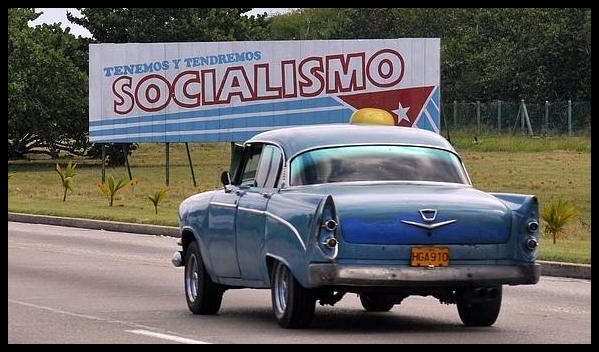
Slogan on billboard is “We’re doing fine.”

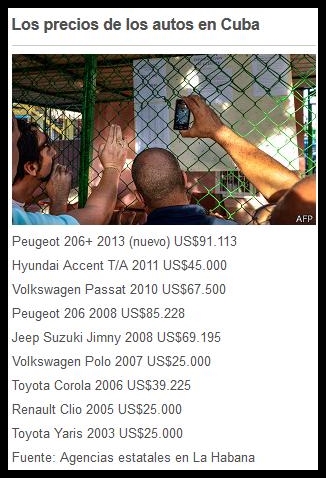
There are few times in a nation’s history when the inhabitants of a country agree unanimously. Now with the prices of cars for sale, one of those scant opportunities has occurred.

Many have drawn upon Kafka, Cortázar, and Virgilio Piñera, but I guarantee that this is even further removed from reality.

The first question Cubans ask is if the person who has enough money to waste on a car would be able to go in person to the sales agency, since they know that they would be captured there. If no one, with the highest salary possible, can save this money, then it necessarily means this is black-market money from some lucrative business, like drug trafficking. You would have to come to the conclusion that the cars are a special offer for these traffickers, and an offer of paradise for prosecutors, the most unequal in the hemisphere.

We have and will have socialism

Cuba is a plaza for criminals, prohibited for honest Cubans.

Ángel Santiesteban Prats

Lawton Prison Settlement. January 2014

Translated by Regina Anavy

29 January 2014

Farewell To Revolutionary Sport / Angel Santiesteban

Life gives us the opportunity to use it at the whim of our possibilities of talent, for personal gain. In life we engage in a search for what we can be as good professionals, if it makes us happy to do it, and in doing so we discover that we add glory to the society around us, and we make our family proud. This is the perfect formula to feel fulfilled, amen, if we are also well-remunerated.

The outstanding sportsman, Lázaro Rivas, ¨Illustrious son of de San Nicolás de Bari,” could feel like that (except for feeling well-remunerated). He gained the world title in his weight class, in Greco-Roman wrestling, among other awards. He brought glory to his town and to Cuba, until his official retirement in 2011.

In recent days he disappeared physically as a consequence of a brawl with another sportsman. His family members came to say goodbye to his body, as did two trainers and some friends. The corresponding sports officials were not present, nor was the government. That was, in sum, the gesture of gratitude that the State awarded him for his efforts.

The precarious infrastructure on which sportsmen count is no secret to anyone, above all those at the bottom layer, to accomplish their feats. Your would have to appreciate more their human capacities and persistence to achieve such rewards, a great part of those being at the top and refusing opportunities in professional sports where they could earn large sums of cash, the only thing that would guarantee them economic sustenance after the official retirement pension given by the Cuban authorities.

I was witness to seeing the legendary boxer, Teofilo Stevenson, roaming the city to find ingredients for a sancocho (a type of soup), that some shops kept for him, to feed the pigs that he raised in the swimming pool of his house. He also participated in the familiar theater of pleasing foreigners who visited him and were itching to pose for a photo with their idol, after coming to an agreement to pay 100 euros, to put on the table some bottle of good whiskey, and in the best of cases, moreover, invite him to a restaurant, to obtain this souvenir.

The also distinguished fighter, Félix Savón, has had to accept this manner of survival. Visitors leave with his photo and a gesture, or a stench of knowing that their admired gladiators live off handouts. I got to know a Czech who visited them. Many ballplayers live off public charity; they eat and drink at the expense of their fan club.

Thanks to the opening of the State, above all in baseball, those older players with fewer performances are permitted to go to small clubs that can pay for them in some way, either as athletes or as trainers, so they can live of their savings, some years without destitution.

Among them are the pitcher Lazo, today contracted by a club in Mexico, and before that Victor Mesa in Japan. At least the most distinguished athletes have that opportunity of survival. The others, those whose names have been erased from the collective memory, today are ghosts lost in society, sons whom no one wants. That’s the destiny that revolutionary sports assures.

We would say that a large part of the most talented have made the most difficult decision: to abandon their country and their families, without knowing when they will return. A sad fate for Cuban sportsmen.

Ángel Santiesteban-Prats

Lawton Prison settlement. January 2014

Translated by: Shane J. Cassidy and Regina Anavy

10 January 2014

Traitors to the Thinking of Marti / Angel Santiesteban

If José Martí warned that “capitalism is the superior phase of slavery,” how can those who belong to the Communist Party, beginning with Fidel Castro, call themselves followers of Martí? It’s no secret that when the Comandante of the bearded ones came to power he said on several occasions, in Cuba and in the United States, that the Revolution was not communist, that this possibility was a campaign to discredit them.

Caption on video: “I’ve said very clearly that we are not communists.”

Videos exist where he denies he’s communist. And from night to morning, he declares the Marxist character of this social movement that catapulted him to power in the nation. I always wonder how great the despair of Cubans was that they forgave him and followed all his nonsense. Of course many glimpsed what would come and so resigned, like Comandante Huber Matos, Eloy Gutiérrez Menoyo, William Morgan, among others who were disillusioned that after putting their lives on the line, they understood they had been betrayed by personal ambition. continue reading

Fidel Castro never put the people before his insatiable appetite for power. All the social power that at first he obtained was to mask his image of a dictator. Above all because then, economically, we didn’t depend on our own attempts, on the skill of investments, but we did have the teat of the Soviet Union and the rest of the socialist camp to satisfy his insanity and his plans for conquering the rest of the world.

If those countries didn’t exist who shared “ideology,” his mandate to govern wouldn’t have lasted more than five years, precisely by the great defect of not knowing how to listen to his specialists, to those who were suddenly removed if they didn’t agree with his dreams and his inconsistent, baseless mega-plans that always ended in failure.

Knowing this defect, his “collaborators” became adulators who lied in order to continue receiving the benefits of power. In spite of everything, he has been a brilliant manipulator who knows where to get resources for staying in power, now making his brother, Raúl, head of state.

At the end of this cursed cycle, the only thing that assures us is that José Martí is renewing himself, that his prophecies acquire more timeliness, and that for many years the Cuban people have been slaves, surviving in order to continue breathing, always scared of being whipped by the officials for any criticism or demand for improvement. We are a people basically seeking refuge in being run-away slaves, dispersed throughout the hemisphere.

Let’s hope that this 21st century will be prosperous for the Cuban nation and reunite its families, and that we will be capable of achieving a free and democratic society that assures and balances the needs of its people.

Ángel Santiesteban-Prats

Lawton Prison Settlement. January 2014

Translated by Regina Anavy

25 January 2014

The Attendees of the II CELAC Summit Should Know the Authorities’ Deception / Angel Santiesteban

Disgracefully the image of José Martí (January 28, 1853) has been used from one side to the other, for one thing or another, thanks to its universal meaning. And his great image.

Tomorrow will be another one of those days when the Castro brothers use the birth of the Apostle to dirty his ideas.

To assume that Marti would support the “revolution” is one more of the frauds to which we are accustomed. It’s no secret to anyone that they are taking up the old practice that “the university is for revolutionaries,” so those who don’t participate in the political convocations are stigmatized as being against the regime, disaffected from the regime, and therefore will suffer the consequences. Secondary-school and pre-university students will never reach a higher level, and those who now have finished their studies could lose their graduation certificate.

But the blackmail won’t end even after graduation, because they won’t get the degree until two years later, after they’ve completed their military service. Then they will need an endorsement of good behavior and political participation to be situated as qualified professionals in suitable positions.

Nor will the odyssey end there, because the threat and constant blackmail of being unemployed is permanent. Maintaining a correct affiliation with the Castro brothers is the only indispensable requirement for surviving on the Cuban archipelago.

The presidents who attend CELAC should know this. We are a repressed people, with a guillotine hanging over our necks, and with the least breath, whatever the capacity for respiration, the bloody blade will come down. Keeping sight of that cutting blade creates major fear for Cubans. Their perpetual torment.

Ángel Santiesteban-Prats

Lawton Prison Settlement. January 2014

Translated by Regina Anavy

27 January 2014

Angel Santiesteban Asks the CELAC Summit not to convert their visit into support for Raul Castro’s regime

From Prison:

Cuban writer sends message to the attendees at the CELAC Summit.

Ángel Santiesteban, sentenced to five years in prison, asks the leaders invited to the meeting to not convert their visit into an act of support for Raúl Castro’s regime.

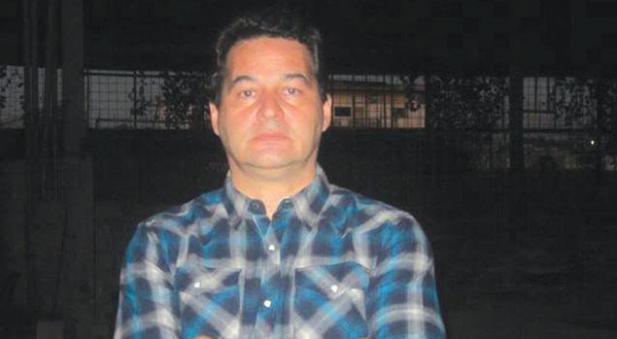
The writer Angel Santiesteban is sentenced to five years in prison (Cortesía).

Luis Leonel León / Special

The Cuban writer, Ángel Santiesteban, sentenced to five years in prison, asks the presidents and international political figures invited to the Second Summit of the Community of Latin Amerian and Caribbean States (CELAC) in Havana, that they not convert their visit into an act of support for Raúl Castro’s regime.

“The Castro brothers have been the most skilled manipulators in the hemisphere. Their political astuteness has kept them in power for more than half a century. To support relations with the dictatorship is a shameless act that the attendees will add to their curriculum vitae,” Santiesteban declared, in a message sent from the Lawton Prison Settlement in Havana.

Santiesteban, one of the most prominent contemporaneous writers of the island, affirmed that Cubans could never resolve their internal problems by way of civic protest, since any popular demonstration would be suppressed in hours, as happened on August 5, 1994. continue reading

“We don’t have the possibility nor the way to decide our future. All of us who have taken this step find ourselves in prison or obligated to abandon the country,” the intellectual pointed out.

The CELAC Summit will take place in Havana on January 28 and 29, with the attendance of some 20 heads of state and governments, including the Secretary General of the United Nations, Ban Ki-Moon, and the Secretary General of the Organization of American States, José Miguel Insulza.

Santiesteban, 48 years old, was condemned under charges of “violation of domicile and injuries” against his ex-wife in a controversial judicial process. He entered prison on January 28, 2013, and since then has gone on hunger strikes to protest the conditions of his detention and “a fabricated trial.”

“My crime has been to write what I think about Cuba and its dictatorship, something that I’m not going to stop doing,” said Santiesteban in an interview granted from prison to Diario Las Americas.

A few days ago, several officials violently ransacked his cell, since they presumed he could be preparing to make a statement to the foreign press.

During the search, they confiscated the magazines and books they found, among them the Universal Declaration of Human Rights, the by-laws of Amnesty International and a story that he hadn’t finished writing.

Although other Cuban intellectuals have been interested in his case, the government continues to keep him isolated “hoping that they forget about me.”

During the beating that a group of agents from State Security gave him before he was sent to prison, one of them warned him that he could have something happen to him like the opposition leader Oswaldo Payá, who died in a controversial accident in July 2012.

“When you get out of prison, you could die as if it were an accident,” Santiesteban remembered an agent warned him while they were beating him in November 2012.

That year Santiesteban also wrote an open letter to Raúl Castro, in which he accused him of intensifying the repression against the opposition. Days after sending it, they charged and condemned him for the supposed crime of domestic violence, which under a normal proceeding would have been sanctioned only with a fine.

“Since I began my blog they always told me to give it up and occupy myself with literature. As I didn’t stop, they fabricated a case of domestic violence in which they alleged that I entered the house of my ex-wife, the mother of my son, to beat her. They used false witnesses, hoping to silence the true reason they were prosecuting me, which is my dissidence,” argued the writer.

Amnesty International 

Intellectuals, activists and human rights organizations have requested that Amnesty International recognize Santiesteban as a prisoner of conscience, but up to now the organization hasn’t responded.

However, he considers that “something strange has happened.”

“I don’t know what purpose those lists serve,” he declared. “Except to support a cause and offer cover to someone in the claws of a totalitarian power, to more or less assure his life.”

He remembered that two days before going to prison he received a call from Amnesty International assuring him that they recognize his cause, but that they couldn’t add his name to the list until he was in prison. Later he learned that someone in Cuba had bothered to puruse it, because the organization had placed his name on the list of political prisoners without consulting him.

“However, it doesn’t make me lose sleep. I can’t turn back from the road I took. Everything started when I expressed ideas that were adverse to totalitarianism. My crime has been to think differently.”

False proofs, manipulations and silences

To reveal the falsity of the judicial process they planned against him, Santiesteban used the collaboration of a friend who pretended to be a prosecutor and demanded that the false witness tell her the truth about what she maintained about the accused.

“The conversation with the supposed prosecutor was recorded,” he said. In it the witness confesses that she had been pressured and bribed to testify against me.”

He described that during his presentation in court, searching for arguments to condemn him for the supposed maltreatment of his ex-spouse, they ordered him to write a sentence extracted from the newspaper Granma (the official organ of the Communist Party of Cuba).

“After analyzing my handwriting, a proficient calligrapher dressed as a soldier certified my guilt, saying he found a certain inclination and a suspicious size in my letters. It would be a joke if I weren’t in prison,” he commented.

Six months ago, the request for review of the case was delivered to the Minister of Justice, where they allege that the documents have been lost and that they don’t know who removed them. Recently the attorney who represents Santiestbean discovered that some of the documents had been extracted from the file.

“The regime is hoping that they will forget about me, in order to kill me later,” reported Santiesteban. “They’ve threatened me with that on multiple occasions,” he pointed out.

Published in Diario las Americas

Ángel Santiesteban, a victim of the repressive politics in Cuba

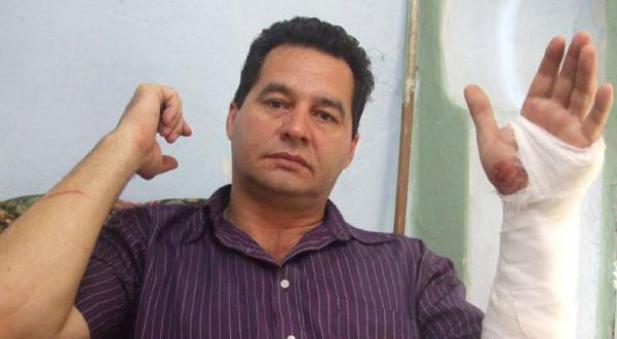
The Cuban writer is in the Lawton Prison Settlement, in Havana.

Ángel Santiesteban, Cuban writer. (otrolunes.com)

Iliana Lavastida/Special 

@IlianaLavastida

Destroying the image of their political adversaries is a tactic of regimes that want to control the masses. The same as the Nazi ideologues, who achieved the manipulation of the minds of million of followers, totalitarian governments like the Cuban one use the method to destroy the figures who oppose them.

Ángel Santiesteban, winner of various Casa de las Américas prizes and winner of such prestigious competitions as Juan Rulfo and Alejo Carpentier, is recognized as one of the strongest voices in contemporary Cuban literature. However, his decision to dissent and to dare to question the repressive methods of the regime and open up through his blog on the Internet, which he considers “a space for constructing free thought,” implicated him in a judicial trial, after which he ended up being condemned for a common crime.

After a rigged trial, the prosecutor came forward with an order of 15 years of privation of liberty against the intellectual, who was accused of rape, robbery and attempted murder against his ex-spouse, the mother of one of his two sons, and they also prohibited him from approaching her for two years.

In these moments, the writer is in the Lawton Prison Settlement, in the Cuban capital. From one of his cells, thanks to the collaboration of activists inside and outside Cuba who support the dissident, the photos of Santiesteban behind bars accompany as graphic testimony the interview he granted to Diario Las Americas.

The five years of prison he is serving, according to the figureheads of power, are intended to make him desist from his interest in writing about the truth, but the same declaration of principles published by Santiesteban while he awaits sentencing define exactly what he has chosen as his lifeline.

“Since I undertook my journey with the blog, I felt the energy of a liberty that I didn’t know. And once it’s tried on, now it can’t be missed. It’s as essential as oxygen itself.”

Published in Diario las Americas

Translated by Regina Anavy

24 January 2014

My First Book in Exile / Luis Felipe Rojas

FEEDING THE FIGHTING DOG, new poems by Luis Felipe Rojas. Now for sale on Amazon.

Poster designed by Rolando Pulido (cover designed by Idabell Rosales).

Here is the link for my book, “Feeding the Fighting Dog,” published by NeoClub Press under the direction of Armando Añel and the talented hands of Idabell Rosales. This poster would not have been possible without the work of Rolando Pulido, under the original cover. My first book in the land of liberty. Thank you, everyone who has bought it, you have been very generous. In a couple of weeks we will be giving a public presentation, which will be dedicated to my brother in prison, Angel Santeisteban. What better homage could I make for a colleague who continues writing and doesn’t stop telling the truth, no matter where he is.

Translated by Regina Anavy

11 March 2013

They Criticize Corruption and Traffic in Diamonds / Juan Juan Almeida

From the same instant in which General Raul Castro was enthroned as President, he hasn’t stopped warning that “The battle against crime and corruption has no room for doubt.” On many occasions he has been seen at the podium exhorting publicly the members of his cabinet to maintain an “implacable” conduct against the mentioned scourge.

It’s difficult to convince that popular body that for lack of confidence, without realizing it, passed from alarming sloth to heartless hibernation.

In order to execute his crusade and give veracity to his words, in the year 2009 he created the Controller General of the Republic of Cuba, an organ that until today has carried out audits on all the State institutions and brought before tribunals those accused of economic crimes and corruption, a good number of functionaries, employees and directors of state enterprises, an ex-minister and an ex-vice minister of the food industry, foreign businessmen, an ex-son-in-law of the above-mentioned General President and family members who, confused, wealthy or followers of a lucrative ideology, one day swore loyalty to the revolutionary process.

For some citizens, the General represents a Caribbean Grim Reaper with a collapsible neck, who, with an olive-green cowl and a scythe in his hand will put an end to the kleptocracy. “The struggle against corruption” is an epic banner that the First Secretary of the Communist Party decided to raise, and to hoist it more, he named as gonfalonieri his son the Colonel, a middle-aged man who is a specialist in judging everything and an expert in looking after personal objectives.

Certainly, the law is the only form of giving an effective and round answer to the problem of corruption; but sadly, the publicized content is one more myth, which isn’t precisely destined to eradicate the matter from the Cuban horizon, but rather will concentrate the country’s resources and total power of the State in the hands of the most corrupt, most restricted, most faithful, and even most compromised group belonging to the Castro Espin clan.

Why didn’t the General say anything when the Cuban government was discovered attempting to transport military materiel through the Panama Canal hidden under tons of sugar in a North Korean ship?

If this isn’t muddy, then there’s the possibility that before the unpolluted island ruler, neither was it corruption that a group of “cooperating Cubans” engaged in bringing in contraband diamonds from Ghana and Namibia to Havana, stones that later were sent by air to a beautiful port city in northeast Belgium, Amberes, casually known as the world center of diamond trafficking and commerce. How could that happen without the approval of the State that sees everything, like Big Brother?

I also recall very well that some years ago, in 1989, a group of high military officers were punished for similar acts. And look here, curiously, these trafficking specialists, whom the Cuban government feigns not to know, are all ex-military man and civil workers of the army that works for ANTEX S.A., an anonymous society of Cuban capital located on the African continent, with offices in Angola, whose initials mean strangely (and excuse me for the use and intentional abuse of these adverbs) the name of General ANTonio Enrique (Lusón) EXportations. A Raulista convert who not only is corrupt but also basks in it.

Translated by Regina Anavy

15 August 2013

Prison Diary XLVIII. Raulist Politics: Schools Converted into Jails / Angel Santiesteban

One of the big boasts of those who took power in 1959 was to have converted military jails into schools; today, these schools are being converted into penitentiary centers.

The old “schools in the countryside” were closed thanks to Raul Castro’s new politics, to save what was invested in the logistic means designated for those students.

Those old schools are again opening their doors to receive convicts, after having been transformed into jails, with the required bars on windows and doors, and the security barrier around the perimeter to avoid escapes.

The tortures in those jails under the Batista dictatorship have returned with the dictatorship of the Castros.

One of the young men they sent to a prison in distant provinces, because of his relationship with me and because he offered me help in my communicating with the exterior, has returned, after two months, with horror reflected on his face. The method used to harm him was written in his file, the classification of “dissident.”

Upon arriving at the jail, an old “Youth School” in Santa Clara, the 22-year-old prisoner, Pedro M. Ferro, because he was political, was beaten savagely by the head of the unit, Lieutenant Colonel Delvis, who, after filling his body with hematomas, and without taking off the handcuffs, locked him in the “cubicles,” a place, says the young convict, of inhuman conditions. This was his punishment for collaborating with a dissident.

Thanks to the petition of his mother, a nurse, who demanded the return of her son to Havana, and also because he was a lieutenant colonel, they agreed.

What must there be inside the breast of that mother, who surely turned over her own youth to the totalitarian system that now abuses her son? Was her own sacrifice worth it? Any political system that tortures is fascist. Ours included.

Now Pedro M. Ferro wants to be a dissident. He doesn’t want to accept any utensil that hands him re-education. What is really undisputed is his full right to choose his own way of thinking and acting, maximized after witnessing the continual abuses of the penitentiary regime.

At least Pedro M. Ferro will not suffer the deception his mother suffered.

Ángel Santiesteban-Prats

Prison 1580. July 2013.

Translated by Regina Anavy

15 August 2013

Childcare Centers are Almost a Luxury / Luis Felipe Rojas

The possibility of getting a place for a child in a childcare center in Cuba has become a real search for the impossible. The small capacity in these nurseries, the bad food, and the reduction in the requirements of admission for women who work in the ministries of Public Health and Education make many see that goal as a chimera.

The childcare centers and kindergartens were implemented at the beginning of the ’60s, so that Cuban parents could work without worrying about the care of their kids. But in the last years, these educative centers have been converted into something exclusive, above all in some interior regions of the country where approximately one exists in each municipality.

Without the syndicate’s recommendation, the support of the Federation of Cuban Women and other sources that have leverage, it’s impossible to obtain a space in these places.

Mildred Sánchez, a nurse who resides in the coastal municipality of Antilla, in Holguín Province, could never put her kids in a childcare center since she had not graduated.

“The solution now are the girls who haven’t gone to university and don’t have work, so they take care of children,” says Mildred.

These youngsters “take care of children less than one year because the mothers have to work, and they go with them and take care of the babies. Here on my block live two 16-year-old girls who are taking care of babies, one has three babies in her house and the other has four,” she affirms.

The alternative of private nurseries first passed by the rigor of state inspectors,

who fined those who ran them, until the last attempts at reform included them as a mode of “self-employment.”

In the capital, an employee of these nurseries can earn a salary of almost 40 CUC a month, and, in addition, they are guaranteed a free lunch.

In Antilla, where Mildred lives, there is a childcare center, divided into two parts, “one in front of the other. They are the private homes of people who have emigrated from the country,” Mrs. Mildred Sánchez concludes.

Yanisleidis Rodríguez, a mother in Havana, is a worker and a dissident at the same time. She has a black mark against her, and it would be impossible for her to get a place in a childcare center. “Before being in this (she is referring to the opposition), I didn’t have the right, and now I have even less,” she remarked. She has two children, one who is 7 and another who is 4.

“To think that I worked in Provincial Education and even so they wouldn’t give me a place for my children. There with me were mothers who spent many years working in Education and had to pay a person to take care of a child so they could work,” she indicated.

Corruption has penetrated this sector, as Yanisleidis recounts, who asserts that mainly being a director or having a good recommendation makes it possible to obtain the precious placement for a child in these places.

The concern over enrollment for the children of Yuliet Pérez, a resident in Pinar del Río and an ex-worker at the Provincial Hospital Abel Santamaria, came up against a concrete wall.

“When I had my first girl I asked and never got a reply,” she says, and she adds that neither were there careers for educators in childcare centers, which also affected the availability of these services.

From Havana, the independent journalist Álvaro Yero Felipe denounced on the Digital Spring website that “six workers in a childcare center in the Arroyo Naranjo municipality sent a letter to the National Director of the Ministry of Education in Havana, where they accused the administration of the center of diverting food and economic resources and materials meant for the children,” said the publication.

Yero reported that the incident took place in the Luxil childcare center, located in Arroyo Naranjo, and the letter related the diversion of “resources that the government received from foreign humanitarian organizations for the children who are boarding there, under state authority because they don’t have families.”

The children are under state custody, and their principal support is the agency of security and protection, SEPSA, and they are not older than five years of age.

Translated by Regina Anavy

25 June 2013

A Dirty Text on This Wall / Luis Felipe Rojas

Text and Photos: Nilo Julián González Preval

[From LFR: Today begins a series of photographs and texts from the experimentalist artist, Nilo Julián González Preval. My blog, Crossing the Barbed Wire, opens its windows to the artists and writers on the island. On this occasion Nilo presents us with a text, which is nothing more than a photo-reportage on daily life, “if you want it and believe it,” he told us from Havana.]

“Today I went to visit your aunt. I don’t know why this week I haven’t been able to stop thinking about her. How can you live well in Holguin? She is fine. As fine as you can be in an institution of blankets and loneliness. I brought her a pudding and some sweets. A soft drink of mate. I slipped when I was getting out of the truck and looked to see who was laughing. The first one to laugh was going to get it. Gracefulness was what cost me our divorce. Is she very nice? She doesn’t ask me for anything. That is how people lie and lie without any reason. I know that you told me the truth. That you went, and I am grateful to you for the sincerity, although my heart was broken, until Miguel appeared, and it’s not that he is a watchmaker but he took me out of the hole and we could both advance. Are you following what is going on with the Party and politics? In the factory they’re talking about a Chinese boat that Cuba was hiding to make war in America and for the trafficking of arms and other things. I know that this separates us. I was thinking only of the family and about food for our children. As for their education…my politics is a united family and some children who will know that, for me, homeland means the love of my children. Their kisses every morning.

“What is her name? If you ask me to I’ll send you dulce de leche with your cousins who are truckdrivers.

“A big kiss.”

Lavidaenrosas@gmail.com

Translated by Regina Anavy

12 August 2013

I Have Two Homelands / Reinaldo Arenas (from the blog of Luis Felipe Rojas)

Reinaldo Arenas, the genial writer from Holguin, the dissident against all the banners he saw fluttering before his path. Those homelands of Marti that he could rewrite, Cuba, his immense sorrow, and the night, that friend who accompanied him up to that final hour in which we all find ourselves.

I have two homelands: Cuba and the night.

By Reinaldo Arenas

Both plunged in a single abyss.

Cuba or the night (because they are the same).

They both confer the same reproach

In the foreign land, of a braggart ghost.

Until your own fright is an illusion,

A lost wheel of a foreign coach

that rushes into a cataclysm

where breathing is itself a waste.

The sun has no light and it would be cynicism

that the time you were living was for loveliness.

If that is the homeland (the homeland, the night)

that has left us centuries of egoism,

I await another homeland, that of my madness.

*Translator’s note: The title of this poem is the first line of a poem by José Martí, titled “Two Homelands.”

Translated by Regina Anavy

24 July 2013

Photo-report: A Demonstration in the Middle of Miami

The activist, Jesús Alexis Gómez, during an hour of rest, showing symptoms of fatigue.

I have just come from the corner of 13th Ave. and 8th Street in the heart of Little Havana. There the activist for human rights, Jesús Alexis Gómez, and the leader of the Democratic Movement, Ramón Saúl Sánchez, have been carrying out for 17 and 10 days, respectively, a hunger strike. Their goal is to call the world’s attention so that the Governor of the Bahamas frees and stops torturing the Cubans who are detained there, when they arrived on the coast in search of a longed-for liberty.

Alexis converses with his brothers in struggle.

Ramón Saúl interacts with the activists.

Ramón Saúl Sánchez took advantage of the occasion to exchange words with his organization’s activists and give instructions about the strategy to be followed. In the state in which he finds himself, he writes his opinions about the boycott of the Bahamas and the purpose of the strike.

The leader of the Democratic Movement continues his work to call for the world’s attention and solidarity with the prisoners now in the Bahamas.

An activist, upon leaving church this Sunday, went to the tent to offer a Christian prayer for the strikers and the prisoners in the Bahamas.

Posters, placed in public view.

Many visitors pass by without asking, although their curiosity is aroused.

…but others arrive and ask about the reason for the strike.

The activists help expand the space and put up signs.

The demands go from the cessation of torture to the unconditional release of the detainees in the Bahamas, without sending them back to Cuba.

Translated by Regina Anavy

4 August 2013

A Shameful Stab in the Back for Angel Santiesteban from UNEAC / Amir Valle, Angel Santiesteban

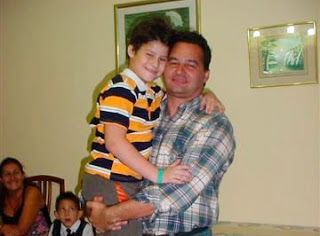
The writer Angel Santiesteban Prats and his son Eduardo Ángel some years ago.

By Amir Valle

The strategy of UNEAC and certain “disinformed” writers against Ángel Santiesteban

One more shame falls on the Writers and Artists Union of Cuba. This time, the shame is a dirty attack, manipulative and disloyal, against Ángel Santiesteban.

I read it in the blog “The Unknown Island,” by the Cuban essayist and journalist Enrique Ubieta, and it appears to be signed in principle by eight women, among whom we find some of the writers most admired for their work. But more than these signatures, what catches my attention is their taking advantage of the accusation against Angel Santiesteban to call for a struggle against violence toward women and to initiate with this article (embarrassingly manipulative) a campaign to collect signatures.

It is, in short, another step in the campaign to criminalize Ángel Santiesteban.

The initial question that I pose to the signatories is this: The person or persons who have hatched this campaign, have they had the decency to give you access to the documents that both the prosecutor and the attorney used in the trial? I, from Germany, only had to ask that they send me everything by email, and it was enough for me to read both files: Prosecution and Defense, to add my name to the call that we, his colleagues and friends, have made internationally in support of someone like Ángel Santiesteban.

I write these words from the deep respect that I feel for women, whom as a Christian I consider the most perfect creation of God. I have demonstrated this in my life and my professional career. Just this March 8, when you signed this document, I marked 16 years of marriage with a woman I consider responsible for all the good things I’ve done since I’ve known her.

And just as you were signing, I gave a lecture on literature written by women in Cuba, in which, of course, I mentioned some of you, proud of having been a witness to one of the most solid literatures written by women in the Spanish language, and, moreover, proud, until today, of being the only Cuban writer who decided one day to discover, promote and include in four anthologies the work of these Cuban women writers. As you surely know, I’m proud to say that many of the most important women writers in Cuba today saw their first stories published in my anthologies.

The lie is lame

“The truth always catches up with the lie, now matter how much it runs.”

I believe in that maxim. I know the mechanism for soliciting this type of signature: They ask you to sign against something or someone without putting all the real cards on the table; they want you to come out against something or someone only explaining to you the official version, the part of the facts that suits them. For that reason I have decided to write to you (and to those who want to read this article), inviting them (inviting everyone), to respond with dignity and integrity to these questions.

A brief introduction

I am one of the few people who can witness directly from the beginning the relationship between Ángel Santiesteban and Kenia Rodríguez, the mother of Eduardito, this boy they both conceived.

At that time, I lived in Ángel’s house and was very close to the beginning of this love story, diverted today, sadly, into hatred. I remember that Ángel brought only virtue and a better life from the beginning of their relationship. Kenia worked in a Chinese restaurant, and thanks to Ángel’s tenacity, she managed to start a UNEAC course in theater production. Years later I saw Kenia traveling abroad, accompanying Ángel on cultural trips.

Now Kenia is the complainant in the case for which he has been sentenced. I don’t know what little bird whispered in Kenia’s ear that made her, two and a half years after their separation as a couple, decide to initiate a series of personal accusations “oddly and coincidentally” just after Angel opened his blog, “The Children Nobody Wanted,” and his former wife began a steady love affair with a well-known artist. It would be good to note that Kenia, even acknowledging publicly that Ángel was an excellent father, forbade any relationship between the boy Eduardo and his father. Now it is known that, in secret from his mother, Eduardo sought out his father when he was barely 15-years-old.

Knowing Kenia as I do, I would like to make an appeal to her conscience so that she will see the light, so she will tell and defend the truth, without lending herself to any guy’s manipulations, above all for the well-being of the son that was born from this love; I call on the courts to reopen a case that, as the defense attorney showed, should be legally annulled because of the great quantity of procedural and judicial irregularities committed; and I call on the decency of those who have launched from their offices or those who have naively joined the campaign of criminalization without assessing the pure truth of the facts.

From my point of view, I noticed in the whole trial against Ángel Santeisteban sufficient evidence to strongly affirm that it’s a matter of an absurd and crude strategy by State Security to silence his voice. They are afraid of the impact that his criticisms could have, coming from a writer of his courage and reknown.

If I could find one single factor of merit that demonstrates Angel’s guilt in the crimes attributed to him, I never would have raised my voice in the way I did. I have even written that if Angel is guilty of something, he should be condemnded for that. But what we have seen, in the police work as well as in the judicial process, is so full of fraud, irregularities, violations and attempts at corruption and lies against Angel, that surely we can raise our voices to denounce this outrage.

We have rallied prestigious institutions (the majority of them not political) to take up our defense. And we have done it with proof in hand. I therefore encourage anyone who reads this article to offer answers substantiated by the truth to the following questions:

Why weren’t the complaints consistent from the beginning, and why did it take more than a month between the first and the last act, when according to the complaint it was a matter of a sequence of facts that occurred the same day? One month later did Kenia remember details that were supposed to be certain, that remained in her memory?

Why did the complainant present the medical certificate with a date previous to that of the complaint?

Why did the doctor, who supposedly signed the warrant, according to the declaration that is on record in the investigative file, not remember having attended her nor even remember the case?

Why did the complainant lie on the day of the trial, asserting that she was taken to the hospital, accompanied by the police, after making the complaint, if the date of the warrant shows that it was prepared one day before?

Why did the Provincial Court accept these lies, in spite of the attorney’s claim in the closing statement of the oral hearing? Why did the Supreme Court, which is supposed to be the petitioner in charge of ensuring the facts, not see that these violations didn’t occur?

Why, as was verified later, did Mayor Pablo, Chief of the heads of the Plaza Municipality sectors, who was involved in a love affair with the complainant, pressure the prosecution witness to not recant, and for what motive did he advise Kenia Rodriguez, according to the same informer, to confess before Angel and his son?

Why was the case file reopened after having been archived upon determining that there was no cause to send it to the Prosecutor and open a lawsuit?

Why reopen a file when never before did they take Kenia’s accusations seriously (performing only the bureaucratic process of listening to her), upon the evidence, according to the investigator’s own words, of Kenia’s nervous disorder and the constant sham and inconsistencies in her declarations? Why did the complainant commit blunders when referring to them?

If there aren’t political reasons, why try to convert a man considered an exemplary citizen and a distinguished writer into a public monster at the moment he decides to publish criticisms about the Cuban political reality through his blog? Why does this campaign of criminalization coincide so well with his being marginalized in the national culture?

Why was the file forgotten (archived) just until the invitation from the First Festival of the Word in Puerto Rico arrived, where Ángel Santiesteban would participate together with a group of intellectuals (from the Left, but with positions critical toward the political reality in Cuba)? Why did they “casually” cite him with urgency and decide to impose on him a bail of $1,000 pesos, thereby preventing his participation in the said event, which has international prestige in literary circles? Why, just at the moment when the international impact of his blog would grow and just when he would enjoy the promotion of his work and critical labor as a blogger in an international festival did they decide to impose on him the precautionary measure?

Why did they send the case investigator (yes, the same person who had archived the file) on a different tack, and mysteriously extract the file to take it to another police unit with another investigator? Why did this investigator reopen everything trying to implicate Santiesteban during three years, without being able to find the least glimmer of evidence that would tie him to the facts? What obliged this investigator to pressure, blackmail and harass the witnesses, investigating them in their neighborhoods and spreading the rumor that the neighbors might be implicated in the murder of a foreigner? Why, as these witnesses confessed, were they pressured to give up their decision to testify in favor of Angel?

Why did they wait three and one-half years to have the oral hearing? Why after setting it for the day of April 3, 2009, did they suspend the hearing? Why did they violate in such a flagrant manner the Penal Code that establishes that once a date is ratified and the parties notified, the matter can’t be suspended and they can’t return to an investigation, except if new evidence comes up in the same oral hearing that the Court needs to investigate? Did they not understand that no elements existed to judge the accused and sanction him, as they finally did? Did they understand that it was too obvious that they were committing an unwise injustice and, later, if they didn’t prepare well, they wouldn’t be able to justify the punishment for lack of evidence?

Why did the file travel several times to the Provincial Court after being dismissed each and every one of these times?

Why did they have to threaten the first attorney, as she herself admitted, obliging Angel to look for another legal representative who would not let himself be pressured?

Why did the Prosecutor, police and the complainant (in my opinion encouraged by the impunity they felt at being supported by State Security) set up a false “witness” who, thanks to the astuteness of Santiesteban’s friends, they were able to unmask? Why did the judges not throw out a case obviously invented, before the overwhelming evidence of this video where the false witness relates the pressure he received from the police to declare himself against Santiesteban? Why did Kenia, if she knew the truth, need to bribe the witness, as he could compromise himself in the video where the same witness exhibits the gifts he received as a bribe?

Why, from the time that Santiesteban said he knew about the video (authenticated as real and valid by an experienced official), did the Prosecutor find himself obligated to withdraw these crude accusations that, among other things, were accumulating the exorbitant sum of 54 years in prison for the extensive and fastidious list of false accusations? Why, upon seeing them discovered so clearly, did they have to dismiss the 15 years the Prosecutor was requesting as punishment for all the supposed crimes?

Why starting from this moment, instead of annulling the case because of the amount of irregularities (perjury of the claimant and demonstration of her intention to harm Angel at all cost) did they decide to return the file to the investigative phase, to readjust it and continue with their malevolent plan? Why and for whom did they study it for several months in the police unit, and later in the Provincial Prosecutor’s office?

Important and suspect: Why was the file requested from the General Prosecutor of the Republic?

Something else important and suspect: Why did the file record, in a note signed and sealed by the police investigator, “Urgent Interest of the Minister”? Why was a supposed case of “domestic violence” handled at the highest level of the Ministry of the Interior?

Still more important and more suspect: If there were no political plot behind all this, why was the file sent from the General Prosecutor to the General Headquarters of State Security in Villa Marista, according to what Santiesteban’s attorney was told in the same General Prosecutor’s office? Why, if the General Prosecutor of the Republic said that the file was in Villa Marista, when the defense attorney presented himself at Villa Marista, did they deny that the file was there? What did they have to hide?

Why did the Investigator continue with this false report, if, in spite of his bold attempt to implicate Santiesteban, he could not manage to set a trap?

Why did the Prosecutor, beginning with the aforementioned video of the false testimony, feel obligated to withdraw the complaints, leaving only the minor offenses: “home invasion and injuries”? Why did they keep these accusations, if the same video had already proven that Kenia Rodriguez was lying, for which she could be prosecuted for the crime of perjury, which was not done?

If it was a matter of a supposed ordinary crime, why did they hold the trial in the Main Hall of State Security, in the special headquarters in Carmen and Juan Delgado? Why were members of State Security posted outside? Why, as many witnesses could substantiate, were buses distributed “with veterans and enthusiastic people who spontaneously agree to defend their revolution”?

Why did the Court put Santiesteban in the totally indefensible position of not being able to call his own witnesses? Why, in return, did it keep the flimsy prosecution “witnesses”, all of them State functionaries and soldiers, obviously conspiring to try to give some credibility to the sanction, which, surely, had already been handed down?

How is it possible that a court can accept as convincing truth the testimony of the handwriting expert who stated that Angel was guilty because of the “size and inclination of his writing”, when the defense lawyer demonstrated scientifically and legally that handwriting, according to international norms, cannot ever be considered a conclusive truth?

Why did the Court reject the defense attorney’s testimony that, thanks to his friendship with the complainant, he could affirm that Kenia Rodriguez had told him on several occasions of her intentions to cause harm to the father of her son, meaning to Angel? Why also did they not take into account the declarations of the boy’s teacher (the Director of his school, considered a dependable person), who stated that the child confessed to him that his mother obliged him to lie about his father to damage his public image? Why also, “curiously” did they throw out the statements of three other witnesses, who showed that Angel Santiesteban was somewhere else just at the time that Kenia, supposedly, was being abused by him?

Why did the professionals, who attended the oral hearing–the lawyers, ex-prosecutors, intellectuals–after hearing the parties, agree that Angel was innocent and should be absolved, that absolutely nothing was presented that would incriminate him, except the declaration of the Lieutenant Colonel (the handwriting expert), who stated that he was guilty because of his inclined handwriting?

It’s enough to appeal to a little decency, a small quota of ethics, in order to conclude, before these terrible irregularities, that all this, even though it appears to be a joke, is a stifling and hallucinatory sin.

But if they weren’t enough, I want answers to some more questions:

Important proof of infamy: Why did the State Security official known as Camilo, after beating up Angel Santiesteban, November 8, 2012, tell him, ”Aren’t the five years years we’re going to toss at you enough?”? In front of a witness, Eugenio Leal, Angel said, “Some day you will pay for your abuse,” and Camilo responded, “When I pay, you already will have.” How could Angel Santiesteban, thanks to agent Camilo, alert the international community about his sentence one month before the Court sentenced him?

Why was the sentence excessive, as the defense showed in the appeal, if the court recognizes Santiesteban as a citizen who is distinguished by his intellectual work, nationally and internationally, and there are no prior offenses, circumstances that, according to Cuban legislation, are attenuating, which could drastically reduce any sentence?

Why do multiple cases exist in this same Court, processed for the same supposed crime, sometimes with weapons involved and with people with a full criminal history, and in none of the cases did the sentences come close to five years’ deprivation of liberty?

Why, again “curiously”, did the Court make a mistake in the second clause, which added one more year to the sentence? Why wasn’t this annulled, as established by law for this type of procedural “error”?

Why did the Superior Court, which had a decent opportunity to amend the scope of this injustice, catalogue as “without place” (meaning, they didn’t accept it) the diligently-researched file presented by the lawer as a Cause for Appeal, in the face of the enormous list of irregularities committed in this case?

I have many other questions. I only ask whoever reads this article that they don’t judge without having the evidence. To the present and future signatories of this call for signatures, “Zero Tolerance for Violence against Women”, that UNEAC now brandishes, deceitfully, taking advantage of Angel Santiesteban’s case, I now remember that in the history of our country, we intellectuals have been participants in many injustices simply by not searching for the truth and by conforming ourselves to what our government officials tell us.

I, convinced by the evidence of Angel’s innocence, continue asking these questions. I don’t expect them to be answered, although perhaps they should be.

Why did Kenia Rodriguez, the supposed victim, if she were convinced of the solidity of her accusations, tell her son that she conceived him with Angel’s love, and “that I never thought to bring a lawsuit”?

Why and who, again “casually”, decided and authorized that they wait until the International Book Fair in Havana conclude to emprison the writer Angel Santiesteban if the sentence was already handed down?

Why does Angel Santiesteban now not falter, if he is an intelligent and humble man, who other times has seen fit to publicly recognize the mistakes in his personal and professional life?

Why does he feel so proud to find himself in prison?

Why has he decided to give State Security a lesson in principles and loyalty to his ideas, reminding them with his performance and his writings that this move against him is simply a punishment, an underhanded message about power against Cuban intellectuals and the martyrdom that those who decide to rebel against the establishment can suffer?

They do what they can do against Angel, and I am certain that History will reclaim him some time as one of the cleanest, most transparent intellectuals and brave fighters of his time inside Cuba in these so-convulsed times that we Cubans live in. I know him with his virtues and his defects. I feel proud to be a member of his generation of writers; I am filled with pride at his brotherhood, and I feel proud to be the friend of one of these Cubans who, from the island, fights so that all of us can have the right to think with our own heads, have our differences respected, express our criticisms and nonconforming politics, without being catalogued by the government with the classic, trite, derogatory labels that up to today they have used, those who defend totalitarian thought, which, happily, each day that passes, has more cracks in Cuba.

Published under “Personal Thoughts”, Amir Valle’s blog.

 Translated by Regina Anavy 

Spanish post
9 March 2013