
The War Over the Expropriated Brands in Cuba Extends to Beer

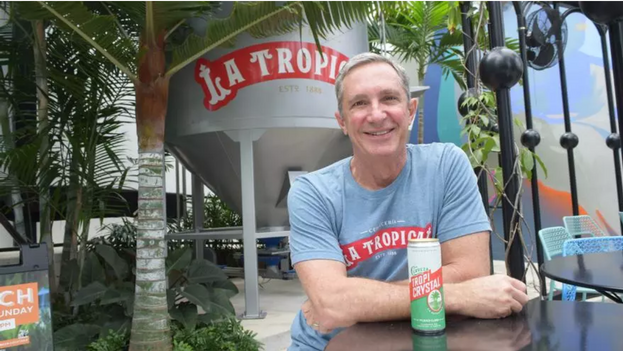
Born in Miami 56 years ago to Cuban parents, Portuondo considers himself to be the heir to the tradition and history of the Cuban brewery. (EFE)

14ymedio biggerEFE (via 14ymedio), Miami, Jorge I. Pérez, 29 March 2023 —  Cuban-American businessman Manny Portuondo was missing something when he inaugurated La Tropical brewery in Miami two years ago, a replica of the one that existed in Cuba with the same name: its most popular beer, Cristal, which in April will begin to be sold as Tropi Crystal, La Auténtica.

“It’s the authentic one, and we put the history of the beer on the label: ‘Made in 1928 by La Tropical brewery in Havana and now in Miami by its founders’,” Portuondo tells EFE.

The businessman says this while holding a can of Tropi Crystal, which lost the Latin “i” in the middle of the “war” to recover the brands that existed before the Revolution, which began with rum.

Born in Miami 56 years ago to Cuban parents, Portuondo considers himself to be the heir to the tradition and the history of the Cuban brewery La Tropical, which dates back to 1888.

He is the great-great-grandson of Federico Kohly, who sold the land to the Blanco-Herrera family so that, in 1888, he could build a brewery on the banks of the Almendares River. continue reading

The brewery was constructed with colorful gardens, several party rooms, a baseball field and even a castle, at the same time as Park Güell in Barcelona,” according to historian Yaneli Leal del Ojo, author of the book Los Jardines de la Tropical [Tropical Gardens].

Two years ago and after 25 years of research, including a trip to the Island, Portuondo inaugurated La Tropical de Miami, in the bohemian neighborhood of Wynwood.

Then he launched the oldest brand in the portfolio, the Tropical La Original, but he did not have the clear and refreshing Cristal registered in the United States.

“I like to do things well, and legally,” says this “lover of history, gardening and brewing.”

The can of Tropi Crystal La Auténtica, which comes to the US market on April 4, says on its back label, “Enjoy the refreshing and authentic flavor of Miami’s favorite beer.”

“It says that because we are no longer in Cuba. So, this beer is for all the exiles, all the Cuban emigrants who have had to come here since 1959 to make a new life. This beer represents the pride of all of us,” he says.

The Cristal beer that is sold in Cuba is made by the Bucanero brewery, whose factory is in the province of Holguín, and for Portuondo, it is not the authentic one.

“It can only be authentic if it is in the hands of those who created it in 1928, our family and the Blanco-Herrera family, who founded La Tropical and were in charge of managing the brewery until 1960, when the Cuban government took it at gunpoint,” he said.

Portuondo constructed gardens in La Tropical de Miami that are full of symbolism, like the two murals: one represents a “free” tocororo (the Cuban Trogon, Cuba’s national bird) outside an iron roundabout that acts as a cage and another by the artist Rigo Leonart, dedicated to the 11 July 2021 (’11J’) protests on the Island.

“The historical portfolio of La Tropical in Cuba consisted of three main brands of beer and a brand of malt. The beers are La Tropical La Original, which is the brand we launched two years ago and can now be found in more than 700 points of sale in South Florida; the Tropical 50 La Negra, from 1938; and I was missing the Cristal, which was the most popular,” he says.

The Portuondo label has the three royal palms, the original typography and the green, red and white colors of the Cristal, but there is a notable change with the Greek Y.

“We won the Tropi Crystal registration in the United States, where the Cristal brand cannot be sold with an “i” (Latin) because that registration belongs to a Peruvian brewery. We keep the logo and the association with La Tropical, which was the one at the beginning.”

“The recipe is the same, made in a more modern way with automated equipment. In Cuba they call it ’the favorite of Cuba’ and we call it ’the favorite in Miami,’” he said.

Translated by Regina Anavy

____________

COLLABORATE WITH OUR WORKThe 14ymedio team is committed to practicing serious journalism that reflects Cuba’s reality in all its depth. Thank you for joining us on this long journey. We invite you to continue supporting us by becoming a member of 14ymedio now. Together we can continue transforming journalism in Cuba.
The Governor of Puerto Rico Invites Diaz-Canel To ‘Liberate the Cuban People From Communism’

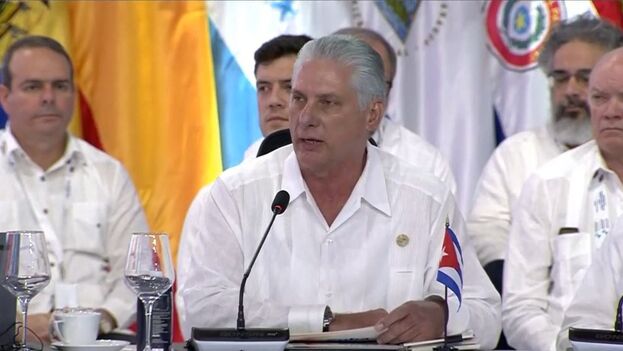
Cuban President Miguel Díaz-Canel during his speech at the Ibero-American Summit, where he spoke about the independence of Puerto Rico. (Ministry of Foreign Affairs)

14ymedio bigger14ymedio, Madrid, 27 March 2023 — Miguel Díaz-Canel’s passage through the Dominican Republic during the XXVIII Ibero-American Summit resulted in a dispute with the Governor of Puerto Rico, Pedro Pierluisi, who was upset on Saturday night by the Cuban President’s allusion to the independence of that territory associated with the United States.

“We reaffirm the historic commitment to the self-determination and independence of the people of Puerto Rico,” Díaz-Canel said in a speech in which there was also no lack of defense of the absent leaders of Nicaragua and Venezuela, ideological partners of Havana, or support for the recovery of the Malvinas [Falkland Islands] for Argentina.

The words did not sit well with the Puerto Rican governor, and, a few hours later, he showed his discomfort on Facebook. “Last night I was at the inaugural events of the Ibero-American Summit at the invitation of my friend, the President of the Dominican Republic, Luis Abinader. I returned to Puerto Rico early this morning and did not participate in the work of the Summit because, as Governor of Puerto Rico, I am not a member of it,” Pierluisi began.

“Although my presence was limited to such activity, I cannot ignore the words of the President of Cuba, Miguel Díaz-Canel, calling for the independence of Puerto Rico in today’s session,” continued the leader of the New Progressive Party and the Democratic Party of the United States.

After this preamble, Pierluisi defends the current status of Puerto Rico and lashes out at the Cuban president. “Here we believe in democracy, and the desire of the majority of our people in favor of Statehood and Equality under the flag of the United States must be respected.” continue reading

“I recommend that you focus on freeing your own citizens from the yoke of communism, which has only brought poverty and pain to the Cuban people,” he said.

A few hours later, Díaz-Canel went to vote this Sunday at his polling station in Santa Clara where a Puerto Rican journalist from the newspaper Claridad asked him, not about the controversy with Pierluisi, but about the position of the United States against the vote on March 26 to elect the new deputies of the National Assembly. The Cuban president was, as usual, indignant with Washington, to which he attributed a “hostile narrative that is imaginary, slanderous, a fantasy, provocative and untrue.”

The Cuban leader considered that the United States is annoyed that Havana does not follow its dictates as, he let drop, happens in other countries. “We are so sovereign and so independent, so our own… that we do not have to submit to an opinion of the US embassy because for us it does not influence anything that we are doing; we work from our convictions,” he added.

The Cuban press omitted information this Sunday about the dispute, but at midnight on Monday, Prensa Latina did release a statement from the Hostosian National Independence Movement (MINH), a Puerto Rican left-wing and pro-independence organization closely linked to Havana and with little political representation in its own territory. In that text, the MINH reproaches Pierluisi for his words towards Díaz-Canel and is grateful that he attracted attention to “the colonial case of Puerto Rico and its inalienable right to self-determination and independence.”

“Governor Pierluisi should feel embarrassed because Puerto Rico cannot participate in that important event [the Ibero-American Summit], due to its status as a colony of the United States,” says the report, which describes the “unconditionality” of the governor toward the United States as humiliating.

“His pathetic denial of the Caribbean and Latin American condition of our Homeland provokes the contempt and rejection of the governments of independent countries participating in the Summit,” the statement adds, without giving a single example of his assertion.

Translated by Regina Anavy

____________

COLLABORATE WITH OUR WORKThe 14ymedio team is committed to practicing serious journalism that reflects Cuba’s reality in all its depth. Thank you for joining us on this long journey. We invite you to continue supporting us by becoming a member of 14ymedio now. Together we can continue transforming journalism in Cuba.
Cuba’s Regional Media Want Paid Advertising and Less ‘Verticalism’

With this change, “economic support” for the official press will be distributed from the income it receives from the state budget, from allocations for “special treatment” and as a communication company. (14ymedio)

14ymedio bigger14ymedio, Havana, 27 March 2023 — The official press will begin to incorporate advertising in the midst of the economic crisis that Cuba is experiencing, Escambray reported on Monday, and it describes this new stage as an “experiment” in which 15 other state media will also participate. Although the newspaper insists that there will be a change in editorial management, it also says that the press will continue to be governed by the political model of the Revolution.

Escambray says that “sooner rather than later” the possibility of having advertising or including in its business portfolio the elaboration of campaigns and communication plans for legal companies and natural persons will materialize, although it does not specify what type of companies could advertise. Radio Sancti Spíritus will do the same and will have an air-conditioned room and a recording studio for “its potential customers.”

With this change, the “economic support” for the official press will be distributed from the income it receives from the state budget, from allocations for “special treatment” and as a communication company. Until now, the Government has maintained the discourse that advertising in newspapers, radios, television and any official media are practices of capitalist media and associated with the Cuban Republican past.

However, the newspaper wonders if the conditions are now in place for that change, since “the public media system, which worked in another context, is barely on crutches in the 21st century.” continue reading

Despite the fact that the media insists that the change “is a wide open window” and occurs in a context that cries out for a new model of management of the public press, it recognizes that the official media will remain aligned with “Cuban-style socialism,” around the “solid foundations and strong forces” of the Revolution.

The official press is part of the government machinery aimed at extolling the political and economic model, in addition to disseminating its slogans. From time to time, however, the regional media publish relentless reports on the deterioration of the economic and social activity in their territories. Pressured by social networks, the media have also had to deal with issues little addressed by the regime, such as the wave of violence suffered by Cuba and the migratory exodus.

Even so, Escambray considers that the press has been an “essential pillar” in state management, but that the new strategy will try to “remove from its letter and spirit” the “vertical, unidirectional and dusty paradigm of the mass media,” which “fulfilled its mission in another context.”

The article constantly defends the idea that the incorporation of advertising into its content “will enrich” its purposes but also states that this poses “ethical challenges,” such as defining how the media will deal “with a market for goods and services not explored by most Cuban media.”

The new “ideological paradigm” poses another challenge: to regain the credibility of the public media, in a context where the audience has grown for “informal communicative channels” associated with information technology, a clear allusion to social networks.

Nor does the newspaper miss an opportunity to blame the “permanent economic and media hostility of the United States,” which, in its opinion, conditions the press as a mechanism of political control.

Finally, Escambray recognizes that the much-acclaimed “modernization” also involves integrating into digital media, a space that is not taken advantage of “optimally” due to the lack of technological infrastructure and professional knowledge of the collaborators.

The change in the management of the state media is the prelude to the XI Congress of the Union of Journalists of Cuba, which will be held this coming July and where the progress of the model will be discussed. Escambray issues a warning that if these changes do not contribute to raising the “credibility of journalism and social authority… we will not even be halfway on the road to transforming the Cuban press.”

Translated by Regina Anavy

____________

COLLABORATE WITH OUR WORKThe 14ymedio team is committed to practicing serious journalism that reflects Cuba’s reality in all its depth. Thank you for joining us on this long journey. We invite you to continue supporting us by becoming a member of 14ymedio now. Together we can continue transforming journalism in Cuba.

Baseball Player Who Left Cuba in 2022 Signs with the Saint Louis Cardinals

Yadiel Batista pitched a no-hitter at the Cándido González de Camagüey stadium in August 2022. (Twitter/@francysromeroFR)

14ymedio bigger14ymedio, Havana, 24 March 2023 — Cuban baseball player Yadiel Batista made the Major Leagues less than six months after he left the Island. At 18 years old, the player reached an agreement with the Saint Louis Cardinals of the United States. According to journalist Francys Romero, “this Friday he signed the contract” and “received a bonus of $250,000.”

Since he settled in the Dominican Republic, last October, the athlete from Ciego de Ávila was observed by recruiters. At 6’3″ and 189 pounds, Batista’s main quality is a powerful arm; he is capable of throwing the ball at a speed of 88-91 mph.

Before leaving Cuba, on August 3, 2022, this left-handed pitcher won a no hitter at the Cándido González de Camagüey stadium. “This was the sixth no hitter — a game without hits or runs — in Under-23 National Championships since the beginning of these tournaments in 2014. Batista got 7 innings, 4 strikeouts,” Romero published in Baseball FR!

The Cardinals, the same team that hired Randy Arozarena in 2016, “have been scouting Cuban talent lately, especially in the area of pitchers,” the reporter said. continue reading

The news about Batista was given a few days after he received the free agency, necessary for him to sign with a team. After that he underwent physical examinations, which went smoothly. In his process to enroll in a Major League team, he was represented by Edgar Mercedes.

Francys Romero saw him a year ago as “a rotation pitcher” with an impact in the near future in the National Series. “He also has plenty of tools to throw in professional baseball,” wrote the Cuban baseball specialist.

This Thursday, Cuban catcher Alfredo Fadragas was declared a free agent by the Office of the Commissioner of Major League Baseball (MLB). The 23-year-old left the Island after he was suspended for life from the sport following an unsuccessful escape attempt in Mexico.

“When it seemed that Fadragas’ successful career was inside the darkness of a tunnel, the catcher was able to leave the country for the Dominican Republic,” published Baseball FR! Now Fadragas hopes that the interest of the Major League teams will be realized in a contract.

As part of his career, Fadragas joined the Cuban team in almost all categories: Under-15 World Cup (Mexico) and Under-23 Pan American 2022.

Translated by Regina Anavy

____________

COLLABORATE WITH OUR WORKThe 14ymedio team is committed to practicing serious journalism that reflects Cuba’s reality in all its depth. Thank you for joining us on this long journey. We invite you to continue supporting us by becoming a member of 14ymedio now. Together we can continue transforming journalism in Cuba.
Cuba’s Official Press Criticizes the Managers Who Squander the State’s Money

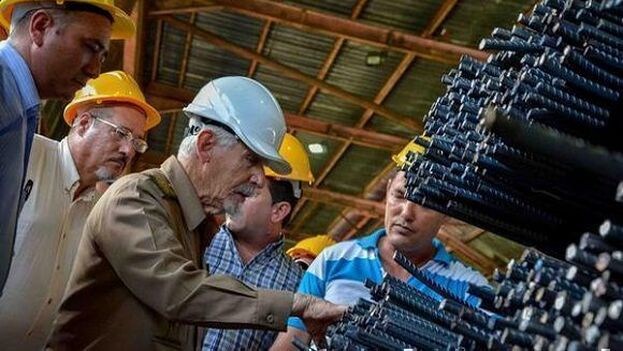
The Deputy Prime Minister of Cuba, Ramiro Valdés Menéndez, during a visit in 2017 to the steel company Acinox, one of those mentioned by the local press. (ACN)

14ymedio bigger14ymedio, Havana, 25 March 2023 — Of the 63 Cuban state companies that operate in the province of Las Tunas, 25 received million-peso payments from the Government without any productive support. The fact, which the local press unequivocally described as a “scam,” addressed the total expenditure of 29,924,000 pesos [$1,246,830] in January alone and motivated a meeting of local leaders, but the analysis was “not at all rigorous” considering the seriousness of the crime.

It’s not the first time that the province “bleeds” the allocated budget, details the official newspaper Periódico 26. In 2022, the numbers were similar, and the managers of the companies did not have to answer for the contrast between investment and results.

The list of non-compliances is long and involves the most important companies in Las Tunas. Although the newspaper does not provide the production data, it does reveal the amount that each one received. The Poultry Company received 3,551,000 pesos [$147,958]; the Pharmacy and Optics Company, 3,394,800 [$141,450]; the Construction and Assembly Company, 2,534,700 [$105,613]; and the Acinox steel company, which presents itself as “the leading company in Cuba in world exports of products offered by the metal industries,” 2,363,800 [$98,429].

Other companies that paid the salaries of their workers with hardly any profits in January were the Agroforestry, Twisted Tobacco, Acopio, the Wholesaler of Food, Raw Materials, Duralmet and even the Electric Company of Las Tunas. In addition, each of the Commerce companies – and several sugar and agricultural companies – are in the same situation in the municipalities of Manatí, Jesús Menéndez and Amancio.

The worst, complains the report, is not the waste of public money, but the inaction of the directors and their provincial and national supervisors. “Anyone without the required responsibility can make an improper payment of that magnitude, but he immediately has to answer for it,” the newspaper says. However, the reality is different: “The directors of those entities still do not respond with the rigor that the matter entails.” continue reading

The newspaper asks that those responsible be “prosecuted by the competent courts” for squandering the state budget. However, there does not seem to be any will either in the provincial government or in the “cores” that the Communist Party maintains within each company.

“Literally it is not happening,” says Periódico 26, arguing that paying million-peso amounts to unproductive companies is a violation of Resolution 6/2016, the enforcement of the forms of payment in the state sector.

“No control,” “lack of demand” and scams by the boards of directors are some of the characteristics that the report attributes to business management in Las Tunas. “It’s true that there are companies that for various reasons have seen their management limited and their workforce decreasing production, which sometimes becomes almost zero, but it is necessary to find formulas to reorient the work and find other options that sustain wages. And that is rarely done,” it admits.

Without mentioning at any time the US embargo — the preferred excuse of the Cuban media and leaders to justify their inefficiency — the article defines a clear cause for the loss of the almost 30 million pesos destined for Las Tunas in January, but it does not dare to call it by its name: the corruption of businessmen and their impunity before state supervisors.

Translated by Regina Anavy

_______________

COLLABORATE WITH OUR WORKThe 14ymedio team is committed to practicing serious journalism that reflects Cuba’s reality in all its depth. Thank you for joining us on this long journey. We invite you to continue supporting us by becoming a member of 14ymedio now. Together we can continue transforming journalism in Cuba.
Amnesty International Denounces the Hundreds of Prisoners in Cuba for Exercising ‘Their Human Rights’

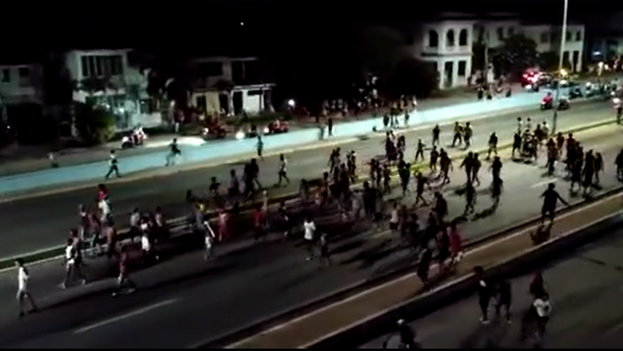
Hundreds of people participated in a multitude of spontaneous protests over last summer’s blackouts. (Captura)

14ymedio biggerEFE (via 14ymedio), Havana, 28 March 2023 — The NGO Amnesty International (AI) denounced on Monday in its annual report the “hundreds of people” in prison in Cuba for “the peaceful exercise of their human rights” — including “three prisoners of conscience” — and the “repression” of “dissidence” and protests.

In its document, which summarizes the most relevant violations of the year by country, it also notes that the new Cuban Criminal Code consolidates “limitations on freedom of expression and assembly as is customary” and represents “a disturbing panorama for independent journalists, activists and anyone critical of the authorities.”

It also highlights the social problems due to the “food shortage” suffered by the country and the “frequent” power outages. It says that the State has the “obligation to enforce the economic, social and cultural rights” of citizens.

The NGO points out that at the end of last year “hundreds of people who had suffered the repression of the July 2021 protests were still in prison,” the largest in decades. continue reading

The demonstrations were spontaneous and mostly peaceful at a time of serious economic crisis due to the concurrence of the pandemic, the tightening of US sanctions and errors in national economic policy.

AI also recalled that in September and October, after the passage of Hurricane Ian, “there were protests throughout the Island against widespread power outages,” in which “the authorities responded by deploying military cadets to suppress the protests and used arbitrary detentions.”

The authorities “interrupted access” to the Internet “deliberately,” said AI, which is an “increasingly common tactic to limit communication in Cuba in delicate moments from the political point of view.”

The NGO indicated that the Cuban president, Miguel Díaz-Canel, “undermined the importance of the widespread nature of the protests,” attributing them to a “minority of counterrevolutionaries with connections outside Cuba” and reducing them to acts of “vandalism” that would be confronted with “the rigor of the law.”

“Three prisoners of conscience remain in prison, a figure that represents only a tiny percentage of the total number of people who were detained for the peaceful exercise of their human rights,” the report adds.

AI was referring to the artist and activist Luis Manuel Otero Alcántara, the musician Maykel Castillo Osorbo and the opposition leader José Daniel Ferrer, for whom it denounced the periods that Ferrer passed in “solitary confinement” and “incommunication” in prison.

The document also mentions the strong migration that the country suffers, the approval in September of the Family Code — which legalized marriage and adoption for homosexuals — and the non-inclusion of femicide in the new Criminal Code.

Translated by Regina Anavy

____________

COLLABORATE WITH OUR WORKThe 14ymedio team is committed to practicing serious journalism that reflects Cuba’s reality in all its depth. Thank you for joining us on this long journey. We invite you to continue supporting us by becoming a member of 14ymedio now. Together we can continue transforming journalism in Cuba.
Cuba’s Ministry of Economy and Planning: ‘In Six Months, It Will Be Worse Than Now’

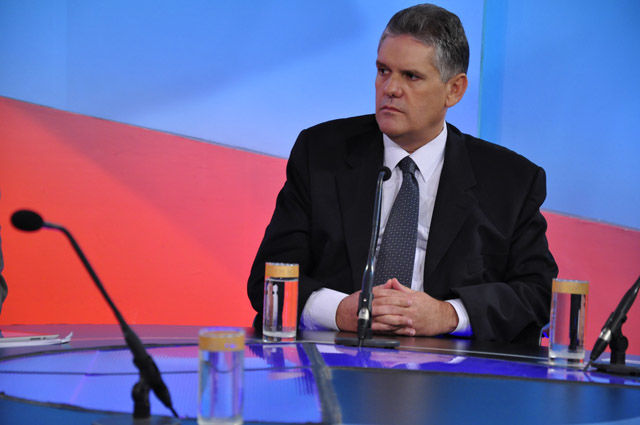
Cuban Ministry of Economy and Planning, Alejandro Gil (Cubanet)

14ymedio bigger14ymedio, Elías Amor Bravo, Economist, 24 March 2023 — Prime Minister Manuel Marrero was present last Wednesday at the annual meeting of the Ministry of Economy and Planning, headed by Alejandro Gil. The extensive participation included the communist leader of the party’s productive economic department, Joel Queipo; the Minister of Finance and Prices, Meisi Bolaños; the Minister of Labor and Social Security, Marta Elena Feitó; and the new Minister-President of the Central Bank of Cuba, Joaquín Alonso Vázquez. From this economic conclave of the leadership, several conclusions can be obtained that are highlighted in this blog.

First, Gil and all his ministries are mistaken in proposing a GDP growth of 3% in the Cuban economy in 2023. Without reforms there is no possibility of growing, except by manipulation. What is needed are In-depth structural reforms that eliminate the obstacles and impediments that prevent the effective linking of sectors and productive activities. They have been proposing this type of message since they launched the Guidelines, but the results are not seen. In addition, growing by 3% is an unambitious figure, which not only prevents the economy from returning to the pre-pandemic situation, but is insufficient to correct serious problems, such as inflation and currency depreciation.

Second, according to what was stated at the annual meeting, the Cuban economy will stagnate in 2023, and this will take place because of the adverse effects of the dollarization of the economy, retail inflation, centralized access to foreign exchange, the insertion of new economic agents and the adverse results of companies with losses, still more than 400, which will remain unresolved. These effects are not the only ones, because blackouts, lack of food and deterioration of infrastructure have an continue reading

even more negative influence. The Cuban economy has been dragging for several consecutive years for cyclical and structural reasons, and this can make it more difficult to correct imbalances and to slow the growth of them.

Third, the recipe proposed by Gil, based on consolidating the restructuring of the currency allocation mechanism of the economy, the decentralization of competences to the territories and the integral transformation of the socialist state enterprise is not what the Cuban economy needs at the moment. It falls short, and this may be due either to technical ignorance of the rules of operation of an economy or to the lack of effective instruments to face problems. Or both at the same time.

The Cuban economy needs a more effective policy mix of monetary and fiscal policies to promote growth. Delaying  decisions over time can further aggravate the current scenario. For example, the idea of decentralizing spending to the territories may further increase waste, deficits and indebtedness, which is exactly what is not needed at the moment. Similarly, the Cuban communists say they want to advance in the macroeconomic stabilization of the country in 2023, but they neither adopt measures nor know in which direction they have to move to do so. The result will be a failure.

Fourth, Marrero said that there are still distortions that must be corrected to continue developing the economy and active participation in society, a disturbing message if they do not specify what those distortions are. In any case, they have their origin in the interventionist model of the regime since they are only found in Cuba. In that sense, Gil’s proposals for economic actors, consisting of creating an institute and a general direction of the ministry for attention, coordination and control of economic actors, more bureaucracy and intervention, have as its main objective to further subordinate the performance of economic actors to the decisions of the regime. Farewell to economic freedom.

The announcement of fiscal stimuli only to economic agents dedicated to producing and importing goods and raw materials in the Cuban economy to create productive chains within the socialist state company seem more like an unproductive expense that is useless, than like a program aimed at consolidating the productive structures of the economy. Why don’t they stimulate everyone? In reality, this type of asymmetric and partial measure, instead of improving the general functioning of the economy, cause negative effects with dangerous intersectoral transfer of resources.

Fifth, with regard to the transformation of the socialist state enterprise, Gil said that in order to advance in this area and achieve effective performance as the main actor of the economy in the production of goods and services, two things are required: to start the classification of state companies, which has all the aspects of a bureaucratic task, and to present the proposed law of companies that, clearly, seems to show a preference for state companies without any glimmer of hope for the private sector. The 400 companies with losses will not see their situation improve.

Sixth, and closely related to the design of economic policies, it is useless for Gil to defend maintaining the principles of more equity, social justice and benefits to the population if this does not produce more and better. This will not be achieved if the priority is not set correctly. And it seem sthat in this balance-sheet meeting, the importance of production and supply is is not taken into account.

Conclusion, more of the same, without being able to see signs of improvement in the Cuban economy. In six months the Cuban economy will be much worse than now. What’s the point of voting on March 26?

Translated by Regina Anavy

____________

COLLABORATE WITH OUR WORKThe 14ymedio team is committed to practicing serious journalism that reflects Cuba’s reality in all its depth. Thank you for joining us on this long journey. We invite you to continue supporting us by becoming a member of 14ymedio now. Together we can continue transforming journalism in Cuba.
Images of Empty Voting Centers in Cuba Belie the Official Participation of More Than 70 Percent

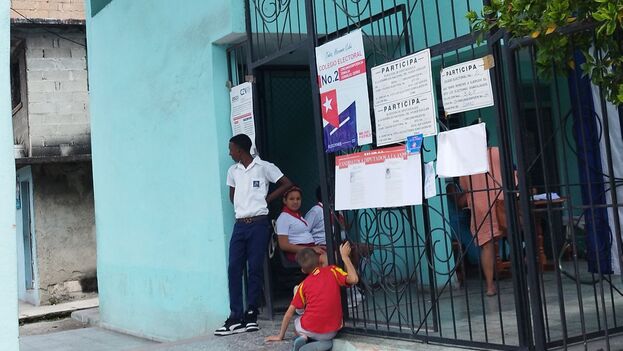
The attendance was low in the capital’s polling stations  and in other provinces. (14ymedio)

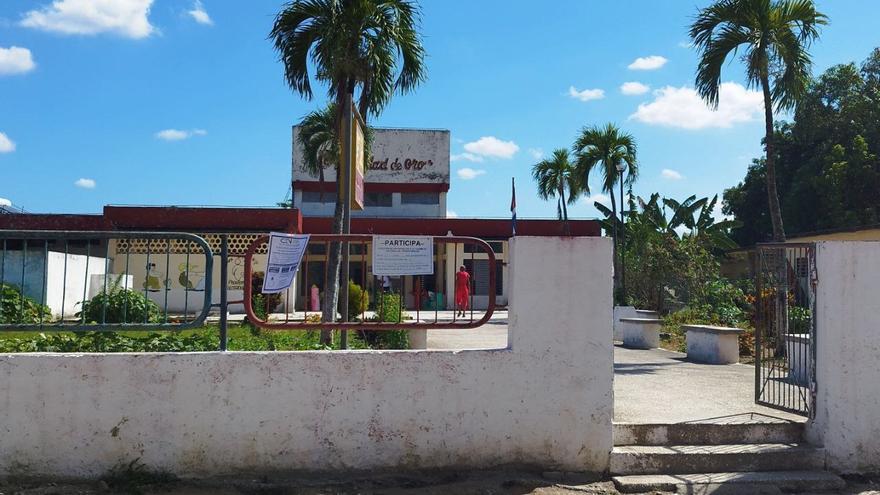
14ymedio bigger14ymedio, Havana, 27 March 2023 — A lack of enthusiasm marked Cuba’s parliamentary elections on Sunday, March 26, which even with the official data available so far already point to the lowest turnout since 1959. The 14ymedio team was able to verify in different polling stations in Havana that not many Cubans came to vote. In the provinces, where it is more complex to be recognized as having abstained, greater encouragement was noticed.

The low attendance is confirmed by collaborators of this newspaper in different provinces and is also suggested by the coverage of the official press, which has not been able to show photos of voters standing in line. The newspaper of the Communist Party of Cuba, Granma, has been inaccessible since the closing of the polls.

According to official data, by five in the afternoon, 70.34% of the electoral census had voted, which is 8.23 points less than in the 2018 elections, which had the least participation at the time. Alina Balseiro, the president of the National Electoral Council (CEN), is expected to appear this Monday to give the first definitive data.

The polls remained open two more hours until 7 p.m., since the CEN extended the deadline by one hour without further explanation. Manuel Cuesta Morúa was one of the opponents who said that the extension was “without causes of force majeure,” as happened in the referendum for the Family Code, held a few days after the passage of Hurricane Ian.

The opponent also questioned the growth of participation between 9:00 and 11:00, when the jump went from 18.15% to 41.66%. The official data of the 2018 elections reflect the same trend, but it was not the case in the municipal elections of 2022, when fewer people voted in the time slot from 9:00 to 11:00 than in the time slot from 7:00 to 9:00. In 2018, the campaign in favor of abstention was not as intense as in this last election, but, nevertheless, the regime now presents higher attendance data. continue reading

The lack of international observation missions was one of the biggest criticisms of the opposition and different NGOs, such as Electoral Transparency. “The results issued by the National Electoral Council cannot be disputed” and go in the opposite direction “of the abstentionist trend that the CEN itself reflected” in past elections, the organization said in statements to the Spanish news agency EFE.

Electoral Transparency called for “an independent audit so that the announced results are reliable.”

Despite everything, even the official data do not point in a good direction for officialdom, which has turned more than ever to trying to activate the vote. Participation in the parliamentary elections on the Island has been historically high. Between 1976 and 2013 it was always above 90%, and only in 2018 did it fall for the first time below that barrier, to 85.65%, even though the campaign for abstention was not as active and mobilized as it was this time.

In comparison, the abstention in last year’s voting in Cuba was greater than what the CEN offered at 5:00 p.m. In last November’s municipal elections it reached 31%, and in the referendum on the Family Code held in September it stood at 26%.

The authorities have stressed that voting participation on the Island is much greater than that of countless elections in Western democracies, starting with the United States itself. However, the Cuban government knows the peculiarities of its own system and knows that it can only compare to itself, so the decrease in voters who go to the polls is bad news that is difficult to hide.

Image of a polling station in Sancti Spíritus this Sunday, March 26, during the elections to the National Assembly. (14ymedio)

Last Thursday, in the propaganda program Con Filo [Cutting Edge] on Cuban television, the presenter himself explained it as follows: “The suffrage in Cuba has a double significance: not only are future deputies elected to the National Assembly but, as in every election, our political system is subjected to a tacit referendum. That’s how we see it and that’s how our enemies see it.” Abstention and null or void votes will be fundamental in analyzing the loss of support for the Revolution on the part of Cubans.

The NGO Cubalex, in addition, pointed out this Sunday different acts of repression against independent journalists and opponents who tried to exercise observation tasks in the elections. By 9:00 p.m. it had identified 27 cases, with about 30 affected.

In this Sunday’s elections, 470 candidates were presented for the same number of seats, almost all of them militants of the PCC, the youth organizations and others related to the government. The authorities urged a block vote for all the candidates proposed by each district in messages reproduced in a loop in the state media and disseminated with the hashtag #YoVotoXTodos.

On the ballot, voters could put an “x” in the box for all the candidates (following the official call), or imply next to some of the names, or even leave the ballot blank.

This call for a “united vote” led the most fervent followers of the Government to vote for unknown candidates from their district.

“We don’t know all the candidates, but we voted for the Revolution,” Rafaela, a 67-year-old Cuban near the polling station in Havana, told EFE.

That age group was one of the few still relatively mobilized, according to the information collected by 14ymedio in the previous days. Young people are, again, the ones who expressed the most disinterest, either because of their perception that the Revolution doesn’t belong to them, or because their only thought is to leave an Island that is in a worse condition than ever.

The progressive fall in participation since 2018 has been read by the Government as a response to the economic crisis. The president himself, Miguel Díaz-Canel, went so far as to speak of a “punishment vote” during the referendum on the Family Code.

After voting, the president dismissed the possibility that abstention  will continue to gain ground in elections: “I don’t think so, because this hasn’t been the only moment with difficulties and economic complexities.”

The Minister of Foreign Affairs, Bruno Rodríguez, expressed himself in the same way in statements to the press at a polling place in Havana: “Cuban elections will continue to be different in the sense of greater participation and democracy than the majority you see on the planet.”

Translated by Regina Anavy

____________

COLLABORATE WITH OUR WORKThe 14ymedio team is committed to practicing serious journalism that reflects Cuba’s reality in all its depth. Thank you for joining us on this long journey. We invite you to continue supporting us by becoming a member of 14ymedio now. Together we can continue transforming journalism in Cuba.
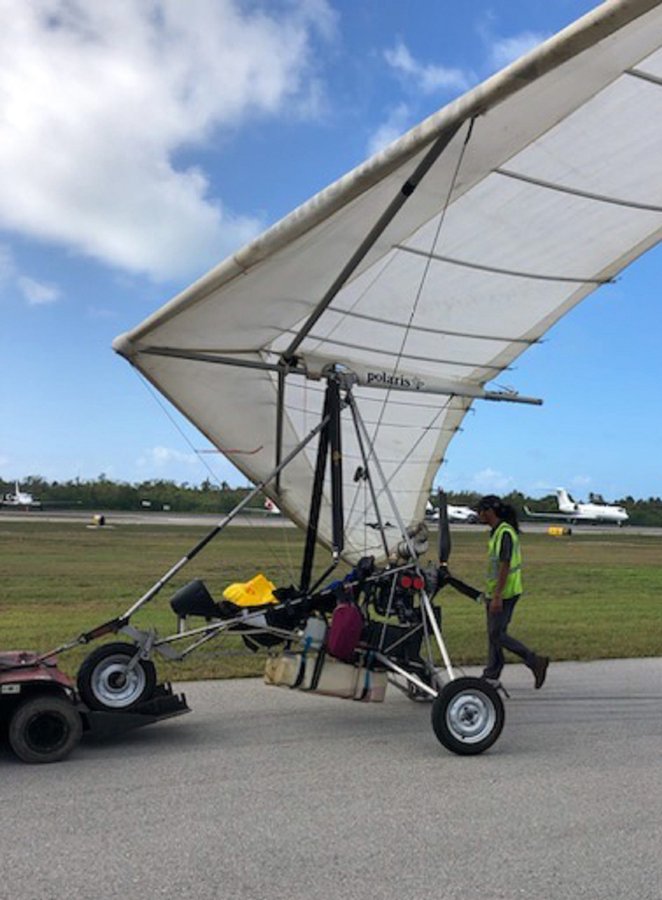
Two Cubans Arrive in Key West on a Motorized Hang Glider

The motorized hang glider in which two Cubans arrived in the United States. (@mcsonews/Twitter)

14ymedio biggerEFE/14ymedio, Miami/Havana, 25 March 2023 — Two Cubans were arrested this Saturday at Key West International Airport, in southern Florida, where they arrived aboard a motorized hang glider, police sources confirmed.

Adam Linhartd, spokesman for the Monroe County Sheriff’s Office, said that the two Cuban citizens, about whom he claimed to have no information, were handed over to the Border Patrol.

The arrival occurred around 10.30 am local time, and apparently the Cubans had not suffered any injuries during their flight.

The Border Patrol limited itself to reporting the detention of the two migrants without giving details and thanked the Monroe Sheriff’s Office for its support.

The tourist island of Key West is located 90 miles from Cuba and, like the rest of the Florida Keys, is an area where Cubans land in rudimentary boats.

Arrivals by air, like today’s, are unusual. On October 21, 2022, Cuban pilot Rubén Martínez Machado fled Cuba in a Russian-made Antonov aircraft and landed at the Dade-Collier Training and Transition Airport, located in the middle of the Everglades. Originally detained, heis now free, after a judge granted him political asylum.

One of the arrivals was a 29-year-old pilot of the Cuban Air Services Company, belonging to the Cuban Aviation Corporation, and he left the Island from Sancti Spíritus.

Customs agents interrogated the pilot as soon as he landed, and he was immediately put in the custody of the authorities.

Translated by Regina Anavy
____________

COLLABORATE WITH OUR WORKThe 14ymedio team is committed to practicing serious journalism that reflects Cuba’s reality in all its depth. Thank you for joining us on this long journey. We invite you to continue supporting us by becoming a member of 14ymedio now. Together we can continue transforming journalism in Cuba.
A County in Northern Ireland Requests Doctors From the Cuban ‘Henry Reeve’ Brigade for a Hospital

The South West Acute Hospital, in the Northern Irish city of Enniskillen, closed the emergency surgery room in November due to a lack of staff. (HSC)

14ymedio bigger14ymedio, Madrid, 24 March 2023 — Given the lack of staff in one of its hospitals, a local government in Northern Ireland (United Kingdom) is asking Cuba for doctors. As reported on Thursday by the BBC on its news website, the authorities of Fermanagh County have sent a letter to the Embassy of the Island in London in which they ask if the Henry Reeve Brigade “could provide assistance” to the South West Acute Hospital, in Enniskillen, “so that it can meet the required staffing standards.”

The center had suspended its general surgery service in the emergency room last November due to a lack of healthcare workers.

As is the case throughout the United Kingdom with its National Health Service, the management of the hospital budget and the hiring of personnel are carried out by trusts that are distributed throughout the country. In this case, the Western Trust is responsible.

On March 15, the county’s policy and resources committee extended an invitation to this trust to accept the proposal, but the local media has not reported whether it has responded or not.

The Fermanagh Herald mentions that the problems of this trust “to recruit and retain medical personnel” in that hospital have caused a crisis, which local councilors are trying to remedy by importing Cuban health workers. continue reading

The diplomatic headquarters responded to the politicians immediately, indicating that the request for medical personnel had been transferred to the Ministry of Public Health of Cuba. A letter signed by Marta Castillo, who is in charge of cooperation matters at the Embassy, asks for as many details as possible about the staff and specialties required by the County Council, and also suggested holding a video call with the councilors about it.

Not all members of the Fermanagh Council, however, are satisfied with the hiring of Cubans. The most enthusiastic is independent counselor Eamon Keenan (from the left, judging by his social networks), who is responsible for the initiative and stated that he “never had any doubt” that Cuban doctors would take the county’s request seriously. He alleged that the Western Trust itself had expressed its willingness to hire staff “at the international level,” so this was “a great opportunity.”

“Cuba, a country that lives under strong economic sanctions from the United States, can and is willing to send medical support to us, the poor people of Fermanagh,” Keenan said.

Counselor Victor Warrington (of the Unionist Party) was more skeptical and pointed out that they need “permanent responses to our problems and not a Band-Aid.” In addition, he specified that the imported Cubans “probably would be temporary.”

For his part, Donal O’Cofaigh (of the Labor Party), said that even if Cuban doctors were there for only one or two years, their presence could help “stabilize” the situation until they found “permanent surgeons.”

The Henry Reeve Brigade, defined as an “international contingent of doctors specialized in situations of disaster and serious epidemics,” was created by Fidel Castro in 2005, as propaganda after the passage of Hurricane Katrina in New Orleans.

Since then, it has intervened in different countries in cases of floods, earthquakes and outbreaks of diseases such as Ebola. During the COVID-19 pandemic, it acted in a total of 40 countries, according to data from the Cuban Government.

Unlike other missions in Havana, it boasts of being “charitable,” and has even been proposed for the Nobel Peace Prize. According to the NGO Cuba Archive, the Henry Reeve Brigade is simply an “exportable product” of the military dictatorship, and, as it warned the award committee in Oslo in a public letter in 2020, “it is an intrinsic part of a human trafficking scheme” that violates international law.

Translated by Regina Anavy

____________

COLLABORATE WITH OUR WORKThe 14ymedio team is committed to practicing serious journalism that reflects Cuba’s reality in all its depth. Thank you for joining us on this long journey. We invite you to continue supporting us by becoming a member of 14ymedio now. Together we can continue transforming journalism in Cuba.

Cuban Actor Ruben Brena Dies at the Age of 70 in Havana

Rubén Breña acting in a drama on national television. (ICRT)

14ymedio bigger14ymedio, Havana, 23 March 2023 — Cuban actor Rubén Breña passed away this Thursday in Havana at the age of 70, official media reported. The artist died after spending several days in intensive care at the Hermanos Ameijeiras Hospital due to complications from erosive gastritis.

This Wednesday, and after several postings on social networks by friends close to the artist who denounced the lack of medicines to treat Breña, the official press published a note, something unusual in the health system of the Island, by the Hermanos Ameijeiras Hospital saying that the hospital had “everything necessary for his care.”

“From the first moment the patient had all the treatment required for erosive gastritis with the application of 20 mg of Omeprazole according to the protocols,” said the note, which caused outrage among Cuban Internet users for the severe shortage of drugs that the Island’s health system has suffered for more than two years.

According to the note, the actor had arrived at the hospital “in shattered health.” continue reading

Incredible, but true: Rubén Breña is in intensive care at Ameijeiras. He needs Omeprazole and vitamin K (not orally) and there is none,”   complained the actor and television director, Rolando Chiong, a few hours before the official publication.

Breña, known mainly for his diverse characters in dramatized series on Cuban television, was born in Pinar del Río in 1953. In the early 1970s he graduated from the National School of Theatre Direction of the Ministry of Culture and became part of the Zafarrancho and Trotamundos theater groups. In addition to theater and television, he worked in film and radio.

On television, his performances are remembered in dramatic works such as Tierra brava, Historias de Fuego, Cuando el agua regresa a la tierra and Salir de noche. According to the official media Cubadebate, Breña “was a self-taught painter and was fond of music and poetry.”

“Rest in peace, friend, man and great actor. Someday, someday. The good ones die, the fucked keep being fucked and living. That’s why, damnit, every day I don’t regret what I say,” actor Erdwin Fernandez wrote on Facebook, from the United States, when he learned of Breña’s death.

Among the official recognitions that Breña received in life, the Actuar Award for Life Work awarded by the Artistic Agency for the Performing Arts in 2019 stands out.

Translated by Regina Anavy

____________

COLLABORATE WITH OUR WORKThe 14ymedio team is committed to practicing serious journalism that reflects Cuba’s reality in all its depth. Thank you for joining us on this long journey. We invite you to continue supporting us by becoming a member of 14ymedio now. Together we can continue transforming journalism in Cuba.
Cuba: Police Will Go ‘House to House’ in Villa Clara to Find the Water Thieves

To carry out the theft, screws from the pipes were removed, and piping networks were connected that led to the fields of local farmers. (Vanguardia)

14ymedio bigger14ymedio, Havana, 24 March 2023 — The Villa Clara Police discovered 13 illegal connections and nine leaks in the Hanabanilla, a 15-mile system of pipes that supplies water to a large part of the central provinces of the Island. The farmers of the area had made multiple punctures in the pipes to divert the water to their agricultural fields.

The Hanabanilla, which takes its name from the reservoir that feeds it in the Villa Clara municipality of Manicaragua, extends from Jíbaro, in Sancti Spíritus, to Zapatero, in Villa Clara. The greatest damage occurred, according to the official newspaper, Vanguardia, between the towns of Porvenir and Biajaca, where the drainage left 10,000 people from the towns of Mataguá, La Yaya and Jorobada without a water supply.

To carry out the theft, screws from the pipes were removed and piping networks were connected that led to the fields of local farmers.

The authorities will apply sanctions to those involved and promised to carry out a “program for the suppression of leaks,” which are also common in the system. The official press also says that these water thefts also occur at the Paso Bonito-Barajagua pumping station, in Cienfuegos, but states that the Villa Clara Police “has no jurisdiction to act” there and that they have already informed the neighboring province to “take similar measures.”

According to the local newspaper Vanguardia, the authorities have been trying to contain the illegalities in the area for months. They assure that they have renewed the electrical panels that generate the pumping capacity in Hanabanilla, but that the illegal drainage decreases the pressure of the network and makes it impossible to supply the area. continue reading

The newspaper also points out the population density of the territory and says that, despite this circumstance, the police will go “house to house” to find the offenders. The newspaper says that an “official warning” would be a matter of interest to the inhabitants of Manicaragua and that, “in case of recidivism,” the fines and penalties will increase.

The loss of water in the area — in the midst of a drought that has affected, above all, the central part of the country — has been a blow to the cost of the tanker trucks that deliver water, for which large amounts of fuel are needed and often impossible to get, due to the “energy contingency.”

The illegalities, the price of getting water to mountainous and remote communities and the incompetence of Cuban hydraulic resources companies were not mentioned, however, in the speech given this Thursday at the United Nations Conference on Water by Cuban Vice President Inés María Chapman.

Chapman dedicated her speech to celebrating the Regime’s management and to complaining that due to the US blockade, the Island was not able to have better results.

Translated by Regina Anavy

____________

COLLABORATE WITH OUR WORKThe 14ymedio team is committed to practicing serious journalism that reflects Cuba’s reality in all its depth. Thank you for joining us on this long journey. We invite you to continue supporting us by becoming a member of 14ymedio now. Together we can continue transforming journalism in Cuba.

Between the Ballot and the Ticket To Leave the Island, Cubans Prefer To Emigrate

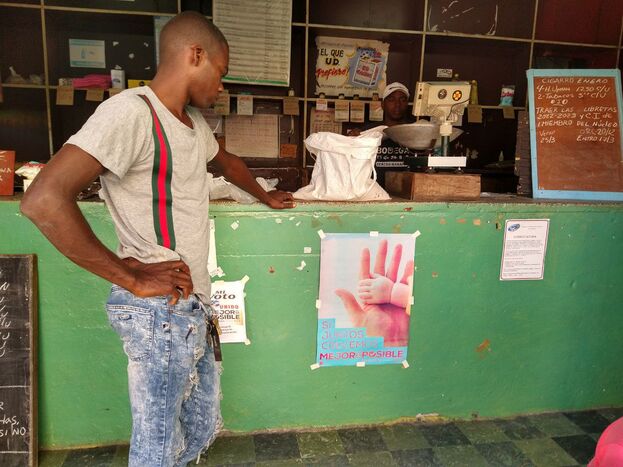
On Infanta Street this Wednesday, a young man in a ration store looked at one of the many official posters which, in these last weeks, promote a united vote for the parliamentary candidates.(14ymedio)

14ymedio bigger14ymedio, Natalia López Moya, Havana, 23 March 2023 — To vote or not to vote in the elections for Cuba’s Parliament, on March 26, is a dilemma in the face of which many Cubans have already taken sides. The economic crisis, lack of hope and little confidence in state institutions favor abstention in a country where not attending the polls is considered a political statement and can involve reprisals.

Among those who are overcoming fear and say that they will not vote are retirees whose pensions don’t go far enough, young people who have not known anything but scarcity since they were born and potential migrants who set their sights outside the Island. The dissatisfaction and mistrust that lay beneath the surface of Cuban society could materialize in an increase in abstentions this coming Sunday.

On Infanta Street this Wednesday, a young man in a ration store looked at one of the many official posters that in recent weeks promote a united vote for the parliamentary candidates. The colorful advertising stands out in the store, which has only a couple of products on display. On the counter, a small blackboard announces that allocation of cigarettes and cigars for the month of January are now being sold.

“I don’t even plan to go out that day, and I’m going to close the windows so they don’t bother me to go vote,” clarified another young woman who arrived at the bodega (ration store) to ask about the arrival of salt. “Two years ago I turned 16 and am on the electoral roll, but I’m not interested. I didn’t go to vote for the Family Code [in September 2022], and I’m not going to go this time either,” she says bluntly. continue reading

The reason borders more on indifference than on rebellion. “It’s not going to change anything if I go or not,” she tells 14ymedio. “My mother has been attending all those processes for 40 years and what does she have now? Nothing. A half-collapsed house, four old rags to wear and some children who only think about leaving this country as soon as they can.”

While she is speaking, an old woman arrives but doesn’t join the conversation. She makes a gesture of denial when she hears the young woman’s words. It is in the elderly where the official propaganda of the united vote and the attendance at the polls as a sign of support for the system penetrates with greater depth. They are the ones who are most afraid of change or have spent more years of their lives supporting the Government.

Maurín, 21, lives in the Havana neighborhood of San Pedro in the municipality of El Cotorro. In front of the door of his house extends a street that years ago lost some of its asphalt. Garbage accumulates on the nearby corner, while the line for the only kiosk that sells food in the area almost reaches his window.  “How am I going to go to vote if they haven’t even fixed the basics?” the young man asks, indignant.

With an engineer father and a nurse mother, Maurín questions the role of the delegates of the National Assembly of People’s Power in his neighborhood and the ability of parliamentarians to improve the lives of citizens. “In San Pedro we have been demanding [from the delegates] for years and years in the Accountability meetings that they fix our streets, improve the quality of the bread and open new stores to buy food, but none of that has been resolved.”

Disbelief has taken over many of the residents in the area, a phenomenon that is repeated throughout the country. To try to arouse enthusiasm in recent weeks, the Cuban ruling party has launched a campaign that includes meetings with voters, an avalanche of advertising in the national media, the reduction of annoying blackouts, and agricultural fairs to sell food at prices a little cheaper than in private markets.

However, the ideological offensive does not seem to be bearing fruit among a population that is tired of so many daily difficulties. For Maritza, 64, until recently employed by a branch of the Ministry of Culture, it is striking how people in the streets no longer hide that they will not vote on Sunday.

The Government of Miguel Díaz-Canel seems to fear a growth in abstention, which for decades remained below 10% but has experienced a significant increase in recent years. In last November’s municipal elections it reached an all-time high with 30% of voters absent. For the ruling party, attendance is measured as a sign of support for the system and the Communist Party.

“In the line at the bank I heard two employees who were talking and saying that they were not going to vote on Sunday. For me it is unprecedented that in a state work center people talk so openly in frank defiance of the system,” she tells this newspaper. “Before, that was unthinkable, and it shows that between fear and defiance, many are choosing defiance.”

Cuban dissidents have also raised the tone in the calls for abstention as the electoral date approaches and, for the first time in a long time, they have agreed on the “I don’t vote” premise, which has been joined by activists of various political stripes.

In Santa Clara, Ignacio, 47 years old and self-employed, has also decided to abstain. “The deputies will not solve any problem because they are the gears of this machine but not its essence. They are mostly a group of puppets without voice or vote because everything in Cuba has always been planned in that manual of ’continuity’,” he says.

Ignacio recognizes that others will go to the polls but says their attendance is not exactly because of a belief that the National Assembly will help improve life on the Island. “One of the saddest things is the political apathy of these people and the hopelessness that leads them to vote or take any decision dictated by the Government, such as voting for everyone,” he emphasizes.

Others, such as Jorge, a 23-year-old university student and resident of Camajuaní, Villa Clara, recognizes that he will go to vote on March 26 because he feels that attendance is “practically mandatory.” He does not want to stand out publicly and prefers to avoid teacher retaliation that could result from not going.

However, he recognizes that no candidate for parliament represents him “because the politics they defend has nothing to do” with his way of thinking. “The election process will solve absolutely nothing. All leaders follow the same ideology and do not change anything once they are elected,” he concludes with skepticism.

There are also those who seem impervious to the official campaign for the March 26 elections and say they are not even aware that voting will take place. “I don’t care about that; I just want to survive every day and wait for my sister to find me a sponsor to go to the United States,” acknowledges 19-year-old Jean Marcos. “The only place I’m going to go is to the airport when I have my flight.”

Jean Marcos’ friends share his position. Given the choice between the ballot or the ticket, they all seem to opt for something that gets them out of Cuba as soon as possible.

Translated by Regina Anavy 

____________

COLLABORATE WITH OUR WORKThe 14ymedio team is committed to practicing serious journalism that reflects Cuba’s reality in all its depth. Thank you for joining us on this long journey. We invite you to continue supporting us by becoming a member of 14ymedio now. Together we can continue transforming journalism in Cuba.
The Cuban Chancellor Says That It Is in the Interest of the United States To Have the Island on the Terrorism List

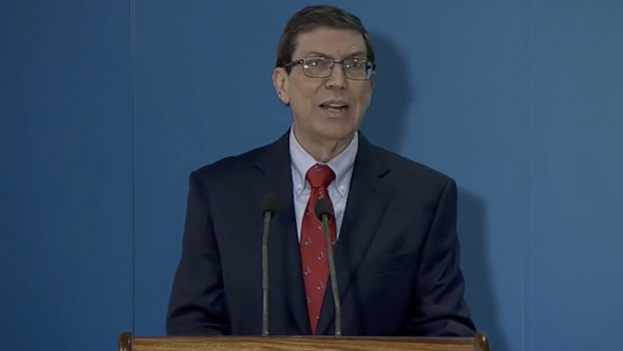
Bruno Rodríguez believes that the position serves the United States “for its criminal policy of economic suffocation.” (Screen capture)

14ymedio biggerEFE (via 14ymedio), Havana, 24 March 2023 — The Government of Cuba affirmed on Thursday that the United States never intended to remove the Island from the list of countries sponsoring terrorism because it “is convenient.”

Foreign Minister Bruno Rodríguez declared on Twitter that the North American country has no plans to “correct Cuba’s unfair classification” since “it is convenient for its criminal policy of economic suffocation.”

Rodríguez echoed the statements this Thursday by the US Secretary of State, Antony Blinken, in which he said: “We are not planning” to remove the Island from the list.

During an appearance before the Foreign Relations Committee of the House of Representatives, Blinken said “if there is a review, it will be based on the law and the benchmarks it establishes, which, as I said, have a very high bar.”

The Cuban head of Foreign Affairs stated that Blinken “confirms, in fact, that the State Department’s qualifying lists are nothing more than tools of political and economic coercion, totally divorced from such sensitive issues as terrorism, religion, human rights, drug trafficking, corruption and other things.”

The inclusion of Cuba on the list in January 2021 was one of the last decisions made by the Trump administration before leaving office. continue reading

The United States then justified the measure, which entails several sanctions, alluding to the presence on the Island of members of the Colombian ELN guerrillas, who traveled to Havana to start peace negotiations with the Colombian government.

The Island was taken off the list in 2015, during the rapprochement  promoted by US President Barack Obama. It was put back on by Trump, who during his term redoubled the sanctions against Cuba and paralyzed much of the “thaw” stimulated by his predecessor.

The current Biden Administration has made some gestures towards the Island, such as the elimination of the remittance limit for Cuba, but it is still far from Obama’s rapprochement.

Translated by Regina Anavy

____________

COLLABORATE WITH OUR WORKThe 14ymedio team is committed to practicing serious journalism that reflects Cuba’s reality in all its depth. Thank you for joining us on this long journey. We invite you to continue supporting us by becoming a member of 14ymedio now. Together we can continue transforming journalism in Cuba.
Without Private Participation, Transport in Cuba Will Not Go Very Far

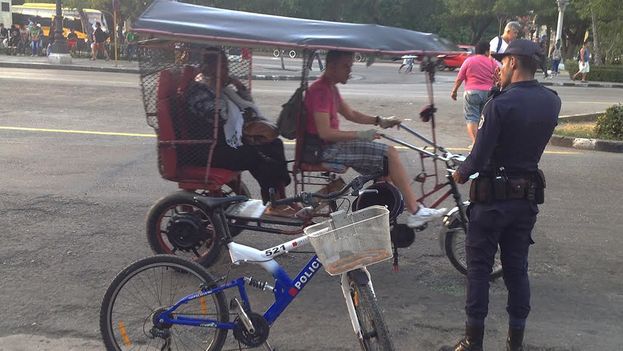
A police checking the papers of a pedicab driver in Havana. (14ymedio)

14ymedio bigger14ymedio, Elías Amor Bravo, Economist, 22 March 2023 — They don’t want to admit it, but if they want to get somewhere with transport in Cuba, they have to turn to the private sector. There is no other choice. In fact, one of the sectors of the Cuban economy that suffers a true crisis because of communist ideological measures is transport. And this, despite the fact that it is a fundamental sector for the proper functioning of the national economy in which the public and private must cooperate.

Unfortunately, none of this was mentioned at the annual evaluation meeting of the Ministry of Transport, Mitrans, held a few days ago and chaired by the Prime Minister, Marrero. In these meetings, the directors of the department talked about actions to stop road deterioration and begin its recovery, consolidate the development of computerization and strengthen the link with universities. The same thing every year. All this, according to the official press, to “achieve a robust transport system in 2023.” And to start over. It can be as robust as they want, but it won’t go anywhere.

And, as surprising as it may seem, there was only one reference in passing to adopt measures for prices in passenger transport, and this, despite the fact that, in February, the transport component of the consumer price index registered a year-on-year increase of 15% with an intense acceleration in the first two months.

It’s all the same. The Minister of Transport emphatically announced that this year, “the indication is to achieve the integration of all sectors of the industry to improve the quality of services.” The same “indication” of every year that later is never fulfilled. Integration and collectivism, the two vectors that prevent the sector from prospering.

At the meeting, with a large participation of officials and senior leaders of the communist party, not a moment was lost in blaming the embargo/blockade, the global economic crisis and the complex international situation for the lack of results. As a novelty, the minister insisted on “the need to eliminate the self-blocking and the limitations that many impose on themselves, with the aim of moving forward and looking for alternative solutions,” but without indicating which ones. A maxim since the times of the guidelines, which continues to be repeated like a scratched disc. continue reading

In his speech, Marrero surprised the attendees by pointing out that the most economical solution for the transport of goods “must be shipping,” and, a little surprisingly, he affirmed the need to “maintain performance with the support of state cars in public transport.”

Next, he said that a proper implementation of the recent Decree 83 on the transfer of ownership of motor vehicles, trailers and semi-trailers, their marketing and import (which seems to be a failure in view of the results) must be achieved; and they must raise the coefficients of technical availability of the vehicles with closed financing schemes (in the most absolute gibberish of the regime) and, from innovation, recover spare parts and added values (the scrappers’ business).

Next, he referred to the dissatisfactions with the work of the freight forwarding companies (dedicated to the distribution of international and state parcels, that is, dependent on it), which, in the case of Mitrans, are the entities Aerovaradero S.A. and the Freight Carrier Company (Transcargo). He concluded by saying that “Roads are one of the most complex issues facing the Island and, to guarantee productive activity, a solution must be found and the issue of road safety must be analyzed.” Traffic accidents are increasing significantly.

When talking about the transport of goods, Mitrans’ Director of Cargo of pointed out that the participation of various economic actors in the management must be increased. Work plans must be organized objectively to optimize resources, as well as the use of rail and shipping for the transport of cargo over long distances. It was the only reference to the private agents who offer their services in the sector.

In the case of Operation Port-Transport-Internal Economy (OPTEI), the Brigadier General at the head pointed out that it is necessary to maintain as a style of work the most agile transport groups at the beginning for extraction in the ports and final delivery to the client.

The director of passenger transport for Mitrans, pointed out that, although 2023 will be difficult, the measures adopted will allow the gradual recovery to begin. He insisted on the need to set objectives to meet the transport plans of the main services: taxis, school, urban, intercity, workers and rural. All this, without taking into account the February price increase in these services.

The general director of the Union of Railways of Cuba stressed that part of the actions for this year are focused on achieving the recovery of discharged equipment, including the manufacture of railways and on increasing efficiency, the quality of services and strengthening preventive work to avoid rail accidents. But it cannot prevent the use of the railway from being marginal for both passengers and goods.

At this point, Marrero ended by requesting the use of “carahatas,” a word that has no definition in the dictionary but that the prime minister said are small motor cars, alternatives for transport in rural areas. He also asked to conclude the work at the Central Railway Station of the capital and analyze the use and operation of urban trains.

For his part, the director of the Port Maritime Business Group (Gemar), said that within the projections is the launching of the ferry service and the floating dam, which Marrero said was a priority for the country, although curiously, he did not say anything about the transport of goods by shipping.

Finally, the president of the Corporación de la Aviación Cubana S.A. (Cacsa), spoke of improving the quality of passenger service and aircraft and achieving the sustainability of technological systems with a great impact on air activity, among other aspects. He also reported that work is being done on repairing the runways of the airports of Cayo Coco, Havana and Santiago de Cuba, as well as the expansion of Terminal 3 of the José Martí International Airport, which must be completed this year.

The vision that the authorities of the communist regime have of the transport sector does not go beyond the design of state policies, which leave aside the marginal private initiative that tries to survive on the Island. Good proof of this are the few 190 SMEs [small and medium-sized enterprises] authorized by the regime for transport, which are barely 4% of the total. That scarce participation of private activity says a lot about the grip that the regime has on the sector, preventing its development.

Translated by Regina Anavy

____________

COLLABORATE WITH OUR WORKThe 14ymedio team is committed to practicing serious journalism that reflects Cuba’s reality in all its depth. Thank you for joining us on this long journey. We invite you to continue supporting us by becoming a member of 14ymedio now. Together we can continue transforming journalism in Cuba.