
Oil Tankers Arrive in Cuba but There Is No Fuel on the Island: Where Is the Gasoline?

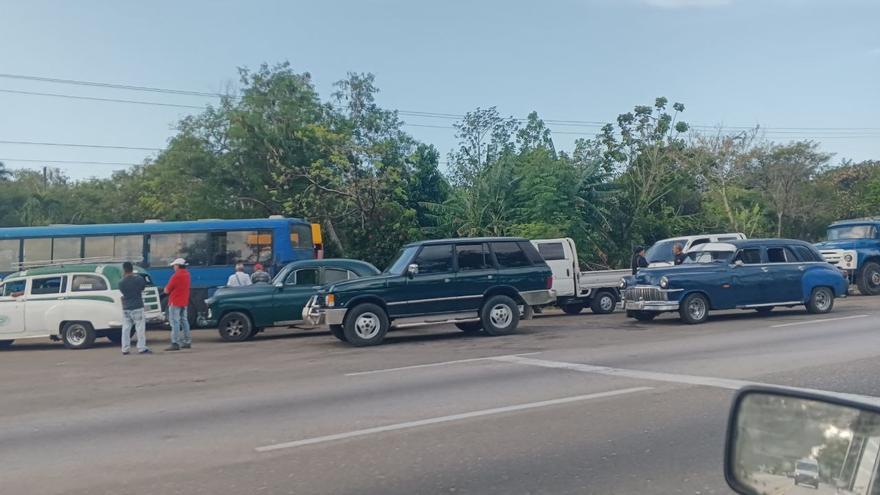
Lines at the Bacuranao gas station, in Habana del Este, last Thursday. (14ymedio)

14ymedio bigger 14ymedio, Madrid, 24 April 2023 — Despite the incessant arrival of oil tankers with all kinds of hydrocarbons in the main ports of the country, the director of Cuba Petróleo (Cupet), Néstor Pérez Franco, insists that the Island has problems with fuel imports. And, by the way, he denies the rumors that attribute the shortage to the export of refined gasoline on the Island, with the aim of obtaining foreign currency.

“For several months we have had limitations on imports of refinable crude oil and derivatives of diesel and gasoline, as explained by the Minister of Energy and Mines, Vicente de la O Levy, in an interview on April 12,” the director told Cubadebate, and he said that refineries cannot process as they should, preventing the necessary fuel for the economy and the population from being guaranteed.

“We cannot allow things to be distorted, or create more disagreements than we already have with the shortages that we all suffer, and which we are working to reduce as soon as possible,” he added. Protests have begun to be seen in some parts of the Island, and, although for now they are not widespread, what happened in the summer of 2022 could be repeated, something that generates fear in the Government.

Pérez Franco explained that “one of the closest suppliers” of refinable crude oil and derivatives — he didn’t say which one, but everything indicates that it’s Venezuela — “has been subjected to war, with sabotage to their facilities and limitations of spare parts and resources. They have guaranteed the supply of some products to alleviate the existing situation but it doesn’t cover all the demand.” continue reading

In addition, the director added that since consumption cannot be guaranteed, it is impossible to export gasoline and that, with regard to refinable crude oil, “although it is true that they could guarantee the country’s consumption, with the limitations they have imposed on imports and the high prices of the markets, it is very difficult for the country to access that product.”

The authorities thus try to settle the doubts sown from a theory exposed by the specialist Jorge Piñon, director of the Energy Program for Latin America and the Caribbean at the University of Texas. Last week, Piñon questioned the statements of the Minister of Energy and Mines in statements to Martí Noticias based on the shipments received from Venezuela and Russia.

The first shipment, according to Reuters data, was large — 1.53 million barrels of fuel oil and heavy oil — sent to the Island at the end of March. The second, with 980,000 barrels of diesel, arrived in Cuba, Uruguay and Panama in the same month.

“It is possible that the need for money and the need for foreign exchange is so great that they are willing to sacrifice domestic demand and create this situation. It can backfire from a political, social and even economic point of view. But it is possible, because it has happened in other years, that Cuba is exporting gasoline once again, to generate the currency it needs,” Piñon suggested to the media, based in Miami.

His statements spread like wildfire on social networks and generated a lot of discomfort in a population that has been lining up at gas stations for weeks without being able to access a drop of fuel, whose lack also affects electricity generation. The shortage is already so evident that this weekend the modification of classes has been announced in several Cuban universities, which have had to rethink how to plan coursework under such adverse circumstances. In some cases, virtual classes have been chosen, and in others, the return to the classroom is postponed until after the May 1st holiday, when the parade is to take place.

The May 1 pageantry is another cause of indignation among the population, which fails to understand how the government can even consider having an event that generates so much demand for fuel when the population suffers from shortages and companies face suspension of activity. Among the comments, the idea of suspending the event was very present, although others gave alternative options. “Don’t even dream about suspending it. The parade will take place on foot or by bicycle,” replied a reader.

Proposals abound in the suggestions, from organizing the supply by letter on the vehicle license plate to considering that the government stop subsidizing gasoline, even if it is difficult, and that fuel consumption by tourism vehicles should be charged in freely convertible currency.

Although many appreciate the director’s explanations in order to “attack fake news,” another reader raised the possibility that there could be a third party in charge of the work that Cuba Petróleo refuses to do. “Cupet does not export. Does Cupet have an export license? Is Cuba exporting or is it joint ventures that export, which is possible and logical? And there is nothing to complain about; they are mixed entities or 100% South American, and they pay Cuba to use and exploit the refineries.”

Translated by Regina Anavy

____________

COLLABORATE WITH OUR WORKThe 14ymedio team is committed to practicing serious journalism that reflects Cuba’s reality in all its depth. Thank you for joining us on this long journey. We invite you to continue supporting us by becoming a member of 14ymedio now. Together we can continue transforming journalism in Cuba.
A Fire Delays Repairs at the Santa Cruz Del Norte Thermoelectric Plant in Mayabeque

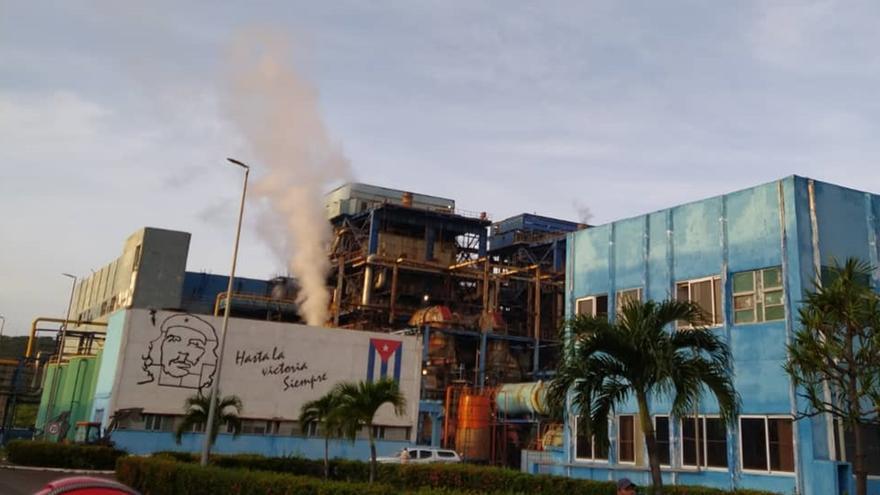
The Ernesto Guevara thermoelectric plant in Santa Cruz del Norte, Mayabeque, in an archive image. (Cuba/Twitter Presidency)

14ymedio bigger14ymedio, Havana, 24 April 2023 — The misfortunes in the Cuban thermoelectric plants seem to have no end. This Monday, a fire occurred in unit 3 of the Ernesto Guevara Power Plant in Santa Cruz del Norte, Mayabeque, with no casualties or injuries being reported. This block is currently under maintenance, so it will delay even more the synchronization with the National Electricity System.

According to official sources, the “small-range” fire was promptly controlled and took place at noon “in a section of the cable tunnels” of the unit. The action of search-and-rescue commandos together with firefighters “prevented the spread of fire to other areas of the thermoelectric plant.”

“So far, the damage caused is being evaluated,” Cubadebate published.

This fire at the Santa Cruz del Norte Power Plant joins a list of accidents that have evidenced the decline of the Cuban Electricity System, which has reported constant and prolonged blackouts for more than two years. Some popular protests against the regime have been motivated by power outages that lasted more than 12 hours. continue reading

On April 7, the chimney of the Antonio Guiteras Thermoelectric Plant, in the province of Matanzas, suffered the collapse of part of its structure leaving four men trapped, and only two could be rescued alive. On the same day of the accident, Alexis Bernardo Labrada, 47, and a day later Lázaro Frank Montero Pita, 57, were  found dead.

A large fire in unit 2 of the Lidio Ramón Pérez Thermoelectric Power Plant in Felton, in the Holguin municipality of Mayarí, occurred in the middle of last year, without loss of life. The block had been under maintenance for several weeks.

Four months earlier, an explosion at the Máximo Gómez Báez de Mariel thermoelectric plant, in Artemisa, caused a fire in which there were no casualties or injuries. The explosion occurred in the steam turbine of unit 7 of the plant and led to an automatic release  in the system a few minutes later, according to the official press.

In the same power plant, another accident on October 4, 2021 left two seriously injured. The state press did not give details of how it  occurred, but Alejandro Canosa Insua, head of the team of operators, and Osmany Cabrera Deybe, operator on duty, were affected with third-degree burns on 78% and 44% of their bodies, respectively.

Translated by Regina Anavy

____________

COLLABORATE WITH OUR WORKThe 14ymedio team is committed to practicing serious journalism that reflects Cuba’s reality in all its depth. Thank you for joining us on this long journey. We invite you to continue supporting us by becoming a member of 14ymedio now. Together we can continue transforming journalism in Cuba.
Cuba Seeks To Extend Prepaid Cards in Hard Currency for Tourism

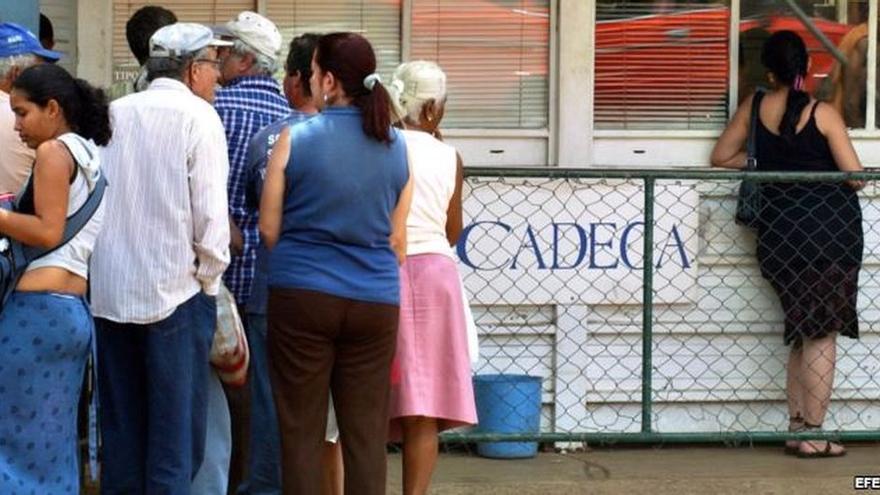
Several people form a line at an exchange house (Cadeca). (EFE)

14ymedio biggerEFE (via 14ymedio), Havana, 22 April 2023  — Cuba wants to extend to tourists who visit the Island the use of prepaid cards in Freely Convertible Currency (MLC), a Cuban virtual currency based on foreign currencies, directors of the official Casas de Cambio (Cadeca) reported this Friday.

Those cards began to be marketed in 2021 with an initial balance of 200, 500 and 1,000 MLC (the exchange rate is similar to the US dollar) and now expand to 50 and 100 MLC cards, the Cadeca official, Ángela Maday, explained at a press conference.

She added that for each card purchased, a commission of $5 or its equivalent in other currencies is applied.

Foreign visitors not residing in Cuba can buy them at exchange offices, hotels, airports and tourist centers, and use them to pay for goods and services in stores that sell in foreign currency, rent cars and for other things.

Maday commented that the service is not yet available for private shops such as restaurants, nor do they allow recharges from outside Cuba. In addition, the cards cannot be used in gas stations.

These cards are good for two years and can only be used in Cuba. In addition, they are not personalized and are activated with a PIN code.

Another feature is that they allow you to withdraw cash in Cuban pesos at ATMs at the official exchange rate of 120 pesos for each dollar, and, in addition, any balance left over will be refunded.

Since 2019, the MLC has been operating in the network of stores that sell exclusively in that virtual currency backed up in foreign currency. In Cuba there are two official exchange rates: one for companies, at the rate of 24 pesos per dollar, and the one established for individuals, at 120 pesos per greenback.

There is also a third rate, on the “informal” market, where the US currency was quoted this Friday at 175 pesos, according to the daily calculation of the independent media El Toque, the reference indicator for economists and transactions of this type on the street.

Translated by Regina Anavy

____________

COLLABORATE WITH OUR WORKThe 14ymedio team is committed to practicing serious journalism that reflects Cuba’s reality in all its depth. Thank you for joining us on this long journey. We invite you to continue supporting us by becoming a member of 14ymedio now. Together we can continue transforming journalism in Cuba.
Will the Doors of the Cuban Financial System Be Opened to International Banking Like Tourism?

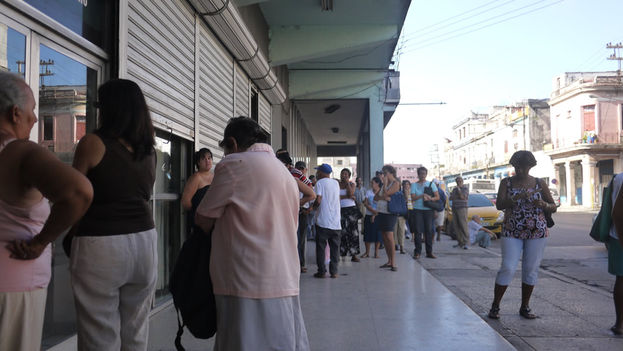
Long lines outside a bank branch Infanta Street in Havana. (14ymedio)

14ymedio bigger14ymedio, Elías Amor Bravo, Economist, 23 April 2023 — Really, now nothing is understandable at all. Marrero says that the Cuban financial system “must play a more prominent role.” Maybe he didn’t mean to say that, or most likely he ignores what he’s saying. It seems unbelievable that the communists are now demanding that their banks earn money.

Yes, you heard right. Speculation in the banking business is the new slogan of the regime. Banks must earn money at the expense of their customers. The ban was lifted to accumulate wealth in these entities that belong to the state. This is more or less what can be concluded from an amazing assessment meeting of Marrero with Gil, Vázquez, the president of the BCC and people from the provinces.

The communists don’t hold back in the slightest. Marrero says that “we need more accompaniment from the Central Bank of Cuba (BCC), our great advisor, to make more proposals in order to make timely decisions.” It seems that Marrero has forgotten what role the Central Bank has within the economic system, which is to contribute to the stability of the currency through monetary policy.

Now it’s not like that. They need to make money anyway they can, and if it means facilitating Cuba’s access to the international financial and banking system, so much the better. Foreign banks in Cuba? Why not? Which ones? That’s something else. The memory of Cuban communist leaders is so short that they sometimes surprise us. Does Marrero really think that the BCC will help him access international funding? Don’t they remember the 94-page judgment of the London judge?

The Cuban financial system cannot prosper by itself, because it depends on the decisions of Marrero, Gil and Vázquez, who do not understand banking or finance. Therefore, the system is inefficient and works at the service of political imperatives such as palming off sovereign bonds to finance the public deficit. Its role is merely that of a conveyer belt for state security orders, with no effectiveness. continue reading

The financial crises that have shaken the world in recent years have not directly affected Cubans because their banking system is so primitive and so isolated from the world that it barely penetrated. Banking in Cuba, Gil’s great goal, is one of the lowest in the world. Cubans don’t trust their banks, with good reason. Most transactions in Cuban pesos (which represent 70% of the commercial circulation) are made in cash.

And what about the challenges of the BCC right now? Of course, they have no relation to what Marrero said in his speech. Neither is there a need for “a comprehensive analysis that allows us to face the phenomenon of the lack of cash that occurs in several territories of the country,” nor “the review of plans or measures that can truly generate foreign exchange income for the nation.”

If Marrero wants to direct the BCC, he has to bet on his international credibility and ensure that the international financial markets take it into consideration. I insist, reading the ruling of the London judge offers ideas of where to go.

Marrero said something related to “working with respect to the foreign debt situation; rethinking the financial bases of foreign investment in the country; and taking forceful steps in the quality and organization of the national payment system, banking, financial education and computerization.” These terms seems interesting but in the long run will not lead to anything concrete.

The solution to the debt is to pay, reduce the internal spending of the state where possible and stop adventures. Be responsible and pay the arrears. Catch up, like any neighborhood debtor. And as much as it hurts, forget about Fidel Castro’s outcry about non-payment of international debt and try to make everyone see that Cuba pays, and that those crazy ideas will no longer be repeated. They must return to the fold. There is no alternative for the communist regime.

And then, of course, Marrero spoke of the eternal improvement of the banking system, which now wants to accelerate with the paradigm of science and innovation of Diaz Canel’s doctoral thesis, which is now essential, while trying to justify the measures of the foreign exchange market saying that they were going in the right direction, but that the measures have not worked. So, they don’t work, we’ll say. In banking matters, there is little to investigate. Ask any of the economists who provide their services at the BCC.

At the meeting, other topics were reviewed, such as cybersecurity, the human capital that is present in all sectoral assessment meetings, and working conditions and credit facilities for new economic actors. Marrero asked for the prevention of financial crimes, with the priority being money laundering, and to increase compliance with the control measures and procedures established in the banking system. These messages are for the international gallery and can only be useful if the appropriate measures are taken in financial operations. It’s one thing to say and quite another to do.

He also demanded that “quality has to reign in the banking system facing the population,” undoubtedly forgetting the clearly-visible lines at some banks to carry out currency exchange operations or the terrible functioning of ATMs, which forces customers to travel miles to find one.  He only briefly referred at the end of his speech to what “recently happen in London as an issue that must be treated and reflected on with a self-critical attitude.” We’re dying to hear more.

The management report of the BCC in 2022, presented by its president (who was not in office during that year), said that in a hostile and complex scenario, the national banking and financial system “maintained the vitality of essential services, actively participating in the Economic and Social Strategy, with a group of actions to design and implement mechanisms to advance the recovery of the economy.” We would have to know what those actions are, because the economy, far from improving, has gotten worse.

And he added in this regard that “the indications related to government measures adopted to increase food production, agricultural development banking, the direct marketing of productive forms and the development of investments were complied with.” It’s no use obeying the government if the same problems continue. The central banks are not here to devote themselves to this kind of thing.

He recognized that the quality of the service provided by the BCC does not yet show the results that society requires, and from here we wonder to which sector of society the BCC directs its services. He also pointed out that the main problems were identified as “the increase in the number of operations that do not correspond to the technological infrastructure and the current labor force; customer dissatisfaction due to delays in services; non-conformity with banking procedures that do not conform to current requirements; inadequate treatment; uncovered demand for cash in Cuban pesos and foreign currency; and inefficiency.” So it’s more of the same as always, and with all that, they want Cubans to put their money in the banks. Good luck.

The president of the BCC also referred to the implementation, as of August 4, 2022, of the mechanism of access to foreign exchange for the population, associated with the development of the foreign exchange market, a measure that he described as “a challenge for the system from the operational point of view and for the very distortions that its implementation has presented.” He must know what he is talking about; he comes from the CADECAS, the state currency exchanges.

In fact, when referring to the distortions, he pointed out that “one of them is the persistence of monetary imbalances that have generated a substantial increase in the amount of money in national currency in the economy, with high accumulation outside the banks, which exerts enormous pressure on the demand for currencies that cannot be satisfied with the supply available in the market at the current exchange rate.”

Monetary imbalances have their origin in the irresponsible and bulky public deficit that the president of the BCC did not have the courage to mention. Here you can see his lack of independence from the BCC, one of the issues that undermines the international credibility of the Cuban communist economy.

And then, as a final instruction, the president of the BCC announced that in 2023, “it is up to the Bank to institutionally redesign the banking and financial system, adjusting it to the current requirements of the economy for its better functioning,” and he announced “other work priorities such as the development of financial intelligence activity; the design of a comprehensive strategy for the reorganization of the Cuban debt; the creation of the public debt market; the strengthening of the foreign exchange market; the improvement of the liquidity allocation system in conjunction with the Ministry of Economy and Planning; and the rescue of the cash coverage necessary for the proper functioning of the banking system and the economy.”

Undoubtedly, duties accumulate, although the most important thing  — implementing a serious and credible monetary policy — is left aside. And the most alarming of all this is the reference to the “institutional redesign of the system,” a proposal that is very cryptic and that could well mean something else, such as the entry of foreign private banks to operate with the state banks, following a model similar to the hotel sector. In for a penny, in for a pound.

Translated by Regina Anavy

____________

COLLABORATE WITH OUR WORKThe 14ymedio team is committed to practicing serious journalism that reflects Cuba’s reality in all its depth. Thank you for joining us on this long journey. We invite you to continue supporting us by becoming a member of 14ymedio now. Together we can continue transforming journalism in Cuba.
The Cuban Government Insists on ‘Celebrating’ on May 1, Despite the Fuel Crisis

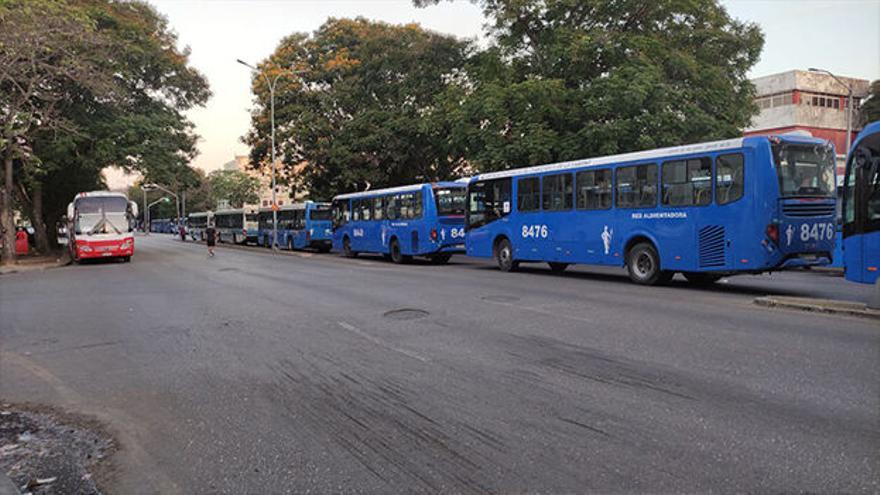
Buses on Carlos III Avenue and Rancho Boyeros that carried those coming to the rally on May 1, 2022. (14ymedio)

14ymedio bigger14ymedio, Havana, April 22, 2023 — The fuel shortage that overwhelms thousands of Cuban families will not stop the Government, which has already announced that there will be a parade on May 1. “We will find a way to celebrate it,” Miguel Díaz-Canel promised this Friday on a visit to the province of Villa Clara.

The Communist Party newspaper did not offer details about how the president intends to carry out his own “direction.” No one seems to be too clear about the script on one of the key dates for the regime’s propaganda, in which thousands of workers are forced to march as a sign of adherence to the Government and a reaffirmation of the system.

Díaz-Canel insisted that he was “aware of the economic situation” but said that it would not prevent the achievement of the objectives of the parade: the condemnation of the “insurgent blockade” and support for the Revolution. “Do not have any doubt  that we will fill our plazas,” was his conclusion.

What worries the population the most are the undeclared expenses that, behind the curtain, will make it possible for the re-designated president to live up to his “promise.” In 2022, after two years of confinement due to the pandemic, the authorities devoted a large budget to the “recovery” of the parade. Security personnel, banners and propaganda, platforms and the mobilization of thousands of state workers cost the regime an arm and a leg, but this year they want to revisit the event.

The announcement has stunned those who expected a more austere May 1, and also Cuban families, overwhelmed by a crisis in the fuel supply that will embitter the summer months not only with the paralysis of the country but with long blackouts. continue reading

However, the Government cannot afford to suspend one of its main showcases in front of those who, despite the regime’s bad reputation in terms of business, persist in a dialogue with Havana. A block of 400 Spanish professionals, associated with the Basque company DIT Gestión, has announced with great fanfare that it will parade alongside the Cubans. Of course, after the march they will enjoy a tourist convention on the northern keys of Villa Clara, for which the authorities have offered “all kinds of facilities,” including transportation.

The images of desolate streets, reminiscent of the hardest months of the pandemic, without cars or people, have been common in the last two weeks. The Government has gone so far as to blame the fuel supplier countries — especially Venezuela and Russia — for not complying with the contracts for the delivery of crude oil and its derivatives, and denies that the crisis is due to “inefficiencies of the country” or problems of the energy institutions.

Although the authorities and the official press have not notified the arrival of new shipments of fuel, the maritime application Vesselfinder recorded that between April 15 and 21, three ships with oil arrived at Cuban ports. The latest is the BT Bicentennial of Mexican origin, and the Zheng He 1, which sails with the flag of Liberia and the Panamanian Caribbean Alliance, which also docked shortly before.

The arrival of these ships has not resulted in energy relief. The service stations are still short of fuel, and rationing measures remain in force, which suggests that the Government is reserving the imported fuel to mobilize those who attend the parade. The suspicion that the transport of May 1 is being paid for with the immobilization and blackouts of these weeks, has provoked a barrage of criticism of the regime on the internet.

“Oh, people of Cuba, how much more you deserve! Even the mockery of the official press. I hope to see you on May 1, firmly supporting this immense Revolution and party that gives you so much every day,” user William Fuentes responded with irony to a Cubadebate publication that carelessly commented on the long lines of cars at gas stations.

The official newspaper published a “comical” article about how “good humor” is maintained among people who play and even cook to pass the time while they wait on Zapata Street, in El Vedado, Havana. “Once again, the ruling press mocks the people,” concluded another user, identified as Osmar Domínguez.

Translated by Regina Anavy

COLLABORATE WITH OUR WORKThe 14ymedio team is committed to practicing serious journalism that reflects Cuba’s reality in all its depth. Thank you for joining us on this long journey. We invite you to continue supporting us by becoming a member of 14ymedio now. Together we can continue transforming journalism in Cuba.
Carlos and Daria Jimenez Begin the Process of Seeking Asylum in Trinidad and Tobago After Leaving Cuba

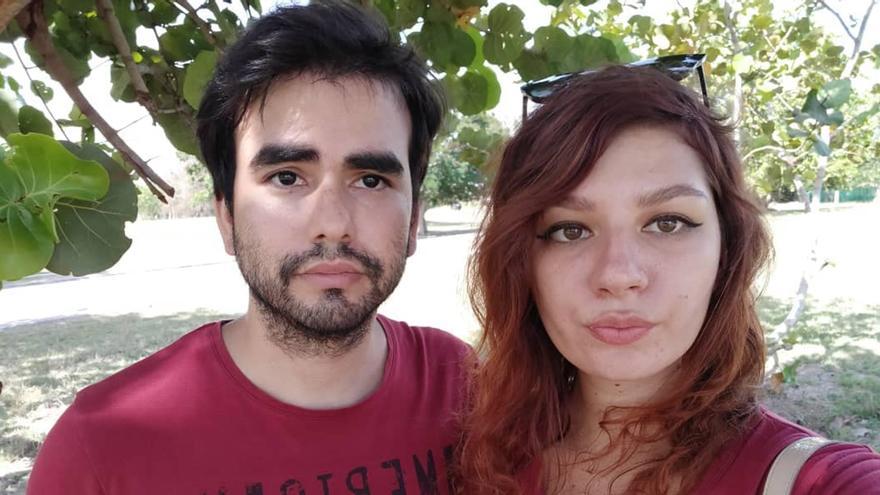
Carlos and Daria in Port of Spain, Trinidad and Tobago. (Ricardo Quintana/Facebook)

14ymedio bigger14ymedio, Havana, 19 April 2023 — The Cuban Carlos Jiménez and Daria, his wife of Russian nationality, have an appointment for May 18 at the office of the UN Refugee Agency (UNHCR) in Port of Spain, Trinidad and Tobago, to apply for asylum. Both left Cuba on Tuesday in the midst of pressure and threats from the immigration authorities.

Now we have to figure out how to survive,” Jiménez tells 14ymedio. “In any case, we have to move forward and not give up.” However, he warns that “they still won’t leave us alone. Last night I received a message from a friend asking me not to do anything else and to shut up. It seems that they put pressure on him.”

Jiménez tells this newspaper that “until the 25th of this month we have a place to live. Then we’ll see what to do. I’m sure something will be resolved. If we managed to get out of Cuba having pissed off a lot of people, anything is possible.”

The young man says that when leaving the Island, through terminal 3 of José Martí International Airport, they were made to wait a long time at immigration control but finally managed to board the flight without major setbacks.

Their departure from Cuba put an end to a nightmare that began last January, when Jiménez escaped being recruited as a soldier for the war in Ukraine. Until then, they both lived in Kushelevskaya Doroga, St. Petersburg. continue reading

The couple then decided to fly to Cuba, where the young man maintains his official residence in his parents’ house. He knew that coexistence would be difficult because of ideological differences, but he had no other choice. As the days went by, the family political contradictions became unsustainable.

“On the morning of March 8, a uniformed man entered our room accompanied by my father. This time they didn’t knock on the door. He was an Immigration officer. He said that my wife had been in the country longer than allowed for foreigners, but that was false because it had only been 55 days and the rule is 90 days. He acted strange and aggressive,” Carlos told this newspaper at the time.

The uniformed man could not specify the objectives of his visit and changed his version saying that there were complaints of noise, but without clarifying where the complaint came from. He finally left a notice for an appointment for another day at the Immigration offices on the municipality of Habana del Este, where they explained that the problem was that Daria was not financially solvent, which was also false, according to her husband.

The first thing Daria did was to contact the Russian Consulate in Havana for help. “I called the Consulate and explained my situation; then a man gave me another number to talk to the consul on duty. When seconds later I dialed that number, the same voice came on the line, and, without stifling his laughter, he let me know that they didn’t help traitors there,” she told this newspaper.

The pressures on the couple were rising in tone and both decided to leave the Island for another country where they could apply for asylum. With few resources and visa limitations, the option that they finally chose was that of Trinidad and Tobago, where they hope to find the protection they failed to receive in Cuba.

Translated by Regina Anavy

____________

COLLABORATE WITH OUR WORKThe 14ymedio team is committed to practicing serious journalism that reflects Cuba’s reality in all its depth. Thank you for joining us on this long journey. We invite you to continue supporting us by becoming a member of 14ymedio now. Together we can continue transforming journalism in Cuba.

The Regime Returns a Cuban-Born Tourist to Canada for Her Criticism on Facebook

Glenda Corella has lived in Toronto since 2012 and didn’t have problems until this March, after “liking” a criticism of the Cuban Government on social networks. (Facebook)

14ymedio bigger14ymedio, Madrid, 21 April 2023 — Glenda Corella Céspedes arrived in Canada in 2012, when the Cuban government agreed to her request to leave the country after eight years of waiting. Her life in Toronto went smoothly until March 7. She decided to return to the Island to attend her brother’s wedding and was met with the refusal of the immigration authorities, who prevented her from getting off the plane that landed at the Frank País de Holguín airport around 9 pm. The reason? Her empathy with the 11 July 2021 (11J) protesters, which led her to register her criticism of the regime on social networks.

The story is told by the protagonist herself to the Canadian public media CBC News. Corella Céspedes, who was traveling with a friend, Mary Guaragna, was carrying in her suitcase medicines for her mother — a lung cancer patient — and a friend, in addition to the clothes for her brother’s wedding and the happiness of seeing him again. Her Cuban passport was in order; she is obliged, despite being a Canadian citizen, to use it to enter the Island.

“Five Cuban immigration officers got on the plane and said that everyone could get off except Glenda Corella Céspedes,” she tells the network. “At that moment,” Guaragna adds, “we looked at each other with a lot of concern. I was as white as a ghost, and Glenda more than me. The Canadians who left the plane looked at us as if we were terrorists. We felt horrible,” she recalls.

One of the officers, according to the story of the two women, left with Corella Céspedes’ passport and, after about 20 minutes, another soldier, apparently of higher rank, got on board and gave the Cuban-Canadian a document which said “Denied” without further explanation. continue reading

Guaragna explains that she spoke with the agent to try to understand the situation and attributes to her Canadian mentality her naivety in believing that an understanding could be reached. “What seems to be the problem?” She asked the officer, who answered only: “She knows what she did, she knows what she did.” “At that moment I looked at Glenda, who gave me a signal not to say anything else.”

Corella Céspedes attributes her problems to a simple “like” on Facebook. At the beginning of the year, Prime Minister Manuel Marrero visited the Gibara hospital, in Holguín, where she had worked as a nurse years ago. A doctor from the center — apparently well connected with the Communist Party — posted on her networks a video of the musical performance with which they received the president and several Facebook users criticized the gesture, saying that they should have criticized the leader for the health situation on the Island, instead of entertaining him.

Corella Céspedes marked one of those comments with a “like” and that’s where it all began. Her  parents began to receive warnings from members of the local PCC, who recommended that they ask their daughter to stop posting and commenting.

After her entry into Cuba was denied, she herself began to receive  messages from a person identified as José Manuel Santos who told her: “Follow my advice. You have your parents here and you have nephews, nieces and cousins. Don’t put anything else on your (Facebook) wall,” he sent her on WhatsApp on March 29.

“Your ban is for two years, but if you keep sharing things on your wall, they will change it for your whole life. You have your mom here.”

CBC News tried without success to contact the Cuban embassy in Canada, which has been closed since February, and the Ministry of the Interior of the Island did not answer their calls either. The media spoke with U.S. resident Cuban lawyer Laritza Diversent, who spoke to them about how the regime uses immigration “regulations” as a control mechanism for critics.

“Cubans who have deserted while they were on missions abroad and rafters have been the subject of this measure in the past,” she said, adding that since the 11J demonstrations — which generated a great wave of solidarity activism on social networks — it applies to those who use cyberspace to disagree.

“Just for shouting for freedom, for shouting we want to eat, completely defenseless people who did not have a stick or a stone to defend themselves were attacked by the police and by a minority that serves the Government to oppress the people,” Diversent said. The lawyer explained to the Canadian channel that Resolution 105 of the Ministry of Communications of Cuba considers any criticism of an official as a cyberattack.

“They have unlimited discretion, there is no judicial supervision,” she added. “If you are denied entry, there is no way to make a claim in court, and in no way can the family in Cuba initiate proceedings to go against that decision.” Diversent has not returned to the Island for five years precisely for the same reason and says that State Security has not stopped pressuring her mother, visiting her on several occasions, to convince her daughter to change her position.

“The exile who begins to criticize is aware that if he does, he will not be able to return, and that is the cost. How then will you be able to bring medicines to your family? It’s a real dilemma, especially since it’s as if they had your family hostage,” she says. And all in the midst of a huge crisis in which the Island wants tourists — with Canadians as the main market — and émigrés to refill the state coffers with foreign currency.

The Government’s attitude, despite everything, is not always successful, and, in the case of Glenda Corella Céspedes, she has multiplied her activism. Now she proclaims her intention not to try to go to Cuba again as long as there is no democracy. “I’m sorry for my mother. I’m sorry for my father, for my sister, for my brother, for my cousin, friends, everyone. But it’s not possible for me to return.”

Translated by Regina Anavy

____________

COLLABORATE WITH OUR WORKThe 14ymedio team is committed to practicing serious journalism that reflects Cuba’s reality in all its depth. Thank you for joining us on this long journey. We invite you to continue supporting us by becoming a member of 14ymedio now. Together we can continue transforming journalism in Cuba.
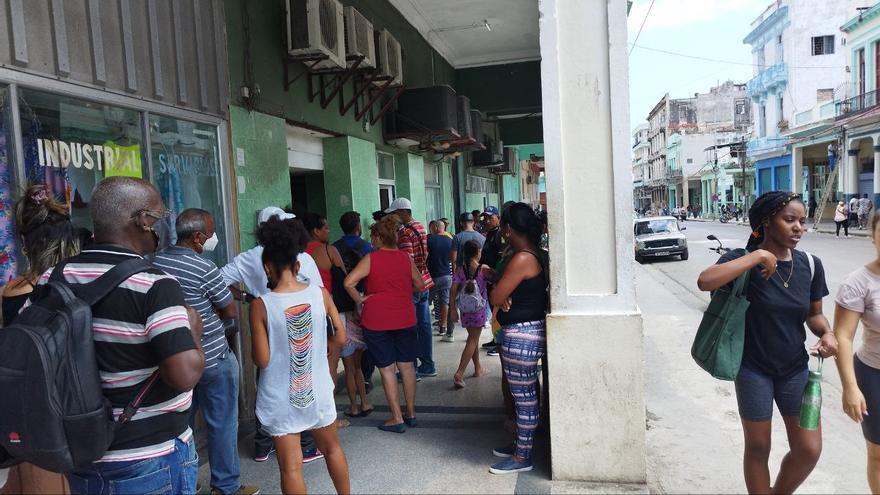
A New 100-Peso Bill Enters Circulation in Cuba in the Midst of the ATM Crisis

The bank says that it is increasing electronic payments  with “all” the agents who offer services or sell goods. (14ymedio)

14ymedio bigger14ymedio, Juan Diego Rodríguez, Havana, 19 April 2023 — The Central Bank of Cuba (BCC) announced on Wednesday the release of a new 100-peso bill, which comes just as the depreciation of the currency against the dollar and the collapse of the ATM network on the Island worsens. The institution pointed out that this denomination is printed with the date of 2023 and retains the main characteristics of the previous issues.

However, the new bill, which will circulate simultaneously with the previous versions, has no tactile feature and is not in the Braille system for the blind, without the authorities offering an explanation. The banknote maintains the logo of the BCC and the signature of the president of the Central Bank, while the inscription  and the year of printing appear in magenta.

The announcement of this new banknote comes at a particularly hard time for Cubans, who have to stand in long lines to withdraw money from the few ATMs that still have cash. “Imagine the level of stress that this causes,” said a resident of Central Havana who had to go to three ATMs to find one that worked.

The man explained to 14ymedio that he sent money to his sister in Párraga, in the municipality of Arroyo Naranjo, to help her pay for an operation for her son. However, when he went to the ATM he couldn’t get cash because it was out of service.

“I gave it to her by transfer because I can’t go there; she lives quite far away,” he said, remembering that driving is not an alternative either because of the shortage of fuel on the Island. continue reading

ATMs in Cuba can’t cope. No fewer than 150 of the 521 that Banco Metropolitano (Banmet) has in Havana are out of service, which means that 30% of them are damaged. This was confirmed by Banmet to the official press last Sunday.

To a query by journalist Francisco Rodríguez Cruz, the bank’s management responded that the technicians are repairing the dispensing modules and the keyboards, which are the parts with the most breakdowns, and they are expecting the new parts to arrive next week.

In the article, Banmet said that “the equipment dispenses more than 160 million pesos every day” and that it needs a change “because of technological obsolescence.” However, it doesn’t  have “an immediate response.” What has been enabled, it insisted, are “domestic alternatives” to mitigate the crisis.

The bank explains that it has increased electronic payments with “all” the agents who offer services or sell goods. Similarly, customers have the option of using the Caja Extra unit to get cash in the 1,904 enabled ration stores, and at least one branch per municipality has extended hours on weekends.

What the banking authorities do not say is that in many ration stores they claim that they have no connection with Transfermóvil to dispense cash, or that they don’t have any cash because everyone that day has paid electronically. The amounts that can be taken out are also low.

From April 8 to 14, cash withdrawals exceeded 200 million per day, but many ATMs, Banmet acknowledged, are only authorized to carry out electronic operations and to check balances.

The bank’s response generated discontent from social media users, who claim that it is “usual” to hear “regrets” from officials about things that do not work well in Cuba, but few solutions are offered such as the availability of POS payment terminals in businesses.

On Calle Infanta, one of the busiest streets in Central Havana, there are three ATMs, but two of them are broken, and the one that works has problems with the screen that makes it difficult to see the information, a Cuban complained.

In addition to the Cuban capital, the ATM crisis extends to the interior of the country. In Sancti Spíritus this week, the banking authorities said that there is no shortage of cash in the machines. “The ATMs have never stopped paying due to lack of money,” María Efigenia Caballero, director of the Banco Popular de Ahorro (BPA), told Escambray.

The director said that the 11 ATMs in the province operate normally, although many of them are old and overused. A resident of the northern outskirts of the city of Sancti Spíritus told 14ymedio that it’s “simply a lie,” because in reality there are only nine ATMs, and most are located in the center. “For example, I have to travel about four miles to get to an ATM, and it doesn’t always work,” he complained.

Translated by Regina Anavy

____________

COLLABORATE WITH OUR WORKThe 14ymedio team is committed to practicing serious journalism that reflects Cuba’s reality in all its depth. Thank you for joining us on this long journey. We invite you to continue supporting us by becoming a member of 14ymedio now. Together we can continue transforming journalism in Cuba.

Villanueva, Cuba: a Waiting Room Turned Into a Camp Due to the Crisis

Those who arrive as a family take turns going out to buy food, fan the children or inquire at the ticket office about the possibilities of boarding the next bus. (14ymedio)

14ymedio bigger14ymedio, Juan Diego Rodríguez, Havana, 22 April 2023 — More than a place with passengers, the Villanueva station, in Havana, looks like a refugee camp: people sitting on the floor, towels that in the early morning cover the bodies that lie in the corners, and the crying of babies who do not understand why they have been there for so many days. The fuel crisis has turned the country’s main transportation waiting room into a makeshift shelter.

After ten in the morning this Saturday, people milled around in front of the ticket office. The bus bound for the city of Sancti Spíritus was about to arrive, and it was hoped that it would have enough empty seats to take some passengers, who could barely breathe in the heavy and humid air. “Only ten passengers will be able to leave,” an employee announced.

“I’ve been here for three days,” says a woman who is waiting for a ticket to get to Holguín, a complicated journey due to the distance and the high demand for travel to the east of the country. “Here the most complicated thing, in addition to waiting, is the situation of the bathroom and getting something to eat. Even drinking a drop of water gets complicated: I can’t leave my place because I might miss my turn.”

Those who arrive as a family take turns going out to buy food, fan the children or inquire at the ticket office about the possibilities of boarding the next bus. On the outskirts, private trucks try to capitalize on the despair. At the door of one truck, in use for 70 years, the driver announces that he charges $83 per person to go to Sancti Spíritus, although the trip is no more than 224 miles.

Although Christmas is not approaching and Easter has passed, Villanueva experiences moments of the holiday hustle and bustle, when the desire to celebrate with family mobilizes thousands of Cubans to be transported to one side and the other of the Island. “If this is the case now, as Mother’s Day approaches, we will have to come with a fan,” predicts another traveler. In three weeks, on Sunday, May 14, every inch of ground at the waiting room could be occupied.

Translated by Regina Anavy

14ymedio bigger

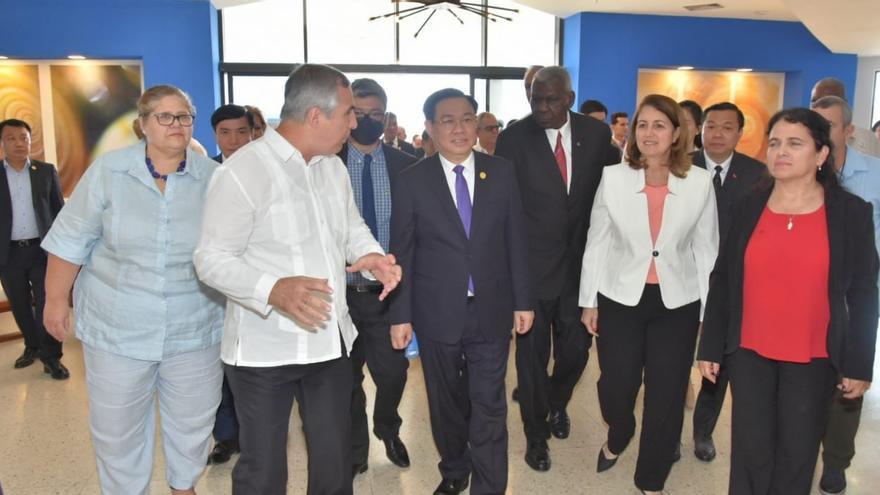
Cuba and Vietnam Sign Four Cooperation Agreements in Economic Sectors

The president of the Vietnamese National Assembly, Vuong Dinh Hue, attended the inauguration of new investment projects in his country related to a factory of detergents for local consumption in the Mariel Special Development Zone, in Cuba. (AsambleaCuba/Twitter)

14ymedio biggerEFE (via 14ymedio), 21 April 2023 — Cuba and Vietnam signed four economic cooperation agreements this Thursday during a business forum in Havana with the presence of the president of the Vietnamese National Assembly, Vuong Dinh Hue.

The agreements cover the sectors of civil aviation, electric power, oil, as well as construction, marketing and production of construction materials.

The Deputy Prime Minister of Cuba, Ricardo Cabrisas, highlighted during the ceremony that in the complex context that the Island’s economy has developed in recent years, “Vietnam’s participation in various sectors has been and is important.”

Cabrisas, appointed two days ago as Minister of Foreign Trade and Foreign Investment and co-president of the Cuba-Vietnam Intergovernmental Commission, pointed out the experience of cooperation and the numerous joint projects and plans underway that cover the main spheres of the Island’s economic and social life.

“Today Vietnam has become our second trading partner and the main capital investor in the Asian region,” he stressed. continue reading

He announced that new business interests have been identified, to be specified in the “very short term,” which impact areas with priority such as agri-food, renewable energies, tourism and construction, among others.

The Cuban deputy prime minister highlighted the “active” presence of Vietnamese businesspeople in the Mariel Special Development Zone (ZEDM), a business center and merchant port created by the Cuban government to attract foreign capital.

On this day, the head of the Vietnamese National Assembly attended the inauguration of new investment projects from his country related to a detergent factory for local consumption and export, and a solar energy park in the strategic economic enclave located 28 miles west of Havana.

Representatives of Vietnamese companies from the sectors of energy, agricultural machinery, steel machinery, electronics, recycling, electromotive, biotechnology, pharmaceutical and medical equipment, fruit and aviation marketing, among others, participated in the bilateral business forum.

Cuban Prime Minister Manuel Marrero said in that context that there are “potentialities” to continue increasing cooperation with Vietnam on issues such as the control of inflation, new economic actors, rice production, polyculture, the planting of corn and the presence of companies from Vietnam in Cuba for wholesale and retail trade.

Since the beginning of his official visit to Cuba on April 19, the leader of the Vietnamese Parliament has met with President Miguel Díaz-Canel, former President Raúl Castro, his counterpart Esteban Lazo and other representatives of the Cuban Government.

Cuba and Vietnam maintain close political and economic ties that have been strengthened in recent times. In addition to the support and common positions in international organizations, companies from the Asian nation have increased their presence in the Island’s economy.

The commercial exchange is around 340 million dollars in recent years, according to official data.

Vietnam exports rice, coal, chemicals, textiles and electronic elements to Cuba, and imports mainly pharmaceutical products from the Island.

Translated by Regina Anavy

____________

COLLABORATE WITH OUR WORKThe 14ymedio team is committed to practicing serious journalism that reflects Cuba’s reality in all its depth. Thank you for joining us on this long journey. We invite you to continue supporting us by becoming a member of 14ymedio now. Together we can continue transforming journalism in Cuba.
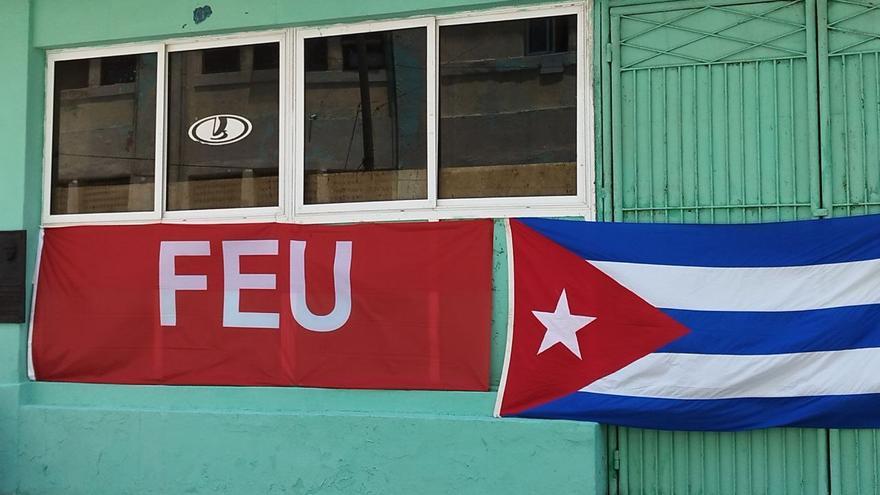
Another Poster Against the Communist Party of Cuba Appears in the Heart of Havana

A few hours later, over the fresh painting, the University Student Federation hung a banner and a gigantic Cuban flag. (14ymedio)

14ymedio bigger14ymedio, Havana, 20 April 2023 — Just three days after a poster against the regime in El Vedado was attributed to the clandestine group known as El Nuevo Directorio (END), on Thursday someone wrote “No to the PCC” [Communist Party of Cuba] on the facade of the building located on Humboldt 7 Street, where several of the young assailants of the Presidential Palace were killed in 1957.

The sign was painted with large black letters on the ground floor of the property, in a state building under repair that has boards over the windows, near the plaque that commemorates the 1957 event.

On its Twitter account, the movement explained that the sign was a tribute to the members of the Student Directory, one of the organizations opposing Fulgencio Batista under the direction of José Antonio Echeverría, and that they wanted to remember the “massacre” that was carried out in that same place by the Batista police “with an action against the Castro dictatorship.”

In its publication, END said that on April 20, 1957, the young people Juan Pedro Carbó Serviá, Fructuoso Rodríguez Pérez, José Machado Rodríguez and Joe Westbrook Rosales “were intercepted” on Humboldt 7, where they had hidden after the assault on the Palace, and there they were “riddled with bullets, without weapons to defend themselves.”

Nuevo cartel de El Nuevo Directorio en el Edificio Humboldt 7. (Youtube)
‘No to the PCC’ reads a new sign from El Nuevo Directorio on the Humboldt 7 Building. (Youtube)

“Blood bathed the staircase of the building, where there was no compassion even at the request of the neighbors. The corpses were dragged into the street in a show of arrogance by Captain Estevan Ventura Novo, a famous torturer and murderer,” they said. continue reading

That event, the group explains, is a reminder of “how many young people have given their lives for the freedom of all” in Cuba, and they consider it a “fundamental” precedent for the struggles against “any dictatorship or tyranny that tries to impose itself on our people.”

Another photograph, shared on Thursday morning on the same Twitter account, showed that the sign had not yet been covered up by the political police.

Although it is a few miles from central places such as the Habana Libre and La Rampa, Humboldt Street is hardly ever used and is dark and not very busy at night.

Last Monday, El Nuevo Directorio painted a sign against the Communist Party at the entrance of the stadium of the University of Havana, on Ronda Street in El Vedado. As usual, they signed with the acronym END, which identifies the clandestine organization.

The message is the same as the one that appeared in the early morning of last March 23 a short distance away, in Aguirre Park. It was presumed to be by the dissident organization in a video disseminated on its social networks. In both cases, the sign was covered up by the police.

El Nuevo Directorio (@NuevoDirectorio) April 20, 2023

“Honor, honor: to the Martyrs of the Massacre of Humboldt 7, the ancestors of the Student Directory, our tribute as we can best honor them, with an action against the Castro Dictatorship.” #ABAJOLADICTADURACASTROCANEL

Translated by Regina Anavy

____________

COLLABORATE WITH OUR WORKThe 14ymedio team is committed to practicing serious journalism that reflects Cuba’s reality in all its depth. Thank you for joining us on this long journey. We invite you to continue supporting us by becoming a member of 14ymedio now. Together we can continue transforming journalism in Cuba.
The European Union Announces That the Bilateral Agreement With Cuba Will Continue To Apply Provisionally

Bruno Rodríguez after the signing of the agreement with the EU, with the then European foreign ministers. (EFE/Olivier Hoslet/Archive)

14ymedio biggerEFE (via 14ymedio), Brussels, 20 April 2023 — The Political Dialogue and Cooperation agreement between the European Union and Cuba will continue to apply provisionally until it has been ratified by all EU countries. Lithuania is the only country that has rejected the treaty, community sources reported on Thursday.

“The current situation is that the Parliament of Lithuania has not ratified this agreement. It is the only member state of the 27 countries that has not formally done so. What this implies is that the agreement is being applied provisionally,” said the sources, asked about the situation of the first bilateral agreement between the EU and Cuba.

The EU confirmed that the agreement, signed in December 2016 and  in force since November 1, 2017, will remain in force provisionally “unless Lithuania ratifies the agreement.”

This treaty meant the end of the so-called “common position” of the EU towards Cuba, the restrictive unilateral policy that the Union maintained towards Havana since 1996, and that linked all advances in the bilateral relationship to progress in democratization and human rights on the Island. continue reading

Asked if it believes that Cuba has fulfilled its obligations in terms of fundamental freedoms within the framework of the agreement, the EU stated that “one of the advantages” of that pact is that, “for the first time, we have the possibility of having a human rights agreement with Cuba.”

“We are using that tool to put on the table our concerns about human rights in Cuba, which are very well known,” the entity explained. In any case, it was stressed that “there is no simple yes or no in terms of whether Cuba has complied with human rights”

“What we have with the agreement is, for the first time, the possibility of engaging directly with Cuba and expressing our assessment of the situation in the country.”

This agreement provides a legal framework for the EU and Cuba to develop a conversation around political dialogue, cooperation, sectoral dialogue and trade cooperation.

Human rights is one of the areas on which the EU placed special emphasis when finalizing the agreement, and the two parties have launched a dialogue focused on human rights, for which they hold meetings periodically.

Specifically, the pact promotes cooperation in favor of sustainable development, democracy and human rights, as well as the possibility of finding shared solutions to global challenges through joint actions in multilateral forums.

The areas of common interest that can be addressed in the agreement include renewable energies, rural development, the environment, human rights, good management, security or job creation, among others.

Translated by Regina Anavy

____________

COLLABORATE WITH OUR WORKThe 14ymedio team is committed to practicing serious journalism that reflects Cuba’s reality in all its depth. Thank you for joining us on this long journey. We invite you to continue supporting us by becoming a member of 14ymedio now. Together we can continue transforming journalism in Cuba.

Baseball player Yosimar Cousin, ‘Blockaded’ by the Cuban Baseball Federation, is Hired in the United States

The native of Camagüey, Yosimar Cousín, will earn one million dollars per season with the Chicago White Sox. (Facebook/Rey Rivero)

14ymedio bigger14ymedio, Havana, 20 April 2023 — The Cuban Yosimar Cousín, who in 2021 thought about “not continuing to play baseball” because the Cuban Baseball Federation (FCB) cut off a contract with the Mexican team Charros, signed this Wednesday with the Chicago White Sox. The agreement is “2,000,000 dollars for two years and he will have a guaranteed place on the club’s roster,” journalist Francys Romero confirmed on his social networks.

Romero, a Cuban baseball specialist, mentioned that the athlete, a native of Camagüey, could improve his salary based on his performance. If he stays in the starting lineup, in 2025 he would receive $1,200,000 per season, but if his level of play goes down, “he will get a contract for $625,000 in the U.S. Minor Leagues.”

The 25-year-old will begin his journey in the advanced Class-A and Double-A levels of the Windy City (Chicago) team. The intention is to see his progress, considering that he is a pitcher with six seasons in Cuban baseball and plenty of experience.

The reporter stressed that Cousín has received favorable comments from those who evaluate his performance, has sufficient potential to appear as a game starter and throws a fastball between 92 and 95 miles per hour. His best pitches, according to several experts, are the slider and the curve ball.

Cousín was deleted from the list of options for the ninth Mexican Charros in 2021, according to what sports director, Ray Padilla, told 14ymedio, because the FCB had him “punished” and he could not “go out or be loaned to any team,” although it was the same Federation that offered him as an option. continue reading

The player demanded an explanation, to which the managers responded by saying that he was “blocked” from leaving. “They have me signed,” he said on his social networks. This was the last straw. Days before, Yosimar Cousín along with Yunior Tur were excluded from the so-called “patriot team” that manager Eriel Sánchez made up for the Under-23 World Cup held in the state of Sonora (Mexico), which resulted in the worst ’bleeding’ in Cuban baseball with 12 players fleeing the team (and Cuba).

Cousín and Tour left the Island in 2022 and went to the Dominican Republic. While Yunior was hired in December by the Oakland Athletics, Yosimar trained for over a year seeking professional signing at the Yuan Pino Academy.

On the other hand, last Tuesday the nightmare ended for baseball player Yariel Rodríguez, who after his participation with Cuba in the World Classic, abandoned his contract with the Japanese team of the Chunichi Dragons and broke relations with the FCB. The Japanese team “dismissed” the native of Camagüey, so he is free to be hired by a foreign team.

Rodríguez had just received the shield that represents the Camagüey territory and a recognition from the Communist Party for finishing fourth with Team Asere, when he announced his intention to seek an opportunity in a Major League team.

In an attempt at sanction, the Cuban Baseball Federation appealed a clause of his contract and claimed the athlete owed 10 million dollars for “damages.” The official sports organization demanded the relevant “rights and responsibilities.”

Translated by Regina Anavy

____________

COLLABORATE WITH OUR WORKThe 14ymedio team is committed to practicing serious journalism that reflects Cuba’s reality in all its depth. Thank you for joining us on this long journey. We invite you to continue supporting us by becoming a member of 14ymedio now. Together we can continue transforming journalism in Cuba.

Cuba’s Largest Reservoir Fulfilled Only 40 Percent of Its Fishing Plan in the First Quarter of 2023

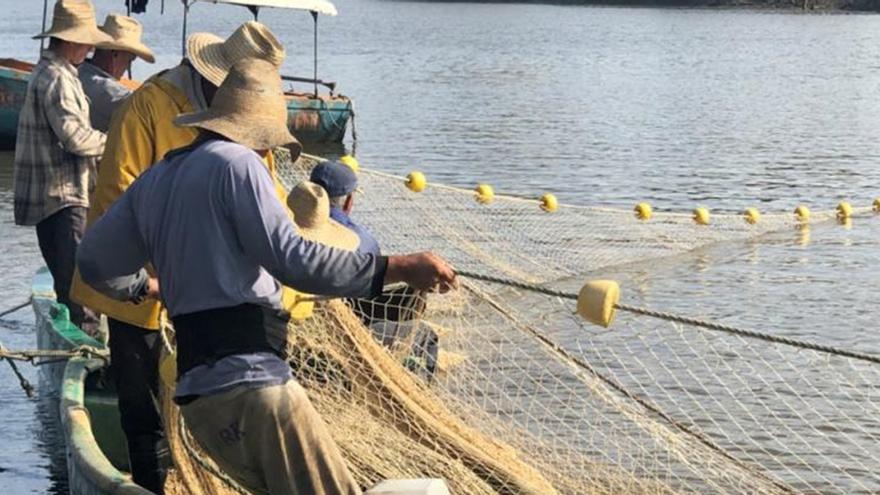
“Fishermen say that there are not enough fish in development,” the official press reports. (Escambray)

14ymedio bigger14ymedio, Havana, 20 April 2023 — The empty nets at the Zaza dam, the largest reservoir in Cuba, have become a constant for fishermen, who warn that there are not enough fish for this year. The situation is reflected in the battered results of the Sancti Spíritus Fishing Company, which closed with a production of just 40% of the plan for the first quarter of 2023.

At the end of March, 291 tons of fish were processed of the 726 planned for the first three months of the year, according to an article in the provincial newspaper Escambray, which also warns that low production will not only affect the company’s workers, but also the “assortment” of this high-protein food on the table of Cuban families.

“The fishermen insist that there are not enough fish in development,” but the most serious thing, the provincial newspaper adds, is the accelerated reduction of the area of operations. The “tanned-skinned men” have to go to more distant places, exposing themselves to more dangerous conditions and strong winds to find the fish, which are still insufficient to meet the production quota.

Between 2018 and 2022, the Directorate of Aquaculture in Sancti Spíritus deposited a little more than 100 million ciprínid fry, a species of fresh water fish, 95% of them from the province itself. But there is another problem: there is no food to accelerate their  growth.

Miriam Solano Valle, director of Aquaculture in the province, reminded the newspaper that it has also not been possible to clear the vegetation in the reservoir, which hinders both fish breeding and extraction. However, she said that “work has already begun” on the elimination of weeds thanks to a fuel supply, and, for the moment, they have managed to recover 33 acres. continue reading

Solano assumes that the fish are hidden in the undergrowth because extreme weather events have not occurred and the dam’s floodgates have not been opened.

Like almost all productive links on the Island, the fishing sector is facing a deep crisis of low production, in part because it does not have boats to work in international waters and it does not have flowing rivers that allow adequate extraction in fresh waters.

This year they are facing another problem: drought. This is the case of the Gramal reservoir, in the municipality of Manatí in Las Tunas Province, which is almost at the end of its useful life with just 18% of water available, the provincial press confirmed at the beginning of April.

An article in Periódico 26 says that fishermen have not stopped their activities and extract a “significant amount” of tilapia, a species that is not currently produced but, thanks to its natural reproduction, competes with other varieties of demand in the market like sea bream or carp. For some, however, this type of fish is not attractive because of its earthy and moldy flavor.

Ángel Hidalgo Torres, head of the local fishing brigade, told the newspaper that in the municipality of Jesús Menéndez alone they extracted 96 tons of tilapia in March. This is not the case with the Colombia micro-dam, where the volume of water is at 10% of its capacity, while El Canario barely subsists with 6%. To make matters worse, Lavado 5 is almost dry, he said.

“In the coming days we will try to remove as many fish as possible, so that their survival is not affected by the oxygen deficit and poor water quality,” said the fisherman, who believes that there will be enough to offer 100 tons to families in Las Tunas.

Translated by Regina Anavy

____________

COLLABORATE WITH OUR WORKThe 14ymedio team is committed to practicing serious journalism that reflects Cuba’s reality in all its depth. Thank you for joining us on this long journey. We invite you to continue supporting us by becoming a member of 14ymedio now. Together we can continue transforming journalism in Cuba.

The United States Deports Another 30 Cuban Rafters Who Were Detained at the Beginning of This Week

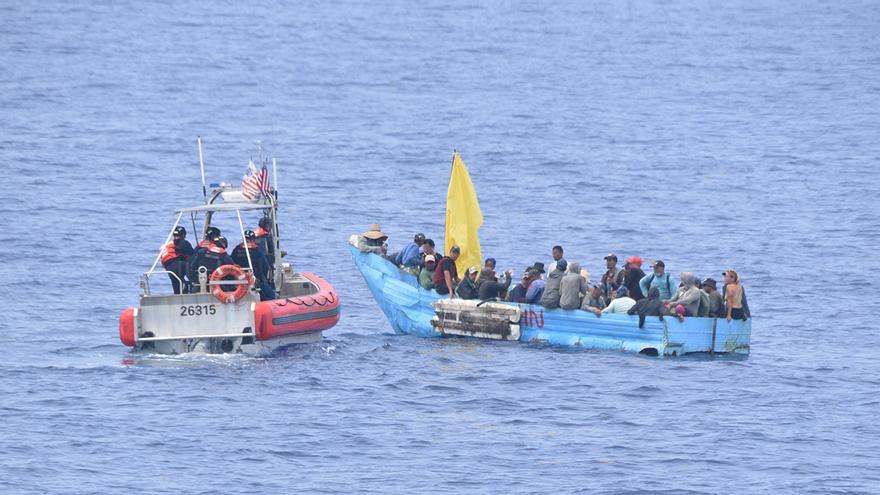
The US Coast Guard reiterated that Cuban rafters who try to reach Florida illegally will be returned to the Island. (Twitter/@USCGSoutheast)

14ymedio bigger14ymedio/EFE, Havana, April 20, 2023 – The United States Coast Guard deported 30 rafters to the Island this Thursday aboard the ship William Trump. The Coast Guard said on its social networks that they were intercepted offshore near the Bahamas earlier this week.

The US authorities reiterated that those who try to arrive by sea irregularly to southern Florida should desist from their attempts because they will be deported. Since October 1 of last year, the Coast Guard has thwarted the landing of more than 6,200 Cuban rafters and has returned 2,387 people to the Island in more than three months.

In the first week of April, the maritime agency repatriated 396 migrants of different nationalities intercepted on the high seas between March 31 and April 7.

At the beginning of 2023, the United States implemented a policy to welcome 30,000 monthly migrants from Venezuela, Haiti, Cuba and Nicaragua.

In parallel, the US has immediately expelled to Mexico the undocumented from those countries who try to cross the southern border in an irregular manner. The Government of Andrés Manuel López Obrador, for its part, agreed to admit 30,000 migrants a month who are returned from U.S. territory. continue reading

This Thursday, the Cuban Ministry of the Interior reported that there have already been 3,238 Cubans returned by several countries this year. This figure doesn’t include the 30 people deported from Florida.

In the last two days, the Governments of the Cayman Islands and the Bahamas deported six and 44 Cubans, respectively, the report said.

In addition, it was pointed out that two of the returned Cubans were on probation for criminal penalties at the time of illegally leaving the Island. They were “placed at the disposal of the corresponding courts for the revocation of said benefit.”

Another of the migrants, the Ministry of the Interior explained, “was arrested for allegedly participating in “a criminal act that is being investigated by the police.”

Translated by Regina Anavy

____________

COLLABORATE WITH OUR WORKThe 14ymedio team is committed to practicing serious journalism that reflects Cuba’s reality in all its depth. Thank you for joining us on this long journey. We invite you to continue supporting us by becoming a member of 14ymedio now. Together we can continue transforming journalism in Cuba.