
Cuba’s Silent Majority

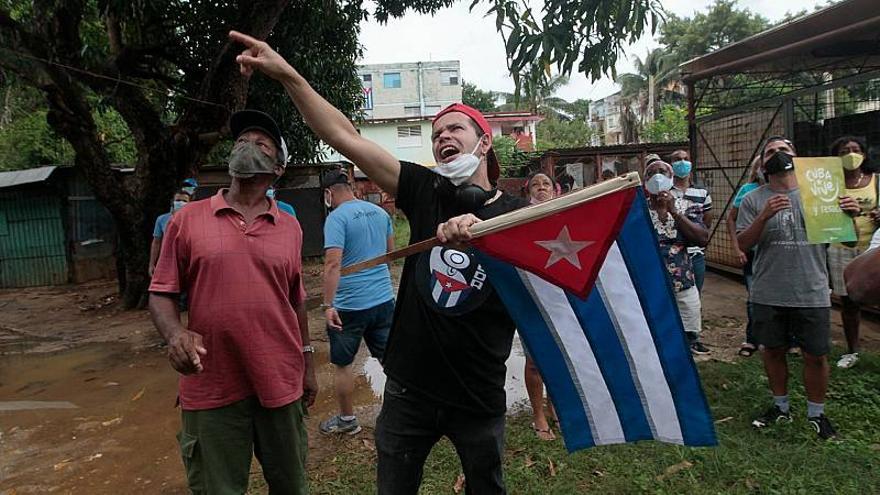
Regime supporters during an act of repudiation in front of Yunior García Aguilera’s home, November 14, 2021. (EFE)

14ymedio bigger14ymedio, Yunior García Aguilera, Madrid, 18 April 2023 — I have a friend who says he’s not leftist, nor rightist, but the opposite. After his apparently absurd joke, it’s evident he is fed up with the polarization that is shaking Cuba and the planet.

The truth is that those on the right tend to move toward ever more conservative poslitions, exploiting ultranationalist sentiment. The left, for its part, shamelessly defends the current dictatorships, becoming complicit in their crimes. Democracy is neither guaranteed, nor an irreversible conquest.

The world is upside down. Putin’s war embodies the most voracious imperialism, while receiving the support of those who always wave “anti-imperialist” flags. These hemiplegic morals justify Russia’s talk of NATO’s expansion, but forget that six decades ago the USSR placed atomic missiles 90 miles from the United States, converting Cuba into a soviet aircraft carrier. The bearded one dreamt of the glory of the holocaust and recommended to Nikita that he launch the first bomb. Fortunately, Kruschev Olympically ignored the cigar smoker, preferring to negotiate with Kennedy.

China, the power led by an unflappable Winnie the Pooh, is now a champion of modern capitalism and also the nation with the most environmental pollution. All this, while technically being a “socialist” country. To heck with all the proletariat and value added rhetoric. To heck also with all the complaints of human rights violations in the giant Asian country. Consumers need to buy cheap, it doesn’t matter that China fills the world with trifles . Meanwhile, Thucydides’s trap threatens to confront, sooner or later, both world powers, and humanity will buy tickets to view, online, the spectacle that could extinguish us.

On the other hand, the more radical leaders on the right have become populists, in the style of Mao, Perón or Castro. They exploit the ire of non-conformists, speak of refounding and making their nations greater, of rescuing an epic past, glorious and superior. They devote themselves to creating armies of followers who lynch and exterminate anyone with a trace of dissent. And hordes of wrathful people believe that the higher they build a wall, the greater their freedom will be. continue reading

I come from a sick country. In the “revolutionary” Cuba, the New Man was forged by the fire of executions, acts of repudiation, purges, mass exodus and permanent crisis. But none of that left a legacy of a more just and inclusive place, it would have been impossible. Today we are the country with the most political prisoners in the region. A handful of bureaucrats and generals has taken the Island hostage and the ransom they demand is death. The majority has shown, on social media, in the streets, and even at the polls that they do not want to continue living under that regime, but citizens lack a single democratic tool to dethrone them.

Those in power, knowing that they are a minority, bet on confrontation, one against the other. They bet on dividing us, on us wearing ourselves out due to our own differences. They patiently wait for us to practice political cannibalism until there is no one left with a good eye.

In the dozens of interrogations I suffered, they rarely asked me questions. They knew everything about me, they had thousands of ways to find out — placing microphones in my toothbrushes, cameras in the toilet. They could threaten and blackmail those close to me until they felt squeezed. Then, why interrogate me?

In all those encounters they invested hours in talking bad about others, in damaging the image of activists like Luis Manuel Otero Alcántara or Tania Bruguera. They aimed to influence my subconscious so I would try to distance myself from them, so I would disagree with their positions and end up making them my enemies.

Those in power enjoy watching social media be the firing squad. And in the crossfire, there is a silent majority that does not know which side to join, disgusted from so much rot. That majority doesn’t find an alternative that seems reasonable and coherent, when faced with the downpour of insults and slogans. But that silent majority, if they decide to no longer be on the margins and rise up, could be a great force.

When this center awakens from its lethargy and takes on a position without fearing the radicals, fundamentalism, it will be folding in on itself to that point on a circle where both extremes meet. And it will be clear that, to those in power, ideology does not matter one bit, they use it for their convenience. Those in power, in reality, do not believe in left or right, but rather, all the opposite.

Translated by: Silvia Suárez

____________

COLLABORATE WITH OUR WORKThe 14ymedio team is committed to practicing serious journalism that reflects Cuba’s reality in all its depth. Thank you for joining us on this long journey. We invite you to continue supporting us by becoming a member of 14ymedio now. Together we can continue transforming journalism in Cuba.
Cuba’s Diaz-Canel, Five Years as Hand-Picked Dictator

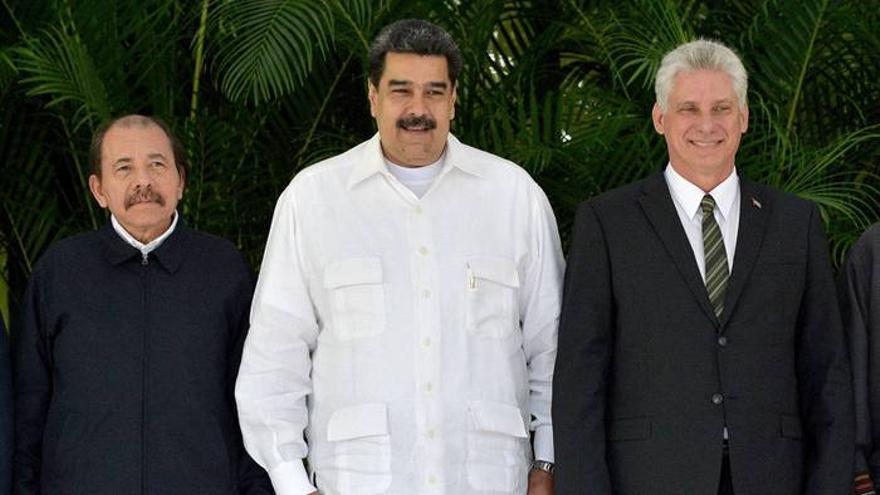
Díaz-Canel’s international policy has placed Cuba on the side of the most infamous causes (EFE)

14ymedio bigger14ymedio, Yunior García Aguilera, Madrid, 5 April 2023 — That April 19, 2018, when deputies had to “elect” the president of the Republic, there was only one name on their ballots aspiring to the position. Raúl Castro himself cleared away all doubts by declaring that his appointment was not a coincidence, that it was planned and foreseen by the Party’s leadership. Díaz-Canel was the only survivor of a dozen “test-tube” leaders who had been training to inherit the throne.

The electronic engineer and lieutenant colonel had slowly climbed from the Union of Young Communists. His ascent was meticulously calculated, without haste, so as not to repeat the mistakes they had previously made with Roberto Robaina, Carlos Lage, Feliz Pérez Roque and Jorge Luis Sierra Cruz.

The “star of Placetas” fulfilled an international mission in Nicaragua. He next became the highest authority of the Party in Villa Clara, his native province, and then was given his litmus test: Holguín. In the “city of parks” he earned the nickname of Miguel Díaz-Condón [condom] for preventing peasants from smuggling milk. And it was also there that he met Lis Cuesta, broke up his marriage and fearing that his promotion would be frustrated.

I remember that on one occasion they both attended the premiere of one of my works. At the end of the show, they stayed for the toast and told us about the adventures of their romance. The then-first secretary of the Party in Holguín feared that the scandal would affect his image and asked for advice from the most experienced boss in the province.

The old man, Miguel Cano Blanco, was familiar with local customs and situations and suggested to his namesake that he grab his lover by the hand and take her everywhere. For a couple of weeks there would be no talk of anything else in the city, but over time, the gossip would run out, people would end up getting used to the new normal, and his career would not be affected. Creative resistance, is what Cano Blanco recommended. Lis Cuesta would take his advice to the letter, to this day. continue reading

There’s not even a shadow left of that guy I once met in Holguín. His face has hardened, giving him a robotic appearance. Paranoia has made his hair turn white in a very short time, and his belly increased at the same rate as his blunders. Pigeons never landed on the new dictator’s shoulder, only vultures. The crash of a passenger plane, a tornado in Havana, the pandemic, the explosion of the Saratoga Hotel and the fire at the Supertanker Base at Matanzas are just a few examples of the unluckiness (salao) that is Díaz-Canel, according to his own words.

But not everything has been a consequence of misfortune. His obstinacy in giving continuity to a perverse and dysfunctional model makes him a direct culprit for the destitution suffered by the Cuban people. The Ordering Task* was a catastrophe and plunged the country into unbridled inflation. And his international policy has placed Cuba on the side of the most infamous causes, such as Putin’s imperialist war and Daniel Ortega’s criminal extremism.

This has also been a five-year period of protests. On July 11, 2021, more than 40 cities took to the streets in a domino effect, and Díaz-Canel decided to stain his hands with blood. His combat order unleashed violence that left a young man shot in the back and killed, several wounded and more than a thousand political prisoners. The 11J was a definitive watershed moment, and the dictator earned the worst nicknames in Cuba’s history.

Then would come the biggest migratory wave of all time in the archipelago, a mass exodus that has left the country without young people and without a future. The popular disenchantment has been clearly reflected in the polls. The regime’s placebo votes have recorded the highest rates of abstention, apathy and rejection.

It is clear that his government has been disastrous. Not even in healthcare, which has always been the regime’s banner, can they boast of anything. His plan to build 1.7 homes a day per municipality went by the wayside. And Parliament itself gave him a standing ovation when he confessed that his management was a disaster.

In any democratic country, someone with his record would have already resigned or would be swept from power at the polls. But Cuba is a dictatorship. Díaz-Canel has received the order to hold the fort as long as Raúl is alive. And no one would be surprised if his name, on April 19, is again the only option on the deputies’ ballot.

*Translator’s note: The “Ordering Task” [Tarea Ordenamiento] is a collection of measures that include eliminating the Cuban Convertible Peso (CUC), leaving the Cuban peso as the only national currency, raising prices, raising salaries (but not as much as prices), opening stores that take payment only in hard currency which must be in the form of specially issued pre-paid debit cards, and a broad range of other measures targeted to different elements of the Cuban economy.

Translator: Hombre de Paz

____________

COLLABORATE WITH OUR WORKThe 14ymedio team is committed to practicing serious journalism that reflects Cuba’s reality in all its depth. Thank you for joining us on this long journey. We invite you to continue supporting us by becoming a member of 14ymedio now. Together we can continue transforming journalism in Cuba.
The (Un)popular Power of Castroism

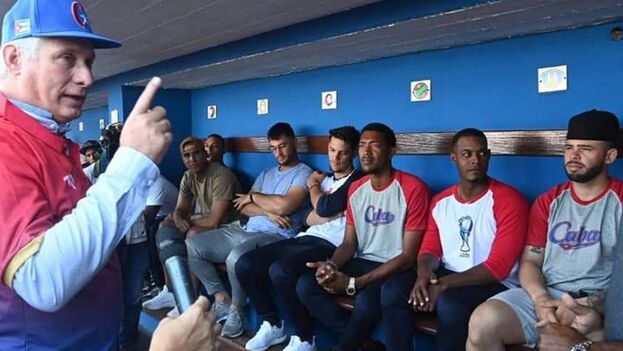
Díaz-Canel goes along under pressure, from platform to platform, taking advantage of anything, even if it’s a defeat in baseball with a score of 14 to 2. (PL)

14ymedio bigger14ymedio, Yunior García Aguilera, Madrid, 23 March 2023 — Next Sunday the Cuban regime will hold “elections” where 470 candidates for Parliament will “dispute,” nothing more and nothing less than 470 seats. When you try to explain this process to any citizen of a democratic country, their brain usually short-circuits. But that’s the scheme, as absurd and brazen as it sounds. The people choose absolutely nothing; they simply ratify a decision that has already been made previously by the single party.

To carry out this esoteric trap, they resort to the “united vote.” The Government itself will be in charge of spending millions of resources on propaganda to convince you that you should vote for everyone, as if it were a combo. If in Stalin’s USSR the ballots presented a single candidate, then in the Cuba of the Castro brothers they save paper. Just put a jumble of names on a ballot and add a circle on top of it that summarizes them all. By the way, you also save ink.

Fidel himself expressed in February 1993 that the ’united vote’ was not a technical issue, but a political issue, that it was “the strategy of patriots, of revolutionaries.” In reality, it was simply his strategy to play at voting, once every five years, without risking absolutely anything.

No candidate, obviously, can be suspected of having divergences in official thinking. All have passed through several filters to reach the final list and will continue to be watched with a magnifying glass, in case they present any ideological deviation along the way. They will be allowed to have some corrupt behaviors, of course. Cuba is a country where corruption is called “fight” and everyone knows “how bad it is.” But State Security will keep in its drawers any material that can compromise them, just in case they have to “be ruined” to make an example of them, as they did with Carlos Lage and Felipe Pérez Roque.

When I lived in Cuba, I was close to several deputies, and the truth is that the vast majority are indistinguishable. They dedicate themselves to attending endless meetings; they will unanimously approve any decision that comes from above, and they will enjoy some privileges that the position affords them. continue reading

That’s why the electoral campaigns are superfluous. There is no need to have or present any project. All you need is a poorly printed biography showing your photo, the morning assemblies at school in which you participated during your childhood and the mass organizations to which you belong. Hardly anyone will stop to read this nonsense, which is usually identical. That is also why the ballot boxes are guarded by children. After all, what could go wrong?

But Cuba is no longer the place where people used to vote like automatons, to “get it over with.” On recent occasions, the number of abstentions, canceled and blank ballots has increased dramatically. Díaz-Canel goes along under pressure, from platform to platform, taking advantage of anything, even if it’s a defeat in baseball of 14 to 2. What does it matter? He and his bosses (generals with more stars than principles) know perfectly well that this March 26 could break the mold: the rejection of a rigged, grotesque and undemocratic model.

Even seeing it from the perspective of those who sympathize with the Revolution, this management has been, by far, the worst in decades! They have not fulfilled any of the projects that were drawn up (like that plan of 1.7 homes a day); inflation rises at a quadrangular rate; hunger lurks in every corner of the country; repression is more guaranteed than the bread of the quota; the blackouts are a joke; the young people leave, and the violence expands in an alarming way.

To make matters worse, the visible figures of the system could not be more gray or unpleasant. Díaz-Canel and his “wife who works at her work” (as he himself called her) have shone in the art of cantinfleo (with the pardon of Cantinflas*). I’m not sure if they try to emulate Maduro, but their clumsiness is about to set a Guinness world record.

What should we Cubans do? Regardless of everyone’s ideology, we have to be honest with ourselves. It would be enough to look around and understand that the night cannot be eternal. This Sunday we can show them and the world that this obsolete and decadent system does not have our support. We can leave them alone in their circus, without being able to boast of a power that is completely unpopular.

Translated by Regina Anavy

____________

COLLABORATE WITH OUR WORKThe 14ymedio team is committed to practicing serious journalism that reflects Cuba’s reality in all its depth. Thank you for joining us on this long journey. We invite you to continue supporting us by becoming a member of 14ymedio now. Together we can continue transforming journalism in Cuba.
The Latin American Hybrid Left

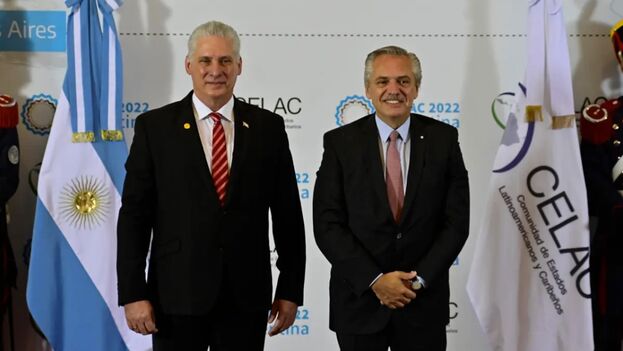
The president of Argentina, Alberto Fernandez (on the right), receives the president of Cuba, Miguel Díaz-Canel, at the beginning of the Celac summit of 2023, in Buenos Aires (Argentina). (EFE/Matías Martín Campaya)

14ymedio bigger14ymedio, Yunior García Aguilera, Madrid, 23 February 2023 — During the Cold War, Latin America was more like a hot zone. It is undeniable that almost all the countries in the area suffered extreme right-wing dictatorships, nor can the United States’ support for these regimes cannot be hidden. The fear of Soviet tentacles was real, and Cuba was proof enough, with a missile crisis that almost exterminated us all.

But Fidel Castro would also use fear as a permanent discourse, governing at gunpoint and deploying a fierce propaganda campaign to seduce fans of violent revolutions.

The left would come out of its first adolescence without being so Marxist or rebellious. The United States lowered the tone and became more tolerant, mainly after the collapse of the USSR. Leftist Latin Americans could then come to power with votes rather than bullets.

This is how the Pink Tide emerged, with its bouquet of enthusiastic figures. The group went along successfully for a while, increasing social spending and managing to reduce poverty. Although, in reality, the initial luck was possible thanks to the increase in the price of oil and other raw materials.

Then came the debacle: corruption scandals, inflation, a return to poverty and electoral defeats. Except some leaders would not be willing to give up power so easily. Today, Latin America suffers from three dictatorships, all of the extreme left.

Some analysts talk about a new Pink Tide after the victories of López Obrador in Mexico, Fernández in Argentina, Boric in Chile and Petro in Colombia, plus the rebirth of Lula in Brazil. And although it is true that the largest economies in the region are governed by progressive leaders, the context is very different. The world has still not recovered from the impact of the pandemic, and Putin’s invasion has disrupted everything. continue reading

Like the war, this tide is quite hybrid. Its protagonists have openly expressed their differences with respect to Russia and have demonstrated nuances concerning the “triangle of sadness” (Cuba-Venezuela-Nicaragua).

Boric, for example, has harshly criticized the three regimes. He has said that the situation of Cuban prisoners of conscience is unacceptable, has urged Venezuela’s President Maduro to hold truly democratic elections by 2024 and has called Nicaragua’s Daniel Ortega a dictator. The Chilean has also described Putin as an autocrat who is waging a war of aggression and not, as Russian propaganda claims, a “special military operation.”

For his part, Gustavo Petro, the first leftist president of Colombia, has been much more ambiguous on the issue of Ukraine and refused to send that country the Russian weapons he possesses, a decision that was applauded by Moscow.

Although Petro tried to keep his distance from his authoritarian neighbors during his campaign, his inclination in favor of castrochavismo is no secret to anyone. With Nicaragua the matter is more delicate, partly because of a territorial dispute between the two nations and also because Ortega’s decision to banish more than 300 Nicaraguans is absolutely indefensible.

For the current president of Argentina, Alberto Fernández, Cuba and the ’blockade’ [i.e. the US embargo] will always be part of the same phrase, since he “is not aware of the repression on the Island.” At the recent Celac summit, he said that all those present had been elected by their people and that Maduro was “more than invited.” However, Chávez’s heir canceled his trip at the last minute. He did not want to take risks, since there is a reward of 15 million dollars for those who facilitate his international capture. With regard to Ortega, the Argentine chameleon has also been forced to condemn him after his last tyrannical extravagance.

For the president of Mexico, castro-ortega-chavismo is as innocent as singing Las Mañanitas. López Obrador sabotaged the Summit of the Americas when Biden did not want to invite the triumvirate, which maintained relations with Maduro while 60 countries recognized Juan Guaidó as the legitimate president of Venezuela, and López Obrador recently handed over the order of the Aztec Eagle to the Cuban dictator. But as with Ortega, El Peje* also softened his radicalism. A few days ago he revealed a letter he sent in December to the former guerrilla-dictator, requesting the release of the opposition prisoner Dora María Téllez.

Lula has been a fervent defender of Castroism, going so far as to affirm that Cuba would have the same standards as Norway or Denmark if it were not for the embargo. He also refuses to hand over weapons to Zelenski and has proposed a third way for a dialogued solution, led by none other than China.

As we can see, the Latin American hybrid left is no longer a teenager, but there is still a long way to go before it becomes a democratic adult.

*Translator’s note: El Peje is Lopez-Obrador’s nickname because of his accent. The nickname comes from pejelagarto (literally, fish lizard), an alligator-like fish from his native Tabasco, meaning he’s hard to pin down.  

Translated by Regina Anavy

____________

COLLABORATE WITH OUR WORKThe 14ymedio team is committed to practicing serious journalism that reflects Cuba’s reality in all its depth. Thank you for joining us on this long journey. We invite you to continue supporting us by becoming a member of 14ymedio now. Together we can continue transforming journalism in Cuba.
A Free Homeland to Live In

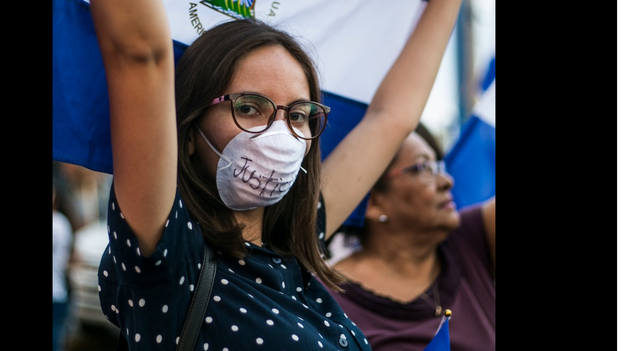
The filmmaker faced a thousand dangers to leave a memory of the popular rebellion that shook the country in 2018. (fotograma)

14ymedio bigger14ymedio, Yunior García Aguilera, Madrid, 2 February 2023 — I have seen the documentary Nicaragua, patria libre para vivir  [Nicaragua, a Free Homeland to Live In], three times, and all three times it has shaken me to the core. Its director, the Andalusian poet and philologist, Daniel Rodríguez Moya, says that you can be born anywhere in the world and love it, but you can also choose a land to love, without necessarily having been born there. And he decided, 20 years ago, to fall in love with Nicaragua.

Daniel sold his poetry publishing company in Granada to finance his film. He went with his camera to the land of volcanoes and faced a thousand dangers to leave a memory of the popular rebellion that shook that country in 2018. Beyond the award at the Invisible Film Festival in Bilbao, what excites the poet is that Nicaraguans have found in his images a bastion against forgetting.

Because they show convulsive times. Sometimes the world prefers to look away and ignore that there are dictatorships in our America, the same or worse than those that stained the Twentieth Century with blood. Sometimes sanctions are not enough to stop those who violate human rights with impunity, trampling on democracy. Sometimes there is an “idiotic left,” as sociologist Sofía Montenegro calls it in the documentary, that continues to support these tyrants in the name of a sick romanticism.

The testimony of someone like Sergio Ramírez, a Cervantes award winner and former vice president of Nicaragua, is overwhelming. Sergio had the moral stature to move away from a revolution that had already lost its course. And after the 2018 protests, Ortega ordered his capture. The novelist had already suffered persecution under Somoza. Now he would be persecuted by his own comrades in the struggle. The founder of the literary festival Centroamérica cuenta, the most important literary festival in the region, recounts how he preferred to be considered a traitor by the beasts, rather than become one of them. continue reading

One shudders to hear the verses of Gioconda Belli, a multi-award-winning writer who has also had to go into exile. The author of La mujer habitada [The Inhabited Woman] would never accept being an accomplice of someone who overthrew Anastasio Somoza to end up becoming another dictator. Nicaragua’s best children have had to leave or are trapped in its dungeons.

I have told Moya that I would love for Cubans to be able to see his movie. It is obvious that the Island’s regime would never allow such a film at its festivals, much less dare to put it on television. But it would be fabulous if it could sneak into the paquete* [“Weekly Packet”] so Cubans could look at themselves in the mirror. There are too many similarities to our own history.

Every time Rosario Murillo, current vice president and wife of Daniel Ortega, mentions the word “love,” one feels nauseated. But in Cuba they also hide behind words such as “solidarity” or “humanism,” while the minions beat our young people in the streets, surveille our poets and condemn an entire country to the most abject poverty.

I have rarely seen an entire audience cry in front of a documentary. And with this one it has happened to me three times. When the father of one of the murdered boys talks about his last meeting with his son, you can’t help but break down. There is too much truth in his words and too much helplessness in his eyes, but not a single trace of hatred. And I think of all the mothers of our boys in Cuba. I think about everything that went through their heads when they saw the Mothers of Plaza de Mayo meet in Argentina with the Cuban dictator who gave the order to fight against our children.

How could those illustrious ladies forget the origin of their causes? How can they put ideological interests before the most elementary sense of justice? I prefer to believe that they are very stunned by the “lobby” and the propaganda displayed by a regime addicted to lies. I prefer to tell our mothers: forgive them, because they know not what they do.

Even the title of this documentary has a close relationship with our reality. The Sandinista revolution has used as its motto a phrase that Augusto César Sandino used as a battle cry in 1927: “A free homeland or death.” And in Cuba, since 1960, Fidel Castro would culminate all his endless speeches with the slogan: “Homeland or Death.” It is no coincidence that both Cubans and Nicaraguans have developed that rejection of the word “death.”

It is time for us, in Nicaragua, Venezuela, Cuba, and in every corner where there is a stupid and hypocritical dictatorship, to close ranks. It’s time to replace death with life, and not just in songs.

*Translator’s note: El Paquete Semanal, the weekly package, is a collection of digital material distributed underground.

Translated by Regina Anavy 

____________

COLLABORATE WITH OUR WORKThe 14ymedio team is committed to practicing serious journalism that reflects Cuba’s reality in all its depth. Thank you for joining us on this long journey. We invite you to continue supporting us by becoming a member of 14ymedio now. Together we can continue transforming journalism in Cuba.
‘She’s Quiet’: Cuba’s University of the Arts (ISA) Has a New Dean

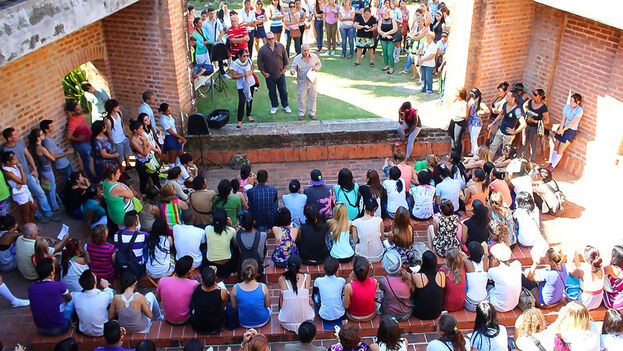
His assignment was never well received by his students nor the professors. José Ernesto continued to be a little snob, well connected but lacking his own merit, a “moron.” (ISA)

14ymedio bigger14ymedio, Yunior García Aguilera, Madrid, 18 January 2023 — A rumor had been going around the Island since December of last year: the dean of the Universidad de las Artes (ISA) had been relieved of his duties. This euphemism is usually used in Cuba when referring to party hacks who are dismissed or dethroned. Many simply go on to occupy other positions. Some, if suspected of disloyalty, are condemned to the pajama plan. While the more fortunate ones, if well connected, tend to fall up.

December 12, 2022 was the last day the Universidad de las Artes’ Twitter account tagged José Ernesto Nováez Guerrero in its publications. The next day, in his place it began tagging Rolando Valentín Ortega Álvarez, who was the director of the Centro Nacional de Escuelas de Artes [National Center for Art Schools]. And just two days later, during a visit by the booed minister Alpidio Alonso to ISA, its tweets were already referring to Rolando Orgega as the dean of that institution. The discrete revelation occurred amid the celebration of Cultural Workers’ Day, while ISA was preparing its delegation to attend the Congress of the Federation of University Students (FEU).

There was no official announcement, nor a press release. There was no farewell in the State newspaper Granma, nor a brief notice of the new tenant occupying the highest seat of leadership. To this day, many professors and students continue to be unaware of the substitution. ISA changed the dean as if he were the subject of a Bad Bunny song, “Ella es callaíta” [She is quiet].

In August 2021, quite the opposite occurred. A month after the most significant social uprising in Cuba, with much fanfare the official media announced one of Iroel Sánchez’s disciples as the new dean of the Universidad de las Artes. Nováez Guerrero didn’t have the CV, nor the degrees, nor the required level of teaching experience for such responsibility. He did not have the slightest idea, but he didn’t need it. The young Taliban had posted on Facebook, “The streets belong to revolutionaries and communists. Homeland or death! The combat order is given.” And that, automatically, converted him into a master and doctor in the eyes of the dictatorship’s bureaucrats. continue reading

His assignment seemed to form part of Iroel Sanchez’s strategy to place his fandom in key positions within cultural institutions. The “Las Villas clan” took advantage of the social whirlwind to position their pawns on the chess board and accumulate power and influence, aware that the party had started. Díaz-Canel, more scared than Ceausescu and not knowing from where the shots would come, preferred to surround himself with those from his province (we know that regionalism in Cuba continues to be key to understanding political moves.) It didn’t matter much to him that his speech abused the word “science.” If they needed to place a novice like Nováez in a position that was too big for him, they’d just do it.

Furthermore, ISA was not just any university. Professors Anamely Ramos and Omara Ruiz Urquiola were from there. From its classrooms graduated Tania Bruguera and a certain playwright they prefer not to mention. The Universidad de las Artes had already been the scene of several hunger strikes, some which received media attention such as the “split pea soup” strike. ISA was playing a role similar to what the University of Havana had played in the past. It was imperative that they put out that flame before it spread uncontrollably to the rest of a sector so dangerous (and powerful) as the students.

His assignment was never well received by his students nor the professors. José Ernesto continued to be a little snob, well connected but lacking his own merit, a “moron.”

But Nováez lasted less time in that position than it takes a Master to obtain their diploma. The cushions in the dean’s office did not have time to adjust to the bottom of the brand new dean. What happened? Did his little poems not motivate those cloistered in the meetings? Did he not realize that corruption tends to run rampant in these institutions? Or did he clash with the big fish of other clans, such as Viceminister of Culture Kenelma Carvajal, the wife of Alex Castro Soto?

For now, Nováez the novice, will need to be statisfied with representing the Network of Cuban Artists and Intellectuals in Defense of Humanity, a network so obsolete it only serves to trap trolls in the southern seas.

Translated by: Silvia Suárez

____________

COLLABORATE WITH OUR WORKThe 14ymedio team is committed to practicing serious journalism that reflects Cuba’s reality in all its depth. Thank you for joining us on this long journey. We invite you to continue supporting us by becoming a member of 14ymedio now. Together we can continue transforming journalism in Cuba.
Cuba: A Raspberry for the Little Dictator

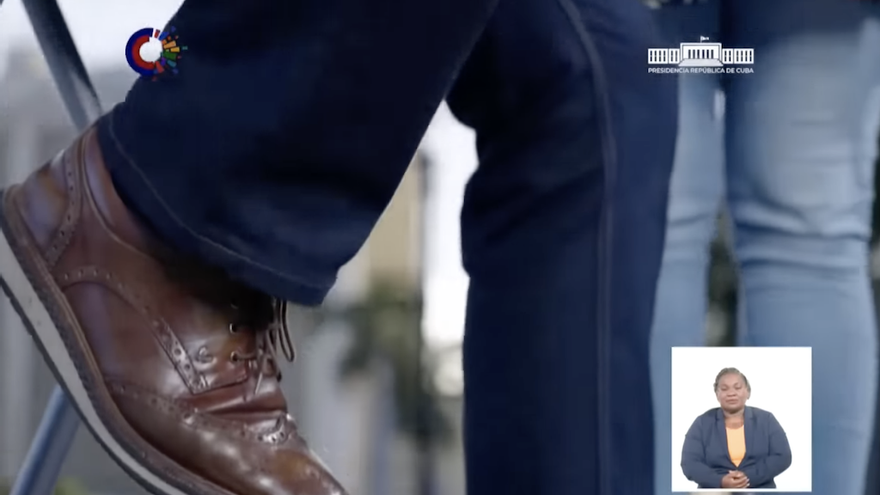
A gentle ’tilt-up’ shows us the model’s shoes and suit, to end up in extreme close-up, with more filters than on Instagram. (Screen capture)

14ymedio bigger14ymedio, Yunior García Aguilera, Madrid, January 3, 2023 — Almost everyone has heard of the Golden Raspberry Awards, popularly known as the Razzies or the anti-Oscars, where the worst films and performances of the year are recognized. The video presented by Díaz-Canel to welcome 2023 could very well sweep those awards, if they were to consider it.

With violins in the background, the camera begins its journey revealing the Cuban flag behind some support columns. And there, in front of the sequestered plaza of a silent Martí, appears the divo of Placetas (not to be confused with Eduardo Antonio). A gentle tilt-up shows us the model’s shoes and suit, ending up in an extreme close-up, with more filters than Instagram.

The hand-picked president of Cuba has not learned (and will not learn) to read the teleprompter with ease. His gestures remind us of elementary school mornings, where some ‘pioneer’ recited verses without having the slightest control over the movement of his or her hands. The president’s makeup artists went above and beyond in their efforts to make him look like the late Walter Mercado, the famous Univision astrologer. And the worst thing, after the completely empty speech, was hearing a “venga la esperanza” [hope, come] said in such an inorganic way, that Corina Mestre herself, an official Politburo hack, must flatly deny having advised him.

We already know that the electric engineer (now also a doctor in who knows what subject) does not possess the characteristics for oratory. Although, to be honest, he has not shown to have the slightest idea about communication, economics, public administration, international law or diplomacy either. His very low level of English made him look ridiculous on his recent tour of the Caribbean. And it must be recognized that he has made a great effort to differentiate himself from Fidel Castro, who neither sang nor danced, but Miguelito did not hit a note either.

The whole world has recognized Vladimir Putin as the worst figure of the year. And the Cuban dictator went to Moscow a few months ago to lick the boots of the new Stalin. All of Europe took note of the meeting and very soon the smiling photo will begin to take its toll on the island’s regime. Díaz-Canel returned to Cuba from that trip with little more than a cold and new debts that he will not be able to repay. continue reading

Upon stepping on national soil, Cubans welcomed him with an historical level of abstention in municipal elections, demonstrating that fewer and fewer are pretending to believe in the dictatorship’s electoral farce. Now the National Electoral Council is in a rush, wondering what tricks they can come up with to avoid another disaster on March 26, 2023, when the time comes to unanimously renew Parliament. Math never falters. Considering Cubans’ behavior at the polls during the last electoral process , only a gigantic fraud would prevent a new record of abstention.

For the New Year’s video, Díaz-Canel donned a white jacket, perhaps to be in tune with the Letter of the Year, during which, according to the Ifá priests, Obatalá will be the ruling deity. Díaz-Canel forgets that on November 15, 2021, many Cubans were violently repressed for dressing in that color. He forgets that 2022 has been a terribly dark year, marked not only by the worst revolutionary blackouts, but also by perennial shortages, protests, persecution, exiles, banishment, and death.

In May we suffered the explosion of the Saratoga hotel, with a total of 47 fatalities. In August we dressed in mourning once again following the fire at the Supertanker Base in Matanzas, where 17 people lost their lives. And in October the disastrous history of the tugboat 13 de Marzo was repeated when 7 Cubans, including a two-year-old girl, lost their lives after the sinking of a boat off the coast of Bahía Honda.

For Díaz-Canel 2023 does not bode well, with the exception of “creative resistance”, a synonym for more misery, sacrifices and waiting. His only success has been to stay in power. However,  in a country where people cannot freely elect their representatives, where a single party has a monopoly on weapons, where the courts are obedient inquisitors, that “success” is nothing more than a Pyrrhic victory.

The little dictator has already more than earned the rejection of the vast majority,  though we do not have democratic and peaceful means to remove him from power. For his terrible performance, both in front of and behind the cameras, Díaz-Canel deserves more than a raspberry.

____________

COLLABORATE WITH OUR WORKThe 14ymedio team is committed to practicing serious journalism that reflects Cuba’s reality in all its depth. Thank you for joining us on this long journey. We invite you to continue supporting us by becoming a member of 14ymedio now. Together we can continue transforming journalism in Cuba.
Cuba: Havanageddon, Apocalypse of a Dictatorship

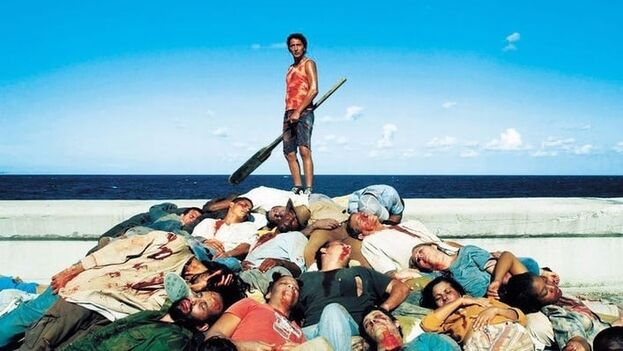
Younger organizations avoid caudillismo, they learn to work in a coordinated manner alongside others, they establish linkages with the generations with more accumulated experience. (Photograph from “Juan de los Muertos”, a movie directed by Alejandro Brugués, 2011)

14ymedio bigger14ymedio, Yunior García Aguilera, Madrid, 7 December 2022 — The regime in Havana is aware that its end is near. In the last three years the system’s undeniable collapse has become evident. The “circumstancial” crisis announced by Díaz-Canel in 2019 has been growing and worsening irreversibly. Applying the ’Ordering Task’* amid the pandemic turned out to be a foolish and suicidal act, which increased inflation, stockouts, and popular discontent.

The Cuban economy is like a Carilda Oliver Labra verse: “I am getting messy, love, I am getting messy.” Not only is it more chaotic than ever, but it is underwater in a sea of debt and unproductiveness. As if that were not enough, the leadership today is experiencing its greatest leadership crisis, with cadres that lack charisma, are politically mediocre and incapable of inspiring respect or making effective decisions.

The official discourse can’t manage to generate a single new idea and is limited to recycling old babble. But now the ones who believe the story of the blockade [i.e. the American embargo] as a perennial excuse are ever fewer, very few have faith that the system will turn out to be prosperous and sustainable and no one believes the threat of a foreign invasion anymore. The reality is that Cuba is not a priority for the Government of the United States. “David” has lost his slingshot and desperately seeks to do business with “Goliath.” The ripe fruit is about to fall to the ground and no one seems interested in taking it. continue reading

To stretch out the agony, the continent’s oldest dictatorship manages to strengthen its international alliances. However, its displays of submissiveness to Putin are like a fatal boomerang. Russia is not in a position to help anyone. And any rapprochement with the Kremlin, at this time, is like marking one’s forehead with the number of the beast.

On the other hand, the citizenry has lost its fear at a rapid pace. Never before had the regime had to confront so many protests, in all corners of the country. Social media is a battlefield where the government has lost by a landslide, despite the internet cuts, the creation of an army of anonymous accounts and the millions invested to attempt to control cyberspace. Even at the polls, their false democracy show has lost its audience. If before they used to brag about a participation rate above 95% of the electorate, the latest electoral skirmishes have broken all records of abstentions and no votes.

The brutal repression against everyone who dissents has not managed to suffocate the flames of protest. State Security has fragmented potential threats into three blocks. They take some directly to jail, issuing long sentences while they try to demoralize them, accusing them of being common, violent or marginalized criminals. They force others into exile, pushing them to abandon the country permanently. And for the rest, they simply use their techniques to reduce them to “non-persons,” they fire them or expel them from the university, surround their homes, cutoff their telephones, and submit them to continuous stress with threats, surveillance, and acts of repudiation.

State Security’s greatest achievement has been, perhaps, keeping the opposition fractured. In this way, they prevent opponents from forming a solid block capable of coordinating effective actions and obtaining legitimacy and recognition by international organizations.

To divide us, they exploit distrust among one another, maximizing ego struggles and diverting discussions toward unfruitful and innocuous areas. On social media, the regime counts on hundreds of anticommunist accounts whose only objective is to attack and discredit all leadership or any attempt at unification. And these anonymous accounts, supposedly radical, manage to do more damage than the typical ciberclarias.** 

However, beyond their success, it is also palpable that many opponents are reaching a level of political maturity that allows them to put differences aside and focus on common strategies. Younger organizations avoid caudillismo, learn to work in a coordinated manner alongside others, they establish linkages with the generations with more accumulated experience and they create strong connections with opponents of other dictatorships, like those of Venezuela and Nicaragua.

Cuban civil society is becoming aware of its potential. Little by little they claim spaces that the regime doesn’t know and cannot reconquer. Each chunk of power taken from them is ground gained for democracy which we must all build together.

The dictatorship knows its end is near.

Translated by: Silvia Suárez

____________

Translator’s notes:  

*The ‘Ordering Task’ [tarea ordenamiento] is a collection of measures that include eliminating the Cuban Convertible Peso (CUC), leaving the Cuban peso (CUP) as the only national currency, raising prices, raising salaries (but not as much as prices), opening stores that take payment only in hard currency, which must be in the form of specially issued pre-paid debit cards, and a broad range of other measures targeted to different elements of the Cuban economy.

**’Ciberclarias’ refers to internet trolls at the service of the government.

____________

COLLABORATE WITH OUR WORKThe 14ymedio team is committed to practicing serious journalism that reflects Cuba’s reality in all its depth. Thank you for joining us on this long journey. We invite you to continue supporting us by becoming a member of 14ymedio now. Together we can continue transforming journalism in Cuba.
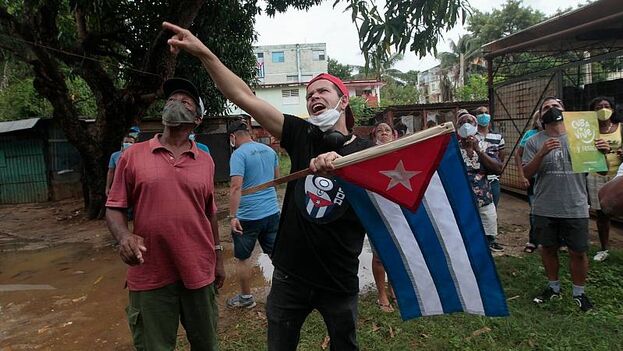
15 November, The Day the Cuban Dictatorship Lost all its Masks

Government supporters during a demonstration outside the home of Yunior García Aguilera on Sunday 14 November 2021. (EFE)

14ymedio bigger14ymedio, Yunior García Aguilera, Madrid, 16 November 2022 — Ever since we first called for the Civic March for Change we knew that it would be a practical impossibility to make it happen. Even so, it was worth it to make them unmask themselves to show their absolutely tyrannical character, above all in a context in which they tried to present themselves as a State of Law/Rights.

Two weeks after 11J [11 July 2021 protests], the judicial organs of the regime held a press conference that is still shocking in its cynicism. The president of the supreme tribunal, in a faltering voice, denied there was a body of opinion which spoke of an avalanche of judicial trials. According to Rubén Remigio Ferro, he only knew of 19 cases involving 59 people. Later it became known that the number of defendants was, scandalously, approaching a thousand.

Another ploy by this man would be to claim that the tribunals operated independently and that they only had to follow the law. Díaz-Canel himself then contradicted this, saying that “in Cuba we don’t work with a separation of powers, but with a unity of powers”. Remigio must have wanted the ground to swallow him up, although for that he’d have needed to have a sense of shame.

The big lie, which definitively pushed us into organising the march, came when we heard him say that “[holding] different opinions, including political opinions different from those which are dominant in the country, did not constitute a crime”. According to the supreme tribunal president, “demonstrating, far from constituting a crime, was a constitutional right”. continue reading

From the Archipiélago platform, and along with the Council for the Transition we tried to expose these lies. Many of us have suffered prison for protesting on 11 July. And despite having done so unquestionably  peacefully, with the international press as witness, we were thrown in a refuse truck and put behind bars.

The first date we chose was 20 November. It was necessary to make our application formally and well in advance. The world would watch our every move. The first reply from the regime was the most threatening possible: the Armed Forces declared 20 November as a National Day of Defence and announced a militarization of the country for the three preceding days.

We kept our composure. Calmly, we explained that we had no interest in a violent confrontation with the army, so we put forward the date to 15 November. This date was chosen carefully because on that day the country would reopen the airports for international tourism and so they couldn’t use the pandemic as an excuse to prohibit the march.

The regime then resorted to using all the repressive mechanisms at its disposal: the municipal governments, national television, district attorneys and all State Security agents. They interrogated any citizen who dared to “like” our posts and filled social media with pictures of the batons with which they would come out to beat us. They even organised vaccination centres for children along the route we proposed for the march. It was clear that almost no one would dare to come out. And so it was.

If the regime had had a minimal amount of intelligence they would just have put low limits on the numbers of people allowed to join the march, or they’d have designated a route far from public visibility. But they couldn’t do even that. The donkey who reckons to be the head of the dictatorship didn’t want to run any risk. And it remained clear for the whole world to see that the people of Cuba have no means whatever to express a political opinion that might differ from the official line.

The international press followed the story closely and barely anyone in the world had any doubt that the banning of the march showed that we, in trying to organise it were justified in our demands. But the dictatorship has a long history of achieving Pyrrhic victories. So they played the only cards remaining to them: discreditation, character assassination, confusion, sowing of suspicion, generation of division, forcing us into exile, launching a campaign of slander against us.

Sadly, this campaign worked for many Cubans. We still suffer like a messiah in that we’re punished if we’re not seen to be flayed and crucified on a cross. It comes hard for us to realize that before leaders we need citizens. And that to face up to a dictatorship isn’t about being a superhero but it’s about learning, effort, resolve and survival.

A year after these events there’s still a lot for us to reflect upon concerning their true impact. What is beyond question though is that on that day the dictatorship’s masks were torn to pieces.

Translated by Ricardo Recluso

____________

COLLABORATE WITH OUR WORKThe 14ymedio team is committed to practicing serious journalism that reflects Cuba’s reality in all its depth. Thank you for joining us on this long journey. We invite you to continue supporting us by becoming a member of 14ymedio now. Together we can continue transforming journalism in Cuba.
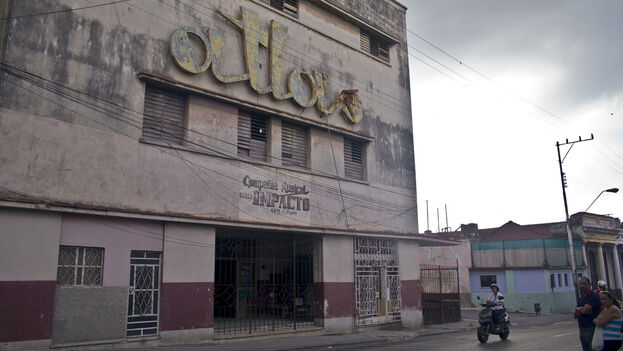
The Culture Crisis of the Cuban Revolution

The pandemic has finished off what was already the poor state of Cuban cinemas.

14ymedio bigger14ymedio, Yunior García Aguilera, Madrid, 9 November 2022 — To the grave situation in the sectors of economy, food, finance, energy, politics, social justice, migration and health — all from which Cuba is suffering — we may add a new crisis that could deliver the final death blow to a fading, crumbling model. Because if culture is the “sword and shield of the nation”, then culture’s current scenario would seem to point to the inevitable total breakdown of the system.

From the first minutes in which Díaz-Canel took power he was already stamping his signature on Decree 349 — which is aimed at increasing institutional control over artistic endeavour — and the passing of the decree would only prove to be the beginning of this unfortunate, hopeless and charisma-free little man’s headaches.

The newer generations of creatives championed an independent art scene, one that could make the most of the tiny opening seen in other sectors during the “Obama era”. But the party idealogues preferred a perestroika without glasnost. They were indeed forced to instigate a timid restructuring  of the economy, but in no way were they disposed to giving up their iron control of the narrative.

At the Youth Show of the Cuban Institute of Art and Cinematographic Industries, El Cardumen’ (The School/Shoal) was established, which defended words such as inclusion, question, risk, equality. They declared on their manifesto: “Our films will continue to speak (…), even though they will try to gag us”. Elsewhere, Luis Manuel Otero Alcántara and Yanelys Núñez organised the ’#00biennial’, on the fringes of officialdom and managed to bring together around a hundred artistes. The creation of their San Isidro Movement would mark a decisive chapter in events that were starting to unchain themselves.

In 2019, in great haste, the ninth congress of the UNEAC (The National Union of Writers and Artists of Cuba) was convened. Its architects conceived the meeting as a dam which could hold back the turbulent cultural waters. But the epic songs of praise to the congress did not take into account an unforeseen event worthy of the Theban Cycle – the arrival of the pandemic.

On 27 November 2020 the abyss that has always existed between Cuban artists and the institutions that regulate cultural policy became unbridgeable again. [Ed. note: See also articles here.] Two months later, the pseudo-poet who served as minister was becoming a vulgar telephone snatcher, and a mob of fat old men would go out to beat up another group of young people in front of the sumptuous mansion (or barracks) in Vedado, where they attempt to direct culture. continue reading

Ever since [the popular song of 1916] La Chambelona, and even before that, songs have always played a decisive role in Cuban political battles. For that reason the tremendous impact of Patria y Vida has not been a surprise, chanted, as it was, in the streets during the biggest social unrest ever seen in the country. It was of no use that the regime charged their hard hitter, Raúl Torres, with the task of getting the government out of a difficult spot. While Patria y Vida was shared millions of times and was awarded two Latin Grammy prizes, including Song of the Year, its counterpart, Patria o Muerte por la Vida, got tens of thousands of “dislikes” in just 72 hours.

With the slogan “Give Your Heart to Cuba“, official journalism took it that it ought to become more “cool” —  in reality, the worst “cool press” possible. So national television would be filled with gossip programmes, such as “With Edge”, where bitching about people becomes the norm.

After 11J [the 11 July 2021 protests], a handful of artists with deserved recognition for their work, decided to face their fears and break their silence. Many of them publically renounced their membership of UNEAC or AHS because both organisations decided to turn their backs on their own members in order to yield to the despots who gave the orders.

Today, Cuban culture is suffering the greatest exodus of talent that has been seen to date. State budgets for the arts have been reduced more than ever before, and the paintings that they hang in front of the institutions possess neither workmanship nor artistic merit, nor leadership.

And to make matters worse, the numbers provided by the Annual Directory of Statistics are overwhelming. A quick comparison of the years 2018 and 2021 would be enough to show the magnitude of the disaster. From 1,765 titles published earlier, the figure goes down to just 527. In only three years 5 ’Casas de la Trova’ (music venues), 6 bookshops, 14 theatres, 19 cinemas, 26 arts centres and 27 art galleries have been lost. During that same period, more than 20 theatre companies and almost two thousand professional music groups have disappeared.

This carnival of mediocrity has laid bare another myth of the Revolution:  In “The time of the mameys[ed. note: “The moment of truth’] the first thing they’re ready to sacrifice is precisely: culture.

Translated by Ricardo Recluso

____________

COLLABORATE WITH OUR WORKThe 14ymedio team is committed to practicing serious journalism that reflects Cuba’s reality in all its depth. Thank you for joining us on this long journey. We invite you to continue supporting us by becoming a member of 14ymedio now. Together we can continue transforming journalism in Cuba.
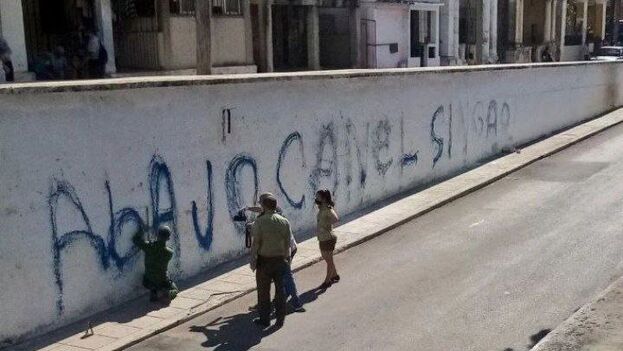
Cuba: The Nicknames of Power

Graffiti against Miguel Díaz-Canel in the Havana neighborhood of Santos Suárez. (Twitter/@ElRuso4k)

14ymedio bigger14ymedio, Yunior García, Madrid, 27 October 2022 — One of the first nicknames that Díaz-Canel received before becoming the visible head of the Cuban regime was when he was the first secretary of the Communist Party in Holguín. He had tried to prevent the farmers from bringing milk into the city. His “dry law” didn’t improve the production and distribution of dairy products in the province, but it did increase the anger of the few ranchers. Some of them preferred to pour the product onto the land, rather than hand it over to the police and inspectors who cordoned off the entrances to the Cuban city of the parks. Canel’s bloodhounds were trained to sniff out all forms of milk trafficking and fiercely punished such an onanistic sin. The inquisitor would be promoted, but in Holguín he was forever baptized as Miguel “Díaz-Condom.”

Epithets existed even before Homer made them famous. Already in the Epic of Gilgamesh, in the Texts of the Pyramids or in the Biblical Genesis, we find the use of appellations that alternate with the name of the character. And although they were generally used to highlight positive qualities, in modern times their usage has been much more pejorative, especially in politics.

The flatterers of power insist on placing bombastic and heroic qualifiers on their leaders, but popular wisdom always adds a little humor to the matter. Thus, the Spanish dictator Francisco Franco, was called  El Caudillo [the Strongman] by his followers; others called him El Cerillita [the Short Straw] because of his short stature. Pinochet was Pinocchio, for those who endured the dictatorship in Chile, and the Dominican Leónidas Trujillo would go down in history as El Chivo [the Fraud].

Nor have the champions of the Latin American left been spared from receiving nicknames. Néstor Kirchner was called El Pingüino [the Penguin], because of his physical resemblance to the character in Batman. Hugo Chávez was El Inombrable [the Nameless]. His heir, Maduro, is well known as Maburro, due to his continuous blunders. Daniel Ortega would be baptized as El Bachi [the Stick] or Mico Mandante [Monkey (Com)mandante], while his wife, Vice President Rosario Murillo, is La Chamuca, a popular name that the people give to Satan. continue reading

Returning to Cuba, almost all the presidents of the Republic were popularly distinguished with some epithet. Tomás Estrada Palma earned fame as tacaño [stingy], and his enemies named him Tomasito, el cicatero [Little Tomás, the miser]. The government of José Miguel Gómez had successes and failures, but the dominant corruption led the leader to be recognized as a tiburön, a shark. The phrase: “tiburón se baño pero salpica” [the shark swims but splashes], is one of those sayings that schoolchildren remember all their lives, beyond the excessive commitment of official indoctrination to narrate the Republic in a simplistic way. Mario García Menocal was known as El Mayoral [the Overseer], Alfredo Zayas as El Chino [the Chinese man] and dictator Gerardo Machado as El asno con garras [the ass with claws]. Nor did Grau San Martín avoid the choteo [joking]. Although his acolytes called him El Mesías de la Cubanidad [the Messiah of Cubanity], others renamed him El Divino Galimatías [the Divine Nonsense].

Fulgencio Batista would be El Hombre [The Man], for many. However, the color of his skin made it impossible for him to accepted by the elites, who called him El Indio [the Indian] and El Negro [the Black man]. After the triumph of January 1, the rebels would place Manuel Urrutia in the presidency, a poor guy who didn’t count for anything and would be nicknamed Cucharita [teaspoon].

Then Fidel Castro arrived to monopolize the national record of nicknames. El Caballo [The Horse] is perhaps his most famous nickname, since that animal occupies number one in the Charada, the Cuban system for picking lottery numbers. But, almost at the end of his existence, his acolytes would insist on calling him Caguairán [a type of hardwood]. The people, however, would use other more ingenious names for him: Fifo, Barba-Truco, Coma-Andante, Comediante en Jefe, El Cenizas or, more recently: La Piedra [Fifo, Beard-Trick, Walking-Coma, Comedian in Chief, Ashes or, more recently: the Stone].

Nor did his little brother, Raúl Castro, escape the nicknames. Tropical machismo insists on calling him La China [Chinese woman], not only for being beardless in the middle of a bearded family, but also because of the countless rumors about his sexuality. Even a late convert, like troubadour Ray Fernández, alludes to this in a theme loaded with malice: “China, search for your tail… of cloud.” Surely the “player” will have to adjust his repertoire to be admitted as a court jester in the cultural activities of the regime.

Finally, we have arrived at Diaska [Polish for “what on earth!”], el ratoncito Miguel [Mickey Mouse], Miguel Mario-Neta [Puppet] the Puesto a Dedo [Handpicked] the CitroneroGuarapero major [old lemon-sugarcane juice], the Dictador del Corazón de La Machi [Dictator of the Medicine Man’s Heart] , KKKanel and DiasContados [Days are Numbered]. Although the best nickname of all, without a doubt, belongs to the authorship of rappers Al2 and Silvito El Libre: Díaz-Canel… Singao [Motherfucker].

Translated by Regina Anavy

____________

COLLABORATE WITH OUR WORKThe 14ymedio team is committed to practicing serious journalism that reflects Cuba’s reality in all its depth. Thank you for joining us on this long journey. We invite you to continue supporting us by becoming a member of 14ymedio now. Together we can continue transforming journalism in Cuba.
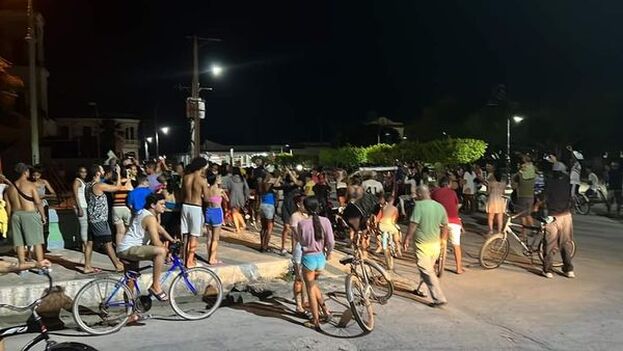
Cuba: The ‘Stockholm Letter’

Photo of the protest in Caibarién, Villa Clara on Monday. (Capture)

14ymedio bigger14ymedio, Yunior García Aguilera, Madrid, 12 October 2022 — On August 23, 1973, in the Swedish city of Stockholm, Jan-Erik Olsson attempted to rob a bank. His four hostages, despite the violence and threats to their lives, ended up protecting their captor and demonstrating vehement empathy toward him. Upon seeing this strange reaction of the victims, psychiatrist Nils Bejerot coined the term “Stockholm syndrome.”

The letter signed by a group of artists and intellectuals, denying the repression and praising the administration of the worst government Cuba has experienced in all its history, seems written by the hostages of that bank. The signatories not only displayed a cynical attitude, but rather, a sick one.

How can they deny the repression in a country where the little dictator gave the combat order on national television? How can they close their eyes to what occurred on our streets, to the hordes armed with clubs exiting the trucks to beat protesters? How can they pretend that in Cuba there aren’t more than a thousand young people in jail for yelling that they have had enough of the darkness and misery? Don’t those who subscribed to that letter realize that their signature is as culpable as the blow of a henchman, or the bullet that entered Diubis Laurencio’s back?

It is not the first time something like this happens. In 2003, a group of well-recognized Cuban intellectuals signed a the Mensaje para los amigos que están lejos [A message to our friends who are far away], supporting the imprisonment of 75 dissidents and the execution of three young men. If that was called the Black Spring, this has been the Black Autumn, as somber as the blackouts, as dark as the present and future of an entire country. Some of those who placed their signature there have, with time, regretted it and have refused to make the same mistake. But others repeat it. And new names are added to the infamy. continue reading

I saw the signatures of certain people who I considered “my friends”. But in signing that letter they are backing all the terror my family suffered. It is as if they themselves were the ones who threw me onto the garbage truck on July 11th, the same ones who decapitated doves at my door, and threatened to put me in jail for 27 years, and surrounded my house on November 14th, the same ones who launched me into exile.  They are not my friends. They are the courtiers of a despotic regime, the accomplices of those who hold on to power by force and have Cuba buried in disgrace.

I don’t know what they gain by “acting like Swedes.” I don’t know if, for them, it is worth smearing their names with mud forever to keep their positions, publish a little book, come out with an album or gain some sad privilege. By signing “the Stockholm Letter” they’ve reached the limit of subservience.

There were always people like this in Cuba, willing to applaud the horror. Today, almost no one dares to admit they supported the parameterization or that they were the architects of the Five Grey Years. But none of those horrible chapters would have happened without counting on the acolytes, slime balls, and applauders. Each sinister phase of history has its side kicks, fixers, co-authors.  And the signers of that letter have made a pact with the mafia that gets fat at our expense.

Returning to Stockholm syndrome, there is an important detail that deserves attention. One year after the bank robbery which gave rise to that psychological reaction, another important event occurred. Patricia Hearst, the granddaughter of a magnate, was kidnapped in California by the Symbionese Liberation Army. Shortly thereafter, the victim herself joined the kidnappers and helped them rob a bank. Patricia, who had been sexually abused by her captors, changed her name to Tania, just like the guerrilla fighter who accompanied Che Guevara. The cameras at the bank recorded her holding a rifle and actively participating in the robbery. Although her lawyers tried to defend her, alleging she suffered from the syndrome, the jury convicted her anyway.

Don’t believe, signers of the infamous letter, that history will absolve you. Lately, you have experienced a massive rejection by most Cubans. And abroad, those hypocritical letters no longer have much of an effect. The world has already seen the repression in Cuba. And the world has seen you buckle, as shameless opportunists, under a perishing dictatorship.

Translated by: Silvia Suárez

____________

COLLABORATE WITH OUR WORKThe 14ymedio team is committed to practicing serious journalism that reflects Cuba’s reality in all its depth. Thank you for joining us on this long journey. We invite you to continue supporting us by becoming a member of 14ymedio now. Together we can continue transforming journalism in Cuba.
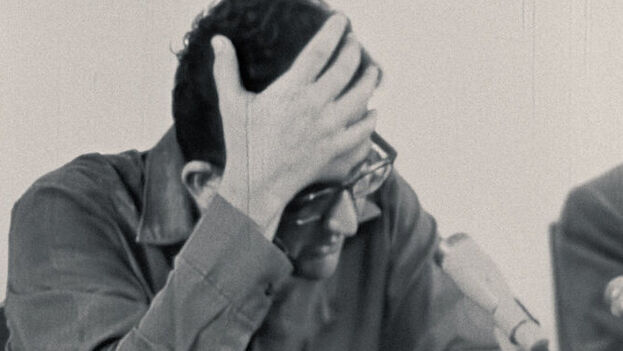
The Padilla case, or the ‘Generous’ Terror of the Cuban Revolution

A frame from The Padilla Case by Pavel Giroud

14ymedio bigger14ymedio, Yunior García Aguilera, Madrid, 28 September 2022 — I was finally able to see The Padilla Case, Pavel Giroud’s film that brings to light a disconcerting, devastating historical archive. The original material remained hidden in the vaults of the Castro regime for half a century, until now. And it’s urgent that we look back at that unburied corpse, because it’s not about ancient history, but about an urgent topical issue.

Many already knew the details of that meeting at the Union of Writers and Artists of Cuba (UNEAC) in April 1971, where Heberto Padilla revealed the Stalinist character of the Cuban Revolution. But seeing the images, observing the gestures, listening to the tone of self-criticism, contemplating the panic in the eyes of those present and feeling the sweat on the poet’s shirt, is an extremely shocking experience.

They say that Mario Vargas Llosa himself, after seeing it, confessed that he regrets not having seen the material when Padilla was still alive, because he would have embraced him and told him: “Now I believe you.” Others have stated that, with materials like this exposed to light, history will not be able to absolve Fidel Castro in any way.

I was in shock for several seconds at the end of the film. Pavel is a renowned Cuban filmmaker who had already triumphed with titles such as Tres veces dos, [Three Times TwoLa edad de la peseta [The Age of the Peseta], Omertá or El acompañante [The Accompanist]. And in this last installment he turns the documentary genre into something different. It’s as if we were dealing with a thriller, a spy movie, a horror drama, an archaeological adventure. His talent for editing allows him to transform an archive filmed in an elementary way into something absorbing, fast-paced, disturbing. Beyond the testimony, Pavel gives us a work with a high cinematic aesthetic and a screen setting of something alive and current. continue reading

What happened in that room of the UNEAC was much more than a warning: it was a collective suicide. The Cuban union of writers, artists and intellectuals emasculated itself, put on its own gags , let itself be violated by a system that spilled all its authoritarian semen into the creative belly of a generation, to force it to give birth to the New Man.

Seeing the faces of those who attended that meeting is quite a spectacle. Recognizing Reinaldo Arenas among the crowd, contemplating a Virgilio Piñera who refuses to applaud, noticing the indifferent yawn of Nancy Morejón… How many of those attendees were paralyzed by fear for lives? How many started suffering from Stockholm syndrome? How much poetry died suddenly that night?

Even today, a part of the intelligentsia still has that absurd romance with a stagnant and dying Revolution. Some still believe, as García Márquez did at the time, that Cuba is a battering ram for which everything must be forgiven, in pursuit of I don’t know what utopia, like the submissive wife who endures the blows of her husband in the name of a sick love. Until when?

The protagonist of the film is neither a traitor nor a martyr. He’s a chip in a game that he cannot win or lose, a game that would leave him out, irremediably, as in the title of his book. Was Padilla sending messages to the future? Was his performance useful? Was it ethical to stab himself in front of everyone and stick a knife into the back of his friends, even if they were forewarned? Did he know how to read the world’s signs? Did he act out of cowardice, sarcasm or the ego of transcending when he was grateful for the “generosity” of the Revolution?

The Chilean writer and diplomat Jorge Edwards said that Padilla felt untouchable, because the Revolution had an image to show to  the European left. But State Security would be in charge of showing him that no one escapes revolutionary terror. The poet was arrested, taken to Villa Marista, locked up, threatened, humiliated, forced to publicly self-flagellate, and what? García Márquez admitted that Padilla’s indictment did even more damage to the Revolution than his own confinement, so? The regime’s hand does not tremble when it decides that it’s time for heads to roll. No one is safe; no one is considered untouchable; no one will have clemency.

How important it is that this material is exhibited right now! How urgent it is to definitively tear the veil off those who continue to defend a mafia that hides behind the word “Revolution”! Thanks to Pavel Giroud and his team for this work, which is already essential for Cuban cinema and for Cuba.

Translated by Regina Anavy

____________

COLLABORATE WITH OUR WORKThe 14ymedio team is committed to practicing serious journalism that reflects Cuba’s reality in all its depth. Thank you for joining us on this long journey. We invite you to continue supporting us by becoming a member of 14ymedio now. Together we can continue transforming journalism in Cuba.
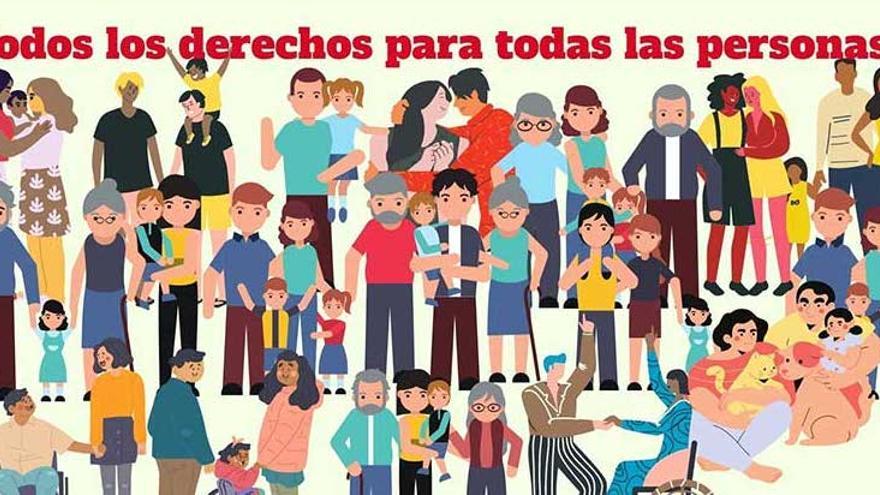
Cuba: Ballot Boxes in Captivity

Official promotional poster for Cuba’s new Family Code. (Invasor)

14ymedio bigger14ymedio, Yunior García Aguilera, Madrid, 14 September 2022 — No one will be surprised if on September 25th the regime’s referendum on the Family Code is rejected. In addition to machismo, which persists in Cuban society, the growth of evangelical religions or even reasonable doubts about the implementation of certain areas of the project, the “No” vote will also be a vote of punishment.

The outcome of that referendum cannot be analyzed using the same standards that are applied in countries where these topics have been the subject of debate. In the first place, because Cuba is not a democracy. The Parliament is not group where different views in the country seek counterweight, consensus and balance, but rather, a group of pets belonging to power and accustomed to following orders, wagging their tails, and clapping like seals. Submitting the rights of minorities to a vote has been a strategy of the Communist Party with a less-than-noble purpose.

Anyone who knows a bit about recent Cuban history knows that those in power have never been allies of the LGBT community nor defenders of the family, but the contrary. I am not speaking only of the [prison camps known as] UMAP (Military Units to Aid Production) and the parametrados* those who were ‘parameterized‘*, but rather recent events during which activists have not only been discriminated against, but have also suffered repression with distinctly homophobic characteristics. continue reading

I’m not only talking about the nefarious declarations of Fidel Castro where he called homosexuals “sick little boys,” but rather the permanence of profoundly machista discourse. One only needs to hear the terrible poem one delegate read at the Assembly exalting the virility of the commandante, at the time the Family Code was being debated.

Today our Island is more broken than ever. The dictatorship has had very dark moments throughout its more than six decades but this is the worst. The scarcity, the inflation, the blackouts, the endless lines, on top of the brutal and sustained persecution of any dissent. There have never been as many protests as there are now, nor the constant threat of another large-scale, social uprising. ##Cuba is suffering the largest exodus in our history, which is emptying the country at an intimidating pace. Never before had the regime received such a massive and explicit rejection. The current nomenklatura is, without a doubt, the most inefficient and unpopular since 1959. And there is no remedy for that, because the political gameboard is designed so that only the mediocre ascend, dismissing anyone who shows a bit of their own light.

Worst of all is that if the No vote wins, the authorities will not care. They will say they did what they could, that it was not up to them. They will accuse the opposition of being backward, right-wing extremist, fascist, ultraconservative. And rights will once again be postponed. If the Yes vote wins, the regime will tout the response as meaning total support for the Revolution and the Party. But in the end, they will do very little, in practice, to benefit the people who really need it, because neither the social base nor an efficient structure exist to enforce those rights.

It is true that there is a lot of superficial propaganda on social media, but I completely understand the fears of some about the very delicate issue of child custody. It is also true that in democratic countries there are similar regulations, but let’s not forget that in Cuba there is one Party that is above the Constitution and the laws. They interpret everything, always in their favor, and they have never needed the law to crush whomever they want. With the Code or without it, any Cuban who becomes the target of destruction will be completely defenseless when facing the henchmen in power.

I have always declared my support and solidarity with the LGBT community. I defend their right to have rights to the end, but I respect the decision each person will take on September 25th. Whatever happens, the struggle to conquer as much dignity as possible and to eradicate all kinds of discrimination should continue with greater force.

The debate surrounding the Code had generated so much controversy that very few have noticed that the dictatorship will return to the ballot box in November. Last year they had announced that, due to the pandemic, the delegates’ terms would be extended. The date is very symbolic, November 27th. But that will be the topic for another article.

*Translator’s note: *Parametrados / parametracion: From the word “parameters.” Parametracion (parameterization) is a process of establishing parameters and declaring anyone who falls outside them (the parametrados) to be what is commonly translated as “misfits” or “marginalized.” This is a process much harsher than implied by these terms in English. The process is akin to the McCarthy witch hunts and black lists and is used, for example, to purge the ranks of teachers, and even to imprison people.

Translated by: Silvia Suárez 

_____________

COLLABORATE WITH OUR WORKThe 14ymedio team is committed to practicing serious journalism that reflects Cuba’s reality in all its depth. Thank you for joining us on this long journey. We invite you to continue supporting us by becoming a member of 14ymedio now. Together we can continue transforming journalism in Cuba.
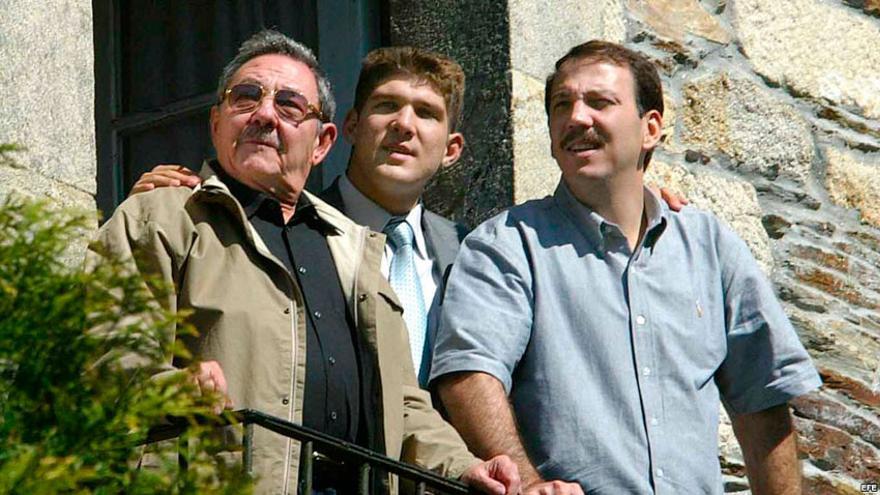
Cuba’s Enemy is in the Plaza of the Revolution

Raúl Castro placed his son Alejandro (on his left in front of his grandson Raúl Guillermo) in what he called the Commission for Defense and National Security. (Cubanet)

14ymedio bigger14ymedio, Yunior García Aguilera, Madrid, 31 August 2022 — If we take into consideration that the security of any country is based on the notion of stability, peace, development, as well as in the strategies to achieve these objectives, there is no doubt that the authoritarian powers on the Island constitute the main threat to National Security.

This concept emerged in the United States shortly after the end of World War II. In the context of the Cold War and facing the threat of nuclear weapons, the term focused on prevention, on the capacity to predict danger and strategies to mitigate its effect. Over time and as globalization erodes borders, the term has acquired other connotations.

Today, a state’s National Security does not only depend on external threats. Included in that concept are common delinquency, mafias, environmental risks, pandemics, catastrophes or uncontrolled migration.

In Cuba, Raúl Castro positioned his only son within something called the Commission for Defense and National Security. As usual, none of the delegates asked uncomfortable questions and no one questioned whether placing Alejandro Castro Espín in that area on a whim was in response to a true national interest or only had to do with having a colonel with the last name Castro mindfully watching over (with his only eye) the monarch’s sacred Family Security. continue reading

It is extremely difficult to define the Cuban system. It is not communist because communism does not exist, pure fiction, something which has never been nailed down anywhere on the planet. Socialism, on the other hand has so many definitions, it would be vague or imprecise to describe Cuba as a socialist state, especially when taking into consideration that on the Caribbean island, laborers are not a force with any political weight, nor do they have the opportunity to propel change in any way.

This small portion of the world has been a territory controlled since 1959 by a clan of individuals who have monopolized decisions, development strategies, and the notion of national security. Since then, Cuba has remained under the yoke of a gang which has used the ideologies of the day at whim to justify its empowerment. This caste has already failed precipitously in the country’s economic development, the conquest and guarantee of individual and collective rights, in achieving the wellbeing of the population and even in the state’s own survival.

The situation becomes more complex when the chiefdom, self-legitimized as a result of historical events, biologically disappears, in addition to the elimination of its contrarians or the best press any generation has had. But they’ve been replaced by a gang of legendless bureaucrats. The replacements (tombs in guayaberas) do not appear in the history books read by schoolchildren,  nor have they worked a day in their lives, and no dove ever posed on their shoulder. The forced replacements did not inherit the charisma of their models, they cannot count on popular support, they don’t even have the benefit of the doubt.

The current situation in Cuba is the worst it’s been in decades because, beyond the inflation, lack of bread, or the 18-hour blackouts, people are no longer willing to keep silent. We are the country in Latin America with the most political prisoners, we are at the bottom of most development list, and we compete with the worst countries in rankings of human rights violations.

However, the gang that has recently moved to Siboney refuses to accept democratic solutions. They continue to blame a “blockade” which collapses every time a Cuban buys chicken “made in the USA” in a freely convertible currency (MLC) store. They insist on the threat of foreign military intervention, which even the most recalcitrant opponents in Miami completely discard. They repeat like parrots that all demonstrations of discontent are paid for by the CIA, which must be bankrupt with so many accounts to settle. Officials of team Diaz-Canel beg ordinary residents for sacrifice, babble slogans that seem like tongue twisters, demand “creative” resistance. They appeal to the people to endure face slaps from police, beatings of 11-year-old girls, and all this for a bright future in which no one believes.

Silvia Rodríguez had a point when he predicted that the people will end up confronting the government. It has done so with flowers, songs. . . or stones. Tomorrow could be worse. The main threat to national secuirty is the system itself.

Translated by: Silvia Suárez

____________

COLLABORATE WITH OUR WORKThe 14ymedio team is committed to practicing serious journalism that reflects Cuba’s reality in all its depth. Thank you for joining us on this long journey. We invite you to continue supporting us by becoming a member of 14ymedio now. Together we can continue transforming journalism in Cuba.