To Kill Marti?

For more than a century, José Martí has been the Cuban figure most likely to go from flesh to marble. (Civic Square, 1957)

14ymedio bigger14ymedio, Yunior García Aguilera, Madrid, 25 October 2023 — Judging from online chats, private conversations and articles in the independent press, more and more Cubans are coming down with Martían fatigue syndrome. For more than a century, José Martí has been the Cuban figure most likely to go from flesh to marble, from light to dust, from elegy to meme. He is the banner raised by opposing, irreconcilable ideologies. Many a fortune cookie contains a quote by him. For us, he is simultaneously the Cuban Christ, the Caribbean Plato and the Marilyn Monroe of national pop art.

In our collective postmodernist hangover, we hit the accelerator, desanctifying all the altars as quickly as possible. The hasty effort did produce a bit of valuable research but also a lot of Martíanoid sausage. The crowning touch was the ruling party designating former Cuban culture minister Abel Prieto and National Assembly delegate Yusuam Palacios as high priests of the sanctum sanctorum. The ensuing indigestion, along with the urge to try to kill off the hero once and for all, was predictable.

Speculations about suicide are not completely implausible, nor are they far-fetched given his romantic nature

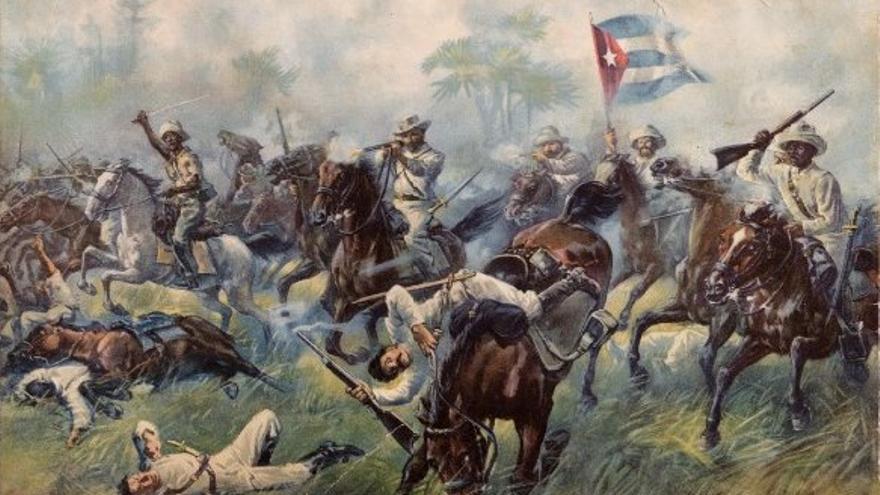
Much has been written about that Sunday in May 1895 when Martí seemed to be looking for a way to die. Speculations about suicide are not completely implausible, nor are they far-fetched given his romantic nature. In his writings he described death as a victory, a celebration, a silver stripe laid upon black velvet. For a man plagued by diseases such as sarcoidosis, chronic catarrhal conjunctivitis with a drooping right eyelid, sarcocele and acute broncho-laryngitis, death in combat was more desirable than imminent death in a foreign bed.

In his 1933 biography Martí, the Apostle, Jorge Mañach asks three essential questions about his demise at the Battle of Dos Ríos. Was it caused by a fit of madness? Inexperience? Or was it just his time to go? Carlos Márquez Sterling attributes his loss to “providence itself.” Gonzalo de Quesada y Miranda comes back to the idea that it was his “appointed hour.” The Argentine writer and poet Ezequiel Martínez Estrada described his death as “enigmatic, absurd, inexplicable, unusual and improbable.” continue reading

Some have blamed Máximo Gómez for the desperation and clumsiness of that day, which were incomprehensible given his experience as a soldier. The generalíssimo himself acknowledged that he was very poorly prepared for battle and did not have time to worry about Martí. Others blame Baconao, the spirited white horse that José Maceo gave him. Quite a few blame the fatality on his wardrobe, which was more appropriate for a wedding than for the rigors of combat. The fact is that Martí — the newly appointed major general, the would-be lawmaker, the likely future president — was the only casualty the Cubans suffered in this militarily insignificant operation.

The hypothesis that he threw himself at the bullets to set an example makes no sense in light of the fact that only Ángel de la Guardia saw him fall and, even then, only felt compelled to rescue Martí’s hat and revolver. The theory that he disobeyed Gómez’s order to “fall back” presents us with an image of a reckless, adolescent Martí very much at odds with his intellect and demonstrated ability to not become self-absorbed when faced with disdain, contempt or even humiliation.

Three bullets pierced his flesh though the drum of his Colt was still intact

The Spanish soldiers could not believe it. They had heard that some “big birds” were among the rebel troops but they could not imagine that the main instigator of that war, which had only just begun, would be such an easy target. It was a firing squad. Three bullets pierced his flesh though the drum of his Colt was still intact. When giving his account of the incident, the Spanish captain Antonio Serra would murmur, “There is a mystery here.”

Another often discussed enigma is the Cuban connection to the shot in his chest. The trajectory of the bullet indicates that Martí was either bent over his horse’s neck or was shot when he was already on the ground. The latter is consistent with claims by a Cuban soldier, Antonio Oliva, who fought for the Spanish under the command of Colonel José Ximénez de Sandoval. Grandfather of the renowned Cuban painter Pedro Pablo Oliva, he boasted of having killed Martí with his own gun. But not everyone believed him. Maybe he was just looking for a medal and a pension.

Martí died face up, as he dreamed. But that night a two-hour downpour drenched his corpse while it was being carried away by his enemies. One-hundred twenty-eight years later he is still falling off his horse, in multiple ways, for a lot of different reasons. The truth is that we needlessly lost the man the future republic needed most. Or maybe not. If he had survived and had governed, the current ruling party would no doubt now be calling him corrupt and self-serving. Thousands of busts and statues of him would not exist, nor would so many Cubans on social media be trying in vain to finish off Martí.

____________

COLLABORATE WITH OUR WORKThe 14ymedio team is committed to practicing serious journalism that reflects Cuba’s reality in all its depth. Thank you for joining us on this long journey. We invite you to continue supporting us by becoming a member of 14ymedio now. Together we can continue transforming journalism in Cuba.

Encounters of the Third Kind with Cuban State Security

Artists being arrested by police in Havana for protesting in front of the Cuban Institute of Radio and Television on July 11, 2021. (EFE)

14ymedio bigger14ymedio, Yunior Garcia Aguilera, Madrid, 4 October 2023 — Those of us who have been a target of the State Security often make two serious mistakes. On the one hand, we overestimate them. They are not the X-Men. They do not have all the latest technology nor are they omnipresent. Their officers come off as increasingly clumsy, ill-prepared, with a progressive decline in cultural awareness. That feeling that you can’t even trust your pillow because they know every time a leaf moves in Cuba, that is a myth they themselves perpetuate in order to paralyze us. It’s not as though their gears operate like those of a Swiss watch — they’re more like those of the National Energy System — no matter how much some government minister beats his chest on TV claiming otherwise.

But neither should we make the mistake of underestimating them. State Security’s founders were trained by the KGB and the Stasi. They inherited manuals and techniques whose effectiveness still stand the test of time. They have penetrated and control every grassroots organization in the country, which is really their greatest strength. From the Federation of Cuban Women to the Committees for the Defense of the Revolution, from the National Artists and Writers Union to the National Association of Small Farmers, from the labor unions to the Federation of University Students. Every day these organizations report their findings to State Security and act as its eyes, ears and fists. continue reading

They have penetrated and control every grassroots organization in the country, which is really their greatest strength

The first time I was “interviewed” by a counterintelligence official was in Holguín, shortly after firing off fifteen questions, which automatically made me a target. I learned from others that the aforementioned individual had been ordered to approach me, though he himself admitted to feeling unprepared. So he spent a few weeks visiting the Provincial Council for the Performing Arts, getting a crash course in drama that, if we’re being honest, didn’t help him much.

His first words were: “We know you’re not collaborating but we would still like to know what you’re doing because we have lots of collaborators around you.” Apparently, I was on a list of young opinion makers and they wanted to warn me that they were watching me closely, trying to stoke fear, paranoia and paralysis in me. But they chose the wrong officer. The man’s lower left eyelid quivered, his words sounded scripted and he seemed eager to be done with his uncomfortable mission as quickly as possible. Instead of working like an anesthetic, it had the opposite effect.

They did not make the same mistake twice. After November 27, they sent Yordan, a cross between U.S. basketball legend Michael Jordan and Cuban wrestler Mijaín Lopez. The guy was over six-and-a-half-feet tall. Standing in front of my house, putting on his scariest face, he told me that I could not leave until he decided I could leave. I have to admit that, this time, the guy was convincing. But State Security also didn’t want to run the risk of him scaring me to the point it radicalized me.

At that time, I still had all the naivetee of someone who had not yet looked into the eyes of Satan. So, a few hours later, they sent in the “good cop.” This time they chose an officer who had been trained overseas, who had more self-confidence and a less limited vocabulary. He said his name was Rodrigo and he took the opportunity to compliment me in an effort to boost my ego. All the while, he was ripping to shreads all the other known activists. He then deployed the “you’re not an enemy, you’re just confused” strategy.

Although at first I swore not to touch anything on that table, eventually I gave into hunger

Later came my first abduction. They took me to one of those houses with curtains on all the walls (and cameras behind them). On the table before me lay all the things that were in short supply in the stores: coffee, cans of soft drinks, candies, even shellfish. Actually, they asked me almost nothing. Again, they just talked bad about everybody and left me alone for long periods of time. Although at first I swore not to touch anthing on that table, eventually I gave into hunger.

I have often asked myself what exactly that scene was all about. What was up with the shellfish? What tidbits were they looking for? I later realized that they just wanted some visuals for their files. If, at some future point, they had to take things further and I publicly accused them of physical violence, all they would have to do would be to take out those videos of me eating shrimp. They know how the mind of the average Cuba works. They knew that, upon seeing those images on national television, some people would say, “I want them to torture me too!”

State Security officials often use several categories to classify their victims: possible agents, willing or unwilling collaborators, confused revolutionaries or incorrigible revolutionaries. They also take into account your ability to influence people and the types of people who could be motivated to follow you. There is a particular approach for each case. But when it comes to good-natured, kind or helpful people, you get the same rough treatment. It doesn’t matter if you are an intellectual or a dock worker.

Once they have made the decision to destroy you, they will do it one step at a time. Possibly, you will first be subjected to cyber attacks. They will accuse you of being a mercenary because money was added to your cell phone account from overseas. Then there will be the disrupted internet, the interrogations, the home surveillance. They will disparage you at your school, at your workplace, to friends and family, and especially to other activists. They will look for ways to exploit egos, jealousies, prominence, and human misery. If you are having an impact online, they will ask TV newscaster Humberto Lopez or the Con Filo lap dogs to tear you apart on the small screen. That will be accompanied by acts of repudiation and a guard permanently stationed at your front door to keep you from leaving the house.

If you are having an impact online, they will ask TV newscaster Humberto Lopez or the Con Filo lap dogs to tear you apart on the small screen

With me, in particular, they resorted to an alleged Afro-Cuban curse. They decapitated two pigeons on my metal fence and smeared feathers, blood and dirt across the doorstep. Several housing department and electric company inspectors also came to visit, allegedly because of complaints of illegal activities that they were never able to prove. Then the public prosecutor’s office will threaten you with sentences that could amount to decades in prison for crimes such as “subversion.” By this point, you are clearly the enemy. And they will try to annihilate you.

There are five ways of finishing you off. Turn you into a non-person, someone with no friends, no family, no internet, no freedom of movement. Fry your brain, making you anxious, paranoid, single-minded, extremist and spouting rhetoric so radical that you elicit no empathy. Force you into exile, where it does not matter if you continue posting online because, if you are not there, you are not relevant. Throw you into prison, where some will advocate for you but the vast majority will get on with their business. And finally, kill you. Cuba’s recent history has no shortage of “accidents,” after which nothing happened.

Cubans have two options. We could act the Swedes, avoiding everything that could happen to us and leave the problem to our children, who would be the ones to take the risk later. Or we could swallow our fear and try to do what we have to do as a generation. It doesn’t matter that hundreds of us have failed before. Someone could do it right and that person could be you.

____________

COLLABORATE WITH OUR WORKThe 14ymedio team is committed to practicing serious journalism that reflects Cuba’s reality in all its depth. Thank you for joining us on this long journey. We invite you to continue supporting us by becoming a member of 14ymedio now. Together we can continue transforming journalism in Cuba.
Cuba: False Emissaries of Peace

The Army of Liberation was riddled with internal strife, plagued by regional divisions, defeatism and poor discipline. (Wikimedia)

14ymedio bigger14ymedio, Yunior García Aguilera, Madrid, September 27, 2023 — By 1877, the Ten Year’s War was was at an impasse. The Spanish had not managed to defeat the Cuban guerillas and the insurgents were nowhere close to a decisive victory. The Army of Liberation was riddled with internal strife, plagued by regional divisions, defeatism and poor discipline.

Vicente García, who had led a seditious revolt in Santa Rita, refused to abandon his territory to join the western invasion. Holguín declared itself an “independent canton” outside the control of the Republic in Arms. And the secretive Republican Unity society in Las Villas was unaware that Gómez and Maceo were leading the war effort. The Cubans were also dealing with a chronic shortage of military hardware, lack of support from the Cuban emigré community and an intelligent enemy in the guise of the new captain-general.

Martínez Campos, a military officer from Segovia, had been a professor at the General Staff School and was the leader of the1874 military coup in Spain. There he was known as the man from Sagunto who restored the Spanish monarchy, famously proclaiming Alfonso XII king of Spain under a carob tree.

But conditions in Cuba were such that the Spanish also found themselves unable to prevail in the conflict. With an army that was ill-prepared, even more badly dressed, and poorly fed, nine out of ten soldiers were being felled by yellow fever and other tropical diseases, not guerilla machetes. The idea of signing a peace deal was in the minds of the combatants on both sides.

However, a law prevented the insurgents from even mentioning the subject. The Spotorno Decree, adopted by the House of Representatives of the Republic in Arms, proscribed the death penalty for anyone, Cuban or Spanish, who turned up on the battlefield talking about peace.

Then a singular character showed up in Havana: William Pope. He claimed to be a member of the “Peace Council”,  bishop-elect of Haiti and envoy of the U.S. secretary of state. His mission was to meet with the insurgent leaders and negotiate the controversial capitulation.

One cannot talk about peace in today’s Cuba. The regime subjugates its citizens with an iron fist. Prison and exile are the predictable outcomes for anyone who dares to raise his or her voice

The meeting took place secretly on May 11, 1877, at the governmental headquarters of the Republic in Arms. The then-president, Estrada Palma, was rumored to have annexationist ideas. At the meeting there was talk of continue reading

paying Spain a figure of between 100 and 150 million pesos to buy independence. That money, of course, would be lent by the United States. And although it was not entirely clear to the rebels, the seeds of ending the war without having defeated the enemy had been sown.

It is said that Bishop Pope later met with Martínez Campos, who told him he was not authorized to accept such a proposal, urging him to instead travel to Madrid and present it to senior government officials. Pope celebrated a military mass in Santiago de Cuba’s cathedral, where he was given a bishop’s ring by the captain general.

But this is where the story gets murky. It turns out that Pope was not American after all but Irish. Nor was he a bishop, just a priest with outsized ambitions. The man apparently dreamed of distinguising himself by playing mediator in some important affair and, perhaps, serving as bishop of Havana. Years later, Máximo Gómez would find him in a Honduran prison, convicted of stealing some religious vestments and a Holy Communion chalice.

In December, 1877, the House of Representatives overturned the Spotorno Decree, paving the way for the Pact of Zanjón, which was was signed on February 10 the following year. Antonio Maceo famously rejected the treaty in a document known as the Baraguá Protest. He would acknowledge shortly thereafter, however that the conditions necessary for carrying on the fight were not there. The Bronze Titan was forced to negotiate with Martínez Campos for a letter of safe conduct out of the country to exile in Jamaica.

Enrique Collazo would write, “The Cuban people, deaf for ten years to our cries of glory and agony, watched impassively as the revolution died, drowned in the blood of its martyrs.” It was the end of a long war that fizzled out without achieving its basic objectives.

One cannot talk about peace in today’s Cuba. The regime subjugates its citizens with an iron fist. Prison and exile are the predictable outcomes for anyone who dares to raise his or her voice or engages in even the most peaceful of protests. And though there is no Martínez Campos in the government, ready to negotiate, there is no shortage of Popes who talk falsely of bridges, of peace, of love.

____________

COLLABORATE WITH OUR WORKThe 14ymedio team is committed to practicing serious journalism that reflects Cuba’s reality in all its depth. Thank you for joining us on this long journey. We invite you to continue supporting us by becoming a member of 14ymedio now. Together we can continue transforming journalism in Cuba.
The Cuban Regime Is Not Alone, But It Is in Very Bad Company

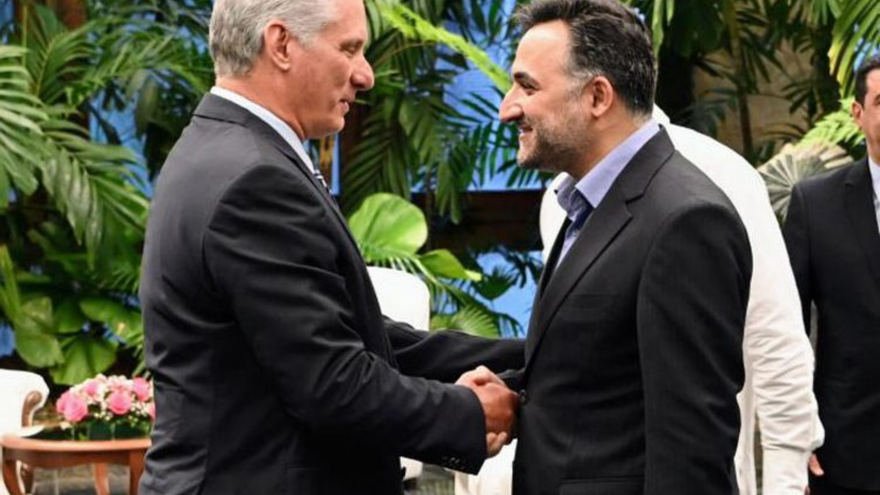
Cuban President Miguel Díaz-Canel received Iran’s Vice President Ruhollad Dehghani on the occasion of the G-77 summit plus China in Havana. (Estudios Revolución)

14ymedio bigger14ymedio, Yunior García Aguilera, Madrid, 20 September 2023 — These days the propaganda of the single party in Cuba has used to the point of exhaustion a desperate slogan: Cuba is not alone. In fact, we have seen some characters parade through Havana who never leave their caves, except to come to ours, where they find refuge, pats on the shoulder and exchange tricks on how to perpetuate themselves in power. However, it alarms other democratic leaders that, like Aesop’s frog, they mount scorpions on their backs.

The 47 agreements from the G77 plus China summit repeat the mantra of science, technology and innovation, as if they prayed to the gods of the North for a little attention. It is obvious that progress depends on the development of this knowledge and these tools, but it’s unfortunate that totalitarian systems use the privilege of attendance not to produce more or find solutions to our problems, but to monitor, control and punish.

The countries of the South, after this summit, have not “raised their voices” as some catatonically insist; they have simply threatened to change their masters

The countries of the South, after this summit, have not “raised their voices” as some catatonically insist; they have simply threatened to change their masters. In the next edition, the same dilemmas will be heard again, similar agreements will be signed and we will remain in debt up to our necks. The complete absence of self-criticism does not allow us to understand the weight of our own guilt in the advance of hunger, misery, violence and the lack of hope suffered by the peoples of the South. With these songs, we will be even poorer, more whiny and less democratic.

The summit has actually served to legitimize authoritarian models, to bring a considerable block of nations closer to the axis of China, to mitigate the condemnations against Russia and to promote the puppet of Castroism as a “world leader.” continue reading

Cuban President Miguel Díaz-Canel arrived in New York wearing that suit, or believing that he was wearing it, although he was naked. His dyslexic speech has been a pastiche of everything that Cuba has been ruminating for decades. All that is condemned at a global level is reproduced internally. They condemn the sanctions but mercilessly sanction any Cuban citizen who disagrees; they speak of “blockade” but block and put absurd obstacles on the Island to any development initiative outside state control; they condemn a hegemonic world but defend the hegemony of the single party; they want an orchestra of multipolar nations but keep Cuba as a monolith, creating a solo of maracas.

Beyond exhibiting to the world an appearance of a leading country, Castroism urgently needs to show the Cubans some light at the end of the tunnel. That desperation to hold great events or flaunt the occasional victory reminds me of the Pan American Games in Havana in 1991. Fidel Castro then praised the Pan-American Villa and swore that he had never seen anything more beautiful. He even said, with his usual fondness for hyperbole, that it should be called “Olympic Villa.” But the Berlin Wall fell and we would suffer the worst crisis in our history. And all Cubans know what the ruins of that mirage look like today.

Now the regime is determined to be re-elected for one of the 47 seats of the UN Human Rights Council

At the recent G77 summit, Havana did not have a Tocopán,* and they knew that a mediocrity like Díaz-Canel was not enough to impress visitors or look like a leader. They needed a sacred cow, a relic, another Tocopán, so they used the nonagenarian Raúl Castro as the mascot of the event.

Now the regime is determined to be re-elected to one of the 47 seats on the UN Human Rights Council. It sounds frighteningly absurd that the country with the most political prisoners in the region, a flagrant violator of all those rights, is running to occupy a chair. But it wouldn’t be surprising if Cuba succeeded either. Latin America has three positions, and only Cuba, Peru, Brazil and the Dominican Republic compete for them. As the winds are blowing, it is likely that nations will vote for the dictatorship, even if that completely discredits the Council.

Thus, the abusive communist regime goes through life becoming the defender of the victims. On the Island, repression and censorship continue; misery, inflation and crime advance, and hopelessness and the migratory tsunami progress. But the world is so crazy that it prefers to turn a blind eye and suck up to the hypocrite. If those who are truly committed to peace and democracy do not act effectively soon, the authoritarian gang will grow to become Ali Baba and the 77 thieves.

*Translator’s Note: Topocán, K’inich Yax K’uk’ Mo’, was the founder and first ruler of a Mayan dynasty.

Translated by Regina Anavy

____________

COLLABORATE WITH OUR WORKThe 14ymedio team is committed to practicing serious journalism that reflects Cuba’s reality in all its depth. Thank you for joining us on this long journey. We invite you to continue supporting us by becoming a member of 14ymedio now. Together we can continue transforming journalism in Cuba.
Who Would Believe a Regime of Tartuffes?

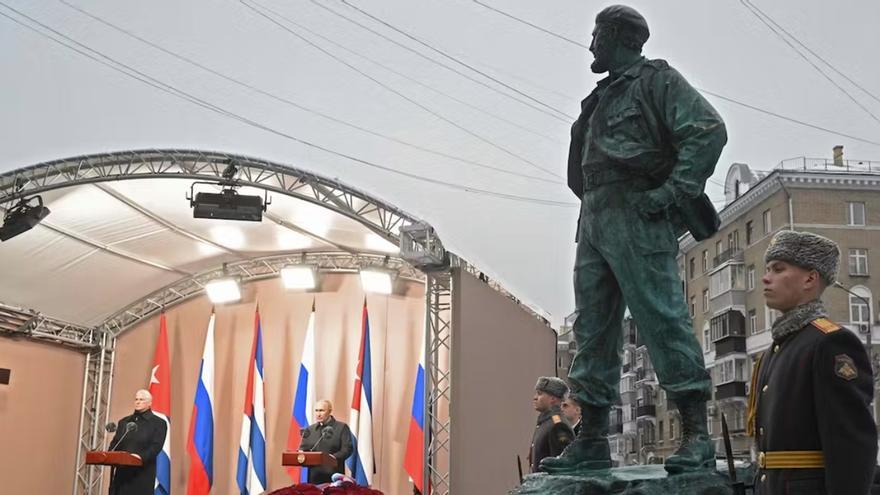
Cuban president Miguel Diaz-Canel and Vladimir Putin beside a statue of Fidel Castro in Moscow. (Sputnik Kremlin)

14ymedio bigger14ymedio, Yunior Garcia Aguilera, Madrid, 5 September 2023 — In the last few hours, several international media outlets have reported that Cuba has uncovered an illegal scheme to recruit Cuban citizens to fight in Ukraine. But the truth is that the regime has uncovered absolutely nothing. It has only reacted — and very late at that — to a scandal that has been brewing on social media for several days. The recent statement by the Ministry of Foreign Affairs is an attempt to wash its hands of the matter and provide cover for a dictatorship that has been Putin’s faithful lackey since the start of the war.

It was the influencer Alain Paparazzi who uncovered this Pandora’s box when two young men contacted him to report their situation. Alex Vegas and Andorf Velázquez, both 19-years-old, signed contracts allegedly to do construction work in Russia. Their willingness to move there under the current circumstances is a reflection of just how desperate young Cubans are to leave their country, no matter the cost. Once on Russian soil, they were relieved of their documents, forcibly inducted into the military and transferred to the front lines in Ukraine.

Diaz-Canel is a pawn who thinks he is a bishop. His outward moves seem deferential to Putin while under the table he is playing footsies with Biden

During the Cold War, Fidel Castro also behaved like a Kremlin pawn but the bearded one had his own way of moving around the chessboard. It was he who popularized a Cuban rhyme that might be translated as “Nikita, my little ladybug, you can’t steal what’s already been given to you.” The Soviet leader would later sideline him from negotiations during the Cuban Missile Crisis before ultimately withdrawing offensive missiles from the island. They say that the homophobic Fidel employed his cigars as anti-kissing shields on his trips to Moscow to discourage his Soviet comrades from engaging in this particular display of affection. When perestroika was unleashed, he had no qualms condemning his favorite general to death by firing squad to send and clear and unequivocal message to those in Cuba’s own nomenklatura who were sympathetic to Gorbachev’s reforms. For this and other reasons, the Cuban regime survived the fall of the Soviet bloc. The Cuban pawn knew he was a pawn but aspired to get to the other end of the board so he could become queen. continue reading

Diaz-Canel, on the other hand, is a pawn who thinks he is a bishop. His outward moves are deferential to Putin but, under the table, he is playing footsies with Biden. Despite all the pro-Putin propaganda from official media in Cuba, to say nothing of foreign outlets such as TeleSur and Russia Today, most Cubans reject such a blatantly imperialist military invasion. And yet the government has not voted in favor of any of the resolutions condemning the war. Not even the one sponsored by the World Health Organization (WHO) decrying the almost 1,000 attacks against Ukrainian hospitals and healthcare centers.

The famous Molière character, Tartuffe, is one the world’s most archetypal hypocrites, which makes the Cuban regime the quintessential Tartuffian dictatorship. For decades it has condemned invasions, wars of aggression, annexations of territories and mercenary escapades. But now it finds itself trapped in its own moral back alley. That is why the Foreign Ministry’s statement is so disgusting. It reads like the script for an energy drink commercial.

They are looking for what every nation at war needs: political and military support. In this regard, the only thing Cuba can offer them is cannon fodder

Diaz-Canel has shown no qualms about flying to Moscow to pay homage to his tsar-in-chief. His last visit broke Putin’s near total isolation at a time when even Xi Jinping could not be bothered to pick up the phone. A squad of high-ranking Russian officials have also been parading through Cuba. They are hoping to not only collect on their debts but to expand their Cuban investment portfolio. They are also hoping Cuba can serve as the front man for their interests in Latin America and Africa. And they are looking for what every nation at war needs: political and military support. In this regard, the only thing Cuba has to offer is cannon fodder.

It is no coincidence that Cuba has so many military personnel at its embassy in Moscow. And it is no coincidence that, during a meeting with the head of the Department of International Military Cooperation in Minsk, Colonel Mónica Milián Gómez — Cuba’s military, naval and air attaché for Russia and Belarus — that  let slip a possible indiscretion as we know from her Twitter account. Or that Belarus’ Deputy Defense Minister Valery Revenco wrote that “the main focus of attention the was training of Cuban military personnel.”

So the regime has nothing to do with recruiting young people to go to war? Really? Tell that to Orgon or Madame Pernelle. No one with half a brain would take the statements of such a Tartuffian regime seriously.

____________

COLLABORATE WITH OUR WORKThe 14ymedio team is committed to practicing serious journalism that reflects Cuba’s reality in all its depth. Thank you for joining us on this long journey. We invite you to continue supporting us by becoming a member of 14ymedio now. Together we can continue transforming journalism in Cuba.

For Whom Is Argentina Crying?

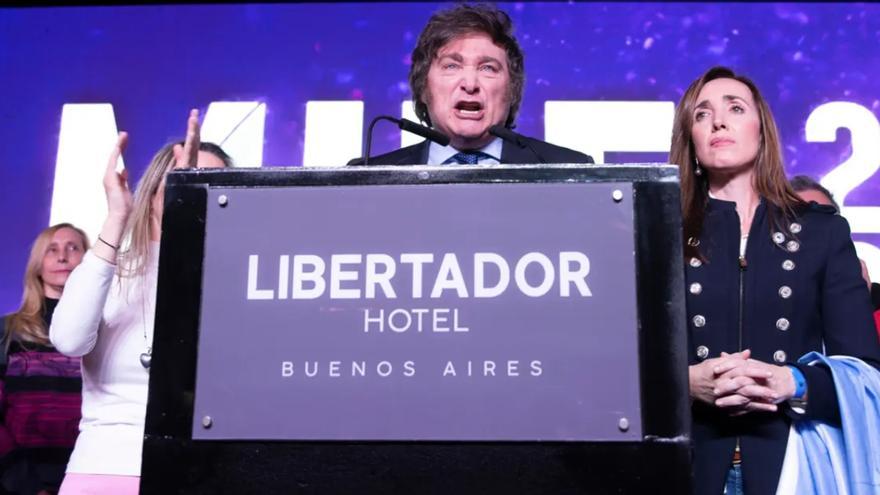
Milei’s rhetoric about ending “the parasitic, stupid, useless political caste” has caught on with voters. (EFE)

14ymedio bigger14ymedio, Yunior García Aguilera, Madrid, August 22, 2023 — To understand the Milei phenomenon, we have to go back a bit in history. Almost all of us have heard the song “Don’t Cry for Me Argentina,” a show tune that has been covered by the likes of Madonna, Sinéad O’Connor, Sarah Brightman, Christina Aguilera and Andrea Bocelli. It was inspired by María Eva Duarte, better known as Evita Perón: a politician, actress, first lady of Argentina and wife of Juan Domingo Perón. Evita died of cancer in 1952 when she was only 33 years old. After her death, she was declared “Spiritual Leader of the Nation.”

Since then, Peronism has been the country’s most influential political movement. Its broad spectrum of adherents has made it difficult to classify. Several groups, from both left and right, claim to be Peronists. Among its most important offshoots, however, is the populist, nationalist wing, which is closely aligned with the working class and whose main issue is social justice.

Perón left Argentina after a military coup in 1955. After the demise of the so-called Liberating Revolution, and then the Argentine Revolution, (which were nothing more than dictatorships), Perón returned to Argentina and became president for the third time in 1973. He died a year later, however, leaving the presidency in the hands of his new wife, Isabel Perón, a former nightclub dancer who was thirty-five years his junior.

Argentina has now experienced thirty years of uninterrupted democracy. However, the beginning of the 21st century saw the collapse of the economically liberal policies adopted ten years earlier by Carlos Menem.

Isabelita, whose real name was María Estela Martínez, was not exactly a left-wing feminist. All thirty-nine cabinet ministers during her time in office were men. The country also suffered from runaway inflation, consumer shortages and corruption. Violence was unleashed, mainly between an anti-communist vigilante group, known as Triple A, and guerrillas of the radical left, known as the Montoneros. For much of the Cold War, Argentina was the only country in the region not governed by a military dictatorship and, even then, its weak democracy existed on life support. continue reading

Last year, the movie Argentina, 1985 won a Golden Globe award and received an Oscar nomination for Best Foreign Language Film. It dramatizes the trial of the military junta which ruled the country from 1976 to 1983, leading the most brutal dictatorship in Argentina’s history. During this time, 9,000 persons disappeared, prisoners were tortured, infants were kidnapped, and people were even thrown alive from aircraft into the sea during “death flights.”

In 2018, I personally met General Martín Balza in Buenos Aires. In 1995 he surprised everyone with a self-critique on national television. The then Chief of the General Staff read a statement in which he acknowledged that the Army had committed human rights violations. For the first time, the military admitted its guilt and condemned all uniformed personnel who gave or carried out immoral orders.

Argentina has already experienced a thirty-year period of uninterrupted democracy. However, the beginning of the 21st century saw the collapse of the liberal economic policies adopted ten years earlier by Carlos Menem. Five presidents paraded through the Casa Rosada in one week, anarchy broke out and Fernando de la Rúa boarded a helicopter to his forced retirement. The stage was set for a new center-left Peronist variant: Kirchnerism.

Except for a period from 2015 to 2019, when Mauricio Macri was presdient, the Kirchnerists have governed the country since 2003. But the Argentine situation is once again chaotic, marked by an increase in poverty, insecurity, corruption scandals, internal divisions among the Kirchnernists, widespread discontent and chronic, intolerable inflation.

The economist Javier Milei speaking during a rally in Buenos Aires after primary results were announced. (EFE / Gala Abramovich)

Into this scene comes Javier Milei, an anarcho-capitalist libertarian, faithful disciple of the Austrian school, and admirer of Trump and Bolsonaro. His ideas had already been generating a lot of noise on social media as part of several cultural wars being waged by Argentina’s Agustín Lage, Guatemala’s Gloria Alvarez and Chile’s Axel Kaiser. The ruling party focused its efforts on demonizing Milei, which only made him more attractive to younger voters.

Aware that voters had had enough, Milei decided to play the Joker, grew sideburns like Menem and adopted incendiary rhetoric. His enemies made the mistake of attacking him for his relationships with his dogs and his sister, whom they compared to the Game of Thrones character Cersei Lannister. His calls to abolish “the parasitic, stupid and useless political caste” has caught on with voters, even though he himself has become a leader of that caste.

Milei is proposing to massively reduce in the size of government, to “voucherize” education and health care, and to dollarize the economy. He has even talked about doing away with all restrictions on firearm possessions and about creating a marketplace for the sale of human organs. It remains to be seen if he will be elected president, or if he will be capable of carrying out the policies he is proposing, or if he will inspire or prevent largescale social unrest. For now, Milei is the person for whom more than seven million Argentinines are crying.

____________

COLLABORATE WITH OUR WORKThe 14ymedio team is committed to practicing serious journalism that reflects Cuba’s reality in all its depth. Thank you for joining us on this long journey. We invite you to continue supporting us by becoming a member of 14ymedio now. Together we can continue transforming journalism in Cuba.
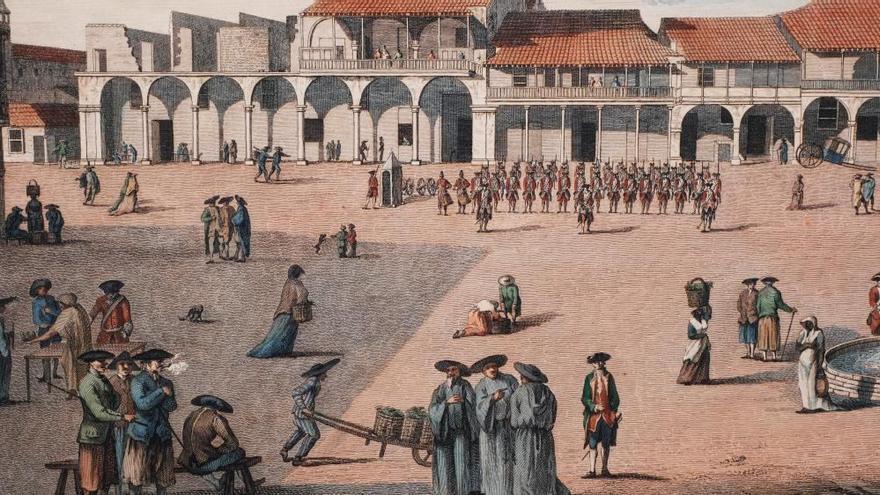
The Unfortunate Laziness of Our Liberty

An engraving of Havana’s Plaza Vieja in 1763 during the British occupation, by Elias Durnford.

14ymedio bigger14ymedio, Yunior Garcia Aguilera, Madrid, August 16, 2023 — Why did it take Cuba so long to gain its independence? By the time most of its neighboring colonies had won their freedom, why was Cuba still known as “the ever loyal one”?

So why has the Castro regime lasted so long? Jorge Videla was dictator of Argentina for only seven and a half years, Augusto Pinochet ruled Chile for seventeen and Francisco Franco was caudillo of Spain for thirty-six. But Castro-ism has been entrenched in Cuba for more than six decades! And we are not talking just about exile, repression and censorship. These years have been marked by poverty, financial ruin and backwardness. How is it possible that we have not been able to get ourselves out of this pothole?

I try to avoid looking back on our past with pessimism, though at times it is inevitable to find some examples of history repeating itself. “Continuity” (another term for laziness), “loyalist reform” (change so that everything can stay the same), and “creative resistance” (I am suffocating but I enjoy it) are faults that have almost always been with us, making us prone to fatalism

During Havana’s eleven years under British occupation, its inhabitants never much bothered trying to learn English. In language, religion and culture, we have always felt closer to Madrid than to London. It is said that local peasants refused to sell the invaders fruit and that some even tried to poison the “redcoats” by feeding them bananas while they were intoxicated.

Nevertheless, the British never really faced much opposition. In some stately homes tea began being served at five in the afternoon, at which time more than one local official gladly offered his services to them. Their uniforms were the color of the mamey,* so tea time came to be known as “the hour of the mameys.” But, bottom line, the mamey proved to be quite a luscious fruit. A popular rhyme of the period went something like “The girls of Havana have no fear of damnation. / You can find them with the British / In the barrels at the rice plantation.” In July of 1763 the English traded us for Florida and sailed off… leaving us not much worse for wear. continue reading

It was then that Spain began to pamper us a bit, heaping enlightened despotism on top of natural paternalism: “Everything for the people, but without the people.” Cuba gave birth to one of the greatest and most brilliant men of the time, as some say: Don Francisco de Arango y Parreño. The American historian and hispanicist Allan J. Kuethe says of him, “He could have been a Bolivar, but he died like a true bureaucrat.” Beyond his contributions to trade and the island’s development, Arango y Parreño was a reformist, an smart guy, a man loyal to the crown.

Haiti was one of the first countries in Latin America and the Caribbean to obtain its independence.  And today some pro-Castro ideologues claim Cuba and Haiti are two spurs from the same rooster. What is undeniable, however, is that, after the Haitian revolution (1791-1804), the Cuban elite did everything possible to keep the same thing from happening here. “Fear of the black man” was stronger than the urge to be free. Rather than showing solidarity, what Cuba actually did was take over Haiti’s position in the world market. For us, that was what” having spurs” meant.

Cuba is undergoing the worst crisis in its history and today others are benefitting from our misfortune. How many businesses in other latitudes are prospering because there is a dictatorship in Cuba?

The regime has its reformists, whose responsibility is to patch things up from time to time. But the system is more tattered than a carnival banner. Neither Murillo, nor much less Gil,** could fill Arango y Parreño’s shoes.

There are those who opt for satire or memes, like the residents of Havana during the time of the mameys. Others are more lukewarm and prudent, seeing themselves as legitimate partners. There are those who give very radical speeches but deep down prefer Cuba to remain the same, if for no other reason than to serve as a bad example. There are even those who feign a radical, extremist stance, then spend every hour of the day attacking any objective attempt, any realistic initiative, to attain democracy.

But laziness in not conducive to liberty. It has always come at the cost of blood, sweat and tears. We are up to our eyeballs in tears and blood. It’s time for us to get a little wet. Sweat is the blood of our times.

Translator’s notes:
*A tropical fruit popular in Latin America and the Caribbean.
**Minister of Economic Planning Marino Murillo and Economics Minister Alejandro Gil.

____________

COLLABORATE WITH OUR WORKThe 14ymedio team is committed to practicing serious journalism that reflects Cuba’s reality in all its depth. Thank you for joining us on this long journey. We invite you to continue supporting us by becoming a member of 14ymedio now. Together we can continue transforming journalism in Cuba.
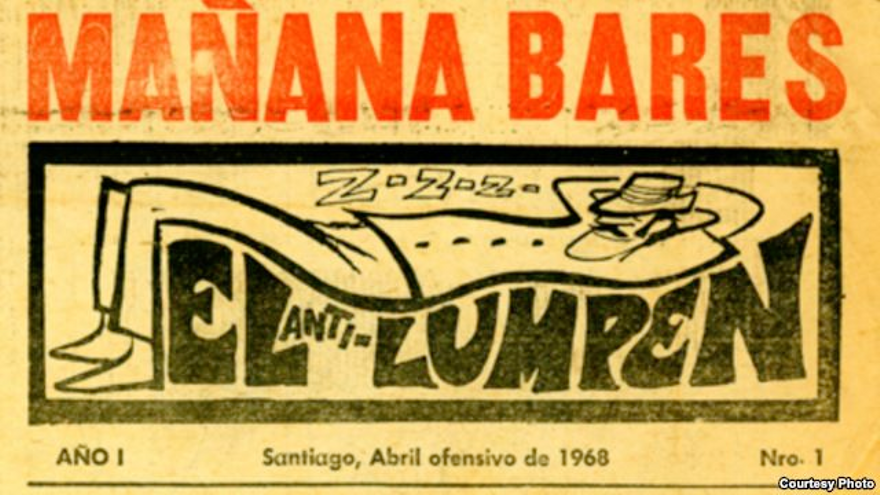
To Have or Not to Have Private Businesses

A Castro-era campaign against private businesses, in this case bars. (Archivo)

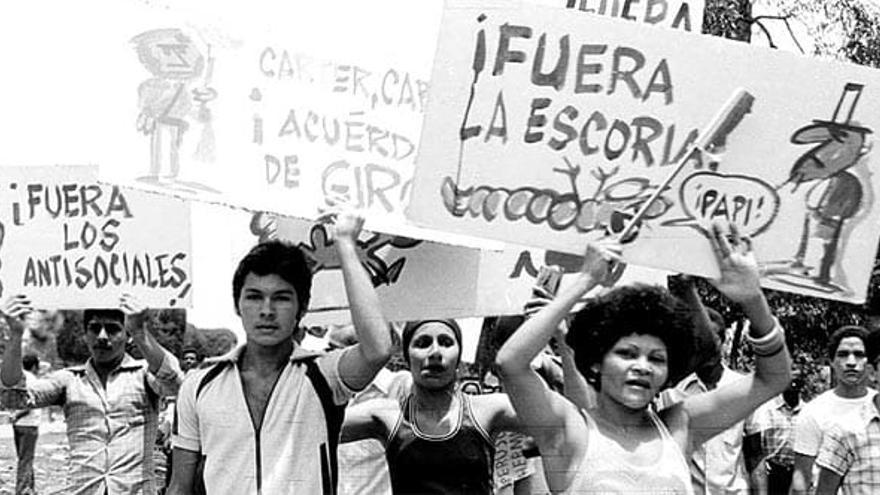
14ymedio bigger14ymedio, Yunior Garcia Aguilera, Madrid, 9 August 2023 — No one hated private business in Cuba more than Fidel Castro. In his 1968 speech announcing the Revolutionary Offensive, which nationalized all remaining small private businesses in the country, he called business owners lazy, hangers-on, exploiters, privileged and lazy. Spooked by his own shadow, he vented his spleen against the 955 private bars that still existed in Havana. According to his “detailed” report, 72% of the owners had a counterrevolutionary attitude and 66% of their regular clientele was made up of antisocials.

With that over-the-top, carnivalesque tone, the comandante shouted: “Gentlemen, we did not have a revolution here to establish the right to trade! . . . Are we going to build socialism or are we going to build boutiques?” He also emphasized that no one had shed his blood so that others could earn a few pesos selling rum, fried eggs, or omelettes. He was much more blunt when he prophesied, “There will be no future in this country for commerce, self-employment, private industry, or anything else. Because whoever is self-employed then pays for the hospital, the school, pays for everything, and pays dearly for it!” His offensive was intended to uproot capitalism, it seemed, once and for all.

However, after the fall of socialism and the crisis of the 1990s, the communist leader had to swallow his pride and permit small private initiatives. This “necessary evil” was seen as a temporary measure, though the paladares (private restaurants) would cling to life in ongoing skirmishes over the size of their seating capacity, as though it were the game of musical chairs.

Shortly after inheriting the throne, his younger brother became aware that his power of hypnosis was not enough to keep the masses entertained with ludicrous battles of ideas. The beardless general urgently needed to get the economy out of the swamp, or at least appear to be trying. To avoid enraging the party’s most pro-Fidel faction, he opted for the word “update” over “reform.”

However, the most rabid “I-am-Fidel-ers” did not remain silent. Who would have thought that what would save socialism was more capitalism? Iroel Sanchez, a compulsive Castrophiliac, echoed his guru in apocalyptic tones: “This revolution can be destroyed. . . We can destroy it and it would be our fault.” continue reading

Certainly, few things have fractured the regime’s image of unity as much as the aforementioned MSMEs (micro, small and medium-sized companies). Anyone who has the stomach for the “revolutionary debates” coursing through the internet will realize how polarized opinions have become on this subject among those who claim to be supporters of the system. On Iroel’s side is Javier Gomez Sanchez, dean of the School of Audiovisual Communication Art. In an online post complaining about the privatization of Jalisco Park, he writes, “To make matters worse, they say that they are going to inaugurate it on July 26. . . Have they no shame? How far are they going to go? What’s next? The privatization of Coppelia?”

The Cuban bureaucratic caste has always been concerned that those they refer to as the “emerging bourgeoisie” will usurp their privileges. But to avoid sounding envious, they try to present themselves as tenacious custodians of the Marxist-Leninist faith preached by Papa Beard. They argue that McDonald’s and Coca Cola are a more lethal threat than the U.S. Navy and warn against the dangers of the carrot-and-stick approach of soft power politics. They are loathe to admit that the idea of socialism as the precursor to true communism has died and that its corpse is on display in the supermarkets of Chinese capitalism.

Now, can a free market alone bring about democracy? We know it cannot. When I discuss this question with knowledgeable Europeans, they almost always tell me Cuba is not China, and China is not Vietnam, but you do not have to look far for comparisons. You have only to see what is happening in Venezuela or Nicaragua to understand that the existence of private enterprise is not enough to eradicate totalitarianism.

In certain quarters of the exile community and the opposition, there are also differing opinions with respect to private enterprises in Cuba, though at times it is easier to find more slogans and conspiracy theories than arguments. While fully aware of all the anomalies surrounding MSMEs, I for one defend the freedom to give them a shot, even in places where freedom has yet to be attained.

Much as I am reluctant to agree with the ultra-Fidelistas, so great was the aversion Fidel felt towards private businesses, and so great were his efforts to annihilate them, that it probably was not, as they claim, a heart attack that killed him. Maybe it was the MSMEs.

____________

COLLABORATE WITH OUR WORKThe 14ymedio team is committed to practicing serious journalism that reflects Cuba’s reality in all its depth. Thank you for joining us on this long journey. We invite you to continue supporting us by becoming a member of 14ymedio now. Together we can continue transforming journalism in Cuba.
When Havana Was Taken by the ‘Red Coats’

English sailors enter the bay of Havana after its capitulation. (Engraving by Dominique Serres based on the drawings of Lieutenant Philip Orsbridge, in 1762)

14ymedio bigger14ymedio, Yunior García Aguilera, Madrid, 1 August 2023 — On June 6, 1762, Captain General Juan del Prado Portocarrero saw an impressive English fleet approaching Havana from El Morro. At first he did not believe that it was an attempt at conquest; he assumed it was a mercantile convoy and even sent the soldiers back to their barracks. The mail that came with the news had been intercepted and gripped the partying habaneros. The clumsy Juan del Prado would show that the defense of the Great Antille was, in fact, too great for him.

It was foreseeable that the English would try to take Havana after declaring war on Spain. They had already occupied Martinique, and the Cuban capital constituted a geographical point of great strategic importance. Twenty years earlier, they had unsuccessfully sought to establish a colony in Guantánamo. To top it off, in 1756 the governor of Jamaica had been invited to go for a walk in Havana, as a gesture of goodwill, and returned to London offering detailed plans of the city and its fortifications.

Much has been discussed about whether Havana at that time was uncivilized, impoverished and miserable. Some have maintained that the capture by the English brought, at last, a little progress. Historian Ramiro Guerra dedicated several articles to Francisco José Ponte trying to deny those statements. Guerra strives to show us a French Havana, much more gallant than other capitals of rich viceroyalties, such as Lima and Mexico. The aforementioned sources showed that both wealthy and poor, white, black or mulatto, they were able to ruin their haciendas and their economies in order to show off the latest fashion. As for its population, Guerra tells us that Havana was more populous than any of the thirteen colonies of North America, even doubling New York.

In any case, Havana was a valuable possession for the Spanish crown. And the battle to try to defend it would highlight the mediocrity of some and the heroism of others. Among Juan del Prado’s blunders was that of disabling three ships of his squadron, seeking to block the entrance to the bay. The operation was disastrous. Not only did some men drown during its execution, but they lost their best warships and prevented other ships from going out to fight from the sea. continue reading

However, there is still talk in Cuba of a Creole like Pepe Antonio. The fifty-year-old Cuban, mayor of Guanabacoa, became legendary by carrying out reckless actions, which could be considered machete charges, long before Gómez and Maceo. In a month and a half he inflicted several casualties on the enemy and captured a good number of prisoners. His natural leadership and his unorthodox maneuvers aroused the envy of the inept Spanish colonel Francisco Caro, who dismissed him in a humiliating way. And the legend has it that Pepe died of disgust, a few days later.

Unfortunately, the chauvinism of our historical memory has made us ignore or relegate other brave defenders of Havana to the background. The most notorious case is that of Luis Vicente Velasco de Isla, who died defending El Morro. When the Spanish monarch learned of his feat, he had a statue of him made in Cantabria and minted several medals with his bust. He also ordered that in his royal Navy there should always be a ship with the name of Velasco and created a new noble title: the marquisate of Velasco del Morro, granted to his brother.

But the greatness of a soldier is more noticeable when it is his own enemies who show their admiration. The English were so impressed by his determination and expertise that, after his death, a 24-hour ceasefire was decreed, to bury him with the dignity he deserved. In addition, a monument was erected in his honor in Westminster Abbey itself. And they say that every time the British Navy passed in front of his hometown, salvos were fired in his honor.

Today there is a very small street in Havana that bears his name, parallel to San Isidro. I remember that, in my school texts, Pepe Antonio and his men were highlighted as “the true heroes of the defense,” while they limited themselves to recognizing Velasco as “one of the few Spanish officers who showed courage.” I think that, without minimizing in any way the heroism of the Creole, it is fair to recognize the indisputable prominence of Velasco in that episode of our history.

Translated by Regina Anavy

____________

COLLABORATE WITH OUR WORKThe 14ymedio team is committed to practicing serious journalism that reflects Cuba’s reality in all its depth. Thank you for joining us on this long journey. We invite you to continue supporting us by becoming a member of 14ymedio now. Together we can continue transforming journalism in Cuba.

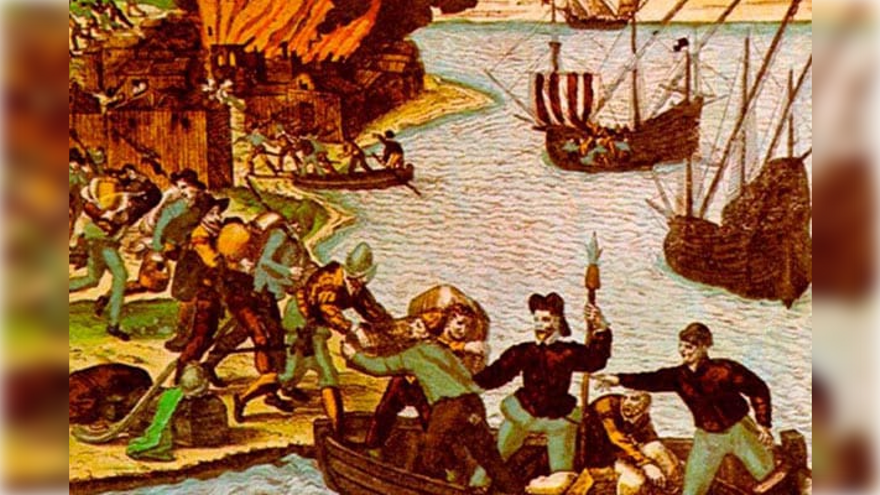
Cuba: Pirates of Yesterday and Today

On the day of the assault, Pérez de Angulo was governor and defended Havana with 65 foot soldiers and 16 on horseback. (Public domain)

14ymedio, Yunior García Aguilera, Madrid, 4 July 2023 – Laws that restrict business to an absurd extent usually generate corruption and all manner of roguery. Following the Conquest and colonisation of the Americas, the maritime powers established a commercial system that created an exclusive relationship between the metropolises and their colonies. Trading with foreigners carried the penalty of a jail sentence, excommunication and confiscation of assets. This measure affected the colonies most of all but it also promoted smuggling and filled the seas with plunderers.

It all started with a few French vessels laying siege to the fleets which arrived in the Canary Islands. Later, these sailors got hold of the Spanish navigation charts and approached the waters of the Caribbean. England, France and Holland saw such substantial gains in these sorts of ventures that they began to invest their own funds in the business. It was the heyday of the black flags with the skulls and crossbones.

As opposed to ordinary pirates, these pirates relied on permission from some country or other to attack and rob from their rivals. When two kingdoms were at war, the offender had to be treated as an enemy soldier, with all the guarantees that implied. In times of peace it was assumed that these pirates had to respect the truce, although the soul of a pirate will nonetheless grant himself a blank cheque to never take this sort of thing seriously.

The buccaneers, for their part, were a kind of pirate of terra firma. The term búcan was the Tainos word for the technique of smoking meat. Many Europeans learnt how to use these skills; they dedicated themselves to smuggling and adopted the name of buccaneers. In Cuba they were mostly to be found in areas like Camagüey and Las Tunas. continue reading

The fledgling Cuban population were victims of pirate assaults on a number of occasions. It’s known that Havana was reduced to ashes in 1538. And in the same year, outside the port of Santiago, the Sevillian captain Diego Pérez battled a French pirate for four days. By day they attacked mercilessly with canon fire. And by night they sent messengers bearing gifts, like good Christian gentlemen, until the French lifted anchor and bid them adieu.

But the most famous attack took place on the tenth of July 1555, led by Jacque de Sores. Ten years earlier, San Cristobal de La Habana was defended by a single canon of 47 hundredweight which they nicknamed “the savage”, evidence of which had been accompanied by exaggeration and ostentation from an early stage. Later the place was “fortified” until it had three canons. At the time of the attack, the governor was Pérez de Angulo, who defended Havana with 65 foot soldiers and 16 others on horseback.

As soon as the French pirate – follower of the famous Pegleg – returned to dry land, Angulo ran terrified to the yucayeque of Guanabacoa. However, the governor, Don Juan de Lobera, stood his ground the best could, defending from the old Fort.

But there wasn’t a great deal of courage in this resistance. Some of his men suggested he surrender, telling him that he could die if he wanted to but he wasn’t going to sacrifice all the others. Sores himself asked who was the madman that was trying to defend Havana with four crossbows. One of his artillerymen even went to negotiate with the pirates, speaking to them in German so that Juan wouldn’t understand a word.

Finally, the pirate conquered the place, although he didn’t find the riches he was hoping for, apart from an emerald ring and a silver dinner service. The Frenchman took hostages and demanded 30 thousand pesos in ransom…as well as some cassava bread loaves! He spared the brave defender’s life and promised not to molest the women.

Angulo, in a final attempt to save his honour, gathered an army together at Matanzas… no exaggeration. There were 95 Spanish, some 200 Africans and around 80 indigenous men. The element of surprise was a key factor, but the indigenous men, who were used to attacking with ferocious noise, alerted the French with their shouting and it was a disaster. The pirate swords repelled the attempt and Havana continued to be under French rule for a few more days.

As a counter-offer, three thousand pesos ransom was offered. However, the inhabitants only managed to get together one third of the amount. Sores, outraged in the face of such destitution (or miserliness), set fire to everything that could be burnt. Angulo was sent to Spain and was tried for cowardice and lack of foresight. He was the last of the civilian governors.

Today, centuries later, buccaneering still survives. And in Cuba many have permission to practice it, which, technically… turns them into pirates?

Translated by Ricardo Recluso

____________

COLLABORATE WITH OUR WORKThe 14ymedio team is committed to practicing serious journalism that reflects Cuba’s reality in all its depth. Thank you for joining us on this long journey. We invite you to continue supporting us by becoming a member of 14ymedio now. Together we can continue transforming journalism in Cuba.
Now Havana Wants to be Dulcinea

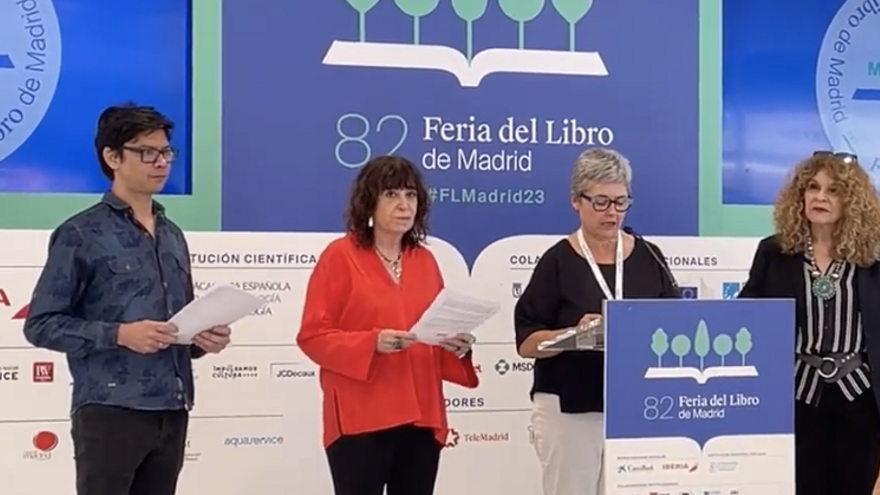
From left to right, Yunior García Aguilera, Rosa Montero, Eva Orúe and Gioconda Belli, during the reading of the manifesto at the Madrid Book Fair. (Screen capture)

14ymedio bigger14ymedio, Yunior García Aguilera, Madrid, 12 June 2023 — At the recent Madrid Book Fair, they read out a manifesto: Literature, always on the side of freedom. The regime in Havana, always quick with a smart answer, put out a riposte in the name of Casa de las Americas, with the title: On the side of Don Quixote.

They accuse the editors of the manifesto of “giving in to the campaign by the hegemonic press against anyone who refuses to accept the dictates of Washington.” How very ironic, coming from a people who bend over backwards to the dictates of Moscow, to go out to battle with this faded old cliché. Perhaps they don’t realise that their “joker” convinces no one anymore? Maybe they just have absolutely no imagination left at all? Are they that mediocre that all they can do is cling onto arguments that are so obsolete, so yellowing and worn out with endless, interminable use?

Perhaps it needs to be gently pointed out to the Cuban regime that the principal promoter of this manifesto is Gioconda Belli, winner, no less, of the Casa de las Americas Prize in 1978, amongst many other honours. The Nicaraguan poet and novelist doesn’t need to ’give in to any campaign’ – because she has been, along with her compatriot Sergio Ramírez, at the centre of attacks from a deranged dictator like Daniel Ortega. Also, these two have received the support of an overwhelming majority of intellectuals,  along with all of the other people who have been forced into exile – although Havana maintains a stony silence on such immense injustice.

Among the signatories of the Manifesto are some huge names – some of which the centre, at 3a and G in El Vedado hasn’t yet been able to invite to attend. And it’s probable that some names have been gathered in error (something which has already been rectified) but there we see other names like: Rosa Montero, Juan Carlos Chirinos, Joan Manuel Serrat… and the list just keeps growing.

The Cuban authoritarianism’s declaration, having nothing to put forward in its defence, takes futile refuge in the pages of Quixote and tries to pass itself off as Dulcinea del Toboso. They demand that we judge them as good and just people, though everyone knows that there’s nothing left to celebrate there.

The land of Dulce María Loynaz is just a sad wasteland today, in which the hospitals and the schools fall to bits whilst the number of luxury hotels and the number of prisons multiplies. Cuban artistes suffer censorship today like in the worst times of the pavonatowhilst they see all their rights flattened and with no right of reply. Every Cuban tilts against absurd windmills every single day, carrying out great heroic feats just to obtain a plate of food and dreaming about escape from this hell. continue reading

In Cervantes’ book, Dulcinea represents the platonic love of the protagonist – although in reality she is the idealised form of a country girl called Aldonza Lorenzo, whom the author describes, in a cruel manner, with shades of humour, saying that she  was the woman who was the most skilled at salting a pig in the whole of La Mancha. And even when Sancho Panza presents Quixote with a supposed Dulcinea it’s really a foul smelling wench with a hairy wart on her top lip. Don Quixote, a prisoner in his own delirium, justifies the woman’s ugliness by saying that she’s been the victim of some “magic curse”.

It’s understandable, that a regime which has nothing at all positive to show in its master plan, would insist on appealing to Utopias. But more than sixty years have already passed and real life could not be more dystopian than it is now. It is utterly unforgivable that they continue with this fraud, passing themselves off as some kind of joke princess with the hairy wart on her top lip. These people neither want nor plan for any project for their peoples’ freedom. The only, only, thing that interests them is clinging onto absolute power at all costs. The reality of Cuba is not a Cervantes one, it’s an Orwellian one.

We Cubans are totally screwed off now with this stupid endless obsession with romanticising the misery and suffering of a people. The Mexican president, Andrés Manuel López Obrador, wants us to be a modern Numancia, although the inhabitants of that village situated on the Muela mountain ended up dying of starvation, from slavery or by suicide. Not long ago, Josep Borell said that Cuba will be the Mallorca of the Caribbean. As the top representative for foreign affairs in the EU he didn’t seem in the slightest bit worried about the more than one thousand political prisoners, nor about all the violations of human rights: he saw only beaches of white sand where European tourists go to get tanned. He only sees the threat from the Chinese and the Russians’ plundering our land whilst Europe fails to grap its own share of the pie.

But Cuba does not want to be any kind Numancia, nor a Mallorca, even less a Dulcinea. Cuba wants to be free. And then, when we are, we will tear down all of those windmills.

Translated by Ricardo Recluso

____________

COLLABORATE WITH OUR WORKThe 14ymedio team is committed to practicing serious journalism that reflects Cuba’s reality in all its depth. Thank you for joining us on this long journey. We invite you to continue supporting us by becoming a member of 14ymedio now. Together we can continue transforming journalism in Cuba.
An Unfinished Essay on Hate in Cuba

We were lumpen, scum, worms, bastards… and now we are haters. (Ecured)

14ymedio bigger14ymedio, Yunior García Aguilera, Madrid, 30 May 2023 — The Cuban regime behaves like a violent husband who, after destroying his partner’s face, swears he did it out of love. They, the ones with slogans about death and clubs studded with nails, are now the “Care Bears”. Díaz-Canel, after giving his abhorrent combat order, dons a pink dinosaur costume and pretends to be Barney and Friends.

They say they’re on the side of “those who love and found.” First they used José Martí as the intellectual author of an armed attack on the Moncada barracks. Then they attempted to tattoo a hammer and sickle on the apostle’s* forehead, concealing his criticism of Marxism. Later they juggled to reinterpret the phrase, “with everyone for the good of everyone,” insinuating that “everyone” only included them. And now they waste rivers of ink trying to turn a dramatic poem, Abdala, pointing out that it was an adolescent Martí who spoke of “invincible hate”, an immature Martí.

Against us, the beaten, they always used hateful phrases. We were lumpen, scum, worms, bastards… and now we are haters. They think that, after all the beatings they gave, we will be submissive and get in bed with them.

Che, his model to be followed, was a bit less hypocritical. The hesitant guerilla spoke of hate as a factor in the fight, the intransigent hate of the enemy, the hate that should turn them into efficient killing machines. Che said that “a people without hate cannot triumph over a brutal enemy.” Guevara, at least, consciously assumed the role of hater, without pouting or masking his dislike with fake emojis.

I am not a Guevara fan. The asthmatic guerilla’s incendiary philosophy is not my paradigm. But I take responsibility for my rage. I cannot be indifferent when faced with all the crimes of a deceitful regime that has dispensed so much physical and psychological abuse, in the name of an abstract love. continue reading

That love, considered by Albert Camus as worse than hate, resulted in the Holy Inquisition, the Nazi genocide and the horrors of Stalinism. Hitler himself said he fought for love. And Castroism wants us to view executions, concentration camps for homosexuals, parameterization,** censorship, rapid response brigades, the sinking of ships with children aboard, political prison and forced exile as “crimes of passion”.

The regime has exploited the issue of Buena Fe’s Spanish Tour to shed its clothes. Even Alpidio Alonso has been so cynical as to talk about “harassment” and “physical assault in public”. The Minister of Censorship forgets the January 27th when he not only went out to snatch phones away from people on the street, but also to throw punches at young artists, beat them onto a bus, and drag them to a jail cell.

The members of Buena Fe have not been thrown onto a garbage truck, they have not seen decapitated doves at their doors, they are not imprisoned nor prevented from leaving the country, patrol cars don’t harass them. On the contrary. In a free country, Spain, they can call the authorities if they feel threatened, they can count on their protection during concerts. In Cuba, however, it is the very police deliver the scratches. It is they who dress as the people to spit and throw stones at everyone who doesn’t believe their official discourse.

This flipping of the dictatorship’s narrative about love and hate is not casual. Their laboratories know that there is a global controversy around hate on social media, that the algorithms are programmed to promote or contain content, depending on this dilemma. That is why they abuse those little words that sound altruistic and they place them in their hashtags. The order to speak of love is not the result of a genuine sentiment, it is the Party’s official directive to its technicians on the use of social media.

But millions of Cubans refuse to continue suffering from Stockholm syndrome. Millions of Cubans have shut the door, as Nora in A Doll’s House. Twenty-first century Cuba does not want to continue to be hostage to a toxic love. This country wants to report them, take them before the tribunals, so that they will pay for their abuse. And it is not hate, it is justice. This country can no longer stand the slimy phrases of a regime that only loves power, that only wants us so we can iron their shirts. And it is not hate, it is dignity.

This country… wants a divorce.

Translated by: Silvia Suárez

Translator’s notes:
*José Martí is known as “the apostle” by Cubans of all persuasions.
**Parameterization is a process of establishing parameters and declaring anyone who falls outside them (the parametrados) to be what is commonly translated as “misfits” or “marginalized.” This is a process much harsher than implied by these terms in English. The process is akin to the McCarthy witch hunts and black lists and is used, for example, to purge the ranks of teachers, or even to imprison people.  

____________

COLLABORATE WITH OUR WORKThe 14ymedio team is committed to practicing serious journalism that reflects Cuba’s reality in all its depth. Thank you for joining us on this long journey. We invite you to continue supporting us by becoming a member of 14ymedio now. Together we can continue transforming journalism in Cuba.
Cuba is Not a Country for Young People

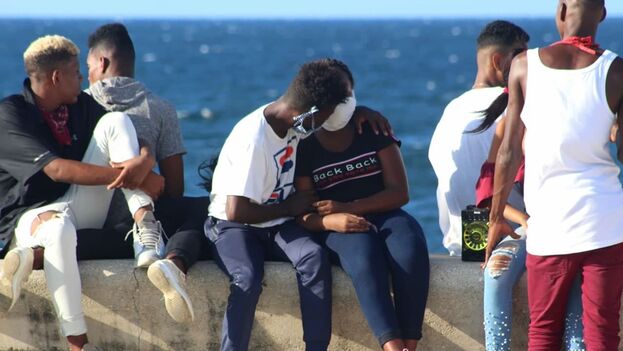
A group of young people sitting on the wall of the Malecón in Havana. (14ymedio)

14ymedio bigger14ymedio, Yunior García Aguilera, Madrid, 16 May 2023 — I’ve rewatched the brilliant Coen brothers’ film No Country for Old Men. The 2007 thriller tells the story of a hunter who finds two million dollars and decides to run away with the money, while being pursued by a relentless hit man. The plot is completed by the county sheriff, who ends up baffled and skeptical of a reality that he can no longer understand.

At the end of the film, I thought a lot about Cuba, about the growing violence in a country where everything remains the same, although nothing is the same anymore. I have thought about how the Revolution tried to sell a narrative of itself that ended up as a cliché, in a crude parody of Animal Farm. I have imagined the possible endings of something that was intended to be an epic saga, but ended up as a soap opera: an exhausted model that is endlessly recycled, producing increasingly mediocre and decadent versions of the same failure.

Even those flags that were once arrogantly raised have ended up in rubble. Education, for example, has been reduced to simple indoctrination, and social networks demonstrate it. Our spelling is no better than the most backward nations in the region. The Ministers of Education and Higher Education were among the few removed in the recent parliamentary circus.

Their dismissal is even more significant considering that the others, although they could not have done worse, retained their positions. The tweets of the highest leaders are embarrassing. The first secretary of the Union of Young Communists has written the phrase “Fidel didn’t told them” five times, demonstrating not only the absence of her own ideas, but also an absolute contempt for the most elementary grammar.

Healthcare, meanwhile, suffers the worst crisis in its history. In 2021 we saw 55,000 more Cubans die than in the previous year, due to the Covid pandemic and its mismanagement. In hospitals there is nothing to treat the most common ailments. I have relatives who have had cardboard taped to a broken arm, because there is no cast. Suicide is among the top ten causes of death, even though the regime uses the euphemism “self-inflicted injuries.” continue reading

Meanwhile, the much-vaunted vaccines ended up being another Ten Million Harvest, an excessive expense that affected the rest of the production of medicines and that did not yield the expected results at the international level. More than an honest interest in confronting the pandemic, the Cuban vaccines tried to be a political weapon, although they never hit the target they were aiming for. In the end, they were neither fully recognized on a global scale, nor were they sufficient to satisfy domestic demand. The country had to acquire the Chinese vaccine from Sinopharm to combine it with a Soberana [Sovereign], no longer so sovereign.

The Cuban regime acts with the same psychopathy and violence as the character of Chigurh, masterfully interpreted by Javier Bardem in No Country for Old Men. More than once Castroism has decided if someone lives or dies, if they go to jail or exile, as if it were tossing a coin. We are the country with the most political prisoners in all of Latin America. There are hundreds of Cubans who are prevented from leaving and many others who are denied the right to return.

Cuba is a land without law, where the “president” assures that his decrees are a “joke.” The hand-picked office-holder has also said that the separation of powers is an evil of the capitalist countries and that is why they practice the “unity of powers.” The courts are simple lambs that obey the guidelines of the single party, they are puppets in the hands of ventriloquists.

Fidel Castro, the greatest scriptwriter of the tragedy we suffered, has not been and will not be absolved by History. He wanted to blame José Martí for being the mastermind of his fight, but evidently he looked elsewhere for inspiration. One of the last paragraphs of Mein Kampf, by Adolf Hitler, literally says: “The judges of this State can calmly condemn us for our actions; but History, which is the embodiment of a higher truth and a better right, will one day despise this sentence, to absolve us of all guilt.”

That’s why our young people flee. They do not want a future that is reduced to clapping or being locked up. But neither do they want to face the beast, only to later fall victim, as in the film, to the extras that swarm on social networks, even attacking brave men like Luis Manuel Otero.

Cuba, definitely, is not a country for young people

____________

COLLABORATE WITH OUR WORKThe 14ymedio team is committed to practicing serious journalism that reflects Cuba’s reality in all its depth. Thank you for joining us on this long journey. We invite you to continue supporting us by becoming a member of 14ymedio now. Together we can continue transforming journalism in Cuba.
More Lost Than Columbus

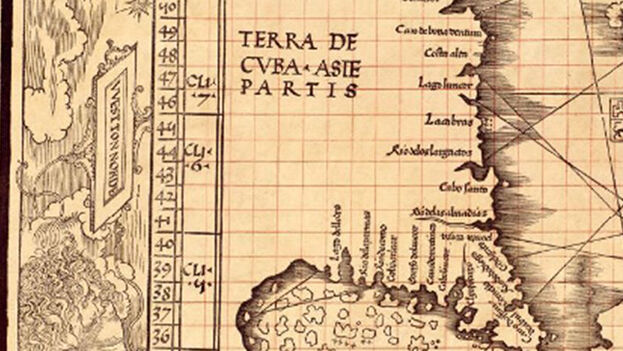
Map of the Island with the description “Terra de Cvba-Asie partis,” which means “Land of Cuba— A Part of Asia” (US Library of Congress)

14ymedio bigger14ymedio, Yunior García Aguilera, Madrid, 9 May 2023 — Our history classes, with few exceptions, were insufferable. They hammered our brains with the Marxist view that, from the time of the aboriginal people up to the bearded cacique, the history of Cuba was limited to the struggle of the working class to create communism. Our exams were reduced to organizing events chronologically, coming up with adjectives for our heroes, repeating by heart dates and slogans. I tip my hat to those teachers and historians who come out of that system, but to be sure, they are like gold nuggets at the bottom of a river.

It’s shameful that so many college students have no idea what distinguished the Taino people from the Ciboney, or can’t name more than two presidents from the republican era. What’s worse, these last decades have been a wash, drowned in censorship and propaganda. In this column, I will try to approach, as a curious, avid reader, the hidden story of an island that was first named Juana and later Fernandina.

“History Without Hysteria” originated as a segment that lasted two seasons on the Cuban podcast El Enjambre. I invite you to debate, dissent, add information and anecdotes. Let us make our history a recurrent theme in our daily conversations, so that it is not confined to academic circles.

I’ll start off with Columbus, a figure so misunderstood that even he never knew what he had “discovered.” I begin with him, because he was the first to write down the name of our land, although he did it incorrectly. Without a clue as to what the Lucayans were telling him about a large, rich island to the south, the Admiral wrote in his diary a mysterious name: Colba. continue reading

Upon reaching land, probably at what is today Bariay, he stated that well-known phrase about “the most beautiful land,” etc. But let’s not get carried away with vanity. Columbus had been travelling for more than two months surrounded by water everywhere and with a crew that was about to throw him overboard. The Admiral would see a bird and sigh; a blade of grass would make his eyes water. All the hyperbole and metaphors were meant to raise the morale of the men and reassure the kings they had invested their two million maravedis well.

Another theory states that the first landing in Cuba was in Puerto Padre. In fact, there is a legend that a sailor exclaimed to a priest: “What a port, padre!” But no, friends of Las Tunas, despite all the paintings that depict a priest with a cross at the landing, there was no priest aboard the two caravels, nor on the ship Santa María.

Christopher Columbus, whose name in Genoese means something like “the dove of Christ,” had made his living as a sailor and a vendor of maps, until he found a more ambitious project: going left to reach the Indies. Fortunately, he did believe that the world was round, not like the millions of people who today still believe it is flat. But his calculations were incorrect. The terrestrial sphere was about four times larger than he and others of his age believed.

Even so, upon landing in Cuba, he assumed that he had finally reached Cipango, the name the Europeans then used for Japan. On top of that, the Admiral asked where he could find the great Khan, and the Taino answered, “Cubanacán, Cubanacán.” The Admiral was overwhelmed by the throng in hides and racoons, although his steadfast objective was the gold. He did not see much, however, but for the occasional ornament in the form of snot hanging from their noses.

On his second voyage, Columbus attempted to circumnavigate Cuba by going south, but he gave up before he reached the western end. He then rectified the assessment made on his first voyage: Juana was not an island, but the mainland. The Admiral understood that he was not in Cipango, but in Catay (China). And he made his men swear to it, on pain of losing their tongues.

Today, more than five centuries later, many are still clueless. Sadly, a lot of people still have a romantic and childish vision of us, with no idea about the country pulsating beneath Castro’s propaganda, the tourist ads, and the ideological banners. For all those suffering from Columbus syndrome, there’s a very native expression: “Wake up, we’re in Cuba!”

Translated by Cristina Saavedra

____________

COLLABORATE WITH OUR WORKThe 14ymedio team is committed to practicing serious journalism that reflects Cuba’s reality in all its depth. Thank you for joining us on this long journey. We invite you to continue supporting us by becoming a member of 14ymedio now. Together we can continue transforming journalism in Cuba.
Killing the Castro We Carry Inside Us

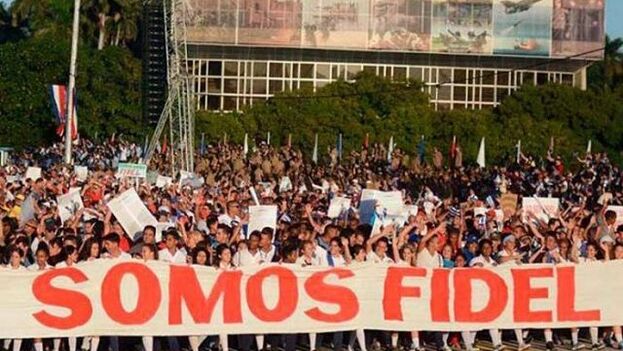
“WE ARE FIDEL” – The greatest challenge that we Cubans face is not only to overthrow a despicable dictatorship, but to know how to build a democratic country tomorrow, truly free, without dogmas. (Cuban State TV Roundtable program)

14ymedio bigger14ymedio, Yunior García Aguilera, Madrid, 2 May 2023 — The Cuban dictatorship has practiced for decades the exclusion and extermination of anyone who thinks differently. They shot and put thousands of adversaries behind bars, locked others in concentration camps, ostracized hundreds of artists and intellectuals, and pushed almost a quarter of the population into forced exile.

To raise the flags of intolerance, they always used the excuse of the besieged fortress. Anyone who dared to depart from the dogma was accused of being an “accomplice” of the historical enemy, a CIA agent or a mercenary in the service of the empire.

The worst thing that could happen to those of us who oppose fundamentalism would be to end up reproducing their methods. The playwright René Ariza closes the documentary Improper Conduct  by saying: “You have to watch out for the Castro that everyone has inside.” The greatest challenge that we Cubans face is not only to overthrow a despicable dictatorship, but to know how to build tomorrow a democratic country, truly free, without dogmas.

Every cause runs the risk of being absorbed by its most radical wing. And that radicalism is sometimes the result of legitimate pain, but at other times only a symptom of opportunism. Some need to be purer than the rest, more upright. In the time of Christ, the Pharisees were the Jewish sect that appeared to be more rigorous and attached to the law. Hitler counted on the fanaticism of the Brown Shirts. Mao mobilized an army of students, with his red book under his arm, to carry out his Cultural Revolution. Díaz-Canel embraces his Red Scarves, the young militia that shouts with devout pathos: “I am Fidel.”

However, in exile we did not escape the jihadist temptation either. Anger is a product that sells well, especially on social networks. And some have exploited the market of anger to the fullest. State Security uses thousands of whisperers to feed distractions. They push us to waste arrows against the periphery and even against ourselves. continue reading

In recent days, while the dictatorship was indoctrinating 300 Americans, part of the exile was entertained by putting Ana de Armas against the wall. And what was the capital sin of the actress who played Marilyn Monroe? Did she shout “Homeland or Death” or take a selfie with the dome of the Capitol? Did she defend the regime or applaud the repression? No, she just went to spend her birthday in the country where she was born, with her friends. The actress, after being nominated for the most important award in the film industry, decided to celebrate with her classmates from her first years as an acting student.

I am not saying, with this, that we should give up debating about the human and the divine. Debates are essential to build a critical society. But the line that separates the expression of opinion from an act of repudiation is usually very thin. Cabrera Infante said that, in those convulsive first years, Fidel Castro called Nicolás Guillén a “slacker” at a university rally. “The bearded one” used his charisma and power to throw a mob of students against the poet’s house, shouting slogans against laziness. Whether the anecdote is true or not, Guillén would not be the only victim of the sinister influencer.

Sometimes one goes on social media wondering, who are they stoning now? Just a few weeks ago we witnessed attacks against the documentary The Padilla Case, by filmmaker Pavel Giroud. But there was not only debate about how he had access to the original files or whether he should have published them in their entirety. It went further. Some even started boycott campaigns to prevent the film from reaching certain festivals. Time showed that his work knew how to reach circuits and spaces where the original material had been Olympicly ignored. Life proved the artist right. Seeing him receive the Platinum Prize and listening to his words in front of millions of people around the world was an unquestionable victory for the cause of Cuba’s freedom.

To achieve the long-awaited democracy, it is not enough to assume the opposite discourse. It is also necessary to move away from authoritarian and totalitarian methods. To win the empathy of millions of undecided Cubans and the international community trapped in doubt, we must never look like that rabid caricature that Castroism tries to sell about us. We must put aside the temptation to pretend that everyone thinks and acts like us. We have to kill the Castro we carry inside us.

Translated by Regina Anavy

____________

COLLABORATE WITH OUR WORKThe 14ymedio team is committed to practicing serious journalism that reflects Cuba’s reality in all its depth. Thank you for joining us on this long journey. We invite you to continue supporting us by becoming a member of 14ymedio now. Together we can continue transforming journalism in Cuba.