
Our Intellectual Stupidity

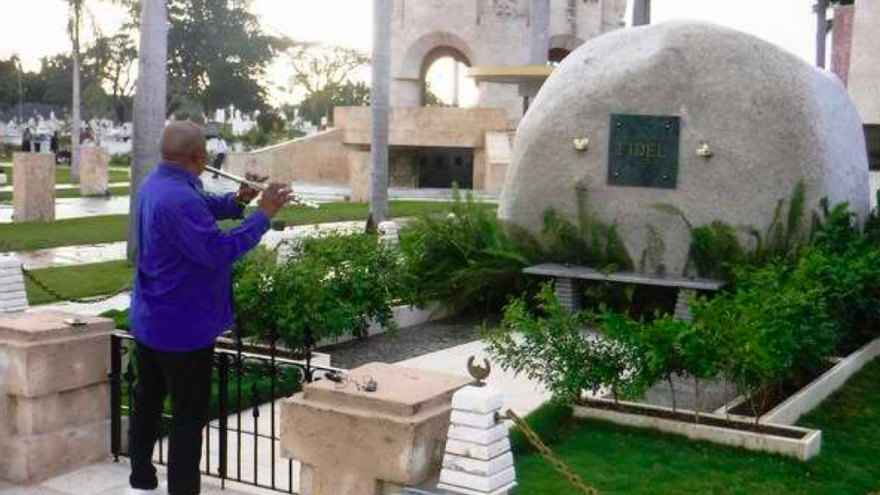
Like dozens of other artists and intellectuals, flutist José Luis Cortés (a.k.a “El Tosco”) pays homage at the tomb of Fidel Castro. (Juventud Rebelde)

14ymedio bigger14ymedio, Yunior García Aguilera, Madrid, 7 February 2024 — No one is stupider than the idiot who thinks he is an intellectual, myself included. When I started becoming politically active, I arrogantly believed that, where others had failed, I would succeed. I thought that the higher the collective IQ a movement had, the better its chances of success. I figured that the more illustrious the names on the list, the more people would be willing to join. I had forgotten that most of our mambises* were illiterate.

For the last two years, the resistance and the fight for change in Cuba have been led primarily by the poorest, least enlightened people, not by some egghead. The most significant aftershocks of the mass demonstrations on 11 July 2021 have occurred in marginalized areas, far from provincial capitals. The very few scholars who have displayed a courageous, dignified attitude have had to deal with a very harsh isolation, beyond the metaverse.

On the other hand, the dictatorship knows it can rely on the support of tens of thousands of ambidextrous artists and intellectuals who, yes, do offer some criticism from time to time, following the mantra “a little positive, a little negative.” But they still sign loyalty oaths, attend marches and official events, and remain active in the National Writers and Artists Union (UNEAC) or the Hermanos Saíz Association (AHS), organizations which exist expressly and openly to monitor and control their members, not to promote their work in any way. continue reading

Why do exceptional cases, like members of the Filmmakers Assembly, run around in circles, ruminating on the same statements and making the same speeches?

So what’s going on? Why have Cuba’s cultural and academic unions not known how, not been able, or not wanted to effectively articulate ways to bring about change? Why do exceptional cases, like members of the Filmmakers Assembly, run around in circles — ruminating on the same statements and making the same speeches — like cattle heading inexorably to the slaughterhouse, never leaving the corral?

By the time Fidel Castro issued his ultimatum**, “Words to the Intellectuals,” State Security had already meticulously planned how to keep us subjugated. They would employ our own egos against us, our very enlightened banalities, our jealousies and envies, our desire to be in the spotlight, our ambiguities, our contradictory herd mentality. Their tactics and strategies ranged from flattery — designating sacred cows and golden calves — to public sacrifices which would serve as a lesson. We normalize the use of masks and the misuse of allegories.

It is so sad and so naive when an artist boasts of having defended himself against his inquisitors by saying, “That is not what my work says. You are just interpreting it that way.” It is so very painful to have to hide behind an alter-ego to say what we dare not say aloud  to ourselves.

It is so very painful to have to hide behind an alter-ego to say what we dare not to shout ourselves

When a state-supported intellectual asks to speak at a meeting, he first asks himself if it will be the right time and place to say what he thinks. He then starts his speech by clarifying that he (or she) is indeed a true revolutionary and that his criticisms are, of course, from within. In common parlance, this is referred to as putting on a patch before there is a hole. When the person in question finally finds the courage, he launches into a stern criticism of himself. Never against the disease, only against the symptoms.

Those with experience in this type of public venting know all too well that the the big shots really enjoy attacks like this, which are directed at low-ranking officials. It is the perfect opportunity to display power, demagoguery and populism. They will make a fool of the little guy even if his misstep is the result of an order from above or something endemic to the system.

This sacrifice — the fall from grace, the exile of one’s contemporaries — benefits the mediocre intellectual. It presents an opportunity to attain what had previously been out of reach. That is why almost all the country’s top prizes and awards ignore Cubans living overseas. Their colleagues on the island do not want the competition. They should have eliminated the National Prizes’ absurd categories long ago but the topic is never even mentioned at their conferences.

The Spanish word necedad, a term the regime’s defenders use to explain their actions, can mean stubbornness or obstinancy. But if you look it up in a dictionary, the first synonyms you find are simply stupidity, imbecility, idiocy and nonsense.

José Martí and Reinaldo Arenas would be disgusted by all these supposed intellectuals who believe themselves to be superior for knowing how to disguise their cowardice as intelligence.

Translator’s notes:
*Afro-Cuban insurgents who fought for Cuba’s independence from Spain in the 19th century.
**”Within the Revolution everything, outside the Revolution nothing.”

__________________

COLLABORATE WITH OUR WORKThe 14ymedio team is committed to practicing serious journalism that reflects Cuba’s reality in all its depth. Thank you for joining us on this long journey. We invite you to continue supporting us by becoming a member of 14ymedio now. Together we can continue transforming journalism in Cuba.
La Chambelona

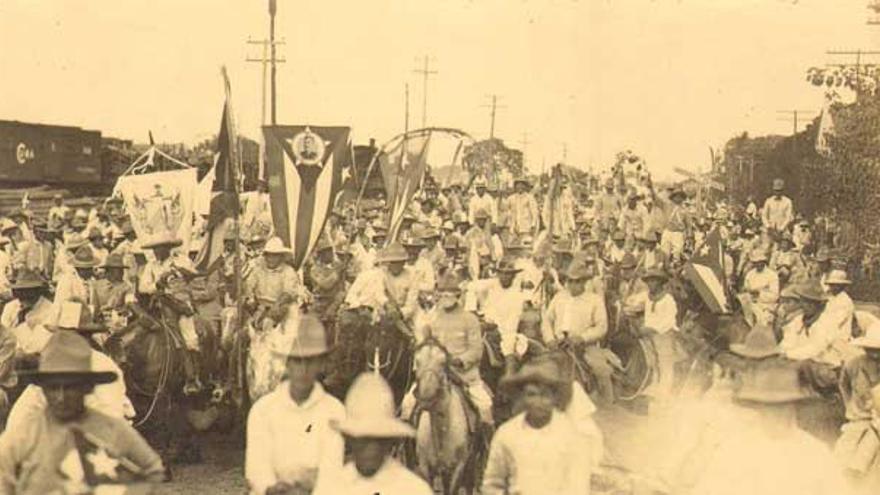
Cuban president José Miguel Gómez halted his march westward to dance to the anthem in the town Majagua. (Cubahora)

14ymedio bigger14ymedio, Yunior García Aguilera, Madrid, 1 February 2024 — The history of Cuba is sung. When Perucho Figueredo composed our own Marseillaise, he did so by disguising it as a religious march. He even played it in the main church during the Corpus Christi celebrations in the presence of the Spanish officials. They, of course, were suspicious. That melody was much too powerful and passionate to be a simple hymn dedicated to the Lord. They summoned the orchestra director and Perucho himself. Their interrogators knew nothing about music so the creator of our national anthem got away with it. When, not long after, he included the lyrics while mounted on his horse, there was no longer any doubt that La Bayamesa was a battle march.

Several years ago, Anima Studios in Holguín commissioned me to write a script for an animated cartoon about the history of our anthem. What I wrote about was the present, not the past. The words were the same dialogue we used when silently conspiring against the dictatorship. They fell for it. I think they even premiered it on one epsisode of State TV’s Roundtable program. I don’t know, however, if Cuban television will continue broadcasting material about the national anthem in which my name is at the top of the final credits.

I don’t know, however, if Cuban television will continue broadcasting material about the national anthem in which my name is at the top of the final credits.

Getting back to the topic at hand, there were several musical battles during the Republican era but perhaps the most famous of all was the one over La Chambelona. The head of government at the time was our third president, Matanza’s Aurelio Mario Gabriel Francisco García Menocal y Deop.

The Foreman, as he was nicknamed, was born in Jagüey Grande in 1866. His family was exiled during the Ten Years’ War and young Mario ended up graduating with a civil engineering degree from an American university. He became part of an ambitious project that is still being discussed today: the Nicaragua canal. continue reading

Upon returning to Cuba, he quickly joined José Martí’s war efforts, rising to the rank of major general. He was one of nine Cuban generals who were invited to attend the handover ceremony after the war ended. He was also chief of the police in Havana during the first North American occupation as well as inspector general of public works. He stepped away from politics for a time, dedicating himself to managing the Chaparra power plant in Las Tunas. But the conservatives needed a leader like him.

Running for president as a conservative candidate, he lost to José Miguel Gómez but won against Alfredo Zayas in 1912. World War I turned out to be a boon for Cuba because it raised the price of sugar. During his time time in office, the country adopted a national currency. The Cuban peso was pegged to the U.S. dollar and backed by the silver standard. If Menocal knew the peso’s worth today, he would turn over in his grave.

When the Foreman tried to get reelected, it launched the Chambelona revolution. The catchy tune, with its conga rhythm, was inspired by an old Spanish song. There are those who say that it originated in Chambas, hence the name, but that has not been proven. It is also not clear who the original author was so there were no disputes over copyright issues. La Chambelona became a liberal anthem. José Miguel Gómez himself halted his march westward to dance to La Chambelona in the town of Majagua.

Perhaps all that dancing is what caused them to arrest him and his son, and take them to Havana. Menocal’s advisors wanted to humiliate him even more

Perhaps all that dancing is what caused them to arrest him and his son, and take them to Havana. Menocal’s advisors wanted to humiliate him even more. They wanted him to walk him handcuffed along the Paseo del Prado and the Malecón to the paddy wagon. But José Miguel Gómez, the Cuban president whom official historians want to strip of all virtue, said the following: “You forget that the man who is imprisoned is a general of independence. You forget that the man who is imprisoned is an insurgent who covered himself in glory during combat. You forget that that man who is imprisoned was my friend and my comrade-in-arms.”

Cubans have had other anthems in more recent times, from Nuestro Día Ya Viene Llegando (Our Day Is Now Coming) by Willy Chirino to Patria y Vida (Homeland and Life), which was sung in the streets during the mass protests on 11 July 2021. The regime has tried to emulate these songs with some musical clunkers composed by Raúl Torres, whom the muses have not only abandoned but who has gained hundreds of thousands of “dislikes” on YouTube.

Cuba’s current president Miguel Díaz-Canel, who isn’t a poet and who cannot pull verses out of thin air, might hum a few bars of La Chambelona while in the shower. Perhaps he even sings a few lines out of tune  to himself: “I am not to blame and I don’t blame here.”

____________

COLLABORATE WITH OUR WORKThe 14ymedio team is committed to practicing serious journalism that reflects Cuba’s reality in all its depth. Thank you for joining us on this long journey. We invite you to continue supporting us by becoming a member of 14ymedio now. Together we can continue transforming journalism in Cuba.
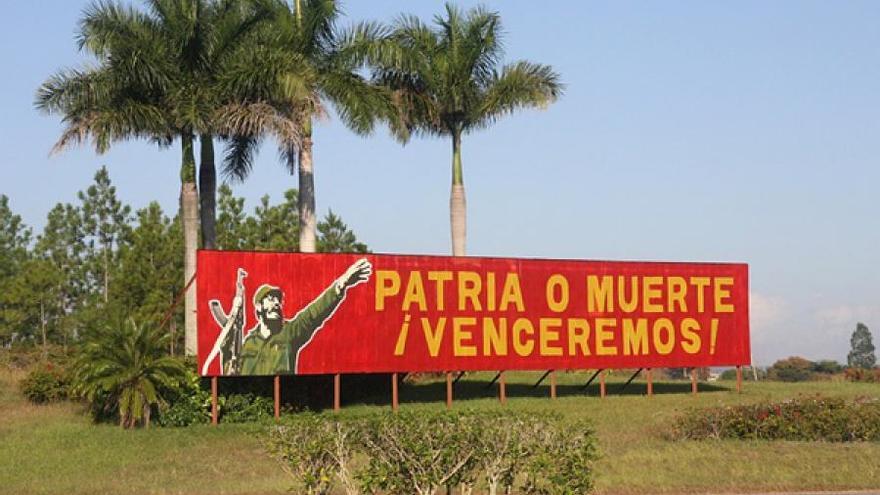
Little Homeland, Too Much Death

Fidel Castro’s fatal prophecy of “Homeland or Death” is being fulfilled. (Ministry of Foreign Affairs)

14ymedio bigger14ymedio, Yunior García Aguilera, Madrid, 24 January 2024 — The Homeland, or what remains of it, is in danger of extinction, and the data prove it. It is not a campaign of the regime’s enemies; their own statistics say it clearly, even if they try to hide them, delay them or cover them with clumsy makeup.

In 2021, the same year that people took to the streets to shout “Homeland and Life,” 167,645 people died in Cuba, about 55,000 more than in the previous year. An average of 459 Cubans died every day, and it is even worse if we compare ourselves with other countries. That year alone, the gross mortality rate in Cuba was 14.65 per thousand inhabitants, one of the highest in the world. In the United States it was 10.40; in Brazil, 8.33; in Colombia, 7.74. Cuba was even higher than Haiti, where the mortality rate was 8.68.

It is evident that the regime concealed the real number of deaths from Covid-19, but it is also obvious that it was not difficult to die of anything in a collapsed country, without medicines, with poor food and with terrible hygienic-sanitary conditions.

Nor is there optimism about total births. In 2021 this fell to less than 100,000 for the first time. It was even worse in 2022, with 3,693 fewer births

Unfortunately, the situation did not improve much after that year. The National Office of Statistics and Information (Onei) published the figure of 120,098 deaths in 2022, well above the number  before 2021. And it is continue reading

suspicious that the second head of that Institution, Juan Carlos Alfonso Fraga, admitted a much higher figure shortly before during an interview with the AP agency: 129,049 deaths. In four months, almost 9,000 numbers of that statistic disappeared.
Nor is there optimism about the birth rate. In 2021, total births were less than 100,000 for the first time. It was even worse in 2022, with 3,693 fewer births. The Regime pats itself on the back, bragging that Cuba has birth rates similar to that of developed countries. Another lie! People don’t want to have children in Cuba because of the misery and insecurity they experience. Even Cubadebate has had to admit that there has been no generational replacement since 1978.

And then there is the migratory phenomenon. The country does not want to include in its statistics the hundreds of thousands of Cubans who have left without returning in the last three years. They hold on to the fact that the population continues to be more than 11 million inhabitants. They have extended the allowed time of stay abroad again and again. They say they do it because of the pandemic and its effects, they are so good! In reality, they do it so as not to have to admit the tremendous gap that the Island has suffered. Cuba is, on top of that, the country with the lowest proportion of immigration worldwide.

According to the Ministry of Public Health, the first cause of death is related to heart disease. It is fatally ironic that the Regime’s slogan was precisely: “On Cuba, put a heart.” It would seem like black humor in another context, but in this one it sounds like premeditated cruelty. The constant stress to which they subject a people who no longer know what the next order or package will be has the country at permanent risk of a heart attack. It is also alarming that, among the top 10 causes of death, suicide is found, even if they use the euphemism “self-inflicted injuries.”

In a country with destroyed roads and obsolete cars, how can we expect accidents to go down?

When all the statistics for 2023 come out, it will be hard not to cry for Cuba. If we add to all of the above the sudden increase in violence, femicides, drug use among young people, machetes, stab wounds… God!

In a country with destroyed roads and obsolete cars, how can we expect accidents to go down? In a country that gives combat orders against its own people and plays dice with the economy, how do they expect young people to stay? In a country that has made an apology for violence, where its officials hand out slaps, how can they expect young people from the slums not to pick up knives?

If the Regime does not fall soon, do not imagine that they will be there for 62,000 millennia; at this rate, the population will become extinct in ten years. This will fulfill Fidel Castro’s fatal prophecy when he said “Homeland or Death.” There is very little left of the homeland, and what is left is unrecoverable. Death is the one equalizer, from Punta de Maisí to Cabo de San Antonio.

Translated by Regina Anavy

____________

COLLABORATE WITH OUR WORKThe 14ymedio team is committed to practicing serious journalism that reflects Cuba’s reality in all its depth. Thank you for joining us on this long journey. We invite you to continue supporting us by becoming a member of 14ymedio now. Together we can continue transforming journalism in Cuba.
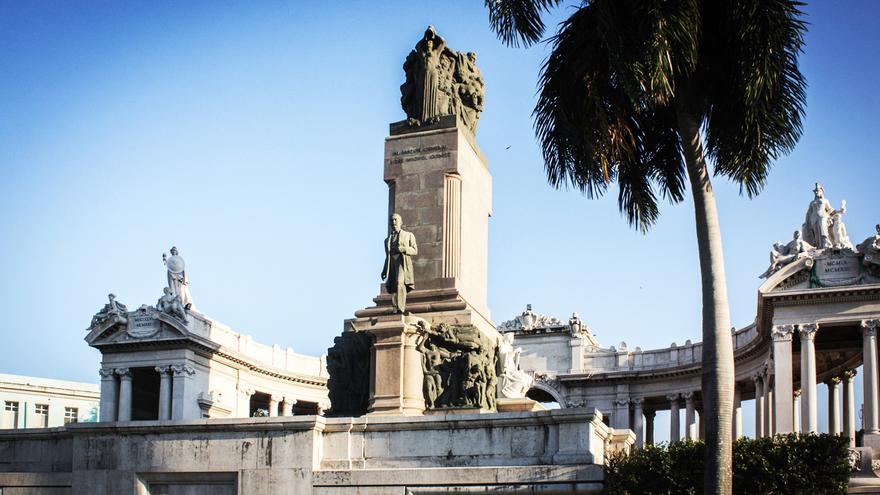
The Shark… and Chicken instead of Fish

In 2012, controversy arose over whether it was appropriate to preserve or demolish the gigantic sculptural complex at G and 29th streets.

14ymedio bigger14ymedio, Yunior García Aguilera, Madrid, January 17, 2024 — The Cuban president with the biggest monument is perhaps Jose Miguel Gomez. In 2012, controversy arose over whether it was appropriate to preserve or demolish the gigantic sculptural complex at G and 29th streets in Havana. It all started with a song by the group Obsesión.

“Tear it down,” they rapped, “and don’t tell me this is about heritage / that it can’t be taken down because it belongs to Eusebio* / this is not a polite request / it is a demand from the people.” Some see the monument as a tribute to a racist, a man responsible for the massacre of independence fighters of color, which occurred a century earlier. For others, Gomez represents the personification of corruption. The only thing most Cubans know about our second president, however, is his nickname: Tiburón (the Shark). So obvious was his corruption that it was said of him, “When he swims, he splashes.”

Indeed, the ‘guajiro’ president was corrupt. There were several scandals during his tenure, such as a land exchange between Villanueva and Arsenal

Indeed, the guajiro president was corrupt. There were several scandals during his tenure, such as a land exchange between Villanueva and Arsenal. No one can deny that he emptied the coffers and left office with his pockets full. But the shark seems more like a sardine if we compare his appetite with those of the Castro brothers, who ended up taking over an entire country, spent decades destroying it, and gave us chicken instead of fish.

He was also a general in three wars of independence, a teenager who left school to take up arms, and an insurgent who rose through the ranks not from an armchair or hammock but on the battlefield. continue reading

By the time the Battle of Jíbaro ended, he was a major general and its hero. After the signing of the Treaty of Paris, which officially ended the Spanish-American War, he was one of nine generals invited to attend the handover ceremony. He later accompanied General Calixto Garcia on his visit to Washington. He was a member of the constituent assembly which drafted the country’s first constitution in 1901. He was appointed governor of Las Villas by U.S. General John Brooke and was later elected to that post by popular vote. By then, he was clearly one of the country’s most important figures, someone said to be “presidential material.”

As governor, he proved to be an excellent manager, building roads, improving agriculture and livestock, and investing in education. But perhaps his most notable achievement was the enormous popularity he gained among Afro-Cubans after appointing several black and mixed-race Cubans to posts in his government. Back then, absolutely no one considered him a racist.

To vote at that time, one had to be at least 21-years old, have a net worth of 250 pesos and be able to read. Members of the Liberation Army did not have to meet the last two requirements. And given the fact that most members of that army were of African descent, the black vote became a matter of utmost importance.

José Miguel wanted to be president so, with elections approaching, he launched an insurrection against the incumbent, Tomás Estrada Palma. For his part, Estrada Palma sought American military help, which led to a three-year period of U.S. occupation. In 1908, Gómez defeated Mario García Menocal, with 60% of the vote, to become president. His Liberal Party gained an absolute majority in Cuba’s House of Representatives. Though he and his allies would control the Senate, they had to deal with a new party: the Independents of Color (PIC).

The Liberals split into two factions: the nationalists, headed by Vice-President Alfredo Zayas, and the republicans, led by José Miguel

The Liberals split into two factions: the nationalists, headed by Vice-President Alfredo Zayas, and the republicans, led by José Miguel. One anecdote illlustrates the level of animosity between the two men. As the story goes, during the victory banquet, cigars were being passed around. Around the cigars were paper bands were images of both men printed on them. Gomez took one with the image of his vice-president on it, lit it and, in a jocular tone, said, “As for Zayas, I am smoking him.” El Chino, as Zayas was known, was not a smoker, so he responded in kind by saying, “And as for José Miguel… I am putting him in my pocket.”

Then came 1912. The PIC had been banned two years earlier. The Morúa Amendment, sponsored by a mulatto patriot, outlawed parties made up of a single racial group. The decision may have been controversial but it was fair, and several black patriots supported it. However, both conservatives and annexationists began adding fuel to the fire, seeking the overthrow of the liberals and end the American occupation. Faced with the uprising of the independents of color, Gomez acted with a heavy hand, one that was too harsh. More than 3,000 Afro-Cubans were slaughtered. ​

No, José Miguel was not a mackerel. He was a shark. But there was more than one culprit in that massacre.

*Translator’s note: a reference to the late Eusebio Leal, official historian of Havana, whose office was responsible for the restoration of the city’s historic center.

____________

COLLABORATE WITH OUR WORKThe 14ymedio team is committed to practicing serious journalism that reflects Cuba’s reality in all its depth. Thank you for joining us on this long journey. We invite you to continue supporting us by becoming a member of 14ymedio now. Together we can continue transforming journalism in Cuba.
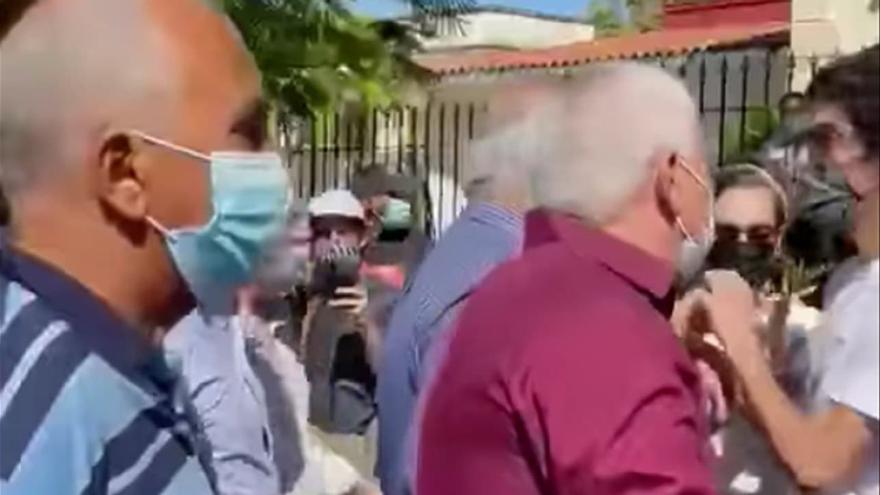
Cuba: Good Bye, Fernando

The Minister of Culture, Alpidio Alonso, together with the then Vice Minister Fernando Rojas, during the attack on some artists who were peacefully protesting, on 27 January 2021. (Screen capture)

14ymedio bigger14ymedio, Yunior García Aguilera, Madrid, 10 January 2024 — These days the dismissal of Fernando Rojas, the vice minister of Culture, has been in the news. There are many who have publicly celebrated the end of the career of one of the cultural commissioners who arouses the most antipathy. There have also been many, too many, affected by the exclusive and abusive cultural policy that the regime has carried out for decades.

But Fernando has been one of the most enthusiastic and visible executioners. He never refused to spearhead a cancellation. And despite all his efforts to show himself worthy of occupying the highest position in the ministry of censorship and ultimatum, better known as Mincult, no one trusted him enough to be the standard bearer.

We have both been antagonists in several of the most recent episodes, so I think it is pertinent to give my opinion. I do not intend to add to the insults, which are already many, and which contribute little, beyond personal relief. I will try to give the most honest view possible about someone who has just lost the little power he had left and whose life is definitely going downhill. continue reading

I will try to give the most honest view possible about someone who has just lost the little power he had left and whose life is definitely going downhill

The first time I exchanged words with Fernando was during a small reception that the ministry offered to Antón Arrufat. They told the playwright that he could bring some friends and I was among his guests. Suddenly, amidst rum and Soviet jokes, Abel Prieto made an unexpected confession: he was retiring from the position. So he told the younger ones: “Go out and smoke with Fernando, because he will be the next minister.” I remember that Fernando took out his tobacco, he paused and appeared as if he had already received the official appointment.

A short time later the news would come out, but nothing about Fernando being named. The new minister was a certain Rafael Bernal. He would only last two years in office, being dismissed after an art theft scandal. Once again, Fernando was left quietly in his chair. The appointee was then Julián González, and this time it would be Rojas himself who would be in charge of sawing the floor for his new boss. His appointment seemed inevitable, but… not even! Abel Prieto himself would be brought out of his sweet retirement to resume his position until 2018. By that year, Díaz-Canel was betting on a closer friend: Alpidio Alonso.

When in 2016, during a meeting of the Hermano Saíz Association (AHS), I asked Luis Torres Iríbar 15 uncomfortable questions , it would be Fernando Rojas’ turn to answer me. His answers must be recorded somewhere. Fernando lamented that we Cubans could travel without an exit permit, buy a cell phone or a computer, or buy and sell our own houses. For him, all those decisions were painful and must be temporary. From that moment on, I think he began to see me as an annoying intestinal pimple every time we met at those useless AHS or Uneac assemblies.

He even visited me at my house on a couple of occasions, concerned about the direction my Facebook posts were taking

However, I dare to speculate that, despite everything, Fernando appreciated me. It took it personally to try to keep me in the “uncomfortable artist” zone and not cross that invisible line where you are considered “incorrigibly counter-revolutionary.” He even visited me at my house a couple of times, concerned about the direction my Facebook posts were taking.

But November 27th arrived. That day, we both held a long and tense telephone negotiation, until the protesters were able to enter the ministry, well into the night. The false dialogue would be broken two months later, with a simple slap of the hand and an unjustifiable beating .

The last time we saw each other was at the Argos Teatro headquarters, after a performance of one of my plays. In the dressing room, I told him: “Before we start discussing our differences, tell me how your son is doing.” Fernando burst into tears for about ten minutes straight. Apparently, no one in his camp had asked him about the boy’s health after a domestic incident.

I’m delusional if I think he really appreciated me. He did not hesitate to go house to house of some colleagues to publish videos against me. He didn’t hesitate for a second to close my group and ban all my works. He applauded the lynching that my family suffered in the same house that he himself visited one day.

Fernando is already ancient history, but the worst of all is that those who replace him today are made of the same material.

____________

COLLABORATE WITH OUR WORKThe 14ymedio team is committed to practicing serious journalism that reflects Cuba’s reality in all its depth. Thank you for joining us on this long journey. We invite you to continue supporting us by becoming a member of 14ymedio now. Together we can continue transforming journalism in Cuba.
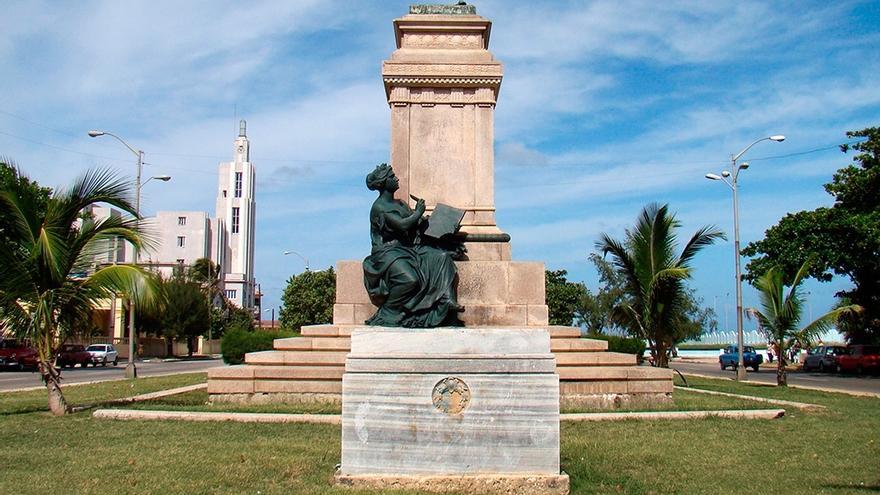
Putting Yourself in the President’s Shoes

All that remains of Tomás Estrada Palma are his shoes, which sit atop a desecrated monument on Avenue of the Presidents.

14ymedio bigger14ymedio, Yunior Garcia Aguilera, Madrid, January 4, 2023 — If you came here thinking that I would be talking about Díaz-Canel or his shoes, you would be mistaken. To be president of a republic, you need to be elected, at least by a parliament. And electing someone implies being able to choose between two or more options. In the case of this individual, he was the only candidate on the parliamentarians’ ballot. So they elected nothing and he presides over nothing. Díaz-Canel is just an appointed director, a front man, Raul Castro’s latest whim.

The person I intend to talk about in this column was the first Cuban president to be elected by popular vote. At school they told us little more than that he favored annexation by the United States. Official historians have emphasized that he requested, begged, implored the U.S. to occupy Cuba a second time. Less mainstream journalists revel in anecdotes about his legendary stinginess. But the truth is that, in Cuba, little is known about who our first elected president was.

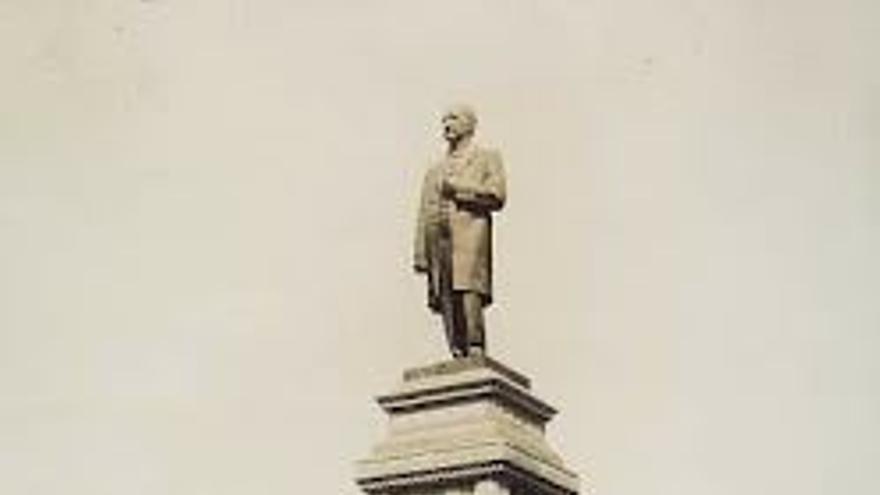
All that remains of Tomás Estrada Palma are his shoes, which sit atop a desecrated monument on Avenue of the Presidents, known locally as Avenue G, in Havana’s Vedado district. His statue, which was the creation of the Italian artist Giovanni Nicolini, was unveiled in 1921 and destroyed in 1959 in a fit of collective hysteria. continue reading

Estrada Palma’s presidency was austere, yes, but no one could call him corrupt. His motto — “more teachers than soldiers” — was consistent with his vocation and the needs of the country

The story goes that it was the people who ripped his statue off its pedestal back in the 1970s but ordinary people do not have cranes. Its destruction was not the result of a truly popular rejection but rather an order from powerful officials with a very clear purpose: to erase history. They say that one of Estrada Palma’s sons was staying at the Hotel Presidente Hotel at the time and witnessed this official act of iconoclasm. Perhaps his only revenge was seeing how his father’s shoes clung to the marble.

Years later, a group of pedestrians happened to walk past it without any idea what the monument represented. Some thought it was perhaps an homage to that poem about the rose slippers by Jose Martí. The stubborn bronze shoes remained there until 2020, when the Office of the City Historian finally decided to finish the job, remove them from public view and store them in their archives.

Tomasico* was was born, it is said, on July 9, 1835. He was the only child of Andrés Maria his wife Yaya. His father died when he was little and he developed a singular attachment to his mother. Perhaps because of that bond, he was unable to finish his studies in Seville. He returned to his hometown to be with her and to run La Punta, his family’s hacienda. He was named petty-lieutenant in Bayamo, an administrative position with about as much authority as its pleasant phonetics imply.

When war broke out, Tomás was sent to by the authorities to negotiate with the insurrectionists but ended up joining them. He managed to rise through their ranks, ultimately becoming president of the Republic in Arms. There were more losses than victories, however, and those defeats would leave their mark on him.

La destrucción de la estatua de Estrada Palma no fue el resultado de un rechazo auténticamente popular, sino una orden del poder con un propósito muy claro: borrar la historia. (CC)
The destruction of his statue was not the result of a truly popular rejection but rather an order from powerful officials with a very clear purpose: to erase history. (CC)

His dearly beloved mother died in the mountains of hunger after being captured by the Spanish and then released into the wilderness alone. He himself was captured near the end of the war by Cubans who sympathized with Spain. During his imprisonment in Morro Castle, no Cuban went to visit him. The colonial government spread the news that he had switched sides and he was unfairly assumed to be a traitor. To withstand the December cold, he had to rely on clothes given to him by Spanish soldiers.

Perhaps this is why he had little faith in Cubans’ ability to govern themselves. It was in the United States where rediscovered his love of teaching and where he found a degree of respect and dignity. He regained his belief in Cuba only because someone with the stature of Jose Martí rekindled that hope in him.

Estrada Palma’s presidency was austere, yes, but no one could call him corrupt. His motto — “more teachers than soldiers” — was consistent with his vocation and the needs of the country. Those who insist he favored annexation by the United States ignore his efforts to make sure the Isle of Pines remained part of Cuba and to reduce the number of American naval bases from five to just one.

He was not perfect by any means, but nor was he the rube nor the sellout portrayed in Cuban history classes. A country was being forged and, in such times, it is all too easy to get burned. Perhaps one of his most famous lines says it all: “We have a republic but it does not have citizens.

*Translator’s note: Spanish diminutive of Tomás.

____________

COLLABORATE WITH OUR WORKThe 14ymedio team is committed to practicing serious journalism that reflects Cuba’s reality in all its depth. Thank you for joining us on this long journey. We invite you to continue supporting us by becoming a member of 14ymedio now. Together we can continue transforming journalism in Cuba.
The Ideological Endogamy of the Cuban Regime

Inauguration of the eye hospital in Anhui, China. (Consulate of Cuba in Shanghai)

14ymedio bigger 14ymedio, Yunior García Aguilera, Madrid, 28 December 2023 — Endogamy is the practice of marrying in closed groups, between individuals of common ancestry. Reproduction between parents who are closely related greatly increases the chances that the offspring will be affected by recessive traits or genetic impairments. One of the most notorious cases was King Charles II of Spain, known as the Bewitched.

The multi-pathological monarch was not able to learn to walk or talk until he was between six and nine years old. He died just shy of his 40th birthday, without any of the attempts to exorcise him being successful. His autopsy described “a heart the size of a peppercorn, corroded lungs, putrid intestines, a single coal-black testicle, and a head full of water.” His death, leaving no descendants, marked the end of the House of Austria.

Another case that has recently achieved notoriety is that of the Whittakers, in West Virginia. Its members suffer from various physical and mental anomalies and are known as the most endogamous family in the United States. Mark Laita, who introduced them to us, claims that they communicate with each other with howls and growls. His controversial documentary on YouTube has been seen by more than 40 million people.

As the model reproduces in a closed circle, it generates anomalies, recessive traits, philosophical and structural deterioration

Regimes that insist on maintaining a kind of ideological endogamy also run the risk of their system suffering the same ailments as Charles II of Spain continue reading

and the Whittakers. As the model reproduces in a closed circle, it generates anomalies, recessive traits, philosophical and structural deterioration. Single-thinking systems breed increasingly mediocre leadership, not to mention the suffering they cause in the body of the societies they try to lead.

That is why the Cuban model is doomed to disappear, because its stubborn inbreeding, far from maintaining a supposed “ideological purity” that ensures power, is reproducing the same error code, with increasingly worse symptoms. From the Process of Rectification of Errors we moved to the Special Period, from the disastrous Battle of Ideas to an even worse Ordering Task, from an endless Coyuntura [roughly ‘temporary sitaution’] to an eternal Contingency, from a very poor Creative Resistance to the current (and ridiculous) War Economy.

Who knows what name they will give to this very long and incurable crisis in 2024. If Díaz-Canel was the smartest sperm generated by the Single Party, what can be expected from the most lagging gametes? There we have Alejandro Gil, perhaps the worst Minister of Economy on the planet, who does not blush when giving the same message of failure, year after year, without anyone thinking of doing him the favor of dismissing him.

There we have Gerardo Hernández Nordelo, the ill-fated former spy who today posts imbecilities from a position as useless as that of presiding over the most grotesque and impoverished mass organization of all those created by the regime to monitor us.

And things get worse if we look at the “new marabous” (they cannot be called “pines”). At least one limits oneself by launching very strong criticisms towards characters like Michel Torres Corona or Pedro Jorge Velázquez. It is not politically correct, in these times, to emphasize their disabilities. Although, in reality, theirs is more about political mountaineering and impudence.

The terrible thing is that all of us, even if we have escaped from the prison island, run the risk of reproducing its practices. The extreme polarization and algorithms of social networks lead us to consume ideas very similar to our own. And we can easily end up locked in circles that reproduce exclusive new thoughts.

Debate is almost an obsolete word. The ’cool’ thing is to say that so-and-so “swept the floor” with so-and-so, or vice versa

Debate is almost an obsolete word. The cool thing is to say that so-and-so “swept the floor” with so-and-so, or vice versa. This obsession with headlines related to the same domestic task shows a great lack of imagination, but it is the result of the intellectual laziness of our time. No one wants to get tangled up in the conflict of having to decide between two divergent opinions. The correct one, a priori, is whoever thinks like me, period.

So, if you can’t reason with another, insult him. If you run out of arguments, launch a smear. If you can’t see the curvature on the horizon, shout that the earth is flat! Most have never climbed so high and they may even applaud you.

I already know that pluralism is not fashionable. But perhaps, just perhaps, respecting the diversity of opinion is the only effective remedy to eradicate, once and for all, that ideological endogamy that we carry in our blood.

____________

COLLABORATE WITH OUR WORKThe 14ymedio team is committed to practicing serious journalism that reflects Cuba’s reality in all its depth. Thank you for joining us on this long journey. We invite you to continue supporting us by becoming a member of 14ymedio now. Together we can continue transforming journalism in Cuba.
Rotten Fruit

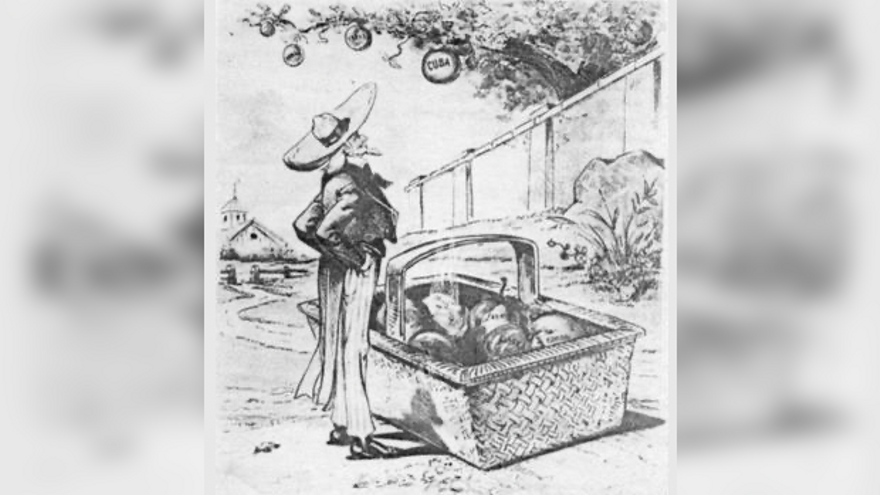
Cartoon published in 1897 in the American newspaper ’Puck’ with the title ’Patient waiters are not losers.’ (Cubainformación)

14ymedio bigger14ymedio, Yunior Garcia Aguilera, Madrid, 21 December 2023 — The Cuban regime and its ideologues have, time and again, recycled a statement made in 1823 by John Quincy Adams. The then American Secretary of State wrote about gravity, or rather about Cuba, comparing us to a fruit. He predicted that, when the island broke away from Spain, it would inevitably fall to the ground. Or, in other words, towards the U.S.

But Adams, who would later become the sixth president of the United States, never got past Isaac Newton and did not live long enough to learn about the theory of relativity. Many years later, Albert Einstein would redefine gravity, not as a force but as a deformation of space-time. And though some Granma librettists still cling to that quasi-vegan phrase, history has witnessed, on more than one occasion, space-time deformations.

If we put ourselves in his shoes, Adams words make perfect sense for someone of his time and place

If we put ourselves in his shoes, Adams words make perfect sense for someone of his time and place. Cuba enjoyed an enviably strategic position. In enemy hands, it could constitute a real threat to the United States. Our island was also the world’s largest producer of sugar, the white oil of its time. And in the coming years U.S. actions did indeed follow the “low-hanging fruit” logic, whether that meant trying to buy the island, supporting the insurgency or entering directly into the conflict with Spain, as it ultimately did. continue reading

The Teller Amendment, however, expressly prohibited eating the fruit. So what happened? Was it sudden reluctance? Fear of unfamiliar foods? In fact, not all Americans wanted this particular new star on their flag. Some were genuinely committed to our independence. Others rejected annexation because of the threat that Cuban sugar competition posed to their own businesses. And quite a few simply did it out of racism. At the time, Cuba had half a million people of African descent in a country with barely a million and a half inhabitants.

The first period of military occupation (1899-1902) has been widely studied by a broad range of historians. I personally recommend Viento Norte (North Wind) by Ignacio Uría — a sharp, intelligent, well-documented study that does not come with the embarassing Castro-Stalinist baggage that afflicts so many of our history books.

The fact is the Americans left. Years later, Cuban president Estrada Palma begged them to return. They came and left again. What was up with the fruit? This inconsistency in the American diet has confounded more than one Marxist historian. But as for the fruit, they really don’t seem to be too interested.

What John Quincy Adams never imagined was that the United States was not the only place where the apple — or, to be more tropical, mango or papaya — could fall. It took until 1959 for gravity to pull it towards Moscow. That rollercoaster of a fall was like a second Platt Amendment.

The rot in the fruit became so obvious that Fidel Castro began to see “worms” everywhere

The rot in the fruit became so obvious that Fidel Castro began to see “worms”* everywhere. He was convinced that only the Soviet cherubim could prevent the Yanks from going into full Adam-and-Eve mode on the little fruit. But the Cold War ended and the United States still showed no appetite, even though they had the opportunity to bite down hard. The balsero crisis in 1994 gave them the perfect excuse but they didn’t do it. Nor did they do it after widespread anti-government protests in July of 2021.

Some have theorized that there are those in Washington who prefer that the Cuban regime survives if for no other reason than to serve as a bad example. But one bad apple can spoil the whole bunch as we have seen in Venezuela, Nicaragua… The “defective sample” theory has been worse useless; it has been downright dangerous.

Regardless of how Washington or anyplace else sees us, we do know how important it is for us to be free. And if we have to do it on our own, we had better be realistic. Because freedom is not just about taking to the streets to celebrate and throw streamers. The country we will be inheriting is a pile of rubble.

There is much we can learn from that first transition, when the republic took its first steps. We have often looked to others such as the countries of Eastern Europe or post-Franco Spain for inspiration. But looking at ourselves can also shed a lot of light. And we must stop believing, once and for all, that we are a fruit.

*Translator’s note: “Gusanos” in Spanish, a term Castro often used in his speeches to disparage Cubans who opposed his regime.

____________

COLLABORATE WITH OUR WORKThe 14ymedio team is committed to practicing serious journalism that reflects Cuba’s reality in all its depth. Thank you for joining us on this long journey. We invite you to continue supporting us by becoming a member of 14ymedio now. Together we can continue transforming journalism in Cuba.
Fire in the Forge

Alexis Triana was appointed president of the Cuban Institute of Cinematographic Art and Industry on November 9. (Cubadebate)

14ymedio bigger14ymedio, Yunior García Aguilera, Madrid, 14 December 2023 — Two speeches, completely opposed, have marked these days of the film festival in Havana. On the one hand, we have the inaugural words of Alexis Triana, the appointed official at the head of the Cuban Institute of Cinematographic Art and Industry (ICAIC). On the other, those of the filmmaker Ernesto Daranas, in the presentation of his feature film Landrián.

Daranas spoke with the authentic humility that characterizes him. Behind his slow tone was all the firmness of the artist who does not resign himself to obedience and silence. The renowned director of films such as Los dioses rotos, Conducta and Sergio y Sergéi, publicly condemned exclusion and censorship, those “great stigmas of Cuban culture and society in general.” The director dedicated the presentation of his documentary to the Assembly of Filmmakers and to all the colleagues and compatriots who have been the object of injustices. His words, simple and direct, were widely applauded, shared and commented on by thousands of Cubans on their social networks, although the official media prefer to pretend that they were never said.

Those same media, on the contrary, have not lost a minute in spreading the speech of official Alexis Triana to the point of exhaustion

Those same media, on the contrary, have not lost a minute in spreading the speech of official Alexis Triana to the point of exhaustion. The new commissioner of the ICAIC used the pompous, laudatory and demagogic style that he has been rehearsing in all his years as an employee of the bureaucratic apparatus. The people of Holguīn know well that declamatory intonation that he used to throw from the balcony of La Periquera, always losing his voice, as if he were a mixture of Republican mayor and revolutionary cheerleader. continue reading

Alexis has spent his life trying to prove that he is a loyal cadre; maybe that’s why he insists on imitating Eusebio Leal, without ever achieving his popular eloquence. This time, the one he did manage to imitate perfectly was Lindoro Incapaz, a humorous character who represents the typical official on the Island.

Alexis belongs to the list of those who were humiliated and defenestrated by their own leader, when they suffered from that disease called youth, something that is usually healed over time. And he was cured, definitely. Rebellion aged him; being candid gave him gray hair, and male menopause made him immune to having a free spirit. Today, he is an older man who has worn so many masks that he no longer remembers his true face.

But Alexis is a smart guy, I admit that. He knows perfectly how to manipulate his audience with figures and statistics, anecdotes retrieved from the drawer, flamenco movements of his right hand and the occasional emphasis on key words. Aware of the participation of a good number of progressive filmmakers in the festival, he used a “left-wing” rhetoric, according to the eighties manual, for the attending veterans; he drew out of his sleeve a feminist wink to the guest filmmakers and recited a “they, they, they, they” for the youngest. He spoke, of course, of “imperialism” and “cultural colonization,” although this time he preferred to leave the word “blockade” on the desk of his new office.

Those who know him well, know that Alexis had four drinks when he gave the speech. It was noticeable in certain slurred vowels and in the continuous skating with words where “S” and”R” abounded. Alexis would be able to spend the entire ICAIC budget to subsidize epic drunkenness. Then he will disguise some buddy as an Eskimo to say, with all the grandiloquence of the world, that the new Inuit cinema has finally arrived at the Havana festival.

He spoke, of course, of “imperialism” and “cultural colonization,” although this time he preferred to leave the word “blockade” on the desk of his new office

 Alexis’ mission in the ICAIC is clear. He’s a fumigator. He comes to clean the disobedient guild of “vectors” and fill the movie theaters with smoke. He doesn’t care about the quality or transcendence of the works. He wants to show off figures and some small blow for effect, although his ego is usually depressed by his being reduced to a simple official. When he talked about Alfredo Guevara and Wikipedia, he was actually talking about himself, with notable emphasis on the “we” when he mentioned cultural managers and promoters. It hurts that they see him for what he is: a bureaucrat.

Alexis may have a coefficient above the average of the cadres that populate the office ecosystem, although that is not difficult. Bureocrats don’t have dreams, only tasks. For Cuban officials there is no word for future; their mission is to stretch the past, disguising it as the present. His speech should not have been called “The fire is still in the forge,” but rather, “I’m still blowing smoke.”

Translated by Regina Anavy

____________

COLLABORATE WITH OUR WORKThe 14ymedio team is committed to practicing serious journalism that reflects Cuba’s reality in all its depth. Thank you for joining us on this long journey. We invite you to continue supporting us by becoming a member of 14ymedio now. Together we can continue transforming journalism in Cuba.
Public Indifference

John Milton Hay, U.S. Secretary of State, signing the Treaty of Paris in 1899. (CC/Wikimedia)

14ymedio bigger14ymedio, Yunior García Aguilera, Madrid, December 6, 2023 — When Spain and the United States signed the Treaty of Paris, Cuba’s future was uncertain. The Americans had made it clear that they were not interested in annexation but there was no clear path to sovereignty either. The island’s fields had been torched by war, small landowners had no animals to plow them, and the railway infrastructure lay in ruins. What then did it mean for the majority of those we call “the public” or that other thing we call “freedom”?

The rebels’ machetes and bullets killed just over 3,000 Spaniards while various diseases claimed more than 40,000 lives. Some 80,000 Cubans fought on the Spanish side, either as volunteers or replacement troops. The Army of Liberation, however, never amounted to even half that number. Worst of all, most of its soldiers did not join the struggle until its final month, after the United States had already intervened in the conflict and it was clear that Spain would lose control of Cuba.

Jumping aboard the victory bandwagon has always been easy. At that point in the war, everyone on the island could sing “La Bayamesa”. On more than one occasion, the rebel commander Máximo Gómez became frustrated with the widespread public indifference to the conflict. At the end of the Ten Years’ War, as he was preparing to go into exile, a crowd gathered at the port of Santiago de Cuba. Gómez would later write in his diary, “I gaze out with great sorrow at a throng of more than 8,000 young Cubans who did not have the courage to take up arms to liberate their country.” It is understandable that he would choose not attend the ceremony transfering power from the panchos to the gringos on January 1, 1899. For him, peace often had a bitter taste. continue reading

Many Spanish officials remained in their posts. Today, some Twitter users would be scandalized and call this a fake change

Initially, the provisional government retained the same administrative system as well as the civil and criminal codes. Many Spanish officials even held onto their positions. Today, some Twitter users would be scandalized by this and call it a fake change. But the truth is that, as the Americans saw it, not everyone who could wield a machete was ready for a desk job. Their priority was to get a shattered economy back on track and maintain as much stability as possible.

Naturally, the radical nationalists were furious. They had not shed their blood in the mountains only to end up being ordered around by someone with a Castilian accent. America’s Secretary of War at the time, Elihu Root, admitted to leading a stressful life, afraid of finding out that his troops had been forced to shoot the former Cuban insurgents.

It became necessary to integrate the war veterans into the new government. Among those chosen were men with illustrious names. Men who had been trained in the United States or Europe, who had patriotic credentials and their own fortunes and thus would not be tempted to use the public purse to enrich themselves. It could be said that they were a thousand times more competent than the current Cuban government, staffed as it is with useless cadres trained in demagoguery and double-talk. However, history was not be kind to those first Cuban officials. They have been mostly ignored or branded with broad labels that did not take into account the historical context.

The same thing will probably happen to those brave enough to take on administrative responsibilities when the time comes for Cuba to transition to a free society. Accepting government postions at that point will involve making more complex, controversial and perhaps thankless decisions. It will be like setting oneself on fire. Quite possibly none of those who decide to participate in this process will be go on to play a role in the future democracy.

And while all this is going on, what role will the broader public play in the transition? It is likely that crowds will take to the streets in euphoria. One can assume that many will attack the symbols of Castroism as happened after the fall of Machado and Batista. We can even imagine Patria y Vida being sung on the major boulevards at full volume. But then most will go back to hiding behind their cell phone screens, onlookers to the change.

Most of us are on airplane mode, waiting for someone to bring out the body as we scroll past the inanities of some government minister, reports on the Cuban first lady’s latest  international first-class jaunt with her son — the unofficial bodyguard— and the viral videos of Yarelis and her boyfriends.

What we call the public is often an abstraction, a dream from which we awaken from time to time if something, or someone, shakes the bed forcefully enough.

____________

COLLABORATE WITH OUR WORKThe 14ymedio team is committed to practicing serious journalism that reflects Cuba’s reality in all its depth. Thank you for joining us on this long journey. We invite you to continue supporting us by becoming a member of 14ymedio now. Together we can continue transforming journalism in Cuba.
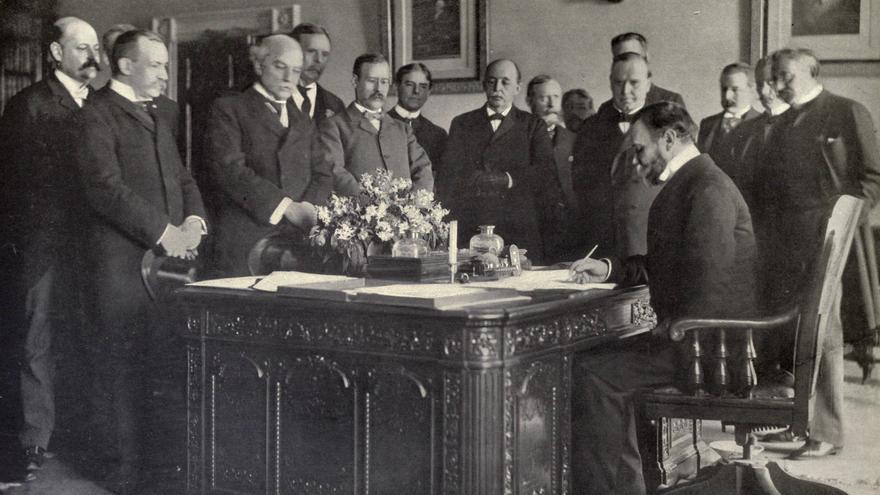
Cuba, So Far From God!

Image of the protest in front of the Cuban Institute of Radio and Television during the mass demonstrations on 11 July 2021. (Facebook/Leonardo Fernández Otaño)

14ymedio bigger14ymedio, Yunior García Aguilera, Madrid, 29 November 2023 — A recurring phrase in Mexico is the one attributed to former President Porfirio Díaz: “Poor Mexico, so far from God and so close to the United States.” Although the expression brilliantly summarizes the history of a country, the truth is that many Mexicans have seen this proximity as quite the opposite. Even today’s President Andrés Manuel López Obrador himself modified the phrase before the North American Secretary of State, Antony Blinken, in 2021. For López Obrador, those 3,180 kilometers of border were a juicy blessing from which they should get every possible benefit.

The US has land borders with Canada, to the north; and with Mexico, to the south. But the case of Cuba is quite unique. It is not only about the famous 90 miles that separate us, and that beat in the minds of a good number of Cubans like a fixed idea. There is also the land border that, de facto, covers 44 kilometers of wire fences at the Guantanamo Naval Base. The Mexican phrase could well be extrapolated to a country where poverty, the denial of God and belligerence with the North have been taken to absurd limits.

In 1961, 136 Catholic priests were expelled from Cuba. In his pathetic speech of 13 March 1963, Fidel Castro also attacked other religious groups that he called “instruments of imperialism.” For decades, admitting your religious creed could deprive you of studying for a university degree. I myself was “not approved” at the end of my secondary studies and could only aspire to study masonry at a trade school, despite having a notable academic record. My parents managed to remedy that matter and I was able to go to a civil construction polytechnic. I studied there for two years, without being able to build a single wall, because there were no bricks or cement anyway. continue reading

Some Jehovah’s Witnesses suffered unspeakable torture. One of them, after refusing to salute the flag, was hoisted as punishment on the flagpole itself, where he remained hanging upside down, under a hellish sun, for long hours.

Popular culture reflected the denial of faith that some had to feign. Adalberto Álvarez marked a musical milestone with his hit And what do you want them to give you?, where he sang: “There are people who tell you that they don’t believe in anything, and they go to consult each other early in the morning…” But others had worse luck. There are hundreds of testimonies of those who ended up in the UMAP camps, our concentration camps. I personally knew some Jehovah’s Witnesses who suffered unspeakable torture. One of them, after refusing to salute the flag was, as punishment, hoisted on the flagpole itself, where he remained hanging upside down, under a hellish sun, for long hours.

Although the regime never managed to completely distance us from faith, the visits of three Popes in recent years have also failed to erase the ditch imposed by an atheist State. The power aspired for the only sacred word to be that of the maximum leader. And the party cadres were to be the only clergy.

It already hurts to continue talking about Cuban poverty. It has become customary to recalculate the real value of the salary every week, watching helplessly as Alice in Wonderland’s potion is drunk. If the World Bank has established $2.15 a day as the poverty line, at what threshold do Cubans find themselves? We already know how the regime cheats with numbers to camouflage our misery in global statistics. With this they manage to deceive two or three clueless people who continue to mention Cuba as an example of certain “achievements.” But the Cuban who is there, biting into the mud, knows perfectly well what figures he carries in his stomach.

And we are left with the old and new relationship with the United States. The island’s politics have never depended as much on Washington’s sneezes as in these six decades. The North is the Goliath at whom Castro could not throw the stone, because Nikita Khrushchev took away the slingshot. The neighbor has become the magnet of blame, the perennial excuse, the wild card for the regime to to declare itself a victim before the world and hide its own atrocities against its citizens.

The truth is that the United States doesn’t care much about us. Its policies towards Cuba respond, above all, to the demands of a community with electoral weight in the state of Florida. The real conflict of the Cuban regime is not with the government of the Stars and Stripes, but with an ever larger exile and with more reasons to fight for the overthrow of that shameful dictatorship.

Poor Cuba, so far from God, from the United States, and from itself.

____________

COLLABORATE WITH OUR WORKThe 14ymedio team is committed to practicing serious journalism that reflects Cuba’s reality in all its depth. Thank you for joining us on this long journey. We invite you to continue supporting us by becoming a member of 14ymedio now. Together we can continue transforming journalism in Cuba.</p

Weyler, a Hitler in Cuba?

Valeriano Weyler, recognized as “the most sinister figure of the 19th century.” (Wikipedia)

14ymedio bigger14ymedio, Yunior García Aguilera, Madrid, 22 November 2023 — Cuban historiography recognizes Valeriano Weyler as one of the most nefarious characters in our history. And he certainly was. His “Reconcentration” policy caused the death of hundreds of thousands of civilians, especially children, women and the elderly. The “reconcentrated” were thrown together in the villages, surrounded by barbed wire. Families slept in doorways, streets and barracks, decimated by hunger and disease. American newspapers called him “the butcher,” “the most sinister figure of the 19th century.” And in the memory of Cubans he is recorded as a tropical Hitler.

For Spain, however, he was much more than an illustrious soldier. Not only did he participate in almost all the wars that the country fought in his time, but he was also captain general of Valencia, the Canary Islands, the Balearic Islands, the Philippines, Cuba, Catalonia, Burgos, Navarre and Vascongadas and Castilla la Nueva. He was recognized as a capable, hard and inflexible soldier, oblivious to conspiracies and political compromises. He was senator of the Kingdom for the Canary Islands, head of the Central General Staff, twice Minister of War and president of the Supreme Council of War and Navy. He received the titles of Marquis of Tenerife and Duke of Rubí, as well as Spanish nobility and the Golden Fleece.

Today there are some monuments in his honor. In Santa Cruz de Tenerife there is a square that bears his name. And on Madrid’s Marqués de Urquijo street, number 39, there is a commemorative plaque where you can read: “Valeriano Weyler, model of loyalty.” One might ask: how is it possible that, in our time, someone with war crimes has monuments in his name?

His defenders, who are not few, attribute the black legend of Weyler to a campaign of the American press at the time. It is true that the American yellow press sought to force the Government into conflict. It is also true that the enemies of Spanish Prime Minister Cánovas echoed those complaints in Spain. But that does not diminish Weyler’s responsibility in the genocide. continue reading

Arsenio Martínez-Campos, whom Weyler replaced, had admitted to feeling unable to implement those drastic measures, although perhaps inevitable, from a military point of view. Weyler defended himself from his critics by arguing: “You don’t fight a war with chocolates.” Was the Spanish general successful? To a certain extent. He managed to kill Antonio Maceo, the ’Bronze Titan’, and to “pacify” the western part of the Island. But at what price?

There are some monuments in his honor today. In Santa Cruz de Tenerife there is a square that bears his name

On the other hand, those who seek to clear Weyler’s name argue that the Reconcentration Policy was neither new nor was it practiced exclusively by Spain. They also defend the idea that the Weylerian measures sought to protect the peasants from the mambises [rebels] abuses. And here I take a break. It is obvious that not all Cubans sympathized with independence. It is true that many openly supported Spain, even with weapons. It is more than likely that some insurgents committed abuses against those who refused to help them or considered themselves traitors to the ideal of independence. It is undeniable that the incendiary torch, the widespread burning of the countryside,  practiced by the mambises contributed to the lack of food. However, the cruelty generated by Weyler’s policies was infinitely superior.

The images of the “reconcentrated”, with starving children and elderly, whose bones looked “like rings under a glove,” undoubtedly contributed to the decision of the United States to interfere. As some historians claim, it is possible that Weyler was winning on the battlefields, but he was definitely losing the battle of communication.

When the Mallorcan general was about to start the final offensive against the insurgents, an Italian anarchist murdered Anotnio Cánovas del Castillo in Spain. Spanish Prime Minister Mateo Sagasta, with whom he alternated in power for years, was among those looking for the path of negotiation. Weyler was leaving Cuba, taking as loot the watch, revolver and saddle of his archenemy Antonio Maceo. They say that a crowd went to the port of Havana to say goodbye to him as a hero. That’s how absurd and contradictory the real story is.

For millions of Cubans, there is only one character capable of accumulating more hatred and resentment than Weyler: Fidel Castro. For many, all of Cuba has been a huge concentration camp for more than six decades, where hunger has spread. The bearded man also has statues and monuments in various parts of the world. He also enjoyed a long life, like Weyler, who died at the age of 92.

No one who commits genocide should have statues, no matter how “heroic” some people think them.

Translated by Regina Anavy 

____________

COLLABORATE WITH OUR WORKThe 14ymedio team is committed to practicing serious journalism that reflects Cuba’s reality in all its depth. Thank you for joining us on this long journey. We invite you to continue supporting us by becoming a member of 14ymedio now. Together we can continue transforming journalism in Cuba.
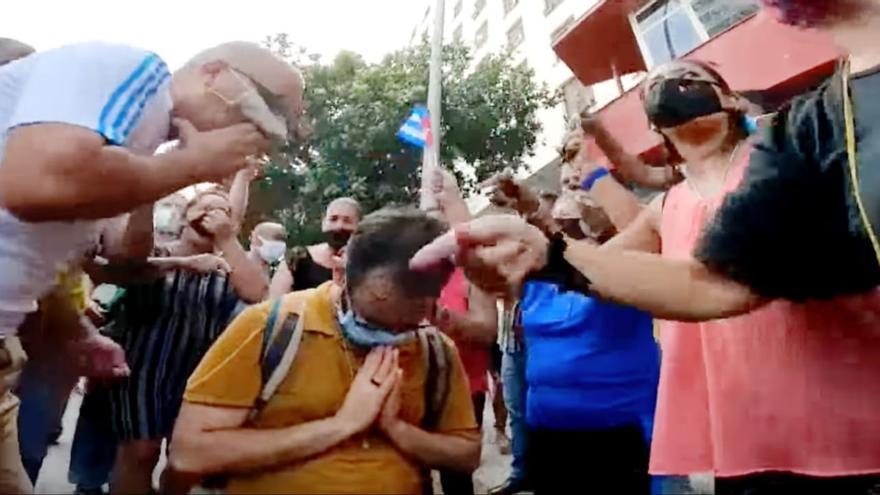
Cuba Respects Neither Human Rights nor ‘Human Lefts’

In countries such as Cuba, power is cynically ambidextrous. All the dissidents who have been persecuted, imprisoned or exiled know this, even if they espouse social democratic ideas. (14ymedio)

14ymedio bigger14ymedio, Yunior Garcia Aguilera, Madrid, 15 November 2023 — The international left sometimes seems less like an ideology and more like a dogma. Many of its organizations and activists are motivated by compacts, debts and interests, not by principles or objectives. The Mothers of Plaza de Mayo, for example, are capable of embracing today’s dictators while turning their backs on other mothers now fighting for justice for their unjustly imprisoned children.

The sect had its share of altars, relics and prayers but its aspirations were emptied of their content. Poets and singers lent it their talents with blind fanaticism, paving the road to hell with good intentions.

The fires of that hell burn in countries like Cuba, where no one believes in songs about equality and social justice anymore because reality hits you in the face like a henchman’s boot. We have stopped speaking in the future tense. Our everyday speech now compels us to disguise the future as some uncertain present. No one says, “I will come tomorrow.” Instead, we say, “I come tomorrow.” In Cuba we stopped dreaming a long time ago. Now we escape en masse, heading towards the American dream or the Spanish siesta. continue reading

The western world’s oldest dictatorship has acquired extensive experience in influence trading and diplomatic marketing

It is paradoxical and disingenuous in the extreme that a regime as abusive as Cuba’s retains a seat on the United Nations Human Rights Council. One might ask: What is the purpose of an institution whose judges are notorious criminals? What’s the point of putting a jurist’s robe on a known human rights violator?

It’s obvious the system is not working. It has a factory defect. The western world’s oldest dictatorship has acquired extensive experience in influence peddling and diplomatic marketing. They know exactly what screws to tighten to get favorable votes in international institutions. And once the truth becomes plainly evident, they have a loyal left all too willing to betray its ideals and play along with the bloc.

Nothing remains of the old 20th century utopia. Every version of the great revolutionary scam became more dystopian, both in Venezuela and in Nicaragua. Ultimately, it was never about the people, much less the workers. It was about power, plain and simple. The Orwellian prophecy came to fruition in spades, filling the farm with ever more two-legged pigs.

Like every religion, the Latin American left had its own sacred texts. Eduardo Galeano’s The Open Veins of Latin America became the bible of the continent’s progressives. The Uruguayan writer later admitted he had a shaky grasp of economics and politics when he wrote the book. “I wouldn’t be able to read it today,” he admitted in Brasilia in 2014. “That sort of traditional leftist prose can be very heavy-handed.”

I would like to pose my own challenge to Cuba’s state-run press: I dare you to publish the Universal Declaration of Human Rights in your newspapers’ centerspreads, without taglines or manipulative commentary!

It is, in fact, a well-written albeit populist book. It simplified complex issues using seductive language. It appealed more to emotion than to reason. It absolved us of all blame, foisting all our problems and their solutions onto the shoulders of others. Despite this, Galeano continues to be quoted with the same fervor that Jesuits quote St. Ignatius Loyola.

Another poet of the pantheon is Mario Benedetti. In his poem “Everything Is Clear Now” he posed a challenge, calling for a broad internernational compaign for “human lefts.” The writing is unquestionably brilliant. But in countries such as Cuba, where power is cynically ambidextrous, such work is ultimately sterile.

All the dissidents who been persecuted, incarcerated or exiled know this. One young man, Romero Negrín, knew it in his ribs. He once dared to hold up a poster that read, “Socialism yes, repression no.” They beat him to death. Alina Barbara Lopez Hernandez, an intellectual accused of resistance and disobedience, knows it. Everyone who has tried unsuccessfully to form an independent trade union knows it. The teachers who do not get paid on time, whose monthly paychecks are only enough to buy a measly carton of eggs, know it. Doctors who lack what they need to save lives while hotels get everything they want know it.

I would like to pose my own challenge to Cuba’s state-run press: I dare you to publish the Universal Declaration of Human Rights in your newspapers’ centerspreads, without taglines or manipulative commentary. Would their owners permit it? Cuba is the country where the police could once arrest you for covertly distributing this document. Cuba is where the regime’s henchmen shouted “Down with human rights!” during pro-government demonstrations. In Cuba not even the poetic though impotent human lefts are respected.

____________

COLLABORATE WITH OUR WORKThe 14ymedio team is committed to practicing serious journalism that reflects Cuba’s reality in all its depth. Thank you for joining us on this long journey. We invite you to continue supporting us by becoming a member of 14ymedio now. Together we can continue transforming journalism in Cuba.
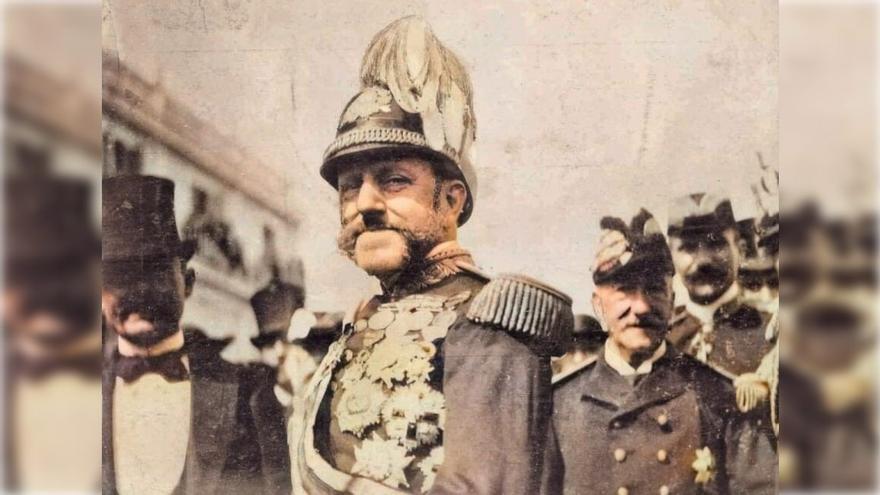
Cuba’s ‘Peacemaker’

Martínez-Campos returned to Cuba in 1876 with the mission of achieving peace. (14ymedio)

14ymedio bigger14ymedio, Yunior García Aguilera, Madrid, 8 November 2023 —  In 1895, when almost all of the rest of Latin America had already achieved its independence, we Cubans were still a colony of Spain. All previous attempts had failed: the Big War and the Little War. And Martí’s War, as Máximo Gómez called it, began with the early and unnecessary death of its principal brain.

The captain general of Cuba at that time was Calleja, who had some 14,000 soldiers throughout the island and did not attach much importance to the new uprising. He believed that the conflict would soon die down due to lack of fuel. But in Spain all the alarms bells went off. Almost immediately, Calleja was replaced by the man from Zanjón, “the most prestigious military man in Spain”: Arsenio Martínez-Campos Antón.

For most Cubans, Martínez-Campos is only remembered for the Baraguá Protest. And from this event we only have two sentences: “Guard that document,” and “We don’t understand each other.”

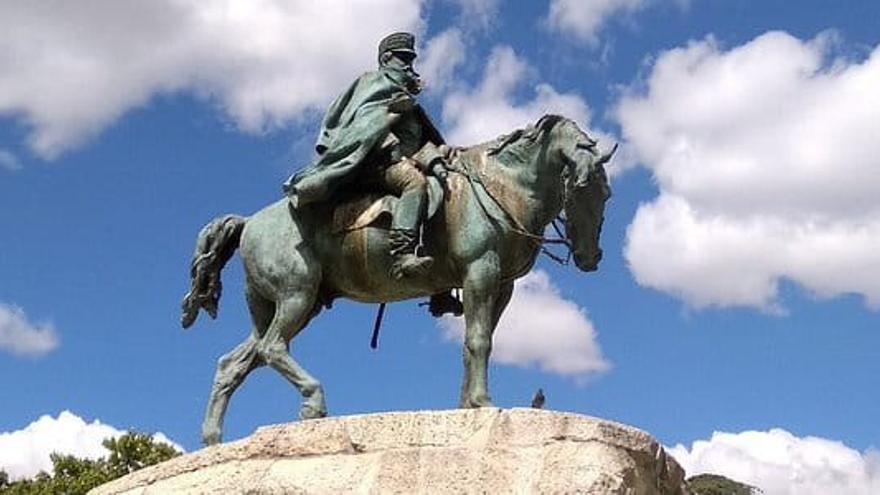
In Retiro Park, in Madrid, there is a solemn equestrian sculpture dedicated to the Spanish general. When I saw it for the first time, I thought about how little we Cubans know about a character who had a major importance in our history. For most Cubans, Martínez-Campos is only remembered for the continue reading

Baraguá Protest. And from this fact we are left with only two sentences: “Guard that document” and “We don’t understand each other.”

For the Spain of 1895, the Segovian was a figure of the first order, with extraordinary military, theoretical and political experience. He had returned from his first stay in Cuba with the rank of brigadier. He later participated in the Carlist wars and was the architect of restoring the Bourbons to the throne, becoming “the man from Sagunto” for the Spanish. In 1876 he returned to Cuba with the mission of achieving peace.

Much is said about Maceo and his protest against Zanjón, although in reality, the Bronze Titan, as he was known, had to leave the country shortly afterwards with a safe conduct. However, little is known about another great Cuban and another act of resistance: Ramón Leocadio Bonachea and the Jarao Protest. This was the last mambí left fighting in Cuba and the only one to reach the rank of division general in the war of 1868. And although he was also forced to go into exile, he returned in 1884, and was arrested and executed one year later.

Martínez-Campos returns to Spain as “the peacemaker” of Cuba. He held the position of president of the Council of Ministers and Minister of War. He then took charge of creating the General Military Academy. It is said that the decision to send him again to Cuba in 1895 did not unleash the general’s joy. The queen regent, at his farewell, saw him disheartened and pessimistic, and she was convinced that he was not the man to lead that war. It is also said that before setting sail, he murmured: “Who knows! What is now is not what was then. The pitcher can only go to the fountain so many times…”

The fall of Martí in the Dos Ríos skirmish did not diminish the morale of the Mambises, as the Spaniards expected. In June, Máximo Gómez crossed the Jobabo River, entering Camagüey against all odds. This depressed Martínez-Campos to the point of his wanting to resign. But later he would defeat Maceo in his attempt to take Bayamo with twice as many men, something that gave him back a bit of optimism.

In June, Máximo Gómez crossed the Jobabo River, entering Camagüey against all odds. This depressed Martínez-Campos to the point of his wanting to resign

However, doubt gnawed at the 64-year-old general. He was convinced that his attempts to negotiate peace were fruitless, because the parties had lost influence; because Spain had not finished applying the Abarzuza reform law of 1895, finally granting autonomy; and because the mass of the population supported the insurgents. He was aware that it would be inevitable to isolate the towns, reconcentrate the families and cut off supplies to the mambisado. But his Christian principles and character prevented him from such cruelty. He even said: “I think I don’t have the conditions for the case. In Spain, only Weyler has them.”

In November, Gómez harangued his troops, speaking of “the hard and merciless war,” in contrast to that “generous and brief war” that Martí preached. He had 3,000 horsemen to cross the trail that divided the island in half, and they succeeded. The Spanish spoke of a “fugitive offensive,” since the purpose of the invading column was to flee forward, avoiding confrontations and burning everything in its path. Martínez-Campos offered himself as bait, to provoke a direct confrontation, but Gómez and Maceo “wobbled,” leaving the Spanish general with all the desire, “fighting against fires and hurricanes.”

In February 1896, Valeriano Weyler was appointed captain general. But Weyler… Weyler is another story.

____________

COLLABORATE WITH OUR WORKThe 14ymedio team is committed to practicing serious journalism that reflects Cuba’s reality in all its depth. Thank you for joining us on this long journey. We invite you to continue supporting us by becoming a member of 14ymedio now. Together we can continue transforming journalism in Cuba.
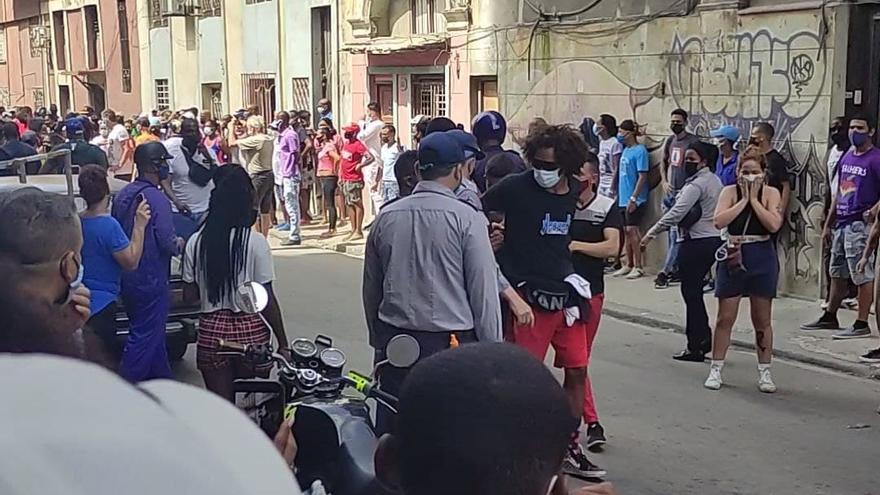
Cuban Totalitarianism’s Philosophy of Disposession

With Raúl Castro and his feint of a timid and fruitless opening, it seemed that the waters would calm down, but the general was only looking for Israeli investment. (Cubadebate)

14ymedio bigger14ymedio, Yunior García Aguilera, Madrid, 1 November 2023 — Unpopular Cuban President Miguel Díaz-Canel has called for “global action” to stop Israel. It is clear that the conflict in the Middle East is much more complex than sensational or biased headlines may show, but Cuba is far from being a neutral country in this story.

Cuba was the only country in Latin America that voted against the creation of a Jewish State, in 1947. Ramón Grau San Martín was governing at the time and his decision to oppose Resolution 181 responded to multiple reasons.

The Cuban intellectual Carlos Alberto Montaner met Dominique Lapierre, one of the authors of the famous book Oh, Jerusalem! When they talked about Grau’s decision, they referred to three fundamental reasons: the need to appear sovereign in the face of Washington’s dictates; the conviction that this would bring permanent instability in the region; and the corruption suffered by the Island, where many were willing to accept bribes from countries like Saudi Arabia. continue reading

Both political parties and civil society organizations, including the University Student Federation and the Cuban Workers Union, advocated for the recognition of Israel

However, Grau’s position did not enjoy great internal support. Both political parties and civil society organizations, including the University Student Federation and the Cuban Workers Union, advocated for the recognition of Israel. So, in 1949, the Jewish State was finally recognized and its admission as a full member of the United Nations followed a favorable vote.

Since 1959, the left wing of Zionism sympathized with Fidel Castro and his bearded men. They, for their part, decided to have a friendly relationship with Israel until the mid-1960s. Cuban socialists were fascinated with the kibbutzim, and Hebrew collectivists helped the Island in citrus production. But the submission of the young revolution to the interests of the USSR, as well as Arab pressures within the non-aligned movement, led Castro to break relations with Israel in 1973.

The decision had nothing to do with Zionist expansionism and everything to do with Cold War alliances. The closer Israel got to the United States, the more the Cuban regime became involved with the enemies of the Jewish state. Fidel Castro sent military advisors and instructors to Palestinian bases in Jordan to train the fedayeen. Cuba became the most belligerent non-Arab country against Israel at the UN, while it firmly supported the United States in its policy of sanctions against the Island. The Castro regime gave all its political and diplomatic support to the Palestinian Liberation Organization and Yasir Arafat was greeted with cheers in Havana in 1974.

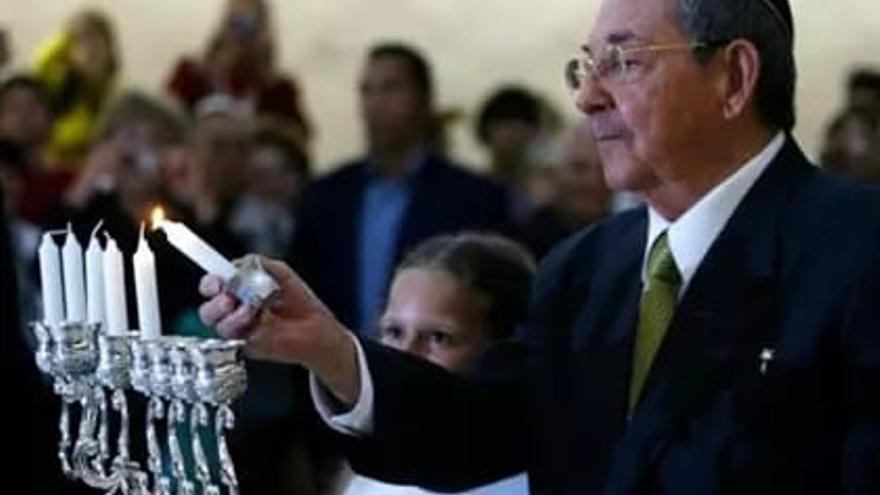
With Raúl Castro and his feint of a timid and fruitless opening, it seemed that the waters would calm down. The general wore a kippah during his visit to the Shalom synagogue in Havana in 2010. He was invited to light the first of the five candles on the fifth night of the Hannukah, the Festival of Light. He also spoke of the “fabulous history” of the Hebrew people and took the Torah to his home. But what really interested Raúl was Israeli investment in Cuba’s disastrous agriculture. If those people were capable of planting crops in the desert, what couldn’t they achieve in our tropical lands?

With Díaz-Canel, ten steps have been taken backwards and now the unmentionable plays at being the leader of the non-aligned

For pleasure. Fidel’s little brother did not read the Torah nor were our lands filled with milk and honey. With Díaz-Canel, ten steps have been taken backwards and now the unmentionable plays at being the leader of the non-aligned, assuming the strongest anti-Israel rhetoric and justifying the terrorist attacks by Hamas, a group with which he maintains fruitful relations.

With his usual dyslexia, Díaz-Canel has read in front of cameras an official statement for “global action” against Israel. Orphaned by his own ideas, he has once again cited Fidel Castro and his “philosophy of dispossession” as the fundamental cause of wars. And this is repeated by the same regime that unconditionally supports Putin’s Russia in its invasion of Ukraine!

The same dictatorship that stripped Cubans of their property, their rights and their freedoms, now talks about philosophy. The same regime that has taken our native soil from us, pushing us into a mass exodus, now speaks of dispossession. One has to have a very hard face to talk about peace when, in response to the most peaceful protesters, they threatened to call out the tanks and crushed our white roses with combat orders.

____________

COLLABORATE WITH OUR WORKThe 14ymedio team is committed to practicing serious journalism that reflects Cuba’s reality in all its depth. Thank you for joining us on this long journey. We invite you to continue supporting us by becoming a member of 14ymedio now. Together we can continue transforming journalism in Cuba.