Who Are You, Little Virgin? / Orlando Luis Pardo Lazo

Poor little doll made of tinsel and wood, so battered across the long and narrow stretch of thousands and thousands of kilometers.

Last night, I saw her in Lawton, and it was daunting.

Because of her, and because of the bleak surroundings.  A neighborhood polluted from the disposition of its inhabitants to the sky that hangs above, propped up by the electric poles that shine a poor pasty yellow light. Houses like caves. Light and faces like grimaces. Light and the feeling that none of these collective biographies should be called human, let alone “from God” (amorphous animalia, ignorant by way of amnesia).

Light that only shines from the “Made in China”[1] patrol cars and in the sequins of the motorized traffic brigade.  The light that has an edge, but no faith in the insolent and proactive eyes of State.

At around 7:00 p.m., in winter time midnight begins in Cuba. It seemed like people were willing to shout anyone down, entertainment hysteria to welcome the weekend in style, as if it were a reggaeton concert (the style of clothing of the young people present proved it).

The motorcade barely slowed down under the traffic light although the corner of 16th and Dolores was a sea of bodies. I heard women curse the mothers of the drivers. I saw people hit the hood of the cars (in a remake of the movie Midnight Cowboy). The smell of conflict in the air did not abate, but added a patriotic spiciness to our pedestrian concept of devotion.

We remember the Virgin when she arrives, that is once during each Revolution.

And indeed, in her glass or acrylic shrine, carrying the pillar of our national coat of arms, and between the Vatican flag and our nation’s heroic rag (without Byrne-style[2] romanticisms in the 21st century: our flag represents barbarity, and I do not love it even if they force me to, mostly because it is the source of demagoguery uniting dictators and democrats).

The anonymous insular Mary finally descended on her rented automobile from the chapel kept by the nuns of Concepción Street, far beyond the Lawton bus depot, the now useless railroad lines and the already putrid River Pastrana; in that stretch of sub-industrial forest that invades the capital from the Cordón de La Habana[3].

Mambí Virgin[4].  The crowd running, cars honking, chants, clapping, prayers from the loudspeakers, a rope to keep the faithful in line. Human circles trained in the parishes, aging and semi-alienated men with their particular quasi-military but Christian-inspired speak plus 1970s fashions that include a dress belt up to their belly buttons. How uncool is Cuba!

Raw collage: Help out the Cuban faithful! It is a masquerade in which Cardinal Ortega comes out from under his own sleeves, and walks up B street to Porvenir Avenue, turns right on 10th Street, then speaks. continue reading

Our prelate looks exhausted behind the microphone. The Cardinal knows that Cuba does not love him any longer, first for being a coward and also an accomplice (among other closet secrets handled only by the Office of Religious Affairs of the Central Committee of a godless party).  No one pays attention to Jaime, “no thistle and no caterpillar”[5] he plants.  A drunkard kisses his hand, and the boys of State Security send the sudden devotee flying back to his non-place on the sidewalk.

And it makes sense that the words of an elderly man do not engage (nor fool) Cuba on this night: the superstar tonight is Cachita[6]. Besides, Ortega, since he first appeared on Cuban television without promotion or credits, keeps talking about Antonio de la Caridad Maceo y Grajales, a 19th century Cuban general who, before going out to kill his fellow men (or be killed by them), checked to make sure that he had, in his breast of starched mulatto, a little medal of the Virgin made of noble metal.

Then, the head of the Catholic Church in Cuba stops speaking, and finally is our turn alone with the headless incivility of the island.  And, we shower ourselves in vandalism: against the temple’s iron gates and up the steps, a movie scene not silent but screeching. Hundreds, thousands. Girls, old men. A man whose mother assured me that he had had a heart attack very recently. A lady whom I lifted from the sea of legs that would have crushed her (she was bleeding from her calves). And again expletives, holy debauchery.

The clerics and seminarians screaming with diction too correct to be violent, almost excommunicating their fellow congregants with primary school teacher admonitions like “if you don’t behave, there will be no virgin for anyone in this neighborhood.” We witness an avalanche of soccer finale proportions, or, of course, a concert in CUCs[7] for thugs who understand nothing.

This is our undeniable raw material (you cannot perpetually impose a myth from the minority, be it the Gospels or History Will Absolve Me[8]).  But, this stage set is missing the elite police brigade: the Special Forces units that perpetrate peace in a Special Period[9].

It is obvious that the Cuban state is interested in making the Catholic Church aware that so many processions a year will create a tragedy for them (I saw several women, all of them black, semi-unconscious being carried to different destinations). Let them buffet each other for a bit amid polyphony of laments and curses. But, it is obvious that some other worse curse words cannot be heard here:  “Liberty,” for example.

Right at that moment, some guys chide me because all of my pictures are focused on the people’s fisticuffs. We then argue over the possession of the truth.  I show them my white t-shirt that says “Laura Pollán Lives”[10].  They swirl around me and surround me while a woman loudly asks me from a distance for whom I work (they all have the language of the counter-intelligence TV series “Las Razones de Cuba”[11] and that of the official blogosphere), but I am already inside the temple, and I seek refuge by the main altar to capture the faces blessed by an Italian priests whose smile I cannot call divine, but democratic.

No wonder I have a work credential to shutterclick away without having my camera stolen or shredded “by mistake” or “by chance.”  And the Virgin that mother of all Cubans who precedes even the motherland, what is the Virgin doing here in her own procession?

Each prayer and each tear is accompanied by a picture taken with a cell phone. Our Lady of Charity is therefore a little bit of pop icon amidst so much media fruition (Nokiarity Syndrome). Her disposition seems a bit timid despite her olive skin, so clean and congenial, Cecilially she is a Valdés[12].  And, with a certain wooden modesty, it could be said that our virgin hides in Islamic fashion under her cloak of sorceress queen. Perhaps, it will be difficult for her to discern whether she is worshiped by subjects of God or Nothingness.  Perhaps She knows more than a few things about tomorrow (with that sad grimace of hers). Perhaps she feels very lonely, condemned to carry that baby who does not grow for eternity.

Poor little Cuban virgin, so fragile, surrounded by a flower holocaust, petals with that smell so peremptorily funerary.

Poor little virgin surrounded by the medieval Cuban populace, forced to the insomnia of the donated electric fans, walled behind that music so falsely happy for when death comes to us, egged on like a fugitive by the brown-out looming over the convent confiscated and turned into a school (this is precisely how the totalitarian state imposes its narrative: turning on and off the central switch).

Poor, oh poor, our Cachita, so invisible under the greedy gaze of the mob, willing to be Maceos in exchange for a quality miracle.

Poor, oh poor, my darling, so Cuban and yet no one in Cuba knows it because they are content with lighting some candles to you and asking you for a visa to the United States. No one spoke of love, my darling. No one in this island or in the Exile ever knew who you were. Now, for example, they will charge against me, but you and I secretly know very well that you and I recognized each other at least this once.

Little Virgin without name or history.  Little ephemeral Virgin of my soul that fades already. Little Virgin of Truth.


[1] In English in the original text.

[2] Refers to Bonifacio Byrne, a Cuban poet who wrote a famous poem to the Cuban national flag from the ship that brought him back to the island in 1899.

[3] El Cordón de La Habana (Havana Cordon) was a plan created by Fidel Castro to plant Caturra coffee beans (a Cuban native variety) around the Cuban capital in 1971-73.  Predictably, the plan failed because of soil incompatibility and administrative blunders.  It did manage, however, to successfully eliminate most of the little individual vegetable gardens in the area.

[4] Mambí were the Cuban rebels who opposed and rose against Spanish rule in the 19th century.  Many were devotees of the virgin, and carried her image into battle.  Virgen Mambisa is also the title of a 20th century hymn to the Our Lady that can be heard here:  http://youtu.be/cq9kGJ44ecw

[5] This is a play on words from Ortega and a verse in José Martí’s poem “Cultivo Una Rosa Blanca” that is in turn part of “Versos Sencillos,” a compilation of poems. The verse reads “cardo ni oruga cultivo/cultivo una rosa blanca”: “neither thistle nor worm I grow/I grow a white rose” roughly.

[6] Cachita or Cacha is a nickname given to women named Caridad (Charity) in Cuba.  The ever cheeky Cubans have given it to Our Lady of Charity as well.

[7] CUC is Cuba’s “convertible” peso, one of the two currencies in use in the island.  It is artificially paired to the U.S. dollar.

[8] History Will Absolve Me was Fidel Castro’s defense speech at his trial for the assault of the Moncada Army Barracks in 1953 in Santiago de Cuba. It was later made into a book, a sort of tropical Mein Kempf (from which it borrowed heavily, including the phrase used as its title).

[9] The Special Period (Período Especial) was the name given by the regime to the period of extreme economic straits following the collapse of the Soviet Union (Cuba’s main political and economic ally and subsidizer) in 1991.  Its end is not very well defined, but seems to have been around the time when the late Venezuelan strongman Hugo Chavez started to send oil and money to the island.

[10] Laura Pollán was the leader and founder of the Ladies in White, a group of Cuban women whose husbands and/or relatives were imprisoned during the purge known as the Black Spring of 2003.  They have marched, and still march peacefully every Sunday after Mass carrying gladioli and dressed in white asking, initially, for the release of their loved ones, and, now, that the regime respects the human rights of all Cubans.  They have been subjected to extreme abuse by the regime and its goons.  Laura Pollán died under mysterious circumstances in 2011.

[11] “Las Razones de Cuba” was multi-part a documentary produced by the counter-intelligence services of the Ministry of Interior in Cuba that supposedly unmasked covert operations of “enemies of the people” and revealed how the government has infiltrated the opposition movements.

[12] Another play on words: it refers to Cecilia Valdés the main character in the 19th century novel of the same name written by Cirilo Villaverde.

Translated by: Ernesto Ariel Suarez

8 September 2013
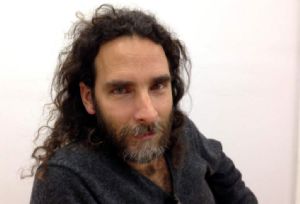
Orlando Luis Pardo : “I was afraid when I had no voice, when I started talking, I lost the fear.”

int-552362Interview by Emilio Sanchez Cartas – from Los Andes Internacionales

The restless, multifaceted Pardo Lazo graduated in biochemistry from the University of Havana, but left the field after 10 years. Since then he has been working as a photographer and writer.

Pardo, who published several books in Cuba, is currently one of the leading independent bloggers. He maintains two blogs (Post Revolution Mondays and Boring Home Utopics) and founded the magazine “Voices,” the first digital publication on the island. The magazine, devoted to literature and opinion, is printed in very small quantities, and is posted on-line as a PDF and distributed throughout the island via CD and flash drive.

Emilio Sanchez Cartas: The United States presents you as a dissident blogger. Interestingly , years ago you said you said you didn’t feel yourself to be a journalist, “neither by vocation nor spirit.” So perhaps you started out hating to be a journalist and ended up being one…

Orlando Luis Pardo Lazo: I greatly respect the profession of journalist. When I say I want to have a column, I’m referring to having a space of freedom where I can exercise my opinion, with certain editorial standards, but without the hard or scientific data, statistical.

I wouldn’t work in favor of consensus: it would always be  a journalist of provocation, seeking to navigate upstream. It would be a more creative column, but grounded in reality, because I believe in the transformative power of writing. I like to exploit the social impact of writing from a position of provocation, always trying to pluralize thought.

ESC: How do you evaluate the impact of digital technology in the social and cultural life of Cuba?

OLPL: The Cuban government has just opened a hundred Internet access points, but with extreme vigilance, no guarantees. They are trying to portray an image of openings, but the truth is that a citizen can not go to a public company and contract for an internet account.

Therefore, there is no internet access in Cuba, although there are officials who do have this privilege; there are certain tourist hotels that offer the service in dollars and also a black market in the Internet. With all these limitations, the Cuban blogosphere still has a good number of blogs.

They began as a form of personal expression, perhaps as catharsis, but now I think there is a civic impact. Recently, many of us have been able to travel, to join the United Nations Correspondents Association, to appear in U.S. newspapers. We have talked and they have recognized us as interlocutors, active and thoughtful voices of Cuban civil society.

In addition to “Voices,” there is a photojournalism contest; spaces of debate like “Citizens’ Reasons” and “State of Sats” [Estado de Sats],which are filmed and posted on the web; projects of street artists, graffiti artists, independent audio visuals; the Rotilla Festival, dedicated to music, organized by the Matraka Group for ten years on a beach, until the Cuban government intervened and hijacked it; the Endless Poetry Festival, of the Group Omni Zona Franca, all month in December, house by house in eastern Havana. All these projects are outside the Ministry of Culture and will survive, because they don’t depend on the State.

ESC: At this level of writing, what are the most interesting and challenging blogs?

OLPL: I recommend reviewing three portals. HavanaTimes.org, where a score of people post, some of them from exile; Bloggerscuba.com, although it disappeared as a portal, you can find individual blogs: Paquito el de Cuba, by Francisco Rodriguez; Negra tenía que ser, by Sandra Alvarez; and La Polémica Digital, by Elaine Diaz.

And, my website, where the blogs are more controversial, Vocescubanas.com. There are the three visions. In the case of Vocescubanas, there collaborators who from anywhere in the world would opinion columns in newspapers or television programs, or be political.

ESC: Ten years ago there was the view that Cuba’s independent press, although very critical of the regime, was not known for quality journalism. Have you evolved? Where is the product of journalism on the island? Where is the questioning of the Cuban reality?

OLPL: There is no journalism. It could be erased at the stroke of a pen by the Faculty of Communication and its journalism courses, because in practice the product doesn’t exist, except outside of Cuba. We have occupied that space; some bring better tools, with skill in argument. Others do it almost without tool, but always reporting, from the news, what foreign news agencies do not want to cover.

That has a tremendous merit and a huge recognition. We have the experience of the Blogger Academy. In 2010 for almost half a year we met twice a week to talk about programs, journalistic and photographic techniques, issues of civil society and the law, anthropology. We have made an effort, because where we can’t go is to the University of Havana, as the government has set up a kind of “cultural apartheid,” where we have no room for those who disagree.

ESC: And the independent press, including bloggers and traditional journalists, is it in good condition today?

OLPL: It is in good condition, but in a committed way. Today there is an explosion because certain areas abroad welcome our reports. We lack a press that is edited and published with local efforts. We lack a newspaper — the dream of Yoani Sanchez — which can’t be legal, because the government does not support it; we lack also a radio station.

For now, some of us bloggers are covering this absence, but that could change any day with the absence of some; if some die and others are exiled, and then it would be the end. So it is a movement that needs to be supported, strengthened, empowered, from the outside. We need international solidarity.

ESC: In Cuba, to be a journalist or independent blogger involves risks. You yourself have been imprisoned. What has been your experience of fear?

OLPL: I was afraid when I had no voice; I had published several books of fiction, I was a member of the Union of Writers and Artists (UNEAC) and yet I was very afraid. As I began to speak, I lost the fear. Now I have no fear. Fear of what ? The only thing that can happen is death.

When Pope Benedict XVI visited Cuba in 2012, I was put in jail, it can be repeated at any time. The official journalists are very frightened perhaps, as are the ministers. Me, no; for me they will come once. Is that when you cross a line, and you are free. And self-censorship? Not at all. There are people who self-censor.

I worked the issue of marijuana, the Cuban Rastafarian community’s use of grass, and about the imprisonment of a Rastafarian priest, who is still in prison, Hector Riscart, the Ñaño, director of the musical group Herencia (Heritage). I investigated, did interviews. Someone advised me to stop. I did not, because I considered it a matter of civil law. Many people get panicky over the  issues of the subculture issues, pornography, racism. I ‘m willing to talk about everything, and I think I ‘m going to be very alone.

8 September 2013

Voces Magazine Returns / Orlando Luis Pardo Lazo

The magazine Voces [Voices] welcomes you to a plural space,
where you can always say what you think
and respect the diversity of opinions.

After a necessary silence for those of us who want to express ourselves freely,
Voces reopens its pages to collaborations, with the only purpose to unite all Cubans in the world.

Although issue #18 is titled “Is the transition in Cuba a utopia?”
you can publish about theater, visual arts, ethnoculture, gender, politics, philosophy, ethics, narrative, poetry, recipes, lyrics, good public messages, publicity and more.

The texts should be between 500 and 1,500 words.

Those who want to write about the topic of the dossier for this #18
the deadline is Monday, September 9.

For the rest, we are open 24 hours.

A secure email until 1 October will be:

menosveinte@gmail.com

That’s it, María Matienzo Puerto

2 September 2013

Every Night, The Night / Orlando Luis Pardo Lazo

unanoche270813
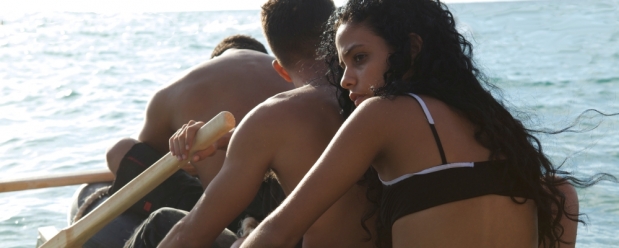
Image from “One Night” by Lucy Molloy

People without God and the State, after the incessant media deaths of Fidel Castro, as in a classroom-cage that’s been left without their despotic teacher, our society is doomed to becoming unhinged overnight. Even in a single night, without having to wait for the morning, our little lives can experiment the one thousand, nine hundred and ninety-nine anecdotes and extract from them a single significance.

In effect, Cuba is beginning to resemble a tele-play, class Z revolutionary themed. An uncaptioned series. Pasture for foreign productions. Scenario where all the characters are extras: scraps of the script floating in the wind of an unbearable island dullness.

Nothing is old under the same post-socialist sun. Ecclesiastical guidelines. Newspeak, newhistory, New. Cuba is not the tedium of a cinematic Moebius strip with no inside, no outside, but rather it is an empty adventure in the style of The Matrix, where the despotic power is unseen but present. And where all that still shines in the middle of the barbarity are the glasses of the General President, whose clapperboard controls not the fraud change but the unchangeable fraud. Ad islinitum.

Much of this televised velocity is included in the copy-and-paste of a New York film, One Night, from the director Lucy Molloy, a film made in Manhattabana that even its actors mistook for a reality-show, using it as a springboard to escape the Castro catacombs of our Caribbean North Korea.

Here in the beginning and at the end it is the verb: the action, the persecution whose only purpose is to take away from Death a few minutes of film, cut to Che. Poetics of the video-clip, of the ephemeral gimmick, of the superficial that almost always is a symptom much more sincere than so-called profundity.

The rush-rush of faked sequences, anger and haste, sometimes with hints of a fake police documentary. Words like kicks. Free, crazy and loquacious language, as befits a professionally amateur cast. And, in the background, in addition to the redundant Cuban music, it’s not even necessary to voice-over Desnoes’ rudeness that our capital “looks like Tegucigalpa.” And it doesn’t seem so at this point in the story. The ironies of Memories of Underdevelopment confronting the illusions of the Left, at half a century of totalitarianism, is already an inevitable background, spontaneously occupying even the worst of tourist photographs of official propaganda.

One Night is not a bad story-board for when Lucy Molloy returns to Havana one night, not only to recreate but to create the tragedy. We need that, a culture without capitalist guilt  resulting in an “unjust” dessert for the Cuban people. Or “inappropriate” before the altar of American academia (without the Revolution there would be no PhD theses nor copyrighted textbooks). I fear that we need a reactionary filmography. From the indecent Right. Neocon. Movies disposed to precipitate the debacle not from art, but from the disaster.

The other would be another half century of kitsch.

Cubansummatum est!

From Diario de Cuba

27 August 2013

Alejandra of Death / Orlando Luis Pardo Lazo

It happened in Chile.  A sadistic Chile.  No one should forget it.

 It was in a criminal Chile which was Castro’s gift to Chilean communists, forcing that country to choose between the intervention of the military or a perpetual communism, Cuban style. Typical of Fidel: the Comandante’s options have always been the same, those two, indistinguishable:  death your way, or death my way.

In the seventies, the Cuban Revolution had to make one thing very clear when it came to international intrigue:  the Chilean way was a piece of shit, the only option for communism was a battle to the death against democracies.

Allende was the happy puppet of the Island and of Moscow:  a mad and half blind lawyer, with even a little Garcia Marquez in his build, who at the end must have faced some ultimatum from Cuban security itself at La Moneda, so that he would not accept the exile with which Pinochet wanted to humiliate him.

She was called Alejandra.

Alejandra de la Muerte.  She was more than a communist, she was a criminal.  Like all of them then.

When she fell in the hands of the military thugs, she didn’t risk being able to stand even the very first of the torture sessions.  She also didn’t know how to kill herself (normally it’s much easier to kill others).

She was brave.  She surrendered and that was that, in advance.  She accepted everything, paid the price of being a human rag-end, so  long as she could reach the future, so long as she could reach the democratic Chile of today and then dynamite it all over again.  She gave up false names, and names it made no sense to name, because death had reached them before her naming.  But here, some malevolent mind looked her in the eyes and said:  skinny girl, cookie, you will be our exterminating angel.

And they would take her for rides, on outings.  To take the air through a cemetery called Santiago de Chile, between the mountain and the ocean, in ice and desert, between death and death, just as Fidel asked of his colleague Pinochet.

Horrifying that this occurred in America, in the plain light of day, in the twentieth century.

They would put skinny Alejandra in a car and take her out like a hunting dog on a chase, to name accomplices, to destroy the destinies of survivors.  Alejandra de la Muerte had to recognize her old comrades, had to condemn them to death with a finger:  that one, that one, that one…

That one, that one and that one, Alejandra, you killed them, you did.

The assassins only stalked them by conviction, because that is how dictatorships render judgments, even the Cuban one: by pure conviction.  And they killed them thanks to that angel Alejandra, who never died because she was an angel, and so she outdied everyone and everything, until she became a professional, even though she had been condemned to death by her comrades in clandestine worlds in Havana and Santiago, with the funerary bugle ringing between Washington and Stockholm.

A car crammed with torturers, a perfect red Lada.  Alejandra surrounded by death and promoting the death of Chileans thanks to the Cuban Padre de la Patria.  Death more death more death: the formula of fidelity.  Alejandra recognizing her old friends walking free on the street, or some old lover, or sometimes, for the sake of pure humiliation, she would finger some innocent who was then condemned to die.  All of it, everything, just so that her life could give testimony of what a human being can do to a human being in the sacred saintly name of Revolution.

How can one survive those limits and justify oneself? I tell the story suddenly and suddenly I want a suicide, for her, for all of Chile, for Cuba somehow, for me.

Alejandra, kill yourself now, my love.

21 August 2013

Carromero’s Courage / Orlando Luis Pardo Lazo

carromeroindexTranslated by Alex Higson.

From Sampsonia Way Magazine.

You must have nearly suicidal courage to accuse Cuban State Security, an offshoot of the Soviet KGB which has thousands of officials and millions of collaborators on and off the island, of a double murder.

The accusation comes from Madrid, from Ángel Carromero, of the youth wing of the People’s Party, who was extradited from Havana and is still serving a four-year sentence, having been accused of the deaths of Oswaldo Payá and Harold Cepero, the leaders of the opposition Christian Liberation Movement (MCL), who were his passengers on July 22nd, 2012, along with the Swedish Christian Democrat Aron Modig (who like Carromero was not injured at all).

Modig was deported to Sweden a few days after the incident, and he remembers only that he was asleep at the time, although he has asserted his confidence in the Spaniard’s version of events. Carromero related his story to The Washington Post and El Mundo, as well as on the radio and television. He also confessed all in person to Payá’s daughter, the human rights activist and new leader of the MCL, Rosa María Payá.

According to Carromero, the collision was not an accident (as he had initially claimed on video, coerced and injected with as yet unknown substances). According to him another car pushed them off the road in the east of Cuba, and uniformed and plain-clothes men took the two foreigners by force to a hospital in Bayamo. Hours later, both Cubans were corpses. The Cuban State has never explained who took them all to the hospital.

Although he has no evidence other than some text messages sent from the hospital, his conscience wouldn’t leave him in peace, and Carromero broke a tacit pact with the secret power of Castroism: its State Security. The easiest thing would have been to incriminate himself of “involuntary manslaughter” with his silence. But not even that would have saved him as long as he was a witness: he would still have been a dead-man-walking.

Now, thanks to his voice and Rosa María Payá’s, the world is coming together to call for an international investigation into the violent deaths of two peaceful human beings with no criminal records. The truth will set us free. Thank you, on behalf of Cuba, Ángel Carromero.

1. THE GREAT AMERICAN NOVEL I HAD TO WRITE / Orlando Luis Pardo Lazo

CHAPTER 1.

To enter the Metropolitan Museum in New York and be disappointed before the ruins and statues. Rags, stones that were columns, oxidized jewelry, masks of invaluable value.

To spit in a corner, in the corner most accessible to the security cameras. To be filmed. To be seen, detectable. What more can a newcomer ask for, if not the power to call attention to exactly one in the midst of a multitude passing by, grazing.

To expect, then, that the gendarmes of decency come for you. For me. To desire arrest, to provoke it. To prepare a speech of defense, which functions as performance in the headlines this same afternoon. To be read, commented on. Raw material for forums, fire of anathema for the prudish preachers who shape the concept of this nation. To become a cult author in the very heart of democracy. To be someone. To be. To become at least a carnival attraction, a circus creature. To discover that overnight we are a viral reference, virtual. America is the place where even fiction is truth.

To hawk. To spit with bad intentions. Not only on the immaculate tiles, but also on the wall. The next step would be to throw up on some pedestrian. But it is by choice. Nothing ever happens here. Like there, on the Island. Like everywhere.

The security cameras have also been abandoned at this brunch time. We live in a welfare state, half a century after the Welfare State. My poor spit. The saliva freezes, twists in the frost, appears out of the blue. It is Cuban saliva and still not adapted to the snow flurries of the USA.

In fact, it has been a long winter, very long. Almost half of the 2013. April is not enough for spring, we should expect the fall. The Weather Underground. Everything looks to be slightly out of time and yet, nothing provokes anything in this country. Nobody is the intimate and intimidating name of freedom Made in New York. Freedom, a despotic goddess imported from China, like each one of the objects that happen here. That happen to me here.

I think about the museum-worthy bodies of Tiananmen Square. Thousands of students on vacation for centuries and centuries, amen. Eternity begins in 1989, probably in summer. No one is guilty. The capital is unpunished, lewd, unpredictable. The comrades are involuntary executioners. Moreover, they themselves sought it, with their anti-tank flowers in exchange for a few Nobel Peace Laureates. Funeral flowers, like the gladioli that Sunday after Sunday some Ladies in White brandish to the sky of my country.

Today could be it, I don’t know. Sunday. Day of the Lord of History and the Son of Humanity. Please. Luckily, I no longer have any country. I am a ghostly lady-in-white, in white. No need even to be Orlando Luis.

You go to the Metropolitan Museum in New York and you’re disappointed before the ruins and statues. Rags, stones that were columns, oxidized jewelry, masks of invaluable value. Mummified residue. Debris, reiteration.

You look at each object as if History were still possible. As if Humanity were possible. As if the culture itself was nothing but the countless bodies of a children’s book called The History of Mankind.

To breathe. To walk through looking at rooms and spaces. Anachronistic lights. Alarms as futuristic as they are ineffective. Drains from before the founding of New York, in exchange not for a mirror but for an image (in all cases, delusions). Screens with movable maps and arrows and a wiki-chaos if audiovisual signals. Pixels without a country. Impossibly making themselves invisible in the Age of Google Maps. Impossible to be seen in the capital of the thousand and one Apps every 24 hours 7 days a week.

In the body not even a hint of the heating system. The body is pure numbness. Like the memory, like the silence. The Spring is almost over and still the cold penetrates. But everywhere those same dwarves in casual wear keep coming, smiling from their eight or nine years as if they really have their whole lives ahead of them They do not know, they do not come from where I come from. It is better not to know, not to go where I come from.

I look at them. Not with malice but with evil, which is the best way to impose on them the misery that is all mercy. They wear unnecessary little glasses. Chew aromatic gums, display tattoos from the recycle bin, drink a fuchsia liquid from a thermos capable of resisting nuclear winter. Take pills to pay even less attention to their surroundings and, yet, meticulously point out every detail. They type on their iPhones or iPads. They look like aliens who should rebuild our civilization on another planet or resign themselves to humiliatingly failing their homework.

Their jaws fall into aesthetic ecstasy or intellectual idiocy. The Ritalin Revolution, mouth breathing. They never stop moving between the paintings. When they suddenly crouch in some corner, then they carefully read — and will do so until the end of the universe — the most recent luxury edition of The Story of Mankind. Van Loon’s lunatics.

Hardcover and art paper. Flaps. These volumes should weigh more than a ton in their hands. Better not to think about the price. I observe them turning the pages, hyperkinetic, with the arrogance of someone who practices a perfect school diction. Ballet of barbarism. Surely born bilingual, trilingual, multilingual. They highlight sentences with aqua-colored markers, mnemonic devices to win the scholarship now that will open the doors to a PhD in copy-and-paste. From the cradle to the academy to the condominium.

To read at this age is, of course, to read aloud, to struggle between spelling and the obligatory orthodontia of dental insurance. They read like little magnets praying to a material god. The skin hyper-sanitized with synthetic alcohol, glory of the carcinogenic chemicals of this nation. The Age of Horror: who’s afraid of José Martí? They are not children, they are the hope of the world. Mankind is waiting to make History of them.

The smell of something aseptic emanates from each paragraph. From each image printed with organic, or maybe transgenic, ink, impossible to tell. Everything is impossible when they are hungry and the clocks just struck thirteen, although in all of the blessed Metropolitan Museum nobody would recognize William Smith in anyone.

In the United Stated the excess of public libraries guarantees the right to not have to read. Also, we Cubans, nobody calls us anything. We even passed the year 1984. We are anachronistic. To Cubans, at most, American children ask us if we are from Miami or from Fidel. As if the difference were possible. The exiles are easy targets for these American children who ask a politically improper question because there is no polite response. Pinga.

New York, New York: Why have you forsaken us?

My throat is dry. No more rudeness or phlegm. The April light is friendly. In Havana a few days ago a criminal sun beat down on me. An ahistorical light, unsupportive, transparent to the point of murder right on the Lord’s Sunday. Our daily and delirious Habanada. Fidelity, fascism, frames that soon become part of the most lying touristic museum tour of the fifty states of the Union.

6 August 2013

Landy* and Lunacy / Orlando Luis Pardo Lazo

The nutcases approach me.

In Cuba it was the same. The United States need not be the exception.

Crazy. Beautiful. Docile. The sufficient causes of great massacres lie at the margins of great truths.

Cubanness, for example.

There is no genocide more perfect than Cubanness.

It began with torture on a ladder, and a poem bad and then some forged two hundred years later.  A mirror of tackiness.

Remember the slap that Antonio Maceo gave José Martí?  It wasn’t a punch, it’s written in the confiscated pages of the victim’s Campaign Diary.  It was a slap, which is how women in Cuba are hit when they misbehave or, as in this case, when they don’t shut up and they think they own all the explanations.

Martí as a faggot among the mass of mulatto machos from the mountains.

Maceo, with thousands of deaths under his belt, who, according to another war diary, killed an informer, a black woman who sold sweets in the rebel camp.  She didn’t choke from the rope, due to her rickets, so the bronze tyrant** lowered her hanging body so that he could break her neck and finish her off.

I love my country’s history.

My beautiful and lovely homeland.

Trucks drove up the Sierra Maestra with arms and drove down with coffee.  Batista’s little criminal soldiers, who couldn’t even kill flies, had to be paid 500 pesos (the ones that could kill weren’t there, but rather awaiting some declaration from the Sierra Maestra itself to go behead the leaders of the urban underground).

Things started early, don’t be fooled.

The armored train cost a pretty penny, but it paid off.

It seems that Martí too hired this or that anarchist for some selective assassinations there, in the very same metropolis that, in the end, won the war against Spain (the bloodiest that a New Yorker like him could imagine).

None of this is mine, I say it as a warning to those “democreformers” who follow my writing with guilt, trying to excommunicate me from their big bland cake of a homeland (anyway, I don’t want to chew on those scraps).

All is apocryphal and I disown responsibility among so many spokespersons.  They’re only nutcases.  Beautiful little nutcases that approach me and tell me their stories.

In Cuba as in the United States.

I still don’t understand exactly why.

Maybe they see in it my eyes.

They see that my eyes are the only eyes in the world that won’t forget their historical horror.

They’re right.

Never.

I love them so much that I couldn’t survive if one sensible day they ceased to approach me.

You, come to me now.

Translator’s notes:
*
Landy is a nickname used by Orlando’s closest friends and family.
**This is a pun on El Titán de Bronce (The Bronze Titan) the historical sobriquet by which Maceo is known among Cubans.

Translated by: Alexis Rhyner and Yoyi el Monaguillo

12 June 2013

Castro vs. the Cuban People: Where was the President? / Orlando Luis Pardo Lazo

Photo courtesy of Orlando Luis Pardo Lazo

With a speech that lasted 35 minutes, Commander in Chief Raúl Castro destroyed the very last traces of the New Man that would complete the 1959 Castroist revolution. In doing so he created a paradox in which a leader accused the masses of living without moral and civic values: Without honesty or decency or shame or modesty or honor or sensitivity or solidarity.

Raúl Castro (who is also the First Secretary of the Cuban Communist Party and President of the Council of State) made this condemnatory speech on July 7 during the 8th Legislature of the National Parliament. At times, the General seemed to be on the verge of ordering an ethnic cleansing of the Cuban nation. He threatened to impose discipline at any cost, even though we Cubans are used to that after more than half a century of watching the government use repression as a mechanism for creating consensus and governability.

So, the governing elite is now discovering that the island is in ruins, and that its raw human material is reprobate at best, guilty of: Theft, impunity, squatting, black-market dealing, noncompliance with working hours, illegal slaughter of livestock and endangered species, breeding animals in the city, hoarding products in short supply and reselling them at higher prices, illegal gambling, bribery and perks, harassment of tourists, computer hacking, drunkenness, swearing, and littering in public (as well as defecating and urinating in parks and on the street), graffiti, pounding music, academic fraud, vandalization of phone booths and pylons and even drains and traffic signs…

For speeches similar to Raúl Castro’s most recent one (what we can call a Cubanicide), many people who are critical of the socialist system have been officially punished with ostracism, stigmatization, jail, exile, and death.

The question that never gets answered is this: Where were brothers Fidel and Raúl Castro while Cuba was falling to pieces? Were they ignorant or inefficient or indolent?

From Sampsonia Way Magazine

22 July 2013

One Year After the Scaffold / Orlando Luis Pardo Lazo

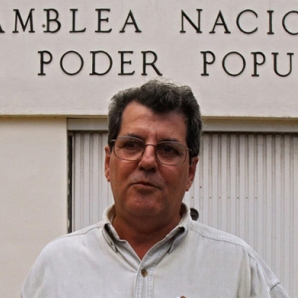
Oswaldo Paya at the entrance of the National Assembly of Popular Power in Havana. (CUBAOUT.WORDPRESS.COM)

I waited until the end of the line, after hundreds of mourners had filed past his casket. It was the month of July, criminally hot. In the Savior of the World parish in Havana’s Cerro municipality, the wake was being held for the founder of the Christian Liberation Movement (MCL): Oswaldo Payá, 1952-2012.

I bent over the glass of the humble box. There was the national flag, with its ever repressive geometry of blue and white bars, and that red triangle with the star like a predatory eye. The odor of dead flowers was unbearable, along with the hypocritical incense of a Church whose Cardinal is today almost a minister of the already fifty-year-old Communist government, turning his back to the faithful as at so many other times in our national history.

I looked at the face of Oswaldo Payá. He had a bruise on his left cheek. Among the Cuban exile, he was accused of being a supporter of the Castro regime for working for a peaceful transition to democracy :from law to law,” one that would redeem the truth and not end up in the fraud-change of exchanging one military caudillo for another in a suit in tie. In the ranks of the opposition, he was criticized for the virtuoso vehemence of this convictions. The loneliness of that fresh corpse was typical of our martyrs.

I thought about how the life of the young MCL leader named Harold Cepero had been claimed along with his. And at this point it was as if Oswaldo Payá looked at me with guilt, without needing to open his eyelids, heavy as backdrops.

At that moment I had a sweeping vision, inspired by the radio address I had just heard in the voice of his even younger daughter, Rosa María Payá, who announced to the world, with pain but great self-possession, that after decades of surveillance and constant threats, her father had been attacked, as demonstrated by the text messages sent to Sweden and Spain by the two foreign survivors of the “accident.”

In my vision, Oswaldo Payá was taken from the rental car he was traveling in and tried in situ by a military court, which condemned him to death without letting him speak, to satisfy the old personal vengeance of the Commander in Chief of the Revolution who never forgave him for being a free and happy man inside Cuba, capable of collecting more than 25,000 signatures against him, of speaking without fear but without hatred in his heart on receiving the European Parliament’s Sakharov Prize, and being on the point of receiving of receiving the greatly deserved Nobel Peace Prize (a title that Fidel Castro always coveted for himself).

Then, a trickle of blood began to flow from the left ear of Oswaldo Payá, streaming down his neck to settle in the pocket of his shirt. No one else saw it in the church packed with opponents of the regime, foreign press and infiltrated secret agents (all indistinguishable in more ways than one). Without realizing it I started to cry. The tears ran down my cheeks, I was powerless to control them. People called me from abroad and I reported crying, although I wouldn’t say I felt sad; I was just devastated. What had begun with some guerrillas who executed without trail since long before 1959, now ended with a State assassination, meanwhile investors in the free world are already counting their money to invest, seeing themselves investing as the saviors of the last totalitarian utopia on Earth.

The MCL’s Varela Project, the idea of reducing the tyranny by ordering it to comply with its own legislation, still exists today, and no Cuban official (not today and not tomorrow) will have legitimacy as long as the National Assembly of People’s Power does not comply with what it stipulates, and recognizes that this citizen’s petition came to them from within the framework of the constitution. This legacy of Oswaldo Payá will survive the Castro brothers. And even the capitalism-without-human-right that is being tested today in order to enthrone it after the Castros.

It is quite possible their crime will go unpunished in legal terms. But the lives of Harold Cepero and Oswaldo Payá (having been torn away as in my vision or in some other cruel way) are already a living gospel, patrimony of all Cubans, so that the violence of the State will be incinerated in Cuba along with the last of the green-executioner uniforms of State Security.

Translated from Diario de Cuba. Note: This is a longer version of an article that appeared a few days ago in the Prague Post.

22 July 2013

In Cuba, Oswaldo Payá’s name lives on / Orlando Luis Pardo Lazo

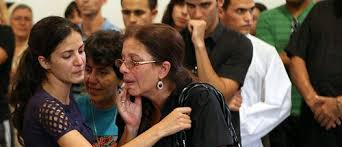
Rosa Maria Paya and Ofelia Acevedo at the funeral of Oswaldo Paya / Photo OLPL

I waited in a queue of hundreds of mourners marching past the coffin below the chief altar. It was a deadly hot July day. The parish of El Salvador del Mundo in the Cerro municipality of Havana held a funeral wake for the founder of the Christian Liberation Movement Oswaldo Payá, 1952-2012.

I looked at Payá’s face. His left cheek was bruised. He was lying there – the man whom the Cuban exile accused of adherence to the Castro ideology due to his endeavor to achieve a peaceful transition to democracy “from law to law,” one that would redeem the truth and wouldn’t end up in a mock exchange of one military leader for another, this time wearing a suit and tie. Payá was also criticized by opposition members for defending his convictions too vehemently – a virtue they mistook for authoritarianism. His corpse was now lying there in solitude, so typical of martyrs.

Oswaldo Paya and Harold Cepero

I thought of the young MCL leader, Harold Cepero, who lost his life with Payá. At that moment I felt as if he had looked at me, guiltily, without opening his dead eyes. The heavy curtain of his eyelids has been dropped forever.

I had an overpowering vision inspired in a speech I had just heard, a speech made by Payá’s daughter, Rosa Maria (even younger than the deceased boy). Despite going through great pain, she announced quite calmly to the world that her father had been assassinated after decades of receiving threats and living under constant surveillance. To support her indictment, she also mentioned the text messages sent by the two survivors of the fake “accident” to their home countries, Sweden and Spain.

In my vision, Oswaldo Payá was taken out of the car he was traveling in and was put on an in situ trial by a military tribunal. He was sentenced to death without having a chance to defend himself. The commander-in-chief of the revolution, who had never forgiven Payá for living a free and happy life, thus completed the old personal vendetta against a man who was able to gather more than 25,000 signatures against the regime, a man who spoke fearlessly and without hatred in his heart upon receiving the European Parliament’s Sakharov Prize, a man who had won nomination for the Nobel Peace Prize – the award that Fidel Castro used to covet before he became a senile old man.

Quiet tears ran down my cheeks, and it was impossible to control them. I wouldn’t say I felt sad; I was just devastated. I realized that what started out as a guerrilla movement with barbaric executions without trial long before 1959 has now ended up in an assassination ordered by the government. And businessmen from the free world keep counting and recounting the money they are planning to invest here in the island to become saviors of the last leftist utopia in the world.

It should be noted that the Varela Project of the Christian Liberation Movement, whose idea was to reduce the tyranny of the totalitarian regime by forcing the government to comply with its own laws, is still valid, and no Cuban official will ever gain legitimacy unless the National Assembly of People’s Power complies with the legislative provisions and acknowledges the lawfulness of this public petition, which has been delivered to it in compliance with the Constitution. The Varela Project is Payá’s legacy that will survive both Castro brothers as well as their successor: the capitalism without human rights that they are currently testing in Cuba.

It is quite possible that the crime will go unpunished in terms of the law. Yet, the lives of Harold Cepero and Oswaldo Payá, regardless of whether they were ended as I envisioned or in any another cruel way, have become a kind of a gospel, a heritage shared by all Cubans symbolizing their desire to burn all violence perpetrated by the State on a pile of green uniforms of State Security executioners.

Orlando Luis Pardo Lazo is a journalist and blogger living in Cuba.

Published in English in The Prague Post

18 July 2013