27 November 2013
Author: Orlando Luis Pardo Lazo
My Dear Lovers, Parents and Grandparents / Orlando Luis Pardo Lazo

Like every self-respecting homeland, ours is a cruel cemetery. One by one we go diminishing the men and women who marked history, those who really shone in Cuba’s history with an intensely personal light, a history of the heart that hurts and hardly forgets: the intimate history of the soul of what a nation has lived, a whispering and secret dream. Not that other shouted demagogue, half combative and half mini-populist, that’s even accented with “Revolution” for a mafia-like elite, an amazing alloy of barbaric foundational peasants and last-minute upstart bourgeoisists.
Like every self-respecting totalitarianism, we had strict schedules, which would still be retained throughout the country if not for the fact that socialism had the late decency to kill itself, never to sprout again. At least not in Cuba. And one of those schedules involved the dawns of the saddest Sundays in the world, Sundays lost forever on an Island that now only exists in our imagination which fades them out one at a time. You know, I’m talking about the Silent Comedy, by Armando Calderón.
Never said better, because the Silent Comedy didn’t even remotely match the longevity of Charlot of the 1910s with the First National, the Keystone Comedy Film or the Mutual Film Corporation. Nor the classics of Buster Keaton, nor much less El Gordo y el Flaco, among other silent geniuses still anonymous in my infantile ignorance which never grew up. The Silent Comedy we attended, marveling, in that disappeared Cuba, on our soviet TVs with horrendous quality, was a work and a grace of its unique author, a man in suit and tie named Armando Calderón, sometimes with a primitive digital watch puncturing his side.
The “man of 1000 voices” really had many more than a thousand. His vocal range, of a scarce phonic shade, was incredibly endless. With his unique bipolar register of damsel in distress or a freed thug, this old man never narrated with the same voice twice in one episode, which he edited almost randomly, manipulating the tapes that were rotting in the archives of a system that had the money to make a soldier babble in heaven, but not to take care of the treasure that is universal patrimony.
To top talent when compared to today, where no Cuban speaker is able to speak a phrase without reading it in an overacting way (the worst example of which would be the simian Serrano hired by NTV), Armando Calderón recorded his madness live, the jeering at merengues and old cars among the neighbors of the Calle de la Paz, the languid art-nouveau girlfriends, the rascals and policemen, all an anachronistic chronicle of that utopia called the United States of America, nothing less than a little despotic country where single-party communism sanctions you forever if “you maintain correspondence with family abroad” and you don’t confess it in every professional or academic interrogation.
Every Sunday, like in the song by Carlos Varela, the sun rose in another city. A poverty-stricken city like once-ruralized Havana, but where even the sense of film adventure allowed us to breathe. Our gods, like in another song by the same folk singer, were Charles, Cara de Globo, Soplete, Barrilito and Barrilón, the fat Matasiete, Pellejito, the Conde de la Luz Brillante and the inevitable charleston.
Armando Calderón wasted himself away before our eyes and we didn’t realize it. He howled, rattled tin plates and bottles, blew his harmonica and sometimes only the air of a siren, rattled fences that had collected in some project, shot gang-gang shots, feigned breaths of orgasms before anyone in his pipsqueak audience had had one, clicked his practiced tongue at all kinds of trades of republican capitalism, while his everlasting suit wore itself out and his tie hung like a bad hangman’s noose.
Our Renaissance gentleman who made himself a ringbolt on camera, lacked the British funding for the future series The Storyteller, but nevertheless, in terms of creative motivation, he had nothing to crave. Still, the most mediocre and repressive of the Cuban cultural institutions, one which, from the beginning, put its antennas in the hands of the Chief Hegemon of our History, gave itself the luxury of sanctioning him more than once, perhaps so he would finally mummify himself and depart to grieve in silence, which this dumb magician was responsible for.
His era had technically ended: color transmission in Cuba was beginning, after a humiliating delay for the #2 nationwide television program in America. Being dumb teenagers, we could no longer tolerate another second of even the best film photography.
Whether it was the alcoholifan at the bar or cancer in his vocal cords after decades of force, we simply did not realize his metamorphosis. The owner of our local divine Comedy watered himself down to one of his dead characters throughout almost a century, but life then was eternal for my generation, and the destiny of the early Sunday morning wasn’t important to us, not a shred to his beloved lovers.
Listen to the silence of the bugle.
18 November 2013
Alaska the Magnificent / Orlando Luis Pardo Lazo
25 November 2013
Who is Afraid of Orlando Woolf? / Orlando Luis Pardo Lazo

24 November 2013
Ah… Alaska Flakes / Orlando Luis Pardo Lazo
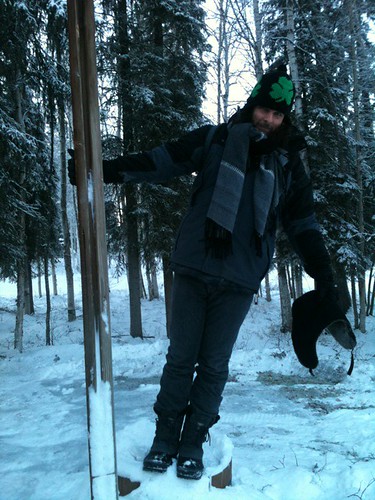
Photo: Orlando in Fairbanks, Alaska
23 November 2013
The Truth in the Gaze / Orlando Luis Pardo Lazo

Poster: Rolando Pulido
Luis Leonel León: The Black Eyes of Rosa María Payá
From El Nuevo Herald
The magazine “People en Español” chose her as one of the 25 most powerful Latin women. On a list that includes Jennifer López, Sofía Vergara, Kate del Castillo, Lupita Jones, Paulina Rubio, Doctor Polo and other celebrities across the entertainment industry, this young woman stands out. She doesn’t design jewelry, isn’t a business woman, doesn’t star in reality television, nor does she scream or cry in soap operas. On the contrary, she contains her immense tears that television would love to scoop up. Many have tried, from Bayly to María Elvira, but she keeps her black eyes still, shaking from within. They only cry in private. And that may be their greatest power.
Paradox of fate, her image became popular for a terrible event that marked her life and her gaze, perhaps forever: on July 22nd her father, Oswaldo Paya Sardinas, leader of the Christian Liberation Movement, and his colleague Harold Cepero, lost their lives on a lonely rural road.
The Cuban authorities say that it was a “traffic accident,” where these two Cubans died and the two foreigners that accompanied them were saved: Swedish politician Jens Aron Modig (who was asleep at the time of impact and then lived eight days of Kafkaesque prison in Havana) and the Spaniard Angel Carromero (who in Cuba was convicted of vehicular manslaughter and who in his own country demanded an international inquiry into what her considers a State crime).
The two foreigners were isolated and coerced by the State Security. There are witnesses who saw these four people enter the hospital alive, but the only “investigations” permitted are those of the same dictatorship that more than once threatened to kill Payá, whose version is validated by the Spanish government. Rosa María, like many others, we are convinced that it was a shadowy operation still pending, like so many other manufactured horrors, for the Castro government will never admit the answer.
For many, Payá was a prominent international figure of dissent on the island. Founder of the Varela Project, he is to date the only man who has gathered thousands of signatures from Cubans (with names and identity numbers) requesting an opposition to the dictatorship.
Never in 54 years, has anyone gone so far in a peaceful confrontation to totalitarianism, to the point that the island autocracy was forced to change its constitution, to contain the purpose of the signatures with not only manipulations and state terror, but also with chains legislated to force people to vote for the irony of a single party, damaging free elections, Payá and his followers still claim, risking everything, even death.
No wonder he won the European Parliament’s Andrei Sakharov Human Rights Prize in 2002 and was an official candidate for the Nobel Peace Prize several times. The official version crumbles before the darkness of the facts and background, as an answer blowing in the wind: it was eliminated because it would not agree with the false reforms that the Cuban government sells the world and its own citizens, cementing the power of new leaders with consumer checkbooks fattened on behalf of that hypocritical melodrama called socialism.
Despite daily violations of the most elementary freedoms, Cuba has once again joined the United Nations Human Rights Council.
Rosa Maria Payá has not stopped speaking before this or other international forums to denounce the reality, to ask for help to speed up democracy and to ask for a serious investigation that would show the true reason for the death of her father and her friend Harold.
Also under death threat by the agents of the regime, for some months she has lived in Florida with her mother. As a good daughter and tenacious disciple, she continues fighting for the holding of a plebiscite that would provide the basis for authentic democracy in Cuba.
Opposing the great hoax called “cosmetic change” which will make the leaders of the Communist Party (or whatever they come up with) legally richer, while making poorer those who asphyxiate every day and that luckily are losing their fear of protesting publicly in the streets. For many this is a chimera. For her it is a desire. Her faith. Another inheritance from her father.
Thanks to People the image of this 24-year-old Cuban (the youngest on the list) is repeated in news and signs, newspapers and social media along with other popular Latinas, powerful (even millionaires), talented and beautiful. Her message, unknown to millions, will be transmitted through other channels a lot more popular to keep attempting to break the blindfold that has covered the eyes of a people for more than half of century, and also the eyes of a good portion of the world.
Neither sad, nor happy, it is Rosa Maria who looks at us from this snapshot by Orlando Luis Pardo Lazo, taken in Lawton, Havana, a few months after her father’s death. The collapsing building where she appears, between reality and a metaphor: the wall of Cuba.
And her black eyes, deep and sincere, through which we can see the horror and the hope, the persistence and the tenderness, and that reward with another nuance, this kind of almanac of successful women. Vagaries of fate. From there, again overcoming again the invading eye of the press, she sustains her fixed look at the kidnapped island.
Translated by: Boston College Cuban American Student Association (CASA) and LYD
15 November 2013
castroisms / orlando luis pardo lazo

and that’s how life surprises you on a saturday night in manhattan, as if it were the most uninhabited corner of havana. there are no differences. the world is like this. horizontal and simultaneous. we are all here and now. we are all contemporaneous and we act to probe the limits of god.
so in my country there are thousands of state bodies. the only way a country has to exist is through the death of its citizens. the revolution is above all necrophilia. democracy would not have to be any different. it’s very easy to talk about transitions and pacifism. this is an outrageous naivete. or a hypocrisy that disgusts me.
there is no social change without control over who dies and who can live. to me, right now, the cuban democrats are telling me all the time: shut up, asshole, you’re not one of us, you don’t agree with us for the criminal cause of freedom.
you know what? stuff your democracy. i never asked to be part of the pie. i’m free. and what’s more, i’m cute. and what’s more, i’m madly lucid. and what’s more, i’m touched by the gift of language and imagination. and what’s more, you all remind me of little castros. you think in castroism. you talk like castros. you gesticulate like castros. without castro you would be lost in the universe. you are castro. not the replacement castro or a posthumous castro of the opposite sign. no. you are really castro, i’m telling you. more castro than castro, because castro improvised on his trail of nameless murders and you are doomed to imitation, which is always more authentic than the original.
and that’s how life surprises you on a saturday night under the leonids falling in the skies of manhattan and you realize we never knew each other. fortunately. there is cubanness far beyond cubans. the united states is the only third world country, this is obvious. but it is the only country. the rest are a battleground, slaughter as training, as entertainment, as sterility. the stars fall one after another and there is nothing to do but watch them fall one after another without anything more to do than to watch them fall one after another.
i am going to die in this country. i don’t know if they will send castro’s executioners to kill me or if i am going to die alone, walking through the tunnels of some pissy station, or in one of the corridors of a thousand doors in the buildings where cubans in this city are hiding from cuba. i want to bear witness at least to the looks. in havana it is no longer possible to look. in manhattan it’s impossible to stop looking and for them to stop looking at you. the people have a barbaric beauty. but they have forgotten. they talk too much. the american language is one of the worst in the universe, communicating nothing, pure emptying of guts. i wonder if americans won’t have a lot of fear of speaking. the english in my father’s books like a dead language. the colloquial english like a triumph of castro in america.
midnight approaches. the trains rush everywhere. i open my mouth and don’t pronounce a single word. for the first time i have hopes, for the first time i am afraid. i don’t want to be them, i don’t want to be you, i don’t want to stand in for the little castros. i don’t want to think in castroism. to speak like castros. to gesticulate like castros. to be another castro of authentic imitation lost on the planet. i don’t want to be me again.
16 November 2013
Blue way, white night / Orlando Luis Pardo Lazo

December 10. It was a foggy day and the remembrance of other similar birthdays, including those old songs in Armenian played many times and out-of-date. December 10. It was a Friday, as usual, and I picked up the phone. No one in the world dials 71-12-10, the whole world knows that “the selected number is out of service or out of the coverage area”. December 10. I put that homeland ballad from the beginning of the 80’s: …blue way and white nights of our lost Erevan, tralali, tralala… on the Russian record player.
It was soft, it was strong. It was a long time since any music band had reminded me that it was possible to sing like this, kissing the lips of the microphones still not in stereo, undressing the acoustic sex of the guitars, barely touching the cymbals of the percussion: pure scratch of the acetate or the staff and a pull from almost 20 years inside the speaker, from the depths of its sound or its muteness.
I was a child in 1984, but I still remember it well. Not only the melody, but also the blue ways and the white nights of our beloved Erevan. There in Armenia: not at the end, but at the beginning of the world.
We were traveling in a bus. I was 12-years-old and I was departing from my homeland for the first time. The family was traveling to Moscow and it was on the next seat where I met her. She, the only love of my life whom I never had the shame to say that I loved. She, and her ambiguous name: Ipatrik. She was 15-years-old and had very short hair. Red. And her eyes. Her eyes: what to say finally, her gaze was like suddenly discovering the rest of reality. The remains of the reality.
Night was falling. It is a saying, in my homeland night never falls completely. The sun only hides, but it doesn’t get entirely dark. The sky turns red, like her hair, and then orange, and then yellow and then planet green and then bright purple and then white and then even more white, almost mercury and that means that it is already past 12:00 and midnight begins to fade directly into dawn. Nameless rainbow. Just in that color, without color; the bus stopped in her village, Añipemza and she got off without my knowing. I saw her stumbling toward my seat with the ticket still in her hand, desperately looking for the number 666. And then I saw her suddenly sitting next to me. She looked directly in my eyes and started to cry. And that was the beginning of my no story with an unpronounceable word pronounced ipatrik.
The rest was the love and the sound of love in the languid voices of the Asbarez group, amplified today in mono by the speakers of my Russian record player and those of that interstate bus: …blue way and white nights of our lost Erevan, tralali, tralala… …your name is the light of the soul, although war takes us so far that memory can’t reach…
That’s how the two vocalists of Asbarez sang: red-haired, like the night already dead and you. That’s how I sang for you, in an inaudible voice so low, of course, just pure confusion before your older girl pouts. And so I stole or invented for forever that sleepless scene of socialism of the heart, in 1984.
And you know what? I have never been as real as when I heard that song, that thirty years later seems to sound the same on my acetate disk, but is missing the half bite that, when you finally stopped crying you offered me:
“You want it?” and you took the first bite.
An apple. I had never bitten a bitten apple. I was disgusted or I don’t know what. And that disgust was the most delicious sensation that fits inside an Armenian man who had just turned twelve-years-old and discovers his first woman three years — almost a lifetime — older.
An apple. A bitten apple. An apple bitten by you, Ipatrik. And all this is like part of a dawning in Euroasia, the great razed continent. By the first great war, two short for us to realize what had happened. And by a precarious peace afterwards, too long for us not realize what was still to come.
“Thank you,” I said, between formal and embarrassed by the surprise and the saliva.
And you smiled, and almost pushed me by the neck to force me to swallow the pieces. Exactly, baby food. A half digested pulp that you gave me tongue to tongue directly from your mouth, that smelled like alcohol more than apple. And it tasted just like the bitter salt of all your fifteen-year-old tears, though I didn’t yet know your age. You tasted like virgin saliva and fermentation, the milk of a future mother, and the memory that is impossible not to love.
…Why are the white nights so short if the blue way is so long?… now sang the two singers from Asbarez. I felt dizzy, but never in the universe did I stop kissing you. Not even to swallow. Until from so much happiness and lack of oxygen I suppose I passed out. Or something like that and no less ridiculous.
The bus arrived at the border with Grusia and you stayed there. I read it in Georgian in your eyes made from instantaneous and real cider. That would be, in any case, your small stateless homeland; since I don’t think you belonged to any lips or place. A sign announced that Tbilisi: our beautiful academic-industrial capital was 10 kilometers from there. And, since then, that was all my orientation I had to look for you until today. Do you understand where my pain comes from and my indolence towards Georgia: my envy, my longing, my jealousy?
Ipatrik made me look outside, through the Calobar glass. The turnaround looked blue, although the whitish night and the two-voice choir of my speakers in mono:…white nights that no blue way is able to reach, without coming or going from our lost Erevan, tralali, tralala…
–Every time you are so alone and you always will be, every time you have a secret love and you always will have, every time you turn twelve years older, and perhaps this will happen in your life up to twelve more times, every time you find a bitten apple disgusts you although you want to be disgusted, every time you swallow saliva with fifteen-year-old tears and your thirst is not quenched, every time someone looks deep into your eyes and still you cannot see yourself, remember that my name was Ipatrik and that always, whatever the color of the sea or the mud, I will continue loving you from seat 666 of an interstate bus from a country that disappeared.
I couldn’t hear anything any more. I would only let her broken voice ring and ring in my Armenian ears, mixed with a homeless ballad from the Asbarez group. I was still in trance. It’s that no one ever spoke to be like that before. It’s that no one had ever spoken to me before.
Ipatrik let her eyelids fall, heavy as curtains, and with them also closed our non-story of love, or at least of the word love. Ipatrik stretched the gloved index finger of her left hand toward me and warned me:
“Don’t look for me there,” and signaled then with the same finger towards somewhere outside the window, toward the empty turnaround or the ambiguity of a fragile border between the mimetic republics of Georgia and Armenia.
And she jumped up from my side, suddenly. Just as she had some, almost without my noticing it. Ipatrik, I-patrik: the one with no homeland, I decomposed the name to better pronounce it in a low voice… blue way and white nights of our lost Erevan… The melody was soft, it was strong: a pain and a relief at the same time. Isn’t love the same as the only impossibility to love?
The bus started. Grusia inside first and Russia inside after, up to the same heart of the great capital: Volgograd, Kuibichev, Kazán, Gorki and the Citizen Station in Moscow. Days and days and nights and nights of travels without you. My parents would look at me with sarcasm and would smile:
“You are not that young,” my father Armenak would tease me.
“You have graduated ahead of time from TV heart-throbs,” my mother Takuji would tease me.
And they would sink back and spy on me again from the back seat. And I also smiled at them, assuming the comical price of the situation. I knew I would be miserable for life, hiding it from my parents, incapable of overwhelming them because in the end they would laugh together. Because we were going to the hospital. Because Armenak my father was afraid that he was dying — once again — as it was his custom throughout a long and sorrowful life to the end without the any diagnosis of illness.
And so I smile at them both today, both recently deceased, incapable of telephoning anyone on this birthday of the Armenian records on the Russian record player in a neighborhood called Lawton on the outskirts of Havana, city on the outskirts of an island called Cuba, nation on the outskirts of an unconnected history.
December 10. Among the memory of other similar birthdays, a bit unfocused by a certain ancient haze, often out and outdated during the real Fridays of the world. December 10. And, as usual, my mobile 71-12-10 started to ring: endless ring-rings that by some miracle I decided to answer, not to be discourteous on my birthday. And just in case it might be her, appearing again, symmetrically, from any phone in any address book or guide of my memory of the world: I-pratik.
It was a wrong number. It was just the Asbarez disk. Isn’t every call, in the end, a wrong number? The silence was thick, unbearable, suicidal. …Although the war takes us so far that…
7 November 2013
Sad Tiger / Orlando Luis Pardo Luiz

(1)
The unfathomable universe, lonely and cold. Your footprints on the cement, still soft in our sidewalk. Your small steps, near and probably lost: Apology of the p. The world, the city, of the town: Cuba, Havana, Lawton. The sea, the year. The hum of the space left by you. The unspoken words, yet waiting. Like tigers, like me. The sadness of zero years in a country not as deserted but as defected: detested. 2000, 2001, 2002. Cuba, Cuba, Cuba: Hypothesis of country. 2003, 2004, 2005. Armenia, Armenia, Armenia: Hypostasis homeland. And the loud rabid sound of a car that turns the corner and stops in front of me. 666: is a police car. The law finally has remembered me.
(2)
Half hour before, I was a free man of the world. Half hour later I would be a free world of the man. Now, for the time being, that uniformed man interrogated me:
-Your name- he said
I looked at him. I was afraid to say the truth. I hesitated. But at the end I told him. And I was wrong. I think. Or maybe not.
-William Saroyan- I said.
The day was beautiful, the town peaceful, and his gaze was noble. He wanted to destroy me, that is true, as perhaps he wanted to destroy himself too. However, even now I am convinced that the mulatto policeman had a noble gaze. Simply he was tired, overwhelmed by himself. And by me.
-Your indentification- he said.
Of course, I didn’t have identification. Otherwise, this story wouldn’t have existed. I told him. That I didn’t have identification, otherwise our story would have never existed. Plus I was sitting on the sidewalk of Fonts and Beales, the strangest two streets in Lawton, just in front of my house. However, the latter I didn’t say it. I shouldn’t confess everything ahead of time. With the law is like that.
-Then you have to come with me- he said, and started pronouncing phrases through his walkie-talkie. He was euphoric, perhaps he would never forget that day. I was happy for him.
Accompany him. The idea appeared fatal. I told him. He pushed me and handcuffed me great skill, hands to the back. It hurt me, but I kept silent. He hit me without too much force in the legs. It was an action that I never understood. In fact, I still don’t understand it. As if he was looking for something, as if he wanted bend something in me. And that was simply impossible. In fact, it still is.
We rode in police car 666 and the car accelerated up Fonts and then slowed down at Beales, until he parked in front of the police station. At the side of a children’s playground, now in ruins.
I was a good man and I was crying. Crying of happiness.
The driver was looking at me surprised; he would scratch his head under his blue hat. The mulatto too. He couldn’t shift that crazy noble gaze from me. I told him.
-Shut up already, you sound like a little girl- he said
And I followed instructions. And just like that we lost our first possibility, in 50 or perhaps 500 years, to have a conversation.
I don’t know. Now I suppose that was the price of our mutual happiness. Mute happiness.
(3)
Isn’t it suspicious that even language exists? And that also rusty railcars from Railways of Cuba exist, stopped at the Luyano crossroads? And the Metropolitan Buses crossing the railways, shimmering in the moonlight, lunatic moles, like dead tigers almost to be point of being revived from a shot at the heart? And the pain of the yellow lines over a zigzagging street that during the day the asphalt has melted? And the metro buses, and big rigs, and bicitaxis, and other reality particles? And the flat feet of the pedestrians, as pedants and forgivable as any policeman, as flat as the eternal first page of the Jairenik newspaper, as precarious as the cries of the Chinese Fu to the long and narrow neighborhood: Jaileni…, Jaileni…, Jaileni…? And the blue color of the night, of the sea, and the uniforms of the authorities? And the extended hands of the beggars at the restaurant, sitting down without dreams at the old sandwich place at Lawton’s bar waiting not for a coin but that it would never dawn? And the natural flowers, like the plastic ones: kimilsungias with super red petals, Bulgarian roses of worker descent, tuberculosis tulips, and lilies from the Pastrana River? In fact, isn’t it even suspicious to live? Just like your radical absence in Havana, except in my room. Just in like your sad smiling picture, hanging from my wall, perhaps from the neck. Just like that smile without memory that, night after night, you remind me that just now you are forgetting me. From another town, anywhere in the world, except Lawton. From Miami, Mexico, Montevideo; from Manila, Moscow, Milan; from Marcella, Melbourne, Madrid or La Mecca: amnesia of the sh. Like the smile three times sadder of that woman in black and white hanging at the lobby of the police station. Under it, someone has written her name and hung a flower. Plastic, of course. But the typography is miniscule and I can’t read it from the bench on which I am detained without a major accusation. Perhaps “Celia”, perhaps “Cielo”, perhaps “Celia in the Cielo” or the reverse. I really don’t know. And me, isn’t it suspicious that I even exist? And the tiger, the beautiful beast that ignores which of the successive cages they have moved him to, isn’t it very suspicious this sudden exhibition?
(4)
They took my fingerprints. There was no ink and they did it with an open pen refill. Blue ink, just like the cap of the driver, and the splendid sky of that January, and the uniforms of all those men there. Good men forced to all like the same color fabric.
They took my fingerprints. For the first time I saw my fingerprints. All fingerprints look like those of a criminal. However, not even criminals can stop being good, despite the ink marks on the top right corner of a “Detention Form”. Or Defunction.
Next to me an old lady was shaking, her hands opening and closing the zipper of her bag. A nylon bag, full of something that no one could now imagine what. Cubanacan S.A., Made in Armenia.
To my other side, squeezed on the other side of the bench, two young girls of 15 or 16 looked at Celia or perhaps at the fake room ceiling. Either way, both with rabies. Good girls trapped by the equitable strap of hate. Black. The old lady was white. Three sad faces and not even a trace of the tiger. I simply didn’t exist. And it was fine like that. If I had existed then, the story wouldn’t exist later.
At that time, kids were screaming outside, having fun in their play ground or paradise now in ruins. A man dressed in plain clothes walked up to me. He kneeled down at the bench and looked at me with all the benevolence of the New Year, century and millennium. After that look without bad intentions, Armageddon could come: humanity was saved. I sensed that this man was a saint and that he was far above good and evil.
-They have told me that your name is William Saroyan- he said.
I nodded.
-Could we trust in your word?- he said
I nodded.
-And in the wildness of your look?- he said and smiled.
I nodded, and also smiled.
And without realizing, we were giving each other a long hug in front of everyone’s surprise. Incapable of the smallest reconciliation, them; incapable of the greatest rancor, us. However, everything had been an error. Horror always is. And then, the man dressed in plain clothes whispered just like when someone says I love you in your ear:
-You are under arrest.
Definitely, he was an immortal.
Or perhaps I loved him.
Or both things at the same time.
(5)
And, ultimately, they are nothing but days of the universe flush with January, time retracted by the tedium of looking at it all wrong. A Sputnik knife, or an Inout pressure cooker, an Amadeo shoe. Nothing fits, everything evaporates in the evaporated milk of reality. Nata Nela. I had a Polaroid camera , and the world at times reminded me a snapshot scene and sometimes a very scenic snapshot. I took photos. Nothingness. Objects left behind. Books without letters. Kids that died with me. Waterfall promises. Wishes to feel wishes. Empty looks, emptied by the boredom of looking at it in reverse. Mine on a rooftop in Lawton, for example. Yours in a corridor of Armenia, for example. Your look humiliated by another Polaroid camera far away, on the other side of the ocean, perhaps two or three meters away: hanged, perhaps by the neck, over the most solitary wall in my room, in my house. And the Caribbean Ocean, the year of the Horse. The indigo blue, the blue uniform from the Industriales baseball team. Nothing settles, all memories float like drool. And, ultimately, they are nothing but days of the universe flush with January: lost time, or even better, a story out of time.
(6)
-William Saroyan, isn’t your real name Rock Wagram? – said investigator number one.
-No- I said.
-William Saroyan, isn’t your real name Arak Vagramian? – said investigator number two.
-No- I said.
-William Saroyan, isn’t your real name Aram Garoglanian? – said investigator number three.
-No- I said.
-William Saroyan, isn’t your real name Wesley Jackson? – said investigator number four.
-No- I said.
-William Saroyan, isn’t your real name Ulises Macauley? – said investigator number five.
-No- I said.
-William Saroyan, isn’t your real name Armenak Saroyan? – said investigator number six.
-No- I said. That’s only my father’s name.
-William Saroyan, isn’t your real name Takuji Saroyan? – said investigator number seven.
-No- I said. That’s only my mother’s name.
-William Saroyan, do you swear then be called William Saroyan and nothing else than William Saroyan? – the man dressed in plain clothesshook me by the shoulders.
-No- I said. That’s only my name.
(7)
Every man is always a good man in a mistaken world. No man is capable of changing even half the story around him. Nor a word. Nor a syllable. Nor silence. Loneliness and sadness are the tribute and the failure of every good man. That’s why we are tragic and innocents and we have long distance loves that will never leave us. Even if we are jailed because the law, finally, has remembered us and it asks us to confess some name, even a false one. Preferably a false one, but plausible: Who would dare to profane the word truth? Itis like a beautiful silence that at the end always obliges us to participate. It overlaps and involves us. From there, then, our implied guilt. From there, out notable guilt. These are the rules of the game. Good laws, like all laws have always been.
(8)
I was released, on my word. That is, under silence. They ask me not to say to anyone what had taken place. It was useless to convince them that in reality nothing had taken place, and it was just there where my story was. I was released even without a fine, by the pure trust of the police institution.
When I got home they were holding a wake for me. My mother, who had not yet passed away, was pouting again. And my father, dead in 1990 something, was consoling her as badly as it was impossible:
-Don’t cry, Takuji. Our son will soon be fine – he would repeat.
The neighbors lookedat them as if they were raving lunatics. And they were. Then they looked at me, as if suddenly they had become the raving lunatics. And they had. And even then, they all slipped stampeding from my wake, the most hysterical yelled “Alleluia, he has been resuscitated.” But I only kissed my mother and a squeeze for my father. It was so unknown that I guess it was just as well. I assured them that there was no horror:
-Dear parents: nothing has happened here – I lied to console them. It has all been a misunderstanding.
And then I walked through the mansion at Fonts and Beales, straight through the longest and narrow halls of the world, and I closed the door of my room to cry. It was a winter cold: the driest season of the year, of the old century, and of the new millennium. Therefore, not one tear I cried.
I looked at the picture of my old love, also in black and white. Just like Celia, or Sky, perhaps Celia in the Sky, or to the contrary, in the police station. Just like the mud accumulated on the sidewalk after the successuve stations of the world. And at that point the phone rang and it was her.
Her, her, her.
After exactly one decade, I heard her voice again. The voice of my old love, or at least, my own voice pronouncing again that old word: love.
(9)
All man who lives without love has to look for love. No man can live in love for too long a time, nor does he want it even if he wants it. And at the same time, love too soon grows bored from any man’s history. These are also, the rules of the game. Magnificent rules, for a magnificent creature. The rest is all literature: literally, hard letters. Exquisite cadaver.
(10)
-I have missed you a lot- she said in Armenian from Erevan.
-Me more- I answered in Armenian from Lawton.
It had been a long time since I had spoken the mother tongue. All the same, it took half of phrase to restore my country to me. I remembered the first verse of the hymn: “Oh, Armenia, the absent sea under your blue peaks on the horizons, they are enough promise for my adoration.”
-And I adore you too- she instantly replied, now talking in Cuban from Europe. The calling card is ending: so is best that I call you tomorrow.
Best tomorrow.
And she hung up.
My old love hung up, hung up, hung up.
Leaving me with the silence in my mouth. Leaving again hanged only from my wall, perhaps by the neck. As smiling and sad as if my room were the lobby of the police station.
And I didn’t even have time to answer her in Cuban from Cuba. There was a knot in my brain before the one in my throat. It had been a long time that I hadn’t spoken that borrowed tongue. Stray. On occasions, not even half a million phrases are enough to be silent.
(11)
The solitary, fathomless and universal cold. Your footprints in the now rigid cement of our sidewalk: rigor mortis. Your footprints dissected, distant, definitely unknown: deception of the d. The mute, the wicked, the mud: Cuba, Havana, Lawton. The sea, the year. The ringing of the silence left by you. Never ask for whom the bells are silent. The over used words, still lying in wait. Like tigers, like me. The sadness of the zero years in a country not as deserted as defected: detested. 2000, 2001, 2002. Armenia, Armenia, Armenia: homeland bandage. 2003, 2004, 2005. Cuba, Cuba, Cuba: homeland apostrophe. And the endearing silence of the car that turns the line and stops in front of me: the joke of the bells announcing that the paper ended. The rusty keys of my old Underwood still doubling the alarm. All aboard. All aborted. Until you finally forget justice. The good thing is that one can dispense of the righteous. It’s as easy as to dispense with a beginning, with no story, and to simulate an end. Irreparable laws to mitigate, without too much success, the noble excellence of our unreality. Good laws, of course, as any laws they should always be.
Translated by LYD
3 November 2013
Young people from all of the Americas ask for plebiscite in Cuba now / Orlando Luis Pardo Lazo
 In this forum the delegations from Cuba, Haiti, Puerto Rico and Dominican Republic ask for a vote on the following declarations:
“At the XXIII Submit of Iberoamerican Chiefs of State and government under the slogan of: Alliance for new paradigms; young representatives of 25 Iberoamerican countries with the objective of taking on the challenges and problems of the region we will get together in the Iberoamerican vanguard marking 500 years since the discovery of the Pacific Ocean, from the 13th to the 16th of October in Panama City, Panama.
“Conscious of our responsibility for the development of Iberoamerican countries we declare necessary that with our commitment to action and the critical support of the leaders of local institutions and multilateral organs we’ll contribute to:
“Considering the importance of sustaining a healthy relationship between all the countries of the Caribbean region. We call attention to the worrisome situation in Cuba related to human rights and recognize a historical solidarity between the Haitian and Dominican countries. Taking into account the petition that thousands of Cuban citizens that using their constitutional right (Article 88g) propose that the citizens are consulted over legal changes that would guarantee fundamental liberties; the petition of Haitians and Dominicans to review order TC/06168 dated September 27, 2013 of the Constitutional Tribunal of the Dominican Republic that will leave without nationality a significant population of Dominicans descendants from foreigners, mainly Haitians.
“We resolve:
“We call on the Cuban government to answer a democratic proposal for a plebiscite of its citizens and invite the Dominican Constitutional Tribunal to review their decision.”
Translated by LYD
16 October 2013
HALLOWEEN / Orlando Luis Pardo Lazo

I remember how my mother in Cuba bent over the jar of hot milk and blew on it, to cool it off for me, making the sounds of an angel.
I remember how my father in Cuba bent over a little yellow slip lined in nylon with the Prayer of San Luis Beltran, every Friday morning.
My childhood was those two gestures, surely unbearable in their time. And now the only thing I have left of Havana in the ‘70s.
Manhattan 2013has a lot of that city. The same neglect, the same feeling of emptiness, the mute multitudes. Everything is parody and allegory. Even, it seems, New York. Even, it seems, so many autumns, which decades ago were still a real station in Cuba.
I close my eyes on the Number 7 train and it’s not hard to see myself on Route 7.
Then I looked at the infant Cuban night and saw those same buildings in New York, were at the height of San Francisco de Paula or San Miguel del Padron. “A microclimate,” said my parents and they shut the window for me.
As a child I was amazed.
I couldn’t know that I was looking at myself dead already in the future, today, on the elevated in Queens, in a third generation Third World.
I thought I wouldn’t grow up. And I was right. Only I grew up.
There is no way to pray realistically in the United States. God is money.
I am absolutely abandoned.
I am on the point of being happy.
31 October 2013
Chile and Death and Cuba and Love / Orlando Luis Pardo Lazo

Ipatria, Alamar, a Vulture, the Night, and Me
1. There are exiles who bite and others like a consuming fire
We met in the Martyrs of Alamar mortuary. Her father had died that afternoon, I’d come in to drink no less than ten coffees on the cheap. I needed them to ease my anxiety, ease my anxiety, ease my anxiety. My nights were long, too long to endure. Blind tunnels until little after dawn, when I managed at last to find myself in a park; only so a swarm of uniformed children could jostle me next, blowing to smithereens my only winks of the day — the week, the month, or perhaps the millennium. Of course, on that first Friday she didn’t call herself Ipatria yet. I saw her sitting like a mortal, alone in the ’Ch’ chapel, scarcely a few feet from the cafeteria where my nerves overloaded. Not even her dead father accompanied her between the candles and the blackout. Afterwards I learned that she herself had ordered a second and a third and a fifth and a tenth autopsy: Ipatria distrusted or “no, now I don’t distrust“, she would confess to me afterward: “now I’m very sure of what’s happening …” The absence of a casket was the first thing that caught my attention. Then her foreign black hair, falling into neglect on her bird-like shoulders: her immobile ebony hair, or of araucaria or cypress. And then it was her chapped voice, prickly, when she called me without looking at me, bluntly: “Come here” (like to a dog). And I went toward her (like a dog), thus ruining forever my somnambulatory routine, for the first time obedient in the anarchic midnight of a worker’s cemetery called Alamar. “Sit“, she ordered, and put me in front of her face. She had extremely black eyes, even more so than her hair: from a nightless night, starry and tattered, and I adored that tiny little bit of shadow in her pupils between terror and blackout. “Do you come from abroad?”, she asked me. “From where, outside?”, I asked her. “From the Cuban night“, she said to me. “I suppose so“, I told her. “And have you seen it? Did you hear it?“, she shook me. “Seen and heard what?”, I withdrew from her attack. “You freak!“, she pushed me until I nearly fell to the ground: “The wingbeat of the vulture, what else could it be?” Then she made a grimace and hid her face: she was horrified to have spoken more. She pretended to cry but neither did she manage to do so. She looked at me with hatred, as if I’d betrayed her secret. I managed nothing. I liked to imagine her crazy from the beginning. “Please“, I calmed her: “there have never been vultures in Alamar“, and I grabbed her by the belt. “Or they went extinct at the beginning of the Revolution“, and I gave her a hug. Blindly. She trembled. Her vibrations transmitted themselves to me. I trembled too. We looked like a pair of epileptics waiting for the casket in which one of the two of us was going to lay down. Then she took her hands from her face and separated me from her body. Her voice returned to being prickly, sliced up, and she dismissed me without looking at me, bluntly: “Split” (like to a dog). So I turned, for the second time obedient (like a dog) and began walking down the hall, returning to the mortuary’s cafeteria where, in spite of the triumphal lack of electricity, the custodians still insisted on straining their coffee. Black smoke inside a bigger cloud of smoke. To be sure, that first Friday Ipatria never called herself by that name. That December 3rd I left her without knowing her name, a terrible key to penetrating her head, to sneak inside her brain, lightly scratched by the sandpaper of Chilean history and its tyrannies: wet waiting room to her now dried up sex through so many tears repatriated in Cuba.
2. Timid herds galloped, devouring the streets, dressed in terror and shadow
The second night was in a tan M -1: pink tin can metrobuses rolling even in a full blackout. She was seated on the steps to the rearmost door, her knees contained by the circle of her hands and the tangle of her hair, in which that night a flower was sunk like an explosion of white. It looked like a fistful of petals with a pistil: a marpacifico, I thought. Although I realized right away it was not: “it’s not alive, moron“, she ridiculed me, “it’s just a piece of plastic, Made in Chile, wholesale.” I kept staring at her for the next couple of stops of the M-1, during three or perhaps thirteen kilometers of the Via Blanca, remembering her again in the funeral home, meeting her again for the second Friday in a month. When the Metrobus started to pant up Cojimar Hill, I dropped next to her on the seats: among bags, lit cigarettes, farm animals, calves, or on barbs. “I’m Sagis“, I ventured. She looked at me, perhaps remembering me from another time in the funeral home, or recognizing me for the second Friday in the millennium. Then she smiled. “Sagis is a name for a mutt, not for people,” and she aimed at me with her left index finger, a long gun complete with bayonet of a fingernail painted white, a petal no less artificial than her imported flower. “My real name is Salvador,” I admitted. But she was unsatisfied: “Salvador is much worse.” And she turned serious: “Surely you were born after ’73.” Her guess left me gob-smacked. “Almost,” I confessed, “December 10th, 1973: I suppose today is my birthday,” and I felt ridiculous in my pathos. Luckily, she looked at me compassionately. With patience. And she returned to smiling for me. Between the kicks from the crowd shone something even more beautiful than the nonexistent box at the chapel. Night was falling. I’d now gone through seven dawns without sleeping since that one in which I bumped into her. Back then I thought I would not see her again — perhaps due to my stupid habit of continually circling the Martyrs of Alamar mortuary, as if her father could die twice in a week and through a paranoid cascade of autopsies. There was an infernal noise under our feet, including white smoke from the motor. I couldn’t stop looking at her while she lectured me: “In December of ’73 I too had had your name, but I was born a few months before“, she shrugged her shoulders, as if they were wings. “Our parents were obsessed with the presence or the presidency of some Salvador,” she said for fright effect and public entertainment in the shadows of the Metrobus. And I loved her vocabulary of political evangelism so much that … I don’t know … the vehemence of her brilliant oratory cast a spell on me. I managed to tell her how much I’d been intrigued by our purely random encounters, and that I didn’t want to lose her again. Because, from that point on, I slept less and as a consequence, my anxiety was worse, my anxiety was worse, my anxiety was worse. “Happy birthday and goodbye, old man“, she gave me a kiss on each cheek. And next she told me no, that it was not possible for me to see her and that she deeply regretted it, but she repudiated coincidence and fate, and I exactly embodied coincidence and fate: which was too suspicious for her intuition. “A power with memory could use anyone to detect you“, she said. She distrusted. Or not, no longer mistrusted: “now I’m not sure what happened,” she said in a whisper. And my ignorance did not guarantee my innocence: that someone from the military junta, for example, might be handling me like a civilian puppet. With me she could never be safe: “I’m very sorry, whether you be Sagis or Salvador, you are too innocent to be not guilty” was her conclusion. “But safe from what?“, I became impatient. And now she almost looked at me with compassion. “Please, safe from a motherland: from Alamar, from a vulture, from the night, and from you“, she told me, and jumped with the door half-open, still stopping our M-1. She escaped from crevices, among the echos of her own enumeration. Like one of the vermin of the night, angelic and frightening creatures, without giving me time to act: to hunt her and really threaten her with death, to see if the she really reacted to me. I looked outside for an instant. I saw her running. I saw her back about to take off, silhouetted against a lunar landscape in permanent revolution. We were in the old Chilean neighborhood: a wasteland even more deserted than the rest of Alamar and perhaps the rest of the country. Chile, Cuba, Santiago de la Habana: how can you tell the difference under the dead gaze of unlove? Besides, no one ever got on or off at that bus stop, out of fear of the legends that, for more than ten years, laid waste to those buildings through sudden repatriation: clandestine mass flight without apparent cause, that made Cuban Chileans invisible in just a few days at the end of the 80s. In Chile democracy finally returned and no one wanted to continue living in Revolutionary Cuba. continue reading
3. They extracted the shadow from the shadow, drew a wind with fangs
Nonetheless, the following Friday I got off right there, after all my cheap coffees in the Martyrs of Alamar. I needed to see Ipatria, if only to lose her again. Her turf was a rocky desert of high salinity, between dirty nondescript buildings and faded walls: on all of them was the same old blind man, in a suit and tie, but wearing a hard hat and, in his left hand, a machine gun pointing skyward, as if signalling surrender or perhaps actually surrendering. I crossed the basketball court laid waste from the 11th School Festival. I crossed the overgrown baseball diamond next to where the drug dealers ply their wares. And I crossed the ghetto deserted by the Chileans at the end of the 80s, who returned in a stampede to their continental island bounded by the Atacama Desert, the Antarctic ice, the Andes ridge, and the voracity of the Pacific. Without gas, without light, without telephone, nor identity documents; expecting the denouncement that would return them to their province of birth, like springs, to reorganize their teeming families and relocate to the capital between mouthfuls of prú and drum beats. Then I bumped into her. Ipatria remained immobile, addressing no one in a loud voice: making speeches, sitting on the shoulders of that old salt-corroded bust, at which we all poked fun as children, without having to ask one’s later adult self what kind of lonely that guy would have to be. The lack of lighting reduced them both to a shadow puppet: the statue standing, Ipatria sitting on top, reciting — straddling the statue — what seemed like verses. She broadcast them without noticing the absence of her public. I paid attention: “In the deepest region of the motherland“, with me still getting closer to the pair, “where the puma growls and the condor cries“, her fingers as tense as claws, “injured by iron and dust“, I stopped next to the pedestal, “the rocks, the dead, the urns“, she covered the eyes of the bust and held it by the chin, “covering themselves in dust and black roots”, as if protecting it from the truth or seeking to be protected by it, “while the flag is hung between two buildings“, I noticed that her block was escorted by two vandalized buildings, “and inflated their cloth like an ulcered belly, a teat, or a circus tent“, and then Ipatria curled herself up on the corroded head of the martyr as if she were finally going to give it birth or perhaps abort it. I applauded, solemnly, trying not to appear sarcastic. I was fascinated by the staging, and also by the right angle at which her legs opened on the statue’s metallic nape, be it copper or brass. It looked like she was determined, because she attacked me right away. “I was waiting for you, Sagis or Salvador, and getting used to a persecution is the same thing as letting myself be trapped“, she said between rage and complaint, “so it seemed to my father and, you know, the consequence was fatal“. I didn’t understand and it wasn’t even important that I understand; the facts were enough for me. We were there by coincidence: wasn’t it perfect? “No, first it’s pathetic, and afterward it’s very dangerous“, she despaired, “You don’t know anything and it’s not important that you know“. “Life is today“, I justified myself with a sureness I didn’t have. “Look, moron“, her voice split out, “they killed our parents, they killed our children, they killed the streets, the trucks, the silent earth” — they seemed like verses to me again — “they killed those who are, those who know, those who feel, they killed the house, the casket, the president’s forehead, they’re going to kill me and I don’t care … what could it matter to you?” By my expression, it was obvious that it meant nothing. “They’re already here!“, she yelled, on the edge of hysteria. “Power tracks us by telepathy. From the Elqui Valley they know everything: from that spiritual center they smell us like rats until they crush our memories first, and the rest of the head afterward. It’s a holocaust from an eyedropper.” For me that was enough. I exploded “But who are they? Fuck!“, I slugged the bust and I grabbed it by the calves, trying to drop her from that insane platform by force of sanity. She meant to defend herself with that look of hers so vacant of chaos and significance; but it didn’t matter to me any more. With a tug I knocked her down, and with the momentum from the fall, we rolled around on the gravel of what, ten years before, well could have been the luxurious garden of some uppity-up in the Chilean Communist Party. We stood at the feet of a trunk with a memorial plaque — it was an imported poplar planted in 1970-something, I read through the rusty metal, by some I-don’t-know-who antifascist poet, even if the monument were only a plaque on a stump. “What’s happening with you, nut?” She kept silent. “What’s up with you, Ipatria?” She kept silent. “What’s happening with you, my love?” She kept silent. And then I jumped on her hips and planted myself there. And I shook her like a rabid animal, trapping her under my weight and moving myself almost at top speed against a resistance that, at the end, never came up: she always maintained her silence. I had an obscene erection that I couldn’t hide, but the more I knelt the more my lump between her legs grew. I went to kiss her on the mouth and she spat at me. I yelled “What the fuck is happening with you, whack job? Does torture panic you?” Ipatria gritted her teeth, I loved her absolute vulnerability. I felt like fucking her right there. “What’s wrong? Isn’t betrayal better after making love?” And then, at last, she reacted: she simply fainted. That was the triumph of her defense, and also my humiliation as an imbecilic national executioner. I lost my erection and my muscles all relaxed, so did my brain; saturated with greed, shame, and funerary coffee. I felt ashamed: I blamed myself. I could have run, but shame paralyzed me. I realized the only whack job in those Friday scenes had been me, that I almost destroyed the only one who looked at me even once during those insomniac nights. I wanted to sing to her, beg her forgiveness; and I sang to beg her pardon. I whispered some nursery rhymes to her, as tender as they were theatrical: they were the only ones I knew, although with mistakes: “Give me your hand and we’ll dance, give me your hand and you’ll love me”, I sang for Ipatria, as out of tune as I couldn’t avoid: “because we’ll be in the dance as a horror and nothing more“. A bird passed over us and squawked – or maybe it was a bat: how could I tell the difference in a half-blackout? It was scary, too. I stopped singing and I sat by her side hoping she’d come to. I was afraid she was suffocating, and I gave her a mouth-to-mouth respiration from the bottom of my lungs. Ipatria started to breathe better, she recovered the discolor of her perfect skin, and in a little bit she was conscious again, almost hugging me. Her long shawl of white cloth, like nylon, was precious to her. She seemed like a bird of prey who they’d made fly until she fell, exhausted. She had drool around her mouth that she took off, and drew back a lock of hair that was hiding her eyes. She looked at me with a hidden peace. Her forehead was sweaty in spite of the cold. Could she be epileptic? And then I don’t know if she gave me an order or begged me: “Sagis or Salvador, take me to the beach now“. And I carried her to the shore: the sterile eroded limestone of La Playita de los Chilenos. The moon came out from between the roofs and rebounded right away to its zenith, through clouds of ruby-red cotton wadding. I kneeled with Ipatria in my arms, that’s what Ipatria would call it at last, incapable of throwing her into the water and me with her, washing away her panic and my anxiety. I carefully deposited her to where the foam came up. The shadow of that stupid bird followed us all the time — it had a very long neck, like a cannon, and circled in ever-widening circles in a counterclockwise direction until its turns faded into the dawn, thus marking the end of that Friday the 17th that would never become Saturday in my memory. I went to kiss Ipatria on the mouth. It was barely a touch, or even less, a premonition. Her breath was warm and gentle, but also very deliberate and cold, without paradox or contradiction. I smelled strange fermented fruit. I extended my hands in a farewell gesture, but in reality I was asking that, at least for just one night, neither of us would say goodbye. But I saw her smile without moving a single muscle in her face; something sinister that made clear, without the need for words, that her body was telling mine that I shouldn’t follow her there, that I wouldn’t follow her.
4. I stopped at the chapter of your heroes, in a loud voice I read out the page of your wines.
The 24th was our worst night. The glow of so many bonfires by the block, uselessly pushing back against the blackout moved me: the anguish froze on my cheeks and wouldn’t let me participate in that spectacle. I was walking underneath the blind traffic light of Via Blanca (White Way) — which had become “Dark Way” by then — and thought about Ipatria’s fate a week before: a limp cat between my arms and the limestone, as tense as a lyre untuned from music and from dread, with fists and face twitching from who knows which nightmare, half insurgent and half official. In the traffic stand a cop was snoring, only lit by a candle and using a red-lettered newspaper in place of a blanket: “El Mercurio”, I could read. On his little battery-powered radio he was still mis-hearing a baseball game. From the National Stadium, the only place with lights in the neighborhood, the Metropolitans were losing, as usual, by an embarrassing score. The sportscaster was talking about “one last chance for the capital’s Red hope” and I followed at length towards Siberia, Alamar’s ground zero: by this time I wanted to return to my hiding place before midnight could so sadly surprise me in the middle of the people’s Christmas Eve. They’re here! I was remembering Ipatria’s babbling just seven nights before, * where “they” were the “provocateurs of the VOP and the MIR, and the cadavers from El Caluche** resuscitated at Villa Grimaldi, and the Coachman of Death giving a ride to the Radical Agitators and those of Plan Z and Plan A hand-in-hand with the mummies of the Concertatión and the Chicago Boys of Senator Vitalicio, and the monks from Colonia Dignidad, and those of the Right Province, and those of Fatherland and Freedom, and the Mechanics’ School”, I told myself, “and the vultures from the tacnazo and those of the tancazo“,*** until it was literally impossible to retain so many names, aliases and last names picked out from her moon rock teeth: “Veaux, Mongliocchetti, McAntyre, Lotz, von Schouwen, Ayrwin, Edwards, Salvattori and Superonfray”, among so many of the Broken or Red Spring * — I now didn’t understand very well – in what seemed to be another nursery rhyme in the style of “give me your hand and you’ll kill”. But neither was there anything to understand in Ipatria, who perhaps would never call herself by that name. It was enough to breathe her ketonic breath to understand the desperate brilliance of her nerves, as long and fragile as her extremities. And so cold. On that Friday the 24th, the darkened buildings looked like hillocks from the Jurassic Era: elemental geometry without memory nor amnesia. A half block before reaching my shelter, I saw her, seated on the curb, underneath a banner proclaiming faith in, or at least fidelity to, the future. She was shaven clean bald, and apparently waiting for me. I recognized her right away: the languid color of her skin gave her away, like a neon explosion imported from some cyanotic Patagonian peak. I felt euphoria on seeing her: an irrepressible joy in half step or half silence. And I laughed, arriving at a jump in front of her, who responded with a serious air — as if our luck meant nothing precisely because it meant so much. Thus, for the first and only Friday, I could review the neurotic map of her handwriting. Ipatria had written: “a bird given to intemperance turned into a soft forest and nothing — neither wonder nor doubt nor even the night destroyed that air.” It was beautiful. I grabbed her. I meant to give her a hug. Smell her pores. Maybe she’d pass a part of her beautiful madness to me: mine was so impoverished that … I felt her cold hand in my even colder hand in which I held hers, a lonely couple on a curb in Cuban Siberia. With my forehead I caressed her bony head, and it seemed to me that her Andean skull could well explode like a grenade: pieces of skin between chunks of the facades of the Alamar. It was obvious that there was nothing left to us. Nor anyone. And that it was never going to be our last Friday to have our paths cross by chance in a workers’ dormitory called La Habanazar. Then I issued a challenge and a prophecy: “Next Friday I’ll wait for you in block Ch-73″, and I blew her a kiss almost touching my mouth. I drew in her fetid and sick-sweet breath, like the asthmatic breath of the 666 volcanoes that cut Chile off from the rest of America: from the remains of America. And she stopped in a jump, and supposedly, from another jump she left, devoured by the incipient dawn and my indecision bordering on indolence: she was always leaving and me never daring to leave anything, although there weren’t more than the three syllables of that word — I-pa-tria …
[* Translator’s notes: The author is taking us on a single-sentence tour through the 5-year period of Chilean history that ended with the Chilean coup d’état in which General Pinochet violently overthrew President Salvador Allende on 11 September 1973. The names of people, places, and events we see here would be familiar to any student of modern South American history. Readers are encouraged to study this history for themselves. The final allusion to the “Broken or Red Spring” is a Spanish-language play on words: “red” (Sp: roja) and “broken” (Sp: rota) are ways, in the author’s view, of describing that Spring in which the coup took place. Readers are reminded that Spring in the Southern Hemisphere begins in September. This entire passage was seriously re-flowed during the act of translation; the original insists on breaking up the double-quoted portions with the phrase “I told myself” … all of these, except the first, were simply dropped from the translation, allowing the historical narrative to be seen as one giant run-on sentence. Putting those little clauses back in wouldn’t have aided understanding at all.
** El Caluche is the subject of a modern Chilean myth in which El Caluche is the name of a ghost ship, manned by the dead. A feature of the myth is that those who sight her shall soon die and become part of her crew.
*** El Tacnazo and El Tancazo, while near-homonyms in the Spanish language, were very different insurrectional events that took place in Chile in 1969 (el tacnazo) and 1973 (el tancazo). The earlier event was named after the regiment in whose ranks the insurrection broke out, and the later event was so named because it involved tanks attempting to surround government buildings in the Capitol. Neither putsch succeeded.]
5. But blood was a tree dressed up in stone. But the hand was a wing born in stone. But night was a fire put out by stone.
She took the belt and hitched it to her hip, naked. Then she hung the sharp blade to her left and adopted a comic pose of a 21st Century knight (a “bland gentleman”, according to her), solemnly announced that “my country is the English sword of America” and began to march in the style of a Republican cadet. She went from one wall to the other of her room, opening her legs at a right angle, like military gardening shears. I could only watch, without interfering with that malevolent alef. I saw her tense muscles pulling the skin white and her sex invisible in the middle: she was shaved with cytostatic precision. I saw her breasts, two double-tattooed circles on each side of her sternum. I saw the tip of the naked metal brushing flush with the ankle, scraping a crossword of cuts that decorated the top of her foot, the beading cuts dripping blood onto the cold tiles. I saw her and she saw me, too, shivering: all at once puppets and puppeteers, without altar nor vestments. And I saw the impossible speech with which neither she nor I would arrive to describe everything: a molecular scene at the disposition of no viewer, in or out of his Island apartment. For the story of us two wasn’t public yet, perhaps the “public” for whatever story had always been just that: a comforting illusion. We were in her room, on a twelfth floor indistinguishable from all other 12th floors in the Chilean district: since 1989, a secret suburb inside Alamar. She waited for me seated on the stairs and invited me to come up with a gesture. I followed some 18 inches behind her, on the stairway erased by the pristine blackout: a State bonus for that 31st day on which ended the month, the year, the century and the Millennium, too. I followed her footsteps and the phosphorescent white of her blanket: a ghostly cataract like the vestige of a flower, or a bird that no one ever dared to name. She pushed the door open and we went in: it had been ajar. “Do you believe now, Sagis or Salvador?“, she seemed pleased with the alleged proof: “They were here, surely they stole the stationery“, and she fled just to return right away with a large pile of candles. She lit them, one by one, for five or fifty or five thousand minutes until their smoke nearly choked us. I started coughing ridiculously and she led me to the balcony. I breathed. Deep, deep, deep.
And from there I noticed that there was no furniture inside, except the TV or a shadow without legs pretending to be a TV: the floor, walls and ceiling seemed to be props, removable tools to allow the house to float from time to time in the air. From my height I saw our own shadows cast across the vacuum, I felt the warm glow of candles on my neck. The cold of a year’s-end leaning over the edge of the planet was slapping me in the face. Ipatria had stripped without a word and was sitting on the stair rail. Her imbalance scared me, and I tried to hold her up if even by a heel; but she rejected me with a kick she’d have given a toy, and on contact, I noticed the seal — or perhaps a spur by now — growing on her left ankle. There Ipatria was whole to me, transparent more than naked. Now it was just a question of reading her into my restlessness and heartbreak: the encyclopedia of vertigo and shipwrecks. The only life form on the landscape were the luminaries with batteries in the National Stadium, where the Metropolitans were still surely playing losing baseball. Ipatria pointed out the stadium for me: “How many swarms of bodies will fit in there?” “Not a single one,” I told her, “they compete because of radio and television“. “You trust your ignorance too much, Sagis or Salvador,” she ignored the irony, “but sooner or later, by reason or by force, even Cubans are going to wind up in that stadium.” It was then that she armed herself with belt and sword. She hitched it up to her hip and hung the blade to the left. She made a joke about the obscure legends of an “Andean gentleman” who wandered around without feet or eyelids from one end of Chile to the other; according to mothers who brought him up in order to frighten their children, and then Ipatria spoke to me of hers: “It’s the moon that sucks my body“, she claimed while walking away. “Half shadow, half scream, ascending in a spiral among thick liquids that leave their scent on me“. She looked at me proudly, her lips a tight line, barely suggestive, like the mound between her legs. “Those are my mother’s verses, moron,” she faced me squarely, “My mother said all the world’s words before I did.” And she told me details about that woman, her mother the martyr, as she turned to walk the room in circles: her legs, a pair of scissors bisected by her sex; by candlelight, her bloody ankles simulated a paleolithic television studio. “This sword is my English motherland in America“, she repeatedly perverted the phrase, sitting on the stair rail once more. I got as nervous as before, but didn’t try to steady her this time. Ipatria crossed both legs over the sword and stroked her crotch with the casual edge of the blade. She moved the sword this way and that, in an ever straightening and speedy embrace each time. Finally, she sunk it hard — yet meekly — into her sex, and shouted “This was the last thing my mother felt: the cold of the militiamen inside her!” She was insane, and I didn’t understand her, nor did I pretend to. I was crazy too; and what of it? I still wanted her just the same in spite of her insanity and my indolence, in whatever order and in none. I had a clinical erection, like I did in the mortuary while listening to the wailing of the mourners for the martyrs of Alamar. Like the night with the statue. In a fit of pure action, I picked up her clothes and gave them to her: I wanted to say something with some kind of gesture; but I still couldn’t imagine what or how. She should see me converted into my own kind of beast, maybe. That she should know painfully real things about me. That she should not expel me this Friday into a popular loneliness that overflows everything out there, undermining my resistance to die*. That she should love me, I suppose, until I could recover to love her, supposing I could resuscitate her afterwards. That she should drink of me and make me burst, the very shitty imported Made in Chile 1973, the very angelic condemned in vengeance by her country’s intelligence agencies. That she should feed herself on my coagulated liquids and of my insomniac flesh now at a flash point like a presidential palace. That she should be a little of me, and I a little of Ipatria, forever. I don’t know. Sometimes mere language doesn’t suffice. But she didn’t seem to notice it, no reaction at all except to smell my bag of shoes and clothes during America’s most eternal minute, before launching it into a parabola free-fall over the railing, where I saw it floating uselessly in the sea breeze only to be swallowed twelve floors below by gravitational force. “My mother flew just like that“, she pointed out with her left index finger, “and so the little dogs made her fly on top of the sea, and since that September spring, nobody ever saw her again,” she said, raising her eyebrows. So she and her father became a little more orphaned, across the mountainous coastline, into a plain populated by insufferable cowboys with a pessimistic air about them. And from there they got on a carousel of exiles that would unload right there on the 12th floor in block Ch-73. Ipatria threw herself off the rail she was seated on, sword in hand, and hauled me inside the room, finally falling over the footless chassis of the television — which wasn’t a television at all, but rather a suitcase — a casket made of poplar or perhaps an araucaria**. “My parents’ portable revolution is a total prisoner here: this is the most sought-after file of the 1980s“, Ipatria smiled and got on top of me. She straddled my body and put a hand on my neck. She arced her legs and pinned me, like she’d done in a previous scene with the mute metal. In fact, her muscles were still bleeding as if from an eyedropper. She used a hand to push my pelvis, moving cleanly in and out of me, penetrated dry and hard until well below and inside. I intended no movement at all; it was so exciting to contemplate its inert execution that … Besides, she had a desperately beautiful body. Besides, I didn’t know her as well as I ought to have, and it had been a long time since anyone had even approached my body without fixing a price first. Then the wood underneath my butt creaked, and the suitcase suddently gave way with the cry of a bird of prey. We knocked each other over, rolling with the explosion, body to body. The floor was icy, driven, and a cold shiver ran through my feet to my rib cage. In one of our turns, I’d pushed her stone-smooth head to one side, and it was then that I saw it. I let out a panicked squeal, like a bird: “THERE!” And she jumped on my neck like a baby “There what, Salvador? There who, Sagis? There where, please?“, and in the roughness of our tumblings her sword sliced my leg. I doubled over in pain. I opened my mouth in the shape of a letter ’O’, perhaps in the shape of a zero, but I couldn’t utter a syllable between such an image and such impossibility. “There! A bird, or whatever I know“, I said after a while, disengaging her from my windpipe so I wouldn’t choke out from her hysteria. I meant to stop, and what’s more, my cut-up knee stopped me. I looked more closely, and in effect, it would have had to have been a giant bird or its silhouette in the same pose as Ipatria struck on the baluster. Perhaps it was the specter of her martyred mother, I don’t know. It doesn’t interest me. The certain thing was that Ipatria was angrily bouncing against my throat, a girl from the docks reduced to a base of sheer dread. So I had to hit her in the face, and as I was reacting without thinking, I tried to push her away from me as far as I could, like someone who launches a bullet or a ball into the infinite. And with that motion, I felt that I was getting rid of something I didn’t know how much it would depopulate me on the inside later. Ipatria wound up off of me but with too much inertia for the top of the balcony, as if she were another bag of shoes and clothes — as if she were her poetess mother some three or thirteen decades prior, launched at the rim of the Antarctic from a National Army gunship. Or as if Ipatria were the shadow of that bird, who, also without opening its wings suddenly allowed itself to fall from the sky: the two bodies were already almost over the edge of the baluster that already wasn’t containing the vacuum on the other side, and were swallowed in the blink of an eye by New Year’s Eve lit only by the light from the candles burning in her apartment and the baseball stadium’s towers, where the Metropolitans still weren’t growing bored of losing by a denigrating score. I remained a half-hollow pit of a room. My open pit of a knee wouldn’t permit me to climb up onto the balcony for a peek, but the imminent date change didn’t impress me, either: from nineteen ninety-nine ninety something to two thousand zero, the zero decade. I almost convinced myself that on that Friday the 31st nothing at all happened;
except the description of the countless objects that the suitcase had scattered on the tiles when it broke. They were icons of the worldwide lie by which Ipatria’s parents had sanctified themselves: banners, posters, clippings headlines, photos, flyers, brochures and books, bonds, tickets and badges, stickers, among other, harder to identify, objects. Luckily, having that splintered paraphernalia run across my sight calmed me: I assumed that the entire December had been scrupulously real, and that justified even more its believable irreality … starting with that three-syllable name that I had just launched into the Chilecubana void of Alamar — I-pa-tria. My sight became cloudy, I felt cold, my muscles ached, and I was sick to my stomach. Afterward, I only felt like sleeping and not waking up until the next twentieth century. It was absurd, was she bleeding me with an eyedropper, like Ipatria’s muscles and her left foot? Or was I cheating with my head scratched by the sandpaper of this story, so that I wouldn’t have to return to La Siberia nor to the Martyrs of Alamar?
[Translator’s notes:
* Here, the author uses the word “sobremorir” as a word play on “to survive” (Sp: sobrevivir, whose etymology works out to “sur+live”, but what he means is “to sur+die”. This author engages in this kind of word play often; it’s one of his distinguishing stylistic attributes.
** The species aracuaria is a kind of (conifer) tree that translates into a “monkey-puzzle” tree in English. Using its translation would have interrupted and distracted from the flow of the story, so it wasn’t done.)
I breathed. Deep, deep, deep. I even had to go over America’s heart attack dawn until I located a clinic where someone could wish me a “happy new year” before feigning interest in my cut. I even had to drag myself up the twelve flights of stairs floor by floor before finding my clothes carpeting the ruins of a garden down there, below, or perhaps sheltering the mortal nudity of the bespectacled statue: pitted by red oxides, but brandishing a machine gun as a warning. I even had to exorcise the dead look of unlove without pathetic rhetoric: that ancient anguish that — like so much sediment — gathered in layers on my cheeks and in my trachea, paralyzing any act of closeness with someone who wasn’t me. I even had to flee that neighborhood, already thinking that in my next Friday’s session, at the edge of some weeks as long as my nights, too long to overcome: blind tunnels until a little after dawn, when with her at last I end up in a park, only so a pack of uniformed kids might jostle me right away until shattering my little sleep and disperse my anxiety, disperse my anxiety, disperse my anxiety. I even had to decide if Ipatria had been her real name, or if the word merely had been free in my mind for the next someone who might appear or disappear. Even …]
Translated by: JT
12 August 2013
30 Questions on the Repression of Religion in Cuba / Orlando Luis Pardo Lazo

In September, two religious leaders living in Cuba, Reverend Mario Félix Lleonart and his wife, the missionary Yoaxis Marcheco, both of the Baptist Convention of Western Cuba, travelled to Washington, D.C. as guests of a Christian Solidarity Worldwide event. With them was Apostle Omar Gude of the Apostolic Movement, who was previously a political prisoner in Cuba and today lives in exile in the US.
At the end of their visit, they released a joint statement on religious freedom on the island, titled “Thirty Questions for the Cuban Government,” which has already gone down in history. It’s a manifesto that in some ways recalls Martin Luther’s redemptive discourse in the absolutist Europe of the sixteenth century.
The revolutionary Cuban state, which according to the Constitution is communist and atheist, officially became “secular” in the early 1990s. However, Religious education has been banned for half a century and there is not a single space available to utter God’s name in the Cuban media. The Cuban Communist Party Central Committee’s all-powerful Office of Religious Affairs monitors, controls, and manipulates any situation of this kind.
The thirty questions range from demands for the return of property confiscated from Cuban churches, to remembrance for the atheist apartheid against believers (the latter were sent to re-education camps in the 1960s). The statement also asks for a denunciation of the repression that has taken place during the few authorized religious processions and during Pope Benedict XVI’s visit in March 2012 (at which there were hundreds of preemptive arrests without charge), as well as revelation of high-level infiltration of cult organizations (such as the Great Masonic Lodge) by State Security agents. There is also a call for the release of US contractor Alan Gross (imprisoned in Cuba for improving internet access for the Jewish community) as well as an independent investigation into the unexpected deaths of dissident Christian leaders such as Laura Pollán of the Damas de Blanco (Ladies in White) and Oswaldo Payá of the Movimiento Cristiano Liberación (Christian Liberation Movement).
If the Cuban government today wants to feign even a small amount of legitimacy, it should take responsibility for responding to these thirty questions, which our citizens should have posed decades ago.
Translated by Alex Higson for SAMPSONIA WAY MAGAZINE
14 October 2013
dreaming in gUSAno* / Orlando Luis Pardo Lazo

The dreams begin, comrades.
Noises in hotel rooms. I begin to hear noises in the hotel rooms where I stay from coast to coast in the United States.
In Cuba, I was never a victim of the homeland paranoia; I only had the certainty of being spied on with criminal cruelty. Millimetric, butcher. I am sorry for Castroism: it failed to sow in me the syndrome of suspicion.
But, in Philadelphia, for example, or in Washington DC, in LA, in Miami, in La Crosse, in Madison, in Chicago, in Boston and who knows in what other city of the union, it is very different. There are hotels, those labyrinths that in Cuba are a rarity in terms of civility. And in the hotels things are heard late at nights. Sounds, whispers. And a cosmic cold that penetrates the soul and only then do you understand that you do not exist here.
Halfway through the late hours of the night, frantic knocks on my room door wake me up. Or not. Perhaps they are at the room across, who knows. The fact is that I wait and wait, but the assault does not repeat itself. Until the next day, during the wee hours of the night, at any time after the silent midnight.
They drag cleaning carts at random times. They scratch the parquet or the cardboard walls that make every building Made in USA.” They walk loudly. They speak a language of unknown accent that in Havana I would have perceived as English. There are little permanent lights that come in through the curtains or fall from the ceiling tiles in the form of a sea of alarms that never cease. And then begin my dreams. My North American dreams. North American dreams about Cuba, it is understood.
At this point in history, to dream of Cuba is purely a preservation instinct. I dream that I am back there, of course. And I laugh, I laugh like a madman.
I laugh at the assassins paid by the powers-that-be who did not arrest me or search my things with the twisted pleasure of rapists at the airport customs. I see things as if they were very small, dilapidated, but with an insane shine, like a drug addict. I see the houses of my city, the ones that I can recognize with my eyes closed. I see the small house of wooden planks, the only one in my life, the one in which I was born and died several times in Lawton; and I see my sacred objects, the ones I barely said goodbye to; and then someone tells me (usually someone I loved a lot, but not anymore): “When are you returning to the United States?”
“Never,” I reply, and suddenly I cannot breathe in the dream, and at that point I invariably wake up crying. With pouting. A baby’s cry, a cry of mental patient.
To return.
Cuba.
Never.
The United States.
The agony of the fighting fish. Their branchiae wide open, like swords. The oxygen of an atmosphere that will never be my atmosphere. Not having ground under my dreams. To be without existing. Orlando, Orlando…why have you forsaken us…?
I open my eyes. It is not dawning yet. I want to forget. My temples hurt. There are weird noises in the rooms around me. I am alone. Desolate.
If one day I go out on a walk, if it snows, and I get lost erasing my footsteps, who and when is going to ask about me? Who takes care of me? Who misses me? Who will feel sorry for my loved ones if one bad day my country’s military death reaches me by edict so that I do not live my life after Fidel?
I turn to the other side of the bed. I sleep naked. I curl up under the blankets and sheets which the American hotels provide me from coast to coast in the nation. The beds are cold here. More than exciting, they are pure erection. I cannot resist myself.
Nor am I sleepy now, but I surrender very quickly. I yawn, I must be exhausted. I nod. I myself make the noises and whispers that are going to reach, incognito, the other room. Strange. I do not stop myself. It is warm and tender like the deep light of the northern skies. Like the smile of teenagers who dispense insipid dishes at a cafeteria while they complete their PhD. I swallow air. I retain it. I am choking. I am not here.
I think about collecting all the Cuban dreams of exile. They are not here.
I am asleep, we are asleep. Soon it is about to be dawn.
*Translator’s note: The word “Dreaming” appears in English in the original. “Gusano” (worm) here refers to the insult hurled by the Cuban regime and its vassals at every person who has opposed the regime in any way, or who has left the country to escape it.
Translated by Ernesto Ariel Suarez
29 September 2013
The Anti-Gospel According to Orlando Luis Pardo Lazo

1 I, that had no motherland, have lost my motherland.
2 The motherland is, of course, the place where your neighbor will mourn over your dead body. 3 And, I never wanted this. 4 I resisted from the time I opened my eyes and saw. 5 Everything was so ugly, so false, so Cuban around me. 6 That I never wanted to give them the only thing that made me good and real. 7 My body.
8In the silent night of childhood. 9 In the fading light of adolescence. 10 In the early mornings being nude on stairwells and neighborhood alleys. 11 In the youth devastated by the nightmare of the 1990s. 12 In the two thousand-nothings when all who were to die had died and love still had not shown up. 13 Now. 14 When I want the least to be mourned in my country or to have a street named after me in democracy.
15 I do not want to be mourned. 16 Seriously. 17 But I want a country. 18 Please.
19 Life is too much of life for it to be humiliated by death. 20 If life ends in a wake, then it was not worth living it. 21 Life opens to life or it will never be life at all. 22 I wish to live.
23 I am going to repeat it slowly because these are two verbs that we Cubans did not know how to execute from that arrogance of beings living in freedom: to wish, to live. 24 We Cubans, who massacre each other in that mystic rapture called Motherland to achieve our most heroic state of slavery.
25 Neither wish. 26 Nor live.
27 Cuban politics is the organ (what a creepy word: organ) in charge of diplomatically avoiding these two vital verbs, to have them forgotten through pure patriotism and terror, to manipulate them in its image and convenience to cheat us out of our time and humanity. 28 That is why the people does not exist. 29 Because it has no body, just mass. 30 Because we fuse as a whole, as a something, as a living organism. 31 Because we are that: scattered organs. 32 Decrepit 33 Lifeless viscera.
34 That is why the Revolution and Castroism will have no day after. 35 It is impossible to resuscitate what has not even died, but continues to live in perpetuity. 36 An unlivable life.
37 The lyrics of the National Anthem are foreboding in that sense. 38 A macabre song, of incarnation of Evil in men and women who were already departing and in those who were yet to come. 39 Demoniacal march, just like the sight of its author on a horse in the outskirts of a city that should have been capital and ended up being holocaust. 40 Mortuary music composed precisely on a Horse*, apocalyptic beast that in less than a century will implement that same anthem to its last poetic consequences.
41 Poetry, and not Cuban politics, has been the main genocidal compulsion in what was on the verge of being my country. 42 Cuba, scaffold.
43 The word “motherland” is not better than the word “impiety.” 44 Someone had to state it for you, Cubans. 45 The word “hope” is not sterile, but breeds sterility exclusively.
46 On the claustrophobic line of the horizon 47 In the planetary twilight of the one thousand nine hundred and fifty-nine exiles. 48 In the bodies abandoned in the stampede. 49 In the love promptly betrayed. 50 In the invisible beauty. 51 In the family that vanished. 52 In the weightless home. 53 In the Cuban body constantly constrained to the cadaver that is going to inhabit it.
54 Men and women of my country, I have loved you from the distance of the most intimidating inner space. 55 From these trachea and intestines I have seen things that you, Cubans, would never believe.
56 Mercy is not enough. 57 You, that never had a motherland, will never lose the motherland. 58 And that pain is unspeakable.
59 May you remain, then, in the posthumous peace of my words.
*Translator’s note: From Spanish “El Caballo,” “the Horse,” one of Fidel Castro’s many nicknames among Cubans. It denotes masculinity and vigor, and it is deeply rooted in that Cuban tragicomic “machismo.”
Translated by Ernesto Ariel Suarez
19 August 2013