HAVANA, Cuba , September 4, 2013, www.cubanet.org – Two police cars parked at the entrance to a high school. From one of them a man in civilian dress got out, and with long strides entered the school. Uniformed police also got out of the cars, but they remained outside the fence. The civilian went straight to the office of the director, who barely had time to react when the newcomer started dragging him, kicking, taking him almost to the center of the schoolyard.
The students witnessed the spectacle as if it were a Roman circus or a “pankration” fight. Most of them cheering the man and some recognizing him as the father of one of the girls at the school. Then, beating the director with a piece of wood until he was unconscious, the man called the police. They came in, handcuffed the defenseless individual on the ground, and carried him to the police car.
It was learned that the director was having relations with the daughter of the aggressor, an 8th grade student, and had been since she was in 7th grade. The romance was a secret until her girlfriend, who knew everything, committed an indiscretion. The offended father, with very good relations with the People’s Revolutionary Police (PNR), gathered all the evidence. The girl confessed. Furthermore, it was learned that the director was participating in a network of falsifying and selling school records.
Prostitution among students
Similar events are common in the schools of Cuba. They don’t always come to light because the students themselves cover for the teacher, or director, either out of their own interests or fear.
Any Cuban who spent part of his youth in the education system of boarding schools in the countryside, heard anecdotes of students being teachers’ lovers. Sexual relations between minors and adults, who were supposed to, under the law, be the children’s guardians. This writer saw, on more than one occasion, students involved with teachers in exchange for a higher grade on an exam, or to avoid having to repeat a year. The phenomenon was not unique to girls. Boys also offered sexual favors to male teachers in exchange for the same things.
Now the phenomenon is spreading. Prostitution is exercised between students themselves, under the auspicious cloak of festivals called “downloads.” In this mode the beneficiaries are the more affluent kids. It’s known for a boyfriend to lend his girlfriend to a classmate in exchange for money or other equivalent material goods. If the matter goes further, and it gets into “experimenting,” the boyfriend also gets into the bed. Bisexuality, more than a possible and legitimate tendency, is now a carte blanche to earn money.
Virginity is a burden
For girls, virginity is a burden that is removed as soon as they’re over twelve. A growing number of girls become sexually active even earlier. For guys, someone who is more than twenty is considered an “old man.” The fast and rushed “burning of stages” is part of the race for survival. The sex trade constantly asks for “fresh meat.” Moreover, many families raise their girls as “animals for the competition.” In blunt terms, they should be ready to find themselves a “daddy with little money.”
For boys, the job of “chulo” — pimp — is practiced within the school itself. It’s a kind of training that is later completed in the street. The school no longer instructs the “New Man.” Now it is a transit point for boys and girls whose sexuality emerges marked by cynicism, consequences and a reflection of a society sick to its very roots.
HAVANA, Cuba , September , www.cubanet.org — For some time now we’ve noticed the absence of Elián Gonzalez and other members of his family from the pages of newspapers, radio broadcasts and television channels. We even know the failed attempt by a foreign press correspondent to interview Elián, who is barely seen in his native Cardenas. Anyone would think that this is the normal course of events when people are immersed in the everyday: the little rafter is a school student and cadet, while his father and other family members go about their usual jobs.
However, a recent development suggests that such ostracism could be responding to a policy laid down by the upper echelons of power. Granma newspaper, in its issue of Friday, 23 August, reported that the National Directorate of the Committee for the Defense of the Revolution (CDR) presented its Neighborhood Award — true, the CDRs don’t function at the neighborhood level, but their bosses run around the country holding meeting and handing out distinctions — to the “Museum for the Battle of Ideas,” located in the town of Cardenas in Matanzas. The ceremony was attended by leaders of the Communist Party, of the CDR, the heads of the Museum, and Señora Irma Sehweret, mother of René González, the “Cuban Five” agent released from prison in the United States and repatriated to Cuba. And Granma did not mention anyone else.
If the bombastic “Battle of Ideas” emerged as a result of the hype orchestrated by Cuban authorities around the efforts for Elián’s the return to Cuba, and the creation of the Museum in Cardenas served the purpose of collecting the history those tumultuous times of marches, rallies, Roundtable TV shows, and the discourse of the barricade, how can we conceive that neither Elián, nor his father, nor any other member of the family, were now present at the delivery of that recognition? Clearly, gone are the days when, after Eián returned, and every time a public event was celebrated, the presenters of the “activity” announced the presence of “Elián Gonzalez and his distinguished family.”
Surely, no well-informed observer of the Cuban reality can escape that many of these people converted, the overnight, into “Heroes” by Castro’s propaganda machine, are useful only when they serve to stoke the dispute with United States; an dispute that the Cuban government needs as a safety valve to cover up its mistakes. The show around “The Elián case” did the job while the child was being held in the United States. Then came, from the year 2000, the noise about releasing the five agents accused of espionage, who had been arrested in 1998. In other words, the new droning chorus burst forth when nothing more could be squeezed from the tribulations of rafter.
In this context it is reasonable to expect that the released René González appears in public less often; and that this would equally be the fate of Fernando González Llort, the next agent to be released in February 2014. Perhaps simply to keep the aura of “heroes” of those who face longer sentences, as is the case with Gerardo Hernandez. However, it is also likely that the star of the already expendable is not completely shut down, and that we will be reminded of them from time to time.
So then, did something special happen to Elián and his family, to disappear like that, so totally, from the Castro hoopla? Apparently not even their neighbors in Cardenas are able to offer an adequate response.
About the author
Orlando Freire. Born Matanzas, 1959. Bachelor in Economics. He has published a book of essays The evidence of our times, winner of the 2005 Vitral Award, and the novel Blood of Freedom, winner of the 2008 Gaveta Franz Kafka Prize. He also won the awards for Ensayo y Cuento in the Universal Dissident Magazine, and the Essay Prize of the magazine Palabra Nueva.
HAVANA, Cuba , August, www.cubanet.org.- Undocumented and with the stigma of “terrorist,” Jesús Rojas Pineda barely survives in Jagüey Grande, Matanzas; after having been released on October 19, 2012, from Kilo 9 Prison.
Last August 7, Rojas Pineda turned 70.
His cause is the same one that Armando Sosa Fortuny was tried for: The 15 October 1994 disembarking together for Caibarién, more outraged than organized, as you will see below.
Before enlisting in the group of seven men who landed that night, Rojas Pineda had been a fisherman in his native Caibarién until on July 12, 1994 he took to the sea in a plastic boat and rowed, coming ashore in Florida
“We were well received as rafters, they helped us right away,” says Rojas.
He also got a job: “I started making pots to catch lobster.”
But, according to his own words, on 12 August of that same year, in a funeral home on Calle 8, the bodies of two Cuban rafters were laid out. “That day 600 boat people arrived on U.S. shores.”
He says that right then a protest was organized against the Cuban government, holding it responsible for the death of the rafters. “The protest lasted 24 days… on October 10 a group of seven of us agreed to return to Cuba with some weapons but without chemicals substances nor explosives.”
The rest of the story is well known. They tried to cross the newly opened causeway that connects Cayo Santa Maria with Caibarién, to the Escambray. On the road a car appeared in which were traveling, among others, the Communist party secretary of the province of Villa Clara , who was killed in an accidental shooting by the gun of Humberto Real Suarez, another of the expeditionaries.
“At the trial, the prosecutor himself admitted that the shooting was accidental, since the weapon Humberto was carrying Humberto was modern and if he had pulled the trigger intentionally it would have released a flurry of shots instead of one, as it happened,” recalls Rojas Pineda.
Nevertheless, the sentences were for between 20 and 30 years in prison; the firing squad Humberto Real Suarez standing out; he had testified at the trial, “I did not come to kill innocents, but to fight against the dictatorship.”
Several of the seven men had been badly wounded by their captors. Fortuny in the head and shoulder; Real Suarez in the wrist; Rojas Pineda by the impact of 82 glass particles after the car windows were blown out; and Diaz Bouza, handcuffed on the ground, was shot by an AK that struck him in the jaw and arm.
The sentence for Rojas Pineda was 20 years, even though at the trial it was recognized by the prosecution that his gun was never fired.
“I lost the key“
After the trial, they were transferred to maximum severity prisons.
To describe the Cuban prison inside, Rojas Pineda says: ” Monstrous, in ever respect.”
Kilo 8 Prison in Camaguey , known as “I lost the key,” was one of the first places they went.
“There I was in the cell No. 50, maximum security. They didn’t let you out in the sun, and denied us medical care claiming that we were terrorists.”
In that prison, Rojas Pineda was nicknamed the Matador because the officials wouldn’t stop mistreating him. “They imposed extra punishments on you, like reducing your water and taking away the foods sent by your family.”
At some point he was in need of an operation of hemorrhoids and for him to see a surgeon he had to stage a hunger strike that lasted 18 days. “They refused not only to let me be seen by the doctor, but also the painkillers.”
When he was 18 days into the hunger strike, a visit was scheduled from the MININT Commission from Havana to inspect the prison.
Rojas Pineda took his blood-filled rags and threw them into the corridor. Only then was he taken to hospital where he underwent surgery the next day. But back in the cell they cut off his water supply. “I had to get up and go to get some water for the toilet, recently operated on.”
“One night, a boy started calling after the order for silence: Let me go to cell of the Matador, he always gives me something to eat,” Rojas Pineda continues his story.
“A guard pulled him out and along with three others beat him nearly to death. The prisoners began shouting, ‘Abuse! Abuse!’ and started hitting the bars. The second night, they called in special troops, that even had flamethrowers, because the prison called them saying it was a revolt against the government. The prisoners were expressed themselves, saying, ‘This is a problem of the daily outrages and abuse.’
“They retired the troops and in a few days a commission of officials from Havana brought 50 releases, 50 paroles and 50 minimum conditions,” he adds.
Parole was denied on many occasions. Finally, on October 19, 2012 he was released “for completing the sentence.” In all, he spent 18 years in captivity.
Until the last day, shared the same task and the same small space with Armando Sosa Fortuny, whom he calls “brother.”
After being released, an opportunity came to visit Fortuny bringing him food, but “they didn’t accept the crate nor the bag, because they said it wasn’t visiting day.” Every afternoon, Rojas Pineda goes to the phone and waits for the call from his “brother.”
Currently, he suffers from hypertension, circulatory problems and an advanced degree of deafness, in addition to all wear and tear from so many years as a political prisoner.
Undocumented
Rojas Pineda’s family is the opinion of this man does not want to be in Cuba any more. At first he could not close any doors in the house.
Rojas Pineda was in the midst of the formalities for U.S. residency when he decided to return to Cub . The mailing address in Miami is the one on the document they gave him when he left the prison, which is not an identity card, but a kind of letter of freedom.
But he can not emigrate legally to the United States, primarily because his U.S. documentation was held by the Cuban authorities after his arrest.
What the Cuban Office of Immigration and Nationality is proposing is to being the paperwork for “repatriation,” to be able to obtain an Identity Card. But Rojas Pineda doesn’t feel well in the land where he was born, that didn’t sufficiently raise its voice for his cause, and that didn’t save him and his family their 18 years of suffering when he was a political prisoner.
When this reporter comments that his story could be read by the Cuban public in exile, he expresses his desire to send a big hug to his brothers and the request that, “If anyone knows of a way in which I can obtain a duplicate of the documentation retained by the Cuban authorities since the day of our arrest, if it might be left in some file in Florida, let me know. I want to spend my last days in peace,” he concludes.
HAVANA, Cuba, August 2013, www.cubanet.org — The school year is about to begin and parents are now shopping around for shoes for their kids. It has been many years since those lace-up leather shoes, known as school shoes, have been sold. They complimented school uniforms well, were durable, protected children’s feet and were fungus resistant.
For some time they have been selling black tennis shoes called Pioneers instead. They go for 120 Cuban pesos, or about 5 CUC (approximately five US dollars). Although children do not like them, they are popular with parents because they hold up well if you reinforce the soles. According to some people, however, they can be hard to find them in the correct size, if you can find them at all.
If Pioneers are not available, then parents have to turn to the hard-currency shopping mall, where quality is not great and prices are high. Finding something that looks good is difficult. Another problem is that after a month’s wear you have to take them to a shoemaker to have the soles repaired.
Shoes for running errands
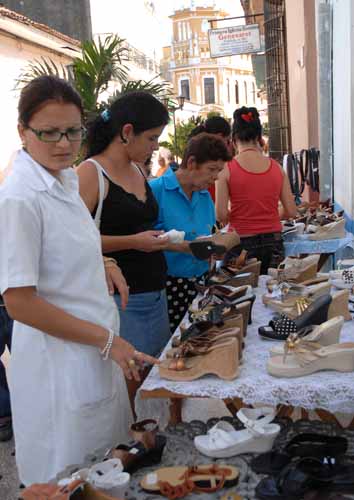
Similarly, it is impossible to find the kind of closed toe, low-heeled ladies’ shoes appropriate for those daily errands that require long walks. There is no justification for this, especially considering the number of women over fifty in this country.
Some time ago the National Office for Standardization acknowledged that imported goods in Cuba — including shoes — were of poor quality. Then why are they so expensive? This means they remain in the display windows of shoe stores so long that, on those rare occasions when they finally go on sale, they already show signs of wear.
A neighbor, Juan Alberto, bought a pair of shoes at a boutique. He paid 46.75 CUC* for them. The second time he wore them, the leather started to come apart.
Orthopedics, forget about it.
“Looking for a pair of shoes is like finding your way through a maze,” says Gloria, a seventy-two year old woman who needs special footwear because of paralysis she suffers resulting from a stroke. Gloria went to a custom shoe store after her orthopedist wrote her a prescription. She was told she would have to call and make an appointment because they were not filling new prescriptions at that time.
Finally, after several months, it was her turn. Once at the store they took her measurements and told her she could pick them up in ninety days. Imagine her disgust, however, when, on the day she went to pick them up, she found out they were two sizes too big and were made with velcro instead of buckles. When she complained to an employee, he acted annoyed and told her, “This is it. Take it or leave it.” Gloria took them home and now uses them as slippers.
There is a popular alternative one can often find in building entryways or areas near commercial centers: people selling shoes recovered from buzos, or trash dumpsters, which have been repaired and cleaned. Prices vary between four or five CUP and ten CUP. Believe it or not, there are always customers, especially among elderly retirees.
About the autHor
Gladys Linares was born in Cienfuegos in1942 and is a school teacher. She worked as a professor of geography and as director of various schools for thirty-two years. In late 1990 she joined the Movement for Human Rights through the Women’s Humanitarian Front. She was an active participant in the Cuban Council and the Varela Project. Her writings reflect daily life in Cuba.
September 1, 2013
*Translator’s note: Cuba has two official currencies: the Cuban peso, or CUP, and the convertible peso, pegged roughly one-to-one to the dollar. The price paid for the shoes mentioned above represents more than two months wages for the average Cuban.
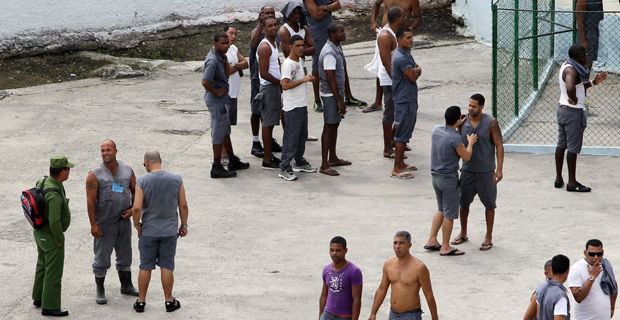
PUERTO PADRE , Cuba , www.cubanet.org – Dragged into the torrent of criminality by genetic defects or by a social environment prone to crime, not a few inmates who today form the very profuse Cuban prison population, have ended up contracting mental illness.
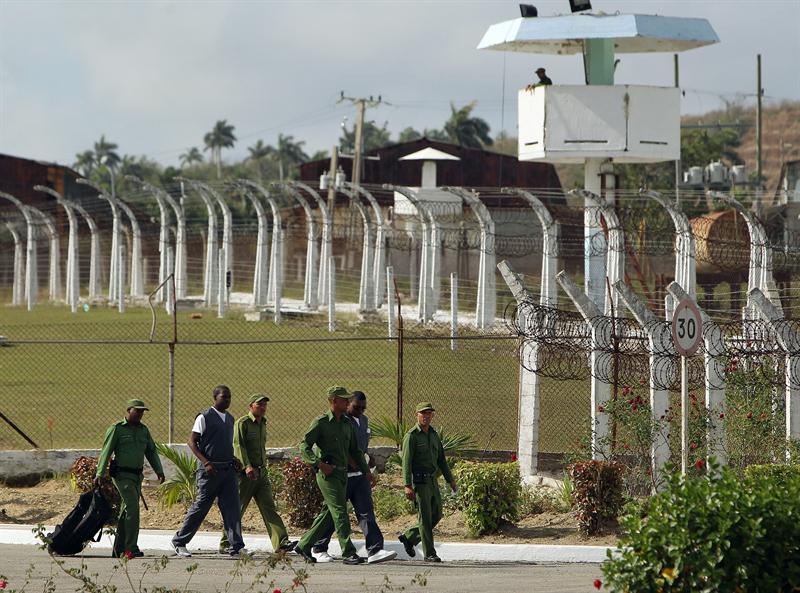
Five maximum security prisons and another 195 prisons form the penitentiary system of the island, where, according to official sources, about 50,000 souls re serving sentences, although human rights organizations place the figure between 60,000 and 75.000.
However, if we add to the above figures the detainees, those who for various reasons spend a few hours to a week in the cells of police stations, assuming only five arrested in each municipality each day, we see that about one thousand more Cubans daily, and that number would be multiplied by the 365 days in the year .
Are Cuban lawmakers action with a view to the future on dementia and crime? According to the Fifth Iberoamerican Congress on Alzheimer’s Disease, which met in Havana October 20-11, 2011, there are 130,000 people with dementia in Cuba. But if this figure is alarming the prognosis is even more so: according to experts, the number of demented could triple by 2040.
This means that in an aging population of about eleven million, almost half a million will suffer some kind of disease that makes it impossible for them to communicate with us and to think clearly.
The exemptions from criminal responsibility are well defined in two paragraphs of Article 20 of the Penal Code: a person is exempted from committing the crime in a state of insanity, temporary insanity or delayed mental development if because of any of these causes he does not have the ability to understand the scope of his action or omission or to direct his behavior.
Now these two sections do not apply if the person commits the crime was voluntarily placed in a state of temporary insanity by the ingestion of alcohol or psychotropic substances.
But if alcoholism is becoming a pandemic in Cuba, which is already having alarming influences on crime, the fractures and breaking up of families is doing no less.
“We would say that Cuba needs today, on the part of its specialists, the precision of a Swiss watch; each of us has as a priceless treasure and we should raise to the level of a national concern every family with a child in prison,” said a sociologist whom I had asked if there are too many prisoners in Cuba.
“The amendments to the Criminal Code, which will go into force from this coming October 1, to some extent will reduce the prison population, as the legislature has enacted the choice of a fine in lieu of imprisonment,” replied this notable criminal lawyer. But, he was wondering, what about those who are already in jail? What about future inmates?
Only an amendment concerning mental health has been considered by the legislature, to tailor the current criminal laws in Cuba: authorization for the Provincial Court of the territory where the inmate is serving his sentence, to make it so that without referring back to whomever executed the sentence, the prisoner can be referred to a psychiatric hospital.
A death now comes to mind: that of Harold Brito Parra, psychiatric patient in the provincial prison in Las Tunas. Dead not so much from delayed medical attention as from the crushing and inconsiderate legal attention. In the same circumstances, Harold would also die today, even with the very recent amendments to the Code and the Criminal Procedure Act.
About the Author
Alberto Mendez Castello (born Puerto Padre, Oriente, Cuba 1956).Degree in Law and Criminal Sciences, graduate in Operational Management. Although an Interior Ministry official from a very young age, professional inconsistencies with his ethical ideas left him no choice but to leave that institution in 1989 to engage in agriculture, literature and journalism. Nominated for the “Plaza Mayor 2003” Novel Award in San Juan Puerto Rico, and the “Max Aub 2006 International Stories Award in Valencia, Spain .
HAVANA, Cuba , August, www.cubanet.org – Among the best thought-up institutional ways of stealing was, for a long time, the “Inventory Adjustment,” a concept introduced in commercial enterprises, which allowed them to absorb a kind of black hole of countless “oddities,” which were not being analyzed and much less being called by their name: Theft.
Inventory Adjustment was a standing item on the agenda of the Board of Directors. Masking multiple benefits through misappropriation, that no one dared to denounce, for fear of being frowned upon by the other leaders of the company.
At the end of the month, all the warehouses undertake a count of their products, but there was always a disconnect between the records of the department of Economics and what really existed. This is called “Inventory Difference,” a concept where losses occur due to deterioration, breakage, confiscation… in numbers that reached tens of thousands of pesos, which added up between all the companies in one province could amount to millions, and which grew each year, to an uncontrollable point.
The difference in inventory was a complex economic event where several factors converged. From broken roofs which let the rain in which in turn spoiled many products, with the reports doubling or tripling (and with the “losses” later sold on the black market), to unpunished “credit notes,” where the sole signature of the Head Manager justified spending money from a bill in the cash register directly to the pocket.
In the wholesale companies one anecdote became proverbial, which occurred in warehouse 637 in Guantanamo, when surprise inspection found a half ton of rice accounted for as “sweepings,” that is not fit for consumption, having been spilled during the downloading. With irony, inspectors congratulated the warehouse workers, “for having collected the spilled rice to pack it back into the bags, and then seal them, as if they had just left the producer in Brazil.”
The ultimate of these company directors, deputy directors, accountants and financial managers, was to institute an internal call for “Inventory Adjustment,” which , at the end of the month, magically erased 14% of the difference issued in inventory. That is, of every hundred thousand pesos, twenty-eight thousand are automatically subtracted first day of each month.
Very few of these authors of authorized embezzlement ever paid for their crimes. Today almost all are retired, or dead. Those who survive look askance at the new Comptroller, and — although they know that corruption is alive and kicking — the take as their greatest enemy the new discourse that calls for a fight against it. They dream of the happy times when no one talked about the issue, when everything was easy and everything was resolved with “Inventory Adjustments.”
About the author
Frank Correa, born in Guantanamo in 1963. Storyteller, poet and freelance journalist. He has won prizes in the Regino E. Boti, Ernest Hemingway and Thomas Savignon contests, all in 1991 . He has published a book of stories, La elección. beilycorrea@yahoo.es
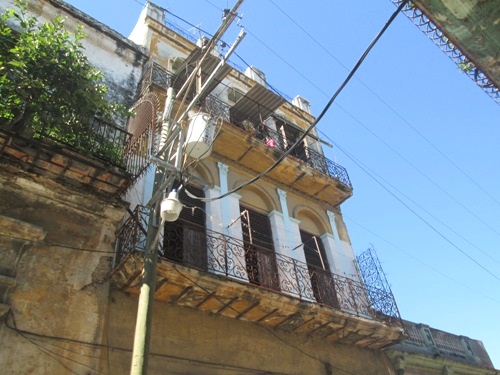
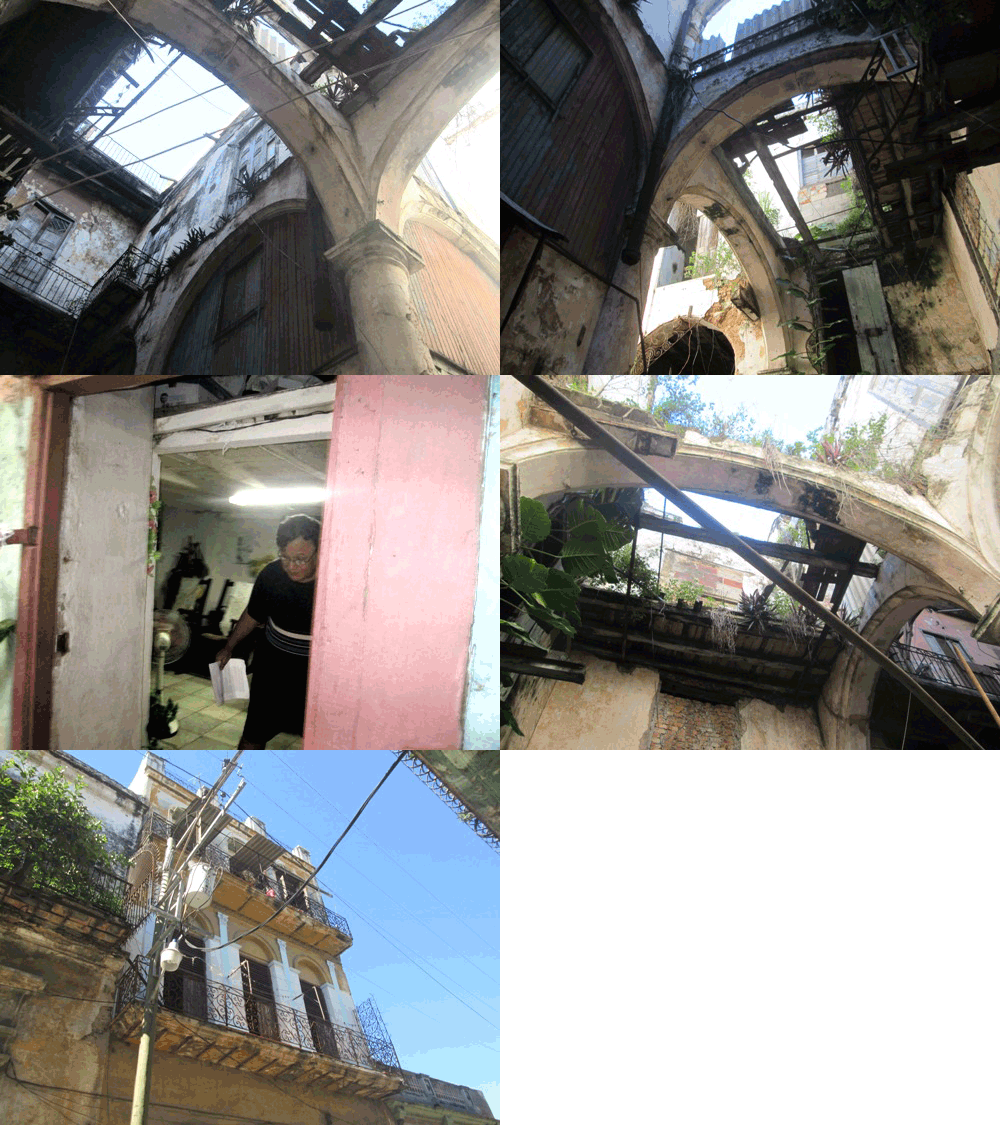
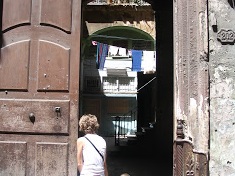
Havana , August, www.cubanet.org – Over a year ago, the Havana news channel reporter, Graciela Resquejo, tried to report the terrible living conditions, life-threatening, in which many families live in the solar — tenement — at No. 12 Jesus Maria between San Ignacio and Inquisidor, in Old Havana.
But to no avail. That report was censored by political commissars of Cuban television.
Resquejo apologized days later to neighbors and urged them to relentlessly pressure the institutions responsible for housing, so that one day they might get out of this hell.
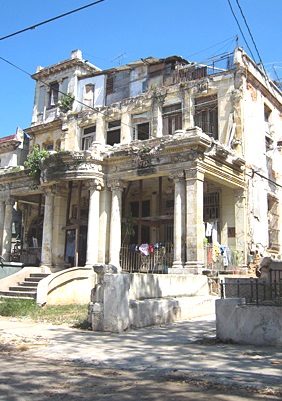
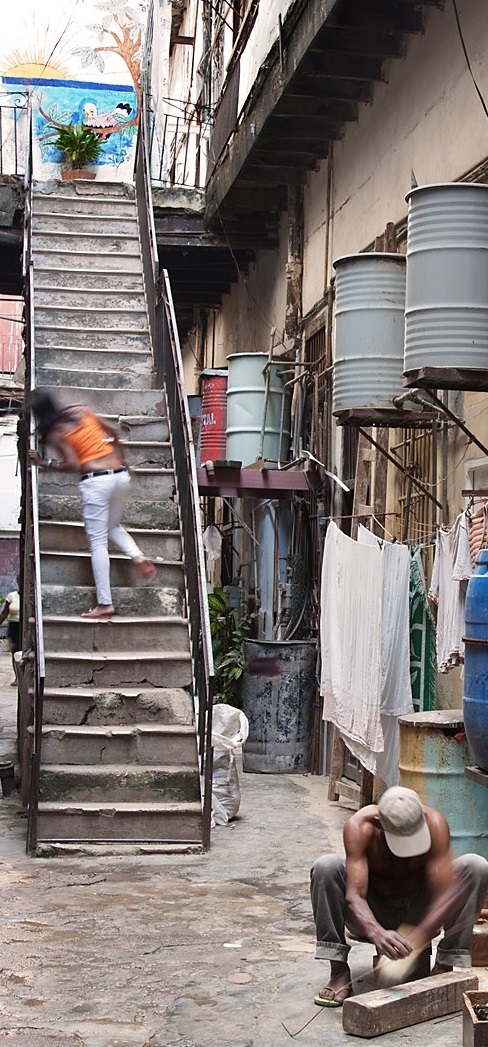
The solar at No. 12 Jesus Maria is a disaster. Its tenants live in fear of a collapse, or the spread of disease, because when it rains, the water penetrates the roofs and walls, leading to a steady drip, even hours after the sky clears. Nor do they have drinking water, which comes through a pipe installed between sewer pipes, and rats and cockroaches swarm everywhere.
Neighbors have appealed, time and again, to the government. But the problem persists in every session of the Popular Power. Finally they went to the Department of Citizens Support of the Central Committee of the Communist Party, who toss the ball back to the municipality.
One of the biggest frustrations of tenants, was in 2007, when they were assigned to some old offices in a four-story building near the tenement. They only had to wait until the bathrooms and kitchens were put in. But while waiting for the arrangements, the government itself gave these offices to other victims who had lost their homes because of a cyclone. Back to square one.
Year after year, this miserable citadel of San Ignacio Street waits for the fulfillment of the promises of the authorities. But promises are always empty .
One of the neighbors of the tenement, whose husband recently had a heart operation, said, “The authorities remember us every time a hurricane comes,” adding, “their cynicism knows no bounds, at times we’ve been asked to find our own shelters, on others they’ve taken us to a multipurpose room at Avenida del Puerto, and as soon as the weather improves, we returned to our citadel, ignoring the building collapses that happen when the sun comes out.”
A young woman who works as a waitress at the pizzeria at 264 Prado and who has lived in the tenement for seventeen years said, “We are not asking for a palace in Miramar or Vedado, we want at least a roof with better conditions, but we are always victims of deceit and manipulation.”
The nine families the No 12 Jesús María tenement, living without hope, victims of government neglect .
Though it has no leading role in socialism as it is practiced in this country, the self-described “new Cuban left” is trying to find its place in the current economic, political and social debate, one in which no one is participating. Perhaps it is inertia that leads it to simply repeat certain well-worn arguments put forth by the government, which are far removed from historical reality.
When referring to the Cuban Republic, the “new left” accepts as fact that it was a neo-colonial and subjugated pseudo-state, constrained by the Platt Amendment and subject to foreign interference. It assumes that only a tiny minority lived well while the rest of the population suffered in misery without education, health services or employment opportunities. It also believes that discrimination against racial minorities and women was rampant. The current authorities have been incessant in their demonization of past eras, facts and historical figures, while some have accepted these claims as absolute truths and go on repeating them.
The reality is that the situation was not quite so gloomy. Cuba was one of the most advanced countries in the world in terms of agricultural and industrial production, health services, education, salary levels and labor rights. Its gross domestic product was also one of the highest in the region, making it an attractive destination for immigrants from other countries. It had an established and thriving middle class, and both its population and cities were continually growing, both from an economic and urban standpoint as well as in terms of infrastructure.
In fact, most of what we still have of value we owe to the republican era. To ignore this truth — even keeping in mind the political situation as well as other shortcomings and problems that existed at the time, and that still have not been resolved — is like listening to only half the story.
When referring to the disastrous years of socialism, however, the new Cuban left characterizes it as true, authoritarian, statist and Stalinist. It focuses attention only on its distorted features, blaming them for all its failures, as though it were not the system itself — independent of its atrocities and its leaders — which has failed wherever it has been tried.
When discussing the future, the “new left” rejects a return to the past, presuming it might lead to something as ridiculous as a return to pre-1959 capitalism. It accuses those who propose abandoning Raul Castro’s model of being responsible for a possible loss of independence and sovereignty (language which daily falls further out of use in a globalized world) or for subjugation by the neighbor to the north. It is a perhaps unintentional reprise of an official rhetorical phrase: “You are either with me or against me.”
The only thing that Cuban socialism has distributed equally throughout the population — which does not include of the tiny elite which hangs onto wealth and power — is poverty. This is the equality that its domestic and foreign supporters applaud. Cuban socialism has enjoyed fifty-four years of missed opportunities, which makes it highly unlikely that the population will be inclined to give it further opportunities either in the present or in the future.
As the popular saying goes, the Castro model’s “last fifteen minutes are up.” Therefore, new opportunities present themselves to other political, economic and social initiatives which can and must include all citizens who care about Cuba. They cannot, however, impose narrow concepts, whether or not they are what we call socialists, democrats, participatives, critics, conservatives, liberals, capitalists, anarchists, rationalists, centrists, decentralists, pluralists, reformers, etc.
It is only natural that this political opening would occur after years of living under a single economic, political and social ideological mindset. The wide variety of new ingredients should produce a dish capable of satisfying the palates of most of our citizens. But this dish cannot be prepared by one single chef. It has to take into account the opinions and participation of those who will consume it, and must include economic development, freedom and social justice.
The goal is to enter the current global jet stream and advance along with it in ways to be determined by citizens exercising their full democratic rights, with participation by everyone but without new and ridiculous political, economic and social experiments or the kind of one-party nationalism that has left us light years behind the world’s democracies.
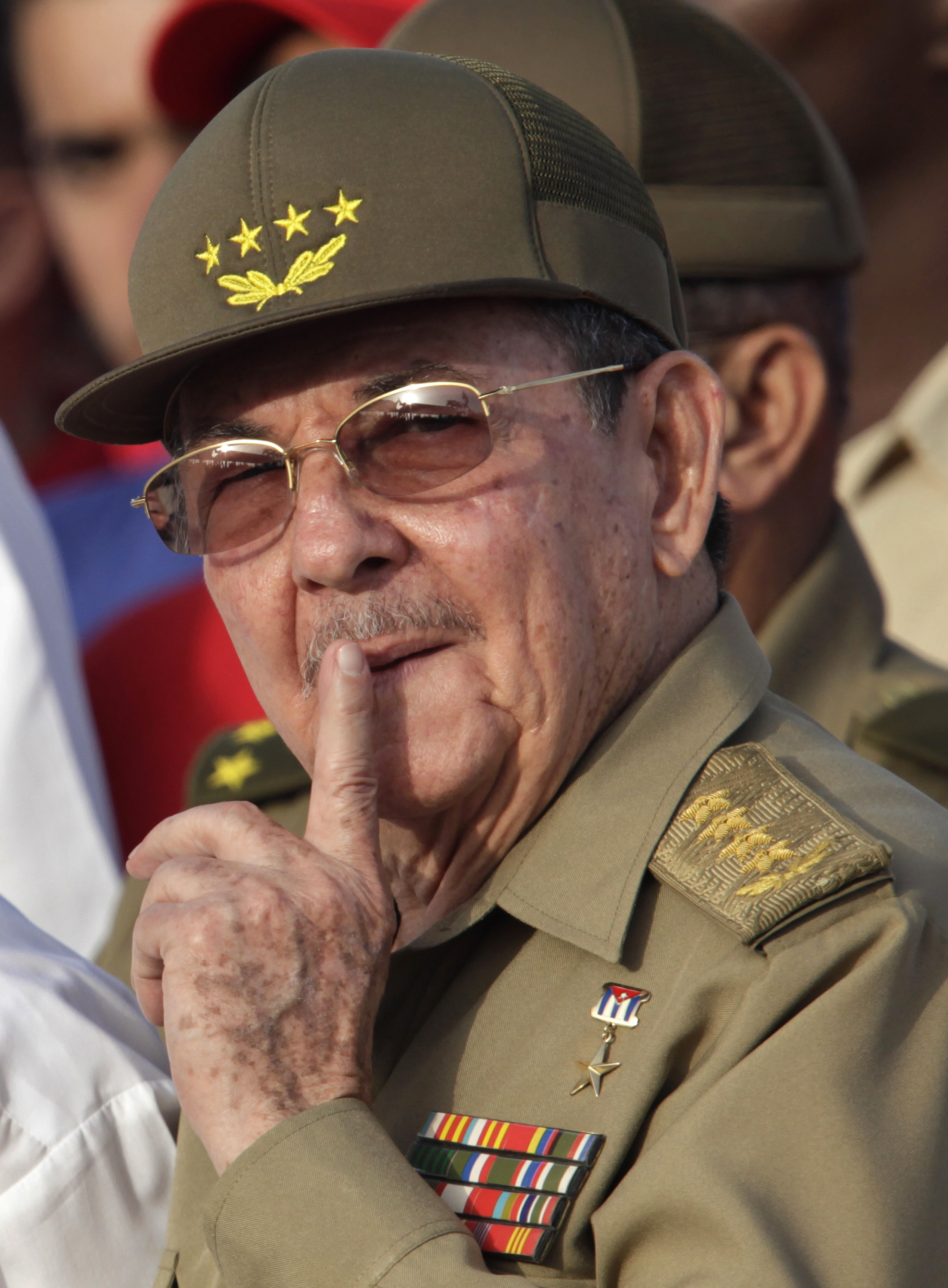
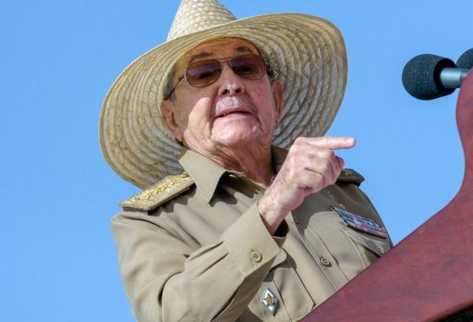
HAVANA, Cuba, August, www.cubanet.org — Does Raul Castro have a vision for the state? After seven years in office the question bears asking. Perhaps few people thought about it during the previous forty-six years because most observers just assumed that Fidel Castro had a grand plan for the state. But in perspective I do not think so. One can be a political animal yet lack a strategic vision for the country. What is clear, however, is that Fidel Castro did have the political fiber required to constantly to remain in power.
He demonstrated the abilities necessary to fuse a founding myth with a sense of opportunity and social control. And everything seemed perfect politically as long as he was able to hide the brutality of his regime, his absolute lack of principles and his incompetence at financial management behind this fusion. But where his lack of vision for the state can be seen is in not having left behind anything serious, such as a legacy, in the three areas where he uprooted the myth: in the social, in values and in the reconquest of the nation. In the end he did not know how to do what politicians with a head for strategy do. He did not know how to reinvent himself.
The followers of Castro, the tall one, can say what they want in his defense. However, this only demonstrates that the confusion between expectations and results continues to be fascinating material for two types of study: mythology and clinical psychology. It has nothing to do with reality.
Milk and marabou
It was hoped that whoever came to power in 2006 would take a healthy dip in reality. Cuba had strayed so far from its revolutionary dreams that this cleansing would be a preliminary step in confronting the task refreshed and with mental clarity. Asians know a thing or two about the relationship between the sauna and the mind. And this appears to be what happened when Raul Castro, in a speech on July 26 of that year in Camaguey, said two trivial words: milk and marabou. They indicated a fresh return to the abandoned land, and an idealized return to the land as metaphor; this after a lofty, fattened regime anchored to the rest of the world only through rhetoric and foreign subsidies.
But strategically the shorter Castro could write a how-to book on disaster. I will not dwell on the long list of his economic adjustments and their social consequences. Much has been well and wisely said about the failure of his so-called economic reforms, notwithstanding the analytical obstinacy of an unwavering group of academics, prominent in the news media, who did (and do) not realize that in terms of economic reform Cuba had (and has) to learn to run, not just move. So I am not interested in judging Raul Castro by his own words. We must measure the man by his results, not by his efforts.
There are two areas I would like to visit in order to analyze what I consider to be a worrying lack of national vision or strategic proposals. One is the port of Mariel and the other is the set of factors facilitating the exodus to what Cubans refer to as la Yuma, meaning everything outside the island, whether it be Brazil, Haiti or the United States itself.
The island as banana republic
Many see in the construction of the port of Mariel a brilliant strategic move. I see the new port as a step towards turning the island into a banana republic, as we used to be portrayed in the schools of most Central American countries. A social poet, who visited several places in our archipelago to feel its vibration before reflecting them in his poetry, described us at the time as a synthesis that was simultaneously powerful and depressing: Cuba, the ruin and the port.
I find no strategic value in a project that ratifies Cuba as a landlord state, living off of a couple of assembly plants and on being the connecting port-of-call between a super-power (the United States), an emerging power (China) and a jolly secondary power (Brazil). Foregoing the economic possibilities offered by the knowledge economy in favor of one for which we are better prepared — one which depends on the crude economics of the exploited and poorly paid port worker — does not get us much closer to a strategic vision for the state. Nor does a property owner prepared to collect tolls and warehouse fees from all who pass through his ports. But that is indeed what is happening.
Mariel: a circle of illusion
This is because — and here the circle of illusion becomes complete — such a step presupposes two additional elements. One is a deep knowledge of the internal reality of the countries in question. The other is effective control over the temptation of the governmental elite to decide things lest they forget that there is a new port in Cuba called Mariel.
Keep in mind what happened in the Soviet Union in 1989 and in Venezuela in 2013. Having information about what really takes place in countries that affect us economically, and being able to process it, is not the strong point of revolutionary leaders. The former socialist superpower collapsed and Maduro won in spite of losing. China is only interested in money and we have none. And Planalto Palace — the headquarters Dilma Rouseff took over from Lula da Silva — has been trembling lately.
Let us remember that investments in Mariel were being managed by a risk-taking partner, President Lula, who held out the promise to a Brazilian business conglomerate, Odebrecht, of a hypothetical opening by the United States to Cuba. It is as though a fiancée were to put on a wedding dress without knowing for sure that her intended would show up to satisfy her nuptial ambitions. A fiancée who, on top of everything else, behaved as though she did not have to do anything to attract the very specific type of suitor she was after by showing him anything he might possibly find attractive in her.
From subsidies to an economic enclave
There is nothing strategic about turning a subsidized economy into an economic enclave within the confines of old-fashioned capitalism, especially for a country that loudly demands — or rather politely requests — a comprehensive modernization built on the foundations of a knowledge-based economy.
If you are wondering why the government of Raul Castro is involved in this issue, which we know as state strategy, then imagine all that can be done by using Cuba’s potential to assure the structural integrity of the country, guaranteeing a relaxed transition and re-legitimized mandate for successors who lack the pedigree of the mountains we know as the Sierra Maestra.
A new port development provides no insurance in either of these areas. It puts Diaz-Canal in quite a precarious position relative to two interest groups. One is made up of real estate interests tied to unproductive corporations, and the other is made up of citizens excluded from sharing in the pie, which can only grow arithmetically rather than exponentially.
And the exodus to la Yuma? Well, this is where the disconnect between the sense of the treasury and the sense of State is perhaps best revealed. Now that the treasury no longer puts food on the table, we have weakened the possibilities of redefining the State by making an overseas sojourn possible for what the utilitarian language of economics calls human capital. It really surprises me that the emigration reform law has been so widely applauded. After granting fifteen minutes of fame to the restitution of a right that did not have to be taken away, there should have come a serious and sober analysis of its medium and long-term impact on the nation and the country, which are really the same thing.
Living off remittances
Two facts continue to be confused: as an economic reform measure, the migratory reform converts Cuba into the El Salvador of the Caribbean: living off remittances. And as the restitution of a right, it destroys the options to rethink an economic model to export the best young minds of the country, as a country like India has avoided.
The media analysis has blurred the problem, focusing the discussion on superficial political terms. They say that the Cuban government has thrown the ball in the court of the rest of the world, as if it were a tournament which, in reality, doesn’t exist between states — all countries let their own citizens leave and abrogate the right to allow the citizens of other countries to enter — and obscure the principal debate: the fate of a country, aging, losing in a trickle or a torrent its potentially most productive and creative people and, on the other hand, not rebuilding its image as a possible nation.
This the principal problem of our national security. And it only has one origin: The concentration of the political in a single lineage. The philosophers of this matter are right: politics begins beyond the family sofa.
The problem takes on a new light, more dangerous in terms of national security, with an immigration reform targeted to Cubans by the United States, much deeper than that of Raul Castro. The granting of a five-year multiple-entry visas to those who live on the island grants a right foreigners greater than that granted by the Cuban State to its own nationals living inside and outside the country. This is somewhat embarrassing. Cubans from here can freely enter and leave the United States for much longer than Cubans can enter and leave their country of birth without renewing their permit.
Citizens of both countries
One of the results we have, one which I want to focus on, is this: we Cubans have become, in theory, resident citizens of two countries. Cuba is one, you choose the other. This is an issue that goes beyond the transnational nature of our condition — very well analyzed by Haroldo Dilla, a Cuban historian based in the Dominican Republic — because over the long term it weakens the center that serves as the axis to the global nature of citizenship. We Cubans will stay in the same place in an ambivalence that weaken loyalties to a nationality that one now feels and lives anemically. A strange and dangerous situation for a country lacking a sense of solidity.
If the story says that the new U.S. policy serves to promote relations between Cubans and Americans and between Cubans and Cuban Americans, in reality we are moving to a scenario in which relations between Cuban-Americans, in fact, resident on the island, and Cuban-Americans by law, resident in the United States arise and are strengthened; and on the other hand between Americans and Cubans residing on both shores.
All that will be left is an irreducible minority, regardless of their ideological leanings, who will resist nationality in both, taking American or Spanish nationality as strong reference points.
So, we return to the economic and cultural circuit of the United States — in some way we have already entered that of Spain — which we supposedly left more than half a century ago. Not to mention other smaller circuits such as those of Jamaica and Italy.
Surrendering to this reality, hiding behind the anti-imperialist rhetoric of “no one surrenders here,” that keeps obsolete arms oiled and “repaired,” is evidence that the strategy of the State has never accompanied the Castros. Will our paradigm as a nation ever be viable? The question is not rhetorical.
HAVANA, Cuba, August, www.cubanet.org –The identity of El Vedado has been in jeopardy for a long time. This neighborhood in the old Elegant Havana is no longer a museum of modern architecture. Here Cuba entered modernity, which was always an accent of its identity. It wasn’t just a neighborhood founded by families of the aristocracy, it was also a neighborhood of tourism and prosperity.
This neighborhood, which germinated from the forest, today has aged very badly. It is a scrap of city that is no longer prepared to handle hard hits, its views have been sacked, deteriorated and blurred, it stopped being an ostentatious site and today its facades are merely a game of appearance.
I remember the homeland of my childhood as a hospitable place, an ecological settlement in which the way of life breathed dignity. Having been born in the Sagrado Corazon and being from El Vedado demanded an etiquette of distinction and elegance, even among the humblest.
Teresa, a woman from Guantanamo who was born in La Loma del Chivo, vowed, from very young, never to go back to her hometown: “I arrived in this neighborhood in 1962 –she testified–and I was dazzled by El Vedado, one could distinguish the personality this place held, it had its own glamor, it was a place where one breathed decency. Back then, the beat of a drum, witchcraft and the sacrifices of animals under the ceiba tree was foreign to this place. Today this identity has disappeared and a culture of flip flops and barracks has been superimposed.
With the new social contract pushed by the Revolutionary inquisition, the customs and culture of El Vedado, as a style of life for the elite of Havana, was amputated by decree and replaced by a culture of barbarity.
The Hotel Trotcha, the Govea and Alaska buildings, or the gardens of the Loynaz home, are some of the lost local patrimony. The Alaska building, that could have been saved, was destroyed by dynamite, and today in its place is the park of the Provincial Communist Party Committee. It’s possible that the same fate awaits the Medical Retreat building, located on N, between 23 and 25. Cinematographic rooms, such as the Gris theater, and cultural plazas, such as the Casa de la Cultura Checa have been lost.
According to Hilda, a Havanan born in the neighborhood of Cayo Hueso, today many mansions in El Vedado are citadels: “I remember that here there weren’t many ancestral homes, among them were the home of the Chalas, now known as Blumer Caliente, and the Guillermina home, where the most troublesome family was that of Silvia, known as La Cochina, white with dark hair and eyes, who left the country in 1980. Now there are other places , such as La Mierdita (The Little Shit), El Sopena, el Hormiguero (The Anthill) and the Pentagon. Chivalry is over, as is good taste and the pride we once felt for this place.”
Areas linked to the echo of fine dining, such as the Varsovia, Sofia and El Jardin restaurants, as well as coffee shops, La Cocinita (The Little Kitchen), El Avioncito (The Little Plane), La Piragua (The Canoe), La Fuente (The Fountain) and Sol Mar (Sun Sea), no longer exist. Other restaurants like Rancho Luna (Moon Ranch), Los Andes (The Andes), Vita Nova, El Cochinito (The Little Pig), Centro Vasco, Casa Potin, Las Bulerias, El Castillo de Jagua, (The Castle of Jagua), La Roca (The Rock), El Mandarin, Siete Mares (Seven Seas), where it is now very difficult to eat seafood and fish, or the pizzerias Cinecitta, Buona Sera and Milan. They are all grey places, abandoned to their fates.
The few places with foreign currency have cancelled opportunities for free entertainment of the common people. The Vedado Tennis, today the Jose Antonio Echevarria Social Circle, is a jungle in which the floating class free their repressions and lay out the trash talk. The Club Sayonara is a sad warehouse of food administrated by the Provincial Management of Gastronomy of the People’s Power of the municipality. The Escondite de Hernando and Club Oluku clubs disappeared and were transformed into a piloto* for the mass consumption of beer. The feeling vanished from Pico Blanco. The children’s hospital Pedro Borras, and the maternity ward, Clodomira Acosta, have been waiting to be demolished for more than 20 years.
While El Vedado continues to lose its role as the Garden neighborhood it once was, new places are being superimposed, as part of the emerging economy: Dulcilandia (Candyland), La Farandula (Showbiz) and La Moraleja ((The Moral). The walk along the Avenue of the Presidents is the sanctuary of the urban tribes (emos, rockers, preps and gangsters). The culture of parks is also crumbling, the Victor Hugo (H and 21) or Medina and Menocal are now animal cemeteries, for the permanent offerings to the ceiba tree of the spirits.
A long time ago, El Vedado stopped being this elegant gentleman, an intellectual dressed in white with a blue cummerbund. Of its traditions, which constituted their own culture, all that is left is the eroticism of La Rampa and the romanticism of the Malecón.
*Translator’s note: The name “piloto” comes from Plan Piloto (Pilot Plan) that began around 1969 after the regime expropriated all the remaining small businesses, including bars, in 1968. There was still a need to sell beer to people to keep them happy-ish, and the regime turned many of the bars and clubs into cheaper “beer halls” under the Plan Piloto. Cubans started to call these establishments “pilotos” (singular: la piloto). In short, a piloto is a trashy, dirty, state-owned beer hall. [The translator thanks one of our most faithful collaborator’s mother for this explanation.]
About the author
Juan Antonio Madrazo Luna: Civic Activist and leader of the Citizen’s Committee for Racial Integration (CIR).
HAVANA, Cuba, August, 2013 www.cubanet.org – At age 16, every girl who is part of an “integrated” and “revolutionary” family, automatically becomes a “federated” woman. Perhaps, like me, the only memory they retain of the Federation of Cuban Women (FMC) is when a neighbor came by the house to collect the dues.
On August 23rd, the only state organization that “defends” the human rights of women celebrated its 53rd anniversary. At the time, extensive articles in the official press accentuated stories about Heroines of Labor, including a female crane operator, among others.
They stuck to those cases of women who were able to overcome the barriers of sexism, but as usual this is a government strategy to hide those Cuban women who are victims of discrimination and of domestic and institutional violence.
Recently, Cuba was examined by the Committee against Discrimination Against Women (CEDAW, for its acronym in English) and the FMC was challenged about the absence of complaints on this issue.
As noted by one of the experts, “the absence of complaints does not always mean the absence of problems; sometimes it’s because of fear and various other reasons that women do not get around to making the complaint.”
In fact, Cuban women do not recognize the House of Guidance to Woman and the Family, nor the FMC, as potential organizations to resolve their problems. This is demonstrated by the low numbers provided by the State regarding assistance to members of the Federation in cases of violence between 2006 to 2008.
Eloísa Ricardo, after a history of mistreatment and abuse by her former husband, a government official, looked in vain to the FMC. On the other hand, Mrs. Regla Bárbara complained to the Federation, and received a response letter sending the case to the Prosecutor’s office, which is standard practice.
The FMC reached this anniversary under the disappointed and concerned gaze of international bodies such as CEDAW, for failing for, so many years, in getting the Parliament to pass a specific law protecting women.
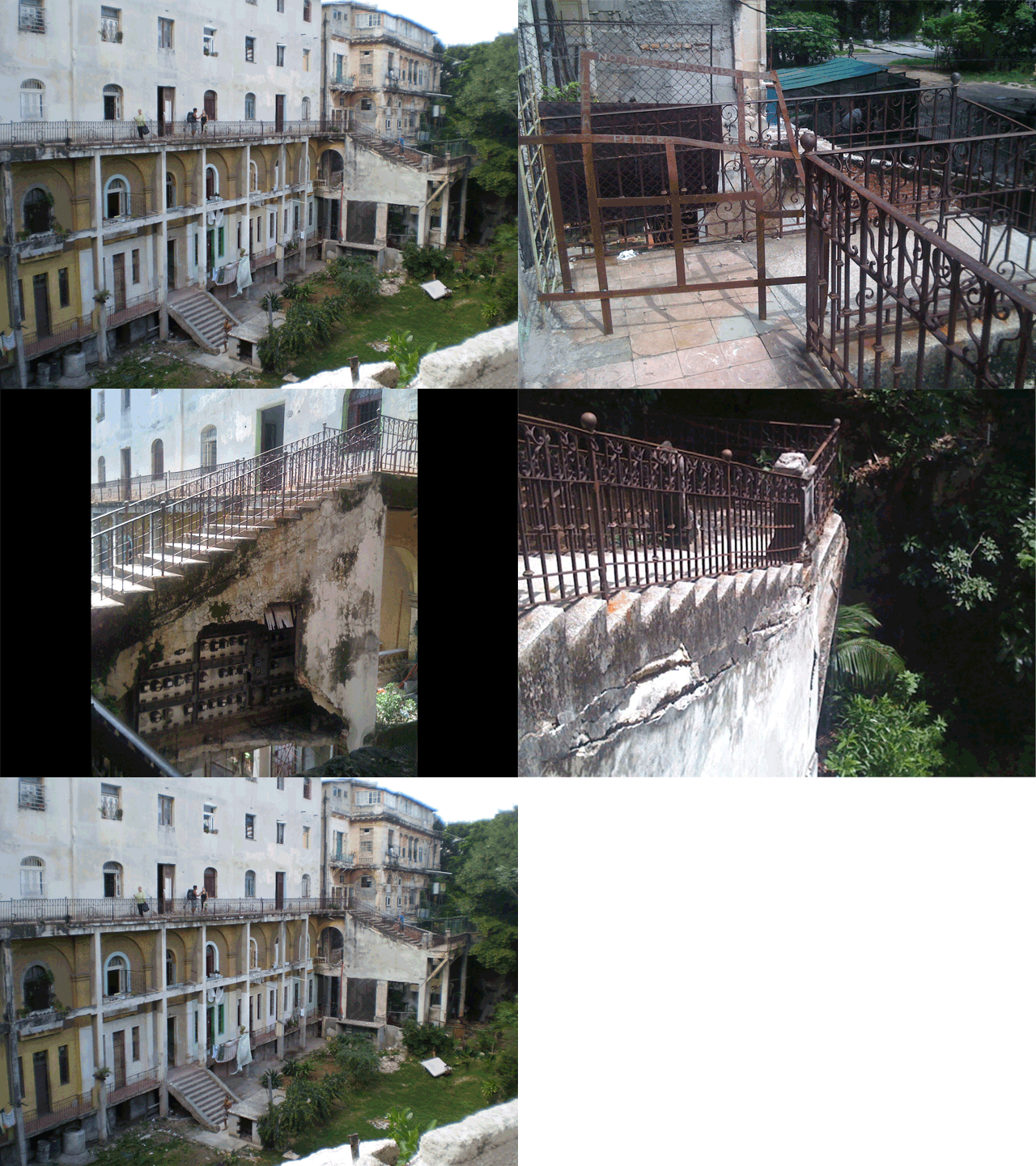
HAVANA, Cuba , August, www.cubanet.org – The Arcos building is in the block formed by
F and E, between 19 and 21 in Vedado. Everyone in Havana knows this unusual building built in the 1930s in the middle of one of the deepest ravines in Vedado.
It’s bad state of repair presents a serious danger to the many families living there, and the tourists who visit it as an example of rare architecture.
One of the neighbors, who asked not to be named, said that they have exhausted all possible official channels for requesting the reconstruction of the old building.
“This building has 71 apartments and is built in an ancient ravine in Vedado that we Havanans call ‘the hole.’ The Department of Multi-Unit Housing promises, the Plaza municipal government promises, the provincial government promises, they ensnare you and do nothing. Everyone is brazen, sh..politicians.”
The facts bear out this neighbor. For a long time now the structure of this property has been suffering as a result of the passage of time, lack of maintenance and neglect of the authorities.
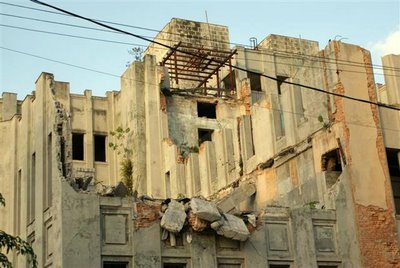
The atypical characteristics of this building require specialized reconstructive procedures. Partial collapses have occurred, for example in the passageway that accesses the apartments from the entrance on 19th Street.
At present, the staircase leading to 19th is virtually collapsed. This staircase, and a long exterior passageway in the form of a balcony, connect 21st Street with 19th Street.
The route allowed pedestrians to avoid the obstacle of the deep and long ravine that cuts across F street in that area. The neighbors decided to avoid greater evils by blocking the way and placing signs warning of the danger.
You can see that the stair supports are broken, weakening it. From another angle, coming from 19th, the principal column that supports the stairs is extremely damaged.
Also the base and the support columns of the building all require attention. A photo accompanying this note is in eloquent in itself. It shows a sign painted by the neighbors which states : “We need help (now), responsibility and the promises to be met. We hope not to face the displeasure of putting ourselves dead.” (sic)
HAVANA, Cuba, August, www.cubanet.org- The organizers of Estado de SATS have worked very hard and the result is that, three years after its inception, in July 2010 in Casa Gaia, this civic project is a fundamental component in the network of organizations that, from civil society and with great variety in points of view, fight to promote changes to democratize our country. Because of this it has also been repressed by the political police and accused of everything the authorities usually accuse those who propose a solution to the crisis. Estado de SATS takes as a fundamental cause that there is no dispute between Cuba and the United States, but rather the dictatorial practices of the Cuban government against its own people.
Hence in the last year, they have focused most of their efforts to disseminate and gather support for the Citizens’ Demand for Another Cuba which, as we know, demands that the Cuban government ratify the UN Covenants on Human Rights. In that work, the project has engaged with many important civil society groups for the sake of a purpose that supersedes political interests, and focuses on citizens and their basic needs.
In recent days, we were able to talk with Antonio Rodiles about the prospects of the project, three years since its inception. The director of Estado de SATS said “Our main goal now is to achieve much more drawing power. Hopefully State Security will stop bothering us,” he said, although he recognized that “at this time there really is something less than harassment of the work we are doing.”
The idea, according Rodiles, is to try to reach many more sectors and to be a place that helps articulate civil society, and above all,”to be able to expand and work on all the plans we have: holding exhibitions, film screenings, panels, debates, literary cafes. All we can do to articulate civil society and grow like any normal country.”
Although it seems like a very easy program to carry out, the reality suggests otherwise. The proof is in the recent past and if recently the political police haven’t harassed as many activities, it has been in part because they have not been as intense as around a year ago, when the Citizen Demand was launched. “Evidently,” observes Rodiles, “we know that everything is not as we would like, but well, I think it’s important to accept the challenge and work focused on everything we have proposed, despite the obstacles.”
Some people have commented that, lately, they have been showing college students videos about civil society activists, including Estado de SATS, where it’s presented through the usual procedures, with a negative image. On this subject Antonio Rodiles says, “The same as always. That’s part of what the system can’t quit doing.”
But, he says, he would like to know exactly what they’re putting out there so he’ll be able to make statements about it. “Unfortunately,” he says , “there is a group of people who have always been characterized by trying to devalue and personally offend any opponent, anyone who thinks differently from the official line.”
In events such as this he sees a disturbing characteristic. “I think this shows the low level of those who have organized it ,” he says, “because they are not able to enter into any discussion of ideas or plans . It is a manipulation, but in any event, thank God, the new technologies allow us to show who we are,” he says, convincingly.
Well, ironically and contrary to the intentions of those who orchestrate this slanderous propaganda, the results could be otherwise. “In a way, this type of action helps disseminate our work. When people look for our CDs, our work, and they see them, then they realize perfectly well that we are not the kind of people they are trying to make us out to be,” he concludes.
He’s probably right. In addition, the days are long gone when some opponents thought Estado de Sats was a project of the “opposition light” and it has gained respect and collaboration, including that of almost all of the most important political opponents, as well as countless artists and intellectuals.
As the director of this project, what lies ahead is a major challenge. Perhaps the hardest path, with all the cultural activities and the panels put on, but especially with the commitment to strengthen the Citizen Demand for Another Cuba and the continuation of this work, in cooperation with other civil organizations, he tries to contribute, gradually, to the extent possible but always with sights set still higher, for a positive change in the country.
A few months ago, Antonio Rodlies and Ailer González — his domestic partner and main collaborator — were in Miami and there at Cuba 8 and at Miami Dade College, they organized panels and concerts of Estado de SATS, besides promoting the Citizen Demand, which has managed to strengthen the support of Cubans from the outside, but inside Cuba there has not been remarkable progress of the campaign in recent months.
According to Rodiles itself, the term “Estado de SATS” (State of Sats) is a phrase used in the theater to represent the moment when all the energy is concentrated to begin the action, or when an athlete is at the precise moment before the starting gun. It is the concentration required to later explode. Hopefully, after three years of hard and complex work, this project is mature and ready to take off, against all obstacles, as the crucible where the forces of the emerging civil society are articulated.
Call for Estado de SATS : First International Meeting on Human Rights and UN Covenants
The independent Estado de SATS project invites artists, intellectuals, activists and human rights defenders to participate in the First International Meeting on Human Rights and the UN Covenants as part of the Campaign for Another Cuba and the 65th anniversary of the Universal Declaration of Human Rights.
Estado de SATS has worked for the past three years in the creation and growth of a public space where different perspectives on reality and the future of our nation can be openly discussed and planned.
Since August of 2012, together with various groups and activists committed to the social situation of our nation, we started the Campaign for another Cuba. This initiative has been involving a growing number of Cubans on and off the island in a civic demand that the Cuban government ratify and implement the United Nation Covenant on Civil and Political Rights and the Covenant Economic, Social and Cultural Rights.
In a time when Cuban civil society is growing the direct exchange with different actors within and outside the island is essential. Holding of this meeting will allow an approach from the perspective of art and thought to a subject as vital as human rights. Activists, artists, intellectuals and professionals, Cubans and the international community, will spend two days sharing views and experiences, in a country where such guarantees and rights are not part of the everyday reality.
The inaugural meeting will be on December 10, 2013 and during the event there will be thematic panels, audiovisual displays, an exhibition with the theme: Art and Human Rights (painting , graphics , photography, installations), performances and a closing concert .
For more information the interested can communicate to this email address: estadodesats@gmail.com.
About the author
Ernesto Santana Zaldívar, born in Puerto Padre, Las Tunas, 1958. Graduate of the Enrique José Varona Pedagogical Institute in Spanish and Literature. He has been a radio writer for Radio Progreso, Radio Metropolitana and Radio Arte. He is a member of the Union of Writers and Artists of Cuba. Awards won: Mentions in the genre of story in the David contest of 1977 and Trece de Marzo, 1979; prizes in Pinos Nuevos, 1995, Sed de Belleza, 1996 (both in the genre of story) Dador, 1998, (novel project) and Alejo Carpentier, 2002 (novel), the Franz Kafka Prize, 2010, for his novel The Carnival and the Dead.
Due to recent experiences I have chosen to address an core issue critical to the future of our country. I mean the few opportunities for young people, often under 20, to succeed as workers in our society; and in addition the way, not at all educational, that they are judged when they go before a court of law.
Have you ever wondered how many people in Cuba led a life of crime, such as prostitution, pimping, diversion of funds, theft, racketeering, etc. … who on leaving the country continue to commit the same offenses? Or why Cuba has a such a high rate of its population behind bars and in prisons? If they did, no doubt you can find the answer yourself. Justice and the social system in other parts of the world operate in ways that encourage their citizens to opt for a sustainable and prosperous life without committing violations of law that may lead to a prison.
In Cuba, youth live a paradox partly responsible for the increase in crime. Of 13 million Cubans, 2 million live outside the country, which means their families in Cuban can survive and lead a relatively normal life, without complications. But for the rest, going to a nightclub or a cabaret could cost them the fruit of their labor for a whole month, that is they can’t enjoy these things without balancing the scales by the illegal means mentioned. Because an element that characterizes Cubans, given the economic differences, is to appeal to whatever resource to keep our pride intact.
Thefts from the State are the most frequent crimes. “What belongs to everyone, belongs to no one.” It is an axiom within most of the Cuban population. Therefore such actions aren’t that embarrassing to people. Event National TV has shown shorts confirming the veracity of such arguments: “In many minds stealing from the State is not stealing, it’s fighting.”
In other cases leaving the country by different routes, whether temporarily or definitively, is the greatest hope of every young Cuban. Prostitution and pimping are the choices made by a considerable number, to which you can add those who have not played those roles, who would be willing in certain circumstances to do so as a way to escape the dismal status quo and thus gain opportunities elsewhere in the world.
For the most part the youngest can’t rely on an education policy that will motivate them to contribute to society, with either detention in a work camp or another alternative outside the bars; rather than educate them, we corrupt them in every way.
The solution in many cases is not to repress us or deprive us of our most precious rights. There are plenty of alternatives that can educate our youth preventatively. If there’s anything I’ve learned in my young life is that you win more with intelligence, than with bureaucracy.
Elsa Velázquez Mata wanders between delusions and afflictions. She’s always seen carrying a portfolio where she saves several records of housing she never received, despite being dependent on welfare, letters sent to her from ministers, medical certificates that attest to the congenital heart condition of her youngest son, and a diary (little notebook) that holds her laments over 17 years.
Elsa, a 43-year-old agronomist, has suffered physical abuse, eviction, prison, and worst of all, the mockery of a government that says it defends the rights of women.
Elsa Velázquez lives with her son in the home of an aunt, in the Santa Maria del Rosario neighborhood in the Havana municipality of Cotorro. “Someone lives because of me, eats because of me, I have no record of identity and residence,” she says while showing an identity card made for her: a piece of white cardboard where her personal data appears in cursive, her photo and fingerprint in methylene blue.
Five years in prison “for burning her husband”
Her life took a sharp turn in 1997 when she was the victim of domestic violence on several occasions. She was sentenced to five years imprisonment for burning her former husband with hot water. But Mata Velázquez always denied the incident. She says her ex-husband, aided by his brother, a former police officer, carried out the attack on himself to have her charged so he could stay in the house.
This Cuban woman has been watched by the authorities for 17 years. In 2004, after serving five years in prison, and with her two-month-old son, the Director of the Convention Center in Havana, Abrahán Maciques, promised her that before the baby started eating she would have a completely legal apartment, Maciques headed in the Provincial Department of Housing and under the protection of the functionary Rafael Martinez, initiated her first housing file for priority cases, number 290 of 2004.
She occupies an abandoned post office
After a year of waiting without receiving the promised housing, the Popular Power in Havana opened two new files for Elsa, numbers 6000 and 6017 of 2005. Two years later, on September 15, 2007, the case was transferred to the Popular Power of Guanabacoa, and Elsa appears on the housing waiting list with case numbers 05272 and 1146. On December 23, 2009, the municipality of Cotorro took over the case and two other files were opened (061285 and 04568), the latter corresponding to a disabled home in the town of Santa Maria del Rosario. All these files were traded (sold), because according to Elsa, “in the civil registry she appeared with another identity.”
Weighed down by being shunted around so much, in January 2008 Elsa decided to take her child and occupy an abandoned post office, located in the town of Santa Maria del Rosario. Aware of the violation, she decided to send a letter to then postmaster of Cuba, Luis Enrique Blanco Prieto, so that this place would be legally handed over to her. On the 28th of that month she was evicted by force. She says that in her absence, the police broke the lock of the room with gunpowder and took the roof, the windows and a rice cooker donated by Social Security.
On May 24, 2010 Elsa response from Luis Enrique to assess the case. But it was too late, that post office had been taken over by a police chief named Daniel.
The houses she never had
February 13, 2010, was her last attempt to demand a “comfortable” home, as she had begged for in each of the files. She made this demand to Juan Contino, then President of the Popular Power in Havana. In reviewing the records of “social cases Liudmila Mejía and Orlando Nunez, the latter second in command of the Popular Power in the capital, found that Elsa Velázquez Mata appears as the owner of six apartments.
Today Elsa, among her delusions, demands “compensation” for the houses she never had. Maybe that’s why she keeps all the meticulous files on the homes, the dates of appointments with officials, letters, eight ration books, newspaper clippings, speeches by Fidel Castro and even the official donation of an abandoned post office.
About the author
Odelín Alfonso, born Havana, 1970. Graduated in 1989 in industrial electronics from the former Eduardo García Delgado Technology Center. In 2004 he joined the internal opposition as eastern region coordination for the Liberal Orthodox Party, and, in 2005, the independent press.
 HAVANA, Cuba , September 4, 2013, www.cubanet.org – Two police cars parked at the entrance to a high school. From one of them a man in civilian dress got out, and with long strides entered the school. Uniformed police also got out of the cars, but they remained outside the fence. The civilian went straight to the office of the director, who barely had time to react when the newcomer started dragging him, kicking, taking him almost to the center of the schoolyard.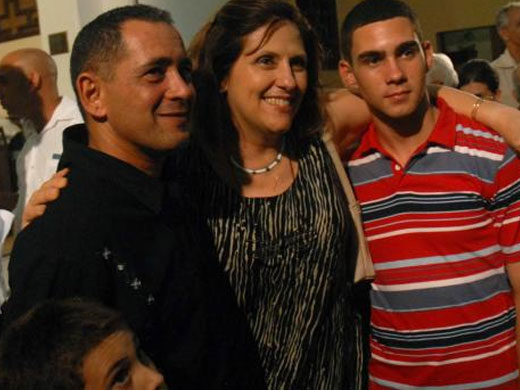
 Orlando Freire. Born Matanzas, 1959. Bachelor in Economics. He has published a book of essays The evidence of our times, winner of the 2005 Vitral Award, and the novel Blood of Freedom, winner of the 2008 Gaveta Franz Kafka Prize. He also won the awards for Ensayo y Cuento in the Universal Dissident Magazine, and the Essay Prize of the magazine Palabra Nueva.


 Gladys Linares was born in Cienfuegos in1942 and is a school teacher. She worked as a professor of geography and as director of various schools for thirty-two years. In late 1990 she joined the Movement for Human Rights through the Women’s Humanitarian Front. She was an active participant in the Cuban Council and the Varela Project. Her writings reflect daily life in Cuba.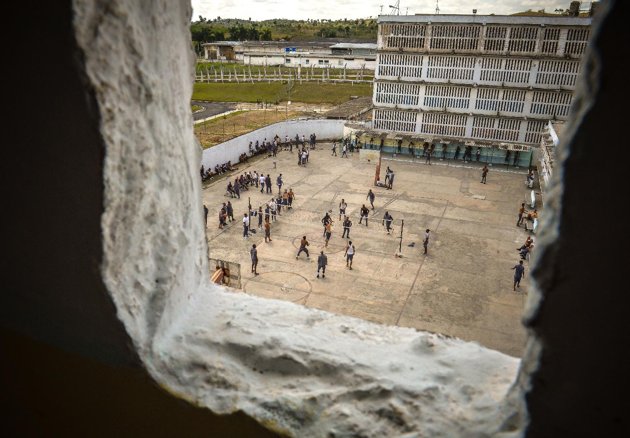
 Alberto Mendez Castello (born Puerto Padre, Oriente, Cuba 1956).Degree in Law and Criminal Sciences, graduate in Operational Management. Although an Interior Ministry official from a very young age, professional inconsistencies with his ethical ideas left him no choice but to leave that institution in 1989 to engage in agriculture, literature and journalism. Nominated for the “Plaza Mayor 2003” Novel Award in San Juan Puerto Rico, and the “Max Aub 2006 International Stories Award in Valencia, Spain .