I am the Woman Who was Raped by an Immigration Officer in the Bahamas / CID

My name is Maireni Saborio Gonzales, I am 23 years old and I live in city of Caibarien, Villa Clara.  I left as a boat person or rafter on September 25, 2012 and I was jailed for 11 months in the Carmicheal Center located in Nassau Bahamas, where later on I was deported back to Cuba on August 21, 2013.

While in Bahamas, I psychologically suffered very much.  I was the woman who was raped by the immigration officer in Bahamas.

I am very afraid to be in this country – Cuba – because I declared myself as dissident on some United States’ radio stations, on the internet and I repudiated wanting to return to Cuba in all instances.

I am under a lot of tension due to all the things that have happened to me; I also had to denounce the Bahamian authorities because of their lack of protection during the time I was imprisoned, due to the sexual assaults that I suffered on several occasions and I am under pressure too because I was returned to a country where I haven’t been able to find a job and I feel that I am under surveillance at all times.

I was one of the women who stitched their mouths shut; I surrendered my beauty and I shaved my head to collaborate with my compatriots, 24 Cubans completely bald.  I did two hunger strikes, one that lasted 18 days and the second one that lasted 16 days, and there were men on strike too.

The Bahamian government detained me because I tried to kill myself due to the psychological stress that I was under.  They detained me and took me to a mental institution in which around March I took a mixture of 20 different medications so I could take my life.  Afterwards, they took me to the Silent Hospital, another medical institution which the Bahamanians have on the island of Nassau to treat the mentally ill.

As I said before, there they gave me medications and wouldn’t tell me anything about what was going to happen with our situation and I was extremely stressed.

We witnessed beatings, we saw our compatriots be beaten, the video that is going around the world is not a lie, this video is real and we lived it and we, the women, decided to go through everything that happened because nothing that you see in those photos and on the internet is a lie and we decided to do it because we were tired of these things and of existing under those horrific conditions in which we found ourselves where we didn’t even have drinking water and we had to sleep on the floor and we couldn’t communicate with our families and we were continually sexually harassed.

In addition to seeing how they mistreated our compatriots, we had no human rights, no one we could count on and we lived in this place in this concentration camp that was horrible and what we wanted was for the whole world to see what was happening and what happens with all these Cubans. We were a little more than forty Cubans who were in the detention center, we aren’t criminals and the only thing we were looking for was a window to freedom and I ask, please, that everyone who sees this video knows what is is real and help us so that one day we can see the freedom we so greatly desire.

Translated by – LYD and RST

13 September 2013

Sonia Garro’s Husband Speaks From Prison about the Accusation of Murder / Augusto Cesar San Martin

Sonia Garro and Ramón Alejandro Muñoz

HAVANA, Cuba , September 17, 2013 , www.cubanet.org.- In a phone call this morning, from the Combinado del Este prison, political prisoner Ramón Muñoz described as embarrassing the prosecutor’s request for a sentence between 10 and 14 years in prison for his wife, the Lady in White Sonia Garro.

“We are being accused of something we did not do,” said Ramón. “We will prove that this is a lie, there are videos that show the opposite,” he added.

The prosecution asked for 14 years for Muñoz for the crimes of Public Disorder and Attempted Murder. It also asks for 10 years for Sonia Garro on charges of Assault, Public Disorder and Attempted Murder. The trial date has not yet been set.

In this regard, Ramón said, “If there is someone here guilty of attempted murder, it’s them, who come in shooting and throwing stones. At no time did we attack them.”

He said the government document does not mention that Sonia Garro was shot in the leg and the beatings she received.

According to the prosecutor’s request, read by Ramón, the government has 16 witnesses, all members of the National Revolutionary Police (PNR), who accuse the couple of Attempted Murder.

Ramón said that Sonia was arrested because she was one of 17 women who would meet with the Pope Francisco in the Bishopric, during the prelate’s visit to Havana during the prelate’s visit to Havana.

“We do not deny the arrest, just ask that Sonia’s arrest be legally documented, something that they never showed.”

The prosecutor’s report describes the Lady in White as socially “undesirable,” with family life issues . The document also lists Garro as a person who “openly demonstrated against the revolutionary process,” the reason why, they say, she “is rejected by the residents of the neighborhood.”

“Sonia was studying for a university degree in clinical laboratory and was never unemployed,” said her husband. “It’s another big lie in the request,” he added.

Ramón Muñoz wrote a public document for all Cubans where he accuses the government of carrying out acts of terrorism to come to power. Also, he denounces beatings of the Ladies in White and the defenders of human rights in Cuba.

He recalls in his statement the executions of the young people trying to leave the country hijacked vessel, comparing it with the assault on a military barracks — the Moncada attack — by those who are still the rulers.

The statement ends with the exhortation to the people to save Cuba from the dictatorial regime prevailing since 1959.

The couple was violently arrested in 2012. Initially accused of Terrorism, until the government changed the accusation for the current one.

A home video with the image of Ramón entrenched on the roof of his house went viral on the internet then. He simply demanded that the his wife be released.

From Cubanet

17 September 2013

Living in a Shelter Comes to Seem Normal / Odelin Alfonso Torna

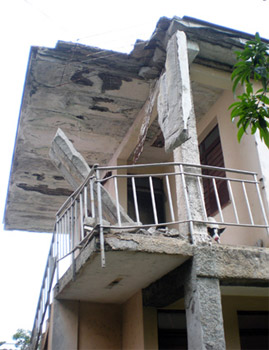
HAVANA, Cuba , September, www.cubanet.org – For ten years, the issue of housing has topped Cuba’s social problems. The state, unable to meet demand in the medium and long term, commits to offering its abandoned and unrepairable properties. Families of victims, calling on their meager resources and their own efforts, are divided out among warehouses, factories, schools, offices and even in abandoned police headquarters.

Offices of an old abandoned factory in danger of collapse, located in Cuervo road in the Havana municipality of Arroyo Naranjo, were previously assigned, provisionally, to three families of victims. In the warehouse of the dismantled La Ideal cannery, in the capital municipality of San Miguel del Padron, shelters other families by whatever means possible. The San Francisco de Paula railway station, in the same municipality, has served as a “temporary” roof for three families since the end of the ’90s.

These spaces donated by the State already existed, to a lesser extent, before 2006, the year that Fidel Castro delegated his powers for reasons of health. Already since 1996, part of the International School of Sports and Physical Culture (EIFD), in the Cotorro municipality, was enabled for dozens of victim families to temporarily stay overnight. These families and their descendents are still living in EIDF.

Transition communities like Gambute, Mantilla, El Comodoro and Martín Pérez, all in the capital, have been operating for more than fifteen years.

According to the ousted vice president Carlos Lage, 2006 ended with 111,373 housing units built, 78,833 more than were constructed in 2011 (32,540). Data provided by the National Housing Institute shows that Cuba must build between 60,000 and 70,000 housing units. However, the State is building some 16,000 while between 8,000 and 10,000 are built through private efforts. The State insists that its priority is to “solve [the problem of] those sheltered because of collapses.”

Does Havana, receiving more than 20,000 new residents each year, especially from the interior of the country, record in its annual housing construction plan the spaces and “transition communities” that are offered each year to victims and social cases? Looking at the nationwide housing stock of more than 3 million units, according to the National Statistics Office (ONE) 61% are in good condition, and the rest are “regular” or “bad.” Annual demand is predicted to be twice the plan figures for construction and repair of housing units.

Oris Silvia Fernández, president of the National Housing Institute, interviewed for the new news show “Cuba says,” argued, “We have a very complicated situation in the country’s capital because we have 5,471 families in shelters, and we have to say that there are other families who live in critical buildings with rather complicated structural situations in the capital, and we are talking of a total requirement of 28,000 homes.”

According to the ONE, the Cuban capital has more then 6,000 tenements and former mansions and old houses subdivided into rooms, plus 46 shantytowns — among them the transition communities — on the periphery, where more than 18,000 people live. All of them, and the new generations that come along, have been waiting for more than twenty years for dignified housing. However, statistically, are these cases resolved by the government?

For the long list of victims, offers of land by the State do not seem to be on the table. And despite Decree Law 217 (1997), which regulates the flow of migrants to the capital, the arrival of emigrants from the eastern part of the country increases the total housing needs in the capital.

Hurricanes and tropical storms over the last ten years have affected more than one million homes. Hurricane Sandy, which hit eastern Cuban in October 2012, most affected the provinces of Holguin, Santiago de Cuba and Guantanamo, causing the complete destruction of 22,396 homes. As of the first half of the year, 20,710 remained unaddressed. From previous cyclones — I’m referring to Gustave, Ike and Paloma — 40,000 totally collapsed homes remain unaddressed, according to Silvia Fernández.

The eastern province of Santiago de Cuba has a housing stock of 329,191 homes, with 40% in fair or poor condition. With this as a starting point, Hurricane Sandy affected 171,000 households, and only 44% of the victims have resolved their situation.

Given the low production of materials and a government program to build housing that does not exceed 20,000 annual units, temporary solutions appear necessary  It remains to be known if this is a permanent state.

By Odelín Alfonso Torna — odelinalfonso@yahoo.com

12 September 2013

Exiled Cuban Photographer Presents His Work at Estado de Sats in Havana / David Canela Pina

Alberto Maceo – taken from Facebook

HAVANA, Cuba , September 9, 2012, David Canela Piña / www.cubanet.org.- Last Friday the civic project Estado de Sats put on, at its usual site, a photographic exhibition by Cuban artist Alberto Maceo, who currently resides in Flensburg, a small German town on the border with Denmark. The exhibition, entitled From Havana to Here, included thirteen portraits of ordinary people of the streets of Germany, and also to a Cuban woman looking to the horizon from the Malecon. The artist was not present at the exhibition.

Cubans have a cultural similarity with the German population: in both communities the people daydream looking out to the sea, breathing the sea air. Perhaps it was this reminiscence that inspired Maceo to search faces for something Cuban: a distant yearning, an introspective silence. The sharpest eye might discover that they are lower class people, but possessing of a certain dignity.

However, the attributes and attitudes revealed in the composition of these figures are not enough to evoke a defined psychological and social profile. The majority neither seduce nor move one. There is a lack of substance, an infinite projection. Some images look like studies: an expression, lacking temperament, delighting in the vanity of its pose.

 Woman on the Malecon - Alberto Maceo
Woman on the Malecon – Alberto Maceo

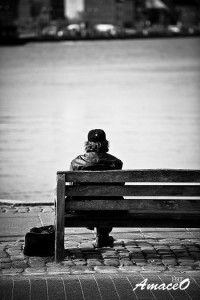
Very few manage to be a vehicle that leads to another universe: the Cuban woman, wrapped in a cloud of mystery, as if watching from the tower of a fortress; the young guitarist who seems to imagine or remember the verses of a song; and a man sitting on a bench, watching a fjord in the gloom. In the other images, it is difficult to guess at a story, an atmosphere, a conflict.

The quality of the photos is undeniable, but they lack character, uniqueness, and the prism of suggestion. It is true that not all photos can be iconic, like that of Sharbat Gula, the Afghan girl who was photographed in 1984 for National Geographic, but they should aspire to those reflections of the soul, and life experience.

Estado de Sats, builder of bridges

As Antonio Rodiles once said, the main objective of Estado de SATS is to create a public space within the Island. If voices that are pro-government (at least in appearance) are excluded or reject the invitation, either out of fear, convenience or laziness, it’s a personal matter for each person. But the space is open to all arguments, tendencies and attitudes, as long as they are defended with respect and rationality.

Public during exposition - Photo David Canela
Public during exposition – Photo David Canela

The second objective has been to build bridges of recognition and collaboration within civil society, some of whose members have been marginalized for their ideology, and for not worshiping a state that presents itself as the supreme idol. These, from their experiences and convictions (and I must say also , from poverty and homelessness), have decided to reclaim their dignity, and pay the price for their independence.

Perhaps the objective can be summarized as an opening new horizons, and between them, leading to healing through beauty, and refining the sensitivity of many people who have become accustomed to marginality, marginalization, beatings and jail cells. Estado de Sats is a path through the weeds, leading to democracy and reconciliation.

About the author

David Canela Piña. He was born on April 27, 1981 in Havana. He attended Fabricio Ojeda primary school and Otto Barroso secondary, both in the municipality of Habana del Este. He earned a scholarship to the V. I. Lenin Institute of Exact Sciences High School, graduating in 1999. In 2006 he graduated with a degree in Literature from the University of Havana, with a thesis on the poetic worldview of the Cuban writer Raul Hernandez Novás . He has worked as an editor, professor of grammar, literary scholar , and now as a digital media journalist. For seven years he lived in Diez de Octubre; he now lives in the municipality of Playa.

From Cubanet

9 September 2013

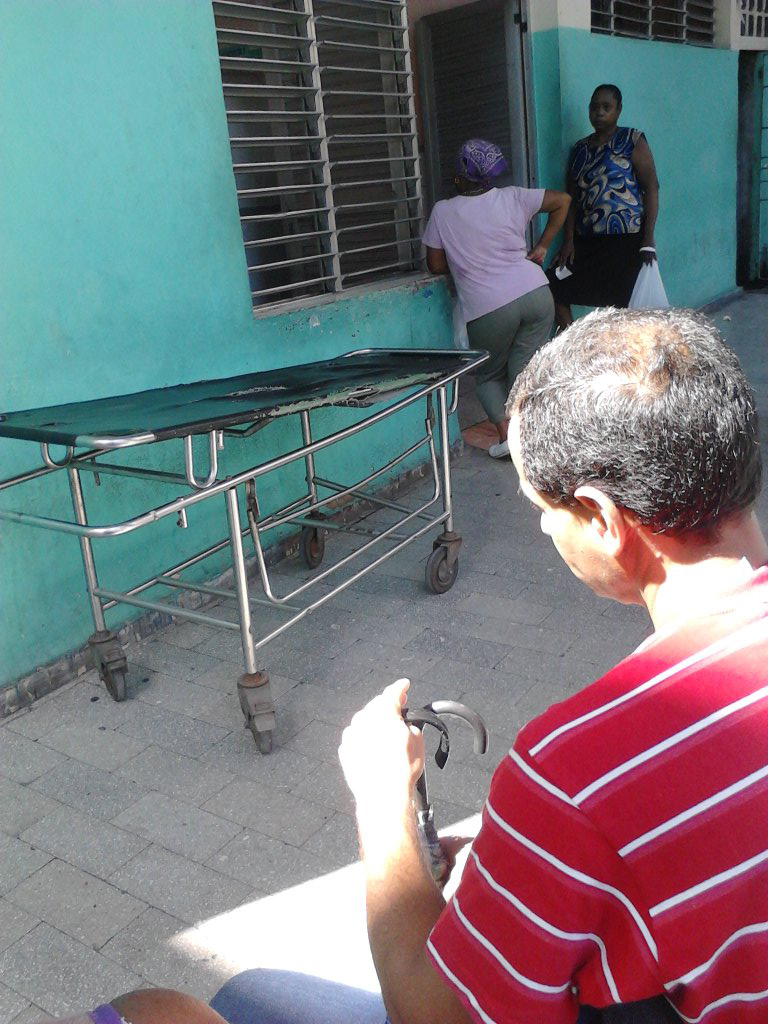
Family Medical Practice: Mirror of Cuban Medicine / Orlando Freire Santana

HAVANA, Cuba, September, Orlando Freire Santana, www.cubanet.org –The Cuban health system has a vertical structure that has its base in family run medical practices, followed by polyclinics and hospitals.

In the ’80s of the 20th century, when they were created, it was thought that all the problems of the population would be solved.

Soon after, patients lost faith in the practices. And today, the task of the family doctor has been reduced to taking blood pressure, prescribing medications, and sending patients to polyclinics and hospitals.

Isabel is an 80-year old woman, who never visits the family doctor in her neighborhood. It isn’t that the elderly woman doesn’t need medical care, just that she prefers to get it directly from hospitals because she has friends who “connect” her with specialists. What’s more–she tells us–many times the doctor’s office is closed and other times instead of the doctor there is a student who is only good for prescribing aspirin.

Ofelia, for her part, doesn’t want to be reminded of the family doctor. It turns out that her doctor doesn’t live in the housing annexing the doctor’s office. He left it to his daughter, son-in-law and grandson. And even though the doctor drops by the clinic in the day, he’s absent at night and in the early hours of the morning. What happens if there’s a medical emergency?

Ofelia’s father-in-law passed away suddenly at home, around 7 or 8 at night.  And since the family doctor wasn’t there to sign the death certificate they had to keep the cadaver in the house until the next day around mid-morning.

Photo: Orlando Freire Santana

Of course she has lived through lot.  Before the Revolution, she says, her family were members of the “Accion Medica” private clinic located in Cocos y Rabi, in the Havana neighborhood of Santos Suarez. For a monthly fee of 2 pesos they had access to all the clinic’s services, including admission to hospitals, in addition to any medications they needed. They could even ask for a doctor’s visit in their home, and the doctor would arrive at the latest only 15 to 20 minutes after the request was made.  Now, by comparison, Clara laments that the family doctor barely “shows up.” That is, he doesn’t visit the sick in their beds.  “Well,” Clara warns, “at least not unless he gets a little present.”

Amelia desperately hopes that they select her to complete a medical mission in any other country.  It doesn’t matter that the Cuban government keeps most of what doctors are paid abroad. But anything would be better than what they make in Cuba, from 15 to 20 dollars a month.  The doctor Amelia “makes do” with what is earned by her husband who, at night, being careful of the police, rents his car, illegally.

The patients are not the only ones who disagree with the family doctor’s offices.  A doctor who works in an office in Cerro –who asked to remain anonymous– showed herself to be overwhelmed:  “When one arrives at the office, within 15 days you know all the elderly in the neighborhood, they come every day, just for kicks, to stretch their legs, because they don’t have anywhere else to go.”

And how do medical students weigh in?  The other day several daring young women with the uniform of medical science, snacked on a bench in the park.  One of them highlighted the importance pf earning high grades from the first day of class, to form a record that guarantees a good placement after graduation. “Yes, of course,” another student asserted, “we can’t slide, they’ll punish us and send us to a family medical practice.”

From Cubanet

 11 September 2013

From State Security Agent to CID* Member / Yudel Rojas, CID

By Yudel Rojas**

I was born on December 24, 1980 in Manzanillo to a family committed to the Revolution. I always dreamed of being a member of the Special Forces and one morning they offered me a chance to work for the revolution.

You might ask how.

A captain in counter-intelligence, a man name Jorge Vázquez, told me I should join his agency as an undercover agent. I told him that, of course, I would do anything for the Revolution.

After a few days he came by on a motorcycle, took me to a Cuban Communist Party guesthouse and led me to a bedroom where I was to receive lessons in intelligence gathering. I was trained in debriefing and security monitoring, which meant having to meet people at various houses, where I was given information and instructions. Thus began my life as a G2 agent.

I had to memorize the phone numbers that the official in charge had given me. I felt very encouraged by the contribution I was making to the Revolution, to which I was told I owed a lot, even my existence as a human being.

One night I was taken to Vallespín Park, a place well-known to residents of Manzanilla, and was introduced to a man I was never to see again. We met up with a dissident known as Pascual. He headed the cell of a splinter group, whose members were known, in the language of counter-intelligence, as grupusculeros. My official let it be known these were people who posed a grave danger to the Revolution and who worked for the United States government.

This group had been infiltrated a year and a half earlier. At the time Pascual, who was married to Mirta, had been sentenced for committing a very dangerous crime. He served out his sentence and a few months later left for Spain.

The head of the Gulf of Guacanalyabo branch of the party was the dissident Tania de la Torre Montesino. Before leaving, Pascual suggested I begin working with Tania, through whom I would meet Nelson Virelles, Diéguez Segura and others.

During the meetings at Tania’s house the discussion was about human rights and the challenges facing the Cuban people. Listening to Tania talk about freedom and democracy, I began to have serious doubts.

I was confused and shared my doubts with the official with whom I worked. He told me it was all a lie. He said that, if these were good people, the Party would accept them as one more Cuban civic organization.

After five years problems began to crop up due to ideas about which I had learned from the dissident movement. After every meeting I would ask the official about the things that had been discussed, which led him to finally ask me if I was with the revolution or against it. I told him it was only a question and nothing to get upset about. Once I did not go to a meeting and was ordered detained by the police.

Things got worse. I learned not to trust anyone. Jorge, the official, told me repeatedly that my goal as an agent was to infiltrate these splinter groups, not to ask stupid questions. I stopped doing infiltration work but kept visiting Tania’s house and participating in various activities.

Over time I learned I had been mistaken, that State Security had confused me and that the truth was to be found there in the old house where the brave fighter known as Tania de la Torres Montesino lived.

I was arrested several times and the head of counter-intelligence, Alexis Díaz, threatened me, saying I might simply disappear if I kept visiting the grupusculeros’ house.

To be continued.

*Translator’s note: Acronym for Cuba Independent and Democratic. An organization founded in Venezuela in 1980, dedicated to “the struggle for the establishment in our homeland [Cuba] of a society committed to liberty and human dignity, completely democratic and sovereign, socially balanced and just.”

** Yudel Rojas is the author’s actual name. He is a member of the CID delegation in Manzanillo.

10 September 2013

Generals Sharpening The Teeth Over the Burial of Castro-ism / Luis Cino

HAVANA, Cuba, September, Luis Cino, www.cubanet.org — Those who restored capitalism in Russia rose from the ranks of the Communist nomenklatura. High-level bureaucrats, officials and generals made immense fortunes appropriating the assets of the state during the process of economic privatization that led to the dissolution of the Soviet Union. The cases of Roman Abramovich and Mikhail Khodorkovsky, former comrades turned multi-millionaires, are two such examples.

It is possible that something similar could happen if Castro-ism has a soft landing, as seems likely to happen, and is transformed into something else which, by virtue of being different, will be less bad in terms of public well-being and political freedoms.

But what could also happen is that, as apparatchiks and generals start filing their teeth over the prospect of burying Castro-ism, the Helms-Burton Act could prevent them from diggings its grave.

According to Title III of the law, which deals with protection of property rights of American nationals, the assets expropriated after Fidel Castro’s revolution — including those of Cuban exiles who have acquired American citizenship — would have to be returned by any government that succeeds the current regime as a condition for American diplomatic recognition and a lifting of the embargo.

After property is returned and people are compensated, it is quite possible that very little of the loot will be left over for “the corrupt bureaucrats, whose jobs were secured through calculation and opportunism, who use their positions to accumulate fortunes, betting on an eventual demise of the revolution,” as General Raúl Castro put it in an address to the National Assembly of People’s Power in December, 2011.

This is the idea the government would like to plant among its supporters who are hoping for the grand prize and Putinism in the tropics. It wants to convince them that burying Castro-ism is not in their interests, that they would be better off digging in, remaining loyal, being satisfied with what they already have and what they can steal. It wants to convince them that they should never exaggerate, that they should play dumb lest the General Accounting Office nab them.

But the chiefs do not have to go along. The players who want to break open the capitalist piñata at the expense of the state know all too well the risks they face. And the possibilities as well. They even know where to stretch their feet and put their hands. Accustomed to shady deals and a shopkeeper’s economy, they are patient, astute and make do with what they can steal… for now. They have begun accumulating capital, knowledge and relationships. After dealing with them for so long, many foreign entrepreneurs prefer to deal with them over the good guys, even if they completely lack the know-how. These players have neither class nor moral scruples but they do have a strong hand, which allows them to maintain order and get Cubans to work like slaves without complaint.

The Helms Burton Act placates the most hard-line exile factions and serves the Castro regime by allowing it to portray itself as the victim. It is not, however, of much concern to today’s players, who hope to be tomorrow’s oligarchs. In a post-Castro scenario this law will be almost pointless. Events, once they are set in motion, will make it irrelevant.  And then the players will be the mafiosi of the piñata, ready to parachute into any given situation with anyone who presents himself. But they will not exactly be working as doormen, security screeners or bodyguards. They know, of course, they will not be able to afford multi-million dollar yachts, real estate in La Luna or mansions in Silicon Valley. They are not fools. Their aspirations are more modest. They better than anyone know in what state they have left the country.

By Luis Cino — luicino2012@gmail.com

From Cubanet

9 September 2013

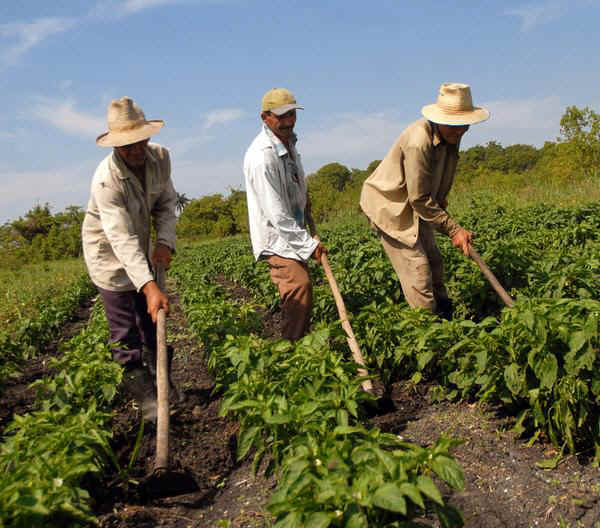
Reservoirs Overflow While Farms Lack Water / Osmar Laffita Rojas

HAVANA, Cuba , September, www.cubanet.org – In Cuba there are 242 reservoirs, administered by the Institute of Hydraulic Resources (INRH). Together, these reservoirs can accumulate 9 billion cubic meters of water. Not to mention hundreds of small dams belonging to the Ministry of Agriculture and Sugar (AZCUBA), which have the capacity to store 500 million cubic meters.

But of the total reservoirs, 106 are not used. Without having a convincing explanation for why, the INRH has assigned resources to undertake the required maintenance.

In these dams out of service today, serious problems have accumulated over the years, leading to the paralyzing of the diverters, the master channels, and the irrigation systems so needed for the crops.

The unjustified waste of water accumulated in reservoirs , throughout the whole country, and its negative effect on agriculture, highlights the fact that the Cuban government has to allocate 1.8 billion dollars for food imports, most of which could  be produced in Cuba without any problem.

The underutilized reservoirs are located in the provinces of Pinar del Rio, Artemisa, Cienfuegos, Villa Clara, Camagüey, Holguín, Las Tunas and the special municipality of Isla de la Juventud. In these territories, the use of reservoir water is down 75%. And in another 35 of these reservoirs water use is down 25%. However, in the territories mentioned, accumulate 566 million cubic meters of water with virtually no destination. These provinces, until recently, were noted for their high agricultural production.

To the problem of under-utilization of the accumulated water in the reservoirs, we must add 778 million cubic meters of water that could be used for fish farming.

The other issue for which INRH has no solution in the offing, is the leaks in the hundreds of miles of major canals and their connection and distribution networks. Due to the deterioration of age and lack of maintenance, millions of cubic meters of the precious liquid are lost every day.

Cuba has no major rivers. Their courses, generally from north to south, are short. The rainfall has become more erratic due to the greenhouse effect. Therefore, the filling of reservoirs and groundwater in recent years has not been as reliable as in the past.

The water problem in Cuba is potentially critical. According to the index of the potential availability of water per capita, the country ranks 105th out of 182 countries, with a range of consumption of 3,404 cubic meters of water per capita.

At present, the government talks a lot about the need to achieve food security as collateral for the material welfare of the population, but it is pure slogan and talk, without concrete results.

From Cubanet

6 September 2013

We Are Fewer But With More Problems / Jorge Olivera Castillo

HAVANA, Cuba , September, www.cubanet.org – Raul Castro and those accompanying him in the exercise of power don’t give a damn about the unstoppable population decrease in Cuba. Faced with this unfortunate prediction, revealed by National Bureau of Statistics and Information (ONEI), we confirm once again that the government has no sense of the nation which, without a hint of modesty, it continues to call revolutionary.

The reluctance of the women to bring children into the world, clear from the high rate of abortions, has its foundation in the socio-economic problems. In addition to the depressed wages we have rising unemployment and the inability to choose a house or apartment with the minimum standards of livability. Currently, the deficit amounts to more than a million homes.

The current environment favors  alienation and marginalization, especially among young people, who tend to see their future away from the land of their birth. The preference for emigrating abroad is also another cause underlying the predictions of a marked decline in the population.

According to the government agency that brought to light details of the issues, By 2030 Cuba will have 10,904,985 inhabitants. Comparing this number to the current population, the decrease exceeds a quarter million people since the most recent census conducted last year, which counted 11,163,934 Cubans.

The consequences of such a reduction in a depopulated country, given that Cuba has a land area of 42,400 square miles, will be unpredictable. Extreme poverty , increase in prostitution and trafficking of drugs, decay of social services, among other high-impact phenomena in the lives of the majority of the people. Of course the heaviest part of the burden will fall on the shoulders of Cuba’s elderly. Many will not be able to endure the stifling conditions.

The symptoms of Social Darwinism are accelerated to the extent that the foundations of real socialism are dismantled. The extreme nationalization, characterized by arbitrary prohibitions, voluntarism and enlarging the bureaucracy to a scale never before seen, have been the main triggers for a series of anomalies that have ruined the economy and social fabric.

The worst news is the fact that there are no reasonable methods to reverse the situation. The circle of power is still committed to delaying a transition to facilitate the rearrangements necessary so that the country will not to fall into chaos. The economic changes implemented lack vision that is viable and pragmatic rather than obstructionist.

While the end for Raul Castro and his entourage is their conservation as a political class, nothing can be expected beyond the news compels them to take refuge in the most remote areas of pessimism.

In 2030 we will be fewer people with many more dilemmas to solve. The culprits of the disaster set back the clock of history at their convenience. So far, unfortunately, they have been lucky in their maneuvers.

Jorge Olivera Castillo – oliverajorge75@yahoo.com

From Cubanet

9 September 2013

Eliecer Avila Defends His Right To Be Politically Active / Lilianne Ruiz

Moderator Gustavo Pérez (left), Eliecer Ávila (center). Photo by Lilianne Ruiz.

HAVANA, Cuba, September 6, 2013, Lilianne Ruiz / www.cubanet.org. – Recently, the Patmos Forum held its third conference. This time the topic of discussion was The Quality of Life, in connection with politics.

The meeting was attended by about 30 people, gathered in the courtyard at the home of independent journalist Yoel Espinosa Medrano, located in the center of a Santa Clara favela (squatter settlement), a few meters from the most important political plaza of the province.

The moderator was Gustavo Pérez Silverio, the historian and researcher on racial matters, who maintains a working connection with the regime.

The special guest was Eliezer Ávila, who is slowly ceasing to be identified only as the young University of Information Science student who got into trouble with the former President of the National Assembly, and is becoming known as a political leader who could have some role in the future of the island.

Ávila began his talk by defining himself as “a Cuban citizen who wants to exercise his right to engage in politics in Cuba.”

The lack of civic culture was addressed as the key to the whole question, recognizing that in the lack of civic responsibility lies the problem of freedom for Cubans. “A citizen is a person who has power, not someone who has to sacrifice themselves for a project in which they are not involved in the decision-making process, “said Avila.

After his speech of over an hour, the floor was opened to audience questions. Librado Linares, the former political prisoner from the Cause of 75 (from the Black Spring of 2003), began by recognizing the invited guest as a man with political talent, motivation, and strength. But he said he was unable to discern in Avila’s “We Are More” movement a concrete strategy for enlisting citizens, overcome by terror and apathy, or for dealing with the pattern of repression by the political police against the Movement.

The We Are More Political Movement would bring together people of different political persuasions, united by the common interest of presenting concrete demands to the Castro government. It would not be limited to Cubans living on the island, but would also welcome Cubans from the diaspora.

“This is a project that I want to build with the views of as many people as possible, because I do not want the people to serve one point of view, but for the point of view to serve the people,” he said.

The bloggers from La Joven Cuba (Young Cuba), labeled by the regime as the “loyal opposition,” had been invited to the Patmos meeting.

Regarding the absence of La Joven Cuba bloggers, Ávila told Cubanet:

“I don’t believe that any political distance is healthy. I had hoped this dialogue would occur, but at the last minute I was told that they had no interest in participating and invited me to dialogue on their blog. It is ridiculous for one Cuban to invite another to a discussion on the Internet, knowing that we don’t have that possibility.”

The Patmos Forum, created in February 2013 by a group of activists led by Baptist pastor Mario Félix Lleonart, was conceived as a space for the discussion of various topics in which different schools of thought are represented.

Previous events were devoted to the Origin of Life and the Right to Life, consecutively.

On this occasion, Lleonart announced the adoption and adaptation by “Patmos” of the Manual of Political Advocacy of the organization Christian Solidarity Worldwide, with the intention of providing workshops that equip Cuban believers with the power to influence the country’s politics, and end the myth that Christians are alienated from partisan politics that affect their quality of life and respect for human rights.

By Lilianne Ruiz, From Cubanet

Translated by Tomás A.

6 September 2013

Urgent Call to the UN in Support of the Ladies in White and Other Defenders of Human Rights / Moises Leonardo Rodriguez

ARTEMISA, Cuba, 4 Septemver 2013, Moisés Leonardo/ www.cubanet.org.- An urgent call regarding the increase in violence against the Ladies in White and other defenders of human rights was presented today to the United Nations High Commission on Human Rights through its Office for Latin America and the Caribbean, through the organization Martí Current.

The two-page document, addressed to the High Commissioner Mrs. Navanethen Pillay, outlines the factual basis for the request as well as the history of the escalation of repression against those who just wanted to leave the country during the exodus of 1980 and only stopped after the institutionalized violence cost Cuban lives.

The appeal has as its basis “a wave of violence around the whole island against human rights defenders who act according to the basic principles required of them under the Resolution on Human Rights Defenders (Resolution 53/144 of the United Nations).

It then refers to the arrests, beatings and death threats made to the Ladies in White and other advocates in recent times by paramilitary and State Security agents as part of the escalation against them.

The experience of the great repression against those who only tried to leave the country in 1980 is mentioned briefly to justify the fear Cuban lives are one again at risk with the rise of repression in the country.

It then warns that “Only the timely intervention of the bodies responsible for ensuring respect for and observance of human rights in all countries can reverse the current situation on the island.”

After requesting the intervention of the international organization in the human rights crisis in the country, it states that “the indifference and inaction at this time is equivalent to tolerance for what contradicts, in fact and in law, the essence of United Nations Charter and international standards of human rights that must underlie and give meaning to the mission of your organization.”

As spokesman for the senders, the petition is signed by the Initial Developer of the Current Marti organization, Moisés Leonardo Rodríguez, and concludes by giving the contacts for an answer by the Office of the High Commissioner, which will be duly informed.

The call is available here in PDF (untranslated): LLAMAMIENTO URGENTE DAMAS DE BLANCO 2013

About the Author

Moisés Leonardo Rodríguez, born Havana, 1947. He was a professor at the Naval Academy and the Enrique José Varona Higher Pedagogical Institute, among other academic endeavors throughout his life. He started in the independent press at the Decorum Working Group agency, and is a director and founding member of the organization Current Marti. He is also part of the Association for Freedom of the Press. Email corrientemartiana2004@gmail.com

From Cubanet

4 September 2013

A Day’s Salary is Spent in Two Trips / Veizant Boloy

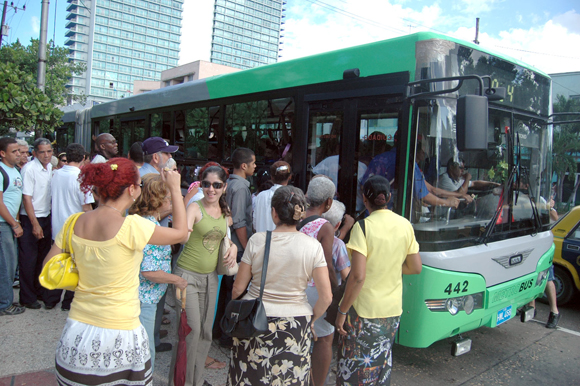
LA HABANA, Cuba, September, www.cubanet.org — With the 2013-2014 school year beginning, Havana’s public transport crisis is hard to overlook. Bus stops are already crowded with waiting passengers and the situation could become even worse in the coming weeks as students begin making increasing use of public transportation.

“After 2007, when the articulated buses came into service, the situation got a little better. Waiting time between buses was reduced to less than twenty minutes,” says Teresa, a route inspector in the Havana neighborhood Tenth of October. “But stops were still crowded and delays were longer than scheduled.”

On the Roundtable television show last July experts claimed the problem stemmed from the critical economic situation, which has led to almost half the buses serving the Cuban capital being idled.

Granma, the official newspaper of the Central Committee of the Communist Party, reported that at the last meeting of the Council of Ministers it was acknowledged that among the reasons fewer buses are in service are antiquated technology a shortage of spare parts, acts of vandalism and poor conditions in maintenance facilities and roadways.

The Havana Provincial Transport Agency announced that it will take steps to alleviate the situation. It has promised to reinforce inner-city public transportation along some routes in the capital. It is now providing the public with the well-known Russian-made “Giron” buses, which have survived three decades of marked decline in this sector. They will take the place of articulated and single-carriage buses made by the Chinese manufacturer Yutong.

Opinions indicate that transport workers and the average Cuban believe the island’s transportation system would benefit from a continued expansion of cooperatives beyond agricultural and into the urban transport sector. This includes cooperatives which would lease vehicles from the state as well as those that would offer technical assistance and vehicle repair services.

Guaguas* for five pesos

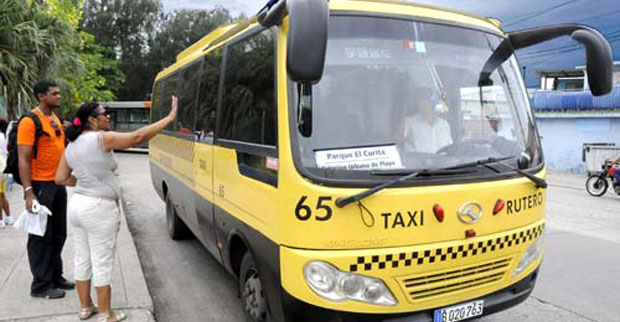
Examples of similar cooperatives are the so-called taxis ruteros. They offer more comfortable travel — some are even air-conditioned — for five pesos a ride.

Carlos, a laborer who works far from home, confesses, “I can’t afford this luxury. I have to make do with the one peso guagua. I make 315 pesos a month and, since I have to catch three guaguas to get to work, I have to watch what I spend.”

People like Carlos, who make barely ten pesos a day, cannot rely on the public transport system. If they want to avoid having what little they earn docked, they must get to work on time, which means leaving home up to three hours in advance.

In Cuba, public transport is a vital component in gauging the success of the “updating of the economic model” called for in the economic policy guidelines. This sector is almost completely funded through the state budget. This is the reason so many people blame the Cuban state for not meeting demand.

veizant@gmail.com

From Cubanet

September 3, 2013

Translator’s note: Pronounced wah-wah; Cuban slang for bus.

Jose Conrado: “I ask Pope Francisco to be firm with the rulers.” / Ramiro Pellet Lastra

An interview with Father José Conrado, from Cuba, by La Nacion newspaper.

Photo: The Pope, yesterday, leaving the Mass he gave on the day of St. Ignatius of Loyola. Photo: AFP

By Ramiro Pellet Lastra  | LA NACION  

José Conrado describes himself as a “small-town priest.” But from his parish in Santiago de Cuba, or in the colonial city of Trinidad, to where he was transferred, he throws verbal darts with a “language of the barricade” against corruption, repression, and other hallmarks of the Cuban government. Close to the dissident movements, Conrado has suffered pressure, aggression and even exile.  But he has continued denouncing the leadership of his country, as in this dialogue with LA NATION newspaper, during a visit to Buenos Aires, after attending the World Youth Day in Rio de Janeiro.

Conrado only set aside denunciation in favor of enthusiastic praise when he analyzes Francisco‘s performance at the head of the Church, a man he trusts, and whom he hopes that “when Dilma, Cristina, or whoever goes to kiss his hand, he tells them the truth.”

How do you see the Cuba of today?

– Cuba is a bankrupt country, economically and morally bankrupt. From a family point of view, it’s an eroded country. There is not a single Cuban who doesn’t have relatives abroad, including Fidel Castro, who has several grandchildren and a daughter outside of Cuba as political exiles. It is a country where everyone, for one reason or another, has suffered the imprisonment of a family member, the death of a family member, in front of a firing squad or in the Straits of Florida. It’s a country with a history of political imprisonment.

-Why in Latin America there are those who still have a good image of the Castro regime?

-I think there is a certain complicity of the Left that wants to see Cuba as paradisiacal paradigm of what Revolution is and what social accomplishments are. There is also an ongoing press campaign on the part of the Cuban government. And there are the visitors to Cuba, because tourists see Cuba from air-conditioned buses and from five-star hotels.

-People came out into the streets to protest in many countries, democratic and non-democratic, but they did not do it in Cuba.

-People in other countries saw a space for freedom that made them decide to forget the spaces of their fear. We haven’t yet gotten to that point. I believe we have a point where this will happen, but we aren’t there yet. In Cuba, a popular saying goes: There’s not one to turn the government over to, but nor is there anyone who can fix it. Everyone in Cuba knows we must have change. It is a silent and unanimous agreement among all Cubans.

Will perhaps a minor incident light the fuse like in the “Arab Spring”?

-Yes, that could happen. I think the government stays away from large crowds.  They don’t have as many large demonstrations as before. I think the government has been very astute to not permit acts of unchecked violence on the part of the police. I think that people would throw themselves into the street [if such acts happened].

-And in this context, what prospects does the government have?

-The seriousness of the situation is forcing the government to think of another way out. Today they are proposing that those whom they always considered their eternal and bitter enemies, Cubans in exile, invest in Cuba..

As a Latin American priest, how did you experience the election of Pope Francisco?

-Francisco is a gift from God for a time of crisis. He is man who is above the conventions of the left and the right, because he goes for the essential, and the essential is God and the people who are suffering. Pope Francisco knows that he is a servant.

-Could he influence not only for Cuba, but for democracies in trouble?

 -I think that he is going to have great influence, because the Church needs a reform from within. How is he going to preach to the politicians not to steal otherwise? A Church renewed from within is an example for these men who have great responsibilities.

-In addition to being an example, could Francisco influence through his discourse, through direct denunciation?

-Yes, of course. I don’t ask the Holy Father to speak the language of the barricade, like I, a small town priest, do, but I do ask him to be very firm with the rulers. That when Dilma, Cristina, or whoever goes to kiss his hand, he tells them the truth.

Translated by: Ernesto Ariel Suarez

1 August 2013

Cooperatives: Like the Cries of the Dying / Jose Hugo Fernandez

HAVANA, Cuba, August, www.cubanet.org — A very brief stop at a Havana park, El Curita (at the corner of Reina and Galiano streets), provides enough time to gauge the opinions of riders of the new public transport cooperative that serves the Havana-Boyeros-Santiago de las Vegas corridor, among the most populous in the capital. In general the consensus is that the fleet of small buses that serve this route were operating better before the switch to cooperative management even though, to much dismay, there has been no subsequent reduction in fare.

Since these buses were managed directly by the state before being taken over by the cooperative, we can already compare how good service was just a short time ago versus how bad it is today.

In Artemesia, one of the other provinces chosen as a test site for cooperative management of public transport, the flood of complaints from riders attracted the attention of the independent press. Meanwhile, the cooperative members themselves, who have been on the job barely a month, cite basic shortages (they rent rather than own their vehicles and do not have access to wholesale markets) as justification for the poor service and changes in ticket prices.

Cuba’s bigwigs believe these “new” cooperatives will provide the magic formula for completing the latest phase of their totalitarian dictatorship without embarrassment.

Looking at it from the standpoint of the world’s fatuous leftists — which is to say as a means for creating new social and economic relationships based on equality, mutual aid and solidarity — the cooperative movement must seem like manna from heaven. The hope is that it will revitalize the regime’s goal of being able to remain masters of all they surmise while simultaneously making it look as though they are seeking innovative ways of raising efficiency and productivity through a clever process of economic decentralization.

Anyone feeling bewildered by the avalanche of prohibitions and assaults with which the regime harasses the self-employed —  taking place just at the moment when many had hoped it would support and even promote their activities — might well find their confusion summed up in one word: cooperatives. The bigwigs have realized that they need not run of risk of privatization (even on a small scale), or even of small business development, which one way or another always leads to free thinking and independence.

By creating cooperatives, the bigwigs hope to make everyone believe (to use another well-worn phrase from Lampedusa) that things are changing even as everything remains the same. And so naively convinced are they that their plan is working that they feel they have the luxury of dismissing and marginalizing the self-employed — the only group that, for better or worse, was proving capable of pulling their chestnuts out of the fire.

Like the cries of a dying man, they are now publicizing, as they typically do, the existence of 124 cooperatives which have been operating since July 1 in sectors such as transport, construction, trash collection and farmers’ markets.

Of course, the project is part of the charming “updating of the economic model,” which has been summed up in black and white and embalmed in what is known as the Guidelines of the Sixth Congress of the Cuban Communist Party. One of its chief promoters is Grisel Tristá, whose position carries the mile-long title Chief of the Group for Corporate Perfection of the Permanent Commission for Implementation and Development. She has charmingly and quite literally stated that cooperatives “allow the state to divest itself of responsibilities that are not of transcendental importance to economic development.”

However, another expert — the president of the Society of Cooperatives of the National Association Cuban Accountants and Economists, Alberto Rivera — was talking no less charmingly about the need to train the public to understand that the promotion of these cooperatives represents a deceptive hoax. Rivera believes they were intended to serve somewhat like spare tires and were given only a passive, short-term role. True cooperatives (even as perceived by the world’s leftists) would be fundamentally incompatible with the bureaucratic, anti-democratic and suffocating nature of the Cuban regime.

What is most laughable about this is all the clucking by the official press over the publicity surrounding this issue. They insist that cooperatives are being set up with the desire and support of their members.

Of the first one hundred twenty-four that have been set up, one hundred twelve started out as state-owned businesses. This is another way of saying they were failed, insolvent enterprises headed by corrupt, inept administrators who later automatically became presidents of their cooperatives. Only twelve started out in the private sector, established, it is said, by self-employed individuals.

Rogelio Regalado, member of another organization called the Commission for the Implementation of the Reforms, has clearly described how certain bankrupt state enterprises underhandedly manipulate their workers by suggesting that they “voluntarily” become partners in a cooperative, telling them, “If there are no workers willing to become partners, the property and assets are liable to be auctioned off.”

Two hundred twenty-two small and medium sized state businesses — all problematic, unproductive and in crisis — were converted to cooperatives which are in theory fully autonomous. A wide range of services — including fresh fruit markets, restaurants and even shrimp farms — will come under this new form of management for which they have already coined the charming slogan “economic solidarity.” In other words, there will be more of the same.

It is a ruse intended to delay access to private property while they still can so as to hamper the country’s real agents of economic progress. This makes a mockery of consumers — in other words the public — which cannot find alternatives to satisfy their own demands and instead must continue subsidizing those of their exploiter, which is to say the regime.

About the author

José Hugo Fernández is an author whose works include the novels The Suicide Clan, The Crimes of Aurika, Butterflies Don’t Flutter on Saturday and The Parable of Bethlehem and the Shepherds. He is also the author of two short story collections, The Island of Blackbirds and I Who Was the Streetcar Desire, as well as a collection of essays, Shadows Against the Wall. He lives in Havana, where he has worked as an independent journalist since 1993.
From Cubanet

28 August 2013

Thousands of Cuban Doctors to Brazil: And For Us, What? / Yaremis Flores

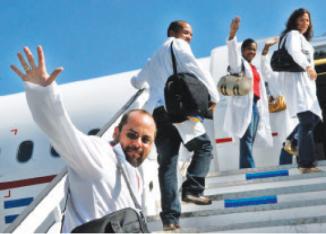
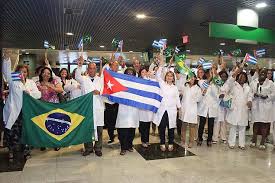
HAVANA, Cuba, September, www.cubanet.org – Since Cuba announced on August 24th the medical cooperation agreement with Brazil, Granma, the Communist Party newspaper, has reported on the front page the arrival of groups of physicians in that country.

All the stories omitted the fact that the offering of “solidarity and love” will pay about $4,200 per month per doctor, according to disclosures by Brazilian authorities.

The National Federation of Physicians of the South American country said the Cuban professionals “will receive a fraction of that.” Some Brazilian organizations have characterized the Cuban collaboration as slave labor.

“Typically the monthly payment received by Cuban doctors is less than $100,” said Yasser Rojas, a Cuban doctor who works with civil society organizations.

Nevertheless, physicians are competing to be selected to go on international missions. Every year thousands of them are posted outside Cuba to provide services, in order to give their families a slightly more prosperous life.

The source said that a general practitioner practicing on the island earns a monthly salary of 480 to 535 pesos in national currency (about $20).

“The doctor’s thinking is: I will sacrifice myself for a while, I will get my usual salary, I will save the payment for the collaboration and the food allowance, together with the gifts that patients offer, for a phone or even a plasma TV,” he said.

Analysts believe that the export of professionals, mainly doctors, provides the principal income of the country, about six billion dollars annually. As the Vice Minister of the Ministry of Public Health said, “Cuba does not export doctors, Cuba exports health services.”

Brazil is one of the nearly 30 countries that receive Cuban medical services for a fee, out of a total of 58.

More doctors in Brazil, fewer doctors in Cuba

“A contingent of 4,000 professionals will arrive in Brazil through the end of 2013,” according to a press release from the Ministry of Public Health of the island. Meanwhile the quality of health services on the island continues to deteriorate, although according to the World Health Organization, Cuba has the highest number of doctors per capita in the world: one per 148 inhabitants.

Government officials recently informed the United Nations, “The National Health System in Cuba, through the governmental and social character of medicine, and universal free access to health services, has been instrumental in raising the health indicators of the entire population, particularly those of women and children.”

There are no polls or surveys to give an idea of popular discontent with medical care. Complaints can be heard daily in any hospital waiting room in the country.

Regla Ríos suffered the negligence of the medical staff at Children’s Hospital of Havana. His minor grandson was admitted for an infected insect bite on his foot. “They prescribed a drug that is for vision, his condition deteriorated, and we waited for him to get better, otherwise they had to operate,” he lamented.

Another elderly woman, who declined to be identified, said that she went to the Mario Escalona Polyclinic in Alamar to make an appointment with a specialist and they gave her one for almost two months later. The lady, in her seventies, said “I could die by then!”

Dr. Rojas asserted that, “Every day it’s harder for the ordinary citizen to find a good specialist, because they have an excess of daily consults, or have emigrated, or are abroad for the collaboration programs.”

“In the end, it’s the people who suffer the worse of it,” Regla commented pessimistically. “With the missions, the doctors at least excel professionally and strengthen the economy. For it’s part, the Government receives economic benefits and international respect.”

And for us, what?

From Cubanet

4 September 2013