One Hundred Thousand Crazy People and a Neighborhood, a Conversation With Comedian Ulises Toirac

“The Communication Law and other demons that complement it practically prohibit the exercise of humor in Cuba”


Ulises Toirac and Jorge Fernández Era in Havana / Facebook/Ulises Toirac

14ymedio bigger14ymedio, Jorge Fernández Era, Havana, 14 December 2024 – Not everyone can have a hundred thousand followers on Facebook. Ulises Toirac reached this number a few days ago, not only for the prestige of an artistic career of more than four decades, but also for the seriousness with which he assumes humor and faces a heterogeneous audience that applauds as much as it denigrates.

Part of those experiences are reflected in his most recent publication, the book Locos de barrio [Neighborhood Crazies], available on Amazon and other platforms. The central subject of our meeting in Santos Suárez, our neighborhood, was that.

Jorge Fernández Era: Do you consider yourself a humorist who makes you think or a thinking being who makes you laugh?

Ulises Toirac: A little of both. Humor, even if it’s a job, is fun. The best proposals are born by vibrating your spiritual need with your communicational need. I consider myself a guy who is always looking for a way to complicate things by over analyzing, and in that way I surprise myself and try to surprise others. When I succeed, I feel self-realized.

Censorship is instituted by levels: from whether you make fun of a street sweeper to whether you do it of a director of Communal Services or the President of the Republic

Jorge Fernández Era: The line between what is allowed and what is prohibited has been crossed in recent years. For good or for bad?

Ulises Toirac: In Cuba there has always been a manifest censorship. I remember it in our beginnings in the Aquelarre festivals or in the shows that were usually held in the theaters. Unfortunately, that was small stuff compared to what we have now. The Communication Law and other demons that complement it practically prohibit the exercise of humor. Censorship is instituted by levels: from whether you make fun of a sweeper to whether you do it of a director of Communal Services or the President of the Republic. The sanction goes up to the extent that your jokes are directed towards those positions and the inability to develop them.

Before, the danger was not so visceral. At this moment anything can take you to trial if so decided. In addition, the general public does not show intellectual interest in humor. When there is censorship, we look for mechanisms with which to communicate with people. At other times, those who attended the theater identified with intelligent humor. Today, either you do junk humor or you dedicate yourself to something else.
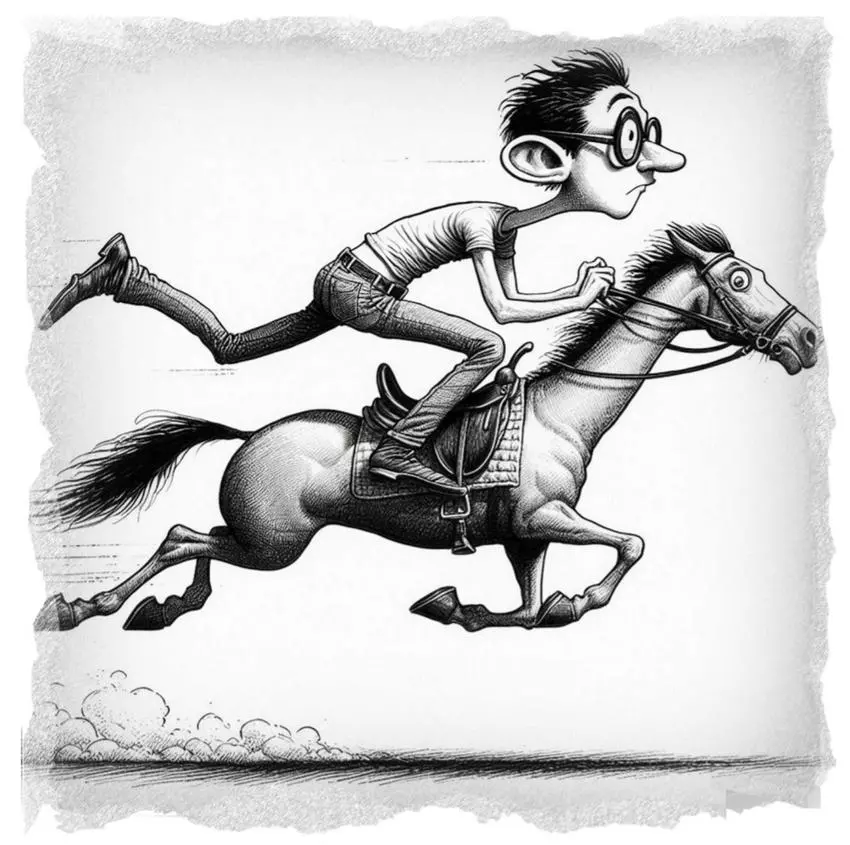
One of the illustrations by Ulises Toirac included in ’Locos de barrio’/ Ulises Toirac/Courtesy

Jorge Fernández Era: When did you realize that you could also write jokes and memories?

Ulises Toirac: It’s a process. I write since I have use of intellectual reason. From a very young age I always liked to do it, not literature itself, but television scripts, librettos for theater… I used near or distant memories to capture them. For a while I have had a purely literary interest, but due to time, interests or work load I didn’t try to gather a series of stories in a book. From the isolation of Covid, and even before, I began to write what we could call stories.

In art, if you don’t find a personal, unique way to express yourself, you can starve to death. I realized that by transferring my personal way of speaking to paper, I achieved that. I was publishing little by little on social networks and before in a newsletter that developed a lot of subscribers. In the last three years it was already a more methodical process. But it wasn’t overnight.

Jorge Fernández Era: With Locos de barrio, does one door close or another one open?

Ulises Toirac: Both. Locos de barrio is the end of literary innocence, that stage in which one is in love with a woman and proposes marriage. With the last stories I wrote I already had the firm purpose of creating the book.

‘Locos de barrio’ is the end of literary innocence, that stage in which one is in love with a woman and proposes marriage / Ulises Toirac

Literature is the greatest incentive of the imagination. You have no limits or brakes; you can scrutinize the universe and do what you want: you close one paragraph, open another, and you move, in no time, from China to the South American cone. It will continue to be the best way to get informed, to acquire culture, to grow.

Nothing is absolute; life is dialectical, and things are intertwined on top of each other. It is clear to me that I want to continue writing and publishing. Another book is going around in my head; it will be called Epistolary without a gun. It is my desire, through letters, to talk about the topics that interest me. The letters will be addressed to a historical character, to my first preschool girlfriend, to my teenage bicycle, to my terror of heights, to the President of the Republic… Or – if the Law applies to me for the latter – to you, so that you can finish this interview.

 Translated by Regina Anavy

____________

COLLABORATE WITH OUR WORKThe 14ymedio team is committed to practicing serious journalism that reflects Cuba’s reality in all its depth. Thank you for joining us on this long journey. We invite you to continue supporting us by becoming a member of 14ymedio now. Together we can continue transforming journalism in Cuba.

The Cuba-Us Thaw Remains the “Right” Approach, Says Obama’s Former Diplomat

“Isolation hasn’t worked for the last 60 years,” says Jeffrey DeLaurentis

Jeffrey DeLaurentis, former head of the US embassy in Havana / EFE

14ymedio biggerJuan Carlos Espinosa/EFE, Havana, 17 December 2024 — Diplomat Jeffrey DeLaurentis, Chargé d’affaires of the US Embassy in Havana during the thaw in bilateral relations of the Obama era, maintains in an interview with EFE that the policy of rapprochement instead of the isolation of Cuba was a success and is still valid 10 years later.

“Despite the fact that this policy was reversed after two years, it was a success and resonates even today, despite the efforts of the (first) Trump administration to bring it down,” says DeLaurentis, who believes it is “totally false” that it failed.

Few know as well as this former US diplomat the meaning, on the ground, of the process of rapprochement between the United States and Cuba. It was announced on December 17, 2014, by Barack Obama and Raúl Castro, after months of secret negotiations involving the mediation of the Vatican and Canada.

In an exclusive interview with EFE conducted via Google Meet, the Chargé d’affaires of the US embassy during the thaw (2014-2017) highlights the legacy left by Obama’s policy (2009-2017) in the relations between the two countries after decades of Cold War.

In his opinion, not even the first term of Republican Donald Trump (2017-2021), with the tightening of sanctions and the inclusion of Cuba in the list of countries sponsoring terrorism, has managed to erase that mark. continue reading

In his opinion, that approach is “the best way to advance the interests” of Washington by “encouraging” the opening of reforms on the Island

“The thaw,” he says, needed “more time” to be “sustainable.” In his opinion, that approach is “the best way to advance the interests” of Washington by “encouraging” the opening of reforms on the Island and “improving the life of the Cuban people,” in contrast to the hard-line policy of the Republicans.

“During my first mission in Cuba (in the nineties), I arrived thinking that the US approach was the right one. But, frankly, I left recognizing that isolation was not the right approach, and, honestly, it had not worked and has not worked in the last 60 years,” he says.

The retired ambassador, who previously worked in the US Interests Section (a category lower than that of an embassy) in Havana in the nineties and 2000s, highlights the rise of the private sector in Cuba after decades of prohibition and demonization.

“You could see how people’s mentality was changing. Young people were enthusiastic and focusing their energy on the Island’s future instead of leaving everything behind and emigrating,” he tells EFE.

After four years of serious economic crisis – with a shortage of basic goods and services, galloping inflation and daily power cuts – Cuba is once again experiencing a great migratory exodus. In the last three fiscal years, more than 600,000 Cubans have entered the United States, according to official figures.

Cuba is once again experiencing a great migratory exodus. In the last three fiscal years, more than 600,000 Cubans have entered the United States

The former diplomat – proposed by Barack Obama as ambassador, the first on the Island since 1960 – recalls the resistance encountered by the Democratic administration to achieve a total political turn towards Cuba.

“Given the long and tortuous history between the two countries, this process was never going to be linear. There were always ups and downs. My feeling was always that the Cuban authorities knew how to deal with the tough posture, but that they were a little more uncomfortable with the approach we were defending,” he recalls.

After Obama’s visit to the Island in 2016, the culminating moment of the thaw, former Cuban President Fidel Castro said, in an article published by state media, that the country did not need “the empire” to give it anything and strongly criticized Obama’s speech during his stay.

On the other hand, DeLaurentis points out that the Obama administration assumed that there would be resistance from hard-line sectors in Cuba and that “there were also people, I suppose mostly from South Florida, who were very much against” the rapprochement.

DeLaurentis highlights how the issue of Cuba awakens a different level of attention between those who believe in dialogue and those who advocate for a hard hand

In view of the next Trump government, which will take office in January and has proposed as Secretary of State the Cuban-American Marco Rubio, defender of increasing sanctions against Havana, DeLaurentis highlights how the issue of Cuba arouses a different level of attention between those who believe in dialogue and those who advocate for a hard hand.

“I think Obama’s approach was very popular at the national level, and, certainly, there are many people who think that this is the best way to proceed. But it is also true that those who defend a harder line, for many of them, that is possibly their main priority. Meanwhile, for those who support the approach, it is important, but they have many other priorities,” he adds.

Translated by Regina Anavy

____________

COLLABORATE WITH OUR WORKThe 14ymedio team is committed to practicing serious journalism that reflects Cuba’s reality in all its depth. Thank you for joining us on this long journey. We invite you to continue supporting us by becoming a member of 14ymedio now. Together we can continue transforming journalism in Cuba.

Stabilak Preservative Is No Longer Added to the Milk, but It Still Does Not Reach Cuban Tables

The dairy industry of Sancti Spíritus collects between 5,000 and 6,000 liters daily, barely 10% of the official plan

The authorities blame the ranchers for the low production / Escambray

14ymedio bigger14ymedio, Havana, 17 December 17, 2024 — The dairy industry of Sancti Spíritus collects between 5,000 and 6,000 liters of milk daily, about 10% of the 50,000 predicted by the province’s official plan. The figures are even worse on weekends when, according to the official press, the number of liters can drop to 1,000. At this rate, the authorities do not even consider closing the year with good results, but despite recognizing the problems of the industry, they continue pointing out the producers who are dedicated to “diversion and illegal sale” as those responsible for the debacle.

The “trend is suspicious,” because derivatives (cheese, yogurt, ice cream) are publicly sold everywhere and even the milk itself,” explains Escambray, the local newspaper.

Since last March, the Executive Committee of the Council of Ministers increased the payment for the product, which is now contracted at 38 pesos per liter (before it was 20) and up to 70 pesos “in times of drought, like this, which puts the State, in this case the industry, as the only destination.” However, the measure falls flat against the reality of the street, where that same liter can be sold for between 120 and 150 pesos. continue reading

Of the 7,000 producers committed to the State to deliver the milk, “only about 1,500 defaulters are counted,” the newspaper said.

The problem, according to the media, “starts from a contract either badly done or poorly followed by the actors involved since a plan was agreed last year that the livestock subdelegation itself thinks was high.” Of the 7,000 producers committed to the State to deliver the milk, “only about 1,500 defaulters are counted,” said the newspaper, which added: “If you know mathematics, take stock of how much milk your cows could be giving.”

However, there are many ranchers in the province who have refused to continue selling their production to the State due to its non-compliance, including the lack of cash in the banks, which prevents them from receiving payment for the product. Without paper money, the farmers refuse to fulfill their commitments to State companies.

14ymedio reported last October that there are producers who had not received payments from the State for four months. “I’ve been selling milk on my own for a couple of weeks. Anyway I didn’t do business to sell it to the State, because the payment is bad. That same liter of milk that I deliver after fulfilling my commitment, that they only pay me at 38 pesos, I can sell on the street at 120,” a producer told 14ymedio at the time.

Regarding the non-payments, Alberto Cañizares, director of the Río Zaza Dairy Products Company, minimized the situation and told Escambray that “it is true that there are problems with cash due to banking, but that does not justify the indiscipline of not delivering the milk, because the distribution is daily.”

“Irregularities in the distribution and quality of the product persist in Sancti Spíritus, despite the measures put in place to reverse the situation,” the media said. One of them was the announcement of the arrival of Stabilak – a natural preservative of national production used to maintain the quality of raw milk from cows, goats and buffaloes. However, it has not been a solution, especially for many inhabitants of the province, who do not see the milk on their tables. “From the 10,000 and 11,000 liters that were produced daily in November, the same number of consumers were left without the product; today minimal figures are reported. Even so, not all consumers – about 20,000 in the cities of Sancti Spíritus and Trinidad who receive that milk – have it guaranteed for their breakfast,” the text said.

Stabilak, “well applied, guarantees the quality of the milk between eight and 24 hours,”although more conditions are necessary for that effect

Stabilak, “well applied, guarantees the quality of the milk between eight and 24 hours,” although more conditions are necessary for that effect. “There are plenty of examples: from the dirty industrial cars that are supposedly cleaned when going out to collect – as the commercial subdirectorate of the municipality of Sancti Spíritus has verified – containers that are not well-scrubbed, mixtures of different qualities, milk that arrives in the morning but doesn’t reach the stores until the afternoon, even the poor conditions of the roads that affect the transport.”

The list for the disastrous collection of milk in the province is long, because, added to the above, there is also “an unsolvable controversy between agriculture and industry about the best time to collect the milk.” According to the article, “it has been collected at 9 in the morning, against the traditional practice, and in this one blames the other, without a government arbitrator who can dictate the most favorable time.”

In many cases, this prevents the milk from being pasteurized and also affects its arrival time in the stores, because “many customers do not know it’s there,” until the afternoon. In addition, Escambray said, all this “has been more confusing with the prolonged blackouts.”

Despite the logistical obstacles, the industry is focused on preventing the milk from escaping the hands of the State. This is the case in Villa Clara, where the Government has installed, in the municipality of Camajuaní, cooling chambers for the milk. The containers, in principle beneficial for production and storage, prevent the ranchers, who allege poor conditions for storage, from continuing to sell their milk on the informal market.

Translated by Regina Anavy

____________

COLLABORATE WITH OUR WORKThe 14ymedio team is committed to practicing serious journalism that reflects Cuba’s reality in all its depth. Thank you for joining us on this long journey. We invite you to continue supporting us by becoming a member of 14ymedio now. Together we can continue transforming journalism in Cuba.

The Deputies Confirm the Painful Situation of the Cuban Health System

Emigration and the stampede to other sectors have made the lack of health personnel the most alarming problem

Significantly deteriorated, the clinics and other health facilities also present a deplorable picture / 14ymedio

14ymedio bigger14ymedio, Havana, 17 December 2024 — The deputies who make up the Health and Sports Committee of the Cuban Parliament received a dose of reality during the last few months in a province-by-province tour. The situation – triggered by the passage of two hurricanes, several earthquakes and the energy debacle – is summarized in a litany of “problems” ranging from the lack of specialists to the “illegal occupation” of clinics.

Cristina Luna Morales, president of the commission, explained on Monday that the deputies had traveled to 39 municipalities in 15 provinces, inspected 98 institutions and talked directly with more than 2,000 Cubans. Emigration and the stampede to other sectors have made the lack of health personnel the most alarming problem in these communities.

“The managerial staff in primary care are not covered, and the heads of basic groups are incomplete. Instead, comprehensive general medical specialists are certified to assume this function, which makes it difficult to assist patients,” said Luna Morales. The situation is especially critical in Camagüey, Sancti Spíritus and Havana. In addition, people do not know who can help them after a reorganization of the clinic staff, given the number of empty positions that exist. continue reading

Cuban Health has applied the same formula as other sectors: send students to fill incomplete positions

Cuban Health has applied the same formula as other sectors: send medical students from their third year of study to fill unstaffed positions. The deputy claimed that the measure, although urgent, is “well-designed” and contributes to the training of students.

Significantly damaged, clinics and other health facilities also present a deplorable picture. Located in rural areas, which the transport crisis has made almost inaccessible, many of the clinics have multiple “deficiencies in the constructive state,” and, although they were included in the “maintenance plans” of the Ministry of Construction, the problem will persist. In addition, the “clinical and non-clinical furniture” are in poor condition.

For his part, the Minister of Health, José Ángel Portal Miranda, alluded to the “challenges” faced by his portfolio in the face of the outbreaks of dengue and Oropouche fevers, two diseases that have hit the Cuban population in recent months. He also criticized the municipal and provincial governments for not including the improvement of clinics in their annual budgets.

“There are problems of organization and discipline, which have to do with the territory; we have been affected by the migratory flow and the departure of professionals in the sector, especially in hospitals. There are also problems in the living conditions for doctors, which must be discussed,” he enumerated.

He asked for more attention to the elderly, who make up 35% of the Island’s population according to official figures. He summarized the state of Cuban health in numbers but did not provide any details about the real situation of health care: “Primary health care has 451 polyclinics and 11,458 medical offices, of which 1,122 are located in the community; 168 in educational centers, 67 in universities, 91 in workplaces and other institutions,” he said.

In the Comments section of the Cubadebate report, several readers drew attention to other problems in the sector

In the Comments section of the Cubadebate report, several readers drew attention to other problems in the sector, to which the deputies did not allude. “What they must analyze is the total lack of medicines. Even if the doctor is in the office, you have to look on the street for what he tells you to take, and at astronomical prices, including dentistry material. That didn’t happen in the Special Period as we are seeing it now. I do not see that analysis beyond mentioning it, not even projections.”

“Our health system, hospitals and doctors have become accustomed to all resources being sought outside the institution. That is, for any intervention they ask patients to look for everything, even [surgical] gloves. Have they done that analysis?” asked another. “Please, I hope that in the upper spheres they are aware of this; if not the communication between the ministry and the institutions is very bad.”

Translated by Regina Anavy

____________

COLLABORATE WITH OUR WORKThe 14ymedio team is committed to practicing serious journalism that reflects Cuba’s reality in all its depth. Thank you for joining us on this long journey. We invite you to continue supporting us by becoming a member of 14ymedio now. Together we can continue transforming journalism in Cuba.

Bolivia is in Solidarity with Cuba Over the Blackouts and Sees Them as an Attempt to Destabilize President Díaz-Canel

The country rejected “the plans of far-right dissident groups” to “convulse” the Cuban government

The Bolivian Ministry of Foreign Affairs blamed the US for the power outages on the island. / EFE

14ymedio biggerEFE (via 14ymedio), La Paz, 20 October 2024 — The Bolivian government expressed its solidarity with Cuba on Saturday in the face of the blackouts recorded in recent hours on the island and denounced alleged plans by “far-right” dissidents who want to take advantage of the situation to “destabilize” Cuban President Miguel Díaz-Canel. The Bolivian Foreign Ministry expressed its position in a press release issued in light of the “energy situation facing” Cuba.

“Bolivia rejects the plans of far-right dissident groups which, from abroad, seek to take advantage of this situation to destabilize the government of President Miguel Díaz-Canel Bermúdez and convulse the country,” it said. The Bolivian Ministry of Foreign Affairs also called on “the governments and peoples of the world” to insist on compliance with “the more than twenty resolutions” approved by the United Nations that “call for the cessation of the US economic and commercial blockade* of Cuba, which is the cause of the anguish and suffering of the Cuban people,” according to the Ministry of Foreign Affairs.

The Venezuelan government, another ally of Havana, also called on the international community on Friday to mobilize in support of Cuba and held the United States and its policy of economic sanctions responsible for the massive blackouts. Venezuela “expresses its absolute solidarity and unconditional support for the sister republic of Cuba, while it faces the current energy contingency, the product of the cruel intensification of the economic war and financial and energy persecution by the U.S. government,” said Nicolás Maduro’s government in a statement. continue reading

In its opinion, the “illegal blockade against the Cuban people” seeks “the application of collective punishment”

In its opinion, the “illegal blockade against the Cuban people” seeks “the application of collective punishment, which represents a crime against humanity.” “Venezuela supports all the heroic efforts made by the Cuban people as well as its president, Miguel Díaz-Canel, to mitigate the impact of the criminal unilateral coercive measures,” the document reiterates.

The whole of Cuba was left completely without electricity this Saturday after the failure of the process to restore the National Electric System (SEN) that began the day before following the total blackout caused by a breakdown in a thermoelectric plant.

The SEN collapsed on Friday morning due to a breakdown at the Guiteras thermoelectric plant, one of the country’s main generators, according to the Ministry of Energy and Mines (Minem), and an event of “zero national energy coverage” occurred, a complete blackout throughout the country.

The SEN is in a very precarious state due to the fuel shortage – the result of the lack of foreign currency to import it – and the frequent breakdowns in obsolete thermoelectric plants, with four decades of operation and a chronic lack of investment.

Blackouts have been common for several years, but since the end of August the situation has worsened to levels similar to those of the worst times, such as the beginning of this year and July and August of 2021 and 2022.

The Bolivarian Alliance for the Peoples of Our America (ALBA), which includes Bolivia and Venezuela, also blamed the United States for the blackouts in Cuba and considered them to be a “consequence of the economic war” and Washington’s “financial persecution” against the island.

*Translator’s note: There is, in fact, no US ‘blockade’ on Cuba, but this continues to be the term the Cuban government prefers to apply to the ongoing US embargo. During the Cuban Missile Crisis the US ordered a Naval blockade (which it called a ‘quarantine’) on Cuba in 1962, between 22 October and 20 November of that year. The blockade was lifted when Russia agreed to remove its nuclear missiles from the Island. The embargo had been imposed earlier in February of the same year, and although modified from time to time, it is still in force.

____________

COLLABORATE WITH OUR WORKThe 14ymedio team is committed to practicing serious journalism that reflects Cuba’s reality in all its depth. Thank you for joining us on this long journey. We invite you to continue supporting us by becoming a member of 14ymedio now. Together we can continue transforming journalism in Cuba.

Let’s See If He Has Any

Cuban chess, according to the official press, is played under the effects of ministerial tyranny, scarcity, mental poverty and false mass appeal.

Fidel Castro wrote crookedly on straight lines, but massive chess, a Moscow strategy, was not such a bad idea. / Radio Trinidad

14ymedio bigger14ymedio, Xavier Carbonell, Salamanca, 20 October 2024 — Salamanca/ Fidel Castro wanted to popularize cattle raising, and the cow ended up becoming an animal as remote and sacred as the bison of Altamira. He wanted to popularize communist militancy, and today – let’s continue with the cattle metaphor – the stampede of leaders is so ferocious that it would annihilate Mufasa again. It is not surprising, therefore, that the popularization of chess had disastrous results. The problem is never Fidel, the faithful will say, but the popularization. But the masses are nothing without their chief popularizer, and as in homes where there is a naughty child, in Cuba he is always the material, formal, efficient and final cause.

To make things easier, let’s say that, like Mephistopheles, Fidel wrote crookedly on straight lines – poor Jesuit schoolboy, more fond of basketball than of the pencil – and that mass chess, a Moscow strategy, was not such a bad idea. It is impossible for all Cubans to be good chess players, but it was not bad that, from childhood, we knew how to defend ourselves on the board. Why? I don’t know, perhaps to demonstrate the intellectual superiority of the infans sovieticus, larva of the bright future.

Here, however, there is very little future and almost no megawatts to enlighten us.

Here, however, is very little future and almost no megawatts to enlighten us. The official press has just published figures on the situation of school chess that must have irritated – if he saw them – Leontxo García, the legendary columnist of El País. The sports media that covered his visit to Cuba in 2022 said that the venerable professor had been “fascinated” by the talent of the players and had asked that the Island be transformed into a “leading country” in terms of educational chess. But we already know that with visitors you have to be polite, offer them coffee and take them to the Hotel Nacional. Leontxo left happy, or so says the State newspaper Granma. continue reading

A member of Randy Alonso’s dream team – those boys from Cubadebate who seduce Ana de Armas and write a pamphlet against the blockade – had the naivety to do his job well and survey 658,771 students and 6,993 teachers. Only 41% of the children and 51% of their teachers know how to play chess. They play “to kill boredom,” say the brave pioneers interviewed. They play very little because there are no pieces or boards. They play badly, under the effects of the “lack of implements” – the Chinese have not sent “pieces” since the pandemic – of the ministerial trick, of scarcity, of mental poverty, of unleavened masses.

In the Third Improvement, chess will not be a subject, as Fidel and Che and other photogenic assassins dreamed.

Things are not going to improve, little Capablancas. In the umpteenth indoctrination plan of the Ministry of Education – what in Mordor they call the Third Improvement – ​​chess will no longer be a subject, as Fidel and Che and other photogenic assassins, who loved to pose in front of the chessboard, dreamed of. It will be, says the national methodologist of Physical Education, a mere “complementary activity.” And every pioneer knows what that means: dancing and enjoying the extracurricular symphony.

The methodologist has ideas whose brilliance should not be wasted by the Electric Union. Possessed of a calm desperation, she calls on teachers “with knowledge” of the game to “facilitate this practice.” She intends to “assess with the National Chess Commissioner to see if he has some support that we could put on computers or on the same phones so that children can play.” There is so much Cubanness, so much revolution in that “let’s see if he has” that it should be the title of our next national anthem.

Like any boy educated under the Battle of Ideas, I learned to play chess as a child. I was taught – by my grandparents, not by my teachers – to be proud of Capablanca, The Machine, and I grew up with the conviction that he was the best chess player in the world. Americans could say the same about Bobby Fischer and the Russians about Spassky or Karpov. But Fischer was a madman and Karpov is Putin’s man – although he criticized him about Ukraine – as he was before the Central Committee. Capablanca was a gentleman. You only have to look at his photos, his classic serenity in front of the board. Always attentive to the pieces, always with a Buddhist smile, to the dismay of his adversaries.

Metaphors need food and electricity, decency and life, and without that there is no head, and therefore no chess.

There has never been another, and the one who came closest – Leinier Domínguez – does not even appear in the newspapers of his country. The country that has no boards or pieces, and where people used to play in the middle of a blackout, sitting on the curb of the sidewalk, illuminated by a small flashlight. Those night games were a metaphor for something, but metaphors also need food and electricity, decency and life, and without that there is no head, and therefore no chess.

You’ll find it hard to believe, Leontxo, that there was so much deterioration in Capablanca’s country, where Fischer and Korchnoi and Tal and Petrosian played. However, those of us who left have some consolation. It’s the same consolation that Nabokov felt when he escaped from Sebastopol on a Greek ship, with the Soviet firefight in the background. There, in front of him and with his back to the horror, were his father and a broken chess board. The bishop had lost his head, the rook was a poker chip. The game was unforgettable. He who flees always tries to do so with a nervous smile, with memory, with a little hope. Let’s see if he has any.

See also: chess 

____________

COLLABORATE WITH OUR WORKThe 14ymedio team is committed to practicing serious journalism that reflects Cuba’s reality in all its depth. Thank you for joining us on this long journey. We invite you to continue supporting us by becoming a member of 14ymedio now. Together we can continue transforming journalism in Cuba.

Leonardo Padura Criticizes ‘Officialdom’ for Using His Work To Attract Tourists to Cuba

The Ministry of Tourism deleted a publication in which it invited travelers to “discover” Havana through the novelist’s books

Padura has not had Cuban publishers since before the coronavirus pandemic / EFE

14ymedio bigger14ymedio, Havana, 17 December 2024 – Famous for his restraint when it comes to criticizing the Cuban regime, the novelist Leonardo Padura described as a “disrespectful act” a publication by the Ministry of Tourism that alluded to his most recent book, Ir a La Habana [Going to Havana] (published by Tusquets in Spain), as a kind of guide for foreign tourists. The post, published last week, was deleted this Monday from the Ministry’s Facebook and Instagram accounts.

Going to Havana, of which there is no Cuban edition – Padura has not had Cuban publishers since before the coronavirus pandemic – has become a bestseller in Spain. The publication by the Cuban Ministry of Tourism, a sector that has not raised its head for years and that by 2025 predicts the arrival of only 2.6 million visitors, has raised suspicions and criticisms.

Padura, whom the Cuban exile has criticized for not radically confronting the regime, is also not well regarded by the regime, which has systematically excluded him from the cultural sphere of the Island. Padura, interviewed by the media Café Fuerte, said that he has always been an “invisible” man in the literary panorama of his country.

“It seems to me a disrespectful act, because I do not have and have never had a relationship with that ministry”

“They never contacted me to do this advertising campaign, and it is rare that a state agency does it at a time when I am more invisible than ever inside Cuba,” he said. “It seems to me a disrespectful act, because I do not have and have never had a relationship with that ministry. Besides, I’m not and don’t pretend to be a tourism writer.” He also criticized that the text continue reading

was accompanied by an image of him that did not have his permission either.

Padura described his latest book, which already has a second edition, as “a work of love and sadness for the suffering of a city that languishes before our eyes, but which, despite all the regrets, garbage and abandonment, is still a magical and endearing place, a place with soul.”

The Ministry invited people to “discover Havana through the pen of Leonardo Padura. His work immerses you in the rhythms and colors of the city, turning each neighborhood into an essential character in his stories.” To the tone, more than rare in an official publication about the author, a recommendation was added that gave a clear idea about the recipient of the post.

“Don’t miss the opportunity to immerse yourself in the literary universe of this outstanding author, recommended by the Spanish Federation of Journalists and Tourism Writers during its congress in Cuba last November,” it said.

The publication of the Ministry, in fact, seems to be extracted – textually in some paragraphs – from an October promotion of this Spanish institution, signed by the journalist Andrés Alonso. The group met in Varadero last month and developed, according to the official press, “strategies to promote Cuba as a destination.”

Reluctant to leave his hometown, Mantilla, on the outskirts of Habana, Padura spends half the year outside the country

At the market level, it has been a good year for Padura. After publishing the novel Personas decentes [Decent People] in 2022, the Havanan has reorganized some of his oldest texts into two compilations, Agua por todas [Water for All] (2019) and Ir a La Habana [Going to Havana]. In addition, Tusquets reissued El hombre que amaba a los perros [The Man Who Loved Dogs], the novel about the murder of the revolutionary leader Leon Trotsky, which gave him worldwide fame and which celebrates 15 years since its publication.

Reluctant to leave his hometown, Mantilla, on the outskirts of Havana, Padura spends half the year outside the country promoting his books. In recent months, in addition, he has slightly raised the tone of his criticisms of the state of the country, although he has never alluded in negative terms to any of the leaders or to the Government in general.

In a recent interview with the EFE agency, Padura described the situation on the Island again: “The option left for people is to leave. And it is not the person who wants to leave, but the one who can, because an exit through Nicaragua and the coyotes costs about 10,000 dollars. And more than a million people have left, so you can imagine the levels of hopelessness and despair that many people have.”

Translated by Regina Anavy

____________

COLLABORATE WITH OUR WORKThe 14ymedio team is committed to practicing serious journalism that reflects Cuba’s reality in all its depth. Thank you for joining us on this long journey. We invite you to continue supporting us by becoming a member of 14ymedio now. Together we can continue transforming journalism in Cuba.

Japan Hires Baseball Player Raidel Martínez for 32 million dollars; 20 Percent Will Go To the Cuban Baseball Federation

Cuban baseball player Raidel Martínez, who ended his relationship with the Chunichi Dragons, is hired by Yomiuri Giants for a record amount in Japan / Facebook/Francys Romero

14ymedio bigger14ymedio, Havana, 17 December 2024 — Raidel Martínez has become the crown jewel for the Cuban Baseball Federation (FCB). From his recently obtained contract for $32,500,000 with the Yomiuri Giants for four seasons in the Japanese Professional Baseball League, the state coffers will collect $6,500,000, more than $1,600,000 per season.

According to the Pelota Cubana journalist, Yordano Carmona, the FCB keeps 20% of the payment for its players’ contracts, but “the big question is ’What is done with that money?’” he asks in the YouTube program Deportes sin Barreras [Sports Without Borders]. Martínez, one of the best closers in the Japanese league, is not the only case. Another 20 Cuban athletes sponsored by the National Institute of Sports, Physical Education and Recreation (Inder) have been hired by different countries under similar terms.

In addition to Raidel Martínez, who has just ended his contract with Chunichi Dragons, Carlos Monier, Liván Moinelo, Frank Abel Álvarez, Cristian Rodríguez, Darío Sarduy and Ariel Martínez have secured agreements this year. Two other players are in Mexico, six in Italy and four more in Canada.

According to coach Julio Estrada, the FCB can directly negotiate agreements with the teams that hire their athletes. However, in the case of “large contracts,” the Island has the support of “a Japanese lawyer.” Unlike agents looking for better salaries, “the federation limits itself to listening to the offer and what it will receive” and passes the document to the player to sign. “The Inder doesn’t even know about the negotiation; it is only informed what will be deposited in the account so that it can collect the commission.”

In minor contracts, he clarifies, “the Japanese team passes money to the FCB based on what the players earn monthly.” Estrada had already denounced, in conversation with Pelota Cubana USA, that the money goes into the pockets of the Federation.

Raidel Martínez’s multi-million dollar contract with Yomiuri Giants exceeds the $26,000,000 of Roberto Osuna and Liván Moinelo / Chunichi Dragons

Raidel Martínez’s contract is “a historic agreement,” journalist Francys Romero highlighted on his social networks. It exceeds the 26,000,000 dollars of Roberto Osuna and Liván Moinelo. Although, the specialist said, “Martínez would have obtained offers of between 50 and 70 million dollars if he had decided to enter the Major League market” of the United States.

The athlete signed a contract for a record amount with the oldest team on the circuit and the leader of the regular season in the Central League. “This is a very good opportunity for me because my dream is to be in a Japanese Series and be able to win it,” Martínez told Pelota Cubana USA.

The former Chunichi Dragons’ star closer has accumulated 166 saved games in seven seasons and his average of clean runs is 1.71, in addition to 353 strikeouts recorded in 310.2 innings pitched.

Translated by Regina Anavy

____________

COLLABORATE WITH OUR WORKThe 14ymedio team is committed to practicing serious journalism that reflects Cuba’s reality in all its depth. Thank you for joining us on this long journey. We invite you to continue supporting us by becoming a member of 14ymedio now. Together we can continue transforming journalism in Cuba.

The Cuban Regime Insists That It Will Be ‘Able To Survive’ a New Trump Presidency

In four years, his administration will have ended “and Cuba, socialist Cuba, will be here,” says Fernández de Cossío

The Cuban Deputy Minister of Foreign Affairs, Carlos Fernández de Cossío / Minrex

14ymedio biggerEFE (via 14ymedio), Madrid, 17 December 2024 — The Government of Cuba denied this Tuesday that it is uncomfortable with the political rapprochement with the United States – which will be 10 years old this December 17 – and acknowledged that it is “concerned” about the economic effect that a second Trump term may have.

“Of course we are concerned about the effect that this can have on our economy and, in particular, the effect that greater US hostility can have on the population’s standard of living, which has proven to be powerful and has a very effective destructive capacity to cause damage,” said Cuban Deputy Minister of Foreign Affairs, Carlos Fernández de Cossío.

These statements were made within the framework of the dialogue forum on relations between Havana and Washington, on the occasion of the tenth anniversary of the so-called thaw.

Fernández de Cossío also stated that the most catastrophic scenarios for Cuba that are being outlined following Trump’s election are those desired by the Cuban population in Florida, but he considered that “it can’t be of interest to the North American nation as a whole” that an increase in instability and violence on the Island materializes. continue reading

“It can’t be of interest to the North American nation as a whole” that an increase in instability and violence on the Island materializes

Despite those omens, he was convinced that the regime will resist a new Trump presidency. “We know we’re going to be able to survive. In four years, the Trump government will have ended, and Cuba, socialist Cuba, will be here,” Fernández de Cossío said.

Moments before, in the dialogue forum, the deputy minister acknowledged that these next four years may not be easy for the country, which has been plunged into a serious economic and energy crisis for years.

Regarding the outgoing US president, he regretted that Biden has maintained the bulk of the sanctions imposed by his predecessor and that he did not remove Cuba from the list of countries sponsoring terrorism.

“The United States knows that Cuba does not sponsor terrorism. But it also knows perfectly well the damage it is capable of causing by keeping Cuba on the list, and that is the purpose it has pursued,” he said.

In addition, the deputy minister denied that the regime felt uncomfortable with the approach advocated by the administration of former US President Barack Obama (2009-2017), which led to the thaw, as pointed out in an interview with EFE by the then-US ambassador to Havana, Jeffrey DeLaurentis.

“Cuba fulfilled all the commitments it made, since our goal was to advance. The U.S. government violated almost all of them. So it is very difficult to say that Cuba was uncomfortable with the thaw,” he argued.

“Cuba fulfilled all the commitments it made, since our goal was to advance”

The vice-chancellor added that “the euphoria” that existed in the country, “the support that there was from our people and the willingness we had to move forward, even with the permanence of the economic blockade* – let’s remember that it wasn’t lifted – is more than a reliable demonstration that Cuba had the disposition and the will to move forward.”

Previously, when speaking at the dialogue forum, he maintained that “the brief rapprochement was positive for Cuba and the United States, and it aroused the respect, congratulations and admiration of many of the world governments.”

However, he pointed out that Washington failed to comply with “practically all” the commitments it reached with Cuba (while Havana kept “every one”) and stressed that, since the arrival of Castroism on the Island, “what has prevailed” on the part of the United States “has been aggression.”

“In this difficult relationship there is an aggressor country and an attacked country,” said the deputy minister, who also spoke of a “difficult coexistence” and said that Cuba will continue to be “consistent” in its position of seeking cooperation and understanding with Washington.

Translated by Regina Anavy

*Editor’s note: There is, in fact, no US ‘blockade’ on Cuba, but this continues to be the term the Cuban government prefers to apply to the ongoing US embargo. During the Cuban Missile Crisis the US ordered a Naval blockade (which it called a ‘quarantine’) on Cuba in 1962, between 22 October and 20 November of that year. The blockade was lifted when Russia agreed to remove its nuclear missiles from the Island. The embargo had been imposed earlier in February of the same year, and although modified from time to time, it is still in force.

____________

COLLABORATE WITH OUR WORKThe 14ymedio team is committed to practicing serious journalism that reflects Cuba’s reality in all its depth. Thank you for joining us on this long journey. We invite you to continue supporting us by becoming a member of 14ymedio now. Together we can continue transforming journalism in Cuba.

Cuban Provinces Cut Off from the Communist Party Newspaper ‘Granma’ Due to Shortage of Mail Carriers

Some faithful readers miss getting “guidance” from the Communist Party

Mail carriers cannot leave valuables such as bicycles, packages, money or letters on the ground floors of some buildings. / “5 de Septiembre”

14ymedio bigger14ymedio, Havana, 9 November 2024 — A symbol of the regime since its creation in 1965 and its flagship publication, the Communist Party newspaper  “Granma” is finding it difficult these days to reach remote parts of Cuba. There are still readers out there — few in number and all with grey hair — who trust what is printed on its pages. “Invasor,”another official media outlet whose own distribution problems are the worst they have ever been, complained on Friday of being “cutoff” from the newspaper known for its red and black type.

Osmayda Valdés, director of the Ciego de Ávila post office and the region’s head postmaster, appeared before the newspaper’s TV cameras — “Invasor” has its own digital broadcast channel — to defend her agency and explain why deliveries of “Granma” and other national newspapers such as “Juventud Rebelde” are routinely delayed.

In an awkward interview, Valdés explained that the newspapers are not shipped from Havana nor are they printed — as as they are in several provinces — at a printing press in Ciego de Ávila. Instead, they have to be fetched from Sancti Spíritus along with packages from Villa Clara province, whose printing press is the only one in the region that has the requisite printing capabilities. It is a logistical nightmare. “The fact is that the press is a daily operation,” she explained, stating the obvious. continue reading

Previously, the Cuban Postal Service (Correos) was responsible for delivering the papers for distribution. “Now we have to go pick them up,” complained Valdés, who was at pains to describe an even more cumbersome delivery process that involved a daily trek from Camagüey to Villa Clara which required drivers to deliver packages to post offices on their return.

Previously, the Cuban Postal Service was responsible for delivering the papers for distribution. “Now we have to go pick them up”

“What is causing the problem,” asked the interviewer bluntly.”We’ve gotten a lot of complaints from the public about not getting their daily newspaper.” Valdés summed it up in a single phrase: “It’s the postmen.” Of the thirty-five mail carriers the province needs, only eight are currently working. “Vistahermosa, a township in Ciego de Ávila, is the most affected because we do not have a single postman in that area,” Valdés said.

The interview then asked about fuel, noting that one of Correos’ main excuses is that there is no way to transport the newspapers from one place to another before distributing them. “It’s not like that,”Valdés replied defensively. She explained that the system is working in the main town though things could be better. “The biggest problem is in the small towns,”she said, especially Morón, Gaspar y Baraguá.

The postmaster describes an extreme situation in which these towns do not have fuel or transportation. “Or anything else,” she added. “We had to make a deal with [Correos’] package delivery service to use their vehicles to deliver the papers two or three times a week. It depends on how regularly fuel is delivered.”

Getting back to the issue of customer complaints, the interviewer turned her attention to subscribers who have paid for newspapers but have, so far, not received notification or compensation when the papers were late or never delivered. “This has been going on for a long time,” said the interviewer. “Day after day, many people are not receiving it. They tell us they have paid for it but are not getting it.”

Valdés washed her hands of the matter, saying that subscribers have every right to file complaints but did not indicate to whom or in what instances. “If there is no mail carrier to make the delivery, then the local government assumes responsibility. Once we are able to hire a mailman — someone who has to meet certain criteria because he will be delivering checks, social assistance, money orders, packages and certified letters – we will be better staffed. Subscribers will not be inconvenienced and [the mailman’s] contract will be renewed,” she promised.

Eventually, the interviewer turned to the topic the postmaster most wanted to talk about: telling the public that Correos is looking for mail carriers. Faced with a workforce depleted by a nationwide exodus of emigrants and labor, the company is hiring. “In the past, we didn’t have transportation for the mailmen but now we do,” Valdés said. Rather than the cars and trucks that it once used, she noted that Correos now provides “Niagara bicycles in good condition.”

“The main issue is screening potential mailmen. We have already told the Ministry of Labour how many positions we need to fill, so any applicants who go there can be sent straight to the company so we can assess their qualifications. We have the transportation. What we need is the personnel,” she concluded.

For years, “Invasor” has been reporting on problems that Valdés blamed on transportation issues, which she described on Friday as “temporary”

For years, “Invasor” has been reporting on problems that Valdés, who has been on the job for less than a year, blamed on transportation issues, which she described on Friday as “temporary.” Last February, when, Lídisy Rodríguez was head of Correos, the newspaper complained about “the shortage of human resources plaguing a not insignificant number of agencies.”

The article was a belated response to a complaint made in 2023 by several subscribers and published in the letters section of “Camisa de Fuerza” (“Straightjacket”). At the time, a reader identified as Arquímides Morales bemoaned the irresponsibility of Correos, which had not delivered his copy of “Granma” for years.

Morales explained the reason why, pointing out that all the mail carriers working in his area had been fired for suspicion of being involved in criminal activity, adding that mail service has been poor ever since.

Correos defended itself, claiming that Morales lived in a building with a gated entry, which prevented the mailman from leaving valuables such as his bicycle, packages, money or letters on the ground floor unattended. He had to wait until the interested party came downstairs to collect his newspaper in person. For three and a half hours — from 7:30 AM till 11 AM — a mailman had to deliver 400 copies of “Granma,” 200 of “Juventud Rebelde,” 400 of “Trabajadores” and 400 of “Invasor.”

In 2023, “Invasor” posed a question to Correos: “Do we really have to exhaust ourselves making complaints…? We expect, like Archimedes, for an answer, which we hope he will eventually be able to read for himself in these pages.” Nevertheless, the problem persisted. Months later, in the February article, the newspaper capitulated. “It seems that Arquímides Morales López will not be receiving a response either personally or through these pages.

____________

COLLABORATE WITH OUR WORKThe 14ymedio team is committed to practicing serious journalism that reflects Cuba’s reality in all its depth. Thank you for joining us on this long journey. We invite you to continue supporting us by becoming a member of 14ymedio now. Together we can continue transforming journalism in Cuba.

Argelio Santiesteban, Author of ‘Popular Cuban Speech of Today’, Dies in Havana

The journalist and writer maintained his curiosity to explore the oral records of Cuba, rarely reflected in the official media, until the end of his life.

With the death of Argelio Santiesteban we lose an encyclopedic author who never let himself be trapped in his writing by ideological slogans or dogma / En Vivo

14ymedio bigger14ymedio, Havana, 27 November 2024 — Journalist and writer Argelio Santiesteban died this Tuesday in Havana at the age of 79, as confirmed on the radio station Radio Progreso’s Facebook account . The professor, scriptwriter and linguist is well known among readers for his work El habla popular cubana de hoy (Popular Cuban Speech of Today) for which, at the time of his death, he was preparing a fourth edition.

“Owner of all the words in the universe, violent guardian of useful words, monster of the adjective in order, feared for his verb, hated for his excellent humor,” is how journalist Elsie Carbo described him in a brief obituary published on Wednesday. Other colleagues and friends joined in the remembrance of a man whose lively conversation and rustic writing distinguished him amidst the soporific official press.

Born in Banes, in the current province of Holguín, in 1945, he learned to love books and good conversation through his father, a cultured man and a Mason. With the mischief that permeated all his stories, he related on one occasion that family example: “I am its diminished and botched second edition, and like my venerable father, I am a passionate lover of good sayings.”

The cultural context in Banes also contributed to his predilection for verbal turns, long conversations and good books. In particular, he recalled the influence that the magazine Portada, founded in 1953 , had in those early years, as it covered local topics but also historical reviews and daily cartoons. He defined his homeland as that “triangle where our nationality was forged,” because Holguín was the birthplace of Fulgencio Batista, Fidel Castro, Guillermo Cabrera Infante and Reinaldo Arenas, among many other figures in politics and literature. continue reading

The cultural context in Banes also helped his predilection for verbal turns, extended conversations and good books.

His participation in the Literacy Campaign in 1961 brought him closer to the way of speaking of the residents of the Sierra Maestra, a knowledge that he later complemented with other ways of saying things during his more than half century living in Havana. For five years he was a professor of Spanish and literature in the feared Castillo del Príncipe prison in the Cuban capital. This experience of teaching among “assassins and thieves” helped him to better understand the jargon of “the bad life in Havana,” according to the ethnologist Fernando Ortiz (1881-1969).

Popular Cuban Speech of Today was born, precisely, from those multiple life experiences and from his constant immersion in the oral expressions that were heard in the cities and countryside of the Island. Santiesteban’s curiosity to explore those registers, rarely reflected in official media but widespread in homes and streets, remained with him until the end of his life.

In 1983 he was awarded the first edition of the National Critics’ Prize, an award that was placed in his hands by Manuel Moreno Fraginals (1920-2001), the author of El Ingenio, a key text for understanding the history of the Island, the birth of the sugar industry and the very identity of Cubans.

For his part, poet José Prats Sariol recalled on Wednesday that the Cuban Academy of Language never admitted Santiesteban among its members and described the journalist as a “brilliant lexicographer and writer of customs on a par with Eladio Secades,” a reporter who excelled in sports reporting and customs in the Cuban press of the 20th century.

Santiesteban also published his columns in various national media, where he addressed curiosities of popular speech, scientific discoveries, humorous texts and also brought to light small chronicles of the past, with musicians, politicians and intellectuals as protagonists. Among his titles, there is also Uno y el mismo (One and the same ) (1994), Picardía cubiche (Cubic Picardy) (1994), Anécdotas de Cuba (Anecdotes of Cuba ) (1999) and the volume on toponymy Cuando el pueblo juega a ser Papá Dios (When the people played at being Papa God) (2011), among others.

With his death, we lose an encyclopedic author who never let himself be trapped in his writing by ideological slogans or dogma. Through his texts he spoke of that profound Cuba that is not spoken of from the podiums or on national television.

____________

COLLABORATE WITH OUR WORKThe 14ymedio team is committed to practicing serious journalism that reflects Cuba’s reality in all its depth. Thank you for joining us on this long journey. We invite you to continue supporting us by becoming a member of 14ymedio now. Together we can continue transforming journalism in Cuba.

The Assault of Revolutionary Collectivism on the Cuban National Identity

Generations emerged conditioned to accept an immutable political order

Cuban flag propped up on D’Strampes Street, in the Havana neighborhood of La Víbora / 14ymedio/Archive

14ymedio bigger14ymedio, Karel J. Leyva, Montreal, 14 December 2024 — Being part of a nation goes beyond inhabiting a territory or sharing a common history. As Benedict Anderson maintains, the nation is an “imagined community,” a collective project that is born from the ability of people to identify with a wider group and commit to a shared future. This concept is not inherent; it is actively built through institutions, culture and, fundamentally, citizen participation.

The nation is not defined by a specific territory. The Kurdish nation, for example, persists without a recognized independent state, while the Kurds are scattered across several countries. The same can be said of the Inuit, whether from Canada, Alaska or Greenland, and of the Sami, present in Norway, Sweden, Finland and Russia. No one, unless they aspire to tell the truth, could say that there is no Inuit, Sami or Kurdish nation. These peoples share more than a common language or culture. They are nations not by their territory or by their genealogy, but by their collective identity. It is this identity that allows individuals to think in terms of “us” no matter where they are, and without renouncing either their rational autonomy or their collective project.

Thinking collectively as a nation is antithetical to submitting to a collectivism imposed vertically by the State. In the same way that a nation exists when the same political, social and cultural status is shared, it is fractured when the national identity ceases to be the binding link of the various plural identities that coexist in society and becomes a space of exclusion. continue reading

Thinking collectively as a nation is antithetical to submitting to a collectivism imposed vertically by the State

This explains why, while the caudillos and sycophants of the Cuban communist regime defended the Marxist-Leninist ideal of a collective identity for the Cuban people, in reality what they did was destroy the very essence of the Cuban nation, diminishing the ability of Cubans to think collectively, freely, without fear of offending the despotic narcissism of a tyrant. The cornerstone of the revolutionary project was never a national ideal, because national ideals do not divide citizens between loyal and disloyal, friends and traitors, heroes and villains. The national ideal, by nature, is plural, because it does not depend on a unitary doctrine, much less on an imported ideology with the purpose of colonizing minds and dominating wills.

The communist narrative exalted the collective as the only means to overcome the inequalities of capitalism, but this ideal implied the total subordination of individual interests to a single, exclusive and authoritarian party. Behind the rhetoric of the community was hidden a project of centralization of power that stripped Cubans of their political agency. The nationalization of private property and the means of production did not seek so much to redistribute resources as to strengthen a structure that eliminated any form of opposition or pluralism.

Stripped of freedoms, rights and autonomy, the Cubans were subjected to a single political party that stood as the only guarantor of national objectives. This implied a redefinition of the collective: no longer as a space for deliberation and participation, but as a mechanism of subordination, dependence and emotional control, validated by the State. Citizen dispossession, social control and the suppression of any autonomous organization fostered a culture of mutual distrust, weakening the social fabric and replacing cooperation with obedience.

Spiritual leaders became public enemies. Art and creativity were co-opted as censorship instruments. Children were subjected to an indoctrination that could only nullify the capacity for critical thinking, homogenize their perspectives and prepare them to think not as a nation but as subjects of a political apparatus. Instead of individuals capable of imagining and building alternatives to the regime, generations emerged conditioned to accept an immutable political order.

The consequences of all this created a politically disjointed population structurally dependent on the State, and an ideal of national collectivity transmuted into an ideological machinery of conformity. This explains, in large part, what Cuba is today: a fragmented society, where individuals are forced to focus on daily survival, rather than on collective national transformation. Meanwhile, the political elites plunder the country with total impunity, while indefinitely postponing the progress of the Cuban nation.

Translated by Regina Anavy

____________

COLLABORATE WITH OUR WORKThe 14ymedio team is committed to practicing serious journalism that reflects Cuba’s reality in all its depth. Thank you for joining us on this long journey. We invite you to continue supporting us by becoming a member of 14ymedio now. Together we can continue transforming journalism in Cuba.

Havana’s Industriales Baseball Team, From Success to Exodus

Of the 37 players who made up the dazzling Cuban team of the 1996 Atlanta Olympic Games, 25 have left the country

The Industriales of Havana have won the National Baseball Series 12 times / Cubadebate

14ymedio bigger14ymedio/Swing Completo, Havana, 13 December 2024 — The Industriales of Havana of the 1995-1996 campaign is one of the teams most remembered by their own and strangers.

14ymedio/Swing Completo, Havana, December 13, 2024 — The Industriales of Havana of the 1995-1996 campaign is one of the teams most remembered by their own and strangers. With a team of great new players, it broke the hegemony of the Azucareros of Villa Clara, who were looking for their fourth consecutive National Baseball Series. Today, however, it is no more than the epitome of the situation of national sport on the Island, bled by migration.

One of the players of the “Blues,” Jesús Ametller, recounted on Facebook the current whereabouts of his former teammates. Of the 37 members, 25 left the country in search of better opportunities, despite the fact that they had years of good baseball health on the Island. In 1996, for example, Team Cuba repeated the Olympic gold – undefeated – at the Atlanta Games. In fact, Cuba won three gold and two silver medals in 16 years, from 1992 to 2008.

Eight of the 13 members of the pitching staff currently reside abroad: Orlando Hernández, Ernesto Noris, Luis Alberto González, Agustín Marquetti Jr., Ángel Díaz, Pablo Miguel Abreu, Leonardo Tamayo and Juan Carlos Llanes; while Jorge Fumero alternates stays between Italy and Cuba. Only Lázaro Valle, René Espín, Juan Rafael Despaigne and Osnel Blas continue reading

Bocourt live on the Island.

Out of the nine starters of the Industriales team that won the National Baseball Series 28 years ago, only Germán Mesa remains in Cuba

As for the catchers, they all emigrated: Ricardo Miranda, Francisco Santiesteban, Bárbaro Cañizares and Michel Hernández.

Regarding the players who ran the bases, six out of eight also looked for better opportunities abroad: Roberto Colina, Juan Padilla, Luis Pestana, Lázaro Vargas, Vladimir Hernández and Ametller himself, who published the list, while Germán Mesa and Alexander Malleta stayed in the country.

Javier Méndez, Carlos Tabares and William Ortega, all of them outfielders, also emigrated; the only one who stayed in the country was Juan Francisco Cuéllar.

Finally, as for the management, Pedro Medina – considered by many one of the best catchers of all time in Cuban baseball, chosen among the 100 best athletes of the twentieth century in the country – resides on the Island, along with Eulalio Linares, Enrique Rojas and Fidel Ramírez. His colleagues Ángel Leocadio Díaz and Reinaldo Batista decided to leave.

On the list are two members who have passed away: one of the coaches, Juan Gómez, and the outfielder Orbe Luis Rodríguez.

Swing Completo says that out of the nine starters on the Industriales team that won the National Baseball Series 28 years ago, only Germán Mesa remains in Cuba.

About 1,100 athletes have fled in the last decade. Most of them, 635, have been baseball players, according to a count by the official weekly Trabajadores, in January 2022. Since then, the numbers have continued to grow. The exile also includes coaches from various disciplines, many of whom have already delivered results with other nations, as happened in Paris 2024, where 50 trainers in 30 countries harvested 28 medals with their athletes, triple those achieved by the Cuban delegation (barely nine).

Translated by Regina Anavy
____________

COLLABORATE WITH OUR WORKThe 14ymedio team is committed to practicing serious journalism that reflects Cuba’s reality in all its depth. Thank you for joining us on this long journey. We invite you to continue supporting us by becoming a member of 14ymedio now. Together we can continue transforming journalism in Cuba.

Cuba’s Electric Union Breaks Its Silence and Announces That the New Turkish Power Plant Is Only Visiting

Random “crashes” multiply, and a fourth total blackout is feared

The ’Cankuthan Bey’ floating power plant [’patana’] in the port of Havana / 14ymedio
14ymedio bigger14ymedio, Madrid, 14 December 2024 — Five days after the arrival in Havana of the new Turkish floating power plant, the Cankuthan Bey, the Cuban Electric Union (UNE) acknowledged its presence. The UNE confirmed on X this Friday that, as published by 14ymedio, the ‘patana’, as the plants are called, arrived last Sunday. However, it also said that the plant will not alleviate the energy situation in any way, because it is in the country only “to work on starting up its units and once concluded will leave Cuba.”

The brief tweet adds: “This floating power plant is not part of the UNE contract with the Turkish company Karen Dis Ticaret.” This also confirms the denial of the state company, on October 25, of the report offered by the official journalist Luis Carlos Céspedes, who had stated that the Island had contracted a new floating power plant from Turkey, one of the “most modern” with the capacity to contribute between 50 and 80 megawatts (MW) to the electricity grid, which represented “significant support in the midst of the current electricity supply problems.”

“The arrival of a new Floating Patana is not true. We ask all users to consult our official pages,” the UNE requested in its information channels

“This floating power plant is not part of the UNE contract with the Turkish company Karen Dis Ticaret”

It was foreseeable, in any case, that, with only 80 MW of production, the contribution of the Cankuthan Bey plant to the national electrical system (SEN) would be modest. For this Friday, the state-owned company predicted a deficit that, as usual, exceeded 1,000 MW (1,025), with a demand of 3,020 MW and an availability of 1,995 MW. The real “affectation” would continue reading

be 1,095 MW, at peak time, late at night, although, as also happens day by day, it was finally greater, 1,412 MW.

For the same demand, this Saturday, the UNE predicts less availability, 1,892 MW, with which there will be a minimum deficit of 1,128 MW. The expected affectation at peak time is 1,198 MW.

Cubans continue to suffer constant blackouts, and although the UNE explains through its social networks that they are due to random “crashes,” many fear a fourth total blackout before the end of the year. The first occurred on October 18, when the Antonio Guiteras thermoelectric power plant, the largest in the country, left the SEN, something that was repeated in the third crash of the system, on December 4. The second complete blackout occurred on November 6, with the passage of Hurricane Rafael through the western part of the Island, whose effects continue.

The power cuts have also affected the sale of fuel, which in itself is scarce. This Friday, in one of the Telegram groups through which the authorities try to organize the gas lines – which can take three days – manager Pedro Garce reported the interruption of service at the Cupet Tángana, in El Vedado, Havana, due a broken pump. “Do not come to the service center; we will let you know when it’s fixed,” he wrote in capital letters in the group. A little later, he added: “The Tángana gas pump is still broken, now accompanied by electrical problems. Don’t worry, when it’s restored we’ll let you know.” Early this Saturday, he reported the repair: “The engine fuel pump in the Tángana was repaired, and another one was incorporated. We readjusted the call [for customers] from 8 am today.”

Translated by Regina Anavy

____________

COLLABORATE WITH OUR WORKThe 14ymedio team is committed to practicing serious journalism that reflects Cuba’s reality in all its depth. Thank you for joining us on this long journey. We invite you to continue supporting us by becoming a member of 14ymedio now. Together we can continue transforming journalism in Cuba.