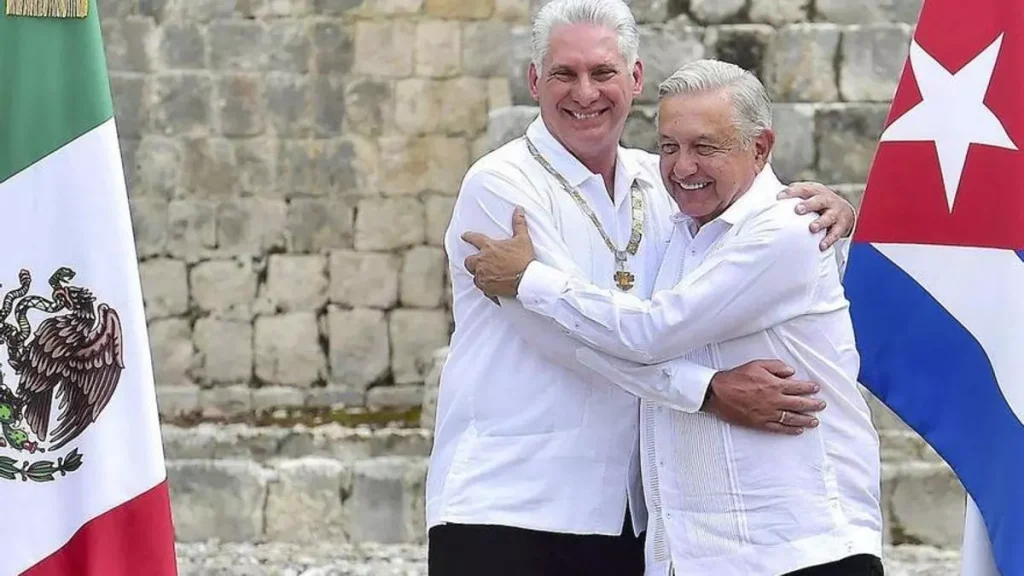
The Presidency of Cuba Announces that Díaz-Canel Is Visiting Mexico for the Fifth Time Since 2018

The Island needs Mexican oil in exchange for thousands of doctors


Díaz-Canel is accompanied by David Kershenobich, who will assume Mexico’s Ministry of Health in the Sheinbaum Government

14ymedio bigger14ymedio/EFE, Madrid, 30 September 2024 — This Sunday, Miguel Díaz-Canel was the first president to arrive in Mexico for the inauguration of the incoming president Claudia Sheinbaum, which will be held tomorrow, Tuesday, October 1, four months after she was elected as the successor to Andrés Manuel López Obrador. López Obrador has been one of the closest allies of the Cuban regime, as evidenced by the Pemex oil shipments to the Island and the substantial contracts for sending doctors to the most remote and dangerous areas of Mexico.

The Cuban president landed at Felipe Ángeles International Airport, where he was received with honors by the military guard and an unknown figure: David Kershenobich, future Secretary of Health in the Sheinbaum Government. Barely a week has passed since it was known that Cuba received more than 23 million euros for three contracts from the Social Security Institute and the Cuban Services Marketing company between July 2022 and December 2023, in addition to the announcement that the Island’s health workers will continue arriving in Mexico under the new Government.

Díaz-Canel is accompanied by a delegation that includes his wife, Lis Cuesta, as well as the Minister of Foreign Affairs, Bruno Rodríguez Parrilla; the head of the Department of International Relations of the Central Committee of the Communist Party of Cuba, Emilio Lozada García; and the general director of Latin America and the Caribbean, Eugenio Martínez Enríquez. The delegation is completed by the Cuban ambassador to Mexico, Marcos Rodríguez.

A note published by the Presidency of Cuba points out that this is “the fifth time that the Cuban leader visits Mexico since he assumed the presidency of the Island in 2018, which denotes the close relationship he has maintained during all these years with the outgoing president, Andrés Manuel López Obrador.”

Shortly after Díaz-Canel, Brazilian President Luis Inazio Lula da Silva arrived. President Gustavo Petro of Colombia postponed his trip to Monday after the helicopter crash in which eight members of the Air Force lost their lives. “I want to accompany the families in their pain and follow the investigation personally to determine the causes of the event,” Petro said continue reading

when announcing his delay. It is expected that this Monday both presidents will meet with Sheinbaum to analyze the possibility of continuing to try a joint mediation of Brazil, Colombia and Mexico that promotes a dialogue between Venezuelan President Nicolás Maduro and the opposition, which claims the victory of their candidate, Edmundo González Urrutia, with 70% of the votes in the July 28 elections.

Díaz-Canel will have several unspecified meetings this Monday, as well as one with “members of the Cuban state mission.” However, the official press makes explicit the exchange about education, culture, sport, the preservation of heritage and the environment, in addition to Health, with special emphasis not only on staff contracts, but also on those for medical students. There is no mention, however, of the shipments of fuel – presumably free – nor of the frustrated agreement on the Mayan Train, with which Mexico hoped to import 200,000 tons of stone from the Island but the total remained at just 7,000, without counting the human and environmental damage of López Obrador’s star project.

Mexico hoped to import 200,000 tons of stone from the Island but the total remained at just 7,000, without counting the human and environmental damage of López Obrador’s star project

At the opening of the Chetumal station, the president-elect starred this Sunday in her last official act prior to the inauguration. “I’m ready, I’m strong. The people of Mexico are ready to start the second stage of the ’fourth transformation’,” said Sheinbaum, referring to the term with which the political project of the ruling party is known.

“In recent months, I have witnessed how beautiful it is to see a president merge with his people and how exciting it is to see a people merge with their president,” she said at the end of her so-called “transition tour.”

“I’m not idolizing you, but I’m proud to say that you are among the greats and that for millions of Mexicans you are the best president our country has ever had,” said Sheinbaum of her predecessor, before praising his achievements: “a new economic model, the foundations of a new judiciary, the foundations of a new thought” and “a politicized and cheerful people,” among others.

“The Mayan Train in the face of all adversities is a reality,” Sheinbaum celebrated, and she said that, contrary to criticism, “the train means the preservation of the largest ecological rainforest after the Amazon.”

López Obrador, who highlighted the role of the Armed Forces in the infrastructure, joked that its inauguration will probably mean vacations for the military workers. “Don’t believe me too much because the new president is very hardworking, and I’m sure she already knows what the trains from the north are going to do.”

The flagship project of the Mexican president contemplates 1,554 kilometers with seven sections that cross five states and 36 municipalities with a total of 34 stations. Sheinbaum announced in July the creation of two new passenger train lines, one departing from Mexico City to Guadalajara, and the other to Nuevo Laredo, Tamaulipas, on the border with the United States, which she described as a “Mayan Train to the north.”

Hundreds of migrants and refugees asked her this Sunday for protection from the violence they suffer

The new president must, however, look at her borders as a priority. There, hundreds of migrants and refugees asked her this Sunday for protection from the violence they suffer.

During a procession with religious leaders from the Catholic Church, the attendees of the 110th World Day of the Migrant and Refugee in Tapachula, Chiapas, called on the Mexican Government to provide free and safe passage for migrants to be able to reach the border with the United States.

Evelin Leonel Villanueva, from Honduras, requested support from Sheinbaum to expedite appointments for interviews in the Mexican Commission for Refugee Aid (Comar), since they have been delayed by six months.

“We feel insecure but also safe with the Mexicans who help us, who can give us free passage to the border and enable transportation for low-income people. It is difficult for us to safely reach the border to be with our family,” she said.

Translated by Regina Anavy

____________

COLLABORATE WITH OUR WORKThe 14ymedio team is committed to practicing serious journalism that reflects Cuba’s reality in all its depth. Thank you for joining us on this long journey. We invite you to continue supporting us by becoming a member of 14ymedio now. Together we can continue transforming journalism in Cuba.

Cienfuegos, Cuba, a City that Dies at Sunset

The corners and parks, which used to be filled with children playing soccer and adults playing dominoes, remain empty. / 14ymedio

14ymedio bigger14ymedio, Julio César Contreras, Cienfuegos, 29 September 2024 — The monotony in the streets of Cienfuegos after three in the afternoon would have been unimaginable a few years ago. The corners and parks, which were filled with children playing soccer and adults playing dominoes, remain empty this Saturday. Procedures and purchases are carried out before noon, and later, when the city goes dark, only beggars and stray dogs remain on the streets.

“I have lived in this city for 71 years, and I’ve never seen it as dead as I do now. People speak ill of the era of capitalism in Cuba, but before, on this same street, one could eat and drink what he wanted,” says Julio, an old man who has paid 20 pesos for a small cup of coffee on the outskirts of the El Español hotel. “This cup is the size of a pea with water, but retirement doesn’t give me enough to pay for a real coffee.”

Gabriela shares the feeling that time is moving slowly and with nothing interesting to do / 14ymedio

Julio complains that, as soon as it’s noon, even the State shops close. As he explains, the variety of entertainment options in the city is zero, and if there were any, it is likely that people wouldn’t be able to afford them. Olivia accompanies the old man, whose visit to the office of the national continue reading

telecommunications company Etecsa – in the middle of working hours – was fruitless. “These people close at 4:00 in the afternoon, and on Saturdays they don’t open until 11:30 in the morning. With my work schedule it’s impossible for me to take care of any business with them,” he emphasizes.

According to Olivia, until some time ago, institutions were still open at 7:00 p.m., but the pandemic was the ideal pretext to restrict working hours and make life even more difficult for the people of Cienfuegos.

“It’s already impossible to go out at night because of the blackouts and the total lack of public transport. Added to that are the few cultural options and the very high price of any product. You can’t even go out for a walk with your family,” the woman reports.

Julio complains that, as soon as it’s noon, even the State shops close / 14ymedio

Julio knows very well what Olivia is talking about. “In my time people went to dance, shared some time at the Casa de la Música or had fun in the Tropisur cabaret. If you were bored, you took a walk around the Jagua hotel or any recreational center in Punta Gorda. Today the only thing we can do is remember that time,” he says.

Gabriela, Julio’s granddaughter, who attends university, is not interested in the activities her grandfather did in his youth. However, she shares the feeling that time moves slowly and with nothing interesting to do. “What am I going to do? Sit in El Prado until they turn on the power at dawn? Go out on a Sunday to find everything closed and the street empty? Expose myself to being assaulted and robbed in the middle of the darkness of the boardwalk? That’s why I prefer to stay home,” she says.

At the age of 21, the young woman hopes to be able to leave Cuba soon with the US Humanitarian Parole Program that her father arranged for her from the United States. “When I leave I’m going to take advantage of the time and go to the movies, which I’ve never done, and to discos and amusement parks. But while I’m here, it’s better to entertain myself on my cell phone,” she says.

Procedures and purchases are made before noon, and later, when the power goes out, only beggars and stray dogs remain on the streets / 14ymedio

Gabriela’s opinion is shared by many Cienfuegeros, who leave the streets as soon as the sun goes down. “If you go to an ATM to withdraw cash, there is no money. If you want to have a soft drink, it’s hot. There is such great negativity and incompetence that coexistence is impossible,” Gabriela complains, with the uncertainty of not knowing how she will get home, near the Tulipán neighborhood.

The Terror of ‘Motorinas’ Spreads in Havana

For fear of the them exploding, a private parking lot prohibits recharging batteries

Whoever reads the sign does not take long to notice the reason for the ’apartheid’ between ’motorinos’ and cars / 14ymedio

14ymedio bigger14ymedio, Juan Izquierdo, Havana, September 30, 2024 — The massive arrival of electric motorbikes or “motorinos” to Cuba, first from China and now from several Latin American countries, has been accompanied by multiple accidents caused by the explosion of batteries in private homes. Entire families have died in those fires, and many Cubans are afraid of the motorinos, considering them to be time bombs.

“It is forbidden to charge electric motorcycles,” says a sign on the door of a private parking lot on Rodríguez Street, in the Havana neighborhood of Luyanó. Whoever who reads it, does not take long to notice the reason for the apartheid, which divides the plugs between motorcycles and the rest of the vehicles.

“People are terrified of those motorinos because lately many have exploded,” says Raquel, a neighbor of the parking lot who remembers having recently seen the news about one of these accidents on social networks. The explosion she is talking about occurred in the capital itself last Wednesday, when one of those vehicles caused a fire at number 59 Picota Street, between Jesús María and Acosta, in Old Havana. continue reading

Last Wednesday one of those ’motorinos’ caused a fire at number 59 Picota Street

In addition to the charred furniture, the destroyed objects and the smoke stains on the facade of the building, a 60-year-old man, identified as Lázaro Calzadilla, lost his life.

Before that accident, another explosion in the Diez de Octubre neighborhood in August ended the life of a family of four – including a baby – with only a 13-year-old girl surviving.

Experience has shown Cubans that you don’t need to tamper with the battery, overuse the motorbike or overheat the circuits for one of them to explode unexpectedly and destroy everything around it. “I understand that they don’t forbid them from entering the parking lot,” Raquel reflects, “but if they don’t show up, it’s better.”

Translated by Regina Anavy

____________

COLLABORATE WITH OUR WORKThe 14ymedio team is committed to practicing serious journalism that reflects Cuba’s reality in all its depth. Thank you for joining us on this long journey. We invite you to continue supporting us by becoming a member of 14ymedio now. Together we can continue transforming journalism in Cuba.

‘Che’ and Fidel, Two of the Poor People Who Attend the Food Kitchen of the Catholic Church in Santa Clara

Dozens of people come to the old garage opposite the cathedral every Sunday, to be given food

The humanitarian association Cáritas supports help programmes in Cuba, such as nurseries, food kitchens and refuges / Cáritas Santa Clara

14ymedio bigger14ymedio, Santa Clara, 19 September 2024 – For five months, a garage opposite the Santa Clara cathedral has filled up with people in need of food. In two rooms inside the old ’storage’ – the name [in English] by which these old installations owned by the Catholic church are known by everyone in the city – a dinner is served up, comprising whatever is available. A layered salchichon sausage with salad, picadillo with mushrooms or olives or rice. The place is soon buzzing with activity. Everyone begins to chat. It happens each Sunday.

Cáritas, the Catholic humanitarian association, provides the food. It’s paid for by donations which “appear”, coming mostly from the German association Help for the Church in Need. It’s open to anyone, in theory, and in practice there are dozens who turn up – 60 or 70 people for whom the State has many names but few solutions: vagrants, the vulnerable, beggars. “They come here principally in search of food, but we also chat with them and make them feel welcomed”, a priest from the diocese tells 14ymedio.

A few diners have become celebrities in their own right, like “el Che”, a beggar who dresses in a military jacket and beret and sports a beard, and who, not infrequently, is the centre of attention, says the priest. “He gets together with two brothers”, he says, not without irony, “who, it just so happens, are called Fidel and Raúl”. There is limited space in the concrete garage, but generally there is a warm atmosphere at the dining tables.

Feeding the poor of Santa Clara isn’t a new project for the city’s Catholic church.

Feeding the poor of Santa Clara isn’t a new project for the city’s Catholic continue reading

church. There have been many initiatives, all of them looked down upon by the local authorities. “It began when a number of young people from the diocese went out into the city giving out food bags but it didn’t please the authorities and ended up being suspended. Now this is being done again, thanks to various donations to Cáritas, but on the condition that it’s done with as little publicity as possible”, says the cleric.

In fact there is little of this activity to be seen on social media. Any image, in the hands of the authorities, could be used to monitor or even obstruct the project. The church, he says, continues to be closely watched by State Security, which, in an already familiar practice, “seems” to have informers in the parish, in cultural centres and in the diocese Training Centre, where courses on the margin of official indoctrination are still being taught.

Just like the country as a whole, the diocese’s humanitarian work is going through difficult times. Ever since the government’s Tarea Ordenamiento (’Ordering Task’) law, the church’s purchasing power has suffered an almost mortal blow and cutbacks have been very noticeable. Nevertheless, charity continues to be a priority and its assistance programmes – the already known distribution of basic supplies that they carry out in no small number of parishes, as well as the food kitchens and the nurseries – have not ceased to function.

Just like the country as a whole, the diocese’s humanitarian work is going through difficult times

In other scenarios, such as in the refuges and clinics, run by Corazón Solidario (Caring Heart) in Santa Clara, where they give out prescription medicines to those in need of them, the administering is adequate but also they have to rely upon Cáritas.

Cuban bishops brought this to attention in a letter written at the beginning of September in which they asked for help and support from Spanish catholics. “The situation”, they said, “is worse than that which we saw in the 90’s, in the so-called Special Period“. Emilio Aranguren, president of the Bishops’ Forum, explained that there is a “huge scarcity of basic produce that can only be obtained at exorbitant prices”. There’s also the lack of medical supplies, which causes “the sick to be very much in distress and makes their lives and the lives of the people around them very difficult”.

Nor are there priests available to travel to the island – whose national clergy is in itself already depleted – a lack of which, in practice, means not being able to count upon enough reliable administrators for ecclesiastical projects and pastoral work.

This shortage of clergy is one of the problems which — according to Aranguren, the source interviewed by this newspaper, and two other prelates, Arturo González, vice president of Conference, and the Jesuit priest Juan de Dios Hernández, secretary general — was put to Pope Francis during their visit to the Vatican on 16 September.

The bishops confirmed that they did talk to the Pope about “the difficult reality” in the country

The three bishops have been extremely cautious about discussing the details of that meeting, but in brief announcements to ecclesiastical media they have confirmed that they did talk to the Pope about “the difficult reality” in the country, about which Francis – who has visited Cuba on a number of occasions – has been reluctant to make critical pronouncements.

The Episcopal Conference will hold elections in November and, despite the advanced age of the bishops (almost all being of retirement age and with no youthful replacements in sight) it’s hoped that Aranguren, who has occupied, since 2017, a post that has been in no small way delicate, will not return to the presidency. Nevertheless, the cleric told us in our interview that when it comes to Cuba it’s not impossible that he will have to continue in office.

In search of an official assessment of the Episcopal Conference’s view of the outlook for Cuba, 14ymedio has tried a number of times to contact its executive secretary, the cleric Ariel Suárez. Our calls have, however, not been answered.

Translated by Ricardo Recluso

____________

COLLABORATE WITH OUR WORKThe 14ymedio team is committed to practicing serious journalism that reflects Cuba’s reality in all its depth. Thank you for joining us on this long journey. We invite you to continue supporting us by becoming a member of 14ymedio now. Together we can continue transforming journalism in Cuba.

“Not Even Its Leaders Believe in the CDRs, and Many Now Live in the United States”

Cienfuegos is left without stew and with blackouts

Without music or celebration, the neighbors dedicated themselves this Friday to spending the blackout in the portals of their homes / 14ymedio

14ymedio bigger14ymedio, Julio César Contreras, Cienfuegos, 28 September 2024 — That a resounding and long downpour would fall this Friday on Cienfuegos was the hope of the Committee for the Defense of the Revolution (CDR) to mask the discouragement in the neighborhoods of the city during the anniversary of the organization. However, neither luck nor hurricane Helene favored the officials; the festivities begin on the 28th, and by afternoon, the sun was shining brightly.

“We have to recognize people’s apathy when it comes to the CDRs. Most of the time we are forced to fill out reports with invented data, because on many blocks we don’t even have leaders at the base level now,” admits a CDR official who tells 14ymedio that it was impossible for them to carry out an activity even on Argüelles Street, where they have their provincial headquarters.

The official, on condition of anonymity, confirmed the suspicions of many Cubans: “The organization has been dying for years. We no longer have the power to call for attendance, to collect food or to ask for voluntary blood donations, which were two fundamental objectives. Not to mention the CDR guard, which disappeared years ago.” continue reading

It was enough to approach the neighborhoods to confirm that the residents did not give importance to the date

At least in Cienfuegos yesterday, it was enough to approach the neighborhoods to confirm that the residents did not give importance to the date and most preferred to stay at home. “Here the only thing we are waiting for is that they put the power back on, because we are now having five hours of blackout. So how can they convince us to have a party and contribute to a stew, when no one has anything to eat or knows what to cook?” Arelis asked, sitting on the sidewalk in front of her house.

“The president of the CDR this year did not dare ask for anything to make the stew, because it is very clear that no one is going to donate the little they have to celebrate the hunger and misery that exists,” the woman explains. After renouncing the militancy of the Communist Party, Arelis explains that she has disassociated herself from everything related to the work of the CDR, because “people cannot be convinced to commit to something that only demands sacrifice without anything in return.”

“A few years ago I still was going into the street every time they announced a meeting. One day my daughter asked me why I was doing it, and I told her that it was for her, that she was at university and I didn’t want her to have a bad mark on her record. That day she told me that she was sick of being watched at school and that we didn’t have to play along with the snitches. Since then I’m not going to any call for anything,” she says.

While years ago on the eve of September 28 the streets were filled with Cuban flags hanging from windows and large cauldrons arranged for the collective stew, today the silence and reluctance highlight the discredit of the organization. “Not even the leaders believe in the CDRs, and they are paid to keep them going,” says Marcos, who claims to be one of the many harmed by the “surveillance disguised as concern” that is typical of the committees.

The calm mood of the neighborhood showed the organization’s lack of power to get people to the meeting / 14ymedio

The comecandela [assholes] who made my life miserable now live in the United States, and I’m still here, in my little house on Reina Street. The CDRs have done a lot of damage. All kinds of scoundrels disguised as revolutionaries belonged to their ranks. Now that the ship is sinking no one wants to be connected to them, but at the time they organized acts of repudiation and were consecrated activists,” he asserts.

The 65th anniversary of the CDRs does not seem to interest the people of Cienfuegos, who, before even considering attending a party, must ensure their daily survival. In neighborhoods with houses in poor condition, destroyed streets and people plunged into poverty, there is no reason to celebrate. “Until recently, on the anniversary you could hear music from Villuendas Park to Martí Park. You could smell stew from the Tulipán neighborhood to the Malecón. Many things have changed,” regrets Arelis, who for years was president of the CDR on her block.

Translated by Regina Anavy

____________

COLLABORATE WITH OUR WORKThe 14ymedio team is committed to practicing serious journalism that reflects Cuba’s reality in all its depth. Thank you for joining us on this long journey. We invite you to continue supporting us by becoming a member of 14ymedio now. Together we can continue transforming journalism in Cuba.

Cuba Extends Tariff-Free Imports for Food and Medication Until January 31, 2025

With the exemption, the regime is convinced that emigrants will continue to provide for the needs of their relatives on the Island

The regime has renewed the measure on several occasions since its implementation in 2021 / 14ymedio

14ymedio biggerEFE (via 14ymedio), Havana, 28 September 2024 — The Ministry of Finance and Prices extended, until January 31, 2025, the tariff exemption for food, medications and other products that travelers can bring to the Island for non-commercial purposes, according to the latest Official Gazette. The regulations adopted in 2021 have been extended on several occasions and so far maintain the limit of the customs value – from 200 to 500 US dollars – for imports made by natural persons through shipments.

The ministry’s resolution puts the value limit for imported items at 500 dollars and up to 50 kilograms, in the value-weight ratio established by the General Customs of the Republic. Likewise, it specifies that the benefit of the exceptional tariff exemption is maintained for the first 30 dollars of the value or its equivalent weight of 3 kilograms, and the rate of 30% will be applied to the excess.

Food, hygiene products, medications and supplies, are authorized up to a limit of 200 dollars or 20 kg

In the cases of food, hygiene products, medications and supplies that are imported by natural persons through air, sea and postal shipments, a limit of 200 dollars or a weight of 20 kilograms is authorized, according to the resolution. continue reading

The current legislation in Cuba on the import of luggage consists of a complex system of weight points and limits that establishes tariffs on excess items brought by travelers. The import of food and medications without tariff limits was a measure adopted after the Island-wide anti-government protests of 11 July 2021 (11J), which had among the main causes the scarcity and shortage of basic products.

With the extension, the regime is convinced that emigrants will continue to provide for the needs – not only financial but also health and food – of their relatives on the Island.

Cuba has been suffering from a severe economic crisis for more than three years, which is reflected in the scarcity of basic products, the partial dollarization of the economy, the depreciation of the peso, the prolonged and frequent blackouts and the sharp increase in prices.

The effects of the pandemic, the tightening of the U.S. economic embargo and failures in economic management are the main reasons for the deterioration, which is stimulating migration – mainly to the U.S. – and social discontent.

Translated by Regina Anavy

____________

COLLABORATE WITH OUR WORKThe 14ymedio team is committed to practicing serious journalism that reflects Cuba’s reality in all its depth. Thank you for joining us on this long journey. We invite you to continue supporting us by becoming a member of 14ymedio now. Together we can continue transforming journalism in Cuba.

The United States Excludes Cuba From the 2026 Visa Lottery for Exceeding the Migrant Limit

In 2024, 3,081 Cubans benefited from a total of 50,000 visas for citizens of more than 50 countries

A group of Cubans lines up to enter the U.S. Embassy in Havana / EFE / Ernesto Mastrascusa

14ymedio bigger14ymedio, Havana, 28 September 2024 — The United States Government decided to exclude Cubans from the Diversity Visas (DV) migration program for the 2026 fiscal year, due to the increase in the flow of migrants from the Island in recent years. No Cuban will be able to participate in the call that will open between October 2 and November 5 for the well-known “bombo.”

“For the DV-2026 visa, natives of the following countries and areas are not eligible to apply, because more than 50,000 natives of these countries emigrated to the United States in the previous five years,” the State Department explained in the call for the program before listing Cuba along with Mexico, China, Haiti and Venezuela, among others.

Washington also stressed that, “with the exception of Cuba,” which is not eligible for the DV-2026, “there were no changes” in the list of eligible countries with respect to the call for the previous fiscal year.

With this decision Cuba joins countries such as Mexico, China, Haiti and Venezuela, which are banned from the program

The Visa Lottery is a mechanism used by thousands of Cubans to emigrate legally and permanently to the United States, at least since 1995 when it was launched after the Immigration Act of 1990. It offers just over 50,000 visas continue reading

annually, which are awarded at random among all applicants from more than 50 countries.

Cubans had participated in the program uninterruptedly. In 2015, rumors circulated of a possible decrease or cancellation of the program for migrants from the Island, due to the re-establishment of relations between Washington and Havana.

With the exception of Cuba, “there were no changes” in the list of eligible countries with respect to the call of the previous fiscal year, Washington explained

In the 2024 Visa Lottery, a total of 3,081 Cubans were selected in the draw, a number that represents more than double those who were selected in 2022, when the United States granted the benefit to 1,358 Cubans. On that occasion, the Island became the country that contributed the most winners in Latin America.

The results of the 2025 Diversity Visa program, which included Cubans, have been published online since May 4. Cubans who registered between October 4 and November 7, 2023 are hoping to be selected for one of the 55,000 visas offered.

Translated by Regina Anavy

____________

COLLABORATE WITH OUR WORKThe 14ymedio team is committed to practicing serious journalism that reflects Cuba’s reality in all its depth. Thank you for joining us on this long journey. We invite you to continue supporting us by becoming a member of 14ymedio now. Together we can continue transforming journalism in Cuba.

Arrested on Sunday, the Leader of the Ladies in White, Berta Soler, is Released

The activist left the Aguilera station in Havana without charges or fines

Berta Soler was arrested while leaving the headquarters of the Ladies in White in the Havana neighborhood of Lawton / Facebook

14ymedio bigger14ymedio, Havana, 24 September 2024 — Almost three days passed before the police released Berta Soler on Tuesday morning. The leader of the Ladies in White was arrested on Sunday by State Security and her husband, former political prisoner Ángel Moya, repeatedly reported that her whereabouts were unknown and that the authorities said they did not know her whereabouts.

It was Moya himself who reported that at 7:45 am on Tuesday, Soler was released at the Aguilera police station in Havana. After her arrest in the Havana neighborhood of Lawton, the activist was transferred to the Aguilera station, then to Cotorro, and finally back to Aguilera. “During her detention, she was confined in semi-dark cells, without water and without possession of her Bible,” said Moya.

She was released from prison without charges or a fine, and this time – unlike other times – the officers did not threaten her. In a post on Monday, Moya reported that his wife “did not appear in the police registry of detainees.” He explained that he called 106 – the police number for filing complaints – and uploaded the audio of the conversation, in which a receptionist at the Ministry of the Interior told him that they did not have the arrest report. In addition, she asked him to go to the “closest” police station and even suggested that Moya was lying about Soler’s arrest.

As happens every week for her activism against the Ladies in White, Soler was arrested last Sunday in the same place. She was taken to the police unit of the Havana municipality of Cotorro and was released two days later. The activist then denounced, in a video on Facebook, that during the lockdown she was threatened by a State Security agent with a “detention of no return.” continue reading

As happens every week because of her activism against the Ladies in White, Soler was arrested last Sunday in the same place

During that time “she was threatened by the repressor Felo, of the State Security, with imprisonment, for not accepting an agreement to end her activism in exchange for going with her husband to the United States” to visit her relatives, Moya said. Regarding the warning, Berta Soler herself said on Sunday morning on Facebook: “I will be on the street and only God knows what can happen. There is no pact with the repressor.”

“This ultimatum that the Cuban regime is giving us,” Soler added in an interview with CubaNet, “this possibility of temporarily leaving the country by removing our ’regulations’ [a prohibition on travel outside the country], is being done to remove Berta Soler and Ángel Moya from above, and also to liquidate or silence the Ladies in White, but that card was played very badly because I am not a person who enters into arrangements with the State Security.”

“Repression has escalated” in recent times against the Ladies in White, the activist said last June, during an interview with the EFE agency.

The members of the Ladies in White in the provinces of Matanzas, Holguín, Villa Clara and Havana have been arrested almost every Sunday since, in January 2022, they decided to go out again to attend mass, after a pause due to the pandemic, in protest to ask for the release of political prisoners, including those of the massive demonstrations of 11 July 2021.

The movement was created by a group of women, relatives of 75 dissidents and independent journalists arrested and sentenced in March 2003 to high prison sentences after the wave of government repression known as the Black Spring. The mobilizations began with a series of Sunday marches to demand their release and became a symbol of dissent, which led to the fact that, in 2005, they were awarded the Sakharov Prize for Freedom of Conscience of the European Parliament.

Translated by Regina Anavy
____________

COLLABORATE WITH OUR WORKThe 14ymedio team is committed to practicing serious journalism that reflects Cuba’s reality in all its depth. Thank you for joining us on this long journey. We invite you to continue supporting us by becoming a member of 14ymedio now. Together we can continue transforming journalism in Cuba.

Cuban Artist and Activist Luis Manuel Otero Alcántara is Awarded a Norwegian Human Rights Prize

The Rafto Foundation has awarded prizes to defenders of democracy, including four people who later received the Nobel Peace Prize

Luis Manuel Otero Alcántara has been imprisoned for more than three years in the Guanajay prison in Artemisa. / (Facebook/Luis Manuel Otero Alcántara)

14ymedio biggerEFE (via 14ymedio), Copenhagen, 19 September 2024 — Cuban artist and activist Luis Manuel Otero Alcántara was awarded the Rafto Human Rights Prize in Norway on Thursday “For his fearless resistance against an authoritarian regime through art.”

The award citation notes that Otero Alcántara, 36 and currently in prison, “has been arrested countless times for his activism” and that his works are “strongly critical of restrictions on freedom of expression.”

Otero Alcántara leads the San Isidro Movement, founded in 2018, which brings together artists, musicians, journalists and academics “who promote freedom of expression” and oppose the so-called Decree 349, which requires creators to be registered with Cuba’s Ministry of Culture, from which they must request permission to perform and exhibit their work.

“The 2024 Rafto Prize aims to highlight the importance of the work of Luis Manuel Otero Alcántara and other artists in challenging power structures and defending democracy and human rights in Cuba and around the world,” said the jury, which urged the Cuban government to release the activist, along with all “political prisoners” and repeal Decree 349. continue reading

“The Rafto 2024 award aims to highlight the importance of the work of Luis Manuel Otero Alcántara and other artists in challenging power structures”

Co-founder of the so-called Museum of Dissidence, he also participated in the music video for the hip-hop song Patria y Vida , which played an important role in the anti-government protests of 11 July 2021, known as ’11J’.

“Since 2016, he has been subjected to interrogations, political persecution and has been arrested countless times. In addition, his works of art have been confiscated and destroyed by state security agents,” the citation said.

Otero Alcántara was sentenced in 2022 for contempt, public disorder and insulting national symbols and is currently serving a five-year sentence in the maximum security prison in Guanajay.

Since 1987, the Rafto Foundation has been awarding prizes to human rights and democracy activists every year. Among them are four people who later received the Nobel Peace Prize: Burmese Aung San Suu Kyi, East Timorese José Ramos-Horta, South Korean Kim Dae-jung and Iranian Shirin Ebadi.

The prize, worth $20,000, is named after Professor Thorolf Rafto, who dedicated his life to defending democracy and human rights.

____________

COLLABORATE WITH OUR WORKThe 14ymedio team is committed to practicing serious journalism that reflects Cuba’s reality in all its depth. Thank you for joining us on this long journey. We invite you to continue supporting us by becoming a member of 14ymedio now. Together we can continue transforming journalism in Cuba.
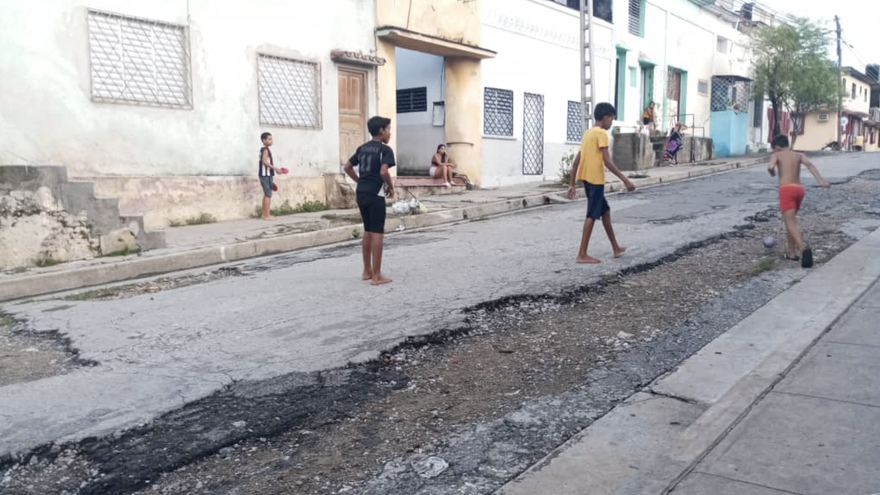
Ten Years in Prison for a Ration Store Administrator in Sancti Spíritus, Cuba, for Embezzling 200,000 Pesos

The official appropriated 24 beverage and food products, in addition to 6,000 liters of kerosene

It is not the first case published of a lower-ranking official convicted of corruption / 14ymedio

14ymedio bigger14ymedio, Madrid, 27 September 2024 –The newspaper Escambray has again reported a conviction for embezzlement of a low-ranking official. The administrator of the La Riviera ration store in Sancti Spíritus was sentenced to 10 years in prison for appropriating of 24 products and 6,000 liters of kerosene worth more than 200,000 pesos.

The convicted, about whom only his age is known (35 years old), was found with rice from the rationed family basket, raw and processed sugar, black beans, salt, powdered milk, toiletries and the aforementioned fuel. In addition, he appropriated drinks with and without alcohol, including beer and soft drinks, and cigarettes from the rationed market.

The total amount of what was stolen is 174,882 pesos, corresponding to the wholesale price. However, for the retail price, the loss is 200,127 pesos, which must be repaid to the Municipal Trade Company of Sancti Spíritus as part of the sentence. continue reading

The total amount of what was stolen is 174,882 pesos, corresponding to the wholesale price. However, for the retail price the loss is 200,127 pesos

The case, tried in the First Criminal Chamber of the Popular Provincial Court of Sancti Spíritus, is dated 2023, which shows that it has taken a year to clarify the responsibilities, although there are no details about the dates on which the events occurred or how the administrator was able to store the products.

The sentence can be appealed, and although it is unlikely that he would win, there could be some variation in a sentence that is even greater than the one announced last May for Alexis Fuentes de La Cruz. Fuentes de La Cruz was the director of the provincial Municipal Trade Company between May 2022 and July 2023, and was sentenced to eight years in prison for a corruption case that included irregularities in hiring and document falsification to prevent the crime from being detected.

The case was, like this one, reported in the official newspaper of the province, and, although the penalty was less, the moral reproach was extensive. Escambray delved into the hypocrisy of the cadres and officials of the Regime who “have sunk up to their necks in the mud of corruption.” The report also made direct mention of the former Minister of Economy and Planning himself, Alejandro Gil Fernández, dismissed for “serious mistakes” committed under his mandate. Nothing has been known about him since he was allegedly arrested in March of this year.

Translated by Regina Anavy

____________

COLLABORATE WITH OUR WORKThe 14ymedio team is committed to practicing serious journalism that reflects Cuba’s reality in all its depth. Thank you for joining us on this long journey. We invite you to continue supporting us by becoming a member of 14ymedio now. Together we can continue transforming journalism in Cuba.

In Havana’s Accountability Assemblies, the Blackouts Arrive on Time

Most of the residents are over 60 years old, and apathy reigns

The energy debacle has been the worst enemy of the Committees for the Defense of the Revolution / Trabajadores

14ymedio bigger14ymedio, Havana, 27 September 2024 — While the notes of an untuned violin mistreated the Bayamo anthem, a dirty lightbulb illuminated the flag, some papers and a desk in the middle of the street. It was the first accountability assembly in a neighborhood of Cojímar and the premiere of a nervous Francisco Rodríguez Cruz – a journalist in the personal circle of President Miguel Díaz-Canel and First Lady Lis Cuesta – as the delegate. What was intended to be a manifestation of revolutionary stoicism ended up having pathetic overtones.

Known as Paquito de Cuba, the gay activist who defines himself as “troubled but happy” was the laughing stock of his own neighbors, who recorded and published a scene that has been repeated dozens of times this week: that of the leader who, in the midst of a dense blackout, tries to “comply” with the “orientation” of holding the assembly.

The energy debacle has been the worst enemy of the Committees for the Defense of the Revolution (CDR), determined to demonstrate their usefulness by organizing accountability assemblies in each neighborhood of the Island. The other has been the shortages. In a country where “donating a head of garlic is now like giving part of your liver” – in the words of a resident of Luyanó – the future will be black for the traditional stews, every year more meager and watered-down, for the celebration of CDR day, September 28.

“Yesterday we peeked out in the middle of the blackout and saw a group of people gathered under a lightbulb,” a woman tells 14ymedio. “We hadn’t even heard about the assembly. There was a flag on the door of a house, and people say that they will be collecting money in the neighborhood. But here no one is going to pay anything, and the person who comes asking will be made to feel like a fool.” continue reading

“Yesterday we peeked out in the middle of the blackout and saw a group of people gathered under a lightbulb,” says a woman

Things have changed, she adds, and apathy is widespread. “There is no movement of anything anywhere. Before, every September 27th, people started from 6:00 pm to prepare the firewood for the stew, if only for the food and the party. That’s over.”

The official press has been projecting a panorama of enthusiasm and kindness in the neighborhoods for days. They allude to the CDR as an institution that “comforts and commits,” and describe the environment of the neighborhoods – increasingly violent, hit by the increase in drugs and police inaction – as a place where “your best brother is the closest neighbor.”

In Nuevo Vedado, Havana, the accountability assemblies have also taken place with little attendance and many complaints. In one of the tall buildings that characterize the neighborhood, on Wednesday night a handful of neighbors, mostly over 60 years old, met to listen to the long report of the constituency’s delegate, who read a litany of complaints and problems suffered by the neighborhood.

The attendees’ participation focused mainly on inflation and the loss of purchasing power that families have suffered. “With my pension I can barely get by; if it weren’t for the fact that my children are still here, I don’t know what would become of me,” lamented a 90-year-old, who had participated in the construction of the building through the system of microbrigades.

Others complained that on the outskirts of the premises managed by the Youth Labor Army (EJT) on nearby Tulipán Street, a “Carthaginian market” has been created where everything is sold, but “it is not controlled and does not sell at the capped prices,” argued a resident. “There are now more goods being sold from the door outside the EJT than on the shelves inside.”

Outside the well-known market, for years there has been a network of informal merchants, who offer everything from cigarettes to strings of onion. “They are not the problem, but the result of the problem, because if you want to buy garlic, detergent, toothpaste or a bag to carry the food they sell inside, you have to end up going to those sellers,” explained another of the participants in the assembly.

One of the residents questioned the State investments that have been made nearby

One of the residents questioned the State investments that have been made nearby, which have not borne fruit or begun operating despite all the resources used. The man pointed to a new bank office, with two ATMs, which was going to be located on Estancia and Conill streets and which, after weeks of work by the builders, has been paralyzed.

In a similar situation, the attendee argued, “there is the Cadeca (Exchange House) that they started building on Tulipán Street, even with a bathroom for the employees. Today the ATMs work when they have money, but nothing else. The Youth Club at Estancia and Santa Ana received special mention, subject to a remodeling a few years ago and converted into a place that barely provides service due to the deterioration of its computers. A woman added that the Youth Club was in the process of “becoming a market for a private enterprise.”

The meeting was finalized by the sector chief of the National Revolutionary Police (PNR) of the area who was categorical: “I’m the only police officer working in this neighborhood where there should be eight of us.” The uniformed man said that “most of the crimes of robbery and theft committed in this area are carried out by people who reside in Cerro,” a poorer neighborhood barely separated from Nuevo Vedado by Rancho Boyeros Avenue.

A little later, under a a burned-out light bulb, the delegate said his final words, and the participants returned to their apartments. Most had not even opened their mouths during the minutes that the accountability assembly lasted.

Translated by Regina Anavy

____________

COLLABORATE WITH OUR WORKThe 14ymedio team is committed to practicing serious journalism that reflects Cuba’s reality in all its depth. Thank you for joining us on this long journey. We invite you to continue supporting us by becoming a member of 14ymedio now. Together we can continue transforming journalism in Cuba.

As Claudia Sheinbaum Is Inaugurated as President of Mexico: A Missing King and an Excess Dictator

When Díaz-Canel is among the guests at the ceremony, it will be like a stinger piercing the pain of our migrants and political prisoners

López Obrador shared the podium with Díaz-Canel during the celebration of Independence Day / EFE

14ymedio bigger14ymedio, Yoani Sánchez, Generation Y, Havana, 27 September 2024 —  The incendiary controversy that has been unleashed between Mexico and Spain upon learning that King Felipe VI has not been invited to Claudia Sheinbaum’s inauguration has overshadowed the names of the leaders who have been invited to the October 1st ceremony. In the official list that has been released among the press, the name of Cuban leader Miguel Díaz-Canel stands out, a figure frequently entertained in recent years by outgoing President Andrés Manuel López Obrador.

Raúl Castro’s successor has been a frequent guest at official ceremonies and public events in the neighboring country during this six-year term. In September 2021, a few weeks after the historic popular protests that shook the island on July 11 of that year, López Obrador not only hosted Díaz-Canel for several days but also shared the stage with him during the celebration of Independence Day in Mexico, the famous “Grito de Dolores.”

The rapprochement, which has served as a diplomatic buttress for the Havana regime, has also included economic support through large shipments of oil. In 2023, the Mexican state-owned company Pemex sent crude oil to Cuba worth close to 400 million dollars. López Obrador has also contributed to calming the criticisms from foreign ministries and governments in Latin America after the repression of the demonstrations that, shouting Freedom! and Homeland and Life!, swept through the Cuban streets more than three years ago. The Mexican leader has played an active role in diluting the accusations against Castroism for the more than a thousand political prisoners it holds in its prisons, the suffocation of independent journalism and for forcing so many activists and opponents into exile. continue reading

Mexican authorities have not even expressed their concern to the island for the thousands of Cubans forced to cross its territory.

Now, when the presidential replacement knocks on the door of the founder of the Morena party, Sheinbaum’s assumption of power seems to be marked by the same imprint of the elderly leader towards the authoritarianism imposed in Cuba more than six decades ago. The winks between both governments, the complacency in the face of the excesses of the Palace of the Revolution in Havana and the complicit silence in the face of the misdeeds of the Castro regime will continue to be the tone that will mark the relationship between both countries. In this diplomacy of complicity, the Mexican authorities have not even conveyed their concern to the Island’s Ministry of Foreign Affairs for the thousands of Cubans forced to cross their territory escaping from their country due to the lack of freedoms and the chronic crisis that grips their lives.

Next Tuesday, when Miguel Díaz-Canel appears among the faces of the guests at the official ceremony that will open Claudia Sheinbaum’s term, it will be like a stinger piercing the pain of our migrants, political prisoners and victims of official intolerance. Will the Mexican president ever apologize for this offense? Will she be willing to change the course of a bilateral relationship that only enthrones authoritarianism? Does she think that time will make us forget the names of those who supported the dictator who muzzles us?

________________________

Editor’s note:  This article  was originally published  on  DW  and is reproduced under license from the author.

____________

COLLABORATE WITH OUR WORKThe 14ymedio team is committed to practicing serious journalism that reflects Cuba’s reality in all its depth. Thank you for joining us on this long journey. We invite you to continue supporting us by becoming a member of 14ymedio now. Together we can continue transforming journalism in Cuba.

Borrell, Latin America and the European Union

Members of civil society in Cuba have requested that the EU subsidy to the Havana regime be eliminated

Borrell was a senior official in the Administration of one of Fidel’s strongest allies, former Spanish president Felipe González / EFE

14ymedio bigger14ymedio, Pedro Corzo, Miami, September 22, 2024 — The conclusion is not edifying, but it agrees with reality.

Everything seems to indicate that many institutions act more in accordance with the opinions of their officials than according to the values on which they claim to sustain themselves, as is the case of the European Union, an entity institutionally committed to democracy and the enjoyment of citizens’ rights, which incurs incomprehensible contradictions.

The Assembly of Cuban Resistance, an organization linked to the overthrow of the dictatorship of the largest island of the Antilles, which, in addition, shows great concern about the dangers to democracy in the hemisphere, has been denouncing, practically since its constitution, the indulgence of the European Union toward the totalitarian Cuban regime.

These accusations, despite their constancy, have not been successful, because one of the most important officials of that entity, Joseph Borrell, High Representative of the European Union for Foreign Affairs, apparently feels sympathy for Castroism and its heirs.

Which leads me once again to agree with the writers Jose Antonio Albertini and Alexis Ortiz, who claim that many personalities born or trained under the management of the Cuban Revolution and Fidel Castro have not been able to get rid of those influences. Borrell was trained and was a senior official in the Administration of one of Fidel’s strongest allies, Felipe continue reading

González, the former head of the Spanish Government, today very rightly opposing the autocracy of Nicolas Maduro.

However, González has never admitted that what Venezuela is currently suffering is a metastasis conceived by his former ally Fidel Castro.

Members of civil society in Cuba and the Assembly of Cuban Resistance have addressed Borrell requesting that the EU subsidy to the Havana regime be eliminated, and they have demanded compliance with a resolution approved by a large majority of the members of the European Parliament demanding the end of support for the Cuban tyranny.

The request states that “human rights abuses and violations have increased”

The request states that “human rights abuses and violations systematically perpetrated by the Cuban regime against demonstrators, political dissidents, religious leaders, human rights activists and independent artists, among other people, have increased,” while demanding “the activation of the human rights clause of the Political Dialogue and Cooperation Agreement with Cuba.”

While Borrell and other officials grimace about Cuban totalitarianism, the number of political prisoners has grown considerably, and their living conditions have seriously deteriorated, as have those of the rest of the citizens.

The call emphasizes that the “number of political prisoners has multiplied by more than eight since 2018, which makes Cuba the largest prison of political activists and dissidents in Latin America,” a shameful position it has occupied since 1959.

On the other hand, I must write with extreme satisfaction that this same Borrell said that the Government of Nicolás Maduro “is a dictatorial and authoritarian regime,” a statement which should encompass the regimes of Cuba, Nicaragua and Bolivia, four Governments that deny their citizens the enjoyment of the most elementary rights.

The failures of Cuban totalitarianism are repeated in Venezuela, Nicaragua and Bolivia, countries that are experiencing precarious conditions on all fronts. Their leaders intend only to perpetuate themselves in power, and, to achieve that goal, they sacrifice the integral well-being of their people.

Castrochavism has turned out to be a tremendous fiasco in each and every one of the countries where it imposes itself and is a certain threat to other nations, among which Colombia and Mexico stand out, where historical supporters of the statements of Fidel Castro and Hugo Chávez govern.

Latin America has never ceased to be a volcano on the verge of eruption, but right now the danger is much greater than in the past. The enemies of democracy are many, and they have more resources and experience. One doesn’t have to be a prophet to realize this.

Translated by Regina Anavy

____________

COLLABORATE WITH OUR WORKThe 14ymedio team is committed to practicing serious journalism that reflects Cuba’s reality in all its depth. Thank you for joining us on this long journey. We invite you to continue supporting us by becoming a member of 14ymedio now. Together we can continue transforming journalism in Cuba.

The Family of Reporter Yeris Curbelo Says That His Trial Was “Rigged” by Cuban State Security

The journalist was sentenced this Tuesday to two years in prison for the crime of “minor injuries”

Yeris Curbelo collaborates with the Palenque Visión agency / Facebook

14ymedio bigger14ymedio, Havana, 25 September 2024 — This Tuesday the Municipal Court of Niceto Pérez, in Guantánamo, sentenced the independent reporter Yeris Curbelo Aguilera to two years in prison for the crime of “minor injuries.” According to the Center for a Free Cuba, which reported the sentence, the case was orchestrated by State Security in retaliation for his political activism.

In a summary of Curbelo’s version published by the organization, the reporter says that on April 14 four individuals – all 21 years old, whom he identifies as Miguel Mosqueda, Douglas Ismark Mazar Góngora and Mariano Reyes – assaulted his 16-year-old son Jessy. According to Curbelo, the authorities only fined the aggressors, despite the fact that the teenager ended up in the Guantánamo pediatric hospital with several injuries.

Months later, on June 16, the four attackers, plus another identified as Adrián Fuentes, assaulted Curbelo himself in the same place where the beating of his son had occurred. Fuentes, 41 years old, even gripped a machete, which, the reporter says, caused injuries to his right hand.

Curbelo sees in both episodes the hand of State Security, because when the police arrived at the scene and stopped the fight, they led him alone to the Guantánamo station, from where he left on bail two days later, accused of causing “minor injuries” to the others. continue reading

Curbelo believes that they want to fabricate a common crime to punish his work of activism and for having spread the protests in the Guantánamo town of Caimanera

The Center for a Free Cuba also interviewed Curbelo’s wife, Odalis Legrá, who says that this Tuesday’s trial was “rigged.” For two hours, she said, the journalist’s lawyer claimed that it was Curbelo who had suffered injuries and that the sentence was a contradiction. “In the trial there was no talk of any of that,” explained Legrá, who also narrated how in the middle of the deliberation a State Security agent entered the premises where the sentence was discussed.

Upon returning, Curbelo was convicted according to the request of the Prosecutor’s Office, but Fuentes – judged in the same process – was acquitted. The other aggressors were taken away as witnesses.

The hypothesis that the attack was orchestrated by the political police has been repeated on several occasions by Curbelo, who believes that they want to fabricate “a common crime” to punish his work of activism and for having denounced, after the protests in the town of Caimanera in 2023, the situation of several prisoners.

The journalist was intimidated by State Security while trying to report the protests

When the demonstrators were tried last May, in the same court where Curbelo was sentenced on Tuesday, the journalist was intimidated by State Security while trying to report the protests. The agents asked him to withdraw immediately, but he had time to spread – through an audio – a brief chronicle of the trial. At that time, according to his complaint, he was also assaulted by the police.

“It is a really immoral and arbitrary condemnation as is the situation suffered by Yeris and his family. It is good to remember that Yeris Curbelo Aguilera has carried out outstanding activism and has a remarkable leadership in his community, the town of Caimanera, a place complicated by the presence of the Guantánamo Naval Base,” said Legrá on Tuesday. She says her husband “has suffered political imprisonment several times, and their son has been psychologically affected and has had to receive psychological treatment from professionals.”

Curbelo collaborates with Palenque Visión, an “independent audiovisual agency” founded in 2012 in the eastern provinces of the Island.

Translated by Regina Anavy

____________

COLLABORATE WITH OUR WORKThe 14ymedio team is committed to practicing serious journalism that reflects Cuba’s reality in all its depth. Thank you for joining us on this long journey. We invite you to continue supporting us by becoming a member of 14ymedio now. Together we can continue transforming journalism in Cuba.

Expensive and Exotic, the Quimbombó No Longer Features on Cuban Tables

The food that once produced a catchy chorus of traditional music is hardly consumed among young Cubans

Not only has the product gone up in price, but the rest of the ingredients that accompany it also cost a fortune / 14ymedio]

14ymedio bigger14ymedio, Natalia López Moya, Havana, 22 September 2024 — Preparing a dish of quimbombó (okra) is one of those popular pieces of wisdom that has been lost with decades of mass migrations, State agricultural plans and a very limited basket for the rationed market. Younger Cubans barely know how to cook this fiber-rich food, which also has little favor among children and that one day slipped forever into a catchy chorus of traditional music.

Quimbombó que resbala pá la yuca seca” [“okra that slides together with dry yucca”] is the song that, among others, was popularized by the Chappottín Ensemble and that has become an inescapable theme with the wiggling of hips and a lot of alcohol. But beyond the festivities, the fruit, which is used in kitchens as a vegetable, has not escaped the Island’s inflation that raised traditional recipes to the level of gourmet food, suitable for very few pockets.

In September of last year, a pound of okra cost 100 pesos in the market at 19th and B, in El Vedado. Twelve months later the food is quoted there at 150 after experiencing an increase at the beginning of 2024 that took it to 200. But those oscillations do not give the measure of how unattainable it has become for many families, because the other ingredients needed for cooking it have skyrocketed even more: meat, spices, garlic, onion and tomato, among others.

In September of last year the pound of okra cost 100 pesos, and twelve months later it is quoted at 150 / 14ymedio

“The first thing you have to do is get rid of the slime,” explains Zenaida, a retiree from Central Havana who declares herself “frustrated” because she continue reading

can only enjoy it by herself at home. “My grandchildren don’t like it. My daughter says it disgusts her, and everyone prefers to eat the picadillo that the butcher sells, even though no one knows what’s in it,” she complains.

Zenaida, a mulata who for decades has been a Santería godmother for dozens of residents in her neighborhood of Pueblo Nuevo, inherited the taste for quimbombó from her mother, the granddaughter of slaves, who ended up marrying a blue-eyed man from the Canary Islands who arrived in Cuba in the 1920s. Of their three children, only the old woman remains on the Island: “My older brother went to a better life and is in the Colón cemetery, and my younger sister also went to a better life and is in Miami.”

In the family, the recipe to make the quimbombó was one of the first that was taught to girls as soon as they began to get into the pots and pans: “First, you soak the quimbombó in water with a little vinegar or lemon to remove the slime,” she explains to this newspaper, in reference to the substance that is seen when eaten boiled, which is slightly reminiscent of gelatin.

“Then you boil it until it softens and in the meantime prepare a good sauce,” she explains. “I like it with meat, preferably beef, but pork also goes very well with it. My mother also threw in chicharrones,” Zenaida recalls. The quimbombó, also know as okra, is highly valued in the kitchens of many African countries and the Caribbean.

“These days they are a little small,” warned a cart peddler who this Saturday offered quimbombó on Carlos III Avenue. “But there are people who prefer it that way because they say it softens more easily.” In the small El Vedado grocery store, a pound of the fruit was offered at 80 pesos, but the presentation was far from the clean bag with larger specimens on offer at 19th and B.

“These days they are a little small,” warned a cart peddler who this Saturday offered quimbombó on Carlos III Avenue

“Most of those who buy quimbombó from me are older people, because the younger ones don’t even know how to cook it,” the merchant explained to this newspaper. “A lot of pizza, a lot of croquettes, a lot of hot dogs: young people here no longer eat real food,” he lamented. “The problem is that quimbombó doesn’t taste good without meat, and meat is harder to find than electricity,” he joked.

“Also, it seems that the farmers have realized that it doesn’t sell very well in the market, so they don’t harvest it as much as before,” the man added. “When I was young there was plenty; you could go to any small shop, and next to the malangas and the squash was the quimbombó, but today people don’t even know how to select it. They cannot distinguish between one that is good quality and one that stays hard.”

A few feet from the wheelbarrow, a retiree, with his empty bag hanging from his shoulder, complained about the price of the product. “I like it but can no longer pay that price, and also in my family, no one eats it but me,” he said. “Just for the tomato and the garlic cloves you need for the seasoning, half of my pension is gone.”

Today, the rise in the cost of living and the loss of culinary traditions have had one of its most notorious victims in the quimbombó. The lyrics of that contagious song are indecipherable for most Cubans born with the ration book and the five-year agricultural plans.

Translated by Regina Anavy

____________

COLLABORATE WITH OUR WORKThe 14ymedio team is committed to practicing serious journalism that reflects Cuba’s reality in all its depth. Thank you for joining us on this long journey. We invite you to continue supporting us by becoming a member of 14ymedio now. Together we can continue transforming journalism in Cuba.