Cuban Authorities Blame the Failure of Banking Reform on Hard Currency Sellers

Two money counting machines, a ’motorina’ [electric motorbike] and a dozen magnetic cards were seized from the woman. (Escambray)

14ymedio bigger14ymedio, Havana, 27 October 2023 —  After turning a blind eye for decades to street currency sellers, the authorities have decided that this activity “hinders” the bancarización* [banking reform] decreed by the Government last August. On Friday, the official press reported a police raid in Sancti Spíritus against an “illegal cadeca” (exchange house run by individuals). Those involved could be fined or punished with between two and five years in prison.

The Escambray newspaper, concise in its report, hides the names of the accused and the date of the events. The media describes the police search of a woman from Sancti Spiritus who used her home as an illegal currency exchange. According to the authorities, the citizen used social networks as a means of contact with her clients, to whom she gave foreign currency in exchange for pesos or vice versa, charging three pesos for each dollar or euro that she sold.

The seizure could have taken place at least a year ago, since the photos published by the provincial newspaper show the exchange of one dollar at 180 pesos, compared to the current rate, which is 255. This has been confirmed to 14ymedio by several citizens of the province, who insist that they have not had news recently about an operation of this type.

“If that had happened these days, everyone would have found out,” explains David, a professor from Sancti Spiritus. “It seems more like a tactic to scare MSME* owners and dollar exchangers into following the rules of banking,” he adds. continue reading

I don’t understand what the problem is, if everyone knows that as soon as people get money from Cadeca [official currency exchange] they go to these resellers

Luis, another resident of the main city, has similar opinions. “I don’t understand what the problem is, if everyone knows that as soon as people get money from Cadeca [official currency exchange] they go to these resellers. I imagine they do these things to justify the failure of banking, which couldn’t get worse,” he argues. “Most likely it’s an old case and they’ll pull it out now.”

Accused of “illegal trafficking in national currency, foreign currency, metals and precious stones,” the accused operated with several cards in her name and those of other people, which she used to withdraw “large amounts” of cash from ATMs. According to the oficial press, this “hinders the true purpose of banking” and constitutes a violation of “socialist legality.”

According to the authorities, a man also involved in the business was detained during the operation while carrying a backpack with about 143,000 pesos (less than $600 in the parallel market). “The individual recognized that said cash had been withdrawn from an ATM after a transfer made by the alleged victim,” the newspaper states.

Two machines for counting money with the available digital records were also seized from the woman, about 10 magnetic cards, a motorina [electric motorbike], large amounts of cash in different denominations — although the media does not specify how much it was mostly pesos, US dollars and euros — as well as an account book containing transactions made to clients.

The authorities also revealed that the woman frequently visited the homes of her clients, some of them regulars, “MSME representatives and “self-employed workers,” two of the sectors most suffocated by the new virtual transaction policy.

The authorities also revealed that the woman frequently visited the home of her clients, some of them regulars, “MSME representatives” and “self-employed workers

“Not even the current process of banking was an obstacle, because she had a dozen magnetic cards to circumvent the mechanisms imposed by the Central Bank of Cuba, and if, as a result of illicit financial activity, she emptied the occasional ATM, bad luck for those who came behind in the line,” declares Escambray. Clearly, for the newspaper, the real crime is not the illegal exchange rate, but rather avoiding the unstable economic policies of the Government.

Since 1968, when Fidel Castro banned the circulation of the dollar on the Island – with serious consequences for those who possessed them – currency resellers began to become increasingly common in Cuba.

The decriminalization of the dollar did not come until 1993, and a decade later the CUC (Cuban convertible peso) appeared, which forced a more flexible business, no longer dependent on both foreign currency and local currency. Although raids were carried out from time to time, people engaged in this business began to group together in enclaves in each city, easily identifiable by the population.

Touts, mostly young men, learned to trumpet exchange rates in English, French and even Russian

This is the case on Neptuno Street in Havana, where touts, mostly young men, learned to trumpet exchange rates in English, French and even Russian. Or Parque Vidal, in Santa Clara, where they gather, without fear, in front of the official Cadeca. In this way, whoever leaves the Western Union office in the capital of Villa Clara quickly finds someone to exchange their dollars.

The recent bancarización, as well as the disappearance of the CUC almost three years ago as one part of the so-called Ordering Task***, has changed the rules of the game for currency resellers. If before the raids were carried out sporadically and to keep them under control, now the State’s need to collect foreign currencies at all costs makes the persecutions more frequent.

The business, however, survives, and has moved to social networks, taking advantage of platforms such as Transfermóvil and EnZona to “schedule” transfers. Another common way, for those who have immersed themselves in the world of cryptocurrencies, is the exchange of pesos for the virtual equivalents of the dollar or the euro, a practice that the State has also begun to pursue but without much success.

Translator’s notes:

*Bancarización— banking reform –in effect since August 3, 2023,  is a set of measures intended to move Cuba to a “cashless” society based on electronic banking.  So far, the fast-falling peso, soaring consumer prices, the inability of the Island’s infrastructure — subject to constant blackouts — to support required elements as simple as ATMs, along with widespread distrust among the population, have stymied the effort.

**MSME — Literally, “Micro, Small, Medium Enterprise.” The expectation is that it is also privately managed, but in Cuba this may include owners/managers who are connected to the regime.

***The “Ordering Task” [Tarea Ordenamiento] was a collection of measures that include eliminating the Cuban Convertible Peso (CUC), leaving the Cuban peso as the only national currency, raising prices, raising salaries (but not as much as prices), opening stores that take payment only in hard currency which must be in the form of specially issued pre-paid debit cards, and a broad range of other measures targeted to different elements of the Cuban economy. 

____________

COLLABORATE WITH OUR WORKThe 14ymedio team is committed to practicing serious journalism that reflects Cuba’s reality in all its depth. Thank you for joining us on this long journey. We invite you to continue supporting us by becoming a member of 14ymedio now. Together we can continue transforming journalism in Cuba.
With Maria Corina Machado in Venezuela, Oil Gifts and Cuban Interference Will End

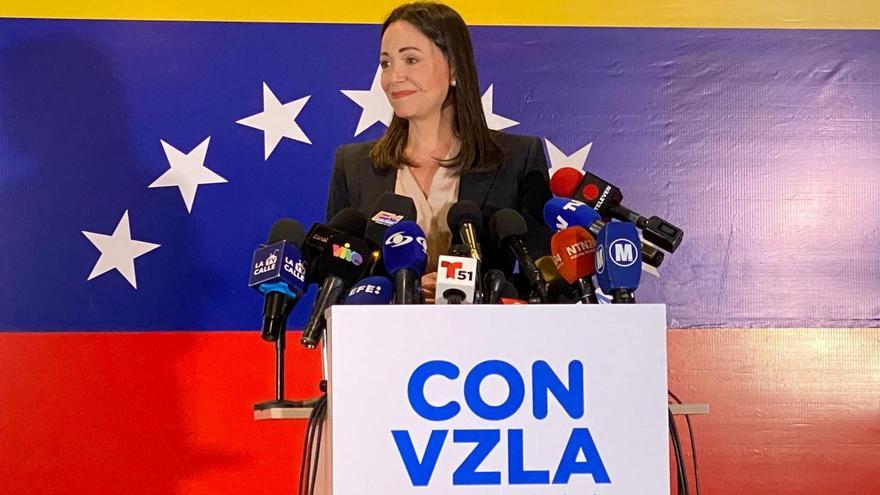
María Corina Machado, opposition candidate for the 2024 elections in Venezuela. (X/María Corina Machado)

14ymedio bigger14ymedio/EFE, Havana, October 26, 2023 — Former deputy María Corina Machado, winner with 92% of the votes in the opposition primary elections in Venezuela, assured that, if elected, she will suspend free oil shipments to Cuba. “If they pay, we can continue sending them,” she warned this Tuesday in a press conference where she was asked, among other topics, about the relations between both countries.

Although her priority is to defeat the Chavismo that has dominated Venezuelan politics for 24 years — and its representative, the current president Nicolás Maduro — Machado promised a review of the link between both nations to cut off at the root all types of interference. “There will be no way or area in which the Cuban regime interferes in the affairs of the State of Venezuela, nor Venezuela in the affairs of the Cuban State,” she insisted.

The energy issue – one of the most delicate because Venezuela has the largest oil reserves in the region – would need “a conference in itself,” Machado explained. However, she assured that her party, Vente Venezuela, has a plan to open the country to “enormous” investments, not only for fuel and gas but also for other resources. continue reading

Her party, Vente Venezuela, has a plan to open the country to “enormous” investments, not only for fuel and gas

The structural transformations planned by the opposition – including the new diplomatic stance towards the Island – pass through a series of “legal and institutional changes” that seek to reconfigure Venezuela’s role in the region.

“At the level of human rights and freedoms, Cubans know that they count on the Venezuelans and that they will count on me with everything I can so that they too can move towards a system of freedoms. That they can live with freedom, with dignity and prosperity,” she concluded.

On Thursday, Machado was proclaimed the opposition candidate for the 2024 presidential elections. The National Primary Commission (CNP), organizer of the process, was in charge of officially announcing her candidacy in an act in which her work was also recognized by the members of this body, the opposition political parties, civil organizations and by the candidates who ran in the elections.

“Today we proclaim our unity candidate for the Presidency of the Republic, María Corina Machado, and we extend our congratulations. A path is opening up that demands inclusion, preservation and broadening of the broad political and social movement that was generated around the primary” said the president of the CNP, Jesús María Casal, before giving Machado her credential.

“We fought a noble fight, which was an example of the Venezuela that we are going to build (…) passionately contrasting ideas but with respect,” said Machado about the electoral campaign, which started with 13 candidates, and ended with 10, after the resignation of three of them two weeks before the primaries.

Machado’s proclamation took place in the midst of attacks by the powers of the State, all in the hands of Chavismo

She assured that “very competent people” who have joined the fight she is leading for change in Venezuela have joined, understanding that “the best, regardless of their militancy or origin” are necessary. Finally, she insisted on her call to all sectors of the country to form “a great national alliance that allows building democratic governance” and work on the route to the presidential elections scheduled for the second half of 2024.

Machado’s proclamation took place in the midst of attacks from the powers of the State, all in the hands of Chavismo, which denounces that there was “fraud” in the process, for which the Prosecutor’s Office opened a criminal investigation into the primaries and their organization.

Also the president of the National Assembly (AN/Parliament) and representative of the Government in the negotiations with the opposition, Jorge Rodríguez, questioned Machado’s meeting with ambassadors and representatives of various nations and said he was “concerned” that they were trying to “interfere” “in Venezuelan politics.

“With all due respect, we ask for restraint, with all due respect we ask for parsimony, do not interfere in the internal affairs of the Bolivarian Republic of Venezuela,” said Rodríguez during the meeting to which the diplomats were summoned in order to present “the evidence” about the “fraudulent primary event carried out by a sector of the opposition,” according to the call sent to the press.

____________

COLLABORATE WITH OUR WORKThe 14ymedio team is committed to practicing serious journalism that reflects Cuba’s reality in all its depth. Thank you for joining us on this long journey. We invite you to continue supporting us by becoming a member of 14ymedio now. Together we can continue transforming journalism in Cuba.

La Gente De Zona Premiere ‘Demasiado’, a Hymn to Joy and ‘Cubanidad’

Image of the video clip of Demasiado (Too Much), by Gente de Zona. (Capture)

14ymedio biggerEFE/14ymedio, Miami/Madrid, October 20, 2023 — The Cuban urban music duo Gente de Zona, winner of 7 Latin Grammys and 12 Latin Billboards, premiered this Friday their new single and video, Demasiado, a tropical song with which Alexander Delgado and Randy Malcom seek to infect their followers “with joy and flavor.”

Demasiado focuses “on the pride of being Cuban,” and through the contagious voices of both, “they give us a melody of celebration and a presentation of their Cubanness,” says a statement.

The song’s chorus, it adds, reflects “the philosophy” of this duo, which in 2000 began as a street-rap collective in Cuba and has become one of the most recognized duos worldwide. “And now I’m here, living what I promised myself, fulfilling what I once dreamed of, proud of where I was born and where I grew up,” says the refrain. continue reading

The song is already available on music platforms under the label of Magnus Music, and on YouTube it already had almost 40,000* views this Friday, a few hours of its release

The song is already available on music platforms under the label of Magnus Music, and on YouTube it already had almost 40,000* views this Friday, a few hours of its release.

Demasiado also has a music video, in which Alexander and Randy have fun while singing in a festive atmosphere in and out of a pool. The video ends with “triumphant images” of their concerts on a stage.

Alexander and Randy were consolidated in 2014 on the international scene with the song Bailando (Dancing), a collaboration of the duo with Enrique Iglesias and Descemer Bueno. A year later, the duo released two great hits with Marc Anthony: La gozadera (Enjoyment) and Traidora (Traitor).

Gente de Zona are also co-authors of Patria y Vida, along with Yotuel Romero, Descemer Bueno, Eliexer Márquez El Funky and Maykel Castillo Osorbo, which became the anthem of the protests of July 11, 2021 in Cuba. The song premiered a few weeks ago in a new salsa version to which the voice of Celia Cruz generated by artificial intelligence was incorporated.

*Translator’s note: 351,000 views as of this translation

Translated by Regina Anavy

____________

COLLABORATE WITH OUR WORKThe 14ymedio team is committed to practicing serious journalism that reflects Cuba’s reality in all its depth. Thank you for joining us on this long journey. We invite you to continue supporting us by becoming a member of 14ymedio now. Together we can continue transforming journalism in Cuba.
Cuba’s Decline: Where There Were Rolex, Towels Remain

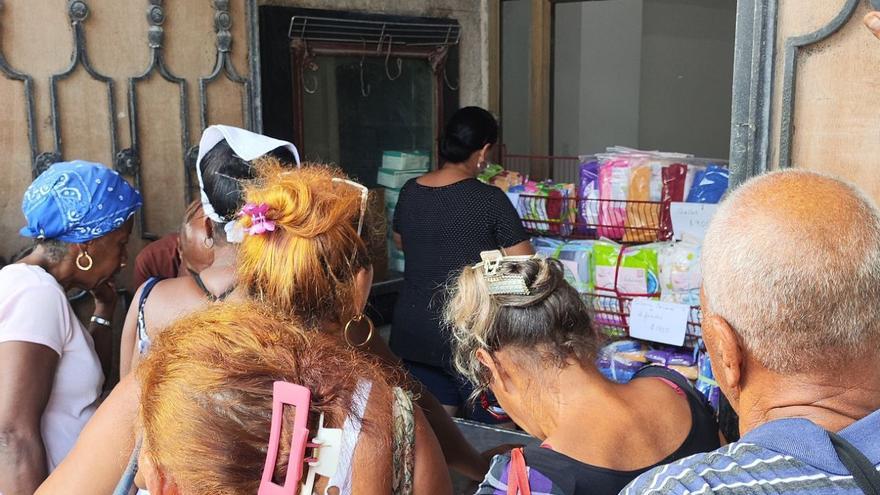
If clients could access the Riviera House before, with its mix of neoclassical and baroque styles and its employees in suits and ties, now sales take place at the door and in a hurry. (14ymedio)

14ymedio bigger14ymedio, Natalia López Moya, Havana, 5 October 2023 — A woman carries a large wad of bills in her hand. She doesn’t bother to protect the thousands of Cuban pesos because, what was once a large sum of money, today barely becomes a few purchases. Adjacent to the peculiar façade, a dozen people lined up this Thursday in front of the former Casa Riviera, an exclusive store on Galiano #456 in Centro Habana, which once sold Rolex watches and jewelry, but which has now been rented to a small private company that offers sheets, cloth wipes for cleaning floors and towels.

A few meters before reaching the store, the symbols of its former class can be distinguished. The imposing entrance gate, the small stained-glass windows decorated with flowery frames where the expensive jewels used to be displayed. The rough stone columns support the entrance hall that used to have beautiful granite floors and today shows impersonal modern slabs, of poor quality and full of holes.

“My place is after the man in the blue shirt,” exclaimed an elderly woman who pledges to have “seized the rhythm” of the MSME* [small private business]. “They sell a little cheaper than elsewhere, so many people come here to buy in quantities and take them away to resell”, she explains to 14ymedio. After years of being closed due to problems with sewage pipes and lack of supplies, the old Riviera began to be managed by individuals a few weeks ago. continue reading

If previously its customers could access the property, with its mix of neoclassical and baroque styles and its employees in suits and ties, now selling takes place at the door and with haste

A bedsheet with two pillow cases, made with a high percentage of polyester and at 1,300 pesos, ($54.60) is displayed at the entrance counter. If before clients could access the property, with its mix of neoclassical and baroque style, and its employees in suits and ties, now selling takes place at the door and in a hurry. “Come on, whose turn is it?” the saleswoman tried to speed up the line, somewhat overwhelmed by the questions from those crowding the counter. Behind her, the interior of the legendary watch and jewelry store was still visible, with its light marbles, its elaborate capitals and a narrow staircase that gave way to the majestic mezzanine.

“Give me ten towels!” A customer shouted and her voice echoed through the walls of the business that initially operated under the Abislaimán e Hijos brand, the exclusive distributor of Rolex watches in Cuba. “Don’t crowd together, I can’t even breathe that way!” the employee demanded when the line got out of control and overwhelmed her. The majority of those who stood in line were humble people, who are willing to get up early to make a few pesos difference on the resale of merchandise.

A bed sheet with two pillow cases, with a high percentage of polyester priced at 1,300 pesos, is displayed at the entrance counter. (14ymedio)

Casa Riviera was not the only business of Julio Abislaimán Fade’s family. His daughter Alicia and her husband Manuel Hernández managed the also exclusive Chantilly jewelry store in a central location on San Rafael Street in Havana. When the confiscations began after Fidel Castro came to power, the clan of businessmen packed their bags and went to Puerto Rico. There, they registered the company as Chantilly Joyeros and, although a good part of the descendants of those Cuban emigrants moved to the United States, the Abislaimán Joyas firm, niece of the Casa Riviera in Havana, still operates in ”La Isla del Encanto” (Puerto Rico).

“If you don’t get organized, the sale will have to stop”, an anxious saleswoman shouted this Thursday, unable to control the customers’ disorder. Next to her, two of the armored glass and bronze-framed windows, which more than half a century ago showed the shiny Rolexes, this morning had a rusty hook for hanging pillowcases and kitchen rags.

*Translator’s note: Literally, “Micro, Small, Medium Enterprise.” The expectation is that it is also privately managed, but in Cuba this may include owners/managers who are connected to the regime.

Translated by Norma Whiting

____________

COLLABORATE WITH OUR WORKThe 14ymedio team is committed to practicing serious journalism that reflects Cuba’s reality in all its depth. Thank you for joining us on this long journey. We invite you to continue supporting us by becoming a member of 14ymedio now. Together we can continue transforming journalism in Cuba.

Cuba, the Other October Crisis

Cuba’s vulnerable and the millions of workers who depend on a state wage are already living on the edge (14ymedio).

14ymedio bigger14ymedio, Reinaldo Escobar, Havana, 28 September 2023 — The topic of the upcoming hardships starting on October 1st no longer qualifies as a rumor, much less as a “counterrevolutionary lie”, now we know, from the word of those who make decisions, that it is true that there will be new problems with transportation, food distribution and electricity generation. New problems that will add to the already existing ones.

During an hour and a half on Wednesday’s Mesa Redonda [Roundtable] program, the Vice Prime Minister and Minister of Economy, Alejandro Gil Fernández, along with the Minister of Energy and Mines, Vicente de la O Levy, explained why there will be new difficulties, but failed to mention possible solutions other than “the will to move forward”.

According to Vicente de la O Levy, 99% of the causes that affect us come from the “blockade” and only 1% can be related to the bad work of the government. For Alejandro Gil Fernandez, the solutions will be within socialism. continue reading

“If the possibility of changing the system is not addressed, 99% of the causes that prevent the country from functioning normally will prevail”

The present and the future of the country are projected on these two apparently immovable columns. The official propaganda maintains that “the blockade” exists because socialism is being built here in Cuba and the United States does not like that. Therefore, if the possibility of changing the system is not addressed, 99% of the causes that prevent the country from functioning normally will prevail.

It is hard to imagine that everything will get worse after October and it is even harder to detail the consequences that a worsening of the country’s economic situation will bring to the people. For that fantasy called “the ordinary Cuban”.

The parents who rack their brains every day to guarantee a little snack for the children who go to school, those who take care of the elderly or disabled people, those who left their remote municipalities to find something better in the capital, but who do not even have a ration book and every month have to pay the rent; the bricklayer who works on his own and almost always lives far from where he is offered a temporary job; the single mothers, the retired person without family support…. These and the millions of workers who depend on a state salary are already living on the edge and the ministers tell them that they need to be understanding.

To dispel foreboding, Gil assured that this will not be the collapse, and that we will not reach “zero”. He also assured that not one millimeter will be ceded in the commitment to build socialism, but he did not dare to mention any metaphorical unit of measure to indicate how far or how close we are to catastrophe.

Translated by: Dylan Roberts, Isabella Posoli, and Skyler Brotherton-Julien, as part of Spanish 321 (University of Miami)

____________

COLLABORATE WITH OUR WORKThe 14ymedio team is committed to practicing serious journalism that reflects Cuba’s reality in all its depth. Thank you for joining us on this long journey. We invite you to continue supporting us by becoming a member of 14ymedio now. Together we can continue transforming journalism in Cuba.
Cachita, the Sea Is Beautiful, and the Wind…

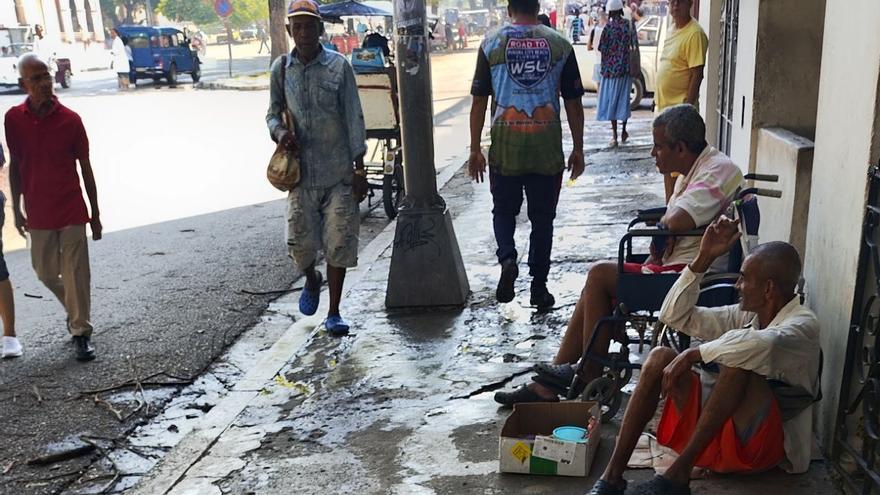
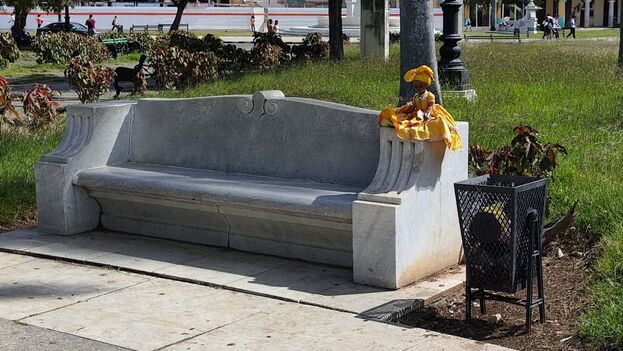
The doll that represents the Virgin of Charity of Cobre, patron saint of Cuba, remained this Thursday on the marble of a bench in La Fraternidad Park. (14ymedio)

14ymedio bigger14ymedio, Yoani Sánchez, Havana, 26 October 2023 — Cachita, the sea is beautiful, and the wind arrives somewhat autumnal this October in Havana. Dressed in yellow, the doll that represents the Virgin of Charity of Cobre, patron saint of Cuba, remained this Thursday on the marble of a bench in the Parque de La Fraternidad, a few meters from the Capitol in Havana. The downward gaze, the necklaces hanging from her neck and the knotted scarf on her head complete the peculiar scene. But the image is not alone.

You can show the doll and promise a client that ‘a trip is in the offing’

A few meters away, absorbed in the hustle and bustle of survival, the owner of this representation, also of the orisha Oshún, haggles over the price of a peanut nougat with a passing merchant. She, who sells her services as a fortune teller, card reader and prophet, encounters everyday uncertainty in Cuba. She can show the doll and tell a client that “a trip is in the offing,” but she admits she is incapable of predicting the price of a dollar on the black market or deciphering the vagaries of the Havana oil refinery.

The prophets of doom live in difficult times on this Island. They focus on the uncertain future or answer the current questions of their clients. Tomorrow doesn’t matter where now is so urgent. So a doll representing Cachita remains dressed and made up on a park bench, while the owner of the image immerses herself in a world where prayers, cascarilla and rosaries can do little to help her.

____________

COLLABORATE WITH OUR WORKThe 14ymedio team is committed to practicing serious journalism that reflects Cuba’s reality in all its depth. Thank you for joining us on this long journey. We invite you to continue supporting us by becoming a member of 14ymedio now. Together we can continue transforming journalism in Cuba.
A Brand New State-Run Technology Store without Internet Access

The Gedeme store on Rancho Boyeros Avenue in Havana’s Cerro district. (14ymedio)

14ymedio bigger14ymedio, Juan Diego Rodriguez, Havana, 16 October 2023 — There is a certain point on Havana’s Independence Avenue, better known as Rancho Boyeros Avenue, where there is no internet signal. At that spot, which is at the intersection of Palmar Street in the Cerro district — 2701 Rancho Boyers to be exact — the state-owned Industrial Company for Information Technology, Communications and Electronics (Gedeme) has opened a bricks-and-mortar store.

The grand opening on October 11 was marked by a small ceremony and a press release. The news item, which appeared as an article in Cubadebate and the provincial newspaper Tribuna de La Habana, explained that customers could go there to pick up purchases made through the store’s website or could purchase those products at the store itself using a QR code, both through the EnZona payment app.

The store’s location, it continues, “was chosen due to the urgent need to make the service more accessible to the public.” Previously, customers had to go to the Gedeme factory in Marianao, at least half an hour by car from the center of the capital, to pick up products they had purchased online.

The article claims the store offers a variety of products including lamps, computer equipment, mattresses, pillows and bases for refrigerators. However, what most people go to Gedeme for, as 14ymedio confirmed on Monday from conversations with regular customers, are light bulbs. “It’s the best thing they have in stock,” says José, who was at the store on Monday. continue reading

“To do this, I would first have to tell you to walk at least one block to the bus stop [where there is an internet signal] so you can pay, and that is not feasible”

The state-run company, which just a few days ago was visited by delegates from the National Assembly, seems to have given its employees only vague information about what it actually sells. “First, the electricity went out,” says José, “and then the service they provided was terrible.” He reports that, while he was there, a young man came in wanting to buy some light bulbs using the QR code and the EnZona app. The employee explained that EnZona does not work there because there is “a very big problem” with internet connection. “To do this, I would first have to tell you to walk at least one block to the bus stop [where there is an internet signal] so you can pay, and that is not feasible,” José claims the woman said.

Similarly, he complains that the employees do not inform customers of either the courier or transportation option as mentioned in the official publications. Instead, they only ask customers to buy online and pick up their orders twenty-four hours later.

The items listed for sale on its website, which can only be accessed from Cuba, are limited. Under “Telecommunications” the only thing the company had for sale on Monday was a landline telephone with a cable but no screen. The “Electronics” section offered a surge protector for household appliances while the “Computer Science” section only had a motherboard for those wanting to build their own desktop computers.

The website boasts of the company’s “innovative thinking, with quality and sustainability in its processes” yet still directs customers to pick up their purchases at the old Marianao address. The online catalogue’s largest section is devoted to office furniture, which includes desks and shelving made of pressed wood and metal. The company also installs aluminum marquetry and lighting systems.

“From what I heard, they said that they were already in talks with Etecsa to provide them with a phone so that customers could buy it right there along with the app,” says José, “But just think, why would you set up a technology company that sells online in an area where there is no internet coverage?”

____________

COLLABORATE WITH OUR WORKThe 14ymedio team is committed to practicing serious journalism that reflects Cuba’s reality in all its depth. Thank you for joining us on this long journey. We invite you to continue supporting us by becoming a member of 14ymedio now. Together we can continue transforming journalism in Cuba.

The National Ballet of Cuba Celebrates its 75th Year with an Intense Program of Classics

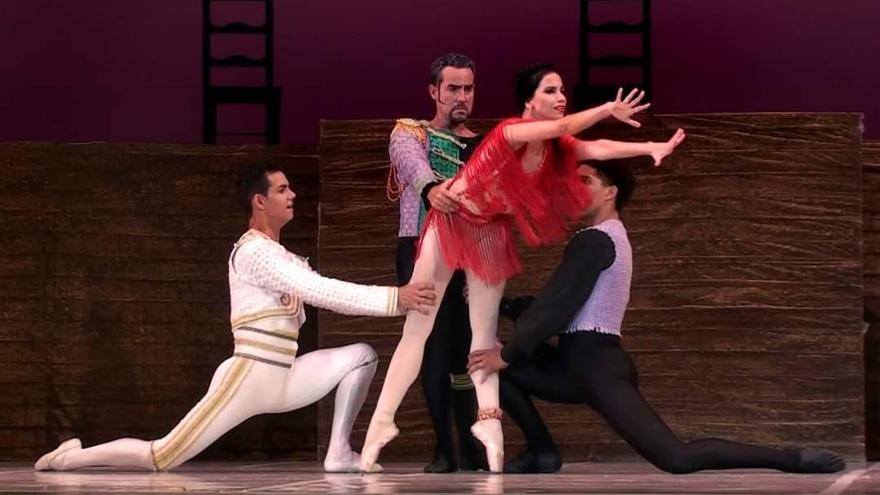
‘Carmen’ is one of the works included in the program for the National Ballet of Cuba’s 75th anniversary. (Ahmed Piñeiro Fernández/National Ballet of Cuba/Facebook)

14ymedio biggerEFE (via 14ymedio), Havana, 27 September 2023 — The National Ballet of Cuba (BNC) will celebrate its 75th anniversary with an intense program of 15 works in one month, including dance classics and the company’s own classics such as Don Quixote, Swan Lake, and Coppelia. The program will run throughout October, coinciding with the month of the company’s foundation, the company’s directors announced Tuesday at a press conference.

“(It will be) a full month with performances every weekend and (with) different programs,” explained Viengsay Valdés, general director and dancer of the BNC.

The performances will be held at the Avellaneda Hall of the National Theater of Cuba, with the exception of October 28th, the last day of the 75th anniversary jubilee, when a grand gala will be held.

Likewise, Valdés said, the company will carry out different activities in public places, movie theaters, and schools in order to “awaken that feeling for the art of dance even more.” continue reading

It will be a full month with performances every weekend and different programs,” explained Viengsay Valdés

The different performances will feature Cuban and foreign dancers from other companies, according to the organizers. And one of the figures who will be at the center will be Alicia Alonso, its former director, main founder, and leading figure, who died in 2019 at the age of 99.

The program includes Rara Avis, Cinderella, Coppelia, Don Quixote, Carmen, Giselle, Song of Life, Seventh Symphony, Classical Trilogy (Act I of Coppelia, Act II of Swan Lake, and Act III of Don Quixote), Alfonsina, Leda and the Swan, Rhythms, Dionaea, Majísimo and Blood Wedding.

The National Ballet of Cuba is the most important classical dance company on the island, founded in 1948 under the name of Alicia Alonso, internationally renowned for the artistic-technical rigor of its dancers and a style in which the romantic and classical traditions predominate.

In 2018 it was declared Cultural Heritage of the Nation for being “the highest expression of the Cuban school of ballet,” a status extended to the repertoire of the company, its archive of images, objects, and documents related to the institution.

Translated by Allison Reyes, Sterling Cole, and TriciaLyn Beamer as part of Spanish 321 (University of Miami)

____________

COLLABORATE WITH OUR WORKThe 14ymedio team is committed to practicing serious journalism that reflects Cuba’s reality in all its depth. Thank you for joining us on this long journey. We invite you to continue supporting us by becoming a member of 14ymedio now. Together we can continue transforming journalism in Cuba.
My Personal Granada: Fidelito and El Gordo

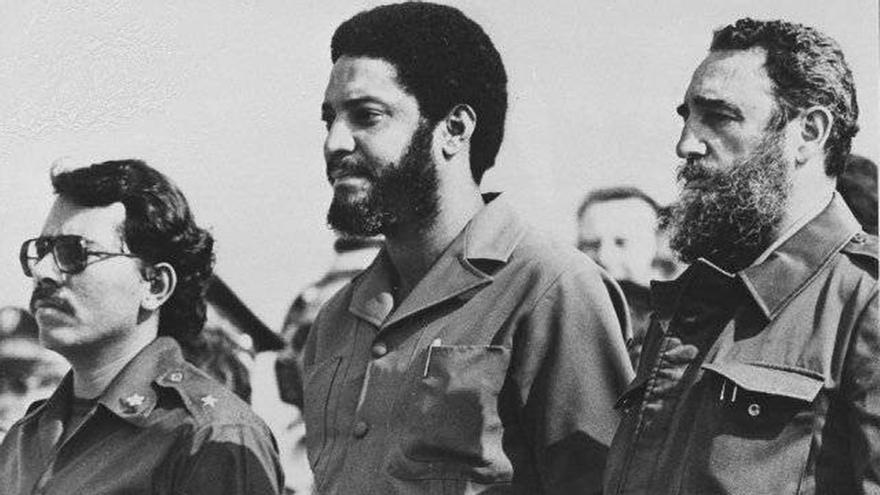
Granada’s First Minister Maurice Bishop (center) with Fidel Castro (right). Daniel Ortega is on the left. (TVCubana.ICRT.CU)

14ymedio bigger14ymedio, Reinaldo Escobar, Havana, 25 October 2023 — All the data is on the internet: how many Cuban soldiers died in Granada, how many surrendered, the weapons of the 82nd US division, the fight between Ronald Reagan and Margaret Thatcher over the invasion, the importance of the airport… but not everything has been told.

At noon in the last week of October 1983, while we were watching the Cuban National Television News, shortly after having lunch in the dining room of the ICRT (Cuban Institute of Radio and Television) microbrigade that was building the Yugoslav model building where I still live, we heard the terrible news that the last Cubans fighting on that small island had immolated themselves wrapped in the flag with its single star.

The news was particularly terrible for us, because among those soldier-masons were two of our companions, Fidelito and El Gordo, who had “stepped forward” to participate in the mission to build an airport in Granada.

At that hour the work was halted and we divided into two groups to visit the relatives of our fallen colleagues, above all to tell them, to swear to them, that their apartments, once the building was finished, were guaranteed, that we would see to it that they were handed over to them. continue reading

The news was particularly terrible for us, because among those soldier-masons there were two of our companions, Fidelito and El Gordo

A few days later it was learned that the news was not true, that perhaps our companions had not died and that we only had to wait for the contingent to return to count them among the living. And so it was.

My friend Pirole, a photographer for the magazine Cuba Internacional, installed a camera with a tripod in his house in front of the television that broadcast the reception of those who returned. “That, that’s Fidelito,” I told him, and we managed to immortalize him while Fidel Castro shook his hand on the airport tarmac, just below the steps of the plane that returned him safe and sound. The photo was my gift to the surviving hero.

A week later El Gordo (whom I was unable to immortalize) and Fidelito gave a “private press conference” to their supportive colleagues from the microbrigade.

Fidelito, who had not yet fathered that pair of twins whom he named Fidel and Raúl, told us how he and Colonel Tortoló entered the embassy of the Soviet Union in Granada. I quote from memory: “They didn’t want to let us in because we were armed and a tense situation arose in which neither the bolos [Russians] nor Tortoló gave in, until an agreement was reached to enter through the kitchen door where there was a closet where we had to deposit our weapons, with the commitment to recover them when we were able to leave.”

El Gordo, so witty, told us that, when they raised the combat alarm to occupy the positions they had planned ahead of time, the heroic Cuban combatants had the perception that they would never return to that camp. They were absolutely right, because those facilities were razed. And for that reason, before leaving the site they took to their military artillery site whatever ’little thing’ that each one could save and transport.

They didn’t want to let us in because we were armed and a tense situation arose in which neither the ’bolos’ [Russians] nor Tortoló gave in, until an agreement was reached to enter through the kitchen door

They had received the order not to fire unless they were attacked, and again I quote from memory: “From our cannons we observed how the Marines grouped themselves in combat formations, we heard the noise of their weapons and we saw them advance towards us without firing, until we had them in front of us saying in Puerto Rican Spanish ’Hands up.’”

“Then you told him aquí no se rinde nadie [here no one surrenders]*,” the secretary of the Communist Party in the microbrigade told El Gordo. “No, it didn’t occur to me, what happened was that they stopped us and searched us. I had my hands up and a Marine bigger and fatter than me, checking that I wasn’t carrying another weapon, touched my back pocket. With great care and without ceasing to point his rifle at me, he took out of that pocket the only ’little thing’ I’d been able to save: girl’s underwear for my daughter in Cuba. In Puerto Rican English and without pointing at me he said: ’Excuse me, sir.’  I didn’t know whether to feel grateful or humiliated.”

Forty years have passed. Fidelito lives today in Miami with his twins and El Gordo decided to take advantage of his five-year visa to wait with his entire family for parole on the other side. That Granada airport no longer constitutes a threat to anyone and those apartments that we swore to safeguard now have new owners. None of this appears on the internet, until now, but I, who am still in Havana, keep it in my memory.

*Translator’s note: ‘Aqui, no se rinde nadie’ — Here, no one surrenders — is an iconic phrase of the Cuban Revolution commonly attributed to Juan Almeida Bosque.

____________

COLLABORATE WITH OUR WORKThe 14ymedio team is committed to practicing serious journalism that reflects Cuba’s reality in all its depth. Thank you for joining us on this long journey. We invite you to continue supporting us by becoming a member of 14ymedio now. Together we can continue transforming journalism in Cuba.
The ‘International Legion’ of the Russian Army Continues To Recruit Cubans To Fight in Ukraine

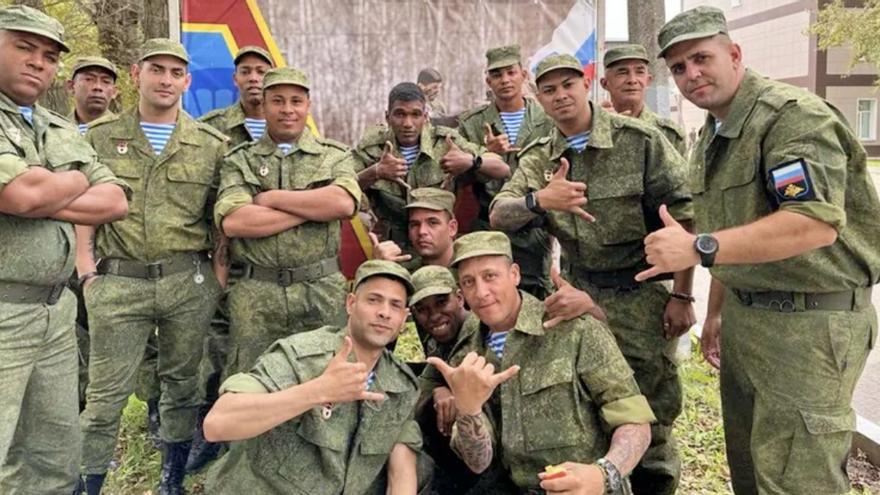
The number of Cubans in Tula continues to increase, according to the documentation revealed by Ukrainian hackers. (Alain Paparazzi)

14ymedio bigger14ymedio, Madrid, 23 October 2023 — The hackers who revealed the identities of 200 Cuban mercenaries fighting with the Russian Army in Ukraine have again leaked data. According to the available information, 59 more Cubans have signed a contract to join the Russian Armed Forces in the city of Tula. Of these, at least 11 did so after the Cuban authorities announced, on September 8, the arrest of 17 people linked to a network of human trafficking and mercenarism.

The arrival of the new recruits to sign contracts took place between August 25 and September 29. Despite this, hackers have been able to confirm that not all the Cubans came from the Island. Some already resided abroad and entered with another passport or even lived in Russia since before the invasion of Ukraine.

Cubans serve in the 106th Airborne Division of the Russian Armed Forces, which, according to the hackers, is becoming, de facto, the “international legion” of the Moscow Army

In some cases, on the contrary, there are recruits who traveled directly from the Island, attracted by promises of nationality, salaries above $2,000 and all kinds of advantages for the soldiers and their families. Cubans serve in the 106th Airborne Division of the Russian Armed Forces, which, according to the hackers, is becoming, de facto, the “international legion” of the Moscow Army. There are also Serbs who have traveled from their country to support their neighbors.

According to the new information, disseminated on the InformNapalm website, there are already at least three Cubans fighting from the last group of recruits, while the rest are still in the process of formalizing contracts. continue reading

The reports that there were Cubans fighting in the Russian Army began as a rumor at the beginning of the invasion of Ukraine, in February 2022, but it was not confirmed until some of them, apparently deceived, began to report it to independent Cuban media located in Miami. On September 6, Cyber Resistance leaked the passports of 199 Cubans who were in Tula after having signed a contract to fight with the Russian Armed Forces, immediately forcing the recognition of the authorities that there were people detained in connection with this matter.

The Government stated that it was working to prosecute mercenarism according to its international commitments, but suspicions continue about Cuba’s possible collusion in sending Cuban combatants, especially since relations between the two countries have become increasingly strengthened.

Different organizations have described it as highly unlikely that a State like Cuba with control over its citizens has escaped the fact that there were operations underway to recruit nationals and take them to fight abroad, a crime that on the Island is punishable even by death.

InformNapalm wonders why it seems that the Cuban government has done nothing, after the announcement of the arrests, to stop this situation.

The obligation of Cuba, as a signatory country of the Hague agreement, is to “prevent the formation of mercenary groups in its territory in order to intervene in an armed conflict before which they have decided to remain neutral.” But this same international regulation does not consider States to be responsible “when individuals cross the border of their own free will to offer their services to the belligerents.”

We have nothing against Cubans who only want to sign a contract and legally participate in this operation with the Russian Army, but we oppose illegality

The Cuban authorities played with this approach in mid-September, when, since the scandal, the ambassador to Russia, Julio Antonio Garmendia Peña, told the state agency RIA Nóvosti: “We have nothing against Cubans who only want to sign a contract and legally participate in this operation with the Russian Army, but we oppose illegality and those operations that have nothing to do with the legal sphere.”

A few hours later, Foreign Minister Bruno Rodríguez reaffirmed “the unequivocal and invariable position of the Government,” which, “in accordance with national legislation, is against the participation of Cuban citizens in any conflict, against mercenarism and against human trafficking.”

For the moment, and in the heat of other international events that have overshadowed the issue of Cuban mercenaries, nothing is known about the detainees and whether their trials have been initiated or the investigation continues.

Translated by Regina Anavy 

____________

COLLABORATE WITH OUR WORKThe 14ymedio team is committed to practicing serious journalism that reflects Cuba’s reality in all its depth. Thank you for joining us on this long journey. We invite you to continue supporting us by becoming a member of 14ymedio now. Together we can continue transforming journalism in Cuba.
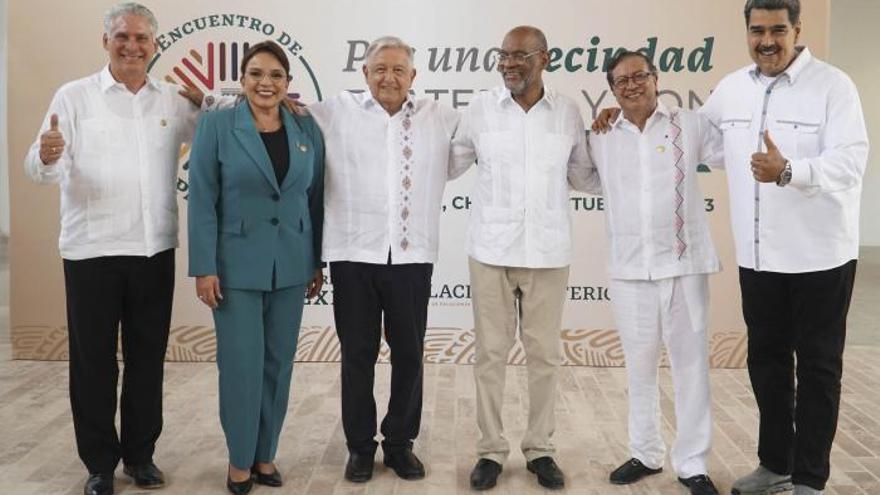
The Mexico Summit Points Out That the Measures for Cubans and Others Stimulate Irregular Migration

Díaz-Canel, the Honduran Xiomara Castro, the Mexican Andrés Manuel López Obrador, the Haitian Ariel Henry, the Colombian Gustavo Petro and the Venezuelan Nicolás Maduro, at the immigration summit in Palenque (Mexico). (Granma)

14ymedio biggerEFE/14ymedio, Palenque/Tapachula (Mexico)/Madrid | October 23, 2023 — The migration summit of Mexico and other Latin American countries concluded this Sunday with a joint statement that rejected “coercive measures,” promised to respect the human right to migrate and requested more legal alternatives for migration.

“[We agree] to urge the countries of origin, transit and destination to implement comprehensive migration policies that respect the human right to migrate, safeguard the life and dignity of migrants and their families, and include the promotion of permanent regularization options,” said Mexican Foreign Minister Alicia Bárcena, when reading the consensual pronouncement.

The joint declaration, with 14 points of agreement, was signed by the heads of state of Colombia, Cuba, Haiti, Honduras and Venezuela, the vice president of El Salvador and the deputy prime minister of Belize, as well as ministers of Costa Rica and Panama, who met in Palenque with the Mexican president, Andrés Manuel López Obrador.

Although Mexico initially reported the attendance of officials from Guatemala and Ecuador, these two countries do not appear among the signatories in the final statement that the Government later shared. continue reading

Although Mexico initially reported the attendance of officials from Guatemala and Ecuador, these two countries do not appear among the signatories in the final statement

Latin American governments argued that “external factors, such as unilateral coercive measures of an indiscriminate nature, negatively affect entire populations and to a greater extent the most vulnerable people and communities,” according to the position read by Bárcena.

In this sense, they agreed to “request from the destination countries the expansion of regular, orderly and safe migration routes with special emphasis on labor mobility, and to promote the reintegration and return of temporary workers.”

They also alleged that the “selective” measures stimulate irregular migration, in reference to the policies of the United States that provide for asylum for certain applicants from countries such as Cuba, Haiti, Nicaragua and Venezuela, but they contemplate the immediate deportation of the rest.

“[We agree] to call on the destination countries to adopt immigration policies and practices in accordance with the current reality of our region and abandon those that are inconsistent and selective, to avoid arbitrarily producing so-called deterrent effects, such as the regularization of certain nationalities,” Bárcena said.

The migration summit takes place while Mexico and Central America face an “unprecedented” migratory flow, according to the International Organization for Migration (IOM), with up to 16,000 migrants arriving at the Mexican borders every day, according to López Obrador.

The Mexican president convened the meeting with the promise of bringing a common regional position to the president of the United States, Joe Biden, in November.

The Government of Mexico offered to cooperate with its social programs Sembrando Vida, for farm workers, and Jóvenes Construyendo el Futuro, for youth work

As a first point, the countries agreed to “develop an action plan,” which has as its axes food self-sufficiency, environmental protection, energy security, trade, investment and the fight against organized crime.

The Government of Mexico offered to cooperate with its social programs Sembrando Vida, for farm workers, and Jóvenes Construyendo el Futuro, for youth work, as well as in gas and renewable energies.

The governments also promised to promote trade, and they urge the lifting of sanctions and “coercive measures” in the region, a reference to Cuba and Venezuela.

They will also support the Republic of Haiti to “restore an environment of human security” and the “normalization” of the country after the political crisis, and efforts to rethink the international financial architecture of sovereign debt in Latin America.

Nations will deepen “south-south” cooperation relations, promote bilateral dialogues between countries of origin, transit and destination of migrants, and strengthen coordinated work with international organizations to serve people with special protection needs.

As a follow-up, they will create a “dialogue at the highest level” with a new working group in charge of the foreign ministries. And they will link these agreements with the high-level meeting on migration and development in Latin America and the Caribbean that Colombia and Mexico proposed for the first quarter of 2024.

In addition, the countries agreed to favor a dialogue between the governments of Cuba and the United States.

The summit brings more of the same, nothing more than the corruption of countries that want to profit from migration, pain and blood

Meanwhile, migrants stranded on Mexico’s southern border burned piñatas with the figures of the presidents of Cuba, Nicaragua and Venezuela in a protest against the immigration summit.

At the demonstration in Tapachula, on the border of Mexico with Guatemala, about 200 migrants, mostly from Venezuela, Central America and Haiti, set fire to piñatas of the Venezuelan president Nicolás Maduro, the Cuban Miguel Díaz-Canel and the Nicaraguan Daniel Ortega.

The foreigners, gathered in the Bicentennial Park, carried the three figures, walked around with them and staged a public trial to accuse the rulers of not supporting the migrants.

The director of Pueblos Sin Fronteras, Irineo Mujica, pointed out that this “counter- summit” is a protest to denounce the president of Mexico, Andrés Manuel López Obrador, for not having a solution.

“The summit brings more of the same, nothing more than the corruption of countries that want to profit from migration, pain and blood,” said the renowned migrant defender.

At the march, the Venezuelan migrant Leonerge Acero said he did not agree with the meeting of López Obrador and Maduro, pointing out that the conditions created by the president of Venezuela force them to leave the country.” You have nothing to do here, because you don’t know what it is to migrate. If it’s your fault we are here in this suffering, it’s your fault we are migrating, and I don’t understand your meeting with that president, to be honest,” Acero said in reference to Maduro.

Ysguel Jean, from Haiti, participated in this demonstration to highlight that he left his country because, according to his perception, most of the politicians are corrupt.

Like other migrants, he demanded that the summit, which will conclude with a common proposal from the region for López Obrador to present to the United States, result in humanitarian and non-punitive policies. “We ask the Government of Mexico to treat us well, to give us papers,” Jean said.

“Many Venezuelans and Haitians are in great need, sleeping in the streets and parks. Let (Mexico) help us and give us shelter,” he concluded.

At the same time, this weekend 65 migrants from Mexico and the Bahamas were deported to Cuba by air, as part of the migration agreements with those countries and according to Cuba’s Ministry of the Interior.

Of these, 37 Cubans (32 men and five women) arrived from Mexico on Saturday at José Martí International Airport, and another 28 did so on Friday from the Bahamas, on a commercial flight.

“One of the migrants returned in Friday’s operation was on probation at the time of leaving the Island and will be placed at the disposal of the courts, for the revocation of that benefit,” reported  the official press, stating that there have already been 114 returns made from different countries in the region so far in 2023.

Translated by Regina Anavy

____________

COLLABORATE WITH OUR WORKThe 14ymedio team is committed to practicing serious journalism that reflects Cuba’s reality in all its depth. Thank you for joining us on this long journey. We invite you to continue supporting us by becoming a member of 14ymedio now. Together we can continue transforming journalism in Cuba.
San Pepper’s Burger, the Holguin Business Raising the Ire of Cuban Officials

The name of the new food service business has irritated some officials. (14ymedio)

14ymedio bigger14ymedio, Natalia Lopez Moya / Manuel Garcia, Havana / Holguín, 12 October 2023 — For decades, chewing gum, corn chips and hamburgers were very much frowned upon by the Cuban government as symbols of American culture. Enjoying these products in public could lead to anything from a reprimand to more severe penalties. Though attitudes have changed a lot since then, some of that resentment remains among the most diehard officials.

A new, privately owned establishment called San Pepper’s Burger* was about to open it doors in the city of Holguín when it got some angry reactions on a government-run news site. An op-ed in Cubadebate criticized the restaurant — basically a hamburger joint — for promoting “a culture which is not our own.” The article’s author goes further, asking, “What happened to fighting the culture war?”

Located on Luz Cabellero Street, between Maceo and Libertad, and next to the José María Ochoa Correa Conservatory of Music, the building has been undergoing repairs for roughly seven years. The renovation process involved some internal structural changes but parts of the original facade, including some colonial-style entrance doors, were preserved to be enjoyed by passersby or people sitting on a bench in the nearby Park of Flowers.

“Word is that its prices will also be high, that the owners will have to recoup their entire investment and that the sign must have cost an arm and a leg” 

That corner was very depressed so I’m glad this is going to, at least, revive it somewhat,” says Heidy Laura, a 28-year-old Holguín resident who lives a few yards from the new business. “But word is also that its prices will be high, that [the owners] will have to recoup their entire investment and that the sign must have cost an arm and a leg.” continue reading

“The wings coming out of the hamburger say it all, that the prices will be sky-high,” she jokes. Of course, unlike the author of the critical article, “Market and Culture with an English Accent”, Heidy Laura welcomes the fact that the city of Holguín will have this type of place. “But I’ll have to save all year to eat the cheapest combo on the menu,” she adds.

Cándida, a 61-year-old engineer who is also the young woman’s mother, believes, “This won’t last long because there are a lot of extremists in Holguín.” She believes that, given the critical article in the official press, it is very likely that the owners will change the name or delay the opening. “The thing is that people here carry a lot of ideological baggage and it’s very difficult to let go of that.”

Cándida remembers that the first hamburger she ate in public was in the late 1980s. “It was when Fidel Castro decided to open some cafes to sell the famous Super-Zas. On the face of it, it looked like a McDonald’s burger. Until then, saying that you wanted to sink your teeth into a hamburger with a bun, sesame seeds, mustard and cheese was like admitting you were a counter-revolutionary,” she says.

So far, there’s been nothing in the local press about it I’ve but I have heard about some party members complaining about the English name because they say it sounds capitalist to them”

The new, privately owned establishment, which is next door to the state-run restaurant 1545 and the Benny Moré Room, “has raised the ire of people in the Communist Party,” says another Holguín resident who prefers to remain anonymous. “So far, there’s been nothing in the local press about it but I’ve heard about some party members complaining about the English name because they say it sounds capitalist to them.” The man notes that, until now, the building has always been used as a residence and that it probably will not open until next month because the furniture layout is still being worked out and the exterior in particular needs some more work.

“If you’ve already put a sign on the facade, it’s because you’re about to open. People walk by and take photos,” he says. “It’s quite large. It takes up half of one side of the block. It used to have a big inner courtyard but it looks like that part of the house has been roofed over and will have tables in it.”

The man shares his concerns about how high the prices might be given what he has seem with other privately owned businesses. “There are differing opinions in Holguín. Many people can’t afford those places but others are glad to have the option,” he says.

The rhetoric surrounding San Pepper’s Burger extends even to preservation of Holguín’s architectural heritage and the impact the recent changes have had on the urban fabric. The house, one of the oldest in the city still standing, was originally the residence of Fr. Antonio Santiesteban, and later of master builder José María del Salto y Carretero, according to experts consulted for this article.

“I don’t like how they’ve remodeled it. They’ve changed the original shape of the roof and now there’s almost nothing left of the colonial style,” complains Juan Ramón, another local resident who believes the city is losing too many historic buildings this way. “They’ve added too many modern elements that are not a good fit for this area.”

Young people, on the other hand, are optimistic that the it will become a popular gathering spot. The nearby Conservatory of Music, its central location and the dearth of public spaces suggest that the new business could become a place in high demand. Ultimately, price will be the determining factor but so will the quality of the ingredients.

“I don’t like how they’ve remodeled it. They’ve changed the original shape of the roof and now there’s almost nothing left of the colonial style,” complains Juan Ramón

“Will the hamburgers be made of beef or pork?” asks Javier, a rancher from Holguín’s Calixto García district. The cattleman describes the problems that the sector is having and the challenges of insuring a stable supply for a restaurant like this. “Will they be importing the product from abroad? Unless they do that, I see them having big problems.”

The theft of livestock, the lack of pasture land and the shortage of supplies and equipment — for example, wire for building fences and hydraulic pumps to provide water to the animals — have led to a significantly smaller livestock population. “Conditions here don’t allow anyone to sell high-quality meat on a consistent basis,” Javier says.

In July, the officials from the Ministry of the Interior arrested three people in the Martillo neighborhood, which is also in Calixto García, as they were transporting 200 pounds of beef on two motorcycles. According to official sources, they had allegedly obtained the meat through theft and the illegal slaughter of cattle.

For her part, the Cubadebate columnist warns that the problem is not the hamburgers — “they are not the enemy,” she writes — and does not want some “extremist commentator” misinterpreting her criticisms.

*Translator’s note: This article was written earlier than, but translated after, the linked article which speaks to the fate of the enterprise.
_____________________

COLLABORATE WITH OUR WORKThe 14ymedio team is committed to practicing serious journalism that reflects Cuba’s reality in all its depth. Thank you for joining us on this long journey. We invite you to continue supporting us by becoming a member of 14ymedio now. Together we can continue transforming journalism in Cuba.

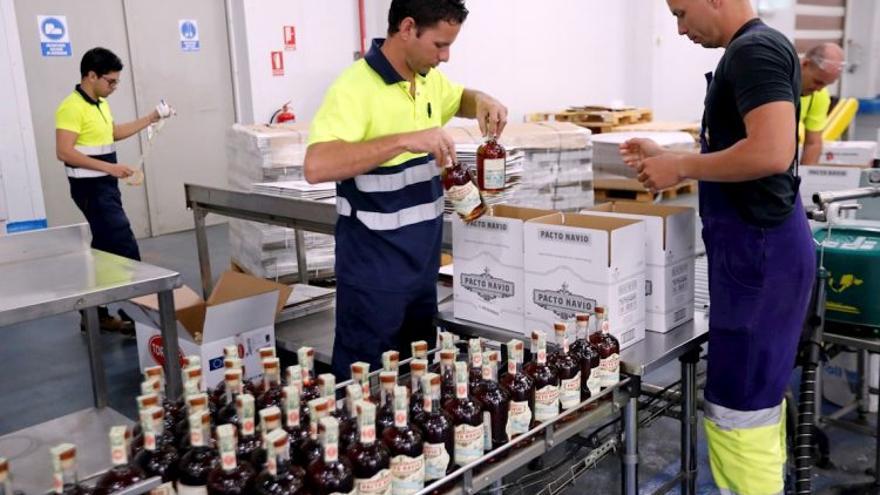
Havana Club Will Produce in Cuba 2,500 Bottles of Tributo Rum at 500 Euros a Bottle

In 1993, the French company Pernod Ricard reached an agreement with Havana to market and own 50% of the rights to Havana Club. (EFE)

14ymedio bigger14ymedio, Havana, 24 October 2023 — With 2,500 “exclusive” bottles of Tributo rum, which will be sold at a price of 500 euros each, Havana Club International will celebrate its thirty years of creation this November at the Expocuba fairgrounds. The new edition of the drink celebrates the “rescue” of the brand, in the middle of the Special Period, by the French company Pernod Ricard and its partner on the Island, Cuba Ron.

The general director of the French company, Christian Barré, explained to Prensa Latina that, after the coronavirus pandemic and a “complex year,” his company is focused on relaunching several of the brands that did not have enough public attention and with which he now intends to recover their “export markets.”

The director also said that Havana Club has signed more than 50 contracts with micro, small and medium-sized Cuban companies (MSMEs) this year. Although he did not clarify what the company’s plan is when partnering with the Island’s private companies, he did include them – along with tourism and shops in freely convertible currency (MLC) – among those “who buy the product through different traditional channels,” without giving details.

The company wants to offer its rums so that private entrepreneurs can “grow rapidly” and market them

He said that the company wants to offer its rums so that private entrepreneurs can “grow rapidly” and market them. However, the largest market for Havana Club, Barré insisted, is still in Europe, in countries such as Germany, Spain and France, and for other large consumers in Canada and China. continue reading

On the Island, the popular consumption of Cuban rum has been partly displaced by drinks that are marketed at cheaper prices, such as vodka and some imported whiskeys that are sold both in foreign exchange stores and in the informal market.

Havana Club had already announced this September its participation in the XIII Varadero Gourmet International Festival to present three new drinks: the Havana Club Smoky, a dark rum with a smoky flavor that is marketed for about 50 euros; the Havana Club Profundo, a clear drink with the same price; and the Havana Club Spiced, with tropical tones and sold for about 30 euros.

In Europe, the different Havana Club lines are among the most expensive drinks available. A drink of the most common of their rums in a bar can cost up to eight euros, a high price when compared to other imported rums. In Cuba, however, the lowest-end rums are barely marketed among the population, such as the Añejo 7 years or the 3 years version, which don’t have the “honeys” that the brand reserves for its exclusive buyers.

Only in hotels, and for a considerable price, is it possible to access a selection of Maestros or a Special. Other editions, such as the Havana Club Máximo Extra Añejo – which is marketed for more than 1,000 euros – are not even displayed in the Island’s shops.

The celebration of the thirty-year agreement between Cuba Ron and Pernod Ricard coincides with the launch in Spain of the book Arechabala, Azúcar y Ron 1878-1959 (Archebala, Sugar and Rum 1878-1959), written by Antonio Santamaría and María Victoria Arechabala.

Nationalized by Fidel Castro in 1960, the original Havana Club brand belonged to the La Vizcaya distillery, founded in Cárdenas (Matanzas) in 1878 by José Arechabala Aldama, a Basque immigrant who grew his industry to become the José Arechabala S.A. group, one of the largest in Republican Cuba, which also managed various businesses in sugar and shipyards.

The Havana Club line, however, did not emerge until the 1930s, when the company was already the reference for Cuban rum of excellence. The new product quickly found its market in the United States, whose population had just come out of Prohibition, a period when the the sale and consumption of alcoholic beverages was illegal.

Arechabala was one of the first companies to suffer the plundering of its properties

A few decades later, with the coming to power of the Revolution and the beginning of nationalizations, Arechabala was one of the first companies to suffer the plundering of its properties, which went from being an irreplaceable symbol of Cárdenas and the Island to becoming ruins neglected by the new revolutionary order.

The Arechabala family fled to the United States, where they sold the original recipe to the Bacardí company in 1994, another of the emblematic rum families of the Island, also exiled after the triumph of Castro.

In 1993 the French Pernod Ricard reached an agreement with Havana to market and own 50% of the rights to the rum, which began to be sold in the world under the same name that the Arechabala originally gave to the drink.

The Bacardí brand also began to produce its own Havana Club in Puerto Rico and to market it in the United States. Since then, companies have been in constant dispute about who owns the real Havana Club, whether it is those who keep the original recipe or those who manufacture it in Cuba.

Pernod Ricard has faced several international lawsuits backed by the Helms-Burton Act for marketing “stolen” property, which includes other products in addition to Havana Club rum. The lawsuits, however, are always dismissed for “lack of jurisdiction” or other causes that prevent judges from imposing sanctions on the French company and its business with the regime.

Translated by Regina Anavy

____________

COLLABORATE WITH OUR WORKThe 14ymedio team is committed to practicing serious journalism that reflects Cuba’s reality in all its depth. Thank you for joining us on this long journey. We invite you to continue supporting us by becoming a member of 14ymedio now. Together we can continue transforming journalism in Cuba.
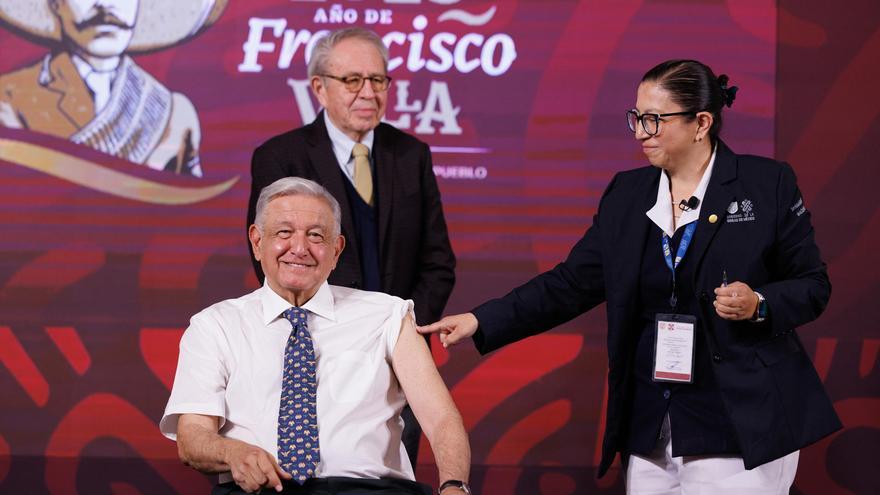
Mexican President Lopez Obrador Defends the Vaccines of Cuba and Russia After Supposedly Being Injected With Abdala

Andrés Manuel López Obrador, during his press conference at the National Palace of Mexico City. (EFE/Presidency of Mexico)

14ymedio biggerEFE/14ymedio, Mexico, 24 October 2023 — The Mexican president, Andrés Manuel López Obrador, defended on Tuesday his Government’s use of the anti-covid vaccines of Russia and Cuba for the free-booster campaign after himself receiving the Cuban drug Abdala.

“Out of interest in some cases, some say that the vaccines that our health sector is applying are not effective. They have said things that I don’t even dare to repeat here, because they are gigantic absurdities, but all vaccines are now guaranteed for the people,” he said in his daily press conference.

The Government of Mexico has the goal this flu season of giving 35.2 million vaccines against influenza and 19.4 million against COVID-19, using the biologic drug Abdala, made in Cuba, and the drug Sputnik, from Russia.

The World Health Organization (WHO) has not endorsed the use of either of these drugs as a booster against coronavirus, but López Obrador supported their effectiveness after being vaccinated live on television with the Abdala vaccine.

“Don’t be confused, all the vaccines that are applied go through quality testing, and public health should not be used for political purposes; they are different things,” the president said. “Health has to do with human rights; it is a fundamental human right – no politics, no ideologies.” continue reading

Medical sources have reported that the Federal Commission for Protection against Health Risks (Cofepris), in charge of the control of medicines, is authorizing the application of expired vaccines

However, medical sources have reported that the Federal Commission for Protection against Health Risks (Cofepris), in charge of the control of medicines, is authorizing the application of expired vaccines. Last August, this newspaper learned of the 70,000 expired doses that would be given in the state of Coahuila, a situation similar to the one highlighted a few days ago by health workers from the state of Morelos, who were forced to put the drug in health centers “in a discreet way,” published El Universal.

The immunization campaign, which began last week, is aimed at specific groups, such as those who are 60 and over, pregnant women and people with comorbidities from the age of five.

The vaccines will be free, but López Obrador promised that people will be able to buy other vaccines, such as those from Pfizer and Moderna, after their expected approval by Cofepris in November.

“Since we also live in a free country, it is decided that vaccines can be marketed, that whoever wants to pay, to buy a vaccine, can do so,” he said.

Mexico is the country with the fifth most confirmed deaths from COVID-19, with more than 334,000 officially recognized.

Translated by Regina Anavy

________________________

COLLABORATE WITH OUR WORKThe 14ymedio team is committed to practicing serious journalism that reflects Cuba’s reality in all its depth. Thank you for joining us on this long journey. We invite you to continue supporting us by becoming a member of 14ymedio now. Together we can continue transforming journalism in Cuba.
In the Midst of Havana’s Darkness, the Cuban Art Factory is Freed from Energy Savings

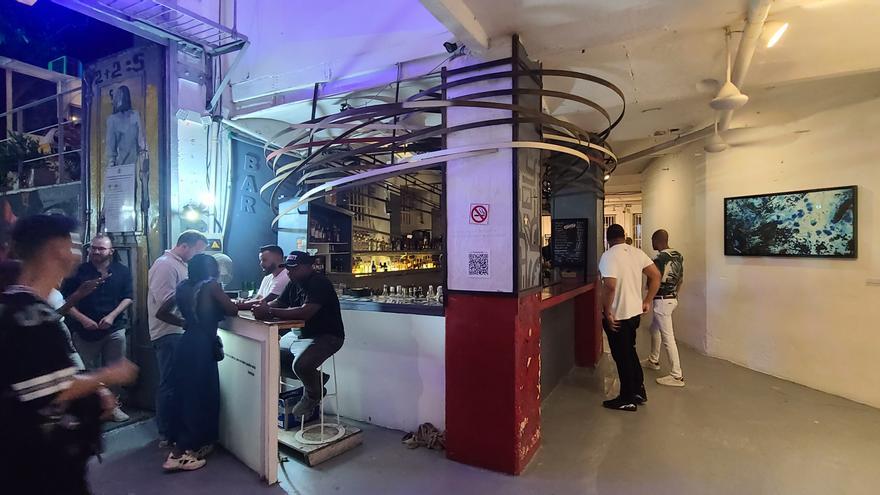
The hallways where the works of art are displayed were perfectly illuminated, as were the different bars that make up the establishment. (14ymedio)

14ymedio bigger14ymedio, Nelson García, Havana, October 23, 2023 — The rebellion of the Cuban Art Factory (FAC) against the energy saving measures required by the Ministries of Energy and Mines and of Culture has had an effect. On Saturday, as this newspaper confirmed, the cultural center was operating at one hundred percent or very nearly.

As explained to 14ymedio by an employee who asked to remain anonymous, they did agree to close on Sundays, and reduce their operating hours by two hours, opening one hour later and closing one hour earlier (hours will now be from 8:00 pm to 3 am). “Although that is relative because depending on the clientele, it may be extended,” the same source pointed out.

In addition, he confirms that they keep some air conditioning units off as well as a part of the lights in the exhibition area.

The hallways where the works of art are displayed were perfectly illuminated, as were the different bars that make up the establishment

It was not something that the public, who packed the place on Saturday and moved to the beat of the music, noticed. The hallways where the works of art are displayed were perfectly illuminated, as were the different bars that make up the establishment. Likewise, patrons could enjoy the images projected on a wall. Nor did the live jazz band lack light at any time. continue reading

The restaurant area was also providing normal service, despite the fact that during the week, another worker told this newspaper, they had to move all the food from the refrigerator because they did not have power. “Between Monday and Wednesday they took the food to other places and on Thursday they returned it, and today everything is working normally,” he said.

The previous week, the same young man said, “we worked with lamps,” carried by both employees and customers, just as the establishment had requested online. “Bring your light and join us on this adventure to keep the FAC beating!” those responsible for the cultural center had written in a statement on October 14.

Signed by its founder and the rest of the team – the musician X Alfonso and the so-called FacInBand — the text explained that it had re-opened on October 5th, after a month of closure, which reduced the regular power consumption by 80%. The consequences, therefore, would be opening two days a month, instead of the 16 that it had been (from Thursday to Sunday).

“We are aware of the energy situation that Cuba is going through, and consequently we have adopted the savings plans established for the state sector, limiting consumption in offices and other FAC spaces to the maximum extent possible, to contribute to the rational use of the energy resources of the country,” they explained.

The FAC thus rejected the allocation of the National Electrical System, and defended that it would continue to open “with the help of the public, artists and followers from all over who want to contribute

In the statement, the institution claimed its position as a leading cultural center on the Island, with more than 300 concerts, 70 exhibitions, 60 dance presentations, 40 theater performances, 40 fashion shows and a long list of actions. “With an affordable price of 250 CUP, in an environment where access to Cuban art is increasingly expensive and high-value proposals are scarce.”

The FAC thus rejected the allocation of the National Electrical System, and defended that it would continue to open “with the help of the public, artists and followers from all over who want to contribute.” It has not been necessary to repeat the experience of customers bringing “their light.”

The success of the FAC in remaining active contrasts with other points of attraction for the national and foreign public, which have been forced to close at night due to the energy shortage, which shows no sign of easing. Several employees indicate both X Alfonso and his sister, the singer Eme Alfonso, “moved and then the Government allowed them to function as they had been doing.”

____________

COLLABORATE WITH OUR WORKThe 14ymedio team is committed to practicing serious journalism that reflects Cuba’s reality in all its depth. Thank you for joining us on this long journey. We invite you to continue supporting us by becoming a member of 14ymedio now. Together we can continue transforming journalism in Cuba.