The ‘Castle’ of the Cortinas in Havana, Converted Into a Military Zone and a Beggars’ Refuge

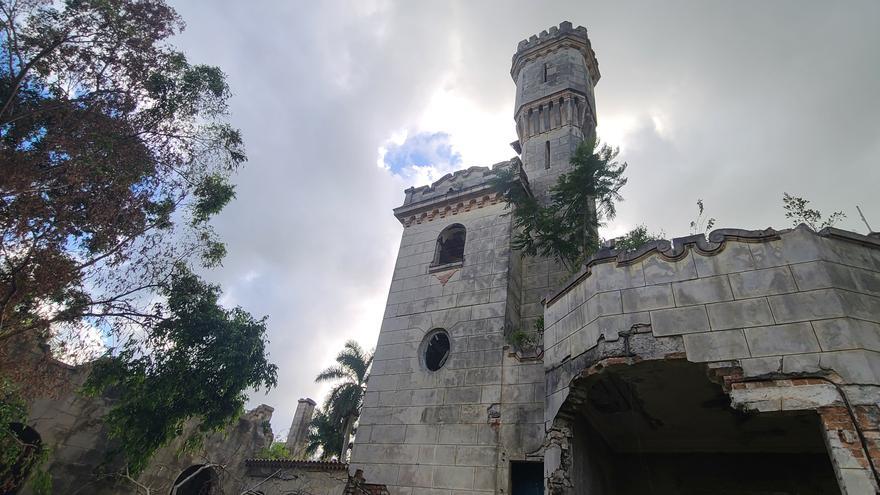
With a concrete structure and a design that imitates the fortresses of the Italian Renaissance, La Luisa has long passageways now filled with graffiti, garbage and weeds. (14ymedio)

14ymedio bigger14ymedio, Nelson García/Juan Izquierdo, Havana, October 23, 2023 — No one enters the ruins of the La Luisa farm, in the Havana municipality of Arroyo Naranjo, with good intentions. Where one of the most powerful families in Cuba once lived, now only beggars dare to sleep, surrounded by walls full of graffiti and vines. The sporadic visitors to the “castle” – the building retains its towers and walkways – are now criminals seeking temporary shelter to escape from the Police and young people who, according to the neighbors, come to “do evil things.”

La Luisa was one of the first properties confiscated by Fidel Castro after 1959. Its owner, the lawyer and politician José Manuel Cortina – who served as chancellor of the Republic on two occasions – was accused of being a “landowner” and died in exile in 1970.

The officials who occupied the “castle” after the triumph of the Revolution then received an order from Che Guevara: to install a metallurgy laboratory that ended up becoming the Research Center for the Mining and Metallurgical Industry (Cipimm). “That didn’t last long,” Jorge tells 14ymedio; he now works in the new offices of that institution, not far from La Luisa.

Without maintenance and after numerous instances of neglect, the old Cortina house ended up collapsing. (14ymedio)

Without maintenance and after numerous instances of neglect, the old Cortina house ended up collapsing. “One day, all the pipes were clogged, the drainage system failed and the bathrooms were unusable,” says Jorge. Shortly after, the “castle” was abandoned. continue reading

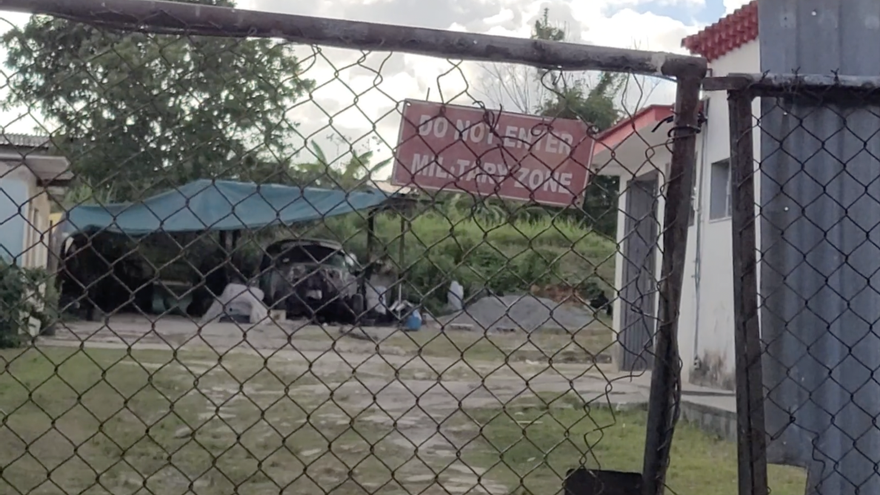
Over time, the Cortina lands – which bordered those of the family of former president Carlos Prío Socarrás – became a military zone. Now, the Army officers’ houses, as well as the new Cipimm – dedicated to studying the possibilities of gold and nickel exploitation in Cuba – are located where Republican politicians once built their summer estates.

“Many efforts were made, when the Historian of Havana Eusebio Leal was alive, for that Office to restore the ’castle’, but to no avail,” Jorge alleges. According to Leal’s architects, it was useless to repair La Luisa: no tourist was going to go to Arroyo Naranjo to see the building, no matter how interesting the construction.

No one else was interested in the farm, where several scenes from the Cuban-Spanish co-production The Nights of Constantinople were filmed, directed in 2001 by Orlando Rojas and featuring actors of the caliber of Francisco Rabal, Verónica Lynn, Rosita Fornés and María Isabel Díaz. However, the film failed to attract the authorities attention to the building.

Now, the Army officers’ houses, as well as the new Cipimm, are where Republican politicians once built their farms. (14ymedio)

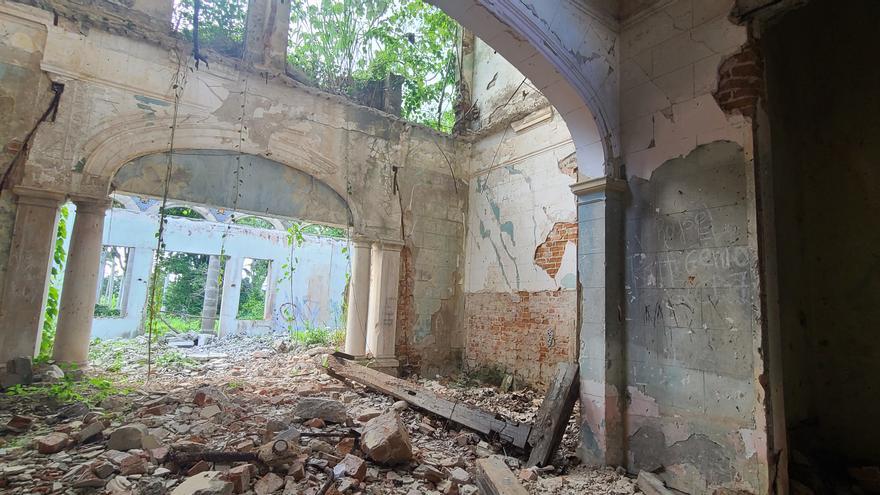
A concrete structure with a design that imitates the fortresses of the Italian Renaissance, La Luisa has long passageways now filled with graffiti, garbage and weeds. Someone – probably a beggar or several, judging by the objects – blocked up several entrances to a room and now sleeps there, among the rubble.

Where there used to be a stately staircase to the second floor, now one made of boards is the only step to reach the upper floor. Balconies and windows, as well as several arches with mosaic work, still allow us to imagine the type of life that was led in La Luisa when the Cortinas occupied it.

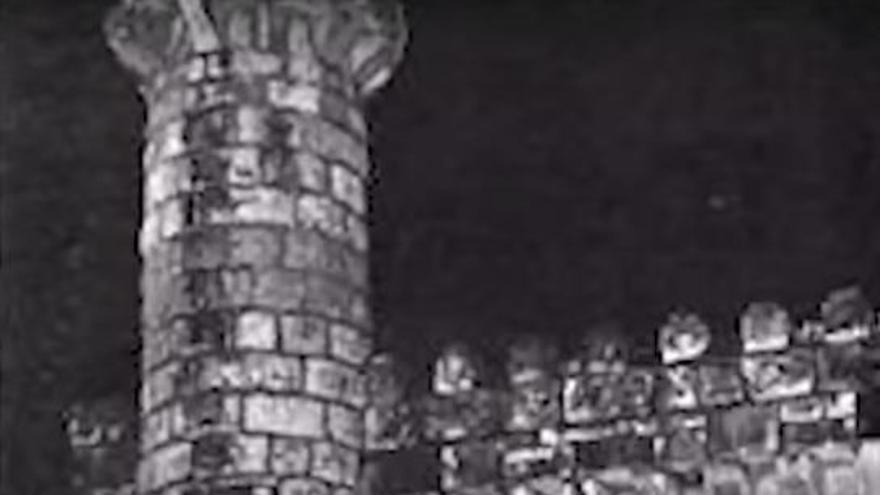
Among the battlements, the central tower stands out from which – it is said – José Manuel Cortina watched over his property and the members of his family, as well as President Prío Socarrás. Trees and vines have broken through each floor, destroying not only the flooring but also the walls and beams.

Even so, the building is overwhelming and must have impressed those men in olive-green who, in the 60s – as a photo from the time attests – went to evict the Cortinas. Jorge knows it well, and continues to admire La Luisa under a demolished arch: “Even in these deplorable conditions, the ’castle’ is still a beauty.”

La Luisa was one of the first properties confiscated by Fidel Castro after 1959. (Ecured)

____________

COLLABORATE WITH OUR WORKThe 14ymedio team is committed to practicing serious journalism that reflects Cuba’s reality in all its depth. Thank you for joining us on this long journey. We invite you to continue supporting us by becoming a member of 14ymedio now. Together we can continue transforming journalism in Cuba.
In Maisi, Eastern Cuba, Women Block the Road After a Week Without Water

Those affected collected tanks and oil drums to block the traffic, which brought in the authorities. (Yadiuska Domínguez)

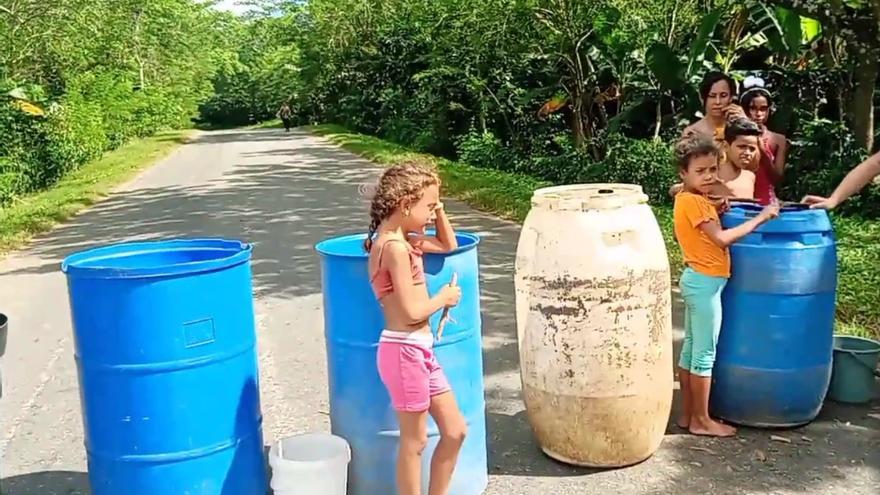
14ymedio bigger14ymedio, Havana, 23 October 2023 – A group of people, the majority of them women, blocked a road last Saturday in Maisí, Guantanamo, after suffering a week with no water supply. During their protest they collected tanks and oil drums to block the traffic, which brought in the authorities.

The protest was shared in social media on Sunday, with a number of videos in which they recorded three key moments of the demonstration. In the first one they are seen barricading the road with oil drums and demanding forcefully that they water, sugar and food supplies be delivered. “I can’t go on like this, I have five kids!” cried one of the women in desperation, before collapsing in front of the camera.

At another point we can see the dispute, now with evident unease, between the women and two police officers who are hardly moving, and and another man — presumably from the Communist Party or a police officer in plain clothes — who moves the barrels and demands that everyone calm down.

It ends with the demonstrators losing patience, several of them lambasting the attitude of the authorities. “This is civil abuse!” the woman who is filming it all on her phone shouts repeatedly. continue reading

In the last video the women are walking away carrying their oil drums and shouting protests against the system itself. “Díaz-Canel’s police mistreat the people!” One of them shouts. “Patria y Vida!” she adds as they retreat.

This kind of peaceful protest has become more evident in Cuba in the face of lack of basic supplies. There was a similar situation during the summer in Central Havana when a group of about twelve people shut off a road by sitting on the ground and protesting about having gone more than three days without electricity.

In September, residents of the capital also cut off a street after suffering for 35 days without running water.

Translated by Ricardo Recluso

____________

COLLABORATE WITH OUR WORKThe 14ymedio team is committed to practicing serious journalism that reflects Cuba’s reality in all its depth. Thank you for joining us on this long journey. We invite you to continue supporting us by becoming a member of 14ymedio now. Together we can continue transforming journalism in Cuba.

Due to Lack of Teachers, Several Subjects Are Not Being Taught Two Months After the School Year Began in Cuba

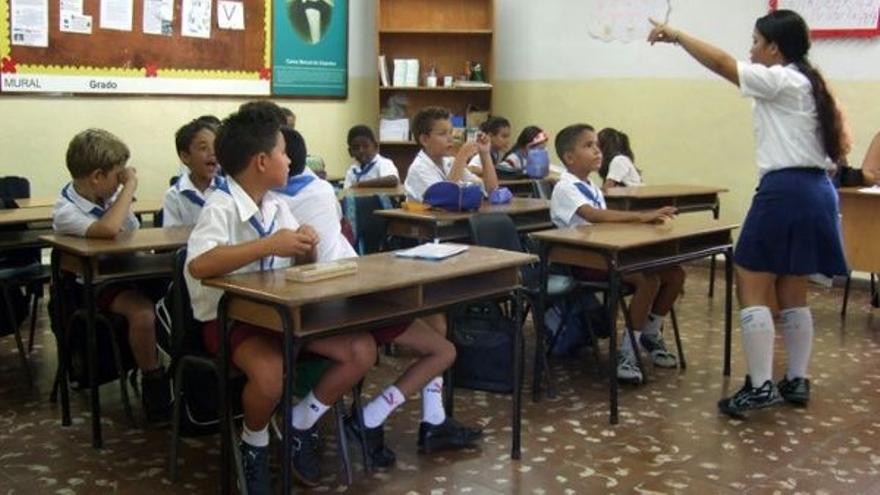
The lack of teachers has increased since the beginning of the school year. (Telesur)

14ymedio bigger14ymedio, Madrid, 23 October 2023 — It has been almost two months since the official start of the school year in Cuba, and in some schools the first class in some subjects has not yet been given due to the lack of teachers. The situation is not new in a country that has been suffering a plummeting number of teachers for years, but the deficit is clearly gaining strength and in just one month has increased by at least 7,000.

At the end of August, days before the beginning of the course, the Minister of Education, Ena Elsa Velázquez, acknowledged that 10,000 teachers were missing, but at the end of September the real figure was 17,278, according to the general director of Basic Education, Marlén Triana Mederos. With that number, the deficit is 3,200 in secondary schools alone, says the official, who specifies the national coverage at 88%. The provinces with the most problems are, persistently, Havana, Mayabeque, Artemisa, Matanzas and Sancti Spíritus.

The provinces with the most problems are, persistently, Havana, Mayabeque, Artemisa, Matanzas and Sancti Spíritus

The data come from a brief report on the Cuban Television news that analyzes with concern the “complex” situation of what it calls “one of the pillars of Cuban society” and which, in its opinion, does not escape the “impact” of the economic situation. The resource of students from pedagogical schools is insufficient, as is the fact that some teachers are doubling their classes and teaching subjects that they barely know.

In 2014 – which gives an idea of how far back the origin of the “complex” scenario goes – the Educating with Love program emerged, in which student assistants reinforce the lack of teaching coverage in classrooms throughout the country. But this bandaid cannot contain the hemorrhage of teaching professionals, and the Government has no way to solve it economically. continue reading

According to the report, the authorities are “on the verge of” implementing measures to help the teachers, but they recognize that, although a higher salary could contribute to retaining staff, each territory, municipality and institution must look for their own  tools, which the Ministry of Education itself says is “a quite complex problem. Today in the country there are 1,163 high schools with more than 32,000 teachers.”

In the video, several teachers intervene to explain the difficulties they face and how the quality of teaching has deteriorated, in addition to claiming that classes are delayed to ensure that the students have learned the material. “We are not talking about an even cut for all institutions,” they clarify, and the measures have to be considered in each educational center.

Among the causes identified by the national television report for the loss of teachers are the usual ones, from low wages to emigration. An important number go to another job and not to another school, the report highlights, a case very similar to that of doctors, who assume that they will earn more in any self-employed business and have fewer personal problems than in vocations that impose the difficulty of working properly, with repercussions on the lives of people, students or patients, in each case.

Talía González, the journalist who prepared the report, says on her social networks that it’s a situation “that cannot be ignored” and that the Ministry is trying to take measures. “All education workers need to be stimulated, recognized and congratulated, because exhausted and overwhelmed we continue to contribute the best we can,” a teacher responds. More belligerent, another user replies that in Higher Education the situation is identical.

An important number go to another job and not to another school, the report highlights, a case very similar to that of doctors

“Deans, vice deans, researchers, scientists often have  a lower salary than a prison guard, just to give an example,” she says. “Without discrediting anyone’s work (…) right now you can find a private business where a significant number of its workers are PhDs, have master’s degrees, are full and assistant professors … serving you a soft drink or baking pizzas. They have not left the sector for lack of vocation but for salary improvements,” she concludes.

The report has motivated a large number of comments, including that of a user who insists that such transcendental complaints should be published on weekdays and not on a Sunday. Other comments say that this problem, extending to many state jobs, has been allowed to grow and is now entrenched as if nothing were happening, with an aggravating factor: the work is borne by the few who sacrifice and decide to go forward despite the difficulties.

“What really bothers me is that until things reach that extreme, no one says anything. It’s been going on for a while, but nothing happens; everything is fine. Let no one come and say that they are discussing the problem over breakfast,” reproaches one user.

Despite this, Cuba continues with the agreements that require it to send teachers to some countries, including Honduras, Mexico and, recently, Jamaica. Havana also has missions of this type in Africa, one of them in Equatorial Guinea, of which Ena Elsa Velázquez Cobiella, Minister of Education until last April, was the head.

Translated by Regina Anavy

____________

COLLABORATE WITH OUR WORKThe 14ymedio team is committed to practicing serious journalism that reflects Cuba’s reality in all its depth. Thank you for joining us on this long journey. We invite you to continue supporting us by becoming a member of 14ymedio now. Together we can continue transforming journalism in Cuba.

The Balance Sheet Is Not Going To Solve Inflation in the Cuban Economy

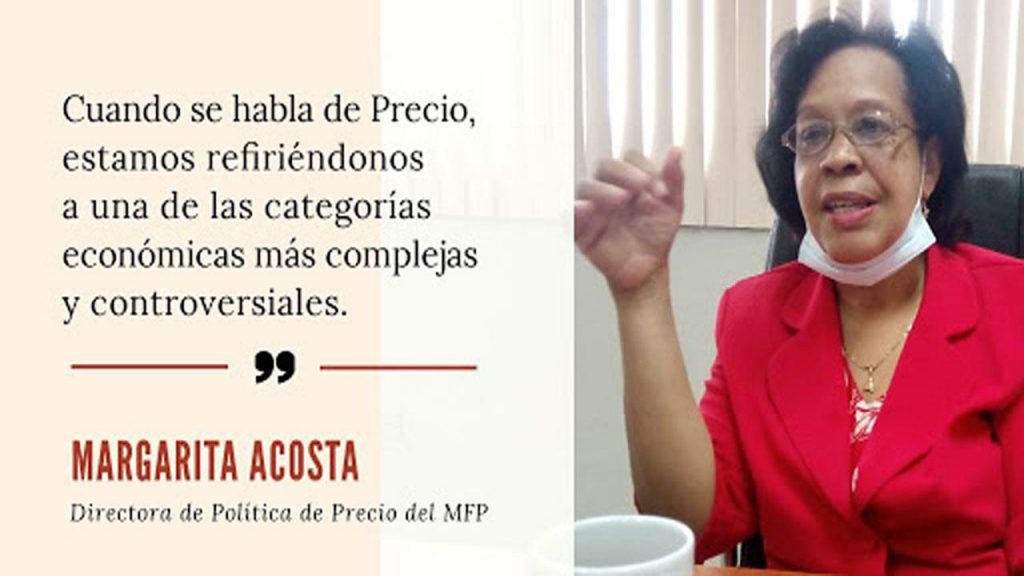
Margarita Acosta, Director of Price Policy for Cuba’s Ministry of Finance and Prices . “When one talks about Price we are referring to one of the most complex and controversial economic categories.”

14ymedio bigger14ymedio, Elías Amor Bravo, Economist, 21 October 2023 — Does updating the balance sheets really help to achieve more rational prices? Perhaps in communist Marxist logic, yes, but for a long time economists have known that the laws of the market are far superior to any instrument of central planning. The Cuban economy is a good example of this.

Apparently Margarita Acosta, director of Price Policy for the Ministry of Finance and Prices, believes that yes, it is possible to face the drama of inflation that the country is currently experiencing by publishing legal rules, which aim to “make costs and expenses transparent, seek efficient reserves and from there promote price decreases.”

It should not be only Ms. Acosta who believes in the superiority of planning. Her action must also be supported by President Díaz -Canel, Prime Minister Marrero, and up and down the ladder. The communist hierarchy is hard to determine in some cases.

What does this curious action of the Ministry consist of?

First of all, it is mandatory to prepare the so-called “cost sheet” for all economic actors. Both non-state and state producers and providers of technical-productive services must submit to this instrument of the regime’s economic control. The measure is considered key among those undertaken in the country to achieve more rational prices and face the abusive ones, a claim of the population. A claim that, in this way, goes nowhere. continue reading

Secondly, the rule will be published when only two and a half months have passed since Resolution 148 of 2023 was issued, published in Official Gazette No. 64 of July 6, in which the Ministry “conducts a process of preparation and training with its territorial directorates, local governments, universities and the National Association of Economists and Accountants of Cuba.”

In statements to the Cuban News Agency, Margarita Acosta Rodríguez, director of Price Policy of the Ministry of Finance and Prices (MFP), clarified that the main objective of the legal norm is to make costs and expenses transparent, look for efficiency reserves and go from there to price decreases, as long as it does not imply deterioration of the results or that the products are sold at a loss.

Thirdly, what is striking is that the authorities recognize that the established methodology and the cost sheet themselves do not solve inflation problems. Of course not. Inflation is not only a supply phenomenon but is also based on the imbalance with demand. No matter how many balance sheets are concocted, the price that the consumer is willing to pay has a much greater influence on inflation. They’re wasting time. Or they don’t do what needs to be done. And that’s how it goes.

This is why the authorities defend the cost sheet, because they point out that “it constitutes the starting point for the evaluation of price agreements, which lead to more effective and favorable regulatory measures for the population in products and services with the greatest impact, and in social consumption.” Price adjustments. Yes, you have heard correctly, it is a twisted way of trying to avoid market adjustment via supply and demand. The regulation and price intervention of the communists do nothing but distort the free adjustment of the markets and create conditions for harmful shortages.

Fourth, the leaders say that a “training process is underway at all levels given the complex context in which the regulations must be implemented.” Unbelievable. In all the economies of the world, millions of transactions between sellers and buyers occur every second, and you don’t have to train for anything.

Those who interact in the markets know their objectives, products and needs well, so there is no need for other agents outside the processes to interpret in their own way “concepts, purposes and how much can become a decisive tool in the negotiations between the parties and in the price agreements of local governments with the economic actors.” Precisely, that negotiation of the local powers with the economic actors should be liberalized and not subject to any control, and that could be an important path to improvement.

The Ministry’s director of price policy said that representatives of more than 3,500 entities of the business system, including budgeted units and more than 12,000 non-state economic actors, have been trained on Resolution 148/23. Figures, in any case, absolutely insufficient if compared to the dimensions of the Cuban economy. In the seminars it has been explained “that the cost sheet can be made with a criterion of flexibility, according to the characteristics and complexities of each activity, but this does not mean that prices are formed by spending methods and that this procedure replaces the Cost System of the entity.”

In short, they want to prepare the cost sheet anyway but at the same time point out that “prices must indicate what national productions and services cost and the real cost of imports, which will gradually allow the elimination of subsidies to business activity, promote greater negotiation between the parties, stimulate the search for reserves of efficiency in costs and expenses, and make real social spending transparent.”

It is a serious mistake. Prices  come from supply, as in this case, but also from demand. A product can be released on the market with a high or low price. Marketing strategists know this and set up different mechanisms in each case. You can’t walk blindly like they do in Cuba, or with only one eye, when you need both. That’s what the communists are unable to recognize.

And here come the different methods. For the formation of prices by correlation, “that is, by comparison, [they use] the references of import and export of goods and services, similar to the external and also domestic market, provided that their origin and the general bases for their determination in reasonable ranges are demonstrated.”

For setting prices in the non-state sector, the regulations are based on the agreements of local governments with economic actors in the commercialization of products and services with the greatest impact on the population and entities, which is established in resolutions 329/20, 84/21 and 263/22, all from the Ministry of Finance and Prices. In this negotiation, the local powers impose conditions on economic agents, almost always unfavorable, which takes away their interest in negotiating.

The authorities insist that in order to conduct business, “it is essential to know the cost sheet of each producer, an essential tool in the negotiations between the parties, and therefore it is planned to close the year with progress in this task.” From this point, “a gradual effect is expected on the decrease in wholesale prices in some productions and services, so that they contribute to lowering the retail prices of those products in high-impact activities, such as in the fast-food economy.” They make it clear.

Translated by Regina Anavy

____________

COLLABORATE WITH OUR WORKThe 14ymedio team is committed to practicing serious journalism that reflects Cuba’s reality in all its depth. Thank you for joining us on this long journey. We invite you to continue supporting us by becoming a member of 14ymedio now. Together we can continue transforming journalism in Cuba.

The First Shipment of Wheat Since July Arrives in Cuba

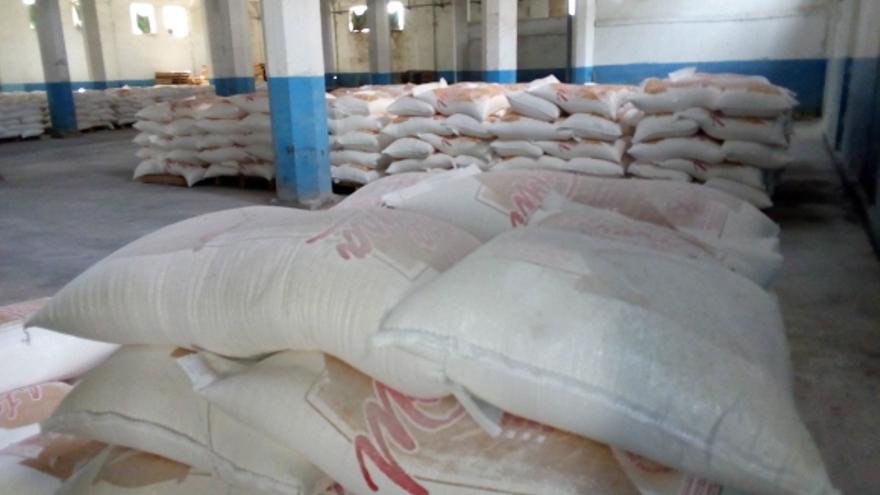
Wheat flour at the José Antonio Echeverría mill. (Cuban Molinería Company)

14ymedio bigger14ymedio, Madrid, 17 October 2023 — The Island’s mills have stopped since the last shipment of wheat arrived in July, according to the authorities, who are now celebrating the arrival of 23,500 tons “from Europe,” with which 16,000 tons of flour can be produced. The first deputy minister of the Food Industry, Mercedes López Acea, disseminated through her X account (formerly Twitter) the arrival of the product, although she did not reveal its origin or whether it is a purchase or donation. With the amount received, the production of bread for the basic family basket will be “stabilized” for just 20 days.

In December 2022, the port of Havana received a slightly higher amount of wheat (25,000 tons), donated by Russia and which, according to estimates made by 14ymedio, barely yielded 41 million pounds of bread, less than 4.4 pounds per Cuban.

The calculation was made taking into account the recipe recommended by the Agricultural Foundation for the Development of Argentina (FADA), which puts at 3.09 pounds the amount of wheat needed to make one pound of flour, and 2.12 pounds of flour needed to make one pound of bread. That is, 3 pounds of wheat for one pound of bread. continue reading

The lack of wheat “has led to looking for alternatives and buying imported flour to secure the bread of the basic family basket”

In any case, the shipment will be a little relief in the current situation. The president of the Business Group of the Food Industry, Emerio González Lorenzo, told Canal Caribe that the lack of wheat “has led to looking for alternatives and buying imported flour to ensure the bread of the basic basket and some very limited social consumption that is prioritized.”

The mills of Havana and Cienfuegos are already working to solve one more moment of bread shortage, which is joined by the lack of fuel, making it difficult, they said, to deliver food, especially in the eastern provinces.

In recent weeks, the official press has once again left room for complaints about the quality and quantity of the bread in the basket. In Sancti Spíritus and Ciego de Ávila, the authorities warned of a reduction in the weight of the bread, which went from the usual 2.3 ounces to 2.1, in the case of the first, and only 1.8 in the second, although the price was also reduced.

In addition, the taste and texture do not satisfy the population either, and Cubans often complain about the product that they have recently received in their rations. “It’s good that the bakery at least sells bath sponges. You are right to feel very happy. Now you can have a good scrubbing in the bath,” reported independent journalist Alberto Arego this Monday, echoing the words of several residents of El Vedado.

Translated by Regina Anavy

____________

COLLABORATE WITH OUR WORKThe 14ymedio team is committed to practicing serious journalism that reflects Cuba’s reality in all its depth. Thank you for joining us on this long journey. We invite you to continue supporting us by becoming a member of 14ymedio now. Together we can continue transforming journalism in Cuba.

The Official Magazine Bohemia Finds the Cuban State is to Blame for the Disaster

Of those interviewed, 64% indicated they would not recommend others pursue a career in the public healthcare sector.

14ymedio bigger14ymedio, Havana, 1 October 2023 — With a frankness unusual for an official Cuban media outlet, the magazine Bohemia touched the sore spot of the island’s labor situation. In an article entitled “¿Colgar el título?” (“Should You Put Away Your Degree?”), it recounts the personal experiences of several individuals — identifying them by name — their professional failures and the ongoing drift of professionals from the state sector into the private sector. The conclusion: “Having a degree in Cuba counts for nothing.”

The other great dilemma — emigration and the resulting brain drain — is treated with caution by the century-old publication. The article focuses instead on the teachers and doctors who drift into small and medium-sized businesses (MSMEs), where they can earn seven times more, leaving the country’s much-needed economic transformation in tatters.

To get a grasp on the situation, Bohemia polled seventy professionals trained in the social sciences or humanities who have left, or are thinking of leaving, the public sector. Of those polled, 20% said they were already employed by private companies. The main objective of all the respondents is to “earn a higher salary,” have “more job opportunities and enjoy better working conditions.”

Several of those interviewed described “healthcare workers as very exploited.” One of them, identified as Guillermo, said he preferred to “abandon the dream of being a surgeon rather than be humiliated and mistreated.” Of those interviewed, 64% indicated they would not recommend others follow their career path. continue reading

One of them, identified as Guillermo, said he preferred to “abandon the dream of being a surgeon rather than be humiliated and mistreated.”

The article cites official figures that measure the degree of alarm among the authorities. According to the National Office of Statistics and Information (ONEI), since 2021 — when currency unification measures were approved — the healthcare sector lost 12,065 doctors, 3,246 nurses and higher eduction lost 1,375 teachers.

In 2022 alone, the science and technology sector lost 2,000 workers while the social welfare sector saw a not insignificant 22,000 professionals leave. If technicians and other types of workers are added to the mix, healthcare lost a total of 31,308 people that year.

The National Employment Survey that ONEI conducted also revealed that 8.1% of unemployed workers in Cuba — some 6,860 people – are professionals who hope, so far unsuccessfully, to find a job “that pays a salary commensurate with their skills and experience.”

The resounding Cuban economic crisis has made some products ten times more expensive than they were in 2021, presenting a professional who works for the state with a dilemma: “Do you do what you like, what you spent five years training at a university to do? Or do you venture into other areas which are perhaps less rewarding from a professional standpoint but which pay better?”

It is natural, the article admits, that many choose the latter option. This is the case with Lesli, a communications graduate who was paid a monthly salary of only 5,060 pesos (twenty-one dollars at the official exchange rate). She survived “by selling recycled clothes on weekends at a garage sale, cleaning a vacant house in Vedado four times a month and trading rationed cigars for sugar, rice and jam.”

Similarly, due to the difficulties of obtaining temporary exit visas, which authorities routinely deny, many students and healthcare professionals choose to apply for permanent leave instead

A 24-year-old former doctor, Liz Hernandez Perez, another of those interviewed by Bohemia, confesses that, when she walks through her old medical school, she “wants to cry.” After receiving her degree, she also had to give up the idea of working in the public sector. Her household  — she lives with her mother, her little brother and her maternal grandparents, who are in frail health — was surviving on her mother’s monthly salary of 5,000 pesos as a nurse.

She now works as a clerk “in one of those big shops sprouting up all over the city” that sell goods imported by privately owned MSMEs. “I don’t have the luxury of not having to think about my salary,” explains Hernandez. She hopes to return to her profession at some point in the United States, where her father lives.

“Similarly, due to the difficulties of obtaining temporary exit visas, which authorities routinely deny, many students and healthcare professionals choose to apply for permanent leave instead,” Bohemia reports.

For eighteen years Holguín resident Miriam Perez worked as a university professor. She now works as a translator and has no regrets. “Being able to work from home, on my own schedule, has given me the freedom to care for my family and help them more financially.” Freedom is also a key word for Lisandra Luaces, a Havana resident with a degree in nuclear physics. “The demands were too great,” she admits.”Too much work, time and study for a monthly salary that only lasted a week.” That’s why she started a document printing business.  All the materials – ink, paper and equipment – have to be imported from abroad.

The magazine provides several more examples along the same lines. The common thread running through all of them is that, as long as the state is offering such poor working conditions, the best option may be to leave one’s chosen field. That does not solve all the problems, however. Even those working two or three jobs still struggle to make ends meet.

“I work a total of fourteen hours a day at three jobs. I have anxiety, anguish, overload, migraines, fatigue, worsening vision and insomnia. I feel guilty for not being able to do everything, or for not being able to perform at 100 percent of my abilities. And the worst thing is that, with the 10,000 to 12,000 pesos I bring in working three jobs, it’s still hard to save, to buy all the food I need, to pay the rent, or to replace  any work equipment that breaks,” laments another of the interviewees.

A barrage of comments from readers serves as a coda to the Bohemia article. The most straightforward of them reads, “The chief culprit for this disaster is the state. Don’t make excuses for it.”

____________

COLLABORATE WITH OUR WORKThe 14ymedio team is committed to practicing serious journalism that reflects Cuba’s reality in all its depth. Thank you for joining us on this long journey. We invite you to continue supporting us by becoming a member of 14ymedio now. Together we can continue transforming journalism in Cuba.

Faced With the Deplorable Transport Situation in Cuba, the Government Looks to the Private Sector

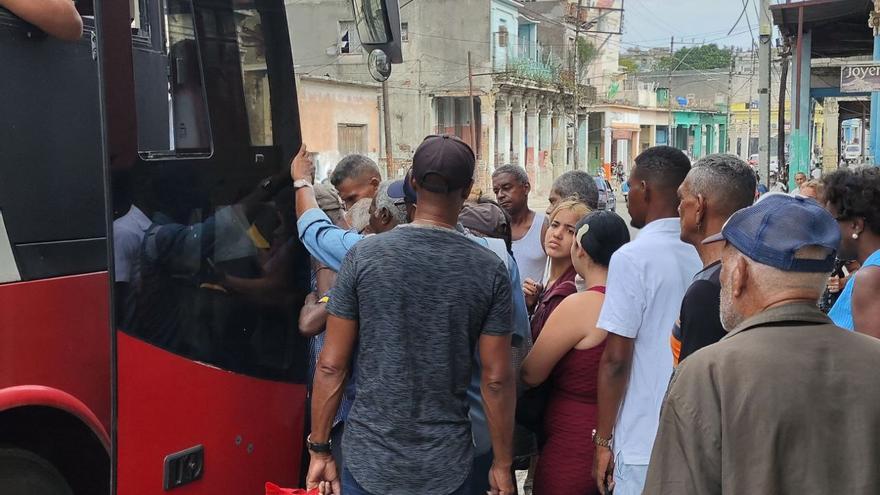
Buses are scarce in the midst of fuel shortages, but there are many passengers. (14ymedio)

14ymedio bigger14ymedio, Madrid, 20 October 2023 — The Cuban Government does not yet know how to integrate the private sector into passenger transport to make it attractive but is studying it, according to the Minister of Transport, Eduardo Rodríguez Dávila, speaking Thursday on State TV’s Roundtable program, as part of a discussion in which he offered the deplorable data of his sector, saying that the participation of MSMEs (micro, small and medium-sized enterprises) is essential.

This is not new, he said, since self-employed businesses and cooperatives are already present in the activity, and now there are more than 350 MSMEs dedicated to passenger transportation, cargo, workshops, road repair, component production and spare parts. All of them can contribute to improving the depressed sector.

So, how to make the incorporation of the private sector attractive? The Government doesn’t yet know. Rodríguez Dávila detailed the problem well. When the company has losses, in order to maintain the rates, vehicles in operation and fuel, the State budget supports it. This doesn’t happen with other forms of management, which invest in leasing and improvements or in the purchase of a vehicle and then have no way to cover the investment, since trip prices are regulated, although he admitted that there is a lack of control for that requirement to be met. continue reading

“Really with state-owned companies we have been accustomed to working in one way, but with non-state management forms we have to work in a different way”

Really with state-owned companies we have been accustomed to working in one way, but with non-state forms of management we have to work in a different way. The purpose is the same, the provision of a service according to the standards that our population expects, but the way to approach it is not the same. We have to learn how to do it well; it is a negotiation system in which there are several actors setting the rules of the game,” he said. The minister is working in a group together with the United Nations “for the improvement of public-private relations, using the world’s experiences.”

Rodríguez Dávila also encouraged state entities to rent vehicles to the paralyzed MSMEs, since, he said, they sometimes refuse to do so out of fear or ignorance. Despite this, more than 1,000 means of transport have been rented to private and other public companies. “We have many variants, and our vision is to try to ensure that both the state and non-state companies can carry out their activities efficiently, because that definitely leads to better service for the people,” he said.

“How can the State not fix a vehicle and the private one can? You have to visualize the dimensions. One car is not the same as 500, but there are also concerns related to prices and the control of transport activities,” he said.

Before reaching that point, Rodríguez Dávila depressed viewers with a cascade of data about the state of the sector, by land, sea and air. The cause, once again, is a lack of foreign currency. A new bus costs $200,000 and a locomotive $3 million, while a ship or plane cost much more. Spare parts or materials to manufacture them are also purchased outside the Island, and that limits the options, said the minister, who did not mention the donations or Chinese and Russian cooperation, which alleviate the situation in some way.

Other numbers: provincial transport companies moved 902 million passengers in 2017, compared to 274 planned for 2023

In figures, Rodríguez Dávila said that 1,500 means of transport that were out of service have been restored. “What happens [is] that you restore them and then have fuel limitations, or they are damaged again by the same level of activity,” he admitted.

The graphs show bleak data. In 1986, thanks to years of Soviet subsidy, there was a peak of passenger trips on the Island of 2.236 billion, but in 1998 the collapse reduced that to fewer than 500 million. Venezuelan intervention, reforms and the thaw made it possible to recover, and in 2017 there were 2.275 billion passenger trips, but last year the sector closed with just 1.008 billion.*

But we don’t have to go that far back. In other numbers: provincial transport companies moved 902 million passengers in 2017, compared to 274 million planned for 2023**. In Havana, where the situation has had the least effects, only 37% of the travelers relative to the numbers from five years ago are expected, while Cienfuegos (11%) and Holguín (12%) have the worst projections.

“Fewer than 300 buses are working in Havana, a city that in the 1980s had 2,500 buses and just four years ago had 600,” Rodríguez Dávila said.

The air transport situation is not much better. Domestic flights to Santiago de Cuba and Holguín have been restored, but there are none to Camagüey and Gerona because the plane is broken down. All this despite the fact that Russia has contributed. “Recently, we received a Russian-made TU-204 that was modernized and will soon be put into operation, and we have an IL-96 and some ATRs that can help internally in the country.” An attempt is also being made to acquire a plane with foreign investment to renew the fleet, he added.

As for the catamaran and the ferry, they take turns. Rodríguez Dávila recalled that the latter was stopped due to lack of fuel, but now it will work again. Of course, the ferry has to be suspended for maintenance. And finally, the railroad: despite delays, maintains stability and meets the planned travel times. “There is a level of general satisfaction,” he said.

Fifty percent of freight trains don’t function, and although work is being done to restore them – thanks to the workshops, cars and locomotives from international cooperation – the process is slow

The case of cargo transport is different. Fifty percent of freight trains don’t function, and although work is being done to restore them – thanks to the workshops, and cars and locomotives acquired through international cooperation – the process is slow. “To the same extent that you restore, other things that were working stop due to new difficulties,” he complained. All this despite the fact that the load has decreased due to the reduction in purchase volume. “We are more or less transporting half of what we did four or five years ago (…) according to the economy’s possibilities,” he explained.

In addition, Rodríguez Dávila devoted several minutes to the conditions of roads, which cause a large number of crashes, as he had warned on many occasions. This time, the minister admitted it without excuses. “There has been a deterioration of the roads that we are unable to contain, and no timely solution to the potholes and cracks.”

The reason, again, was attributed to the shortage of foreign currency, especially for the acquisition of materials and also for  machinery parts. “Many times the limitation of fuel means that we are not able to produce the aggregate or place an order for it later,” he added. That is why it is foreseen that, in addition to other municipal, provincial administrations and ministries that administer roads, the MSMEs will contribute; in fact, there is already one State business that works in the manufacture of asphalt material.

“We are also going in a more active way to non-state management in road repair. Together with the Ministry of Finance and Prices we will review the sources that can be used for financing, because many times we have the asphalt but there is no budget to pay for repairs,” he said.

Finally, as for the old fleet of vehicles, the minister said that the policy is being reviewed to advance “in the reorganization of the commercialization of vehicles in Cuba.” Since Decree 83, which allows the purchase at wholesale prices was approved in March, 1,000 vehicles have been sold. That rule eliminated the restrictions on electric motorcycles, an improvement that, for the minister, “somehow compensates for the decrease in buses working in the capital.”

“Behind every bus, train and other vehicles that circulate is the effort of many people who make it possible every day; and taking care of the little we have is one of the premises to get ahead,” Rodríguez Dávila said in the usual motivational final plea.

Translator’s notes:

*In very rough numbers this translates to about 218 annual trips per person (all ages)in 1986, dropping to 45 in 1998, rising to 200 in 2017, and then dropping back to 90 annual trips in 2022.

**Trips per person cannot be calculated for this set of numbers because the population served by the transport companies is unknown.

Translated by Regina Anavy 
____________

COLLABORATE WITH OUR WORKThe 14ymedio team is committed to practicing serious journalism that reflects Cuba’s reality in all its depth. Thank you for joining us on this long journey. We invite you to continue supporting us by becoming a member of 14ymedio now. Together we can continue transforming journalism in Cuba.

The Havana Refinery Is Turned On and Off in an Attempt To Produce Fuel

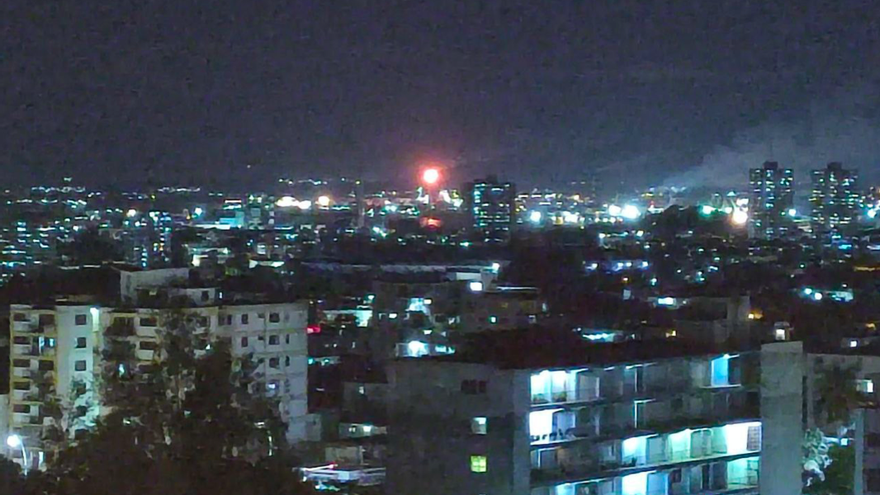
As could be seen from the Newsroom of this newspaper on Friday, the flame of the Ñico López was more powerful than usual. (14ymedio)

14ymedio bigger14ymedio, Havana, October 21, 2023 — The intense flames that came out, on Friday night, from the tower of the Ñico López refinery on Havana Bay, gave the impression that fuel production had been restarted. The joy of the thousands of Cubans in line at gas station was short-lived: in the early hours of this Saturday, the plant’s torch went out again.

From the Newsroom of 14ymedio, on Friday evening, a flame that was more powerful than usual could be seen in the Ñico López refinery, which suggested that the facilities were processing the crude oil that arrived in several tankers from Mexico and Venezuela. A short distance from the refinery, the Emilia LPG, which was built to transport liquefied gas, remained anchored.

Another sign that a supply of fuel arrived in Havana in recent days is the smoke, more intense since Friday, emitted by the chimneys of the patana, the floating power plant contracted from the Turkish company Karpowership. Habaneros have become resigned to the harmful column of smoke emitted from the patana, because it means that the blackouts will have a truce. The environmental impact of the activity of those floating plants, however, will affect the Bay’s ecosystem, as several forecasts have already warned. continue reading

It would be logical that, although intermittent, the refining of crude oil in the Ñico López alleviates, even temporarily, the shortage of fuel in the capital’s gas stations

It would be logical that, although intermittent, the refining of crude oil in the Ñico López alleviates, even temporarily, the shortage of fuel in the capital’s gas stations. Just one day ago, the crisis showed signs of having reached a stalemate: the closure of important cultural institutions “for energy savings,” the streets without a single car and the bus stops full of people, waiting for a bus that does not arrive or passes by full.

University of Texas specialist Jorge Piñón told this newspaper that the Havana plant should be processing at least 22,000 barrels of crude oil per day, an amount that – judging by the number of oil tankers in the Island’s ports – would not be impossible to meet under the current conditions. However, last Thursday, as a 14ymedio reporter noted, the refinery torch was turned off.

At the beginning of September, Ñico López processed crude oil again, after a year of non-functioning. The start was disastrous: an unbearable smell of gas emitted by the facilities was denounced by thousands of habaneros on their social networks. The complaints forced the authorities to give an explanation, and the state-owned Cuba-Petróleo (Cupet) had to admit that the plague emanated from the refinery.

“The operation of the refinery, together with the calm air that has existed in recent days (especially at dawn and in the morning hours), has caused the gases, the product of the combustion in the torch, to generate the odors detected in some neighborhoods of Havana,” the company said.

The failure was unjustified, since Cupet had assured that its technicians “reviewed the handling systems of non-condensable waste gases, verifying that they were directed to the torch or flare for their burning, which is the technological destination that should receive them”

However, the promise to “minimize these unpleasant effects” did not satisfy habaneros, who continued to publish complaints about the impossibility of stopping the bad smell, even after closing doors and windows.

A primeras horas de este sábado, la antorcha de la refinería de La Habana se apagó de nuevo. (14ymedio)
In the early hours of Saturday the Havana refinery’s flame is off again. (14ymedio)

At the moment, Cupet has not commented on the productive intermittency of Ñico López, although Havana’s energy allies, such as Mexican President Andrés Manuel López Obrador, have stated that they will continue to help the Island “with everything possible,” including oil shipments.

Meanwhile, the speech of Cuban president Miguel Díaz-Canel continues to be that of someone under siege. In a long interview broadcast on Televisión Cubana, he said that the country lacks foreign currency and uses the little money it has to buy “a little” amount of fuel. Regarding transport – the sector with the largest impact – he said that the companies were “almost bankrupt.” Of course, despite the continuous arrival of oil tankers, which the Government doesn’t acknowledge, Cuba is experiencing, in the president’s opinion, a fierce “energy persecution” with the “evil objective” of depriving the country of fuel.

Translated by Regina Anavy
__________________________

COLLABORATE WITH OUR WORKThe 14ymedio team is committed to practicing serious journalism that reflects Cuba’s reality in all its depth. Thank you for joining us on this long journey. We invite you to continue supporting us by becoming a member of 14ymedio now. Together we can continue transforming journalism in Cuba.

In Ten Months, 52,000 Cubans Have Benefited From the US Humanitarian Parole

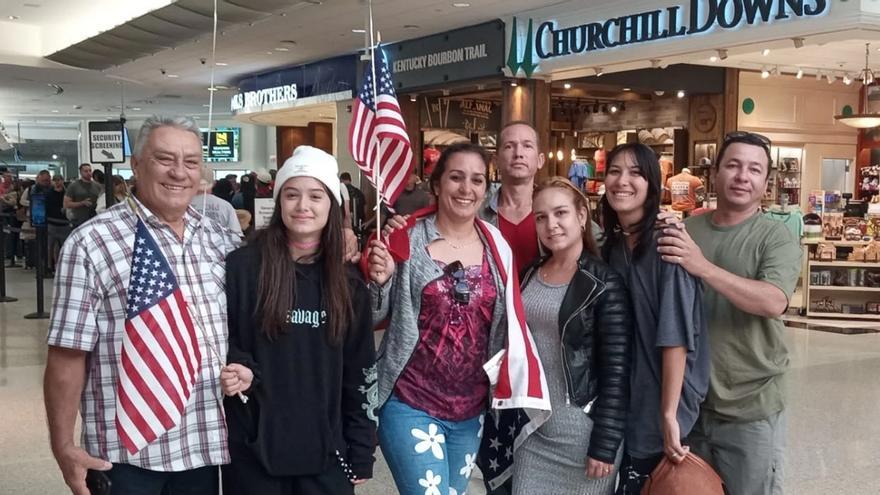
A Cuban family that benefited from the humanitarian parole program arriving in the United States. (Facebook)

14ymedio bigger14ymedio, Havana, 22 October 2023 — During the month of September, the number of Cubans benefiting from the humanitarian parole program established by the United States increased, from 3,500 in August to 5,053 last month. According to figures from the Department of Customs and Border Protection (CBP), the number is below that for Venezuelans with 5,092 beneficiaries, Nicaraguans with 5,298, and Haitians with 12,245, who have benefited the most.

According to Univision journalist Daniel Benitez, more than 52,000 Cubans were approved to enter the United States under humanitarian parole between January and the end of September. Of these, 50,185 have already entered, and the rest are expected to do so shortly.

In total, 265,888 migrants of the four nationalities have benefited from the program established by Joe Biden’s government.

However, with regard to entries through CBP One, journalist Mario J. Pentón from América TeVé warned that of the 43,000 people processed in September, according to US authorities, the main nationalities that “have scheduled appointments” are Haitian, Mexican and Venezuelan.

With the arrival of 341,392 migrants at the southern border of the United States in September, the pressure on the Biden administration has increased in recent months, although it insists that migration has been reduced.

The CBP indicates that, in total, 200,287 Cubans arrived at the borders of the United States in fiscal year 2023 (October 2022-September 2023). continue reading

Congressional Republicans must stop playing political games with border security

In addition, the figures indicate a record in the last 11 months with the crossing of 3,201,144 people to the United States. Meanwhile, the Border Patrol reported that last month it arrested 210,000 immigrants who crossed illegally.

CBP’s interim commissioner, Troy Miller, stressed in a statement that his agency “increased its resources and personnel” in September in response to the “high arrest rates along the southwest border.”

The Biden government also asked the US Congress for $13.6 billion to strengthen the border with Mexico, to manage irregular migration, and to fight against fentanyl trafficking, manufactured mainly by Mexican drug cartels.

“The Republicans in Congress must stop playing political games with border security,” says the document sent to Congress.

Biden said that, among the advances that have been made in the matter, the humanitarian permits for family reunification, CBP One and the immigration management offices in Colombia, Costa Rica, Guatemala and soon in Ecuador, stand out. However, “more funds” are required.

Part of the requested money will be used to send another 1,300 Border Patrol agents to work together with the 20,200 already financed in the budget for fiscal year 2024.

“The accelerated expulsion” of migrants who do not meet the requirements to stay “is not possible if asylum officials” cannot conduct interviews to evaluate whether there is a possibility that they will be persecuted or tortured if they return to their country, the Department of Homeland Security said this Friday in a statement.

Translated by Regina Anavy

____________

COLLABORATE WITH OUR WORKThe 14ymedio team is committed to practicing serious journalism that reflects Cuba’s reality in all its depth. Thank you for joining us on this long journey. We invite you to continue supporting us by becoming a member of 14ymedio now. Together we can continue transforming journalism in Cuba.

In Cuba, Official Culture Loses Ground in the Face of Dynamic Private Offerings

The budget dedicated to the restoration of heritage properties is insufficient, which has accelerated their deterioration. (14ymedio)

14ymedio bigger14ymedio, Havana, 20 October 2023 — Cuba’s officialdom celebrates the Day of Cuban Culture by declaring the existence of a new enemy: the “cultural colonization” promoted by micro, small and medium-sized enterprises (MSMEs). The oxygen that the “new economic actors” have given to the sector contrasts with the situation that – not without reluctance – the local leaders describe this Friday: unpayable debts, millions of pesos lost, the impossibility of restoring heritage buildings and the stampede of intellectuals and artists.

Taking advantage of the anniversary – established by the regime in 1980, following the myth that the national anthem was written on October 20, 1868, by Perucho Figueredo – the official press reviewed the state of culture in several provinces. With varying degrees of sincerity, the officials agreed on one point: the situation is, at the very least, “complex.”

Jorge Félix Lazo, director of the Cultural Sector of Sancti Spíritus, said that for his office it is a “challenge,” despite the fact that the province has about 500 registered musicians and 92 writers, to offer something attractive to young people, victims par excellence, he insisted, of “cultural colonization, which goes unnoticed before our very eyes.”

The problem, he conjectured, is that people are not capable of “changing their thinking,” despite the fact that the province has a university and 24 cultural projects. “It’s a shame that they haven’t taken advantage of them,” he said sadly. continue reading

The few advances made have been by the small private businesses, which make up for the work that the state sector is unable to assume, he admitted

The few advances made have been by the small private businesses, which make up for the work that the state sector is unable to assume, he admitted. But “loosening the reins” – as Lazo eloquently describes government control – has been taken advantage of by businesses that have succeeded in “managing artistic talent and even have sponsored activities and events.”

“But our mission is to lead them, not to leave them alone, to prevent the violation of cultural policy, of which there is only one,” warns the leader, who sees a top-up review of the private businesses to be necessary. “We have had stumbling blocks, because we cannot allow our spaces to lose their essence and be just for dancing and consuming drinks. The role of our institutional system is unchanged.”

Despite his inflexibility, Lazo recognizes that alliances with the private sector are the “road to salvation.” His example is the municipal library of Fomento, which digitized its catalog thanks to a MSME. It was a simple operation, the official said, not like the urgent restoration of the now-closed Museum of Colonial Art, at the moment impossible because it requires “a million-dollar figure” to be carried out.

The most notable failure – which Lazo describes as “unexpected” – is that of the Music and Entertainment Marketing Company, which closed in 2022 with more than 364,000 pesos in losses. Lazo’s justification is that the institution failed not only at the provincial level but also at the national level. The leader predicts that the same thing will not happen this year and that “the dissatisfaction of the artists” can be alleviated, since “the direction has changed and measures have been adopted.”

In opinion columns published in official magazines and provincial institutional meetings, intellectuals and artists affiliated with he National Union of Writers and Artists of Cuba (UNEAC) have recorded that the economic aspect of their work is – and has been for a long time – more than alarming. The request for a “scheme” that allows the profits of the sector, no matter how small, to be reinvested in it, has been a constant in the assemblies of the organization.

The intellectuals and artists affiliated with UNEAC have recorded that the economic aspect of their work is – and has been for a long time – more than alarming

The writer and cultural commissioner Ricardo Riverón, of Villa Clara, explained in the magazine La Jiribilla that the financial ups and downs of the Island have caused a “litany of disagreements” between officials and artists. “The most recent of all, very bitter, is over cinema,” he stressed, alluding to the claims of the independent Assembly of Filmmakers of Cuba, which arose as a result of the unauthorized broadcast by its director, on Televisión Cubana, of the documentary La Habana de Fito, by Juan Pin Vilar.

For Riverón, Cuba is moving towards a process of cultural crisis  similar to the one that the Soviet Union went through, which could have, he warns, similar results. “At the end of the last century, glasnost [openness] did more damage than perestroika [restructuring]: the economy in Russia and other countries recovered, but the socialist ideology had to face the long devaluation of its moral capital, which today is rowing against the tide. The persistent loss of its political attractiveness and mobilizing capacity is still with us,” he insists.

Returning to the solutions of the Special Period – in particular the “decentralization of decisions” of the sector, which Riverón aspires to return to local leaders – could be the light at the end of the tunnel, the official theorizes. However, there is a great danger: the Internet, whose access “has been for us almost the equivalent of a glasnost,” and which generates more “cultural colonization,” he regrets.

Riverón agrees with Lazo in the same fear: for the State, it is intolerable that there be a “discredit” and a “dismantling of institutionality,” because with it, “the socialist conception of society will go away; there is no doubt about that.”

Translated by Regina Anavy 

____________

COLLABORATE WITH OUR WORKThe 14ymedio team is committed to practicing serious journalism that reflects Cuba’s reality in all its depth. Thank you for joining us on this long journey. We invite you to continue supporting us by becoming a member of 14ymedio now. Together we can continue transforming journalism in Cuba.

‘Bring Your Own Power’ – The Cuban Art Factory Rebels Against Government Power Cuts

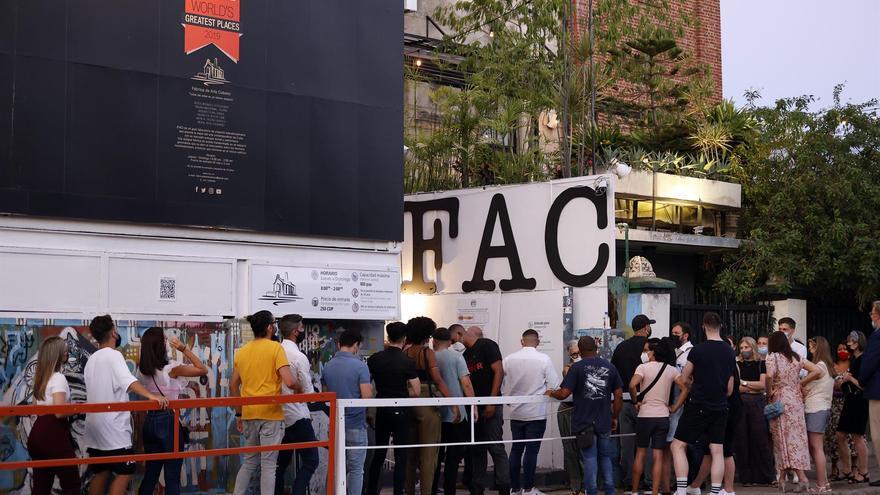
People queue up at the entrance of the cultural centre The Cuban Art Factory (FAC) at its reopening in 2022. (EFE)

14ymedio bigger14ymedio, Havana, 16 October 2023 – The Cuban Art Factory (FAC) has rebelled against the decisions of the two Ministries of Energy & Mining and of Culture. In the face of energy shortages the government imposed an energy plan, which in practice implied that they would have to close, but the centre refused and asked their loyal followers to ’bring their own energy’ to support them.

“Our cultural and social commitment motivates us to re-invent the working structure of the institution to avoid the closure of FAC for the time being. For this reason we are announcing that The Cuban Art Factory will keep its doors open whilst looking for creative solutions that won’t affect the National Grid” (SEN), the centre explained via social media on Saturday.

Signed by its founder and the rest of the team – the musician X Alfonso and the FacinBand – the message explained that they reopened on 5 October (after a month’s programmed closure) with an energy allocation reduced by 80%. Because of this, the consequence would be that they could only open for two days a month instead of the previous 16 (Thursday to Sunday).

“We are aware of the energy situation in Cuba and consequently we have accepted the energy-saving plan established for the state sector, limiting energy use as much as we can in our offices and other FAC spaces, in order to contribute to the reasonable use of the country’s energy resources”, they explain. continue reading

FAC rejects SEN’s energy allocation and says it will keep its doors open with the help of audiences, artistes and any followers from all parts of the country who wish to contribute

In its post the institution defends its position, being as it is the foremost cultural centre on the island – having more than 300 concerts, 70 exhibitions, 60 dance performances, 40 theatre shows, 40 fashion shows, as well as a long list of social actions to its name. “And this is at an affordable ticket price of only 250 CUP, when general access to art in Cuba is increasingly expensive and real experiences of genuine art are becoming pretty scarce”.

FAC rejects SEN’s energy allocation and says it will keep its doors open with the help of audiences, artistes and any followers from all parts of the country who wish to contribute. “Considering the impact of the arts and culture on a society that needs hope and beauty in order to carry on resisting, we feel we have to find creative solutions, without having to create additional burdens”, says the text.

On Saturday, according to the announcement, FAC opened up, having power only from its own generators, plus some lanterns and the light from more than 300 phones of its workers, “who, if FAC were to close, would become unemployed”, the text emphasises, in words which are almost taboo for Cuban officialdom.

“The way we’re going there’ll be no need to shut them up because they won’t have any electricity to operate their motormouths”

“Bring your own light and join us in this adventure for keeping FAC’s heart beating!” they ask.

The resulting torrent of commentary over the whole weekend has been intense. FAC, situated in Calle 26, El Vedado, has become a central point of reference for Havana culture; it is also very much frequented by tourists. In 2019 Time magazine included it in a list of the 100 best venues in the world.

The venue first opened in 2014, in the ruins of a former oil-manufacturing company. Today it occupies two floors, with exhibition areas for photography, design and architecture; a cinema and a theatre; dance studios; bars; a cafe and a restaurant offering international cuisine.

After the long hiccup of the pandemic it reopened its doors in April 2022 using the Cuban Peso as official currency. And in spite of inflation it managed to maintain its previous entry price at 250 CUP.

Many commentators have made enthusiastic proposals for organising the purchase of solar panels for the building, although it would need a huge amount of them, much more than the installation of “torches”, as one contributor suggests. Just maintaining an adequate temperature can be very difficult with a deficit of energy, and on the whole such a project would seem unviable.

Other commentators think the whole thing is just the last straw and they satirise the situation: “If they’re wanting to shut the FAC, tell them to all just shut up”, says one, while another replies: “The way we’re going there’ll be no need to shut them up because they won’t have any electricity to operate their motormouths”.

In a city whose nightlife is increasingly limited by energy problems, an exodus of artistes and a deterioration of entertainment venues, FAC has become one of the last options available for the younger people. Its diverse programme, its numerous spaces and its very location all attract a heterogeneous public hungry for culture.

Translated by Ricardo Recluso
____________

COLLABORATE WITH OUR WORKThe 14ymedio team is committed to practicing serious journalism that reflects Cuba’s reality in all its depth. Thank you for joining us on this long journey. We invite you to continue supporting us by becoming a member of 14ymedio now. Together we can continue transforming journalism in Cuba.

Murdered by Her Partner in the Rural Town of Biran, Where Fidel Castro Was Born

Hidalgo indicated that his mother was “threatened and harassed” by the aggressor, whose identity he did not share. (Facebook/Cristina Ramírez)

14ymedio bigger14ymedio, Havana, 21 October 2023 — Cristina Ramírez Milián was murdered by her ex-partner this Wednesday in her home in Birán, a rural town in the province of Holguín where Fidel Castro was born. The death, reported in the CubaNet newspaper by the victim’s son, Miguel Hidalgo Ramírez, is the 66th femicide this year in Cuba, according to the record kept by 14ymedio based on independent sources.

Hidalgo pointed out that her mother was “threatened and harassed” by the aggressor, whose identity was not given, although the newspaper stated that he was an “informant” or “auxiliary” of the Ministry of the Interior. Ramírez, her son explained, “never went out alone out of fear.” As usual, neither the authorities nor the Police have offered their official version of the woman’s death.

At the moment, the platforms Yo Sí Te Creo Cuba and Alas Tensas – which keep track of deaths due to sexist violence on the Island – have not included Ramírez on their list, which at the beginning of the week counted 65 femicides, double the number those registered in 2022.

This Monday, both observatories denounced the murder of Lisandra Pérez Marcial, 35, who died on October 15 at the hands of her partner in her home, in Caibarién, Villa Clara. In addition, they confirmed the death of Bárbara Rodríguez Guerra, 41, who was also attacked by her partner in Manzanillo, Granma province. Rodríguez, a teacher by profession, was murdered on September 20 and is survived by two minor daughters. For his part, Pérez Marcial’s son witnessed the attack and death of his mother. continue reading

The observatories stressed that these events “leave the families bereaved and raise alerts for gender violence in the country

The observatories stressed that these events “leave the families bereaved and raise alerts for gender violence in the country.” They affirmed that their demands “are clear although ignored by the authorities” and appealed to citizens “for the prevention of something irreparable such as the unnecessary loss of life.”

Both organizations reported that they are working on four alerts of possible sexist crimes in Santiago de Cuba, in the western towns of Guanabo and Bauta, and in Guáimaro, a municipality in the province of Camagüey.

The work of these feminist groups and their dissemination in the independent media have contributed to focusing on cases of sexist murders and disappearances of Cuban women in recent years. The activists insist that a “state of emergency due to gender violence” be declared, and regret that the Government has not taken measures in this regard.

In addition, they advocate for a comprehensive law against gender violence (sexist murder is not classified in the Penal Code) and the implementation of protocols to prevent these events, as well as the creation of shelters and rescue systems for women and their children in danger.

In early June, the ruling Federation of Cuban Women presented the Cuban Observatory on Gender Equality, which includes statistics of “women who have been victims of intentional homicide as a consequence of gender violence in the last 12 months.” However, it does not record all the cases reported by independent organizations. For its part, the Supreme People’s Court (TSP) reported in mid-May that in 2022 there were 18 convictions for femicides, all with penalties – for the crime of murder – above 25 years in prison.
____________

COLLABORATE WITH OUR WORKThe 14ymedio team is committed to practicing serious journalism that reflects Cuba’s reality in all its depth. Thank you for joining us on this long journey. We invite you to continue supporting us by becoming a member of 14ymedio now. Together we can continue transforming journalism in Cuba.

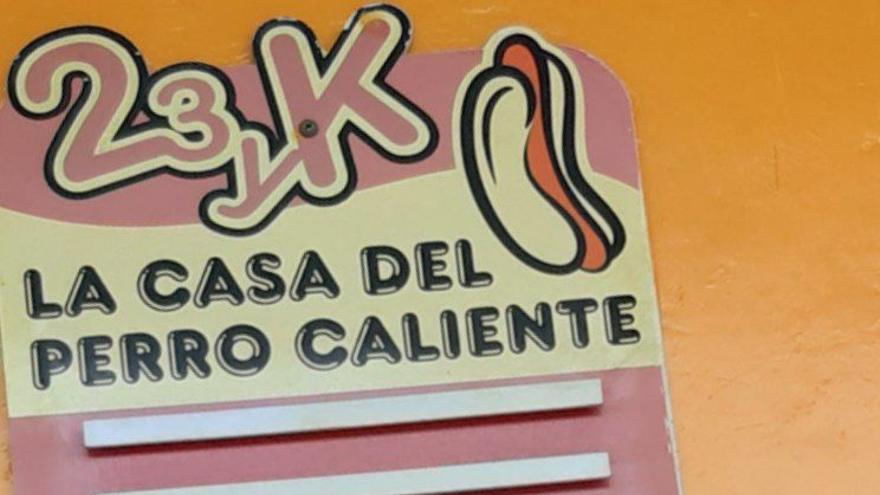
With Prices From 20 to 180 Pesos, the Hot Dog Place at 23rd and K Streets in Havana Reopens under Private Management

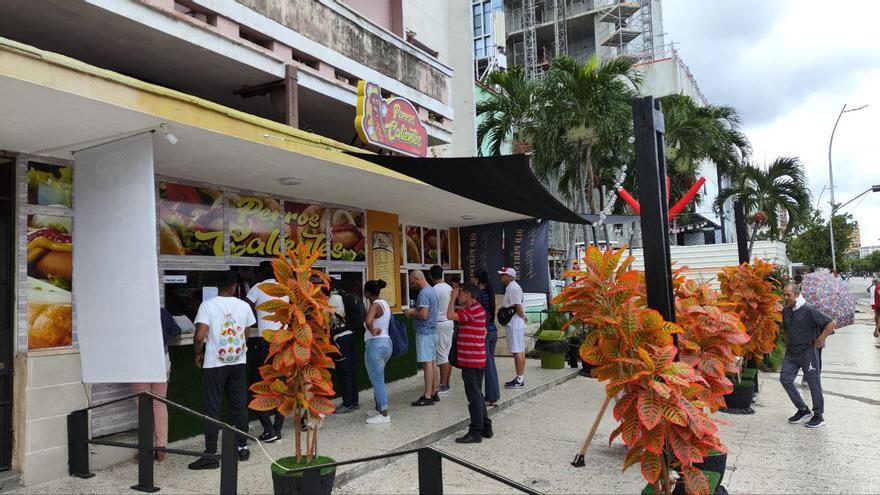
The colors of its signs, red and yellow, are the same but now it is called Lalola Hot Dogs. (14ymedio)

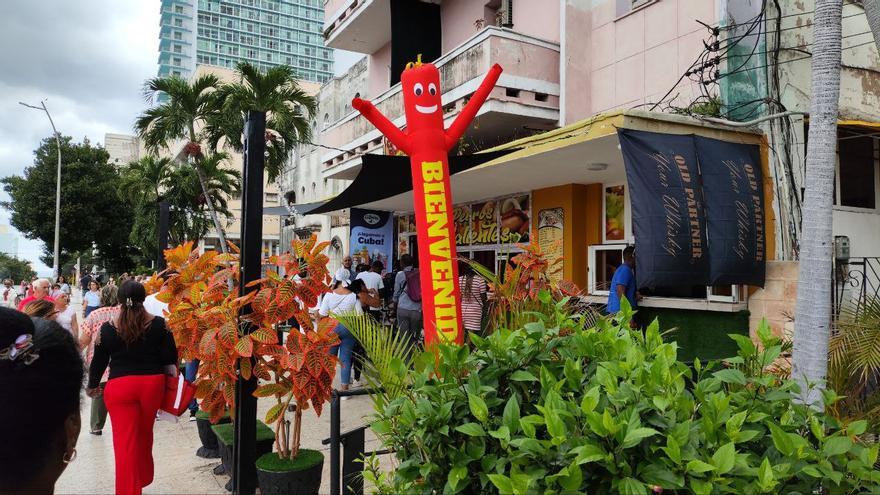
14ymedio bigger14ymedio, Juan Diego Rodriguez, Havana, 17 October 17, 2023 — La Casa de Perros Calientes (The Hot Dog House) — located on 23rd and K streets, right in front of the giant Coppelia ice cream parlor in Vedado — has reopened its doors after being closed for months. The colors of its signs, red and yellow, are the same but now it is called Perros Calientes Lalola, (Lalola Hot Dogs). A red sausage-shaped inflatable welcomes new customers.

The site, located at one of the capital’s most heavily trafficked intersections, is halfway between the Habana Libre hotel and what will be the city’s tallest highrise, Tower K. Originally, it was a state-run cafe but in the early 2000s it began selling hot dogs, which is how it got the nickname La Perreta.

“Has any Havana resident not eaten ’bread with dog’ from this place?” asks Clara, who lives in the neighborhood. “People used to line up outside Coppelia and had to wait so long that they would cross the street and buy a hot dog to hold them over. There were people there at all hours. Morning, noon and night.”

It definitely seems like they are privatizing Vedado

Tony, a Central Havana resident, recalls that the place was still in operation during the pandemic. They were selling hot dogs, coffee and a soft drink but adds, “Like everything else, it was going downhill… [Initially,] it was different. The bread was softer and they had ketchup and mustard. But later they just gave you bread and dog, without anything else. Even then, the bread was so hard that you had to throw it away and eat just the meat.” continue reading

The last time a reporter from 14ymedio visited the place was in January of 2022, when it was still in state hands.  At that point, the Hot Dog House was not even selling hot dogs. Only some ham croissants for thirty pesos apiece. Previously, when they did have the meat, a hot dog cost twenty pesos

A sausage-shaped inflatable welcomes new customers. (14ymedio)

Now, the same product at Lalola Hot Dogs sells for 180 pesos. And that is not the only thing that comes with a sky-high price tag. Juices go for 150 pesos, soft drinks for 170, energy drinks for 200, malts for 250 and milkshakes for a whopping 600 pesos. The establishment offers several types of combos. The cheapest, at 300 pesos, includes two frankfurters with gouda cheese, ketchup, mustard, and a canned soft drink

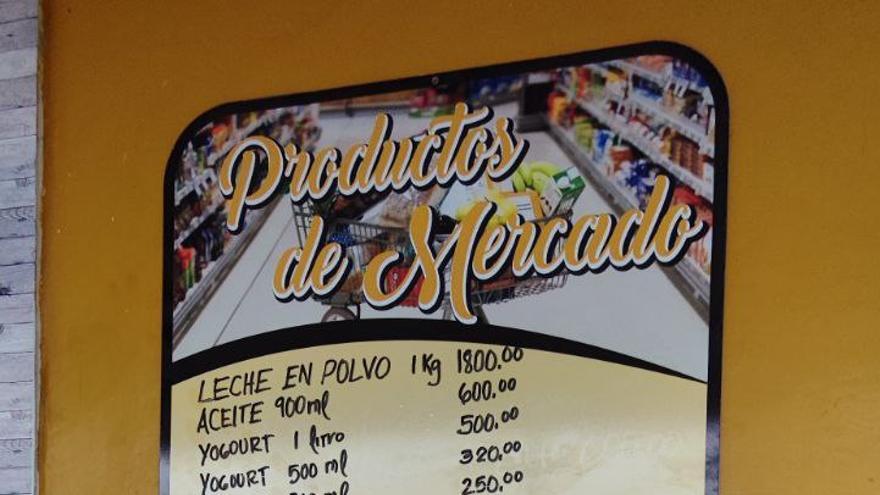
They also sell grocery store items. These include a kilo of powdered milk for 1,800 pesos, cooking oil for 600, a liter of yogurt for 500, a kilo of roasted peanuts for 1,200, and even whiskey, which goes for between 1,200 and 1,300 pesos.

Lalola Hot Dogs also sells grocery store items. (14ymedio)

Unlike when it was state-run and cheap, the place had few customers on Tuesday. “People used to come here to kill their hunger because hot dogs were very cheap. I used to come on Fridays, fill my shopping bag with hot dogs, then refrigerate them so I could eat them during the week while I was watching television,” says Ranier, who today is ordering only one hotdog. “At any rate, whoever owns this place should do a good business. Just look where we are,” he says, making a circular gesture as he points to 23rd Avenue.

Lalola Hot Dogs joins a whole string of food-service establishments that used to be state-run but are now under private management, especially in this centrally located area of Havana. Among the latest and most noteworthy are La Carreta and the old BimBom, which will now be called Bueníssimo. “It definitely seems like they are privatizing Vedado,” observes Ranier.

The last time a reporter from 14ymedio visited the place was in January of 2022, when it was in state hands. They were not even selling hot dogs, only some ham croissants.  (14ymedio)

____________

COLLABORATE WITH OUR WORKThe 14ymedio team is committed to practicing serious journalism that reflects Cuba’s reality in all its depth. Thank you for joining us on this long journey. We invite you to continue supporting us by becoming a member of 14ymedio now. Together we can continue transforming journalism in Cuba.

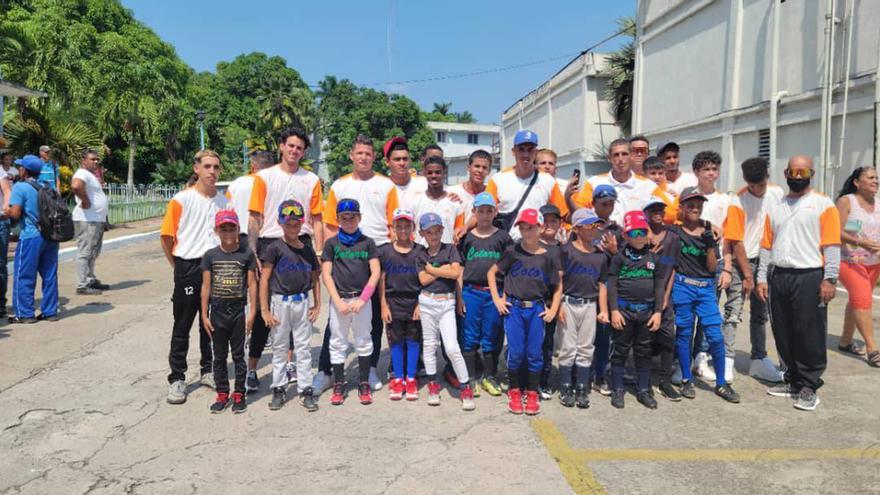
The Cotorro Team Is Expelled From the Havana Provincial Baseball Series for Not Showing Up for Two Games

Image from a game of the 63rd Provincial Series, from which the Cotorro team was removed. (Facebook/Boris Luis Cabrera Acosta)

14ymedio bigger14ymedio, Havana, 20 October 2023 — The Havana Baseball Commission removed the Cotorro municipality team from the 63rd Provincial Series. The squad received the disciplinary measure, announced this Thursday, “for not showing up for their last two games,” according to journalist Boris Luis Cabrera Acosta. The sports authorities did not accept the justification that the absences were caused by the lack of transport due to the fuel shortage that affects Cuba.

A member of the team told the official media Tribuna de La Habana that “they waited in vain for the bus, which no one in the municipality could manage” to take them to the Ciro Frías sports center in Arroyo Naranjo.

Cotorro also lost a second game days later after not showing up to face the Plaza de la Revolución team, so the authorities decided to remove them from the competition that serves as a prelude to the National Series.

“Another desert of disbelief multiplied in the eyes of the protagonists, who visualized how they were given a sovereign knockout from the field,” Swing Completo published. The blow also spread to the fans, who, despite the escapes of baseball players, go to the stadiums to spend moments of distraction. continue reading

Another desert of disbelief multiplied in the eyes of the protagonists, who visualized how they were given a sovereign knockout from the field

Cabrera Acosta recalled that the Boyeros team also faced the lack of transport prior to their match against 10 de Octubre. However, the team paid for the bus with its own money. “The good development of these challenges must be a maxim,” says Swing Completo. “Unfortunately, another stone on the road appeared to hinder the sacrifice of the players, who are the main ones affected in this whole history of turmoil and bureaucracies.”

Pitcher Pablo Luis Guillén, who left Cuba legally in 2021 and currently plays in the Italian League, said when he was interviewed last September by Pelota Cubana, that on the Island “the game is played only out of love and you can’t eat love.”

“When you play baseball and are not paid a dignified salary, where players earn only 14 dollars a month, you can’t be responsible right now for how the world and life itself is in Cuba,” he added.

Image of some of the members of the Cotorro team. (Facebook/Omar Martínez)

It’s not the first time that the fuel shortage has hit Cuban baseball. In August last year, the first match of the Under-23 championship of the National Baseball Series between Villa Clara and Cienfuegos was suspended for this reason.

The Villa Clara Leopards, who were staying at the Pasacaballos hotel, received the notification that they could not be taken to the September 5 stadium, where the host team and local fans were waiting for them.

Translated by Regina Anavy

____________

COLLABORATE WITH OUR WORKThe 14ymedio team is committed to practicing serious journalism that reflects Cuba’s reality in all its depth. Thank you for joining us on this long journey. We invite you to continue supporting us by becoming a member of 14ymedio now. Together we can continue transforming journalism in Cuba.

Diaz-Canel Will Be at the Summit in Mexico To Talk About the Cuban Migrants in Tapachula

In addition to the Cuban president, the leaders of Colombia, Honduras, Haiti and Venezuela will be present. (EFE)

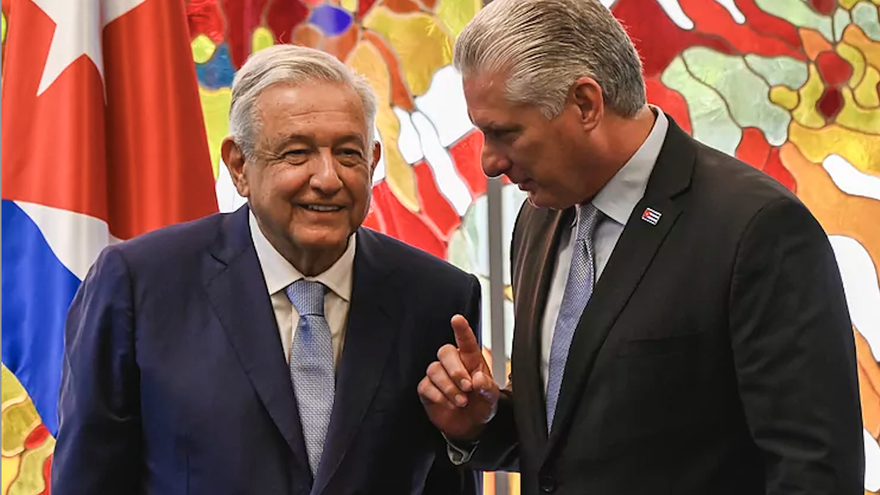
14ymedio biggerEFE (via 14ymedio), Mexico City, October 18, 2023 — The Mexican president, Andrés Manuel López Obrador, confirmed on Wednesday the attendance of the leaders of Cuba, Colombia, Honduras, Haiti, Venezuela, Ecuador and Guatemala at the summit on migration next Sunday in Chiapas, a state on the southern border of Mexico.

“Attending will be the presidents of Central America, the Caribbean, president (Miguel) Díaz-Canel of Cuba, president (Gustavo) Petro (of Colombia), president Xiomara (Castro) of Honduras, the prime minister of Haiti (Ariel Henry), and president (Nicolás) Maduro (of Venezuela),” he revealed in his morning conference.

“The president of Ecuador (Guillermo Lasso) and the president of Guatemala (Alejandro Giammattei) are also coming; so far nothing more; I don’t know of others. They will be represented, in the event that a president can’t come, by a vice president or a chancellor. We are going to meet on Sunday,” he added.

According to what was stated by the president last week, the presidents of El Salvador, Belize, Costa Rica and Panama have yet to be confirmed. At the meeting in Palenque, López Obrador will look for a common proposal from the region on migration and then present it in November to the President of the United States, Joe Biden. continue reading

“We can do a lot if we help each other. The meeting is called “For a Fraternal Neighborhood and in Search of Well-being,” so let’s see what we can do together, how we can help each other,” he said.

The meeting will take place while Mexico and Central America face an “unprecedented” migratory flow, as the International Organization for Migration (IOM) warned last month, with up to 16,000 migrants arriving at the Mexican borders every day, according to López Obrador.

“(The meeting) is very important because it’s a problem that can get worse. It is already worrying, because the number of migrants is growing and we have to attend to it,” said the Mexican president. López Obrador will insist on “attending to the causes, going to the bottom of things, not just holding back or thinking about militarizing the borders or building walls, which don’t solve the problem.”

Questioned about whether he will ask Latin American countries to detain migrants before arriving in Mexico, the president said that all governments should do everything possible to address migration. “In all cases there is interest in helping migrants, in all cases, but many countries are going through difficult economic situations. They don’t have a budget or there are conflicts, either due to political confrontations or due to the blockade in the case of Cuba, which is inhumane,” he said.

Translated by Regina Anavy

____________

COLLABORATE WITH OUR WORKThe 14ymedio team is committed to practicing serious journalism that reflects Cuba’s reality in all its depth. Thank you for joining us on this long journey. We invite you to continue supporting us by becoming a member of 14ymedio now. Together we can continue transforming journalism in Cuba.