‘Minors Are the Most Tortured’ in Cuban Prisons, Denounces Prisoners Defenders

Prisoners Defenders asserts that the Cuban regime “tortures each and every one of its 1,048 political prisoners,” (14ymedio)

14ymedio bigger14ymedio, Havana, 30 May 2023 — The organization Prisoners Defenders (PD) presented a new report on torture in Cuba on Tuesday, after collecting the statements of 181 political prisoners, including seven women and four minors (16 to 18 years old, the criminal age on the Island).

In an online press conference, the president of the NGO based in Madrid, Javier Larrondo, asserted that the Cuban regime “tortures each and every one of its political prisoners,” which PD currently puts at 1,048.

Of them, Larrondo said, “children, minors, are the most tortured.” In this regard, he gave the examples of Jonathan Torres Farrat, arrested for demonstrating on July 11, 2021, who has suffered the 15 types of torture identified in the NGO report, and Gabriela Zequeira Hernández, arrested at the same age and for the same reason, on whom they have inflicted 14 types of torture.

This young woman, they report, also suffered sexual abuse in prison, at the hands of an agent who warned her “that she was a lesbian” and “put her finger into her vagina,” reads the organization’s report. continue reading

This report is an extension of the one that PD presented last year and that documented “15 patterns of ill-treatment and torture” in Cuban prisons: deprivation of medical care, forced labor outside of their criminal conviction, obligation to maintain uncomfortable or harmful positions, solitary confinements, use of temperature as a mechanism of torture, physical aggression, transfer to unknown locations, intentional disorientation, deprivation of water, food and sleep, non-communication with lawyers and relatives, threats to their integrity and that of their loved ones, deployment of weapons and elements of torture, intentional submission to anguish and uncertainty due to the situation of a family member, and humiliation, degradation and verbal abuse.

“All these forms of torture are applied in a widespread and systematic way, without any limitation, except (we can intuit) the conscientious objection of some commanders or guards. It is alarming that all the most common tortures are, if we analyze them, a set of simple and direct tools, and that they do not require excessive need for control,” the report denounces.

The data of this complaint will be transferred to various international organizations such as the United Nations Committees against Torture and the Rights of the Child, as well as the Human Rights Council and several special organization speakers. The data will also be sent to Human Rights Watch, Amnesty International and embassies and representatives of more than 50 democratic governments, among other recipients.

The press conference was also attended by the Cuban jurist Fernando Almeyda — an activist of the Archipelago group who went into exile in February 2022 — in charge of collecting a large part of the cases, as well as several European deputies, including Leopoldo López Gil, Javier Nart and the vice president of the European Parliament, Dita Charanzová.

Both Larrondo and Nart attacked the high representative of the European Union for Foreign Affairs, Josep Borrell, for not having pronounced on the political prisoners on his recent visit to Cuba.

Translated by Regina Anavy
____________

COLLABORATE WITH OUR WORKThe 14ymedio team is committed to practicing serious journalism that reflects Cuba’s reality in all its depth. Thank you for joining us on this long journey. We invite you to continue supporting us by becoming a member of 14ymedio now. Together we can continue transforming journalism in Cuba.

Low-Quality Ice Cream Forces Coppelia to Offer Soft Drink and Cookie Combos

The combo specials at Copellia provide nothing of nutritional value, only soft drinks and some sweets. (14ymedio)

14ymedio bigger14ymedio, Juan Diego Rodríguez, Havana, 30 May 2023 —  Even during the worst of the Special Period, people lined up outside its entrances in double rows, waiting to get in. But the days when Coppelia could call itself the “cathedral of ice cream” are long gone.

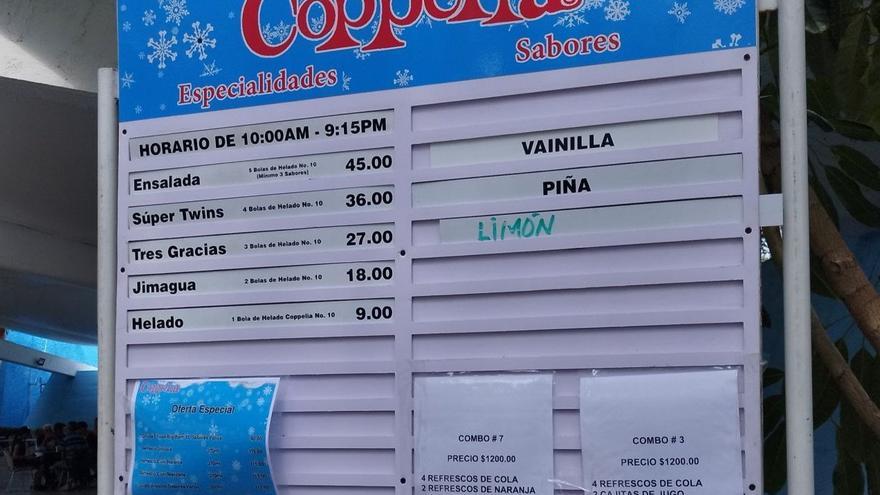
Though it has not had to close like it did early this year due to a product shortage, it is barely keeping its head above water. To stay afloat, it has begun selling combo deals for 1,200 pesos apiece, as 14ymedio discovered on Tuesday.

These package deals contain nothing of nutritional value. One such combo comes with four cans of cola, two cans of orange soda, six packets of cookies and two bars of chocolate. Another contains four cans of cola, two of juice, one chocolate bar and eight packets of cookies.

As for the ice cream, the only flavors available were vanilla, pineapple and lime, at nine pesos a scoop, and the place was practically empty.

A young customer at the counter complained of the bad flavor combination of the 45-peso ice cream “salad.” When she asked that her order include only pineapple and lemon, the employee refused. “You have to have all three,” she said, “because the salads are mixed.”

Another customer, whose stomach is sensitive to acids, asked that the lime be left out. He got the same reply. The lime, he was told, was “mandatory.”

For good measure, the employee then put a scoop of lime on each order. The man was surprised to discover, however, that the most acidic of the three was actually the pineapple. The vanilla was simply bad. “This is what this country has come to,” he lamented. “Nothing is what you expect.”

_____________

COLLABORATE WITH OUR WORKThe 14ymedio team is committed to practicing serious journalism that reflects Cuba’s reality in all its depth. Thank you for joining us on this long journey. We invite you to continue supporting us by becoming a member of 14ymedio now. Together we can continue transforming journalism in Cuba.

Cuban President Diaz-Canel Praises ‘Friend Putin’ on Russian Television and Asks the World To ‘Move Away From the Dollar’

The president explained to Cuban journalist Aliana Nieves “the place occupied by the nation in the current geopolitical context.” (Screen capture)

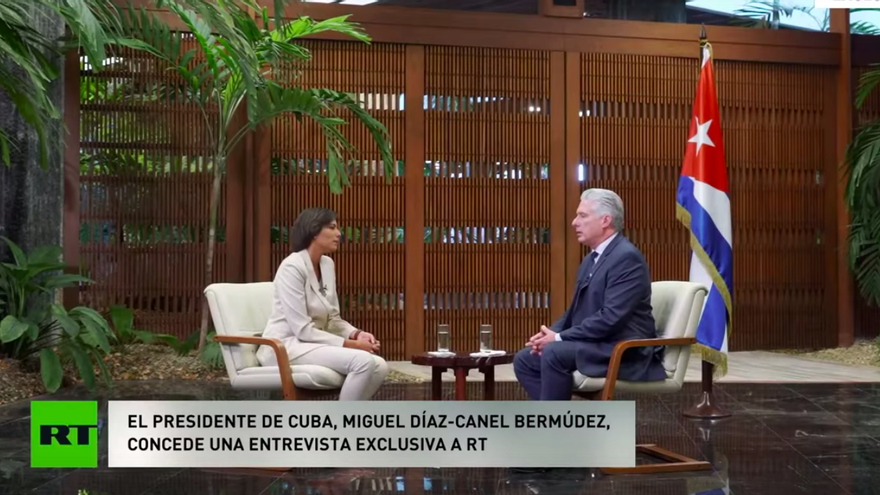
14ymedio bigger14ymedio, Havana, 30 May 2023 — In front of the Russian television cameras, Cuban President Miguel Díaz-Canel once again declared his unconditional friendship with Vladimir Putin. In a long interview, he defended the Social Communication Law recently approved by Parliament and called on the peoples of the world to “move away from the dollar.”

In the conversation, broadcast by the Russia Today television network and available from this Tuesday to Cubans, the president explained to Cuban journalist Aliana Nieves “the place occupied by the nation in the current geopolitical context.”

Díaz-Canel didn’t mince words: “I consider President Putin as a friend. A sincere friend to Cuba. And he has also demonstrated it with actions,” he said. “There is an excellent relationship between the Russian Federation and Cuba,” despite the fact that at some point there may have been “incomprehension or some fracture” between the two countries.

However, all the rough edges were smoothed out, he said, in November 2022, when a Cuban government delegation went to Moscow in search of economic support. “I felt an enormous understanding from President Putin about Cuba’s problems and situation,” he said.

Díaz-Canel exalted Putin as a “Russian and world leader” with whom he claimed to “coincide on many points of the international agenda.”

He also referred to the “historic ties” between Havana and Moscow since Soviet times, including, he said, in the family sphere: “There are Cuban-Russian families, and an important part of the skilled workforce talent that we have in our country was educated in Russia, with a whole exchange.” continue reading

He emphasized what he described weeks ago as his support for Russia’s “energetic condemnation of the West,” although this time he limited himself to “strongly condemning” NATO for “expanding its borders” with Russia.

From Moscow, he summarized, the Island hopes for food, medicines, tourists and economic and commercial support. At the end of the statement, Nieves alluded to the “hope” that was causing the signing of so many bilateral agreements in economic matters, “that ought to or have been translated into everyday life.” Díaz-Canel agreed with the comment and added that the changes would occur “in the medium term.”

To the question about his detractors’ concerns about the Kremlin’s “advice” to the Cuban business sector, Díaz-Canel responded that you have to see “where those doubters come from.”

He claimed that the United States should be the real concern, because it “tightens the screws” more and more. “They give false expectations of an alleged effort to improve the Cuban situation, and everything we experience is the opposite,” he said, not clarifying if he was referring to the Cuban government’s discussions with Washington.

Asked about Cuba’s future role in the context of the economic alliance between Brazil, Russia, India, China and South Africa (BRICS), Díaz-Canel again attacked the United States and limited himself to saying that the Island hopes for a “multilateralism” where Russia also has a leading role.

“BRICS is considering separating from dollarization,” he said, and he pointed out his “strategy”: “By moving away from the dollar, the sanctions imposed by the United States are avoided. Cuba is an example of that,” he said, without alluding to the fact that international remittances in dollars and euros keep the precarious national economy afloat.

One of the measures to incorporate trade with Russia, he added, has been to open subsidiaries of Cuban banks in Russia and branches of Russian banks and financial agencies on the Island.

As for the Social Communication Law, Díaz-Canel called it “historic,” since none of his predecessors in the Government had dealt with the issue, and the legislation, in that sense, “was totally outdated.” “It cannot be a law that remains for many years,” he said, because of the “tremendous speed” at which communications technology advances.

In the context of the law’s approval and the justification for its severity, the president followed the usual script: “Cuba, like other countries, is totally assaulted in the media by campaigns of hatred, slander and discredit, which come from imperial centers of power supported by the US Government,” he said.

“Networks are less and less democratic and are managed by a small number of transnationals” with their own interests, he alleged. His solution? “Post our own content,” adding that he intends for the Cuban population to “know how to communicate” in that way.

Díaz-Canel said that he had achieved “consensus” with the citizenry and was implementing a “culture of debate”: “This is a paradigm that many in the world defend, but that is broken when they try to fracture the dialogues, when others say different things than those they want to impose,” he said, without alluding to the severity of the recently approved law that even penalizes interaction on social networks.

He dedicated the last part of the interview to China but did not describe the present state of its relations with the Island. He limited himself, again, to criticizing the United States and theorizing about the “Taiwan issue,” which threatens the “reunification” that Havana and its allies defend.

Translated by Regina Anavy

____________

COLLABORATE WITH OUR WORKThe 14ymedio team is committed to practicing serious journalism that reflects Cuba’s reality in all its depth. Thank you for joining us on this long journey. We invite you to continue supporting us by becoming a member of 14ymedio now. Together we can continue transforming journalism in Cuba.

An Unfinished Essay on Hate in Cuba

We were lumpen, scum, worms, bastards… and now we are haters. (Ecured)

14ymedio bigger14ymedio, Yunior García Aguilera, Madrid, 30 May 2023 — The Cuban regime behaves like a violent husband who, after destroying his partner’s face, swears he did it out of love. They, the ones with slogans about death and clubs studded with nails, are now the “Care Bears”. Díaz-Canel, after giving his abhorrent combat order, dons a pink dinosaur costume and pretends to be Barney and Friends.

They say they’re on the side of “those who love and found.” First they used José Martí as the intellectual author of an armed attack on the Moncada barracks. Then they attempted to tattoo a hammer and sickle on the apostle’s* forehead, concealing his criticism of Marxism. Later they juggled to reinterpret the phrase, “with everyone for the good of everyone,” insinuating that “everyone” only included them. And now they waste rivers of ink trying to turn a dramatic poem, Abdala, pointing out that it was an adolescent Martí who spoke of “invincible hate”, an immature Martí.

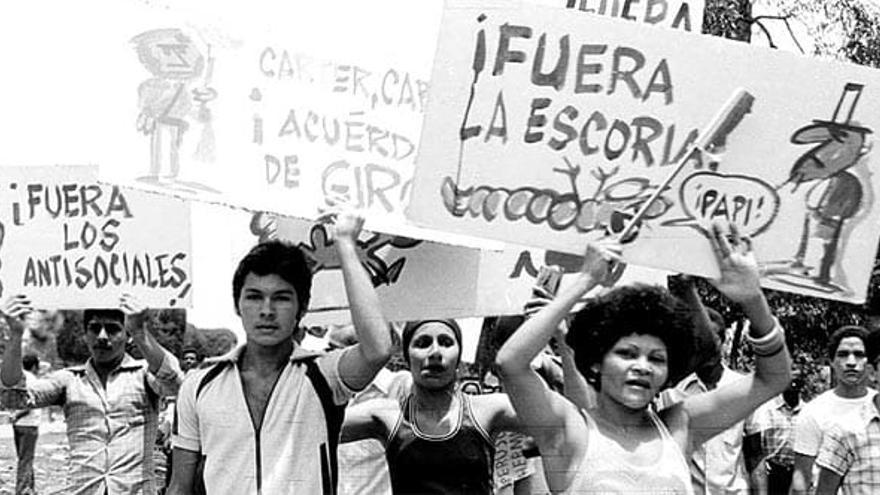
Against us, the beaten, they always used hateful phrases. We were lumpen, scum, worms, bastards… and now we are haters. They think that, after all the beatings they gave, we will be submissive and get in bed with them.

Che, his model to be followed, was a bit less hypocritical. The hesitant guerilla spoke of hate as a factor in the fight, the intransigent hate of the enemy, the hate that should turn them into efficient killing machines. Che said that “a people without hate cannot triumph over a brutal enemy.” Guevara, at least, consciously assumed the role of hater, without pouting or masking his dislike with fake emojis.

I am not a Guevara fan. The asthmatic guerilla’s incendiary philosophy is not my paradigm. But I take responsibility for my rage. I cannot be indifferent when faced with all the crimes of a deceitful regime that has dispensed so much physical and psychological abuse, in the name of an abstract love. continue reading

That love, considered by Albert Camus as worse than hate, resulted in the Holy Inquisition, the Nazi genocide and the horrors of Stalinism. Hitler himself said he fought for love. And Castroism wants us to view executions, concentration camps for homosexuals, parameterization,** censorship, rapid response brigades, the sinking of ships with children aboard, political prison and forced exile as “crimes of passion”.

The regime has exploited the issue of Buena Fe’s Spanish Tour to shed its clothes. Even Alpidio Alonso has been so cynical as to talk about “harassment” and “physical assault in public”. The Minister of Censorship forgets the January 27th when he not only went out to snatch phones away from people on the street, but also to throw punches at young artists, beat them onto a bus, and drag them to a jail cell.

The members of Buena Fe have not been thrown onto a garbage truck, they have not seen decapitated doves at their doors, they are not imprisoned nor prevented from leaving the country, patrol cars don’t harass them. On the contrary. In a free country, Spain, they can call the authorities if they feel threatened, they can count on their protection during concerts. In Cuba, however, it is the very police deliver the scratches. It is they who dress as the people to spit and throw stones at everyone who doesn’t believe their official discourse.

This flipping of the dictatorship’s narrative about love and hate is not casual. Their laboratories know that there is a global controversy around hate on social media, that the algorithms are programmed to promote or contain content, depending on this dilemma. That is why they abuse those little words that sound altruistic and they place them in their hashtags. The order to speak of love is not the result of a genuine sentiment, it is the Party’s official directive to its technicians on the use of social media.

But millions of Cubans refuse to continue suffering from Stockholm syndrome. Millions of Cubans have shut the door, as Nora in A Doll’s House. Twenty-first century Cuba does not want to continue to be hostage to a toxic love. This country wants to report them, take them before the tribunals, so that they will pay for their abuse. And it is not hate, it is justice. This country can no longer stand the slimy phrases of a regime that only loves power, that only wants us so we can iron their shirts. And it is not hate, it is dignity.

This country… wants a divorce.

Translated by: Silvia Suárez

Translator’s notes:
*José Martí is known as “the apostle” by Cubans of all persuasions.
**Parameterization is a process of establishing parameters and declaring anyone who falls outside them (the parametrados) to be what is commonly translated as “misfits” or “marginalized.” This is a process much harsher than implied by these terms in English. The process is akin to the McCarthy witch hunts and black lists and is used, for example, to purge the ranks of teachers, or even to imprison people.  

____________

COLLABORATE WITH OUR WORKThe 14ymedio team is committed to practicing serious journalism that reflects Cuba’s reality in all its depth. Thank you for joining us on this long journey. We invite you to continue supporting us by becoming a member of 14ymedio now. Together we can continue transforming journalism in Cuba.

With the Murder of Anay Perez, There Are 32 Cuban Victims of Sexist Violence This Year

Anay Pérez was murdered by her partner at home in Guanábana, Matanzas. (Facebook)

14ymedio bigger14ymedio, Havana, 30 May 2023 — The death of Anay Pérez is the 32nd femicide of the year in Cuba, a figure that predicts that sexist violence will take more lives of Cuban women than in 2022, when there were 34 events reported by independent organizations and media. Journalist Alberto Arego confirmed with sources close to the victim that her partner killed her this Monday in Guanábana, Matanzas.

According to Arego’s report, a friend of the victim confirmed that the man, identified as Yosvani Torreblanca, killed her in the bathroom of her home around 3:00 in the morning and then turned himself in to the police. “The mother was the first to see her. She had to be sedated because she was very upset. It couldn’t have been easy at all. They didn’t let us see her because she was disfigured,” he said.

“Tata, you left me like that all of a sudden. You didn’t deserve this. You were just a little girl of only 21 years old that everyone here in the neighborhood loved; your life didn’t have to end like this. We will miss you a lot,” the journalist quotes a family member.

The scene of this femicide is about 19 miles away from the small town of Cidra, in the municipality of Unión de Reyes, where last week a triple homicide of a couple and their eight-year-old son took place. The preliminary version given by the authorities and acquaintances of the victims is that the motive of the crime was robbery. continue reading

The murderer, a former soldier, first killed his father, Maykel González Medina, and threw him into a pit that was near a workshop. Then he went to the victim’s house, where he attacked Linet Lucia and her son. The family is survived by a daughter who was not at home.

Meanwhile, the list of femicides continues to increase, and in the last week alone three more deaths were reported. Last Thursday, the Yo Sí Te Creo [Yes I Do Believe You] platform confirmed the murder of a woman identified as Tomasa, in the Havana neighborhood of Luyanó in the early morning of May 24.

In addition, independent journalist Claudia Padrón Cueto confirmed the murder of Daniela Thalia Tasse Arias, whom her partner killed with a knife at the Luis Marcano school, in Bayamo (Granma). Another case was that of Yericel Hernandez González, murdered in Guantánamo by her husband last Friday.

In the first five months of 2023, February has been the deadliest, with 11 femicides reported by independent organizations that keep a record in the absence of official statistics. April follows with six deaths.

Last April, Miguel Díaz-Canel said that his Government will have “zero tolerance” for sexist violence, but Cuban legislation still does not classify femicide as a crime, despite the repeated calls of feminist organizations. A month after those statements, the Supreme People’s Court of Cuba reported that in 2022 there were 18 convictions on the Island for sexist murders. The institution said that the sanctions exceed 25 years in prison and that the convicts range in age from 20 to 44 years.

Translated by Regina Anavy

______________

COLLABORATE WITH OUR WORKThe 14ymedio team is committed to practicing serious journalism that reflects Cuba’s reality in all its depth. Thank you for joining us on this long journey. We invite you to continue supporting us by becoming a member of 14ymedio now. Together we can continue transforming journalism in Cuba.

In Anguish, the Wife of a July 11th Prisoner on a Hunger Strike in Cuba, ‘He Could Lose His Life’

Yosvany Rosell García Caso was sentenced to 15 years in prison for sedition. (Courtesy)

14ymedio bigger14ymedio, Reinaldo Escobar, Havana, 31 May 2023 — Before July 11, 2021, Yosvany Rosell García Caso spent his days between working as a welder and rearing his three children. That Sunday his life took a turn when he joined the mass protests in Holguín. Six months later, he was sentenced to 15 years in prison for sedition. Wednesday marked his 20th day on a hunger strike, demanding his immediate release.

“My husband has lost a lot of weight and he is very frail; he barely weighs 55 kilograms after so many days without a taste of food,” Mailín Rodríguez Sánchez tells 14ymedio. “On May 29th they transferred him from the Cuba Sí prison in El Yayal to the Lucía Iñiguez Landín Clinical Surgical Hospital.

“He is refusing intravenous hydration,” adds Rodríguez, who spoke with her husband to “try to get him to change his position.” However, 34-year-old Rosell was determined to “continue the hunger strike because he is tired of having his rights, and that of other 11J prisoners, continuously violated.”

“I understand him perfectly, but he is in a situation where he could lose his life and that worries me greatly,” says the anguished woman. Rosell began the hunger strike on May 11, following an incident where prison authorities denied him a visit from his wife and his three children, and as the days passed he expanded his demands to include his release as soon as possible.

“We have three children five, six and 14 years old. The younger ones are aware of what is happening with their father, but the oldest does know everything,” explained Rodríguez to us. “Since yesterday my daughter is asking me to go see her father and we are making arrangements so she can visit him in the hospital. I hope she will talk to him and get him out of the position he is now in.” continue reading

Since he began the hunger strike, the woman, desperately, has gone to the prison on four occasions, but they did not allow her to see him and they did not even allow him religious attention. “After much begging they only let me see him yesterday at midday when he was already in the hospital. Today I am going over there again to see if they will let me in,” she said.

Rodríguez says that the damage is not only emotional or physical, “In addition to violating his human rights, the family has lived through two very difficult years, because he was the breadwinner. We’ve suffered repression and an economic hit for his being in prison. He, working as a welder and blacksmith, provided for the family.”

This is not the first time Rosell is on a hunger strike. In February 2022, he did not eat while demanding that he not be transferred from Holguín to a prison in Cienfuegos and demanding improved conditions in prison. At that time, he had been the victim of suspended telephone calls or being kept in isolation.

Several months later, in July of last year, Rossell once again resorted to a hunger strike after being beaten for dressing in white in remembrance of the mass protests on 11J.

“I do not regret anything in the least bit. How could I regret wanting to see my country free of a communist dictatorship, which for more than 60 years, has subjected us to extreme misery and violated all our human rights? That blessed July 11th not only marked a before and after the beginning of the end of communism in Cuba, it also showed the worst face of the dictatorship,” he wrote in a letter shared on social media weeks earlier.

Translated by: Silvia Suárez

____________

COLLABORATE WITH OUR WORKThe 14ymedio team is committed to practicing serious journalism that reflects Cuba’s reality in all its depth. Thank you for joining us on this long journey. We invite you to continue supporting us by becoming a member of 14ymedio now. Together we can continue transforming journalism in Cuba.

Cooking Gas Is Also Lacking In Cuba

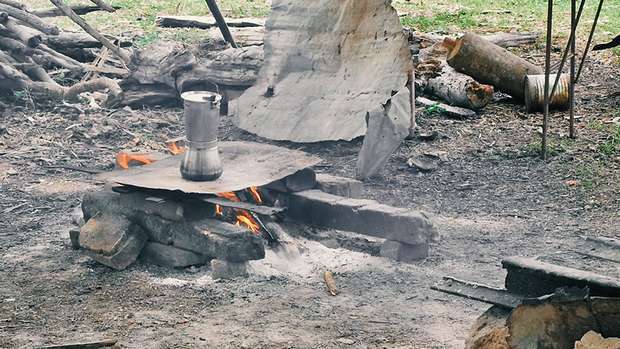
Wood-fired kitchen typical of the Cuban country dwellings. Taken from Invasor, the provincial newspaper of Ciego de Ávila province, located some 400 kilometers to the east of Havana.

Ivan García, 26 May 2023 — The National Highway running through Matanzas province divides Los Arabos municipality in two directions. On the left, a town of just over 23 thousand inhabitants, cracked streets, and wagons pulled by horses that in their tiresome trot leave their poop on the main road.

On the right, a handful of isolated villages with clapboard huts and thatched roofs, surrounded by small food plantations and a few lean cows grazing under the gaze of their owners. If not watched, they are lynched by clandestine butchers.

160 kilometers east of Havana, in the middle of the 21st century—the century of new technologies, 5G and artificial intelligence—Pedro, 56 years old, a generous guy as are almost all the residents of the interior of Cuba, still plows the land with a team of of oxen and cooks with firewood. He lives with his wife and two children in a wattle-and-daub hut with a polished cement floor.

Pedro and his family own few belongings. An antique cathode-ray tube television set, a Haier [Chinese] refrigerator, and a rice pot “from when the Government was giving them out in 2007 during the Energy Revolution,” Pedro explains, and begins plucking a hen. Besides a patch of yuca [cassava] and another of plantains, there are mango, avocado, and sour orange trees. In a pigpen are five native Cuban hogs with shiny black coats.

Two cows and a bull sleep in a shed at the back, attached to the house. “I have to keep them close so they don’t get stolen. It’s a daily struggle to make sure the thieves don’t slaughter the animals and destroy the harvest.” With the milk from the cattle he makes cheeses that his children later sell along the National Highway. continue reading

The fuel shortage prevents him from renting a tractor to plow the land. “We are the same or worse off than during the Special Period. A liter of oil to run the turbine costs me 200 pesos on the informal market. And you can’t always find it. The government talks about food sovereignty, but it provides no fertilizers or fuel, and farm implements and tractors are sold for hard currency. If they don’t change their methods, we are heading for famine,” Pedro predicts.

Three years ago, his wife started cooking with firewood in an open field. “We have a kerosene stove, but it is difficult to find fuel for it. The fuel is usually dry firewood or marabou–the best and healthiest. It doesn’t smoke and the food tastes good. If there is anything in surplus around here, it’s marabú”.

Some 200 kilometers from Pedro’s ranch, in Havana’s Sevillano district, Julia, an 81-year-old housewife, saves liquefied gas down to the smallest measurement. “In March and April, we had a hard time. We had to cook and boil water with an electric oven. In May they gave us a gas cylinder that lasted fifteen days. They should have given us another one, but liquefied gas has not reached the point of sale yet,” she states, then adds:

“There are six people in my house, including a small child. Almost all the gas we expend is for boiling drinking water we and preparing food. At most, it lasts us nine or ten days. On the black market, the gas cylinder costs between 1,000 and 1,200 pesos. Add to that what the courier charges to deliver it. There is no wallet big enough. Before Díaz-Canel’s economic crisis, the gas would be used up sooner, because there were beans to soften, a piece of pork to roast, or a panetela [Cuban sponge cake] to bake. But now, there ain’t nothin’ to cook.”

On April 17, Vicente de la O Levy, Minister of Energy and Mines, said that one of the country’s products with low available reserves is domestic fuel. “Some provinces have one day’s worth left in reserve, others two. But in the eastern region, for example, the fuel in CUPET [state-run petroleum company] tanks at our bases has already run out,” he said.

From end of February to the first days of May, instability in the delivery of liquefied gas has raised alarms among Cubans, who live in constant suspense, awaiting a new crisis. More than 1.8 million customers cook with liquefied gas.

“In Santiago de Cuba we have only the month of May guaranteed. In June, we will see if a fuel ship arrives,” said a worker from the gas company. On May 21 in Havana, families who depend on street gas for cooking lost service that day for a period of more than 24 hours.

“It was about two in the afternoon and I was making dinner. When I turn on the stove, I see that there is no gas. We were like this until Monday afternoon. These people (the rulers) have turned the country into a hell. When it’s not gas that’s lacking, then sugar is scarce, there’s no water, or the electricity goes out. We live in a bloody state of shock,” Luisa, a pensioner, complains.

According to the state-run press, the street gas deficit was caused by an accident at the Puerto Escondido plant, east of the capital. So far in 2023, the fuel shortage in Cuba has grown. There are provinces where gasoline is not sold to private drivers.

“You have to have a permit from the governor or the provincial mayor. That represents another avenue of corruption, because you have to pay an arm and a leg to get the permit. Also, they only sell you 20 liters a week,” stressed a private taxi driver in Villa Clara.

State-owned companies have had to make drastic cuts in fuel use. ETECSA [the state-run telecommunications company], for example, is only receiving fuel for ten or fifteen work days. Most state companies have ceased providing transportation for workers, except military corporations and Communist Party institutions.

On Tuesday the 23rd, the line to buy fuel at the gas station at Infanta and San Rafael streets was three blocks long. “They have tried to alleviate the queues with a WhatsApp feature that notifies you the day you should come to buy. But since there is so much corruption, people arrive early to verify that they’re dispensing gasoline, because sometimes when you get there, they tell you that they’ve run out,” says a private taxi driver.

A liter of gasoline is sold in the informal market for between 500 and 800 pesos, and oil between 200 and 300 pesos. The fuel crisis has shot up transportation costs within the city and also for travel to other provinces.

The fare from La Víbora to Vedado by collective taxi [taxis that pick up people and travel set routes, often in old American cars], which used to cost 100 pesos, increased to 150 pesos–and 200 at night. If you rent a taxi using a WhatsApp feature–a kind of local Uber–an eight-kilometer trip comes out to no less than 1,200 pesos.

This inflationary spiral generated by the fuel shortage has, in a domino effect, caused food prices to increase by between 10 and 40 percent on the informal market–where the vast majority of people are forced to do much of their shopping.

To illustrate: The price of a carton of eggs rose from 1,500 to 2,000 pesos. A pound of rice was 170 pesos, and is now 200–280 if the grain is of higher quality. A pound of ham that used to cost 850 pesos is now priced at 950. The cost of fish increased from 500 to 650 pesos per pound. The biggest increase was that of chicken imported from the US, from 230 to almost 400 pesos per pound. A box of chicken that used to be priced at 7,000 pesos now exceeds 11,000 pesos.

Within the last year and a half, the price of food in Cuba has risen by almost 71%. Various factors have an impact, ranging from the systemic crisis of the economic, political and social model implemented by the regime, to the rise in food and fuel prices on the international market.

Pedro, the farmer from Los Arabos, considers himself lucky. “We don’t even have clothes to wear, and if a cyclone were to pass over us, the house would be blown away by the wind. But at least we have food,” he says. Meanwhile, his wife continues tenderizing a hen with a piece of marabou firewood. And that, in Cuba, is a luxury.

Translated by: Alicia Barraqué Ellison  
Dengue Cases in Santiago de Cuba Reach Disturbing Levels, Especially in Palma Soriano

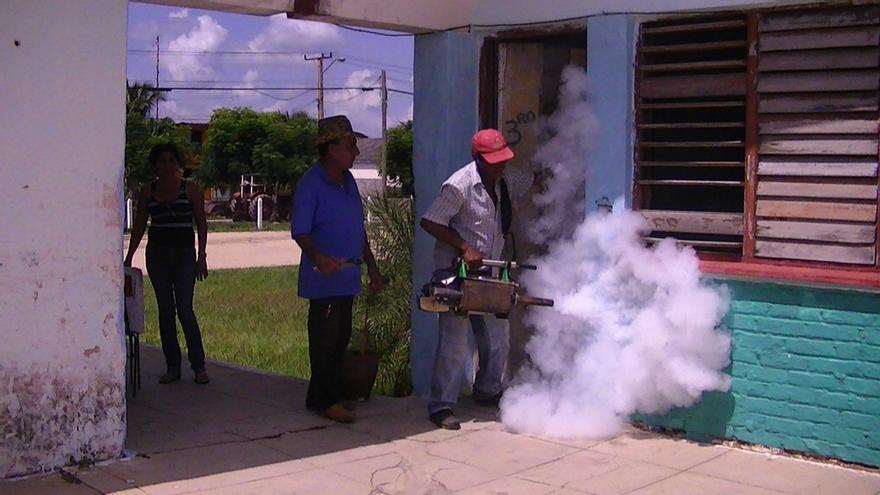
Fumigation in Camagüey to prevent dengue. (14ymedio/archive)

14ymedio bigger14ymedio, Havana, 29 May 2023 – – The rainy season is just beginning and dengue threatens again. In Santiago de Cuba, the contagion figures are already worrying, as an article published this Saturday in Sierra Maestra warns.

“In recent days the number of medical attentions for non-specific febrile syndrome has increased, as well as reactive cases,” says the article, which also warns, as if it were a war report: “With a high-risk infestation index (0.6) and more than 1,800 foci detected (almost 200 more than at the same stage of the previous cycle), the invincible territory has a high probability of moving towards epidemiological events, if a true popular movement for the prevention of the viral infection is not achieved.”

According to the official newspaper, the municipality of Palma Soriano is the one with the worst panorama, and that is why “entomological control actions” (fumigations) are carried out there in about 4,000 homes.

“It is expected that in the coming weeks suspected cases of dengue will continue to appear,” says the report, which also recognizes that the control of the disease “slows down because the economic difficulties that the country is going through limit the size and scope of anti-vector and other actions aimed at eliminating environmental conditions favorable to the insect.” continue reading

As an example of these conditions, Sierra Maestra talks about the “difficulties” in supplying drinking water and eliminating both wastewater and solid garbage, the optimal ecosystem for the reproduction of the Aedes aegypti mosquito, which transmits both dengue and chikungunya.

“The answer to these problems escapes from the actions of Public Health and requires a better performance of Municipal Services and Aguas Santiago (also hit by the scarcity of resources), as well as a greater collaboration of the population, responsible for their health in the first place,” the newspaper says.

And they insist: “If economic conditions have not changed substantially in 2023, you do not have to be an expert to understand that, for the moment, it is impossible to carry out large campaigns.”

Given the possibility that the population does not go to the doctor in a timely manner, as happened in 2022, the provincial newspaper warns of the “danger of staying at home in the face of symptoms such as fever, general malaise and muscle, joint, retrorbital (behind the eyes) and head pain, since dengue can evolve into serious and life-threatening forms.”

Last year, “the most complex of the last 15 years,” in the words of Sierra Maestra, dengue was rampant in several provinces, but especially in Santiago de Cuba, where an incidence rate of 65.2 per 100,000 inhabitants was recorded in November.

The situation was aggravated by the presence of severe or hemorrhagic dengue, which was not alerted by the Ministry of Public Health but by doctors in their personal capacity. “In previous epidemics, perhaps approximately 1% of cases had signs of alarm (those that alert you that the patient is not progressing well), but now it is more than 30%,” a doctor confessed to this newspaper.

The authorities did not give the official death toll at any time, although social networks and the independent press recorded several deaths of health professionals.

Translated by Regina Anavy

____________

COLLABORATE WITH OUR WORKThe 14ymedio team is committed to practicing serious journalism that reflects Cuba’s reality in all its depth. Thank you for joining us on this long journey. We invite you to continue supporting us by becoming a member of 14ymedio now. Together we can continue transforming journalism in Cuba.

Lightning Kills an Employee of Union Del Niquel, a Cuban Partner of the Canadian Sherritt Company in Moa

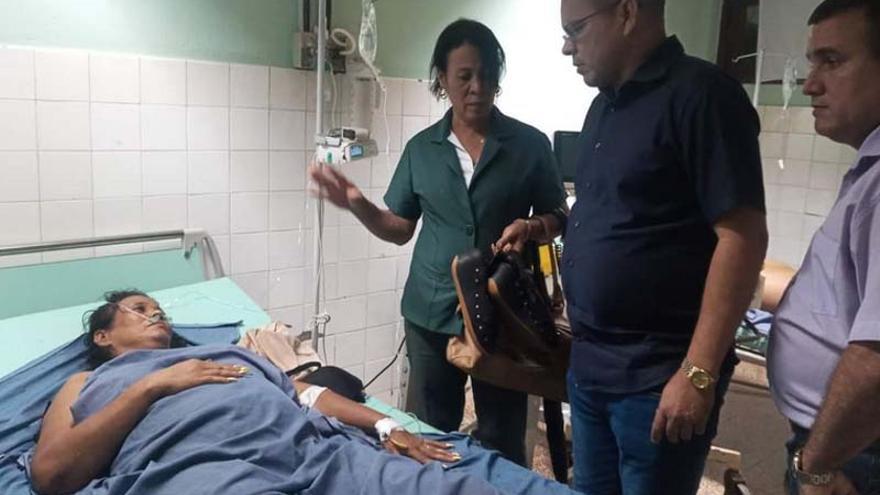
Those affected were transferred to the Guillermo Luis Hospital, in Moa. (Rubiel De La Cruz Rabí/ Facebook)

14ymedio bigger14ymedio, Havana, 30 May 2023 — A lightning strike caused an electric shock in front of the Nickel Union Service Company in Moa (Holguín) and ended the life of one of the workers, Dunielkis Fonseca Borges, in addition to affecting six other people. All of them were employees of the state company and were waiting for transportation to return to their homes when the event occurred.

As a result, Fonseca Borges, “Muma,” who was a specialist in economic management, had to be resuscitated at the site of the discharge but died after again suffering cardiorespiratory arrest upon arriving at the Guillermo Luis hospital, where all the employees were treated.

Another of those affected is pregnant but, like the rest of those treated, she is out of danger.

According to the official newspaper of Holguín, Ahora, Bárbaro Aguilera Pelegrín, a safety and health specialist of the emergency group of the nickel company Comandante Pedro Sotto Alba, said his workers went to the place quickly after hearing the cries for help from those affected, since their facilities are a few meters from the point where lightning struck. continue reading

Three people were lying on the ground when the emergency teams arrived, although only one — the deceased — had to be resuscitated.

The death of Fonseca Borges is the third of a nickel industry worker in Moa to be mourned in the last two months. On May 17, the Canadian company Sherritt International reported the death in a work accident of a worker who fell from a ladder in the nickel-cobalt mine that is located in that town in the East.

On April 24, another employee of the company died, that time in an accident with a vehicle.

Translated by Regina Anavy

____________

COLLABORATE WITH OUR WORKThe 14ymedio team is committed to practicing serious journalism that reflects Cuba’s reality in all its depth. Thank you for joining us on this long journey. We invite you to continue supporting us by becoming a member of 14ymedio now. Together we can continue transforming journalism in Cuba.

In Four Years, Cuba Has Lost Almost 25 Percent of Its Electricity Production, According to Official Data

Havana consumes a quarter of the country’s total energy. (14ymedio)

14ymedio bigger 14ymedio, Madrid, 30 May 2023 — Electricity generation was reduced by almost a quarter in just four years in Cuba. According to the data published on Monday by the National Bureau of Statistics (ONEI), last year there were 15,732 gigawatts (GW) per hour on the Island, 24.5% less than in 2018, when the amount reached 20,837 GW.

The figures reveal a progressive fall in the last four years that accelerates with the pandemic up to the strong collapse of the last year. In 2019, the decrease was minimal, just 0.63%. However, already in 2020 the fall was large, with 7.8%. Although smaller, the decline continued strongly in 2021, when 5.8% less was generated than in the scarce previous year and, finally, the catastrophic situation of 2022 is reached, with -12.4%.

The data are incompatible, in the words of Cuban economist Pedro Monreal, “with the economic recovery in the short term or with long-term development.”

The expert also looks at the alternative sources of electricity generation, which in the case of distribution are even worse, although their weight is less as a share of the capacity of the Island. In the last four years, the electricity obtained by generators fell by 42%, which also rises to 44.6% if the focus is on the last year. In 2021, 5,902 GW per hour were obtained, the highest amount in the last four years, while in 2022 only 3,273 GW were produced, the lowest of the same period. continue reading

Last, there is renewable energy. Part of the strategy announced by Cuba years ago involves the conversion of its energy matrix to a clean one, for reasons of sustainability and potential of the Island, with enough hours of light to be very competitive in solar. However, and despite the fact that the regime has put all its efforts into selling the green energy parks in the portfolio of opportunities for foreign investment, the money does not arrive and progress is extraordinarily slow. In addition, in practice, the Government has not made its own investments that demonstrate its interest in a real change in this regard.

Thus, the Island’s renewable electricity generation barely reaches 4.1%, when the intention is to reach 24% by 2030. “The official statistics reflect the difficulty in increasing the relative weight of renewable sources of electricity in Cuba,” insists Monreal, who also observes an interesting fact. Between 2021 and 2022, renewable electricity generated by auto-production fell 36.1%, from 432.4 GW/h to 276.1.

Another interesting fact revealed by the balance sheet concerns consumption. Both private and state residential consumption was forcibly reduced in the last year due to the fall in generation. Homes used 8,891 GW/h last year of the 14,862 that were consumed in total (and that includes national and imported generation with losses subtracted). Private consumption, meanwhile, used only 834, an amount higher than the 552 consumed in 2022, attributable to the growth of the private sector. As for the state sector, it consumed 4,205 GW/h; 173 went to public lighting and 1,590 to inputs.

The balance sheet also indicates the growth of imported energy, one of the few numbers that increases. In 2021, 1,384 GW/h had to be brought from abroad, compared to 2,590.7 in 2022, 87% more. That year there were eight mobile plants of the Turkish company Karadeniz Powership on the Island, one of which left this April after having fulfilled its contract, according to the Cuban government. Although the rental price of these platforms is unknown, the authorities have never hesitated to describe the cost as “very high,” while insisting that there was no better short-term solution if they wanted to stop the already eternal blackouts that the population has been suffering for a year with almost no interruption.

Another striking fact that the report leaves out is the disproportion of territorial consumption. Havana, where a large amount of population and most of the powerful companies are concentrated, takes a quarter of the island’s energy, 25.2%. Matanzas follows, but at such a distance that it barely stays at 8.1%.

The figures change if gross production is analyzed. The province of the capital only generates 1.5% of the total, with Matanzas (22%), Holguín (16%) and Cienfuegos (14%) contributing the most, both through the public service and through autonomous producers, who direct the surplus into the National Energy System.

Last Saturday, in an interview in Cubadebate, Vicente de la O Levy, Minister of Energy and Mines, promised that with the fulfillment of the maintenance planned until May, “it is expected that we will face the summer in better conditions” from the point of view of electricity. The official said that there would be a decrease in the “uncomfortable lines” in the service centers, after weeks of scarce fuel availability, and added that electricity generation will have, from now on, “a considerable decrease in affectations.”

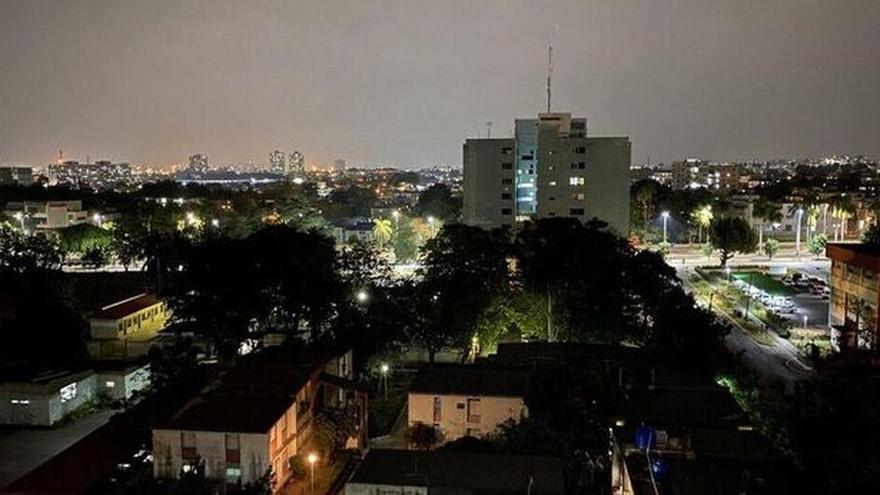
Barely 24 hours later, some points of the Island had already accumulated about 20 hours without electricity.

Translated by Regina Anavy

____________

COLLABORATE WITH OUR WORKThe 14ymedio team is committed to practicing serious journalism that reflects Cuba’s reality in all its depth. Thank you for joining us on this long journey. We invite you to continue supporting us by becoming a member of 14ymedio now. Together we can continue transforming journalism in Cuba.

Cuban Regime Bars Private Companies from Remunerated Training Activities

14ymedio, Elías Amor Bravo, Economist, 17 May 2023–Workforce training is one of the most important activities to develop in any economy that does not want to lose the competitiveness and prosperity race in the knowledge society in which we now live. Unions and businesses, which deploy training programs based on dialogue and social agreements that are applauded by the government and implemented with public and private funding, know this. Unfortunately, in this matter, Cuba is also different from the rest of the world. We’ve just found out that the Castroite economic system cannot be further from reality and the needs of a modern society and economy. We learned yesterday, through the Official account of Cuba’s Minister of Economy and Planning, directed by Gil, that currently, not a single micro, small or medium private enterprise (known as mipymes in Cuba) or nonagricultural cooperative (private entities) includes training activities in its approved social objectives, thus it is not legal to offer remunerated training services. From that, we conclude that mipymes and nonagricultural cooperatives are not authorized to charge for training services.

In Cuba, neither mipymes nor nonagricultural cooperatives have the government authorization to impart training for a fee. Carrying out this activity could be a crime. The regime would like them to do it for free, in which case they would not do them. The matter came to light, apparently, because the Ministry had information that a series of “non-government forms of management had requested to conduct or were conducting courses, conferences, seminars and other types of training on various topics, in exchange for a fee or by contract.”

Think of the damage it could do to an economy if courses, conferences, seminars, and other types of training were provided, establishing a price. The price would be established to regulate the conditions of service delivery in terms of quality and quantity. Is it that the regime would like that these activities be carried out for free? Once again the collectivist principles and false egalitarianism are driving the economy. continue reading

In reality, these activities could sometimes be free, if the training program benefits from some type of subsidy, but in modern economic systems, all businesses, regardless of whether they are public or private, can organize training and if they deem it necessary, may charge for their services as compensation for their effort and dedication to the task. There is nothing abnormal or odd about it.

In Cuba, forget about it. When faced with the complaint, Ministry authorities took Decree 49/2021 out of the drawer, “Of the activities carried out by micro, small, and medium private enterprises, nonagricultural cooperatives, and self-employed workers,” and the rest of the legislation relative to the Cuban education system, which prohibits the private, remunerated exercise of training activities. And they are willing to demand compliance.

In line with what was presented, one of the economy’s main sources of knowledge transfer is eliminated, which is formal or nonformal training. The so-called education and formal training is acquired through the education system and is paid for with taxes collected by the communist government. Good. But in the world of work, training aimed at improving the qualifications of workers, introducing new products or services, new processes, etc. is conducted within and by companies. Díaz-Canel’s doctoral thesis includes some references to this type of issue.

Mipymes that have, through research, development, and innovation (I+D+i in Spanish) acquired some competitive advantages, which may be of interest to others, will not be authorized in Cuba to train others on those advantages, which in any case would be continually changing so as not to lose their competitive edge.  It is interesting because on many occasions, companies finance their I+D+i activities by offering to train others, but in Cuba this path is closed by the regime, such that external training activities, both formal and nonformal, for a fee, are banned by the communist regime for the private sector. Let’s see who risks offering them for free.

The issue is that this measure may extend to foreign private companies that operate on the Island.  Let’s remember that one formula often used to hire qualified employees for open positions is based on conducting training and selecting the most qualified candidates and those that adapt to the requirements of the job. To participate in these programs, on occasion there is a fee. Is this formula banned?

And what will happen to the internal trainings all companies conduct to continually adapt their services and products, aimed primarily at their employees. Generally, these programs are implemented by the employees of the company (who get a salary supplement) or they hire external professionals to develop training initiatives. Will it also be forbidden to contract external firms to conduct training or pay trainers a bit extra? And what will happen to training consulting services that help design better plans adapted to the needs of companies? And what will happen if the union conducts training or the association of Spanish businesses in Cuba, for example?

The formula selected by the communist regime is unjust and is ideologically charged. It prohibits private companies from charging for training services they provide, such as courses, conferences, seminars and other types of training, then are we to suppose that it will do the same to non profit organizations linked to certain institutions that still can operate on the island with an authorization from and under the control of the regime? Why does it apply to some and not others? The consequences of this type of measure is that in Cuba job training will not reach the levels desired for an economy that wishes to prosper. Without training, worker productivity will be deficient and delayed relative to technological advances. Without training, workers lose motivation and are less productive.

Given the state of the Cuban economy, the recommendation to authorities is to start over with a clean slate for the haggard Decree 49/2021, before it’s too late. Cuba cannot be at odds with the world economy.

Translated by: Silvia Suárez

Spanish post
17 May 2023