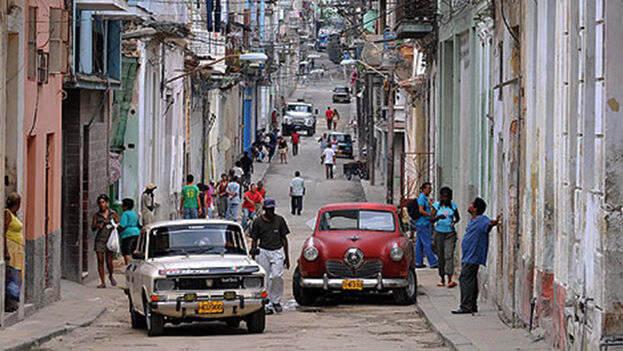
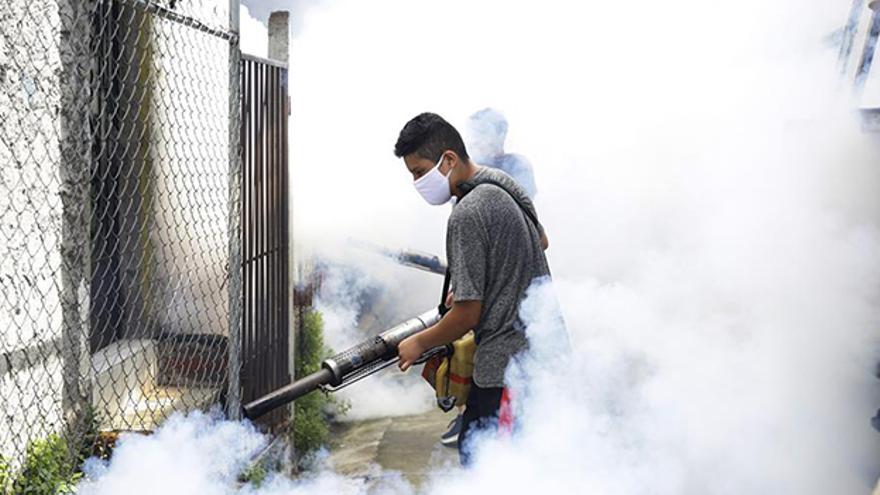
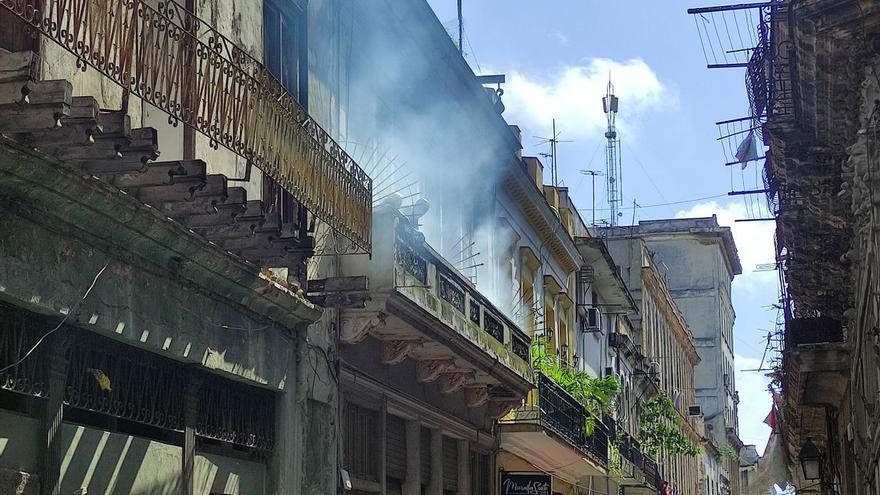
A family waits on their balcony minutes after their home is fumigated in Centro Habana. (14ymedio)
14ymedio, Juan Diego Rodríguez, Havana, 22 August 2022 — The tiredness that María felt last Wednesday did not bode well, although, at first, she thought it had been the walk in the sun throughout Central Havana in search of bread. Later, her discomfort made her fear the worst of it, of which she had no doubts the next day, when she woke up with a fever of 101F: she had dengue fever.
The woman, however, refuses to have it confirmed by a doctor. “I take a lot of fluids, vitamins and paracetamol for the fever,” she tells this newspaper. “If you go to the doctor they don’t give you anything either.” María remembers that the last time she suffered from the disease, 12 years ago, when she was visiting relatives in the province, “they almost brought me to the police because I refused to go to the hospital.”
At that time, she points out, they hospitalized people to avoid contagion. Now, she ventures, alluding to his central Havana neighborhood, “this must be riddled with dengue, because today they were fumigating the streets early and they never do that here.”
“If all those who get sick went to the doctor, the official figures would be much higher, but a good part of the population is afraid of being admitted, and so people do not go,” the official press published this Monday, citing a patient from Pinar del Río.
In the same article, the director of the Provincial Center for Hygiene, Epidemiology and Microbiology of that province, Andrés Villar, offers the figure of 1,457 outbreaks as a result of the Aedes aegypti mosquito in the Vueltabajo area alone. However, the State newspaper Granma does not go beyond describing the situation as a “complicated scenario.” continue reading
In Ciego de Ávila, the newspaper Invasor echoes that the infection rate in the provincial capital, of 0.43 –- compared to the permissible 0.05 -– “sets off the alarms.”
Yordanka Hernández Rodríguez, deputy director of Epidemiology at the Municipal Hygiene Unit, reported that last week, of 114 samples analyzed in Ciego de Ávila, 48 were positive.
The Ministry of Public Health, for its part, has not issued any alert or figures that encompass the entire country. The minister, José Ángel Portal Miranda, appealed to “individual and family self-responsibility” in the face of the spread of the virus.
The minister also warned that patients can progress to a serious condition “very precipitously” and are asked to go “immediately” to medical services “at the slightest sign of alarm that may appear, especially between the third and seventh day after the first symptoms, such as repeated vomiting, edema or swelling, severe abdominal pain, irritability, drowsiness and bleeding.
This Sunday, on the fourth day after her first symptoms, the fine rash characteristic of the disease appeared on María’s extremities. She no longer has a fever, but she prays that it does not turn into severe dengue, hemorrhagic fever, the only case in which she would go to a doctor: “If I go, I only help them with the statistics; they are not going to help me.”
____________
COLLABORATE WITH OUR WORK: The 14ymedio team is committed to practicing serious journalism that reflects Cuba’s reality in all its depth. Thank you for joining us on this long journey. We invite you to continue supporting us by becoming a member of 14ymedio now. Together we can continue transforming journalism in Cuba.
Evangelical pastor Alain Toledano and his family upon arrival in the United States. (Outreach Aid to the Americas)
14ymedio, Havana, 26 July 2022 — Evangelical pastor Alain Toledano Valiente and his family arrived in the United States on Monday. The minister, according to the organization Outreach Aid to the Americas, was forced to leave the island under threats from the Cuban authorities: “Leave the country within 30 days or you and your family will face the consequences,” he was warned.
The family’s arrival in the United States was possible thanks to the intervention of the US Ambassador General for International Religious Freedom, Rashad Hussein, and the Department of State’s Office of Consular Affairs, which allowed the pastor “to obtain emergency parole,” which provided “a secure entry,” the organization said.
The Cuban government’s hate campaign against the cleric, according to Outreach Aid to the Americas, was carried out “simply for running an unregistered church and speaking tirelessly for the rights of other religious and church leaders.”
The leader of the Sendas de Justicia (Paths of Justice) network denounced in November that a man broke into his home, when his wife and daughter were alone, in an act of intimidation, given that the man tried to rip the door off.
During the recovery stage of the covid-19 pandemic, Toledano and his family suffered harassment from the regime on restoring religious services in their church. In August of last year, the leader of the Sendas de Justicia network was arrested at his home in continue reading
Santiago de Cuba, charged with “propagation of an epidemic.” The accusation was unfounded, since since the first week of June 2021 the Government had authorized the churches to resume their activities normally and moderately.
In September of that same year he was summoned to the Police Third Unit, again accused of spreading the virus. As the pastor told Radio and Television Martí : “They booked me like a complete bandit, like a complete criminal.”
The US Government through the #JailedForWhat campaign demanded the release of Alain Toledano, “detained for religious practices,” and questioned Cuba because “instead of promoting and protecting religious freedom,” the government on the island denied religious leaders the right to exercise their beliefs.
In 2016, Toledano suffered the unjust expropriation of land and the demolition of his church in Santiago de Cuba. Despite the fact that he met with the first secretary of the Communist Party in the province, Lázaro Expósito, to claim the goods confiscated by the police during the raid and demolition of the place of worship, the only thing that was returned to him were some discs and computer mice.
____________
COLLABORATE WITH OUR WORK: The 14ymedio team is committed to practicing serious journalism that reflects Cuba’s reality in all its depth. Thank you for joining us on this long journey. We invite you to continue supporting us by becoming a member of 14ymedio now. Together we can continue transforming journalism in Cuba.
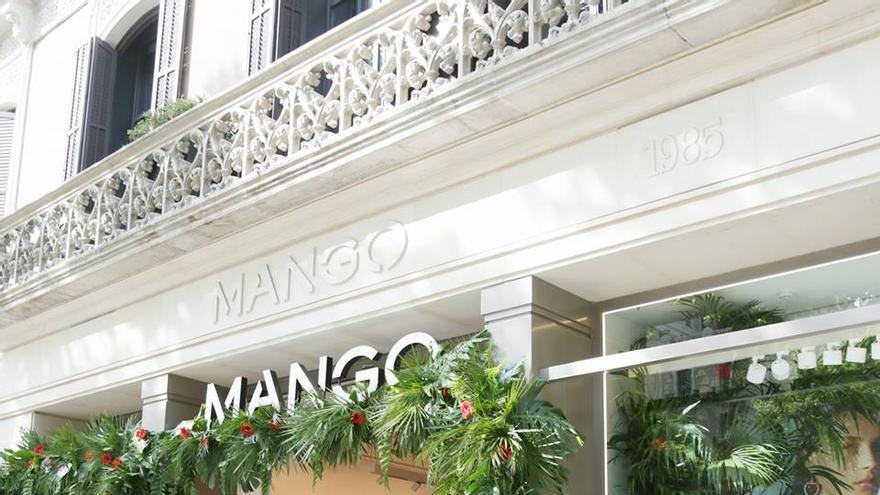
Mango, on luxurious Manzana de Gómez in Havana, is one of the few Spanish clothing stores in Cuba. (14ymedio)
14ymedio, Madrid, 29 August 2022 — The discrete opening to foreign market investment announced by the Cuban government this month has piqued the interest of Spanish businesses, according to the economic daily Cinco Días.
On Monday, the Spanish daily published an article which mentioned that the businesses which market raw materials, food, equipment, machinery, replacement parts, inputs for the development of local industry or inputs for the development of renewable energy will benefit the most, according to Hermenegildo Altozano, a partner in the Bird&Bird law firm, which provides legal advice related to operating on the island.
The specialist warned, however, that it all depends on the weak point of investing in Cuba: legal security. “Cuban operators must comply fully and precisely with the commitments made to foreign operators and they must be assured that there will not be restrictions or conditions on foreign transfers in freely convertible currency,” he explained.
Ignacio Aparicio, an partner at Andersen’s Cuban Desk, another legal advising company specializing in Cuba, believes that the measures of the executive branch are pending additional details, but he considers them of interest to foreign business owners. “Participation of foreign investors had not been possible until now, which limited the posibility of international brands of various products entering the Cuban market. They always had to access these channels through third-party, state-owned companies, which made it difficult to correctly implement their marketing policies such as price setting, sale pricing, and protecting their brand,” he told Cinco Días.
According to that outlet, the companies with the most options are those that have already been exporting to Cuba, such as those that sell equipment, which in 2021 made up 37% of sales to the Island, valued at € 235 million in machinery, mechanical or electronic devices. continue reading
Food, especially preserved meat and fish, represented 19% (€ 117 million), and plastics 8% (€ 49 million).
But the information is also suggestive of a possible arrival of textile giant Inditex, which has a presence in every country in the world except on the Island. “Companies view it as good news due to their affinity for Cuba and the acceptance of these brands in that region of the world, but at the same time, have some reservations due to the uncertainty and the lack of legal security,” said Eduardo Zamácola, president of the National Association of Retail Fashion (Acotex).
The business owner, who through Acotex represents more than 800 companies, believes that if these obstacles can be overcome it will open up a business opportunity for Tendam (which owns Spanish Cortefiel, Springfield, Pedro del Hierro, Women’secret and Fifty); Mango, which had two stores in Havana though only one remains; and Inditex. The Spanish textile empire created by Amancio Ortega includes many popular brands, among which the most well-recognized is the original, Zara.
The article highlights the “successful” Spanish presence in Cuban tourism through hotel management. According to data from Icex (the Spanish government agency that promotes international investment), there are 100 hotel administration contracts on the Island of which 70 are with Spanish companies. Meliá and Iberostar, with 33 and 18 hotels, are among those with the largest numbers, although the activation of Title III and IV of the Helms-Burton law resulted in legal trouble for both of them, especially the first; the final legal decisions are pending.
Furthermore, Icex revealed that three Spanish groups, Globalia, Atlantic Group Investment and La Playa Golf and Resort, are developing large-scale real estate projects associated with golf courses: El Salado (Artemisa), Punta Colorada (Pinar del Río) and La Altura.
Foreigners will be able to invest in wholesale commerce through mixed enterprises, international economic association contracts, or through the creation of an affiliate in Cuba or a franchise that is 100% foreign-owned. In contrast, for retail, the only modality will be through a mixed enterprise.
This measure is intended to ease the scarcity of goods on the Island, which has worsened in the last year, but although investors are eyeing Cuba, the warnings are the same as usual and it all depends on the fine print in the norms.
Translated by: Silvia Suárez
____________
COLLABORATE WITH OUR WORK: The 14ymedio team is committed to practicing serious journalism that reflects Cuba’s reality in all its depth. Thank you for joining us on this long journey. We invite you to continue supporting us by becoming a member of 14ymedio now. Together we can continue transforming journalism in Cuba.
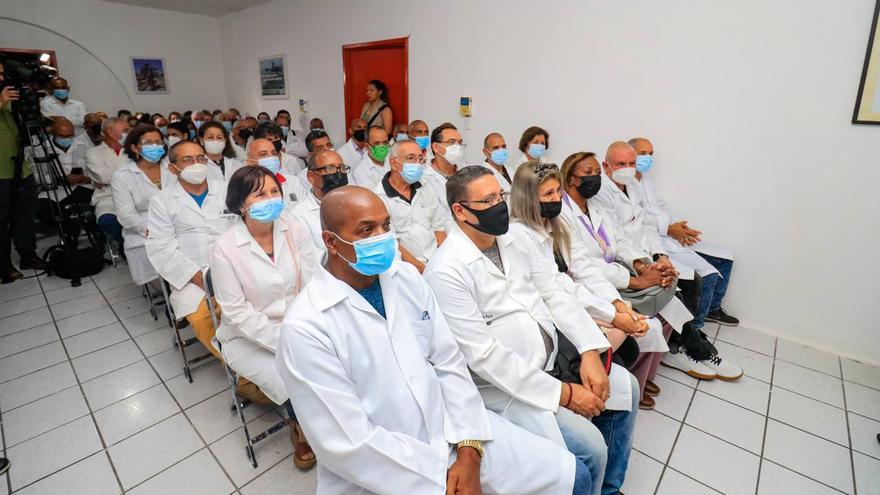
Pa rt of the 55 Cuban doctors who arrived in the Mexican state of Colima in the second week of August. (Facebook/Indira Vizcaíno)
14ymedio, Havana, August 25, 2022 — The president of the Prisoners Defenders Association, Javier Larrondo, said this Thursday during a conference, that “there are State Security agents” among the 641 Cuban doctors hired by Mexico. The conference, entitled “The military truth behind Cuban medical missions in Mexico,” was attended by several members of Mexican civil society and took place in the Casablanca Hotel in Mexico City.
Larrondo added that the administration of President Andrés Manuel López Obrador “is allowing slavery on Mexican soil” and “financing” the Cuban regime. He also specified that, when the health workers entered the facilities of the Mexican Air Force, they were under less control than that usually executed by the military, unlike what happens with ordinary passengers.
In addition, “no one has seen the degrees of the Cuban doctors,” whose presence has already been evaluated by some analysts as a “risk to the security” of the State, Larrondo noted.
Another member of the conference, Beatriz Pagés, former deputy and director of Siempre magazine, pointed out that the mission of medical groups is “more political, more military and indoctrination than healthcare.”
She recalled that this procedure has been carried out by Cuba in other countries, and that it responds to “the advice of those who helped Hugo Chávez and now Nicolás Maduro to preserve themselves in power in Venezuela.” continue reading
By introducing the military with the support of Havana, López Obrador intends to “consolidate his autocratic project and have the presidency guaranteed in 2024,” Pagés said. The Mexican government is “increasingly approaching the most radical dictatorships in Latin America, where human rights are violated, journalists, priests and free-thinking women and men are imprisoned and it’s moving away from democracy,” the journalist warned.
Diplomat and politician Ricardo Pascoe, who served as Mexico’s ambassador to Cuba from 2000 to 2002, explained that the visit to the island of the Mexican president last May also had a military connotation. General Luis Cresencio Sandoval González, Secretary of National Defense, and José Rafael Ojeda, Secretary of the Navy, were traveling in the official delegation, with the task of “organizing political cadres, as in Venezuela.”
According to Pascoe, López Obrador’s government is financing a regime that replaces “the lack of economic development with slave labor.” The result is a strengthening of the “capacity for internal repression” of a regime that is extending as long as possible the “last days before its fall.”
Cuba learned this system of labor exploitation from North Korea, Pascoe explained. The Asian country “invented” an effective way to “rent its people to other countries. There are millions of North Korean slaves working in Malaysia, Indonesia, Vietnam and China.” With that money, Pyongyang “develops its nuclear weapons.”
Comercializadora de Servicios Médicos Cubanos, S.A., a Cuban company internationally accused of human trafficking, agreed with Mexico to hire more than 600 doctors, for the monthly payment of $1,308,922.
For her part, the vice president of the European Parliament for Latin America, Dita Charanzová, explained that “80% of what is charged for the missions goes to the regime. It’s time for the people to know the truth and the other side of Cuban medical missions.”
During the conference, the testimony of a Cuban doctor who was in Mexico during the pandemic was disseminated. He revealed that upon their arrival in the country their passports are withdrawn. Seventeen colleagues escaped from his group, who left the hotels where the Mexican government hosted them. “Cuba doesn’t release the specialists for fear that they will leave,” said the man, who also said that the detachment sent by Cuba is composed of military and general practitioners “who work in primary care clinics.”
This data confirms the suspicion of Dolores González Meza, a union leader in the medical sector, who indicated last Sunday that Cuban doctors are not specialists and that they have limited themselves to offering “ambulatory care, prevention and health promotion.”
The doctor consulted by Prisoners Defenders also mentioned that, on his trip to Mexico, 123 Cuban health workers took a course of just five days on the treatment of COVID-19, when the duration on the Island itself is one year.
“We had a preparation with some Sabina ventilators that had nothing to do with those in Mexico, which also has advanced technology. Their technicians are at a higher level than Cubans,” the man said.
According to several reports written by the Cuban health workers themselves, they were limited during the pandemic to “making beds, taking vital signs, conducting surveys, and handing sponges to patients for bathing.” This contrasts with the triumphalism of the Cuban authorities, who even arrogantly managed to claim the decrease in mortality caused by the coronavirus in Mexico.
In addition to these speakers, Javier Nart, Vice President of the Delegation of the European Parliament for Central America, journalist and novelist Desirée Navarro and lawyer Emiliano Robles, were part of the press conference. Prisoners Defenders, a non-profit association based in Madrid, focuses on the defense of “human rights and pro-democratic defense through legal action.”
Translated by Regina Anavy
____________
COLLABORATE WITH OUR WORK: The 14ymedio team is committed to practicing serious journalism that reflects Cuba’s reality in all its depth. Thank you for joining us on this long journey. We invite you to continue supporting us by becoming a member of 14ymedio now. Together we can continue transforming journalism in Cuba.
Image disseminated by the official press last July of Holguín “specialists” who will serve in Mexico. (Ahora)
14ymedio, Madrid, August 26, 2022 — The characteristics of the last Cuban medical brigade imported by Mexico, which began to arrive in the last week of July, offer no doubt about the spurious interests behind the facade of humanitarian collaboration with which they have been sold to public opinion.
“They are all military” and “none of the doctors are specialists” (they’re family doctors or general practitioners), says Prisoners Defenders (PD) in its detailed report, “The Military Truth Behind Cuban Medical Missions in Mexico,” presented this Thursday in the Mexican capital, about the more than 600 health workers hired by the Government of Andrés Manuel López Obrador to, supposedly, fill places that Mexican specialists don’t want due to “insecurity and remoteness.”
Some of those ‘soldiers’, according to the report and asserted by the director of PD, Javier Larrondo, at this Thursday’s press conference, are “from Cuban Intelligence or G2, now introduced into the country through military airports, without the authorities, except for President Andrés Manuel López Obrador and his closest team, being able to know this fact.”
The document dismantles what he calls “national fraud” on the part of the Mexican president: the solicitation to fill 13,765 places for medical specialists “in poor and high-risk areas of the country,” launched after complaints against previous contracted Cuban missions.
“The characteristics of the areas under contract, which concentrated most of the ’vacant’ places, don’t have the basic infrastructure and equipment for training, care and decent work for doctors, as presented by schools, associations and federations on June 1,” the report explains. “Therefore, the inevitable happened and what could undoubtedly be predicted by the Government: more than 60% of the positions became vacant.” continue reading
That is, the solicitation, in the opinion of the Madrid-based organization, was only an “excuse” for the hiring of Cuban doctors, who, despite what was advertised by the official propaganda, do not have any specialty.
Havana presents them as such, PD says, after passing courses of between three and five days, “without documentary evidence or any professional validation or accreditation in Mexico.”
The discrimination that Cubans pose against their Mexican counterparts, who, as described in the report, are required to practice as specialists, is also being denounced precisely by health personnel from the state of Colima, one of the areas where doctors on the Island have already arrived, along with Nayarit.
Prisoners Defenders also points out in its report the “political, civil and criminal responsibility” faced by López Obrador for knowing “perfectly the convictions for slavery and all the circumstances that affect this slavery and putting at risk the health of Mexican citizens, as well as the embezzlement that this farce of health services represents for the public coffers.”
Among them is the violation of several articles of the Free Trade Agreement between Mexico, the United States and Canada “by promoting human trafficking and slavery on Mexican soil.” The consequences of this, the NGO says, “could be broad for the Government of the Republic and entail even more serious sanctions or consequences.”
The report includes an account of the health missions that have been sent to Mexican soil, since the first one, in April 2020, with the argument of helping to combat the COVID-19 pandemic. All of them were harshly questioned from the beginning by the medical profession, the Mexican media and opposition politicians.
On the hiring of the first contingents, PD details the specific amounts that the Mexican Administration paid to Havana: more than six million dollars from the government of Mexico City (where 585 health workers worked), two million dollars from the government of Veracruz (which hosted 174) and almost two million pesos (about 100,000 dollars) from the government of Quintana Roo (where seven health workers were sent). In addition to them, 40 doctors collaborated in Tabasco during those months.
Reports on the following brigades, largely sent to military hospital facilities, were vague. However, in recent years there have been not a few reports published in the local press revealing some details, such as, for example, that Cuban health workers, far from fighting COVID-19, limited themselves to “making beds” and “carrying out surveys” due to their lack of specialization.
In total, between April 6, 2020 and July 15, 2021, according to Prisoners Defenders, a total of 1,947 Cuban collaborators were sent to Mexico due to the COVID-19 pandemic. Of these, 17 “deserted,” the organization reported.
For the more than 600 who will be reaching 15 Mexican states in the coming months, according to the legal agreement reviewed by Prisoners Defenders, the Mexican Social Security Institute (IMSS) will give the Marketer of Cuban Medical Services up to 1,177,300 euros per month (more than 14 million euros per year). Payments will be made, the NGO continues, to an account of the Marketer, “by bank transfer to an account of the Government of Cuba.”
PD recalls, finally, in its investigation, all the instances that organizations have spoken out against internationalist missions, calling them forced labor, such as the Human Rights Foundation, Human Rights Watch, the US Department of State and the European Parliament.
Translated by Regina Anavy
____________
COLLABORATE WITH OUR WORK: The 14ymedio team is committed to practicing serious journalism that reflects Cuba’s reality in all its depth. Thank you for joining us on this long journey. We invite you to continue supporting us by becoming a member of 14ymedio now. Together we can continue transforming journalism in Cuba.
14ymedio, Carlos Alberto Montaner, Miami, 28 August 2022 — “It’s in the genes.” Javier Figueroa de Cárdenas is a relative of Miguel Figueroa, a brilliant 19th century autonomist. Autonomism was a way of being patriotic in Cuba, especially since the “Pact of Zanjón,” which in 1878 put an end to the “Ten Years War,” until 1898, when the United States tipped the balance in favor of the Cuban insurrection.
Independentism
Autonomism was defeated by the independentism promoted by José Martí, but, as the most reliable historians recognize today, the best Cuban minds were autonomists: Rafael Montoro, Antonio Govín, José María Gálvez, Eduardo Dolz, Figueroa himself and a very long etcetera. Unfortunately, the experiment only lasted 20 years (from 1878 to 1898,) the same period that the “Liberal Autonomist Party” lasted, the first political entity that emerged in a totally independent Cuba.
Javier Figueroa is an excellent professional historian. I met him with Sylvia, his wife, in Puerto Rico, where he taught until he retired. He got his PhD from the University of Connecticut, and he has published a very remarkable book, with more than 700 pages and with almost 2000 footnotes, which he has called “The Unfinished Dream: A History of the Student Revolutionary Directorate (DRE). Cuba 1959-1966”.
The unfinished dream and the “Spanish pax”
Why is it called The Unfinished Dream? Because Cuba has not been liberated and democracy has not been restored, as Alberto Muller, Juan Manuel Salvat and Ernesto Fernández Travieso, the three founders of the DRE, proposed at the beginning of the adventure, in 1961. And why could they not achieve it? Somehow, this first review tries to address that issue. In fact, Cuba and all of Latin America pay to be far from the European fighting pit. They pay (and charge) for the Spanish isolation. The 19th century brought the destruction of the “Spanish pax.”
For several centuries Spain had kept her colonies on the sidelines of European crises, only bothered by the actions of pirates and corsairs. But Napoleon appeared in European history, invaded Spain and, after a moment of doubt, the Latin American peoples became independent, except for Cuba and Puerto Rico. (I know I am oversimplifying, but this is not the place to detail the hypothesis.)
Not all were costs, of course. There were some advantages. To the extent that Spain did not participate in the two world wars, with their enormous share of blood and destruction, but with the relative advantages of the two continue reading
post-war years, Latin America continued to be perceived as something different, despite the fact that language, religion, the layout of the streets, the division of powers and the rest of the symptoms pointed to Europe itself, led by Spain and Portugal, sticking its head out across the Atlantic.
Fidel Castro was a disciplined communist
Thus, on January 1, 1959, came the news that Fulgencio Batista, president and (not so) strong man of the country, had fled the island, leaving his army completely helpless. In the US embassy in Havana there was total confusion. Some accuse Fidel of being a communist. Others, of being, fundamentally, “fidelista.” There are even some (the fewest) who think that he is an “anti-communist democrat.”
A few weeks must pass to unravel the mystery. It happens in April 1959. But the outcome is not at all clear. Castro travels to the USA that spring. He has been invited by the press association. He announces that he will go as part of “Operation Truth” to contradict those who oppose the executions.
Dwight D. (‘Ike’) Eisenhower, as president, and Richard Nixon, as vice president, are in the White House. On April 19, Nixon invites Castro to visit him. Eisenhower is not available. He has some urgent golf games. The VP writes a short memo in which he characterizes Fidel as charismatic (which he is) and as “incredibly naïve” regarding communism (which he is not) or a “disciplined communist” with all its consequences (which he is.) But Nixon’s opinion was not taken seriously by Ike.
Until the beginning of next year. 1960, an election year in which, in the November elections, at the end of the year, Kennedy was preferred over Nixon. However, Eisenhower adopted a wrong strategy, perhaps due to misunderstanding of the Cuban drift that forged the presence of atomic weapons pointing at the United States from Cuba, just 90 miles away.
Let me be clear. Stalin had died on March 5, 1953. With him he had taken to the grave the notion that the Latin American peoples should wait for the American revolution to assault the “winter palace.” That was the talk of Earl Browder and of Browderism. Fidel Castro had shown that a communist revolution could be made a stone’s throw from the USA. Everything depended on what Moscow was willing to risk.
Khrushchev times
Those were the days of Khrushchev, who believed that the future would be communist. He thought that the USA was a giant “Potemkin village.” The first object had left Earth headed for outer space. It was Russian. The USSR was winning the space race. There were reasons to be confused.
In 1966 it wasn’t like that. But what could Eisenhower have done in the last year of his second term, in 1960? Perhaps, understand the danger of Fidel Castro, and admit that Latin America was one more region of the European side, facing the communist challenge, and act accordingly. That meant that he should openly engage his armies, and not uselessly try to hide behind the CIA, created at the beginning of the “Cold War,” in the late 1940s.
Only that this course of action contradicted the widespread prejudice that Latin America was not part of the same value system of the Western nations, subscribed to by Eisenhower, and Fidel Castro should not be taken seriously by his enemies. (It is said in Cuba, sotto voce, that on that first trip to the US, after the triumph of the revolution, a drunken Congressman, Republican or Democrat — in this case it makes absolutely no difference — stared at Fidel Castro, tried playfully to take his hands, and just said, “Oh, Fidel Castro, Cha-Cha-Cha!” The Maximum Leader, as he was called then, looked at him in astonishment.)
A book about Cuba from 1959 to 1966
It gave me great joy that the author gathered in one volume so many scattered friends and even the dead and executed: Virgilio Campanería, Manolo Salvat, Alberto Muller, Joaquín Pérez Rodríguez, José Basulto, Juanito de Armas, Emilio Martínez Venegas, Nicolás Pérez, Huber Matos, Rolando Cubelas, Miguelón García Armengol, Ramón Cernuda, Luis Fernández Rocha, Ignacio Uría, Pedro Subirats, José María de Lasa, Miguel Lasa, Pedro Roig, José Antonio González Lanuza, José Ignacio Rasco, Manuel Artime, Fernando García Chacón, and so many others that would make this chronicle a useless catalog of names.
It occurs to me that the same scruples that Muller, Salvat and Ernesto Fernández Travieso had in accepting the CIA aid were shared by all the groups and personalities that joined the fight in that first wave. To what extent was it honorable to accept financial aid from the CIA?
José Miró Cardona, engineer Manuel Ray and the People’s Revolutionary Movement (MRP), Manuel Artime at the head of the Revolutionary Recovery Movement (MRR), Tony Varona with his Revolutionary Rescue (RR), and all the organizations with their acronyms in tow had serious doubts about accepting the aid offered by the CIA. Perhaps they didn’t know that the collaboration between the USSR and Fidel Castro began as soon as the revolution began.
Angelito Martínez Riosola
Indeed, the party of Cuban communists, the PSP, took over State Security since the beginning of the revolution, and put a man trained by the KGB at its helm. On March 4, 1960, when Eisenhower became convinced of Fidel Castro’s communist drift, and asked the CIA to put together a response, it was already too late. That same day, Soviet General Francisco Ciutat de Miguel had arrived from Curaçao to take charge of the defense of the communist tyranny that had emerged in Cuba. On the Island he was called “Angelito Martínez Riosola” by direct appointment of Fidel Castro.
The CIA was not effective at all in fighting the KGB. It even almost lost in Guatemala in 1954. Despite this, they entrusted the same team to prepare a response plan. The infiltrations it made behind the Iron Curtain were all annihilated. It was, as they used to say in Cuba, “Monkey against lion and the monkey tied up.”
Salvat ended up selling books in Miami, Miró Cardona teaching law in Puerto Rico, Ray exercising his profession as a builder of cheap prefabricated houses. In short, the first batch settled for “the unfinished dream.” Downhearted, Santiago Álvarez told me that the Kennedys would have solved the issue, but I don’t know. They would have to use the US armies or wait for the inherent inability of the collectivist economy to produce goods and services, to cause certain changes that would wipe out the system. That’s what we’re waiting for.
____________
COLLABORATE WITH OUR WORK: The 14ymedio team is committed to practicing serious journalism that reflects Cuba’s reality in all its depth. Thank you for joining us on this long journey. We invite you to continue supporting us by becoming a member of 14ymedio now. Together we can continue transforming journalism in Cuba.
America fights mosquitoes that transmit dengue fever with fumigations. (EFE)
EFE (via 14ymedio), Lucy Lorena Libreros, 27 August 2022 — America continues to fight a hard battle to counteract the advance of dengue fever in the region. In addition to measures such as the elimination of mosquito breeding sites and fumigation, there is now an unusual technique: using drones to release communities of mosquitoes ’vaccinated’ with a bacteria in areas with a high incidence of the disease.
The innovative experiment — whose benefits are recognized by the health authorities on the occasion of the commemoration of International Day against Dengue this Friday — will take place beginning in September in Cali, the third largest city in Colombia, which in 2019 registered 15,000 cases of dengue fever.
This figure represents 15% of the total reported in a country where it’s estimated that more than 25 million people are at risk of contracting the disease. So far this year, the figure has reached 1881.
But how can we understand that it’s the aedesaegypti mosquito itself, the transmitter of dengue, Zika and chikungunya, that is now in charge of curbing these diseases?
Ana María Vélez, a representative of the World Mosquito Program (WMP), makes it look simple: “These transmitting mosquitoes, which are released in a controlled way in areas with a high incidence of dengue, are carriers of a bacterium called wolbachia, which interrupts their ability to transmit diseases to people.” continue reading
Starting in September, WMP, in partnership with the Ministry of Health of Cali, will release — for the first time in America — between 150 and 200 adult mosquitoes that carry the bacteria in different parts of the city, through an 8-motor and 2-meter-long drone, which, guided by a GPS, will accurately recognize the areas where these “new” mosquitoes are needed.
Although it will be the first time that drones will be used, this technique of releasing mosquitoes with wolbachia has already been successfully tested in countries such as Brazil — one of the most affected by dengue — where the bacteria have achieved significant reductions in the number of cases.
This is because it “is transmitted from generation to generation by the maternal line. That is, the new generations of mosquitoes will be born with wolbachia, in order to sustain the bacteria over time. Studies show that the bacteria can remain in the same area for up to 50 years,” the expert tells EFE.
In the case of Cali — where cases of dengue are endemic, at a rate of about 100 cases per 100,000 inhabitants — the release with drones constitutes the third phase of an experiment that began in 2019 with other types of mosquito releases.
This strategy so far has impacted about 800,000 people. “With this new phase, 300,000 more people will be impacted, which would represent in total about half the population of Cali,” says Vélez.
The release of mosquitoes with wolbachia becomes a new step in the fight against an epidemic, which, in the Americas, had a record year in terms of cases in 2019, especially affecting Brazil and Central America, with more than 3 million cases and 1,500 deaths.
Although the authorities in the Americas estimate that during the pandemic there was an underreporting of cases of dengue — one of the diseases “that most congests the hospital system,” in the words of Vélez — this year countries such as Brazil, Peru and Mexico have again raised their numbers.
Brazil, with figures up to July of 2022, has had 752 deaths from dengue, which represents an average of 25 per week, according to recent data from the Ministry of Health.
The figure is 205.6% higher than that caused by the disease in 2021, reflecting the resurgence of dengue.
Also, during that period the country recorded 1,288,403 cases of dengue. A number 195.3% higher than for the same period of the previous year, and more than double that recorded in all of 2021 (543,657).
Peruvians were forced to launch an epidemiological alert last April in the face of the sustained increase in cases with high lethality, which — until the twelfth week of the year — had exceeded the highest peaks of notifications recorded in the last four years.
Until then, infections reached 20,491, an incidence rate of 61.35 per 100,000 inhabitants.
In Mexico, the figures have also set off alarms with the authorities. So far in 2022, 3,134 cases have been confirmed, an increase of 78.5% over the same period in 2021, according to figures from the federal Ministry of Health.
To this are added 8 deaths, 3 more than recorded in the same period last year.
Other countries such as the United States are waiting for what happens in the rest of the region. Although three cases of local dengue have been reported in Miami-Dade, the authorities are already taking precautions in the face of the possible appearance of more contagion as a result of immigration.
Central America has been one of the regions most affected by dengue. Honduras, for example, has a total of 14,764 cases of dengue fever and 6 people killed by the disease so far in 2022, according to the Ministry of Health.
Of the total number of cases, 14,485 patients correspond to the classic type, while patients with bleeding or severe symptoms total 279.
On the other hand, Cuba reported 4 times more cases in a week than in the first half of the year. Last Wednesday, the authorities reported the detection in the same week of 11,634 reactive cases of dengue, 3.8 times more than the positive cases reported in the first half of the year (3,036).
The Government also warned about the increase in the breeding grounds for aedesaegypti and, at the beginning of July, revealed that the Island broke the record for the second year in 15 years for the number of breeding points of the mosquito. It described the epidemiological scenario as “complex.”
The figures are of concern not just to countries in the region. The World Health Organization (WHO) estimates that about 390 million dengue infections occur every year in the world, while about one billion people will be exposed to diseases such as dengue fever by the end of the 21st century, as global temperatures increase, according to a study in the specialized journal PlosNeglectedTropicalDiseases.
Translated by Regina Anavy
____________
COLLABORATE WITH OUR WORK: The 14ymedio team is committed to practicing serious journalism that reflects Cuba’s reality in all its depth. Thank you for joining us on this long journey. We invite you to continue supporting us by becoming a member of 14ymedio now. Together we can continue transforming journalism in Cuba.
Honduras receives migrants from the Caribbean, South America and other regions of the world. (Archivo)
EFE (via 14ymedio), Tegucigalpa (Honduras), 27 August 2022 — About 80,000 ‘irregular’ migrants traveling with the idea of arriving in the United States have arrived in Honduras so far this year, mostly of Cuban nationality, according to figures from the National Institute of Migration (NIM), consulted this Friday by EFE.
Between January and 19 August 2022, 79,667 migrants entered the Central American country trying to advance north with the aim of reaching the United States, according to official data.
The NIM said that so far this year the ‘irregular’ migrants entering Honduras include: 44,535 Cuban migrants, 19,222 Venezuelans, 4,795 Ecuadorians and 3,051 Haitians. continue reading
The numbers from other countries are: 642 from India, 636 from Colombia, 592 from Senegal, 569 from Angola, 470 from Bangladesh, 478 from the Dominican Republic, 446 from Brazil, 423 from Ghana, 403 from Nicaragua, 329 from Cameroon, 278 from Somalia, 256 from China, 239 from Nepal, 209 from Eritrea, and 2,094.
In comparison, according to NIM statistics for the same period last year — between January and 19 August 2021 — a total of 10,032 ‘irregular’ migrants entered Honduras. Of these, 4,294 were from Haiti and 3,622 from Cuba, the predominant nationalities in this group.
Men comprise 55% (43,676) of the immigrants, 28% (22,728) are women and 17% (13,263) are children and adolescents of both genders.
Of the total number of migrants this year, 53% (41,847) were under 30 years old, and 47% (37,820) were over 30.
The Migration Institute also indicated that 77% (61,556) of migrants entered Honduras through the municipalities of Danlí and Trojes, in the department of El Paraíso, on the border with Nicaragua.
In recent months, El Paraíso has become a new route that migrants, mainly from Cuba, Venezuela and Haiti, are using to continue on to the United States.
At the beginning of August, a legislative decree entered into force that exempts migrants ‘passing through’ who enter Honduras from the payment of an administrative fine of more than $200.
The immigration amnesty was published on August 3 in the official newspaper, LaGaceta, three months after its approval in the Honduran Parliament.
Most immigrants who enter Honduras do so in “blind spots” through human traffickers, known as “coyotes,” who don’t always take them to the border with Guatemala.
Translated by Regina Anavy
____________
COLLABORATE WITH OUR WORK: The 14ymedio team is committed to practicing serious journalism that reflects Cuba’s reality in all its depth. Thank you for joining us on this long journey. We invite you to continue supporting us by becoming a member of 14ymedio now. Together we can continue transforming journalism in Cuba.
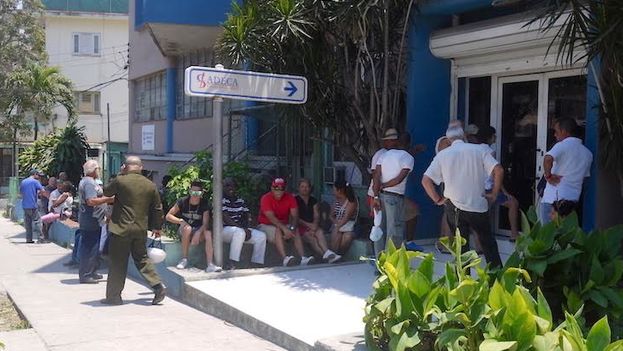
A line outside a currency exchange (Cadeca). (14ymedio)
14ymedio, Elías Amor Bravo, Economist, 27 August 2022 — There is no doubt that the issue of the moment, at least for those of us who are dedicated to the analysis of the Cuban economy, is the official authorization of foreign exchange in a series of establishments and for a fixed amount only for natural persons, while the 1×24 (US dollar to Cuban peso) exchange rate remains for other transactions.
In this blog we have already explained the reasons that lead us to think that behind this authorization there is something hidden, and the negative consequences that can be derived from it, but as the regime moves forward, we can only verify what we see happening.
An article has been published in the State newspaper Granma with the title “Why was the exchange rate of the informal market taken as a reference?” Its source is the website of the Central Bank of Cuba in a common entry with the Ministry of Economy.
What does the article say? Well, basically, to restore the operations of the official foreign exchange market in Cuba, which, it should be remembered, were interrupted by the regime shortly after beginning the Ordering Task* with the impracticable exchange rate of 1×24, there has been no choice but to “take into account the pre-existing conditions of the foreign exchange market in the country.”
And of course, that foreign exchange market is the informal one, which has been operating just since the regime decided not to make changes. Hence, the decision to implement an exchange rate for buying and selling similar to the one that exists in the informal market is justified. Can anyone think of the Cuban communist regime accepting the price of chicken in MLC (freely convertible currency) stores as the same as that in the regulated (rationed) basket? Difficult. continue reading
For those interested in communist dialectics applied to the foreign exchange market, the article will go down in history. Prisoners of the totalitarian ideology that prevents the contemplation of an economy as a continuously growing interdependent market, Cuban communists invent a suigeneris definition of the exchange rate, according to which, it “emerges through a market process in which the supply and demand of foreign exchange are equalized, in which agents (households, companies and governments) have free and timely access to hard currencies, in exchange for national currency and vice versa.” Error.
The exchange rate, such as the price or level of production of the economy, arises from the interaction of domestic markets (goods, labor, assets, etc.) with external markets. The economy cannot set the relative price of its currency only with the currencies that go in and out, but with the destination they have in the national economy. Cuban communists are unable to observe this interrelationship, worried as they are about filling the coffers of the state for their own purposes.
And that’s where the second big mistake comes from when they say that “the state can influence in the establishment of a type of balanced exchange over the sources of supply and demand for foreign currency, through exchange, fiscal, monetary and other policies, but its ability to set an exchange rate is limited by the prevailing conditions in the economy.”
The state can say whatever it wants, but if the economy is in balance, which unfortunately doesn’t happen to the Cuban economy, it’s of little or no use for the state to intervene in the foreign exchange market. The only thing it can achieve is to alter the behavior of supply and demand, which is what it has ended up doing. Markets are looking for balance. Governments, with their economic policies, can influence it but not change it.
Therefore, getting the exchange rate right is not playing roulette, but knowing the equilibrium conditions of the economy and getting it to work. This is not the place to give lessons in practical macroeconomics to Cuban communists, but before acting as foreign exchange players they should start by reducing uncontrolled public spending, reducing the expansion of money in circulation, stimulating national supply through structural reforms, monitoring the value of the peso in terms of fundamentals of the economy; in short, doing things that help and don’t distract economic agents.
In reality, the same regime helps Cubans feel especially motivated to acquire a greater amount of foreign currency, by artificially maintaining a 1×24 exchange rate for the economic operations of the state and its companies and conglomerates, as well as another cheaper exchange rate for the general public. That duality doesn’t go anywhere and usually ends badly, very badly.
And if they want to tell the truth, the one thing that led to the birth of the informal foreign exchange market in Cuba was none other than the state, by renouncing its functions. If it now intends to “illegalize it,” this will be a big mistake, since it will reduce supply and increase prices, removing them from any equilibrium option.
At this point, it could be said that the regime’s decision to choose the exchange rate of the informal market for the restoration of official exchange rate operations in Cuba, should perhaps have led to the testing of other formulas such as a possible authorization of money changer as a form of self-employment that would bring to light the activity of the “informals.”
The informal exchange rate, although it reflects the serious imbalances that exist in the rest of the economic markets, is the one most suitable to deal with the supply and demand of foreign exchange for Cubans. The impossibility of the regime to promote its extension to all economic agents (the state and its companies) indicates that it’s not a general rate, but a partial solution, painted with a ridiculously large brush, that won’t result in anything good. Because the informal market is something very different from the cadecas [official currency exchange points], banks and airport offices. Everyone understands that.
On the other hand, charging as the regime does against the informal exchange rate, accusing it of being “impacted by speculative processes and the costs associated with informality” is unfair. It’s an argument that falls under its own weight, from the moment the regime makes it in this relaunch of the official foreign exchange market.
If the agents who attend the informal market feel motivated to exchange foreign currency (divisas) for national currency and vice versa, at the rate that governs operations, it will be for something, but not at all for those speculative processes or costs. This is unacceptable because it anticipates where the sanctions can come from.
Using the informal exchange rate to ensure that, since the relaunch of the foreign exchange market, the operations of buying and selling foreign currency take place as smoothly as possible through the financial system, is a clear interference of the state and the regime in the private activity of a market that has functioned efficiently and continuously since the changes were suspended at the beginning of 2021.
Good proof of this has been that from the beginning, that exchange rate substantially similar to the one that exists in the informal market has collapsed, and there are already places where the peso is quoted at 1×140 and continues to fall freely. The limitation in the number of authorized establishments, the rationing of dollars at 100 per person per day and the organizational clumsiness of the banks have led to long lines outside these establishments, and the discomfort, protests and anger of citizens. These types of events rarely occur in the informal market, which is preparing to compete directly with the regime.
For those of us who defend the free market economy, attending these first steps in the foreign exchange market in which the regime is powerless to manage its role vis-à-vis private economic agents who operate efficiently and oriented by the needs of its customers, is a formidable spectacle.
Contemplating how the communist giant created by Fidel Castro is defeated by the Goliath of the informal exchange market is great news, which confirms how clueless the Central Bank or Alejandro Gil’s Ministry of the Economy are to face competition with the informal market under the current conditions in which the campaigns of repression and harassment that are supposed to arrive soon have not yet been unleashed. If this scenario were extended to the rest of the markets of the economy, totalitarian communism would have ended decades ago.
Communists are reluctant to maintain an artificially low exchange rate in the market of the population and non-state economic actors, because, as they say in the article, “this would imply constantly injecting foreign currency from other sectors of the economy, which in the medium term would make that exchange rate unsustainable and force the adoption of a new devaluation, which will allow the official rate to be approximated to market equilibrium to continue making foreign exchange operations viable.”
Well, then what do you think is going to happen in a few months with the decision they just made? There will be no choice but to depreciate the peso. Why don’t they wonder how, with the new exchange rate for the sale of dollars, the salary in pesos of an average Cuban has suddenly fallen by more than 400%? It’s true that whoever receives remittances won’t have complications because they will get more pesos, but what about internal inflation? Also, what happens to then 70% of society that operates only in pesos? Too many questions for the regime.
The official exchange market has been born in such unfortunate conditions, that far from fulfilling its purpose, it will pass without pain or glory, being inoperative in a short time. The economy can predict human behaviors with some ease when it comes to “free choice,” something that Cuban communists haven’t understood for 63 years. Failure is coming
Translated by Regina Anavy
____________
COLLABORATE WITH OUR WORK: The 14ymedio team is committed to practicing serious journalism that reflects Cuba’s reality in all its depth. Thank you for joining us on this long journey. We invite you to continue supporting us by becoming a member of 14ymedio now. Together we can continue transforming journalism in Cuba.
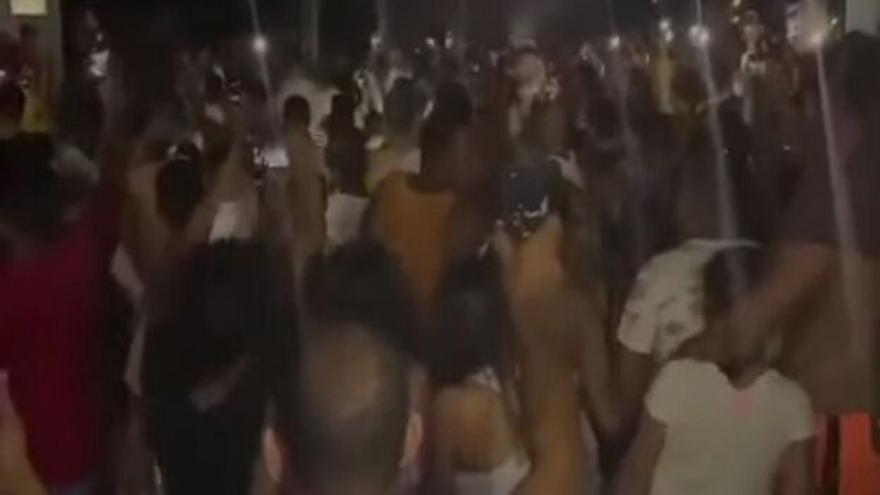
Massive night demonstration in the early hours this Friday in Nuevitas, Camagüey. (Captura/Facebook)
14ymedio, Pedro Corzo, Miami, 28 August 2022 — El23se rompe el corojo [on the 23rd the truce is broken (and we start riding again)], is a Mambisa expression that meant the end of the truce between the insurgents and the Spanish, who refused to leave the “always faithful island of Cuba,” a phrase that, over time, became synonymous with the fact that there is no possible conciliation when the victims of the abuses assume that they have no other alternative but to defeat their perpetrators.
General Antonio Maceo, Bronze Titan, the most distinguished Cuban general, 26 wounds in combat, refused to sign a peace agreement after ten years of struggle, 1868-1878, with the Spanish general Arsenio Martínez Campos, both agreeing to resume hostilities eight days later, motivating among the guerrillas the enthusiastic exclamation: “on the 23rd the truce is broken!” alluding to the end of the truce that many considered ominous.
Castroism breathed into broad sectors of the citizenry the certainty that the regime was immovable, that any action against it would fail and its actors would suffer the consequences. Still more, Fidel Castro had the audacity to proclaim that socialism in Cuba was irreversible, as Adolf Hitler proclaimed his thousand-year Reich.
However, we write with pride that in these six long decades, the resistance has not ceased, as shown by the numerous political prisoners who rot in prisons without international organizations being able to visit them as demanded by, among others, the Cuban Observatory of Human Rights.
On the property called Cuba, which the Castro brothers appropriated, it seems that so many opponents have emerged that the political police can’t control them. Many are losing the fear that gripped them day after day, and others show that the population is willing to break the vile armor of an atrocious dictatorship that has humiliated and vexed them for years. continue reading
It’s evident that Cubans want to break the truce since they don’t stop demanding better living conditions along with the end of the dictatorship, as has been seen in the city of Nuevitas, where the city dwellers have constantly shouted at the dictatorship that they were tired of living as slaves, some alluding in their demands to the Mambi machete redeemer and apparently echoing the expression of General Antonio, “Freedom is conquered on the edge of the machete, it is not asked for; begging for rights is typical of cowards unable to exercise them.”
The protests in most of the national territory are a constant, a symptom that the population is losing its fear and freeing itself from the burden of blind obedience to a leadership that has only reaped failures and that has devastated the country as if it had suffered a war.
Apparently, the growing misery and the permanent harvest of frustrations have led the people to realize that the promises of the regime are invalid and that they need to act at any cost to be able to access a better life.
After the protests of July 11, 2021, there has been a notable discontent aggravated by the power cuts. Power is miraculously restored when the population protests firmly, as has happened in the neighborhood of Pastelillo, in Nuevitas. This can be understood that for the Castro government, those who are obedient suffer the most.
Everything seems to indicate that repression is no longer enough to continue controlling a population dissatisfied in all aspects. Fear and hope, the two most leafy trees of Castroism, are apparently drying up rapidly.
Citizens are noticing, more than ever before, the high levels of corruption and ineptitude of officials to solve the numerous and constant problems generated by the regime itself, which aren’t caused by the vaunted embargo or American aggression.
In addition, the most faithful supporters of Castroism, no matter how servile they may be, understand that the protests are legitimate, that they are not imported and that they don’t respond to proposals from abroad. It is the neighbor, the repressor himself, who suffers from the systematic and permanent stupidity of a failed dictatorship in all aspects, except in their effort to destroy the Cuban nation as they did with the Republic.
Translated by Regina Anavy
____________
COLLABORATE WITH OUR WORK: The 14ymedio team is committed to practicing serious journalism that reflects Cuba’s reality in all its depth. Thank you for joining us on this long journey. We invite you to continue supporting us by becoming a member of 14ymedio now. Together we can continue transforming journalism in Cuba.
Among the artists who participate are Damián Valdés Dilla and Rigoberto Casorla, along with other renowned creators such as Yaniel Agrafojo, Isaac Crespo and Gloria de la Caridad Castillo. (naemi.org)
EFE (via 14ymedio), Miami, 27 August 2022 — The National Art Exhibitions of the Mentally Ill (Naemi) Foundation, focused on so-called “outsider art,” inaugurates a new exhibition this Saturday in Miami with works by renowned “marginal” artists, such as the Cubans Jorge Alberto Cadi El Buzo and Misleidys Castillo.
The exhibition Ousider Art: Revealing Masters of Hidden Art, will open this Saturday at The ArtSpace gallery, on downtown 8th Street in Miami, and features works made with different techniques from Naemi’s collection.
In addition to the aforementioned Cuban artists, the exhibit includes Damián Valdés Dilla and Rigoberto Casorla (Rigo), along with other renowned creators such as Yaniel Agrafojo, Isaac Crespo and Gloria de la Caridad Castillo, according to a statement from the foundation.
“What attracts me the most in the art of people in recovery from mental illness and in ’outsider’ art is their authenticity and originality. Their art escapes the norms and conformism of most contemporary art,” Juan Martín, the executive director in charge of the Naemi exhibition, told EFE on Friday.
The new exhibition, which follows another one inaugurated earlier this year, also in Miami, coincides with the presence of works by three artists sponsored by Naemi in the renowned contemporary art exhibition, Documenta.
One of the most important exhibitions in the world in terms of contemporary art, along with the Venice Biennale, Documenta is held in Kassel, Germany every five years and will be open to the public in its fifteenth edition until September 25. continue reading
Martín, who has 1,200 “outsider” works of art in Naemi’s permanent collection and is looking for a partner to make exchanges, said that for him it’s “an honor” that these artists now exhibit at Documenta.
They are the Cuban artist, Damián Valdés, Boris Santamaría and Carlos El Profe.
Valdés is one of the artists of Art Ousider: RevealingMasters of Hidden Art, from Miami, Martín said proudly.
The promoter said that these artists rarely name their works.
“This exhibition in Documenta proves it: the art of the ’outsiders’ is the last bastion of the creative rebellion against the power of the system. It’s a great honor that Naemi artists are in this exhibition,” he said.
He also explained that the Cuban “outsider art” works exhibited at Documenta in Germany do not belong to Naemi’s collections, but have arrived there thanks to the renowned plastic artist, Tania Bruguera, who organized the exhibition.
According to the Naemi Foundation, “’marginal art’ refers to incredibly unique works produced by artists who have not been formally trained in art, work outside the dominant artistic sphere and have unconventional visions of the world.”
The so-called “art brut” [“raw art” or “outsider art”] sometimes has its origin in collections of European psychiatric hospitals of the 19th century, where doctors clinically analyzed the work, it adds.
Artist Damián Valdés “at the moment is in a psychiatric hospital in Havana,” while Boris Santamaría is “a homeless person in Cuba,” Martín explained.
Last February, Naemi also inaugurated the exhibition TheLanguageGame in Miami, with 40 works by artists with mental illnesses focused on text as a plastic expression, something present in so-called “outsider art” since 1919.
Translated by Regina Anavy
____________
COLLABORATE WITH OUR WORK: The 14ymedio team is committed to practicing serious journalism that reflects Cuba’s reality in all its depth. Thank you for joining us on this long journey. We invite you to continue supporting us by becoming a member of 14ymedio now. Together we can continue transforming journalism in Cuba.
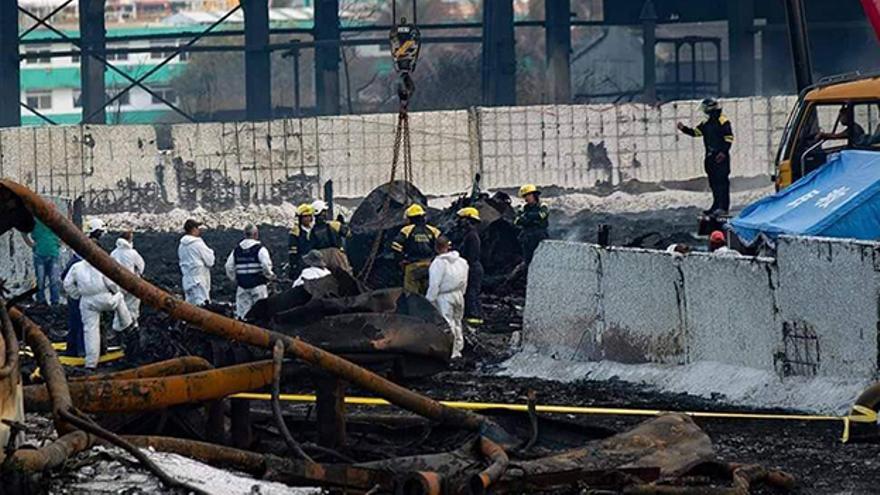
Specialists from the Ministry of Public Health were searching for human remains in the area of the fire. (José Ángel Portal Miranda)
EFE (via 14ymedio), Havana, 27 August 2022 — Cuba maintained a dialogue with experts from the U.S. Environmental Protection Agency (EPA), to learn about rehabilitation techniques for the area affected by the industrial fire at the Matanzas Supertanker Base, the Foreign Ministry reported on Friday.
Cuban experts asked EPA members for “their assessment of the actions already taken” in the area during a virtual meeting last Wednesday.
Representatives of the Cuban Ministry of Science, Technology and the Environment — among other institutions — presented “the main tasks undertaken since the fire was declared extinguished” on August 12, according to the Ministry of Foreign Affairs.
In addition, the Island’s specialists requested “the possibility of accessing the most innovative techniques and procedures accumulated both by the EPA, as well as by companies linked to the oil sector and other agencies involved in these types of accidents,” the source added.
In a statement released on Friday, the Cuban Foreign Ministry highlighted the “professional and profitable exchange” atmosphere of the meeting where they also talked about “possible ways of cooperation” in the rehabilitation of the area consumed by the fire. continue reading
On August 5, a fire of enormous proportions broke out at the Matanzas fuel tank base, when lightning struck 1 of the 8 tanks of the industrial park, according to the Cuban authorities.
Four of the eight tanks of the storage base — the largest facility of its kind on the Island to receive and store crude oil — burned completely, causing explosions and flares of several hundreds of feet.
The column of smoke was seen in neighboring provinces such as Mayabeque and Havana, the latter located 60 miles away.
During the first stages of the fire, Cuba confirmed and thanked the offer of “technical advice” from the United States, although nothing materialized from it.
In the accident, 16 people — mostly firefighters — lost their lives, while another 146 were injured and 15 of them remain hospitalized.
Translated by Regina Anavy
____________
COLLABORATE WITH OUR WORK: The 14ymedio team is committed to practicing serious journalism that reflects Cuba’s reality in all its depth. Thank you for joining us on this long journey. We invite you to continue supporting us by becoming a member of 14ymedio now. Together we can continue transforming journalism in Cuba.
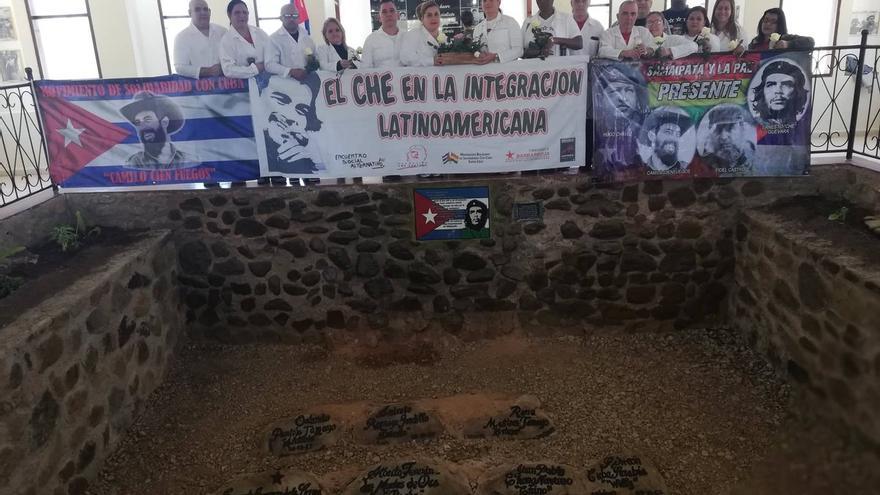
Cuban doctors in 2019, paying tribute to ’Che’ Guevara in La Higuera, Bolivia. (Twitter/@CubacooperaBo)
14ymedio, Madrid, 24 August 2022 — On Tuesday, the Human Rights Foundation (HRF) published a new report denouncing Cuban medical missions as “Human Trafficking.” The document affirms that this “broadly praised” program is based “on the exploitation of health professionals and serves as an important tool of international propaganda and an important source of income for the repressive communist regime.”
In its analysis, HRF details the history of Cuba’s medical missions, which date back to the 1960s and have been sent to more than 150 countries, and it details the main mechanisms used by the regime to exploit its health workers while selling it to the world as “medical diplomacy” and “humanitarian aid.”
The document also focuses on how these missions have financed the Government with “billions of dollars”; the export of medical services is the country’s first source of income, ahead of remittances and tourism.
The New York-based NGO thus concludes what has already been widely denounced by other international organizations, such as Human Rights Watch and Prisoners Defenders: that the Cuban Government “has imposed coercive and reprisal practices on health professionals to prevent desertion, applied in a way that violates international law that protects victims of human trafficking.” continue reading
“The combination of international support and financial exploitation has freed the Cuban Government from the widespread condemnation of the international community and the adoption of structural reforms to end human trafficking,” argues HRF, which presents four requests to end this practice.
The main one is that the host countries stop hiring these medical missions unless the Cuban Government makes three changes: eliminating the ban on returning to Cuba for eight years for deserting health workers; paying the workers their salaries in full (versus retaining a large percentage); and allowing health professionals to establish employment contracts with the host country without intermediaries.
The Foundation also suggests to the international community that Cuba be eliminated from the Pan American Health Organization (PAHO) and that a “transparent and independent” investigation be initiated into the responsibility of PAHO in the trafficking of Cuban doctors in Brazil (through the Mais Medicos program).
“Global democracies should implement sanctions against the communist regime for trafficking in Cuban doctors,” says the HRF, which finally calls on the UN, through its human rights agencies, organizations and programs, to prohibit “the financing of Cuban medical missions” and issue a “public sanction” of the regime for violating the binding treaties on human trafficking.
It is precisely because of the medical missions that the United States keeps Cuba on the list of countries that don’t comply with international standards regarding human trafficking.
COLLABORATE WITH OUR WORK: The 14ymedio team is committed to practicing serious journalism that reflects Cuba’s reality in all its depth. Thank you for joining us on this long journey. We invite you to continue supporting us by becoming a member of 14ymedio now. Together we can continue transforming journalism in Cuba.
Maintenance and repair work of the Felton thermoelectric power plant, in Mayarí, shown on national television. (Captura)
14ymedio, Madrid, 25 August 2022 — The panorama of Cuba’s national electricity system offered by the officials who appeared on State TV’s Roundtable program on Wednesday is catastrophic and, from what they said, will continue to be so for many more months. The Minister of Energy and Mines himself, Liván Arronte Cruz, declared that maintaining it “is expensive” – installing a megawatt (MW) of new power, he explained, costs between one million and 1.6 million dollars – and “it’s not possible to ensure everything.”
After the minister spoke, Edier Guzmán Pacheco, director of Thermal Generation of the Electric Union of Cuba (UNE), explained which blocks or units are out of service and how much it will cost to recover them. Adding up the figures provided by the staff member, the amount would be between $245 million and $265 million.
Specifically, Guzmán Pacheco explained that the Island has “20 thermal blocks” of which only 16 are available. “We have lost four generating blocks, many of them due to large breakdowns,” he said.
These lost units are blocks 6 and 7 of the Máximo Gómez Thermoelectric Power Plant (CTE), in Mariel; block 2 of the Lidio Ramón Pérez CTE, in Felton, in the Holguin municipality of Mayarí, and block 4 of the Diez de Octubre plant, in Nuevitas (Camagüey), precisely where there have been the latest protests.
At the Mariel plant, unit 7 burned down on March 7, and the fire affected unit 6, which was only six months old. To reassemble turbine 7, Guzmán Pacheco acknowledged, “we don’t have the financing,” between 90 and 100 million dollars, he said. continue reading
Another fire, on July 8, was also what ruined Unit 2 in Felton, for which the Government has a budget of $55 million. “We don’t have that funding at the moment,” the official repeated.
Felton is also in full maintenance, the authorities reported on the program, and the estimated time for its full recovery will be, they said, “not less than one year.”
As for block 4 of Nuevitas, it will be the first to be ready, “in 40 days,” Guzmán Pacheco said, despite the fact that, at the same time, the “100 or 110 million euros” that the repair costs is “also an amount that we don’t have… We are seeking financing options, looking for credit options that allow us to make this block work,” he said.
If the 20 blocks were working, explained the director of the UNE, they would provide a total of 2,608 MW to the electricity system. With the four breakdowns, they give 2,042 MW. However, these are not constant either, “due to breakdowns and maintenance.”
As of yesterday, for example, block 2 of the Ernesto Guevara CTE, in Santa Cruz del Norte (Mayabeque), was damaged, and blocks 3 of Antonio Maceo, known as Renté, in Santiago de Cuba, and 1 of Felton, were “under maintenance.”
It’s not surprising, if you take into account this other figure provided on the Roundtable program: the average age of Cuba’s electric plants exceeds 35 years.
As usual, officials again blamed the situation on the U.S. embargo. “Due to the financing limitations and the economic siege of the blockade, we cannot count on the continuous participation of technical assistance that allows us to assimilate this technology,” Guzmán Pacheco said.
However, the lack of money for the repair of thermoelectric plants, some of which, they acknowledged, haven’t been maintained for a decade, contrasts with the financing of five-star hotels, whose construction doesn’t stop.
According to estimates by architects, the cost per room in a five-star hotel is 200,000 euros. In other words, an establishment like the 250-room Royalton Habana would have had a construction cost of 50 million, and a hotel with 100 rooms, 20 million.
COLLABORATE WITH OUR WORK: The 14ymedio team is committed to practicing serious journalism that reflects Cuba’s reality in all its depth. Thank you for joining us on this long journey. We invite you to continue supporting us by becoming a member of 14ymedio now. Together we can continue transforming journalism in Cuba.
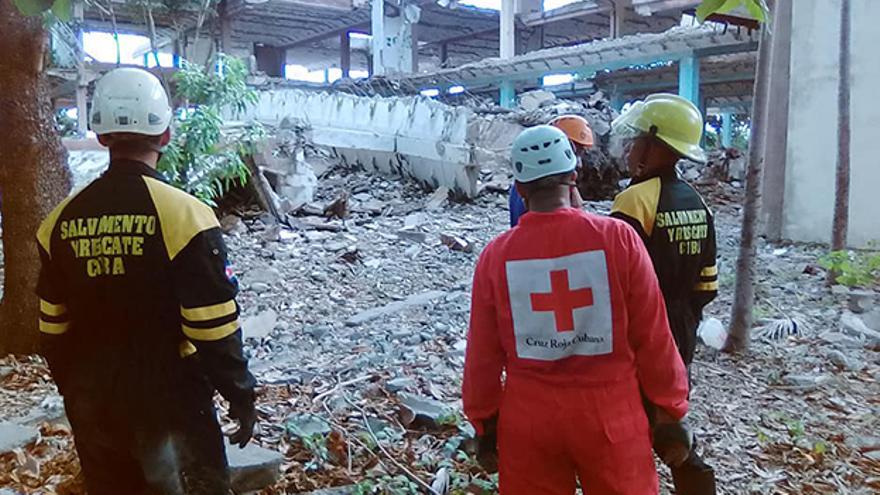
The collapse occurred in the old building of the Antonio Maceo Grajales high school in Santiago de Cuba. (Aris Batalla)
14ymedio, Havana, 25 August 2022 — One person was injured during the collapse that occurred this Wednesday in the old building of the Antonio Maceo Grajales Vocational Pre-University Institute of Exact Sciences (IPVCE), in Santiago de Cuba
The rescue team also tried to locate another individual, allegedly trapped between several cement slabs after the collapse of the structure. This was reported on Facebook by Aris Arias Batalla, provincial head of Operations and Relief of the Red Cross branch in Santiago de Cuba.
“A whole multidisciplinary team worked tirelessly to remove the body that is under the concrete slabs,” wrote Arias Batalla. He added that the injured person was transferred to the Juan Bruno Zayas Clinical Surgical Hospital and, as of last night, he was “out of danger.”
The Cuban Red Cross, the Civil Defense and workers of the Mariel project and the Ministry of Construction are operating at the scene of the accident. In addition, they support the labor of workers at the cement factory, paramedics of the Integrated Medical Emergency System, brigade members and experts in rescue techniques.
During the early hours of Thursday, work was being done to clean up the debris, and they had to break up the concrete slabs with electric hammers, according to Arias Batal, a rescue worker. At 8:00 in the morning, the rescuers began the search in a second sector after not finding any bodies in the first. continue reading
Since the event became known, the people of Santiago have demanded from the authorities the immediate demolition of the facilities of the former IPVCE, which was being used as a source to extract steel from. These actions have already caused accidents, such as the one that occurred on July 6 when another collapse left two people in the rubble.
The injured were illegally removing the steel from the fourth floor of the structure, which collapsed on Wednesday.
“How long will people be so irresponsible and risk death trying to remove steel from the floors and columns?” asked Carlos Caballero Reyes on Facebook, after the latest collapse.
“Since the previous injuries, not even two months ago, those ruins should have disappeared. People aren’t aware,” Idamis Geilis said in the comments.
The boarding schools, especially in the vocational centers, prepared students to pursue university studies in science and technology and were one of the “crown jewels” of the Cuban education system during the years of the Soviet subsidy.
In 2006, a study on seismic vulnerability was carried out, and it was determined that the school represented an imminent risk, due to the occurrence of earthquakes in Santiago de Cuba.
However, over the years, the refusal of families to send their children to these centers, the material deterioration and the shortage of food caused the initiative to capsize. In 2009, Raúl Castro closed the boarding schools in the countryside, which accelerated the ruin of the vocational high schools.
Translated by Regina Anavy
____________
COLLABORATE WITH OUR WORK: The 14ymedio team is committed to practicing serious journalism that reflects Cuba’s reality in all its depth. Thank you for joining us on this long journey. We invite you to continue supporting us by becoming a member of 14ymedio now. Together we can continue transforming journalism in Cuba.
 14ymedio, Juan Diego Rodríguez, Havana, 22 August 2022 — The tiredness that María felt last Wednesday did not bode well, although, at first, she thought it had been the walk in the sun throughout Central Havana in search of bread. Later, her discomfort made her fear the worst of it, of which she had no doubts the next day, when she woke up with a fever of 101F: she had dengue fever.