
Cuban Court in Cienfuegos Agrees to the Request of the Prosecutor’s Office and Denies Bail to ‘Ktivo Disidente’

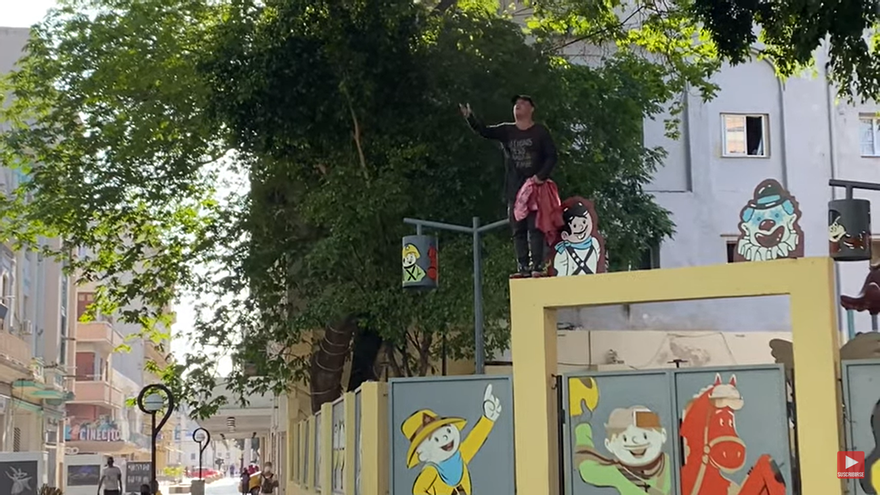
Ktivo Disidente in the Havana protest that has led him to prison. (Camila Carballo INSIDE/Capture/YouTube)

14ymedio bigger14ymedio, Madrid, 27 July 2022 — The Municipal Court of Cienfuegos reversed its decision to release Carlos Ernesto Díaz González (known on social networks as Ktivo Disidente) on bail, and in prison since last April 28. His offense: he climbed a wall on the boulevard of San Rafael in Havana to claim the freedom of Cubans.

According to Diario de Cuba, which quotes a friend of the activist, the magistrates had decided to grant release from prison after payment of 10,000 pesos as bail, but the Prosecutor’s Office rescinded the measure and managed to get the court to rectify it.

“The lawyer has done everything possible to free Ktivo. He requested a habeas corpus procedure in mid-July and the Court scheduled a hearing which the Prosecutor’s Office did not attend and to which they did not take Ktivo. In other words, they totally failed to comply with that procedure,” Manuel Gómez told the independent newspaper.

The man from Cienfuegos is accused of “defamation, disobedience and contempt” and a new habeas corpus hearing is scheduled for this Thursday the 28th, after the one on Friday the 22nd was frustrated.

Keilylli De la Mora Valle, a member of the Patriotic Union of Cuba and a friend of Ktivo, told Martí Noticias in an interview that the lawyer had been waiting in court for four hours on the 22nd when they told him that the hearing was being postponed. “The detainee had no knowledge that they were going to transfer him to court that day, which shows the obstacles and the lies the authorities use to keep him locked up,” she said.

Díaz González is imprisoned in the Ariza prison, in Cienfuegos, where he has received, according to his relatives, mistreatment by officials. At the beginning of June, the artist Luis Dener released a video in which he recounted that five agents took him handcuffed out of the punishment cell where he was, after several days on a hunger strike, and beat him and threatened him, ultimately leaving him with the common prisoners, who allegedly continued to attack him. continue reading

The activist also refuses to wear prison clothes and claims his status as a political prisoner.

Ktivo Disidente demonstrated on December 4, 2020 to demand the freedom of Luis Robles, known as the man with the banner. Later he joined the Archipiélago collective and was arrested in November 2021, the day before the Civic March for Change, for putting up protest posters in Cienfuegos.

But his entry into prison finally took place after the iconic protest that he staged on the Havana wall from which he shouted: “There must be no violence, there must be no bloodshed, but they have to let us participate in the political life of the country. The one who is a communist should be, but the one who should not be respected,” he said, while passers-by recorded it on their cell phones. Finally, several agents sent to the place lowered him from the heights and took him to a police station. Shortly after, he was transferred to Cienfuegos, where he awaits trial.

____________

COLLABORATE WITH OUR WORK: The 14ymedio team is committed to practicing serious journalism that reflects Cuba’s reality in all its depth. Thank you for joining us on this long journey. We invite you to continue supporting us by becoming a member of 14ymedio now. Together we can continue transforming journalism in Cuba.
Residents Take to the Streets of Altamira in Santiago de Cuba to Protest Against the Blackouts

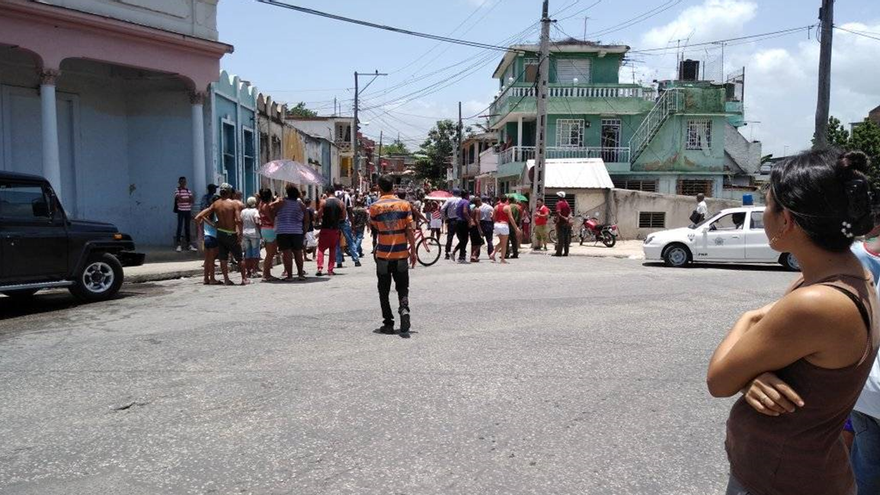
Protests at the Altamira People’s Council in Santiago de Cuba on August 1, 2022. (Facebook)

14ymedio bigger14ymedio, Havana/Santiago de Cuba, 1 August 2022 — A demonstration in the Luis Dagnes neighborhood, at the Altamira People’s Council, Santiago de Cuba, included several residents protesting the blackouts and the precarious economic situation which the city is experiencing. The rally quickly caused the presence of several military and law enforcement forces, while the demonstrators shouted phrases against the government.

“They are abusing us. All morning without light and the power went out again at 11 in the morning,” activist Aurora Sancho explains to 14ymedio. “It all started with a neighbor who began to make noise with an iron bar and complain. Little by little, others joined him. People couldn’t take it anymore today.”

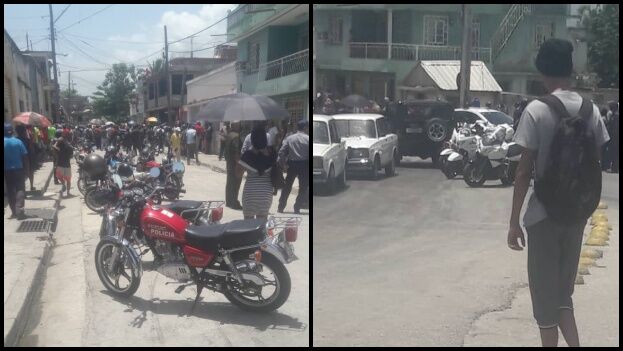
“They shouted slogans against Miguel Díaz-Canel; they also demanded that they turn on the power,” she adds. “Then the police arrived, along with the Red Berets and State Security.” Sancho’s house was surrounded “with two patrol cars” to prevent her from leaving. One of them was car 575, she points out.

Some residents of the area report that, during the protests, the provincial authorities of the Assembly of People’s Power, led by its president, Beatriz Johnson, began a “revolutionary argument” to calm the demonstrators.

https://www.facebook.com/watch/?v=585194603242547

“They brought Beatrix Johnson to make a speech, and people shouted at her. And so they would applaud her, they brought members of a Rapid Response Brigade. So far they have not returned the electricity service to us, and this is still totally taken over by the police.” Sancho believes that “finally the people woke up.”

Several images circulating on social networks record the presence on site of several patrols, police and high-ranking officers of the Ministry of the Interior.

“They entered the neighborhood wanting to repress, but people were only demonstrating peacefully. They wanted to strike blows but the neighbors didn’t let them. They handcuffed a young man who was only watching the protest, and when they were going to take him away, the people themselves protested more strongly and forced them to release him,” the activist adds.

The demonstrators improvised a conga line with several slogans and “even shouted slogans against Fidel Castro,” she says. Among the slogans they chanted were: “Enough is enough,” “Turn on the power, pricks ,” “Díaz-Canel, singao [motherfucker].” The main focus of the protests was on Comancié Street, between Castillo Duany and Piñeira, in the Luis Dagnes neighborhood.

“Then the police arrived, along with the Red Berets and State Security,” said an activist. (Courtesy)

In a video broadcast on social networks by users supportive of the regime, Beatriz Johnson is heard asking the residents for “patience” and said that the blackout schedules in the area were going to be reviewed. She also said that the local media would inform “all the people of Santiago de Cuba of the effects,” the causes and “the distribution of the cuts.”

Popular protests motivated by long power outages have been frequent in recent weeks. In municipalities such as Jagüey Grande, in Matanzas, up to two such demonstrations have occurred in less than a month.

Other places such as Bauta, in Artemisa, Covadonga, in Cienfuegos and Nuevitas, in Camagüey, have also been the scene of hundreds of neighbors who have taken to the streets to bang on pots and pans, with anti-government slogans and demanding freedom.

The People’s Council of Altamira is located in one of the poorest areas of Santiago de Cuba. In recent years, these neighborhoods have experienced a constant police siege, given that some activists and opponents reside in them, in addition to being the headquarters of the Patriotic Union of Cuba (UNPACU).

Translated by Regina Anavy 

____________

COLLABORATE WITH OUR WORK: The 14ymedio team is committed to practicing serious journalism that reflects Cuba’s reality in all its depth. Thank you for joining us on this long journey. We invite you to continue supporting us by becoming a member of 14ymedio now. Together we can continue transforming journalism in Cuba.
Cuban Residents of Bauta, Jaguey Grande and Covadonga Protest in the Streets Against the Long Blackouts

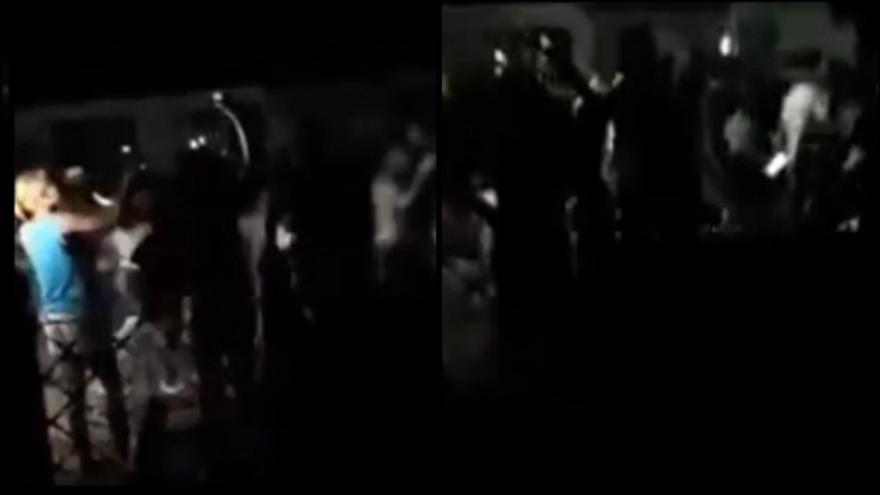
Three protests over power outages occurred on July 30 in different provinces of Cuba. (Collage)

14ymedio bigger14ymedio, Havana, 31 July 2022 — At least three protests, in different provinces of the country, took place on Saturday night demanding the restoration of electricity service. The suburb, La Minina de Bauta, Artemisa; the community of Central Australia, in Jagüey Grande, Matanzas; and the Covadonga neighborhood in the municipality of Aguada de Pasajeros in Cienfuegos were the scenes of these popular demonstrations.

The protests at the Central Australia People’s Council, in Jagüey Grande in the province of Matanzas, are the second in less than a month to take place in that community. On this occasion, also after suffering a long blackout of more than ten hours, hundreds of residents took to the streets banging their pots and pans and shouting “Freedom!” and “Turn on the current, pricks!” This last one was first launched by students at the University of Camagüey last June.

In several videos that have been disseminated through social networks, protesters are seen walking the streets in the dark, some illuminated by the light of their mobile phones. From inside several houses there were also cries of support, and several neighbors managed to broadcast live during the demonstration.

In Bauta, the scenes were similar. In the La Minina neighborhood of that municipality in the province of Artemisa, residents went out banging their pots and pans in the street in the middle of a long blackout. To the cry of “Turn on the power!” these neighbors also demanded the restoration of electricity. continue reading

A very similar protest also occurred in the neighborhood of Covadonga in the municipality of Aguada de Pasajeros, Cienfuegos. Immersed in darkness, neighbors protested in the streets of this community, which this Saturday also suffered a power outage of several hours. Several reports from the place say that in the middle of the demonstrations they broke the stained glass windows of a store that only takes payment in freely convertible currency [foreign currency] and took part of the products for sale.

This type of business has been the target of popular indignation in several demonstrations, and in the protests of July 11, 2022, several of these establishments were stoned and their goods looted. Since the sale of food and toiletries in foreign currency was inaugurated, this commercial network has had to deal with criticism, even among those who support the system.

So far, no official source has spoken out about these protests, although several netizens reported the arrival of several police officers when the demonstration was over. The uniformed men asked about the possible participants in the protests and, especially, about who had “lit the fire.”

The Government continues to ask for patience in the face of the problem of lack of electricity, which reaches unusual levels. The population is aware that there is no short-term solution, since the authorities themselves have said so, insisting that, at a minimum, the burden be shared equally among everyone.

Last week it was announced that power cuts will also begin to be implemented in Havana, a city that until now had benefited from the privilege of having fewer blackouts than other areas of the country.

Translated by Regina Anavy
____________

COLLABORATE WITH OUR WORK: The 14ymedio team is committed to practicing serious journalism that reflects Cuba’s reality in all its depth. Thank you for joining us on this long journey. We invite you to continue supporting us by becoming a member of 14ymedio now. Together we can continue transforming journalism in Cuba.