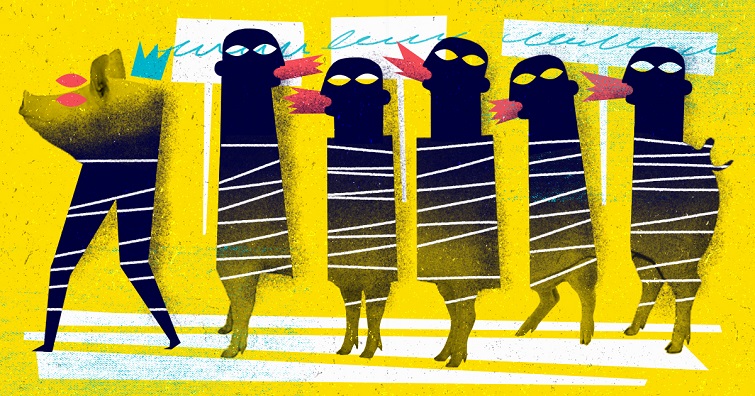
Fights for the Food Mark New Year’s in Cuban Hotels

A group of customers reaching for grapes at the Grand Memories Hotel in Cayo Santa María, Cuba. (Collage)

14ymedio bigger14ymedio, Havana, 4 January 2022 — “Scammed.” That’s how Giselle Muñoz feels after spending the end of the year at the Hotel Grand Memories in Cayo Santa María, north of the province of Villa Clara. The Cuban woman tried to break out of the routine on December 31st and only found shortcomings and disappointments at every step in the state-owned hotel, as reported on Facebook in a text accompanied by a video.

Organizational problems were added to the supply problems of the five-star and all-inclusive hotel, as it describes itself on promotional pages. After waiting hours for the room to be available, Muñoz says on her Facebook profile that when she entered she found that it was occupied. “Luckily no one coming out of the bathroom naked or in another more embarrassing situation.”

“I quickly left and went back to the desk,” continues Muñoz, adding that she was able to settle in with her family at 7 pm in another room. “The air conditioning did not cool, the refrigerator did not cool, the shower did not have hot water, the television did not have a remote control nor was it watchable because it had a split screen, and the bedding smelled like a mouse nest,” she describes.

The young woman, a resident of Sancti Spíritus, went back down to the reception and asked to speak to the hotel managers: “So that they would give me my money back because it was December 31st and I had not yet settled in the hotel. They told me they couldn’t do it, the most they could do was give me a few more hours to stay on the day of my departure.”

Even with much disgust, Muñoz had no choice but to go to continue reading

the end of the year dinner that the hotel had prepared, but if she thought for a second that the stumbling blocks were over, she quickly fell into a rage. The shortages that are spreading through the island’s markets has also reached the hotels.

“No pork, no food, practically, no staff to serve and supply the number of customers,” describes the young woman speaking about what she experienced in the restaurant. She also remembers that “people were anxiously waiting for apples and grapes,” because, she insists, customers paid for “a nutritional supplement that included fruits, fruits that I never saw.”

“Several people had to go into the kitchen to demand the food and fruits and then a cook came out to distribute a sad box of grapes for so many customers,” as can be seen in a video that Muñoz shared on her social networks, which she did, she said, “so that no one dares to say that it is a lie.”

“There were blows, shoves and everything never seen before over a handful of grapes, which in the end all fell to the ground because the same people broke the box trying to take them away.”

“It is unnecessary to remember that money is very hard to get to throw it away like that, it is not five pesos, it is a lot of money,” insists Muñoz.

On December 24 , another customer who identified herself as Rachel Cruz on the Tripadvisor platform, also complained about the poor quality of the food and the organization at the Grand Memories in Cayo Santa María. According to her account, her visit on Christmas Eve turned into a “nightmare,” into “complete madness.”

“My girls were knocked down to get an apple from the buffet. For my little boy there was nothing suitable for his food. We tried to go to eat and we spent three long hours in the endless lines. You asked for something and it had run out. The food was cold and poorly prepared,” she describes. “Terrible, I do not recommend it to anyone.”

Something similar happened to Gina, who worked hard all year in 2021 in her position in a Miami pharmacy with the illusion of saving for the end of the year with her family in Cuba. The plan seemed perfect: sun and sand on the most famous beach in Cuba, Varadero. Along with her brother, two nieces and her mother, the emigrant arrived in the last week of December at the Roc Arenas Doradas hotel in the Matanzas peninsula.

“I spent the four days lining up, lining up for the buffet, lining up for breakfast and lining up at the reception to leave my complaints,” Gina laments. The hotel, managed in a mixed way by the Cuban State and the Spanish chain Roc Hotels, has four stars that some clients question. “It gave me the impression that they had accepted more guests than the amount of food they had available.”

“The very limited food options and the very poor preparation, but the worst thing for me was to see that as soon as they noticed that I was a Cuban living in Miami, they treated me very differently from how they spoke to my mother, my brother and my nephews.” For Gina, “it was frustrating that I was going to get a rest and give my family a fun time but we ended up fighting for the food and stressed by the lines.”

____________

COLLABORATE WITH OUR WORK: The 14ymedio team is committed to practicing serious journalism that reflects Cuba’s reality in all its depth. Thank you for joining us on this long journey. We invite you to continue supporting us by becoming a member of 14ymedio now. Together we can continue transforming journalism in Cuba.
2022, The Year That Forecasts Will be Useless in Cuba

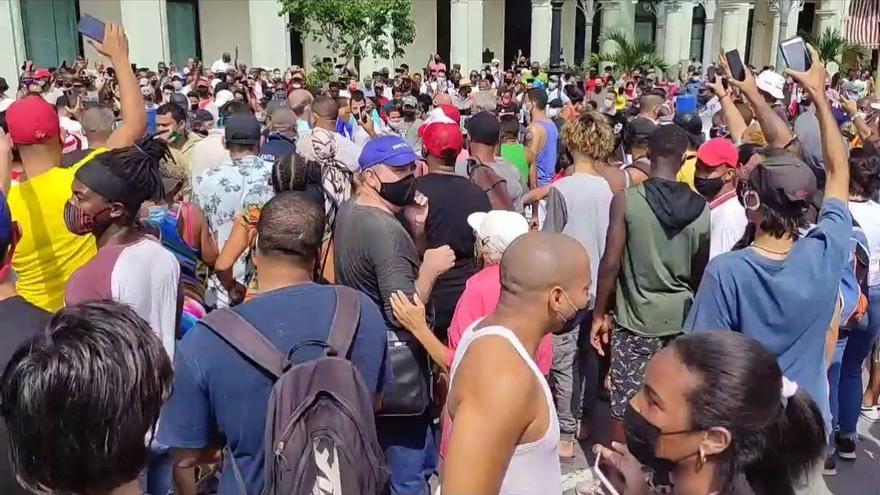
Twelve months ago, on another January 1st in 2021, no one could calculate that the Cuban streets were going to be filled with a river of people demanding freedom, on June 11. (14ymedio)

14ymedio bigger14ymedio, Havana, 1 January 2022 — Cubans have said goodbye to one of the most difficult years in their memory, to enter, this Saturday ,into a period full of many uncertainties. Hundreds of political prisoners, the economy bottoming out, a massive exodus in process, and a pandemic that has not yet ended complete a gloomy outlook for the Island. With these variables, the scenario is unprecedented and any exercise of prediction is useless.

Twelve months ago, on another January 1 in 2021, no one could calculate that the Cuban streets were going to fill with a river of people demanding freedom. July 11 (11J)was the largest and most extensive popular demonstration that has occurred in the history of Cuba. Neither the mambises in their independence struggles, nor the students in their confrontation against Gerardo Machado nor Fidel Castro in the Sierra Maestra had a similar number of followers.

However, the spontaneity and horizontality of the 11J, which was its greatest virtue because it prevented it from being aborted or beheaded in its first hours, was also its greatest weakness. Lacking a script and leaders, the protesters of that day were cornered by the police forces, they did not manage to reach the nerve centers of power and they did not summon the military and police to join them.

However, the regime went into “panic mode” and responded in the only wat Castroism has known how to do in its more than six decades of clinging to power: with repression, trying to rewrite the narrative of what happened and shielding the streets of the entire country with uniformed men. Any illusion that mass protest would force the regime to open up economically or politically has been dissolving as the months go by.

Instead of preparing a program of flexibilities, decreeing an amnesty for political prisoners and launching a program to unlock the productive forces, the Communist Party has preferred to entrench itself. Miguel Díaz-Canel has become one of the most unpopular rulers in national history, some even place him in the first place of the bad ones. continue reading

Can an economically exhausted regime, forced to be in a permanent state of emergency to avoid another uprising and devoid of any political mystique, survive for long? The answer varies depending on the degree of consideration for its people that each group in power has. In the case of the Cuban leaders, it has become clear that nothing stops them in their clear obsession with maintaining power.

That stubbornness and lack of grandeur are a combination that does not herald a peaceful end to a system that in 63 years has destroyed the nation, generated a bloated diaspora, lobotomized millions of students through school indoctrination programs, and sunk the economy to unbearable levels. They are not going to let go of the helm of the national ship to make things better, that is the message that they have sent with force in the last months.

But the current model has no future. Even if they manage to prolong its life artificially, it is doomed. The possibility of a sponsorship, in the style of the Soviet Union or Hugo Chávez’s Venezuela, is not on the horizon. The loss of young professionals that will accelerate in the coming months will further undercapitalize the labor force in an aging country and Díaz-Canel will not be able to reverse the animosity that people have towards him with his clumsy rhetoric.

Will this be the first day of the last year of Castroism? Many wonder in the streets and houses of this Island. It is possible, but right now we cannot know.

____________

COLLABORATE WITH OUR WORK: The 14ymedio team is committed to practicing serious journalism that reflects Cuba’s reality in all its depth. Thank you for joining us on this long journey. We invite you to continue supporting us by becoming a member of 14ymedio now. Together we can continue transforming journalism in Cuba.
A Leather Goods Store with Two Employees and One Pair of Shoes in Central Havana

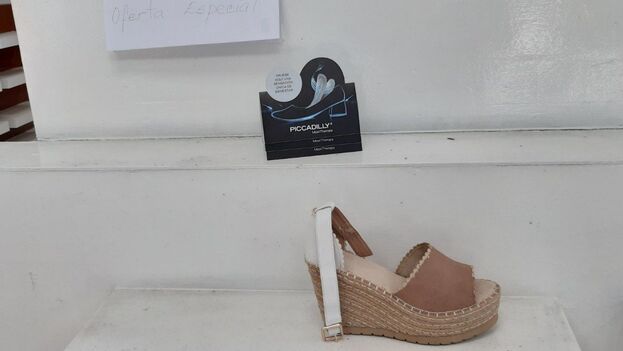
At La Reina leather goods there was only one pair of sandals for sale this Monday. (14ymedio)

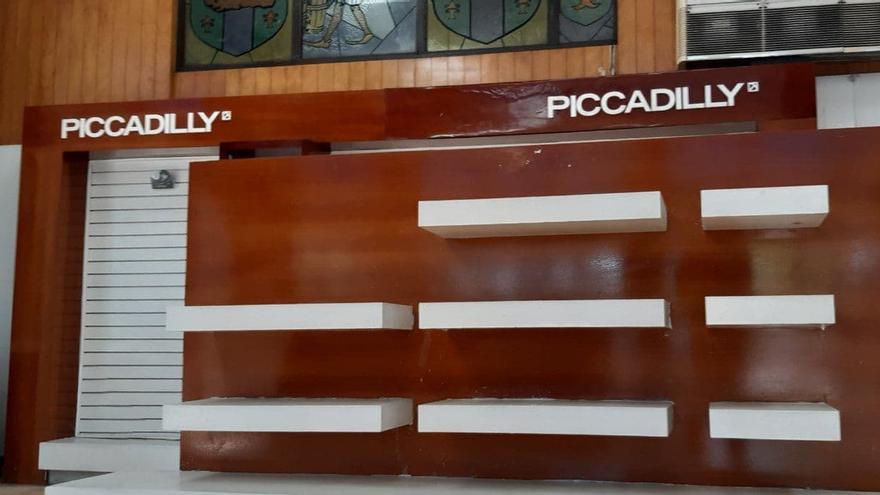
14ymedio bigger14ymedio, Natalia López Moya, Havana, 3 January 2022 — The “special offer” was actually the only one and flawed. In the La Reina leather good store, belonging to the Caribe chain of stores and located in Centro Habana, they only sold, this Monday, one pair of female platform sandals with a broken strap. The rest of the displays, dozens of them, were empty.

Located on the popular corner of Reina and Galiano, the place occupies a large air-conditioned space surrounded by elegant stained glass windows that remain deserted.

“There they sold some Brazilian Piccadilly brand shoes, they were a bit expensive, but they lasted because they were strong,” Marta, a former client of that business, told 14ymedio, who sold her products in the now defunct convertible pesos. “There were for all types of people, from the smallest to the highest numbers and they also sold umbrellas, bags and other merchandise.”

Located on the popular corner of Reina and Galiano, the place occupies a large air-conditioned space. (14ymedio)

Now, in the center of the store, two workers use their mobile phones to kill the hours that pass without interacting with the public.

“We only have that pair that you see there, it’s size 40, so they don’t work for you,” said one of the shop assistants to a lady who came looking for an offer. The woman asked when merchandise would come again. “God only knows,” replied one of the shop assistants.

Leaving the establishment, the woman complained: “What is the logic of keeping this place open paying for air conditioning and electricity and the salary of two people, just to sell a pair of half-torn shoes?”

____________

COLLABORATE WITH OUR WORK: The 14ymedio team is committed to practicing serious journalism that reflects Cuba’s reality in all its depth. Thank you for joining us on this long journey. We invite you to continue supporting us by becoming a member of 14ymedio now. Together we can continue transforming journalism in Cuba.
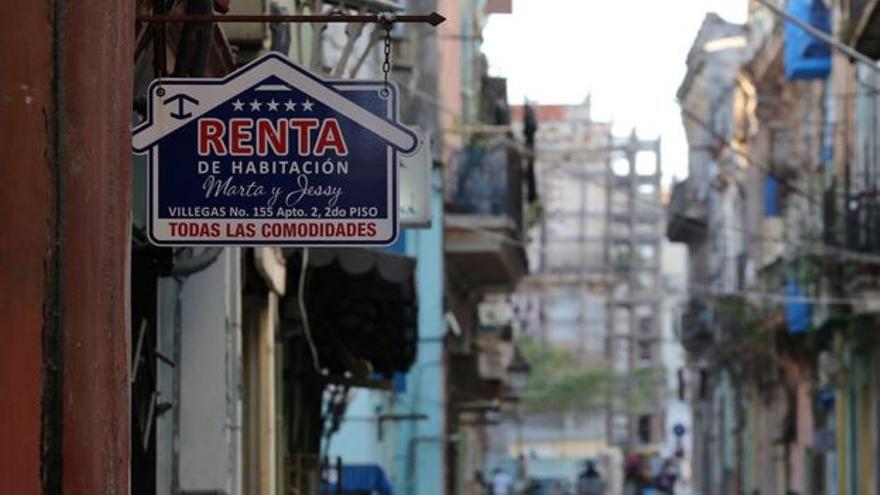
US Government Fines Airbnb for Violating Cuban Embargo

As of April 2016, Airbnb had a network of 4,000 rental homes visited by more than 13,000 Americans. (EFE)

14ymedio bigger14ymedio, Havana, 3 January 2022 — The United States government will collect a fine of $ 91,172.29 from the home rental company Airbnb for violations of the embargo against Cuba, according to a statement published Monday by the Treasury Department.

The company agreed to settle the amount due to “its potential civil liability for apparent violations of the sanctions against Cuba administered by the Office of Foreign Assets Control (OFAC),” the document said.

Although OFAC explained that the violations were not serious and have already been clarified, they included apparent payments related to American guests traveling for reasons other than the 12 categories authorized by OFAC, as well as the failure to maintain records associated with transactions with Cuba.

After reaching an agreement, Airbnb reported that it will address “its deficiencies in compliance with the sanctions” and implement “additional commitments designed to minimize the risk of the recurrence of similar conduct in the future.” continue reading

Among the immediate actions, it will implement an IP blocking regime for the granting of permits to people located in Cuba who act as hosts on the platform and thus prevent transactions with that category from being carried out.

The company also proposes to collect information on the country of residence and the payment instrument of its users, in order to determine if “they are nationals or residents” of the Island, as well as guarantee that the hosts certify that they are private entrepreneurs and not “Cuban government officials or members of the Communist Party.”

After the start of the thaw between Havana and Washington, the US-based platform began its operations on the island in April 2015 with homeowners and private rental rooms. At first, it began with reservations for American or Cuban-American travelers and, 12 months later, it expanded its market to tourists from all over the world.

As of April 2016, Airbnb had a network of 4,000 rental homes in Cuba visited by more than 13,000 Americans. According to company data, they have leases in 40 cities and towns on the island, with a third of their supply outside of Havana, in cities such as Trinidad, Viñales, Santiago de Cuba, Matanzas and Cienfuegos.

____________

COLLABORATE WITH OUR WORK: The 14ymedio team is committed to practicing serious journalism that reflects Cuba’s reality in all its depth. Thank you for joining us on this long journey. We invite you to continue supporting us by becoming a member of 14ymedio now. Together we can continue transforming journalism in Cuba.

Cuba Archive Demands Justice and Freedom for Prisoners on the 63rd Anniversary of the Revolution

A young man is arrested by police and State Security agents during the July 11th protests in Havana. (Capture)

14ymedio bigger14ymedio, Havana, 2 January 2022 –This Saturday, the organization Archivo Cuba (Cuba Archive) launched a petition on Change.org in solidarity with the Island, in which they demand justice for the July 11th prisoners and freedom for the Cuban people.

The initiative was published, intentionally, on the first of January, the sixty-third anniversary of the Revolution, “the regime which has unleashed fierce injustice, repression, misery, and desperation upon the Cuban people,” said the Miami-based NGO in a statement shared Saturday.

In it, they request “three minutes”, the time it takes to read and sign the petition on Change.org, “for 63 years of dictatorship.” They celebrated that another initiative on the same platform, one which advocated for reducing the sentence of Cuban truck driver Rogel Aguilera, sentenced to 110 years in prison in the United States for an accident in which four people died, had resonated and that finally, Colorado’s governor, Jarid Polis, reduced the young man’s sentence to 10 years. “Evidently people sympathize with victims of injustice,” offered the organization led by María Werlau.

The petition states that faced with “the largest public anti-government demonstrations in the last half-century” in Cuba, on July 11th, with thousands of citizens spontaneously demanding freedom and improved living conditions, the Cuban State responded with “fierce repression: arbitrary arrests, trials without due process, layoffs from work, forced exile, and all sorts of persecution and threats.” continue reading

At the same time, they considered the work of the Work Group for J11 Justice, which reported “at least” 1,334 detentions on that day, including 45 minors between 14 and 17 years of age, and 708 people remain incarcerated. “Around 200 have been sentenced to long years of prison, many for up to 20 to 30 years, and hundreds more face similarly absurd punishment,” states the petition.

“Cuban laws discriminate politically in open violation of fundamental rights and thousands more Cubans are incarcerated for alleged common crimes or crimes against State Security and for ’pre-criminal social dangerousness’* [sic] with the purpose of maintaining social-political control,” denounced Archivo Cuba, which exclaimed, “It’s time for this to end!”

As a result, from the Cuban Government they demand, to begin with, the unconditional release of all political prisoners and the dismissal “of all judicial and investigative processes for political reasons.” In addition, they request information on those in custody, “for public demonstration, pre-criminal social dangerousness, and other political causes, as well as access to the public records of tribunals and detention facilities.”

They also request that the United Nations Special Rappoteur on Torture and international human rights organizations have access, for inspection, to detention centers on the Island, selected “without prior notice.”

Lastly, they demand the “dismantling of the repressive apparatus,” the “repeal of all laws and regulations penalizing the free exercise of civil and political rights,” and the “urgent start of a transition process toward a multi-party democracy that guarantees the free exercise of the people’s sovereignty under the rule of law.”

They also ask governments around the world to impose on the Island an embargo on the sale of arms and “equipment used to repress,” as well as sanctions on Cuban officials “including prosecutors and judges,” who lend themselves to repression, and that they cease any actions “that legitimize, fund and support the dictatorship.”

Finally, they request the international community send humanitarian assistance to Cuba “without intermediation of the government until it becomes a legitimate representative of the people,” and they conclude the petition with the motto of the protests, taken from the song with the same name: “Patria y Vida“.

*Translator’s note: ’Pre-criminal social dangerousness’ is the ’crime’ of being someone who may commit a crime in the future.

Translated by: Silvia Suárez

____________

COLLABORATE WITH OUR WORK: The 14ymedio team is committed to practicing serious journalism that reflects Cuba’s reality in all its depth. Thank you for joining us on this long journey. We invite you to continue supporting us by becoming a member of 14ymedio now. Together we can continue transforming journalism in Cuba.
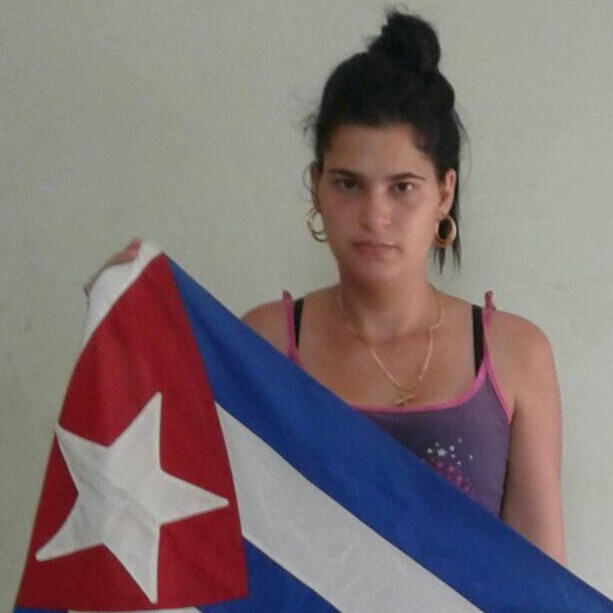
‘Empress’ Sissi Goes to Prison in Cuba / Luis Felipe Rojas

Sissi Abascal Zamora

Luis Felipe Rojas, 28 December 2021 — The Cuban revolution does not mince words or believe in noble titles. On Monday, December 27, a court in Matanzas confirmed the sentence of 6 years in prison for  Sissi Abascal Zamora, age 23, for the alleged crimes of “contempt, attack and public disorder.” Sissi was accused and imprisoned precisely by a woman, who has the rank of major in the Ministry of the Interior.

On July 11, 2021, the largest popular protests in 62 years of the Castro revolution took place across the island. A month after the ’11J’ protests, Sissi told me in an interview that, on the that day, she connected to her Facebook account and saw that the same things were happening in San Antonio de los Baños and Palma Soriano, in the eastern part of the country, and she did not want anyone to tell her the story about it later.

“My father, around three in the afternoon, was arrested and my mother, my sister and I were still in the demonstration. They hit my sister with a bottle on the head, where they had to give her stitches,” she said at the time from her town of Carlos Rojas, in the Matanzas municipality of Jovellanos.

For years I had interviewed her when, every Sunday, she marched as a member of the Ladies in White movement or in the activities of the “Pedro Luis Boitel” Party for Democracy, for which she was frequently detained or beaten by police forces.

Before entering the court and turning herself in to the authorities, Sissi posted photos of the police operation around the institution. In a previous post that morning, she wrote with all the bravery in the world: “Today, December 27, at 9:00 AM, the appeal of my sentence will be held in the provincial court of the municipality of Jovellanos. I was sentenced to 6 years in prison for demonstrating on July 11. Freedom for all political prisoners. Long live Cuba Libre. Patria y Vida.”court

After the events of ’11J’ (11 July) her father, Armando Abascal, went to prison and was later released. The prisoner of conscience Félix Navarro, president of the Pedro Luis Boitel Party for Democracy, still remains in jail.

Of that wave of arrests, human rights groups have reported hundreds of people detained (more than 600 have already been tried or are awaiting trial). There are teenagers, mothers of several minors, people well into the third age, artists, a Christian pastor, university students and even two Cuban citizens residing in the United States and Canada.

However, Havana is deaf and continues to be “populated with slogans,” as a song by the Cuban singer-songwriter Pedro Luis Ferrer says.

Sissi, perhaps an empress for human rights, does not make headlines in the mainstream media. The feminist movements are not going to tear their clothes because a 23-year-old girl asks for the freedom of her country, a country whose government completely denies there is any popular discontent.

Cuban Brigadier General Humberto Francis Pardo, in Charge of Fidel Castro’s Security, Dies

General Humberto Francis Pardo, who died this Monday in Havana. (Archive)

14ymedio bigger14ymedio, Luz Escobar / Natalia López Moya, Havana, 28 December 2021 — Reserve Brigadier General Humberto Omar Francis Pardo died this Monday in Havana, as 14ymedio confirmed on Tuesday. His body, which will be cremated, is at the Calzada y K funeral home, located at Calzada number 52, in El Vedado. A source close to the family told this newspaper that the military man had suffered from Alzheimer’s for years.

He was born in Santiago de Cuba in 1945 and studied in the Soviet Union between 1965 and 1969, according to the Internet forum Secretos de Cuba. “When he returned to Cuba, he carried out military missions, at least in Angola, Ethiopia and Nicaragua,” says this website.

As brigadier general, Francis Pardo was in charge of the the Ministry of the Interior’s Personal Security Directorate, the invisible apparatus with the most power on the island, and was in charge of Fidel Castro’s security. He had under his command the “elite” brigade that has more than 3,000 troops, “shock troops” to face protests.

Considered one of the most powerful Cuban military personnel, Francis Pardo was replaced from his duties as Head of the General Directorate of Personal Security (DGSP) in August 2016. Raúl Castro replaced him with his grandson Raúl Guillermo Rodríguez Castro, son of Luis Alberto Rodríguez López-Calleja, the “czar” of the State company Gaesa. continue reading

Until that moment, within the military scheme, General Francis at the head of the DGSP commanded an anti-attacks brigade that was made up of snipers and experts in all types of explosives, in addition to the counterintelligence service, which in coordination with other State agencies controlled all the information of that brotherhood, the family circle and friends. Vice Minister of the Interior under Abelardo Colomé Ibarra, the military man was also in charge of an international relations department that coordinated with other secret services visits to Cuba by persons of interest and personalities.

General Francis was awarded the Order “June 6” of the First Degree in recognition of 55 years of accumulated service in the ranks of the Revolutionary Armed Forces and the Ministry of the Interior. His “consecration, skill and reliability performance, fundamentally in the organization and direction of protection activities for the main leaders,” of the Cuban regime was highlighted.

All the official reactions after the death of Francis Pardo were published long after 14ymedio reported the death of the soldier. The first communiqué was released by the Interior Ministry, which specified that Francis Pardo had “a brilliant record of service in protecting the physical integrity” of the main Cuban leaders and “in defense of the Revolution.”

It also noted that “his remains were on view” at the Calzada and K funeral home, “for a subsequent ceremony with the corresponding military honors.”

For his part, Miguel Díaz-Canel Bermúdez on his Twitter account described Francis Pardo as “a brave combatant of Personal Security,” who was “head of that troop of loyalists during 30 of his 56 years of service in the Ministry of Interior, under the orders of Fidel Castro and his brother Raúl.

____________

COLLABORATE WITH OUR WORK: The 14ymedio team is committed to practicing serious journalism that reflects Cuba’s reality in all its depth. Thank you for joining us on this long journey. We invite you to continue supporting us by becoming a member of 14ymedio now. Together we can continue transforming journalism in Cuba.

Cuba Acknowledges High Transmission of Omicron Variant and Decrees New Restrictions for Travelers

The Ministry of Public Health recognizes that “the trend is an increase in infections,” specifically a 34.8% increase in Cuba in the last week. (14ymedio)

14ymedio bigger14ymedio, Havana, 30 December 2021 — The Cuban health authorities have decided to establish new restrictions due to the increase in infections in recent days. Some 241 new cases of covid-19 were reported yesterday, almost 100 more than the previous day, and this Thursday the trend continues, with the record 328 cases.

In addition, after several days without deaths related to the coronavirus, there is a reported victim, although he had testicular cancer with brain metastasis, a serious comorbidity.

The Ministry of Public Health recognizes in a statement published this Thursday that “the trend is an increase in infections,” specifically a 34.8% increase in Cuba in the last week, and notes “the high power of dissemination” of the omicron variant , “which has the capacity to double the number of cases in just two or three days,” and which has expanded to 110 countries.

On the island, 72 people who are reported to be infected with this strain have been identified, spread over 12 provinces. “Most are imported cases, although patients who have had contact with these people have already been diagnosed,” says the Health Ministry’s text. continue reading

For this reason, from January 5 there will be new regulations, which mainly affect international travelers.

Now, they will have to present a complete vaccination scheme upon entry to Cuba, in addition to a negative PCR within a maximum of 72 hours.

For travelers “from high-risk countries,” the statement said, “random” surveillance will be increased.

The most restrictive measures, despite the fact that in the United States and Europe the infections are growing exponentially, will affect those who come from South Africa, Lesotho, Botswana, Zimbabwe, Mozambique, Namibia, Malawi and Eswatini, who will be subjected to a PCR upon arrival to the Island and will have to do a mandatory eight-day quarantine in a hotel “destined for that purpose.” Travelers will have to pay for it out of pocket along with transportation. On the seventh day, a new test will be performed, which, if negative, will allow them to be discharged from quarantine.

The same is established for Cubans residing on the island who do not have a vaccination scheme, the regulations specify.

If a traveler who arrives on the island tests positive for covid-19, he will be admitted to a health center, and all his direct contacts, isolated in special centers or “at home, as long as the necessary conditions exist and compliance is guaranteed.”

As for the rest of the population, “mass activities that generate crowds of people” will be prohibited, without specifying whether this includes the daily and very long lines to buy food.

____________

COLLABORATE WITH OUR WORK: The 14ymedio team is committed to practicing serious journalism that reflects Cuba’s reality in all its depth. Thank you for joining us on this long journey. We invite you to continue supporting us by becoming a member of 14ymedio now. Together we can continue transforming journalism in Cuba.

Charges Dropped Against Artists Over July 11 Protests in Front of the ICRT

“We are fighting forcefully and intelligently to put fish on the Cuban table,” an official told Cubadebate. (14ymedio)

14ymedio bigger14ymedio, Luz Escobar, Havana, December 30, 2021 — The artists charged with public disorder for protesting in front of the Cuban Institute of Radio and Television (ICRT) on July 11 learned on Thursday that the cases against them were being dropped. In essence, they were being acquitted.

The situation remains unclear, however, for playwright Yunior García Aguilera and curator Solveig Font, both members of the group, are both outside of Cuba.

Actor Reinier Diaz told 14ymedio that when he went to the police station at Zapata and C streets to sign the legal document dismissing his case, he inquired about the status of García Aguilera and Font and they told him, “Their situations are different,” without giving any further information.

García Aguilera tells 14ymedio that he knows nothing about the status of his case and that Font “is looking into it.”

“I just signed the document dismissing the charges over the July 11 protest in front of ICRT. I was not intending to make a public announcement but I feel indebted to many people for this outcome,” wrote historian Leonardo Fernandez Otaño on social media. continue reading

In the post he thanks friends who helped him support himself during this period and those who were subjected to interrogation because of their closeness to him. He also thanked his parents for “all their suffering,” which he says is ongoing, and neighbors who “ferociously” defended him from assault and attempted acts of public repudiation.

The young historian says he is “grateful” that the charges have been dropped “because no one can hide the truth” but also admits to feeling sad that it was “the privileges of being white and intellectual” that saved him. “The young people from La Güinera were not so lucky,” he writes. In late December thirty-two people from this impoverished Cuban town were sentenced to up to twenty-six years in prison for their participation in the July 11 protests. Fernandez Otaño describes their sentences as “unjust and politically motivated.”

Other ICRT protesters who had effectively been placed under house arrest as a precautionary measure included Edel Carrero, Javier Perez Rodriguez, Juan Carlos Saenz Calahorra, Raul Prado, Gretel Medina, Daniel Triana and Aminta Calzado.

____________

COLLABORATE WITH OUR WORK: The 14ymedio team is committed to practicing serious journalism that reflects Cuba’s reality in all its depth. Thank you for joining us on this long journey. We invite you to continue supporting us by becoming a member of 14ymedio now. Together we can continue transforming journalism in Cuba.
Sixty-Three Anniversaries of the Cuban Revolution

The biggest blow to the Cuban dictatorship was delivered in Las Vegas, where ‘Patria y Vida’ won two Latin Grammys. (EFE / EPA / Nina Prommer)

14ymedio bigger14ymedio, Carlos Alberto Montaner, Miami, 1 January 2022 — It is worth reviewing what happened in Cuba in the preceding months. Year after year, and we are already on our way to the 63rd anniversary, I have said we were near the end. I believed it, but it was not true. I thought that Fidel was interested in the fate of the Cuban people and not just doing what he wanted. Sebastián Arcos, in a statement to the BBC from Florida International University, thought otherwise. He was right. Fidel was willing, as during the Missile Crisis, for everyone to die, as long as he didn’t have to give in. I thought that reality would force him to rectify. In November 1989, communism disappeared, and on December 25, 1991, the USSR itself made an exit from history and it seemed that the Cuban dictatorship was left totally alone.

It was the time of alms and conspiracies. Salinas de Gortari gave him a political hand together with Carlos Andrés Pérez and César Gaviria. That happened in Islas Mujeres, in Mexico’s Caribbean coast, and Salinas de Gortari and Beatrice Rangel, then Minister of CAP, told me about it. Felipe González designed a reform for him and secretly sent Carlos Solchaga, his trusted economist, to carry it out. The Department of conspiracies was in charge of the Sao Paulo Forum and Lula da Silva, and they even invited the engineer Marcelo Odebrecht, a major figure in corruption. (There is a photo on the Internet of Raúl Castro, M. Odebrecht, Ramiro Valdés, and other accomplices of corruption in an image from the Sao Paulo Forum).

2021 was the emergence of the San Isidro Movement and its most visible head, Luis Manuel Otero Alcántara. They are a group of young and very poor artists, most of them mestizo, like almost the entire Cuban people, that emerged in 2018 to fight against Decree 349, that tried to further restrain young artists. Tania Bruguera immediately echoed the protests. And the rappers turned against President Díaz Canel adding an epithet, “si… gao” (“f…ked”) which even a parrot repeated incessantly without knowing that it was in danger of losing its feathers, as a Cuban saying goes.

But the greatest blow to the Cuban dictatorship was delivered in Las Vegas, United States, on November 18, despite pressure against that very well-connected government. It was there, in the Grammy Awards Galas, where “Patria y Vida” won two Latin Grammys (not one, but two: the award for the best urban song and the best song of the year). Composing and singing it are Yotuel Romero, Descemer Bueno, Mykel Osorbo, El Funky and Gente de Zona. Along with Mario Vargas Llosa I heard the song by Yotuel during a special distinction that the International Foundation for Freedom awarded to the creators of what have been called “Cuba’s second anthem.” continue reading

What has happened in Cuba so that the disaster is major and irreversible? Thirteen hundred political prisoners, almost all of them young, for demanding the freedom of Cuba in the July 11 demonstrations. An inflation in this year that is about to end of 740%, reports the Diario de Cuba, citing The Economist’s studies by country. That is an obscene figure that reflects the incompetence of the leadership that runs that poor country. There is no money or anything to buy in Cuba. Pork production has decreased by 44%, reports the digital newspaper 14yMedio and Pedro Monreal, an economist inside the system, verifies the complaint. Not in vain does Cubanet title one of its chronicles, “Empty refrigerators and broken dreams, this is how Christmas Eve was spent in Cuba.” This comes, very well selected, in the daily “packet” assembled by Miguel García Delgado, a former officer of the Second National Front of Escambray.

Reinaldo Escobar, a freelance journalist and expert on Marxism, fears that Díaz-Canel wants to revive Marxism-Leninism to escape the crisis. But there is only one way to escape this mess: to repeat, more or less, what Gorbachev said on December 25, 1991, 30 years ago. Marxism leads to failure and dictatorship. There is no other option but to cancel it completely.

Marx knew this since 1870, when William Jevons, a young British professor, published his “marginalist” conclusions on the theory of value (later reiterated, independently, by the Austrian Carl Menger and by the Frenchman Leon Walras). That is why Marx didn’t publish volumes 2 and 3 of Das Capital. It was useless. If his theory of value was false, as the Austrian economist Eugene von Böhm-Bawrek demonstrated at the time, so was surplus value and his entire hypothesis collapsed. As simple as that.

____________

COLLABORATE WITH OUR WORK: The 14ymedio team is committed to practicing serious journalism that reflects Cuba’s reality in all its depth. Thank you for joining us on this long journey. We invite you to continue supporting us by becoming a member of 14ymedio now. Together we can continue transforming journalism in Cuba.

Cuban Police Detain Motorcycle Thieves as Government Calls Theft ‘Fake News’

Some profiles on social networks and especially groups such as motorcycle clubs have reported some of the violent thefts of electric motorcycles. (14ymedio)

14ymedio biggerFor the Cuban government, the robberies reported in recent days and the growing violence on the island do not exist. The Ministry of the Interior published a statement this Friday in which it insists that events reported on social networks, in particular those related to the theft of electric motorcycles, “are events that occurred in previous years or fake news.”

This, according to the Ministry, is intended “to generate a climate of impunity and public insecurity in the midst of the end of the year festivities.”

However, in the same text it is acknowledged that there have been people arrested for this crime, and that “they have faced the corresponding penal consequences.”

The note, which was read on the national television news, says that “receivers,” some shop owners and mechanics, as well as “citizens who have been warned or fined for trusting the unscrupulous,” have been prosecuted.

The note also claims to have established the modus operandi of these seizures: “Taking advantage of the victims’ neglect, the lack of protection of the property in the public thoroughfare, the commercialization of parts, pieces and accessories or the use of false property documents.” continue reading

Regarding the complaints made to the authorities that have not yet been cleared up, the ministry explains that “they are working hard,” and details that in some of the investigations carried out “there are concrete elements that will allow the arrest” of the guilty and the recovery of the stolen goods.

“Citizen tranquility constitutes a conquest of the Cuban Revolution, and it will continue to be so. There will be no impunity and there will always be vigorous action against criminals,” the note concludes in a triumphalist tone.

The reality shown by social networks and testimonies collected by this newspaper is something else. “On the corner they assaulted a friend of my mother to take her phone,” “in my building they broke the gate over the door to steal but the dog barked and the men ran away,” “they left my sister without her wallet when she got off the bus,” are some of the stories of violence that have been heard in Cuba in recent weeks.

Now during the New Year’s celebration, which has been marked by shortages and high prices, there were also a series of reports of assaults that have put many Cubans on alert.

Thefts with a knife, theft of gold chains or cell phones, theft of electric motorcycles, have been some of the most frequent complaints about the lack of security that exists on Cuban streets.

Some profiles on social networks and especially groups such as motorcycle clubs have reported some of the violent thefts of electric motorcycles. “The best thing is to avoid the red lights,” they warn. In one of the videos that circulated, you can see the moment when a man who is riding one of these vehicles is assaulted at a traffic light and is thrown in the street while the thieves ride away on the motorcycle.

____________

COLLABORATE WITH OUR WORK: The 14ymedio team is committed to practicing serious journalism that reflects Cuba’s reality in all its depth. Thank you for joining us on this long journey. We invite you to continue supporting us by becoming a member of 14ymedio now. Together we can continue transforming journalism in Cuba.

Cuba: The Continuity of Triumphalism

Mural in relief at the entrance to the Youth Labor Army market on Tulipán street, in Havana. (14ymedio)

14ymedio bigger14ymedio, Reinaldo Escobar, Havana, 1 January 2022 — On the last day of 2021, the directors of the Youth Labor Army market (EJT) on Tulipán Street surprised their regulars with a mural in relief that reproduces an old icon of triumphalism: the image of a peasant carrying a succulent bunch of bananas, taken from the back of the 20 peso bills in circulation.

The curious thing is that this image already appeared on the banknotes of the 1990s with the label “Food Program” and in the current ones the foot of the engraving says “Agricultural Development.” Accompanying the guajiro, in both cases, are some furrows that stretch into infinity and some sugarcane workers on a combine in full swing.

The image is taken from the back of the 20 peso bills in circulation. (Collage)

Without the intention of aesthetic pedantries and without pretending that behind the innocent mural is the hairy hand of the ideological apparatus, the reproduction of the banana picker at the gates of a market offers signs that the same triumphalist vision of a controlling State that “guarantees” food to the people continues to be projected.

It doesn’t matter that the bananas they sell on the other side of this gate are no longer those “microjets” from the 90s that made the fat splash up in the pan due to their excessive water content; and even less important is that the price has multiplied by ten today, since the last issue of those bills.

There he is with his slight and sweaty smile, this peasant whose skin has been darkened in the artistic endeavor and to whom, without hidden ideological intentions, they passed the bunch from the left hand to the right. A matter of design.

____________

COLLABORATE WITH OUR WORK: The 14ymedio team is committed to practicing serious journalism that reflects Cuba’s reality in all its depth. Thank you for joining us on this long journey. We invite you to continue supporting us by becoming a member of 14ymedio now. Together we can continue transforming journalism in Cuba.
Cuba: Anatomy of Fear / Regina Coyula

Ilustration: Rafael Alejandro

For the women of today, leaders.

Regina Coyula, Havana, 23 October 2020 (Originally published in El Estornudo).

In 1980, I worked for G2 (yes, the G2), and I provided staff support to that gigantic “Operation Inca” launched during the events at the Peruvian Embassy. The first times I crossed the many throngs, vociferous and intimidating, where Fifth Avenue splits and opens up to the old Abreu Fontán roundabout, I felt the real possibility of physical aggression. Only after reaching the post of the entrance was I able to breathe easily. At Abreu Fontán, there was a concentration of citizens who would abandon the country through the Port of Mariel.

I, who am not one to wear T-shirts and never have been, acquired three of those “Down with the Blockade,” “Yankees out of Guantanamo,” and “No Spy Flights” T-shirts, each one with a corresponding image. They were my fragile protection to feel safe among the crowds. I was not deterred by my great and disarming fear of the wall of “indignant people” seeking their freedom. In the weeks that I worked in that beach spa, converted into a noisy, crowded, and smelly warehouse of anxious people, ignorant of their future, sustained only by their hope of leaving, I thought of the fear of the “other”.

I rejected the barbarity of the acts of repudiation, that amorphous and anonymous mass, which unleashed its impunity and its instincts, which baited frustrations and in collusion with the authorities, passed them the bill. I did not participate in any repudiation. The only one on my block was against a single family, quiet and decent, who never pretended to be in favor of the government. It was carried out by four vociferous women who had just arrived in the neighborhood.

Carlitos Berenguer, himself, received the derision for all those who left. He was, as far as I know, a mid-level government official; however, in front of his building on 26th Avenue, very close to my house, they built a stage with audio and lighting equipment. Every day, they organized a program, which included everything from loud songs to the worst references about his personal life. This was accompanied by gas and power outages and graffiti on the front door of his apartment.

I cannot imagine the hell his family went through and was ashamed for continue reading

them the one time my curiosity detained me there. I recognized in many of the faces the same rejection it inspired in me, but they did their part to appear neither too enthusiastic nor too apathetic. Spontaneously, those who were purely ideological took the microphone, they raised their fists and lost their voices during their diatribes.

To many of them, who today spit in disgust in the four corners of the world when anyone speaks of the Revolution, the fear of being unmasked accompanies them, and that also must be a very disturbing fear.

There were other cases less meaningful but which ended tragically in injury or death. I do not know if the data exist, 1980 was not the internet era, and much of that horror occurred unbeknownst to the world and even to Cubans themselves. I can understand hate eating away at them forever because, in life, there are strong blows. . . Even so, there were repercussions for the Government of Cuba. Retracting, after affirming that the people would take action; Fidel Castro declared the moral superiority of the people, putting an end, at least officially, to those shameful days of intransigence.

The latency of the method was maintained by the Rapid Response Brigades and during the “Maleconazo” of 1994, and especially so far during this century, against the peaceful opposition and especially against the Ladies in White.

It was my turn to closely observe the act of repudiation in 1993 against the families of my husband’s, Rafael Alcides’s, children. Hospitalized for months to protect my pregnancy, and three days after my C-section, the details of that grand performance and Alcides’s detention became known to me with time. The street closed off, cameras, loudspeakers, strangers taken from their workplaces to yell without knowing to whom or why they were yelling.

My own act of repudiation was missing. And I experienced it on December 10th and 11th of 2013 at the headquarters of Estado de Sats. Twenty years later, but the same methods: the street closed off, cameras, loudspeakers, strangers taken from their workplaces (and schools) to yell without knowing to whom or why they were yelling.

I do not want to focus on the repudiations, intrinsically vile. I want to focus on the fear. In the fear of blowing their cover and denouncing the degradation to which human beings were being subjected, those who on the previous day they greeted or perhaps they even owed a favor to the enemy. Of the fear that, like preventive medicine, they attempt to spread among an ever more indocile citizenry; of the participants’ fear of ending up transformed from the victimizers into the victims.

The fear of demonstrating my rejection at the “right moment and place,” the fear of being considered not sufficiently combative, the fear of not belonging. The fear at that the time they surrounded the headquarters of Estado de Sats and I decided to cook to set aside my worries that my family hadn’t heard from me since the day before. Terrible thoughts enter your mind at moments like those.

This is not a story, it is only to call attention to a phenomenon that is creatively recycled, always with those hateful ones whose help further damages — if that is possible — the fragile social fabric. That is the fear that remains.

Translated by: Silvia Suárez