Cyclones, Housing and Revolution / Dimas Castellano

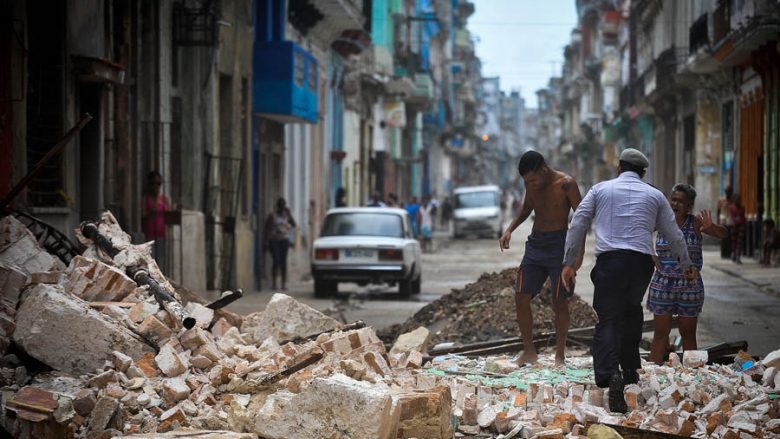
Havana after Hurricane Irma. (ELSALVADOR.COM)

Dimas Castellanos, 13 October 2017 — According to information from the National Defense Council, Hurricane Irma, a category-five storm, hit Cuba between September 7 and 9, causing 14,657 houses to collapse, and another 16,646 to partially collapse, thus totaling 31,303 —not to mention the tens of thousands that suffered other kinds of damage.

Between 2002 and 2004, in the Pinar del Río province alone, Hurricanes Isidore, Lili, Charley and Ivan – categories one, two, three and five, respectively – damaged more than 98,000 properties. In 2008 the tropical storms Fay, Hanna, Gustav and Ike totally demolished around half a million houses; and in 2005, Hurricane Dennis, a category-three storm, damaged more than 80.000 homes in Pilón (Granma), more than 70% of the homes in Casilda (Trinidad), 5,241 homes in Santiago de Cuba, more than 25,000 in Granma, some 400 in Jaruco (Mayabeque), more than 3,200 in Matanzas, 8,200 in Sancti Spíritus, and 1,828 homes in the capital. continue reading

The magnitude of this damage was such that the sum of the houses damaged by cyclones alone is similar to the figure for the housing shortage that the Revolution inherited: according to the Economic Commission for Latin America and the Caribbean, the housing deficit until 1959 was of about 700,000 homes, while the pace of construction between 1946 and 1953, according Erich Trefftz, was 26,827 as an annual average, a figure that increased between 1953 and 1958.

In 1953 Fidel Castro proposed “A revolutionary government would solve the housing problem by resolutely lowering rents by 50%, sparing from any contribution those homes inhabited by their own owners, tripling taxes on rented houses, demolishing the infernal barracks and erecting in their place modern high-rises, and financing the construction of houses throughout the island on a scale never seen before, based on the idea that it is ideal, in the countryside, for each family to owns its own land, and, in the city, for each family to live in its own house or apartment.”

On October 14, 1960, in its Urban Reform Law the revolutionary government established that: “Every family has a right to decent housing, and the State will ensure this right in three stages; in the medium term, the State will build, with its own resources, homes that it will cede in permanent usufruct, free, to each family.”

The final provision of said Law stated: “Exercising the Constituent Power wielded by the Council of Ministers, this Act is declared an integral part of the Basic Law of the Republic. Consequently, this law is granted constitutional force and hierarchy.”

However, as an annual average, the first plan, from 1960 to 1970, was unable to exceed 11,000 homes; and the second plan, from 1971 to 1980, barely reached 17,000. Thus, in the first 20 years the pace of annual construction was lower than that of the period from 1946 to 1953. Thus, instead of relieving the housing shortage, it was aggravated.

To recover from the setback, it was proposed to build 100.000 per year starting in 1981, but in the first decade it was unable to exceed 40,000 per year. This plan was interrupted in 1995 by the crisis known as the “Special Period”. Carlos Lage Dávila, secretary of the Executive Committee of the Council of Ministers, then presented a report to the National Assembly of the People’s Power in 2005, in which he assured that due to the “improvement of the country’s financial potential,” they were going to “construct and finish no less than 100.000 new houses per year as of 2006.” That is, a second plan of 100,000 homes would be undertaken.

According to the National Bureau of Statistics, in 2008 about 45,000 were built, but in the year 2013 there were fewer than 26,000 (a figure again below the average for the period from 1946 to 1953, when the population of Cuba was half today’s). That is, in five years construction decreased by about 19.000 houses.

A conservative estimate of the non-fulfillment of the plans, and houses destroyed by atmospheric phenomena, yields a shortage greater than the 700.000 that were calculated before 1959. And this figure would be even worse if it were not for the more than two million Cubans who have left the country since 1959.

If we accept the fact that the figure remains at 700,000, at the rate of about 25,000 per year, it will take 28 years just to make up for the shortage. If we also account for Cuba’s new needs, due to demographic growth, the ageing of existing housing, the lack of maintenance, the increasing number of collapses, the shortage of construction materials, and the effects of natural phenomena … it will take about half a century. We are, then, dealing with a major housing crisis and all its implications.

The Urban Reform Act of 1960 stated that “The State, with its own resources, will build the homes, which it will give in usufruct, permanently and free, to each family.” Then the General Housing Law of 1984 defined the “microbrigade” as the main instrument for their construction. Meanwhile, the failed plan for 100,000 placed the responsibility on families, a demonstration of the incapacity of the State to tackle the housing issue alone.

An abridged account of the 50 years that separate us from the Urban Reform Law of 1960 reveals a shift, spanning from the State’s promise to build and to grant decent housing, permanently and for free, to the construction of houses with palm trees toppled by the hurricanes, with roofs of zinc tiles or asbestos cement, likely to be demolished by future hurricanes. But it also reveals the impossibility and inability of the totalitarian state to solve the housing crisis, as this would require joint action by Cubans, equipped with basic instruments, such as the rights and liberties of citizens, to contribute to the resolution of a problem as vital as housing, one of the basic components of integral human development.

Translation from DiariodeCuba.com
The US Embargo and Cuba’s Internal Blockade in Times of Halloween

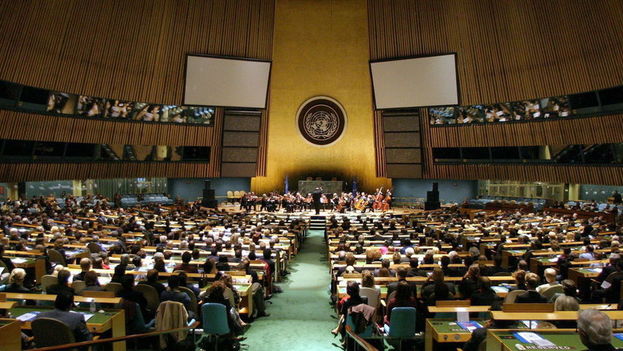
Again, as expected, the UN has condemned the US embargo on Cuba. (EFE)

14ymedio biggerPedro Campos, Miami, 2 November 2017 – Once again, as expected, the United Nations condemns the United States embargo on Cuba. This annual exercise is part of the diversionary masquerade of the Castro regime to try to make the naïve believe that it is the United States that is the main culprit in Cuba’s economic and social disasters, not the internal blockade to which the regime itself has subjected the Cuban people.

The US embargo, aimed at trying to affect the regime’s economy, is based on the fact that the Cuban dictatorship violates the civil, political, economic and social rights of the Cuban people and grounded in the assumption that the pressure of the embargo would force the Cuban regime to assume a democratic transition process. continue reading

If anyone had doubts about these violations, it would be enough to observe what the regime has just done with the opponents and dissidents who tried to present themselves to be nominated as candidates for grassroots delegates to the Popular Power; or simply to follow the records of the opponents and dissidents detained, imprisoned, beaten or forcibly prevented from participating in national or international events.

But in reality, the embargo never achieved its purpose of forcing the regime to that democratic transition, while the Castro government counted on the help of the USSR and the “socialist camp” first, and later that of Venezuela in the golden age of oil.

Now, as the USSR and the socialist camp have disappeared and Venezuela is going through a political and economic crisis, with no prospects for a solution favorable to the Castro regime in the short term, those who believe in the effectiveness of the embargo have new hopes that it could have an effect.

It should also be noted that the Cuban rulers have never suffered the direct consequences of the embargo. They continue to live like kings. They live in luxurious mansions and entertain themselves in the best Cuban landscapes, they have the best cars and yachts, they have hunting grounds, airplanes, the best possible medical attention, they enjoy the most exquisite delicacies and spend all the money they need at the cost of fleecing Cuba’s wage slaves.

But it is no less true that economic difficulties have led the regime to have to make some concessions to the private economy and foreign investment, which they always manage at will, without clear laws, with abusive taxes and absurd prohibitions.

If the Cuban leaders were really interested in eliminating the embargo, they could achieve it very easily if they declared an amnesty for political prisoners, decreed the freedoms of expression, association, election and economic activity and allowed a multi-party system and a free market.

But they consider that this would be “to surrender” to imperialism, when in truth what they would be doing is lifting the internal, economic, political and social blockade that they have imposed on the development of Cubans and their economy in the name of a socialism that has never existed.

In the end, the fear of losing power is the real cause of all this handling of the embargo and the internal blockade. A few measures already taken with regards to private work and other measures successfully confront the state, offering better services and salaries.

The Castro regime is, thus, more and more statist than the Chinese and the Vietnamese, who have yielded in economic power but closed any alternative option to political power. Here, they are unwilling to cede even that.

The entire international community, except Israel, lends itself to the Castro regime for two fundamental reasons: first, because the embargo provisions, which are not always applied, apply to investments in Cuba of foreign capital and trade with other countries, due to their extraterritorial clauses; and secondly because for many it is the only way they have to “stand up to the tiger.”

The Ministry of Foreign Affairs presents the event as a great triumph of the regime’s diplomacy, knowing that many of those who support it in this “battle” are very clear that this is a dictatorial government, a violator of the human rights of the Cuban people.

It also does it to throw a crumb of solidarity, for Cuba’s “contributions” to health and education and as compensation for other negotiations in the UN, where Cuba can support others with its votes for some help from Unesco, the World Food Program, or on issues that demand support in negotiations.

The Castro dictatorship, flagrant, massive and a systematic violator of the civil, political, economic and social rights of the Cuban people, with its internal blockade, is the main obstacle to the economic development of Cuba. Its entire “fight” against the US embargo is a mask very well rehearsed for the vote in the UN in times of Halloween.

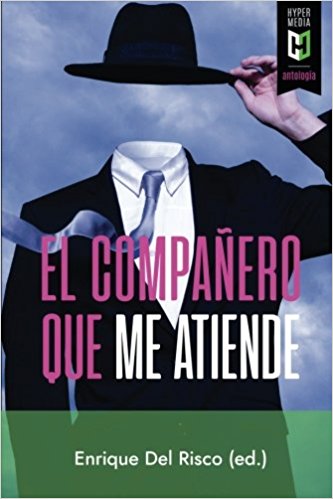
The Compañero Who Looks After Me

Angel Santiesteban, 16 October 2017 — Another title of this book could be A Cuban History of Fear. The fear of living (and, above all, of writing) surrounded by an army of police, undercover agents, collaborators and simple snitches in charge of rounding up the misguided souls of Cubans, be they writers or not. But “this book is not a monument to grievance,” insists the anthologist. What is intended is “to collect a small amount of Cuban contributions to a genre already proclaimed by Kafka from the first pages of his unfinished novel, The Trial. The first chapter of the novel, which announces in the first sentence that K. “without having done anything bad, was detained one morning.” A genre that Orwell would continue in 1984, with the addition of hope: “You are a difficult case. But don’t lose hope. Everybody is saved sooner or later. In the end, we will kill you.” A recompilation that stretches from the time of almost artisanal vigilance up to that virtual panoptic that is Facebook. And beyond.
Translated by Regina Anavy

Obama Made The Mistake Of “Giving In Without Demanding,” Regrets Father Conrado

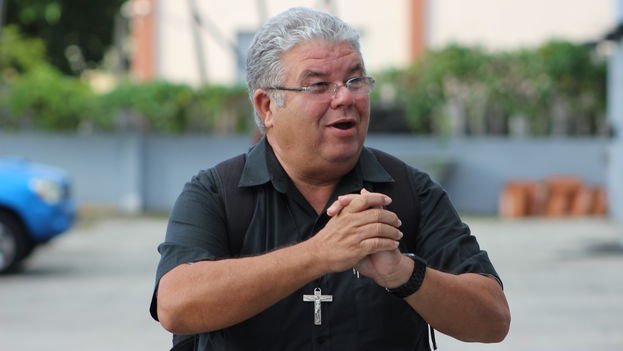
“The Church does not have many possibilities to help because the spaces that the Government gives are very small and because the Cuban Church is poor,” says the priest José Conrado. (14ymedio)

14ymedio bigger14ymedio, Mario Penton, Miami, 4 November 2017 — The Catholic priest José Conrado Rodríguez, parish priest of the church of San Francisco de Paula in Trinidad, visited Miami last week to present his book Dreams and Nightmares of a Priest in Cuba.

On the way to Miami’s Ermita de la Caridad, where he planned to offer his book to the Virgin of Charity of Cobre, he spoke with 14ymedio about the Cuban reality and the role of the Catholic Church, the largest religious group on the island with a presence in each one of the municipalities of the country.

14ymedio/Mario Penton. What is your assessment of the Cuban reality?

José Conrado. Cuba is facing a huge material, economic, political and leadership crisis. It is the crisis of a model that has become insufficient and incapable of solving the problems of the nation, but at the bottom of this reality there is a deep spiritual and moral crisis. That is the root of the other crises. continue reading

What we are experiencing today has not come suddenly, but is the result of policies and deep attitudes that have led the nation to this deadend. The repression of freedom in Cuba and the religious conscience for many years has caused the crisis in which the country is sunk. It is the result of fear that has been planted, which is deep in the bones of people, in the most intimate, in the most personal.

14ym. If you keep raising your voice inside Cuba, why do you think the island government lets you leave and return, officiate Masses and even move freely around the country?

José Conrado. When one reaches a certain level of public and international recognition, the measures taken by the repressive organs are different. Because of being a priest, faithful to my convictions and pastoral work, they take care not to convert me into a problem with the Church. Nothing I do is bad. In no country in the world is it a crime to visit people, establish bridges and promote dialogues. The reality is that anyone can leave Cuba as long as they have the money for the passport and the visa of the country that receives them.

14ym. Do you feel guarded or persecuted by State Security?

José Conrado. Ah, yes. In Trinidad the largest urinal in the town is the door of my house, for example. I have denounced it many times, even from homilies, and nobody does anything. The men open their flies and in front of everyone they urinate on the door of the Church. There are even women who also do it. That is degrading. It is not by chance that we have denounced this so many times and it continues to happen.

14ym. Trinidad is a tourist village but you also know its poorest side. How is it that the city that does not appear in the guides for foreigners and what has the Church done to alleviate the hardships?

José Conrado. The Church does not have many possibilities to help because the spaces given by the government are very small and because the Cuban Church is poor. People get confused about the Church because it gives, but the reality is that it gives from its poverty. When the Church helps, it is because someone from outside the country gave something or because the faithful in Cuba, from their poverty, are capable of sharing. It is a true epic of the Cuban Church to help so many people with so few resources.

The programs of the parish are maintained thanks to my salary and the donations of the faithful. There is a lot of poverty in the cities but even more poverty in the rural towns. In the parish we are helping with food a group of about 20 children who do not have lunch at the rural school, but Hurricane Irma took the roof of the Church. Part of the money that is collected with the sale of the book Dreams And Nightmares Of A Priest In Cuba will be used to rebuild that site and another part will go to the victims of the hurricane in Ciego de Ávila.

We do everything we can to help people, but the service of faith in a people that has no hope is the greatest service we can provide. That is the mission of the Church.

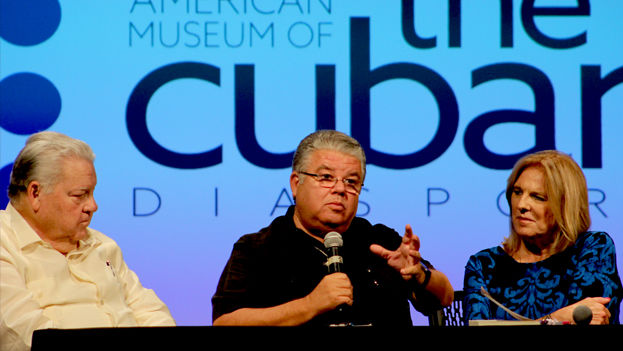
Father José Conrado Rodríguez (center) during the presentation of his book at the American Museum of the Cuban Diaspora, accompanied by Manuel Salvat and Myriam Márquez. (14ymedio)

José Conrado.The Church did what it had to do – I’m speaking of Pope Francis. However, I see an important fissure: it was an agreement between the greats: the hierarchy of the Cuban Government, the Church and the United States, but the solutions Cuba requires are deeper. If we must have a healing as a nation, we need to do it for all Cubans, not just the rulers. That is why any arrangement that only touches the upper echelons is an insufficient arrangement.

In Cuba, everyone wanted and had hope with the path that President Obama initiated, but the United States Government yielded and yielded without demanding. That is an insufficient way to negotiate. Human rights are the entitlement of every human being and it is not a subject that is dispensable in negotiations with Cuba. This agreement between Cuba and the United States did not reach where it had to go.

14ym. Many people criticize the silence of the Cuban ecclesiastical hierarchy regarding issues such as the violation of human rights on the Island.

José Conrado.I myself have said on several occasions that this silence can be considered a complicit silence, but it would be very unfair not to remember that the Church has raised its voice many times to warn of danger. When one thinks of the Pastoral Letter Love Hopes All Things, or the letters of the bishops at the beginning of the Revolution and the documents of the Cuban National Ecclesiastical Meeting, a more objective assessment of the role of the Church in the history of the country can be made.

Normally nobody collects the homilies of priests and bishops, where they also denounce, but that is not written. We have more commitment to doing than to saying. I think there is a lot of injustice, but above all, ignorance among those who say that the Church is silent.

14ym. How much remains for the Cuban Church to do to accompany the people?

José Conrado.We have made our way in the silence, in the dedication of each day, in the fidelity of the Christian people who have lived alongside the Cuban people and have suffered their pains, sharing their needs and witnessing the presence of God in the midst of the people. The Church has to look ahead and that has to be the legacy of the Cuban Church.

The Church runs the danger of the self-referentiality that Pope Francis speaks so much of, to become an end in itself. As if all that would be needed is that there were ever more powerful and numerous Churches, but we know well that this is not what would allow us to achieve the realization of the vocation of the Church.

In this sense, the Cuban Church has an advantage: it is already in the peripheries, but it must have more audacity. God calls us in a certain circumstance and the Church is called to serve, that is his vocation: to serve the needy, those who are being persecuted and crushed.

14ym. What leadership does Cuba need to get out of the crisis?

José Conrado.Leaderships can be of many types, for example Fidel Castro, who gathers power in one hand and takes it away from individuals. There are other leaders, such as Mandela, who did not need to divide because he discovered that in the forgiveness of the other, in the recognition of the other person and in confronting violent attitudes and the denial of the other is true freedom and the best way to be a leader.

I believe that the leadership that Cuba needs is the one in which the leader denies his power so that people learn to be free and build a nation with all and for the good of all that is born of participation and responsibility in the face of to the common good.

14ym. How do you assess retirement of Jaime Ortega at the head of the Archdiocese of Havana?

José Conrado.It is too early to answer that question, but knowing as I know the new archbishop of Havana – a man of deep faith and a very radical commitment to the gospel – I am sure that his presence in the Archdiocese will be of great benefit for the people of the capital.

14ym. How do you value the evangelical churches gaining more and more ground in Cuba?

José Conrado.If Christ gains ground in Cuba, we all win. If a person truly becomes a Christian, we are happy whether he is Catholic or Protestant. Those who are not being Christians are those who, by considerations of doctrine, leave the path of charity. Among Catholics and Protestants in Cuba I see above all a lot of understanding and a lot of love. There are rare cases of those who react violently to another religious belief.

The Cuban ‘Big Brother’ Seen by 57 Writers

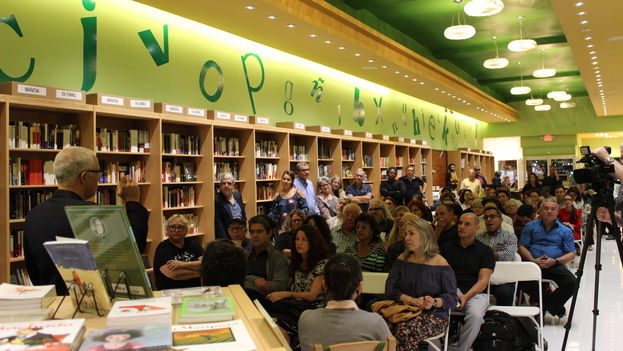
About 90 people showed up at the bookstore Altamira Books for the presentation of the book ‘El compañero que me atiende.’ (14ymedio)

The book ‘The Compañero Who Watches Me’ was presented last Thursday in Coral Gables (Florida) and reflects its authors’ preoccupation with the omnipresence of surveillance in Cuba

14ymedio bigger14ymedio, Mario J. Penton, Miami, 3 November 2017 — Writing a book can be like an exorcism, especially when trying to leave behind ghosts of the past. This is the case with publisher Hypermedia’s new book, El compañero que me atiende (The Compañero Who Watches Me), a compilation of fictional stories by 57 authors, collected by Enrique del Risco, about the omnipresence of surveillance in Cuban life. Something that marked the national literary output.

“This book is not a memorial of grievances, nor is it a book about repression. In the Cuban case, on the list of those aggrieved by a regime that is close to finishing its sixth decade, writers score rather low compared to other parts of society,” clarified compiler Del Risco. continue reading

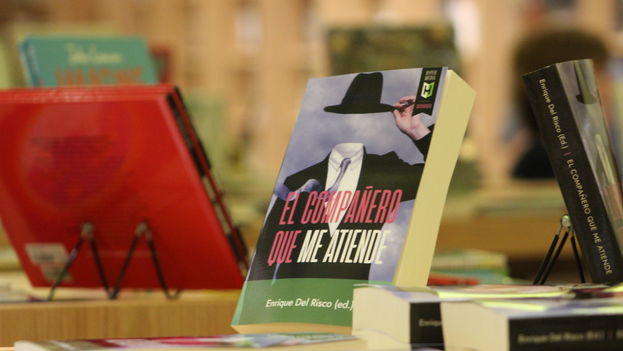
The book, almost 500 pages long, was presented Thursday in the bookstore Altamira Books, a very welcoming place in the city of Coral Gables (Florida); the store’s purpose is to “foster knowledge and use of the Spanish language,” according to its owners.

Del Risco, the renowned Cuban poet and narrator Legna Rodriguez Iglesias, Abel Fernandez Larrea, Jose M. Fernandez and Luis Felipe Roja, journalist for Radio Marti, presented the book to almost a hundred people among whom were some of the best Cuban writers in exile.

“This book began as an idea and was written thanks to the enthusiastic response of the authors who are in Cuba and in the diaspora. We have stories by 57 writers who are not only in the United States but in different parts of Latin America, Canada and Europe,” explained Del Risco.

El compañero que me atiende collects for the first time passages by authors who speak of the surveillance work of the Cuban state and how this influences the Island’s literature. Del Risco told 14ymedio that the response exceeded his expectations. “We have writers of all ages. Censorship and surveillance is a national phenomenon that has happened at all social levels and is a common denominator in the whole revolutionary process,” he said.

“The book also helps those writers and artists who have been censored and surveilled feel part of a society that suffers that as a whole. It is not just something that belongs to intellectuals but workers, women, students, everyone has been a part of and victim of this phenomenon,” explains Del Risco.

Among the authors who live on the Island is the writer – recently released from jail – Angel Santiesteban, who presents his story The Men of Richelieu, part of an unpublished book entitled Zone of Silence.

Also from Cuba came stories by the actress and writer Mariela Brito, Raul Aguiar, Atilio Caballero, Ernesto Santana, Jorge Angel Perez, and Jorge Espinosa, among others.

‘El compañero que me atiende’ will be for sale on Amazon and in some Florida bookstores. (14ymedio)

The central idea of the anthology is to give voice to writers so that they can describe the surveillance atmosphere created by the totalitarian state as a consequence of the political system installed in Cuba after the 1959 Revolution.

Writer Jose M. Fernandez, who emigrated to the Dominican Republic in 1998, recalled that in his writings he had proposed the thesis that the Cuban political system, in spite of having declared itself atheistic, “was organized as a profoundly religious structure around a dogma.”

“It had its Christ and its martyrs, and the compañero who watched us was the ghost,” explains Fernandez.

Writing his story, removed from the politics but addressing the lurking danger of being heard in a country in which each person seems to be an ear of the state, “freed” him.

“I realized that it was like a salvation because the trauma accompanied me throughout my life. It was not caused by the censorship itself but because those who were my friends, my companions and those with whom I had to finish five long years of university lent themselves and caused it to happen,” says Fernandez who has had a prolific career in the Dominican Republic.

According to the author, although a good part of his story is fiction, there are some events that did occur in the city of his birth, Santiago de Cuba. On sharing his story with a friend, the response she gave surprised him: “As always happens in Cuba, the reality surpasses the fiction,” she told him.

Fernandez has planned to send a sample of the book “to the companion who attends him” with this dedication: “You fucked me over, but I immortalized you.”

Legna Rodriguez, for her part, said that a good number of Cubans do not realize how powerful the surveillance they are subjected to. “It is not felt or seen, but it becomes a sickness, an amorality, a cancer,” said the writer.

Luis Felipe Rojas remembered the long interrogations to which he was subjected by the authorities because of the passages that he published on his blog Crossing the Barbed Wire.

“I always thought that I should write about this, that I could fictionalize it, but it wasn’t until I left Cuba that all that flowed. Inside it would have been impossible,” said the communicator.

Translated by Mary Lou Keel

Diapers and Tractors Connect With Real Needs at the Havana Fair

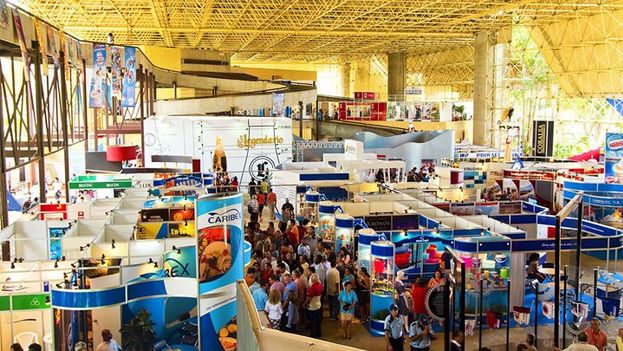
The Havana International Fair brings 63 countries to Cuba with plans for new products. (Fihav)

14ymedio bigger14ymedio, Zunilda Mata, Havana, 3 November 2017 – Italian diapers and Caterpillar tractors have been the stars of the 2017 Havana International Fair (Fihav), which brings together more than 3,000 entrepreneurs from 63 countries, including the United States, this Friday. Both products will have a presence on the island if conditions agreed with the manufacturers are met so that they can set up operations in the Mariel Special Development Zone (ZEDM).

In its struggle to raise more than 2.5 billion dollars in direct foreign investment, the Cuban Government is presenting a portfolio of 395 projects in 15 economic sectors at the fair.

Beyond the numbers, often fanciful, managed by the authorities, what catches the attention of Cubans interviewed by 14ymedio is the creation of Industria Arthis, a Cuban-Italian joint venture that will build the first factory for disposable diapers in Cuba. The factory is scheduled to begin production in the ZEDM in 2019. continue reading

It will be a relief for Cubans, tired of reusing disposable diapers and exposing their children to the possible infections that entails. Currently, the product routinely disappears from stores or is sold only in hard currency, so many families turn to the black market or import them to maintain a supply. The official media blame the deficit on hoarders and the poor organization of distribution, but the president himself, Raúl Castro, admitted in 2012 the inexcusable need for our own industry. “We have to do it, I do not remember how much it costs, it’s expensive, but we have to do it,” he exclaimed during a meeting of the Council of Ministers.

Daniela, the mother of a baby who by 2019 will no longer need diapers, is an expert in their reuse. “I buy the filling separately and I put it in the diaper, so I save money and avoid having to wash cloth diapers, which takes time and the expenses of detergent,” explains the young woman, who for now would settle for achieving the dream of “having at least one new disposable diaper for each day.”

The future Arthis facility will produce four sizes of children’s diapers, in addition to three sizes for adults, with the filling to reuse them. Due to the aging of the population, in a country with almost 20% of people over 60 years of age, demand grows at both ends of the demographic pyramid.

The slowness that distinguishes the entire investment process in the Island, however, foreshadows delays. The official newspaper Granma acknowledged last week that the project is still hampered by “excessive delays in the negotiating process.”

The economist Elias Amor analyzes the problem without equivocation: “For many years, decades, Castro’s economy works outside the inexorable laws of the market,” the specialist explains. “When they try to apply those laws and incorporate some rationality into business processes, they do it badly.”

The International Fair, nevertheless, celebrates another advance this year with the return of the American giant Caterpillar, hand in hand with Rimco, the Puerto Rican company and an official distributor in the Caribbean of the famous heavy machinery.

From Expocuba, the news has flown to the plains of San Juan y Martinez, in Pinar del Río, where the Perez clan received the news with enthusiasm. “We have an old tractor that has been with us for more than half a century and is full of patches,” says the family patriarch.

Cultivators of tobacco, flowers and papayas, the Perez have jealously guarded their small tractor, painted a fiery red and considered the family’s most precious possession. His obsession for years has been to get replacement parts to keep “the monster” running, as some affectionately call it.

Although the date when the industry will start up and if its equipment will be marketed directly to private producers is still unknown, the return of the brand, absent since 1959, is perceived as a great step.

Less than a kilometer from the Perez house another family looks forward to the day. “Most of the work is done by hand, with oxen or with tools such as knives and hoes,” says Serafin, who leases a plot dedicated to the cultivation of beans and vegetables.

“I’ve always wanted to have a small tractor that serves me mainly to prepare the land,” the farmer told this newspaper. “I do not care what brand it is, but of course if it is a Caterpillar so much the better, because my grandfather had one of those and it lasted a long time,” says the peasant, who, although he admits that the process may well be delayed, he supposes that with the new machinery he would be able to produce more and with more quality. “And even sell my products in other countries, who knows?” he asks hopefully.

A year ago, both farmers buried their dreams of improving technologically, when they learned that the US manufacturer of Cleber tractors had been excluded from the projects approved to settle in the ZEDM, with its small format models which are called Oggúns.

“We are not going to give up, this is a long-term,” said Saul Berenthal, co-founder of the company with Horace Clemmons, after hearing the decision of the Cuban authorities. Twelve months later, Cleber still has not been able to enter the Cuban market and now a bigger opponent, Caterpillar, is ahead of them.

During the five days that the 2017 edition of Fihav lasted, the agreements that have been made public have been numerous and in many sectors, but another of the most valued at street level is that of telecommunications.

United Telecommunication Services (UTS), a company of the ally Curaçao, signed an agreement with the national monopoly, Etecsa, to increase the bandwidth for internet service

Paul de Geus, president of UTS, explained that the company operates a network of submarine fiber optic cables that allow direct access from multiple global operators, especially in the Caribbean, Central America and the Andean countries.

“For us it is a great pride to formalize this agreement, the result of a process of several successful commercial missions coordinated between the ministry of economic affairs of our country and Cuba,” explains the UTS president.

The Government of Havana seems, with this agreement, to consolidate the search for new allies with which to improve its access to the network in the new context of the Venezuelan crisis (Caracas was the provider of the submarine cable to bring internet to the Island), and of the tension with the United States since the arrival of Donald Trump to power, which cools the possibilities of cooperation with the northern neighbor in this area.

Beyond these developments, the traditional allies in the commercial field have also wanted to make their mark in this edition of the fair. The first partner of the island, Russia, advanced in the negotiations for the reform of the railway network, a project that covers works in more than 1,100 kilometers of railroad and the supply of construction equipment, roads and transport. In addition, ACINOX Stainless Steel and Russian YUMZ signed a contract for more than 30.2 million dollars to modernize a factory producing wire rod for construction.

Spain, Cuba’s second commercial partner, took advantage of its remarkable presence at the fair to review the state of economic relations and deal with the renegotiation of debt, but also to contribute to the expansion of solar energy in Cuba, a sector that, well-managed, could become a key to national economic development.

The Spanish company Assyce Yield Energía SA will install, together with the German company EFF Solar, panels to generate 100 megawatts/hour of electricity in the western provinces of Pinar del Río, Artemisa, Mayabeque and Matanzas. Both companies signed a contract with Unión Eléctrica de Cuba for a period of 25 years, for which Assyce will supply 55 megawatts/hour to Pinar del Río and Artemisa, while EFF will deliver 45 megawatts/hour to Mayabeque and Matanzas.

This agreement is part of Havana’s strategy to reduce its dependence on the oil that Venezuela supplies at subsidized prices but in decreasing amounts. However, renewable energies will not be able to compensate in the short-term for the oil deficit created by the fall from 100,000 to 55,000 barrels that the island receives each day from Venezuela, its Bolivarian ally.

Prices Will Be Capped To Fight The Shortages In Cienfuegos

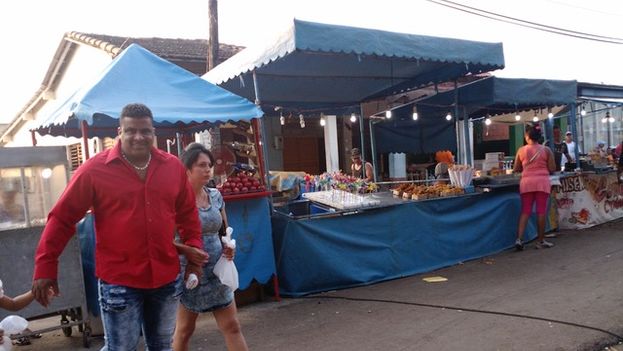
Street vendors will also have to comply with the new maximum prices for food products. (14ymedio)

14ymedio bigger14ymedio, Havana, 3 November 2017 – As of this coming Monday, the prices for agricultural products will be capped in Cienfuegos province “temporarily,” by decision of the Council of Provincial Administration (CAP) in response to the need for a “sensible reduction” of prices after the passage of Hurricane Irma, reports the local press.

The regulations “are supported, legally and institutionally, by two resolutions of the Ministry of Finance and Prices” that allow the CAP to regulate the amounts of these products in case of disasters or emergencies, Raúl González Quintana, secretary of the agency, explained at a press conference. continue reading

The price caps apply to the State Agricultural Markets (MAE), the points of sale of the Cooperatives of Agricultural Production (CPA) and the Cooperatives of Credits and Services (CSS), and also to the stalls of the so-called “organopónicos” belonging to Urban and Suburban Agriculture.

Street vendors (carters), together with supply and demand markets, managed by private producers and their intermediaries, will also have to comply with the new maximum prices for products, which range from fruits and vegetables to processed meats.

González Quintana said that meetings are being held in the municipalities of Cienfuegos with more than 800 vendors from the non-state sector who offer their merchandise in the province to inform them of CAP’s decision and “the social impact” of this measure.

The price list will have to be visible in each market. The violations of these rates will be penalized with fines of up to 1,500 pesos and, in cases of greater severity, the license to sell will be withdrawn.

Last week the government imposed price controls in the agricultural sector in Villa Clara, another of the provinces affected by Hurricane Irma, to curb what it called “the unjustified increase” in the cost of food.

Since the end of last year, the imposition of price caps has spread from the province of Artemisa to reach all the municipalities of Havana. Most consumers celebrate the lower prices but regret the fall in quality and supply after the imposition of maximum prices in the markets.

The capped prices have also encouraged an increase in the sale of agricultural products on the black market, an increasingly common practice on the island’s roads, where unlicensed merchants offer products that are hard to find in markets, such as onions, garlic, beans or pork.

The measure, which put producers and intermediaries on alert, was taken after a session of the National Assembly held in December 2016, in which the issue of the price of food led many discussions. In response to the demands of several deputies, Raul Castro said that measures would be taken to bring prices closer to wages.

‘Russian Meat’ Returns To Cuba But It Is Brazilian

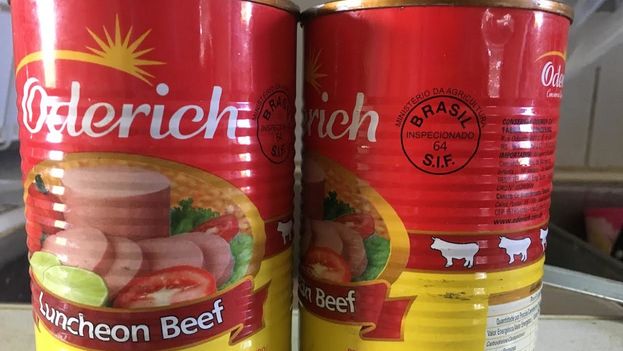
The Cuban government is selling cans of meat from Brazil to households in the areas affected by Hurricane Irma. (14ymedio)

14ymedio bigger14ymedio, Havana, 2 November 2017 — In the years of greater political closeness between the Soviet Union and Cuba several products arrived from the distant Eurasian country to fill the shelves of the stores on the island. Matryoshka dolls adorned thousands of living rooms throughout the country and the national tables were full of dishes made with canned beef labelled Made in USSR. Housewives became experts in buying and cooking it.

In the markets, people tapped those cans without paper labels and with a porpoise’s face painted on metal. If it made a loud sound it had more water or fat than fiber, but if it didn’t make much of a sound it was “good” and worth buying. Russian meat was a part of the Cuban diet for so many years that all canned meat came to be called by the name of that country.

Last October a special supply arrived at the bodegas of the rationed market in several Havana neighborhoods. After Hurricane Irma, the Government sold through the ration book cans of meat from Brazil, from the Oderich brand, at a price of 1.50 Cuban pesos (CUP), for every three consumers registered in the “nuclear” family. In memory of those years of the Soviet embrace people baptized it “Brazilian Russian meat.” What occupied the plate for such a long time is rarely forgotten.

Travel and Immigration Reforms Will Bring More Hard Currency to Cuba / Iván García

Photo taken from Martí Noticias

Ivan Garcia, 2 November 2017 — Twice a week, Mayté, a bank employee, usually talks with and sees her daughter through an internet app that she uses from a park in western Havana. The travel and immigration rules that the Cuba authorities will begin to apply as of 1 January 2018, still won’t allow professionals like Mayté’s daughter, who abandoned her posting in a foreign countries, to visit Cuba.

“The new measures don’t repeal the rules that prevent doctors and professionals who abandon their missions abroad to return before eight years have passed. Right now, everything is the same. They [the regime] have an urgent need to find money, so they are implementing these new travel and immigration reforms,” says Mayté, after talking with her daughter in Miami through the IMO app. continue reading

An immigration official, who requested anonymity, said that “there will be gradual changes in travel and immigration regulations, both for Cubans living in the country, and Cubans living abroad.”

Martí News wanted to know if future reforms would cancel the prohibition that prevents professionals, categorized as deserters, from traveling to Cuba before they have been away eight years, and when the extensive blacklist prohibiting opponents of the regime living abroad from visiting their homeland would be eliminated.

“The policy that after two years certain rights are lost will change in the short term,” says the official, referring to the current policy that requires Cubans who remain out of the country for more than 24 months to get special permission to return.

“Also the prohibition of professionals who defected from different missions,” he adds, “and a provision that allows doctors who once decided to leave, to return to the country is in force. But the issue of belligerent Cubans who seek to change our political system is different. That remains a matter of national security. Although for humanitarian situations they have authorized their entry into the country. The State is interested in maintaining a fluid relationship with its emigrants. And all possible openings will be made in that sense,” the official explained.

“Then in the near future will Cuban emigrants be able to hold public jobs?” I ask him.

“Right now I don’t know. But I repeat, the government wants better relations with the emigrants, especially with anyone who is non-confrontational,” he responds.

Eduardo, an economist, says that the new measures “are aimed at capturing as much fresh currency as possible. In the middle of the current economic recession, which has all the signs of becoming a deep crisis due to the 40 percent decrease in oil imports from Venezuela, and with Russia and China apparently unwilling to get involved in the unproductive local economy, as happened in past decades, there is no doubt that the government needs to open new ways to raise more dollars and euros. Family remittances, retail trade in convertible pesos and tourism for Cubans settled in other countries, is a business that moves millions. With these travel measures, and others that could come, such as facilitating the creation of small and medium businesses run by Cubans living abroad, the economic situation could take a favorable turn. As long as they do it in an impartial, independent and reliable legal framework.”

Carlos, a sociologist, doubts that these travel and immigration regulations are the first of a later set of economic reforms focused on private entrepreneurs or stimulating future business with Cuban emigrés.

“I don’t believe it. Those provisions are to improve the flow of liquidity in the state coffers. Until proven otherwise, the regime has always watched with concern the authorization of busineses by Cubans who, among other reasons, left because they disagreed with the socialist system. The current Investment Law does not prohibit Cubans living in other nations from doing business in Cuba, but in practice the state does not open the door for them. In times of uncertainty, with a worsening economic crisis and the backtracking in relations with the United States, the rapprochement with the exile would help to move the country forward. But there is a caste of conservatives within the government who do not approve of this approach. Look at the handbrake they put on people working for themselves. The objective of these travel and immigration reforms is purely financial,” the sociologist explains.

Luisa, the mother of a Havana baseball player who plays in the minor leagues in the United States, believes that “the government should repeal all the laws that prevent Cuban players, doctors and other professionals who stayed during a mission or sporting event from traveling back to Cuba. Bad, good or regular, they are Cuban and they have families here. If they could come freely, and not wait for eight years to pass, if they could open businesses and in the case of the players, compete for the national team, that would contribute to maintaining better relations with an emigration has been vilified. They have branded those who left as scum, traitors, worms.”

Yasmany, the father of two children living in Miami, says that with the recently announced measures “the government is not doing any favors to the Cuban emigrants. It is a right that is contemplated in international laws. If they approve it now, it’s simply because they need money.”

Gloria, a lawyer, states that “it is a legal aberration that Cubans have to get a special stamp on their passport in order to travel to their own country. All that is absurd. The convenient thing would be that they can come and go without legal obstacles on the part of the state. Also that they can establish businesses in their homeland, occupy political positions or live one season abroad and another on the island. In recent years, the government has made progress in the area of travel and immigration, but it is opening spaces little by little.”

Many people consulted agree that, in the same way that Havana is the capital of all Cubans, Cuba is the home of all Cubans, wherever they live and however they think. And no one should have the right to regulate their freedom to travel or to settle in their native city when they can or want to.

But the regime has another point of view. That is why it governs the island as if it were its property.

Translated by Jim

Cuban TV Censors Come Down on Director and Screenwriter Eduardo del Llano

The film director, screenwriter and writer Eduardo del Llano. (EFE)

14ymedio bigger14ymedio, Mario Penton, Miami, 1 November 2017 — The film director, screenwriter and writer Eduardo del Llano has denounced that the Cuban television censors are hounding him and accuses the authorities of wanting to force him to emigrate.

According to a statement written by the artist and shared through the social networks of Carlos Lechuga, the director of the also censored film Santa and Andrés, “it is not a matter of disavowing [Del Llano’s] specific content,” but of deciding to bar the artist from the small screen.

“Over the past three years, several members of the Vivir del cuento team, including the director and the best-known actors, had asked me to write for the program,” says Del Llano, born in Moscow in 1962. continue reading

The artist had warned the cast of the popular comedy program that delivers social satires in prime time on Mondays, that in 2015 another television director had contacted him for a summer program “and the program was taken off the air,” telling him the screenwriter was forbidden on television.

Del Llano has been a co-writer of important Cuban films such as Alice in Wonderland (1991) and Ana’s Movie (2012). Producer of more than 20 short films, in 2004 he stoked the cultural censors’ hatred against him by deciding to launch the Sex Machine Productions label with a series of short films about the national reality starring a character named Nicanor O’Donnell, who reflects the contradictions of daily life in Cuba.

The first of these films was called Monte Rouge and was a stark satire of the omnipresence of State Security in the life of Cubans. It was followed by others on information policy and various topics seen through satire. They were not released on television, but those shorts were widely disseminated through The Weekly Packet and USB flash drives.

Despite the warning, the director of Vivir del Cuento encouraged him to write a chapter of the saga of Pánfilo, the witty retiree who stars in the series and whose life revolves around the increasingly small assortment of products available through the ration book.

“A little more than a month later [the director of the series and another actor] called me, excited to let me know how much they had liked an episode that I presented to them, and to say that they were going to film it in October, along with three others by different authors,” says Del Llano, who clarifies that in the script he wrote for the program “he maintained the usual tone of social satire of Vivir del cuento but did not try to be particularly hard.”

However, in mid-October, according to the artist, “things went bad.”

The director of the television series called him “very distressed” and “saddened” to tell him that “from above” they had accepted the three other programs for the television series, but not the one written by Del Llano.

According to the artist, several members of the Vivir del Cuento team “are convinced” that “what is censored is not the specific work” but rather the writer. “I mean,” he says in a jocular tone, “that the Upper Television Spheres will continue to censor me even if I write Aunt Tata’s Storytime.”

“Excommunicating artists is a noble tradition of Cuban culture, especially on the tiny screen,” reflects the author and brings up the case of a film critic who had a regular space on Cuban television but who confronted “someone from above” and as a result will not be able to return to television, while a dozen already recorded programs were thrown away.

Del Llano clarifies that “until now” the actions against him are limited to Cuban Television and that with the Book Institute, the Humor Promotion Center, and even the Cuban Institute of Cinematographic Art and Industry his relationships “are reasonable and mutually respectful.”

“As you can see, the censorship is not even coherent,” he adds in an ironic tone.

The writer, however, regrets that “from above” they take away his opportunity to write for a television program that he considers a challenge in his career.

“How was it left? Without explanations to the team or to me, without anyone showing their faces and telling me why they condemned me in the first place,” he says and answers with a rhetorical question:” Do they want to leave me without options, force me to emigrate? Let them be the ones to go.”

Navigating Among the Travel and Immigration Nonsense

A Cuban rafter who emigrated seven years ago now wants to return on his yacht, but he has been told that his family in Cuba cannot go out for a ride on his boat from the Hemingway Marina. (umbrellatravel)

14ymedio bigger14ymedio, Generation Y, Yoani Sanchez, Havana, 2 November 2017 — Three days and thirty calls, this is how Carla summarizes the time immediately after the announcement of the new travel and immigration measures. “I dialed all the numbers I had on hand,” she says, with a cup of tea in her hands at her home in Centro Habana. The nursing graduate is anxiously awaiting a reunion with her brother who left Cuba on a raft and has been based in Tampa for seven years.

However, in the complex skein of prohibitions in Cuba’s travel and migration policy, the relaxations that will take effect as of the first of January in 2018 have introduced more uncertainties than certainties. “He wants to come on his yacht so our family can take the boat along the Cuban coast and even fish,” she explains.

Several calls to Marina Hemingway have crash-landed the nurse’s dreams. “Your brother can arrive on his boat, but Cubans living on the island can not yet go out for a ride on the boat,” a voice told her from the other end of the line. Thus Carla came up against that part of the legislation that still hasn’t budged an inch. continue reading

For decades, Cubans have been locked in successive boxes. Some compartments are designed to hobble their ability to decide who governs the country and what newspapers they can read. In the last decade, some of those restrictions have become obsolete, or been repealed or changed, but their “hard core” still stands.

At the center of so many limitations is the government’s conviction that if it allows citizens to have greater spaces for decision and action they will end up overturning the current regime. A trip on a yacht along the Cuban coast could make Carla’s family wonder why they have been denied that pleasure for so long and increase their discontent.

What this hypothetical long-awaited journey can trigger has long-term connotations for the family.

The mother, with a monthly pension that does not exceed 15 dollars, will cry for joy when she sees, before dying, the face that has been hidden from her by el Morro, something that few Havanans have been able to enjoy. She may even stuff down a lobster tail freshly pulled from the water by her son, “the enemy who escaped the Revolution,” as he was described by the president of her local Committee for the Defense of the Revolution on learning of his departure.

When the earth recedes and they find themselves in the safe discretion of the immense blue, it is probable that Carla will tell the former rafter how she steals medicines from the hospital to sell on the black market and that she dreams of an immigration process based on “family reunification” that will get her out of the country.  “No one can stand it, my little brother,” she will confess, protected by the waves and the sky.

If that maritime route were to open, a partition of the sealed compartment in which they have been enclosed will collapse and will not be able to rise again. An interior wall, of fear and lack of opportunities, will be seriously damaged. Aware of that, for the moment, the ruling party must be meditating on all the costs of allowing such a thing.

Until now, and as things are going, everything seems to indicate that next year, the nurse’s rafter brother will be able to enjoy, in his status as an emigrant, something his relatives on the island are denied. Half-changes provoke these contradictions, but complete changes unleash fear at the highest levels.

With her cup of tea, Carla continues to dial phone numbers so that someone will answer a simple question: “Can we get on that yacht and walk the deck?” No one risks answering with certainty, but many wait for a slip that tears down that and other walls.

Lawyer for ‘Man With the Flag’ Will Request His Release With a Medical Report

Daniel Llorente has been hospitalized for five months and detained for six. (14ymedio)

14ymedio bigger14ymedio, Havana, 2 November 2017 — Daniel Llorente, the man who waved an American flag during the May Day parade in the Plaza of the Revolution, has hired a lawyer this week to help get him out of the psychiatric hospital in Havana popularly known as Mazorra.

The lawyer has requested a report on the mental state of Llorente with which to request his release, explained Eliezer, son of the activist, who is working with the doctor who attends his father to deliver the document. continue reading

“The doctor has always told my dad that he is a sane man,” so “let’s hope that next week they will give me the paper with that in writing and that there will be no surprises,” Eliezer Llorente told 14ymedio. In the psychiatric hospital they informed him that it will take “at least a week to prepare the paper.”

The son of the man known as “the man with the flag” hired a lawyer from the Collective Law Firm located on Aguacate Street between Sol and Muralla in Old Havana. “I signed a contract with her to represent my father so he can leave the hospital,” says the young man.

The head of Public Health at the Council of State and several officials of the Office of Attention to the Population of the Supreme Court advised Eliezer Llorente to seek a lawyer to represent his father.

The activist has been detained for six months, first in the detention center known as 100 and Aldabó for a month, and now for five months in the psychiatric hospital without receiving treatment, he denounced by telephone to 14ymedio.

Both the father and the son report that the internment in the psychiatric hospital is being used in retaliation for having raised the United States insignia during a parade that the ruling party always touts as a show of support for the Government.

In May 2016, he celebrated the arrival of the Adonia cruise ship in Havana also with a US flag, and was arrested and detained for 24 hours.

Alain Toledano: “If We Stay Quiet They Crush Us”

Pastor Alain Toledano, from the Apostolic Ministry Pathways of Justice. (Facebook)

14ymedio bigger14ymedio, Ricardo Fernandez, Santiago de Cuba, 30 October 2017 — The evangelical pastor Alain Toledano feels that he has lived through 18 years of intense battle since he founded his own church in Santiago de Cuba, a congregation that has experienced a “rapid growth,” according to what he told 14ymedio.

The high numbers attending the worship services “frightened the authorities” from the first day and then “the confrontations began,” the pastor maintains. In Cuba, among the denominations of greatest expansion in recent years are Pentecostals and Baptists. continue reading

Although official entities rarely give figures, international religious organizations estimate that on the island there are some 40,000 Methodists, 100,000 Baptists, and 120,000 members of the Assemblies of God. The latter had only about 10,000 faithful at the beginning of the 1990s.

In July 1999, Toledano left the Assemblies of God to create the Emmanuel Church. “We met in an apartment and the crowd blocked those who tried to climb the stairs of the building,” he recalls. The pressures of the authorities forced them to move the temple to a courtyard.

“There we did not bother anyone and even so police officers came to try keep us from meeting,” the pastor explains. He believes that from the beginning it was not a question of order and that all those pressures were part of “an attack against the Church.”

Between January and July 2016, more than 1,600 churches were subjected to religious persecution by Cuban authorities, according to Christian Solidarity Worldwide (CSW). The entity accused the government of Raúl Castro of attacking the temples “to strengthen control over the activities and composition of religious groups.”

The annual report on religious freedom, published in the middle of last year by the US State Department, indicated that the government of the Island “supervises religious groups” and “continues to control most aspects of religious life.”

The first direct attacks suffered by Toledano came from the Office of Religious Affairs of the Central Committee of the ruling Communist Party, led by Caridad Diego. “On several occasions they sent their officials to prohibit me from continuing to hold the services,” says the leader of Emmanuel Church.

Toledano, of the Apostolic Ministry Pathways of Justice, did not give into the pressures and State Security took action on the matter. “At first they did not attack me, rathered they offered to have me work for them,” he says. “They told me they needed a person of influence in religion inside and outside of Cuba.”

The offer included the legalization of the congregation in exchange for collaborating as an informant and opinion agent within the Pentecostals.

“Given my categorical refusal, they entered another phase and the eviction came,” the first of them in November 2007. Nine years later, while Toledano was traveling in Miami, the story was repeated and the police deployed a broad operation that included special forces.

On that day, more than 200 of the congregation faithful were arrested and the police demolished the place authorized for worship that the Toledano family had taken years to prepare.

The troops also made off with chairs, benches, musical instruments, a piano and more than a thousand legally purchased cement blocks with which the family planned to improve the conditions of the house and the temple.

“The objective was to leave us without resources and to pressure us to opt to emigrate,” the religious reflects. “No one who is persecuted in Cuba is exempt from passing that thought through his head,” he says, although in his case he has chosen to stay with the congregation.

In January 2016, Pastor Bernardo Quesada, of Camagüey, also saw how the political police assaulted his evangelical church, destroyed the structure in the courtyard where he met with his faithful and arrested him and his wife for several hours.

A year after those events, the pressures have not diminished for Toledano. “When we were preparing the celebration for 18 years of the ministry, on October 17, they arrested the host who lends us his patio to meet.” The man was threatened with eviction and his house demolished if he continued to offer the land to the congregation.

“It’s not the first time it has happened and we’ve had to move twice because of the pressure on the owners of the places where we meet,” says Toledano.

In May of this year, in the Abel Santamaría neighborhood in Santiago de Cuba,Toledano started a project to help with food for vagabonds and other marginalized people. “We are doing our bit in this country, in this society,” he told several independent media at the time.

“It is better to talk, because if we stay quiet they crush us,” explains the pastor, who has chosen the path of social networks to denounce the boycott of his congregation.

Cubans Between Openings and Closings / Juan Juan Almeida

Juan Juan Almeida, 1 November 2017 — As of this November, Cubans will be able to do the paperwork to get a visa to travel to the United States in third countries. The application for an immigrant visa can be made at the United States consulate in Bogota, and for a non-immigrant visa at any US embassy outside Cuba.

The measure, taken in response to the sonic attacks, and which to some extent has as an objective to pressure the Cuban government with the removal of a great part of the US embassy personnel in Cuba along with the closure of certain consulate services, will increase the work of American officials and result in costs and travel inconveniences to Cuban families. But it will not upset the Castro leadership which, by the way, just a few days ago, announced a dodgy counterattack with spectacular effect. continue reading

An agreement signed on 4 November 1994 by his excellency Señor Pardo García-Peña, former Foreign Minister for the Republic of Columbia, facilitates visas for indeterminate times for Cubans who have a diplomatic passport.

The agreement, ratified on 27 October of that same year, by the former Cuban Foreign Minister Roberto Robaina, also allows that citizens who are holders of official passports will be allowed to enter Columbia either in transit or to remain in the country for up to 6 months.

The government of Cuba maintains a similar protocol with Belize, Bolivia, Dominican Republic, Ecuador, Guatemala, Guyana, Jamaica, Mexico, Nicaragua, Panama, Suriname and other 66 countries.

And this is normal. According to international treaties, diplomatic and official passports should be issued only to people who require them for matters of an official nature during their trip abroad. But what the advisers of the government of the United States apparently ignore is that the Ministry of the Interior (MININT), the Ministry of Foreign Affairs (MINREX) and a group of travel and immigration laws that have been very well designed by the government of the Republic of Cuba, delay the use of this type of documentation to a much wider group.

Decree 26/78, which regulates the use and issuance of passports in Cuba, authorizes the possession of a diplomatic passport to members of the Politburo and the Secretariat of the Central Committee of the Communist Party of Cuba, as well as a very long list of other other officials that includes: Members of the Central Committee of the Communist Party of Cuba; heads and deputy heads of departments, heads of sections and officials of the Central Committee of the Communist Party of Cuba; members of the Council of State; deputies to the National Assembly; members of the Council of Ministers; Presidents of Organizations of the Central State Administration that are not part of the Council of Ministers; General Secretary of the Cuban Workers Center; president and vice president of the Supreme People’s Court; Attorney General of the Republic; deputy prosecutors of the Attorney General’s Office; Judges of the Supreme People’s Court; first secretaries of the Provincial Committees of the Communist Party of Cuba; Presidents of the Provincial Assemblies of Popular Power; vice-presidents and vice-ministers of the Organisms of the Central State Administration; diplomatic and consular officials of the Republic, advisers and commercial, economic, cultural, press, military, air and naval attachés; officials of the Ministry of Foreign Affairs and Diplomatic Post; department heads of the National Assembly of People’s Power, of the Council of Ministers and its Executive Committee; advisers to the vice presidents of the Council of State and the Council of Ministers; advisers and officials of the Council of State, Council of Ministers and its Executive Committee, as well as their respective Secretariats; department heads of the Ministry of the Revolutionary Armed Forces and of the Ministry of the Interior; department heads of the Ministry of Foreign Trade and Foreign Investment and of the Central Bank of Cuba; delegates to International Conferences or intergovernmental or diplomatic conferences; and as many other officials of the Communist Party of Cuba, the State and the Government, the Minister of Foreign Affairs deems convenient and necessary for the full accomplishment of the entrusted missions; and, very especially, family members of the people listed above. And all this includes authorizing travel even if the trip is not for any official purpose.

Now, if the American intention, in addition to protecting its consular staff assigned to the embassy of Havana, seeks to encourage popular discontent on the island, I am sorry to say that the advisers, at least on the Cuba issue, are more confused than Don Quixote at a wind farm. Popular approval of the Cuban government has just been noted, with the official decision, already published, to eliminate the “authorization” of the passport for Cuban emigrants to Cuba; to allow Cuban citizens residing abroad to enter and exit Cuba on pleasure boats; to allow Cuban citizens who left the country illegally to enter Cuba; and tofacilitate the process so that the children of Cubans living abroad, born abroad, can obtain Cuban citizenship and an identity document. A measure that, incidentally, responds clearly to the current occasion in a theatrical way to show the “integrative” and conciliatory face of the government. It is no coincidence that it was announced at just the moment when the member countries of the United Nations (UN) are preparing once again to vote for or against the Embargo.

Cuba, as always, has an economic, political purpose and seeks to incite the exiled-emigrant pulse; but this time it has a sarcastic addition; repealing the infamous “habilitación” — the special permission now required for Cubans abroad to to return home — and to allow more family and nostalgia-related trips with affordable prices make an infallible convoy. Starting this coming January 1, instead of going out to spend a Saturday night on the town in Miami, it will be cheaper to spend the weekend in Havana.

How Cubans Remember the Missile Crisis / Iván García

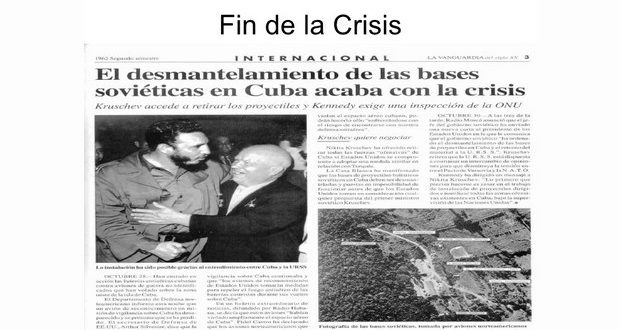
Headline in a newspaper of the time: End of the Crisis

Ivan Garcia, 30 October 2017 — The leaden sky presaging rain did not stop Hector, 79, from roasting chicken breasts and a snapper over charcoal. In his house in Víbora Park in the Arroyo Naranjo neighborhood in the south of Havana, the atmosphere was festive. His brother Humberto, who has lived in Canada for 20 years, was visiting Cuba with his children and grandchildren.

On the patio, the adults shared beers and nostalgia, while they listened to the Spanish group Nino Bravo on the stereo. In the living room the youngest members of the family were dancing and singing Despacito, by Luis Fonsi and Daddy Yankee. continue reading

It was just after one o’clock on the afternoon of Sunday, October 22nd. At that hour, Humberto turned on a small battery radio and started listening to the news. The announcer recalled that 55 years ago, John F. Kennedy addressed a 17-minute televised message to the American people and publicly announced that a naval blockade would be established against Cuba.

Humberto experienced those two weeks of uncertainty on the Island. After a brief silence, he recounts his personal experience. “I was 24 years old and I had just graduated in civil engineering. Like most Cubans, I supported Fidel Castro. I enrolled voluntarily in the militias. I passed a quick course on antiaircraft artillery and they sent a group of us to an area of Pinar del Río that today belongs to the municipality of San Luis. Later I would find out that very close to our unit they had deployed Soviet nuclear missiles,” recalls Humberto and adds:

“In Cuba we did not have the slightest idea what a nuclear conflict was. We were uninformed, there were no shelters or the necessary supplies. There was no awareness of what an atomic war represented. In a night watch, on October 22, 1962, the battalion chief told us about Kennedy’s speech and Khrushchev’s decision not to stop the ships traveling to Cuba. ‘War is a matter of days away,’ the boss told us. Among the troops it was thought that it would be a kind of safari to hunt Yankees. Morale was sky high after the Bay of Pigs. Someone said: ‘Comrades, this conflict is different. There will be no winners or losers, we are all going to die.’ That was when I realized the seriousness of the situation.”

The former political prisoner and journalist Pedro Corzo, now living in Miami, in 1962 was already an opponent of Fidel Castro’s communist regime.

“I lived in San Diego del Valle, a town in the old province of Las Villas. I had not been imprisoned yet, but there is ample evidence that the dictatorship planted dynamite around the entire perimeter of the Model Prison and other prisons where the political prisoners were, and as events unfolded, they were ready to blow them up. In the village there was a strong movement of Russian troops and weapons. At that time, opponents never thought that it was nuclear missiles. When the armaments passed through San Diego del Valle, the army told us to go inside, close the windows and not look out.”

In October of 1962, Tania Quintero was about to turn 20 years old. “What I remember most about those days is that ordinary Cubans did not know what was happening and mocked the Soviets, ‘Russians’ became a disparaging term. I think that was when they started calling them ‘bolos’ — bowling pins — because they were so crude,” says the current independent journalist, who since November 2003 has lived in Switzerland as a political refugee.

According to Tania, “The feelings of the Cuban leaders were adopted by the population. The people didn’t want the Americans to get a foot in the door and wanted them to let the Soviets install the rockets on the island. You’d hear people say, ’Why did you bring [the weapons] then? They are assholes if they allow them to send them back.’ It seemed like they were talking about conventional weapons and not missiles. They called Khrushchev ‘Nikita Nipone’ (someone who neither removes the rockets or leaves them in place.) That’s how simple and superficial things were to ordinary people. The chill came later, when we knew what was at stake, in Cuba and in the world. Fidel Castro never spoke clearly to the people and told us that we were on the verge of a holocaust.

“We didn’t know and didn’t see and so we weren’t terrified, despite the huge military mobilization that was visible all over the Havana and especially along the Malecon, with the soldiers behind sandbags and the ‘four-mouths’ (anti-aircraft batteries) ready to shoot if ‘a little enemy plane’ tried to get close.”

Alberto, a retired former military officer, never thought that Cuba would be wiped off the map in the event of a nuclear conflict with the United States. “The perception that I had and that was shared by the vast majority of the population, was of the Cuban military dominance. We believed that the USSR’s armament was superior and that the Soviets would have a secret weapon that would prevent a Yankee attack. We did not know that the correlation of forces in nuclear missiles was one to eight in favor of the Americans. Neither television, radio nor the ICAIC news reported on the dangerous situation we were in. Despite the fact that only 17 years had passed since the atomic bombings in Hiroshima and Nagasaki, with thousands of deaths and irreversible damages to the survivors. In Cuba, I believe that by Fidel’s direction, people were not told about the harmful effects of a nuclear mushroom cloud. The only thing that Fidel cared about was going down in history. We were manipulated, we were naive. In the same situation the North Koreans are in today. ”

Magdalena, a housewife, was born in December 1962 and says that her parents had told her about the October Crisis. “But I came to know that we were on the verge of a third world war, when in 2001 I saw the film Thirteen Days, starring Kevin Costner. It was hard for me to believe that what was narrated on the screen really happened and I realized that in 1962 my parents lacked information and did not know the magnitude of the situation created between Cuba, the United States and the Soviet Union. Luckily, the ‘bolos’ took their rockets out of the country. ”

After the fall of the Soviet empire, some secret archives were opened to the public, among them the letters exchanged by Fidel Castro and Nikita Khrushchev. In one of the missives the Caribbean autocrat urges the president of the Soviet Union to launch the first strike. But the official media hide and barely analyze that epistolary exchange that reveals the irresponsibility of Fidel Castro and puts into question his gift as a statesman.

Fifty-five years after the Missile Crisis, many young Cubans are unaware of the real context of the events and the reckless spirit of their rulers, who summoned the people to immolate themselves.

Dayán, a third year high school student, in a mechanical tone, explains what he knows about that stage, according to what he learned in class: “After the Bay of Pigs, there were plans by the United States and the CIA to invade Cuba. That is why the USSR decided to place nuclear weapons in our territory, as a deterrent force. The Revolutionary Government did not agree. What they wanted was a commitment from the Soviets, that in case of aggression against Cuba it would be considered an aggression against the USSR. When Khrushchev decided to withdraw the missiles, what bothered Fidel most was that the Russians did not use him to negotiate a better solution. In other words, in return, withdraw the rockets, close the Guantanamo Naval Base and confirm the commitment of the United States not to invade Cuba.”

The official story about the Missile Crisis only relates the part that reflects well on the regime. It is silent about the rest.  Or tries to forget it.