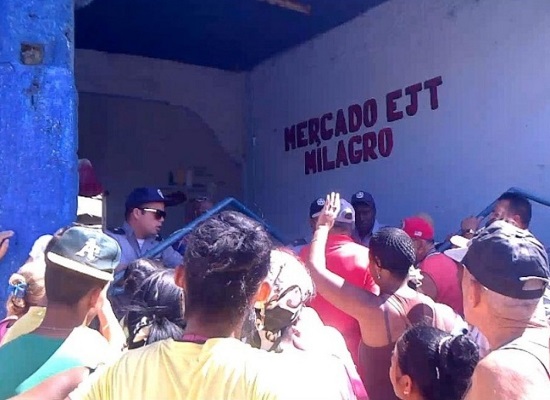
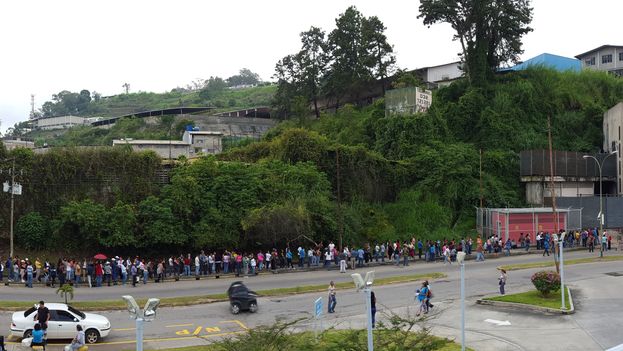
Policemen trying to control line to purchase potatoes (file picture)
Cubanet, Miriam Celaya, HAVANA, 6 November 2015 — Hopes and expectations that encouraged Cubans at the beginning of 2015, following the announcement of the restoration of relations between the governments of Cuba and the US, have vanished completely. Over the past eleven months there has not been a hint of any economic improvement for the population, and the end of the year is expected to be grim, judging by, among other factors, rising prices in the food sector, our most important market.
Visits around numerous commercial shops and roving street markets in the populous municipality of Centro Habana, in the neighborhoods of San Leopoldo, Pueblo Nuevo and Cayo Hueso, evidence the shortages in merchandise, the low quality of products and the unstoppable rise in prices. Pork meat – the Cuban indicator par excellence –– fluctuates between 45 and 50 pesos per pound; while black beans go for 10 to 12 pesos. Other grains are priced beyond the reach of most pockets. The price for one pound of red beans has reached 17 pesos, while white beans cost between 18 and 20, and the price of chick peas has risen to 22. continue reading
Meanwhile, greens and vegetables are competing in this amazing climb. A pound of tomatoes at the San Rafael market costs 25 pesos; bunches of carrots or beets – a variable, indefinite and inaccurate national-trade measure — are priced at 20 pesos, same as a pound of small onions and peppers, placed on pallets next to the also stunted cabbages, advertised at 15 pesos apiece. Avocado prices may fluctuate between 7 and 10 pesos apiece. However, during the weekends it reaches up to 12 pesos.
Tubers and other vegetablesare not beyond the amazing rise in prices. Thus, a pound of taro costs 8 pesos, twice the price of yucca and yams, which are between 3 and 4 pesos. Small to medium plantains sell for 4 pesos apiece.
A quick calculation, taking as a base the so-called Cuban average income – between 400 and 450 pesos (around $23 U.S.) per month, according to official data — results in the obvious conclusion that the purchasing power of the median active labor force has continue to decline, not to mention the growing aging demographic sector, dependent on miserable retirement pensions, or aid from relatives, when they can afford to help, or on the solidarity of some nice neighbor who might occasionally offer a plate of food. Getting a full meal in Cuba has virtually become a true luxury.
Few differences exist between one retail outlet and another, and between the municipalities in the capital. The last four months of the year have shown the highest increases in food prices to date, for a population whose incomes, whether stemming from salaries, retirement funds, remittances from relatives living abroad, or some other source, is increasingly inadequate, not only to satisfy living demands, but insufficient to cover the barest necessities: food, clothing, footwear and shelter.
More than four years have transpired since the ‘updating of the model’, with government experimentation in the retail sale of agricultural products by ‘self-employed’ sellers (pushcart vendors) as well as by non-state cooperative farmers markets, and the upward trend of food prices, far from ceasing, has accelerated its rate, which indicates a failure in the official plans for this important issue – production and commercialization of foodstuffs to satisfy the needs of the population and at the same time replace imports — which was one of the most important items in the guidelines of the April 2011 Sixth Congress of the Cuban Communist Party (PCC).
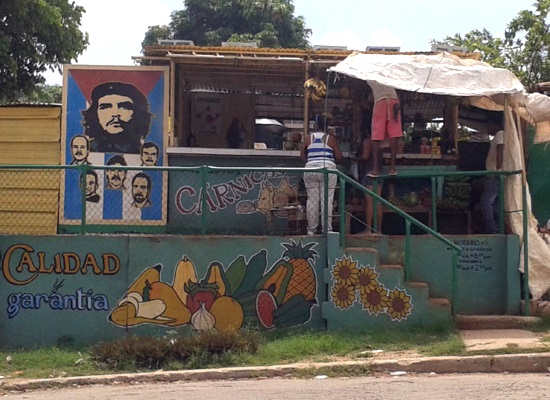
It is mandatory to hang propaganda posters at the entrances to farmers’ markets and retail outlets. (file photo)
The internal situation in Cuba, with its shortages and deficiencies in an ascending mode is looking increasingly more each day like the situation we endured in the 90’s, following the collapse of that house of cards which was once called “the Socialist Camp”. At the same time, the Cuban people’s discontent, despair, and the stampede overseas continue to grow.
The bubble of dreams awakened last December has been popped by the stubborn reality of a system designed for the benefit of the hired applauders who cling to power and to the submission of the rest of society. A general feeling of frustration continues to rise in Cuba, but nobody seems to know how to channel disappointment except by escaping, by any means, from this life-sentence of misery.
Paradoxically, the spiral of poverty that marks everyday life on the Island seems to be the most effective weapon of the regime to maintain social control to date. And, while ordinary Cubans, unaware of tomorrow, continue to rummage with resignation from one market to another, foraging among the small dirty pallets for their scarce daily food, flocks of raptor merchants arrive from overseas to the International Fair of Havana so they may fight for any good slice that the spoils and the ruins of the national-failure-converted-into-merchandise, by guerrillas-turned oligarchs, might offer them. The capital celebration has once again opened its doors in Cuba, but we Cubans are not invited.
A few minutes ago I received a call from a relative of Angel Santiesteban-Prats to inform me that at noon Angel was arrested again. Upon contact with his family, they still did not know why he was arrested and what he is accused of.
He said he would call later in the afternoon and still they have no news of him.
We imagine that it is a reprisal from Castro’s regime for having denounced the life-threatening danger political prisoner Lamberto Hernández Planas is in, on hunger strike, for having been the victim of a new maneuver by the State Security to revoke his parole and prevent his work as an independent journalist.
Once again, as usual for almost three years now, we hold the dictator Raul Castro responsible for the life and integrity of Angel Santiesteban-Prats.
A few minutes ago I received a call from a relative of Angel Santiesteban-Prats to inform me that at noon Angel was arrested again. Upon contact with his family, they still did not know why he was arrested and what he is accused of.
He said he would call later in the afternoon and still they have no news of him.
We imagine that it is a reprisal from Castro’s regime for having denounced the life-threatening danger political prisoner Lamberto Hernández Planas is in, on hunger strike, for having been the victim of a new maneuver by the State Security to revoke his parole and prevent his work as an independent journalist.
Once again, as usual for almost three years now, we hold the dictator Raul Castro responsible for the life and integrity of Angel Santiesteban-Prats.
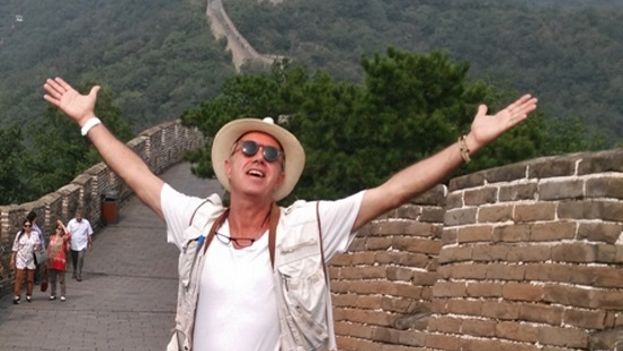
Juan Carlos Cremata in Mu Tian Yu the Great Wall of China, 2015. (Courtesy of the author)
14ymedio, 30 October 2015 — The critic and filmmaker Enrique Colina came out Thursday in defense of the Cuban director of films and plays Juan Carlos Cremata with a strong message titled On Censorship and Its Demons. In the text, which has been widely circulated by email, he affirms that to remain silent in the face of the censorship suffered by the playwright, “Is to fold before the arbitrary decisions that potentially affect all of us as creators, but also as citizens.”
A reading of Colina’s article was a part of the agenda of the upcoming meeting of the G20 Group, a gathering of numerous artists and producers who demand a law for the cinema. However, Cremata said that the organizers of the meeting determined “it is not the time” to present the article at the meeting this coming Saturday at their headquarters at Fresa y Chocolate in Havana’s Vedado district. continue reading
The letter was made public via email with the consent of the author, who sees no “contradiction in discussing a cinema law which we are fighting for, in which it is explicitly guaranteed that the law supports us to defend the culture against the exercise of a censorship which calls itself revolutionary.”
Colina, a man of great prestige without the Cuban film industry, and the creator of a work that enjoys great popularity, says in the message that accompanied the letter that there is an “ethical deterioration fed by neglect, corruption and the most cowardly and opportunistic faking.” As the only remedy, the director of the films “Neighbors” and “The Marble Cow” calls for a ripping away of “this gag that the bureaucratic bastards want to impose on committed artistic expression.
“After so many years preaching Marxism-Leninism it seems that the custodians of the orthodoxy of silence have forgotten the laws of dialectics“
“After so many years preaching Marxism-Leninism seems that the custodians of orthodoxy of silence have forgotten the laws of dialectics,” Colina reflects strongly, adding that “faith and obedience to immobility seem to be the altars of worship at which we convene with their damning anathemas and excommunications,” and, in a colloquial tone concludes: “But no, my friend, we protest.”
“There is already a stagnation in citizen awareness and ideological exhaustion from the spent propagandistic character of the media,” says the letter. “This conduct of intolerance expresses well the weakness and the intellectual and political shabbiness to take on an open and responsible debate,” he added.
“What real constructive sense does an exclusive censorship bring to the debate between those who undertake these artistic activities and are potentially the subjects of this same arbitrariness,” asks the director.
Colina’s support is added to a long list of cultural figures inside and outside Cuba who have denounced the censorship against the play the The King is Dying (also produced in English as: Exit The King), directed by Cremata and closed down last September. Later, the authorities revoked Cremata’s contract as a theater director.
Just a week ago, Cremata announced a fundraising campaign to “continue independent work in film and theater in Cuba,” a gesture that opens the way to self-financing after decades of working with the Cuban Institute of Art and Film Industry (ICAIC) and the National Council for the Performing Arts.
The critic and filmmaker Enrique Colina. (Youtube)
14ymedio, Enrique Colina, 30 October 2015 – The artistic censorship practiced in Cuba during these 56 years, against works and creators, from a culture in favor of a supposed defense of the Revolution, has paradoxically resulted in a backlash against the political prestige of the Revolutionary Process, the same one that encouraged and developed from its beginnings the diverse artistic expressions that today sustain and reinforce our national identity and guarantee the continuity of the positive legacy of this stage of our history.
If we consider the rectifications and rescues of cultural works and personalities that were once stigmatized with the counterrevolutionary sanbenito by officials and leaders of a rigid and dogmatic orthodoxy – on occasion fractured by a corrupt and opportunistic, or simply inconvenient, act within a centralized and vertical structure of power, which led them to be separated and condemned to political ostracism – the list would be long. Today the injustices committed during the so-called Five Gray Years are officially recognized, and the reparations, repairs and appropriation of our cultural legacy is often realized when its authors have already disappeared, moreover of those who had to emigrate, but for those who left because of criticism, warnings and the denunciation in their works the authoritarian and intolerant drift of the systemic bureaucracy, for those “rescued” they have to be dead already.
There is already a stagnation in public awareness and an ideological exhaustion from the worn out propagandistic character of the media continue reading
Intolerance to criticism as a rule to know the truth – which is inherent in the artistic phenomenon that explores, investigates and scrutinizes human conflicts, socially, politically and economically framed in its reality and its history – has been and continues to be a projection of a fear to face the responsibilities emanating from a bureaucratic power that has made mistakes, and suffered losses and deviations from its original revolutionary and libertarian impulse.
Mistakes and absurdities motivated on occasion by a chimerical immobility incapable of adapting and overhauling the utopia to meet the urgent requirements of a reality in need of an objective, sensible and balanced assessment of the causes of its defects in order to correct and amend them. Rather, and despite, the cyclical openings of rectification and the calls to public criticism against what has been done badly in these 56 years, attention was always focused on the phenomena and not the causes.
Thus the absence of a systematic critical confrontation through the media, subjected to a castrating censorship, has ended up forging the sacredness and untouchability of the vertical decisions of power, although it tries to mask them with participative consultations to touch up the make-up.
There is already a stagnation in public awareness and an ideological exhaustion from the worn out propagandistic character of the media that support an opaque future reality and provoke this apathy and escapism that so concerns those who are worried about the ideological diversionism, superficiality and banality of the entertainment people seek in the “weekly packet,” the computer games, and reggaeton music…
This loss of values, bad education, vulgarity, social indiscipline… are also the result of not having promoted and nurtured in public practice that rebellion and autonomy of opinion that Che encouraged against all the liars and opportunists who preach the dictates of discretion, caution and restraint in the expression of our non-conformist citizens. Disagreement as a lawful civil right to express an opinion without being reprimanded through this inoculation of fear in the face of the consequences of expressing a critical point of view in “an inappropriate place, at an inopportune moment, and in a politically incorrect manner.”
Movies, plays and artworks … have suffered the brunt of this reactionary hangover that rejects the debate of ideas
Movies, plays and art works have contributed with many of their creations to confronting us with this wall of silence protected by the ideological gatekeepers who censor and condemn in the name of the defense of the Revolution when in reality what they do is undermine the humanist pillars of its continuity. Movies, plays and artworks – without forgetting the period of prohibition suffered by the best exponents of the Nueva Trova who ultimately became the most authentic singers of the Revolutionary work – suffered the brunt of this reactionary hangover that rejects the debate of ideas and crouches in the stone trenches to launch their poisonous inquisitional darts.
Recently — and in contradiction to the appeal made by the government’s highest authorities to face reality with a critical eye, honesty and ethical commitment, recognizing that unanimity of opinions is a fallacy of simulation — they have launched attacks against a writer whose literary work and journalism is an example of seriousness and sincerity recognizing our current material and spiritual scarcities, in addition to being a genuine exponent of a committed and authentic Cubanness.
I’m talking about Leonardo Padura and also referring to the stupid ban on the movie based on his novel, Return to Ithaca, which months later was shown during French Cinema week, more to keep up appearances than as recognition of the error of arrogance committed. Stupid because it shamelessly exposed the fangs of the crouching dogmatic beast just to create a problem that discredits not only its own maker but the power it represents.
Because it is understood that more than strength, such intolerant behavior expresses the weakness and the intellectual and political intolerance for open and responsible debate with reasons and arguments that nourish a shared confidence to seek solutions to the problems denounced in the work, so that this sad history is not repeated, a history of encouraging this “revolutionary” combativeness with a propensity to gag thinking and make a paranoid sickness of the logical precaution that assumes a change like that which is being produced in our country. Healthy change, not only of the intentions to keep everything the same, but to expunge this inability to see ourselves in an uncomfortable mirror, to recognize our imperfections and to question the historic deficiencies in the systemic structure of the model that encourages them.
Such intolerant behavior expresses the weakness and the intellectual and political intolerance for open and responsible debate
Thus, I finally get to the starting point that motivated me to write these lines: the prohibition of the play by Juan Carlos Cremata and the suspension of his employment as a theater director. This brought me to remember those years when the Cuban theater, that had reached its splendor with the Revolutionary triumph, suffered that purifying “parameterization” with its aberrant and repressive prejudices that resulted in frustration, ostracism and exile for creators and artists who were only enriching with their art the cultural patrimony that we know constitutes the support and sustenance of our national identity.
I am not telling the story nor mentioning names overwhelmed by that outrage which I consider truly shameful and counterrevolutionary, which only brought discredit to a Revolution that some extremists with the power of decision interpreted the aspiration to create a New Man with that of creating an obedient robot, dogmatic and filled with reactionary prejudices, today under attack but not exterminated. Nor will I stop to argue about the work in question which one can agree with or not, like its staging or not… no, I only want to point out that I consider it inappropriate for some – who are not artists nor have they contributed anything to the national culture – to again set themselves up as inquisition judges and who, yoked to an ephemeral authority, decide to frustrate the fate of an artist, of a creator whose work in the cinema and the theater is already the patrimony of our culture.
There may be contradictions and wherever a theater director can decide whether or not to present a work, whether to suspend or continue its representation, the anomalous case is that if there was prior supervision with respect to its content or staging, the responsibility the censors have in the situation created after the premiere.
The theater in Cuba is under by the Ministry of Culture and responds to a political culture whose tuning fork should be as broad as the recognition of the national audience’s capacity of discernment, an audience officially recognized for its educational, political and cultural level. So why, then, the censorship of the adaptation and staging of a play that itself contains great provocation, perfectly compatible with the shock factor of an art that tries to break taboos, move us and make us think, to take sides in favor or against their proposal?
Do we or do we not have an educated and committed audience with revolutionary ideas and principles capable of drawing their own conclusions to approve or reject it? What is the real constructive sense of an exclusive censorship without mediating a debate among those who undertake this artistic activity who are potentially subject to this same arbitrariness?
Some extremists with the power of decision interpreted the aspiration to create a New Man with that of creating an obedient robot, dogmatic and filled with reactionary prejudices
When, 25 years ago, censorship was dictated against Daniel Diaz Torres’s Alice in Wonderland, and direction was given to the militants of the Provincial Party, headquartered at M and 23rd, to go to the Yara Cinema during its showing to “cut off at the pass any manifestation of counterrevolutionary approval.” On the front page of the newspaper Granma an official note appeared where it was announced that the Council of State decided that the Institute of Cinematographic Art and Industry (ICAIC) would be under the supervision the Cuban Institute of Radio and Television (ICRT). This meant that the National Film Institute lost the relative autonomy of political decision-making for the approval of film production, which until then had allowed them to do documentary film production and today could be considered as a diagnosis of the evils of the Special Period which worsened to point of sounding the alarm on the urgent need to make the changes and openings that today are so long delayed.
At that time we filmmakers gathered to protest against that decision that discredited the film, its director and dissolved the ICAIC. The film was not counterrevolutionary, nor was its director nor any of those who went down on their knees to defend the artistic space with critical proposals, all lined up against the bureaucratic authoritarian and reductive abusive interventionism, exactly like that which caused the so-called desmerengamiento* (total collapse) of the Socialist Camp. (Because it was the same hammer and sickle that brought down the Berlin Wall, and it is worth saying that it was because of disbelief and the political dysfunctionality of the Socialist model, in whose womb, worn out and corroded, lay the revolutionary essence of its origin.)
What is the real constructive sense of an exclusive censorship without mediating a debate among those who undertake this artistic activity who are potentially subject to this same arbitrariness?
There were directors like Santiago Alvarez, Tomas Gutierrez Alea and others who, with their artistic careers, supported the continuity of this critical slope that always confronted the harassment and repudiation of those keepers of the chalice, pristine and pure, of that ideology without supreme saviors, without Caesar or bourgeoisie or God… today we say a controversy in the practical application of the laws of dialectics. And, thanks to this resistance they would keep making movies that never turned their backs on reality and that today maintain intact their rebellion against bureaucratic ukases and diktats.
So our protest is also confirmed by the pretension of excluding us from decision-making in the supposed restructuring of the ICAIC and the insistence, for more than two years, in the belief in a Film Law that guarantees the recognition of an independent production and a movie institute that promotes and protects national filmmaking and not one that monopolizes and controls it, because there is no… (There is an official claim of legitimate institutions eroded by a future that has exceeded its capacity for functional readjustment to meet new demands imposed by a very distinct present very different from that which motivated its origin. See the documentary, “Put me on the list…”)
The Cremata case falls within the ideological debate which has marked the destiny of a process that needs to keep alive the historic memory of its cultural work so as not to continue committing and supporting errors that put this valuable cultural treasure in danger, a critical thermometer that no censorship will be able to disconnect while we are able to act in consequence and committed to our civic duty.
*Translator’s note: Desmerengamiento was coined by Fidel Castro to embody, in a single word, the debacle of the Soviet Union. It comes from the word “meringue” and, like a failed meringue, refers to the idea of a complete collapse.
Diario de Cuba, Havana, 14 November 2015 – The United States Embassy in Cuba has denied a non-immigrant visa to the graffiti artist Danilo Maldonado, known as “El Sexto” (The Sixth), according to information on Friday from the artist himself, via his Facebook account.
The graffiti artist displayed a document where the embassy said that the decision cannot be appealed, but that it is not permanent. In any event, it recommended that Maldonado wait for one year before submitting a new visa application.
The artist was recently released after spending 10 months in prison without trial for trying to stage a controversial performance in December of 2014. Amnesty International declared him a prisoner of conscience.
Ivan Garcia, 5 November 201 5 — Daniela Sarmiento, 61, has exhausted all the legal options with State institutions to complete the process for a new home She lives with her three children in a house cracked because of a partial collapse or roofs and walls, putting their lives in danger.
“Since 1988, following the construction of a bomb shelter built by the government near my house, they damaged the foundations. Specialists of all kinds have come by here. They evaluated the housing as uninhabitable but no one resolved anything. I have written letters to the president of the country, the national assembly, the armed forces. But by case has no solution,” she says. continue reading
When you tell her there are dissident groups that can help her, the woman opens her eyes and says, “But can these people (the opponents) resolve anything if they are as much victims than we are.”
In El Calvario, a village of dusty streets and low houses south of Havana, the dissident attorney Laritza Diversent, since August 2010, has managed a legal clinic that has looked at around 140 files of humble people who have exhausted all legal paths.”
Because of the anachronistic Cuban laws, Diversent and her group of lawyers can not represent their clients. Their only option is to advise them.
“Eighty percent of the cases we serve are from people who are not dissidents. Very poor people who feel that the courts or state institutions do not represent them,” says Diversent sitting in her living room converted into an office.
Aside from the independent legal collectives and a few opposition strategies to connect to ordinary Cubans, dissident leaders live in another dimension.
Raul Castro’s autocracy has cleverly hijacked the opposition’s demands. The first factions of democracy activists arose in the mid 1970s, reclaiming spaces that the olive-green government has been discreetly implementing.
It wasn’t in a session of the monotone Cuban parliament, or in an editorial of the State newspaper Granma, or in a union debate, where the demand is made for niches for private work, access to the internet, the buying and selling of houses and cars, being able to travel abroad, or the elimination of tourist apartheid.*
It was peaceful opponents and independent journalists who raised their voices. In their writings and documents such as The Nation Belongs to Everyone. For demanding political openings and changes, hundreds of dissidents, alternative communicators and human rights activists have gone to jail or into exile, including 75 during the Black Spring of 2003.
Many of these demands are now part of the package that the government of General Raul Castro sold as “updating the Cuban economic model,” scoring a political victory and presenting himself as a reformer.
The unquestionable merits of the dissidence in Cuba cannot be ignored. It is a feat to be an opponent in a totalitarian society where those who think differently are repressed and there is no legal space to undertake their work.
They could be gentle grandparents, father or mothers who read the boring midday national press and care for their children and grandchildren. But the value of dissent in an autocratic society does not exempt them from being judged for their incompetence.
“Why,” I ask a neighbor who every morning complains about things in Cuba, “don’t you join an opposition group?”
“Apart from the fear, I feel that the dissidence in Cuba doesn’t meet my expectations I don’t seem them chatting with people in the community to learn about their problems. They don’t have a strategy to put the government up against the wall, they just denounce the repression, they could be important, but what affects all Cubans, whatever we think, is the low quality of life, a chaotic infrastructure, and seeing what we have to do just to find food every day. Political freedoms are paramount, but you can’t eat them,” he confesses.
Yamil, a Havana taxi driver, thinks similarly. “I believe it’s more about a media show than communicating with ordinary Cubans, and we are the most fucked. Most of them don’t even work. Ninety percent of the people in Cuba agree with the demands of the dissidents, but they don’t know how to win over the people Their work isn’t going in this direction.”
Raudel, a university student, makes a comparison, “In the street you see the religious denominations, like the Jehovah’s Witnesses who are persecuted by the government, proselytizing house to house. The dissidents just meet, have discussions and travel abroad.”
In the last 25 years, except for Oswaldo Payá Sardiñas’ Varela Project that managed to get 11,000 signatures, the dissident strategies don’t count on popular support. The excessive role of some of them doesn’t help either.
Every opposition leader manages their projects as if it were their own property. The lack of transparency, intolerance, and shenanigans condemn them to a poor performance.
Eight of every ten Cubans want change and not just economic ones. People want more freedoms, But there are not many regime opponents who are doing the work of paying attention to them. It is a thankless task to walk under the sun without public recognition.
But that is the silent work that adds supporters, When they are able to call a march with 10,000 people the regime will take them into account.
They don’t have to convince the United States or the European Union about the economic disaster and the lack of freedoms in Cuba. They have to talk to their neighbors and tell them that a free and developed society depends on them.
Photo by Ernesto Garcia Diaz of the press conference convened by the United Democratic Action Roundtable (MUAD) last August in Havana.
*Translator’s note: Until recent years, ordinary Cubans were not allowed to step foot in tourist hotels, tourist beaches, and other tourist facilities (except as employees).
Iván García, 12 November 2015 — Liudmila and Sheila are prostitutes and they don’t know about business or cutting-edge technology. But a colleague sent them a text message telling them, “Come here, the yumas (foreigners) are wild.”
They put on stunning high heels, tight clothing and perfume with an anesthetizing fragrance. Their plan was simple: to prowl around the stands for Canada, South Korea, France and Germany, and see how the fishing was at the International Fair of Havana.
“I can speak pretty good English. Let’s go to each pavilion and ask about the products on display or the possibility of working in a company. When we see some foreigner checking us out, we can go on the attack,” says Sheila, who has seven years of experience in prostitution. continue reading
They were in luck. Two Spanish businessmen invited them for drinks and disco dancing that night in Miramar. “At the least the romance will be only a joke. But it could end in a courtship and a definitive exit from the country,” reflects Liudmila, while she drinks a Bucanero beer in a temporary bar at the recently-concluded Havana International Trade Fair (FIHAV) of November 2015.
Of course prostitutes are a minority among those who visited Expocuba, the site of commercial fairs since 1989 (the first one was celebrated in 1982 with a few exhibits from Spain, Panama and Cuba).
At the end of the ’80s, just as the almost-perpetual economic crisis was beginning, you might think it wasn’t a good idea to waste millions of dollars building a space for a fair 25 kilometers southeast of the center of the capital.
Excited by what he had seen on his trip to Pyongyang in 1986, Fidel Castro wanted Cuba to also have a permanent exposition, where it could exhibit the “achievements of the Revolutionary Process.” And on January 4, 1989, Castro inaugurated Expocuba, a space much too large for an economy that was shrinking.
The disintegration of the USSR caused the loss of millions in subsidies, which pointed out the deficiencies in local industry. Ricardo Ortiz, a retiree who for 10 years worked in a food import business, says that Expocuba was transformed into a children’s amusement park and a place where, in the hard years of the Special Period, people could find products.
“As transport was scarce, you had to go on bicycle, and when you got to Expocuba, they gave you the right to buy two packages of fried chicken, 10 breadfruits and flavored yogurt. This was in the same epoch when, for lack of fuel, oxen were used for plowing instead of tractors,” remembers Ortiz.
In the Cuban autumn of 2015, Expocuba shows an obvious deterioration. On one afternoon, a strong downpour obliged hundreds of people to seek refuge under the pavilion roofing. “It rained more inside than outside,” said a Spanish tourist. Visitors to the Fair complained about the lack of informative posters.
“Everything had been organized in a slapdash way. You walked around disoriented, not knowing where the exhibit you wanted to see was located,” says Juliana, an English professor, who was looking for the South Korean stand to find the latest version of the Samsung Galaxy.
When the Havana Fair opened its doors to the public on Friday, throughout the neighborhood dozens of private and collective taxis were calling out their services. For Cubans, a round trip could cost 40 CUC (roughly $40 US).
“For a foreigner, 60 CUC or more,” points out Reinerio, the owner of a ramshackle Lada 2105 from the Soviet era. “But I offer a price of 20 CUC, since my car has a gas engine. Fewer people came to this fair than before.”
The suffocating heat invited people to drink cold beer in the bars, cafeterias and restaurants located in Expocuba. At a glance, it was apparent that a lot of attendees were lunching on Creole food or drinking beer, which ran through the pavilions.
According to Marcia, a Fair employee, “the most happening stands were those of South Korea, Canada and Japan. A few businessmen and book publishers from the U.S. exhibited their wares. For 2016 we expect an avalanche of American businessmen.” When you inquire from foreign businessmen about business prospects in Cuba, opinions go from optimism to prudence.
An official from a Swiss tourist agency explained that they now have a permanent office in Havana. “We might not make a big profit right now. But you have to open a way, occupy a space. I’m afraid that when the Americans arrive, the businesses of other countries are going to have to pack their bags.” An investor, also Swiss, is even more bold and claims he’s building a high-class hotel in the Cojimar district.
With more doubts than enthusiasm, Fabian Koppel and Jakub Brzokoupil, from the German firm Optimum, which specializes in industrial machinery, say that in 2012 they did business on the Island. “But because of various difficulties we had to leave. In Cuba everything is very complicated. But our company thinks that now there are better possibilities,” says Fabian.
The perception among businessmen is that 2016 could be a decisive year. A manager of Egyptian origin from Mercedes Benz hasn’t lost hope. In 2014 they sold only 30 multi-purpose trucks to Cuban companies, and in 2015 that went up to 110. As for luxury cars, from 25 in 2014, they hope to sell 200 in 2016.
This is timid growth, but unofficial calculations show that when the State floodgates open, sales can shoot up. Although a Cuban with an average monthly salary of 23 dollars could never buy a car valued at 70 or 80 thousand dollars.
Liudmila and Sheila, the prostitutes from Havana, didn’t lose the opportunity to take a selfie in front of three Mercedez Benz, as if they think it’s possible. “But we would never buy a car in Cuba,” they say, smiling.
Iván García, 9 November 2015 — One warm evening in September, a scrapping brigade arrived from Habaguanex* and, in a little more than two hours, dismantled the aluminum tubes and awnings of three open-air bars on the Avenida del Puerto, where Havanans and tourists drank beer or ate fried chicken among the ambling musicians and prostitutes on the hunt.
The smell of fritanga** combined with the street-sellers’ cries and the nauseating odors from the contaminated Havana Bay. The spillage of waste matter was the pretext for the mandarins, who control the strongbox in the old part of the city, to disassemble the gastronomic shed, a couple of outhouses and, in passing, put some three dozen workers out of work. But the real reasons were something else. continue reading
Let’s call him “Mario,” a bureaucrat from the Habaguanex corporation, and he says: “The businesses adjacent to the port are controlled by military companies, who receive rent and fees from the old warehouse of San José, which has been converted into a handicraft market and even hostels, cafes, restaurants and shops. There is a master plan*** for converting the port into a tourist plaza that would offer recreation facilities and services for the cruise ships.”
In 2014, another old market in the port zone was transformed into a beer hall. And the inauguration of a maritime esplanade just in front of the Alameda de Paula is imminent.
They also have repaired and expanded sections of the road, planted palm trees and put up modern lighting on the street median. The area where the mobile bars were has been cleared to have more space for future tourists.
“They’re going to relocate them to other sites. They don’t want the view of the Bay entrance and the Christ of Casablanca to be obscured. By 2016 they hope to have more than 70,000 tourists from the cruise ships,” pointed out Mario.
The Regime is betting a lot on cruise-ship tourism in Cuba. President Obama, according to his roadmap, is interested in empowering private entrepreneurs and regular Cubans. But to the autocracy, only those businesses where the State is the manager are important.
Or to be more exact, the military businesses. Luis Alberto Rodríguez López-Callejas, Raúl Castro’s son-in-law (although some rumors indicate that he separated from Raúl’s daughter, Deborah), is a kind of tropical Martin Bormann, who handles the treasure of the business network of the Army, which controls the holding company GAESA****.
There is no way to probe into or know the volume of money they handle and how these funds are used: It’s a State secret. The generals, now converted into businessmen, have substituted white guayaberas for their uniforms. Eighty percent of the Council of State and the principal posts in the national economy are controlled by the Armed Forces.
After the U.S. Department of Treasury granted licenses to authorized cruise companies so they can go into Cuban ports, the falcons rubbed their hands together.
Raúl Castro is an expert at camouflaging his intentions. He also has been clever in dismantling, stone by stone, his brother’s pernicious voluntarism. He has changed the furniture, but he keeps up the décor.
Like Fidel Castro, he has boosted parallel mechanisms in the economy and the private reserves where the budgets are not discussed in the docile local parliament.
Castro the First was a staunch enemy of cruise ships, and he prohibited them in 2005. He argued that a horde of drunken tourists with little money would dirty up the Bay (even more than it is) with beer bottles and other garbage.
But Commando Raúl Castro thinks differently. The mid-term plan is for U.S. tourists to become an engine of growth that will catapult Cuba into the greatest tourist spot in the Caribbean.
But the present hotel infrastructure isn’t satisfying demand. “Every time a cruise ship comes into port, the beer, rum and mineral water disappear from the shops in Old Havana. We’re hallucinating if we think that four or five million Americans will come to the island, when we haven’t invested enough in lodging or services,” points out Fernando, a tourism officer.
December 17, 2015 — the day the United States and Cuba announced a resumption of relations — left in shreds Castro’s propaganda apparatus. For decades, it sold the narrative that the Revolution was of the people, by the people and for the people.
But a group of measures dictated by Raúl Castro put it into question. If anyone has been the big loser from the timid economic reforms of the last eight years it’s been the most poor, especially the elderly.
Without blushing, the olive-green autocracy has implemented unpopular measures that harm the population.
The Customs tax rates, the stratospheric assessments on commodities sold in the dollar stores and the favoring of cruise-ship tourism over ferry transport between Havana and Florida, which would permit a large transfer of assets and alleviate the poverty of many Cuban families, are evidence that the Regime governs only by thinking about its corporate benefits.
The White House has issued more than 15 “specific licenses” for passenger ferry service to Cuba, but they can’t operate immediately because of a lack of infrastructure on the island, sources from the Ministry of Transport confirmed at the beginning of October.
In a clear stalling tactic, the authorities allege that they need time to create an adequate infrastructure to receive ferries. José Ignacio, an expert in port services, thinks differently.
“It’s a contradiction that the Government says it doesn’t have the infrastructure to receive ferries and jumps for joy at the future arrival of cruise ships. The reality is simple: the cruise ships constantly leave behind dollars in cash. The ferries, to be more economical and transport up to 200 pounds per passenger, would boost trips for Cubans located in Miami, who would benefit their relatives with their packages. The official strategy is that they send all the money they want, so that people are obligated to buy in the State shops,” says José Ignacio.
Quietly, a State mercantilism is being built in Cuba, governed by silence and the lack of transparency. The worst possible capitalism.
Photo: Academic cruise ship M.V. Explorer from the United States. After a journey through 17 countries, the final destination for the 624 students coming from 248 U.S. universities was the Port of Havana. Taken from Martí News.
14ymedio, Reinaldo Poleo, Caracas, 11 November 2015 — Alex is one of those characters who leaves a mark on your life. He is a bright guy, a diligent scientist, methodical, focused. He has been this way since the day I met him, back in the eighties, when we were studying together at the La Salle Foundation on Isla Margarita.
He is an avid reader, whose personality seems to come from a Franz Kafka work, with Herman Hesse for a father and Mafalda for a mother.
His patience dictated early on what he wanted to do: this man was definitely born to be a fish farmer.
He’s the kind you say was born in the wrong place at the wrong time. continue reading
Since we left manual labor, Alex has focused on fish production, which he has mastered to an extraordinary extent. He is a guy who should be developing this activity in a country that needs it as a way to produce proteins.
Alex has never doubted, he has fallen and he has risen. He is a worthy Venezuelan who has believed, does believe and holds fast to the dream; he is in the here and now suffering like every Venezuelan, he has no plans to flee, he has stayed to “try”…
For days we have been exchanging notes, talking about the things that are happening and what we think will happen or should happen. So here I am, sitting in a corner at the clinic, waiting for the doctor, when his whatsapp arrives. It is a message from a tired man. Sometimes tilting against windmills is tiring.
“Good friend, I have to climb Junquito in the morning and continue with the fish, but first I have to complete a ritual that belongs to my caste: go to the PDVAL [Venezuelan Producer and Distributor of Food].
“The ritual starts today, going to bed before eight in the evening to get a good night’s sleep, because, in addition to standing in line, if you want to buy anything, you have to get there before dawn.
“Usually I go at four in the morning, confident that the thugs, like nocturnal guácharos, are going to return to their dens and so it is possible that today will not be the last day I stand in line in this life.
“I get to the PDVAL and, like always, the ritual of my caste has started from the early hours of the day before. Those in the line tell me that they sleep on cardboard. I take my place at the end of those who are not of the so-called “third age,” those who make up the line.
“Not everything is that bad during the hours prior to the opening of the PDVAL. It is an interesting place to chat with other members of the clan and when the day dawns, they also begin to take the shapes of their silhouettes. And what silhouettes!
“At six, an Afro-descendent – I still don’t understand why it is bad to call them morenos and/or negritos – come by checking our ID’s and informing us in which batch it will be our turn to enter. There is still time to continue chatting and enjoying the silhouettes, which reminds me of a beautiful phrase from a friend of mine: ‘Superlative forms, almost insolent, of beauty.’
“At half past seven they open and the first batches begin to enter. Those pioneers, via cellphones, advise as to what is available and also begin to horde for their friends in the basic products lines. Thus, in entering, it’s common to see a man or a woman with a stroller with twelve chickens, for example, when you only get two per person.
“At nine it is my batch’s turn to enter. On hearing your name they take your ID and you enter. Something that always happens is that, on crossing the threshold, the people, literally, run to the shelves. I haven’t reached that level, but I do start walking faster.
“I turn first to where there is milk, rice, sugar, coffee and oil; only with luck will they have all of them. Then I go to the refrigerators looking for chicken at 70 bolos [bolivars] for a kilo and meat at 250. With great great luck, they will have both. Once having grabbed these products, you relax a little and look for some extras that you fancy. The final phase is the line to pay, as slow and cumbersome as the one to enter. By 11:00 I am out of PDVAL. I have completed the ritual.”
After such a story, I wonder if Lycra is the mandatory uniform, if some baby must be carried, and if there are large size ladies saving places for 10 housewives at the top of the line, to which he responds:
“Well, there are urban legends that say that in the PDVALs in the 23 y Enero parish, those in El Valle and La Vega, are only for the use of the clan called ‘that of the Colectivos.’
“Also there is the Clan of the Women, who come carrying their babies, and with another inside them, or another line with the blind and lame and people in wheelchairs; all that is missing to complete the picture is the spiritual master.”
He explains that the “urban legends” come from other historians in line, survivors of the above lines.
Finally the doctor shows up. I notice she is visibly upset: the insurance company wants to significantly lower her fees, she has to operate on a fractured tibia and fibula, displaced and open, of a member of the Clan of the Motorized. She asks 70,000 bolivars. As a fee, the company only pays 30,000. Immediately she tells me about the price of the dollar, her studies, the risks…
An operation like that for $87 dollars is absurd, and more absurd is trying to get her to do it for $37 dollars. She explains herself, she knows she isn’t paid in dollars, but in a country where everything is imported, it seems that we pay for things in dollars. Particularly, when a doctor can’t spend a day standing in line at a PDVAL, because the fallen “Motorized” can’t wait. Perhaps she will join the exodus of professional who have successful practices abroad. In Venezuela, we train excellent medical professionals, among others.
Toilet paper shortage in Venezuela: “Dear Customers. We inform you that is a three package limit for toilet paper per person. Thank you and forgive us the difficult situation. (Wikimedia)
Our doctors have graduated in the daily practice of battlefield medicine, as they have seen the need to work in the worst sanitary conditions, with limited equipment and medicines, risking their lives when criminals kidnap them to save the life of a gangster, on pain of losing it if they fail.
The story of don Rey came to me in a similar way, a monthly pilgrim to the Social Security High Cost Medicines Department, who belongs to the Clan of those who fight against a Cancer. Once a month he meets with his Clan, from the early hours of the morning, waiting for the medicines he needs to confront such a terrible illness. Once again, he has missed a morning’s work, however, he couldn’t find the medicine; he waited for them to open to hear the news: There isn’t any.
A lady who comes from far away, with her head covered with a scarf, tries with difficulty to hide her lack of hair and dares to ask when they will have her medicine. The cold response from the official is the same for everyone: “I have no idea, there is no date.”
The next day, don Rey and the lady are there at the same time and he overhears the official denying her the medicine because “today, there isn’t any for you.” Crestfallen, the lady left, returning to her home more than three hours from the office intended to provide service to “the people.” Nobody says anything, everyone turns away, no one dares, if they deny you medicine it is a death sentence. The bald lady walks away in silence bowed by the weight of the death sentence on her shoulders.
Don Rey follows her with his eyes, a lump in his throat chokes him as he thinks about his own mortality. Don Rey loves life and endures humiliation because he wants to live.
His gaze pauses at the graffiti painted on the front wall, the sketch of a man with his hand raised and the legend that asks: “Free Leopoldo.” That boy and his family belong to the Clan of Political Prisoners, who also have their sentence.
In this precise instant, in the line at Locatel in Los Palos Grandes, Yuiriluz confronts Yuletzaida. Both are women of great size. The first is saving a place for her six friends, two of whom are pregnant and with babes in arm; the second said she had been there from early holding a place for another three. They are “resellers.” A push from Yuletzaida manages to make Yuiriluz fall headlong; a wad of notes and a cellphone falls out of her bra. The women in the line are trying to get away without losing their places, some men approach just to watch and, laughing, even place bets.
Yubiriluz rises with unusual agility while one of her friends collects her belongings from the ground, at the same time extracting a knife wrapped in lycra panties. The men step away, some shout. Before the astonished gazes of the rest of the line, she prepares to lunge at her attacker.
A couple of policemen from Chacao appear on their motorbikes, people shout after them, but they continue on their way without even blinking under their sunglasses.
However, something has changed, the armed woman moves away. Just this once Yuletzaida has been saved, surely tomorrow there will be another line for food, surely tomorrow she won’t have the same luck.
And so the days pass in our Venezuelan village: some loot to survive, while the most powerful build their empires with the dark elixer flowing from the ground
The dark troops fear the Clan of the North, it seems there are winds of war between the clans.
The Clan of the South looks after its regional tyrannies, disguised as democracy and people, while strengthening the defenses at the cost of hunger for the people.
And people live separated from each other, engaged in the struggles between their impoverished clans, bearing up under and dealing with their individual miseries.
The heroes falter under the gaze of a disunited people, critical from fear and waiting for help from the Messiahs from the North, they don’t know how to emerge from their own cowardice.
Some leave, others stay. But that is not important; what matters is that here or there they are finding their way to poverty, the mental poverty that kills dreams and numbs feelings.
Don’t think that we are all dead, every day I build my clan, with my family and friends. Every day that passes I speak about the Venezuela I dream of, and I have the pleasure of knowing more people who are waking up and beginning to dream, better still, they are starting to move in accord with their dreams.
My clan is increasing. In my clan we don’t loot, we work, we do not make war, but we are willing to give it.
In my clan we do not forge armies but ideas. In my clan we do not destroy, rather we strive to build.
In my clan, Alex will be the fish farmer we need, don Rey will live longer to enjoy the life his 74 years has given him. The lady with the headscarf will once again comb her hair, and the children of Yuletzaida and Yubiriluz, as well as those of their friends, will have the same opportunities that I had. Opportunities are not free, but a good government should create guarantees so that everyone can pay for them.
Because my clan does not belong to Generation Boba that waits for things to come from the sky or for a government that makes a gift to them of what they loot from the effort of others. It is time to make way for the builders, the critical and productive people, for true democracy and the defense of freedoms.
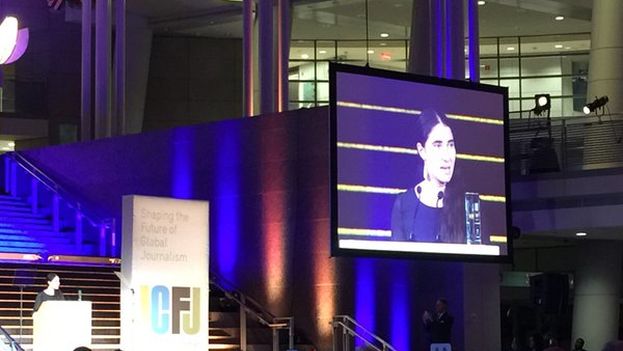
Yoani Sanchez accepts the Knight International Journalism Award 2015. (karinkarlekar)
Generation Y, Yoani Sanchez, 12 November 2015 — My grandmother only knew how to write the first letter of her name. She would sign documents with an almost childish looking capitalized “A.” In spite of being illiterate, Ana always advised me to study and learn as much as possible. Nevertheless, that laundress who never went to school taught me the best lesson of my life: that tenacity and hard work are needed to accomplish one’s dreams. She instilled in me the urgency of “action.” Action with a capital “A,” like the only letter of her name that she could write.
However, action can become a problem if it is not appropriately accompanied by information. An uninformed citizen is easy prey for the powerful, a guaranteed victim for manipulation and control. In fact, an individual without information cannot be considered a whole citizen, because her rights will constantly be violated and she will not know how to demand and reclaim them. continue reading
The most expansive authoritarian regimes in history have been characterized by a strict control of the media and a high disregard for freedom of information. For these systems, a journalist is an uncomfortable individual who must be tamed, silenced, or eliminated. These are societies where a journalist is recognized only when she repeats the official government rhetoric, applauds the authorities, and sings praises to the system.
I have lived forty years under a government that considers that information is treason. At first, when I learned to read and began to pay attention to the national media, with its optimistic headlines and data on the country’s economic over-achievement, I blindly believed what those newspapers were saying. That country that only existed in the ink of the Cuban Communist Party’s national newspaper was similar to the one my teachers taught me about in school, similar to the one from the Marxist manuals and the speeches of the Maximum Leader. But it did not resemble the reality.
From the frustration between my desires to know and the wall of silence that the official Cuban press imposes on so many issues, the person I am now was born.
My first reaction in the face of so much manipulation and censorship – like that of so many of my fellow citizens – was simply to stop reading that press which served those in power, that propaganda disguised as journalism. Like millions of Cubans, I sought information that was hidden, censored news articles, and I learned to hear the radio transmissions coming from outside even with the interference that the government would impose on them.
I felt like I would drown if I wasn’t informed. But, then another moment came. A moment when I switched to “action.” It wasn’t enough to know everything that was being hidden from me and to decipher the truth behind so many false statistics and such editorial grandiloquence. I wanted to be part of those who narrated the Cuban reality. Thus, I began my blog Generation Y in April of 2007, and with it I took the path of no return as a reporter and a journalist. A path filled with danger, gratification, and great responsibility.
During the past eight years, I have lived all of the extremes of the journalistic profession: the honors and the pains; the frustration of not being allowed to enter an official press conferences and the marvel of finding an ordinary Cuban who gives me the most valuable of testimonies. I have had moments where I have exalted this profession and moments in which I wished I had never written that first word. There is no journalist who does not carry the burden of her own demons.
Now, I lead a media outlet, 14ymedio, the first independent news platform inside of Cuba. I am no longer the teenager who turned her eyes away from the official press, looked for other alternative news sources, and later began her own blog as if she were someone opening a window into the entrails of a country. I now have new responsibilities. I lead a group of journalists, who every day must cross the lines of illegality to perform their jobs.
I am responsible for each and every one of the journalists who are a part of the newsroom of our news platform. The worst moments are when one of them takes longer than expected to return from covering a story and we have to call their family to say that they have been arrested or are being interrogated. Those are the days that I wish that I had not written that first word…or that I had not written that first word the moment I did, but much earlier.
I feel that if we had moved towards action, and if we had exercised our right to inform much earlier, Cuba would now be a country where a journalist would not be synonymous with a tamed professional or a furtive criminal. But at least we have begun to do it. We have moved from information into action, to help change a nation through news, reporting, and journalism. It is Action with a capital “A,” like the one my grandmother wrote on those papers though she never really understood what they were saying.
Note: Speech delivered by Yoani Sanchez on 10 November in New York, at the ceremony for the 2015 Knight International Journalism Awards. The director of 14ymedio was given the award last May by the International Center for Journalists for her “uncommon resolve in the fight against censorship.”
Residents in an Old Havana tenement demand “decent housing.” (14ymedio)
14ymedio, Armando Martinez, Havana, 9 November 2015 — In Old Havana, the residents of a tenement on Compostela Street, between Luz and Acosta, across from the Belen Convent, no longer want to risk their lives under the roof of their dwelling. The façade is no longer a place where sports passions are written, now the residents have turned it into their Wailing Wall with an irrevocable demand: “We want decent housing.”
The reason they have taken their beds into the street is the deterioration of the building, which threatens to fall down on their heads. As of last Friday, the residents of the place made the decision to sleep in the entryway, which seems more secure, with their more precious treasures: a TV, a refrigerator, three mattresses and a table. continue reading
Since we’ve come out of there they are starting to listen to us,” says a woman of around 50, referring to the local authorities. With an unconvincing optimism, the woman says, “This Monday they will give us an answer, they’ve promised.” However, she adds with determination, “We do not want to go to a shelter and spend 15 or 20 years there waiting for the day they give us a decent house.”The residents of the Compostela Street no longer want to continue to risk their lives under the roof of the dwelling. (14ymedio)
In November of last year the official press published the alarming number of families in need of homes: 33,889 (132,699 people). Many of them have lived for two decades in shelters for victims of uninhabitable housing. According to the census, 60% of the 3.9 million housing units on the island are in poor condition.
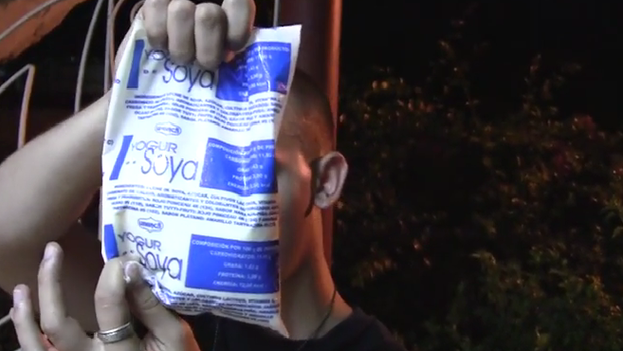
Consumers report the loss of product quality with soy yogurt due to failures in refrigeration and sanitary control. (Youtube)
14ymedio, Orlando Palma, 11 November 2015 – The shortage of soy yogurt in the regulated market has worsened in recent weeks, and this product intended for children between 7 and 13* years of age is also characterized by its low quality.
The shortage of soy yogurt has worsened in recent weeks in the regulated market where the product intended for children aged seven to thirteen years it is also characterized by its low quality.
Designated mostly for the “basic family food ration” and school meals, soy yogurt began to appear on the island in 2003, but manufacturers have never been able to fulfill their commitments for 275,500 tons annually. continue reading
In the last session of the National Assembly in July, industry officials blamed the instability of Party managers, technological obsolescence and the deterioration of refrigeration systems for the distribution problems.
On that occasion, the Minister of the Food Industry, Maria del Carmen Concepcion, reaffirmed the importance of soy yogurt and agreed on the urgent need to “find immediate solutions.” However, over the months the problem has worsened rather than improved.
The points of sale, distributed in each municipality, should be supplied three times a week, so that each child receives twelve bags in a month. Consumers complain that the quota is never met, but it is possible to find the same yogurt in the unregulated markets*.
“It shows up once or occasionally twice a week, but it is not safe,” an employee of a dairy in Central Havana explained this Tuesday, while a mother complained that “sometimes it doesn’t arrive for a whole week.”
Consumers also reported a loss of product quality due to failures in refrigeration and sanitary control.
In some areas the product has been replaced by a powdered mixture to prepare it, but with little acceptance among customers. “People do not want it because you need milk to mix it with. Made with just water the children don’t like it,” says an employee of a market in Havana’s Vibora neighborhood.
Modesto Perez, director of the dairy complex in the capital, explained the technical problems facing the industry on national television this week. “Maintaining stability and three operating boilers is complex. Whenever there is a situation with a boiler, production stops because steam is essential to the production.”
In the middle of this year the official press announced that nine million convertible pesos (CUC) would be earmarked to “gradually resolve the issue of technological obsolescence in the production and distribution of soy yogurt.” The results are not yet visible to the consumer.
Across the country the situation is repeated; the 15 companies that produce this food are all affected by breakdowns that prevent or hinder production. The most affected regions, including the capital, are Bayamo, Guantanamo and Santiago de Cuba.
Rebeca Monzo, 9 November 2015 — While preparing for my departure from Miami, a friend suggested I ship part of my luggage by sea to lighten my load and the custom duties. To do this, we turned to an agency advertised on local TV.
The staff at the company, Tu Envío a Cuba (Your Shipment to Cuba) was very attentive and professional, which made us feel this was a reliable alternative. They assured us the packages would arrive in Cuba within twenty-three days or less, which further encouraged me to choose this option. What was never mentioned was how the process would play out once the shipment arrived in the country. continue reading
Sometime after the estimated time of arrival, I decided to call the offices here in Havana. After countless attempts over several days, I managed to get in touch with the information department, which provided me with the long-awaited answer. I was told my package had in fact arrived on October 18 at 2:30 pm (on the scheduled date no less), and I was even provided with a confirmation number. But when I insisted on details about the delivery date, they responded categorically that the shipping container in which my package arrived was at the port of Mariel and that I would have to wait three months due to shortages of trucks and manpower.
I decided to look into the matter further and discovered that one company, Almacenes Universal (Universal Warehouses), controls transportation and distribution of all merchandise, both state and private sector, throughout the island. Though the company has a fleet of vehicles at its disposal, they have never been fully operational. Many of its trucks are broken or in repair shops, hence all the delays now being experienced in delivering what are in many cases essential supplies to commercial and manufacturing enterprises.
Therefore, as one might expect, those of us who decide to ship some of our luggage by sea have to sit and wait patiently since we are not among the government’s priorities.
What is even worse is that the company to which we as travelers entrust our personal possessions does not warn us of these problems before taking our orders and collecting our money, as logic would dictate.
In my particular case, I can afford to wait, though this is neither the best nor the desired outcome. Unfortunately, however, this situation also impacts supplies of pharmaceuticals, soft drinks, mineral water and many other essential products, leading to regular shortages at pharmacies that affect the entire population.
14ymedio, Manuel Pereira, Mexico City, 8 November 2015 — Since the second half of the twentieth century we Cubans have been the Jews of the Caribbean, and the Malecon is our Wailing Wall. Among other topics, the immigration issue figures in the meeting between Raul Castro and Pena Nieto in Merida, Yucatan. The two countries are united by historical ties: the poet José María Heredia lived and died here in Mexico, José Martí married here, passing through here were the politicians Mella, Fidel Castro, and Che Guevara. In 1951 Perez Prado launched “Ruidoso Rico Mambo” here, then came Benny More, Celia Cruz, “La Sonora Matancera,” the “Mulatas de Fuego” and, in the sixties, “The Tremendous Corte” triumphed on radio and television with Trespatines, Rudesindo and the Galician Rudesindo. All these humorous, musical and voluptuous cyclones are forever linked with Cuba.
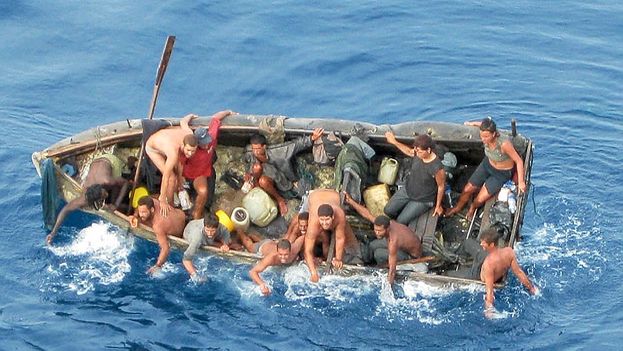
But the Cuban exodus is a tragedy of biblical proportions. If the desert crossing of the Israelites lasted for 40 years, that of the Cuban people has lasted half a century, counting from the first mass exodus from the port of Camarioca (1965), followed by the port of Mariel stampede (1980), which was repeated during the “rafters crisis” (1994). continue reading
In 1995, when the US Coast Guard began to return Cuban rafters intercepted in the Straits of Florida, the island’s escaping slaves sought other routes toward the south. They started out from Camagüey, for Santa Cruz del Sur, toward the Cayman Islands and Honduras. Even between 2002 and 2004 many Cubans traveled as tourists to Russia, some asked for political asylum at the layover at the Barajas airport and for those arriving in Moscow it was harder. Some managed to get documents to travel to Mexico at astronomical prices, others ended up so far away they left with a free visa for Sao Tome and Principe in West Africa.
Mexico as a bridge to the United States became the most coveted goal. The sign of the most persistent “blood, sweat and tears” runs to Guatemala drawing a geography of pain that is clear proof of the failure of the Cuban utopia. As Voltaire said: “It has been tried in several countries not to allow a citizen to leave the nation in which he had the accident of being born; visibly the meaning of this law is: this country is so bad and so badly governed that we prohibit every individual from leaving, for fear that everyone would go.”
Those fugitives fleeing from the chronic shortages, repression, lack of individual human rights and a bleak future, soon crowd into Ecuador thanks to the close ideological relations between that country and the island. The Cuban government, as on other occasions, needs a valve to release the steam from the cauldron and, also, a future source of income from family remittances. And Quito has become the ideal place from which to reach Mexico in the long Cuban pilgrimage. From there, groups leave for Colombia, then Panama, Costa Rice, Nicaragua, Honduras, Guatemala and Mexico. The flow of Cubans who come from Ecuador to Tapachula, a migration station in Chiapas, varies between 40 and 50 a day. They are looking for safe conduct to cross Mexico as a bridge to the Promised Land.
The Cuban diaspora is the most extensive in world history since the Jews in the time of the Babylonian captivity. This dispersion of wandering Cubans has grown and accelerated since the “thaw” between Cuba and the United States, growing still more with the rumor of the imminent repeal of the Cuban Adjustment Act. It goes without saying that these tropical pilgrims face hurricanes, sharks, sunstroke, impenetrable jungles, tumultuous rivers, human trafficking, extortionist police and guerrillas and thieves…
This Cuban exodus evokes the riskiest travel fictions: The Odyssey by Homer; the myth of Jason and the Argonauts; Virgil’s Aeneid; Jonah and the Whale; The Lusiadas by Luis Vas de Camoes; Sinbad the Sailor; Defoe’s Robinson Crusoe;Gulliver’s Travels by Jonathan Swift; The Narrative of Arthur Gordon Pym by Edgar Allan Poe; Moby-Dick by Melville; The Sphinx of the Ice by Jules Verne; Stevenson’s Treasure Island; Joseph Conrad’s Heart of Darkness and other works that do not fit here.
The Cuban reality exceeds any of these stories no matter how fanciful and exaggerated their authors have been. In the film Memories of Underdevelopment, by Tomas Gutierrez Alea, the protagonist paraphrases Che Guevara when he says: “This great humanity has said enough and has started to get moving… and will not stop until it gets to Miami…”