Zaqueo Baez: ‘We Must Fight From Here, Within” / 14ymedio, Reinaldo Escobar

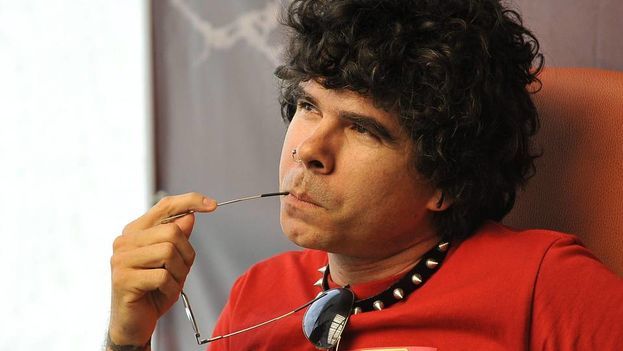
Zacchaeus Baez during a meeting of Cuban Civil Society Open Forum, weeks before his arrest. (14ymedio)
Zaqueo Báez during a meeting of Cuban Civil Society Open Forum, weeks before his arrest. (14ymedio)

14ymedio bigger14ymedio, Reinaldo Escobar, Havana, 10 November 2015 — This Monday afternoon the three activists who were arrested when they approached Pope Francis in the Plaza of the Revolution in Havana, last September 20, were released.Zaqueo Báez Guerrero and Ismael Bonet, members of the Patriot Union of Cuba (UNPACU), and the Lady in White Maria Josefa Acon Sardina, face trial for the alleged crimes of public disorder, disrespect and resistance.

In conversation with 14ymedio, Zaqueo Báez said that after nearly 50 days in prison he felt “weak and tired, but ready to continue fighting for democracy in Cuba.” When asked about how he will await his trial, he stressed that they were warned by the police that they could only “go from home to work and work to home.” continue reading

“What I most want to do, is to continue in opposition against the dictatorship,” said the activist. “So I will comply with these instructions, from my home to the street to engage opposition and so, if I am lucky and they don’t arrest me again I will return to my house,” he says.

Just two hours after being released from prison, Baez said their date to appear in court has not yet been announced. The regime opponent hopes that “they can not ask for the maximum sentence” because “none of the three of us have criminal records.”

To those who question his conduct before a head of state, the activist replies firmly that does not feel unhappy: “I think we could do a little more, like going out with a sign to ask freedom for political prisoners, for example.” However, he notes that “at an event of this nature we prefer to be moderate and peaceful activists for human rights so they don’t confuse us with aggressive people who want to harm the Pope.”

“We are not terrorists nor do we want to appear to be so,” Baez said a few hours after he was released and still feeling anxious from the days of imprisonment in the police station known as 100 y Aldabo in Havana. “I would have loved to get a microphone and demanded that the Castro brothers ask forgiveness from their people,” but he recognizes “that would be to think like a Hollywood movie.”

When asked about his future plans, he said he is preparing himself
“better and I want to make it clear that I have no intention of leaving Cuba as a political refugee.” A statement immediately qualified with, “Perhaps I will leave to take a course or something like that, but I believe we have to continue fighting here, within.”

Despite the rigors of prison, he believes that “we must exhaust all peaceful tools for change in Cuba.”

Three Activists Arrested During Visit of Pope Francis Are Released / 14ymedio

Activists arrested during Pope Francis’s Mass in the Plaza of the Revolution (frame of a video)

14ymedio bigger14ymedio, Havana, 9 November 2015 – This Monday afternoon the three activists arrested during Pope Francis’s visit were released. Zaqueo Baez Guerrero and Ismael Bonet, members of the Patriot Union of Cuba (UNPACU), and the Lady in White Maria Josefa Acon Sardina, were released pending trial as corroborated by 14ymedio in a telephone call from one of those released.

For nearly 50 days, the three dissidents had been held at the police station known as 100 y Aldabó in Havana, for approaching the bBishop of Rome on his arrival at the Plaza of the Revolution in the capital, on 20 September.

Within hours of the arrest, Baez managed to communicate with the leader of his organization, Jose Daniel Ferrer, who told the press: “Zaqueo told me that he managed to make it to where the Pope was and to tell him the truth and to shout ‘Freedom!’.”

During the first days of imprisonment, two of the regime opponents went on a hunger strike, but later they ceased to fast. UNPACU maintained a strong campaign for their release under the slogan “The three who reached the Pope,” which included marches in the east and other cities in the country.

The activists were charged with the offenses of assault, disrespect, public disorder and resisting arrest, according to what was detailed by family members who were able to visit them during their confinement.

Refugees / Somos+, Javier Martinez

Emigrating through Central America

Somos+, Javier Martinez, 9 November 2015 — According to the Spanish newspaper El Pais, from its Facebook page, “The Garage of Those Not Going Anywhere,” 94,000 Syrians are on migratory routes to Europe. They are trying to flee the worst civil war that has plagued this Middle Eastern nation. UN estimates show a quarter of a million refugees have fled the country, and another eight million have been displaced from their homes, while Europe, in the first half of the year alone, received around 338,000 emigrants.

But Syrians are not the only ones today leading such a stampede. There is a migratory corridor in Latin American which the world media ignores. We don’t know the reasons although what these migrants face in many cases are situations very similar to the Syrians. continue reading

I am not trying to make comparisons, I hope to make this point clear, but we need to call attention to the thousands of Cubans who are today traveling through Central American countries risking their lives, in subhuman conditions, and without the least support or recognition from the international community.

While the Syrians pay between 2,500 and 4,000 euros (approx. $2,700 – $4,300 US), Cubans have to pay between $5,500 and $8,000 US from Ecuador, although at times the price is even higher, depending on the time of the trip and the security displayed by the traffickers.

I do not doubt that the Islamic State is a terrorist group, we have seen their videos terrorizing the world, but the Central American gangs are not far behind, in El Salvador, Nicaragua or Costa Rica and even in Mexico. They kill Cubans for that simple fact, of being Cubans.

While the Syrians navigate the Mediterranean and in many cases are shipwrecked with lamentable lost of human lives, Cubans are held at various border posts in “brother countries,” forced in many cases to strip naked, raped, beaten, and held until their families pay to rescue them.

The jungles of the Darien Gap, between Colombia and Panama, where emigrants have to cross on makeshift rafts, are known for excesses, blood and death. A simple variation in the route, a shout a fear, a cry of hunger, and they fall into the lands of narco-traffickers and paramilitaries. The stories are true, told by the survivors who make it to the US.

We will never know the exact number of Cubans who have died on the journey to reach the United States from Ecuador. Never.

Some disbelievers want to compare wars and government excesses. Clearly the Syrians are facing a national situation worse than ours. In Syria you can die from a bomb or a stray bullet, in Cuba you die as an old man without political, social or economic freedoms. In the war you can lose your house, your car, your land and your business, and in Cuban you never have any of these things.

The world today condemns the Syrian government, but applauds the person of Raul Castro at the United Nations. Tens of thousands of Syrian migrants are recognized by the European countries, while thousands of Cubans are abused on their passage through Central America. The Syrians bring their religious, cultural and social conflicts to the continent that shelters them, while for years Cubans have brought healthcare, education and well-being to the people who mistreat them. There are obviously

There are solutions to save the lives of Cuban emigrants. The Cuban government could ask for guarantees for the free passage of its citizens from the Central American countries, could try to establish agreements that would care for and preserve the lives of its emigrants. The same people who, later, with their remittances sent back to Cuba, oxygenate the economy of the system. However, it hasn’t done it, it will not do it, because it would imply recognizing the expiration of a system and of a totalitarian government, that leaves no other options for its citizens, other than escape.

Syrians are political refugees and so are we Cubans. There, a dictator governs, and in our country a different dictator governs, who, of course, supports the Syrian dictator. Raul Castro and Bashar al-Assad are close friends. People emigrate because of the ineffectiveness of their leaders and their rejection of those leaders remaining in power. Although each one faces different consequences, the cause is the same: the refusal of a man to leave power.

Sources:

Diario el País, España.
www.cubadiplomatica.cu
www.elcomercio.com
www.oncubamagazine.com
Spanish post

Angel Santiesteban Explains What Happened During His Arbitrary Detention

“I traded one cell for a slightly roomier prison, because I continue to think that this island is a prison.”

Elisa Tabakman (Blog Editor), 6 November 2015 — Angel Santiesteban-Prats was arrested on November 4, suspiciously, after reporting the previous day that the political prisoner Lamberto Henández Planas died in Combinado del Este Prison as a consequence of the hunger strike he maintained during his re-imprisonment, the result of a sinister new maneuver by State Security to lock him back up after 23 years in prison.

What happened since Angel’s arrest at his home, and the new “Kafkaesque process” that ended in a summary trial, lasting only 5 minutes, in which they “revoked his probation and in the same act revoked the revocation because there are no reasons to re-incarcerate him” shows that they threw together a crude spectacle to draw media attention, releasing from the police station (where he remained until being transferred to the court) all kinds of false, absurd and contradictory versions, which we believe were concocted to cast a new shadow of suspicion on Angel and to discredit the serious accusation he made about Lamberto’s life, and incidentally, to continue the ongoing campaign they have mounted to destroy Angel’s reputation and to try to diminish the numerous international awards he obtained during his two and a half years in prison, something they well know has failed. Precisely for these reasons, we preferred to maintain a cautious silence about what was happening and to wait for Angel himself to explain it and not to keep playing the dictatorship’s game.

This is an excellent opportunity to remind the dictator Raul Castro that Angel is waiting for the response to the Review of the judgment, filed July 4, 2013, and that was admitted to the 3 instances why it happened, proving that they have already acknowledged errors, irregularities, and violations of judicial procedures, because, it never hurts to remember, THERE IS NO OBLIGATION to acknowledge the revisions, only to acknowledge them when such “mistakes” are proven.

General Raul Castro, it is very sad to go down in history through the sewer, to be remembered by posterity as a violator of human rights and the architect of all kinds of crimes against humanity.

What follows is the account of the “episode” in Angel’s own words. [Recording of phone call in Spanish is available here.]

The Editor


Which Korea? / 14ymedio, Reinaldo Escobar

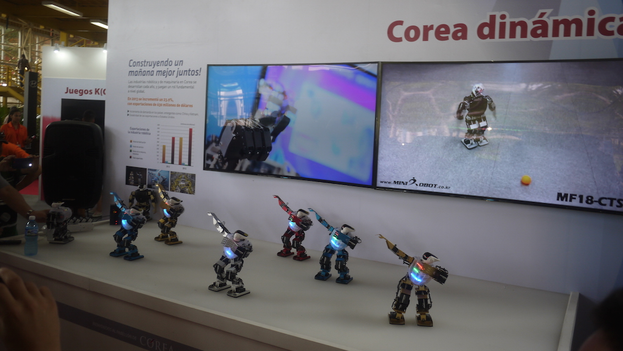
The dancing robots at the South Korean pavilion at the Havana International Fair
The dancing robots at the South Korean pavilion at the Havana International Fair (4ymedio)

14ymedio bigger14ymedio, Reinaldo Escobar, Havana, 7 November 2015 – So which Korea is it that has a pavilion here? A woman asked this of a uniformed guide at the International Fair of Havana. The man, friendly and solicitous, turns to the huge welcome sign at the entrance, looks at it as if he’s seeing it for the first time and answers, “Which Korea will it be madam? What you said I believe is written with a “K.”

The woman enters, followed by many others visiting the site, to look at the brand new Hyundi cars, or to admire the agricultural machinery, the Samsung technological products, the drinks, and to simply enjoy the display of small robots that dance and jump to the beat of the music. continue reading

The 9,500 square-foot pavilion is managed by the South Korea Agency for Trade Promotion and Investment (KOTRA). The Asian country has brought this time a delegation of 17 exporting companies of large firms such as Samsung Electronics and Hyundai Motors, as well as others such as Global Green and Seasco.

Many who throng in front of the exhibition of products and technology that fill the stand are very excited about the appearance in their lives of all this Korean manufacturing. “My aunt has a Samsung flat screen,” you can hear a boy who has come with his parents and cousins boasting to another. Others detail the latest Galaxy line of phones have come on the market and a woman dreams of a microwave oven from the distant peninsula.

On leaving the place, no one doubts that this display does not come from the Democratic Republic of Korea. They know because they have not seen a single picture of the Kim family, or a photo of any sculpture where someone raises a threatening fist or points towards an imaginary dazzling future. But also because business representatives moving through the halls do it with ease and freedom and do not ask anyone if they work for a State enterprise.

In this 33rd edition 33 of the International Fair, the most uptight are the Cubans, especially the officials because the gorgeous models pose happily for the cameras. The opening days were invitation-only and it was just on Friday that the doors were opened to the public. It is hard to believe that with the capital’s transportation problems so many people decided to go to the ExpoCuba fairgrounds.

Nearly a thousand companies from 20 countries exhibited their products here. Canada, Germany, Spain and Mexico are the pavilions attracting the most people but Korea’s has something special that nobody wants to miss. After asking several people why so many people visit this site, a young man gave me a surprising answer: “I came to see them, because Cubans are going to have to learn to be Koreans.”

Padre Conrado: “The Church has the responsibility of accompanying the people in new pathways” / 14ymedio, Luz Escobar

José Conrado Rodríguez receiving the Patmos Institute Award

14ymedio bigger14ymedio, Luz Escobar, Havana, 8 November 2015 –To a long list of awards and accolades received by the priest José Conrado Rodríguez Alegre, the Patmos Institute Prize has been added, awarded last week by the Baptist church. The pastor said that in his life he has made “a personal journey of great friendship with my Protestant brothers.” About this ecumenical attitude and the current situation of the Catholic Church in Cuba he offered this interview by telephone from the city of Trinidad.

Escobar. Some weeks after the visit of Pope Francis to Cuba, what do you think has been the most important legacy of his visit to the island?

Conrado. It was an extraordinary experience for all of us, Catholics and Cubans in general. Francis made a call for a more committed life, more faithful to justice and truth, but also invited us to live more committed to mercy. He has called us to see the faces of those who are suffering, who are waiting for a helping hand, one breath. He has demonstrated that attitude of closeness to the most needy, the poorest, the elderly, children. continue reading

Escobar. The Cuban church is bound to face some changes with the end of Jaime Ortega y Alamino’s tenure as Archbishop of Havana. How do you envision this new stage to come?

sacerdote-Jose-Conrado-Rodriguez-Alegre_CYMIMA20151108_0001_11Conrado. The current times demand from us a more intense presence at the side of the people, a greater commitment with the people and at the side of the people. I would say these are moments of a new sensitivity to respond to the call of our people, who have lived through very difficult times. Our people have had to face great difficulties over the years and the Church has the responsibility of accompanying the people along these new pathways. This requires a new inspiration, a renewed ability to seek paths of hope that will lead us to the responsibility of each person to achieve a better Cuba.

Escobar. You worked for a long time in the poor neighborhoods and towns of Santiago de Cuba, but now you are located in Trinidad, a more prosperous city thanks to tourism. What differences do you see between one community and the other?

Conrado. In Trinidad there is also great poverty, especially in the countryside. It is a region of contrasts. Some people are surviving with a little more resources, but there is also great need. As a consequence, people see things in a material way, and they turn a little more to resolving material problems and so often forget life’s spiritual dimension and a commitment to others.

Escobar. You just received the prize from the Patmos Institute which is a Baptist organization. Is it possible to reconcile religious differences for the good of Cuba?

Conrado. Yes, there is no doubt. When one adopts an attitude of true love. Love does not exclude, love includes. Love crosses borders and breaks down the walls that separate humans.

Escobar. How do you value this award?

Conrado. I am very pleased that people of another Christian denomination positively assess my behavior, but above all that they have done so thinking of Cuba.

Escobar. What do you think are the greatest challenges facing the Catholic Church in Cuba today?

Conrado. The challenge of fighting for justice, of solidarity with those who have violated your rights, or living overwhelmed and drowned by the weight of a very difficult life. Seeking ways in which people make their decisions but without forgetting others, without forgetting this dimension of openness to love that must always be present in the Christian.

Escobar. What kind of work are you doing from your parish?

Conrado. We help children by giving lunch at noon to those who live far from school. Many rural classrooms have had to close for economic reasons and then the children must attend school in the larger towns, but they live far away and returning home to eat could mean that they can not return for the afternoon session. It is a real problem.

We also visit the sick, we take care of them. Support for prisoners and families of prisoners is part of our work. We are there, in those situations where human beings are helpless, suffering injustice, without being heard. Pastoral work is accompanying, listening, paying attention, being there for people.

Nicolas Maduro’s Two Plans / 14ymedio, Carlos Alberto Montaner

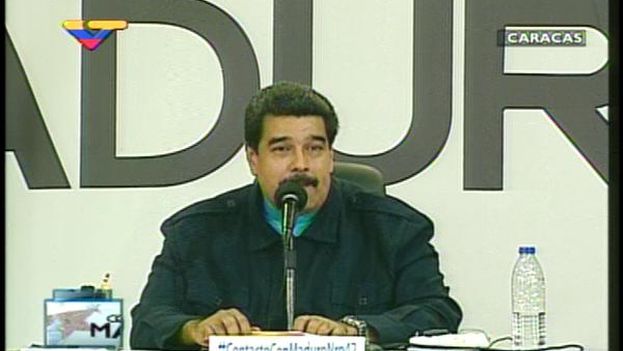
The Venezuelan president on his television program 'In Touch with Maduro'
The Venezuelan president on his television program ‘In Touch with Maduro’

14ymedio bigger14ymedio, Carlos Alberto Montaner, Miami, 7 November 2015 — Nicolas Maduro knows he will lose the election on December 6. The disaster is too intense. So say all the polls. Ninety percent of Venezuelans want a change. Eighty percent blame Maduro. Seventy percent are determined to vote against this thoroughly incompetent government.

Venezuelans are tired of lining up to buy milk, toilet paper, whatever. The inflation horrifies them. Everything is more expensive every day that passes. The salary of a month is consumed in a week. The corruption disgusts them. They know and intuit that the Chavista leadership is an association of crooks with no lack of narco-traffickers, all colluding to plunder the country. Lacking flour, violence is the daily arepa (bread). Caracas is one of the most dangerous cities in the world. And one of the filthiest. (This is also what Cubanization is: Wreckage and sewage running in the streets on the worn out pavement full of potholes.)

But Maduro blindly obeys an axiom of the Castros: “The Revolution will never surrender.” The Revolutiuon is actually a verbal construction that, in reality, means The Power. The Power is what is never handed over. The Revolution is a plastic thing that transforms itself so as not to lose power. The verbal construction has other rhetorical components: “the people, social justice, anti-imperialism, the oppressed poor, the greedy rich, multinational exploiters, the Yankee enemy.” There are hundreds of expressions that arm the story. continue reading

Until 1998, according to the Castros, power came from the barrel of a gun and the Revolution was declared. This was the dogma. This is what they had done. At the end of that year, Hugo Chavez won some elections and came to power by other means, but with the same ends. Fidel, reluctantly, accepted the change in method, but clarified that power is never relinquished.

He accepted that Chavism dismantled in slow-motion the scaffolding of the liberal democracy and liquidated the trifles of the three powers and the freedom of press and association, but made it very clear that the Revolution, that is, Power, was never negotiable. Alternation was a ridiculous republican practice of the soft bourgeoisie. That option did not fit into a genuine testicular and revolutionary model.

What will Maduro do in the face of the electoral defeat predicted by the polls and his decision never to relinquish power, imposed by Cuba but enthusiastically taken up by him and the Chavista leadership?

Maduro has a Plan A and a Plan B.

Plan A is to try to win the elections or to accept losing by a minimum amount. How will he perpetrate it? Jailing or prohibiting the participation of opposition leaders who could drag their supporters to the polls. This is the case, among others, for Leopoldo Lopez and Maria Corina Machado. Manipulating the voting machines. Generating false ballots. Drawing the districts to favor his voters. Abusing the media 100 to 1. Putting obstacles in front of the opposition vote in a thousand ways .

The intention of the government is to discourage the democrats so they do not vote. They calculate that with the total of all these tricks they can win, or lose by a small margin. And if they lose, they buy at any price a handful of dishonest deputies and continue with the power fiercely clenched between their legs.

And if Plan A fails? Plan B would be launched if the avalanche of votes is such that there is no way to hide a stunning defeat. That’s what happened to Jaruzelski in Poland in the summer of 1989. He used all the advantages of power to crush Solidarity in partial elections limited to the Senate, but Walesa and his democratic tribe obtained 95% of the vote and nearly all the seats. The communist regime collapsed before the evidence of widespread rejection.

Maduro has had the courtesy to announce his Plan B. If he loses he will use the prerogatives of the enabling law to demolish the few institutions of the Republic left standing. In that case, he will govern “revolutionarily” with “the people and the army” through a civilian-military junta. They call this infamy “deepening the Revolution.” Hand over power? Don’t even dream of it. He would create a satrapy pure and simple, collectivist and brutal, without bourgeois disguises.

What should Venezuelans do? What the Poles did. Come out to vote in massive numbers. Bury this filth under a mountain of votes, and fight ballot by ballot and polling place by polling place, without fear and without faltering.

Plan A is worse than Plan B. Plan A continues a dying farce that will inevitably lead to a slow and painful death. Plan B has the advantage of shamelessly undressing the totalitarian character of this dictatorship and puts an end to the doctored narrative of the revolution of the oppressed. End of story.

Many Venezuelans, Chavez supporters or not, military or civilian, will perhaps not remain impassive while Maduro and his masters in Havana distort the popular will and impose a permanent yoke. It will all play itself out on December 6. Perhaps life itself.

Gorki Aguila Released After Several Hours of Detention / Diario de Cuba

diariodecubalogoDiario de Cuba, Havana, 8 November 2015 — The musician Gorki Águila was released on Saturday after being held for a few hours in the 5th police station in Playa municipality in Havana. Águila was arrested with two French journalists who were also released.

As he explained in statements to Radio Marti, the reason for the arrest was his wearing a shirt with the phrase “Down with you-know-you” while he was being interviewed on the street by journalists.

“People (agents) follow me and one of the minions spoke with State Security, so that was why we were stopped,” said Águila.

After two hours in the cells, the musician had an interview with a member of the State Security, according to the artist, and threatened him, “in the form of advice” to stop any kind of activism. “Same as always,” said Águila.

Musician Gorki Aguila Arrested Along With Two Foreign Journalists / 14ymedio

Musician Gorki Aguila (Photo EFE)

14ymedio bigger14ymedio, Havana, 7 November 2015 — The musician Gorki Águila was arrested this afternoon in Havana, as he was traveling in a car with two journalists from the television channel France24. The composer and singer managed to call this newspaper from the Fifth Police Station in the Playa municipality, where he was taken with the two reporters.

Águila, leader of the punk rock band Porno para Ricardo, does not know why he has been arrested and when talking with 14ymedio the police still had not informed him whether he would remain in a cell in the station, or be fined or prosecuted. Last August the musician was detained for several hours in the same station, where he was warned that if continue his activism “those who invite you to visit another country will have to come to looking for you in a boat.”

In May, a similar incident occurred when Águila was forcibly detained outside the Museum of Fine Arts in Havana for carrying a poster with the image of the graffiti artist El Sexto along with the word “Freedom.

Prostitution in Cuba: Solutions to a Current Reality (Part 1) / Somos+, Jose Manuel Presol

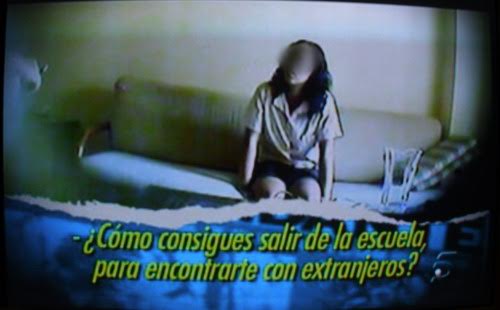
“How can we get out of school to meet foreigners?”

Somos+, Jose Manuel Presol, 3 November 2015 — I’ll never forget a comment from my father: “Jose Manuel, remember we made the Revolution, among other things, so that Cuba would no longer be the whorehouse of the United States. Years later, during a rather heated discussion with a person who said he was close to the so-called “Committee to the Support the Commander,” I repeated what my father said and his response was, “the compañeros didn’t do it for vice, but for patriotism, to bring currency to the Revolution,” and I’ll never forget that either. It was one of the rare times in my life when, faced with the cynicism, I was floored.

The truth is that now Cuba is no longer the whorehouse of the United States, but it is for Canadians, Spaniards, Italians, Mexicans and anyone landing on the island who brings enough dollars or euros in their pockets to pay a pittance for something that in their own country, if they offered that amount someone would laugh in their face. continue reading

I am not trying to do a sociological or anthropological study on the current phenomenon of prostitution in Cuba, there are people much more capable than I am than those who have done and continue to do such studies. What I want to express is the problem, trying to offer some solutions.

Prostitution in Cuba, as in almost all countries, is not a new problem. It has existed for many years. The oldest antecedents in our country are perhaps, not counting the brothels erected by landowners, in non-harvest times, to “take advantage” of the surplus labor, where free slaves prostituted themselves to earn a few pesos to buy the freedom of their children and other family members. The big difference today is how widespread it is.

This generalization is not based on the huge number of women, men, girls and boys who dedicate themselves to is, but to the chain of accomplices and abettors that come with it, which means that a high percentage of society is directly or indirectly involved in it.

The first accomplice and abettor is the State itself, I mean the current Cuban government that — despite its laws, its supposed warnings, its famous three warning letters, after which the victims can be sent to prison for 1 to 3 years — tolerates the situation.

I say victim because everyone, absolutely everyone who engages in or tolerates prostitution is a victim of the situation created. All are victims and make up a long chain.

The chain is formed, at a minimum, by:

  1. The teachers who allow the girls and boys trusted to their care leave classes with impunity to prostitute themselves, and they do it, because the remuneration they receive and the methods at their disposal are not adequate to exercise their profession in proper conditions. It is hard for me to think of a teacher who on a whim is capable of letting their students prostitute themselves. Their morality is simply “asleep,” if it is that, because of the need to solve their own problems and for the lack of an honorable alternative from the system itself after more than fifty years and the same thing happens with the rest of the links in the chain.
  2. The police who, far from preventing the offense of the offenses, in the case of minors, prefer to look the other way and take a few Cuban convertible pesos (CUC), that allow them to resolve some of their needs. I am not capable, as in the former case, of imagining any component of the People’s Revolutionary Police (PNR) acting this way for the pleasure of it. They are all aware that the person who prostitutes themselves tomorrow could be their daughter, their brother, their lifelong friend.
  3. Those in charge of control in the hotels, who are the in the same case as the previously. They know perfectly well that today someone walking through the doors of their hotel could be their sister, or that this could be happening at that precise moment in any other hotel. No one wants to see a loved one on the arm of a tourist stinking of rum.
  4. The pimps. Even these, although they personally dedicate themselves to the offense, I cannot imagine they are very comfortable in the role of suppliers of “fresh meat” if they could dedicate themselves to some other activity. Evidently, in the world as it is today, everyone, absolutely everyone deserves, at least, the benefit of the doubt.
  5. The prostitutes themselves. There is no greater victim. Here we can’t help but affirm that, absolutely everyone is the owner of their own body and can to with it what seems most opportune, but they cease to be such owners from the moment when a child is hungry, a mother needs medicine, a brother has to pay a debt, or simply they need the power to have whatever is not within their reach that could make them feel equal to those yumas (foreigners) who brazenly pass in front of them. Here we must highlight the high number of people who engage in prostitution, despite an elevated cultural level and superior training, seeing themselves brought to it because of not being remunerated in their profession and on the point of being unable to solve their basic daily problems at home.

In short, the ultimate culprit is none other than the government oppressor, which has imposed an undeclared blockage that is the origin of the problems we suffer.

The Story of the Wage Increases / Fernando Damaso

Fernando Damaso, 6 November 2015 — Currently the minimum wage in Cuba is 225 Cuban pesos a month, which is the equivalent of about $10 US. In 1958 it was 85 pesos, equivalent to $85 US. If we compare both minimum wages, the current wage has dropped 75 dollars relative to 1985. The equivalent of 85 dollars is 2,040 current pesos, so Cubans, as a minimum wage, receive 1,815 pesos less (2,040-225=1,815) than before.

But the problem doesn’t end there: what we can buy today with the Cuban peso is infinitely less than what we could buy before. Let’s look at some examples: a can of condensed milk cost 20 centavos then; today it costs 29 pesos. A loaf of bread that cost 10 centavos, today is 10 pesos. A pound of pork was 18 centavos then, today it is 40 pesos. A pair of shoes was 8 pesos, today it is no less than 400. A pair of pants then was 7 pesos, and today 300. The list could go on forever. continue reading

So it is ironic, when in a report in some of the government media, an old worker remembers when he only earned 100 pesos a month during the Republican era, and today he considers himself favored because he earns 1,500. He doesn’t realize that to earn the equivalent today of what he earned then, he would have to receive 2,400 Cuban pesos. And that earning 1,500 pesos is receiving 900 less than before. And this without considering the low purchasing power of the Cuban peso explained above, due to the price increases on products.

To increase salaries with a devalued money doesn’t resolve the problem: it is nothing more than a false image of a quantitative improvement that does not improve the quality of life for our citizens. The increases realized in the salaries of doctors and athletes are a part of them: they represent the minimum salary of 1958.

Someone could argue that education and health care are free and make up for the differences. In reality those services are excessively paid for with what each citizen, over his entire working life, doesn’t receive every month.

In addition, we cannot forget that in 1958 there were public healthcare and education, supported by the State, to which all citizens had access. This, without mentioning that there were also private healthcare and education, that cost between 2.85 and 5 pesos a month for the health care, and between 2.50, 5 and 10 pesos for education, for those people who wanted to utilize them and whose personal economic resources allowed them to.

El Sexto With Somos+ / 14ymedio, Reinaldo Escobar

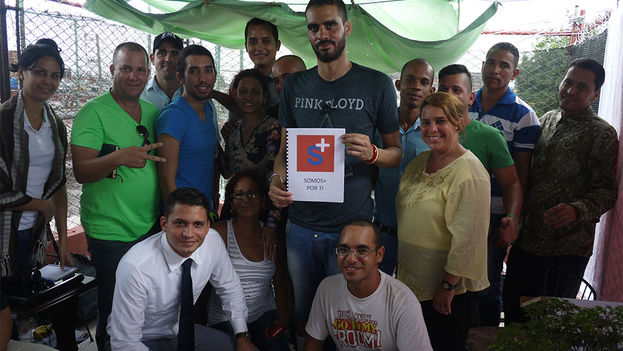
Danilo Maldonado, El Sexto, with members of Somos+ (We are more). (14ymedio)
Danilo Maldonado, El Sexto (the tall one in the center), with members of Somos+ (We are more). (14ymedio)

14ymedio, Reinaldo Escobar, Havana, 6 November 2015 — On Thursday a roof in Havana’s Cerro district was a suitable space for a group of young people to have a meeting with the graffiti artist Danilo Maldonado, El Sexto (The Sixth). Perhaps because neither the artist nor the members of the Somos+ Movement (We Are More) are given to extreme formalities, it is inappropriate to call what took place a tribute. But in fact, it was. continue reading

Danilo was given an anthology of messages of support from many parts of the world, sent during the almost ten months he spent in prison for attempting to stage a performance that angered the Cuban authorities and in particular the political police. The displays of affection came into his hands, the shouts of joy for his release, and the words of encouragement that filled the social networks during his imprisonment.

The coordinators of the young political movement, which is currently holding its third and expanded National Council, invited the artist to relate his experiences in prison. Numerous questions about his artistic action and about his days of confinement allowed El Sexto to demonstrate that he is something more than a “smearer of walls,” as his detractors from the official side call him, but rather someone with artistic sensibility and political will.

Asked about his hunger strike undertaken to secure his release, Maldonado drew with words the most recent of his artistic strokes, which today I want to share with you:

“As people we all occupy a physical space and I believe the most important thing is to make a scratch on this time line in the space we have occupied. I have always had the conviction that I was doing something right. I cold die, but I consoled myself knowing that if this happened I would be remembered, My jailers told they were going to let me die and I responded to them that my death would be different from theirs, because my family and friends would remember me.”

For Cuban Scientists Paradise Is Abroad / 14ymedio, Lilianne Ruiz

The subsidies that accompany scholarships abroad is also a motivation to apply for them. (CC)

14ymedio bigger14ymedio, Lilianne Ruiz, Havana, 6 November 2015 – He arrived in Berlin without a single euro in his pocket and with a pound of beans in his suitcase. Ariel Urquiola remembers his arrival in Germany to do post-doctoral work at Humboldt University’s Leibniz Institute. His departure from Cuba, like that of so many young specialists, was motivated by the desire to do serious science.

After graduating and earning a doctorate in cellular and molecular biology, Urquiola felt he had reached his peak inside the island. He was looking for a laboratory where he could examine zoological specimens but the lack of available technology didn’t allow him to study in his own country.

“Here I could work with at most one species, and in year have limited results,” he related during a visit to Cuba. “In contrast, in Germany, in just a month and a half I was able to process 503 samples,” that had arrived in Berlin from Cuba through institutional channels, he related with satisfaction. continue reading

His work consists of analyzing samples of the zoology of the Sierra de los Organos mogotes in Cuba’s Pinar del Rio province, research that he continued at the Leibniz Institute. The eyes of the young scientist shone when he explained that the results of his study might conclude that the population of the area by wild species “is much more ancient that is thought.” Like many other Cuban university graduates who have emigrated, he feels that abroad his work has potential.

In comparison to doctorates earned within the country, options abroad have a much more professional profile, according to the majority of those surveyed. A young Cuban biochemist who earned her PhD at the Catholic University of Chile points out “the quality and importance of scientific journals where research results are published.”

Cuban university students can choose from among more than 300 scholarships offered to PhDs by foreign governments. Many decide not to return to the island after having benefitted from one of them

Dr. Ileana Sorolla, director of the Center for International Migration Studies at the University of Havana, said in the journal Alma Mater: “Cuban employment centers need to readjust (…) to try to recover talent, so that returning to the country is an alternative. And not just because of an ethical, moral, political and ideological commitment, but also for business advantages.”

According to the official, looking at migration patterns of Cubans today, “some 23.9% are people with a university education,” and “around 86% of professionals who emigrate do it before they are 40.”

The subsidy that accompanies these scholarships abroad is also a motivation to apply for them. In the case of the German Academic Exchange Service, the researcher receives a monthly allowance of 1,000 euros to cover living costs, plus assistance for travel expenses, health insurance and a lump sum for study and research, among other secondary benefits.

Although the cost of living is much higher in these countries, conditions are incomparably better for these high-achieving university graduates, used to living in Cuba under the same roof as their parents and grandparents, unable to even afford dinner at a restaurant.

Just outside the Canadian embassy in Havana, several young people were waiting on Monday to start the consular procedures. A couple was reviewing all the documents they would present at an interview for the expeditious entry program to qualified professionals who want to settle in that northern country. Each year, 25,000 places are awarded worldwide.

Candidates must pass tests of English or French, deposit an amount of $ 5,000 in Canadian funds in a bank account in Canada, and confirm that their profession is included in the National Classification of Occupations. The applicant’s and spouse’s ages and levels of education are also considered for granting residence visas. This path is widely used by graduates of scientific specialties in Cuban universities.

The one in greatest demand is the program to settle in Quebec, which does not require a bank account in Canada, but applicants must give proof of sufficient funds to cover travel and subsistence. On the consulate website all the details are explained, but given the poor internet connectivity on the island, the information spreads by word of mouth.

Planning to settle in Quebec is Maikel Ruiz, holder of a degree in mathematics from the University of Havana, who considers that the financial benefits are not as important as the passion for scientific discovery. “When a professional is accustomed to living with an income below 40 convertible pesos a month, getting above the poverty threshold allows you to dedicate yourself completely to what interests you most.” It is not about “the mere fact of making money, eating or dressing better” he says.

Ruiz is the only graduate of his year who remains in Cuba, and currently teaches private math classes to high school students to pay for the legalization of his university degree*, an airplane ticket and the emigration paperwork that will bring him to “the land of snow and opportunities,” as he calls it. The visa alone costs 445 convertible pesos (CUC).

If someone wants to do probability mathematics at the theoretical level, they will consider going as a scholarship recipient to Paris or Toulouse,” explains Ruiz. “If they are interested in Geometry, they will think about the United States or Germany,” he points out, although he also believes that “to get this training in a dynamic system it’s better to go to Brazil or France, and those interested in number theory, they will do well in Hungary.” As he speaks it’s like watching him stick colored pins into an imaginary map, but none of them are stuck in Cuba.

For Cuban mathematicians, as for other scientists, the world out there seems an infinite universe of opportunities. “Mathematics needs to be engaged in with  new technologies,” reflects Ruiz, sure that as a specialist in his field he will have many work opportunities.

Dr. Urquiola is one of those few professionals who undertook the path of emigration and who now returns frequently. He carried out several projects in Pinar del Rio, including the development of an agroforestry farm in Viñales where he created a nursery to preserve Cuban timber species. “I am working hard with local authorities so that they will allow me to find ways of doing this work,” he says, with that air of tenacity that is achieved when one is “coming and going.”

*Translator’s note: Emigrating Cubans must pay fees that can run into the hundreds of dollars to the Cuban government to get certified copies of their degrees or professional experience. 
Santeria is Big Business in Cuba / Ivan Garcia

Store selling religious objects. Photo from the blog Memorias de un cubano.

Ivan Garcia, 28 October 2015 — The smell of pine and varnish permeates the narrow building where Idelfonso and his three assistants sculpt a collection of bowls, amulets and gadgets used in Santeria initiations rituals

The studio is air-conditioned and the high quality of his work has allowed Idelfonso to renovate his house and buy a fourteen-thousand-dollar Soviet-era car with a diesel engine and German automatic transmission.

And he has no shortage of clients. “I have  Russian, Swiss, Cuban-American and even Japanese buyers. Santeria is expanding all over the world. And it has given rise to an industry to satisfy locals and foreigners who want to be initiated,” he says as he places a recently varnished figure of San Lazaro (St. Lazarus) in a closet next to other religious objects to be sold wholesale to an intermediary. continue reading

Although an autocratic Fidel Castro took a particularly belligerent stance towards the Catholic church, syncretic religions, Masonic associations and Afro-Cuban secret societies in the early years of the revolution, Cubans never stopped worshiping their saints.

In the houses of some of Castro’s most diehard supporters it was common to find an image of the Virgin of Charity and a small cabinet filled with offerings to some African deity right under a photo of Fidel.

Syncretism — the blending of one or more religions — is widespread in Cuba. Many Afro-Cubans have their children baptized in the Catholic church and later perform an itá,* consulting with their Santeria godfather by tossing pebbles and shells onto a wooden tablet.

When Fidel Castro was hanging by a thread after the fall of the Soviet empire, which brought down the satellite regimes of Eastern Europe in its wake, he devised a political strategy to bring Cuba’s various religious denominations into a new and powerful alliance.

The plan made perfect sense. The Americas has the largest number of Catholic followers in the world while many people in Central America, South America and the Caribbean worship indigenous deities or gods of African origin.

There began to be less talk of Lenin and Marx in Cuba. The national stage was opened up to a variety of religious beliefs, provided they were in communion with the regime.

The rise of Santeria and other religious beliefs that come to us from Africa has been augmented by a booming private-sector industry that arose to meet the demand for fetishes, sacrificial animals, religious imagery, prayers and potions.

Just in Tenth of October — a Havana district of more than two-hundred thousand residents which has become the most populous in Cuba — there are roughly a hundred religion-related businesses

The self-employment regulations adopted by the government in 1993 and expanded in 2010 by General Raul Castro allow herbalists, fortune-tellers and babalaos, or priests, to provide consultations, read Tarot cards and sell religious images.

Abdiel is one of them. For ten years he has been selling herbal medicines and Santeria necklaces in a stall a stone’s throw from the old bus terminal in La Vibora.

“I also sell wood carvings and animals specifically for religious sacrifice. Sales are good. I pay relatively little money in taxes to the state,” he says while sitting on a small wooden bench.

In the courtyard of a big house with high ceilings in San Miguel del Padron, Arturo makes money by selling goats, roosters and pigeons, animals commonly used in Santeria “endeavors.”

“I have been in this business since 1998. You can’t imagine the number of people in Cuba who are adopting Santeria. It might seem like a primitive sect for black people, but most of my clients are white and affluent,” says Arturo.

Jose Ignacio, a babaloa with thirty-five years experience, claims that followers of African rites outnumber local Catholics by a wide margin. “None of the three popes who have visited Cuba met with leaders of the Yoruba religion, even though the two faiths share the same saints.”

This Havana babaloa believes the Catholic hierarchy looks upon them with disdain. He notes that there are as many if not more white people practicing Santeria as there are black or mestizo followers. “It’s only logical,” he observes. “Whites often live better and have more money.”

In Cuba “becoming a saint,” or being initiated, is an extremely costly proposition. Reinaldo, a well-known follower points out that it can cost four to eight thousand dollars depending on the type of saint. “It shouldn’t be that way but many unscrupulous people have turned Santeria into a very lucrative business,” he says.

For a foreigner the cost is even higher. For Frank, a Canadian who is married to a Cuban woman, getting initiated cost him $13,000. “And what’s worse, I’m still spending money,” he complains.

Becoming a saint in Cuba has gone from being a spiritual need to being a fashion statement, a socially acceptable way of displaying a person’s affluence. Behind the scenes an empirical and highly profitable industry makes it all possible.

*Translator’s note: A ceremony conducted on the third day of consecration in which the past, present and future is discussed with the initiate and shells tossed on a table are believed to carry meaning.

Is 21st Century Socialism Marxist? / 14ymedio, Jose Gabriel Barrenechea

Carlos Marx theorizes a society that surpasses capitalism, but without putting aside its unquestionable achievements.

14ymedio bigger14ymedio, Jose Gabriel Barrenechea, Santa Clara, 30 October 2015 – What do the socialism of Karl Marx and that of Nocolas Maduro have in common? Just like between the two men: nothing, or very little, perhaps the mutual membership in the human race and not much more. The difference between them, on the other hand, is comparable to that which existed between the dissatisfied Socrates and the satisfied pig of Platonic dialog.

In the Marxist vision, socialism will be the product of a very specific, contained social class – industrial workers – which Marx, in a not very happy semantic selection, called the proletariat. In turn, the distinction is made of a lumpen-proletariat, reactionary by nature, explicit in the clear vision of the people. He is in no way a believer in the supposed ethical or any other type of superiority of the most disadvantaged. In much of the analysis he left us about the events of his era, he clearly shows us a fear of this amorphous classless mass, not at all given to the values on which progress is based, which the demagogues and populists have interestingly joined together under the exotic word, “people.” continue reading

Marx believes in the superiority of industrial workers derived from their special position in the productive process of modern western society. Their concentration into great productive units, where complex forms of cooperation and socialization are created, from the level of the company to the planet, and where science and technology completely replace the natural landscape, allows them, unlike the lumpen and the farmer, to have the ability to construct a sophisticated society capable of overcoming the deficiencies of capitalism without, at the same time, renouncing its achievements. Having, in short, the progressive values necessary to arm a post-capitalist society, still based on the science and technology that overcame capitalism.

It is this supremacy based on constructive circumstances – not on a race or on a position in the income pyramid – that supports the industrial worker in building the society that Marx prefers to call socialist. And he is absolutely certain that this is something that those natural reactionary elements, opposed to progress – the lumpen and the peasant – could never achieve.

If we look at current Venezuelan society, we immediately notice the main difference between this socialism and the Marxist model: the support base of 21st century socialism is more than ever the lumpen, not the proletariat. In fact, it in “Madurism” (support of president Nicolas Maduro) it has gone so far that, to a large extent, its supporters are found today in the most openly criminal, in the underworld in the hills.

We ask ourselves: Why Maduro, or this gavel-wielding caveman, who, reluctantly from the presidency of the National Assembly, cannot manage to reduce the incredible Venezuelan crime rates? Quite simply because this criminal element is one of the most important bases of support for 21st century socialism.

More than a few thugs from the collectives dedicate their free time to smuggling, robbery and even assault, which should not surprise anyone: at the end of the day, if one inhabits the hills, one is subjected daily to the continuous and interminable nonsense that Nicolas Maduro launches on national television, which only ideological obsessives like Atilio Boron or Luis Britto could classify as political speeches, and so one couldn’t help but find it fair and morally justifiable to “redistribute” the wealth at the barrel of a gun, á la Robin Hood. Isn’t the Caracazo – the 1989 Caracas riots – one of the most memorable events of Chavez-Maduroism? During those disturbances it wasn’t just food that was looted, but home appliances and even luxury items.

I invite anyone who can bear it to listen to hours of Manichean phrases, barrio bluster, puerile lack of respect for the other, obvious contradictions, the worst chants, ridiculous gestures of fidelity and greetings to former comrades in the struggle discovered in the crowd, and you will soon discover this terrifying truth: Maduro’s rants are nothing more than incitements to hatred. Hatred of the rich by the poor, but also of the brilliant and creative by the mediocre, of the intelligent individual by the deficient intellect.

Madurism is by no means an experiment leading to a post-capitalist society. In essence, it is nothing but populism That is, today’s Venezuela is nothing more than a capitalist society in which all the progressive classes and sectors in the country have been stripped of power by a horde of lumpen-proletariat who are dedicated to consuming, or rather destroying, all the wealth previously created, without bringing anything new or making any kind of effort. Venezuela today is, therefore, something like a new Rome occupied by barbarians.

Hopefully the resulting Middle Ages will not be very long and soon Venezuela can rejoin the legitimate world seekers of a society that will truly surpass capitalism, and so prevent the return to pre-capitalist ways, a barbarism greatly feared by Marx in his later years.