Chronicle of a Cuban “Rafter” on Foot (Part 2 of 3) / 14ymedio, Mario J. Martinez Penton

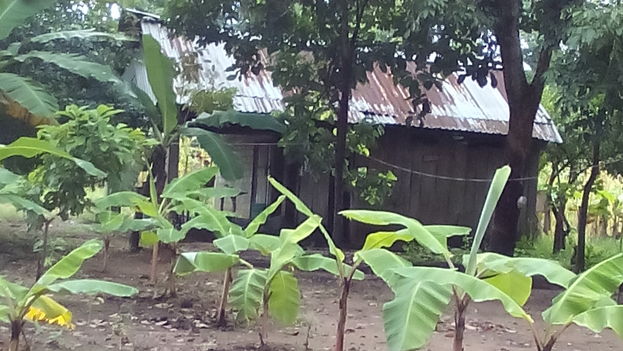
Farm in the jungle of Veracruz where Cuban migrants stay on the way to the US. (MJ Penton)

This is the second part of the testimony of a Cuban who has made the dangerous trip from Guatemala to the United State. Part 1 is here

14ymedio bigger14ymedio, Mario J. Penton Martinez, Guatemala/Mexico Border, 17 November 2015 — The days pass slowly in the vicinity of the border Suchiate River. Guatemala, right now, is mourning the death of hundreds of people buried in the October landslide in the village of El Cambray. In the “waiting house,” as we have baptized it, we eight Cubans continue to wait for the moment when they will take us from here to cross the border and continue heading to the United States.

Cubans are arriving in dribs and drabs and bringing with them the stories of border crossings. Colombia, it seems, is the most important obstacle. From there they came by boat to Panama. A small plane got them into Guatemala and the human trafficking network took over from there. continue reading

Several thousand dollars are paid out on the trail of the main route of the Cuban exodus. People disappear falling in to the sea, are assaulted by thugs, women are raped… A whole accumulation of stories that we know by word of mouth and that some day the historians will have to write down for the historical memory of the Cuban nation.

Night falls at the moment when they suddenly alert us: “You’re leaving in 20 minutes.” Joy, surprise and consternation after 15 days of waiting, last words to family members, preparation for the final departure. “My brother, if you don’t hear anything of me in 15 days, you can tell Mom that something happened to me in Mexico.”

This is a truly dramatic moment for everyone. We will join another group of Central Americans on the road, at least that’s what we’re told. We have to get through 27 fixed checkpoints between Guatemala and Mexico City, plus whatever the Mexican Federal Police improvise.

The van ride to the river lasts half an hour. The coyote’s strident Christian music contrasts with the stillness of the cornfields. Finally, the coyote hands us over to the guide, the person who will take us to Mexico City. A final prayer with our solemn envoy, like the missionaries do it, is the memory our coyote Juan leaves us with.

The guide, Carlos, is a simple person, and I dare say there is something noble shining in his eyes. He lived for a time in the United States as a “wetback,” but returned to Guatemala when life became unbearable without his family. Now he dedicates himself to this “business,” which, according to what he tells us, earns him in one week what it would take three months to earn in his job as a farmhand.

They tell us we will be joined by two Guatemalans, among them a girl who, before leaving, asked the coyote to bring enough condoms because she fears being raped

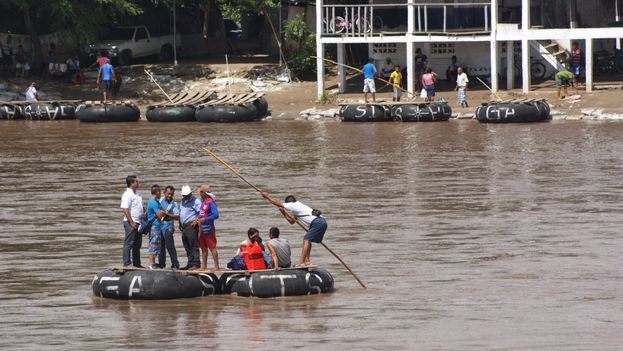
The first challenge is to cross the Suchiate River. It is midnight and it was swelling, to the point of having to wait two hours to be able to do it, and not without risks. A fragile tractor innertube tied to some boards carries us to the other side. Here they tell us we will be joined by two Guatemalans, among them a girl who, before leaving, asked the coyote to bring enough condoms because she fears being raped. We walk for around two hours among cornfields and jungle. The dogs and lights from houses make us run like crazy. We all follow the leader because the orders are clear: we are in an exercise for survival.

We come to a creek that the recent rains have turned into a heavy stream. The water pushes us hard, reaching our chests, while we carry our passports on our heads so they won’t get wet. The two women in the group, one Cuban the other Guatemalan, have to be helped. This night ends around four in the morning, when we come to a house in the middle of nowhere. There we meet the other part of the group, eight Hindus who, without a word of Spanish, have launched themselves on the adventure of crossing half the world to join their families through the porous southern border of the United States.

Before dawn we are led, just as we are, wet and shivering with cold, to an island in the middle of a swamp. The boat trip is, without a doubt, spectacular. The richness of the mangrove, filled with alligators of course, reminds us of the Zapata Swamp in Cuba. The forests, the clouds painted red with the rising sun, the sensation of being close to the sea… On that island we hide all day.

On one side the sea, on the other the swamp. That is where I meet Erick, age nine, who with his deep black eyes and indigenous accent tells us of the dangers of the jungle and his dreams of becoming an architect to build a beautiful house for his mom, the powerful dreams of a child contrasting with the humbleness of dirt floors and sheet metal roofs.

One meal a day gives us strength to continue. At night we leave again, by boat, for the mainland. We are taken in trucks to the Mexican Army checkpoints, surrounded by thickets full of dangers: rivers, poisonous snakes, farmers protecting their properties from thugs… Long hours on the road at night, accompanied by the image of the Virgin of Charity of Cobre, Cuba’s patron saint.

Once more, I confirm how little those of raised under the Revolution are trained to coexist with those who are different but pose no threat

Day surprises us in the heart of the jungle. We will have to wait for the protection of the night to continue on our way. A torrential rain makes us crowd tightly together under the only available blanket. These are difficult hours when care not to be discovered is combined with protecting our documents that prove we are Cubans. Again, one meal a day.

With my deficient English I try to translate what the guide is saying for the disconcerted Hindus. Some Cubans start to show an antipathy towards those of another race but the rest pass the time praying. Mutual ignorance, fueled by the primal instincts of a suspicious islander, thin the atmosphere almost to the point of starting a fight. Playing the role of mediator is hard work. Once more, I confirm how little those of raised under the Revolution are trained to coexist with those who are different but pose no threat. The anthropological damage is done and it will take generations to overcome it.

Again, roads impassable at night, feet covered with blisters, skin bitten by insects. Hungry and tired we cross a railroad line, toward another border checkpoint. It is two in the morning when the guide tells us to be silent, after hearing movement up ahead. The sharp stones of the rail bed don’t help. Apparently attacks are common here. Tonight we’re lucky. The attacker pretends to be asleep next to a huge machete. Accustomed as he is to frightening small groups of Central American “wetbacks” who don’t usually exceed three or four people, our group seems like too much for him to take on alone. For now, we are safe.

The road to the next point of rest is extremely uncomfortable. In a fetal position we are crammed into and hidden in the truck. Only the moments where there is a threat of the police are a break, because we have to get down and rush to hide ourselves in the bush. The night ends and the signs announce we are in Veracruz. We have spent three days in the land of the Aztecs. We arrive at a farm where we spend the day.

Mexico City, the next stage of the journey, is getting closer.

___________________________________________________________

Editor’s note: The author worked as a religious consecrated to the Catholic Church in Guatemala for almost two years before embarking on the journey to the United States.
The Ostrich Syndrome / 14ymedio, Reinaldo Escobar

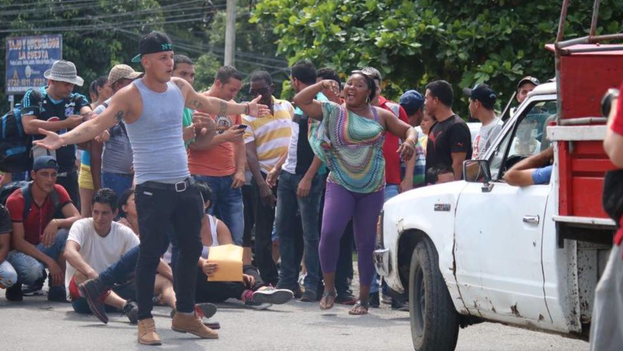
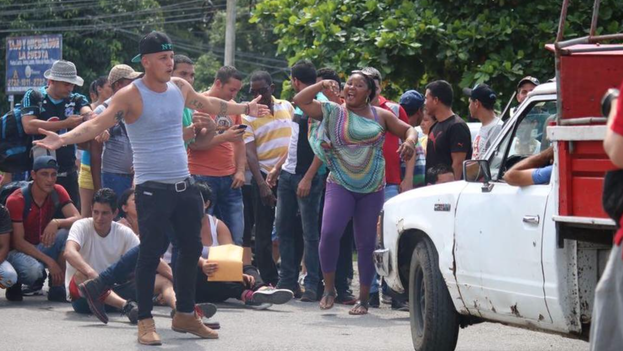
A group of Cuban immigrants block the Interamerican Highway at the border between Costa Rica and Panama in protest at being held. (Alvaro Sanchez / courtesy / El Nuevo Herald)

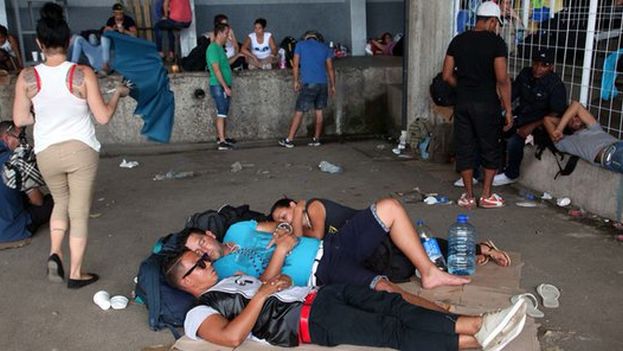
14ymedio bigger14ymedio, Reinaldo Escobar, Havana, 17 November 2015 — Like the ostrich who buries his head in the sand so as not to see what terrifies or disgusts him, the Cuban government and official media have refused to recognize the plight of thousands of compatriots stranded at the borders of Central America. Single men and women, families with children, workers, peasants, students, Cubans all, are attacked by immigration authorities, exploited by human traffickers, and punished by a nature they don’t know, in their desire to emigrate to the North.

Not a single statement from the Ministry of Foreign Affairs, no comments in the Communist Party’s provincial meetings, not one clarification from a delegate in the Accountability Assemblies of People’s Power. Not even on radio, television or the nationally circulating digital media has there been any mention of the issue. continue reading

However, in the street everyone is talking about it because they hear about it on foreign radio broadcasts, despite the interference, they see it through prohibited and persecuted satellite dishes, or they hear of it by using anonymous proxies to access the internet sites so delightedly blocked by the soldiers of information. In the most dramatic cases, they learn about it first hand, because they have a relative or friend suffering through it.

Cuba is bleeding into an uncontrollable migratory hemorrhage, but listening to officials and official journalists gives the impression that this is the country’s least important problem.

Cuba is bleeding into an uncontrollable migratory hemorrhage, but listening to officials and official journalists gives the impression that this is the country’s least important problem. The speeches follow a script drafted from above and focus on demanding more discipline and a high level of command and control. Inspectors go to stores and count the inventory to the last nail, checking for missing or diverted resources, but fail to note the thousands of employees who leave the island each year, be they warehouse workers or inspectors.

The nation’s expanding desire to leave appears to be of no importance nor cause any pain according to the government’s rhetoric. It is as if there is no interest in the fate of those who launch themselves on the sea or put themselves in the hands of coyotes, leaving everything behind: their professions, property, part of their family, promises of love, debts…

We are becoming a plague issuing from a country that boasts of its healthcare services. We are rejected, disdained, in airports and at border crossings despite our reputation as a sympathetic and friendly people that took us centuries to craft. This new scum* that has leapt from the oven, from the “crucible of the Revolution,” does not want to melt in the mold where they try to tame its nature. In Cuba there is no war, as in Syria, no famine like that of some African countries, only the fear that with improved relations with the United States the privileges awarded by the so-called Cuban Adjustment Act will be eliminated.

In the same way that parents do not divorce their children, States should not lose interest in what happens to their citizens, before whom they have duties, some of which are not even promulgated in laws or articulated in the Constitution. Worse still is the silence of the media, gagged by the same old culture of secrecy. The ostrich buries its head in the sand from cowardice, but its wings are too short to cover the eyes and ears of others.

*Translator’s note: During the Mariel Boatlift Fidel Castro said “let the scum (escoria) go.”

Costa Rica Accuses Managua of Forcibly Expelling 1,600 Cuban Migrants / EFE, 14ymedio

Cuban migrants rest at the Costa Rican border after being returned by the Nicaraguan Army

14ymedio biggerEFE/14ymedio, Managua, 16 November 2015 — Tension is growing between Costa Rica and Nicaragua because of a group of 1,600 Cubans trying to cross the border with safe conduct passes issued by the Costa Rican authorities, who are being blocked by the Nicaraguan army.

On Sunday, Costa Rica’s Foreign Minister Manuel Gonzalez rejected Nicaragua’s accusations with regards to the granting of temporary visas to Cubans and strongly criticized the use of force to prevent them from crossing the border.

“I absolutely refute each one of the words included in the statement of the Nicaraguan authorities,” Gonzalez said at a news conference, referring to the Nicaraguan Government’s official bulletin in which in branded Costa Rica as irresponsible and provoking a humanitarian crisis. continue reading

“Sending the country’s Army against a migrant population in the situation in which men, women and children find themselves. That’s the way this country (Nicaragua) addresses this issue”

“Sending the country’s Army against a migrant population in the situation in which men, women and children find themselves. That’s the way this country (Nicaragua) addresses this issue,” the foreign minister deplored.

The diplomat denied that Costa Rica has “launched” the Cuban immigrants on Nicaragua saying that Nicaragua closed the border last Friday, which prompted the Cubans to try to cross illegally.

According to Gonzalez, the Nicaraguan Army repelled the immigrants with gas and violence, and he lamented that that country does not see the situation as a humanitarian issue.

“What Costa Rica has done is to regularize the situation of immigrants through a seven day transit visa. But when other countries take the irresponsible decision to close their borders, these people will search for any mechanism to reach their destination” said the minister.

The foreign minister said his country respected international treaties and the human rights of immigrants, and that this can be confirmed by the United Nations High Commissioner for Refugees (UNHCR) and the International Organization for Migration (IOM) with whom they worked on this situation.

At the same time, the Nicaraguan Army announced the reinforcement, by an infantry battalion, of the southern border. The military institution said in a statement Sunday that the Costa Rican authorities “launched” Cuban citizens on the legal crossing of Peñas Blancas, “who pushed for the forced and illegal entry into the country, violating our laws.”

As a result, the Army said that the Caribbeans are being held and captured by its border detachments to return them to Costa Rica.

The Nicaraguan Army reinforced control of the southern border and accuses Costa Rica of “launching” at it Cuban citizens, “who pushed for the forced and illegal entry into our country, violating our laws”

“In compliance with the mandate of the Constitution and laws of Nicaragua to ensure the defense of our borders, the inviolability of the national territory and to enforce our laws, the Army of Nicaragua will not allow the entry of illegal persons into the country, to which end it has reinforced the southern border with an infantry battalion,” he added.

In recent weeks a wave of some 1,600 Cuban immigrants gathered on the border between Costa Rica and Panama, which the Costa Rican government decided to resolve by giving them seven day transit visas through that country.

The Cubans initially arrived in Ecuador by air, then passed illegally by sea and land through Colombia and Panama to reach Costa Rica. Their intention is to cross all of Central America.

Foreign Minister Gonzalez called on all countries involved in the transit of Cuban immigrants to create a “humanitarian corridor” to give them protection and to ensure respect for their human rights so that they would not fall into the human trafficking networks.

“Far from missing our responsibility, knowing that Costa Rica is not the point of origin of this situation nor its point of destination, we advocate the creation of a humanitarian corridor. This is a structural problem that must be tackled internationally for all countries involved,” he said.

Nauta Breakdown Leaves All of Cuba Without Email / 14ymedio

Throughout the weekend, the Nauta email has not been accessible to Cuban users. (14ymedio)

14ymedio bigger14ymedio, Havana, 16 November 2015 – Almost 72 hours after its Nauta email service was interrupted, cellphone customers have not received an explanation from the Cuba’s State-owned Telecommunications Company (ETECSA). Calls to the #118 complaint line are told “it is a technical problem affecting the whole country” and the engineers are working on it.

On Friday afternoon, national email users started having problems sending and receiving messages. During the weekend it has not been possible access to mailboxes and they have ceased to be visible in browsers on the main page at webmail.nauta.cu. 14ymedio has also been hurt by the incident, which affected content updates over the weekend. So car, the only telephone company in the country has not issued a notice regarding the breakdown.

Last June users were warned several days in advance about technical problems on the platform that supports the email providers enet.cu and nauta.cu. On that occasion, ETECSA “apologized for the inconvenience such incidents might cause,” which contrasts with the lack of information prior to the current repair/

In Cuba there are more than three million mobile customers, most of them on a prepayment plan, Minister of Communications (MIC) Maimir Mesa Ramos said last July, when he also acknowledged the high level of technological obsolescence in the country and the limited capacity of mobile phone base stations.

Prostitution in Cuba: Solutions to Today’s Reality (Part 2) / Somos+

Somos+, Jose Manuel Presol, 4 November 2015 — The Cuba of tomorrow will have to face this situation, which cannot be resolved, certainly, in a 24-hour effort. The deterioration caused by half a century of ineptitude and corruption cannot be solved in one day.

What we must make clear is what we are going to do.

Who? This writer, whom you are reading, he who is democratically elected by the People, the teachers, the members of the new National Police, the hospitality professionals, the current pimps and prostituted persons. continue reading

What? What we will not do is persecute the victims, and try, like in the terrible years of the sixties, to achieve their “social reinsertions” (by the way, which years haven’t been terrible in the last decades?). What we are going to do is persecute the causes.

We are going to put in the hands of all the victims something they do not have now: hope, faith in their future, a vision of what else they could do; and for this what we have to do is make work what does not work; to provide schools and centers of learning through the State (including, of course, decent salaries for educators) that are adequate to carry out their work; facilitate the resources so that the different policing organs can pursue real crime; make it possible for employees of hotels and the rest to do their jobs; make the stays of tourists who come to enjoy our country satisfactory, but without staining our people; making it possible for even the pumps to have alternatives ways of earning a living and, above all, making them and their prostitutes compatriots have a future.

And as we work to put all this in their power, by placing a person, an individual in the center of all the decisions. Remembering that the much talked about national sovereignty is not only an abstract concept, but it is formed by the freely expressed decision of every single citizen.

All this is, of course, related to a free and prosperous economy, for which there must be laws passed and methods facilitated for the entrepreneurial development of Cubans within Cuba, so that Cubans abroad will return and to support foreign investment. Without an economy that is far from being asleep, like the current one, flexible, dynamic, that satisfies the needs and generates work and wealth, all talk will be only words.

Resources, at first, will be scarce, or it’s quite probably almost nil, but what there is must be applied to generate jobs, improve expectations, motivate our young people, to say to everyone, in short, that there will be a new and better future, and it will be because they, yes, them, and not “papa state” will be the shapers of what they desire.

It will take work, but the day will come when a new generation of Cubans, without needed to abandon their island, will be able to look out from their homes at their children heading off to a school where they will begin to build their own future.

Liberte, Egalite, Fraternite! / Somos+

SOMOS+ Communications Team, 14 November 2015 — When we are preparing to work, with great joy, on the celebration of our First International Convention, scheduled for 14 November, we encounter news that touches us in our conviction as democrats.

In Paris, capital of France, birthplace of the phrase “Liberty, Equality and Fraternity,” that touches all people of good will, there have been terrorist acts, with a still undetermined number of victims, but we already know it is in the dozens and possibly hundreds.

In the face of this we can only say that we firmly reject any kind of violent act that involves pain for even one human being. Violence is always reprehensible and can only engender more violence.

In these circumstances, we say to the French people and their government that our hearts, today, beat at the same rhythm as yours and are tears are joined with yours.

Je Suis Cuba / Rosa Maria Paya Acevedo

Image of solidarity with the victims of the attacks in Paris.

Diario de Cuba, Rosa Maria Paya Acevedo, 15 November 2015 — Two years ago in Paris, at exactly this time, I had the satisfaction of meeting in person a renowned Cuban writer who lives there. I was there only a few days and travelled little around the city. They were days of work, meetings and interviews before flying to Strasbourg, to attend the Sakharov Prize ceremony for the child activist Malala Yousafzai, who had suffered an assassination attempt at the hands of the Pakistani Taliban in an attack that shocked the world.

I remember that at the foot of the most famous tour in the world all the languages I could hear echoing. I imagine that this is the sound of freedom of movement. Something thousands of Cubans have not had, Cubans who escape the island on rafts, ready to die and in many cases dying in the sea. The same freedom of movement that made possible the terror in the City of Light this Friday, when eight boys started shooting dozens of other boys. continue reading

I know what this is, I have lived it. The families of the more than 120 fatally wounded victims will never recover. This November it will not be easy for the French people to overcome this. Like the Christian refugees, who have been lucky enough to escape the ethnic cleansing occurring in the Middle East with less media coverage, will not return to their countries.

And again it is repeated: attacks on human dignity are no longer circumscribed by geographical boundaries, call it jihadism or the Castros’ totalitarianism. Terror has shown the power to cross the Mediterranean, like authoritarianism is reproducing in Latin America.

I fear that the crime that took the life of the young activist Harold Cepero on a Cuban highway should warn us of the deaths of teenagers on the streets of Caracas two years later.

Solidarity is no longer a question of altruism but of survival. We do not ask for whom the bell tolls. As in Paris and so in Havana, it tolls for all of us.

What Can the Opposition Offer to Cubans? / Juan Juan Almeida

Cuba’s National Assembly of People’s Power, voting unanimously, as it virtually always does.

Juan Juan Almeida, 9 November 2015 — Cuba is a country where polemics or its relative, debate, is the daily bread of artists, private entrepreneurs and intellectuals; an island where the majority of the young population are assured of being poor or having no possibility of fulfilling their dreams; a nation where the average professional suffers from a ridiculous salary; and a State where discontent between the politicians and the military is worrisome. Still, the opposition, which works for freedom and the right to establish a democratic government, has been incapable of building a plausible alternative.

Where exactly does our opposition find itself in relation to the other components of the Regime? continue reading

The truth sometimes hurts; but hiding it can bring sorrow. I understand that being marginalized and repressed for so long without pity makes it difficult for many in the opposition to accept that this isn’t the moment to exclude those who have been excluded, but to reconcile and try to cooperate with all the social groups.

I don’t doubt the eagerness or the day-to-day need for mass actions, but being the fact of seeing “securities” (State Security agents) everywhere and having to constantly be ready to defend yourself from being infiltrated by State Security makes them easily fall prey to doubt, internal disputes, the political sin of disconnecting from the people, and the clear lack of the power to put out calls for action.

In the present circumstances, being a dissident and not fighting to be in the National Assembly of People Power, they allege that they “don’t want to play the Government’s game.” I acknowledge that many may like this expression; it arouses curiosity and fascination. But today, it’s a weak statement.

We know that antagonism, in times when anything other than what is voted on is considered violence, is more difficult than war and demands new strategies.

Obviously, social pressure on the Government will increase in parallel to economic growth for Cubans. So instead of predicting both the collapse or the overthrow of the present authoritarian regime, it’s preferable to think about a gradual process of erosion, and to have an accurate and objective analysis of the growing deterioration of relationships inside the governing clan.

Let’s be realistic. What can the internal Cuban opposition offer to those inside Cuba, besides political debate, the need to improve working conditions, schools, housing, health, etc.?

Only confidence. And for that it’s essential to fight to occupy spaces in society and in the parliament, in order to, from the inside, be able to dispute the legitimacy of the governing group.

In addition, among other things, to try, to come and approach the leaders of stone; participate in the debates organized by young, fashionable teachers (in principle, free from suspicion) in places like “El Hueco del Instituto de Periodismo,* about which a well-known professor at the Higher Art Institute says:

“They are important meetings because you hear the judgment of the son who counsels the father, the suggestions of the young who claim to know more than the old, and the incredible proposals of one sparkling part of the people who, by being irreverent, allow themselves to condemn even the ruler himself.

* “El Hueco” (the hole) is a space at the Havana International Institute of Journalism. It’s surrounded by trees on a patio at the back of the school. Every 15 days a group of young trova musicians get together with Ireno Garcia, a Cuban singer, to promote trova music.

Translated by Regina Anavy

Minimum Restaurant Charge to Use the Internet / 14ymedio, Sol Garcia Basulto

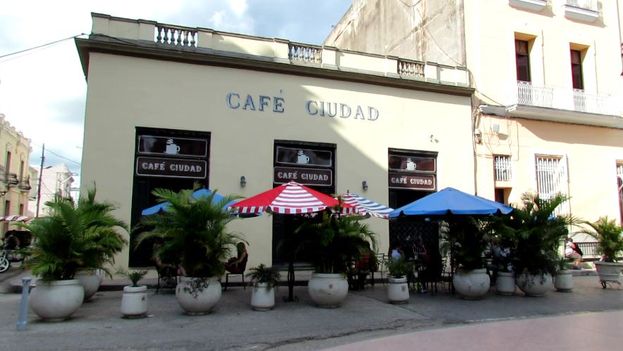
Facade of the Café Ciudad in Camaguey. (14ymedio)

14ymedio bigger14ymedio, Sol Garcia Basulto, Camaguey, 14 November 2015 — The number of wireless zones in the country continues to increase, as reported this week by the Cuban Telecommunications Company (ETECSA), but little is said about improving conditions for websurfers. In the city of Camagüey, the web browsing service is characterized by instability and inconvenience for users, to which is added the profit of some State establishments.

Café Ciudad modified its rules about food purchases on finding itself in the area covered by the antennas installed in Agramonte Park. Now, the restaurant requires a minimum food purchase of 5 Cuban convertible pesos (equivalent to a quarter of the average monthly salary) in order to connect to the Internet from inside. The “offering” does not include the right to connect devices to the electrical outlets, a detail that, along with the high prices, has annoyed patrons. continue reading

To learn the reasons that led to the adoption of these measures, 14ymedio approached Elizabeth Napoles, brigade chief of Café Ciudad. “We had to apply this measure because it was already too much, the whole world came and sat here,” explained the functionary, who noted that “they ask for a coffee and they stay for hours, but this is a place to eat, we have to generate income.”

Those who do not have the required sum to remain in the place choose to sit on the stairs, in doorways and nearby sidewalks. “It’s awkward and uncomfortable trying to write a message or have a videoconference with the noise of cars and people passing by,” comments Gustavo, 33, an engineer who frequently uses the services of the WiFi zone in Camaguey.

However, Café Ciudad does not seem willing to modify its pricing policy. Naples justifies the decision because the place has been a victim of certain incidents of “social indiscipline” since the opening of the WiFi network. She says “the situation came to be very difficult; we have to call on the police to get people to leave the tables.”

The brigade chief declared that “this doesn’t mean you have to pay five convertible pesos to remain at the table, but this is a bonus if you eat that much.” With this much money a customer can “drink five Cristal beers, or four Bucaneros and a soft drink, for example,” she points out.

For Naples it is intolerable what happened before the implementation of the new tariff, when “businessmen sat and spent the day connecting one device to another, and they left with more than 50 CUC in their pockets and just bought a soft drink,” she explained, referring to connection resellers who sell shared access to a single account on the Nauta Internet service (by creating a hotspot on their own device).

The usual Café Ciudad customers have screamed to high heaven about the measure. “Now, if you’re having a coffee and you need to connect for a moment, you have leave and this means you lose your table,” Wilfredo Aróstegui Quesada told this newspaper. “Not everyone has enough money to subscribe to this option, the price of two convertible pesos* for an hour of connection is already high.”

The place used to be the meeting place for Camaguey celebrities and the local artists. Rafael Hernández believes that the implementation of this minimum service is unfair: “It seems to be that ETECSA should enable spaces like this to offer its service free,” says the independent artist.

Café Ciudad employees wash their hands of it and say the command “came down directly from the provincial capital’s Tourism Company.” According to Elizabeth Naples, this policy has not solved the problem because “we always face some customers who pretend to be playing on their cellphone” while “staying connected, enjoying the comfort of our establishment,” adds the official.

*Translator’s note: That is, the 5 CUC a customer must spend on food and drink does not include a free wifi connection.

The Frustrated Trip of the Deported / 14ymedio, Orlando Palma

A group of Cubans protest in Paso Canoas, on the border of Costa Rica and Panama. (Alvaro Sanchez / courtesy / El Nuevo Herald)

14ymedio bigger14ymedio, Orlando Palma, Havana, 14 November 2015 — They were seated in the back row when the passengers entered the plane. Cubana Airlines Flight 131 took off Thursday from Mexico City with four deportees on board. The Cuban bureaucracy calls them “returned by air” and they represent only a portion of those who are repatriated en route to the United States.

In recent months the number of Cubans leaving for the north has grown, as also has the number of those who are intercepted and returned to the island. Most are not dissuaded after a forced return and try again. Their worst nightmare is not immigration officials, but an end to the Cuban Adjustment Act. continue reading

From October 1, 2014 to this September 30, 43,159 Cubans reached the United States. The main entry points were the border areas of El Paso and Laredo (Texas), Tucson (Arizona) and San Diego (California).

“This was my third attempt, the first was on a raft and in the second they sent be back from Panama,” says Clara, 48, who was returned from Mexico this October. She considers her return to the island a real catastrophe. “I had sold everything to leave and when I got here I was repatriated without a penny in my pocket and no house to live in,” she explains.

“I had sold everything to leave and when I got here I was repatriated without a penny in my pocket and no house to live in”

Clara now sleeps on the couch of a relative in San José de las Lajas, Mayabeque. “I only have what I had in my hand luggage,” she adds. Her trip was frustrated at the Benito Juarez International Airport, where she was considered a potential migrant to the United States. She came from Havana, where she managed to get a visa to the Aztec soil, but her family in Miami, was left with the table set and their dreams frustrated.

“They took me to a room that was full of Cubans who were also to be returned” says Clara, recalling that fateful day. “We had to wait there for Cuban planes to have room to return us,” she details. The woman had a hotel reservation for seven days in Mexico City. “I already knew that if they asked me I would have to say I was not planning to visit any border area.” The truth is that the next day she was planning to leave for Nuevo Laredo and from there enter the United States.

Advice passes from mouth to mouth. “Don’t be nervous, don’t talk too much, just give short answers,” her daughter had warned her; having made the same journey she is now living in Miami’s Little Havana. But Clara was a bundle of nerves when they inquired about the reason for her trip. “I started to stutter and that was suspicious.” Afterwards they asked her how much money she had brought with her.

Clara was a bundle of nerves when they inquired about the reason for her trip. “I started to stutter and that was suspicious.”

“I had $200 and they told me that was a proof that I wasn’t going to spend a week in Mexico City, because it was very little.” She wasn’t able to make a phone call to warn her relatives of the situation in which she found herself and spent the rest of the night in a room with dozens of compatriots. “Everyone was in the same situation: they wouldn’t let us enter but we didn’t want to return.”

Some Cuban exiles carry out the first protest of their lives on foreign territory. Riots, hunger strikes and clashes with authorities have become common practice when they have been left stranded at airports, border crossings and immigration detention centers. This Friday, a group of them blocked the Panamerican Highway on the border between Costa Rica and Panama to demand that they be allowed to continue along the road. If they are returned to the island, they won’t be the same people who left.

“I returned a big mouth, I won’t shut up for anything,” relates Clara, who says she has “acquired a taste for freedom” in her three attempts to leave. For the Cuban authorities the best outcome is that people like her leave again, “because we no longer fit in here and they know it,” she says while pointing upwards with her index finger. “What I want is to leave, so I’m not going to fix something that has no solution.”

“What I want is to leave, so I’m not going to fix something that has no solution.”

On the flight back to Cuba, Clara agreed to give ten dollars to another passenger to borrow her cellphone just as they landed. An employee of the State airline, in his double role as a flight attendant and guard of the deportees, said they couldn’t get off until all the other passengers had gotten off. “We had to wait for two “uniforms” to come and get us and they gave them our passports,” she said.

Then they took her to an office at José Martí Airport, where they took down all their data and gave them warnings. The chairs in the room remained filled with the deportees who were arriving on other flights. “It didn’t stop, every time there were more, coming from Panama, Ecuador, Colombia and Mexico.”

When she left there, she managed to make the call. “They sent me back,” she told her daughter. On the other end of the phone line she heard the long moan. The failed trip had cost the family $3,000, months of planning and the stress of every minute when they didn’t know where she was.

This mother of a family shudders to remember that day when an immigration officer stepped between her and her dreams. But she isn’t giving up: “Nothing matters here, nothing attracts me, I just think about leaving again.”

Costa Rica Agrees To Give Safe Conduct To Cubans Detained On The Border With Panama / 14ymedio

A group of Cuban immigrants blocked the Interamerican Highway at the border between Costa Rica and Panama in protest at being held. (Alvaro Sanchez / courtesy / El Nuevo Herald)

14ymedio bigger14ymedio, Havana, 14 November 2015 — Costa Rica agreed to grant humanitarian visas to more than a thousand Cubans who have been held at the border with Panama for some days, according to a report this Saturday in El Nuevo Herald. The announcement was made ​​Friday night by the Costa Rican government, which clarifies that the measure is only for Cubans already in their territory and that it is adamant about its decision to close its border to citizens of Cuba who try to enter without a transit visa to the United States.

The crisis in the Paso Canoas border crossing on the border with Panama was complicated by the arrival of more Cubans, now numbering about 1,400, whom Costa Rica wishes to deport to the neighboring country and who, on Friday afternoon continued blocking the main highway. continue reading

The measure seeks to cut off the business of organized crime human trafficking, said the Director of Immigration of Costa Rica, Kattia Rodríguez.

Before Wednesday, Costa Rica allowed entry to Cubans to process them as refugees. But Cubans never followed the procedures and always continued to travel to Nicaragua, the rest of Central America and Mexico, on their way from Ecuador to the United States.

Rodriguez told El Nuevo Herald that the crisis arose after Costa Rica disrupted a network last Tuesday dedicated to the illicit trafficking of Cubans. For each Cuban crossing from Ecuador to the United States, the mafias charge $7,500 to $15,000, she remarked, detailing that the flow between January and September of 2015 was 12,166 Cubans, compared to 5,144 in 2014, and 2,549 in 2013.

Costa Rica Closes Its Borders To Cubans / 14ymedio

Cubanos-Costa-Rica-Panama-YoutubeCB24_CYMIMA20151113_0013_13 (1)
Cuban migrants detained at the border of Costa Rica and Panama. (Youtube / CB24)

14ymedio bigger14ymedio, Havana, 13 November 2015 — Costa Rica on Wednesday closed its borders to Cubans who have no visa and announced that those who try to enter by land will be returned to Panama.

In an interview published Thursday in El Nuevo Herald, the Costa Rican Director of Migration, Kattia Rodríguez, said: “Costa Rica is cutting the chain at this time,” and confirmed that the order is to deport Cubans to Panama, which in turn refuses to receive them. More than a thousand Cubans at Paso Canoas, on the southern Costa Rican border, are in immigration limbo. “We are attributing to Panama this flow coming into Costa Rica from Panamanian soil, and it is mobilized by mafias of organized crime,” she said. continue reading

The Central American country is taking this step after seeing an exponential increase in the number of Cuban citizens who are transiting the country in order to continue their overland journey to the United States.
A report released Thursday by The Tico Times says that up to September, 12,166 Cubans had been arrested by the authorities of Costa Rica since early this year, which represents a 24,332% increase over the approximately 50 immigrants detained in 2011, according to figures from Immigration. In 2013, 2,549 Cubans entered Costa Rica without a visa, and in 2014 the number was 5,114.

Speaking to the TeleTica cameras, some Cubans trapped at the border criticized the measure, stressing that they are not interested “in the country, nor in its immigration laws.”

“We are in transit and we just want to get to the United States,” said one.

“We don’t want to stay here,” stressed another.

The network noted that the inhabitants along the southern Costa Rican border have complained about the measure, which has started to affect the flow of trade.

Cubans passing through the Central American countries usually come from Ecuador. Along the way, in some countries, such as Costa Rica, they were allowed to enter as refugees to travel to the capital to continue the process of regularization, which obviously they never continued because their objective was to reach the northern border. Honduras granted them humanitarian treatment to allow passage and Mexico gives them a safe conduct with a term of 20 days to leave the country.

#Cuba SOS: Angel Santiesteban Arrested Again (Updated)

Angel Santiesteban-Prats. Military Prison, Jaimanitas.

Just reported from Havana, that this afternoon Angel has called a relative and has said he was arrested for not having signed the Probation (order) last week and because there is a new accusation upon him.

As we do not have the details, we will wait until he can tell us himself, about his situation to not make room for speculations.

Angel’s Editor

Translated by: Rafael
4 November 2015

More Than 12,000 Cubans Have Traveled Through Costa Rica In 2015 To Go To The US / 14ymedio

Mexico is one of the countries that Cubans who want to travel on foot to the United States have to cross. (Marti TV / screenshot)

14ymedio bigger14ymedio, Havana, 12 November 2015 — Costa Rica has seen an exponential increase in the number of Cubans who enter the country illegally, intending to cross on foot to the United States, usually from Ecuador. A report released Thursday by The Tico Times says that as of September, 12,166 Cubans had been arrested by the authorities of Costa Rica since the beginning of the year, representing a 24,332% increase over the approximately 50 immigrants detained in 2011, according to figures from Immigration.

The Director of Immigration, Kathya Rodriguez, told the Costa Rican newspaper that one of the possible reasons behind this increase in numbers is the fear that the thaw in relations between Cuba and the United States will put an end to the Cuban Adjustment Act. continue reading

The report notes that on Tuesday the authorities of Costa Rica arrested 12 people who formed a band dedicated to smuggling aliens into the United States, mainly Cubans, Asians and Africans.

The immigrants arrived by land to Costa Rica coming from Panama, then evade immigration controls in various South American countries.

Once in Costa Rica, the criminal gang hides the immigrants in hotels in Paso Canoas (on the border with Panama) and in San Jose, and later moves them to La Cruz, Guanacaste Province (border with Nicaragua) where the group’s base of operations is located.

Moreover, the authorities of Costa Rica began Thursday to deport to Nicaragua to more than a hundred Cubans without legal status, while on the border with Panama there are about a thousand waiting to enter, government sources informed the news agency Acan-Efe.

The Caribbeans being deported entered Costa Rica illegally in recent weeks and were detained in a center of the Directorate of Immigration in San Jose.

Rodriguez told reporters that “the Nicaraguan government accepted those Cubans who have their papers in order.”

Apart from those, there are now almost a thousand Cubans in Paso Canoas on the border with Panama, although authorities have said it is difficult to determine the exact number.

These migrants, who have been coming to Paso Canoas gradually in recent weeks, are trying to enter Costa Rica to continue their journey to the US, but the Director of Immigration stressed that those who entered illegally “cannot remain in Costa Rica and will be returned to Panama.”

Chronicle of a ‘Rafter’ on Foot (Part 1 of 3) / 14ymedio, Mario Penton Martinez

A group of people crossing from Guatemala to the Mexican side aboard a raft. (Manu URESTE)

Today we publish the first part of the testimony of a Cuban who has made the dangerous trip from Guatemala to the United States

14ymedio bigger14ymedio, Mario J. Penton Martinez, Guatamalan/Mexican Border, 13 November 2015 – I live proud of being Cuban. I always have been. Cuba evokes the warmth of a mother’s lap, the tenderness of my great-nephews, friends, my first love, the pain of a suffering nation. I am one of a generation born on the threshold of the euphemistically called Special Period, so also coming to mind are blackouts, scarcities, building collapses and censorship. How can I forget that I had to come to Guatemala to hear the music of Celia Cruz for the first time, or to learn of the valiant struggle of the opponents of the Cuban regime? How can I forget that rights like freedom of expression, assembly, enterprise and the press were something that I never experienced, things that according to what was said could only be obtained “outside”?

It was pouring down rain in the Guatemalan capital the day they gave me the news. “After serious consideration we believe that your path is not to be a consecrated religious.” The temperature dropped and like every Caribbean in these mountainous lands, I began to feel a glacial cold. A lapidary moment. One by one the floor tiles start to sink to the rhythm of my life: the dreams that I had forged, the people with whom I had related, the university students, everything was being erased by that hurricane, whose vortex would be the duty of returning to Cuba. continue reading

It took a few hours to get over the shock: the decision was made. I would melt into this human river that had been written about in the independent media, and that few or no one in the world knew: the hemorrhage of Cubans who risk Central America and Mexico to get to the United States. Rather than return to slavery, at least I would try to get to a land of freedom. I knew it could cost me my life, but it was worth it to try.

The whole border region lives off human trafficking. My experiences confirmed it.

The first point was to find an appropriate coyote. Not all are reliable, so you have to make sure it is someone who has made successful trips. Through friends who made the journey previously I got Juan’s number. What first drew my attention was his ring tone. It was a popular Christian doxology. “It is so people will feel confident,” I thought. On the other end of the cell a voice assured me that the journey would be a success and that a group of Cubans was already waiting for me to leave. The cost, $2,500 US, in cash in Guatemala, was the price of the American dream, $5,000 if it was from Ecuador and you wanted to be sure to arrive. I had to leave, on my own account and at my own risk, from one of the most violent countries in the world to a border city with 18,700 quetzales in exchange. They were waiting for me there.

The bus that took me to the site was a tower of Babel: Africans, Hindus, Cubans… It seemed very ordinary, as no one was surprised. After a six hour journey, I arrived at my destination. At least a dozen people crowded around the terminal offering, to anyone who looked foreign, help in crossing the border illegally. Another passenger told me that the whole border region lives off human trafficking. My experiences confirmed it.

Behind me, making me shudder: “Are you Juan?” I was facing the emissary of my coyote. Following a positive response, we wended our way through a web of intricate alleys to a poor neighborhood on the outskirts of the city. “Don’t worry, bro, this neighborhood is controlled by us, there’s no problem.” Both the fake Cuban accent and the difficulty of getting to the place sparked the exact opposite of what the guide intended.

That same afternoon, I was installed in one of the many houses used to hide the island migrants. In the full light of day, and unrestrainedly, because the law in Guatemala constitutes these networks tied to violence and nobody knows for sure how many millions of dollars move. Just to give an idea, it is said that globally, human trafficking generates gross revenues of more than 32 billion dollars annually, some $13,000 on average that each subject brings his coyote.

It was there that I met in person, I learned later, one of the most recognized coyotes in the traffic between Central America and Mexico. His humble demeanor hardly reflected the power he possessed. Emerging from the underworld of rural Guatemala, this person had trafficked drugs and belonged to the maras (armed groups or gangs who generally control the extortion, human trafficking and drugs in the region). Alcohol and drug use, along with little schooling, marked his life. In time, and according to what he himself told me that afternoon, he converted to evangelical Christianity, and today is its staunch promoter.

It is said that human trafficking globally generates more than 32 billion dollars annually, some $13,000 on average that each subject brings his ‘coyote’

Juan alternates conversation with preaching, and while he charged me $2,500, he affirmed to me that today Christ is the center of his life and the one who has given him everything he possesses. “God and Cubans,” he corrects himself. Under his protection are charitable sites and he shares his life between both passions: “The Church and crowning people so that they get to their destination: the flagpole with the stars and stripes.” Before leaving he let me know that I should leave there everything I owned. I will only be allowed to depart with a change of clothes and my papers. The rest will go into the coffers of his charities. “It doesn’t matter, at the end of the day when they will crown you in la yuma,” he blurts out as consolation.

Once the coyote left, I was alone in an unknown house, in the midst of an unknown city and in the hands of unknown people without very good references. I’m facing a mountain of clothes, shoes and the belongings of those who came before me. Judging by the number of garments there were dozens. On the walls graffiti recorded the names and hometowns of Cubans. Manuel from Matanzas, May 2013; Yoenia González from Camagüey, December 2013; Yendry from Bayamo, June 2015… What had become of them? Did they make it to the United States or are they in a mass grave? Images of Auschwitz crossed my mind, while on the roof rats frolicked. The die is cast. I waited three days in solitary confinement, three days “with the Creed in my mouth” as my grandfather used to say: facing death and praying to God to save me.

Thus began the long road of a “rafter” on foot. Swamps, jungles, rivers, robbers, internal divisions and police would take turns adding to the difficulties of a crossing already difficult, to reach free soil.

___________________________________________________________

Editor’s note: The author worked as a religious consecrated to the Catholic Church in Guatemala for almost two years before embarking on the journey to the United States.