Brief Inventory of Personal Fears / Regina Coyula

As with almost everyone, as a girl darkness was a problem. I loved playing hide and seek, crouching in the bushes, but when evening came, the shadows became something dangerous, boogeymen coming to take me away, and I would run to the safety of adults and the light.

Another of my major fears at that time was that I would get sick on vacation, With chronic throat problems, tonsillitis threatened to rob me of the beach; and I had reasons to fear the colds all around me or a certain burning when I swallowed, or too strong a fan overnight.

Those fears gave way to others, trivial or important, but no less for this: the fear of failing an exam, losing a boyfriend, getting fat, of not sounding too combative in an era of ideological definitions given my petty bourgeois ballast.

Ultimately, the beach lost its charms for me years ago, because of the sun that pursues us everywhere on this little Caribbean island; I now had boyfriends and all it would take was for me to look at something to get fat. Coming from the bourgeoisie haunted me like a ghost in my youth, I couldn’t compete with those who maintained the discourse of the barricade, but they lived in the old houses and according to the manner of the overthrown bourgeoisie.

I continued to be a scaredy-cat, just my fears changes. I had a panic attack they day they did a caesarean to get my son out. I remember dressing in white and walking with a gladiolus in my hand to honor Orlando Zapata Tamayo on the anniversary of this death, and when a car stopped to ask directions I almost had a heart attack. Last December 10 (Human Rights Day) was another good occasion to be afraid.

Very recently, happy on returning from a seminar on citizen journalism and social networks in Lima, Peru, I was taken to the “little room” by customs officials. My luggage wasn’t overweight, there was nothing illegal, but they did a detailed search of my luggage, and retained for “customs inspection” SCAN0000, a laptop with charger and mouse, a camcorder with two tripods and four memory cards, two external drives, all new in their original box, in addition to my camera, my tablet, a USB drive and my phone, the latter not even having a charger; articles that on leaving Cuba didn’t need to be declared for personal use.

The other suspicious articles were four books written by my husband, which also left with me, a book about social networks I was given, and the folder with the conference agenda and my handwritten notes.

I spoke to you of far. All these valuable articles often upsetting the balance of saving money, how not to feel a punch in the gut to see them disappear into a sack, no matter how much you’ve got all the right paperwork. At that time it came to mind the cases of theft in customs. But that wasn’t the greatest fear.

With my hands crossed over my knees so as not to show my nervousness, I saw how a piece of my privacy was handled with impunity. The little I said was to make clear the arbitrariness of which I was the object. I didn’t waste energy, because those officials face other officials; the political police who ordered the measure.

Then a strange fear is provoked, because I gave no thought to abandoning my openly critical stance towards the government. The fear that set my adrenaline flowing, confirmed for me the nefariousness of a regime which, far from serving its citizens, is allowed to ride roughshod over them, over their sovereignty.

It’s time to recover this sovereignty.

4 June 2014

Its Rightful Place / Fernando Damaso

The history of Cuba is in need of an objective study, oblivious to the spurious political and ideological interests that have prevailed so far, defended by a group of pseudo-historians, concerned only with achieving prominence and publishing their books.

In the study of history, one of the most manipulated periods has been that of the Republic, which lasted from 1902 to 1958, for fifty-six years. Completely dismissed and treated contemptuously as a pseudo, neocolonial or mediated republic, all that has been written and published about it, at least around here, has been atrocities, without considering that there were mistakes and successes, and bad and good things, as in all social organism .

Unlike in civilized countries, where the Republican stages are divided into first, second, third and fourth Republics, and an analysis of each is undertaken, here they decided to to totally repudiated it and erased it, which is not only absurd and criminal, it is impossible.

We Cubans today are the result of all eras that have been experienced on our island, some better than others, but with no exclusions whatsoever. Moreover, the so-called revolutionary process was conceived during the Republic, and its historic protagonists and many others were born, studied, lived and prepared during it. If this wasn’t the case, their existence would be impossible. During the Republic important writers, architects, engineers, physicians, educators, researchers, biologists, botanists, musicians, singers, dancers, economists, historians and others also appeared, who have given pride and prestige to the nation.

I am confident that, with the intervening years, the many mistakes and failures and the blows received, the minds of most have evolved, leaving behind prejudice, nonsense and sterile radicalism, beginning to react with reason and intelligence. In this process, no doubt, the Republic will occupy its rightful place.

1 June 2014

Raul’s Reforms as Strategy for Survival / 14ymedio, Miriam Celaya

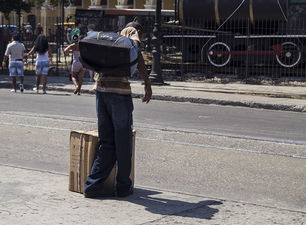
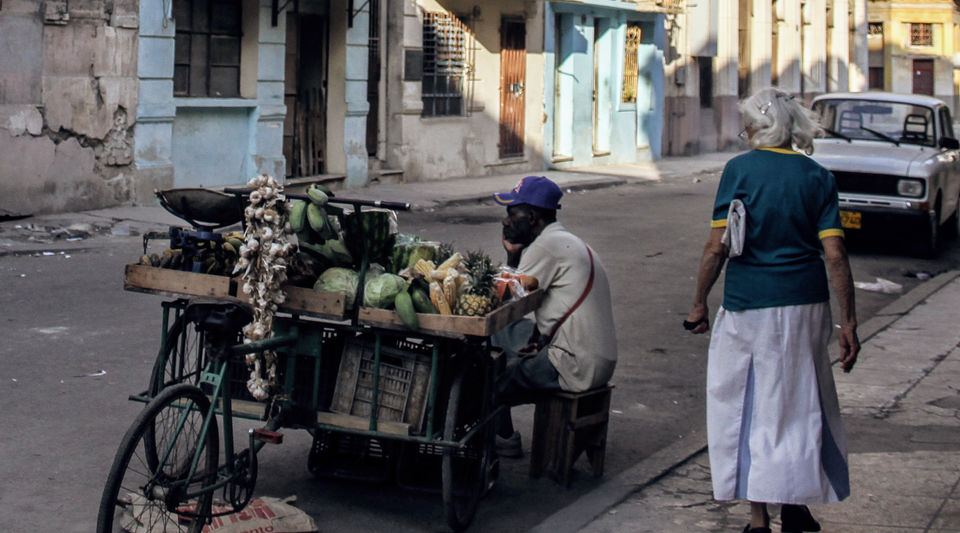
 Cart vendor in Havana (14ymedio)
Cart vendor in Havana (14ymedio)

Six years since General-President Raúl Castro assumed power in Cuba; it could be argued that almost as many legal changes have been implemented as were introduced during the early days of the revolution and, without a doubt, a lot more than in the four decades preceding “Raulismo”

Viewed in perspective, Raúl’s reforms are significant and are -at least in appearance- a break from Fidel’s directive, marked by immobility, by such measures as:

  • Distribution of land in usufruct to private farmers and cooperatives
  • Approval of “non-state forms of production” or “self-employment” (private business), which eliminates State monopoly on employment
  • Approval of sales and purchases of real estate, cars, and other goods , as well as lodging for Cuban nationals in hard currency hotels and tourist facilities
  • Authorization for free contract of cellular telephony and internet connections; sales of computers, printers and other hardware in stores accepting only dollars
  • Comprehensive migration reform act, one of the most radical transformations, conditionally eliminating “authorizations” for exit and entry and extending stays abroad up to 24 months
  • And more recently, the new Foreign Investment Law, which relaxes some limitations of previous legislation established in the 90’s, though it retains others

Such measures should be a substantial turn-around in a society subjected to a centralism which previously invalidated all vestiges of autonomy. In fact, some foreign media exaggerate the process, multiplying, to the point of fable, the effects of government measures as if this were an effective socioeconomic change. Unfortunately, such changes have been more nominal than real for Cubans. There have been no benefits at the macroeconomic level that indicate a positive trend towards ending the crisis. continue reading

In addition, the past few years denote a regression, not only in the economic indicators, but also in social benefits, such as health and education, the former severely affected by the exportation of professionals under contract, involving substantial hard currency income for the regime –particularly through physicians and technical staff tied to that field- and the latter, by the shortage and/or disqualification of teachers due to low wages, among other reasons.

The reforms are significant and constitute a break with Fidel’s directives.

It is not a secret, even to the most optimistic mouthpieces of the mercantile post-Castro era that “Raulist changes” are just the best survival strategy of the Castrocracy, because no change in Cuba will be real unless it is accompanied by political change.

European and other economic powerhouses put their expectations in a kind of quasi-race to access untapped markets before the United States and economically powerful sectors of the Cuban exile community assume prominence on the Island, while native citizens [living in Cuba] are just hostages of those interests and of the government which, nevertheless, continues to dominate life and property. Of course, nobody cares; as if the uncertain fate of 11 million Cubans was a deserved punishment or simply that the exclusion was a matter of “collateral damage” in the battle for the market.

For the powerful, it is not about empathy any more, with the “beautiful people” with smiling faces peeking out of tourist postcards, wielding either rifles or maracas indistinctively, according to the occasion, or –as demonstrated recently- marching, submissive and happy, before the official podium every May Day. It’s about an opportunity to be first and to arrive on time, capital in hand. Cubans, sadly, don’t have a goddamn way of defending themselves against that other power that far exceeds the one that has dominated them for over half a century. It turns out that the Cuban revolution was a waste of time. At the end, capital always wins.  And long live Raulismo!

At the Train Station We’re All Fighters / 14ymedio, Lilianne Ruiz

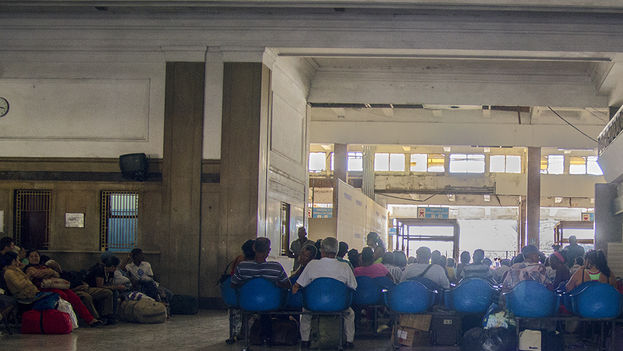
 Central Station, Havana. (14ymedio)
Central Station, Havana. (14ymedio)

In Havana, travelers bound for the provinces don’t just say goodbye from the platform, they wage a daily battle for survival

Lilanne Ruiz, Havana / June 4, 2014 – It’s seven p.m. in Havana. The train to Guantanamo has just arrived at Central Station. “Let’s go, have your tickets ready!” the conductor shouts, while inching open the gate to the platform.

The travelers push forward, some carrying all their luggage, others squeezing through and waiting for a family member to pass their boxes and suitcases to them through the bars. “Take care, I’ll call when you get there,” says a voice. Only the passengers can get to the cars. No one complains. They’ve never lived the classic scene of saying goodbye from the platform to someone departing on a train.

The Central Railway Station in Havana is an imposing building, built in 1912. The deteriorated ceilings are propped up by wood in the platform-access areas. Despite the neglect, the building endures and impresses.

In the lounge several rows of seats are arranged without a view of anything. It seems like an immense classroom, but without a teacher or blackboard. You can’t see the platform, only the wall. It is a lifeless scene, that gives no sense of movement nor help to make the wait enjoyable. continue reading

There are only 11 weekly trains to meet the demand. For the eastern region, those to Guantanamo, Santiago de Cuba, and Bayamo-Manzanillo, depart every three days. Those are the biggest, with 10 or 12 cars of 72 seats each. For the route to the center of the island, there’s one to Sancti Spiritus and one to Cienfuegos. Another goes to Pinar del Rio and five smaller ones travel to Guines and Los Palos, in Mayabeque .

Travelers who gather at Central Station, uniformed in poverty, are forced to improvise. They dress with what they can and assemble their luggage from what’s available. Briefcases, sealed plastic buckets, cardboard boxes covered with tape. If they can carry it, they bring it.

The figures of Ministry of the Interior (MININT) officials in battle dress stand out. They are armed. It is not known if they will be traveling or if they are patrolling. One of them, sitting two benches to my right, drinks from a bottle of homemade wine. He works in Havana but lives in the east. He goes on vacation every five months and returns to see his family. In the boxes, he says, he’s carrying packages of macaroni, spaghetti, and crackers that he’ll sell at the military unit before leaving.

Shipping ground coffee from the eastern part of the country is a crime comparable to transporting beef

He’s lucky to be able to transport all of this. For other people, moving goods is a problem. Shipping ground coffee from the eastern part of the country is a crime comparable to transporting beef. You may not carry more than two kilograms of cheese because the authorities assume that that is the limit of household consumption. Although farmers are allowed to sell the milk produced by their cows, it is prohibited to sell cheese.

If they can’t sell, how would they survive? “In the East there is no money,” says a woman waiting to go to Jiguaní the next day. When she came to Havana the train broke down at 3:00 a.m. in Ciego de Avila and did not get underway until twenty-four hours later. The passengers, united by adversity, got off the train to talk and share water and food.

Despite a potential fine of 1,500 Cuban pesos, vendors selling bottles of ice water pass through the waiting room. There is no water on the train. Women carrying satchels offer sorbets, candies, and mints. The state-owned outlets offer sliced pork and rice with black beans in small cardboard boxes for 25 Cuban pesos, or hot dogs for only 10 pesos. The cheapest offering is bread and ham for 3 pesos. The ham is a slice slightly thinner than a razor blade and the bread is the color of white cement. Hunger helps one overlook the poor appearance of the food.

A cardboard box is the usual luggage of travelers. (14ymedio )

A wrinkled old woman is chewing hungrily. She lives in Dos Rios, where José Martí died , and she is the granddaughter of an Afro-Cuban soldier from the war of 1895. She came to Havana to spend a few days with a granddaughter and brought back a box of malangas because “you can’t get it there.” The bag that her belongings are in was once a sack for detergent. Her clothes look worn, but as clean as if they had been washed and dried in the sun.

Two women wearing the uniform of those employed by the “Safety and Security Agency” contemplate a sandwich wrapped in plastic without deciding whether to eat it. It is the snack given to them by the state, their employer. Most sell it to get 20 pesos. I ask them why the platform is barred and the gate controlled as if for barnyard animals. “They try to board the train without a ticket, that’s how to make sure people pay.”

Why don’t they want to pay? “There are those who travel with nothing but a bottle of water and 5 pesos. Ay mami, this is very hard,” one answers. She doesn’t finish the sentence and laughs out loud as she walks away.

“In Havana, the fight is better than in the East,” everyone repeated

Those who sell and those who buy have a word in common: fight. “In Havana you fight.” “Here the fight is better than in the East,” everyone repeats. They come to the capital because they believe that the wages are higher. They do masonry, or work in agriculture with private producers, who pay fifty pesos a day (more than twice the average wage).

A young mother nurses her four-month-old baby. She carries a cargo of detergent, soap, toothpaste, and candies for kids. “The east is hard. Worse than Havana,” she says. She came from Guantanamo with a box of mangoes and guavas for her family in the capital: “There the fruit is sweeter and cheaper,” she says.

A woman wanders through selling plastic sandals. She explains that it is good business to buy in “La Cuevita” (a large unofficial market in the San Miguel del Padron municipality of Havana) and resell for a little more to travelers in the station. “We are all fighters, and this is the fight for survival,” she says, indicating the station with a sweeping gesture. “We’ll sell whatever is available, even caskets. Life is hard.”

The sandal-seller says that some regulars are homeless and spend the day at the station. They search in the dump for anything they can sell. “They go to La Coubre, the reservations and waiting-list terminal near the Central Station, to sleep on cardboard boxes they put on the ground. There they take advantage of and steal the suitcases from those unfortunate ones going back to the country,” she reveals.

The last train has left for Sancti Spiritus at 9:20 p.m. In front of the television in the waiting lounge men and women huddle who do not seem like travelers. They’re not waiting for anything. When the train has gone, the employees and a policeman prepare to close the terminal. They shoo them out: “Get up, we’re closing.”

Everyone obediently withdraws until the next day, at 6:30 a.m., when everything begins again.

Translated by Tomás A.

“One of the Hallmarks of the Twenty-first Century Will Be Overcoming the Burden of Political Labels” / 14ymedio, Eliecer Avila, Reinaldo Escobar

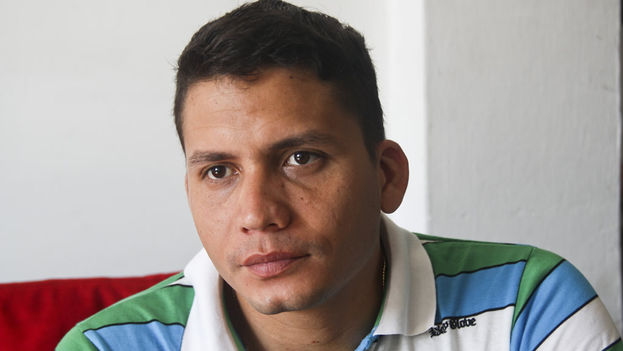
Eliecer Avila. 14ymedio

We speak with the founder of the political movement Somos+ (We Are More)

Reinaldo Escobar, Havana | May 30, 2014 – Eliécer Ávila launched the website this week of the political movement Somos+ (We Are More), which he created in June 2013. This 29-year-old computer engineer published a letter to young Cubans asking them to participate in “the reconstruction of the country.”

Question: What are the objectives of this movement?

Answer: We call ourselves Somos+ because we believe that every day there are more of us in Cuba dreaming of a different future. Among our objectives is to start talking among ourselves to know how many of us there are who have different ideas about how the country should be managed, from an economic, political, social point of view with regards to rights and freedoms.

Today we are isolated, and thus we have the idea that we are 11 million people thinking the same thing but not talking to each other about it, because there is neither the necessary confidence nor the platform to serve as a loudspeaker for people to express themselves without fear.
We are aware that in this early stage there will not be many people who want to be part of the movement, but we hope that we can count on a vanguard. We don’t expect to be a mass movement, but we can bring together an important number of responsible and thinking young people around a project for Cuba. We believe that it’s not enough to describe and criticize problems, we have to go from complaints to active participation and this participation implies that we need to organize ourselves. continue reading

Q: This has been a significant step in the evolution of your activism. At what point did you decide to found Somos+?

A. In February 2007 a video released on alternative sites showed a discussion I had with Ricardo Alarcón, then president of the National Assembly of People’s Power. From that moment hundreds or thousands of people from across the country approached me.

I noticed that people had huge cravings, cumulative desires, to share ideas, and that there was an enormous overlap in these ideas. I heard very similar things in Guantanamo, Camaguey and Pinar del Río. Then, in the same way that a businessman identifies what is called “market niches,” a politician or an aspiring politician should know how to find the missing link in a certain chain that will make things start to happen.
What we lack are platforms where the greatest possible number of Cubans can come together to talk; for example there are 20,000 of us who support the urgent need to give Cubans open access to the Internet.

“It’s not enough to describe or criticize the problems, we have to shift from complaining to active participation.”

Q. Throughout this half century there have been many initiatives to create political platforms. What differentiates Somos+ from what has happened so far? Is it about continuity or rejection?

A. We can’t ignore these organizations, many of them very respectable like the Varela Project that collected more than 11,000 signatures and presented them to the Parliament. There are precedents in the history of the Cuban opposition that have been developed by talented, serious, hard-working people. All these initiatives deserve respect. But everyone can come up with his own, named, initiative, something with his own history specific to the time the project is undertaken.

Q. One of the issues most discussed currently among the opposition is that of unity. Do you think creating a new movement contributes to or hurts this aspiration?

A. In order to join forces there have to be forces and I think that everyone, on their part, can capitalize on all the energies in their group, and in their generation and this is also a way that in the end we’ll have more forces to unite.

Q. It’s almost inevitable that a political movement is labeled based on classifying it among the known political leanings. Left, center, right, social democrat, liberal, Christian democrat, etc. What do you think would be the label most acceptable to Somos+?

A. The issue of labels, although to our regret it still exists, in the long term will be seen as a remnant of the 20th century. I have the impression that one of hallmarks of the 21st century with regards to political conceptions, will be overcoming the burden of political labels. On some issues we may have opinions leaning to the right, and on others to the left. So those who feel obliged to define us using these old classification tools will have to settle with placing us in the center.

We’re not unaware of the importance of the free market, but we observe with close attention that there has to be social justice. The different tendencies can be expressed like the legs of a table which, when everyone has the same freedom of action, we have to find social equilibrium.

With the Somos+ movement there will never be a single idea. We are open to people who are members of the Communist Party or who have openly declared themselves to the right or left. We want to bring together those who believe in clear goals. There could be many Communists here who are in agreement with us that we need a greater degree of participation, that we lack a democratic parliament, that Cuba needs to be inserted once and for all into the technological globalization to be present in the world. We will not refuse anyone the right to participate because they have a different ideological viewpoint.

“A good strategy for making progress in this field as turbulent as this is to pay less attention to what the adversaries say”

Q. What does a person have to do to join the Somos+ movement? Do you include Cubans living outside the island?

A. We are going to take our ideas everywhere. Already in eight provinces we have been invited to give conferences on the subject. It’s about young people who are eager to do something and don’t know how. Friends, family, neighbors who get together.

Among the founding documents that are posted on our website there is a summary of our ideas and principles, and also a Letter to Young People where I explain our motivation. We have included a form that people can fill out with their particulars, both those living on the Island and those who live anywhere else in the world, provided they share the objectives of our movement.

Q. Presumably that now attacks will come. From official institutions that will accuse you of being another mercenary of the empire and from sectors of the opposition that will say that your movement is a maneuver by Raúl Castro to make people believe he is democratizing. What answers do you have for one or the other?

A. A good strategy for advancement in this very turbulent field is to dedicate less attention to what your adversaries say and more attention to communicating with people. That is what we are going to spend 99.99% of our time on, regardless of what extremists from either sector say.

Q. I’d like it if you would get ahead here of the one question you are going to be asked from all directions and with the worst intentions. How is the movement financed?

A. The members of the movement will make voluntary contributions to help defray costs. That is reflected in our bylaws. It’s impossible to do what we want to do without resources and it would be very irresponsible to try to do it without stable economic support. Our finances will be public and we will prepare a report so our accounts can be audited.

If you sell a pig and you want to bring a part of the profit to our movement you can do so, like Christians do in their churches to maintain the church. This movement is our faith.

Implicit in the bylaws is that any natural or legal person can make donations as long as they comply with certain principles: that the money does not come from illicit sources, that they are not trying to influence the politics of the movement with a donation, that they haven’t participated in violent acts. We don’t believe that the enemy of our adversary is necessarily our friend. We would love to have a public debate with the Communist Party on the topic of how to finance a political organization.

Q. One last question that someone asked Fidel Castro in 1954, when he was your age: Do you plan, at some point, to perpetuate yourself in power if you achieve your purpose?

A. We won’t leave for tomorrow the issue of handover of positions. Internally we have elections and this will be a habit we will continue. I personally disagree with any initiative that can lead to a person remaining in power. The 1940 Cuban constitutions addresses this with great clarity.

Even Toilet Paper Is A Luxury / Lilianne Ruiz

That the State sells cheap products at high prices is a dreadful cynicism.

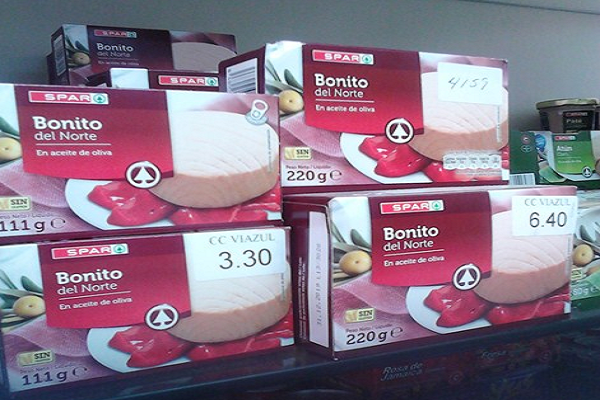
HAVANA, Cuba. — First there appeared the “SPAR” products.  Then, on a shelf of the Ultra store in Central Havana, we saw the unmistakable seal with the little red bird from “Auchan.”  Imported products from Europe, which is equivalent to saying, in political terms, from the European Union.

But the prices:

“Very expensive.  Are you looking?  Almost no one buys them,” says the grocer at a small neighborhood market that now displays, also, “SPAR” jellies, cans of bonito and tuna at astronomical prices (in comparison with the buying power in Cuba) and that people do not seem to see; committed as they often are to getting a little package of chicken thighs or some greasy alternative and so to complete the Cuban menu of more fortunate days, too distantly spaced on the calendar: rice, beans, meat, vegetables and the main course, that now cannot be fish or beef.

Everything that the State sells is so expensive that for ordinary Cubans any basic product becomes a luxury. continue reading

With toilet paper there are those who can give themselves the luxury and those who prefer to save it to buy something more urgent.

But that the State is selling “Auchan” at elite prices, a line of products for popular sectors, seems a dreadful cynicism. Because if these products have been leaked through the porosity of the Common Position it means that the Cuban people are thought of as the most affected by scarcity and need. The Cuban people are thought of as hostages to a policy that within the Island, with everyone and the Common Position, has remained immutable, in spite of any reformist makeup.

At the same time that the Cuban government tries to disguise from national and foreign public opinion its unquestionable violations of human rights, it cries, denouncing as meddlesome the position of the European Union and of the United States in defense of democracy for Cubans.

Presumably the European Union will be considering that in all these years it has not managed to benefit the population by the policy that it maintained with respect to the island’s government.

They begin to perceive the first signs of opening, changes must begin, first order products appear, by strict order of learned survival.  Because it is not the same to eat breakfast with cement-like bread and water as to make it with “SPAR” cereals.

But the Cuban government does not recognize liberties, it does not respect rights; which would also bring prosperity to Cuban homes, without exception!  Bent on its own survival, Castro-ism bets on squeezing the nut, and we Cubans pass by the shelf because those delicacies do not appear to have been made for us.

The Cuban government’s message for nationals and foreigners seems the same cynicism as always: “I keep collecting currency, I keep being the same extractor as always, the same parasite as always.”

It is clear. Human rights are the only engine for development, as much for an individual as for a country. You cannot give them up to eradicate poverty. In fact, you cannot eradicate poverty if you sacrifice human rights.

A government that hijacks freedoms should be made to change, especially when the people under its domination have been incapacitated from defending themselves after more than half a century of individual and collective denial.

May 29, 2014 / Lillianne Ruiz

Translated by mlk.

Dialogue Without Future / Juan Juan Almeida

Young historian Elier Ramirez asserts that “Dialogue, Dialogue” is a space for debate and reflection that the Cuba Pavilion welcomes each month by initiative of the Saiz Brothers Association.

What’s extraordinary is that he calls for dialogue, and I am neither adding nor removing a comma, about the exchange of necessary ideas at this moment in order to stimulate in different social circles the debate about the topics related to current national affairs in pursuit of assuring the continuity of The Revolution.  If you understood, explain it to me.

Translated by mlk.

30 May 2014

Lies and Deceptions of a Revolution / Tania Diaz Castro

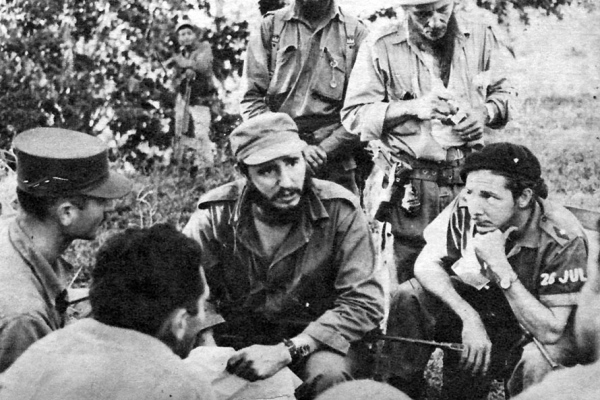
1401662613_fidel-raul-2Havana, Cuba – Because of the many lies and deceptions in Fidel Castro’s history, new generations of Cubans have great doubts about everything that happened since 1952.

Celia Sánchez was one of the key figures of the Revolution. She died in 1980. Her 21 years as personal secretary to Fidel Castro were devoted mainly to gathering “every last scrap of paper,” as she put it, in order to recover the history of that time, as it actually happened. On May 4, 1964, she founded the Office of Historical Affairs of the Council of State. They include, I suppose, the documents recording all the times that Fidel Castro swore up and down that he was not a communist.

A few days ago, on the 50th anniversary of the creation of that Office, Dr. Eugenio Suárez Pérez, its director, told the newspaper Granma that Celia‘s objective was to safeguard the historical memory of the Revolution, from the Sierra Maestra to its eventual triumph, and that they had currently collected more than 56,000 background documents and more than 159,000 photographs. continue reading

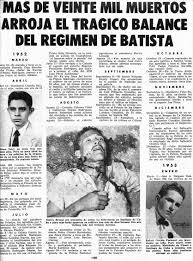
If we could ask why Celia—“the advocate of the truth above all else” who “reviewed and classified the archives and processed the texts personally”allowed the repetition in the national press for decades of the glaring and absurd lie that 20 thousand people had been martyred in the war against Batista, a lie created in the magazine Bohemia by Enriquito de la Osa, no one could answer, because they have never been able to produce a list of names of those alleged martyrs.

This lie has been told more than once within the United Nations by Bruno Rodríguez Parrilla, Minister for Foreign Affairs. On March 3, 2010, he said:The military dictatorships in Latin America, imposed and sustained by the United States for decades, have killed 400,000 people. In Cuba alone they caused 20,000 deaths.” And on October 26 the following year, also at the UN:Cuba made the great change in 1959 at a cost of 20 thousand lives, swept away by the dictatorship of Batista, the henchman of the United States.”

baracuteyTheHeroine of the Sierra” also mutely accepted that the amnesty granted to the prisoners who had attacked the Moncada Barracks was the result of pressure from the masses, when she well knew that the masses had remained outside the fray, and had not even participated in the general strikes Fidel had called for from the Sierra. Journalists in the employ of the regime and senior officials have lied about this.

Esteban Lazo, President of the National Assembly of People’s Power, on the 45th anniversary of that invented feat, exclaimed before hundreds of Havana residents in the Vedado park at 23rd and 30th, that “it represented an extraordinary example of the people achieving victory.And Ciro Bianchi: “The people backed the Batista dictatorship into a corner, because of their demand the bars of the cells were broken.”

Even today the national press, completely in the hands of the government, shamefully attempts to manipulate the people with political demagoguery, which few believe. They repeat like parrots that the people approved the hundreds of firing-squad executions, just because a fraction of those masses of people, taken by surprise at a rally on January 21, 1959, was bedazzled in the face of the  obsessive-compulsive personality of the guerrilla leader.

For the same reason, Cubans today are forced to accept socialism, just because a bunch of overheated militia, assembled by Fidel Castro, cheered for him on the afternoon of April 15, 1961. That was the maximum leader’s style. He had done the same thing with those men who, in the summer of 1953, had no idea why they had come to Santiago de Cuba, hours before the attack on the Moncada Barracks.

May 30, 2014 / Tania Diaz Castro


A Turn of the Screw Against the Informal Market / 14ymedio

14ymedio, Havana, 30 May 2014 – A regulation of the General Customs of the Republic, published last Wednesday, has sellers of imported products and other private traders on edge. The official document includes new restrictions on travelers carrying goods to Cuba.

The measure adds to an escalation against the private market that hit a low point last December 31 when the government closed the so-called boutiques and outlets of varied merchandise, run by the self-employed. Many of these vendors transitioned to illegality, now offering their wares via catalogs that circulate hand to hand.

The Official Gazette has put special emphasis on warning of administrative or criminal liability for anyone who brings “foreign packages” to the Island. A direct reference to the so-called “mules” who bring clothing, shoes and other products sent by Cuban exiles to their families on the Island. continue reading

A video posted on the website of the Official Gazette shows a dramatization of the arrival of a traveler with 150 USB flash drives. On being questioned, the visitor said he did not know the contents of what he had brought because it came from another person who was sending it to his family.

For Antonio Tapia, who just bought an iPod through the classifieds website Revolico.com, it is “significant that Customs has chosen to issue their warning through these new technologies.” According to him, “For weeks we’ve been under a barrage of official propaganda against these technologies and now this shows up.”

The informal sellers are also very worried. On Reina Street in downtown Havana several outlets for imported clothing have been closed since the beginning of the year. However, most have continued to provide their customers with a wide range of dresses, brand name shoes and jewelry, although now they must do so illegally. “It gets worse and worse,” says Yanaisa, who has a boutique specializing in women’s underwear.

At José Martí International Airport Terminal 2, 14ymedio spoke with recent arrivals coming off a flight from Florida. So far no one has said they perceived a change in customs searches compared to previous trips. Carmen, age 61 and living in New Jersey, said that she was “very scared” when she heard about the measure because she always comes “loaded with gifts and commissions from others.” However, she reported “no problems of any kind” entering the country.

The effects of this new turn of the screw on the importing on merchandise could start to be felt in the coming weeks. But at the same time, in the words of Ruben Eduardo, a seller of computer parts, “We can always invent something.”

Over One Thousand Arrests of Activists in May / 14ymedio

14ymedio, Havana, 2 June 2014 – In its latest report*, for the month of May, the Cuban Commission for Human Rights and National Reconciliation reported 1,120 arrests of peaceful dissidents and activists. This figure is one of the “highest in recent decades with regards to the number of arrests for political reasons,” the document reports.

As an example, the report cites the case of journalist Guillermo Fariñas, winner of the European Parliament’s Sakharov Prize for Freedom of Thought, who has been arrested every Monday over the last 19 weeks. In the introduction to the list of detainees, the text reports an increase in “repressive violence against citizens who dare to disagree publicly.”

This report is prepared monthly by the Cuban Commission for Human Rights and National Reconciliation, an independent organization led by Elizardo Sanchez; the government of the island does not recognize the organization in any legal way.

*Translator’s note: Although the report is in Spanish it is laid out in such a way that an English-speaker reader can grasp the dates, places, and names of those arrested.

Radio Marti’s Listeners on the Central Committee of the PCC / Juan Juan Almeida

Radio Marti’s Hertz waves arrived in the Cuban ether May 20, 1985. That Monday, the island radio scene was disconfigured. Today I want to tell the same history from another perspective.

Fidel Castro, the man of pride stuck to the military uniform, hated surprises, and that’s why, long before the day that Senator Paula Hawkins presented the draft bill, he had already ordered his most loyal ears, within and outside of the United States, to obtain facts and information about what later happened. And at the same time, he installed an invisible army that, like mold spores lurked, awaiting the opportunity to act. continue reading

Havana became another battlefield, where the leader desirous of a conflict was more excited than an egomaniac passing through a hall of mirrors.

With a strategist’s skill and the tantrum of a sodomized victim, he organized a commission of shysters who, lacking no resources, came to see the transmissions as a flagrant violation of international rights and not as a simple, alternative and informative radio service directed towards a population that, if it did not want to listen, could change the dial.

On the outskirts of Havana, and with the help of Moscow, an underground center was created in San Jose, from which was transmitted a sort of rebel signal with wide programming directed towards the United States; but this Radio Answer served only to send encrypted information to their spies. The dreadful programming was unattractive, and its hidden announcers showed themselves to be “Mr. Nobodies” with more love of money than sense of ideology.

By then, and whether because of novelty or because we Cubans are like receptive sponges exposed to the adrenaline provoked by the prohibited, plus the avidity for information and the satisfaction of curiosity, Radio Marti won space within Cuban homes.

Such a fact was demonstrated in an old study commissioned by the DOR (Department of Revolutionary Orientation) to a select group of sociologists and professors from the University of Havana.

Of all that could be heard through the dark hallways of a hermetic, Pepto Bismol-taking Central Committee, Radio Marti demystified the image of its leaders and of its Commander in Chief. Then they had to punish everyone who listened to it. Here, right here, began the big problem because many leaders, impelled by the logical shock of seeing themselves reflected, or because of the dark pleasure of knowing what is said of their political colleagues, became habitual radio listeners.

The nearest example was my own father who, although it is implausible, was a fervent follower of the prohibited broadcast; that’s why when he grew old and lost his hearing, he listened to Radio Marti at such volume that, by decision of the highest management of the country, it was ordered that his bodyguards keep their distance when this occurred and so avoid hearing news that might undermine the integrity of a Revolutionary.

But ancient history to one side and with a view to the future, I believe that today Radio Marti has an enormous task; that of being the impetus that helps us, as a people, to decide whether to continue the confrontation and all that it entails; or begin to heal the wounds of our Nation in order to found a new country on the basis of respect for diversity, justice, happiness and impartiality.

Translated by mlk.

27 May 2014

Where to Have Sex in Havana? / Camilo Ernesto Olivera Peidro

He who waits, feels desperate. Internet photo

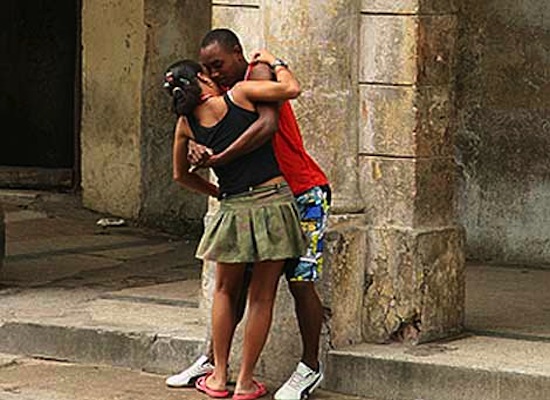
Havana, Cuba. It happened in the Motel on 11th and 24th streets, near the iron bridge connecting Vedado and Miramar. In a room rented for two hours, the unpleasant whisper was heard: “Mami, you have a wonderful stench!” It was the 1980’s, Cuba was still receiving 5 billion in subsidy from the Soviet Union, the shortages of the Special Period were still far away, but vulgarities were emerging.

More than two decades ago those hotels where people go for sex* (or to make love) — Cubans call them posadas — were abolished in Havana. A cyclone was guilty. The wind and heavy rain left thousands of people in Havana without a roof, and the government, due to the lack of housing, sheltered them in these posadas.

It was a difficult solution for the sheltered ones: “We had to put up a sign at the entrance: ’This is not a posada anymore, families are living here, do not disturb,’” said a person housed there, in the old Venus posada, near the train station, and he added. “Couples would arrive, drunk, screaming, ’Desk clerk, give me a room we are dying to …!’ Imagine those vociferous vulgarities, where small children and old people were living. What a shame!’

The destiny of the posadas in Havana definitely changed after the so-called Storm of the Century, in March 1993. During that time the majority of them were under the control of the Popular Power. Some of them were in a state of disrepair, with leaks in the roofs and mold in the walls.

There are cities in the interior of the country, such as Holguin in the east, where posadas still exist. In that provincial capital, the government managed to set aside years ago a budget for basic repairs of old hotels in the urban area; the Majestic and El Turquino. These maintained payment for services in Cuban pesos (CUP).

In another inland city of Cuba, in Santa Clara, the two hotels, Modelo and América, received investments for repairs and were reopened with a grand pomp. The inhabitants of Santa Clara fixed them in order to have a room where to make love for two hours, which the desk clerks don’t report. Sweet deal.

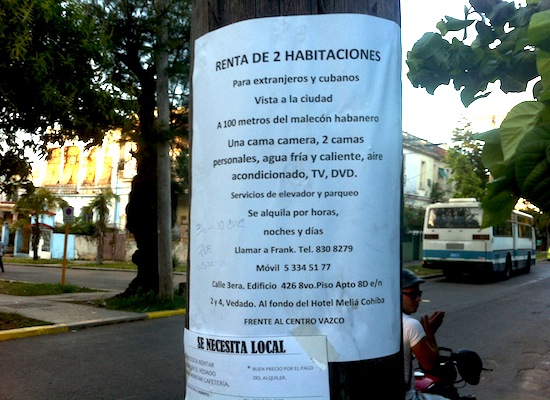
These advertisements (rooms for rent by the hour, night and day) are often seen in the Malecon area. Photo by CEO.

In the capital, the price for one room — in private houses — corresponds with the facilities that offer, and the location. They charge more in Vedado, close to the zone of the Oncologic and the Calixto García hospitals. In Playa, the tenants, situated close to the Casa de la Música de Miramar, have regular customers. The prices range from 5 CUC per hour.  Depending on the quality of the room and the day of the week, the amount may be higher.

Near Havana’s Malecon — basically an area of prostitution — a lot of families rent their daughter’s room, or that of any family member, by the hour to prostitutes and pimps. One tourist said that, accompanied by a mulatto girl, he came to a house in the Laguna Street in Havana, where the family was watching the soap opera on TV and the father of the family said to one of his daughters: “Go wake up your grandmother, a couple is here.”

In the meantime, in the popular memory the remembrance of the posadas of  eastern Havana or of the Circunvalación, immaculate hotel rooms with air-conditioning, bathrooms with cold and hot water, clean sheets and bar service 24 hours, to which any couple could come by car, without being seen by prying eyes.

In today’s Havana you will find it difficult to find a safe, comfortable and clean room to have sex, if you can’t pay in hard currency or a pile of money; you can risk going down to the reefs, venture into the darkness of a park, although this is not recommended: bad guys are roaming there.

*Translator’s note: Because of the crowded housing conditions in Cuba and the fact that young people can’t afford to live on their own, nor do they own cars, privacy is hard to come by.

Cubanet, 20 March, 2014 | Camilo Ernesto Olivera Peidro

Translated by: AnonyGY, Michaela Klicnikova