The Illusion of Color / Yoani Sanchez

Caribbean TV

I got home from school and there was a man sitting on the floor in front of the TV. His fingers were stained with paint and some oil-paint tubes were scattered around him. It was the latest fad in the neighborhood: painting a colorful pattern on those boring black-and-white screens. The first one to do so was the downstairs neighbor, always up-to-date with the latest trends, which included posters of lightly-clad women taped to the walls, and an enormous porcelain tiger at the entrance to her home. She dictated fashion throughout the whole tenement, so when she transformed her “boob tube” with a rainbow in reds and blues, everyone imitated her. In my house at 218 Krim, they painted some stripes and even a central circle in various tones. Most significant is that years later, I remembered the programs and cartoons I saw on that “invention” as if they’d come to me in their original polychrome. My brain had joined the shades and constructed the illusion of color.

This personal anecdote comes to me when I read the latest 2012 Statistics from the Census of Population and Housing. On learning that there are still more than 700,000 black-and-white TVs in Cuba, I can’t help but evoke the excited neighbors of my tenement using their fingertips to paint their cathode ray tubes. But in the current figures, there is not only evidence that they are still watching TV programming in black, white and gray… but also that they are economically worse off in our country. They are the ones who have failed to get together the convertible pesos for a modern Sony or LG. Those who probably have no family abroad, who haven’t found a way to divert State resources, or whose privileges ended with the end of the USSR. The poorest who, in a society of such avid TV watchers, don’t have the resources to enjoy the tonalities.

I wonder if any of those old TVs touched up with stripes in green, purple and cyan still survive… If some child on this island still watches like my sister and me did, mentally joining a piece of color here and another there to imagine Huckleberry Hound was a blue dog, or Cheburashka with his fur brown.

Now I no longer know, I can no longer distinguish in my memory, between what came to me thanks to the ingenuity of painted screens, or what I enjoyed years later thanks to Technicolor.

The post La ilusión del color appeared first on Generación Y – Yoani Sánchez.

23 November 2013

Arturo Sandoval: I Have Fulfilled My Dreams / Ivan Garcia

Arturo-SandovalTo speak about music in Cuba is an analogy. Cuba is the music. There are nice people, splendid weather, the smell of salty residue, and there’s always a reason to party. Other things, like the shrimp, tropical fruits, or beef are a luxury after 54 years of misrule. Cuba lacks essential liberties, but the music goes on.

Fidel Castro tried to scrap the Sunday calls to retreat and replace them with arrhythmic marches calling for combat. The olive-green regime planned to transform music. To bury guaguancó, toque de santo, and jazz.

But he couldn’t. In addition to inventing parameters to measure the quality of a music, in the medias sent to censure the greats like Mario Bauzá, Celia Cruz, or such a Lupe, only because they chose to observe from the distance the ideological folly established in the island.

And the music, like poetry, doesn’t let you break. The trumpeter, pianist, and composer Arturo Sandoval (Artemeisa, 1949), knows this very well. In the flesh has lived the holy war that political and cultural commissioners, scribes and historians, unleashed in 1990 when he decided to move away from the Communist madhouse. According to official decree, Sandoval was to die.

It’s rained a lot since then. The times are different. It’s been 24 years, indignant Berliners in the night demolished the wall that divided a same nation. Castro had to change politically. He spoke of socialism or death on a Havana platform, but from the sewers of power, sent especially trying to make negotiations with magnates of capitalism. He had to make accords. With the Catholic Church, the Afro-Cuban religion and with the selfsame devil. He cracked the social discipline and the fear was lost.

And in full view you could find blacks on a Cayo Hueso lot, in downtown Havana, between rounds of rum and dominos, daring to listen, at full volume, to Celia Cruz, Willy Chirino, Paquito D’Rivera. or A Time for Love, disco from 2010 by Arturo Sandoval. I was a witness.

On November 6th the Cuban trumpeter turned 64. On the 21st of this month his name may be announced in Las Vegas as the winner of a Grammy, the tenth in his career, to go along with 6 Billboard Awards and an Emmy. Although the most moving of all will be the Presidential Medal of Freedom, which will be presented to him in December by Barack Obama, along with fifteen other figures, including former President Bill Clinton, Oprah Winfrey, and Mexican scientist and Nobel Prize winner in chemistry Mario Molina. Despite his busy schedule, Arturo Sandoval graciously answered a questionnaire from Diario de Cuba.

Arturo, I was a boy when your name rang out with force on the island. I remember you taking complete notes on the trumpet while Irakere was making Bacalao with bread. Would you be able to summarize your artistic trajectory?

“I have to give thanks to God every day because in my career I’ve been able to accomplish my dreams. Look, coming from a dirt-poor family, where nobody was linked to art, and me having been able to be in the best situations and share with the musical greats. I think that sums up my trajectory: a dream come true.”

He doesn’t say it out of modesty, but another dream come true is the Arturo Sandoval Institute, proud institution of Cuban music on two shores.

Looking back, Arturo, what did Irakere mean to you?

“Before belonging to Irakere I was a member of the famous Cuban Orchestra of Modern Music. When I joined the orchestra, I was 16. I started at the bottom, being the sixth trumpet, until I made first. Without a doubt, the Cuban Orchestra of Modern Music has been one of or the best ever formed in Cuba, with musicians of great magnitude, like Luis Escalante, El Guajiro Mirabal, Paquito D’Rivera, Chucho Valdés, Guillermo Barreto and Juan Pablo Torres, among others. I and some of these latter would form the group Irakere. To me, Irakere was a source of inspiration. The combination of rhythms that we could make gave new sounds to Cuban music. Through Irakere we had the chance to make ourselves known throughout the entire world, including winning a Grammy.”

Was Dizzy Gillespie the musician that influenced you most?

“Definitely. Dizzy has influenced me the most, and not just as a musician, also as a person and friend. We struck up a great friendship, we got to be like father and child. His teachings have been and continue being standards to follow in my life. I’ve had other musicians who’ve influenced my professional life such as Duke Ellington, Clark Terry and Clifford Brown, among others. The list would be unending, for I’ve also had classical influences like Rachmaninov, Ravel and many more.”

Your records arrive on the island on flash memory or pirated CDs. I know a DJ in Carraguao who, for 10 CUC, will copy your discography. How do you feel, knowing that despite censorship, Arturo Sandoval stays alive in the memories of many compatriots?

“It’s very sad to think that somebody has to sneak around to buy a record by an artist from his own country, that my music is forbidden and that in the land where I was born and continue to love, nobody can hear it. I feel proud that my compatriots want to hear my music, but at the same time I’m saddened that they have to hide out to do so. It’s sad that the music of a lady like Celia Cruz or a Willy Chirino and many more have to be listened to in the shadows, as if it were a crime. This shows not only political ineptitude, but also social and cultural incapacities of this regime.”

In Cuba, some criticized your opposition at the performance of Juanes in the Plaza of the Revolution in 2009. Do you still maintain that while democracy does not exist in Cuba, all cultural interchange is propaganda for the communist autocracy?

“I continue to hold the same opinion. I believe that cultural exchange cannot be one-sided. If Juanes could play in the Plaza of the Revolution and was received with fanfare, why can’t Gloria Estefan, Willy Chirino, Andy García and others — including myself — do the same? Stopping off in the Plaza of the Revolution and freely expressing our feelings through music. The obsolete regime of the Castros is afraid, and by that I don’t mean of cultural exchange. They’re afraid we’ll speak before the people and might say that which Juanes and others did not say when they had that opportunity: the truth of what this communist regime represents and has represented for 54 years.”

Would you support an authentic cultural exchange, political or sporting where the Cubans from both shores might be able to offer concerts, games, or debates in their country without permission from the regime? With the Castros in power, do you see yourself giving a concert in the Karl Marx theater or in a plaza in your native Artemisa, now a province?

“Without the Castros and with a democratic government, I suppose so. With the Castros and without democracy, NO.”

Do you believe the shipwreck of the national economy has reduced the quality of Cuban music?

“There is a lot of talent in Cuba. Cuba has always been an inexhaustible source of musical talent, with and without communism. But look, since the triumph of the Revolution there aren’t specialized houses where a musician might go to buy an instrument or a music book. Nothing. Luckily, in Cuba music grows wild, but it’s sad that a person who wants to study music should have these kinds of limitations, not a single place to go and buy a book with staves.”

When you lived in Cuba, the people spoke against Fidel Castro, muttering in their living rooms. Now no. In many places they carry on about the malfunctioning of the government. There are those who continue seeing the game from the bleachers, but cases like Robertico Carcassés’ happen. What kind of value do you place on the controversies and public criticisms against the regime that take place today among the intellectuals and also the everyday Cubans?

“I am proud of all of them and believe that it’s going to be the only form the world will come to know; that Cuba does not assent to continue being dominated by a group of inept opportunists and crazy people.”

Your opinion about the intention of Chucho Valdés to regroup the musicians of Irakere and offer a nostalgic concert.

“Chucho supports the communist regime in Cuba. I am a US citizen and I defend the liberty and democracy. Irakere is not just him, to be the authentic Irakere, he’d have to count on all the musicians who are alive. Speaking for myself, they won’t count on me.”

How do you see this post-mortem homage that they want to give to Bebo Valdés in the next Havana Jazz Festival?

“Bebo deserves all kinds of recognition, but in this case it’s a flagrant act of demagoguery and hypocrisy. Bebo was a bitter enemy of this system and never came back to Cuba because he did not agree with the regime. They had to have recognized this while he was alive, for this they’ve had enough time.”

What have you got new for the next few months?

“I just finished the score for three movies, in one of them with Andy García and Vera Farmiga in the protagonist’s role, and in another the actor Beau Bridges is appearing. I finished producing the last record of the great Peruvian singer and composer Gianmarco, it’s a jewel and it’s nominated for the 2013 Grammy as Best Album of the Year. I finalized another record, “A Century of Passion”, that I dedicated to the Fuente family, famous Cuban-American tobacconists, nominated at the Latin Grammys as the Best Tropical Album. I recently concluded a tribute to Armando Manzanero and now I’m starting two more projects for film scores, but I still can’t say their names while we’re in the midst of contract negotiations.”

Arturo, with your hand over your heart, are you coming back to a democratic Cuba one day, or do you believe it will continue being a utopia to whomever it’s worth the trouble of continuing to struggle?

“Hope is never lost, our country deserves something better. I believe it is not a utopia. It’s worth the trouble to keep struggling, I know that Cuba will shake off the dead weight of the Castros and their henchmen.”

Iván García

Video: Havana, 1985. Dizzy Gillespie and Arturo Sandoval in Night in Tunisia, composed by Gillespie en 1942.

Translated by Boston College Cuban American Student Association – Carlos Fernandez

16 November 2013

Bastion or Bastille? / Reinaldo Escobar

bastionbastillaAs details about the Bastion Strategic Exercises 2013 come to be known, doubts and questions emerge.

When Army General Raul Castro Ruz, in his role as President of the National Defense Council, ordered the start of this training, he explained (in my opinion, inaccurately) that this was done with the objective of being prepared “to confront different actions by the enemy.”

So far, not him, nor any other high level official or functionary, has wanted to call the enemy by its proper name, nor have the journalists who write about the issue who — as if they had received an order — have limited themselves to putting phrases in their interviewee’s mouths such as: “Today it’s an exercise, but the Yankees are capable of anything…”; “we will destroy any imperial adventure,” or at best, allusions to “our historic enemy.”

There’s no need to place secret microphones in the rooms where they convened the Leadership of the Organs of Security and Internal Order or the Working Groups or the Provincial Defense Councils, to know that in these instances when they make the plans to “preserve interior order” or “to prevent vandalism,” he directly states the names of other “enemies.” There, they detail what to do with the uncomfortable opponents, who will deal with those captured and what site they should be taken to, and in case things get ugly, what extreme measures should be applied.

The much mentioned “Cuban military doctrine” rests on the principle of “The War of the Whole Power” which has nothing to do with the war of one party of the people against another party of the people.

A philologist friend whispered in my ear that Bastion and Bastille are closely related, sharing the same etymological root. On 14 July 1789, a crowd of Parisians assaulted the infamous prison. And the soldiers located on the Champ de Mars had refused to shoot the people advancing on the fort, not only to release the prisoners but also to seize the ammunition. The rest is well-known history. The Bastille fell into the hands of the people. Many of its stones, from its subsequent demolition, were used to build the Pont de la Concorde — the Peace Bridge.

Reinaldo Escobar
Havana

Why Amnesty International Should Declare Angel Santiesteban A Prisoner of Conscience / Angel Santiesteban

We thank Lamasiel Gutiérrez for his solidarity with Ángel Santiesteban-Prats; he has created a petition to collect signatures on the AVAAZ.org platform asking Amnesty International to declare him a prisoner of conscience, for as you know, he is serving a 5 year sentence for common crimes that they have failed to prove because he never committed them.

In this blog, available to all who care to consult it, is the complete legal file, where there is not only proof of Angel’s innocence, but where it is also demonstrated the fabrication of the case on the part of the Castro political police and the total dependence of judicial power on political power.

Our deepest gratitude to those who have already signed and to all those who want to sign and collaborate in getting more signatures in support.

To sign, please go to PETITION TO AMNESTY INTERNATIONAL.

Between everyone it is possible, in the same way that the freedom of Cuba is won with the efforts of everyone united in the same cause.

The Editor

22 November 2013

Humanitarian Demand / Rafael León Rodríguez

  1. In recent weeks we have heard some information in the United States media about the possibility of selling medicines produced in Cuba in that country, particularly Heberprot-P, a drug for the treatment of diabetic foot. On the other hand, the Cuban authorities continue to express themselves about the obstacles facing them in buying certain medications and medical instruments produced in the US, due to the restrictions occasioned by the politics of the US embargo on the island.
  2. There are different opinions about this issue, both for and against, dismissing the urgencies of those priorities which should be considered: the diabetics in the United States who could be treated with Heberprot-P avoiding, in some cases, dangerous amputations of their extremities, and of patients in Cuba who can’t access treatments to cure them or to improve their quality of life because some medications and specialized instruments produced in the U.S. can not be purchased by Cuba.
  3. Faced with any discussion on this issue, it is important to take into account Articles 12 and 15 of the United Nations International Covenant on Economic, Social and Cultural Rights and the “Declaration on the Use of Scientific and Technological Progress in the Interests of Peace and for the benefit of humanity,” among other things.
  4. For all these reasons, the undersigned, Cubans and Cuban Americans, members of independent civil society and citizens in general, affirm our determination to support, from a vision of respect for human rights, the possible analysis that would permit the expansion of everything related to scientific exchanges in the areas of drug development and medical techniques. Also, the marketing of medicines and specialized instruments for these purposes, in order to meet the medical care needs of people who need to be treated in both countries.

Julio Aleaga Pesant — Independent Journalist
Hildebrando Chaviano Montes — Independent Journalist
Manuel Cuesta Morúa — Progressive Arc
Siro del Castillo Domínguez — Solidarity with Cuban Workers
Gisela Delgado Sablón — Independent Libraries
Eduardo Díaz Fleitas — Pinar del Rio Democratic Alliance
Reinaldo Escobar Casas — Independent Journalist
René Hernández Bequet — Cuban Christian Democratic Party
Rafael León Rodríguez — Cuba Democracy Project
Susana Más Iglesias — Independent Journalist
Eduardo Mesa — Emmanuel Mounier Center
Marcelino Miyares Sotolongo — Cuban Christian Democratic Party
Héctor Palacios Ruiz — Liberal Union of the Republic of Cuba
Oscar Peña — Cuban Pro Human Rights Movement
Pedro Pérez Castro — Solidarity with Cuban Workers
Rosa María Rodríguez Torrado — Cuba Democracy Project
Wilfredo Vallín Almeida — Cuban Law Association

21 November 2013

Marta Beatriz Roque, Injured by State Security / Lilianne Ruiz

On Tuesday we learned of the beating of Marta Beatriz. They didn’t just beat her, they also dragged her up the stairs, 31 steps, beating her neck and whole body. I did not ask Marta’s age but she is an older woman, perhaps older than 60. She was the only woman in the group of 75 (from the Black Spring of 2003), imprisoned for her activism and for publishing her opinions against the regime.

She, a group of activists and friends, had been standing in front of the Zanja police station to protest the harassment she suffers from some of her neighbors.

That morning Marta had refused to let her house be fumigated with smoke and oil, an invasion on the pretext of doing away with the mosquito that carried dengue fever. There are other methods of fumigation, which here they call “special” that also eliminate the larva and the mosquitoes, but that was not available and the smoke was spreading into the house through the slats of the blinds, and the smoke is toxic for people with asthma and any respiratory problems, like her.

I can’t stand even the noise these smoke machines make and also that any stranger can come into our rooms. Sometimes they must enter our houses along, because if the smoke injures us they assume we have to leave for them to fumigate, and trust they won’t touch any of our personal things.

To me, it seems like a form of violation of our spaces. On the other hand, the city is full of trash dumps and potential breeding grounds for mosquito larva, huge deposits of stinking water. But our houses are preferred by the State.

Marta had spent the whole night in front of the police station, protesting. At 7 in the morning a police car stopped in front of her she was taken by force by two of those rude women who join the Ministry of the Interior — it’s sad to see what they turn into because of their envy and hatred, attacking without scruples any enemy o the government.If the order was to kill they would kill. It seems they have no conscience.

They are the result of ideological propaganda and the zone of ignorance fed to them by the free education of the State. Later you see them coveting any trinket, proudly receiving some jewelry, probably the fruit of Customs forfeitures, as a reward for their cruelty.

The two MININT women were beating Marta the whole way, stopping at the entrance to the building where she lives, on Belascoain, and dragging her out of the car. They continued dragging her up the stairs without allowing her to stand up, the 31 steps to the door of her house.

Since then her home has been under siege by the police. The second day didn’t let her 17-year-old nephew come up to bring her juice. The two activists with her happened to be in the house because they went there to make coffee to take to the Station, and were surprised to see Marta beaten, swollen and bruised, with the veins of her arms and legs on the point of splitting from so much trauma. They won’t let them see her, which seems to be the point of the siege at the house; perhaps they are waiting for the bruises to fade.

But Marta Beatriz hasn’t been able to be seen by a doctor. She is taking anti-inflammatory pills that have begun to damage her stomach. Yesterday they were arresting all those who came to visit.

21 November 2013

Never-ending Wait / Cuban Law Association, Esperanza Rodriguez Bernal

Esperanza Rodríguez Bernal

Juan José returns to the Cuban Law Association for advice because the Compensation Fund has paid only 3,000 of the 39,000 pesos that he was awarded in the judgment of the People’s Municipal Court of Arroyo Naranjo as compensation for the injuries and damages caused by Ernesto, the driver of the Ministry of Agriculture truck that collided with his vehicle.

He told us that he has gone to the Fund many times and that the answer is always, “we have no money to pay.”

His health condition caused by the accident has deteriorated: he has had to undergo two operations on his arm, and two on his spine, declining a third because of the risk of being rendered completely disabled.

To make matters worse, his wife had to undergo surgery for breast cancer, resulting in expenses for transportation and food that his retirement pension cannot cover.

Juan contends that if he could have recovered the majority of the compensation he could at least have fixed their vehicle, and this would have allowed him to get a taxi-driver’s license in order to improve their economic situation.

A letter from the Director of the Compensation Fund dated March 13, 2012, informed Juan, among other things, that “the obliged or debtor has not begun to pay the civil liability imposed by the Municipal Court of Arroyo.”

The letter added that the Fund serves as an intermediary through which the injured party can collect, but it does not take on the responsibility of the debtors to pay the compensation, and therefore it has no funds for assuming that responsibility.

The judgment declaring Ernesto responsible was dated July 6, 2011, and in May 2012, Juan José had recovered only a fraction of it.

According to Article 26 of the Constitution, Juan has the right to make a request to confirm the legality of the judgment of the Arroyo Naranjo Court because it has not been complied with, as regulated in Article 474 in relation with Article 473 of the Labor and Economic Administrative Civil Procedure Law, as well as that established in Law 82 of the People’s Courts in Articles 6 and 7, paragraphs a), b), c) and f), which expressly states:

The courts must effectively implement the rulings that they issue and monitor compliance with them by the agencies charged with being involved in the implementation process, and must also perform the acts prescribed in the appropriate procedural laws, when the execution of their rulings lies with other state agencies.

How much longer must Juan wait to collect the compensation that the Municipal Court of Arroyo Naranjo ordered in a final judgment?

If the agencies charged with enforcing the law do not take the matter in hand, Juan’s wait will be never-ending.

13 November 2013

To Disparage, It’s a Pleasure / Fernando Damaso

Photo: Peter Deel

Since the introduction in early 1959 of the term bitongo* to refer to youths who voiced opposition to the newly formed regime, Cuban authorities have routinely used denigrating terms when referring to those who do not share their ideas or their proclivity to publicly express them.

Annexationists, Plattists, mercenaries, imperial lackeys, traitors, stateless, anti-Cuban and many other epithets have been extensively used for more than fifty-four years. They continue to be used even today as tools in campaigns to discredit opponents. The term most commonly employed, however, has been gusanos, or worms.

Gusanos were professionals, intellectuals, artists, workers and students who first said no and they are those who continue to say no. The term has become so ingrained in the public’s mind that many people use it indiscriminately, without thinking about its meaning, to refer to anything that veers from the official party line. For these people there is no such thing as someone who thinks differently; there are simply gusanos.

Inertia has led some opponents and dissidents to also use the term when referring to themselves or to others who sympathize with their ideas. A well-known woman, now deceased, who was opposed to the regime from its very beginnings, used to say with pride that she was a “protozoan worm.”

While not going such an extreme, the term’s usage continues to grow even today within Cuban society, throwing a log on the fire of division and political confrontation. It is the preferred term among defenders of the regime during disturbances carried out by students, workers, professionals, artists, housewives and others mobilized under the official banner of “an enraged people” who participate in “acts of repudiation” against the Ladies in White and other peaceful opposition figures.

The term anti-Cuban is reserved for those living overseas, wherever they may be, who carry out orders issued by “Miami’s anti-Cuban mafia.” In reality what exists in Miami is a powerful group of Cubans opposed to the government — a situation repeated in other cities around the world — just as there were Cubans opposed to the Batista dictatorship in the 1950s. It did not occur to anyone at that time to label them anti-Cuban because they were not that then nor are they that now. Politics is one thing; Cuba is something entirely different.

Distorting terminology to take advantage of the confusion this creates and generalizing disrepute has been a regular practice of Cuban authorities. This is not conducive to creating the climate of tolerance and mutual respect essential to producing the national dialogue that Cuba needs.

Translator’s note: Someone who is arrogant, haughty, vain, swell-headed; a bourgeois youth.

19 November 2013

Prison Diary LXVIII: New Challenge for Castro: Violate Human Rights While Being a Member of the UN HumanRights Council

The dictatorship frightened and cautious

The Cuban government has decided once again that the “Bastion” exercises would be held just on the even of December 10, the day celebrated for Human Rights.  It’s their way of oiling the “defense” machine, which is intended only to send a sly message to the opposition that they are prepared to attack the smallest anti-government movement, and who have already activated their repressive measures.

Young woman attacked with machete by Castro supporter

Young woman attacked with machete by Castro supporter

Laura Pollán and other Ladies in White attacked by a government mob

Laura Pollán and other Ladies in White attacked by a government mob

Ladies in White being arrested

Ladies in White being arrested

To manage the infrastructure deployed war, the country is spending millions that it can’t afford to waste, especially knowing that thanks to the military investment for more than five decades, they have plunged this country into total misery.

Days before I see the concern of State Security that opposition groups will carry out a demonstration, especially the dreaded Ladies in White. They have their spies desperately seeking information about the planned day and time.1385046202_che1385046203_raulcastroexecutes1385046203_raul-castro-sierra-maestraRaul Castro knows that in becoming a part of the United Nations Council on Human Rights he is committed to respect them. He has to wonder, what he disrespects them, what is that same UN Council going to say about such a breach. Will it be the first time a member of the Commission is expelled for not honoring what it is supposed to respect?

Newspaper article about the concentration camps for religious, gays and other “counterrevolutionaries”

In fact, it’s a great contradiction, like being the “President” of the Community of Latin American States (CELAC) and not showing respect for it, nor for the countries represented. What is corroborated by the Castro brothers is that it’s all a chess game to gain time in power and to manipulate international public opinion. To be part of the Council is their “Sword of Damocles.”

Mourners arrested at Oswaldo Payá’s funeral

What we do know is that the dictatorship has a new challenge ahead of it: to ridicule the UN or give way before the basics that prevail in this 21st century, which is respect for individual rights. We can only wait, call on the international news media to pay attention to current events in Cuba, because December 10 will not pass unnoticed.

Ángel Santiesteban-Prats

Lawton Prison Settlement, November 2013

21 November 2013

Public Services: Horror and Nightmare / Jose Hugo Fernandez

cap
The Rapid of Ayesteran and Boyeros in Cerro. Photo: Jose Hugo Fernandez

Havana, Cuba, November,  www.cubanet.org — In a state cafeteria called The Rapid, in the Havana neighborhood of Cerro, the clients do not have access to the television installed there for public purposes.  The equipment shows them only its backside while the screen remains facing the employees, who hoard it for their exclusive use.  It may be a trivial detail, but it really is an expression of a very serious conduct, on which rests the chronic crisis of public services in Cuba.

Because of a malformation that has become endemic and whose origins are rooted in the bad example and bad seed that the totalitarian dictatorship disseminated among us, the employees of this kind of public service seem to be convinced that it is their customers who owe service to them, not the other way around.

If bureaucrats abuse on a whim the time and patience of those who pay them to be attended to, or if the employees of the business and food receive customers as if they were intruders who slip onto their private property, that is not due only — as is customarily said — to the “employment unsuitability” nor to the big gaps in their school preparation.

The destruction of the culture of good service among us is above all a consequence and expression of the system of government that we have suffered in the past five decades. In fact, the regime itself represents the first major evidence of the problem, since instead of being a servant of the people, as all governments are required to be — in concept and in practice — it inverted the terms from the first day, making us its servants.

No analysis, no project to address the debacle of our public services, could be purely objective if there is no recognition of the basic causes and if it does not conceive of their eradication as a first step.

As in the oldest and and most rancid monarchies, Cuba is marked by many small fiefdoms. With the disadvantage that our offspring of feudalism reached a high in that it ceased to be functional even for the king’s own interests, and turned into  just a surreal counterproductive nightmare.

At the summit are the chiefs of the regime as absolute sovereigns. Then come the subordinated of power, who have their parcels distributed according to the influence of each group or individual, and how close they are to the king. In this direction the pyramid descends to the most ridiculous extreme. So anyone who is holding anything in their hands needs those who are lower on the scale, making a fiefdom of their limited domain. And in the end there are only the serfs, whom, moreover, also create tiny fiefdoms, such as public service employees.

Life right now is showing us that it was naive to think that with the opening of small businesses by the self-employed, that at least in this area headway would be made in improving customer service.

The truth is that in its fundamental aspects, the culture of good service is not enjoyed in the establishments and other means of self-employment. Both when they stop doing what they should, and when they do they should not, the way that most of the self-employed serve their clientele does not distinguish them as people who have had a change of mentality.

Negligence and sloppiness is so deeply rooted for so long among us, that it is not possible remedy it unless we start by removing the evil at its root.

José Hugo Fernándaz

Cubanet, 18 November 2013

ETECSA, A Bankrupt Monopoly / Pablo Pascual Mendez Pina

DSC07931That we are in a state of ruin is something that no Cuban in his or her right mind really questions, though we have become all too accustomed to the cynicism of the architects of this disaster, who continue to blame the “Yankee blockade” for all the misery afflicting people.

As though this were not enough, it is appalling to see Havana overrun with billboards and posters touting utopian slogans such as “Let us fight for a prosperous and sustainable socialism.” And “Revolution means never lying or violating ethical principles.” Or “Banish the fear of looking for problems in fulfilling our duties.” One cannot walk even a few kilometers to refill a mobile phone account, to wait in line in hopes of resolving some bureaucratic issue or to file a complaint without coming across a marquee announcing, “ETECSA, on line with the world.”

What is obvious is that the state telecommunications monopoly, commonly known as ETECSA, is no longer a public-private partnership with financial backing from the multi-national telecommunications firm Telecom, whose employees wore uniforms, drove a fleet of vehicles and had access to spare parts in order to respond to the needs of its customers.

Some 85% of workers questioned believe that, ever since ETECSA fell into the hands of GAE – a business arm of the Ministry of the Interior (MININT) – it has become a kind of Cinderella. Innumerable questionnaires indicate that it has also become known for its inefficiency.

Rolando Chapotín, a 70-year-old retiree from Vedado, describes how an ETESCA employee fit together various bits of cable to fix a problem with his landline. “It was obvious he did not have the parts he needed,” says Chapotín, “but he worked hard to resolve the problem until fortunately it was fixed. That young man made me forget about all the waiting in line and arguments with bureaucrats. Now I would like to know where the hell all the money that GAE takes in is going.”

To the question “Why does it take so long for ETECSA to resolve problems that have been reported?,” a technician replies, “We don’t have the vehicles, we don’t have the materials, we are short-staffed, wiring is no longer well-sealed and whenever there is a downpour, the problems multiply. There’s also a significant number of customers who have spent three months waiting for their landlines to be repaired.” The technician summed it up by saying, “ETESCA might be on line with the world, but not so much with Cuba.”

From Moron to “Cuba Says”

The government sponsored website Cubadebate reported that this past October a meeting of company directors from the eight eastern provinces was held in the town of Morón. It was chaired by Mayra Arevich, an engineer and the current chief executive of ETECSA. The goal was to prioritize the handling of complaints from the public and to analyze problems associated with mobile phones and landlines, services to which only three million customers currently have access.

Hilda Arias, ETECSA’s head of mobile phone services, told those present that there would be an increase in capacity of 270,000 just this year, resulting in a growth of two million mobile phone lines, or the equivalent of 18% of Cuba’s population.

According to anonymous sources a significant part of this increased capacity is destined for use by the Revolutionary Armed Forces Ministry (MINFAR), the Council of State, the Council of Ministers, the offices of the Communist Party and other governmental organizations. These are services to be paid for indirectly by private customers.

A recent installment Cuba Dice (Cuba Says) — an ongoing series broadcast by Star Television News (NTV) in which official journalists solicit opinions on pertinent topics from people on the street — raised the issue of problems with telecommunication services.

As might be expected, 90% of respondents complained of punitive fees on mobile phone and internet services, and the ludicrous 5 CUC mandatory monthly charge for maintaining cell phone service.*

Other complaints involved overcharging to refill pre-paid cell phone accounts, long lines at branch offices and retail outlets, and the inability of local customers to take advantage of double-airtime offers available to overseas customers.

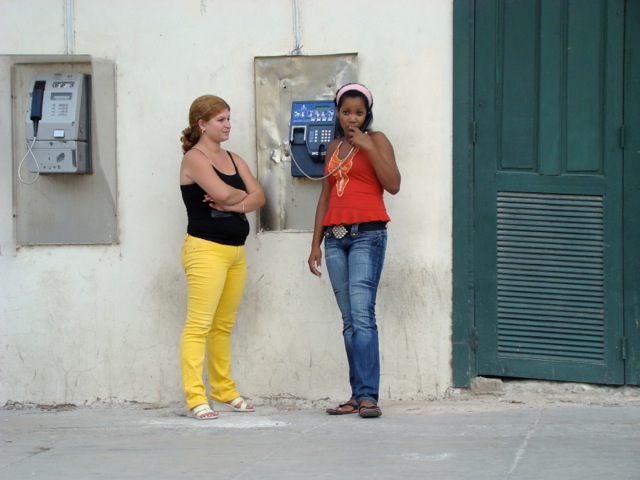
However, the most pointed criticisms involved the refusal by officials to increase the number of landlines and pay phones, restrictions which impact the poor, who cannot afford the cost of mobile phone service.

In interviews company directors distanced themselves from the serious financial problems facing ETECSA and its inability to made new investments in infrastructure. They say that most of its income, which is in the form of convertible pesos (CUCs), is spent just on subsidizing local phone service.

“Mobile phone service in Cuba costs 2.50 dollars a month,” says Hilda Arias, the aforementioned director of ETECSA’s cell phone services. According to Arias the company is obliged to offer double-airtime minutes to attract overseas customers due to the need for “fresh sources of hard currency.”

Sniffing around

A former ETECSA director, who requested anonymity, stated that in the 1990s a Telecom vice-president informed his Cuban partners that his company was willing to make the investments necessary to provide a landline to any Cuban who asked for one.

“At the time international calls were the principal source of ETECSA’s revenue and it was clear that increasing the number of domestic customers would increase profits,” he says.

“The company’s Cuban partners, however, were strongly opposed and agreed to only a modest expansion, with priority given to workers in healthcare and education. Assigning the remaining increase in capacity was left to the mercy of Revolutionary communities and organizations.

“Up till now,” says the former director, “Cuba has not even been able to double the capacity it had in 1959, when there were eight landlines for every hundred residents and it ranked 14th in the world in terms of telephone coverage.”

In contrast the former director points to the case of neighboring Haiti, which had a rate of phone coverage lower than that of Cuba. But because landlines and pay phones were considered obsolete, it successfully extended mobile phone service to nearly 85% of the population in a very short period of time.

Asking not to be identified, a former MININT official stated, “One of the justifications for slowing the growth of phone service in Cuba is that there is a requirement that any increase in private telephone coverage be augmented by an equivalent increase in the monitoring capabilities of the CIN, MININT’s counter-intelligence branch. The systems for telephone surveillance, known as K1 and K2, must have a capability of 100%, as was the case in the former East Germany.”

According to this source, internet use is also under surveillance. Monitoring, however, is not clandestine. State Security actually likes citizens to feel they are being watched.

“ETECSA has become a military organization,” says an anonymous worker. He is referring to the change in administrative structure under the aegis of GAE. “Now the old branches are called divisions and other department have been reclassified with names like Strategic Projects and Logistics.”

In spite of these changes, some ETECSA directors and workers are still dipping their hands in the till. As is the case in any given part of Cuba, corruption thrives in the absence of other financial incentives. Sources indicate that one distinctive feature of ETECSA is that it is the employees who previously worked at MINFAR and MININT who have proven to be the most corrupt.

Some ETECSA workers admit to having been shocked when Miamir Mesa, an engineer and former head of the company, was given a promotion and put in charge of the Ministry of Communications after a notorious corruption scandal which came to light in July 2010 involving Cubacell as well as Logistica, a firm with ties to foreign companies.

During his tenure at ETECSA he used and abused “means of collateral responsibility” for which company directors were called to account for irregularities and misdeeds by their subordinates.

The client is never right 

At the end of the October 25th broadcast of Cuba Says on NTV, a constituent from the Carmelo people’s council in Havana’s Vedado district — a man nicknamed “el Master” in reference to his level of college education — made a statement.

“No one has yet explained to me why Cubans complain so much,” he said. “A mobile phone contract costs 120 CUC but they have reduced it to 30. A nation’s mobile phone system is not some trinket meant to be sold on a street corner. ETECSA serves society and a society must work with the resources at its disposal. Let’s be clear. Mobile phone and internet fees are high but no one is taking money out of anyone’s pocket. We might pay 4.50 CUC for one hour of internet time but we might also get a surgical procedure for free that would cost $20,000 in the US.”

He added, “We Revolutionaries have not seen the need for an election in fifty-four years. To those non-conformists who have left for other parts, well, let them stay there.”

Pablo Pascual Méndez Piña

Diario de Cuba, November 18, 2013

*Translator’s note: The fee, roughly equal to five US dollars, is equivalent to 25% of the average monthly salary in Cuba.