As the results of their proposals have been the same, perhaps it makes no sense to discuss how they carried them out.
Fidel and Raúl Castro during the last session of the 6th Congress of the Communist Party / Cubadebate
14ymedio, Reinaldo Escobar, Havana, 26 April 2024 — Any attempt to theorize about methodological issues in the way of governing is usually dismissed when the results are the same. That is one of the reasons why the differences in method to exercise power between Fidel Castro and his brother Raúl are barely mentioned.
If I had to define Fidel’s method, I would reduce it to a single sentence: “We will go forward no matter the cost.”
Raul’s contribution is evidenced in his attempt to achieve “a sustainable (and prosperous) socialism” and his insistence on advancing “sin prisa, pero sin pausa” — without haste, but without pause.
Four years ago Raúl met with a large group of leaders from all political and governmental levels, and he warned them that waste and improvisation had to be eliminated and that they had to “have their feet and ears glued to the ground.”
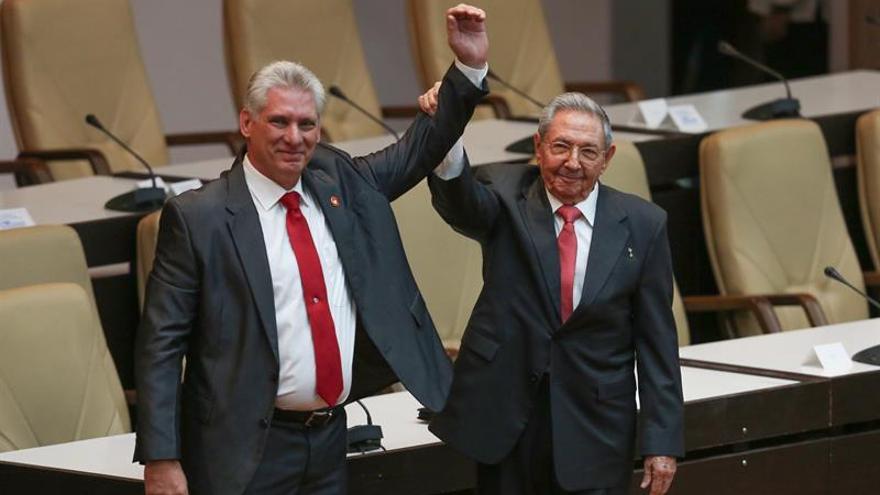
When in April 2018 Miguel Díaz-Canel assumed the position of president of the Council of State by appointment, Raúl Castro assured that this was part of a process of “gradual and orderly transfer.”
While it can be said that everything that happened in Cuba from 1959 to 2006 (especially the disasters) was the result of Fidel Castro’s indisputable voluntarism (everyone makes his own to-do list), it can also be said that the poor result of the reforms promoted by Raúl Castro from 2008 to the present is largely due to the slowness and lack of depth of their application.
As the results have been the same (I have my own list), it makes no sense to discuss the methodology.
But I make this observation:
If Fidel Castro had applied the nationalization of foreign companies in a gradual and orderly way, and his Revolutionary Offensive of 1968 would not have been decreed with the stroke of a pen but with his feet and ears on the ground…
If Raúl Castro, a chainsaw ready for action, had put an end to the inefficient socialist state enterprise and put the country’s economy into private hands, opening the doors to foreign investment…
The methdology wouldn’t have mattered.
Translated by Regina Anavy
____________
COLLABORATE WITH OUR WORK: The 14ymedio team is committed to practicing serious journalism that reflects Cuba’s reality in all its depth. Thank you for joining us on this long journey. We invite you to continue supporting us by becoming a member of 14ymedio now. Together we can continue transforming journalism in Cuba.
The outcome of any of the scenarios presented here is subject to Raul Castro’s ability to make decisions in April 2028, two months before his ninety-seventh birthday.
14ymedio, Reinaldo Escobar, Havana, 15 April 2024 — The most depressing arguments against the possible scenarios presented here actually taking place can be summed up in two popular expressions in plain and simple language: “You know that these people do whatever they want” and “anything can happen here at any time.”
Putting aside these truisms, another (though unlikely) scenario which would be one in which Miguel Díaz-Canel successfully completes a second term as president. In this instance, we must try to address what academics refer to as “the scientific problem” as expressed in the next question: Who will be appointed president of the Republic of Cuba in April 2028?
With four years to go, it seems premature to make predictions. However, this is the time when movement — or rather big shifts — could happen, leading to “the great designation” that will come as a no surprise to anyone.
In any presumably democratic country where presidential elections are held, speculation about the possible winner is based on how seemingly willing the electorate is to choose one candidate over several 0thers. To win the voters’ approval, politicians must campaign for office through the media and at public events. They offer campaign promises and eventually prevail over their opponents.
That simply does not happen in Cuba. Nominating commissions made up of organizations claiming to represent civil society but which are controlled by the Communist Party are the ones who nominate candidates for executive office. In the ten times that the National Assembly of People’s Power has met, not a single candidate has ever been rejected at the polls. It is the members of the newly chosen assembly who vote to approve the candidate proposed by the presidential nominating commission as President of the Republic.
The joke that bests reflects this situation would be one that asks, “What do polling results show?”
Current electoral law mandates that, to be president, a candidate must be a member of the National Assembly, no older than sixty at the start of his or her first term in office and no younger than thirty-five. Each continue reading
term is to last five years and no one may serve for more than two terms. These strictures are enshrined in the Cuban constitution.
Since the president is inevitably the Communist Party first secretary, it is obvious that the designee must be a party member as well as an official who already holds positions in the party and government, though that is not stipulated anywhere in writing.
Miguel Díaz-Canel’s second term in office ends in April 2028 so it is relatively easy to figure out who would meet the the age requirements by that date in order to be eligible. The data is publicly available. One need only type “Parlamento cubano” into the Google search engine and add a name.
The figures below are current as of April 15, 2024.
Of the 471 names currently on the roster of National Assembly members (this includes those who have died, resigned or been fired), only 348 would meet the presidential age requirements in 2028. To be more precise, of the current members, ninety-three would be over sixty years of age and thirty would still be under thirty-five by that date.
Members of the the eleventh National Assembly will be take office shortly before the next president is chosen. One can assume, however, that it is unlikely that a “new arrival” — a junior legislator — would be elected to high office. Therefore, any analysis or speculation about who the most likely candidates for president might be will have to be done based on the current list of Assembly members.
Of the 348 members who will meet the age requirement, one belongs to the Politburo and three to the Secretariat. Nine hold the post of first secretary of a provincial wing of the Communist Party. One is a deputy prime minister and another is a government minister. Fourteen are members of the Council of State, though four of them hold none of the other positions previously mentioned.
Keeping in mind that some of them hold more than one of the positions mentioned here, we are talking about twenty-seven potential presidents.
Of those twenty-seven, the ones who seem to have the best chances are these six members of the Communist Party Central Committee / Collage
Of those twenty-seven, the ones who seem to have the best chances are these six members of the Communist Party Central Committee:
Gladys Martínez Verdecia (1970), who is also a member of the Politburo and first secretary of the Communist Party in Artemisa province.
Joel Queipo Ruiz (1971), member of the Secretariat and head of its Economic and Productivity Department.
Jorge Luis Broche Lorenzo (1970), member of the Secretariat and head of the Department of Social Services
Félix Duarte Ortega Martínez (1974), member of the Secretariat and president of the National Association of Small Farmers.
Beatriz Johnson Urrutia (1969), first secretary of the Communist Party in Santiago de Cuba province and member of the Council of State.
Assembly member Susely Morfa (1982) could join the list if she does well in her new job.
The next four years could see promotions and dismissals that require significant revisions to this list. But the most radical reform, the one that could upend everything, would be a decision to change the age requirement.
With all that being said, let’s take closer look at the first two depressing realities mentioned at the beginning of this piece.
Article 228 of the Cuban constitution stipulates that,”when the reform refers to… the powers or the term of office of the President of the Republic… ratification is also required by a vote in favor by the majority of electors in a referendum called for such purposes.”
There is no obligation to put any changes to the age requirement to a referendum since only “the powers” and “the term of office” are explicitly mentioned, not the requirements. Therefore, it is older people, the ones already ensconced in powerful positions, who might entertain presidential ambitions. They might be tempted to promote this seemingly minor but decisive modification but they would have to propose it in the next four years, which is why it pays to be attentive.
Let’s say they propose raising the maximum age for a first-term president to seventy. That would still rule out the old guard, all in their eighties or nineties, but the pack of wolves highest up in the food chain would presumably still be in the running.
Of the thirteen apostles of continuity, these six members of the Politburo are first in line / Collage
Of the thirteen apostles of continuity, these six members of the Politburo are first in line:
Roberto Morales Ojeda (1967), who is also the Central Committee’s secretary of organization and deputy prime minister.
Lázaro Alberto Álvarez Casas (1963), major general and Minister of the Interior.
Ulises Guillarte de Nacimiento (1964), who is a member of the Council of State due to his position as secretary general of the Workers’ Central Union of Cuba.
Teresa María Amarelle Boué (1963), who is a member of the Council of State due to her position as the secretary general of the Federation of Cuban Woman.
Though several rungs down on the pecking order, these seven members of the Central Committee are worth keeping an eye on / Collage
Though several rungs down on the pecking order, these seven members of the Central Committee are worth keeping an eye on:
Inés María Chapman Wugh (1965), deputy prime minister.
Gerardo Hernández Nordelo (1965), national coordinator for the Committees for the Defense of the Revolution, member of the Council of State and Hero of the Republic of Cuba.
Jorge Luís Tapia Fonseca (1963), deputy prime minister.
Liván Izquierdo (1967), member of the Central Committee and Communist Party first secretary in Havana province.
Rogelio Polanco Fuentes (1966), member of the Communist Party Secretariat and chief of its Ideology Department.
Homero Acosta Álvarez (1964), Secretary of the National Assembly and of its Council of State.
José Ángel Portal Miranda (1967), Minister of Public Health.
Assembly member Luis Antonio Torres Iríbar (1965) could join the list if he does well in his next job.
If the National Assembly agrees to do away with the age limit, we could see the return of Machado Ventura or the rise of Elián González.
The outcome of any of the scenarios mentioned above is subject to Raul Castro still being able to make decisions in April 2028, two months before his ninety-seventh birthday. If he is unable to express his will as he did in 2018 with Miguel Díaz-Canel, one can assume that the process of appointing the next president could be more rules-based and subject to consensus.
But, as everyone knows, these people can do whatever they and anything can happen at any moment.
____________
COLLABORATE WITH OUR WORK: The 14ymedio team is committed to practicing serious journalism that reflects Cuba’s reality in all its depth. Thank you for joining us on this long journey. We invite you to continue supporting us by becoming a member of 14ymedio now. Together we can continue transforming journalism in Cuba.
It is not very credible that such a hierarchical corruption plot can be carried out without others noticing or knowing it.
14ymedio, Havana, Reinaldo Escobar, 8 March 2024 — An unusual “official note” made public the depth of the fall of Alejandro Gil Fernández, Cuba’s now ousted Deputy Prime Minister and Minister of Economy and Planning. Readers of the the Communist Party press already know that this headline discloses the most important information, but this note was not signed by a ministry or a state entity, but by the leader of the Government and the Communist Party of Cuba (PCC).
Miguel Díaz-Canel had congratulated Gil a month earlier on his 60th birthday and in another tweet, where the president was delicate with defenestrated ministers, including Gil, when he told them: “They gave their energies in very hard years for the country. They will have tasks to continue doing for Cuba.”
The March 7 note is obscure and imprecise. It does not reveal who was in charge of the “rigorous investigation” that determined the “serious mistakes” made by Gil in the performance of his duties. Later it adds that, given “the level of verification of the facts, and at the proposal of the Attorney General’s Office,” the Political Bureau and the Council of State approved that the Ministry of the Interior initiate “the corresponding actions for the clarification of these behaviors.” By the way, the mistakes made in the exercise of a position are not conduct or crimes.
Here you have to ask yourself not only who carried out the rigorous investigation but who approved it. Rumors point to a namesake of Alejandro, who, it seems, has the power to investigate without waiting for permission.
Although they are different cases, today the same questions that surrounded the so-called Case number 1 of 1989 are reopened.
The lack of precision becomes more evident when one tries to identify the nature of the facts with the mention of three generalities taken from a moral code: “corruption, pretense and insensitivity.” They are mentioned as part of the ethics of the Revolution that “has never allowed, nor will ever allow them.” The president (Díaz-Canel) lacked “revolutionary firmness” by limiting himself to these insinuations. continue reading
What is most heard right now in the streets of Cuba are questions, and the most frequent refer to whether other heads will roll below and even above the level of the accused former minister. It is not very credible that such a hierarchical corruption plot can be carried out without others noticing or knowing it.
Although they are different cases, today the same questions return as those that surrounded the so-called Case number 1 of 1989*, which began on June 14 with an informative note from Granma and ended on July 13 with the execution of the main characters involved.
If, under the accusation of breaking the stained glass window of a commercial establishment in the middle of a citizen protest, several people have been sentenced to prison terms of 12 or 15 years, what will be the request of the Prosecutor’s Office for Alejandro Gil and his accomplices? Will there be a public trial? Who is going to sign the next “official note”?
*Translator’s note: A reference to General Arnaldo Ochoa, who was found guilty of drug smuggling among other crimes and was executed by firing squad.
Translated by Regina Anavy
____________
COLLABORATE WITH OUR WORK: The 14ymedio team is committed to practicing serious journalism that reflects Cuba’s reality in all its depth. Thank you for joining us on this long journey. We invite you to continue supporting us by becoming a member of 14ymedio now. Together we can continue transforming journalism in Cuba.
Manuel Cuesta Morúa talks to 14ymedio’s Reinaldo Escobar about Parliament’s rejection of an amnesty law for political prisoners
14ymedio, Manual Cuesta Morúa/Reinaldo Escobar, Havana, 21 February 2024 — The Cuban Parliament recently rejected a request to process an amnesty law promoted by dozens of relatives of political prisoners. From that request, which the National Assembly classified as “inadmissible,” a broad debate was generated about the relevance or not of appealing to the Cuban regime’s own laws to promote change on the Island.
Manuel Cuesta Morúa talks about this with this newspaper. The opinion of this veteran dissident, based on the Island, addresses several of those aspects that we share with our readers.
Reinaldo Escobar/14ymedio: To legitimize or not to legitimize? Can you live under an authoritarian regime and refuse to accept all its official regulations and protocols?
Manuel Cuesta Morúa: It might seem cynical to say that the process of legitimizing dictatorships begins with the acceptance of the institutions that manage our existential or social condition. The misnamed “supply book” [ration book], the identity card and the passport are among those institutions through which the dictatorship regulates, controls and limits us, but which we accept. And not because we want to, but for two reasons: dictatorships are possible only if they institutionalize all social life. They are also obliged to incorporate language and certain democratic tools.
The misnamed “supply book” [ration book], the identity card and the passport are among those institutions through which the dictatorship regulates us.
RE/14ymedio. Why do they have that obligation?
MCM. Otherwise they have a serious problem of both internal and external legitimation. They have to appear to themselves and to others. For this reason, the legal and constitutional spaces that are left to the population so that they can become citizens are only conditions, almost inevitable obligations that dictatorships impose on themselves in order to be able to cross with a certain impunity the field and the game of appearances.
RE/14ymedio. So is it like a game of mirrors?
MCM. Exactly. They are not conditions that they impose on us, but rather institutional realities that they have no choice but to assume if they want to be accepted in some way. The dictatorship imposes some things on us by law, such as Article 5 of the Constitution, and others, the majority, outside continue reading
or manipulating the law.
RE/14ymedio. An example of some of those conditions within the law?
MCM. The requirement to have a voter certification to file a petition before the National Assembly, which may be similar to any other citizen authentication requirement in any genuine democracy. However, in the case of Cuba, this is an excessive barrier. However, it can be skipped if we impose on ourselves the exercise of strong citizenship.
RE/14ymedio. So do you recommend requesting voter certification?
MCM. Yes, I believe that applying for it is a step in our becoming civic citizens. We would not be playing into the hands of the dictatorship, which is not interested in appearance becoming reality, but in ourselves. They don’t even disseminate these legal paths.
RE/14ymedio. Do you think that the regime itself hides the existence of these channels?
MCM. Exactly. Does the Government speak on any radio or television program about laws such as 131, which includes the possibilities of civic responsibility? Do they systematically print the Constitution to distribute it — not sell it — in workplaces or schools?
RE/14ymedio. But wouldn’t using those paths be “playing into the hands” of the regime?
MCM. Judging by the responses to the Varela Project or the proposal for independent candidates in the elections for local People’s Power delegates, the Government did not believe, not even remotely, that it would play into its hands. The test of authenticity of civic alternatives lies in their ability to legitimize themselves, both within their own rules and within the conventional rules of society and the State. The real problem with dictatorships is that they always feel constrained when it comes to the rules of the game.
RE/14ymedio. You are among the promoters of a project that recommends using these paths. At what point is that project right now?
MCM. The process began in 2022 with the help of the Council for Democratic Transition in Cuba and the D Frente platform. Julio Ferrer, an independent lawyer, warned us that in March 2020 Law 131 had come into force, which regulates how signatures must be collected for any citizen initiative. A person has to start by going to the National Electoral Council to request certification of their voter status.
As cumbersome as it may seem and be, this is a step forward compared to the time of the Varela Project, when, once the first 11,000 signatures were delivered, the Government demanded the requirement that each signature had to be authenticated before a notary.
Before each incursion of ours, they raised the fence of the requirements to make our civic exercise more difficult.
RE/14ymedio. And have these certifications been achieved?
MCM. Obtaining them has been an odyssey. We start by going to the Municipal Electoral Councils. In some, after consulting with their superiors, they accepted our request and signed a copy as acknowledgment of receipt, others did not. It was all very irregular and that is why we went to the National Electoral Council, first to Ferrer to insist and finally obtain the first voter certification delivered in Cuba. Later, I investigated why the rest of the requests made in different provinces had not been processed.
RE/14ymedio. What did they answer?
MCM. A legal advisor told us that the processing had to be done in each Provincial Electoral Council. That’s what we set out to do, only to find out that it wasn’t at that level either. Before each of our incursions, they raised the hurdle of requirements to make civic exercise more difficult for us. So far, eight voters have received their certification among a dozen applications.
RE/14ymedio. Between criticism from your own side and bureaucratic obstacles from the other, the result seems quite uncertain?
MCM. Our determination is to continue jumping hurdles. From law to law, and from below, that is still the best path.
____________
COLLABORATE WITH OUR WORK: The 14ymedio team is committed to practicing serious journalism that reflects Cuba’s reality in all its depth. Thank you for joining us on this long journey. We invite you to continue supporting us by becoming a member of 14ymedio now. Together we can continue transforming journalism in Cuba.
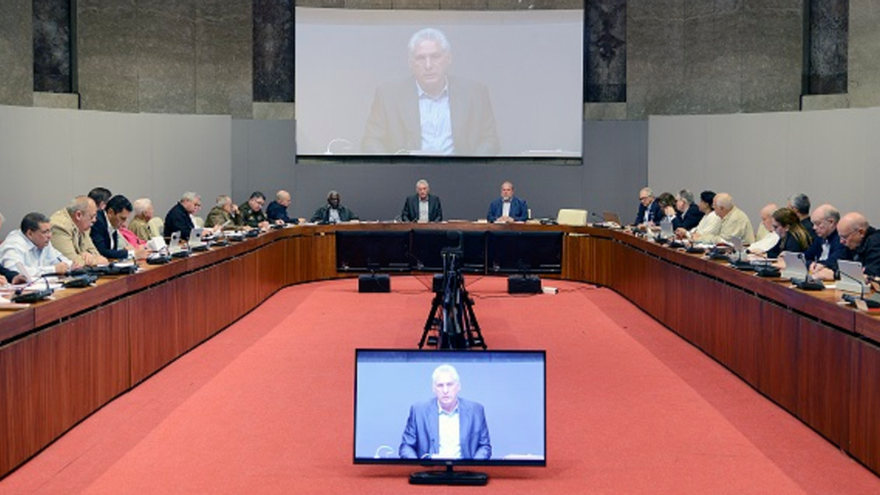
Meeting of the Council of Ministers chaired by Miguel Díaz-Canel in 2022. (Studies Revolution)
14ymedio, Reinaldo Escobar, Havana, 17 February 2024 — If it were possible to conduct a national survey without the participants being afraid to answer truthfully and with the guarantee that the results will not be manipulated, I dare to say that when asked, “Are you satisfied with the management of those who govern?”, we would see that the vast majority would mark the “no” box. If the question were more precise and investigated the popular will to carry out a profound change in the system, the same majority would mark the “yes” box.
I refuse to believe that all the people I talk to, those with who agree with me, in a bus, a taxi, a line or the privacy of their homes are lying when they show their disagreement with the rulers or when they project a new way of living in Cuba. In any case, if they were to lie, it would be to say that everything is fine and that socialism is the solution, but they would do it out of fear.
I have known many who believed in the project that was intended to build communism in Cuba and who today no longer believe in it, but I don’t know anyone who, having really been against it, have been convinced that the proposals of the only party allowed are the desired future for the country. There are many imposters among those who applaud, but the only ones who pretend are the State Security agents infiltrated into the opposition. continue reading
In any case, if they were to lie, it would be to say that everything is fine and that socialism is the solution, but they would do it out of fear
Communist Party militancy represents less than 9% of the Cuban population, but its presence in Parliament, in the Council of State and in the Council of Ministers exceeds 98%. These abysmal differences between a minority that rules and a majority that must obey are cemented in Cuba on apparent political differences, far from the entrenched divergences between Sunnis and Shiites that fractured Iraq or the ethnic conflicts between Tutsi and Hutu that ended with a genocide in Rwanda. Camagüey will never be separatist like Chechnya; the devotees of the Ocha Rule (UN Office for the Coordination of Humanitarian Affairs)* will not promote a massacre of Catholics; the war between blacks and whites that occurred in 1912** will not be repeated.
When those who occupy the seats in the spheres of power are a minority, they can only maintain their prevalence through force, expressed in the intimidating presence of repressive institutions, the political control of the judicial spheres and a network of collaborators dedicated to betraying and participating in acts of repudiation.
This structure can be corroded from below or from above.
Loyalty to historical nonagenarians is still the best currency to stay afloat
Here below you can see that, although many people continue to pay their fee as members of the Committees for the Defense of the Revolution (CDR), they only do it to keep appearances before a presumed “verification” to ascend at work, but no one is on night guard anymore, and the private businesses that pay better salaries than the State do not do verifications. The aspiration to emigrate, which entails the requirement to demonstrate a credible fear, far exceeds the ambition to be head of something in a State entity. The presidency of the CDR does not determine who is going to install a landline phone and, in short, with cell phones the communication issue is resolved.
“Up there” is where you can best see the masquerade dance. Loyalty to historical nonagenarians is still the best currency to stay afloat. But that minority that mostly occupies the positions in the chamber of power is composed of human beings who, no matter how cynical and opportunistic they are, realize that their commitment to those who rule is in contradiction to their responsibility to those they supposedly represent.
They are in the minority, and the majority realize it.
Translator’s notes: *Resolution 46/182 and other resolutions affirm that UN humanitarian assistance must be provided in accordance with the principles of humanity, neutrality, impartiality and independence from political motivations. **The “Little Race War” in 1912 was a series of protests and uprisings in Cuba, in which the Cuban armed forces put down a rebellion by black Cubans in the eastern part of the country
Translated by Regina Anavy
____________
COLLABORATE WITH OUR WORK: The 14ymedio team is committed to practicing serious journalism that reflects Cuba’s reality in all its depth. Thank you for joining us on this long journey. We invite you to continue supporting us by becoming a member of 14ymedio now. Together we can continue transforming journalism in Cuba.
As is common knowledge, major decisions cannot be made in Cuba before consultations with and approval from the trio of nonagenarians who hold the reins of power. (Cubaenvivo.net)
14ymedio, Reinaldo Escobar, February 2, 2023 — The economic measures that were widely dubbed “el paquetazo“* — the package — were unpopular but necessary. Even from a coldly economic perspective, however, they seemed to be too little too late.
As is common knowledge, major decisions cannot be made in Cuba before consultations with and approval from a trio of nonagenarians — Raúl Castro, Ramiro Valdés y José Ramón Machado — who hold the reins of power. Once they have signed off, then the politburo weighs in, followed by the Communist Party Central Committee and lastly the complacent legislature, at which point the Council of Ministers is only too happy to give its approval.
What could the triumvirate’s motivation be? This is almost impossible to know. They are driven by factors both biological and ideological, and by family commitments, about which we can only speculate. Where Gil ultimately ends up in the Cuban political hierarchy now that he is no longer economics minister is still unknown. This raises the question of whether he was fired or has “failed up” as those whose job performance is lacking yet who still manage to climb the ladder of power are jokingly described. continue reading
The nonagenarians may have calculated that, if the package’s measures took effect right now, the resulting social upheaval could occur before their ultimate biological hour of reckoning arrived
Perhaps Gil was too cautious and Cuba’s khaki-clad leaders needed a figure who could convey greater speed and toughness in implementing the measures. Or perhaps his name became too quickly associated in the public’s mind with an acceleration of economic reforms and this set off alarm bells in the older generation, whose hands still steer the ship of state.
Maybe this is just one round in a complex boxing match. This time, the almost hundred-year-old guardians of orthodoxy have won, ejecting a technocrat from the ring. He has been knocked out an apparatchik, but that does not rule out future fights. What has become clear is that the Cuban leadership no longer seems as rock solid as it once was. It cracks under pressure and sends the public an unfortunate message: uncertainty.
If this was a fight between anxious traditionalists and bureaucrats worried about economic asphyxiation — officials who were looking for small ways to preserve the system but ventilate it financially — the traditionalists have won. Gil’s departure may be celebrated, but it could be the worst news for Cuba’s short-term future. They used him as a scapegoat but that does not stop inflation, nor does it revalue the peso much less improve what is served on Cuban dining tables.
But if the obdurate traditionalists have won this round, we must know why.
The nonagenarians may have calculated that, if the package’s measures took effect right now, the resulting social upheaval could occur before their ultimate biological hour of reckoning arrived. Prolonging the agony of the country and its people in exchange for not having to pay in life for the consequences of a disaster for which they are completely responsible illustrates the depth of their selfishness.
Perhaps the settling of scores is not over. As the popular saying goes, “the goat that breaks the drum pays with its skin.” Especially if he is a scapegoat.
*Translator’s note: “Paquetazo” is basically ‘package’, but the ending ‘azo’, signifying a blow, adds a certain heft to it. (See “Maleconazo“) See also from Spanishtogo.app: “Paquetazo, a term used predominantly in Latin America, refers to a package of economic reforms implemented by the government that often includes a series of austerity measures. Over time, it has become a popular term among citizens to express discontent with these policies.”
____________
COLLABORATE WITH OUR WORK: The 14ymedio team is committed to practicing serious journalism that reflects Cuba’s reality in all its depth. Thank you for joining us on this long journey. We invite you to continue supporting us by becoming a member of 14ymedio now. Together we can continue transforming journalism in Cuba.
Cuba’s vulnerable and the millions of workers who depend on a state wage are already living on the edge (14ymedio).
14ymedio, Reinaldo Escobar, Havana, 28 September 2023 — The topic of the upcoming hardships starting on October 1st no longer qualifies as a rumor, much less as a “counterrevolutionary lie”, now we know, from the word of those who make decisions, that it is true that there will be new problems with transportation, food distribution and electricity generation. New problems that will add to the already existing ones.
During an hour and a half on Wednesday’s Mesa Redonda [Roundtable] program, the Vice Prime Minister and Minister of Economy, Alejandro Gil Fernández, along with the Minister of Energy and Mines, Vicente de la O Levy, explained why there will be new difficulties, but failed to mention possible solutions other than “the will to move forward”.
According to Vicente de la O Levy, 99% of the causes that affect us come from the “blockade” and only 1% can be related to the bad work of the government. For Alejandro Gil Fernandez, the solutions will be within socialism. continue reading
“If the possibility of changing the system is not addressed, 99% of the causes that prevent the country from functioning normally will prevail”
The present and the future of the country are projected on these two apparently immovable columns. The official propaganda maintains that “the blockade” exists because socialism is being built here in Cuba and the United States does not like that. Therefore, if the possibility of changing the system is not addressed, 99% of the causes that prevent the country from functioning normally will prevail.
It is hard to imagine that everything will get worse after October and it is even harder to detail the consequences that a worsening of the country’s economic situation will bring to the people. For that fantasy called “the ordinary Cuban”.
The parents who rack their brains every day to guarantee a little snack for the children who go to school, those who take care of the elderly or disabled people, those who left their remote municipalities to find something better in the capital, but who do not even have a ration book and every month have to pay the rent; the bricklayer who works on his own and almost always lives far from where he is offered a temporary job; the single mothers, the retired person without family support…. These and the millions of workers who depend on a state salary are already living on the edge and the ministers tell them that they need to be understanding.
To dispel foreboding, Gil assured that this will not be the collapse, and that we will not reach “zero”. He also assured that not one millimeter will be ceded in the commitment to build socialism, but he did not dare to mention any metaphorical unit of measure to indicate how far or how close we are to catastrophe.
Translated by: Dylan Roberts, Isabella Posoli, and Skyler Brotherton-Julien, as part of Spanish 321 (University of Miami)
____________
COLLABORATE WITH OUR WORK: The 14ymedio team is committed to practicing serious journalism that reflects Cuba’s reality in all its depth. Thank you for joining us on this long journey. We invite you to continue supporting us by becoming a member of 14ymedio now. Together we can continue transforming journalism in Cuba.
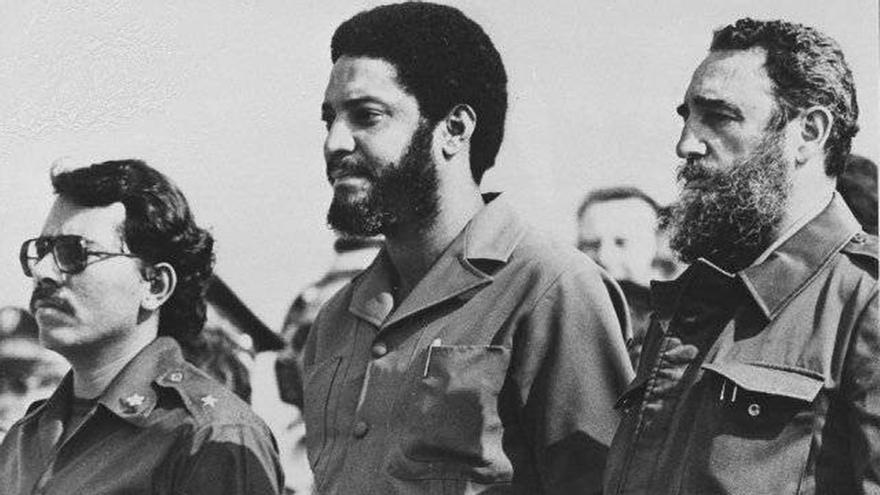
Granada’s First Minister Maurice Bishop (center) with Fidel Castro (right). Daniel Ortega is on the left. (TVCubana.ICRT.CU)
14ymedio, Reinaldo Escobar, Havana, 25 October 2023 — All the data is on the internet: how many Cuban soldiers died in Granada, how many surrendered, the weapons of the 82nd US division, the fight between Ronald Reagan and Margaret Thatcher over the invasion, the importance of the airport… but not everything has been told.
At noon in the last week of October 1983, while we were watching the Cuban National Television News, shortly after having lunch in the dining room of the ICRT (Cuban Institute of Radio and Television) microbrigade that was building the Yugoslav model building where I still live, we heard the terrible news that the last Cubans fighting on that small island had immolated themselves wrapped in the flag with its single star.
The news was particularly terrible for us, because among those soldier-masons were two of our companions, Fidelito and El Gordo, who had “stepped forward” to participate in the mission to build an airport in Granada.
At that hour the work was halted and we divided into two groups to visit the relatives of our fallen colleagues, above all to tell them, to swear to them, that their apartments, once the building was finished, were guaranteed, that we would see to it that they were handed over to them. continue reading
The news was particularly terrible for us, because among those soldier-masons there were two of our companions, Fidelito and El Gordo
A few days later it was learned that the news was not true, that perhaps our companions had not died and that we only had to wait for the contingent to return to count them among the living. And so it was.
My friend Pirole, a photographer for the magazine Cuba Internacional, installed a camera with a tripod in his house in front of the television that broadcast the reception of those who returned. “That, that’s Fidelito,” I told him, and we managed to immortalize him while Fidel Castro shook his hand on the airport tarmac, just below the steps of the plane that returned him safe and sound. The photo was my gift to the surviving hero.
A week later El Gordo (whom I was unable to immortalize) and Fidelito gave a “private press conference” to their supportive colleagues from the microbrigade.
Fidelito, who had not yet fathered that pair of twins whom he named Fidel and Raúl, told us how he and Colonel Tortoló entered the embassy of the Soviet Union in Granada. I quote from memory: “They didn’t want to let us in because we were armed and a tense situation arose in which neither the bolos [Russians] nor Tortoló gave in, until an agreement was reached to enter through the kitchen door where there was a closet where we had to deposit our weapons, with the commitment to recover them when we were able to leave.”
El Gordo, so witty, told us that, when they raised the combat alarm to occupy the positions they had planned ahead of time, the heroic Cuban combatants had the perception that they would never return to that camp. They were absolutely right, because those facilities were razed. And for that reason, before leaving the site they took to their military artillery site whatever ’little thing’ that each one could save and transport.
They didn’t want to let us in because we were armed and a tense situation arose in which neither the ’bolos’ [Russians] nor Tortoló gave in, until an agreement was reached to enter through the kitchen door
They had received the order not to fire unless they were attacked, and again I quote from memory: “From our cannons we observed how the Marines grouped themselves in combat formations, we heard the noise of their weapons and we saw them advance towards us without firing, until we had them in front of us saying in Puerto Rican Spanish ’Hands up.’”
“Then you told him aquí no se rinde nadie [here no one surrenders]*,” the secretary of the Communist Party in the microbrigade told El Gordo. “No, it didn’t occur to me, what happened was that they stopped us and searched us. I had my hands up and a Marine bigger and fatter than me, checking that I wasn’t carrying another weapon, touched my back pocket. With great care and without ceasing to point his rifle at me, he took out of that pocket the only ’little thing’ I’d been able to save: girl’s underwear for my daughter in Cuba. In Puerto Rican English and without pointing at me he said: ’Excuse me, sir.’ I didn’t know whether to feel grateful or humiliated.”
Forty years have passed. Fidelito lives today in Miami with his twins and El Gordo decided to take advantage of his five-year visa to wait with his entire family for parole on the other side. That Granada airport no longer constitutes a threat to anyone and those apartments that we swore to safeguard now have new owners. None of this appears on the internet, until now, but I, who am still in Havana, keep it in my memory.
*Translator’s note: ‘Aqui, no se rinde nadie’ — Here, no one surrenders — is an iconic phrase of the Cuban Revolution commonly attributed to Juan Almeida Bosque.
____________
COLLABORATE WITH OUR WORK: The 14ymedio team is committed to practicing serious journalism that reflects Cuba’s reality in all its depth. Thank you for joining us on this long journey. We invite you to continue supporting us by becoming a member of 14ymedio now. Together we can continue transforming journalism in Cuba.
Fernando Vázquez honed his skills as a communicator in the days he hosted shows for tourists at the Hemingway Marina, an occupation he took up after working in Argentina. (14ymedio)
14ymedio, Reinaldo Escobar, Miami, 31 July 2023 — Dr. Fernando Vázquez is not recognized in Cuba for his skill as a doctor but for his courage as an activist for the cause in support of political prisoners. In the middle of this hot summer and harassed by the political police, he opens his doors to 14ymedio to talk about his peculiar life path that goes from Public Health to tourism to finally leads to civic action.
Even today it is possible that his neighbors omit the information that Vázquez is a doctor and limit themselves to saying that he works as a gardener in the building where he lives in El Vedado or that he sometimes sells avocados. They will hide his profession because Cubans who have a medical degree are prohibited from working in activities related to tourism and he asked them for discretion on that issue when he aspired to be a tourist entertainer when, in 200 he canceled his employment ties with the Ministry of Public Health.
His experience as a doctor began in 1990 when he was sent on an “internationalist mission” in Livingstone, Zambia.
“When we landed at the Lusaka airport, I was moved to see that officials from the Cuban embassy were waiting for us just at the bottom of the steps of the plane. I thought they were to welcome us, but no. They were only there to take our passports because the regulations prohibited us leaving the city to which we would be assigned.” continue reading
As an activist for the release of political prisoners, Vázquez carried out his first public action on June 14 of this year when, after announcing it on his Facebook wall, he attempted a peaceful march from Lennon Park, on 17th Street, between 6th and 8th, in the Plaza de la Revolución municipality, to the offices of the prisons department of the Ministry of the Interior, in the same neighborhood of El Vedado.
“Although I did not call out to anyone, the State Security agents who detained and interrogated me warned me that I could be prosecuted for the crime of incitement to commit a crime. The document that I wanted to hand over was not only brief but mild, almost sweet, where it implored them, begged them, those who are holding the July 11 protesters in prison to release them as soon as possible.”
In his frequent speeches on Facebook, Vázquez insists that all his activities are motivated by strictly personal motivation. “I don’t belong to any political organization,” he repeats every time. On his broadcasts he conducts himself with ease, he never seems irritated and, unusually, pronounces every letter in every word.
His skills as a communicator were honed in the days when he hosted shows for tourists at the Hemingway Marina, an occupation he took up after working in Argentina.
“I left for Argentina in 1995 as a tourist, after the polyclinic where I worked gave me a permit for a month. There I managed to get hired as a consultant in a clinic, but at that time, according to Cuban immigration laws, I could not be out of the country for more than eleven months. When I returned for the first time, with the intention of not losing my rights as a Cuban, I learned that in order to leave again I needed another permit signed by the minister. That is how I stopped having a working tie with the Ministry of Public Health. Why didn’t I stay to live there? Because I wanted to be with my mother in her last years of life and because my heart is still here, especially in las Minas de Matahambre, where I lived as a child.”
Vázquez doesn’t just talk in front of a camera. Since he defended the freedom of political prisoners, he has visited the relatives of many of them. He has knocked on almost all the doors in the La Güinera neighborhood where a protester was murdered by a police officer, he traveled to Santiago de Cuba to get to know José Daniel Ferrer‘s family up close in the Altamira neighborhood, and he has given a voice to mothers and wives of several political prisoners. On Monday, July 24, he sat on the Malecón in Havana and prayed for freedom. State Security warned him that if he does it again he will be prosecuted for disobedience.
Many of his numerous followers highlight the quixotic nature of his actions, but if Alonso Quijano went mad from an overdose of reading novels of chivalry, Dr. Vázquez sustains his behavior in other readings that have nourished his lucidity. There, all the works of José Martí and the Sermon on Mounts of Jesus of Nazareth have a special place, but also Gandhi, Emerson, John Ruskin, Tolstoy and Henry David Thoreau, who taught him the concept of civil disobedience.
“If I had to define myself in a few words, I would say that I am a peaceful disobedient willing to pay the consequences for fighting against injustice.”
____________
COLLABORATE WITH OUR WORK: The 14ymedio team is committed to practicing serious journalism that reflects Cuba’s reality in all its depth. Thank you for joining us on this long journey. We invite you to continue supporting us by becoming a member of 14ymedio now. Together we can continue transforming journalism in Cuba.
Vladimiro Roca was a MIG pilot who filled us with admiration with his stunts in the skies of Cuba. (EFE)
14ymedio, Reinaldo Escobar, Havana, 30 July 2023 — I met Vladimiro Roca in mid-1963. At that time I was a student-soldier at the San Julián Base located in the westernmost part of Pinar del Río. Vladimiro was a MIG pilot who filled us with admiration with his stunts in the skies of Cuba. Then he was just “the son of Blas Roca” who shared his status with Carlos Jesús Menéndez, another pilot who was the son of the Jesús Menéndez, a union leader and politician in the sugar sector.
I heard from Vladimiro again in 1996 when they were trying to hold the Cuban Council to bring the opposition ranks to an agreement. A year later, together with Martha Beatriz Roque, René Gómez Manzano and Félix Bonne, he signed a document known as La Patria es de Todos [The Homeland Belongs to Everyone] that cost him five years in a maximum security prison. Until that moment I had never spoken to him.
In 2003, when I was working as Editor-in-Chief of the digital magazine Consenso, I interviewed him at his home. It was only from that moment on that I was able to discover his human quality, his knowledge of the national reality and his genuine willingness to work for the future of this country.
Later we ended up coinciding in different events in Cuba and abroad, where I was able to realize his strong character and his predisposition to defend his beliefs in a courageous and sometimes defiant way.
Vladimiro has been afflicted by the consequences of what he has experienced in 80 years of life. The penultimate news I had of him was his admission to a hospital with a pessimistic prognosis. Since then I kept hoping that he would manage to improve his state of health but I know that since then he was ready to say goodbye.
Neither he nor I believe very much in the legend that people go to heaven, but I see him there, having fun while doing daring pirouettes in the sky.
____________
COLLABORATE WITH OUR WORK: The 14ymedio team is committed to practicing serious journalism that reflects Cuba’s reality in all its depth. Thank you for joining us on this long journey. We invite you to continue supporting us by becoming a member of 14ymedio now. Together we can continue transforming journalism in Cuba.
Carlos Alberto Montaner would have been the best president of the Republic of Cuba at any moment when there might have been a transition to democracy. (Photo capture from YouTube)
14ymedio, Reinaldo Escobar, Havana, 30 June 2023–“What qualifier should I use to win the title of top toady?” I asked Carlos Alberto Montaner one day. “Illustrious,” he replied, and we could not stop laughing.
I met him in 1996 during my first trip to Spain. I called the number for the Playor editorial offices and a secretary transferred me to him. “I am a Cuban journalist passing through Madrid, and I would like to speak with you,” I said by way of introduction. Following a brief pause he replied, “I’ll expect you here tomorrow afternoon.”
Being that Montaner was in the top tier of “enemies of the Revolution,” I assumed that before entering his office, located near the Puerta del Sol square, his bodyguards would search me and that certainly there would be cameras monitoring my visit. But such was not the case. Montaner himself opened the door and invited me into his office. “Do you work for Granma?” he asked, and when I told him that I was an outcast from official journalism, he made the first joke that started the bond of humor we shared: “Then I’ll notify the Marines and the CIA that they can call off the operation.”
At the conclusion of that first encounter, he invited me to have a coffee at a nearby kiosk, where he confessed to me that this act — which he would repeat every day — was his therapy against nostalgia for Cuba. continue reading
I have read all of his books and most of the articles he published throughout his long career. Every time we would meet in Miami or Madrid he would ask me specific questions about Cuban issues, of which he was always deeply informed. For many, including myself, he would have been the best president of the Republic at any moment there might have been a transition to democracy. Once, when he was in his seventies, he said that he he was already too old to aspire to such political responsibilities. In May of this year, already having lived to 80, and suffering from a cruel disease, he retired from the mission of writing columns.
Today I have learned that he will never be in Havana celebrating with friends the end of the dictatorship. If I get to witness that outcome, I promise to raise a glass to him — for his ideas, for his courage, and for his brilliant intelligence.
Goodbye, my illustrious friend.
Translated by: Alicia Barraqué Ellison
____________
COLLABORATE WITH OUR WORK: The 14ymedio team is committed to practicing serious journalism that reflects Cuba’s reality in all its depth. Thank you for joining us on this long journey. We invite you to continue supporting us by becoming a member of 14ymedio now. Together we can continue transforming journalism in Cuba.
Yosvany Rosell García Caso was sentenced to 15 years in prison for sedition. (Courtesy)
14ymedio, Reinaldo Escobar, Havana, 31 May 2023 — Before July 11, 2021, Yosvany Rosell García Caso spent his days between working as a welder and rearing his three children. That Sunday his life took a turn when he joined the mass protests in Holguín. Six months later, he was sentenced to 15 years in prison for sedition. Wednesday marked his 20th day on a hunger strike, demanding his immediate release.
“My husband has lost a lot of weight and he is very frail; he barely weighs 55 kilograms after so many days without a taste of food,” Mailín Rodríguez Sánchez tells 14ymedio. “On May 29th they transferred him from the Cuba Sí prison in El Yayal to the Lucía Iñiguez Landín Clinical Surgical Hospital.
“He is refusing intravenous hydration,” adds Rodríguez, who spoke with her husband to “try to get him to change his position.” However, 34-year-old Rosell was determined to “continue the hunger strike because he is tired of having his rights, and that of other 11J prisoners, continuously violated.”
“I understand him perfectly, but he is in a situation where he could lose his life and that worries me greatly,” says the anguished woman. Rosell began the hunger strike on May 11, following an incident where prison authorities denied him a visit from his wife and his three children, and as the days passed he expanded his demands to include his release as soon as possible.
“We have three children five, six and 14 years old. The younger ones are aware of what is happening with their father, but the oldest does know everything,” explained Rodríguez to us. “Since yesterday my daughter is asking me to go see her father and we are making arrangements so she can visit him in the hospital. I hope she will talk to him and get him out of the position he is now in.” continue reading
Since he began the hunger strike, the woman, desperately, has gone to the prison on four occasions, but they did not allow her to see him and they did not even allow him religious attention. “After much begging they only let me see him yesterday at midday when he was already in the hospital. Today I am going over there again to see if they will let me in,” she said.
Rodríguez says that the damage is not only emotional or physical, “In addition to violating his human rights, the family has lived through two very difficult years, because he was the breadwinner. We’ve suffered repression and an economic hit for his being in prison. He, working as a welder and blacksmith, provided for the family.”
This is not the first time Rosell is on a hunger strike. In February 2022, he did not eat while demanding that he not be transferred from Holguín to a prison in Cienfuegos and demanding improved conditions in prison. At that time, he had been the victim of suspended telephone calls or being kept in isolation.
Several months later, in July of last year, Rossell once again resorted to a hunger strike after being beaten for dressing in white in remembrance of the mass protests on 11J.
“I do not regret anything in the least bit. How could I regret wanting to see my country free of a communist dictatorship, which for more than 60 years, has subjected us to extreme misery and violated all our human rights? That blessed July 11th not only marked a before and after the beginning of the end of communism in Cuba, it also showed the worst face of the dictatorship,” he wrote in a letter shared on social media weeks earlier.
Translated by: Silvia Suárez
____________
COLLABORATE WITH OUR WORK: The 14ymedio team is committed to practicing serious journalism that reflects Cuba’s reality in all its depth. Thank you for joining us on this long journey. We invite you to continue supporting us by becoming a member of 14ymedio now. Together we can continue transforming journalism in Cuba.
The press can only be the State press or, failing that, the one that the State can control. (14ymedio)
14ymedio, Reinaldo Escobar, Havana, 26 May 2023 — The entry into force of the Social Communication Law and its corresponding regulations will have consequences from which there is no way to defend oneself.
If the deadlines of 120 days for the Law to enter into force are met and the subsequent 120 days for the Council of Ministers to approve the corresponding regulatory provisions, it can be predicted that in January 2024 no one who lives or transits through the national territory, whether Cuban or foreign, will be able to freely generate content that could be considered capable of subverting the constitutional order and destabilizing the socialist State.
It is already known how susceptible those who rule in Cuba are when it comes to processing criticisms when they are not made “in the right place and at the right time.” The main red lines will continue to be the legitimacy of the rulers, the viability of the system and the action of the repressive apparatus, and not only that. Protesting the inefficiency of the Etecsa monopoly, civilly calling for the repeal of a law or the dismissal of a minister will continue to be seen as part of “the communicational aggression that is taking place against the country.”
It would be naive to appeal to some deceptive paragraph of the law where social communication is defined as a sociocultural process that “contributes to social interaction, the production of meaning, the configuration of individual and collective identity, dialogue, debate, popular participation and consensus.”
Those propositions only make up censorship or, to put it in popular language, they are dribble, babble and nonsense, which are combined with ambiguous terminology that requires a translation to understand their meaning. continue reading
For example, Article 29.4 in the chapter referring to social communication in the media field, where it says: “The creation of these means (the non-fundamental ones) is excluded when their management is proposed as the constitutive activity of the social object or work project of a non-state economic actor.” This translates as: “A non-state actor is prohibited from having an independent medium as his main social object.”
We journalists who collaborate with the independent media will have three alternatives: face the consequences and continue publishing from Cuba with name and surname, go underground with the subterfuge of modifying our style and using a pseudonym, or withdraw from the profession. The first is reckless, the second is dangerous, the third is unworthy.
If the Cuban regime manages to get rid of the rebellious presence in the media, if it manages to eliminate video transmissions and uncomfortable comments on social networks, if in its delirious totalitarian ambitions it conquers that redoubt of minimal resistance that is to interact by giving a “like”; if this law reaches its purposes, the people would be mute, and although the dictatorship has never wanted to listen, now it would not even be able to hear. It would end up deaf.
Translated by Regina Anavy
____________
COLLABORATE WITH OUR WORK: The 14ymedio team is committed to practicing serious journalism that reflects Cuba’s reality in all its depth. Thank you for joining us on this long journey. We invite you to continue supporting us by becoming a member of 14ymedio now. Together we can continue transforming journalism in Cuba.
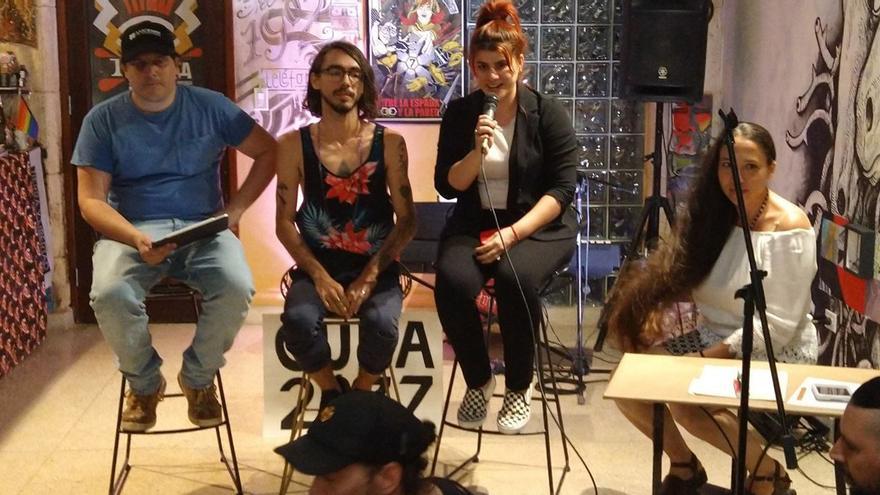
From left: Camilo Condis, Maykel González Vivero, Lucía Marcha and Yadira AlBet. (14ymedio)
14ymedio, Reinaldo Escobar, Havana, 2 April 2023 — On this first Saturday of April, colleagues of El Enjambre [The Swarm] podcast celebrated the end of its sixth season and the announcement that, no later than in a couple of weeks, the seventh season will begin.
This weekly space was inaugurated in October 2019 as part of El Toque project and became independent in October, 2022. Under the constant threat of censorship, the program discusses political, economic and social issues seriously, and at times lightheartedly.
Seated in front of a group of followers in the main hall of La Marca, in Old Havana, filmmakers of this podcast recreated anecdotes, answered questions and offered statistical data on the composition of their audience, which is mostly young and based in Cuba. Resembling themselves, there were debates, live music and a nice amusing moment about what the elections in Cuba would be like in 2077.
Under the constant threat of censorship, the program discusses political, economic and social issues seriously, and at times lightheartedly
Asked about the future of El Enjambre, Camilo Condis told 14ymedio : “We know that it will be hard to continue because the difficulties that are coming are those that creators in Cuba, not working under an official institution, have to face. They are the same limitations that all of us face, but we’ll carry on.”
Maykel González Vivero, who joined the team in its fourth season, is a promoter of balance. He says that “it’s very boring when everyone is discussing something they agree on”. On the other hand, in contrast to Camilo Condis, “so pragmatic and clinging to the facts, to the numbers”, Maykel chooses to present himself as “more qualitative”.
El Enjambre is seen in official circles as too critical and, at the opposite end, as too trivial. The truth is that behind each installment there is painstaking professional work and the intention of opening a gap to expose and debate the main events of each week and the long-term problems that the country is suffering.
Translated by Norma Whiting
____________
COLLABORATE WITH OUR WORK: The 14ymedio team is committed to practicing serious journalism that reflects Cuba’s reality in all its depth. Thank you for joining us on this long journey. We invite you to continue supporting us by becoming a member of 14ymedio now. Together we can continue transforming journalism in Cuba.
The first secretary of the Communist Party of Cuba and former president Raúl Castro raises the arm of Miguel Díaz-Canel after his appointment in 2018. (EFE/Alexandre Meneghini)
14ymedio, Reinaldo Escobar, Havana, 14 April 2023 – “If they remove the one who is there, who are they going to put in?”
In these terms of interchangeability, as if talking about a spare machine part, many people consulted by 14ymedio venture to discuss whether Miguel Díaz-Canel — will be re-elected on April 19 – or, more accurately, re-appointed — to occupy the position of President of the Republic.
When asked if this is what is most likely to happen, most of those consulted agree that it is, that repetition seems inevitable. But nuances arise when the question is raised regarding whether it is convenient for the interests of the dictatorship.
On the one hand, it is argued that “up there” they must be aware of the degree of discontent that the population has with the management results of the current occupant of the job, even though the majority of the dissatisfied have the perception that he is not the one who decides the measures but rather the one who meekly executes them. continue reading
To put in another person could open the hope of substantial changes, but for that the new figure would have to refrain from pronouncing the word ’continuity’, which has been due north in the compass of the job’s current occupant. In any case, the designation of a new character would not be to make changes, but to buy time.
On the other hand, there is a perception that removing Díaz-Canel would be an acknowledgment of the resounding failure of his administration and, therefore, of the decision of Raúl Castro, who was ultimately the one who put him in office. Díaz-Canel’s success is summed up in having opted for continuity. He has gotten on well with Raúl, although he has gotten on badly with the population. And if Raúl Castro continues to be the voice that calls the shots in Cuba at this level of decision-making, Miguel Díaz-Canel will begin his second presidential term, despite everything.
If Díaz-Canel falls, it is said, it could be a sign that Raúl Castro is no longer the one who decides or that, despite his 91 years, he has the capacity to realize that the ’baby of the family’ has not managed to achieve the prosperous and sustainable socialism that he promised when he was left in charge of the ship.
But the most disturbing question remains: if they remove the one who is there, who are they going to put in his place? According to the constitution, the person must be a deputy and under 60 years of age. The list is short and putting in an unknown person would show even more that we live in a country where citizens find out who is going to be their president without first having known who the candidates were.
In these so-called elections there will be no winners. We will all be defeated.
____________
COLLABORATE WITH OUR WORK: The 14ymedio team is committed to practicing serious journalism that reflects Cuba’s reality in all its depth. Thank you for joining us on this long journey. We invite you to continue supporting us by becoming a member of 14ymedio now. Together we can continue transforming journalism in Cuba.

 14ymedio, Reinaldo Escobar, Havana, 26 April 2024 — Any attempt to theorize about methodological issues in the way of governing is usually dismissed when the results are the same. That is one of the reasons why the differences in method to exercise power between Fidel Castro and his brother Raúl are barely mentioned.