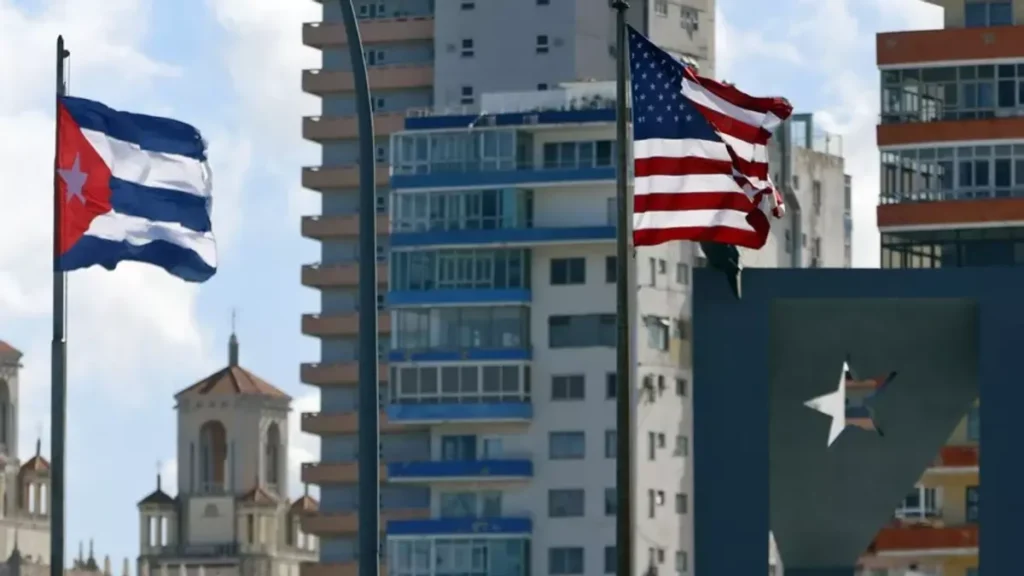
 14ymedio, Madrid, November 24, 2026 / Two U.S. Democratic congressmen sent a letter to Miguel Díaz-Canel on November 18 asking him to release more than 200 political prisoners in order to unblock talks between the two countries, which have shown no signs of progress for months.
Gregory Meeks, a representative from New York and member of the House Foreign Affairs Committee, and Joaquín Castro, a congressman from Texas, signed the letter, which USA Today obtained.
“Although no single measure can resolve the longstanding differences between our countries, this could go a long way toward building trust and creating political space for real progress that could ease the humanitarian crisis that nine million Cubans suffer through every day,” it states.
“Although no single measure can resolve the longstanding differences between our countries, this could go a long way toward building trust”
The two Democratic politicians are urging the release of those “more than 200 political prisoners whose cases have been discussed in recent exchanges between Cuba and the United States,” underscoring that, as has been reported throughout this year, the prisoner releases have been one of Washington’s demands.
USA Today mentions the release from prison of Luis Manuel Otero Alcántara last July as one of the highest-profile releases, although it does not indicate that the artist served his full five-year prison sentence. In fact, the activist remained in hiding from State Security for several days after completing his sentence, until he left Cuba for Miami.
The outlet does recall that Maykel Castillo ‘Osorbo’ remains in prison—he still has more than three years left on his sentence—and that there are more than 1,300 political prisoners in similar circumstances.
The letter sent by the Democratic congressmen recognizes the economic reforms as positive, particularly those that expand the role of the private sector. “The task now must be to build on this opening, with lasting steps that improve the lives of the Cuban people, ease the humanitarian crisis, and open a path toward opportunity and prosperity for all,” they state.
According to USA Today, the letter seeks to get things moving in talks that have stalled and could become more turbulent in the future. Many analysts have recently pointed out that, following the Republican Party’s heavy losses in the midterm elections, Trump might attempt military action in Cuba to secure a victory.
With a bogged-down war in Iran that has left devastating consequences for the U.S. economy—one of the factors that, according to polls, weighed most heavily in the overwhelming vote for Democrats—bringing about regime change on the Island, something all U.S. presidents have pursued over the past 60 years, is a very tempting idea for the Trump administration.
Bringing about regime change on the Island, something all U.S. presidents have pursued over the past 60 years, is a very tempting idea for the Trump administration
Talks between the Cuban regime and the U.S. State Department, led by Cuban American Marco Rubio, came to light in early February, although Donald Trump himself had cast the first line barely a week after Nicolás Maduro’s capture in Caracas, when he said: “We are talking with Cuba.”
Axios and USA Today have been the outlets that have reported most extensively on the existence of this dialogue and the key role played in it by Raúl Guillermo Rodríguez Castro, the general’s grandson, known as El Cangrejo [The Crab]. In March, at a press conference, Díaz-Canel confirmed the talks and announced economic reforms that, in any case, he tried to separate from pressure by Washington.
However, the negotiations are blocked, not suspended, as both sides have implicitly acknowledged, because of Havana’s refusal to undertake democratic reforms. The regime says it is willing to discuss all kinds of issues of interest to both countries but will not tolerate being told what its political system should be.
Washington has continued to alternate these contacts with a strong economic pressure campaign, through sanctions targeting members of the government’s upper ranks in particular, as well as state-owned companies and businesses in other countries that maintain contracts with them. Added to this is an oil blockade that has halted state-level fuel supplies. Despite this, the U.S. has become Cuba’s largest—and only—fuel exporter through sales to the private sector, some of which is subsequently diverted to the regime.
Translated by Regina Anavy
______________________
COLLABORATE WITH OUR WORK: The 14ymedio team is committed to practicing serious journalism that reflects Cuba’s reality in all its depth. Thank you for joining us on this long journey. We invite you to continue supporting us by becoming a member of 14ymedio now. Together we can continue transforming journalism in Cuba.