The stations that transmitted via satellite stopped sending data after a “disconnection and reprogramming” that the authorities have not explained
 14ymedio, Madrid, November 22, 2026 / Cuba’s National Seismological Service is going through a “critical situation” in monitoring seismic activity, its head, Enrique Diego Arango Arias, warned in posts on social media this weekend.
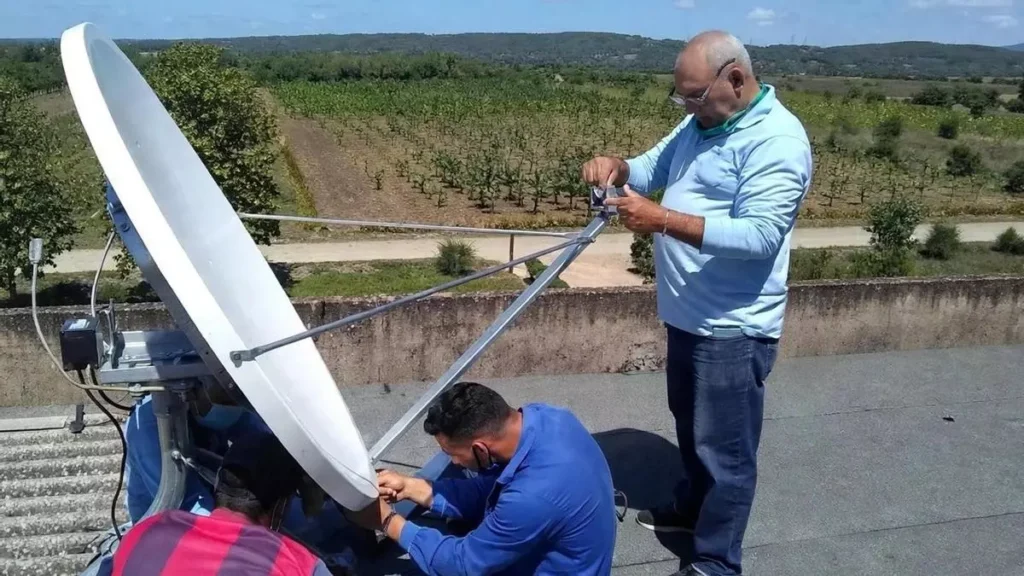
Arango attributed the problem “fundamentally” to the lack of electricity at the towers and centers of Etecsa – the state telecommunications monopoly – through which the signal from each station reaches the Central Station in Santiago de Cuba, but he added that for several days now the situation has worsened due to a “disconnection and reprogramming” of the VSAT satellite antennas across the country, an operation for which the authorities have given no official explanation.
This affects the stations that transmit by that means: Río Carpintero, in Santiago de Cuba; El Yarey, in Granma; Camarioca, in Matanzas; and Cascorro, in Camagüey. As a result, Arango explained, the only station available in the eastern region for monitoring seismicity is the one located at the Guantánamo Naval Base, an enclave that the Cuban Government considers territory illegally occupied by the US.
“The cause is not the absence of earthquakes, it is the lack of connectivity of the network of stations”
The interruption does not mean that the seismometers stop recording, but rather that their data does not reach the central station in real time, which limits the location of events and the calculation of their magnitude. Arango reported this Sunday that Etecsa configured the VSAT (satellite) antenna at the Río Carpintero station on Saturday, which allows them to monitor seismic activity “to some extent,” but clarified that “a single station is not enough to accurately locate an epicenter of an earthquake.”
He explained that the installation of the antenna in Las Mercedes, so that at least one of the three stations in Guantánamo can be linked to the central station, and the link in Holguín of the Pinares de Mayarí station are still pending in the eastern region.
Arango also pointed out a consequence of the lack of signals: on Saturday, a 5.1 magnitude earthquake in the central region of the country was published on the map of the National Center for Seismological Research (Cenais) website, causing concern and alarm on social media. He apologized for the error, which he attributed to a failure in the automatic location of the site “due, precisely, to the absence of signals from the stations.”
He apologized for the error, which he attributed to a failure in the automatic location of the site “due, precisely, to the absence of signals from the stations”
Two days later he indicated that in the east only El Yarey was broadcasting, and even then only intermittently. The following day he reported that only the Pinar del Río station was transmitting. In those same days he lamented thefts at the service’s facilities in Holguín and said he had collected “everything that was left” of Cenais [National Center for Seismological Research] there. The eastern zone, in particular the southern coast of Santiago de Cuba, Granma and Guantánamo, has the highest concentration of seismic activity in the country.
VSATs are satellite terminals that Etecsa uses as a service for entities in hard-to-reach places, and they are for state use, so they should not be confused with Starlink, the SpaceX constellation whose use is not authorized on the island. So far there has been no official explanation from Etecsa about the disconnection of the antennas, nor any timeframe for restoring transmission.
The episode coincides with a tightening of control over unauthorized telecommunications equipment, which this newspaper has already reported.
On November 6, the Ministry of Communications reiterated the ban on mobile signal boosters and warned of fines and confiscations, while a territorial Control director in Cienfuegos, Pablo Morales Concepción, called for vigilance to be “community-based.” The restrictions have been accompanied by confiscations since April 2025 and by prison sentences of four and five years for antenna sellers.
Etecsa, Cuba’s only telecommunications operator, maintains the monopoly on telephone and internet services on the island and is under the control of the military conglomerate Gaesa.
On November 9, the Foreign Ministry notified embassies and international organizations accredited in Havana that they cannot import or use Starlink terminals either. The Government’s explanation is that these devices use encryption and foreign infrastructure with no possibility of state auditing, which is why it considers them a matter of “national security.
“Etecsa, Cuba’s only telecommunications operator, maintains the monopoly on telephone and internet services on the island and is under the control of the military conglomerate Gaesa. The company has been the target of constant criticism for the poor quality of its services, its high rates and its role in censorship and content filtering, as it is subordinate to the ideological priorities of the State and not to the needs of its customers.
In Santiago, the area of greatest seismic danger in Cuba, the silence of the stations is a symptom that Etecsa’s monopoly is failing not only in basic service to its customers, but also in the country’s capacity to protect itself from natural disasters. That capacity now depends on a station located at the United States naval base.
Translated by GH.
_____________________
COLLABORATE WITH OUR WORK: The 14ymedio team is committed to practicing serious journalism that reflects Cuba’s reality in all its depth. Thank you for joining us on this long journey. We invite you to continue supporting us by becoming a member of 14ymedio now. Together we can continue transforming journalism in Cuba.