Alejandra García denounces that prison authorities sanctioned her for trying to deliver water, food, and books to the journalist, who has been imprisoned since September
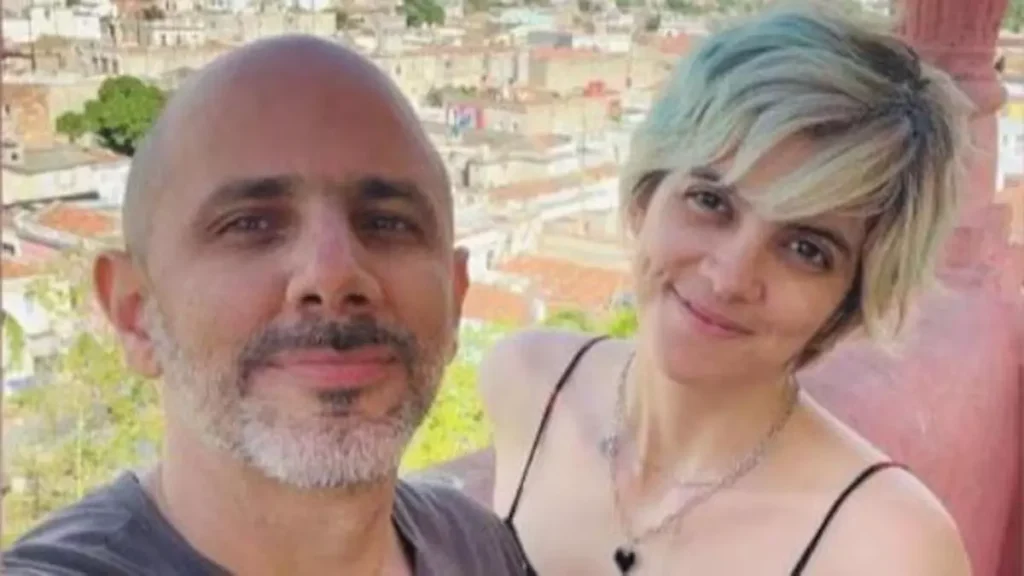
 Cuban authorities have added a new measure of punishment against independent journalist Henry Constantín, director of La Hora de Cuba, who has been imprisoned in Camagüey since September 16. This time, the sanction falls on his partner, fellow journalist Alejandra García, whom the Kilo 7 prison administration has banned from visiting him for three months for attempting to deliver drinking water, food, and books. The items never even made it into the prison.
The complaint was published by La Hora de Cuba in a video in which actress and independent journalist Iris Mariño interviews García about what happened. According to her testimony, she received a call from prison officials asking her to come in on Thursday, November 19. After waiting several hours without being seen, she was told to return the next day. On Friday, she was informed that her visits to Constantín were suspended for three months.
The alleged reason given by the authorities was that she had tried to deliver items to the inmate outside of designated visiting hours. García explained that the water, food, and books were rejected by the officials. Despite this, the prison administration decided to impose a sanction that will keep her separated from her partner for three months.
“Another injustice is being committed right now,” La Hora de Cuba reported when publishing the testimony. “Everything has been arbitrary, everything is unjust; it has all been pressure, aggression, and threats,” García stated.
Her defense has denounced obstacles to accessing the court file, procedural delays, and the refusal to modify the precautionary measure.
The new measure adds to a series of incidents denouced since the journalist’s arrest. He was initially accused of disobeying a police summons, which he maintains he did attend. After being detained at Villa María Luisa, the State Security headquarters in Camagüey, he was transferred on September 24 to Kilo 7, where he remains in pretrial detention.
Since then, his defense has denounced obstacles to accessing the court file, procedural delays, and the refusal to modify the precautionary measure. A habeas corpus petition filed to challenge the illegality of his detention was rejected.
The persecution denounced by his family and friends is not limited to the legal proceedings. On October 15, Constantín was sent to solitary confinement after officials claimed to have found a homemade knife among his belongings. The journalist denied that the weapon was his and maintained that it had been deliberately planted to frame him.
In addition to the accusations, there are complaints about his conditions of confinement.
In a statement published by his own media outlet , García questioned the circumstances of the search and claimed that no fingerprints had been taken from the object. The incident resulted in 15 days of isolation and a second criminal case for alleged disorderly conduct and possession of weapons in prison facilities.
In addition to the accusations, there are also complaints about his prison conditions. García stated that Constantín had lost about eight pounds and was being pressured to leave Cuba. She also reported that he was not receiving all the medications and food sent by his family.
The journalist described hygiene problems, the presence of mosquitoes and bedbugs, as well as difficulties accessing drinking water. In an article published after her first conjugal visit , held on November 12, she recounted the conditions of the cellblock and reported that prison authorities had threatened her because of her writings about Constantine’s imprisonment.
The ban on visits comes, therefore, after García made those allegations public. Although the authorities cite a violation of prison regulations, the journalist interprets the measure as further retaliation against her and her partner.
Constantin’s imprisonment comes amid a repressive escalation against the independent Cuban press.
The legal situation also appears to be stalled. According to García, Constantín’s lawyer informed him that the case for disobedience is now before the Camagüey Municipal Court, under the abbreviated procedure. However, a trial date has not yet been set.
The case has prompted statements from international organizations. The Inter-American Press Association (IAPA), whose Committee on Freedom of the Press and Information Constantín serves as regional vice president for Cuba, demanded his release and described his imprisonment as extremely serious. Reporters Without Borders and the Committee to Protect Journalists have also called for his freedom, while the Cuban Observatory for Human Rights has requested guarantees for his physical and psychological well-being.
Constantín’s imprisonment comes amid a repressive escalation against the independent Cuban press, marked in recent months by arrests, interrogations, threats of imprisonment, and restrictions on movement. In November alone, police detained reporters Adelth Bonne and Camila Acosta, while Yoani Sánchez, director of 14ymedio , was held for nine hours by State Security.
More recently, Acosta denounced that the authorities intend to charge her with assault . The Inter-American Press Association (IAPA) had already warned in October about the intensification of police and judicial harassment against those who practice journalism outside of official media outlets, in a country where the independent press still lacks legal recognition.
______________________
COLLABORATE WITH OUR WORK: The 14ymedio team is committed to practicing serious journalism that reflects Cuba’s reality in all its depth. Thank you for joining us on this long journey. We invite you to continue supporting us by becoming a member of 14ymedio now. Together we can continue transforming journalism in Cuba.