It’s true that the problem of begging was not born with the Revolution, but it is a direct result of the demagogy and cynicism of pretending to serve the poor.
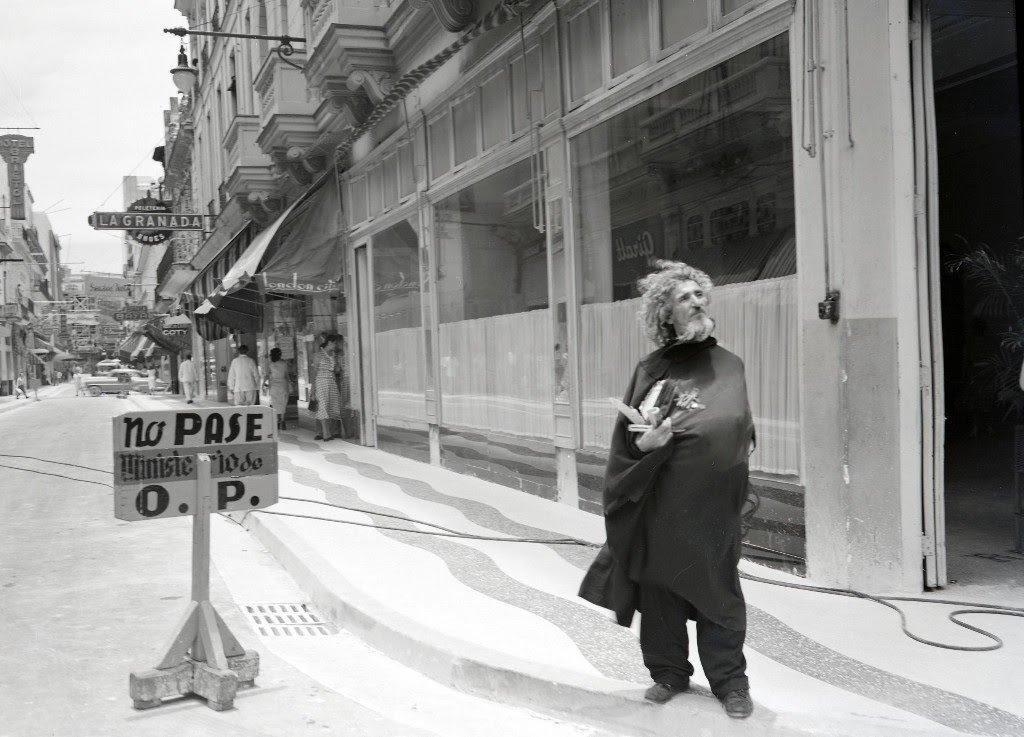
 14ymedio, Yunior García Aguilera, Madrid, 17 July 2025 — In the collective memory of Cubans, there are figures who, without having held official positions, are more remembered than most ministers. One of them is José María López Lledín, better known as El Caballero de París, the Knight of Paris. His image — with prophetic beard, white mane and an unbreakable dignity wrapped in rags — still inhabits the imagination of Havana residents. Despite being a wanderer, a “street madman” to many, he became a myth, an urban legend and a symbol of the Cuban contradiction between marginality and popular respect.
López Lledín was born in Spain in 1899 and emigrated to Cuba when he was just a child. He is said to have worked in hotels, restaurants and even as a bank clerk. But it was the street that eventually took him in. For decades he wandered through Havana with a flowery speech, greeting those he met with nineteenth-century courtesy, pronouncing philosophical phrases, improvising speeches, collecting papers, sometimes writing in the air. His wandering made him part of the urban landscape, a kind of living statue that roamed the city without restrictions. He died in 1985, in the Psychiatric Hospital of Mazorra.
The official story has tried to turn him into a romantic eccentricity of the past. He has even been carved in bronze in front of the convent of Saint Francis of Assisi, as if the country had to settle its debts with the homeless only after death. But what is most annoying is not that kind of late symbolic redemption. What’s irritating is that the same system that tried to cover up the problem of begging by locking up wanderers now disguises itself as “sensitive.”
What’s irritating is that the same system that tried to cover up the problem of begging by locking up wanderers now disguises itself as “sensitive.”
The Minister of Labor and Social Security, Marta Elena Feitó, has “resigned” after generating a scandal by saying that “there are no people living on the street,” only “people who disguise themselves as beggars.” The regime first tried to erase the videos of her speech. Then, when they understood that it was too late and the indignation almost reached the doors of the Parliament, they decided to “disappear” her. Her speech, worthy of a libretto by Ionesco, exposed a Revolution that swore to be humble but ended up accommodating a caste that never lowers the windows of its cars.
It’s true that the problem of begging was not born with the Revolution, nor was corruption, opportunism or poverty. Cuba, like any country in the world, has always had its marginalized population. But what is the direct fruit of the regime is the demagoguery and cynicism of
pretending to serve the poor, but instead multiplying them. For decades, “madmen” and beggars were hidden in institutions such as Mazorra or “social rehabilitation” centers, just as they also tried to hide homosexuals, believers and the ideologically confused. The city had to look clean, disguised only by workers and militants.
The Knight of Paris, with all his elegance and delirium, represents something uncomfortable for power: the dignity of the homeless.
Today, economic decline, runaway inflation and loss of meaning in a country with no visible future have dramatically increased the number of homeless people. You only have to go for a walk through Centro Habana, Matanzas, Santa Clara and Santiago. And yet, the official speech insists on the mirage that “no one will be left behind.” Social networks, counter-revolution and imperialism are blamed for the real image of the country, while a parallel narrative is produced where Cubans have a hard time only “in the movies.”
The Knight of Paris, with all his elegance and delirium, represents something uncomfortable for power: the dignity of the homeless, the untitled intelligence, the madness that tells truths. His figure, idealized by some, reminds us that social problems are not solved with bronze statues, denial or falsely empathetic speeches, but with concrete policies.
Today we do not have a Knight of Paris, but we have thousands of Cubans sleeping on cardboard, escaping from hunger and dodging the police, “inventing” to survive. Meanwhile, the statue in front of Saint Francis of Assisi seems to ask, in silence, why those who come to pay homage to him today do not want to look at those who continue, like him, to wander the streets of an unremembered Cuba.
Translated by Regina Anavy
____________
COLLABORATE WITH OUR WORK: The 14ymedio team is committed to practicing serious journalism that reflects Cuba’s reality in all its depth. Thank you for joining us on this long journey. We invite you to continue supporting us by becoming a member of 14ymedio now. Together we can continue transforming journalism in Cuba.