An Old Castro Weapon Still in Operation / Ivan Garcia

"Long Live the CDRs" (Committees for the Defense of the Revolution)

Renato’s family emigrated to the United States on October 3 but that did not stop them from having some weak communal soup, drinking cheap rum and dancing the timba on a block of Reparto Sevillano south of Havana on the night of the 27th, the eve of the anniversary of the Committees for the Defense of the Revolution (CDR).*

There were photos of Renato with the president of the CDR and the person in charge of surveillance, a guy with connections to the special services. As a momento of the festivities, they were shown with their cell phones.

Thanks to a stereo on loan from a bookie of an illegal lottery known as the “bolito,” or ball, a round of boleros began after midnight and ended with “Lágrimas Negras,” (Black Tears) the anthem of Cuban emigres.

Have times changed? Yes. Are the Castro brother’s quasi-state institutions more tolerant? No. The ongoing twenty-five-year-old economic crisis has led to a political sleight of hand in the strategies used by the Communist autocrats.

Now the goal is to generate enemy greenbacks that Cubans living in the United States generously send to their poor relations in Cuba. The CDR, the Federation of Cuban Women (FMC), the Young Communist League (UJC) and other state institutions have thrown off their heavy ideological ballast in favor of the political pragmatism currently being practiced in Cuba.

It is not unusual for a successful Cuban prostitute living in Europe or someone who has risked his life crossing the treacherous Florida straights to return after a few years and take part in a celebration sponsored by the CDR in his or her old neighborhood.

It was not always this way. On the night of September 28, 1960 — amid the sound of firecrackers — Fidel Castro set a system of collective surveillance on every block. Democratic civil society was dissolved until further notice.

Cuba was divided into “revolutionaries” and “worms.” Institutions were militarized. Obsessive spying into citizens’ private lives became routine. Everything was of interest to the special services, from how you lived and what you ate to the marital infidelities of members of the party and armed forces.

Betrayals and anonymous phone calls denouncing neighbors flooded the switchboards of police precincts. Cuba had entered its worst phase in the Cold War.

The CDR was and still is one of the primary instruments of control and cooperation for the Department of State Security. Thanks to its informants it was able to detain thousands of Castro opponents in April 1961 in advance of the Bay of Pigs invasion.

Though it still keeps an eye on dissidents, after fifty-four years the CDR is now an organization in obvious decline. Once upon a time its members organized scrap drives, were involved in public health campaigns, conducted nighttime neighborhood watch patrols, did volunteer work and taught political science courses.

It spite of its decline it remains the governmental institution with the largest membership in the country: around seven million people. Everyone is automatically enrolled at age fourteen.

The committee on each block maintains a book known as the “Directory of Addresses” in which the names of everyone who lives on the block are scrupulously recorded.

If you move, you are required to notify the the committee so that the new address can be registered in the book. Anyone visiting the home of a neighbor must also be reported to the CDR.

According to CDR reports the police detain and return to their provinces of origin Cubans from other areas who are living in Havana illegally.

Perhaps its most important current function is to exert civilian oversight on those suspected of illegal activities and corruption, but especially over activities by opponents and independent journalists.

Individual CDR committee heads provide data on all citizens residing their areas to the local police chief or investigators from the UJC or Cuban Communist Party (PCC), and regularly provide information to State Security.

On individual blocks there are other anonymous informers. They are responsible for checking and reporting on a dissident’s routine and visitors.

Generally, they are bored retirees or diehard Castro supporters. They take down license plate numbers of people visiting a dissident’s home and go through the trash cans of opponents looking for food containers, bottles of perfume and empty beverage bottles that might indicate “an expensive lifestyle.”

At a ceremony last year in Havana’s Convention Center, Raul Castro stated that the CDR must employ new tactics to combat dissident activity.

The general asserted that “the enemy will never stop working, will never change, so the organization must alter its strategies.” The regime is trying to carry out a bizarre course correction on a hybrid of the worst form of state capitalism combined with inefficient and authoritarian Marxist socialism.

He is trying to build bridges to the new breed of émigrés using any means possible. Though a large segment is unsympathetic to the regime, they also want nothing to do with political dissidents.

Not even megalomaniacal dictators like Mussolini or Hitler had groups of people in every vicinity who betrayed neighbors and mounted systematic acts of repudiation against opponents.

Though it has become something of a formality, the CDR remains an effective weapon for the regime. In terms of controlling those who opposed his revolution, its creation was one of Fidel Castro’s indisputable achievements.

Ivan Garcia

Photo: Cubanet

Translator’s note: The CDR is a network of neighborhood committees across Cuba. Committee heads monitor the activities of every person on their respective blocks. Yearly neighborhood parties to commemorate the organization’s founding are centered around a “caldosa,” or communal soup, to which residents are expected to contribute.

22 November 2014

Unidentified Coiled Objects / Rebeca Monzo

To the astonishment and concern of patients, one day there appeared in the ceiling of a surgical recovery room in the old Charitable Clinic (now renamed the Miguel Enríquez Hospital by the government in honor of a Chilean doctor killed during the Pinochet dictatorship) a coiled, yellow animal or vegetable entity that was visibly growing and getting fatter. A few days later another one appeared and then another, exhausting the patience of those confined to the room.

After repeated complaints by patients and family members, two hospital employees finally arrived armed with a ladder, brushes and paint. In one fell swoop they knocked the three unidentified coiling objects from the ceiling, quickly applied a few strokes of paint to the area where the objects had appeared and then left.

No one later came to investigate the cause of these apparitions nor did anyone fumigate. Everything was simply covered up with paint.

Just a few years ago I was caring for a friend who had just had surgery and was in recovery in the Institute of Nephrology Surgical Hospital when I suddenly heard a commotion behind the drop ceiling. To my astonishment the regular patients told me with a striking calm and acceptance, “Don’t worry, ma’am. It’s just the cats chasing the rats!”

According to the United Nations, our country is among the top ten healthiest on the planet. This, as well as daily incidents of sanitation problems and lack of maintenance that affect our hospital facilities — the exception being those exclusively for top government leaders, their family members and foreign patients — demonstrate that both the visitors and the workers of this world-renowned institution, whether there as a guest or working permanently in our country, resign themselves to what the government tells them to do and don’t bother to look for anything more than that.

The patients from the same old hospital, are still waiting to be informed about the cause and origin of those unidentified coiled objects.

 Translated by: BW

1 December 2014

Battered women in Cuba: Where can they go? / 14ymedio, Yoani Sanchez

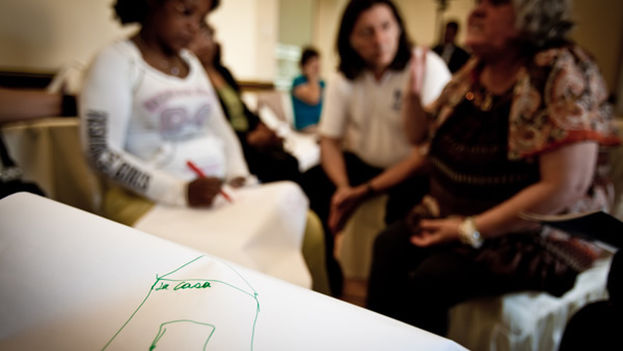
UNHCR workshop on prevention and response to gender-based violence with women from Cuba, Haiti and Peru. (UNHCR Americas)

14ymedio, Yoani Sanchez, Havana, 25 November 2014 — “Do you know what it feels like to break the wall?” she asked me years after we met. “It’s like someone cracked a table on your face… it hurts, but you can’t believe its your body.

“Now I’m afraid of men, I don’t want to have anything to do with them,” she confessed while we talked in a café with more flies than menu options. She began to narrate the details of a Calvary she had always kept hidden, from shame and because she felt responsible for those blows. Today, she can’t hear out of one ear, her nose slants to the left and she mistrusts all those whose pants have a fly.

Like many provincial women. Ileana landed in Havana on the arm of a man who promised her “villas and castles,” he said. “I was very young and, since I was a little girl I’d been taught in my house in Banes that I should serve a man and please him.” While she told me her story I had the impression I was speaking with a woman from the early twentieth century, but no: Ileana is younger than I am. She wore the school neckerchief, shouting “Pioneers for communism, we will be like Che,” and studied up to the eleventh grade in a high school in the countryside.

“I came to Havana and for the first weeks he treated me like a queen,” she said, unable to contain her smile. When Ileana laughs her whole face lights up and her nose looks more crooked than ever. “Then he started to mistreat me, but only verbally,” she says, downplaying the importance while looking over her shoulder. A young man had sat down at the table next to us and was observing us laciviously. “Ladies, did someone stand you up? Because here is a stallion who never fails,” he blurts out, under the imperturbable gaze of the waiter.

“The neighbors called the police several times. Then we spent hours and hours at the station at Zanja and Dragones streets, for nothing. The investigator told me they didn’t get involved in things between husband and wife,” and that, “I had to go home with him, because I didn’t have anywhere else to go,” she explains, already on the verge of tears. In Cuba, current law has enormous gaps with regards to gender violence. If the abuse “is not defined in the Penal Code, the abuser is not sanctioned,” a lawyer at the law firm on Carlos III Street later explained to me, asking not to be named.

“He could only be charged if a doctor determined I had injuries,” Ileana recalls. However, a black eye or an ache in the side isn’t considered one. “I had to show a wound that was a puncture or bleeding,” she explains. I look at her and question why a doctor would ignore the marks of cigarette burns on her forearm and her boxer’s nose, without protecting her. What was lacking for a restraining order? That he kill her? I wondered, without sharing it with her.

Things have calmed down. The abuser is far away and this petite woman with her battered face confesses, “Well, I have to say, he wasn’t so bad,” and immediately adds, “in the tenement where we lived one woman had a husband who came home drunk from work one day with a machete.” She touches wood and looks around while concluding, “Thanks to the virgin, I was luckier.”

Her case was archived again and again. She had no phone to call from, no address for a battered women’s shelter is published in the official media, so Ileana endured and remained silent. Her martyrdom lasted for a decade, including rape within the marriage—also not defined in our laws—the odd fracture, and constant humiliation.

“Then my daughter was born and she made me bold,” says this woman dressed in baggy clothes, looking down, avoiding the eyes of the man sitting beside us at the café. “One night I gathered everything and went to my aunt’s house.” However, the escape didn’t last very long. “Someone ran their mouth and told him where I was staying and he came to find me. It was the darkest night of my life.”

Between pushes and insults, Ileana returned to her husband’s house. “That night he forced me for hours while telling me ‘you’re mine and no other man’s’.” She told how the next day she couldn’t even urinate. “I hurt all over and had his teeth marks all over my back.” Then began the phase of total defeat. “I got used to it, that my life would be like this, and stopped resisting,” she related with a pragmatism that is still painful.

Shortly afterwards the abuser found “an even younger country girl he mistreated,” recalls Ileana. “I was crushed, I didn’t want to look at myself in the mirror, I didn’t put on make up, or go out in the street.” In all that time, no women’s organization approached her, she didn’t know of any haven where she could find shelter, and more than a dozen times she heard the police that responded say, “Well, she must have done something to piss him off.”

Today, Ileana shared with me her wish. “I want to have sex with a man without fear… romantically.” As she says it her right hand touches her nose, trying to push it to the center… The place where it should have been if the abuser had not crossed her path.

The Ferguson case and its possible implications for Cuba / 14ymedio, Yoani Sanchez

Ferguson protests. (Andrew Benedict, Twitter)

14ymedio, Yoani Sánchez, Havana, 27 November 2014 – The events in Ferguson, arising from the death of the young man Michael Brown and the decision not to charge the police officer who killed him, have caused millions of people in the United States to question the situation in their country. The protests that followed the grand jury’s verdict raised new questions about the image of coexistence within the diversity that has been presented as a pillar of American identity.

The situation has renewed the alarm about the American model and sets off warnings in other countries where large sectors of the population continue to be disadvantaged, whether because of ethnicity, race, or geographic origin. This week’s images showing the overwhelming anger on the streets of Missouri speak to us of the accumulation of problems, which have found their trigger in the recent decision not to charge the police officer.

It is not only a question of Michael Brown’s death during a questionable arrest, but one of a society that has been fractured for centuries, living with racism that prolongs the distrust, stokes hatred and fuels the violence that is now breaking out into fires and vandalism. A scream, at times, sometimes silenced, that now raises its volume after the sad events of last August 9th.

Cuban society should take note of the events in Missouri. Among us racism, far from diminishing, has increased in recent decades. Motivated in part by the stubborn official policy of denying its existence and downplaying the rancor that sometimes hides under the disingenuous appearance of a joke, but whose bitter side is the high percentage of the prison population that is black, or the economic precariousness that characterizes this community.

At the last minute, and in a race to show international organizations that it is working on the problem, the Cuban government has created an agenda to fight against racism, which sadly lacks independence as well as enforceability. Lectures, conferences, statements by prominent figures in the Afro-descendant community, abound in the media. However, in reality, little has been done to give a voice to those who suffer first-hand from these prejudices.

Capitalizing on fear of greater discrimination has been, for too long, an instrument of ideological subordination on the Island. The constant allusions to a past of abuse and segregation – prior to January 1959 – have been used by official propaganda to maintain the support of the black community. As if the only choices were the current situation or returning to the slave quarters and slave drivers.

The authorities have ended up hijacking and distorting the voice of this community that should have its own presence in independent organizations and entities that allow it to denounce and make demands with regards the situation in which it exists.

Lately, the Ferguson case has also been sadly used by the official media to stoke fears of democracy. “Look at what happened in the United States,” the television commentators – obsessed with the mote in another’s eye – seem to say to black Cubans. Again, the fear of returning to the whip and the specter of police lynchings are used to call Cubans of African descent to conformity or false complacency.

However, anger is something that is incubated slowly. We are fed facts such as false quotas of power delivered to people by the color of their skin, people who have no real possibilities of decision-making.

Anger gains strength when you enter a university classroom and see hardly any colors beyond a “light mixed-race,” while in the prisons it is just the opposite.

Resentment rises when you see who lives in the illegal slums that crowd the outskirts of the capital and compare that to the racial origin of those who hold positions in foreign joint-venture companies, tourist facilities, or in the administration of economically strategic entities.

Pain increases outside the offices that receive remittances from exiles abroad and you can see for yourself that the most of the people who rely on this relief in convertible pesos are white.

Anger grows slowly and one day explodes. The detonator can be a police officer in Ferguson who kills a young black man, or a man in Havana who is handcuffed and put in a squad car for the simple act of walking through a tourist facility with that skin tone that brings so many problems in so many places.

Academic Cruise Ship from U.S. Arrives in Cuba / 14ymedio

place
Students from Semester at Sea at the University of Havana. Photo Credit: Semester at Sea.

14ymedio | Havana | 29 November 2014 — (Supplemented with information from EFE news agency) The M.V. Explorer academic cruise ship from Semester at Sea arrived today [Saturday, 11/29] in Havana bearing 624 students. The students, hailing from 248 U.S. universities, will participate in a program of cultural exchanges, conferences and excursions.

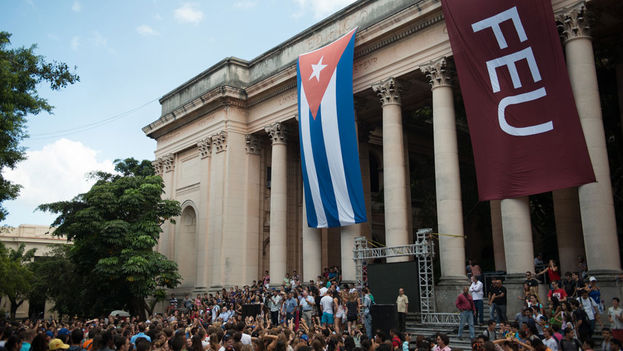
Frank González, rector of the University of Havana, greeted the group upon their arrival. The students were then transported to the grand staircase of the university where they were given another welcome.

On their first day in Cuba, the students were scheduled to attend conferences on US/Cuba relations, and to view an evening performance in the Havana Amphitheater.

On Sunday, the students were to have their choice among excursions to provinces such as Matanzas, Pinar del Río and Villa Clara. This last one will include stops in Remedios, the Monument to Ché, and the eco-tourism/art project, NaturArte. The Trinidad itinerary includes a stop at Topes de Collantes in the Escambray mountains, while in Matanzas they will be able to visit Playa Girón in the Bay of Pigs.

In Havana City, the students are scheduled to visit Ciudad Escolar Libertad (Freedom School City), the old Columbia military encampment that, after the Revolution, was converted into a school. There will also be a tour through La Habana Vieja (Old Havana) that will explain the restoration process for various buildings and streets in the city’s historic district.

The M.V. Explorer will remain docked in the port of Havana until Dec. 3.

Apparently, the program will provide these university students with a very specific vision of Cuba, one that celebrates the “achievements” of the Revolution in the areas of culture and education, among others.

May these students also be able to maximize their brief stay on the Island so that they may compare this ideal vision with the reality that we Cubans live every day.

Translated by Alicia Barraqué Ellison

Eastern Family Protests in Havana, #Cuba

[youtube=http://youtu.be/cYOJCA84NwI]

The family in this video is protesting having been evicted from their home. Of note is the openly expressed anger of the crowd at the police action against them.

24 November 2014

The family in this video is protesting having been evicted from their home. Of note is the openly expressed anger of the crowd at the police action against them.

24 November 2014

Activists Denounce Act of Repudiation Held During Child’s Birthday Party / 14ymedio

This morning several activists reported an act of repudiation against members of the Network of Community Journalists and Communicators in the eastern city of Manzanillo.

According to reports by those to whom this newspaper had access, Leonardo Cancio had organized the celebration in his home for the birthday of a six-year old nephew and invited his colleagues from the Network.

From the day before he could see around his home several women who the activists say were convened by State Security to communicate to them that they would not permit “a party for children organized by the counter-revolution,” and also they visited neighbors’ houses to warn them not to send their children to said activity.

From early hours a crowd, calculated at some three hundred individuals by the members of the Network, surrounded Cancio’s house in order to impede access by the invitees. Nevertheless, some activists like Tania de la Torre, accompanied by her daughter and granddaughter, managed to arrive in advance. De la Torre explains that “the State Security agents called Alexis and Julio” on seeing them come out of the house “pushed us against the crowd” where they would have received blows and threats of future reprisals.

In statements offered to 14ymedio by Martha Beatriz Roque, leader of this group of independent journalists, the dissident remarked, “That is the Cuba that the Spanish Chancellor Margallo comes to visit, where human rights are trampled unceremoniously.”

Translated by MLK

“You Are A Confrontational Media Outlet,” Security Official Tells ‘14ymedio’ Correspondent / 14ymedio

Juan Carlos Fernández Hernández

14YMEDIO, Havana, 28 November 28 — At nine in the morning Friday, 14ymedio correspondent Juan Carlos Fernandez attended his summons at the Piñar del Rio police station. It was the third interrogation to which he has been subjected this year, although on this occasion he did not receive an official warning. A major from State Security, who only identified himself as David, accused him of collaborating with this newspaper, which he characterized as a “confrontational” media outlet that “serves the interests of a foreign power.”

The accusation was accompanied by threatening phrases about a possible “police action” against Fernandez if he continues “doing what you are doing now,” the officer confirmed. Nevertheless, to the question of the accused about a possible arrest and legal prosecution, the interrogator downplayed the seriousness of the reprisals.

Juan Carlos Fernandez defended his right to put his opinions into writing and publish them in any press medium. “I warn you, the weight of the law will fall on you,” responded the man using the pseudonym David, but without giving details. The officer invoked the Constitution of the Republic of Cuba and said that “the Government counts on the support of the people,” at which point the reporter reminded him that the Communist Party has fewer than a million members while the population of the country exceeds 11 million.

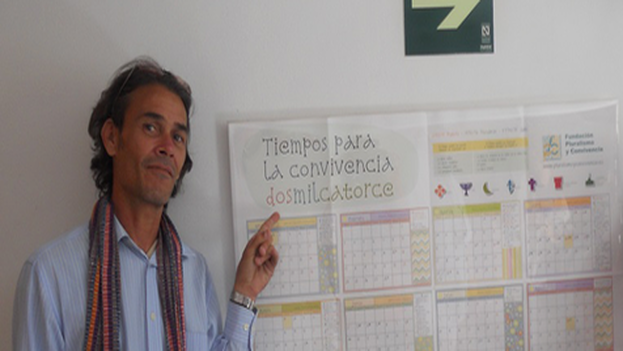
Juan Carlos Fernandez is a member of the magazine Coexistence which is published in Piñar del Rio, and since last August he has begun working as a correspondent for 14ymedio in that province. His journalistic works cover the cultural life of the city, reports about social topics and a wide photographic coverage of the territory.

A couple of months ago, Juan Carlos Fernandez brought to light the censorship that Piñareno painter Pedro Pablo Oliva had suffered with the cancellation of his exhibit Dissidences and Utopias.

Translated by MLK

Cuba: Access to WiFi or When Ingenuity is Penalized / Juan Juan Almeida

It is a paradox that on Friday, November 7, the 151st anniversary of the death of a singer of innocence and virtue, the Matanzas poet Jose Jacinto Milanes, at the People’s Court of Cardenas in the same province of Matanzas on the same day two Cuban citizens are awaiting sentencing — Rolando Cruz (age 46) and Livan Hernandez (35) — charged with “illegal use of the airwaves” and “illicit economic activity.”

Of the five arrested only two were charged. Both Hernandez and Cruz, instead of punishment, deserve recognition for demonstrated skills and support for development looking to the future.

The frequency of this network, according to the propaganda in the Girón, managed to link computers, videogame consoles and smartphones, across more than 26 kilometers. It never interfered in the frequency of the Telecommunications Company of Cuba SA (ETECSA), which means it does not constitute an illegal to use of the Cuban airwaves.

The court, as usual, was forced and ignored that Law Number 62 of the Cuban Penal Code in force as of April 1988, in addition to being obsolete, has absolutely no concept of the use of WiFi connections and without a law that sanctions it, there can be no penalty. That is: Nulla crimen, nulla poena sine praevia lege. (There is no crime, no penalty without previous law.)

Rolando and Liván violated a resolution that had been signed by the Revolutionary Commander Ramiro Valdés when he was minister of information technology and communication. However, this being an administrative order by a particular agency, the men’s activities could only be deemed a misdemeanor and not a crime.

After five months in jail, under the terrorizing pressure of a process of “instruction,”the accused agreed that the users of that network could access the Internet. However, during the trial the magistrate called to the witness stand five residents of Cárdenas, who said that the connection was only good for gaming, watching movies, and chatting amongst themselves.

The invoices for the servers were produced, and these proved that the purchases were made in Canada and brought legally into Cuba. It was also demonstrated that the accused charged not a single penny and that the users had made only two monetary payments — one for 6 CUC and another for 10. These were for improvements to the network infrastructure, not usage fees.

The prosecutor — an awful neurotic and somewhat loudmouthed version of the famous Dr. House — took the wild recourse of accusing the defendants of “illicit economic activity.” She reminded the tribunal of the guidelines from the Attorney General’s office regarding the severe penalties that are to be imposed for such activities, because of the “ideological danger” that they pose for the Revolution.

The defense attorney, one Nestor González, performed spectacularly. The defense was courageous, convincing and articulate — but hardly effective. The accused had already been sentenced way before the first hearing. It was the usual: the idea is to make examples of the violators, produce a sort of electroshock as a reminder and to demonstrate that in this corporate military era the director general doesn’t want any flight of money, as well as to ratify that the Revolutionary government cedes no space.

Therefore, keeping in mind that in this case there is no crime but rather a country that lacks a legal structure capable of functioning independently from the mandates of the government, we await the sentence.

Translated by Alicia Barraqué Ellison and others.

12 November 2014

UNPACU Denounces A Plan For “Liquidating the Most Active Opposition” / 14ymedio

14YMEDIO, November 28, 2014 — UNPACU issued a statement Thursday night in which it accuses President Raul Castro of having ordered the “liquidation” of the opposition. The organization cites sources from the Ministry of the Interior (MININT) according to which the elimination of the most diligent activists should be carried out in the next three months.

UNPACU believes that the latest attacks on the Ladies in White and Jose Daniel Ferrer fit within that supposed order, given that they involve violent attacks against key dissident figures in the last weeks and come from people tied, in their judgment, to State Security.

In the statement they review last Tuesday’s event in Santa Clara in which activist Guillermo Fariñas asserts he suffered an assassination attempt and in which several Ladies in White were injured, leaving one of them in serious condition. “A similar case occurred at two UNPACU sites in Santiago de Cuba and is now the source of a farce that the government is trying to fabricate against Jose Daniel Ferrer,” continues the statement.

Jose Daniel Ferrer has been called by State Security to give a statement, presumably as a defendant, for the crime of assault against the complainant Ernesto Jimenez Rodriguez. As the statement explains, last November 13th, at the UNPACU headquarters located in Reparto Mariana de la Torre, in Santiago de Cuba, this man, supposedly sent by the political police, provoked a violent altercation.

“Fortunately, with several activists and responsible individuals present at the headquarters, they managed to disable the aggressor, immobilizing him and removing from him the metal weapons that he carried,” the document highlights.

The same individual had sought membership in UNPACU weeks before, for which reason the organization made the usual investigations that “are performed before accepting any applicant.” The conclusion was that he was tied to the Ministry of the Interior.

“In view of such fact, and without telling the individual anything about it, he was allowed to enter the headquarters with the proper control and knowledge by those present of his status as a political police infiltrator and only for events of no significance for activism,” they explain.

Jose Daniel Ferrer, who has denounced the situation, said that “in no case can an individual who has been seen by more than 15 witnesses attacking numerous people cause a peace activist for Human Rights to be taken into police custody with the objective of creating a false accusation and maybe holding him there without a possible defense. We at UNPACU are not going to submit ourselves to this farce in any way.”

Translated by MLK

Cuba 2014 / Rafael Leon Rodriguez

The 32nd Havana International Fair (FIHAV) 2014 closed its doors after a generous awarding of prizes this past Friday, Nov. 7. It’s said that Brazil was the exhibitor that saw the most growth in traffic from prior years, and Spain — with 132 participating companies — was the most-represented.

This statistic took into account Cuba’s presentation of the “Purse of Opportunity,” now a feature of the country’s new Foreign Investment Act, and the offers of special perks to businesses from the Mariel Special Development Zone. The Cuban proposals, fundamentally framed within the joint-venture model, places at the disposal of foreign investors concerns ranging from those that are active to semi-active – such as sugar refineries – to arable lands, as well as biotechnology and pharmaceutical enterprises.

In short, a promotional gamut of possibilities encompasses virtually all domains of production and services. The Cuban Revolutionary State, which confiscated everything, and everybody, at the start of its totalitarian experiment, now puts up for sale at least half of every asset they have remaining. Of course, this is just for foreigners.

When we Cubans on the Island approach these fairgrounds, we mark them with a bit of wonder, as distant spheres cut off from our reality — A Different Cuba, of which little or nothing has to do with us.

The same happens to us with tourist zones: Varadero, Cayo Coco or Cayo Roman, and with the medical and pharmacological research institutes — these are all spaces that are alien to the majority of Cubans.

They fill the isolated display cases/oases that are viewed and enjoyed by foreign visitors and a privileged few from the home turf. They are diverse pieces of this rigged jigsaw puzzle which the state has made of Cuba.

They are also a likely cause of the flattering, but inaccurate, comments from outsiders regarding our national scene. This whole dynamic – coupled with the crony-capitalist bad habit of ostensibly over-investing beyond the profit potential of the country — has created in the minds of many foreign speculators a “virtual reality” view of Cuba.

But our nation can only be itself. It is the product of all these different spaces, of its successes and failures, in which we Cubans all participate, be we here in the islands, in exile or in the diaspora spread across the world. It is this sense of joint belonging that unites and lifts us up, that makes us feel a certain, commonly-shared pride, when one or some of us stand out. It matters not if they are Cuban players in the American Major Leagues, artists, or volunteer doctors fighting Ebola in Africa.

Therefore, what we need to recover, so that we may join together as one people, are our liberties. We need to re-insert ethics into our value system, to once again place honesty above loyalty that is blind, deaf and dumb. In short, to relaunch a pluralistic democracy in which we all may participate with dignity, without exclusions, in the rights and duties appertaining to Cuban citizens – with no display cases in sight.

 Translated by: Alicia Barraqué Ellison

15 November 2014

Extremes Meet / Regina Coyula

I am not Argentinian nor did I lose someone during that country’s military dictatorship, but I am appalled to learn about the agreement between Jorge Videla and Fidel Castro as well as by the selective memory of the mothers and grandmothers of the Plaza de Mayo. What would Stella Caloni, someone always in the Cuban media, say about this? Or the current Argentinian president, Cristina Fernandez, in her crusade for human rights?*

On Telesur last night I saw Juan Carlos Monedero, one of the leaders of the new left-wing Spanish political party Podemos (We Can), demanding to know what Spain’s democratic leaders had done to counter the excesses of Latin American dictatorships while showing a photo of none other than King Juan Carlos together with Videla.

Fidel Castro seems to be in no position to explain anything. Emilio Aragonés, Cuba’s ambassador to Argentina at the time, died incognito years ago. (His death did not merit even a brief obituary on page 2 of Granma.) One of our shrewd journalists should get to the bottom of this.

And I personally believe someone from the government should provide an explanation and issue an apology.

*Translator’s note: The author is referring to recently released secret cables indicating that in 1977 Cuba asked Argentina’s right-wing military government, then led by Jorge Rafael Videla, to support its admission to Executive Council of the UN World Health Organization in exchange for the Cuba’s support of Argentina’s continued membership in the UN Social and Economic Council. 

Stella Caloni is an Argentinian journalist and writer. In an introduction to a recently published biography, Fidel Castro described her as “a recognized expert in communication” who “untangles the objectives in the counterinsurgency’s media war.”
24 November 2014

Customs, Another Point Against It / 14ymedio, Victor Ariel Gonzalez

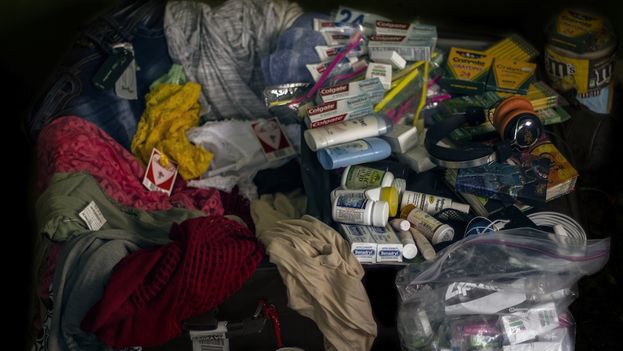
Inside the suitcase of a traveler from Miami (14ymedio)

14ymedio, VÍCTOR ARIEL GONZÁLEZ, Havana. 24 November 2014 — From food to motorcycles, stuffed into plastic water tanks, Cubans use the most improbable ways to introduce products into their country. But it has nothing to do with drugs or weaponry, but basic necessities intended as much to satisfy consumer demand as to supply a retail market that the state – so far – is incapable of supplying.

In one of the usual reports by national television where they intend to lecture the audience, an official reporter recently stressed that “Customs has confiscated several containers with articles that are not classified as household goods because among them are clothes, footwear, toiletry articles and foods. Also home construction or repair materials, fixtures and all kinds of spare parts, water tanks full of miscellaneous items, a central air conditioning unit compressor and internal combustion engines, new and disassembled, in order to trick customs control.”

“Household goods” is one of the classifications that General Customs of the Republic (AGR) employs for products that Cubans bring to the Island when they return from a trip or that they send here in packages.

The reason for the irregularities described by the press, according to an AGR official named Yudesis Alfonso, lies in the fact that “one of the fundamental advantages for individuals is that household goods are exempt from payment of Customs duties. And it is regrettable that there are people who use this operation to try to introduce merchandise into the country without declaring it to Customs as legislative decree 162 of 1996 specifies in article 6.”

In the words of Jorge Alberto, a Cuban with a Spanish passport who for months served as a mule for the importation of small volumes of merchandise in exchange for 150 CUC per trip, “What is really regrettable is that we have to bring hidden things in because the stores are bare.” When the government intensified the administrative measures about what it considers “commercial importation,” in addition to prohibiting the sale of clothes and footwear, Jorge Alberto was left without work, and what he will do now is finally emigrate from Cuba.

AGR is part of a strict system of state control that hinders the development of private businesses in Cuba where there exists no wholesale market for many self-employed activities. For this institution it is quite an achievement to display for the cameras cases such as the one that one of its officials, Aniuska Navarro, describes: “Within this white tank was an internal combustion motor, separated into pieces. This tank had to be broken up in order for us to be able to gain access to the pieces of the motor.”

The television report concludes that “Customs … is in a constant fight against the illegalities,” in a country whose domestic economy survives thanks to the black market.

The regulation of “household goods” exception is legally regulated by resolution 43/1998 by the Ministry of Finances and Prices and resolution 122/2009 by the AGR, but “on occasions” citizens have been found “importing into the country great volumes of merchandise which show a marked commercial character” as well as “the intention to import articles belonging to third parties who should use a different Customs regulation, which involves paying tariffs in convertible pesos.”

Which is to say that besides confiscation of the articles – whose subsequent fate is unknown – the offenders are criminally prosecuted for tax evasion, “being accused just as they should be to the competent agencies: the Ministry of the Interior and the system of justice.”

Among those affected, a group that includes businesses as much as consumers, opinions like those of Jorge Alberto abound. “The customs taxes that are so high are the essential reason that we commit these crimes. They don’t let us raise our heads.”

Translated by MLK

American Agency Will Operate Direct Flights Between New York and Havana / 14ymedio

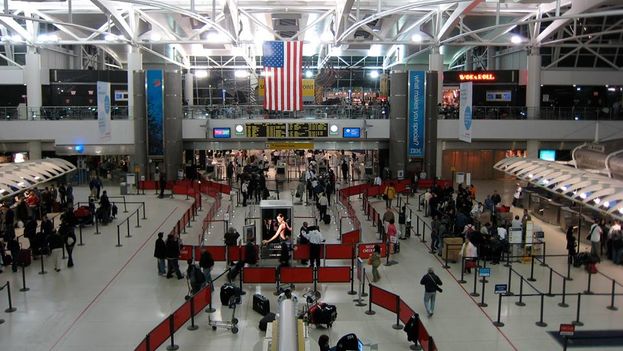
New York’s J. F. Kennedy Airport.(Cuba Travel Services Facebook page)

14YMEDIO, Havana/November 21, 2014 — The American agency Cuba Travel Services announced last Thursday that it will operate a direct flight between New York’s J.F. Kennedy Airport and Havana. It is envisioned that the trips will occur daily in the afternoon, although company workers have not been able to confirm either the departure days or the frequency of the flights.

Cuba Travel Services has not provided information about the date the service will begin, but it has announced that the price for a round trip ticket on the inaugural flight will start at $849.

The company organizes travel to popular destinations like Cienfuegos, Camaguey, Santa Clara, Holguin and Santiago de Cuba, with flights operated by Sun Country Airlines.

The Turbo News site explained this afternoon that “in the spirit of the recent New York Times editorial published October 11, 2014, entitled ‘Time to End the Cuban Embargo,’ the agency Cuba Travel Services chose to provide an important cultural and social link between the two cities.”

The agency maintains that the expansion of its offering will permit travelers who leave from New York to save as compared with the current options on the market, avoiding the delays of connections and the cost of additional fares for stops in Miami, Fort Lauderdale or Tampa.

The company, which organizes daily flights between the US and Cuba, asked for permission to operate flights also from Newark Liberty International Airport, but that request was rejected.

The US government suspended direct air links with the Island at the beginning of the 1970’s and resumed them in 1999 with a flight between New York and Havana. After a slight opening by President Bill Clinton, Barack Obama also opted to soften restrictions on travel by Cuban Americans visiting the Island; now they can travel every year instead of every three and stay as long as they like.

In 2012 the Cuban government suspended landing rights on the Island for two airlines from Miami, Airline Brokers and C&T Charters, explaining the reason for the decision “as over capacity of seats and other operational issues,” although the travel agency operators revealed suspected payment defaults with Cuban authorities. Airline Brokers operated weekly flights to Havana and Cienfuegos from Miami and Fort Lauderdale, while C&T Charters traveled to Havana and Camaguey from Miami, New York and Chicago.

Translated by MLK

An Epidemic of Editorials / Fernando Damaso

Archive photo

A few days ago the sixth editorial by the New York Times appeared regarding relations between the Cuban and North American governments. I believe that never has a country so small and relatively unimportant merited so much – and such sustained – attention. This smells of strange interests on both shores.

The editorial writer who undoubtedly pulls down an annual salary in the five figures, must feel fulfilled. It is said, although I cannot confirm it, that he was over here seeking official information for his writings. This would not be surprising.

To cast blame on the embargo for all of Cuba’s problems — even for the exodus of our professionals lured by United States government policies — lacks originality. It is merely repeating the same worn arguments made by the Cuban government during almost 56 years in order to sweep under the rug its own errors, economic failures, misguided adventures, blunders, etc., which have resulted in the prolonged political, economic and social crisis that Cuba endures.

It is true that artists, sports figures, doctors and many other professionals seize the slightest opportunity to leave the country in search of better living conditions. The majority of our youth do this, too. But this does not occur only because North American government policies offers them incentives them do do so.

Rather, it is the terrible situation in their country: no housing, miserable salaries — even after raises — and, what’s worse, no real opportunities for bettering their circumstances.  Every human being has but one life to live, and it cannot be squandered believing in outdated lectures about the future — always about the future — when what is truly important is the present. This is a concept that apparently eludes the editorial writer.

What’s more, if we truly look at reality, only a portion of Cuba’s medical missions abroad are provided freely. The majority are paid-for by the governments of countries that benefit — a juicy business for the Cuban authorities, who even describe them as better revenue-generators than sugar harvests because they provide greater sums of foreign currency. Between 60 and 75 per cent of the total salary payments made by these governments for the services of Cuban doctors remain in the hands of the State, which then apportions the remainder as wages — and even that comes not entirely as hard cash, but rather as rights for obtaining housing or consumer goods, at the artificially high prices set by the State. Something similar happens with artists and sports figures working abroad.

In any event, although many of these professionals leave the country, the Cuban authorities never lose. This is because after the emigres settle in other countries, they begin sending monetary remittances to their relatives, who then spend them primarily in government establishments where the prices are set high, the stated objective being to maximize the collection of foreign currency.

The editorials will continue and the official Cuban press will go on reprinting them in their entirety, down to the last comma and period. It would be helpful if those who influence public policy and public opinion, whether from the inside or the outside, would not allow themselves to be misled.

Nobody is against change, and even less so if such change were to lead to the restoration of normal relations between the governments. However, this cannot be achieved on the backs of the Cuban people without their true and complete participation.

Translated by: Alicia Barraqué Ellison

21 November 2014