A court gives Immigration ten days to grant permanent residency to Ghislayne Jiménez Moret, Luis García Ramirez, and Otmara Arencibia Bustamante.
Otmara Arencibia Bustamante, Ghislayne Jiménez Moret and Luis García Ramirez in Tapachula, Chiapas / UltimatumMx
14ymedio, Ángel Salinas, Mexico City, June 25, 2025 — The Cubans Ghislayne Jiménez Moret, Luis García Ramirez and Otmara Arencibia Bustamante began a hunger strike this Monday in front of the headquarters of the National Institute for Migration (INM) in Tapachula, Chiapas. The migrants blame the Mexican Commission for Aid to Refugees (COMAR) for delaying their asylum procedures.
“We will be here for as long as it takes,” says Luis García Ramirez, who left the island last October. The lack of documents has limited the possibilities for this young person to find a well-paid job. “It’s very difficult because they don’t accept you for any job,” he says.
García Ramírez tells this newspaper that because of their appointments with Migration, they have lost job opportunities. “They keep you there for five hours; they don’t attend to you, and then they return you home without your process advancing.”
Otmara Arencibia Bustamante, diagnosed with breast cancer, tells this newspaper that she started the process five months ago. Despite “getting the eight signatures required” by COMAR to conduct a final interview, “they don’t tell you” when it will be held. The woman showed the Amparo [protective order] 957/25 to which she resorted to expedite the procedure, but she still hasn’t received refugee status.
A source revealed that COMAR in Tapachula “has no operational staff, translators or interviewers”
The delay has affected her income; the little that she receives from family members helps her to survive in Tapachula. “I would like to have papers so that I can work,” she says. “If I don’t have papers from Mexico, they won’t continue reading
let me work.” Arencibia Bustamante says that, despite having a unique key of registration of temporary population (CURP)*, there have been sites indicating that “it is not sufficient” to get a job.
Currently, COMAR’s headquarters in Tapachula is only providing a CURP and scheduling appointments to have a final interview with the migrant to decide whether he or she can be a beneficiary of refuge. The migration process normally involves several formalities and takes a few months. During this period, a work permit is obtained while it is decided if the applicant can become a refugee, but at present this process is not being respected by the institution in the face of an influx of migrants.
Attorney José Luis Pérez points out to 14ymedio that this group of Cubans has faced apathy from the authorities. The lawyer confirmed that the Fourth District Court “gave the INM ten days to respond to its procedure of permanent resistance.”.
A source from Migration, who requested anonymity, revealed that COMAR is facing restructuring. “There is no operational staff, translators or interviewers in Chiapas,” he said. “At the moment there are hundreds of migrants in limbo. Procedures are taking up to a year.”
El Colectivo de Monitoreo-Frontera Sur denounced the accelerated institutional deterioration that directly affects thousands of migrants and asylum seekers on the border between Mexico and Guatemala.
The organization pointed out to Diario del Sur that due to the deterioration, “COMAR’s operational capacity has been reduced, in addition to the existence of a backlog in the humanitarian flights of the INM and forced evictions without minimum guarantees, which reflects a migration policy based on omission, criminalization and abandonment.
* CURP stands for Clave Única de Registro de Poblacíon para Extranjeros, or Unique Key of Registration of Foreign Population.
Translated by Regina Anavy
____________
COLLABORATE WITH OUR WORK: The 14ymedio team is committed to practicing serious journalism that reflects Cuba’s reality in all its depth. Thank you for joining us on this long journey. We invite you to continue supporting us by becoming a member of 14ymedio now. Together we can continue transforming journalism in Cuba.
Students from the two neighboring schools “get high in broad daylight”
Instead of prioritizing prevention, authorities mount exemplary trials with sentences of up to 20 years in prison.
Alberto Sosa González Secondary School, in Holguín / Facebook
14ymedio, Miguel García, Holguín, 26 June 2025 — Holguín’s Marijuana Alley earned its name years ago for the ease of finding someone to sell some “marijuana cigarettes.” But with the appearance of the ’químico’ – chemical – and its cheap and potent papers, cannabis is in retreat. The new king of drugs now passes from hand to hand, from high school students to younger boys, from the unemployed to housewives, while it continues to gain ground in the city.
A few meters from the alley there are two schools, says Susana, who used to attend both centers as a social worker. The secondary school is called Alberto Sosa González and has about 1,000 students. In an annex, “almost wall to wall,” she explains, there is also a pre-university. “With 150 or 200 pesos in hand, any of those boys can get a dose of chemical,” she says.
She has seen them herself, she confesses. “In the morning, before they go to school, you find them there, smoking cigarettes and something else. Then in the afternoon, when they leave class, they go back to the alley,” she says. A few years ago students were hiding while sharing marijuana cigarettes, but now they are completely uninhibited. “Even outside of school, while waiting for their girlfriends, many get high as if it were nothing, in broad daylight.” continue reading
Susana is no longer a social worker, but that hasn’t stopped her from noticing that drug use in Holguín is “rampant”
Susana is no longer a social worker, but that has not prevented her from noticing that the consumption of drugs in Holguín, especially in schools, is “rampant.” “Although they have not been made public, there have been several cases of boys being found with little bits of chemical in their rucksacks or uniforms. They have also been caught eating it,” she warns.
Parks, corners, specific streets or entire neighborhoods. The cannabinoid is present throughout the city, not only in schools. “A few months ago I myself witnessed a purchase,” says the Holguinera, who places the events in the so-called Chivos park, another enclave where drug “transactions” have become frequent.
“A man arrived on a bicycle and stopped in front of three young boys without getting off. The boys paid him, and he took out a sealed pack of cigarettes, gave each one a little piece of paper and left,” says Susana, who up until that point was not sure what she had witnessed.
“I immediately noticed when the boys started taking the tobacco out of the end of the cigarette to make room for the chemical. They lit up right there and started smoking.”
Susana has also heard of other methods of consumption. “To amplify the high of the chemical, they buy rum and instant soft drinks. After consuming the drug, they prepare a concentrate of the alcohol and powder that makes them feel good,” she explains.
In addition to Marijuana Alley, Susana relates the areas of greater presence of the chemical with the most marginal neighborhoods. “There is a place known as the Loma del Tanque where there is also a lot of drugs, especially among young people aged 15 to 25. There are very poor people who live there; they have come from other municipalities and the countryside trying to get close to the city,” she points out.
The 26 de Julio neighborhood, she adds, is another “red zone.” If she had to point out the “capital” of the consumption of chemical and marijuana, says Susana, it would be Chivos park.
Susana has learned of many trials and operations to combat the presence of narcotics in the city
Susana has learned of many trials and operations to combat the presence of narcotics in the city. “A few days ago they raided two places on 13th Street and seized químico,” she says. But the areas that are commonly known to be epicenters of narcotics sales continue to spread, and among consumers, although mostly still young people, there are also adults and the elderly, both men and women.
Far from focusing on prevention and rehabilitation, the Cuban Government has chosen to wage war against those involved in crimes of drug use and possession. It is a rare day when the official press or news does not speak of an exemplary trial against sellers and consumers. This same Wednesday, the official newspaper Granma reported the sanction of up to 20 years in prison for a resident in Ciego de Ávila for growing marijuana. Another person was sentenced to three years for knowing and not reporting the crime.
On the same day, the Prosecutor’s Office of Santiago de Cuba disclosed the case — without specifying the sentence — of a 64-year-old Venezuelan citizen, tried for “crime related to illicit drugs and substances with similar effects.”
Both trials were broadcast one day before the celebration on Thursday of the International Day Against Drug Abuse and Illicit Trafficking, a day that the Government has used to underline its “zero tolerance” towards narcotics.
Translated by Regina Anavy
____________
COLLABORATE WITH OUR WORK: The 14ymedio team is committed to practicing serious journalism that reflects Cuba’s reality in all its depth. Thank you for joining us on this long journey. We invite you to continue supporting us by becoming a member of 14ymedio now. Together we can continue transforming journalism in Cuba.
Nearly 14,000 private motorcycles fill the gap left by the authorities.
Of the 190 routes officially established in Santiago de Cuba, 131 are operational / Sierra Maestra
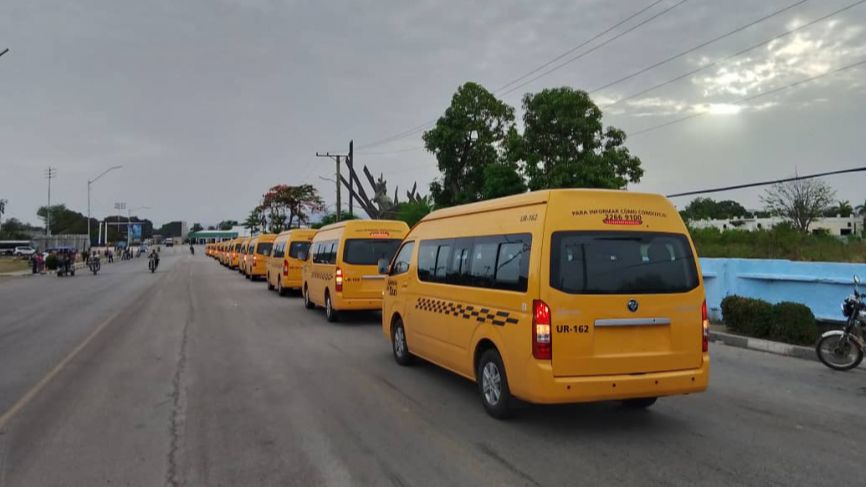
14ymedio, Havana, June 26, 2025 — The new Foton minibuses are slowly arriving in the provincial capitals where they have been allocated after the government reversed its decision to concentrate in Havana the 100 vehicles purchased from China. This Wednesday, the newspaper Sierra Maestra reported the arrival of 20 sent to Santiago de Cuba to reinforce “the four routes of greater mobility,” in an attempt to mitigate the effects of the prolonged shortage of fuel and spare parts.
The new minibuses, according to Jaime Codorniú Furet, delegate of the Ministry of Transport in the province, are part of the actions for the city’s 510th anniversary and an effort to sustain a service that has been seriously limited for years. The official also noted that 20 electric bicycles have been operating in the southern part of the city since 2023, with an average of 10 trips per day, although they do not escape the interruptions caused by frequent and long blackouts.
The coverage is clearly insufficient
Santiago de Cuba, with more than 500,000 inhabitants, has 190 officially established routes, of which 131 are currently in operation, according to data from the transport agency itself. These journeys are served by a combination of state transport, company vehicles, private cars and leased vehicles, some of which are also used as ambulances and hearses.
However, this coverage is clearly insufficient. Given the shortage of buses and the irregularity of rail service, where many so-called “ferrobuses” remain out of service, users have found in motorcycles a fast and relatively affordable alternative that is adaptable to current conditions. continue reading
Santiagueros have found in motorcycles a fast and relatively affordable alternative that is adaptable to current conditions
The boom of electric bicycles and motorcycles in Santiago has been documented both by state media and independent publications. Their popularity soared in the last five years, especially after the pandemic, when restrictions on mobility and the collapse of public transport pushed many citizens to purchase personal vehicles.
Although private motorcycles are not regulated as public transport, in practice they have become a semi-informal taxi service. Many circulate in strategic boarding points such as Trocha, Garzón and Martí avenues, as well as in peripheral areas with little bus coverage.
The attempt to ban passenger transport on motorcycles in 2021 accomplished nothing. At that time, Santiago de Cuba had about 14,000 motorcycles circulating in the city. Faced with complaints from motorcyclists, the government was forced to back down.
The cost of those trips went from 150 to 300 pesos
Four years later, motorcycles and prices have multiplied. On social networks, Santiagueros often comment on the cost of these trips: from 150 to 300 pesos, depending on the distance, time and fuel availability. For many state workers or students, this rate is unaffordable on a regular basis, exacerbating inequality in access to transport.
The proliferation of motorcycles is not without risk. Authorities have reported an increase in traffic accidents related to these vehicles, as well as fires, robberies and violent incidents. Despite these problems, their presence is widespread and in neighborhoods without bus routes they are the only means of connection to the city center.
In parallel, the Government has tried to alleviate the situation by providing 18 boarding points in the provincial capital and one in each municipality, according to official figures. Animal carts and bicitaxis are also retained as short-distance options, although their availability is limited and coverage uneven.
In neighborhoods without bus routes, motorcycles are the only means of connecting to the city center
Chronic fuel shortages have had a direct impact on transport. In March 2024, the Minister of Transport, Eduardo Rodríguez Dávila, acknowledged before the National Assembly that the Cuban motor vehicle fleet was “on the verge of collapse”.
Against this backdrop, urban mobility in Santiago de Cuba seems increasingly to be supported by individual ingenuity rather than effective state planning. Motorcycles, a symbol of everyday life, still have a role that, although unofficial, is essential for the functioning of the city.
Translated by Regina Anavy
____________
COLLABORATE WITH OUR WORK: The 14ymedio team is committed to practicing serious journalism that reflects Cuba’s reality in all its depth. Thank you for joining us on this long journey. We invite you to continue supporting us by becoming a member of 14ymedio now. Together we can continue transforming journalism in Cuba.
Betania Publishing House is making the document available to readers for free download.
The open letter was written in 1988 by writer Reinaldo Arenas (r) and artist Jorge Camacho (l). / EFE
14ymedio, Havana, 19 June 2025 — Written in 1988 by writer Reinaldo Arenas and artist Jorge Camacho, A Plebiscite on Fidel Castro was neither a pamphlet nor an angry proclamation, but an open letter written from exile—between New York and Paris—calling for what in any free country would seem obvious: a free and transparent referendum on the continuation of the regime. It did so, moreover, in a sober tone, without insults or diatribes, appealing to the universal right to vote, the end of the monopoly of power, and freedom of expression as essential pillars of any just society.
The letter was inspired by the plebiscite held that same year in Chile, under the dictatorship of Augusto Pinochet. The idea was simple but powerful: if a political regime claims to have the support of the people, why fear the ballot box? This direct appeal, formulated from an ethical perspective rather than a harsh one, transformed the document into a call that transcended borders. It was soon translated into English and French and sent to dozens of cultural and political figures. The response was overwhelming.
The letter is inspired by the plebiscite called that same year in Chile, under the dictatorship of Augusto Pinochet
In its final 1990 edition, the letter had 274 signatures: 110 Cuban and 164 foreign. Eight Nobel Prize winners—among them Octavio Paz, Czeslaw Milosz, Saul Bellow, and Claude Simon—signed the letter alongside former Latin American presidents, writers, filmmakers, philosophers, journalists, activists, and academics. Among them were Mario Vargas Llosa, Susan Sontag, Allen Ginsberg, Jacques Derrida, Lydia Cabrera, and José Ferrater Mora, an intellectual constellation that gave the text a legitimacy that was difficult to refute. It was not a letter “against Cuba,” but “for Cuba”: for its right to decide, for its silenced citizens, for its still-pending democracy.
From the island, under infinitely more adverse conditions, there were also supporters. For many, the gesture meant surveillance, persecution, or permanent exile. But it also stood as testimony that not everyone remained silent, even within the system.
The letter not only denounced the absence of basic freedoms, but also demanded a democratic and peaceful solution.
More than a specific proposal, A Plebiscite on Fidel Castro was—and remains—a moral snapshot. The letter not only denounced the lack of basic continue reading
freedoms, but also demanded a democratic and peaceful solution, with minimal transparency, and under the protection of the international community. In the current context, marked by renewed repression and political frustration, the text reads like a warning that stands the test of time. Its relevance is not circumstantial, but ethical.
Today, when authoritarianism is becoming naturalized or the value of the free vote is being relativized, this document reminds us that dignity does not admit excuses or postponements. As Reinaldo Arenas affirmed in his other texts, freedom is defended with words, but also with lasting gestures. Committing to a plural Cuba, open to dialogue, without dogmas or exclusions, remains an outstanding debt that this text denounces with lucidity and courage.
Thanks to Betania Publishing, A Plebiscite on Fidel Castro can be read and downloaded for free in PDF format. It is an opportunity for new generations of Cubans—both inside and outside the country—to reconnect with a critical tradition that has not died. Disseminating it is more than a cultural exercise: it is an act of active memory, a way to keep alive the flame of peaceful and civic change.
Thanks to Betania Publishing, A Plebiscite on Fidel Castro can be read and downloaded for free in PDF format.
In an era when social media is saturated with empty slogans and misinformation seems omnipresent, recovering a text like this is also a commitment to clarity and depth. Its pages contain no hatred, but hope; no revenge, only a demand. Rarely in the history of exile, words have managed to break the siege of fear with a concrete, communicative, and firm proposal.
More than a historical relic, A Plebiscite on Fidel Castro is a living tool. To read, share, and discuss it is to resist resignation. Because that letter doesn’t just ask for a vote: it demands Cuba’s right to be itself, without tutelage or caudillos. And that, thirty-five years later, remains urgent.
COLLABORATE WITH OUR WORK: The 14ymedio team is committed to practicing serious journalism that reflects Cuba’s reality in all its depth. Thank you for joining us on this long journey. We invite you to continue supporting us by becoming a member of 14ymedio now. Together we can continue transforming journalism in Cuba.
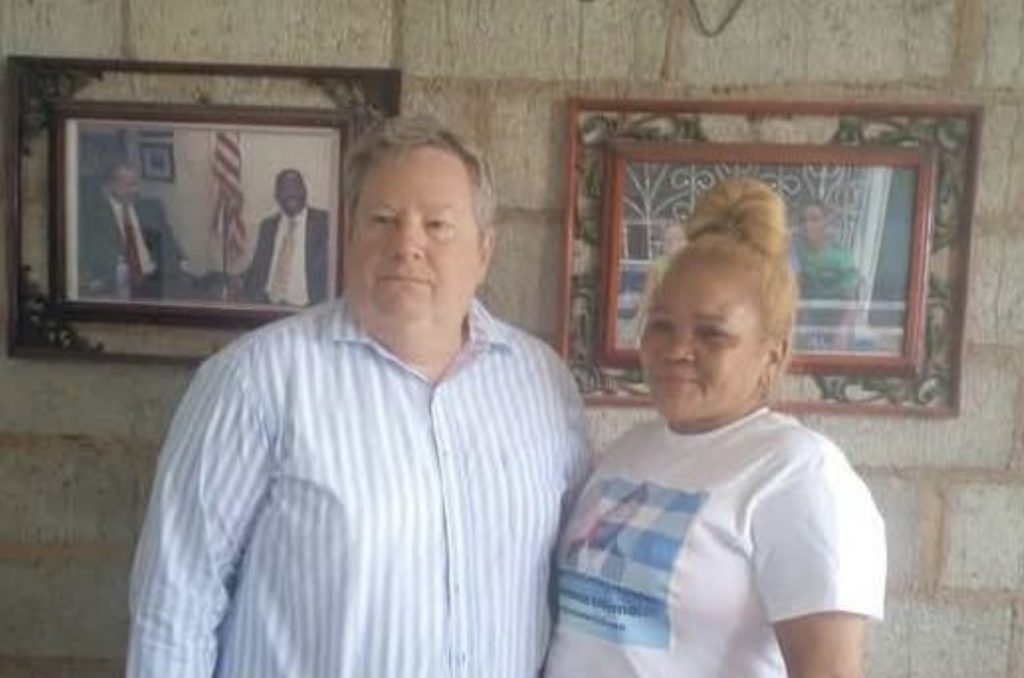
Last month, the US representative in Havana, Mike Hammer, visited her in Placetas.
Donaida Pérez Paseiro with Mike Hammer, Chief of Mission of the U.S. Embassy in Cuba. / X/@USEmbCuba
14ymedio, Madrid, 11 June 2025 — The Provincial Court of Villa Clara has revoked the release of another political prisoner who had been released earlier this year as part of the agreement between the regime and the Vatican. This is Donaida Pérez Paseiro, a Yoruba priestess and resident of Placetas, sentenced to eight years in prison for “public disorder,” “disobedience,” “contempt,” and “assault” after participating in the historic Island-wide protests of July 11, 2021.
In a brief statement released Wednesday on its social media, the court argues that the “benefit of early release,” which it claims—without detailing how—was granted to a total of 553 people, has been revoked “due to noncompliance with obligations, essentially related to the workplace, and for failing to appear when summoned by the Executive Magistrate.”
The “conditional” release granted on January 15, they explain, “involves a probationary period equal to the remainder of the sentence remaining to be served,” something the regime had warned about from the moment it began the releases. According to government spokespersons, it was “neither an amnesty nor a pardon,” but rather “benefits” that did not exempt those released from returning to prison if they failed to comply with their “obligations.”
This is what happened to Pérez Paseiro, who has continued to exercise and assert her rights. As exiled journalist José Raúl Gallego notes in a Facebook post, she has demanded the release of her husband, Loreto Hernández, also continue reading
an opponent and political prisoner, who is “in a serious health condition.”
That request and her “political stance” were the reasons Cuban authorities gave on May 26 for denying Pérez Paseiro permission to travel to an event in Bogotá, Colombia, organized by the Christian Democratic Organization of America. “They weren’t going to allow me to speak ill of the revolution or how they treated counterrevolutionary prisoners, much less promote the ‘Don’t Let Loreto Die’ campaign,” she told Martí Noticias that a State Security agent had told her.
“They weren’t going to allow me to speak ill of the revolution or how they treated counterrevolutionary prisoners.”
This demonstrated “the intransigence of this totalitarian regime toward those of us who fight for a free Cuba,” the opposition leader continued, asserting: “As far as I’m concerned, I stand my ground. They won’t let me leave for another country, but from here I will continue to denounce all the atrocities they commit against political prisoners and the Cuban people in general.”
In addition, at the beginning of that same month of May, she received a visit from the head of mission of the US Embassy in Havana, Mike Hammer, on one of his trips around the interior of the island, which have been denounced by the regime.
Her case follows those of José Daniel Ferrer and Félix Navarro, whose release was revoked on April 29. In Ferrer’s case, he was violently detained during a raid on the headquarters of the organization he leads, the Patriotic Union of Cuba, in Santiago de Cuba. According to his wife, Nelva Ortega, two weeks later, the opposition leader is being charged with propaganda against the constitutional order and contempt of Miguel Díaz-Canel.
The release process was announced on January 14, just hours after Washington, in the final days of the Biden administration, unexpectedly announced Cuba’s removal from its list of state sponsors of terrorism, a list the Island was returned to as soon as Donald Trump took office a week later. Although Havana defended the releases as a unilateral and sovereign measure, taken as a humanitarian gesture for the jubilee year decreed by Pope Francis, the coincidence with the White House announcement was evidence of the agreement. Nor does it seem a coincidence that the arrests of Ferrer and Navarro occurred a week after Pope Jorge Bergoglio’s death.
____________
COLLABORATE WITH OUR WORK: The 14ymedio team is committed to practicing serious journalism that reflects Cuba’s reality in all its depth. Thank you for joining us on this long journey. We invite you to continue supporting us by becoming a member of 14ymedio now. Together we can continue transforming journalism in Cuba.
The Supreme Court upholds the former president’s six-year prison sentence, in addition to her perpetual ban from holding public office.
Cristina Fernández de Kirchner with Cuban president Díaz-Canel in a file photo. / Ámbito
EFE (via 14ymedio), Havana / Buenos Aires, 11 June 2025 — Cuban President Miguel Díaz-Canel expressed his “unwavering support” for former Argentine President Cristina Fernández de Kirchner on Tuesday after learning that the country’s Supreme Court upheld her sentence of six years in prison and a lifelong ban from holding public office.
“We reaffirm our unwavering support for Cristina Fernández de Kirchner in the face of this political judicial process,” the Cuban president wrote on social media. “Strength, dear Cristina,” he added.
Díaz-Canel stated that “once again, the justice system is being used for political reasons, as an instrument of the right against progressive leaders in the region.”
Cuba’s Foreign Minister Bruno Rodríguez also expressed Cuba’s “firm solidarity” with Fernández on social media using the hashtag #TodosConCristina and considered the conviction “a clear act of revenge and threat.” “We reiterate our support for the Argentine people in defense of sovereignty and dignity,” the minister stressed. continue reading
“We reiterate our support for the Argentine people in defense of sovereignty and dignity,” the minister stressed.
Argentina’s Supreme Court rejected the former president’s appeal and upheld the 2022 conviction for irregularities in the awarding of road works contracts. The former president could be detained in the coming hours or days to serve her sentence.
In 2022, a court sentenced the former president to six years in prison and a lifelong ban from holding public office in the so-called “Roads Infrastructure case.” The conviction was for fraudulent administration to the detriment of the State.
The Criminal Cassation Chamber upheld that ruling last year, and on Tuesday, the three members of the Supreme Court unanimously upheld the ruling by rejecting an appeal filed by Fernández’s defense.
In addition, the court also upheld Fernández’s acquittal on the charge of criminal association, after rejecting the Prosecutor’s Office’s request to increase her sentence to up to twelve years in prison.
According to the 27-page Supreme Court ruling, to which EFE had access, the sentences handed down by the previous courts were based on the “extensive evidence produced” and the Penal Code, without demonstrating “in any way” that the appealed decision was contrary to law or that any constitutional guarantee was violated during the proceedings.
“Due process has been upheld, and the appellant has obtained a judgment based on law,” the members of the Court stated.
According to the 27-page Supreme Court ruling, to which EFE had access, the sentences handed down by previous courts were based on the “extensive evidence produced.”
The ’Roads Infrastructure case’ focused on irregularities in the awarding of 51 road construction projects in the province of Santa Cruz (south) to firms owned by businessman Lázaro Báez during the governments of then-President Néstor Kirchner (2003-2007), the husband of the former president who died in 2010, and Cristina Fernández de Kirchner (2007-2015).
During the investigation phase of the case, the court determined that nearly 85% of the Santa Cruz road contracts were awarded to Lázaro Báez, a personal friend of Néstor Kirchner.
The oral court that sentenced the former president in 2022 included among the grounds for the sentence that “the incontrovertible profits obtained” by businessman Báez “do not exhaust the economic advantages that this fraud yielded, since part of the money disbursed by the State was ultimately destined for the former president’s family businesses.”
This Tuesday, the Court noted in its ruling that the judgment alluded to the fact that Lázaro Báez, through companies he controlled, signed rental and management contracts with Kirchner family companies that operated hotels, in addition to having conducted other real estate deals.
According to the Court, these relationships were not challenged by Fernández’s defense, beyond arguing that the commercial acts were “completely lawful and carried out at market prices,” which, in the Supreme Court’s view, “reduces any effectiveness of the argument.”
According to the ministers of the Court, these circumstances led to the conclusion that the awarding of the road works contract to Báez involved a presidential decision that “relegated the economic advantage for the public administration to the economic advantage for private interests.”
The Court also noted in its ruling “various flaws” in the defense’s presentation. Among them, it noted the listing of various judges and prosecutors or meetings with certain executive branch officials “without indicating a single specific circumstance that would reasonably allow one to infer that the impartiality of the judges in this specific case has been compromised.”
The former first lady has also called on the militants to “stand by the people in need” and has warned that she will stay to “put her face and body on the line.”
In addition, according to the Supreme Court, the defense also failed to indicate “how the fear of bias it sought to avoid would have been manifested, and the issuance of a ruling adverse to its interests was not sufficient to achieve this.”
Fernández de Kirchner, in a speech at the headquarters of the Justicialist Party, which she heads, stated that the Supreme Court judges who upheld her conviction “are three puppets who answer to those above them” and that their decision represents a “block to the popular vote,” given that the former president had planned to run in the legislative elections in September.
In addition, the former first lady also called on the militants to “stand by the people in need” and warned that she will stay and “put her face and body forward.” “We are not mafia members,” she said, while also considering that “being imprisoned is a sign of dignity.”
Argentine president Javier Milei quickly reacted to the news through his profile on the social network X, where he asserted that “justice” has been achieved. Milei, now in Israel on an international tour, stated that “the republic is functioning, and all the corrupt journalists complicit with lying politicians have been exposed in their operettas about the supposed pact of impunity.”
In the country, there were numerous demonstrations on Tuesday by his coreligionists.
____________
COLLABORATE WITH OUR WORK: The 14ymedio team is committed to practicing serious journalism that reflects Cuba’s reality in all its depth. Thank you for joining us on this long journey. We invite you to continue supporting us by becoming a member of 14ymedio now. Together we can continue transforming journalism in Cuba.
Cuban students, particularly those in high school and university, are fed up with the restrictions and violations of their citizenship rights by totalitarianism.
The rising cost of telephone services provided by the state through Etecsa sparked student protests. / Radio Rebelde
14ymedio, Pedro Corzo, Miami, 22 June 2024 — Recent student protests in Cuba raise hopes for a return to the days when this transient sector of Cuban society was a constant and just demander of its rights.
Cuban students, particularly those in high school and university, are fed up with the restrictions and violations of their citizenship rights imposed by totalitarian regimes. The rise in the price of telephone services provided by the state through one of its entities, the Cuban Telecommunications Company (ETECSA), has fueled frustration and a lack of hope for a better life for the entire population, particularly young people, with steep price hikes for internet and phone services, the so-called ‘tarifazo.’
According to an article published by El Nuevo Herald, the State’s communications monopoly Etecsa is at least partially owned by Cuban military companies, the true owners of the island.
According to an article published by El Nuevo Herald, the State’s communications monopoly Etecsa is at least partially owned by Cuban military companies, the true owners of the island.
These uniformed thugs have earned millions of dollars selling telephone services to Cubans living abroad for their relatives living in Cuba. Furthermore, columnist Nora Gámez states, “secret financial documents obtained by the Miami Herald show that Rafin SA, a military-controlled company with a significant stake in Etecsa, had $407 million in cash in continue reading
August of last year.”
The inefficiency and greed of the Cuban totalitarian system are equal. Its officials refuse to engage in profitable productive activities, but they adore the means that allow them and their offspring to enjoy a better life, as evidenced by the fact that Manuel Anido Cuesta, a law graduate from the University of Havana who is Miguel Díaz-Canel’s stepson with Cuba’s titled First Lady, Lis Cuesta, is enrolled in the National Taxation Program for Professionals at IE University Business School in Madrid.
The sum accumulated by these Etecsa partners is so significant that it is impossible for Díaz-Canel to have spent it enrolling his wife’s son at the Madrid university or the children of other women at various higher education centers, while ordinary students on the island cannot access the services of the Island’s only existing cell phone service due to its high prices.
The protests by students and the rest of the population are very important. We don’t know how long they will last, but nevertheless they demonstrate the massive exhaustion of the population, which is most aptly reflected in the high number of political prisoners more than six and a half decades after the Castros came to power.
Cuba is an extremely dry prairie. For 66 years, government failure has accumulated the malignant residue of its errors, lies, failed plans, misery, and death, making it very possible that the humblest rebuke could unleash a chain of events that displaces the ruling class and paves the way for momentous changes.
The protests by students and the rest of the population are very important. We don’t know how long they will last, but they still show the massive exhaustion of the population.
Igniting the redeeming spark that will bring the island’s fields, destroyed by totalitarianism, is in the hands of Cubans themselves. There are plenty of examples in the land of our birth, such as on January 12, the eve of the assault on the city of Bayamo, Oriente, when a group led by Pedro Figueredo Perucho , author of the lyrics to “La Bayamesa,” decided to set fire to their homes.
Cuban students, especially university students, played a particularly vigilante role during the Republican era, and Fidel Castro was quick to neutralize them in the initial months after the triumph of the insurrection when he decided to take control of the University Student Federation, an entity that for decades yielded to the will of totalitarianism, as evidenced by the statement by the national president of that organization, Ricardo Rodríguez González, who accused “supposed enemies of manipulating the recent expressions of discontent in the country’s universities, following the tuition increase announced by the state university.”
Students, like the rest of the population, are forced to demand their rights. General Antonio Maceo said: “Freedom is conquered with the edge of the machete, it is not asked for; for begging for rights is typical of cowards incapable of exercising them.”
____________
COLLABORATE WITH OUR WORK: The 14ymedio team is committed to practicing serious journalism that reflects Cuba’s reality in all its depth. Thank you for joining us on this long journey. We invite you to continue supporting us by becoming a member of 14ymedio now. Together we can continue transforming journalism in Cuba.
I had lost the interest and passion that had taken me out of my province and placed me among the top ranks of Medicine.
“What could a young college student with such a passion for Galena do but pack it in a suitcase and run?” / Instagram / Liz Ashelle
14ymedio, Liz Ashelle Díaz Gómez, June 2, 2025 — I live in the state of Hidalgo, Mexico, in a town that is two hours from Mexico City. It’s small and colorful, and I loathe it with all my soul. I work in a marketing agency for the telephone company AT&T, and part of my job is doing field work: going to remote places in the city and begging the most ignorant and poor people in the neighborhood to change to our company, because our salary depends on that commission. So I have known little by little every corner of this territory.
We go up to the mountain ranges, under the burning sun, and I pretend to relieve the pain in my heels by thinking about what scene of the cinema reproduces the images that I have in front of me. It is a landscape of hills with discontinuous stairs to access the community: girls coming out of school in their horrible uniforms, socks up to half calf, rushed, carrying piñatas shaped as an axolotl* under their arms; the murals, all with skulls and crosses, and shoes hanging from the power cables.
There are grocery stores on every block, with their millions of snacks and sweets that I do not know, although my fellow hikers stop every now and then to buy some that they know I have not tasted. They await my reaction with wide-open eyes as I grab the first and issue a judgment, which is usually the same every time: “It’s good but it stings my mouth.”
“Oh, that’s nice, this is like a Mexican movie,” and we all laughed out loud. My supervisor replied: “Because you’re in Mexico!”
They hang colored flyers from post to post for the Day of the Dead and do not remove them throughout the year, similar to those that hover in my childhood from a CDR party, and the wind beats them and turns them into the only thing that moves and sounds in those streets paved with dust and abandoned on top of a hill. Everything is cinematic. I know that there is, although I can not remember it, some film of Alfonso Cuarón that I saw as a teenager, with a scene identical to the panorama of which I am part, and a protagonist who surely is called Marifer but does not dress like me, speak like me or have my skin color and hair.
On the first day we walked up, and I stood at the edge of a ravine and saw the colorful houses stacked, distributed throughout the surface of the hills, separated by narrow streets where the cars tumbled past, so tightly that they seemed like toys. I shouted: “Oh, how nice, it’s like a Mexican movie,” and we all laughed. My supervisor replied: “Because you’re in Mexico!”
I’m in Mexico. Magical Mexico. Why am I no longer living in Cuba?
I was living in Havana with my girlfriend, in a rented cottage in a bad part of Cerro, very pretty and cool, where they almost didn’t turn off the power. On some weekends we visited Matanzas and came back crying a lot. Amanda’s continue reading
family lived in Jovellanos, an hour and a half from where my mom lived, in a two-story home. There they shut down the power religiously at five in the morning and turned it on at two in the afternoon. As soon as the air conditioner was turned off and the house was in a resounding silence, I irredeemably woke up and began my most exhausting hours of the day.
The heat began to flood the bedroom little by little, appropriating the space. I uncovered Amanda, who was still sleeping undisturbed, and she began to turn around in bed looking for the cooler side of the sheet. The minutes before dawn lasted three hundred seconds. We were gradually moving from an overwhelming stillness to the first signs of morning life: you could hear the grandfather just waking up doing his toilet routine in the bathroom, including all the throat clearing and the most scandalous evacuation. Then, the grandmother chasing after the baker or yoghurt maker, shouting at them from the back of the house as she walked to the door, and the dog barking, sticking her tail between her still agile legs.
“Would those things happen anywhere else in the world?” / Instagram / Liz Ashelle
From the bedroom, we could hear all the conversations inside and outside the house, no matter the tone of voice. I heard my mother-in-law whispering at the window: “Don’t shout, you’ll wake up the girls.” When the sun finally began to rise, Amanda became meat for the mosquitoes; they appeared to bite her legs and torso without any compassion. I tried to kill as many as I could and turned my hand into a fan to scare them away. I was not stung; mosquitoes never liked my blood, but she woke up full of red welts and almost always about to cry, soaked in sweat.
By that time I had spent four or five hours awake in that thick darkness, thinking. I watched her sleep as only a woman in love, twenty years old, can watch the dreams of someone who was about to become the most immediate victim of emigration. I pushed her hair out of her face and kissed her sweaty and sour forehead. She groped for my hand with hers, passing over the quilt, the clothes I took off, my thigh, the cell phone, a portable charger and, finally, my hand.
Amanda and I were arguing louder each time, more violently, more like men. I let months fly by watching as the relationship of my teenage dreams crumbled and dragged us in its wake, becoming two monster daughters of other monsters that occasionally made love. Twenty-three years of the most beautiful woman I had ever seen sleep, with her mouth open, mosquitoes making a halo over her head and my hand clinging to hers. Completely naked in front of me, on equal terms, we the most optimistic thoughts about a future together, which only required that we fix a little here and there to make it sparkle, and I had to punish myself for forgetting that the night before she had spit in my face and we had screamed until we were completely exhausted.
They were daily hours of a struggle between the deepest love and a dangerous madness. When there was a spot of light on the ceiling, we were two women recognizing each other’s more miserable and rotten side, and when not, the only miserable and rotten thing we could see was the Revolution. Amanda woke up in a puddle of rancid fluids and tears. By then I had bathed, cried, and had breakfast with her mom and grandmother. She would sit on my legs on the Swiss couch in the kitchen and share with me her most horrible impression of the blackout: we were visiting, but her family and my mom lived like that.
“My mother had decided that she was running out of time, that, with almost fifty years under her belt, the bars of the island prison were closing and she wasn’t going to stay inside”
My mother had decided that she was running out of time, that, with almost fifty years under her belt, the bars of the island prison were closing and she wasn’t going to stay inside, even if to leave she had to sell the only asset we had in the world: the house of my childhood, with everything inside. House for sale with everything inside, in Pueblo Nuevo. It comes with the washing machine and the scratches made by the dog on the door. I will leave you the microwave and the landline telephone, the picture of the girl’s quinceañera, the fish tank, the extra bed. Also if you want to occupy it, there is a cat, how are you going to keep him from breaking into his house? I will leave the blacksmithing things with the tools, and the pillows… everything, but I ’m taking the quilts because they say that it’s cold in El Salvador.
The sticky mark on the wall is from a poster of Malú, I think with acetone it will come off. That air conditioner does not work, but I’ll leave it and you can sell it for parts. Look, this is how the door opens, by pulling the cord on the stairs so you don’t have to go up. The armchairs are not upholstered in the back. The water tanks are on the roof, one is yours and the other is for my sister who lives downstairs, and it’s all painted because my husband bought the girl some spray paint years ago, and I had to let her graffiti the ceiling in exchange for not vandalizing the street. Yes, it was necessary to control her so she wouldn’t get into that gay propaganda, but she came out lesbian anyway. Do you see how there are two keyholes on the door? They open with the same key. If you want to buy it we can sign the papers this week, the refrigerator is still under warranty. I want to sell now because in a few months there will be elections in the United States, and you never know.
“I was forced to make a very cruel decision: take part of the money and stay in Cuba, or leave with her”
Once put on sale in all the Facebook groups, with explicit photos that violated the privacy of what was once my home, I was forced to make a very cruel decision: take part of the money and stay in Cuba, or leave with her.
The return to Havana was an even more excruciating hell. Sometimes my in-laws would take us in their car, but we had to make most of the trips on foot through the street, stumbling, loaded with packages of frozen food and clothes, until we reached the Martí neighborhood. The university, which in other years had been the place of greatest achievement for my generation, had become a deeply hostile place, and I, adapting to circumstances, had completely lost the interest and passion that some time ago took me out of my province at all costs and positioned me among the best ranks of Medicine.
Who was going to tell the 18-year-old teenager who sat in a psychological consultation about to decide that she would leave her home, that it would be to the capital, that she would study medicine, and that she would have to marry her stepfather to get the papers from Havana and be able to study there, that half of her dreams were going to be consumed like raisins when she put them in the hands of the system. When the alarm sounded in the morning, I broke into uncontrollable crying that has accompanied me since childhood, as the crudest symptom of depression. The days that I could open my eyes without crying and transport myself to school were even more miserable, and I ended up finding an excuse to go back home, prepare food and throw myself into bed to watch a pretentious A24 movie.
“Exaltation and doubt had been brutally murdered by the disinterest in teaching and the lack of resources”
The peak of academic demotivation was reached in my first direct experience with the clinic in Fajardo. What could a young college girl with such gallant passion do but pack her bag and run? The Red Theater, which once bestowed on me the Relevant Award on the Day of Science, was one more arm of the dictatorship, where the dean exercised his power of political-ideological coercion.
My group of friends, who used to be an optimistic study team and successfully navigate the group dynamics, had become a flock of zombies walking around the hospital, dodging reasonable protests from patients and waiting for the visitation pass to end. Exaltation and doubt had been brutally murdered by the disinterest in teaching and the lack of resources.
My last day at the Teatro del Fajardo, which I recently heard collapsed, was the day they announced that they were going to assess the school for accreditation. The news came with a blackmail that put in play my grade of a filler subject, if I did not answer the questions cautiously to favor the prestige of the University of Havana. That day, for the first time since I arrived in the capital, I did not raise my hand to speak. I shut my mouth and chewed up the virgin and scandalous girl who first entered the theater and was amazed when they turned on the lights, who cracked open a window and directed her group towards the row on the right because more air came in, who stood in front and explained a research paper and published it, who ate an omelet with bread on the staircase of the theater at midnight on guard duty. I swallowed them and never went back in. The system was given a passionate, enthusiastic, revolutionary, idealistic and committed-to-science teenager, and in three years it returned a woman imprisoned in anger and skepticism.
The decision was not difficult; it was taken before it was considered possible, before 1959. The day I was born, in the maternal hospital of Matanzas, bald, pink and without consciousness, this fate had already relentlessly swept over me. The only thing left for my very small and not so free will, was when.
“I walked slowly all over G, in the same uniform coat they gave me in my first year, now a faded yellow and tight”
It was over a month, which felt like a year, before I could accept that I was saying goodbye. I went out to buy vegetables in the country and observed the fruits and the delicacies in detail, the avocados that did not fit into my hands, the yucca that did not know what it was called in Colombia or in Uruguay, the man on the little square who signaled me that he had shrimp for sale under the table. Would these things happen anywhere else in the world?
We turned on the projector and I placed with excessive care the books that supported it (Internal Medicine I and II), and I memorized the counters and the prices of the kiosk where we shopped daily. The rattling of the key that closed the front door, and the roar that the balcony door made when it was thrown open; we always agreed to put a quilt there to cushion the blow but then forgot. Halfway through the film I paused the projector and asked Amanda to bring something to eat. She protested, surrendered, came out, projected the film on her naked body. I tried to memorize it, ran behind her to hug her and started crying. There was no need to speak, it was over. I had pronounced a death sentence and after that there was only room for silence and crying.
The streets of Havana appeared bigger, more beautiful, more populated; they embraced me with their capital’s arms. I walked slowly all over G, in the same uniform coat they gave me in my first year, now a faded yellow and tight around my chest and arms. I made a mental journey with my eyes closed to the theaters of El Vedado; I imagined the sound of my boots stepping on the wooden floor of the Trianon, like the first time I went to see The Shoemaker’s Prodigious Wife [a play by Federico García Lorca].
I crossed and walked making a mental sketch, with the privileged memory of grief, of the previous occasions I had walked those streets, and with whom, and what clothes I wore, and how I felt. Every two or three blocks I would stumble upon someone to greet and tell him that everything was fine, I’m here, struggling, say hello to your mom. The smell of the salt water from the Malecón began to accost my nose, and the memory of the first night I sat alone on the wall, just arrived from Matanzas, believing that I was going to die of homesickness and that I was in a movie by Fernando Pérez.
The city held my hands very tightly, as if I wanted to escape and it had to tame a naughty child. I walked clenching my fists, why was I so upset, so tired, so violent? I did an urgent introspection exercise, and the anger was born so far back that I had my own stuffed animal in the crib from which I fell at three months. My face was burning, red with fury and flooded in tears: I’m leaving, I’m leaving Cuba, tomorrow I’ll confirm it to my mother, I’m leaving here. I had begun the journey.
* An endangered Mexican salamander
Translated by Regina Anavy
____________
COLLABORATE WITH OUR WORK: The 14ymedio team is committed to practicing serious journalism that reflects Cuba’s reality in all its depth. Thank you for joining us on this long journey. We invite you to continue supporting us by becoming a member of 14ymedio now. Together we can continue transforming journalism in Cuba.
Of the total, 32% comes from Russia, especially from its Ministry of Civil Protection.
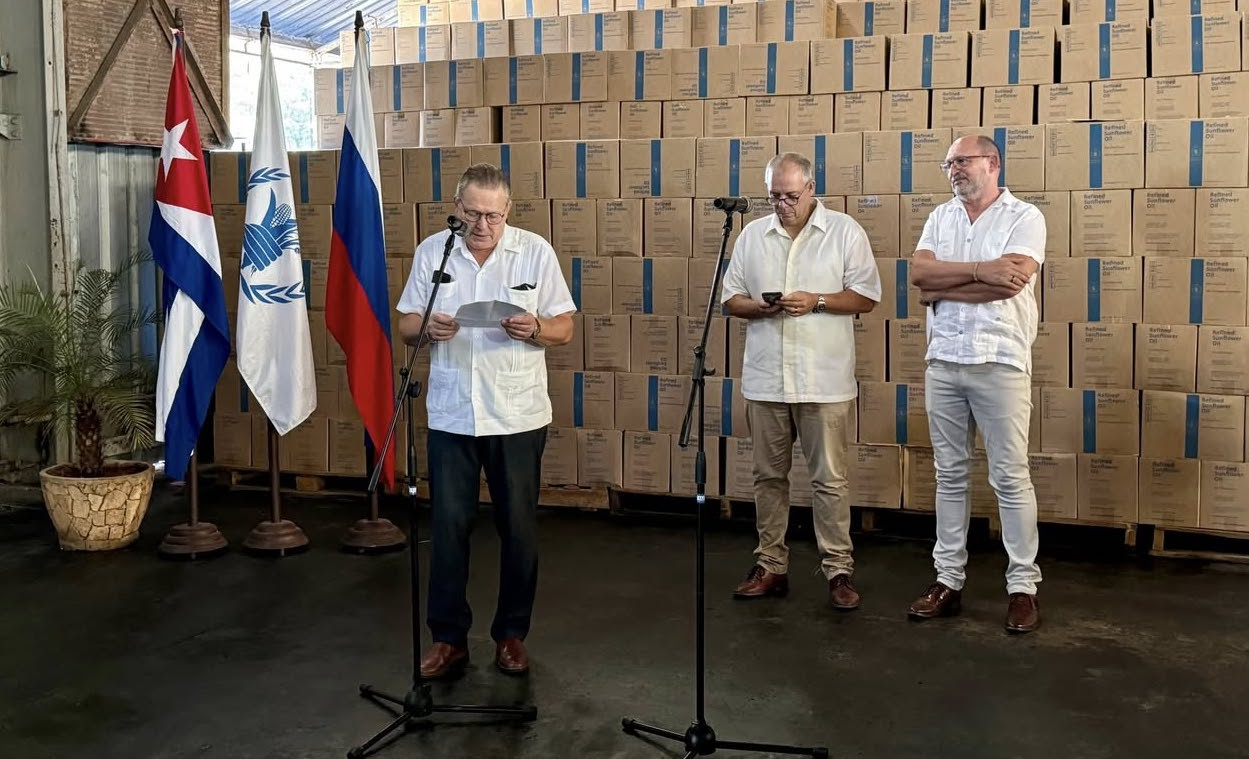
Russian Ambassador to Cuba Victor Koronelli, with donations of vegetable oil, on June 18. / Facebook/Russian Embassy in Cuba
14ymedio, Havana, 26 June 2025 — The World Food Programme (WFP) has allocated $57.9 million to Cuba in support of food and nutrition security projects since 2021.
With the funds, the official press reported Thursday, “rice, grains, and oil have been purchased to benefit the most vulnerable people and to respond to food emergencies in the country.”
At least five million dollars of the total was used to “supplement a varied and nutritious diet” for primary school children (ages 5 to 11).
“We will continue to provide support to our sister country, Cuba, both through international organizations and bilaterally.”
Of the total, according to WFP figures, 32% comes from Russia, “with significant contributions made through its Ministry of Civil Protection, Emergencies and Disaster Management” (Emercom).
The Russian aid has made it possible to purchase 844 metric tons (MT) of vegetable oil this year, of which 656 MT have already arrived on the island, according to a report in Adelante. On June 18, 470 MT of the same product also arrived as a donation, “to benefit victims and vulnerable sectors.” continue reading
“We will continue to provide support to our sister Cuba, both through international organizations and bilaterally,” declared the Russian ambassador to the island, Víctor V. Koronelli, at a ceremony held that day at the Ministry of Domestic Trade’s Loading and Unloading Distribution Center in Old Havana, which official media described as “simple.”
The diplomat recalled that in 2024 they delivered to the Cuban Public Health system “emergency modules and medications, as well as fire and rescue motorcycles, bags of sanitary first aid, and water purification filters, and earlier, food donations of sunflower oil and peas arrived.”
In February of last year, in the midst of the systemic crisis from which the island has yet to recover, the Cuban government formally requested assistance from the WFP for the first time to distribute rationed milk to children under seven.
The diplomat recalled that in 2024 they delivered “emergency modules and medications” to the Cuban Public Health system.
The UN program recognized the “urgent need” and, in a statement, emphasized “the importance of this request,” especially in the context of the “deep economic crisis facing Cuba,” which, in its view, was significantly impacting the population’s food and nutritional security.
At the time, the regime had not made public either the request or the initial multilateral contributions. In response to a letter sent by the Ministry of Foreign Trade and Investment to the WFP executive directorate in Rome at the end of 2023, the UN agency indicated that in February 2024 it had managed to deliver “144 metric tons of skimmed milk powder,” benefiting nearly 48,000 children between seven months and three years of age in Pinar del Río and Havana—nearly 6% of the children to whom the government intends to provide subsidized milk.
____________
COLLABORATE WITH OUR WORK: The 14ymedio team is committed to practicing serious journalism that reflects Cuba’s reality in all its depth. Thank you for joining us on this long journey. We invite you to continue supporting us by becoming a member of 14ymedio now. Together we can continue transforming journalism in Cuba.
Without electricity, businesses stop selling and stop accepting all types of money
Stationary bikes for 280 MLC, along with beach umbrellas, were some of the few options at the old Ten Cent / 14ymedio
14ymedio, Julio César Contreras, Matanzas, 25 June 2025 -The pattern repeats itself. In any city where a dollar store opens, businesses in freely convertible currency (MLC) accelerate their decline. Matanzas could not be any different, and the Ten Cent store on Medio Street is the latest example of this silent struggle that runs through the commercial fabric. Almost empty, it now appears that the spacious store’s days are numbered.
Since the beginning of April, three stores in the city have switched to foreign currency sales. La Matancera, La Reina, and La Atenas de Cuba were chosen to join the group of markets across the island that sell in dollars or with the Classic Card. The old Ten Cent, renamed Centro Comercial Variedades decades ago, was not included on that list, and since then, its offerings have only diminished.
Some of the products that were previously on the shelves of the market in MLC moved to La Atenas de Cuba, located a few meters away, on Callejón de la Sacristía, at the corner of Milanés. The direction to strip one saint to pay another came from “on high,” according to an employee of the disgraced store who spoke to 14ymedio. Thus, boxes and boxes of merchandise changed both their location and the currency in which they were sold.
When the blackout hits, the lack of electricity affects both locations, in dollars and in MLC. / 14ymedio
“This looks like a gym without people,” a customer could be heard saying this Monday morning as she browsed the spacious sports equipment area in the former Ten Cent. The white granite floor, high ceilings, and a strong, musty smell give the market the appearance of a rarely visited museum. Stationary bikes for 280 MLC, along with beach continue reading
umbrellas, were among the few offerings.
The neglect and disorganization extend to the rest of the store, where the most visited space isn’t the counter with cleaning supplies or the appliance area, but the place where customers can leave their bags. The dynamism is due to the fact that some Matanzas residents store their backpacks and purses there when they want to enter other nearby stores that have restrictions on access with bags or packages. Few even head inside the Variety section.
However, when the blackout hits, the lack of electricity affects both establishments equally. Without power, the workers at La Atenas de Cuba halt sales, and the hard cash dollars stop flowing into their cash registers. The old Ten Cent also sinks further into stagnation. Without electricity, the gap narrows, and both businesses are just two dark, empty buildings.
____________
COLLABORATE WITH OUR WORK: The 14ymedio team is committed to practicing serious journalism that reflects Cuba’s reality in all its depth. Thank you for joining us on this long journey. We invite you to continue supporting us by becoming a member of 14ymedio now. Together we can continue transforming journalism in Cuba.
Cuba’s Minister of Tourism announced in an interview with the Spanish newspaper ‘El País’ that there will be direct flights between Barranquilla and Santiago de Cuba.
Foreign tourists giving money to a woman on Havana’s Paseo del Prado. / 14ymedio
14ymedio, June 25, 2025 — Cuba’s Minister of Tourism, Juan Carlos García Granda, has a proposal to encourage tourism in Cuba: the creation of a visa-free common area in Latin America. The idea does not seem, for now, to be more than in his head, but he outlined it in an interview with the Spanish newspaper El País during a meeting with tourism entrepreneurs in Colombia, held at the Hotel Dann Carlton, north of Bogotá.
“Perhaps we need to start talking about visas that can be used for several countries, as is the case with the Schengen Area in Europe. We must see how the world has done it and apply it in the region to attract common benefits from such distant tourist flows,” says García Granda, who considers it essential to reduce bureaucracy. The official introduces the proposal when asked about the Chinese market, which Cuba has been dreaming about for at least two years.
The minister explains to the journalist that the decline in traditional markets, particularly in Europe, has led his department to try to look for new fishing grounds, including Turkey, China and Russia. “We already have better [tourism] flows that we want to grow. And we want to do so by providing a unique offering as a region that benefits us and by sharing it, he states.
“We already have better [tourism] flows that we want to grow. And we want to do so by providing a unique offering as a region that benefits us and by sharing it”
García Granda omits a part of the reality revealed by his own data. The number of Russian tourists arriving on the island has plummeted so far this year. Until 2024 the evolution was positive, reaching third place by continue reading
origin and with around 185,000 travelers last year, but in 2025, a decline of around 50% began. It is true that the number of Turks (12.6%) and, above all, the Chinese (48.6%) visitors increased, but the figures are still anecdotal: 14,898 and 26,760 respectively.
The minister says that another strategy is to increase connectivity. “Faced with such a difficult scenario, we are trying to strengthen markets that we have always had, like Colombia, Mexico and Brazil,” he says. The last two had a good evolution last year, maintaining the figures of Mexico, which is not small in view of the debacle of the sector, and Brazil rose by 11 percent. However, Colombia did have a substantial drop: 32,604 travelers arrived from that country, 20% fewer than in 2024.
Perhaps the effort to recover the lost quota was part of García Granda’s meeting with some 30 tour operators and sales managers of Colombian airlines. El País reports that beginning July 3, the airlines will have a new route between Barranquilla and Santiago de Cuba, coinciding with the celebration of the Caribbean Festival. “This demonstrates how there are still people with enthusiasm and knowledge of Cuba and the Colombian market. I think they have made a bet that has every chance of winning,” says the minister. Although there are no more details about these routes, the Colombian press has indicated that they are charter flights and also suggests that they will continue after the event.
“All the people know that the economic benefits of the sector bring prosperity and cushion the effects of these very difficult times.”
In the interview, García Granda tries to convince the journalist, as he does in Cuba, that the investment effort made by the State is aimed at improving the conditions of citizens. “All the people know that the economic benefits of the sector bring prosperity and cushion the effects of these very difficult times,” he said, when asked by the journalist about a possible rejection of the population towards the strength of the hotel sector in the middle of the long blackouts. “That [narrative] has tried to provoke the counter-revolution and slanderous campaigns,” he spit out.
Next, García Granda, after claiming that the establishments have their own generators, tries to soften his remarks. “I would not say that there is an isolated system of energy generation, but we work so that the weight of our consumption [that of the hotel sector] does not necessarily fall on the shoulders of the population.”
In the interview, there was also time to talk about the United States. The journalist asks García Granda if Havana plans to improve relations with Washington in order to recover the sector. The minister remarks that the ball is in the court of the White House, which prevents its citizens from traveling to the island. “It is very bad that governments prohibit their citizens from deciding freely, and the world should help citizens to do so and not sell the US as a symbol of freedom,” he argues.
The official also wants the journalist to ask former president Barack Obama – who was in Cuba in April 2016 – “what is the only place where the Beast (Obama’s armored car) has walked and even the people threw a tomato at him.”
COLLABORATE WITH OUR WORK: The 14ymedio team is committed to practicing serious journalism that reflects Cuba’s reality in all its depth. Thank you for joining us on this long journey. We invite you to continue supporting us by becoming a member of 14ymedio now. Together we can continue transforming journalism in Cuba.
The music cuts out at the Cuban Art Factory and Coppelia closes because the ice cream is melted.
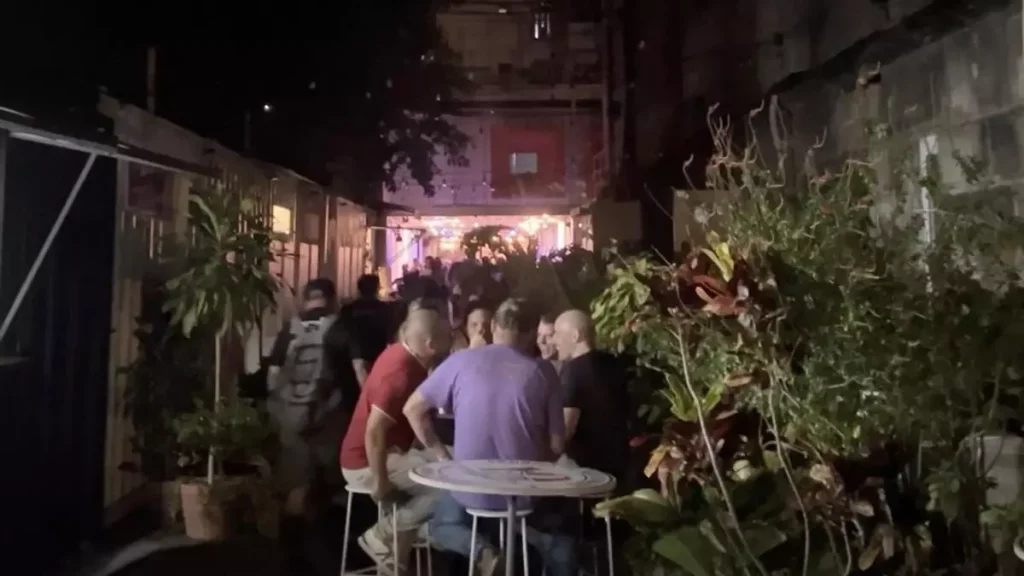
The regulars at the Fábrica de Arte entertain the nights with conversation, with no more air than that of their fans and no more dancing than that of an imaginary rhythm. / 14ymedio
14ymedio, Darío Hernández / Juan Diego Rodríguez, Havana, 24 June 2025 — The increasing number of blackouts respect fewer and fewer hours and fewer neighborhoods. Living in Havana’s most touristy areas doesn’t guarantee a night without power outages. This is true of Vedado, which has had power for just a few hours for several days. Even the most famous entertainment venues, such as the Cuban Art Factory (FAC), are not spared.
“The power goes out almost every day at dawn, and the power lines only give power to the bar,” says a worker at the bar, located on 26th Street and 11th Street. Without music and in the stifling Havana heat, the regulars pass the time chatting away, with no air except that of their fans and no dancing other than to an imaginary rhythm.
Many of the scheduled concerts must be canceled or postponed, the same employee indicates. The courtyard is dark, the auditoriums and exhibition halls dimly lit, mosquitoes hit the lamps at the bars—and the legs of patrons—the FAC is presenting its most subdued appearance these weeks. And not even the rebellion it displayed almost two years ago, when it launched the creative “Bring Your Light!” campaign against the energy-saving measures that the Ministries of Energy and Mines and Culture were attempting to impose on it, is of any use now.
This Tuesday, just a few meters from the luxurious Iberostar Hotel in the K Tower, not even the traffic lights were working. / 14ymedio
During the day, the neighborhood isn’t much luckier. This Tuesday, just a few meters from the luxurious Iberostar Hotel in the K Tower, not even the traffic lights were working. Sitting on the steps of the Banco Metropolitano at 23rd and J Streets, several customers waited for the lights to come back on. At the busy intersection of L and 23rd Streets, by the Habana Libre, a patrol car seemed to be managing the passage of vehicles from one side to the other, but no: the same police car was trying to make its way through the chaos.
Across the street, the iconic Coppelia ice cream parlor did have electricity, but it didn’t matter: it wasn’t open because the ice cream had arrived from the factory already melted. “It’s disrespectful,” exclaimed a mother who had come with her daughter from a distance, only to find the place closed. “The truth is, it doesn’t matter when you come; the ice cream is always served melted, and the water is hot when they serve it,” another woman protested. “This is more like the cathedral of milk shakes.” continue reading
Along with a cordon to keep people out, a candy stand—cookies, sweets, bottled water—was the consolation prize for anyone who came to the ice cream parlor.
At the busy intersection of L and 23rd Streets, below the Habana Libre, a patrol car seemed to be managing the passage of vehicles from one side to the other, but no: the same police car was trying to make its way through the chaos. / 14ymedio
In other areas of the capital, the blackouts are also continuing. “They’ve been cutting off the power practically all night,” says a resident of Guanabacoa. “Here they cut it off last night from 12:20 a.m. to 2:00 a.m. and then from 4:30 a.m. to 7:00 a.m. And now it’s from 11 a.m. to 3 p.m. Not to mention the fact that we’ve been without water for four days.” The woman reports that some friends claimed to have heard people protesting by banging on pos and pans “around the Amphitheater.” The situation is not much different in Cerro, where residents say there were also protests near the Sports Casino.
“I live right next to an avenue, and the silence is incredible,” says the Guanabacoa resident. “People are physically and mentally exhausted. They go to bed nervously knowing that the power could go out at any moment, and with this heat, I assure you it’s impossible to sleep.” What worries her most, though, “is that this is just beginning; the hottest months are coming.”
The iconic Coppelia did have electricity, but it didn’t matter: it wasn’t serving because the ice cream had arrived from the factory. It had melted / 14ymedio
The deficit projected by the Cuban Electricity Union (UNE) for this Tuesday’s peak hour once again exceeds Monday’s forecast . With an availability of 1,830 megawatts (MW) for a peak demand of 3,550 MW, there will be a deficit of 1,720 MW and an estimated impact of 1,790 MW.
Yesterday, according to the UNE report, “the service was affected 24 hours a day and the situation continued throughout the night.” The maximum impact was ultimately 1,760 MW, but this did not coincide with peak demand, but rather later, at 10 p.m.
____________
COLLABORATE WITH OUR WORK: The 14ymedio team is committed to practicing serious journalism that reflects Cuba’s reality in all its depth. Thank you for joining us on this long journey. We invite you to continue supporting us by becoming a member of 14ymedio now. Together we can continue transforming journalism in Cuba.
The political prisoner has been in solitary confinement for five days, says Anamely Ramos.
Maykel Osorbo has been in Pinar del Río prison since 2021. / Screenshot
14ymedio, Madrid, 24 June 2025 — Rapper Maykel Castillo ‘Osorbo’ has been on a hunger strike for five days and is isolated in a punishment cell at the Kilo 5.5 Provincial Prison in Pinar del Río, according to curator Anamelys Ramos. The activist, who serves as the political prisoner’s spokesperson, had announced the possibility last Friday, attributing it to “inmates in solidarity,” although she only confirmed the news on Monday, without specifying how.
“After two days without news, today we learned that Maykel is indeed on strike and has been isolated in a punishment cell for five days without food. We don’t know if the strike also includes thirst,” she stated on her Facebook account.
According to the curator, “what triggered this new crisis was that Maykel was suddenly removed from his company for disciplinary infraction and was threatened with being transferred to a prison in eastern Cuba. I don’t think it’s necessary to explain why we can’t allow Maykel to be sent more than 800 kilometers from his place of residence,” she said.
Ramos, who has emphasized that Osorbo should never have been imprisoned, points out that whatever happens is the responsibility of the authorities. “I know you believe you own not only the country but also the bodies of Cubans. I also know that you believe your power is irreversible. But there are plenty of examples that you are increasingly weaker and have fewer resources to stabilize a country that has already crossed the threshold of many deaths. I will only tell you that you are not prepared for Maykel’s death,” she warns. The activist urges people to share information to demand the rapper’s release. continue reading
“I know you believe you own not only the country but also the bodies of Cubans. I also know that you believe your power is irreversible. But there are plenty of examples that you are increasingly weak.”
Last Friday, Ramos had already reported the situation as practically certain, based on sources within the prison. At that time, she asserted that Osorbo was standing firm in the face of the threat of transfer.
“The fact that he’s more than 150 kilometers from his place of residence is cruel. And now they intend to send him almost ten times farther. And they expect this to happen without him or us doing anything. You’ve gone crazy,” she warned. “Nothing, except the desire to humiliate Maykel and make his life more difficult, justifies sending him there. Maykel knows full well why they’re doing it, and it’s precisely his survival instinct that drives him to stand his ground.”
Just two months ago, Osorbo was involved in a similar situation. It was at the end of April , when he was held in solitary confinement for five days after a confrontation with a State Security agent “during a routine visit that was suspended.” Ramos stated at the time that the official, like others on various occasions, had provoked the situation by trying to force a reaction that would justify the sanction.
“They’ve been insisting for months that Maykel is behaving badly. They want to convince those close to him, and everyone else, that what’s happening to Maykel, and therefore this punishment, is his fault,” she wrote. At the time, the curator warned that the political prisoner’s health could worsen, as he went into isolation with a virus.
“They’ve been insisting for months that Maykel is behaving badly. They want to convince those close to him, and everyone else, that what’s happening to Maykel, and therefore this punishment, is his fault.”
Osorbo, one of the authors of the song “Patria y Vida” (winner of two Latin Grammys), has been serving a nine-year prison sentence for contempt, assault, public disorder, and “defamation of institutions and organizations, heroes, and martyrs” since May 2022, although he had already spent 13 months in prison—since April 2021—which are being discounted from his sentence. In the same trial, artist Luis Manuel Otero Alcántara was sentenced to five years.
Although the rapper has repeatedly expressed openness to the possibility of being released on the condition of forced exile, the option has not prospered. Nor was he released during the process agreed upon with the mediation of Pope Francis, through which more than 500 people, fewer than half of whom were political prisoners, were released, according to the government, “for the Jubilee Year.” Among those who benefited from that pact—which involved removing Cuba from the US blacklist of sponsors of terrorism for just the week Joe Biden remained in office—were Félix Navarro, José Daniel Ferrer, and Donaida Pérez, whose measures have since been revoked .
____________
COLLABORATE WITH OUR WORK: The 14ymedio team is committed to practicing serious journalism that reflects Cuba’s reality in all its depth. Thank you for joining us on this long journey. We invite you to continue supporting us by becoming a member of 14ymedio now. Together we can continue transforming journalism in Cuba.
Some neighborhoods barely suffer any outages, while others live among candles and silent refrigerators.
Members of the Teatro de las Estaciones, in Matanzas, with a poster announcing the suspension of the play. Sign: “Function suspended. Theater for children is not a priority of those who plan electricity service.”/ 14ymedio
14ymedio, Pablo Padilla Cruz, Matanzas, 20 June 2025 — “The essential is invisible to the eyes,” says the famous quote from The Little Prince. But when Antoine de Saint-Exupéry wrote it, he was not referring to the blackouts. In Matanzas, the children find it difficult to see the adaptation prepared by the group Teatro de las Estaciones. The city has become a dark pit, in whose abyss the light is distributed with diffuse and often arbitrary criteria. In that abyss, only some – the chosen few, the closest to power – receive the grace of constant electricity. As is often the case on this island, for some to win, others must lose.
“We know what is going on in the country. We know and understand that hospital circuits must have priority. What we don’t understand is how a circuit where there are only houses of Party officials and militants has ten hours more electricity than any other,” says a theater worker who prefers anonymity. While he brings a cup of coffee to his lips, he smiles with irony and adds: “The provincial headquarters of the PCC [Cuban Communist Party] is just there,” and he points to some lights a few meters away.
The comment is not isolated. Parents, artists, technicians and theater managers share the same frustration. It is not just the impossibility of rehearsing or presenting performances, but an implicit message: culture, childhood and art are not priorities. continue reading
It is not just the impossibility of rehearsing or presenting performances, but an implicit message: culture, childhood and art are not priorities
The children who came to the theater with the hope of seeing a puppet show, accompanied by parents who strive during the week to offer them moments of healthy recreation, found the doors closed, lights out, curtains down. “Then we and the kids put our heads in our hands. Places where children can grow up with sensitivity are not valued,” continues the same worker.
The Teatro de las Estaciones is not just any institution. Founded by maestros Rubén Darío Salazar and Zenén Calero, it has been for decades a quarry of creativity and sensitivity for generations of Cubans. Its members have taken the puppetry technique to unexpected levels, combining tradition and avant-garde, raising the genre to a level of respect and recognition. “I don’t say it only because I work here,” insists a woman from Mantanzas. “I say it because we have built it with a lot of effort, with every rehearsal, with every performance under the sun and under the blackouts.”
The work, entitled A Trail in the Stars (Invisible poems to say at twilight), started from the verses of Asteroid B612 by writer José Manuel Espino – a book that pays homage to Saint-Exupéry’s immortal classic. The company has had to suspend performances, adjust rehearsals and reinvent the calendar because of power cuts. But more than a technical contingency, what is perceived is a deep fracture: the lack of equity in the distribution of energy.
The authorities have implemented a rotation system that, according to the official discourse, seeks “equity” in the distribution of electricity. In practice, however, the perception is different. Some neighborhoods barely suffer cuts, while others live among candles, exhausted batteries and silent refrigerators.
Art, like the flower of the Little Prince, needs care. It does not survive without light, without attention, without a space to flourish
Art, like the flower of the Little Prince, needs care. It does not survive without light, without attention, without a space to flourish. And although the rulers proclaim from the grandstands the importance of culture and healthy recreation, administrative decisions contradict that discourse. “They talk about culture as a shield, like a sword, but here we feel forgotten,” says another member of the artistic collective.
And this is not just a cultural anecdote. It is a reflection of how the blackouts – that word so present in Cuban daily life – affect not only domestic life, but also the social fabric, the mood, the soul of the nation. Because when the theaters go out, it’s not just the light bulbs.
Artists don’t ask for privileges. They ask for minimum conditions to do their work, one that often fills educational, emotional and spiritual gaps. In a country where childhood is surrounded by scarcity and uncertainty, theater is something more than a respite.
“We are not a priority. That is clear. But at least don’t keep telling us that we are,” one of the actors concludes with resignation. While in some neighborhoods the air conditioning does not stop buzzing, in others, as in this theater, the heart of Matanzas, the only thing you hear is the silence of a performance that was not. A flower that could not be watered, a child who did not know the fox, an asteroid without light.
Translated by Regina Anavy
____________
COLLABORATE WITH OUR WORK: The 14ymedio team is committed to practicing serious journalism that reflects Cuba’s reality in all its depth. Thank you for joining us on this long journey. We invite you to continue supporting us by becoming a member of 14ymedio now. Together we can continue transforming journalism in Cuba.
The mysterious company, falsely Mexican, opened a La Favorita butcher shop in the central market
New butcher shop sells in dollars at La Favorita by Richmeat on Cuatro Caminos / 14ymedio
14ymedio, Juan Diego Rodríguez / Olea Gallardo, Havana, June 20, 2025 — A new business has just joined the fever of dollarization in Havana. And not just anywhere, but in the largest and oldest market of the capital, Cuatro Caminos, in Centro Habana. This is a butcher shop of the firm Richmeat, which three months ago signed an agreement with Cimex to manage a whole complex of shops under the name of La Favorita, as some of its products are called.
Just a few days after opening, the place looks pristine, clean and perfectly air conditioned. A blue and yellow balloon decoration shows that the opening is recent. All of the employees address anyone who enters with the same question: “Can I help you with something?”
The variety of the offers – pork, boneless or seasoned chicken, house brand picadillo (El Cocinerito), sausages, burgers… – contrast with the freely convertible currency (MLC) part of the Plaza, only a few years ago well stocked and now languishing.
While the store was previously accessed through a door in front of the MLC products, it is now accessed through the main facade on Cuatro Caminos. / 14ymedio
As if to separate the new venue from the old, which is gradually being abandoned, they changed the entrance. Previously accessed through a door in front of the products in MLC, clients now enter through the main facade of Cuatro Caminos. “The hard currency gets the red carpet,” an old man mocked in front of the new butcher shop.
“Here there is almost nothing, but look there, girl, in dollars,” indicated a custodian of the place to a client. Nothing was said about the poor quality of continue reading
Richmeat’s products, which does not prevent the company from becoming increasingly prosperous.
La Favorita will soon open a branch in a privileged enclave, the Náutico de La Habana, a shopping center close to the exclusive club of the same name, in the municipality of Playa. That was going to be the first of the shops according to the agreement between Richmeat and Tiendas Caribe, announced by the authorities, but the one of Cuatro Caminos has advanced without explanations.
An employee confirmed to this newspaper that the plan to open that butcher shop in the western part of the city is still ongoing, predictably also in dollars.
The poor quality of the products of the Richmeat factory does not prevent the company from becoming more and more prosperous
The official press indicated last March that in a “first stage” of the agreement with Cimex they would have not only the Playa store, but three more. As “the project progresses,” said Cubadebate, “its expansion to other territories of the country will be planned.” They did not say at that time, however, that the sale of products would be in dollars.
This agreement was the second of its kind by the state corporation belonging to the Group of Business Administration (Gaesa), after the one signed with Vima for the store at Infanta and Santa Marta, in Centro Habana, inaugurated last January.
This is not the only similarity between the two brands. Like the one founded by the Spaniard Víctor Moro Suárez, Richmeat products are little appreciated by Cubans, although they often represent the only protein option in the basket amid perpetual scarcity. “No one wants to eat the picadillo” is the comment of many consumers when they receive those tubes of 400 and 800 grams, which are marketed under the brand of El Cocinerito and La Favorita, respectively.
Another coincidence with Vima is that both companies are registered abroad, in Mexico in the case of Richmeat, but neither is known in their respective countries. In Cuba they have preeminence and receive all kinds of hospitality.
There is no indication that Richmeat is a truly Mexican company and not a Cuban firm “disguised” as foreign
Beyond its legal registration, effectively in Mexico, and the nationality of both its president, Luis Alberto González Hernández, and its vice president, Alejandra Chapela Díaz – both present at the signing of the recent agreement with Tiendas Caribe – there is no indication that Richmeat is a truly Mexican company and not a Cuban firm “disguised” as foreign.
As 14ymedio found, the most important Mexican meat industry agencies do not have this company registered: neither the National Agri-Food Certification and Verification Agency, nor the National Association of Establishments Type Federal Inspection (ANETIF) or the Mexican Meat Council.
Even more significant is that the National Service of Health, Safety and Agri-food Quality (Senasica), the Mexican authority responsible for issuing animal health certificates for exporting meat and products derived from it, has no news of Richmeat. “This must be because it operates directly in Cuba, and its products do not come from Mexico,” an official of that agency who asked for anonymity told this newspaper.
According to a knowledgeable source, Richmeat sources its meat on the island, not in Mexico. / 14ymedio
According to a knowledgeable source, Richmeat purchases the meat in Cuba, not in Mexico. This would explain the poor quality of the products. Meat in Mexico has an established reputation, and it’s no wonder the country is one of the world’s leading exporters of beef. According to this source, Richmeat buys the meat on the island, and one of the sites where they buy is the Rigoberto Corcho Credit and Service Cooperative (CCS), in Artemisa.
That it is truly Cuban and not Mexican would explain the “constant presence” of Richmeat “for more than eight years,” which the official press often emphasizes, “even in the most critical periods during the covid-19 pandemic”.
What is clear are the privileges received by the firm. It is often praised by the authorities and now has a location in Havana’s main market. This suggests that it is most likely a company controlled by the Cuban leadership, and the view is that it is expanding.
Translated by Regina Anavy
____________
COLLABORATE WITH OUR WORK: The 14ymedio team is committed to practicing serious journalism that reflects Cuba’s reality in all its depth. Thank you for joining us on this long journey. We invite you to continue supporting us by becoming a member of 14ymedio now. Together we can continue transforming journalism in Cuba.

 14ymedio, Ángel Salinas, Mexico City, June 25, 2025 — The Cubans Ghislayne Jiménez Moret, Luis García Ramirez and Otmara Arencibia Bustamante began a hunger strike this Monday in front of the headquarters of the National Institute for Migration (INM) in Tapachula, Chiapas. The migrants blame the Mexican Commission for Aid to Refugees (COMAR) for delaying their asylum procedures.