14ymedio, Juan Carlos Fernandez, Entronque de Herradura, 31 January 2015 – Entronque de Herradura is a little village in the Pinar municipality of Consolacion del Sur. I go there in search of Eduardo Diaz Fleitas, a Cuban with rapid speech, skill with the ten-line stanza and proven courage. He was among the 75 dissidents sentenced during the Black Spring of 2003, but not even a long prison stay made him lose his smile or wit.
Fleitas asserts that he is “just a meddlesome peasant.” In this interview he speaks of his life, his early activism and of that other passion, which is the land where he has worked as long as he can remember. continue reading
Question: In other interviews your work as an opponent always comes up, but I would like to speak of your personal history. What did you do before that fateful March of 2003?
Answer: As a child I worked in the fields. I had to grow up fast, and I studied auto mechanics. Later I became a driver and even drove a bus. In 1989 I started driving a taxi and later became a transport inspector. However, in 1993 I stopped working for the State, demanding that they pay me with dollars to be able to buy in the hard currency stores because the national currency had no value. Since then I have worked on the plantation with my father.
Q: Where did the ethical and moral values that guide your life come from?
A: My father taught me respect, kindness, honesty and love of work, spirit of service and help to others. From my mother, a farmer and housewife, I learned effort and integrity as well as loyalty and also love, which I have seen in them, because they have been married since 1950.
Q: What was the process that led you to be disappointed in the political and social process which, from its beginnings, said it was defending the peasantry?
A: With the triumph of the Revolution we thought, like many, that it was something good. But after three or four months things began to get bad; the executions, the land was no longer ours. The discourse ran one way and reality the other. All that was waking me up.
Q: But it’s a long way from discontent to activism. When did you begin to be a dissident publicly?
A: In the year 1988. Since then and until now I have been active in several opposition organizations and held different responsibilities.
Q: During the Black Spring of 2003 you were arrested along with other dissidents, journalists, librarians and independent trade unionists. They sentenced you to 21 years imprisonment and you were behind bars almost nine years. How hard was jail?
A: What most struck me about the Cuban penitentiary system is the great cruelty with which the inmate is treated, whether political or not. There you are not a person, you are at the mercy of your jailers. I saw extremely sick prisoners ask for medical attention, and the guards laughed in their faces. We must humanize Cuban prisons!
I also have to say that prison offered me the chance to see, to my surprise, how many people support, in one way or another, the peaceful opposition movement in Cuba. I never felt alone inside. Prison also gave me the opportunity to harbor not even a drop of hatred against my victimizers. In my heart there exists neither hatred nor rancor towards them.
Q: You have participated in several unity initiatives among opposition forces, the latest of them the Open Space of Civil Cuban Society. Do you believe consensus can be achieved in spite of differences?
A: All proposals of this type are excellent. What I do consider unjustifiable is the dismissive insult and personal attack among ourselves. That is the method the Cuban government uses against us, it is anti-democratic and not at all ethical. No activist should fall for something like that. We must have consensus on basic points, and that is what Open Space has achieved and what we have sought for years. I am happy to be able to participate in that initiative.
Q: What do you think about the intention of the governments of Cuba and the United States to re-establish diplomatic relations after more than half a century of confrontation?
A: As of last December 17 a new era for Cuba began. The government of the United States has realized that the prior policy was a dead end with no way out, and now a host of opportunities is opening for our people.
I have asked people about the measures announced by the American government, and they look favorably on them, because they mean prosperity for the people. But when I have asked them what they think of the Cuban government in the face of this challenge, they answer that they do not trust it. Nevertheless, I am optimistic. We must create awareness that dialog is best. I believe that the United States is committed to us and has intelligently confronted the regime.
We have to have the courage to reclaim democracy and to respect our rights. The era of change may be coming for all Cubans, and it falls to everyone to do it in harmony. Cuba has to flourish again for everyone and for the good of all!
Unanimity is not good. We must live in diversity. But it is good for us to be unanimous when dealing with differences. Well…better I say it in verse:
Cuban,
Why is it that it doesn’t matter to you
To ruin your dignity?
Because so much calamity
Will never produce heroism.
Bury that pessimism
That daily assaults you.
Raise your voice, you are able
To be the example of the titan
Awaken those who are
Prisoners of their own webs.
Young Cubans marching in a government sponsored protest against the United States
Whatever the Cuban government does, that amorphous thing with no head or eyes, that they call “the masses,” is in its final days. And with it are also ending the repudiation rallies, detentions, physical attacks on the Ladies in White, and other forms of repression.
Cubanet, Rafael Alcides, Havana, 29 January 2015 — In the first elections of Cuban socialism, an old Communist leader would call the voters from his neighborhood and would instruct them which candidate they should vote for. I, being a provocateur and also a friend of his, told him, “Didn’t we agree to let the masses decide?” He replied to me, with a complicit irony while stopping the next voter in order to instruct him, “Yes, but we need to orient them.” continue reading
I say complicit irony, because that leader understood that I, by that time, should have known all too well that the trappings of democracy are a farce in socialism, mere props. Being, after all, totalitarian, one thing the Socialist State fears is that the citizenry – “the masses” as those who “orient” them call it – could think for itself.
From there proceeds the State’s lifelong fear of the artist, the intellectual – even of those whom it pretends to honor with its paper roses – and its fear of the individual, of the loner. In Cuba, the State – the better to keep an eye on him, and beyond that to convert him into one of “the masses” – made the peasant a member of a cooperative, he who had been granted two plots of land, and whenever possible made him live in housing developments where the units were joined window to window, allowing the residents to watch and overhear each other at good advantage.
Clearly, this fear had to be hidden. Taking advantage of the political circumstances of the moment (we’re talking of the months following the Bay of Pigs), the “Within the revolution, everything; outside the revolution, nothing”* pills were quickly manufactured, which had a certain flavor of patriotism on the outside, and much Soviet medicine on the inside.
Even though they appear to have been produced for use by the intellectuals, these pills have been a daily dose administered to the masses. We observe them when, arguing that “the enemy** is listening,” Cubans are prohibited to speak unless it is to praise the Revolution. Or when, without consulting the people, the government declares wars in which the country will participate with tens of thousands of men. Or when, as right now, the government makes peace with the “enemy” of just a minute ago, according to the surprising announcement by Raúl this past December 17.
All right, now. Following this announcement, which the people have greeted with emotion, these pills have lost their potency. Or, we must re-think this. Besides, logic and the reasoning of the Socialist State tend to not coincide. The foreign press continues mentioning (while the national press doesn’t discuss it) new detentions, operatives stationed outside residences, all with the object of preventing the opposition from attending anti-establishment events, and reporting names of dissidents whose passports have been confiscated or not renewed – who rightfully fear being returned to their former condition of “prisoners at large.”
But, why? When, after all, ‘round about two years ago, they were allowed to travel outside the country, and the government did not collapse. So, then, why this regression? And besides, why now, at this moment, when the hackneyed and same old song about the “plaza besieged” can no longer be invoked?
We are not so Hellenic, although anything can happen in a government full of secrets.
In any case, let the government do what it will now, that amorphous thing with no head or eyes, which the government leaders privately call “the masses,” is in its final days. And with it are also ending the repudiation rallies, detentions, physical attacks on the Ladies in White, and all manner of repression that has up to today been the government’s common practice.
Because, with the ratification of the United Nations Covenants on Civil and Political Rights and on Economic, Social and Cultural Rights – without which as a precondition for the agreements announced on December 17, 2014, Obama would have become a super-generous Santa Claus to Raúl Castro – the dissidents will, finally, enter into possession of the rights that will allow them to dedicate themselves, without government interference, to the formation of political parties, societies, professional schools and institutions, all essential to a democratic civil society. Why? Because in those little pills that are the Covenants — and the reason the government has not wanted to ratify them — is contained all that is necessary to articulate a democracy wherein the citizen can enter an electoral college and vote with decency, without anybody “orienting” him.
Translated by: Alicia Barraqué Ellison
* Translator’s note: A line from Fidel Castro’s so-called “Speech to the Intellectuals,” delivered in June 1961.
** Translator’s note: The “enemy” is a common epithet used by the Castro government and its supporters to refer to the United States.
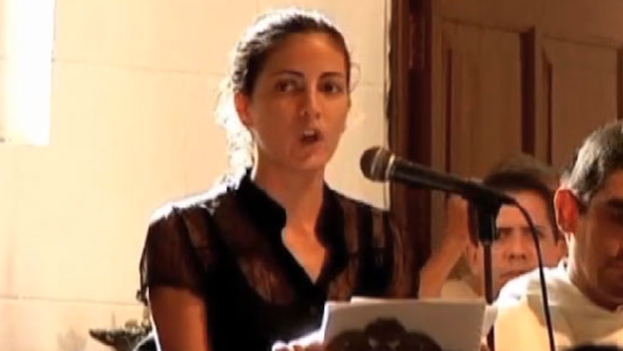
24 January 2015 (EFE) –Rosa MariaPayá, daughter of the late Cuban activist OswaldoPayá, in a meeting today with the senior advisor for Latin America at the White House, defended the need to “stop the impunity” of the Cuban government against dissidents on the island, and the right to decide for Cubans.
Payá, who left the island a year ago, participated in a forum on human rights, before meeting with Ricardo Zúñiga, who is part of the White House delegation that, since June 2013, secretly negotiated with Cuba the rapprochement between the two countries.
Speaking with EFE after the meeting, the activist explained that she sent the US official some “very specific” points that, in her judgment, continue reading
“should be addressed with the Cuban government, which of course address ending the impunity with which State Security operates on the island.”
The Christian Liberation Movement (MCL) activist (as was her father), lamented the harassment to which some of her compatriots are subjected, a complaint that has been elevated to international organizations such as the Inter-American Commission on Human Rights (IACHR), before which she asked in 2013 for protective measures for her family.
“We want the democratic governments which are in communication with the Cuban government, to approach not only the Government but also Cuban citizens,” said the activist.
The 26-year-old daughter of dissident Oswaldo Payá — who died along with activist Harold Cepero in a traffic accident in 2012 — used the meeting at the White House to call for an independent investigation into what happened.
“What they have said to me is that there will be a discussion on human rights and that is where we want to influence, not only on the subject of independent investigation, (…) but in favor of that which is the basis of Cuban democracy,” he said.
This week negotiations begin in Havana to restore diplomatic relations after the thaw announced by both governments last December 17.
In this new scenario, Payá believes that “there are some possibilities to bring pressure for the rights of Cubans,” supporting some demands “consistent with democratic values” such as a plebiscite to “ask citizens if they want to participate in free and pluralistic elections.”
“No Cuban who is younger than 80 has ever participated in fair, competitive and free elections, so it is time that Cubans can decide their own future,” said the young woman who asked the democracies of the world to “support the right of Cubans to decide.”
“The Chileans did it in the eighties, the international community supported the Chilean plebiscite, Cubans deserve no less,” she said.
Payá’s hope, she said, lies “not in what a foreign government can do for Cuba, but what we Cubans can do for ourselves, and I hope the democracies of the world will support this.”
The young woman said that a commitment to the request for an independent investigation into the death of her father will be on the negotiating table, as well as support for the right of Cubans to decide.
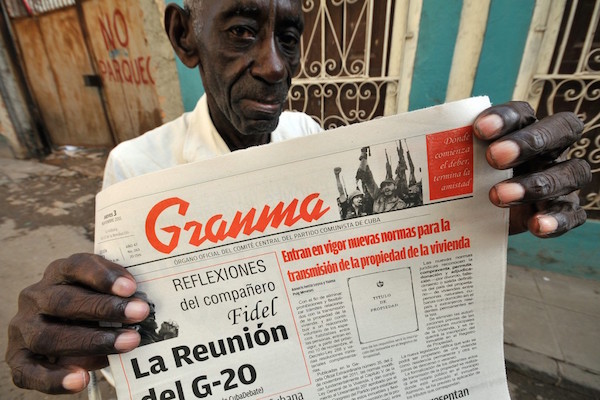
A joke making the rounds: Napoleon said, “With Granma, nobody would have found out about my defeat at Waterloo:” (Photos: Internet)
Cubanet, Luis Cino Alvarez, Havana, 26 January 2015 – “Cubans are seeking a new conception of the press within socialism. All that can be predicted, without a doubt, is that it will be a democratic press, lively and original,” wrote Gabriel García Márquez in 1975.
That Gabo — always so unreal, so optimistic when it came to opining about his friend Fidel Castro’s Revolution. Such a quest does not show signs of obtaining results in any near future. It is easier to imagine the ascension into the heaven above Macondo of Remedios the Beautiful with a band of yellow butterflies*, than to reap, within olive-green socialism, a journalism free of shackles continue reading
, sparkling, with bubbles that the Genius of Aracataca** would foresee 36 years ago.
Even Gabo himself had to admit that the Cuban press “seemed to be made more to conceal than to publicize.”
Another brilliant writer, who could never be said to be complicit with the enemies of the Revolution – the Uruguayan Eduardo Galeano – was more precise in describing the Cuban press when he said that “it seems to be from another planet.”
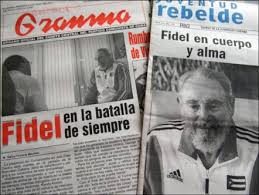
The official Cuban press, which manipulates, distorts, enshrouds and when it speaks truths, does so only halfway, only as far as is convenient, has nothing to do with the real Cuba. It seems to speak of another country, a virtual one, where everything functions in a manner quite distinct from how it is in reality.
Fidel: Omnipresent in the official Cuban press
In recent years there has been much talk about the need to create a credible journalism, one more analytical and critical. The task turns out to be a chimerical one. The press is forced into being the concubine of Power. They endowed it with the chastity belt of “informative politics.” Journalists are “ideological workers,” forced to constantly reiterate their loyalty to a stubborn and myopic regime which, as it racks up failures, divorces itself evermore from the interests of the people.
On repeated occasions, the “fearless leaders” have referred to “the need to reconcile the informative politics of the press with the interests of the country’s direction” and they have warned that “disagreements can be of form but never of principles,” because above all, “the defense of the Revolution” must take precedence.
Thus, official journalists find themselves confined to the sad role of mere propagandists and mouthpieces of worn slogans. Even those more honest among them, who can’t seem to hide their doubts and dissatisfaction, only go so far as the “danger” signal if they allow themselves to express any complaints during debates about informative politics. They all know how to have it both ways.
When, at the beginning of his mandate, General Raul Castro attended the VIII Congress of Cuban Journalists (UPEC), he said that some of the problems discussed were “older than Gutenberg.” But they are going to be resolved… and I say no more,” he said, smiling enigmatically. And he left everyone “in that.” Like halfway to an orgasm.
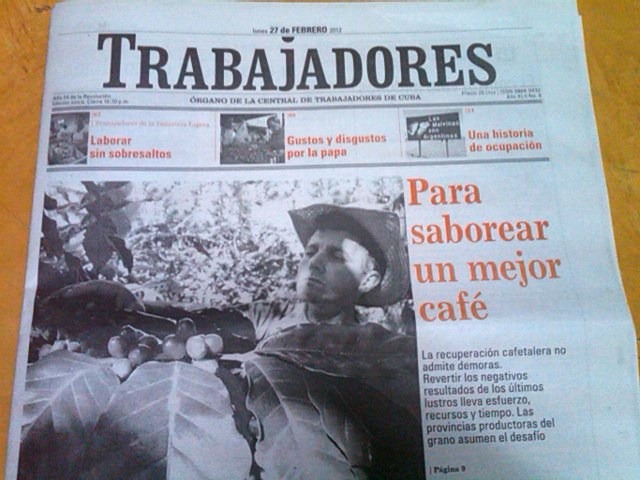
“To taste a better cup”: What a farce! Cubans drink coffee mixed with ground-up dried peas.
The years have passed and our problems have not been resolved. To the General-President’s exhortations and chidings to official journalists have now been added those of Vice-President Díaz Canel. The result: Nothing. The official media — except for issuing some occasional critique that goes no further than the medium levels of government — continue to be as irrationally exuberant and attached to the inertia of the sermon as ever.
The idyllic and bubbling journalism inside olive-green socialism of which Gabo dreamed, now almost four decades ago, has not materialized.
The bad news, as General Raúl Castro has warned on various occasions, is that we should expect neither miracles, nor magic.
Translator’s notes:
*Refers to Remedios La Bella (“Remedios the Beautiful”), a female character in García Márquez’ novel, “100 Years of Solitude,” who resides in the town of Macondo, and who one day ascends into heaven, body and soul. Remedios is in love with a man who is constantly surrounded by a band of yellow butterflies.
Presentation about the book ‘From Confrontation to Efforts at “Normalization.” The Policy of the United States towards Cuba.’ (14ymedio)
14ymedio, Victor Ariel Gonzalez, Havana, 29 January 2015 — “In Vietnam, Yoani Sanchez would be in prison,” says Rafael Hernandez, editor of the magazine Temas (Topics), comparing the Cuban regime with the Vietnamese one. And he adds: “Check out how free this country is!” According to the official researcher, Cuban bloggers “are arrested and released, but they are not put in prison,” as occurs in the southeast Asian continue reading
country, where these cyberspace activists receive “nothing but” jail for being “anti-government.”
The political scientist and essayist offered these observations last Wednesday at the Juan Marinello Center during the presentation about the book “From Confrontation to Efforts at ‘Normalization.’ The Policy of the United States towards Cuba,” by the publisher Social Sciences. One of the authors, Elier Ramirez, participated in the panel discussion held by the magazine.
Just reading its name, one deduces that the essay by Elier Ramirez and Esteban Morales – co-author – reflects the offical Cuban position about the rapprochement between the Island and its “historical enemy.” The word “normalization” in its title appears in quotation marks because, among other reasons, “the United States has always understood normalization from the position of domination,” says Ramirez. “There is no change in its strategic objectives [basically, regime change in Cuba, but] a profound tactical adjustment” behind the negotiations between Washington and Havana, according to the author.
This work had already been released, at least once, during the presentation of the volume “Back Channel to Cuba: The Hidden History of Negotiations Between Washington and Havana,” written by U.S. researchers Peter Kornbluh and William LeoGrande. But then, last October, the political situation was very different from the current one.
During Wednesday’s presentation about the book, the comparison between Vietnam and Cuba emerged in the context of what Rafael Hernandez considers a double standard in U.S. foreign relations which criticizes Cuba on questions like freedom of expression while not doing the same to other countries. “How do you [the American government] demand from me [the Cuban government] what you do not demand of the Vietnamese who put bloggers in prison?” asked the researcher who is also a moderator of the space Ultimo Jueves (Last Thursday).
Rafael Hernandez also referred to the case of the performance by Tania Bruguera last December 30. In order to justify the attitude of Cuban authorities, he gave as an example a hypothetical megaphone protest in front of the home of the British prime minister. “Before taking out the loudspeaker, they already told him off and got him out of there,” he said, referring to the imaginary protester. “What does that have to do with freedom of expression? What are we talking about?” he added, insisting on the supposed “double standard” of the western discourse with respect to that basic right.
Entering into a process of negotiations that both parties have deemed “historic,” one can no longer speak only of “a relationship between two governments” because now there is also “a relationship between two societies” declared Hernandez, who called for a realization that “there is a new game.”
The official analysts define this “game” as a “form of battle” for preserving the regime, different from all previous battles. This war, certainly is already taking place also in the symbolic realm where the most rancid nationalists have been contaminated by a certain foreign banality, especially American.
It is not strange that an official intellectual like Hernandez expresses himself thus about the rapprochement between the two countries. As far as his comparisons in matters of human rights, it is legitimate to ask what exactly the editor of Temas meant to say. There are three possible interpretations:
Vietnam is a dictatorship.
Cuban bloggers should be prisoners.
We bloggers should feel grateful for the few handouts of freedom that the regime grants us and that it also can take from us at any time, imitating its “sister nation” from southeast Asia.
Known as “The BimBom 23 and Malecón” this is one of the meeting points for “pingueros.” (14ymedio)
In tribute to El Caso de Sandra (The Sandra Case) by Luis Manuel García Méndez
14ymedio, Lilianne Ruiz, Havana, 30 January 2015 — A farmer wakes up before dawn to brand with a burning iron the last cow he has left. It’s a ritual of pain and possession. A tourist brands a young person in one of Havana’s cabarets and takes them to bed in exchange for some money. The brands are different, but both as permanent.
Sandor was born in the countryside and was raised to be rough. When he reached adolescence he had already castrated and slaughtered pigs. His wide shoulders, olive skin, and oriental eyes earned him town-wide fame as being “hot.” Since he was young he felt the pressure of desiring other men continue reading
. It was like a permanent breath down his neck that followed him everywhere.
His father had deep wrinkles around his mouth, a group of them also skirting his eyes. The hours in the furrow, beneath the sun, had cracked his skin and his character. He started drinking rum with his friends in the afternoons after work, but ended gulping anything he found. One day, Sandor saw him downing one of his grandmother’s perfumes. His mouth smelled of sweet roses for hours.
Sine he was little, Sandor resolved not to end up like his father. After he turned 16, he packed up what little clothes he had and went to Havana. He arrived at night and walked from the train terminal to Fraternity Park, where the lamps were off and one could hear moaning coming from the shadows. “This is my thing,” he immediately said to himself.
Between footlights
In Las Vegas Cabaret, the air smells of urine. There are tables far from the lights where almost anything can happen. Sandor watches, empty-eyed, the male stripper show unraveling on the stage. The bodies shine from the oil they have been rubbed with.
A sixty-year-old moves forward and puts some bills inside one of the dancer’s underpants. Sandor follows him with his eyes and later sits on his same table. He’s wearing very tight clothes and his muscles stand out provocatively, but competition is strong. He is part of a sea of ephebes practicing prostitution that will battle to see who takes the foreigner to bed.
“I am a male sex worker, a pinguero,” he says shamelessly to anyone who cares to hear him. He offers his goods to any buyer, although he emphasizes not considering himself a homosexual. Sometimes his clients are women, European and in their fifties, but his main market is made up of men who come “de afuera” – from abroad. Cuba is a promising destination for gay tourism and Sandor casts his rod into the turbulent river waters of caresses for money.
He fixes himself up constantly while speaking, an eagerness for physical perfection that makes anyone who approaches him feel ugly and wrinkled. He has shaved his eyebrows and painted them in a fine, high arch. On his arms, his forearms, his chest and his pubis there isn’t a single hair. Hours of painful hair removal have left his skin smooth and even.
He prefers this world to days of working in construction, erecting walls or putting roofs together. He spent his first months in Havana working with a brigade of bricklayers, but he couldn’t stand it. Now, the palms of his hands feel soft from the body lotion he lathers on to please his partners with caresses, but during those times the hammer and chisel had left him with rough and ugly calluses.
He is part of a sea of ephebes practicing prostitution who will battle to see who takes the foreigner to bed.
The Malecón, Central Park and the private Cabaret Humboldt, on the street bearing the same name, are his habitual working grounds. “I go looking for yumas [foreigners]. I get there and, in between drinks, the zorreo [flirtation] begins and then comes business,” he says when describing his modus operandi. There isn’t much to say in those places, because those who visit know the codes and steps to take in order to leave accompanied.
“I never leave with a Cuban, even if he has all the money of the world,” assures the young man. The rates range from 10 to 100 CUC, so he seeks to reach a middle ground so as to not sell himself “for nothing” but also not to end up “more alone than the 1 o’ clock peal.” Not few times has he had to exchange love for objects, like a watch, a pair of shoes or an expensive bottle of cologne, but “I prefer cash,” he says.
The hours to “expensively sell oneself” are before midnight. After that, “the goods lose value and you have to take whatever comes your way.” He learned that language, or jargon, while working in a produce market. Amid dirty sweet potatoes and the smell of rotting onion, he understood that wasn’t the life for him. “Now, in one night I can make as much as I made in a month behind the counter of an agricultural market.”
Below the sun-faded awning where he sold fruits and vegetables, the first foreigner branded him. This, in street slang, means identifying someone and exchanging seductive glances. He was Dutch and had come to buy some plantains, but he noticed Sandor and invited him for some ice cream. That night, they slept at the Hotel Nacional and for the rest of the week he didn’t show up to his job at the produce market. He had never been in a hotel, so he jumped on the bed and left the faucet open for hours. He swallowed his breakfast almost without chewing it and the tourist gave him a gift of some clothes.
Las Vegas Cabaret, one of the places where tourists “brand” pingueros, jineteras, and more. (14ymedio)
At that time, Sandor lived with an older woman, through whom he was able to get a transitional address in the capital written down on his national ID card. Without that, he was in danger of being deported by the police if they asked him for his ID on the street. One night he arrived with a lot of money, a bottle of wine under his arm, and she began to suspect. While he slept, she checked his cellphone and found a picture in which the Dutch man held him by his fly. In the middle of the night, the woman threw his clothes from the balcony and told him never to return.
Later he had a Mexican. “When this farmer saw himself driving a rental car, with a gold chain and money in his wallet, he got used to this life,” he recalls while speaking of himself in the third person. However, he says he prefers Europeans and North Americans because “they pay better and are more delicate.” He had an African only once, a doctor from Luanda who gave him many gifts.
“My body is my enterprise,” he brags. “Pingueros are better paid than the most regal prostitutes”
Beginning some years back, Sandor has had a routine he repeats daily. He gets up at noon and tries to eat only protein. “No bread or fried things that make me fat; my body is my enterprise,” he brags. He also takes vitamins and spends hours in the gym. “Pingueros are better paid than the most regal prostitutes,” he points out while lifting several pounds of iron to render his biceps irresistible.
At the gym he met Susy, a transsexual who is also in the business. She helped him find more select clients with more money. They both work without pimps, although there are groups of pingueros that pay others to protect them as they try to make a living in certain territories. On the corner of Payret Theater one can only work if “one is protected” because police harassment is very harsh, explained Susy on the first week of friendship.
The police know the hook-up zones well. Some of the officers fight to patrol those corners or streets to get money in exchange for looking the other way. It’s a profitable business, where the pinguero has everything to lose if he doesn’t give the cop a piece of the prize or do him a sexual favor.
Sandor prefers not having to show himself off on the street, instead he looks for his clients inside of clubs, cabarets, and other local party scenes. His ID with a transitional Havana address expired and he is now illegally in Havana. If he comes across a troublemaking policeman, it’s very probable that he will be deported to his home province.
Since he arrived in the city, he has been detained on various occasions. He has three warnings and could be tried for the charge of pre-criminal dangerousness. The last time he was inside a police station, the officer told him that he knew what he was doing, so he changed his area of operation from Old Havana to Vedado and Playa.
The danger is not only to end up in a courtroom, it’s falling victim to police extortion and having the entire night’s earnings snatched away
The danger is not only to end up in a courtroom, it’s falling victim to police extortion and having an entire night’s earnings snatched away. If he had a pimp, then he would protect him and keep la fiana, or the police, away, but since he works alone, he needs to deal with those in uniform. The worst thing is ending up in a cell, because there anything can happen.
The price of meat by its hanging weight
Every day, the market becomes more competitive and each client wants the best porcelain for the smallest price. The illusion of buying a home or supporting a lover with what you make is a thing of the past. A wrinkle, a bit of belly that may show when you strap your belt will signify tens of convertible pesos in losses. “On facial and body treatments, gym and clothes alone, I spend most of what I make,” he says while showing us his Dolce & Gabbana underwear. Most likely they are a counterfeit of the Italian brand, but, even so, they cost about a month’s earnings for a regular state worker.
He doesn’t scout his clients on looks because he confesses that his work does not give him pleasure and it’s been a long time since he has felt anything. In order to give a good performance of his role, he tries to think of some porn film or he drinks some alcohol. Sometimes he thinks of a girlfriend he had back in his town, when he still wore his middle school uniform and life seemed simpler.
But that was a long time ago. Now he has to work very hard. Cuba continues to be a cheap destination for tourists searching for a night of wild passion, but there are many young people for sale and prices decrease. For months he disguised himself an “intellectual” with sandals and went to Plaza de Armas. There, he feigned looking at books on displays and branded the yumas, capturing various sleepless admirers of Che who wanted to feel “the clay of the new man.”
Susy has shown him how to tell the ones who are forrados (the wealthy ones) apart. It’s in the details; like being treated to bottled water or a Heineken beer on the first date. He once knew a German who, in August’s midsummer heat, would pack his own beverage in his backpack and wouldn’t even offer a sip.
The man turned out to be so stingy that Sandor got payback and applied la segunda, which is to take him in a taxi to where, supposedly, they will spend the night. The client would have paid for the room in advance and when he gets out, the driver hits the gas and “if I once saw you, I no longer recall.” He later had to share his earnings with the taxi driver, but at least he taught the miserly man a lesson… “so he learns,” he would chuckle to himself for weeks.
Cuba continues to be a cheap destination for tourists searching for a night of wild passion, but there are many young people for sale and prices decrease.
The best case is when an old client recommends a pinguero to his friends and so more come over. Sandor spent some months with a group of Japanese businessmen because of that, but the Cuban government didn’t pay them what it owed and no one from the company ever came again. When he remembers those days his face lights up and he shows off a gold tooth, “it’s a shame they didn’t come back, because they were very polite and had a lot of money.
In the world of the pingueros there’s someone for every taste and every wallet, but Sandor explains that “the one you see there, with the nice watch and the fancy cellphone, most likely if a yuma propositions him for 20 CUC he will say no” and he will demand that he give him more than the 150 he already has in his wallet. But those older than 20 can’t make such high demands. “Fresh meat, the fresh meat always wins,” he says with some melancholy as he touches his hardened thigh muscles from hours at the gym.
When Sandor closes a deal, he goes off to a privately rented room. A bed, condoms, and it’s all set. Nowadays he prefers private rooms to hotels because they’re more intimate and he also gets a commission for taking a client. Some of them are just like hotel rooms, with air conditioning, Jacuzzis, minibars, and mirrors on the ceiling.
Sometimes he gets a client who wants a longer relationship. Those are the most yearned for. The biggest success of the operation is finding a foreigner that will support them from overseas. The highest price for his caresses is to manage to leaving the country. But, make no mistake, on the other side he says he wants to abandon this lifestyle. “I’ll load bags onto ships with my bare back or mop floors in a hospital, but I won’t return to this filth.”
For the moment, while waiting for the foreigner who will get him out of here comes around, he dreams of buying a motorcycle. When he has it, he wants to show it off in the same areas he has offered his goods, but this time with a “hot girl with a killer body” on his arm. That will be his small revenge for all that’s past.
Maybe he’ll go back to his town, to see what’s become of his dad. He will take a bottle of aged rum for him and get his grandmother some new perfume. From that trip “I’ll come back with a country girl to wash and iron my clothes who I can also introduce to the business.” He plans to live off of her for some time, but, if they have a child, “he has to get out of this shit, he has to get out of this shit.”
14ymedio, Pedro Campos, Havana, 29 January 2015 — The main contradictions in Cuban society lie between the concentration and centralization of property ownership and decision making of all kinds, and the broad cultural, technical and professional training of Cubans, eager to improve their material and spiritual living conditions. The unviable state-dependent employment model has been incapable of satisfying these needs.
Its origin is the conception of socialism inherited from Stalinism, which was based on the concentration of ownership and decision-making, and the system of wage-labor for the State, with everything administered by the Communist Party continue reading
: a State-monopoly capitalism that sharpened all the conflicts of the exploitative wage system.
The lack of a solution to these problems has stalled the productive forces, the development of society, economic progress, modernity and improvements in the living conditions of the great majority of the population.
The solutions move to increase the participation of citizens in property, ownership of the results of their work, and decisions of all kinds: economic, political and social. Democratization of politics and socialization of the economy are also imposed.
But “state socialism” blocked these solutions, almost eliminating the small and medium proprietor, preventing the development of forms of free labor — unionized or otherwise — the free-management of production, the social economy, and restricting the democratic participation of citizens in political matters.
Now, with the normalization of relations with “the enemy,” there is no danger of military aggression, always used as a justification to postpone the empowerment of the people, and the Cuban government should not delay any further moving in this direction.
The solutions move to increase the participation of citizens in property, ownership of the results of their work, and decisions of all kinds
The return to power of groups of oligarchs allied to American capital would not resolve these contradictions – rather it would increase them – newly excluding workers and citizens in general from economic and political power, with concentrated ownership passing from the hands of the State to the huge capitalist entrepreneurs, and political power from the Communist Party to another party that could act at will without submitting itself to democracy.
The proposals made from the positions of Participatory and Democratic Socialism, since 1991 with the 4th Cuban Communist Party Congress, raise the need to advance this process of democratization and socialization of politics and the economy. Traditional opposition sectors have also presented similar demands.
In 2006, networks of the international left published “Urging the Cuban Revolution to Advance Entrepreneurial and Social Self-management” and sent it to the Cuban Communist Party (PCC) and the Government. The following year, they published “15 Concrete Proposals to Revitalize Socialism in Cuba.” In 2008, we publicly presented the document “Cuba Needs A Participative and Democratic Socialism, Programmatic Proposals,” and with the view of the 6th Congress of the PCC and the entire Cuban people, we announced our “Proposals to Advance Socialism In Cuba.” More recently, we published “14 Keys for the Padlocks that Depress the Cuban Economy.”
These and other documents of the broad democratic left argue the need to democratize the party and the society, free up self-employment and cooperatives, and especially to involve employees in the direction, management and profits of state enterprises, without ignoring the necessary spaces for state capital, domestic private capital, and foreign capital.
The neo-Stalinists have tried to prevent the people from having knowledge of these ideas and a part of the traditional opposition has tried to ignore them.
The “update of the model” did not resolve these conflicts — although it introduced dynamics and presented proposals concomitant with participative and democratic socialism — due to its limitations, state-centric origin, biased legislation and its application of the same traditional bureaucracy present in a State willing only to strengthen its total control and never disposed to transparently bend toward the essential.
In this scheme, the “update of the model” has not been able to accomplish substantial modifications in what continues to block the development of a socialized economy directly in the hands of the citizens.
The recent agreements between the governments of the United States and Cuba come when all the problems of Cuban society are aggravated and the insufficient “updating” is exhausted, unable to attenuate those problems.
The inability of the State-Government-Party to understand the urgent need to develop popular autonomous control of the economy and the political life of the country is worrying
Today, with the persistence of a high level of ownership concentration and centralization of decision-making and its respective mechanisms and laws, the economic and political structure of the country appears unprepared to absorb the impact represented by the new US policies.
The inability of the State-Government-Party to understand the urgent need to develop popular autonomous control of the economy and the political life of the country is worrying.
Bureaucratic obstructionism at all levels, at fault for the slow “updating of the model,” seems to be playing the same game with respect to the normalization of relations with the United States.
The democratic left is also concerned that the eventual increase in investment will be directed only to state enterprises, which will not resolve the already exposed internal contradictions of Cuban society and will lead to an alliance between monopolistic State capitalism and huge American capital which, logically, will results in greater exploitation of Cuban workers.
While there are American business sectors whose only interest is to do business in Cuba, the Obama administration is also interested in supporting “non-state” businesses, which they welcome.
The issues of democracy and human rights in the United States and Cuba are a matter for their people, not the governments of both countries, which should respect the Cuban people’s sovereignty and their capacity to decide their future. The role of the governments is to create conditions so that people can exercise their sovereignty.
Cuba should open a process of dialog and negotiations between all the visions and projects, political, social and economic, led by a new constituency, capable of harmonizing in democracy all the interests present in the country.
The enunciated American policies to economically and politically empower the citizens don’t hide their intentions to influence the internal politics of Cuba, which are being manipulated by the new-Stalinist mentality, the official press, the political structure and foreign “leftists,” like the “imperialist [intention] to overthrow the Revolution by other means.”
The US government may be making a mistake by stating that its new policy is designed to achieve the same strategic objectives of the previous failed
The US government could be making a mistake by stating that its new policy is intended to achieve the same strategic objectives as the prior, failed, policy. If the objectives continue to be to provoke political changes in Cuba, the American government should ask itself if it would like Cuba to propose the same objectives in its policies toward the United States.
The objectives of the new policy, if they don’t want it to backfire and be counterproductive, should be to live in peace with Cuba, to support its economic development and to facilitate, with the elimination of pressures on the Cuban government, the Cuban people being in a better condition to decide their destinies, without political changes imposed from outside.
For its part, the Cuban government must consider that methods (policies) must predominate over ends (strategy), so that the fact that the United States has changed its policy – from one of pressures and isolation to one of dialog and rapprochement – should influence what prevails in this latest approach.
There are those in the bureaucracy and in the opposition who believe that the problems of our country can only be resolved with the help of the United States. Those who think this way don’t seem to recognize the character of the internal contradictions nor their solutions, such that it will be difficult to find support for their plans among the great majority.
We appreciate the support of Obama and his administration for respect for the human rights of the Cuban people, and for their offer of assistance to non-state businesses and to facilitate people’s access to the Internet. But the democratization of the Cuban political system, the decision about the form of government, and the democratic election of our representatives, these are our tasks and the more the Cuban government feels that the United States is interfering in Cuba’s internal affairs, the more difficult is the situation of Cubans in Cuba and the more the current government will oppose this process.
The more the Cuban government feels that the United States is interfering in Cuba’s internal affairs, the more difficult is the situation of Cubans in Cuba
Accelerating all the transformations toward a greater democratization and socialization of political and economic life should be the priority in order to cushion the impact of the new dynamics generated by the “normalization” and to guarantee that internal changes are driven by citizen empowerment and not by external forces. Something that appears to be impossible as long as the go-slow bureaucracy continues to have sufficient power to block the necessary transformations.
The difference between changes being promoted from within versus from outside could mark aspects of the independence and sovereignty that would appear in the future, sooner rather than later.
The current contradictions could exacerbated, rather than resolved, and the call for normalization of relations with the United States could stalemate or fail through not achieving the dynamics a new US policy could generate, and through lack of respect by both governments for the interests of the Cuban people who, in their vast majority welcome the normalization, but who also – for the most part – reject outside interference.
Talking about the Cuban economy these days is a complex task but, if it can be done without alluding to Marx or Keynes, I am at least grateful. My bus ride on the P3 to Acosta Avenue and Tenth of October proved so entertaining that it actually felt short.
An ordinary-looking man in his forties was explaining the gist of our current economic situation to the person sitting next to him in the same way that those books for dummies explain things like string theory continue reading
. The person reading the book may not be able to explain what a lepton is, but at least he has a basic understanding of something which up to that point had been a mystery.
But getting back to the P3, the forty-something man was yelling — a way of talking loudly that comes so naturally to us Cubans — to keep the din of the bus’s motor from drowning him out. As a result, all those around him on the guagua* were forced to listen. I could see at a glance that almost all the passengers were leaning in so as not to miss a word.
The person sitting next to him seemed to almost regret having get off at the same stop as me. The forty-something stayed on the bus, yelling from the window, “But don’t worry, my friend. It’s all screwed up in the end. There’s no one left.”
I was amazed. The language this man used was like a flawless populist scalpel dissecting the current state of the Cuban economy. If only Dr. Juan Triana or any of the consultants involved in the “economic update” had the gift of explaining it so that it made sense to a carefully coiffed repa*, to a black man in a SEPSA* uniform, to someone like me. And all for the modest price of forty Cuban pesos. The cost of a ticket.
*Translator’s note: Guagua is the Cuban word for bus. Repa is a slang term for a young person from one of Havana’s a poor working-class suburbs. SEPSA, the Spanish-language acronym for Specialized Security Protection Services Company, provides a variety of comprehensive security services to Cuban businesses.
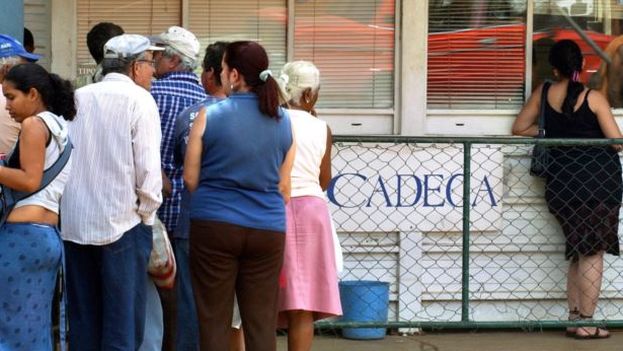
Several people stand on line at a currency exchange (CADECA). (EFE)
14ymedio, Miriam Celaya, Havana, 29 January 2015 — It was barely 10:00 am Wednesday, January 28th, and the currency exchange (CADECA) at Belascoaín had no national currency (CUP)*. One of the tellers explained that he had only several 50 peso bills and that was it until the “cash truck” arrived. Some customers, leaving because they could not transact business, stated that this has become the norm, not only at this currency exchange continue reading
, but also at the one on Galiano Street, across from the Plaza del Vapor.
These are virtually the only two currency exchanges operating in the municipality of Centro Habana after most of them were converted to ATM’s, so both exchange of hard (i.e. foreign) currency to Cuban convertible currency (CUC) as well as CUC to CUP implies traveling to some CADECA or to Banco Metropolitano, both located at some distance, and the likelihood of having to stand on long lines before being able to complete the desired transaction.
Another difficulty that has become common in both CADECA and ATM locations is the absence of bills in denominations smaller than 100 or 50 CUP, which also distresses the population, especially the elderly, who receive their pensions in debit cards and are often unable to withdraw all of their money, since there are no 5 or 1 peso bills available. In these cases, they need to wait a whole trimester or quarter until enough funds accumulate in their accounts to cover the minimum denominations of 10 or 20 CUP, a ridiculous amount compared to the high price of any market product, but what is significant is that the affected individuals depend almost entirely on this income.
Since the start of 2015, Cubans who receive remittances from abroad or convertible pesos by other means are quick to exchange their money into the national currency. Those who receive larger amounts – on the order of 100’s of CUC, in general the owners of more thriving private business — prefer to use the black market to exchange their funds into US dollars. The common denominator is that nobody wants to hold CUC money, which, until recently, was in high demand and CADECAS would even often run out of.
Announcement of a new national currency bill being issued into circulation in February, in 200, 500 and 1000 peso denominations, coupled with the ability to access the former “hard currency market” with either money, has sounded the drum-roll in people’s psyche as a prelude to the much anticipated monetary unification. People fear that an official changeover will take place that will carry penalizing fees that will cause serious losses to people’s pockets.
Fear is running throughout the population that an official changeover will take place suddenly, with extremely high fees that would produce serious loses to their pockets
The expectation is felt, by osmosis, in the capital’s agricultural trade networks, especially in meat markets that are not “state-owned”, where either one of the two currencies was accepted a few weeks ago. “Mother of Mercy, give me national currency!” is the butcher’s cry at Combinadito de Sitios in Centro Habana when a customer brings out 20 CUC to pay for a cut of pork meat whose price these days of non-ration cards has risen to 45 Cuban pesos per pound. “Country farmers don’t want CUC, my brother, they have a lot of money** and are really afraid of the monetary unification. They won’t sell me meat unless I pay in national currency”.
Something similar is happening with peddlers with street carts, who still accept payment in “convertible” currency for retail sales, but their wholesale suppliers are demanding payment in national currency for their products. A street peddler in my neighborhood states “farmers have high incomes and almost all producers have accumulated large sums. None of them wish to lose when the currency is unified”.
The lack of information and clarification from the official media creates uncertainty and speculation in the population.
It is evident that, once more, the lack of information and clarification on the part of the official media are causing uncertainty and spreads speculation throughout the population, giving way to obstacles such as the (unexplained) shortage of cash in the CADECA, increasing the demand for US dollars in the black market foreign exchanges.
With the imminent introduction of the new denomination bills, clear evidence of the very high inflation rate in Cuba, nothing is known about a monetary unification that -according to official notification- will be gradual and will “not affect” Cuban pockets. For now, it is expected that, when it takes place, the official exchange rate of 25 pesos in national currency for each CUC will not continue, a transaction with which the CADECA and the state commercial networks have operated to date. Our experience, after decades of deceptive monetary maneuvers, has motivated the popular wisdom so that, already, before the dreamed about monetary unification, Cubans are shedding was has been the last few years’ supreme sign of Cuba’s status: the CUC.
Translator’s notes:
*See here for a longer discussion of the history of Cuba’s currencies and the plan to move to a single currency. Briefly, Cuba has two currencies: Cuban pesos, also called moneda nacional (national money), abbreviated CUP; and Cuban convertible pesos, abbreviated CUC. In theory CUCs are a hard currency, but in fact, it is illegal to take them out of Cuba and they are not exchangeable in other countries. Cubans receive their wages and pensions primarily in CUPs, with wages roughly the equivalent of about $20 US per month, and pensions considerably less. The CUC is pegged 1-to-1 to the American dollar, but exchange fees make it more expensive. The CUP trades to the CUC at about 24-to-1.
**It has been a common practice in other tightly controlled countries, when new currencies are introduced, to limit the total amount of money people are allowed to exchange and/or to require documentation of the sources of larger sums. As the old currency becomes instantly worthless domestically and internationally, people who have been ‘hoarding’ it can see almost all their savings disappear. Cubans fear this could happen with the elimination of the CUC.
One of the few Havanans not happy with the historic agreements of December 17th between President Obama and General Raul Castro was Dagoberto, a guy approaching forty who got out of jail six months ago after serving a six-year sentence for marijuana possession.
“I have family in la yuma (US), but because of my drug possession record I don’t qualify for the family reunification program. My only option is to throw myself into the sea and make it to the Mexican border,” he said while drinking a Corona beer in a Havana bar.
A couple of times in 2014, Dagoberto tried to reach the United States. “The first time the American Coast Guard intercepted me. I spent $3,000 to buy a motor and gas and with a group of friends we prepared a wooden boat. continue reading
“The second time I boarded a plane for Ecuador. But customs in Quito sent me back to Cuba. It’s rumored that with the new policy, the Adjustment Act’s days are numbered, for people who plan to leave on a raft or enter through a third country. I have to hurry if I want to get to the North.”
In a park in Vedado, two blocks from the United States Interests Section (USIS) in Cuba, where from the early hours in the morning people line up for visas, the topic of discussion is the Cuban Adjustment Act.
In the past two years, Ihosvany has been denied a visa four times. But he keeps trying. “A cousin in Orlando invited me and they denied me a tourist visa. Now I’m doing the paperwork to leave for family reunification, to see if I have more luck.”
USIS consular officials insist that for those people who want to travel or emigrate to the United States, the strategy of applying over and over for a visa is not the best.
Yulia, desperate to leave the country, openly ignores them. In a house near USIS, she fills out the paperwork to take to the consulate again. “Three times they’ve told me no. We are going to see if the fourth time is lucky, because a friend in Chicago got me into a university program. If what they say is true, that the Adjustment Act will be repealed in 2015, there will be another Mariel Boatlift. There are tens of thousands of people who want to leave Cuba.”
Every year, the Interests Section awards more than 20,000 visas under the Family Reunification program. In the last 20 years, about half a million people have left the Island through the migration accords signed by Bill Clinton and Fidel Castro in 1994.
But demand exceeds supply. Those who don’t have relatives or spouses resort to any trick or simply opt to launch themselves into the turbulent waters of the Florida Straits in a rubber raft.
In an attempt to discourage the worrying growth in illegal journeys from the Island, the US authorities have reiterated that the immigration policy and the Coast Guard operations will continue without changes and insist that only Congress can repeal the current laws on Cuban refugees.
The Coast Guard issued a government warning, after an unprecedented growth in the illegal flow of emigrants from Cuba during the second half of December and the first days of January, coinciding with President Barack Obama’s announcement of the normalization of relations with Havana.
According to analysts in the United States, the steps taken by Obama don’t alter the Cuban Adjustment Act and it is not a priori in danger of being repealed by a presidential act. It is a Federal law, Public Law 89-732/1966, approved by the U.S. 89th Congress. Being a public and general interest law — unlike a “Private Laws” — it can only be amended, revised or revoked by the Congress of the United States of America.
But the Cuban rafters appear to have deaf ears. A total of 890 Cubans have been intercepted in the Straits of Florida and in the Caribbean zone, or have managed to make it to the U.S. coast since the beginning of the 2015 Fiscal Year, last October 1. Of them, 577 have done so during December and the first days of January in an escalation that has set off alarms in Washington and Miami.
After Obama’s announcement, the Cuban side captured 421 people at sea. Everything seems to indicate that the flow could increase. Cuban-American members of Congress and Senators are questioning the letter and spirit of the law.
Many Cubans say they are politically persecuted and so they flee, invoking this when they decide to seek asylum in the United States. But in a few months they return to Cuba, as tourists. Incongruities that are difficult to explain.
A majority of Cubans, on both shores, demanded the normalization of relations with the United States and the end of the embargo. But, according to a recent survey conducted by Florida International University, 85% of Cuban-Americans in south Florida favor the continuation of the Adjustment Act. Even among the generation that left Cuba between 1959 and 1962, only 36% favor its elimination, while 64% are opposed.
It doesn’t look like a winner. If the relationship between the governments goes down the path of good neighbors, the White House will have no reason to give special treatment to Cuban citizens.
If the Adjustment Act was created to legalize the status of thousands of Cubans who fled from the Castro autocracy, then it should be applied that way. And Cubans who take shelter under this law, should only be able to travel to the Island in exceptional cases. Not to spend time with their families or have a beer with friends in the neighborhood.
This is privilege enjoyed by no other citizen in the world, to settle in the United States. Either the laws are abided by or their existence makes no sense.
Iván García
Photo: One of the lines that forms daily outside the United States Interest Section in Cuba to request visas. Taken from “Voice of America.”
This debate seems far more serious and interesting than the candles feeding the shadows of a study, in this I agree with Arturo Arango. I have no time to sit and watch TV, I saw the little program. And I doubted, for when the pavonato took place, I was a child and didn’t suffer it directly. It touched others, more recent, in the eighties.
But this man of the seventies, I hadn’t seen his face. It drew my attention that whomever make the report skirted around, olympically, the fact that Pavón was the President of the National Council of Culture. Nor did the narrator’s voice dare to name the charge! continue reading
Maybe for the younger generation, a word as undesirable as “parametrado” doesn’t disturb our memory. I wrote this and circulated it on the night of the 6th, after reading Desiderio and Arturo, now I add that I agree with all this fruitful debate. That it should not be only the responsibility of those affected. Nor of those who lived through the nonsense. It should not the responsibility only of those affected. Or those who lived through the nonsense. My grandmother used to say this refrain: If you saw me I was playing, if you did not see me, you‘re fucked. When ignorance and malice unite!
Count on me for anything.
Jorge Luis Sánchez
Another message from Jorge Luis Sánchez
So?
A group gathers inside, to discuss and analyze.
A larger group, from outside, follows — with more or less computerized information — the result of what those inside discussed.
As in those bad American movies of the “Tanda del Domingo” (Sunday Show) TV series, it would seem that with the statement by UNEAC (Cuban Writers and Artists Union) all is resolved. It is subtly conclusive. It does not satisfy me. I do not feel represented by it, even though I am not a member of that organization.
Meanwhile, TV — which, full of incoherencies, censures Strawberry and Chocolate, among other films produced by the current political culture, a film that it contributed, not just to the culture, but to all of society, making us less medieval — our TV continues its particular Political Culture which in general is no more than the historic application of the not-Political Culture. Remember that what does not appear on television in this country simply does not exist. It is not.
Meanwhile, on the wound (the conflict), a band-aid (the Declaration) is applied, which lacks the demand for an efficient solution, thus it becomes a palliative, or something like a methodologically antique response, inefficient and unsatisfactory. I think that the UNEAC should have demanded, and TV should have responded. In this case, TV responded via the voice of the UNEAC, so that one should be left positively frustrated, and more confused.
Once again, the screwed-up practice is repeated of publishing a Declaration which, for the people, is incomplete, destined to be interpreted by clairvoyants, being that it omits any amount of data, and it dissolves in its generality.
In Centro Habana they have asked me what happened, and it tires me to summarize what has been happening all these days, all these years, all these decades. A paradox, this, because the majority of Cubans — for whom their existence is designed to be lived attached to the television set — don’t know what happened in the three television programs mentioned in the Declaration.
Serenity should not be related to the application of old solutions to old, and new, problems. I quickly tuned in, in case anyone said, publicly (more or less), that the Revolution is already tired of justifications.
Never will a clumsy move be resolved by another clumsy move.
At least unless a better outside sign of tranquility is desired, lessening the focus on the inside–another old practice.
Since I was born all the great and essential debates about the culture of my country continue to be postponed, with the conservative, monotonous and worn-out argument, “It is not the right time.”
So, when will it be the right time?
The Declaration might have been a better sign. It is not enough that they write that the Policy of the Revolution is Irreversible. To which provisions can one appeal when that guarantee is threatened? To which historical figure? Where? To a Declaration? To a Self-Criticism? Well? All right, then, it must be that sorrows beat up on each other, and Sindo said this is why they are not lethal.
Shall we eternally be children of contexts? Naively, someone told me that, between the 80s and the start of the 90s, it caused plenty of headaches for artists. Remember the film, Alice in Wondertown.*
*Translator’s Note: This film, which satirized Cuba’s bureaucracy, caused the early retirement of the then-director of the ICAIC, Julio García Espinosa.
Jorge Luis Sánchez.
January 18, 2007
Translated by Regina Anavy and Alicia Barraqué Ellison
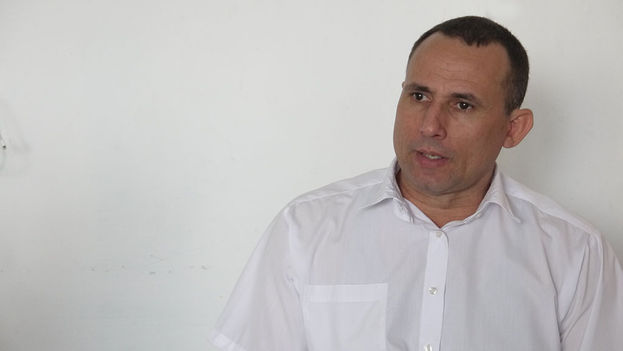
José Daniel Ferrer during the interview. (14ymedio)
14ymedio, Reinaldo Escobar, Havana, 20 January 2015 — Few could imagine that this activist, born in the east of the country and leader of Cuba’s most numerous opposition organization, is also a compulsive reader and an avid collector of famous quotes. Conversing with José Daniel Ferrer is like a trip that starts with a pamphlet cast in the streets of Palmarito del Cauto, then jumps to the best texts about the French Revolution, and ends in the pages of some modern psychological treatise.
Yet, the biggest pleasure of speaking to a man like him is to see him behave as if he were free, despite the police surveillance and the years he has spent in prison. During a quick visit to Havana, Ferrer answered some questions for the readers of 14ymedio about the current situation of activism in Cuba and the new stage that is opening up for dissidents.
Escobar: How does the Patriotic Union of Cuba (UNPACU) view the negotiations between Washington and Havana?
Ferrer: This process, which started after 18 months of secret talks, will be very positive in bettering the difficult life conditions of our people. However, the final result will best be appreciated as the announced relaxation of policies is implemented and also in the way that it is put in practice. If it is applied in an intelligent manner and is consistently complemented by solidarity and support to the independent civil society, it will yield better results than the prior policies. continue reading
Escobar: And the embargo?
Ferrer: Our people and the international community have in great part been critical with regards to the embargo, which by now has lasted for more than 50 years. In all this time, and especially following the collapse of the Soviet bloc, the Cuban government has placed the blame for our economic woes on the embargo, and has even used it to justify repression within the country. Obama’s policies delegitimize these justifications. Additionally, they are in tune with the sentiments of Cubans and of the international community.
Escobar: During your encounter with various American members of congress, you expressed the gratitude of your organization’s activists who had been released from prison as a result of the negotiations. Can you give us more details about them?
Ferrer: Of the 38 political prisoners that were freed between the days of January 7 and 8, 28 of them were members of the Patriotic Union of Cuba, in other words more than 70%. Of the 10 who were not members of UNPACU, 4 have already reached out to us and vocalized their desire join our organization. However, 14 of our activists are still imprisoned, 10 of them affiliated with our branches in eastern provinces and the other 4 belonging to organizations that are associated to our own.
“As soon as they find out about someone who has chosen not to make their dissent public, they threaten them with removing them from their jobs or even worse things.”
Escobar: What type of activism does UNPACU carry out?
Ferrer: Our organization is not just a group of audacious and courageous activists that protest peacefully on the streets. That mode of operation, that type of battle, is just the tip of the iceberg. Our strategy includes a great variety of means of peaceful combat, including seminars, courses, disseminating leaflets when the wind is favorable, putting up posters in public spaces… even better if it’s at the headquarters of the People’s Power (Poder Popular) or the offices of the Communist Party.
In a society that has been paralyzed by terror for many years, our actions can make people lose their fear.
Escobar: Do you see a disjunction between street activism and other forms of dissidence?
Ferrer: Discrete activism also greatly annoys the regime. They, through their intelligence apparatuses, know where we meet and with whom despite our greatest efforts. As soon as they find out about someone who has chosen not to make their dissent public, they threaten them with removing them from their jobs or even worse things. This is especially true when it’s someone who, because of his or her training or talent, could be a strong protagonist. But, if that person chooses to defend their rights, then the threats can be greater. That’s the proof that they fear these forms of activism more than the others.
Escobar: It has transpired that the organization you lead has lost alliances with other groups. Is that true? And if so why is that?
Ferrer: Many factors come to play here. In the first place, when other organizations merged with the Patriotic Union of Cuba, the oppressive bodies of the government also multiplied their efforts to divide us. Another issue is that some leaders believed at certain points that the best way to accelerate the process of non-violent combat was by uniting with UNPACU and later they changed their minds. Be it because attacks multiplied or because there were also instances of disagreement, some chose to return to their prior situations.
In fact, the relations between these groups and us remain good. Our disposition to cooperate remains. If we had to choose what was more important, for everyone to come under the same name and things not run as smoothly as they should, or that each keep their organization’s name and that things work better, we would choose the latter. We have separated but we did not become enemies.
“Some activists and opposition leaders object to reestablishing relations between the two countries and also disapprove of dismantling the embargo.”
Escobar: And has Obama’s announcement of December 17th deepened those differences?
Ferrer: With regards to the recent changes in policy announced by the Cuban and United States governments, there are some who believe it is a mistake. Some activists and opposition leaders object to reestablishing relations between the two countries and also disapprove of dismantling the embargo. However, we have to find what unites us. They want the same as we do: the democratization of the country and that Cuba respect human rights. They want us to be a just and prosperous nation “with all and for the good of all*.” The difference is in the means, not the objective, which we hold in common.
Escobar: So, you propose finding consensus points?
Ferrer: Yes, we would work together to reach that common end, including those who disagree with us today on topics like the reestablishment of relations between Cuba and the United States. We hope that they too understand that they can cooperate with us.
*Translator’s note: A quote from José Martí who is honored by both the Castro regime and its opponents.
Diario de Cuba, Antonio G. Rodiles, Havana, 28 January 2015 — The recent visits to Havana by American legislators and by Assistant Secretary of State Roberta Jacobson, have reawakened controversy over the transparency in the process of political dialogue between the Obama administration and the Castro regime. So far, the aim of furthering a previously determined plan has been evident, as well as raising the profile of those political actors who support and conform to this policy.
Indispensable voices from the opposition movement have been conspicuously absent from the meetings held. Equally apparent was the reluctance to have a balance of opinions in these contacts.
On multiple occasions, in support of the new policy, the Obama administration has posited the premise that the Cuban people should be the ones who guide the process of change on the Island. This pronouncement implicitly seeks approval for the new measures and opens the door to strong criticisms of those of us who reject the unconditionality — and the notable lack of transparency and consensus — that have characterized the start of this process. continue reading
This premise, presented simplistically and with an added dose of false nationalism, tries to label those of us who demand firm commitments to the advancement of democracy and human rights,as individuals who are incapable of assuming our political responsibilities — stuck in the past or wanting foreign governments to come in and make the needed changes. The administration’s theory is curiously parallel to the old idea of “national sovereignty” employed by the regime for so many years and echoed as a part of the arguments of the self-declared “loyal” opposition.
Do Obama’s measures promote the Cuban people’s empowerment, insofar as their civil and political rights are concerned? Can the opposition generate a broad social compact, given the degrees of control, repression and impunity with which the regime operates? Are there guarantees that the new measures will generate a Cuban entrepreneurial class in the medium term? Can Cuban society move toward a Rule of Law, given the atomization, evasion and corruption in which the vast majority of Cubans live?
If we are realists, the answers are obvious. The current Cuba only functions through corruption and patronage. We lack the legal framework that permits the empowerment of the people in any aspect. There cannot exist any broad and extensive leadership by Cuban democrats and entrepreneurs as long as the regime can maintain these high levels of repression and social control without paying a large political price. And a peaceful transition to full democracy requires such leadership.
Peaceful and sufficiently ordered transitions of despotic regimes to democracies have occurred under intense international pressure coupled with an effective internal push. Political results have emerged when these regimes sense that their permanence in power is impossible and they start to fear that a total social collapse will put them in disadvantageous or dangerous situations.
The continued presence of the political heirs as a part of the new system is one of the flashpoints in any transition. Experience also shows that, in the majority of cases, this continued presence brings with it an inheritance of corruption and a web of influences, and that it ultimately hijacks the genuine interests in building full democracies. To allow a transfer of power to the heirs correlates to perpetuating the poverty of the Cuban people, and sacrificing the future of our nation in the medium and long terms.
The dialogue conducted by the current American administration has not achieved even the release of all political prisoners and the annulment of their sentences. Many of the freed prisoners were released conditionally and not to full liberty. Such is the case of the 12 prisoners from the wave of repression of 2003, released in 2010, who decided to remain in Cuba and who now find themselves on parole and prohibited from traveling outside the country. This dialogue also has not managed to prevent further imprisonments and waves of arrests, such as the ones that occurred at the end of 2014 and start of the new year.
To insist on the idea that Cubans don’t understand fundamental rights and that only basic necessities are their priority demonstrates ignorance of our reality and gives a biased view of our genuine democratic aspirations. Freedoms don’t need to be explained; even when they have not been experienced, the human being can recognize them. We Cubans are not the exception.
A probable failure of this political process would be very harmful for all concerned, but most of all for the Cuban people. The Obama administration should combine effective pressure on the regime with the consensual work of a large group of democratic actors from within the Island and in exile. If the desired ultimate result is truly the democratization of our nation, a change of direction is needed.
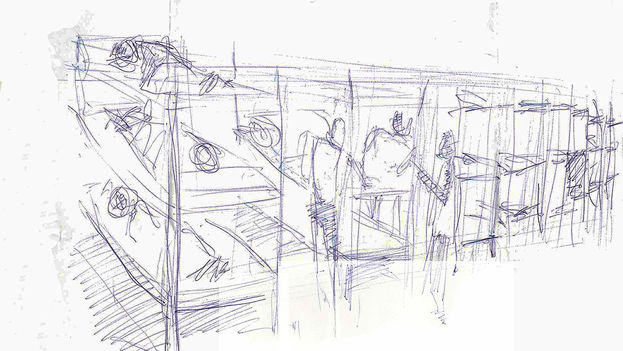
Map of the 4H Company in prison hand drawn by Danilo Maldonado, ‘El Sexto’
El Sexto tells of his incarceration in the Valle Grande prison
14YMEDIO, Havana, 28 January 2015 — Danilo Maldonado, the graffiti artist known as El Sexto, finished a month in prison this January 25. He was arrested while riding in a taxi whose trunk was carrying two live pigs. The animals were painted green and each bore a name written on his side. On one could be read Fidel and on the other, Raul.
The artist’s intention was to release them in Central Park in order to recreate a rural tradition in which one tries to catch pigs with the added difficulty that their bodies are smeared with grease. His frustrated performance art was entitled Animal Farm, in Memoriam.
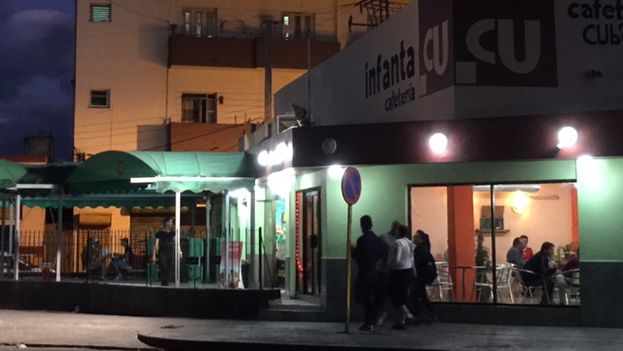
The light blue Lada that was transporting him was intercepted by three Revolutionary National Police patrol cars. The agents took away the identity cards of Danilo and the vehicle’s driver and took them to the Infanta and Manglar Station. Two days later, they transferred the artist to the Zapata and C unit where a prosecutor told him that he would be taken to trial. He stayed in those dungeons seven days until he was transferred to the central police station of Vivac de Calabazar, where he spent another seven days.
It happened that Vivac was the destination for dozens of arrestees accused of trying to participate in the performance announced by performance artist Tania Bruguera in the Plaza of the Revolution last December 30, which was interpreted by authorities as a counter-revolutionary provocation. Some of those arrested, who learned of his presence at the place, shouted, among other slogans, “Freedom for El Sexto.”
From the Valle Grande prison, where he is now, Danilo has sent us some jail anecdotes and a couple of drawings.
The Tank
When I arrived at Valle Grande they took blood samples for the lab, shaved my head and beard. They also photographed me. During my stay in Vivac, they had diagnosed me with pneumonia, for which reason I was carrying antibiotics with me, but they took them from me and have not seen fit to return them to me so far, nor has a doctor listened to my chest to find out if I am the same, better or worse than when I arrived here. To make matters worse, I am surrounded by smokers who do not care at all that I am sick and asthmatic. continue reading
I am in Company Four. They call this place “the tank,” and there are all kinds of people. I met four dissidents from Alturas de la Lisa. Yorlay Perez, Yusel Perez, Santiago Perez and Hanoy.
Fidelito
One day a boy came into the tank who said he knew me from the park and that he followed my work on the streets. This swarthy young man of small stature surprised me when he took off his pullover revealing on his back a tattoo of the face of Fidel Castro. I explained to him that I am an opponent of the Castro regime and that the gentleman he wore engraved on his skin was the one responsible for me being a prisoner.
He responded that he had no family and that he was a “son of the fatherland,” for which reason Fidel had given him a home, and that was not happening anywhere else in the world. I told him that was true, that if he had been born in another country no one would have given him a home, but maybe he could have sought it for himself and that really he owed nothing to Fidel. I told him of the case of Amaury Pacheco, who with a family of six children was harassed into an eviction from an abandoned house in the Alamar suburb, where they had gone so far as to refuse him water and electric service.
Later I found out through another boy, whom I met in Vedado, that it was said that he was with State Security and that he always had a pistol under his shirt. His acquaintances nicknamed him the Hoarse One, but I called him Fidelito.
This son of the fatherland was prisoner for falsification of documents, something he had done in order to leave the country. In a single night he tried to hang himself twice.
Yusel, the Opponent
In one of the constant inspections that they carry out here, a major and a second lieutenant thought that the fingernails of one prisoner were too long and that he had to cut them. He explained that he had no nail clippers, much less scissors. The major took a knife from his belt and threatened to cut his nails by force. The boy resisted and then the major told him that he had to bite them off.
Bunks. (El Sexto)
When they passed by the place where the opponent Yusel was, they noticed that he wore a white bracelet with the word Change on one of his wrists. As he did not obey the order to take it off, they forcibly snatched it from him. Then Yusel started yelling, “Down with the Castros, down with the dictatorship.” The second lieutenant cornered him against a bed to beat him but the rest of the prisoners got in the middle and prevented it. Things got hot but did not go further because the major started screaming that they were not going to beat him. Only then did the prisoners relax. Yusel was in a punishment cell for four days, but they did not beat him.
‘The Cigar’ that urinates
The Cigar arrived without a noise. Strong, tall, he must be between 60 and 70 years old, and he does not sleep. He said that he was a prisoner because he had threatened with a screwdriver some teens who were throwing a ball against the wall of his house. No one got close to him because he did not bathe. One day he urinated in the middle of the hallway, which was understood as “blackmail” for the other prisoners who would have to clean his filth. When they demanded that he wipe up that puddle, he said that he would do it with his clothes but they did not let him because that would mean enduring an even greater stench from him. We understood that he was going crazy the day that they read out loud the cards where our names and crimes appear. Then we learned his case: child sexual abuse.
To my Facebook friends and blog readers
I want to tell you that I really miss finding out about your trips and other events that are reflected in your accounts. I would also like to thank everyone who supported my cause and confess that none of my crazy things would have been possible if I had not known that I was not alone and that I count on the support of many of you. It is possible to fill hearts with hope. Evil will never overpower good. Retrograde minds will never overcome free minds. Violence will never overcome art and reason. Death will never overcome life and love.
I am going through an ordeal that has only been the legitimization of a good work and the confirmation of an iron dictatorship, which must be combatted with wit and cunning.
Believe me, sometimes I laugh alone in this dark place of 18 by 100 feet with 37 triple bunks, that is to say between 118 and 190 people plus those who sleep on the floor. I laugh even though the toilets are stuck next to each other without any privacy. I live happy because I live without fear and, although they persecute and harass my family, they will never manage to make a dent in my creativity. This time I believe they have been ridiculed like never before by anyone. Although they kept the pigs from getting to Central Park, all of us who have an imagination can see them running with their names engraved and people behind them like a true Animal Farm.
Ha, ha, ha. Hugs to all, and I wait to be able to read you.

 14ymedio, Juan Carlos Fernandez, Entronque de Herradura, 31 January 2015 – Entronque de Herradura is a little village in the Pinar municipality of Consolacion del Sur. I go there in search of Eduardo Diaz Fleitas, a Cuban with rapid speech, skill with the ten-line stanza and proven courage. He was among the 75 dissidents sentenced during the Black Spring of 2003, but not even a long prison stay made him lose his smile or wit.