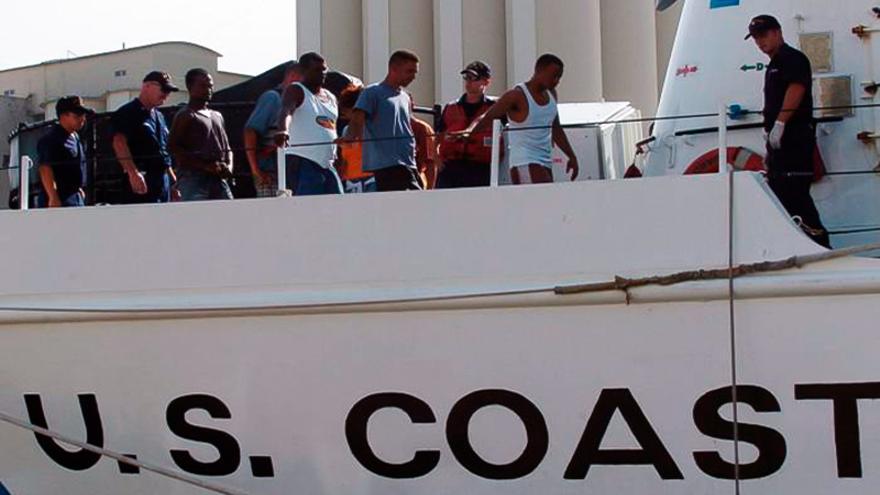
Cuban rafters being repatriated by the United States Coast Guard. (EFE /Archive)
14ymedio, 5 September 2018 – A Norwegian Cruise Line ship rescued and handed over to the authorities this Sunday four Cuban-born rafters, a spokesperson for the company confirmed to 14ymedio.
After leaving Miami, and about 40 miles from Key West, the cruise ship found four people in danger who “were safely and immediately taken to the medical installation of the ship for evaluation and were provided with clothing and food.” continue reading
The Bahamian Maritime Authority and the Coast Guard were informed by the captain of the vessel, who received instructions to disembark the rescued people at the port of Costa Maya, making them available to the Mexican authorities.
“We are very proud of our team for executing a successful rescue of these people,” said the Norwegian Cruise Line spokesman.
After the end of the dry foot/wet foot policy in 2017, which allowed Cubans who reached dry land in the United States to legally reside in the country with protective measures, the number of people who throw themselves into the sea fleeing Cuba has decreased drastically.
I am currently on Norwegian Getaway and some passengers noticed a flash in the middle of the ocean. They then told the cruise workers and they stopped and it turned out to be four people from Cuba which they rescued. Other videos coming now @OfficialJoelF pic.twitter.com/nc6XeaQis5
Since last October 1st, 331 Cubans have tried to emigrate to the United States by sea compared to the 1,989 recorded in the entire 2017 fiscal year, according to figures from the Coast Guard
The authorities have warned that all Cubans who try to enter the country clandestinely, either via the land border or by crossing the Straits of Florida, will be returned to the island.
Translated by Wilfredo Díaz Echevarria
_____________________
The 14ymedio team is committed to serious journalism that reflects the reality of deep Cuba. Thank you for joining us on this long road. We invite you to continue supporting us, but this time by becoming a member of 14ymedio. Together we can continue to transform journalism in Cuba.
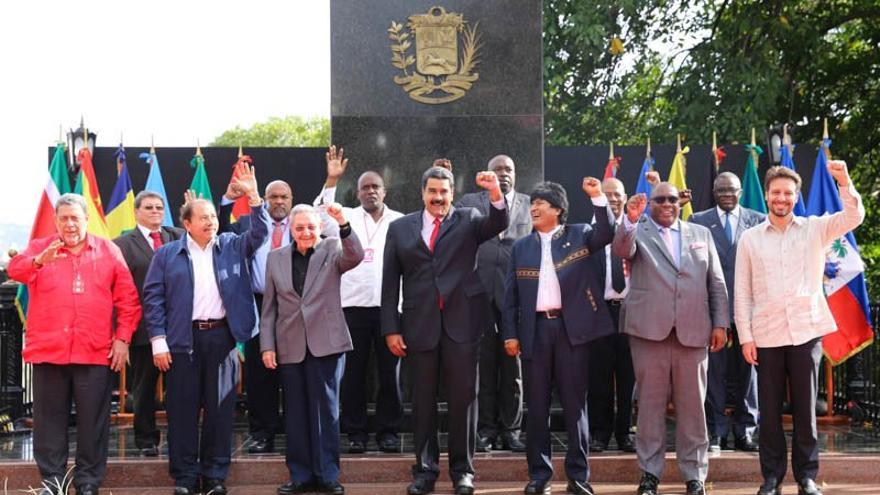
Family photo of the 14th ALBA-TCP Summit, in Caracas. (@ALBATCP_Cuba)
Carlos Malamud, México | 27 August 2018 — The Venezuelan migratory crisis, aggravated by events and with an expansive wave of continental reach, has claimed a new victim: the Bolivarian Alliance for the Peoples of our America (ALBA). The cause, the departure of Ecuador from the organization, a decision that seriously compromises its future.
The motive offered by the Ecuadorian Foreign Minister was the “lack of will” on the part Caracas to resolve the delicate situation that has been created throughout the region. Subsequently, additional motives were added: the social upheaval in Nicaragua and the high price paid in human lives at the expense of government repression.
Since its creation in 2004, what was then called the Bolivarian Alternative of the Americas, had been constantly expanding from its two founding countries, Cuba and Venezuela. Bolivia was added after the arrival of Evo Morales to power. Together with these three, Nicaragua and Ecuador constituted the hard core to which were added a series of small Caribbean countries such as Antigua and Barbuda, Dominica, Grenada, Saint Kitts and Nevis, Saint Lucia, Saint Vincent and the Grenadines, and Suriname, all of them attracted by the cheap oil of the once almighty Venezuelan oil company Petrocaribe. continue reading
The point of maximum expansion was achieved in August 2008 when Manuel Zelaya decided to add Honduras to the group. In January 2010, after the coup that took him from power, the new Honduran government decided to withdraw. Thereafter, the decline began, aggravated by the death of Hugo Chávez and the absence of alternative leadership. Venezuela’s economic problems and the continued decline in oil production made things worse.
ALBA is no longer what it once was. The prosperous Latin American dawn that Hugo Chávez and Fidel Castro predicted when they set it up as an alternative to the Free Trade Area of the Americas (FTAA) has ended up eclipsed. At that time David — that is ALBA — liquidated Goliath — FTAA — with the help of Néstor Kirchner and Lula da Silva, and the collaboration of Diego Maradona once again playing his starring role as the buffoon.
The moment is critical. Not even the efforts of its executive secretary, former Bolivian Foreign Minister David Choquehuanca, famous for not reading books and extracting his knowledge from rocks and the wisdom of the ancients, have been able to rescue the institution from the paralysis in which it found itself. One by one the integration organizations promoted by Chavismo have collapsed: CELAC, Unasur and now ALBA.
All of them were products of what many academics pompously called “post-neoliberal integration,” when they were just empty shells, as the passage of time has shown. And their failure was not due, as they will want us to believe again, to the effect of diverse conspiracies hatched by imperialism, but to their incapacities and the lack of a serious project of regional integration, aggravated by the shipwreck of the “Bolivarian Revolution.” The eclipse of ALBA has marked the decline of the so-called “dream of Bolívar,” the construction of the “Great Homeland,” leaving orphaned, now, of powerful supporters.
Note from the Editor: this analysis has been previously published in El Heraldo de México. We reproduce it with the authorization of the author.
________________________
The 14ymedio team is committed to serious journalism that reflects the reality of deep Cuba. Thank you for joining us on this long road. We invite you to continue supporting us, but this time by becoming a member of 14ymedio. Together we can continue to transform journalism in Cuba.
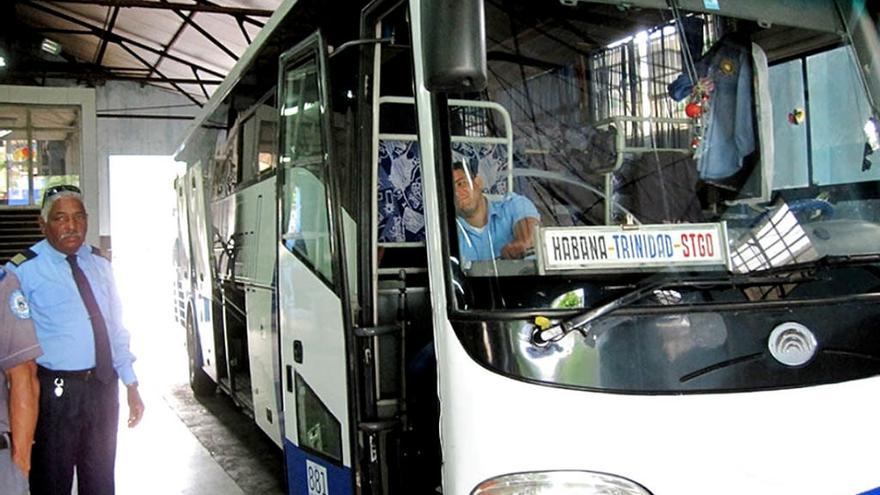
Gladys Carbonell’s grandson and great-granddaughter spent 24 hours on a Via Azul bus to Santiago de Cuba (FLICKR)
14ymedio, Gladys Carbonell, Havana, 4 September 2018 — In addition to the terrible catastrophe of the plane crash in Havana, there have been many road transport accidents in Cuba lately, in which, unfortunately, people of all ages have died, including children which is the worst and most heartbreaking. There have also been many other accidents in different provinces of the country.
I would like to relate what happened to my grandson a few days ago on his trip to Santiago de Cuba, when he was taking his 7-year-old daughter home from her vacation in Havana to the place where she lives. My grandson lives in Havana and makes these trips often to fulfill the sacred duty of taking care of his daughter on vacation and spending time with her as he wants to do after his divorce. As a grandmother, and because I can take on the expense of these trips, I help him to fulfill his function as father and give the child a chance to enjoy being with him, for which I pay the Government the approximate sum of the almost 300 Cuban convertible pesos (CUC) that these trips entail.
There are no planes and there is no chance of getting a space on bus if you are paying in Cuban pesos (CUP). The only alternative if you need to move between the two most important cities in the country are the Vía Azul and Transtur companies, initially created to transport tourists or residents who are living abroad. continue reading
It took my grandson and his daughter 24 hours to arrive via Vía Azul in Santiago de Cuba. A trip that should last about 15 hours lasted 24, because they left the terminal on August 28 at 6 in the morning and arrived in Santiago de Cuba on the 29th past 6 in the morning. It was an endless journey and full of many needs, something normal when you take a child.
The reason for the delay was that the rubber on the left front tire of the bus peeled away in Ciego de Ávila, which could have caused the bus to overturn which probably would have caused the death of several people. Who knows if it would have fallen to me to mourn the death of my grandson and my great-granddaughter.
As always happens, the company did not have the spare part. They sent it to look for it and, finally, the person who was supposed to bring this part to the place where the bus was parked, forgot where it was.
A month or so ago, the same thing happened when a son of mine returned from Santiago de Cuba to Havana. The bus that left at 10:30 on the night of July 26 broke down as it arrived in Palma Soriano, shortly after leaving Santiago, and they had to go back and to get on another bus to get to the capital. How is it possible that it broke down so soon after starting out? Is it possible that these vehicles are not checked at the maintenance base before leaving? Don’t they care that people could lose their lives?
How many CUC does the Government collect for that simple trip by bus on Vía Azul, which is sure to be full and where there are children? Which of those revolutionary leaders that supposedly must watch over the well-being of their people travel or live an experience like that? Which one pays for terrible service, the price of which is almost six times the monthly retirement income of any Cuban professional? Please, do not blame the ’blockade’ for this. Any other argument, even if it seems like a lie, I could believe it.
Translated by Jim
________________________
The 14ymedio team is committed to serious journalism that reflects the reality of deep Cuba. Thank you for joining us on this long road. We invite you to continue supporting us, but this time by becoming a member of 14ymedio. Together we can continue to transform journalism in Cuba.
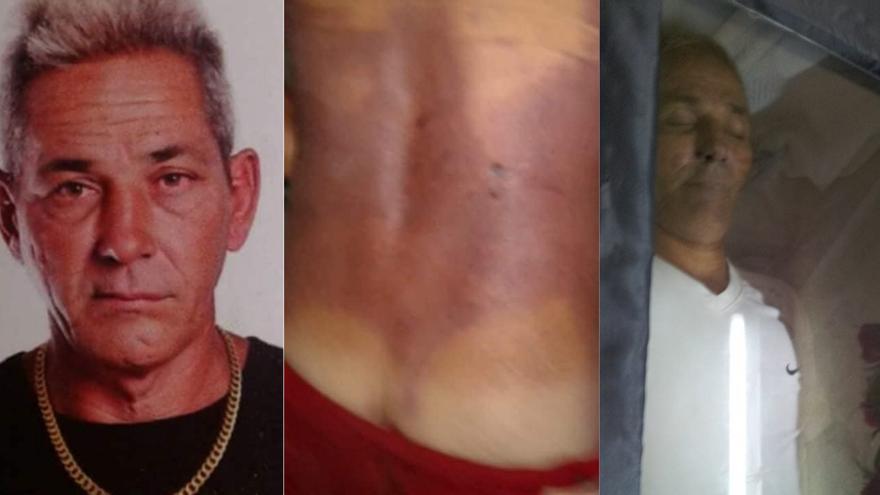
Alejandro Pupo Echemendía, who died in police custody. (Courtesy)
14ymedio, Havana, 3 September 2018 — The two main human rights organizations in Cuba published Monday their reports about repression during August.
The Cuban Commission on Human Rights and National Reconciliation (CCDHRN), with headquarters in Cuba, puts the number of arbitrary political arrests at 219 in August. For the CCDHRN the most serious event last month was the death of Alejandro Pupo Echemendia, arrested on the 9th and declared dead hours later while in police custody. The activist was taken to the National Revolutionary Police (PNR) station in the city of Placetas in Villa Clara, and relatives and witnesses assert that the body showed signs having been brutally mistreated before his death.
“Official responsibility must be revealed in this flagrant case of another citizen who dies in police custody,” demands CCDHRN. continue reading
On the other hand the organization applauds the announcement of the opening of a trial against some twenty officials and other citizens who are accused of bribery, document fraud and other crimes aimed at facilitating the “illegal” relocation to the capital of people who live in other provinces, building a criminal network.
CCDHRN thinks that the government intends to keep the detention figures low, but in the face of this, it increases control over people and has carried out at least 21 acts of harassment and four physical assaults against opponents.
Moreover, the Cuban Human Rights Observatory (OCDH), with headquarters in Madrid, has accounted for at least 208 arbitrary detentions in Cuba during August, a figure somewhat higher than that set out in July.
The organization highlights the harassment and arrests suffered by several independent artists on the 25th when they held a concert against the approval of Decree 349 which increases censorship of the sector. The non-governmental organization Amnesty International has pronounced itself against that day’s arrests.
The activist network of OCDH accounted for 133 repressive actions against women and 75 against men on the Island, at the same time that more acts of harassment and intimidation were brought against members of civil society and activists throughout the Island.
Another of the punished sectors last month has been the milieu of the political movement Somos+ whose activists were victims of arbitrary arrests when they tried to meet to debate the draft version of constitutional reform.
For its part, the Center for Cuba Coexistence, directed by Dagoberto Valdes, continues suffering its particular repression of police citations and interrogations.
The personalized repression and the measures controlling departures abroad have become the tools most used in recent times, which, according to the Observatory, “leaves exposed the absence of the government’s political will to change.”
This fact also is denounced by CCDHRN which maintains that while it was “permitted” that nine dissidents travel to Peru in order to participate in two academic events, another nine were impeded from doing the same on the basis of various pretexts or simply the use of force.
Translated by Mary Lou Keel
_________________________
The 14ymedio team is committed to serious journalism that reflects the reality of deep Cuba. Thank you for joining us on this long road. We invite you to continue supporting us, but this time by becoming a member of 14ymedio. Together we can continue to transform journalism in Cuba.
Rebeca Monzo, 2 September 2018– Some years ago a well-mannered gentleman appeared in our neighborhood selling the most delicious baked meringues. He told us he was living, not in the best of conditions, in a distant suburb on the outskirts of Havana. On almost on a daily basis he walked the streets of Nuevo Vedado, where he had found some customers.
Recently, which is to say a few years ago, privately operated sites began springing up in our neighborhood where one could buy bread, cookies, candy and meringues, the latter supplied by Manuel, who also continued walking the streets in his normal street vendor way.
Several months ago we lost sight of him. All the neighbors were asking, “Have you seen Manuel?” His delicious meringues were still available at certain designated spots but we no longer crossed paths with him. We missed chatting with him — this older, cultured, pleasant man with a unique demeanor — when we made our purchases. continue reading
Today, I inadvertently crossed paths with him for the first time in months at one of the sale locations. We had a brief conversation during which I discovered that his absence was due to the fact that, after several years of retirement, he had decided to accept an offer to return to teaching at the University of Havana, where for years he had been a professor. His main source of income, however, remained the sale of meringues, which his family had taught him how to make.
On planet Cuba it is very common to find distinguished and elderly professionals living not on their salary or pension paid in Cuban pesos but on little freelance projects which earn them hard currency. This is a finer point not addressed in any article of the pitiful draft of the proposed new Cuban constitution.
14ymedio, Havana, 3 September 2018–The Union of Cuban Journalists (UPEC) has accused The New York Times (NYT) of surprising its readers with a “crazy theory” about the supposed sonic attacks that harmed the health of various US diplomats stationed in the embassies of Havana and Beijing. The daily ran an article in its Science section on Saturday in which it quotes various physicians and experts who, discarding other explanations, point to microwave technology as the prime suspect in the health hazards inflicted upon the functionaries.
UPEC has published a letter by attorney José Pertierra — among the most popular pro-Cuban government jurists, and one who has a law office in Washington, DC — in which he classifies the article as “an example of poor journalism,” being based as it is on “pure speculation” and not exposing the cause of the possible illnesses. continue reading
“Every time that a witness makes unsubstantiated claims in a court of law, the attorneys are required to present the ’evidence’ and to ask a fundamental question: ’How do you know this?’ Unfortunately, The New York Times does not ask this fundamental question,” writes the lawyer, who is thus demanding that scientific or procedural criteria be applied to journalism.
The New York Times article says that the scientists believe that unconventional weapons which utilize microwaves are the most probable cause of the so-called sonic attacks. Although the report published in March by the Journal of the American Medical Association (JAMA) following an examination of 21 affected diplomats in Cuba makes no reference to this type of wave, the author of the study and director of the Center for Brain Injury and Repair at the University of Pennsylvania, Douglas H. Smith, said in a recent interview that microwaves are now considered prime suspects in more than likely causing brain damage.
“Everyone was relatively skeptical at first, but now all agree that there is something there,” said the specialist, who added that the physicians jokingly refer to the injuries at issue as the “immaculate concussion.”
Discarding other possible causes such as sonic attacks, viral infections, or contagious anxiety, some analysts, according to the NYT article, now point to the “Frey Effect,” a phenomenon discovered decades ago by the scientist Allan H. Frey, which posits that microwaves can fool the brain into perceiving what might seem like common sounds.
These false sensations could explain the noises and buzzing sounds cited by the diplomats, which at first were thought to be evidence of attacks by sonic weapons.
While the US Department of State and the FBI are declining to make further statements about an ongoing investigation, a group of experts has collaborated this summer with the federal government in evaluating new threats to national security which, apparently includes the mysterious Havana embassy case and weighs various explanations, among which is the microwave theory.
Frey, the discoverer of the microwave phenomenon, who has worked as a contractor and consultant with various federal agencies, speculates about the possibility that Cuba allied with Russia could have executed these attacks with microwaves in order to damage the relations between Havana and Washington that began during the Barack Obama administration.
Frey explains that decades ago, during a visit to the USSR to give a conference, he was taken to a military base outside Moscow, whose government was “so intrigued by the prospect of mental control that it adopted special terminology for the general class of potential weapons, calling them ’psychophysical’ and ’psychotronic,’” according to the scientist as quoted in the NYT.
An infinity of home appliances, such as short-wave radios, kitchen ovens, and mobile phones emit microwaves in a harmless manner — but they are easy to manipulate and concentrate because of their small size. According to statements quoted by the NYT, it is believed that Russia, China, and many European states have the know-how to manufacture basic microwave weapons that could weaken, create noise and even kill.
Last October, the magazine Neural Computation published an article by Beatrice A. Golomb, MD and professor of medicine at the University of California San Diego, that lays out the most detailed medical case for microwave attacks at the Havana embassy.
In her article, Golomb compared the symptoms of the diplomats on the Island with those reported by persons who are said to suffer from radio frequency illness, and she asserted that “numerous, highly-specific characteristics” of the diplomatic incidents “fit the hypothesis” of a microwave attack, including the production of perturbing, Frey-type noises.
The incidents at the embassy provoked the exit of non-essential personnel from the diplomatic headquarters–about 60%–and this has had significant repercussions on the daily life of Cubans, who have since had great difficulties in obtaining visas to the US, the county to which they have the most ties. Havana accuses Washington of inventing an excuse to obstruct the thaw, being that the cause and extent of the injuries suffered by the officials have yet to be determined.
Translated by: Alicia Barraqué Ellison
________________________________
The 14ymedio team is committed to serious journalism that reflects the reality of deep Cuba. Thank you for joining us on this long road. We invite you to continue supporting us, but this time by becoming a member of 14ymedio. Together we can continue to transform journalism in Cuba
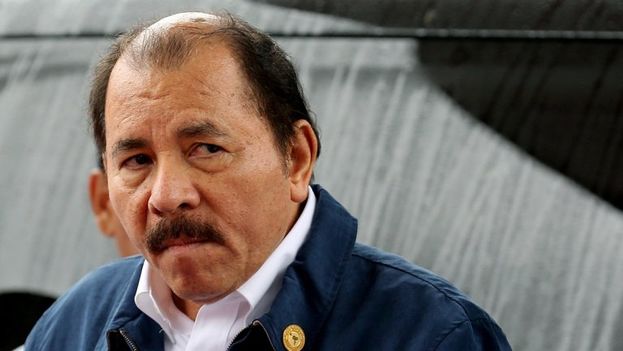
The president of Nicaragua, Daniel Ortega, remains in power after one of the bloodiest crisis in the history of his nation. (EFE)
14ymedio, Carlos Alberto Montaner, Miami, 2 September 2018 – I’m told that Daniel Ortega, the Nicaraguan dictator, ordered a discreet survey to find out what percentage of the country supports his continuing to lead the government. Daniel was enraged when he learned the results: only 9% support him. He is two points below Nicolás Maduro. Those who consider themselves Sandinistas were 25% of the survey, but the Danielistas are a handful that tends to shrink as the crisis intensifies.
And the crisis is unstoppable. It consists, essentially, in the absence of investments and the paralysis of economic decisions. That is fatal for any government. The good functioning of societies is based on trust, and trust, in turn, depends on the soundness of institutions. You would have to be absolutely crazy to take a dollar to Nicaragua. What sane people do is take their savings to Costa Rica, Panama or Miami, where there are guarantees that they will not be confiscated by the governments of those countries.
Faced with this reaction, stupid governments accuse those who behave rationally and protect their capital of being traitors. But they do something even more serious: they steal the independence of national banks, they intervene in bank deposits, they create so-called corralitos and freeze deposits, they devalue currencies to liquefy debts, they seize the dollars or euros of remittances sent by long-suffering emigrants, and they punish businesspeople by invading their properties or confiscating them, although in the rough hands of the government these properties usually have a very short life before they begin showing losses, a prologue to their ultimate closings. continue reading
All this increases uncertainty and distrust. Those who do not have access to dollars acquire valuable pictures, precious stones, gold or anything that retains some international value. I have seen fortunes in postage stamps, spurs for fighting cocks, race horses and even curious relics, false or real, like the fragments of Napoleon’s testicles, carefully amputated by Dr. Francesco Antomarchi in Santa Helena, the Mallorcan doctor who autopsied the corpse and ruled that the emperor died of stomach cancer at age 51.
What is Daniel Ortega’s next move? He knows he has to face the polls, but he is waiting for his image and that of his Government to improve. That will never happen. The problem is that everything he does aggravates and worsens his personal situation and the perception of his regime. The Organization of American States (OAS) ruled that it is a repugnant dictatorship that kills without compassion. The Inter-American Press Association (IAPA), after a visit by its president, reported that the rights of the people are violated without compassion. There is no human way to improve that image, unless he announces his decision to advance the elections and leave the country or stay, if he has the delicate talent that is required to agree on a negotiated solution with the opposition.
Although it seems incredible, the worst is yet to come. And the worst is the nationalization of Nicaragua’s weak productive capacity. I do not know if Daniel still believes in the Cuban model of the eighties, which was in force when he first took power with the Sandinistas, because he was a very ignorant young man, but Cuba, which has lost its compass after 60 years of failures, no longer believes in it and is trying various formulas to bury the Revolution without it being noticed and without losing power, two impossible missions.
If I were a Nicaraguan, along with the departure of Daniel, I would be thinking about what to do to prevent further revolutions and setbacks. A substantial part of what was achieved after the defeat of the Sandinistas in 1990 has gone by the wayside. All of the work undertaken to overcome Nicaragua’s bankruptcy, to straighten out its finances, to end hyperinflation, to fix the wounds and to begin to grow again, has been lost.
It is a shame that every so often a catastrophe like this occurs and overthrows coexistence. Well-functioning nations have remarkable human capital and functioning institutions. They are not governments of special men, but of laws that apply to everyone equally and in which one ascends not by one’s connections but by one’s merits.
Is there a country that has shined a light on this exhausting exercise? Yes. Switzerland did it in 1848, after the liberal revolution. They decided never to export mercenaries, to participate in wars, or to become poor again. They dropped out of stupidity. Today very few people know the name of the president of Switzerland. Nor do they need to.
________________________________
The 14ymedio team is committed to serious journalism that reflects the reality of deep Cuba. Thank you for joining us on this long road. We invite you to continue supporting us, but this time by becoming a member of 14ymedio. Together we can continue to transform journalism in Cuba.
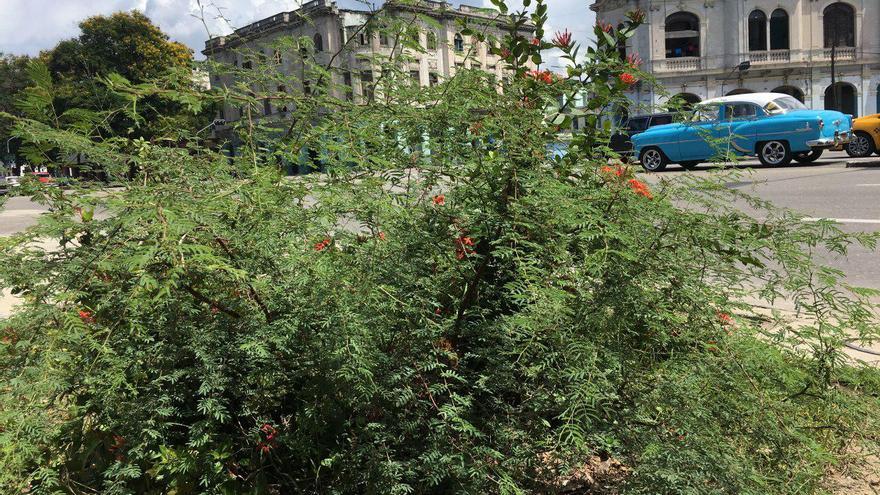
The invasive marabou weed has spread from the Cuban countryside and invaded Havana (14ymedio)
14ymedio, Marcelo Hernández, Havana, 30 August 2018 — On both sides of the Central Highway and the National Highway there is no other plant that dominates the landscape as much as the invasive marabou weed (called marabú in Cuba, and also called sicklebush in English). However, this thorny bush — which has become a plague in the fields of the island — is no longer just an element of rural zones but has also extended its presence to urban areas.
In the central Havana intersection formed by the streets Carlos III, Infanta and Ayestarán, a marabou bush grows defiant a few inches from where collective taxis circulate and tourists take pictures. The majority of passers-by do not realize the presence of the plant, others joke about the progress of its invasion into the cities and a few remember that currently the invasive plant is not seen in a bad light.
What until a few years ago was considered an undesirable species has become the raw material of charcoal that the country exports to the US, Europe and other regions. The authorities recently commissioned China to manufacture a prototype marabou harvester to alleviate the hard work now carried out by brigades of men with gloves and machetes. Some craftsmen also use it for wood carvings and accessories, while more than a few farmers consider it an insurmountable barrier that prevents trespassing by strangers to their lands.
Thus, slowly, after displacing the Royal Palm in the countryside, the marabou has managed to get people accustomed to its presence and to begin to take advantage of its thick branches. It has won the battle against the other plants, the insults and the state plans to finish it off.
__________________________
The 14ymedio team is committed to serious journalism that reflects the reality of deep Cuba. Thank you for joining us on this long road. We invite you to continue supporting us, but this time by becoming a member of 14ymedio. Together we can continue to transform journalism in Cuba.
Havana Times, Lynn Cruz, 8 August 2018 — Verkami, a creative crowdfunding platform, has become very popular amongst independent Cuban artists. The reason for this being that the website is Spanish so it doesn’t run the same risks as other platforms, such as Indiegogo or Kickstarter, which are from the US and the US Department of the Treasury could freeze these funds at any time because they are related to a project being managed within Cuba, which is what happened to filmmaker Miguel Coyula with his film “Corazon Azul”.
Creating a Crowdfunding campaign is basically what we Cubans call a kitty or collection. People interested in the campaign can make their donations on the website over forty days. We have chosen to create ours on Verkami, to collect the amount we are asking for and to finish producing the play Patriotismo 36-77.
We launched the campaign on July 16th. This platform has a special feature which means that if you don’t raise the amount you are asking for, you lose all of the money collected. Of course, in this case, donations are returned to donors, who are called sponsors. continue reading
Seeing as we are making slower progress than most of the projects on this website, I am beginning to get worried. For example, one of the most prominent campaigns on Verkami in 2017 was created by photographer Paco Gomez and expeditioner Hilo Moreno. . They launched the first campaign to explore Antarctica via Whatsapp. And they managed to raise 22,000 euros for their project in just 40 days.
Lynn Cruz
How can a Cuban make their dreams come true, living in Cuba?
Because that’s essentially what we are campaigning for, to make a dream come true. Obviously we need to find similar people who like this dream and that’s where the challenge lies.
Over time, I have seen how much the Cuban political and economic system has affected us, especially when these words are used in the same sentence: “Dreams and aspirations”.
Genetic engineering in Cuba has been to decapitalize us. Cubans quite simply don’t have any credit because we don’t have a bank. In the world today, credibility is governed by accumulated sums in accounts.
How can you trust a second-rate citizen, who is being paid 30 USD per month by their government for being a professional in the sciences, arts or humanities?
I have been with actors Juliana Rabelo and Luis Trapaga here in Cuba. With filmmaker Terely Vigoa, who collaborates from Madrid, because internet access is another problem we face.
While the number of places we can connect to social media have increased on the island, we still have problems not only because of the slow connection, but also because of how much it costs.
We are all working subject to one single idea. Over time, we have realized that the best reward for our efforts won’t be found in a sponsor who contributes a large sum of money (although that could also be the case), but we would like to recover the ritual nature that our theater has lost.
We have discovered that we can make Cuban theater for the world thanks to the internet. Raising an audience’s awareness by choosing a focus that stems from desperation.
We have taken action in our art and to defend our civil rights out of consciousness and this has also brought us consequences. So, why not take our own testimonies as a starting point? This is where the idea for Patriotismo 36-77 came from.
If our project is successful and we manage to bring the most sponsors we can together, we would invite them all to see the play live, on our vimeo channel. We would add English subtitles because we want anyone, anywhere to be able to participate.
We would suggest times that suit both the West and East. People will be able to comment on social media. Write texts. Write a critical analysis which would help us to improve our art.
The livestream of the play will be in HD and the cameraman will follow actors throughout the entire performance, so that everyone seeing it online can enjoy a more cinematic recording.
On the other hand, the audience present at the live performance will see a play, a piece of performance art and the recording of the movie at the same time.
Cubalex, 23 August 2018 — According to Pedro Edgar Rizo Pena, in an article entitled “Demythologising Decree 349,” what the “activists against 349″ have not troubled themselves to analyse (perhaps due to lack of legal understanding, or not co-operating in reading and interpreting it) is that the decree promulgates the basis for the legal provisions which regulate self employment in the country… that is to say, this fact destroys the argument that the decree acts against the interests of artists and their creative expression.”
I completely disagree with what the writer says. Decree 349, in its first “Insofar as,” indicates that it updates Decree No.226 (but in the Final Disposicion it revokes it) where this section expressly recognises its application to breaches of regulations and provisions currently in force relating to provision of artistic services in public spaces or premises, in labour matters and in regard to cultural, artistic and literary policy. It does not mention self-employment, and nor does Decree 349 expressly refer to it. continue reading
Nor does it refer to the Labour Code, as did its predecessor, by way of Law No. 49/83, which was repealed by Law No. 116/2014 (the current Labour Code), which authorises the Ministry of Culture (Article 76) to establish the procedure and the entities authorised to evaluate the eligibility and professionalism necessary to carry out artistic work, as well as the form of remuneration for artists.
It does act against the interests of artists and their artistic work
If Decree 349 does not act against the interests of the artist, what is the meaning of the offence mentioned in Section e) of Part 1 of Article 2. I quote: “In the offering of artistic services, there are contraventions … the person who performs artistic services in the absence of authorisation to carry out artistic work in an artistic position or occupation.”
Subsequent to the entering into force of the new Labour Code, the Ministry of Culture (MINCULT) promulgated Resolution No. 45, of 16th June, 2014, “Regulations for the evaluation system for workers in artistic fields.” This established an Artistic Technical Council or evaluation tribunal, whiich assesses the quality of work, qualitative development of the ability and skill of the individual or collective, and awards or withdraws the professional designation of artists (be they graduates of artistic teaching, general teaching, or amateurs) for artistic festivals, genres and specialities, and artistic responsibilities.
The Ministry of Culture and the Cuban Institute of Radio and Television authorise institutions to make and market artistic productions and services. Only these entities are authorised to establish employment regulations with artists and groups of artists, according to professional performance. They have to apply for permission when they wish to contract an artist who has no evaluation for a particular performance or piece of work. It is forbidden to enter into employment relations with artists lacking an evaluation, who are not graduates of the artistic teaching system (they can be reevaluated after a year). An artistic group which loses its evaluation is dissolved.
There is no legal relationship with the self-employment regulations
Finally, Decree 349 broadens its coverage from “public places or institutions” to “public places or institutions which are or are not state-controlled.” The unhindered discretion and legal uncertainty is increased when the government does not define what is meant by “public places or institutions which are or are not state-controlled.”
It also widens the range of those to whom it may be applied. Decree No. 226 was limited to those individuals performing on behalf of a state, private, or mixed entity. Self employed persons (in the non-state sector) were not included because they are not entrepreneurs and therefore there is no legal reason for the state to consider them as entities (see the constitutional project glossary of terms).
Those individuals are authorised to undertake an economic activity, which, in the majority of cases, they undertake in their own houses. Clearly they carry out alterations to these business properties (hairdresser, bakery, restaurant, etc.) but legally they remain private residences. The state does not classify them as businesses or see the value of the property in that way. There is no justification for considering the place where they work on a self-employed basis to be one of the “public places or institutions which are or are not state-controlled,” let alone as “businesses.”
Havana Times, Lynn Cruz, 23 August 2018 – When darkness seems to hang over us a little heavier, there is a truth that shines through: “The essential thing is to work, to create.”
It has been over a year now since our documentary Nadie, which we tried to screen at a private venue: “Casa Galeria El Circulo”, suffered police repression. Then, during the Mar del Plata International Film Festival, we received a strange email to cancel the screening of this same documentary at the festival, after it had initially been accepted.
After hearing our accounts about censorship not only on the island but abroad too, visual artist Tania Bruguera told us about the persecution her own work had suffered and how this had gone beyond seas and borders and that this should be reported. continue reading
This is how the idea for the Cuban Cinema under Censorship exhibition at the Museum of Modern Art, MoMa, which was held last March, was born.
A total of 8 movies were shown as part of Bruguera’s project which she put forward with the Hannah Arendt International Institute for Artivism (INSTAR), which started operating at the end of 2017 in Havana.
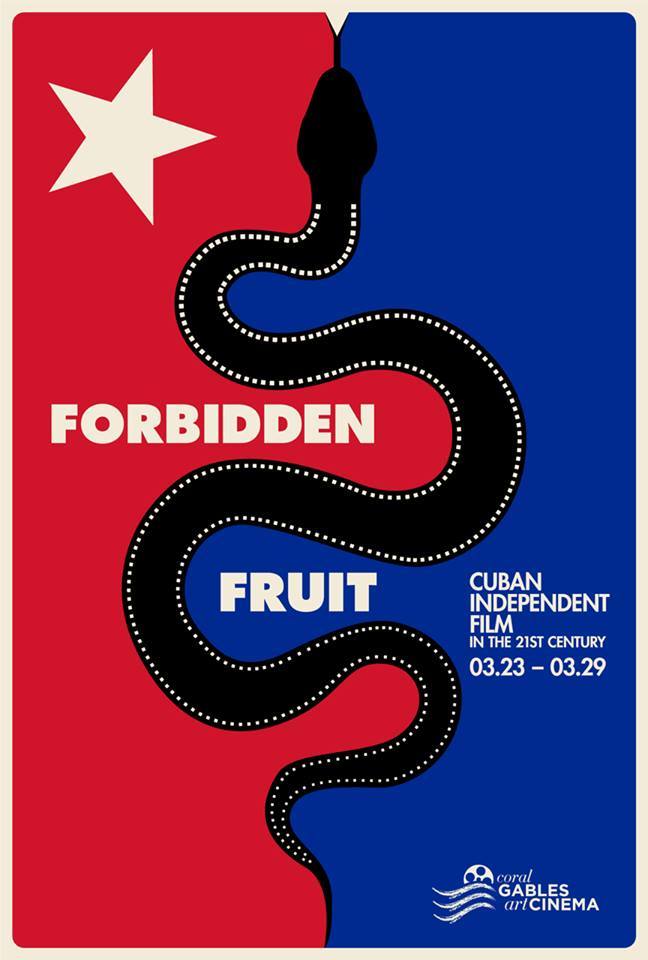
Then, in April, Cuban-Lebanese-American Nat Chediak, an intellectual and film enthusiast, founder of the Miami Film Festival, organized the first Independent Cuban Film Festival outside of Cuba under the name, Forbidden Fruit.
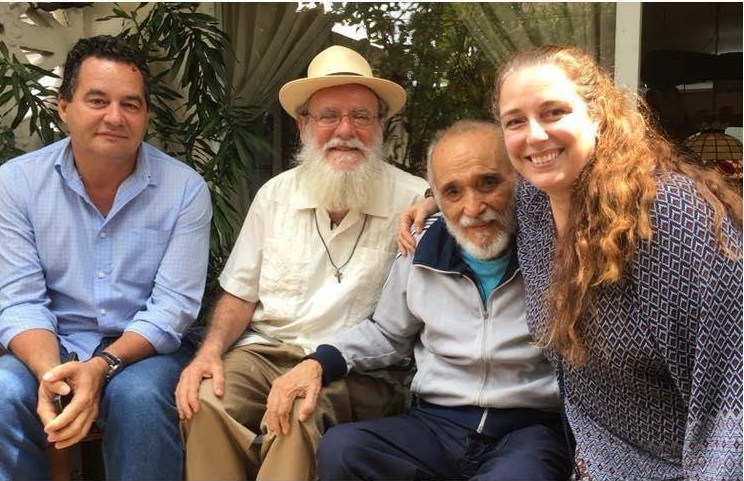
From left to right: Angel Santiesteban, Rafael Almanza, Rafael Alcides, Tania Bruguera.
The festival took place at the Coral Gables Art Cinema in Miami, which Chediak is currently responsible for programming, and was also curated by critic Alejandro Rios.
At this time, a new copy of the movie produced outside of Cuban institutions, is headlining at the World Cinema Amsterdam Independent Film Festival which is underway right now and will end on August 26th. It also includes movies which have had protection from Cuban institutions, the most noteworthy being Sergio y Serguei(RTV Comercial) by Ernesto Daranas or Ultimos Dias en La Habana by Fernando Perez (ICAIC).
In this way, it has become evident that independent filmmakers are beginning to become a force to be reckoned with. Bruguera has kicked off a new funding campaign to continue developing Cuban film, which is deprived in Cuba and only survives thanks to filmmakers’ own initiatives.
Today, the Cuban Institute of Cinematographic Art and Industry (ICAIC) only produces historical movies. Alejandro Gil’s movie about 8 medical students who were shot during Spanish colonial times is currently in the post-production phase as is Jorge Luis Sanchez’ movie which focusses on the character of Julian del Casal, a poet who represented the move towards modernism in Cuban literature; as well as Rigoberto Lopez who is working on a movie about Ignacio Agramente, a hero of Cuba’s independence wars.
ICAIC doesn’t seem to have any interest in integrating new filmmakers either, and the way scripts are chosen within this institution is still unknown.
In contrast, INSTAR’s deadline for submissions will end on September 8th. Filmmakers interested in taking part can fill out a form online or download one as a PDF file. This is essentially an opportunity to make your first movie.
This opportunity offers a niche for everyone who wants to make their first feature movie, short movie or documentary. It’s a question of thinking about film from its genesis outside of government institutions.
Few outdoors shoots, a reduced technical team, would be strategies that allow these movies to be made.
Now is a good time for Cuban film thanks to these initiatives by Cubans who have managed to pave the way for Cuban film abroad and try to continue developing and offering opportunities to the Seventh Art created on the island, with or without the protection of Cuban Film Laws.
14ymedio, Justo Mora, Cienfuegos, August 30, 2018 — Pedro Albaladejo arrived in Juraguá 31 years ago. At that time he didn’t have as much gray hair as he does now, nor did he let his beard grow more than five days. He was a strong young man, with a tanned complexion, who at 35 made his living as a builder.
One day he received an offer to be part of the group that was going to build “the work of the century” in Cuba: the nuclear power plant that would provide electricity to the industrial center of Cienfuegos. He exchanged his ranch in Las Tunas for a temporary hostel and ever since has lived in the vicinity of what the locals call the CEN, the ruins of the mammoth project of the National Electronuclear Plant.
“Before, this place was full of people who came to work. Trucks never stopped arriving. It was another time. The Soviet Union supported us and here there was hope that life would get better,” he says as he pastures a herd of goats among abandoned blocks of concrete. continue reading
“So many people without houses in this country, and here they have left a ton of apartments unfinished. That’s a crime, boy,” a neighbor laments. (14ymedio)
$1.1 billion was invested in the construction of the reactor, and more than 10,000 workers, engineers, and architects worked on the project. Dozens of Russian specialists worked together with the Cubans on the projects of the Nuclear City.
Fidel Castro made an agreement with the Soviets in 1976 to build two nuclear reactors of the VVER-400 V316 type, but the Chernobyl nuclear disaster in 1986 slowed down the Russian nuclear program, and the end of Soviet subsidies to Cuba ended up paralyzing the project in 1992.
The first houses in the Nuclear City, developed in the Soviet style, were turned over in 1981. “We built these buildings ourselves,” says Albaladejo, pointing out a block of five-story apartments. Empty. “So many people without houses in this country, and here they have left a ton of apartments unfinished. That’s a crime, boy,” he laments.
Around him are the ruins of what in the past were hostels, warehouses, offices, dozens of buildings abandoned and cannibalized by the “stonepickers,” as the locals call the people who devote themselves to pulling out blocks, rods, and slabs from the ruins.
“Homeland or death! We will win! Socialism or death! Resist and win!” The old slogans painted on the buildings and the portraits of Fidel Castro and Che Guevara resist the passage of time. A completely abandoned 18-story building and various apartment blocks without doors or windows remind one of Pripyat, the nuclear city that the Soviets built nearby Chernobyl which was evacuated and abandoned after the explosion of a reactor on April 26, 1986.
“No one wants to live here. Young people leave for Cienfuegos or abroad because there’s only work here as a guard, in the private hospital, or as a teacher. There’s almost never water and in the buildings it rains more inside than out because of all the leaks,” he laments.
In the Nuclear City and its vicinity around 9,000 people live, according to the most recent official figures. After the disaster of the atomic plant, the Government created a tobacco factory and promoted agriculture as a source of jobs.
“A while ago the Government built a hydroponic facility here. They figured that we would be able to eat vegetables from there at low prices. The only thing remaining from the venture is the name because there’s not even a plot, no way,” says Albaladejo.
Yasniel was born in the Nuclear City and has never left the province. He’s 13 and has the look of someone who has already lived a lot, despite his young age. In the afternoons he goes out to fish with two friends on the pier. He dreams of having his own boat when he’s an adult, but the prices are through the roof, he says.
Yasniel was born in the Nuclear City and has never left the province. He’s 13 and has the look of someone who has already lived a lot, despite his young age. In the afternoons he goes out to fish with two friends on the pier.
“I sell the fish to other fishermen, and they resell it in Cienfuegos. The truth is that there’s not much to do here. Sometimes at night I go to the Circle (a recreation center) to listen to music.”
His school is destroyed. After Irma, the last hurricane that affected Cienfuegos, pieces of windows and part of the structure are on the ground. “It [the school] is a disaster. There aren’t even teachers,” he says. Where there used to be laboratories and classrooms, there are now only piles of debris.
Yasniel says that he would like to be like the Olympic boxing champion Robeisy Ramírez, native of the Nuclear City. “That kid was a great boxer, but here they don’t give life to anyone. He did well to stay in Mexico.”
When he gets together enough money, Yasniel takes the opportunity to connect to the internet in one of the City parks.
“There’s nothing else to do around here,” he says resignedly. “Whenever I can, I chat with friends on Facebook. A bunch of people from the CEN live in the US and some were friends of mine before they left.”
Translated by: Sheilagh Carey
_________________________
The 14ymedio team is committed to serious journalism that reflects the reality of deep Cuba. Thank you for joining us on this long road. We invite you to continue supporting us, but this time by becoming a member of 14ymedio. Together we can continue to transform journalism in Cuba.
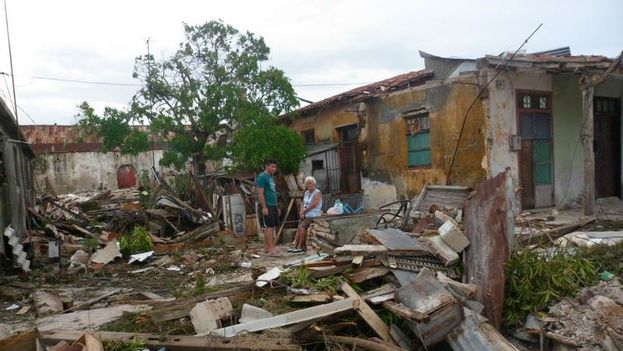
House destroyed in Caibarién by Hurricane Irma. (Pedry Roxana)
The Cuban Economy, Elias Amor Bravo, 27 August 2018 – Someone asks a naive question in Granma today: “Can a policy be more harmful than a hurricane?” The answer is yes, of course a policy can cause irreparable damage to a society by its application.
The most obvious example is the policy practiced by the Cuban communist regime against its people. Don’t look at “the blockade or the US embargo,” because however many measures one can cite of concrete cases of the application of that legislation, the harm caused by communist policies is infinitely worse. One in particular, the worst of them all: expropriations without compensation.
In any case, as has already been pointed out on this blog on numerous occasions, the matter of the embargo has an easy fix: pay what is owed by the Cuban regime. When one of the parties is unwilling to assume its responsibilities in a dispute, normally the other one will not make a move either. continue reading
It has been almost 60 years, certainly, but many more could pass, because I insist that the damage that the poorly-named ’blockade’ causes the Cuban economy is miniscule compared with the waste, lavish spending, nonsense, and accepted bankruptcies over six decades of the Castro regime.
Cuba has done business, received investments, obtained credits and loans over decades, without any limit, but nevertheless, that did not mean an improvement in the living conditions of Cubans, but rather the complete opposite. It’s time that demagogy be set aside once and for all, and that they begin to assume responsibilities for the many votes that they obtain from the countries of the United Nations.
Even a hurricane, as the Cuban residents of south Florida well know, with all its destructive force, can still create economic opportunities in recovery that over the long term end up being positive. To this end, it is the financial sector, savings and insurance, whose development on the island is practically nonexistent. The Castro blockade of an activity essential for the functioning of an economy, in terms of connection to disasters, is an example that confirms the terrible quality of the economic policies implemented on the island.
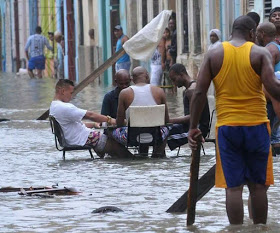
Playing dominoes in Cuba after Irma.
In Cuba, cyclones are devastating, among other things, because there is no space for private or public savings. Basically, because Cubans scrape by on the lowest salaries in the world, incapable of saving for old age and with a notable suspicion and distrust toward the banks belonging to the state, which on occasions have shown that, when the time comes to defend interests, they never put first those of their depositors, but rather those of the ones in charge. The Cuban economy has neither the rigor nor the confidence necessary for the damages of a hurricane to be fixed as happens in any other country in the world. To that end, the consequences are bigger and it takes much more time to return to the levels of prior to the natural disaster.
History is what it is. After the property confiscations decreed by the communist revolution at the beginning of the 60s and until the “revolutionary offensive” of 1968, the hereditary private capital of Cubans passed to the hands of the state without any compensation.
A hurricane of massive destruction. It’s possible that the Granma columnist doesn’t know it, or that the report that is sparingly made every year for the United Nations doesn’t want to refer to it, but those uncompensated expropriations by the state from their legitimate owners (many of them citizens of the US whose government sees itself as entitled to defend their interests) meant the absolute impossibility of every again reaching their prior levels of income and wealth and, for this reason, they ended their days in the most absolute misery.
Perhaps it doesn’t matter to the communists what could happen to these people, their assets, and their companies, but what they had to endure as a result of these “revolutionary” actions was much more destructive than the worst of hurricanes: exile, rupture, the loss of family ties, or simply fleeing abroad in search of freedom.
What Granma calls “the economic, commercial, and financial blockade imposed by the United States against Cuba” is a joke compared with the harm caused by that communist greed to change the structure of property in the Cuban economy. The impact of this was well over $140 billion. In practical terms, this is the total value of all the homes and savings that were expropriated suddenly in two or three neighborhoods in Havana. If what they want is to compare, let them do so.
I insist again. The “blockade” has an easy fix. Pay. Once done, let’s see if it’s true that the Cuban economy can straighten itself out. I greatly fear that it won’t be possible if one considers the design created in the so-called “constitutional reform.” One step forward, but two steps back. This is the real check on any real advance in the Cuban economy and in the improvement of the population’s living conditions.
For a responsible government, throwing a stone and hiding the hand isn’t the most appropriate conduct. If the communist regime wants to normalize economic, commercial, and financial relations with the United States, it knows well what it has to do.
I don’t see the US government especially interested in maintaining a policy whose sole responsibility belongs to someone else. The recent toughening of sanctions by president Donald Trump in 2017 is a good point in the game to try to put a definitive end to the dispute. Above all because it means not accepting a Castro “snub” from which US citizens and companies never should have suffered.
The United States does well to defend its’ people’s interests. It’s a message that, transferred to the rest of the world, has a very clear and valuable meaning, possibly quite superior to that given by other countries to their citizens who are victims of communist expropriations.
History is there to be told. Frequently, the communist regime in Havana tends to create a history that never existed, or to cut from it scenes that by now turn out to be unviable, like the arguments offered to oppose a democratic and pluralistic multiparty system. This is typical of authoritarianisms, because they only want one culture, one economy, a political system based on one ideology: socialist or communist, it doesn’t make a difference.
If the General Assembly of the United Nations really wanted to help in this matter, it would be easy. Maybe in Havana they are more interested in permanent harassment of their neighbor to the north. Maybe they want it to continue this way for another 60 years.
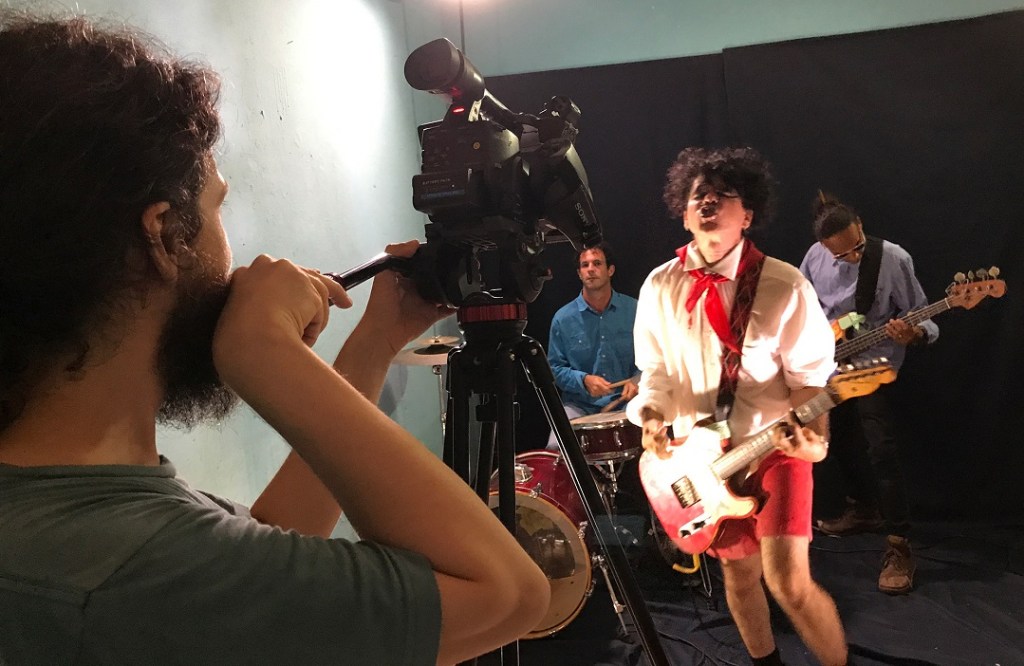
Gorki Aguila and Porno Para Ricardo in a scene from “Corazon Azul” (Blue Heart)
Havana Times, Lynn Cruz, 17 August 2018 – Last Saturday, we filmed a new scene for the movie Corazon Azul (Blue Heart) by Miguel Coyula. This time, we went to the Playa neighborhood in the capital where Paja Recol is located, a recording studio and Gorki Aguila’s home, leader of punk-rock band, Porno para Ricardo.
It’s incredible how the fact that this band can’t play on the island has become second nature.
Like anyone else from this punk genre, he rips every taboo and social convention to shreds. Everything is game for these musicians. Sex, Fidel Castro, a State Security agent, an official or even the outrageous figure of a district representative, who in reality is actually a city mayor. continue reading
It’s best if he doesn’t talk about you, my friend used to say. To be honest, it was the first time I saw this band play live. They played the same part of the song “Tipo Normal” (Normal guy) chosen by Coyula for a scene in the movie, over and over again.
A boundless energy and Aguila’s special charisma, along with Renai Kayrus and Yimel Garcia, filled the room. In my mind, one question kept going round and around: what’s going on in this country?
I still can’t understand how, in all this time, I’ve only known about their work via USB drives, when they are literally only a few minutes away from my house.
How is it possible that Cubans can’t see these three musicians play, who only rehearse because the Cuban government doesn’t let them play?
The country has been drained over time. Now, we are only left with wrong ways. There is no reason why these musicians continue to be confined to a room in an apartment.
Art doesn’t make sense if it can’t be shown. At this point, we will never know what this band could have been if they had enjoyed full freedom.
They are witty, intense and original. While talking to Gorki about their impact on me, he told me in his humble way: “If you only knew, people have told me this, that they like to see us play.”
Miguel Coyula filming Prono Para Ricardo for “Corazon Azul.”
He also told me that when they were allowed to play concerts, they were always thinking about their performance. One time, they showed a guitar at the beginning and told the audience: “This Soviet guitar needs to die”.
They gradually distanced themselves and ended up becoming radicalized. Having celebrated its 20th anniversary, this band carries the tragic sign of what it means to be ahead of your time.
To be honest, they are missionaries at the wrong time because Cuban reality was greatly marked by the disastrous ‘90s. And in 1998, Porno para Ricardo was founded.
That’s to say, that Gorki, Kayrus and Ciro Diaz Penedo (also a founder) were already in the future. They were singing from the past to a post-revolutionary Cuba.
Nobody on the island had ever dared to mock Fidel Castro before like they did. This is important because eliminating political humor was one of the first changes that Castro made to the press.
The Revolution had to be serious. Coyula’s movies have a special connection to this band. You can see this in his movies Memorias del Desarrollo (2010) and Nadie (2017).
Now, in Corazon Azul, they not only come together with the same energy, but Porno para Ricardois responsible for creating part of the movie’s soundtrack and they will also appear playing on a TV channel, created within the movie’s plot.
Slowly, Cuba’s truly underground and alternative world will come together like a puzzle. Prison, persecution, repression are all constants for the majority of artists in this universe that have an influence, not in the fringes of the city, but outside of the Museum of Cuban Socialism’s political establishment.
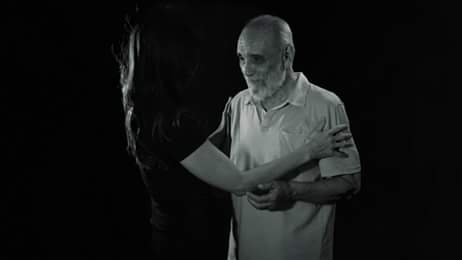
The poet Rafael Alcides and actress Lynn Cruz in the film “Nadie” by Miguel Coyula
Havana Times, Lynn Cruz, 17 July 2018 — Everybody knows that there has been a upswing of repression and censorship of artists here in Cuba. Within its institutions and recently, censorship of the film “Quiero hacer una pelicula” (I Want to Make A Movie) by Yimit Ramirez, during the previous edition of ICAIC’s Young Filmmakers’ Festival.
This led the young filmmakers and organizers at this annual event to protest against the intolerance of Cuban Institute of Cinematographic Art and Industry (ICAIC) officials, who disrespected the program made by the organizing committee by showing the film in small venue so few people could see it.
Now, with the government’s so-called “constitutional reforms”, Decree-Law no. 349/2018 and its Chapter of Violations has appeared, with a new crime of contempt against artists. continue reading
Another attempt to gag Cuba’s artistic community. It’s clear that this new decree-law aims to give a legal framework to the arbitrary measures that were already being carried out by government police and security forces.
The #00 Biennial which took place in May 2018 (an event organized by the Museum of Dissidence and Omni Zona Franca) annoyed government authorities and Ministry of Culture officials because of its financial but also political independence.
Many of those who offered their personal spaces (homes or private studios) were given the same fine that now appears in this “new decree-law”.
It could be deduced then that these were being applied illegally before because this law still hadn’t come into effect yet, or at least nobody had been informed about it. An independent Biennial had never existed before either.
Cuban artists weren’t the only ones who were persecuted, foreign artists who also attended this first independent visual arts event were also persecuted.
In April 2017, the documentary Nadie by Miguel Coyula suffered a police raid and State Security agents prevented the screening from taking place at the La Casa Galeria El Circulo, in the Vedado neighborhood at No. 316 10th street, between 13th and 15th streets. Painter Luis Trapaga and Lia Villares own this space.
During the premiere of my play Los Enemigos del Pueblo, State Security forces and the Police prevented guests from entering La Casa Galeria El Circulo again, where it took place in front of an audience of only two persons. This happened in November 2017.
Artist Tania Bruguera has been harassed, repressed, suffered abuses of power by State Security. All of this as well as her critical path in performance art are a result of her creating the Institute of Artivism which has summoned well-renowned figures from all over the world.
She was recently slandered in Cuba’s official newspaper Granma. Acting with total impunity, the government accused her of being a CIA agent, without giving any proof to support these charges which she has been publicly accused of. Bruguera also received a 1500 peso fine during the #00 Biennial.
Recently, the unfair imprisonment of scientist and writer Ariel Ruiz Urquiola proved how the system oppresses an individual and tries to reduce them to nothing, when the only thing they have done is raise their voice to condemn the government’s injustices.
His release after nearly two months in jail and a year-long sentence also prove Ariel’s brilliance, which are qualities that are much-needed today, and they have made Cubans both in and outside of Cuba aware.
Legitimizing repression is nothing more than a new terror strategy. Obviously, it’s part of art’s job to question an artist’s reality. To exercise their right to be free not only in form but in content too.
Creation can’t exist without freedom, especially if it is created as a means of perseverance and not for lucrative ends. None of these artists I’ve mentioned charge their audience an entry fee.
All of this goes to show the determination of Cubans both on and outside the island, even when they don’t have weapons, governmental or legislative power. We don’t need leaders, but causes. We don’t need to harangue, we need to work.
Cuba’s destiny doesn’t belong to a handful of military men or empowered civilians. Cuba wants to follow the path that Marti once dreamt of for his homeland: “With everyone and for everyone’s wellbeing.”
 14ymedio, 5 September 2018 – A Norwegian Cruise Line ship rescued and handed over to the authorities this Sunday four Cuban-born rafters, a spokesperson for the company confirmed to 14ymedio.