History of a Botched Job

The most sagacious inquire why the same section of the conduit is broken again and again, as it is not even located on a busy street with heavy vehicles. (14ymedio)

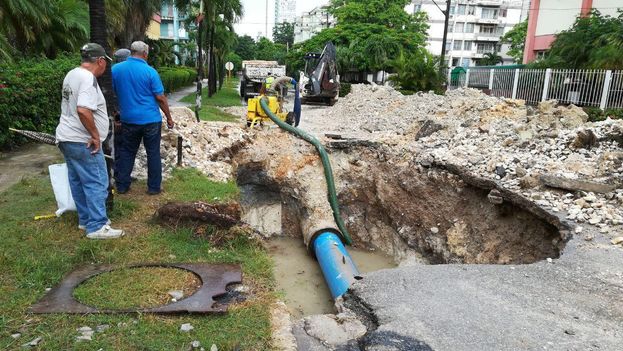
14ymedio bigger14ymedio, Yoani Sanchez, Generation Y, Havana, 11 September 2018 — The neighbors who pass in front of the huge crater scratch their heads, confused by the impression that they are suffering from déjà vu. Reasons for this estrangement are not lacking because the waterworks rupture that forced the closure of Conill Street, very close to the Avenida de la Independencia (Rancho Boyeros), has been repaired four times in a period of less than three years.

The current pit has been dug by the Havana Water Company, which is in charge of the supply of drinking water, the maintenance of the sewer system and the sanitation and storm drainage in the capital. On this entity falls a good part of the popular mockery and insults, for its remarkable inability to offer stable quality service.

With a bulldozer and an exasperating slowness, workers have unearthed on Conill Street a broken pipeline which, with its successive repairs, has become part of the landscape of this area of ​​Nuevo Vedado which is full of tall buildings constructed during the days of the Soviet subsidy. The deteriorated conduit has become a well-known character in these parts as well as an unwanted “neighbor” who, time after time, reminds us of his presence with a leak. continue reading

“It’s because the pipe was damaged,” the head of the works repeats with little enthusiasm this week, every time a concerned resident asks about the repairs that have affected the water supply to several surrounding blocks. The most sagacious inquire why the same section of the conduit is broken again and again, a section that is not even located on a busy street congested with heavy vehicles, but the man avoids answering.

The key to understanding the recurrence of the breakage is to recognize the degree to which most public works in Cuba are botched. “Every time they fix it, they don’t reinforce the area between the pipe and the asphalt, so the passing of the cars ends up damaging it,” says a neighbor who has not studied engineering or led a hydraulic repairs brigade, but who knows his own neighborhood well.

Others have been indirect accomplices to the bad practices suffered by this stretch of pipe. “The last time they stole some of the materials and there was even someone who paved the entrance to his private garage with what he diverted from that work,” says another resident nearby. “They filled the hole as well as they could and two weeks later there was another,” he says.

The hole in the street started as a slight drop, but over the months it turned into a dangerous cavern. Vehicles from the nearby Ministry of Agriculture had to drive around to avoid it and after the rainstorms it flooded for several days. In the end, the story repeated itself and the pipe that was underground ended up giving way.

“We have paid four times for this repair,” says a self-employed neighbor who sells pizzas a few yards away. “And I say we have paid because this comes out of our taxes, which are quite high.” The worried taxpayer passes each morning in front of the hole and wonders if there will be a fifth time. “Is this a curse?” He asks himself. But the Havana Water Company has no answers.

___________________________________

The 14ymedio team is committed to serious journalism that reflects the reality of deep Cuba. Thank you for joining us on this long road. We invite you to continue supporting us, but this time by becoming a member of 14ymedio. Together we can continue to transform journalism in Cuba.

"I Loved a Government That Today Deceives Me"

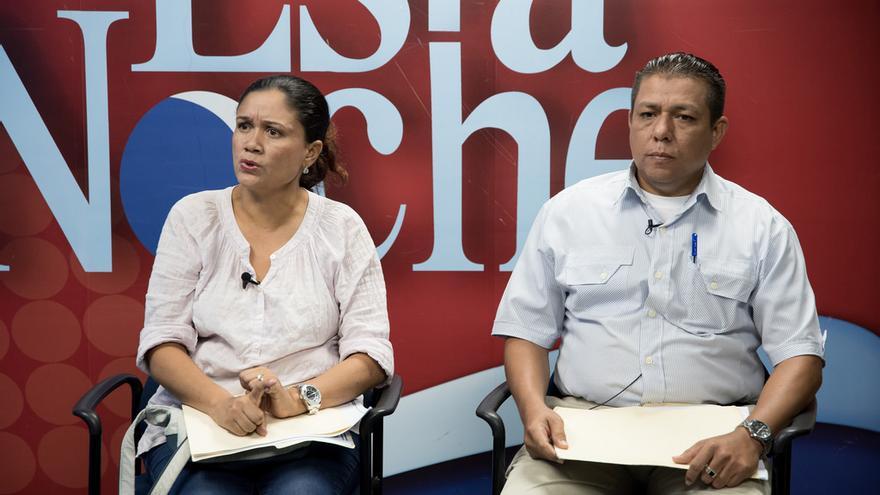
Elisa Silva  on the program “Tonight” where she denounced the arrest of her brother, accused of terrorism. (Confidencial)

14ymedio bigger14ymedio, Maynor Salazar, Managua | 10 September 2018 — Elisa Silva Rodríguez feels deceived. The illegal detention of her brother, Carlos Humberto Silva, destroyed the trust and credibility she had towards “her president,” Daniel Ortega. Elisa was a faithful militant and supported “her party” in all elections, however seeing her brother on Channel 6, accused by the National Police of being a terrorist, annihilated the devotion she had towards the Sandinista ruler.

“It scared us to see my brother in clothes not hisown, and being exposed as a criminal, terrorist, and we are not terrorists, others are terrorists, but my brother is not. Is it to be a terrorist to think differently?” said Elisa in an interview on the TV show Esta Noche.

Silva was arrested on August 25 when he had just finished playing a basketball game at Luis Alfonso Velásquez Park against a team from the Mayor’s Office of Managua. His only crime was to proclaim: “When we win, we are going to change the name of this park.” Then a police officer arrested him. continue reading

“We learned about it because a friend told us that he had been arbitrarily arrested. They said a policeman came and told him ‘we are going to take you’. My brother asked him ‘why are they going to take me?’ The agent responded, ‘We’re going to take you away,’ and Carlos turned around and they handcuffed him,” Elisa said.

That night Elisa and Carlos’s other relatives went to the National Police districts one, two, three and four. In none did they get an answer. When they arrived at El Chipote, the officer on duty denied them information. Again they made another tour of the police stations, ending again in the cells of the Directorate of Judicial Assistance (DAJ), where this time they confirmed that her brother was there.

“I did not look for any media to denounce what happened, I did not look for anyone, I still believed in justice, because I defended, I defended the vote of my commander Daniel Ortega, I was dying to go to the square, to be in an activity, because I believed that everything was fair, but today he is hurting a person who served him,” said Elisa.

Charged by the Police 

After eleven days detained in the cells of El Chipote, the National Police charged Silva on Tuesday and accused him of being the leader of a terrorist group “that maintained traffic barriers in the vicinity of the National University (UNAN) in Managua.” Senior Commissioner Farle Traña, second chief of the DAJ, added that in addition to being accused of terrorism, he “caused” damage to public property, used homemade weapons, industrial weapons, molotov bombs and launched mortars.

The Police “investigation” says that on May 11, at the Rigoberto López Pérez roundabout, Silva burned the chayopalos* installed there.

“I went to Channel 10 to tell the commander that I was willing to kiss his feet, because my brother is an innocent man. How can he repay me today by accusing him of being a terrorist, is there justice in this country? I want them to give me proof of the paraffin because my brother didn’t so much as light a match,” said Elisa.

Silva’s sister explained that her brother supported the barricaded students of the UNAN-Managua, bringing food so that they had something to eat. When her brother found out that a student was dying, he cried bitterly. And if he heard they were attacked, he would come out with an aluminum pot to bang and make noise in the neighborhood. Of course, he was never on the university campus.

“That was his way of protesting, but my brother was never a ringleader and he did not know the students, how is it possible that you do this to Daniel? Do not keep destroying our families, President. I honored you, I did not believe in any other channel more than in what the president said, and today I’m slapped in the face, that’s why I denounce you,” said Elisa.

She added that, “He (Daniel Ortega) knows very well that I was out there, supporting him faithfully in the elections, with that much I want to tell him, because I gave my life for the ballot box, because they would not take a vote from my president. I am not a politician, but I defended your vote, I ask you for justice for my brother.”

Illegal detention

As with other citizens, the detention of Carlos Silva occurred within the framework of illegality. Vladimir Miranda, the lawyer who leads the case, explained that until Tuesday, September 4, there was no accusation against him in the courts of Managua.

“Arrest is for a serious crime or by judicial order. And we have a more than clear understanding that neither of these exists in the case of Carlos, which is why we talk about kidnapping. No charges have been filed in the courts of Managua. Eleven days have passed. We were expecting the order of the judge within 48 hours, and that was not the case,” said Miranda.

The lawyer explained that the family of Carlos Silva has a judicial record dated August 29, which indicates that Carlos has no legal precedent, which proves that he was illegally detained.

“We used all the legal avenues mandated by our law, we filed an appeal, an judge was appointed, we went to El Chipote, we met with the judge and they did not even let him in. From the legal point of view, there is no alternative for these people. It is more than clear that the rule of law in Nicaragua is weak, even if you have all the resources, what the law orders you to do, everything that the law dictates at this time, isn’t worth the paper it’s written on,” lamented Miranda.

The lawyer added that the citizens are being unfairly accused and there is no option that will enforce their rights. He said that the Prosecutor’s Office, the Public Prosecutor’s Office, the Police, the judges, are in collusion.

“I’m not the one to say if you leave or if something is going to happen to you or if you want to die. That’s your problem, you’ll know how you’re going to defend yourself, but I defended you one day, and I fought because I thought you were the best candidate, and today I feel deceived,” insisted Elisa, speaking of Daniel Ortega.

Elisa said that she never received any privileges from the government party and that her fidelity was not bought by a piece of land or two hundred cordobas. Neither with food nor a political position.

“I did believe in Daniel Ortega, and I say it in a different channel, and I believed with all my honor. And it hurts me that they are not speaking the truth about my brother. I worked for this government, Ortega knows that I did that work out of love Because I did not receive a payment from the Council. I did it out of love, because I liked my Government. I ask my brother’s forgiveness for having loved a government that today deceives me, “Elisa concluded.

*Translator’s note: “Chayo palos” are ornamental tree-like sculptures, also known as “trees of life” installed at enormous expense (reportedly $25,000 each) under the direction of Nicaragua’s first lady Rosario Murrillo, who is nicknamed “Chayo.”

________________________________

Editor’s note: This article has been published in the Nicaraguan newspaper Confidencial which authorizes this newspaper to reproduce it.

The 14ymedio team is committed to serious journalism that reflects the reality of deep Cuba. Thank you for joining us on this long road. We invite you to continue supporting us, but this time by becoming a member of 14ymedio. Together we can continue to transform journalism in Cuba.

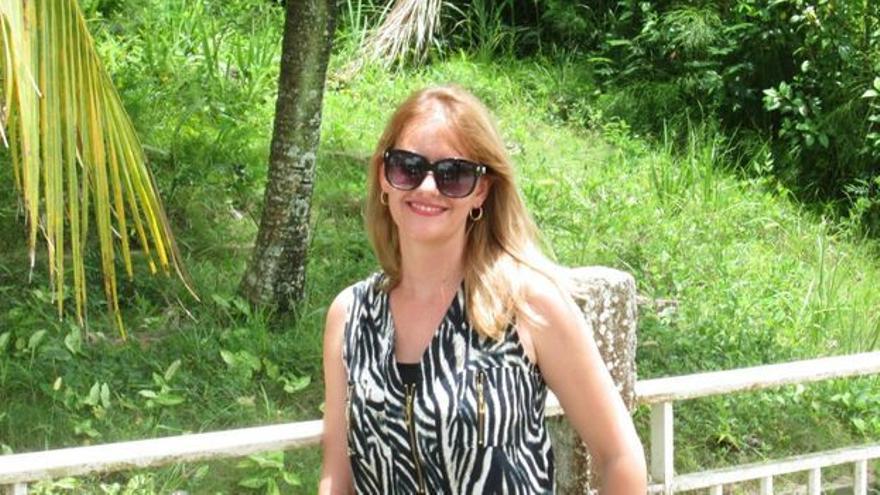
Professor Expelled from Las Villas Central University Also Forbidden to Leave Cuba

University Professor Dalila Rodríguez González. (14ymedio)

14ymedio bigger14ymedio, Havana, 10 September 2018 — Professor Dalila Rodríguez González of Villa Clara was prevented from leaving the country this Sunday, she told 14ymedio by phone. The young woman is the third member of her family to be restricted from traveling abroad.

Rodríguez, a philologist who was expelled from Central University of Las Villas  and forbidden to teach because of her closeness to groups that promote religious liberty, said that she had been invited to Argentina by the Center for the Opening and Development of Latin America (CADAL).

“An official from the Ministry of the Interior at the Santa Clara airport asked me to wait to be called again when I tried to pass through migration,” said Rodriguez. continue reading

A few minutes later, she was taken to a room where an official informed her that she was under a travel ban. As has happened with other activists and human rights defenders on the island, when trying to investigate the causes of their travel ban, immigration officials explained to Rodriguez that they could not provide more information.

“It was almost an interrogation,” said Rodriguez, a member of the Patmos Institute, an evangelical group that promotes religious freedom and respect for human rights on the island. “They did not notify me in advance, looking to do double damage,” Rodríguez adds.

In a statement issued by Cadal on Sunday, the organization referred to Article 13, paragraph 2 of the Universal Declaration of Human Rights, which recognizes that, “Everyone has the right to leave any country, including their own, and toreturn to their own country.”

On this trip the academic was going to participate, between September 12 and 14, at the Sixth Latin America Think Tanks Summit, the theme of which is Think Tanks: a bridge over stormy waters and turbulent times.

At the event, which will take place in Montevideo, Rodríguez had planned to be a member of the panels New Faces and Ideas: Diversity of Think Tanks and Innovation and Think Tanks and the Media.

As part of her agenda in the Uruguayan capital, the academic was going to hold meetings with José Gabriel González Merlano, a specialist in religious freedom at the Catholic University of Uruguay and, in Buenos Aires, with authorities of the Argentine Council for Religious Freedom.

Dalila Rodríguez González has a degree in literature and a master’s degree in Spanish linguistic-editorial studies. Since 2006 she has been a professor of Spanish and Scientific Communication in the Department of Foreign Languages of the Faculty of Humanities of the Martha Abreu Central University of Las Villas until she was expelled last year.

The argument put forward by the university to justify her expulsion was that the professor had not been able to “correct a group of attitudes that differ in the social and ethical aspects from the correct educational teaching required by her status as a teacher, and that can affect training of the students.”

In April of this year she participated in activities with Cadal in Argentina, Chile, Peru and Uruguay, as well as attending the alternative conference to the VIII Summit of the Americas, presenting The Right to Democracy in Cuba. She offered a talk at the Institute of Liberty and Development in Santiago, Chile on Cuba Before the Third Universal Periodic Review before the United Nations Human Rights Council, along with the Chilean deputy Jaime Bellolio.

On Sunday, Cadal denounced in a statement that “Cuba is the only country in Latin America and one of the few in the world that arbitrarily prevents people from leaving the country.”

In the statement, the organization asked the governments of Latin America and the European Union to express their concern to the Cuban government “for the violation of this fundamental right” and to “call for an end to this arbitrary practice, especially in the case of a country that will serve twelve years as a member of the UN Human Rights Council.”

What happened on Sunday is part of the tactic used by the government against activists on the island. The arrests, the surveillance, the confiscation of personal belongings, the raid of their homes and the imposition of judicial charges and to all this is added, more and more often, a travel ban under any pretext.

 _________________________

The 14ymedio team is committed to serious journalism that reflects the reality of deep Cuba. Thank you for joining us on this long road. We invite you to continue supporting us, but this time by becoming a member of 14ymedio. Together we can continue to transform journalism in Cuba.

The Desired Constitution / Fernando Damaso

Fernando Dámaso, 7 August 2018 — The draft of the new Cuban constitution introduces some changes to the previous Stalinist constitution of 1976 in regards to economic, social, structural and organizational considerations as they pertain to the operations of the state and government. It is simply an acknowledgement of the current situation, with the Cuban communist party continuing to exercise absolute power over the republic and the constitution, whose own text defines it as the “superior guiding force of society and the state.”

At the Constituent Assembly which drafted the 1940 constitution, Dr. José Manuel Cortina, president of the Coordinating Commission, addressed tensions that arose by delivering the historic words “Political parties out; the nation in!” The current commission seems seems instead to be saying “the party in; the nation out!” continue reading

Among the striking features of the new document are the abandonment of communism as a goal and the ratification of socialism as “irrevocable,” the acceptance of dual nationality, marriage between two people regardless of gender, acceptance of various forms of private property (while favoring socialist property), limitations on property (though not on wealth that is legally obtained), and the reestablishment of the offices of President of the Republic, Vice-President and Prime Minister as well as provincial governorships and city mayors. Compared to the previous constitution this is a clearly a step forward though not as significant as Cubans would like.

In order for this constitution to be the constitution for all Cubans and not just for one political party, it must undergo some changes:

• Eliminate wording from Article 3 that mandates the irrevocability of socialism and socio-political system that has existed since the revolution. No constitution should define as irrevocable or untouchable certain articles since all are subject to change with the passage of time and under new socio-political considerations.

• Eliminate wording from Article 5 stating that the communist party “is the major guiding force of society and the state.” If the constitution is the “law of laws,” no political party can be above it, not even the so-called “sole party.” No party can put itself above the nation unless those who created it believe it to be a religion on par with Christianity, Islam or Buddhism, which would be absurd. And if, as Article 97 states, “the National Assembly of People’s Power is the supreme organ of state power,” it is contradictory that the sole political party, which represents only a minority of the Cuban people, should be the guiding force of society and the state as Article 5 states.

• Establish in Article 14 unrestricted political pluralism and legalize all manner of organizations, not just those which are organized and controlled by the state. A political party is no more than an organization in which citizens, to a greater or lesser degree, join together out of common economic, political and social interests with the goal of putting them into practice through the exercise of power achieved through free elections in which a majority of voters express their will.

• Grant in Article 21 private property the same status and rights as state property.*

Discussion and analysis by the population of the already approved constitution will be more or less democratic; the same cannot be said of its drafting.

 *Translator’s note: Article 21 of the proposed new Cuban constitution identifies six forms of property ownership, including “socialist” and “private.” The former allows for very broad control of the means of production. While ownership of private property also allows for such control, it has traditionally been much more severely limited, typically to very small private businesses.

Miss Glamour Holguin 2018 Defies Homophobia

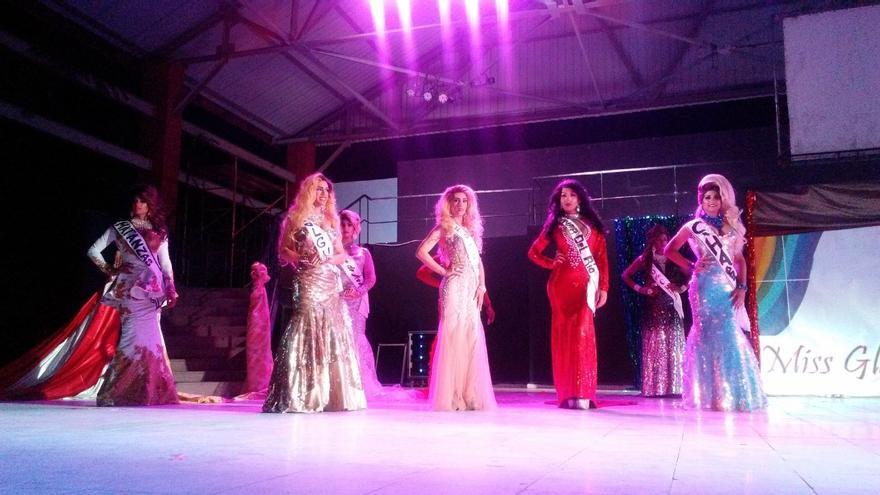
The Miss Glamor Holguin 2018 competition saw the best of transvestism on the island, in its fifth edition. (Leonardo del Valle / 14ymedio)

14ymedio bigger14ymedio,  Leonardo del Valle, Holguín | 7 September 2018 — In the heart of Hoguin, Tuesday and Wednesday nights were filled with sequins before the astonished looks of the security guards at the Bariay Cultural Center. The 2018 Miss Glamour Holguin contest saw a parade and the best transvestism on the Island in the fifth edition of some awards that are still controversial in the conservative society of Holguin.

“If they are like this now, what will we see when they can marry?” said one of the guards at the state venue where the event took place, under the auspices of the LGBTI Cuban and Cuban-American community. To see men holding hands is still taboo in many parts of the Island. Despite the work on the part of the State and civil society to erase homophobia, centuries of machismo remain in the core of national culture. continue reading

Transvestism is considered an art and is not only linked to the LGBTI community. There are many heterosexuals who enjoy changing their appearance and interpreting characters. Long dresses, extremely high heels, wigs with hair below the waist and flawless makeup enhance the beauty of these ladies of the stage.

The eight contestants performed in playback songs of Juan Gabriel, Céline Dion, Isabel Pantoja and Rocío Jurado, among other artists, during a spectacle that overflowed with passion, strength and style.

The young Manuel Yong, presenter of the magazine Mi Habana TV, and the charismatic Margot, a Havana drag queen of vast experience, conducted the show which, during its first day ended at the stroke of two in the morning, long before the second, the great award night.

The crown of Miss Glamor Holguín 2018 went to Huma Rojo, who off stage is Ángel Boris Fuentes, a 25-year-old man, director of the Ciego de Avila dance company ABC Danzares and a third-year ballet student at the University of the Arts. The second place was taken by Adriana Brown, from Havana and the third place medal was won by Miracles, from Matanzas.

Also awarded were prizes for Miss Sympathy, Miss Public, Miss Photogenic and Miss Social Networks.

“Doing an event of this kind is a very difficult task, especially when you feel that many see it as something exclusive to the gay community, something that only matters to us and is supported by us,” Mikeli Peña, contest director and president of the central jury, tells 14ymedio.

The cost of a ticket to see the show is two CUC (roughly $2 US), the average salary of an engineer for two days of work, which goes to the State for allowing use of the Bariay facilities for the contest. The resources for the show are obtained through sponsors on the island and in the United States, explains Peña.

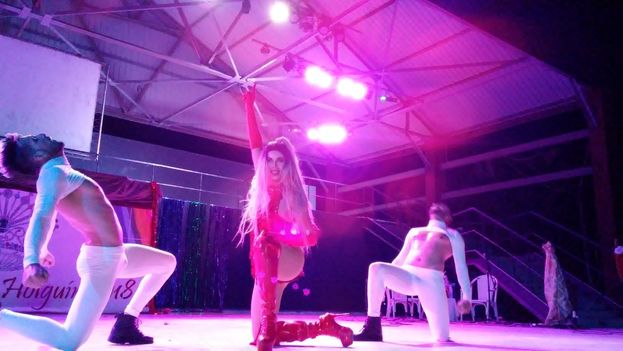
The show, which overflowed with passion, strength and style, could be seen for 2 CUC. (Leonardo del Valle / 14ymedio)

“Thanks to them we can deliver the prizes and assume most of the expenses incurred by the event such as lodging, food and transportation for the guests.” The Cuban gay community affirms that this is the best competition among its kind in the country, and that beyond the recognition “it is an immense responsibility,” Peña adds.

The notes of a song sound from the dark stage that suddenly lights up to unveil Shanaya Montiel, Miss Glamor 2017, received with applause. The queen, of exceptional beauty, opens an imaginary door and, after her, parade across the stage not just transvestites who double as musical successes, but true artists delivered body and soul to their profession.

“Many people do not even know that the contest exists, maybe it’s our fault, maybe we do not give the event the promotion it deserves, but sometimes it’s difficult to access the media for this type of activity. We would like radio and other media to participate but they don’t and it is not because we do not invite them in. The point is that it is very difficult for them to join us,” says Roberto Oro, coordinator of the Provincial Network of Men who have Sex with Other Men.

The swimsuit parade, as well as the fantasy and well-dressed parades, are the three main moments of the competition and alternate with colorful shows starring the invited guests, both from Cuba and Miami.

“Female impersonation is a very expensive art. They are very ingenious. What I can buy in store in Miami, they have to make with their own means and creative talent, and that’s why the recognition is double,” adds one of the guests arriving from South Florida.

During the two days that Miss Glamor 2018 lasted in Holguín, there was no talk of anything else. In horse-drawn carriages, guaguas (buses), bodegas and policlinics, detractors and defenders of equal marriage, which could be approved after the constitutional reform, did not hesitate to offer opinions.

“They say that in the Bariay that is disgusting, homosexuals disguised as women, they want to be more female than one, what are the children going to think? And now if they give them wings they will be able to marry, and no one knows where it will end,” said a lady just minutes after the show ended.

Meanwhile, inside, Miss Glamor 2018, dressed in an elegant white dress, was enthusiatically thanked with applause.

“I am going to wear this crown that is not from Ciego de Avila or from Holguín, it is from all over Cuba, a crown of the entire Cuban gay community that I hope will serve to change the minds of those who still discriminate against us, so that they know that behind a dress, a wig and exquisite makeup there is a person with values who loves and feels.”

_______________________

The 14ymedio team is committed to serious journalism that reflects the reality of deep Cuba. Thank you for joining us on this long road. We invite you to continue supporting us, but this time by becoming a member of 14ymedio. Together we can continue to transform journalism in Cuba.

Residents of 505 Zulueta Street Carry on Without Institutional Respect

This video is not subtitled but clearly shows the state of the building at 505 Zulueta Street

14ymedio bigger14ymedio, Marcelo Hernández, Havana, 8 September 2018 — If it rains, bad; if the sun shines, the same. For the residents of the half-ruined building at 505 Zulueta Street in Havana, there is no peace treaty with the climate. The hurricanes make them nervous and the long dry periods make the whole structure creak. After more than two decades living among the ruins without any institutional response, their patience is exhuasted.

The former GranVia Hotel is currently inhabited by eight fmailies, eight of them on the upper floors. The problems started 40 years ago, when in 1978 the building was declared uninhabitable, but the situation worsened at the beginning of the 90s. The structure began to lean and collapse at different corners.

While waiting for state institutions to offer them alternative housing, a few of the residents resist from within the building. “Almost half of it has completely collapsed,” explains Miroslaba Camilleri, one of the residetns, to 14ymedio. continue reading

Recently, an apartment on the first floor collapsed, leaving all the residents without a water tank, which the building collapses onto. Now they have to carry water from neighborhing buildings, a labor that us very complicated because of the damage to the stairs.

“Since the 80s they needed to evacuate it to make repairs, but in the 90s children were born in the building who are already men and women who have children themselves are still here,” complains Ricardo Fromenta, anoth of those who risk their lives every day living in the ruins.

Most of the residents suspect that the authorities are waiting for everyone to abandon the building, “to repair it and convert it into a hotel.”

“They don’t want to invest all the resources it takes to repaid it if its for families to live in,” laments one of the residents, who asked to remain anonymous.

The City Historian’s Office has included the former Gran Via Hotel among its future projects, but no employee of the Office, led by Eusebio Leal, could tell this newspaper if the building willonce again function as a residence, or be dedicated to tourism.

Over the years the family have had to deal with the holes, the wooden posts that hod up part of the roof and keep the stairs from falling Accidents and injuries have not been missing, but, fortunately there have been no victims to lament, but many fear that their luck will run out at any moment.

A few months ago, the residents met with representatives of the municipal and provincial government along with officials from the Historian’s Office, says Liubus Garlobo, another of the residents. “No one has given us an answer, they’re not telling us if they’re going to let us be killed here,” she complains.

The residents’ last hope is in a letter sent to the National Assembly, but the answer may take up to two months, a timespan Miroslaba Camilleri believes might be longer than the building will remain standing.

“No one has showed up here to show any concern,” laments Garlobo, who stresses that many buildings are being built in Old Havana, most of them for tourists. The only alternative offered by the authorities has been to invite residents to stay in the House of Culture, which they have rejected, believing that this measure would be like the concept of a common shelter, without privacy or divided spaces.

Last May, during the intense rains of subtropical storm Alberto, the family living on the ground floor of the dilapidated building moved a crib, a large bed and a baby carriage out into the portico, for fear that the roof would collapse on them while they sleep. They spent several days in the open air, but had to return to their apartment because of the lack of alternatives.

“This building has had 23 partial collapses. Eight families live above our apartment, although some have gone to shelters,” Iraida Alberto, the grandmother of a four-year-old girl and another of two months who live in former Gran Via told this newspaper.

In 2009 a large part of the place collapses and the authorities offered the families a place on Muralla Street where they could build their own homes with their own labor. Initially the work would have lasted just 18 months, but after 8 years they have only managed to obtain housing for those who gave up their jobs and were able to dedicate themselves body and soul to building their new homes.

The remainder, especially the families with divorced mothers and elderly people without children, had not choice but to remain at 505 Zulueta, where they are still waiting for a soluiton.

Cuba has a housing deficit of more than 800,000 homes. Of the 3.8 million residential units on the island, at least a third are in “regular or bad” condition according to official data.

When a family suffers the loss or collapse of their housing they are often relocated to a shelter, an option rejected by the residents of the old Gran Via Hotel. The length of stay in a shelter is on average 20 years, and in the 120 of these shelters located in the capital, the majority of them are old motels or industrial warehouses, there are more than a 126,00o people crowded in, while another 34,000 struggle to get a place in one.

For the authorities, it’s as if none of these buildings existed,” says another resident of the property where, every night, the residents are alert to every sound of creaking that comes from the roof.

____________________________

The 14ymedio team is committed to serious journalism that reflects the reality of deep Cuba. Thank you for joining us on this long road. We invite you to continue supporting us, but this time by becoming a member of 14ymedio. Together we can continue to transform journalism in Cuba.

Habeas Corpus Proposed in the Constitutional Reform is Ineffective / Cubalex

Habeas Corpus will be elevated to constitutional status

Cubalex, M.sc. Laritza Diversent — Article 50 of the constitution, as proposed to the National Assembly by the Cuban Communist Party, will recognise Habeas Corpus. This guarantee against illegal arrest was the subject of parliamentary debate. The Deputy for Baracoa in Guantanamo province, Tamayo Mendez, made reference to this precept.

“Any person who is deprived of his liberty,” he read. “Here we are affirming that it was foreseen that someone may be illegally penalised,” he added. “No, not penalised, but illegally deprived of their liberty,” he was corrected by Deputy Jose Luis Toledo Santander, member of the constitutional editing commission. continue reading

“What is being addressed here is the protection of the right of an individual who is deprived of their liberty to due process as established by law. This process exists in the Law of Legal Procedures,” explained Toledo Santander.

Due process” for Habeas Corpus and the authorities’ practices

In effect, Habeas Corpus is regulated in domestic law, but offers no protection against arbitrary detention, nor against enforced disappearance.

For example, one of the “processes established by law” is that of denying Habeas Corpus, if, during the arrest, a “sentence of or order for a limited period of imprisonment” was decreed. Every year, the Cuban state and its agents undertake thousands of arbitrary detentions as a punishment for exercising freedom of expression, meeting and association. 

Additionally, it requires that “the place where the person is held be identified, as well as the official or his agent or the functionary who is holding him.” The government agents employ pseudonyms, wear plain clothes and do not identify themselves. As far as human rights defenders are concerned, they do not complete any detention paperwork, to isolate them and make it impossible to identify their location, opening the door to their enforced disappearance.

The tribunals limit themselves to verifying that the required procedural criminal documentation exists, and reject pleas for habeas corpus, without requiring the police officials to produce the person who has been detained and to explain when and why he was detained. It is unlikely they would agree to an applications for oral hearing.

Awarding constitutional status to a guarantee which does not comply with international standards does not constitute any advance in human rights, and is obviously ineffective.

M.sc. Laritza Diversent

Translated by GH

"Here We Haven’t Asked for Anything"

Like every other September, parents participated in an assembly to apportion responsibilities and conduct the necessary collections of money. (14ymedio)

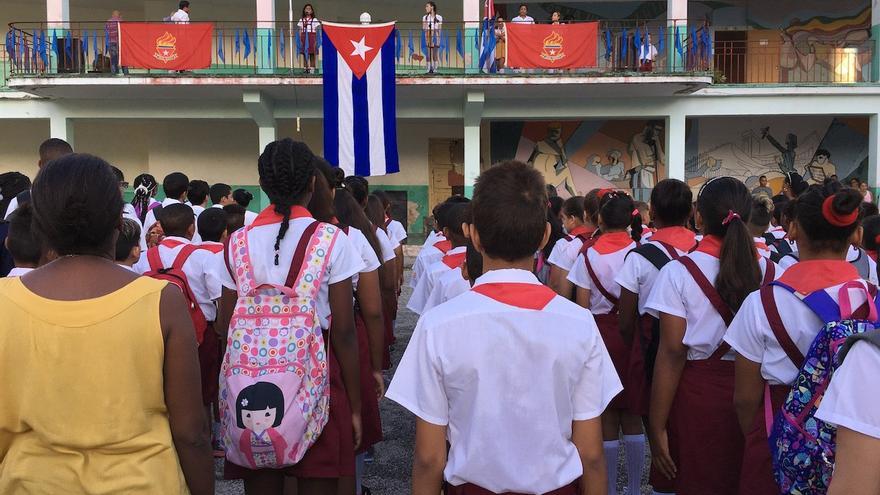
14ymedio bigger14ymedio, Marcelo Hernandez, Havana, 6 September 2018 – “Here we haven’t asked for anything” was the most repeated phrase during the parents’ first meeting of the year in an elementary school in the municipality of Plaza de la Revolución, in Havana. The emphatic clarification, accompanied by gestures with eyes and hands that seemed to negate it, was made by the teacher after the authorities of the Ministry of Education called on their employees to not demand resources and money from parents in order to shore up the material precariousness of the classrooms.

Like every other September, the parents participated in an assembly to apportion responsibilities and conduct the necessary collections of money that allows for  purchases from fans to cleaning supplies. However, unlike other years, teachers were warned by their directors that they could not participate in the appeals for, or in the organization of this aid. “You already know that I cannot be here when you collect money, so act like I don’t know about it,” the teacher warned. continue reading

For decades, and in view of the deterioration that public education has suffered on the island, it has become common practice for families to finance part of the resources used collectively in the classroom. These contributions are not only used to buy brooms or trash cans, but also to pay people who clean the classrooms “under the table”. Some of the money can also end up in the hands of the teachers to “stimulate” them to continue with their work despite the low salaries.

Faced with constant criticisms and denunciations motivated by this situation, the Ministry of Education decided to cut it off, but not by prohibiting the parental aid, but by appealing to the ostrich technique. “As I do not know, then it is not my responsibility,” opined the overwhelmed educator in front of those who calculated the amount of money that each household would have to give. “That is your thing and I cannot get involved,” the teacher repeated, but everyone understood that it was a formality to save her from liability.

“She knows that without this money it would be very difficult to keep a functioning classroom, but instead of giving her more resources now the Ministry tells her to look the other way,” criticized a grandmother. “This support will now be more clandestine, but it will continue,” said the lady who was already preparing to hand over about 10 CUC (convertible peso) in the coming weeks.

Translated by Wilfredo Díaz Echevarria

____________________________

The 14ymedio team is committed to serious journalism that reflects the reality of deep Cuba. Thank you for joining us on this long road. We invite you to continue supporting us, but this time by becoming a member of 14ymedio. Together we can continue to transform journalism in Cuba.

Young People Stay Up Late To ‘Get Drunk’ on 100 MB of Etecsa Data

This weekend Etecsa is running its third test of internet access from mobile phones. (14ymedio)

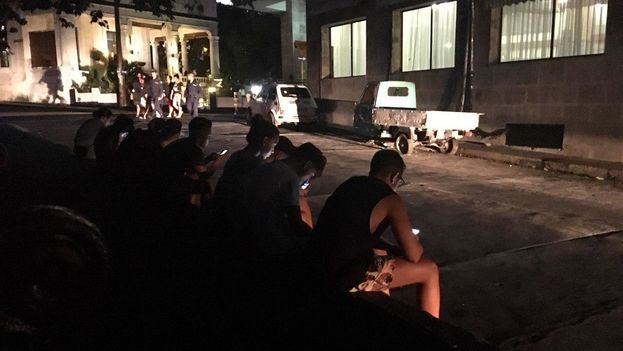
14ymedio bigger14ymedio, Yoani Sanchez, Havana, 8 September 2018 — Before midnight Friday, Samuel, Yoyi, Cristian and Laura made a vow to use up, in just one night, the full 100 megabytes that the Telecommunications Company of Cuba has allocated to each user of a prepaid mobile phone during the 72-hour test that runs until Monday.

“We’re going to binge on the internet from our cell phones,” joked Samuel, 16. The young man waited on Havana’s centrally located G Street for “the zero hour,” as he called at the moment when the service would be activated, among friends, guitars and screens that lit up faces.

The four friends picked up their cell phones, as in a virtual toast, and “clinked” the devices a few minutes before the time came. Then came the silence of concentration, interrupted only by some questions from those who had not yet been able to connect. “Don’t ask me for a mega, I’m stingy, stingy,” one of them was heard to say. continue reading

As frequent users of the public wifi zones, the four teenagers have been waiting for years for the state telecommunications monopoly to take the final step towards individual connectivity. They want to be able, at any moment, to get on line using the device they now carry in their pockets everywhere they go.

However, the authorities have prioritized public access zones and connections in workplaces and schools. Another element the authorities take into account in allocating precious kilobytes is the “political reliability” of the users, so for months now government officials and official journalists have already been able to access the great world web from their phones.

“That street corner that you see there is like my room,” says Yoyi, just turned 15, who has molded her anatomy to a bit of space in Havana’s Vedado neighborhood where she often accesses the network to chat with friends and check her Facebook account. “Sometimes I get cramps, from sitting on the sidewalk for so many hours,” she explains.

Thus, the four friends decided to dive into social networks the very second the clock struck the zero hour this Saturday and consume, in a few hours, the two packages — 50 Megabytes each and free of charge — that Etecsa has allocated to each customer. “It’s so little that you have to drink it in one gulp, like a shot of rum,” explains Cristian.

The third connectivity test differs from the previous ones. In the first one, carried out on August 14, users were able to navigate without a data limit for about nine hours. That first massive incursion in the service was a resounding failure, due to constant crashes and low speeds.

By August 22, Etecsa seemed to have understood that their infrastructure “couldn’t keep up,” Cristian, 17, said ironically. “Then they did what they do in the bodegas (the rationed market) and only allowed each customer to consume about 70 Megabytes between 8 in the morning and midnight.” The result left much to be desired, but at least the connection was more stable.

This weekend the state company has returned to the arena. On this occasion the “rationing” of bytes is stricter; if a person spread out their use over 72 hours it would come to about 33 MB per day. “You can do very little with that, barely chat, check social networks and watch a short video on Youtube,” Yoyi calculates.

What she most regrets is that Etecsa still has not announced its schedule for the opening of the service and that it is also jealously guarding what the final cost of each package will be. A gesture of secrecy that points to high prices and a deepening social differences between those who can navigate more comfortably and those who can barely “put a toe in” from the edge of the network.

One of the young people on G Street managed to join a videoconference after midnight through the popular IMO application, designed to be used at low speeds. The face he saw on the screen was totally pixelated and froze for a few seconds. “See, this is my kitchen,” said the voice and showed something that could only be distinguished as a lighted area without contours.

Near the group, a couple inquired about the details of the settings “to be able to go online.” Only one of the teenagers responded, quickly so as not to lose a minute in front of his screen. “There are people who are going to find the data gets used up as if there’s a leak,” says Yoyi, “because they have many applications that eat it up in the background.”

A policeman watching the group from nearby didn’t have a clue. “Keep it down, there are people sleeping in this area,” he scolded. At three in the morning some could already count on the fingers of one hand the megabytes left to them. “I’m going to save some for tomorrow to say hello to my cousin who lives in Miami,” promised one of the teenagers.

In the entire time that quiet “data feast” lasted, not one of them entered an official news site, no one retweeted a message from a government institution and none of them was interested in what the front page of the official newspaper Granma had to say. Nor did they visit sites with opposition programs or show any interest in looking up any dissident campaigns. “These data, I spend only on me,” Samuel repeated.

__________________________

The 14ymedio team is committed to serious journalism that reflects the reality of deep Cuba. Thank you for joining us on this long road. We invite you to continue supporting us, but this time by becoming a member of 14ymedio. Together we can continue to transform journalism in Cuba.

Cuban Government Fights Another Unfair Battle Against Artists / Lynn Cruz

Lynn Cruz. Photo by Miguel Coyula

Lynn Cruz, Havana Times, 7 September 2018 — Even though I have written about the possible causes that led to a decree-law being written up which criminalizes art, and even though I have resisted forming part of an entertainment policy which has made Cubans travel along the tree’s branches instead of going directly to the trunk, I must write again about Law #349.

In my own case, its just about becoming a theater director. In 2011, I started directing with a friend of mine, researcher and anthropologist, Carlos A. Garcia, and I had a group of actors, but the low budget we had meant that instead of putting on a play, it ended up being a monologue.

Now, with my work Patriotismo 36-77, I am able to put on a play that is told by more than one character, played by different actors. continue reading

The foundations of Postdramatic Theater are of particular interest to me, among many other influences, movements and trends. In essence, from all the ideas that I have adopted looking for a language, there is the idea that anyone can become an actor and anywhere can become a stage.

This is why I set out on this journey with visual artist Luis Trapaga, and humanities student Juliana Rebelo joined us later. Both of them have been victims of repression and censorship, which is a key theme in Patriotismo 36-77.

So, when I studied the Stalinist guidebook that has been perversely drawn up against artists, in the so-called reform of a system without a name, I realized that the theater that I want to make isn’t even included in the words in brackets that make up this decree.

That’s to say, I am in a limbo within limbo itself because, among other ambiguities in the text, even when a project isn’t being managed by an institution, you still need authorization to be able to perform your work.

That is to say, you need to be institutionalized. There are no opportunities for independent art. Even when the Council of Performing Arts, which governs theater, has proven itself to be a den for administrative corruption, in spite of the privileges that the institution’s managers already enjoy. However, artists are the criminals here apparently, for being independent quite simply.

An important detail is that in Decree-Law 349, the phrase “services rendered” as well as the word “commercialization” appear over and over again.

Today, persecution of thought in Cuba no longer has anything to do with an ideology, but everything to do with market demands.

As the absolute and totalitarian owner of the Cuban economy, the Cuban government doesn’t want to have any competition.

Independent artists are a threat to state institutions because these survive thanks to them exporting the government’s ideology, which sinks into crisis when outside of these, artists not only enjoy creative freedom but also financial freedom.

I am not interested in having a base for a theater group because my quest isn’t inside a performing space that has been delimited by an institution’s bureaucracy.

The theater that gets my blood running is in the streets. In an old man’s sad face. In a line at a bakery. In the remains of cut-down trees. In Cuban families’ living rooms.

My idea is to continue making mobile theater, which really moves me and steers me towards taking on all of the effort bringing a piece of theater to life entails.

I have just recently finished my creative crowdfunding campaign to get the production money we needed for Patriotismo 36-77. Doing that was a real challenge for me. This is the second time that I have been able to secure funds to create outside of state institutions. Outside of a policy that gives censorship a green light, to crush Cuban intellectual thought.

Note: This post, in English translation, is taken from The Havana Times.

Cuban Policeman, Rafter and Now Confessed Murderer of Two Women in the United States

The bodies of Angie and Elizabeth Rodriguez Rubio, granddaughter and grandmother respectively, were found in Shenandoah National Park. (Facebook)

14ymedio bigger14ymedio, Mario J. Pentón / Manuel Mons, Miami | 6 September 2018 – Cuban police captain Hareton Jaime Rodríguez Sariol, who arrived as a rafter in the United States in 2016, is the main suspect in the death of Elizabeth Rodríguez Rubio and her granddaughter, Angie Carolina, whose bodies were found in Shenandoah National Park, in the state of Virginia.

Harrisonburg police confirmed to 14ymedio this Thursday the finding of the bodies of the two Colombians, aged 48 and 12 years, missing since August 5.

In exchange for his cooperation in leading the police to the location of the victims’ bodies, the Cuban will avoid the death penalty. continue reading

Sariol faces a grand jury indictment in Rockingham County on September 17 and could receive a 20-year prison sentence for each crime or life imprisonment.

Elizabeth and Angie were last seen at Dukes Plaza in Harrisonburg on Sunday, August 5. Rodriguez Sariol was going to take them to his home in Maryland, but they never got there. The police issued an alert, on August 7, for the missing child and her grandmother.

The vehicle in which Rodriguez Sariol was driving both women, a red Honda Civic, was found on fire on Interstate 66. After this the suspect drove a 2000 Volvo truck on August 6 and 7 to different parts of the country. Rodriguez Sariol was arrested in Lackawanna, Pa. “The captain was madly in love with that woman and was obsessed with her,” said a source close to the Cuban police officer.

Rodríguez Sariol came to the United States in April 2016 aboard a raft with 25 other emigrants when the wet foot/dry foot policy was still in effect, which granted refuge to all Cubans who stepped on US territory.

The video that recounts part of his journey went viral on social networks because he and another officer, Michel Herrera, arrived wearing their National Revolutionary Police uniforms.

As they said at the time, they did not take off their uniforms in order to avoid being detained when they were moving the boat to the coast in Cuban territory.

“The Captain,” as he is called by his acquaintances due to his rank while in the National Directorate of Transit in Cuba, denied having repressed dissidents or participated in acts of repudiation against the opposition in several interviews given to the South Florida media.

The rafters left Guanabo, east of Havana and were at sea for more than 30 hours before reaching the United States. Once in the country, Rodriguez Sariol received help from the Government and settled in Virginia.

Translated by Wilfredo Díaz Echevarria

________________________________

The 14ymedio team is committed to serious journalism that reflects the reality of deep Cuba. Thank you for joining us on this long road. We invite you to continue supporting us, but this time by becoming a member of 14ymedio. Together we can continue to transform journalism in Cuba.

Cubans and Venezuelans Among The Most Detained and Expelled From Panama

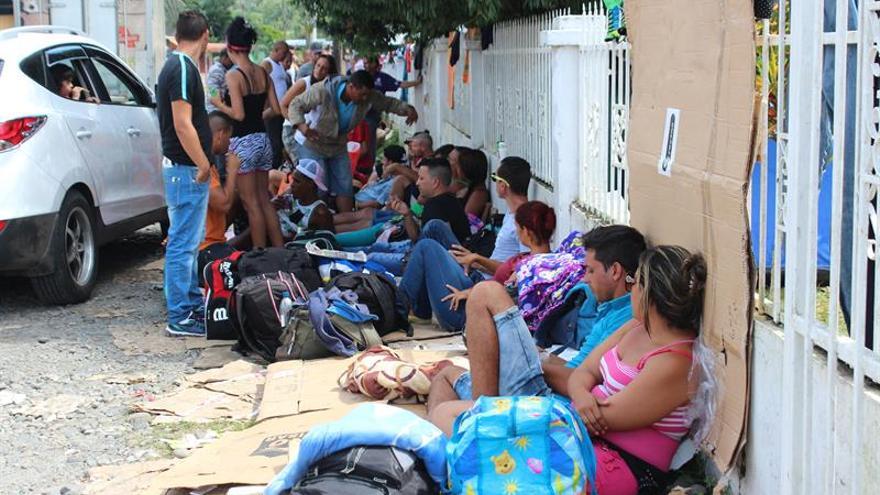
A group of Cuban migrants in Canoa Passages (Panama) during the 2015 crisis. (EFE /Marcelino Rosario)

14ymedio bigger14ymedio, Miami, 6 September 2018 – More than 100 Cubans have been expelled from Panama so far this year, according to figures revealed by the National Immigration Service to 14ymedio.

Cubans occupy fifth place in the number of nationals expelled, deported or voluntarily returned, surpassed only by Venezuela, Colombia, Nicaragua and the Dominican Republic.

According to the National Migration Service’s explanation to this newspaper “the deportation of Cuban citizens maintained an upward form in the months of May (13), June (17), July (18) and August (27), while the largest amount of expulsions of the islanders thus far in 2018, occurred during the month of May. continue reading

The authorities added that the main causes for expulsions are irregular stay and residency in the country and the expiration of visas.

“The foreigner who has been deported may not enter the country for a period of 5 to 10 years,” warns the National Immigration Service.

298 Cubans with irregular status in Panama have been arrested thus far this year. According to official statistics, Cubans occupy second place in the number of arrests only behind Colombia, a border country, and Venezuela, which is experiencing an unprecedented exodus.

Panama, along with Costa Rica, are countries of transit for thousands of Cubans who come to the United States border every year seeking refuge. In 2016, both countries were the epicenter of a crisis when thousands of Cubans were stranded in their territories. After an agreement with Mexico and economic aid from the United States, more than 9,000 Cubans were transported on two airlifts to the southern border of the United States.

In January 2017, a few days before the end of his term, President Barack Obama put an end to the wet foot /dry foot policy, which provisionally welcomed Cubans arriving in the United States. Although the number of Cuban migrants to the United States dropped drastically, thousands continue arriving at the border to ask for political asylum. Some Latin American countries have experienced a rapid increase in Cuban emigration.

Panama is also one of the main destinations for “mules”, Cubans who travel legally to buy products and resell them in the island’s large black market. So far this year more than 25,600 entries have been recorded coming from Cuba.

Translated by Wilfredo Díaz Echevarria

________________________

The 14ymedio team is committed to serious journalism that reflects the reality of deep Cuba. Thank you for joining us on this long road. We invite you to continue supporting us, but this time by becoming a member of 14ymedio. Together we can continue to transform journalism in Cuba.

The Stampede of Venezuelans Jeopardizes Latin America

Hundreds of Venezuelans earn their living in the streets of Cúcuta by carrying suitcases of other emigrants who left like them. (14ymedio)

14ymedio bigger14ymedio, Yoani Sanchez, Generation Y, Bogota/Havana, 9 September 2018 — Beside me, a woman with two children sobs as she remembers her native Caracas. In the office of the Immigration and Naturalization Service of Bogotá, the Venezuelan accent is heard on all sides, a multitude of exiles who have come from the neighboring country with barely the clothes on their backs and who still have the bewildered look of departure.

In another part of the Colombian capital, near the Plaza de Bolívar, a young man sells arepas very cheaply from a small cart adorned with the eight-star flag. He tells me that he left his two children on the other side of the border and that he is hoping to make enough money to reunite his family “in a safe country.”

A few yards away, another man works as a street artist, becoming a living statue of Simón Bolívar, with the buttoned uniform, a sad look and a sword in his hand. The sculpture breathes under Bogota’s drizzle and seems to symbolize a nation’s fall from grace. From the libertarian summits, through the paths of populism, to arrive at the abyss of the diaspora. continue reading

Almost everywhere in Colombia are the displaced people of the regime of Nicolás Maduro. Something similar to what has happened in Ecuador, Brazil and Peru, although the exiles also make it to Chile and Uruguay, in addition to those who have managed to leap the Atlantic and take refuge in Europe and those who have managed to enter the United States.

They have left behind their homes, their neighborhoods and their friends. They are the most recent chapter of the Latin American exodus, but this time starring citizens of a country where, just a few years ago, the president promised a future of opportunities for all. They are escaping from the failure of a system, putting land between their bodies and broken dreams.

The figures of this escape are just beginning to be known. At the end of August 2018, according to official data, 935,593 Venezuelans were living in Colombia, but the real number promises to be much higher. On the corners, at the traffic lights, on the outskirts of the markets you can see them, with the lost look of people trying to grasp their new context and a certain air of relief at having been able to escape.

The authorities of the receiving countries also display a certain disorientation. Most have had a long tradition of emigration and now face the challenge of welcoming their neighbors. The institutional response is clumsy in most cases and, in others, not very hospitable. The exodus has already faced xenophobic responses in some communities.

One of the most interrelated regions of the planet, with the majority of countries sharing a language and customs, has not been successful in crafting joint policies to ease the drama of these exiles. The granting of work permits, healthcare coverage, access to public education for Venezuelan children and the recognition of professional titles occurs at different levels in each host nation, without a common front.

The continent where, a few years ago, the standard-bearers of 21st century socialism joined hands and proclaimed an America for all, is now unable to respond in a judicious and inclusive manner to this humanitarian crisis. Territorial conflicts and the inability to work together are making the exodus more difficult for Venezuelans.

As a curious fact, the escape route does not include Cuba. The island does not appear on the destination map of these migrants. On the one hand, because it is not advisable to take refuge from an evil in the place that promoted and supported the implantation of the system from which you are fleeing. On the other, because behind the false image of a country in solidarity, Cuban legislation is among of the strictest with regards to obtaining residency or sheltering displaced persons.

But the drama is not experienced only by those who have left, but also by those who are left behind. The massive exit of citizens is causing an accelerated depopulation of the South American country, which will be one of the most negative outcomes and most difficult to overcome. Infrastructure can be repaired and capital returned, but the effect of mass emigration becomes irreversible.

Gone are the most daring, the most prepared and probably the most discontented. As in Cuba, the incessant flight of nationals leaves a lethargic population and a country easier to control. Those of us who stay must get used to the farewells and absences. Few of those who leave end up returning.

“If you don’t like it leave,” the acolytes of the Plaza of the Revolution have repeated for decades, and now Nicolás Maduro also embraces that contempt and mocks the emigrants who are “washing dishes in Miami.” For both regimes, exile is a thing of the weak, the refuge of the selfish who did not want to incinerate their lives in the crucible of the cause.

In both cases, the official discourse has passed through denying the escape, applying denigrating adjectives to those who flee, and blaming third parties for the incessant departure of nationals. Both Caracas and Havana also shrug off concern for their exiles, whom they see only as potential senders of remittances, but not as citizens with rights.

Mass emigration is a bloodletting that weakens any country. Every Venezuelan who now wanders the streets of Bogotá, Quito or Rio de Janeiro is a life project that was lost to his homeland.

___________________________

The 14ymedio team is committed to serious journalism that reflects the reality of deep Cuba. Thank you for joining us on this long road. We invite you to continue supporting us, but this time by becoming a member of 14ymedio. Together we can continue to transform journalism in Cuba.

The Lynching of Mauricio Rojas*

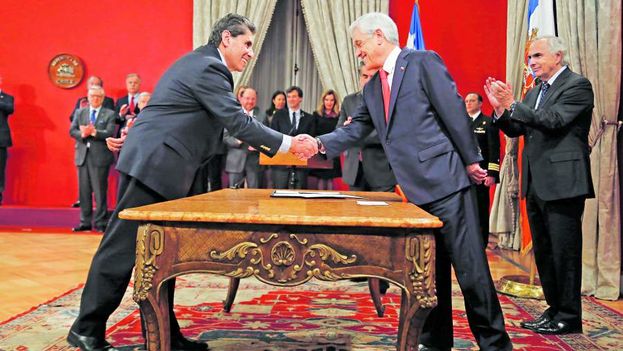
The President of Chile, Sebastián Piñera, greets Mauricio Rojas in the Moneda Palace.
(La Tercera)

14ymedio bigger14ymedio, Álvaro Vargas Llosa, Santiago de Chile, August 20, 2018 — It is not easy to assimilate that what just happened to Mauricio Rojas occurred in Chile at the height of 2018, after less than a fifth of the 21st century.

Almost one century after the trials in Moscow, the Chilean intellectual has been submitted to an attempt at destruction of personality, a negation of a whole life trajectory, a traumatic deformation of his thought and actions, a stripping of all dignity and humanity, with the purpose that such a condemnation—so empty of content, so morally and psychologically ruinous, a death sentence (in this case expulsion from the city, to use the classic formula)—be something that the condemned man himself demand of his judges, convinced that his existence is useless. The only thing missing, to complete the Stalinist montage, was that Rojas beg of Chile: Shoot me, I am, in effect, a non-person, a non-man. continue reading

The Right and the Left have killed many people throughout history, and it’s hard to make a definitive accounting of who has killed more, but the Left has an overwhelming advantage in moral destruction, dehumanization by way of personality assassination of the real or supposed adversary. When the Right massacres someone, it gains moral standing, because the right is the incarnation of evil; when the Left massacres someone, it is freeing humanity of an enemy. Mauricio Rojas was the enemy from whom the Left had to liberate public life and the Chilean State.

The essential campaign against Rojas consisted of attacking his strength, which is his moral authority. That moral authority came from two things. First, his former militancy in the Revolutionary Left Movement, the violent MIR of the ‘60s, and his later conversion to liberalism, a process derived from experience, the most powerful thing that can cause someone to come to a conviction and then communicate it to his fellow human beings. To this was added a second source of moral authority: his denunciation, in the name of freedom, of all forms of political violence, abuse against human rights and authoritarian or totalitarian regimes. His books, articles and conferences have been for decades a denunciation against dogmatisms of the Left and the Right, against ideologies that justify vile methods with the pretext of accomplishing noble ends. His texts are available for anyone who takes the time to go to a bookstore, search on Amazon or look them up on the Internet.

This double source of moral authority made Rojas a problem. It was very difficult to throw away his reflections on the contribution of the fanatic Chilean Left of the ‘60s and ‘70s, or on the 1973 Military Coup and the bloody dictatorship and, thus, his present criticism of the dangerous radicalization of the Chilean Left in recent years. After all, this criticism came from the experience and the confession of a convert to liberal democracy, not from a Pinochet supporter.

It’s not difficult to understand why Rojas’ history, his life adventures as well as his discourse, profoundly offended the New Left, which looks very much, mentally, like the Left of the ‘60s and ‘70s, and which contributed much less than what Rojas contributed, between the end of the ‘80s and the decade of the 2000s, to making Chile the most successful country in Latin America.

Once he was named the Minister of Culture, it was essential to destroy his moral authority, that intellectual solvency that stemmed from his personal testimony and his intransigent liberalism in the face of the excesses of the Right and the Left. He only had one way to end the insolence of that nomination that the Executive Power enthroned, and in a position of high visibility to such a dangerous enemy for the strategy of the Chilean New Left. That way was to destroy his moral authority by distorting his double history—his life and his discourse—and converting it, literally, into the opposite of what it really was, into self-negation.

A quotation taken out of context about the Memory Museum was converted into a perfect casus belli for this operation. Anyone who would have taken the trouble to read Dialogue of the Converts would have understood that Rojas himself qualified what Pinochet did as “State terrorism,” and he affirms that nothing justified what happened. Anyone who would have deigned to make a few “clicks” on the Web would have obtained flagrant proof of what Rojas was thinking and continues to think about Pinochet. Among the many texts that would have appeared on the screen is, for example, his article, Revolutionaries and September 11, published 40 years after the Military Coup. There, once again, he speaks of the “horrors of the crimes of the dictatorship.”

If anyone had made a minimum effort to be informed about what the Chilean intellectual thinks about the Memory Museum it would have been enough to prove that his criticism had nothing to do with denial, since on various occasions he made it clear that the brutality and cruelty of the dictatorship that is plotted in the museum reflect facts that truly happened and should never be repeated. It would have informed anyone, also, of the true nature of his criticism of the museum, that can or cannot be shared, and that doesn’t emerge from the negation of the crimes that he himself fought from the first day and that he continues repudiating. At his trial, there was an incomplete version of that black period in the country’s history, because it left out a fundamental teaching that every new generation should learn: in the destruction of democracy, the radicalization of the Left played a decisive role, with its scorn for democratic institutions and the rule of law.

Saying and thinking similar things does not mean justifying Pincochet or that Rojas prefers the crimes of the Right to those of the Left, but rather to work so that never again will such a traumatic, painful and bloody experience be possible, such as what that dictatorship represented. If the antecedents and context of what happened in 1973 are put aside, it is, in the opinion of Rojas, dangerously mutilating the story of that historic stage. To argue this is a form of patriotism, in addition to being an exercise of high intellectual honesty on the part of a man who confesses to having contributed to that state of things from his own ideologization and acceptance of armed struggle as an instrument of justice. Why patriotism? Because he understands that it’s the best way for future generations to free Childe from the bitterness, the polarization and the hatred that led the country to a sinister Military Coup, which in another context surely would not have been viable.

I hope that those who attack the museums of memory in other countries do it in this civilized, reasoned and solid form. In Péru, for example, those who vilify the Museum of Memory are all sympathizers and, at times, servants of fujimorismo, and they do it from denial. For these critics there was no systematic violation of human rights; the figures of deaths are invented; and the story of State violence is an ideological lie of the Left.

Is there any book, article or conference of Mauricio Rojas that has ever argued the monstrosity that Pinochet’s crimes didn’t exist, that the State didn’t violate human rights during the military phase and that the falsity of the Left’s narrative consists in inventing abuses that didn’t happen? I spent many years hearing him speak before different audiences (we often met frequently at public events), and he never argued or even joked about such an imbecility.

Do his critics know this? Of course they do. Those who didn’t know were those numerous Chileans for whom Rojas wasn’t yet a household name, a public man fully recognizable, or he was someone whom they vaguely knew about. Because this easily manipulated public didn’t have an educated idea about Rojas, his detractors tried to convince them that he was aligned with State crimes. And something more: that he was an imposter who invented his biography for convenience.

It wasn’t enough to fabricate the idea that his thinking was like Pinochet’s in order to destroy his moral authority. It was also necessary to reveal his imposture, to convince themselves and outsiders that his life was a farce from beginning to end. Thus, one or another MIR figures were paraded through the press who insisted that Rojas never served in that organization. It didn’t matter that those who said this had responsibilities in the MIR much later than when Rojas was involved, or that many young Marxists of the ‘60s were close witnesses of his ideological radicalism and adherence to the MIR, because, after all, it wasn’t a matter of verifying the truth. The important thing was to advance the lie that then would make any contrary testimony unbelievable.

His detractors didn’t exhaust their methods in this operation. It was indispensable that they assure themselves that, if President Piñera decided against all odds to give Rojas tenure, his performance in that role would be impossible. He had to disavow his representative as a high-level member of the State and reject him as a player. It didn’t matter that Rojas would have announced that one of his great missions was to “democratize culture” to bring it everywhere, including to the poorest and most vulnerable, something that if the Chilean Left had been tolerant, they would have recognized as a goal in tune with their own aspirations (the Left used to talk about democratizing everything: property, credit, services and, horror of horrors, culture, precisely so these things wouldn’t be privileges of an elite).

Nor does it matter that, in the last five months, since his appointment as Presidential Assessor, Rojas had worked to bestow more social sensitivity on the Chilean Right and limit its rough edges. Today these qualities make him someone even more dangerous. The world of culture denies him the possibility of doing his work by using a systematic boycott against him and converting him into a non-person. It is not a lesser irony that, in its actions, the Left thoroughly gives Rojas justification for revealing that it is acting in the dogmatic spirit of the ‘60s and ‘70s.

His detractors think they’ve won the war against Rojas. In reality, they have won only one battle. Like so many converts of the last century (Carlos Alberto Montaner has recalled, speaking of himself, Malraux, Koestler, Semprún and Paz), he is much closer to the truth than his enemies. This should give him, in this moment of ingratitude, strength to win future battles.

(Published previously in La Tercera, one of the major newspapers in Chile. It is reproduced here with the author’s authorization.)

*Translator’s note: Minister of Culture, the Arts and Patrimony of Chile August 9, 2018 – August 13, 2018. He was fired for criticizing the Museum of Memory, commissioned by former President Michelle Bachelet after the Country’s Truth Commission issued a mandate to “account for human rights violations” committed during Pinochet’s dictatorship. In Rojas’ youth he was part of MIR, a revolutionary left-wing movement, and he was exiled to Sweden. He has since become more conservative. In an interview in 2016 with CNN, Rojas said the Museum of Memory gave a false version of history. Francisco Estevetz, the Executive Director of the Museum, says its creation was necessary to guarantee that the abuses suffered under Pinochet will never happen again.

__________________

The 14ymedio team is committed to serious journalism that reflects the reality of deep Cuba. Thank you for joining us on this long road. We invite you to continue supporting us, but this time by becoming a member of 14ymedio. Together we can continue to transform journalism in Cuba.

Four Cuban Rafters Rescued on the High Seas

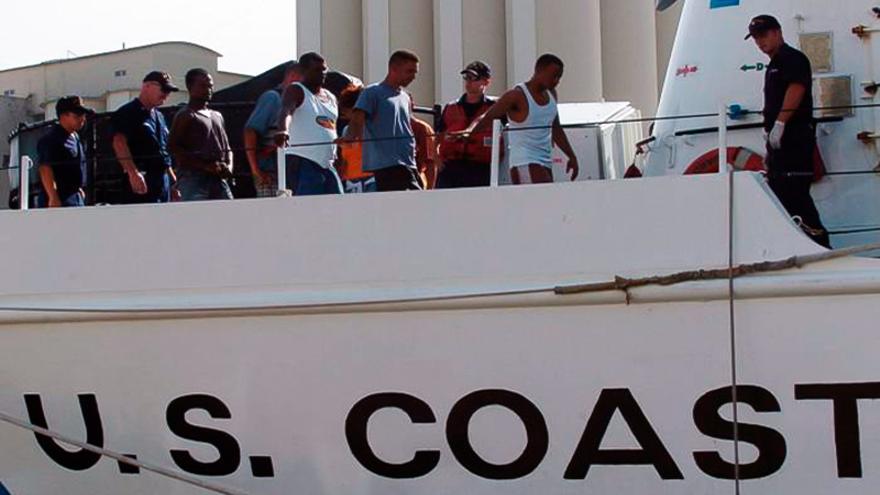
Cuban rafters being repatriated by the United States Coast Guard. (EFE /Archive)

14ymedio bigger14ymedio, 5 September 2018 – A Norwegian Cruise Line ship rescued and handed over to the authorities this Sunday four Cuban-born rafters, a spokesperson for the company confirmed to 14ymedio.

After leaving Miami, and about 40 miles from Key West, the cruise ship found four people in danger who “were safely and immediately taken to the medical installation of the ship for evaluation and were provided with clothing and food.” continue reading

The Bahamian Maritime Authority and the Coast Guard were informed by the captain of the vessel, who received instructions to disembark the rescued people at the port of Costa Maya, making them available to the Mexican authorities.

“We are very proud of our team for executing a successful rescue of these people,” said the Norwegian Cruise Line spokesman.

After the end of the dry foot/wet foot policy in 2017, which allowed Cubans who reached dry land in the United States to legally reside in the country with protective measures, the number of people who throw themselves into the sea fleeing Cuba has decreased drastically.

I am currently on Norwegian Getaway and some passengers noticed a flash in the middle of the ocean. They then told the cruise workers and they stopped and it turned out to be four people from Cuba which they rescued. Other videos coming now @OfficialJoelF pic.twitter.com/nc6XeaQis5

— Pico (@alberto__rpr) 4 de septiembre de 2018

Since last October 1st, 331 Cubans have tried to emigrate to the United States by sea compared to the 1,989 recorded in the entire 2017 fiscal year, according to figures from the Coast Guard

The authorities have warned that all Cubans who try to enter the country clandestinely, either via the land border or by crossing the Straits of Florida, will be returned to the island.

Translated by Wilfredo Díaz Echevarria

_____________________

The 14ymedio team is committed to serious journalism that reflects the reality of deep Cuba. Thank you for joining us on this long road. We invite you to continue supporting us, but this time by becoming a member of 14ymedio. Together we can continue to transform journalism in Cuba.