
A New Constitution and "Preparing for the Worst" on the Economy, Says Raul Castro

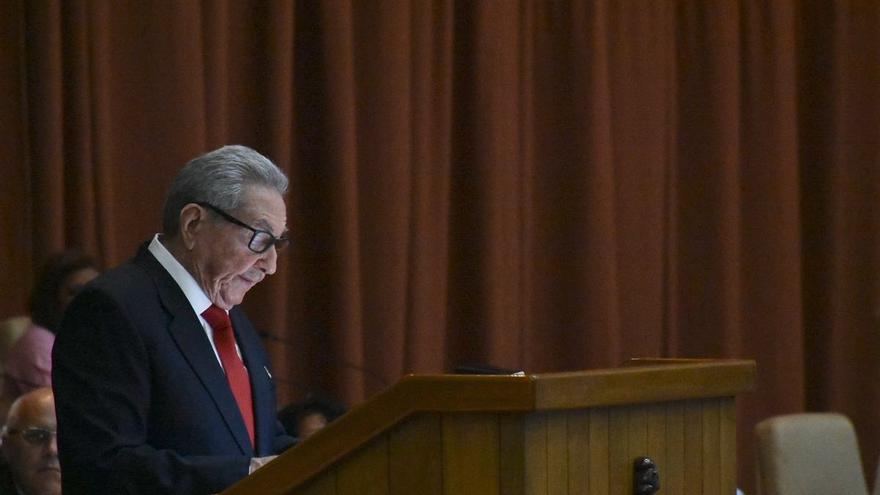
In his speech in the National Assembly, General Raul Castro stood up for Nicolás Maduro and described international pressure on the Venezuelan government as “unconventional methods of warfare.” (@AsambleaCuba)

14ymedio bigger14ymedio, Havana, 10 April 2019 — The proclamation, this Wednesday, of the new Constitution of the Republic of Cuba was accompanied by the bad news that the ex-president Raúl Castro was commissioned to announce in a speech before the National Assembly. He warned that the country faces “additional difficulties and that the situation could worsen in the coming months.”

The day began with a symbolic act, where Castro was not present, in the Camagüey town of Guaimaro, where on April 10, 150 years ago, the country’s first Constitution was approved.

Later, in the Palace of Conventions in Havana, the parliamentarians began the act of promulgating the constitutional text that the ex-governor defined as a “child of its time,” which “guarantees the continuity of the Revolution” and “safeguards, as fundamental pillars, the unity of all Cubans and the independence and sovereignty of the country. “ continue reading

Given the criticism the constitutional text has provoked, Castro said that “as expected, the historical enemies of the Revolution have sought to question the legitimacy of this comprehensive constitutional exercise,” and he noted that among those who voted No in the referendum there were those who rejected only some issues of the Constitution.

With regards to the worsening of the economic situation, the 87-year-old general clarified that “it is not a question of returning to the phase of the Special Period of the decade of the 90s… Today is another scenario in terms of the diversification of the economy, but we must always prepare for the worst variant.”

“Faced with the turbulent scenario that has been formed,” he said, “we have defined as an unavoidable priority the preparation of the country for defense and the development of the national economy,” he said. He gave as an example the measures adopted “in the interest of strengthening the capacity and combative disposition of the Revolutionary Armed Forces and the entire defensive system of the country, under the strategic conception of the war of the whole people.”

In his speech, the general stood up for Nicolás Maduro and described international pressure on the Venezuelan government as “unconventional methods of warfare.” He recalled that last year he had warned that “the siege of the empire is tightening around Venezuela, Nicaragua and Cuba.”

The new Constitution has 229 articles, 2 special provisions, 13 transitory and 2 final. The text was updated with several of the economic reforms of recent years in an attempt to get closer to the reality of the Island, in a way that recognizes private property and applauds foreign investment.

However, the new Constitution does not leave open any possibility for a change in the country’s political model and consecrates the supremacy of the Communist Party of Cuba (PCC) over other organs of powers, in addition to ratifying, in its preamble, communism as the ultimate goal.

With its publication, today, in the Official Gazette, the Constitution enters into force. However, the adoption of a new electoral law is pending, which will be presented in Parliament in July during the next ordinary session.

Then, the Parliament will have three months to elect its president, vice president and secretary, the other members of the Council of State and the President and First Vice President of the Republic.

The new Constitution, which limits the office of President of the Republic to two terms, creates the figures of a prime minister and also of provincial governors.

____________________________

The 14ymedio team is committed to serious journalism that reflects the reality of deep Cuba. Thank you for joining us on this long road. We invite you to continue supporting us, but this time by becoming a member of 14ymedio. Together we can continue to transform journalism in Cuba.
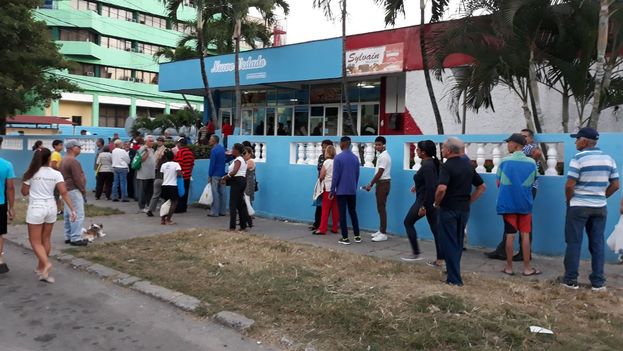
Cuba Establishes Priorities so as Not to Return to the Crisis of the “Special Period”

Shortages of food have made the daily routine difficult for Cubans who now have to stand in long lines to buy it. (14ymedio)

14ymedio biggerEFE, via 14ymedio, Havana, 14 April 2019 – Given the renewed pressure from the from United States and the inefficiency of its economy, Cuba established “clear” priorities in a plan looking ahead to 2030 to avoid at all cost falling into a serious crisis like that of the so-called “Special Period” in the decade of the 1990s, according to president Miguel Díaz-Canel.

The harshness of the moment requires us to establish clear and well-defined priorities, so as not to return to the difficult times of the ‘Special Period’,” said Díaz-Canel at the end of an extraordinary session of the National Assembly, which, this week, approved the new Constitution.

The leader, who will complete his first year as Head of State this coming Friday, recognizes that the Island still bears “the weight of administrative inefficiency, import mentality, lack of savings and insufficient income from exports.”

“We cannot exclude the manifestations of corruption and illegalities, unacceptable in the Revolution,” he added, outlining two absolute priorities: preparation for defense and the economic battle.

The priorities will be tourism, biotechnology and the pharmaceutical industry, renewable energy sources, food production, and construction, along with the export of professional services which analysts believe to be the country’s main source of income.

__________________

The 14ymedio team is committed to serious journalism that reflects the reality of deep Cuba. Thank you for joining us on this long road. We invite you to continue supporting us, but this time by becoming a member of 14ymedio. Together we can continue to transform journalism in Cuba.

The Impossible Agreement

Higinio Vélez, president of the Cuban Baseball Federation, signing the agreement with the MLB of the United States. (FCBA)

14ymedio bigger14ymedio, Ernesto Santana, Havana, 9 April 2019 — It was expected that Donald Trump’s administration would cancel the agreement that the Cuban Baseball Federation (FCB) and Major League Baseball (MLB) authorities had achieved. As soon as it was signed last December, Senator Marco Rubio announced that he would act to undo it. Honestly, it didn’t take much effort to achieve that.

Passions aside, the heart of the matter is that, according to the laws of the US embargo, MLB teams can not pay any amount of money to the Cuban government. Although the Obama administration had considered the FCB as a non-governmental organization, for the Trump administration it is one more pro-government institution.

When the agreement was signed, its two weakest points became immediately evident. The first is that the FCB, to legitimize its agreement with MLB, tries to compare itself with the Japanese Baseball League, the Chinese Professional Baseball League and the Korean Baseball Organization, which are private entities, independent of their governments. continue reading

On Cuban television, Higinio Vélez, president of the FCB, used two arguments that prove nothing at all to demonstrate that his organization is, in effect, nongovernmental: First, that the FCB “has existed for some years,” and second, that “it is recognized by organizations such as the World Baseball and Softball Federation, the Pan-American Baseball Confederation and other international institutions related to this sport.”

The other weak point is the clause allows that the FCB to charge a percentage for releasing each player and for the training given to him. For this, a license from the Office of Foreign Assets Control — an arm of the Department of the Treasury of the United States — is required, which the Trump Government will not allow.

The FCB claims to be a non-governmental association. In other words, the same as the Committees for the Defense of the Revolution and the Federation of Cuban Women, which the Cuban government itself created but insists are part of civil society. However, the fact is that the FCB belongs to the National Institute of Sports and Recreation, whose presidency has just been changed by a decree of the Council of State. As a picturesque note, it must be added that the second in command of the FCB is Antonio Castro, son of the late Fidel Castro.

In the declaration of the Cuban entity with regards to the cancellation of the Agreement condemns the actions of Marco Rubio and US National Security Advisor John Bolton, along with the politicization that has been made of this sports agreement “mostly supported by both Cuban and American societies,” but the government of Cuban’s neighbor to the north is not interested in “the welfare and tranquility of the Cuban family.”

In fact, the FCB is trying to convince us, the main reason it signed the pact was to protect our players from human trafficking, the risks of illegal emigration and the “humiliating and discriminatory treatment of which they have been victims” previously.

To demonstrate its goodwill, the Cuban federation had accepted the return to the national baseball team of Yuniesky Riquimbili Betancourt, for many years considered a deserter, who returned after participating in foreign leagues in Mexico, Japan and the United States, where he played nine seasons and, he confessed, was able to realize his dream of proving himself in the best baseball in the world.

Almost at the same time of Betancourt’s arrival in Cuba, Victor Labrada departed, the first player to turn his back on the agreement, a few days ago, unconcerned about the possibility of spending two years without being able to sign a contract with MLB teams, or perhaps anticipating that this arrangement with Major Leagues did not have much future, as has just been demonstrated.

Labrada did not wait to be “liberated” by FCB. He had been chosen among the most outstanding youth athletes of 2018 and captained last year’s Cuban team to the Pan American Under 18. In the last National Series, Labrada grabbed attention when he hit a home run in the first at-bat of his career and finished with a .350 average. However, he preferred to strike out on his own and left legally for Haiti.

At the moment, everything will continue as it was before: every Cuban player, in order to play under the “Grand Tent,” will need a specific license from the US Department of the Treasury. In fact, it sounds absurd that the FCB seriously believed in the possibility that, had the agreement survived, it would be the organization mediating between each player and the team that wanted to hire him.

More absurd, and very cynical, it sounds like the Cuban sports authorities are trying to make us believe that they are really worried about the fate of our players in their dangerous adventure of finding a place in the best baseball in the world.

If they care so much about the players, they could pave the way for them by waiving the right to collect any percentage as a “nongovernmental organization, letting each one sign the contract that they get and, even more, allowing the creation of a truly independent union that looks after the interests of the players, because, as we know well, the FCB, whatever it says, has never dedicated itself to defending them.

______________________________

The 14ymedio team is committed to serious journalism that reflects the reality of deep Cuba. Thank you for joining us on this long road. We invite you to continue supporting us, but this time by becoming a member of 14ymedio. Together we can continue to transform journalism in Cuba.

Cuban Police Raid the Home of Journalist Augusto Cesar San Martin

After the police search of his home, Augusto César San Martín was taken to the Zanja Street Police Station. (Cubanet)

14ymedio bigger14ymedio, Havana, 9 April 2019 — Tuesday, the police raided the home of journalist Augusto César San Martín in Havana, as confirmed 14ymedio by his wife Yanela Duran. After the search the reporter was taken to the Zanja Street Police Station, where he was released after being detained for five hours.

At seven o’clock today nine people showed up to undertake a police search in the independent journalist’s house in Carlos III street, at the corner of Marqués González. The raid concluded at 10:45 am, said Durán.

“An official from the Interior Ministry informed me that Augusto Ceesar would be taken to the Zanja Street Station to be informed of the charges. They took all his work equipment, computer, camera, microphone, flash memories, a NanoStation and numerous documents,” explained Durán. continue reading

San Martín is a frequent contributor to the Cubanet information site and activist of the Pro Libertad de Prensa Association (APLP). During the search this Tuesday they had to take him to the hospital because his blood pressure was very high, his wife details.

Among the nine people involved in the operation were two police officers, two plainclothes individuals who presented themselves as technicians in telecommunications, Lieutenant Colonel Kenya Maria Morales Larrea, two from State Security and two other witnesses from the local Committee for the Defense of the Revolution (CDR), as required by law.

After being released, San Martín explained to 14ymedio that he was shown search warrant but was not allowed to read it. “They came with the justification of looking for communication equipment but they took everything they felt like,” he said. He also explained that when he was released, they did not levy charges or say he would go to trial, but he does have fines to pay. “They gave me two fines, one for having telecommunications equipment and the other for illegal economic activity without specifying absolutely anything about what they are referring to.”

This is not the first time that Augusto César San Martín has been the target of a repressive action. Last December, San Martín was summoned to the offices of the Department of Immigration, Identification and Emigration (DIIE) in Havana’s Plaza municipality. An officer warned him then that if he continues with the work of an independent journalist, he ran the risk of being arrested and having his work tools confiscated.

Last February, the Inter-American Commission on Human Rights (IACHR) published a detailed account of violations against freedom of expression and the exercise of the free press in Cuba. The IACHR denounces that “despite the years that have elapsed and the repeated recommendations on this matter, intolerance continues to be the rule on the part of the Cuban authorities towards any form of criticism or opposition.”

For its part, the most recent report from the Inter-American Press Association (IAPA), presented in Cartagena de Indias (Colombia), denounced that freedom of expression and the independent press fall into the category of “criminal behavior” according to the Cuban Constitution. The IAPA adds that article 149 of the Penal Code maintains the crime of “usurpation of legal capacity” — that is, working in a profession without a license — is used to punish independent journalists.

_________________________________

The 14ymedio team is committed to serious journalism that reflects the reality of deep Cuba. Thank you for joining us on this long road. We invite you to continue supporting us, but this time by becoming a member of 14ymedio. Together we can continue to transform journalism in Cuba.
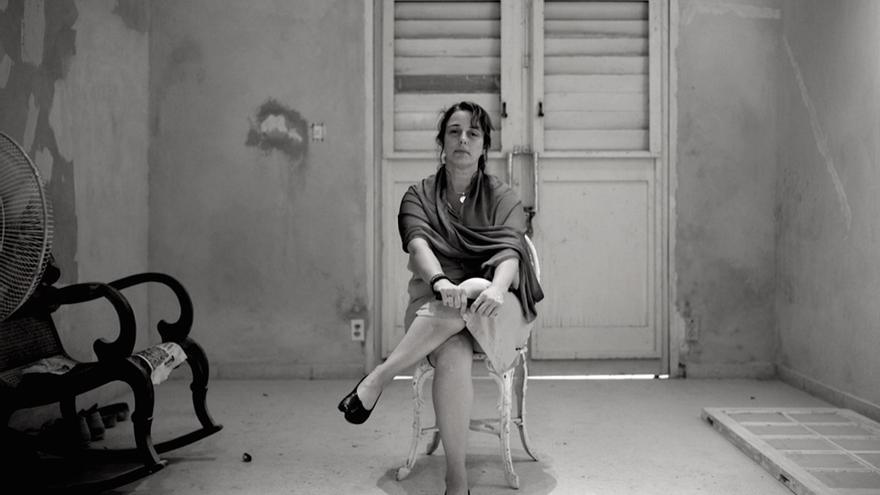
Requiem for Havana / Fernando Damaso

Fernando Damaso, 19 March 2019 — That Havana is falling apart stopped being news a long time ago. The institutional abandonment, the widespread apathy and irresponsibility, during the six decades that the city has been affected by the “tornado” that hit down in January 1959, have totally destroyed it.

In November will be Havana’s 500th anniversary of its foundation and, for this reason, the authorities have foreseen to beautify it a little, that is, to give it some rouge, so that it looks a little better and is somewhat more presentable, at least for the foreign guests who will surely attend the celebration.

As usual, this involves many more words than actions and, everywhere, the date is announced with the slogan “For Havana the Greatest.”

However, the work that is being done, except in a few cases, is quite sloppy, of low quality and over it by those responsible. Examples of bad work can be seen on Línea Calle in Havana’s El Vedado neighborhood, full of cuts that hinder vehicular and pedestrian traffic, which has been going on for months and, most of the time, without anyone working on it.

Meanwhile, in Nuevo Vedado’s Acapulco Park they have demolished some of its areas, rebuilt and demolished then again, thanks to the bad quality of the work undertaken, also for months. If this is the case in these two examples, I think that very little can be done for the celebration.

We all know that, a situation that represents the deterioration accumulated over decades can not be solved in a few months, but, at least, what is done should be done with quality.

Why Am I Not Going to the XIII Havana Biennial?

The Cuban Artist and “Artivista,” Tania Bruguera. (Twitter)

14ymedio bigger14ymedio, Tania Bruguera, Havana, 14 April 2019 — Before giving my reasons I want to clarify that I admire the work of the curators of La Bienal de La Habana and I do not consider any of my reasons to be their responsibility. Rather, they are a response to the cultural policies of the Ministry of Culture. I am an artist formed by the Havana Biennial and maybe that’s why what is happening pains me more.

I am not going to the XIII Havana Biennial because I do not understand the incoherence of suspending the Biennial in 2017 to redirect its resources to the reconstruction of Hurricane Irma — which was a position posed as aesthetic-ethical — and now, in 2019 , when a few months ago a tornado devastated several of the poorest and most hard-working areas of Havana, the Ministry of Culture (MINCULT) has decided that it is more important to spend a good part of its budget in promoting and using the Havana Biennial to clean up its international image in the face of the campaign against Decree-law 349.

Because MINCULT does not practice institutional transparency. When the Deputy Minister of Culture was asked openly through Twitter for the budget of this year’s Bienniel, the response was a string of personal accusations without, of course, answering the question. continue reading

When I explained that this was an internationally established practice, his response was silence. That silence continues even when the Ministry of Culture and promotional material support to the project of an artist is determined based not on artistic quality but on their loyalty to the government and the use it can make of that artist to enhance the international image of the country.

Because the objective of this Biennial is not to promote Cuban artists (it affects each one according to their possibilities), but that everyone understands that Decree-Law 349 will be applied only to those who are independent and ask uncomfortable questions.

Because it could not attend a party to share my impressions about the artistic merits of a work of the XIII Biennial of Havana while I know that Congolese medical students are being repressed, abused and confronted at gunpoint by Cuban police in the same streets that we walk to go to see an exhibition, and nobody is doing anything to avoid this happening or to show solidarity with the students.

I could not take a selfie among friends while I know that, at that moment, there are artists who are prisoners and constantly harassed because they are considered ’uncomfortable’ and do not fit into the official narrative of the Biennial created by MINCULT.

I can not continue to justify with the official euphemism “bad work” when in reality it means “I’m not getting involved in this because it will bring me problems.” I can not be an accomplice, because I already know with irrefutable evidence that State Security gives orders to MINCULT.

Because the double standards of those who support the protests in the Whitney Museum (because a member of their council is ethically unacceptable), or in the Guggenheim (so as not to accept ethically unacceptable money), are the same people who in Cuba justify ethically unacceptable attitudes and do it with tremendous joy; this is incomprehensible to me.

Nobody is innocent anymore, the person who is blind is so because he took out his own eyes so as not to see. Who cares about the injustices that exist in Cuba? Not those who visit The Biennial, Cuba is not their problem, they are passing through and have exchanged for a party and sunny skies their power to pressure the Cuban government to get Luis Manuel Otero Alcántara and the rappers Pupi and Maykel Osorbo out of jail and to stop harassing Amaury Pacheco, his wife Iris Ruiz and their children.

Injustice can not be a rumor circulating among mojitos and solidarity in places like Cuba is not a ’pretty slogan,’ it is not Venice nor is it Kassel; Cuba is a country that represses freedom of expression (especially when there is no Biennial).

Because my struggle to achieve freedom of expression in Cuba, my defense of cultural rights, to achieve the end of political hatred among Cubans and to defend the right to demonstrate in the streets is not limited to an event but is a life mission.

This is the biennial where no one is innocent anymore, this is the biennial where everyone must act according to their conscience. My conscience does not let me be part of the spectacular process of whitewashing which Mincult has made of the Havana Biennial.

_____________________________

The 14ymedio team is committed to serious journalism that reflects the reality of deep Cuba. Thank you for joining us on this long road. We invite you to continue supporting us, but this time by becoming a member of 14ymedio. Together we can continue to transform journalism in Cuba.
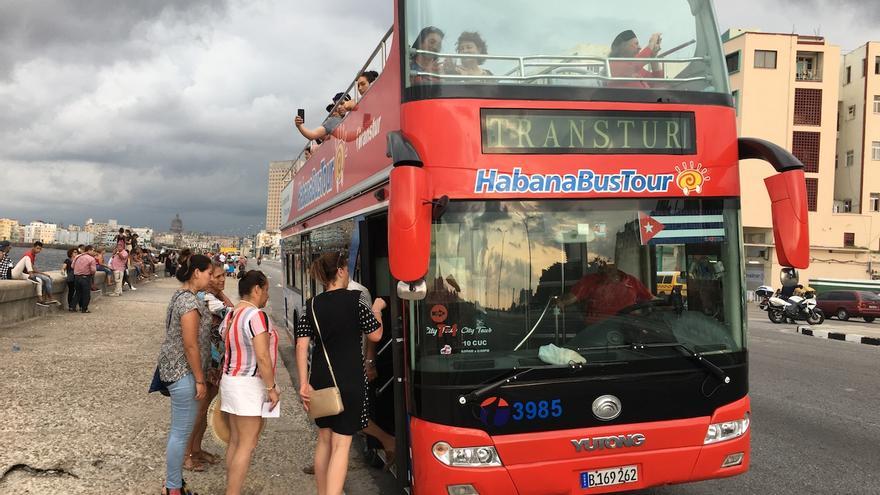
Change and Continuity in Cuba

Tourism is one of the few sectors in Cuba that has seen growth in the past six decades. Nearly all the others have fallen.

14ymedio bigger14ymedio, Carmelo Mesa-Lago, Pittsburgh, April 9, 2019 — The 60th anniversary of the Cuban Revolution is an opportune time to examine how things have changed and how things remain the same in the intervening years. The country’s market economy lasted until 1958 but, by 1961, had been transformed into a centrally planned economy overwhelmingly dominated by state-owned enterprises and collectivized agriculture. The market took a back seat to the central plan.

Though it has failed throughout world, this economic model survives largely intact in Cuba, resulting in monumental economic inefficiency that has negatively impacted growth. The dependence on the sale of sugar, which constituted 75% of total exports in 1958, was replaced with an 80% reliance on professional services and tourism.

Cuba was not exporting any professional services in 1958, while the number of tourists in 2018 was 18 times what it had been thirty years ago, with income from this activity 53 times what it had been back then. continue reading

Oil production is 79 times what it was in 1958 and Cuba now even produces natural gas. The dependence on energy imports has been reduced from 99% to 50%. Previously, social services were mainly limited to urban areas and were provided, at least partly, by privately-run organizations. Now those services are state-managed, virtually universal and free.

On the other hand, Cuba’s foreign debt is 190 times what it as in 1958, and that is after significant debt forgiveness by the Paris Club, Russia and other countries. Annual population growth in 1953 (the last time a census was taken) was 2.1% compared to a 0.2% decline in 2017 due to an increasingly aging population. The proportion of older adults rose from 9% of the total population to 20%. Cuba has the oldest population in the region, which has increased the health care and pension costs.

In regards to continuity, in the past six decades Cuba’s socialist economy has not managed to eliminate or significantly reduce its enormous reliance on trade with, or investment, aid and subsidies from another nation.

A 55% reliance on exports to the United States in 1958 became a 72% reliance on the Soviet Union and, since the beginning of the 21st century, a 44% reliance on Venezuela.

Between 1960 and 1990, the Soviet Union loaned Cuba the equivalent of 58.5 billion euros but only got back 450 million. The rest was written off as price subsidies and non-reimbursable aid. The collapse of the Soviet bloc in the 1990s led to a severe crisis in Cuba. At their peak in 2012, Venezuelan aid, subsidies and investment amounted to 11% of Cuban GDP.

In spite of substantial foreign assistance, the economy stalled — average annual growth from 2014 to 2018 was only 1.7% — due to the economic system’s inherent inefficiency. The target for 2019 is 1.5%, a quarter of the 6% officially acknowledged as the level needed to generate adequate growth.

In 2017, most manufacturing, mining, agriculture and fishing production was below the 1989 level. Only tourism showed a significant increase. Foreign trade has suffered a systematic decline: 6.76 billion in 2017.

The surplus generated by the Cuba’s primary source of foreign exchange — the export of professional medical services provided by doctors, nurses and related professionals — decreased 35% from 2012 to 2018 due to the economic crisis in Venezuela, which had been paying 75% of the cost of these services. Overall trade with Venezuela also fell from 44% to 17% of GDP, the supply of oil fell by half, and all the country’s investments in Cuba were halted.

These problems led to a cut of eight percentage points in social spending from 2008 to 2017 with a resulting decline in health and education services. From 1989 to 2017 the value of pensions fell by 50%, home construction by 80%, and the wage adjusted for inflation by 61%.

The US embargo is blamed for these problems. This was true 25 years ago but Cuba now trades with at least eighty countries, including the US, and has received investments from multiple nations. The embargo still has negative impacts — sanctions are imposed on international banks that do business with Cuba — but the fundamental cause of these problems has been the inability to generate exports to pay for essential imports, both of which have declined in recent years.

Between 2007 and 2018, Raúl Castro tried to solve these problems with market-oriented structural reforms. They had no tangible effect, however, due to extremely slow implementation, disincentives, taxes and an about-face starting 2017.

Neither the new president, Miguel Díaz-Canel, who favors continuity, nor the new Constitution, which was ratified on February 24, have changed the essential economic model. This is an absurd attitude given the collapse of the Venezuelan economy and the teetering of its regime due internal rebellion and international pressure. Maduro’s fall would further aggravate the current crisis in Cuba.

__________________

The 14ymedio team is committed to serious journalism that reflects the reality of deep Cuba. Thank you for joining us on this long road. We invite you to continue supporting us, but this time by becoming a member of 14ymedio. Together we can continue to transform journalism in Cuba.
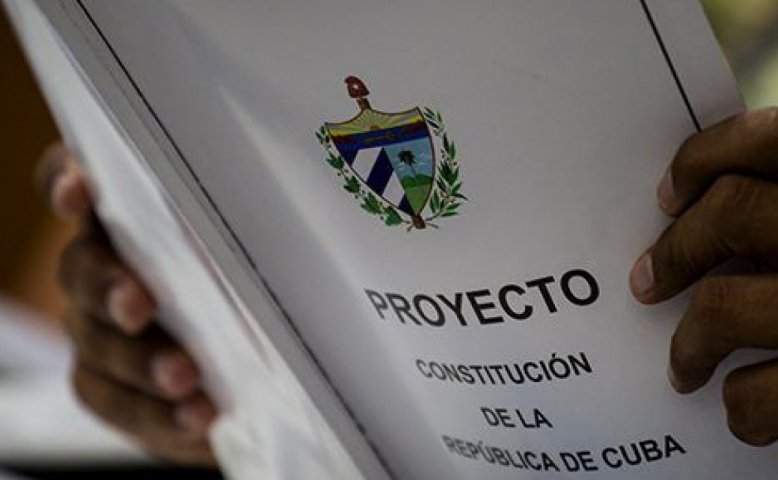
Cuban Constitution: A False Legacy / Miriam Celaya

Constitution Project (Cubadebate Photo)

Cubanet, Miriam Celaya, Havana, 12 April 2019 — As implausible as it may seem, 60 years after its arrival in power, the Castro regime has not yet been able to legitimize itself. The self-awareness of the nature of its bastard lineage is reflected with particular force in the persistent insistence of inventing associations of historical continuity with the wars of Independence and their heroes, and also with the civic and intellectual legacy of the Republic.

The matter is not trivial. For the regime, the search for historical legitimacy became an essential strategic issue at the beginning of its storyline. Not coincidentally, Fidel Castro placed the blame for his audacious armed assault on a military barracks on José Martí’s constitutional army, an alarming sign of recklessness and almost suicidal violence completely alien to Martí’s legacy.  However, this pronouncement was ignored by a people too attached to the worship of leaders.

But the epics of the Moncada, the Granma and the Sierra Maestra  ̶ whose essential purpose was the restoration of the model 1940 Constitution – which was tainted in 1952 by Fulgencio Batista’s military coup – disappeared as soon as the Castro’s yearned-for democratic revolution turned into a dictatorship, although many Cubans of that time didn’t notice it. continue reading

Now, in another forced round of acrobatics, today’s Castro regime is, once again, desecrating the historical memory when proclaiming the new Constitution on exactly the same date it was approved 150 years ago, by consensus and by means of a Constituent Assembly of the Republic in Arms, consisting of delegates representing the three insurgent regions of the Island of Cuba  ̶ Oriente, Las Villas y Centro (Camagüey) ̶  the first authentically Cuban Law of laws: La Constitución de Guáimaro.

For further derision, it was Army General Raul Castro, First Secretary of the Communist Party and heir dictator by dynastic line, who proclaimed the spurious ‘Magna Carta’ (today’s constitution) instead of the “civil power” representative, supposedly sanctioned at the National Assembly.

According to the General, the recently imposed new Constitution, “is a continuity” of the one at Guáimaro’s (1869) and of the Constitutions of Jimaguayú (1895) and La Yaya (1897), “because it safeguards the unity of all Cubans and the Homeland’s independence and sovereignty.” The truth, however, is that there are not only abysmal differences between the old Constitutions and the shady Castro regime’s edict recently established, but that the latter means a true regression with respect to those in terms of recognition of civic rights and freedoms.

The first difference is in its origin. The the genesis of the current legal embryo was the dictatorial Power’s creation of a dark Commission charged with writing, in greatest secrecy, what would be the “Project” of a Constitution. This “Project” would later be submitted to what they called “popular consultation”  ̶  whose debates, “contributions” and proposals were never published ̶   a process that continued with the formal amendments carried out by the same mysterious “Commission,” always under the autocratic power’s baton, giving us the above-mentioned Project, which today was officially consecrated as the “Constitution.”

Regarding the differences in essence and text, it is enough to mention, for example, the perception among the delegates to the Constituent of 1869 of the need to divide powers, a democratic-liberal spirit that begins to be reflected in the Constitution of Guáimaro, in spite of it being a political proposal under war conditions and being destined to exist only while the armed conflict with Spain lasted. In its Article 22 (of a total of 29 Articles) it endorses: “The Judicial Power is independent; its organization will be the object of a special law”.

Later on, Article 28 establishes rights that, 150 years later, are only remote aspirations to essential rights, whose exercise may result in repression, imprisonment, or exile of Cubans: “The Chamber will not be able to attack the freedoms of worship, printing, peaceful assembly, education and petition, nor any inalienable right of the People.”

So significant was this democratic principle for the founding fathers that they kept it in force in the Constitution of La Yaya, through its Thirteenth Article: “All Cubans have the right to freely express their ideas and to meet and associate for the lawful purposes of the living.” A basic right of every free and democratic society because of which thousands of the best Cubans of that time lost their lives, and which found a place in the magnificent Republican Constitution of 1940, only to be violated by corrupt leaders of different political groups but with identical ambitions and thirst for power in the past 67 years.

Therefore, such continuity does not exist. If invoking Guáimaro is what this is about, we are facing a false legacy. The Castro Constitution is not only the negation of the rebellious and libertarian spirit of Guáimaro, but, on the contrary, it condemns us, from 10 April 2019 onwards, to live under a permanent dictatorship. The General’s constitution is neither legacy nor continuity: it is an epitaph.

Translated by Norma Whiting

Cuban Government Ignores its Responsibility and Advises Others How to Avoid Traffic Crashes

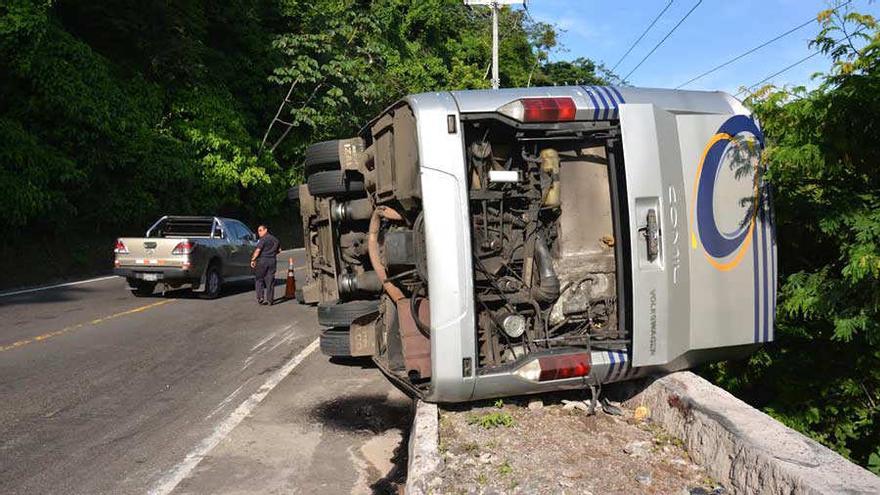
The overturning of a tourist bus with 40 people on board a dangerous road in the province of Guantánamo this January. (Escambray)

14ymedio bigger14ymedio, Havana, 29 March 2019 —  On Tuesday, the official press published the report of the National Road Safety Commission with the loss data of 2018 in an extensive report of more than 1,200 words in which no word is written regarding the State’s responsibilities in the 10,070 crashes last year on the island, that left 683 dead and 7,730 injured.

The report, far from the informative tone that could be expected in a data document, which only appears in the second half of the report, is characterized by a maudlin tone that even includes in the introduction this sentence: “And we hope that these lines will help to ensure that drivers, passengers and pedestrians, take more care of their own lives and those of others.”

Human error, in fact, is behind 90% of traffic crashes according to the World Health Organization, however, the same agency indicates that the vast majority of deaths in this type of accidents occur in low-income countries, to the point that people of low socioeconomic status are more likely to be involved in traffic crashes. continue reading

The WHO report on road safety in the world states that 93% of deaths occur in low and middle-income countries, despite the fact that they have only about 60% of the world’s vehicles.

From these data it is clear that the state of the roads, the vehicles and the security systems, without neglecting road safety education or adequate health care, after the crash, are decisive when it comes to reducing mortality related to traffic.

“The cornerstones of this approach are safe roads, safe speeds, safe vehicles and safe users of the roads, all of which must be addressed to eliminate fatal crashes and reduce serious injuries,” says the WHO, noting that these claims cost countries up to 3% of their GDP.

The Cuban data for 2018 (one crash every 52 minutes) are slightly better than those of the previous year, when 750 people lost their lives in 11,187 crashes and 7,999 were injured. This supposes a reduction of 10% in the number of crashes, 9% in the mortality of victims and 3% of those injured. Despite this, a person dies every 13 hours because of road collisions.

According to the official press, it is confirmed that the number of major crashes increased, from 36 in 2017 to 44 in 2018, leaving a balance of 165 more injured and one fewer killed compared to the previous year.

The report indicates that the majority of those involved in the crashes (5,686 people) were “in full socially useful capacity,” a phrase they use to describe the age range from 21 to 55 years.

Traffic crashes decreased in 69% of the country. The provinces of Camagüey, Las Tunas, Granma and Havana, recorded 36% of the total events (3,661), 29% of the deaths (195) and 17% of the injured (1,329).

Pinar del Río, Mayabeque, Artemisa, Villa Clara and Las Tunas are other provinces in which there are disasters with fatal consequences in which one person died in every second or third crashes.

From Monday to Friday, between 3 and 9 in the evening, are the times when the most incidents occurred. Another fact that is extracted from the report reports the incidents by sectors, with 10,856 state cars involved in crashes, compared to fewer than 5,000 private vehicles.

The authorities claim to have taken some legal measures, such as the withdrawal of 36,000 traffic permits, 233,710 fines and the performance of 13,088 breathalyzer tests that resulted in 31% (4,022) of those tested found to be driving under low effects of alcohol, while 126 were in a full drunken state.

According to the EFE agency, so far in 2019, more than a dozen crashes have been reported, the bloodiest, in January, was the overturning of a tourist bus with 40 people on board on a dangerous road in the province of Guantanamo, which caused the death of seven passengers (three Cubans, two Argentines, one German and one French) and caused injuries to 33.

The National Road Safety Commission indicates that during the mandatory inspections, “technical deficiencies were detected, mainly with the brake system, steering and lights,” in 44% of the verified cars (63,966), a fact that confirms the poor condition of the vehicle pool. The difficulties in acquiring new vehicles, along with those of obtaining quality repairs, are a perfect scenario to drive cars that, on occasions, represent a public danger.

The official newspaper Granma, as the government spokesperson, ignores the responsibilities of the State in road safety and sidesteps the issue with: “As popular wisdom already says, nothing has to do with chance, and in that ’reckless’ way on more than one occasion we assume the risks.”

_________________

The 14ymedio team is committed to serious journalism that reflects the reality of deep Cuba. Thank you for joining us on this long road. We invite you to continue supporting us, but this time by becoming a member of 14ymedio. Together we can continue to transform journalism in Cuba.

The Chinese Press Reveals Lis Cuesta’s trip to Beijing and Her Meeting With Xi’s Wife

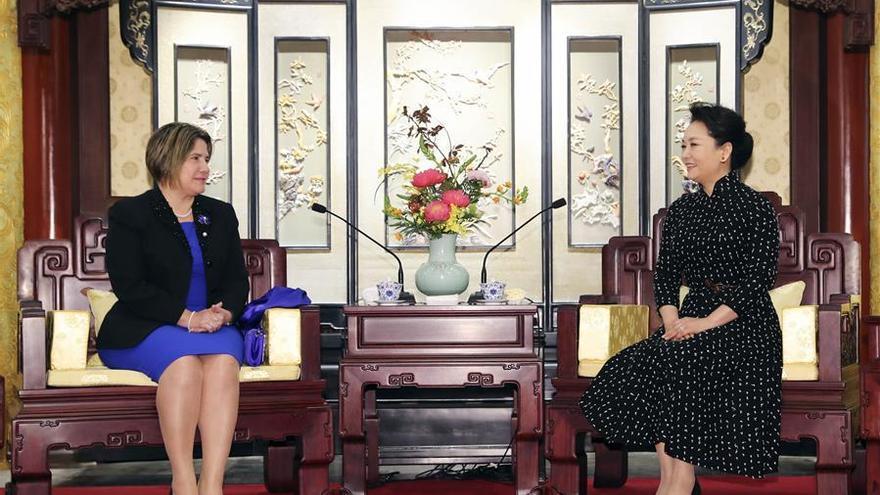
Lis Cuesta and Peng Liyuan wanted to bring to light the diplomatic ties between their countries. (Xinhua / Ding Lin)

14ymedio bigger14ymedio, Beijing, 11 April 2019 — Lis Cuesta Peraza, the wife of Cuban President Miguel Díaz-Canel, traveled to China this week, where she had a meeting with Peng Liyuan, wife of Chinese President Xi Jinping on Tuesday. The visit is unprecedented in the Cuban diplomatic framework, after decades without an institutional role for the spouse of a head of government.

However, the news was reported by the Chinese press. The official Cuban media have not covered the meeting or given any information related to the trip of Diaz-Canel’s wife to Beijing.

Lis Cuesta said that Cuba admires the achievements of China over the past 70 years and expressed its gratitude to Beijing for the long-term support and assistance it has offered to the island. continue reading

Diaz Canel’s wife conveyed her desire to “seize” the opportunity of the 60th anniversary, in 2020, of the establishment of diplomatic relations between the two countries to promote cultural exchanges between both peoples and consolidate the institutional friendship of both nations.

In addition, she asked Peng to convey the greetings and good wishes of Diaz-Canel to Xi and spoke on behalf of the Cuban people to affirm that the island loves Chinese culture and its people.

For her part, Peng confirmed that the two countries share a deep traditional friendship and expressed the hope that Sino-Cuban cooperation will achieve fruitful results and the bilateral friendship will last.

Peng explained to Cuesta her work as a special envoy of Unesco for the promotion of girls’ and women’s education and as a goodwill ambassador of WHO for tuberculosis and HIV/AIDS. She shared China’s experience in the promotion of education and health.

Xi’s wife expressed the hope that the two countries will strengthen exchanges and cooperation in these areas and praised Lis Cuesta’s “active efforts” to promote bilateral exchanges between peoples and cultures.

The public appearances of Cuesta contrast with the secrecy that surrounded the private and family life of Fidel Castro for decades. His wife and the mother of five of his children, Dalia Soto del Valle, was only seen in the last years of the ruler’s life and during his funeral.

Cuesta, however, has joined her husband in at least 11 countries, the last of them Nicaragua, for the VIII Summit of the Association of Caribbean States. The first lady was also present at the reception in Cuba for Prince Charles of England and Camilla, Duchess of Cornwall, as well as a recent luxury hotel event Iberostar Grand Packard of Havana.

______________

The 14ymedio team is committed to serious journalism that reflects the reality of deep Cuba. Thank you for joining us on this long road. We invite you to continue supporting us, but this time by becoming a member of 14ymedio. Together we can continue to transform journalism in Cuba.
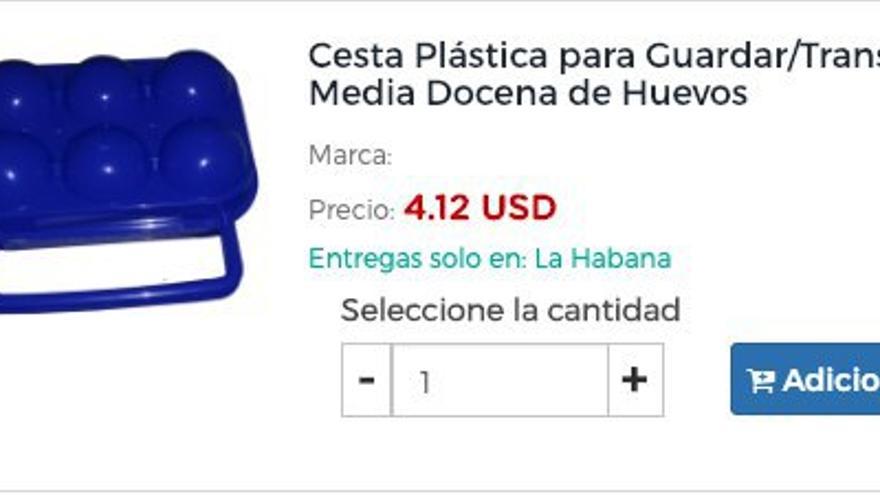
’Online Markets’, the Last Bastion for Purchases in Cuba, Are Also Empty

Searching the Supermarket Treew site for “eggs” finds a plastic holder to carry them but no actual eggs.

14ymedio bigger14ymedio, Havana, 5 April 2019 — The shortages have reached the online stores, which were until now the only place where you could get products missing from the stores of the island. Online sales portals such as Supermarket TreewShipments to Cuba or the Carlos III shop, work from merchandise stored in Cuba but have their own inventories of physical items.

These online stores sell everything from food and cleaning supplies to furniture and appliances, but they have no avoided the shortages experienced by the island’s markets. Until recently, these portals had a priority supply and were able to provide products that had disappeared from local markets.

“I ordered a box of chicken quarters and they told me that they would deliver it to my family in San Miguel del Padrón, Havana, in seven days, but 12 days later, nothing,” explains Marianela, 38. A Cubans living in Tamoa, she frequently uses these shopping services through the web. continue reading

Another client complained about having received an email after purchasing a mixed food package, with pork, vegetable oil and chicken for his family in Santiago de Cuba. “I paid online, they deducted the money from the card but two days later they wrote me saying they could not guarantee the quality of the merchandise and that therefore it would be longer than agreed,” he tells this newspaper.

“The payment I made includes a fee to deliver the food to my mother’s door, she is a very old person,” he explains. “Initially she was going to receive the purchase between 10 and 21 days because she does not live in the capital but in the city of Matanzas, but she has been waiting for a month and has not received even a chicken thigh,” he complains.

In recent weeks the official media have published several articles on the problem of shortages that affect the national stores, a situation attributed to the “economic stress” that is affecting the whole country and the problem of liquidity in the state coffers. However, they have not commented on these online markets.

“Up until now we had been a prioritized sector because it is real money that arrives in this way, not colored paper like convertible pesos,” a messenger from the 3rd and 70th store in Havana tells this newspaper It also offers online purchases to be paid with a credit card and focuses on emigrants with family on the island.

“The warehouses have always stored the products that are already reserved online but the problem is that right now everything is empty, especially the butcher shop,” he says. “What we have is not the kind of food that is sold online. What we have are very low quality things like sausages, turkey hash and hamburgers, but we do not have the boxes of chicken quarters or breasts that sold very well in the digital sites.”

Now, some customers based abroad spend hours in front of their computer screen to “catch” the few offers of these foods that appear for online sale. “I filled the shopping cart of the page and in the few minutes that passed until I went to pay I got a sign saying that one of the products I had added was not for sale,” says Maria, a Supermarket Treew customer.

“When I realized what was happening I got very early the next day and I kept putting the word ’chicken’ in the search engine until they supplied the product.” But , she added, “I have to go to work and I can not spend all that time with my finger on the mouse waiting for food to show up, and that brings me very bad memories of the lines I used to stand in before I left Cuba.”

Recently, at a meeting of the Council of Ministers, Miguel Díaz-Canel acknowledged the problems with the supply of basic necessities such as chicken, eggs, bread and cooking oil. The president called for “closing the productive cycles,” and criticized the inefficiencies in “contracting transport or delaying shipments” that delays the arrival of imports to markets.

Managers of the state corporation Cimex, in charge of the management of many of the hard currency stores that operate on the island, attributed the high cost to the tense financial situation of the whole country and confirmed that. with regards to chicken, only  “40% of the normal demand of the network,” had been delivered.

“What has happened is a mixture of problems,” says an administrative employee at the Carlos III store, on condition of anonymity. “To the extent that products such as chicken have begun to be lacking, many customers have asked their relatives abroad to guarantee their food by buying it online, even though it is more expensive because of the cost of home delivery.”

The worker addes that this practice is also the resource of many paladares (private restaurants) who have to guarantee certain products to keep their menu well stocked. “We started receiving more online requests than usual, a jump in demand that exhausted our stocks,” he explains.

“We are selling little by little because we can not guarantee that when the customer clicks on the product over there we will have something to deliver here,” he concludes. A few yards away from the warehouse where a lot of merchandise was previously stored for online sale, the shelves for customers who arrive physically are also almost empty.

________________

The 14ymedio team is committed to serious journalism that reflects the reality of deep Cuba. Thank you for joining us on this long road. We invite you to continue supporting us, but this time by becoming a member of 14ymedio. Together we can continue to transform journalism in Cuba.
Venezuela Rejects Extradition Request for the Accused Killer of Two Cuban Women in Madrid

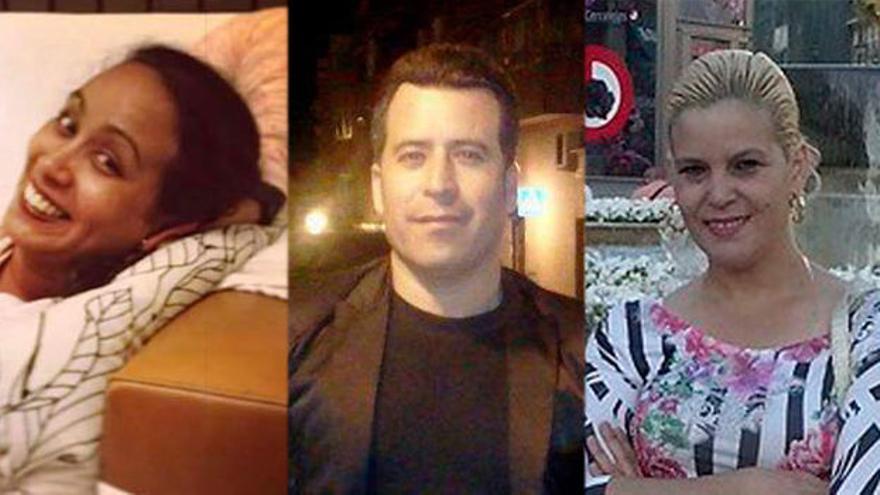
The three victims of the Usera Street murder. From left to right, Elisa Consuegra, Pepe Castillo and Maritza Osorio. (El Mundo)

14ymedio bigger14ymedio, Havana, April 10, 2019 — The man accused in the so-called Usera triple murder will be tried in Venezuela, not in Spain. In citing its resaon for rejecting an extradition request, the criminal division of the Supreme Court in Caracas noted that Dahud Hanid Ortíz, the man accused of the murders of two Cubans and an Ecuadorian in June 2016, is a Venezuelan national.

The defendant, who also holds U.S. citizenship, is Venezuelan by birth, which — according to Venezuela’s criminal statutes and its constitution — prevents him from being handed over to another country for trial.

The criminal court ordered the trial to be held in Venezuela, where Ortíz fled to evade Spanish justice. In its finding the court pledged its “firm commitment to the Kingdom of Spain that Dahud Hanid Ortíz will be judged solely for the crimes of homicide and arson,” adding that “the above-mentioned citizen will be treated with due respect in accordance the inherent dignity of a human being.” continue reading

The court is also ordering the public prosecutor’s office to solicit and collect from the Kingdom of Spain any corroborating evidence that might be used in his prosecution.

A court in Madrid, where the triple murder was investigated, requested his extradition on November 30. The United States also issued an extradition request for the suspect, Dahud Hanid Ortíz, who served in the U.S. army as a first lieutenant and fought in the Iraqi war.

Cuba has also threatened to intervene because two of the victims, Elisa Consuegra Gálvez and Maritza Osorio Riverón, were Cuban citizens.

Venezuelan authorities arrested Ortíz on October 13, 2018 in El Chaparral district of Puerto Ordaz, a mining area in the south of the country. During his arrest, two documents issued in the names Abdel D. Makarem Dalal and Makarem Urdaneta Fayiz Hussein were seized. Also found were a U.S. Army Purple Heart and a German student ID card.

The three murders attributed to Ortíz occurred on June 22, 2016 in Madrid’s Usera district. Emergency services personnel made the discovery after responding to reports of a fire at the offices of the Eurasia law firm. It is alleged the suspect started the fire to cover his tracks.

According to an investigation by Spanish police, the incident was an act of revenge by Hanid Ortíz after discovering that his wife, Irina Trippel, had been having an affair with Victor Salas, a Peruvian attorney and owner of the law firm where the two Cuban women worked.

As academic records indicate, attorney Elisa Consuegra Galvez, who was born in Havana, was considered a brilliant student. She had studied at the Vladimir Lenin Vocational School. She later received a law degree from the University of Havana and had worked in Cuba as judge.

A few days after the murder, Ortíz wrote a note to the sister of his ex-wife in which he said, “I used to be a good man but Irina changed all that… I don’t know who I am anymore… I did terrible things without wanting to. I’m dead inside.”

_________________

The 14ymedio team is committed to serious journalism that reflects the reality of deep Cuba. Thank you for joining us on this long road. We invite you to continue supporting us, but this time by becoming a member of 14ymedio. Together we can continue to transform journalism in Cuba.
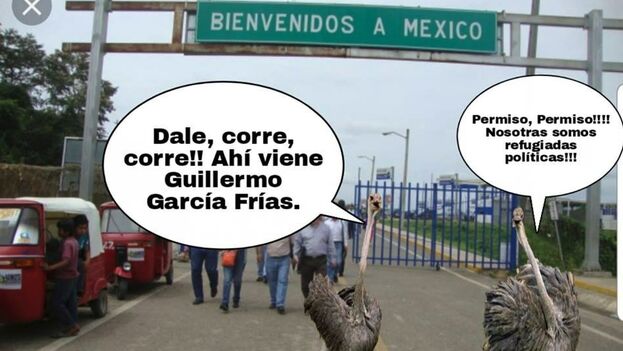
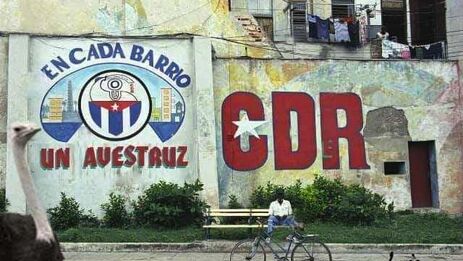
‘Memes’, A Political Weapon Against Power In Cuba

With a little help from Photoshop: “In every neighborhood, an ostrich” (14ymedio) (CDR is the initials (in Spanish and English) for Committee for the Defense of the Revolution)

14ymedio bigger14ymedio, Yoani Sanchez, Havana, 11 April 2019 — Social networks were recently flooded with parodies about the flight of the presidential caravan from an area affected by the tornado, but this week the protagonists are ostriches, jutías (giant rats) and crocodiles which, according to comandante Guillermo García Frías, could resolve Cuba’s food problem. Just this week the 91-year-old García Frías proposed raising these animals to fill Cuban stomachs.

Memes have become a democratic alternative to the cartoon as a way of criticizing a power not greatly given to jokes. It is within the reach of almost anyone to make one and spread it until it becomes viral.

Political humor has been absent for decades in the official Cuban press, where only burlesque cartoons about capitalism or the president of the United States are found. No one has ever dared to offer irony about the ministers, officials or figures of the national leadership. All the jokes about them have been oral, told in low voices or in gestures.

Overhead: Welcome to Mexico. Ostrich 1: Run! Run! Here comes Guillermo García Frías. Ostrich 2: Hey! Hey! We are political refugees!

continue reading

And then the internet came to mobile phones. What in other nations has been happening for more than a decade has just began to become a reality for the residents of this Island. Now, the virtual world is not only a way to contact friends who have emigrated, seek out scholarships as a way to escape to some other place, or to ask a relative in exile to recharge your phone, but it has been erected as a place to mock the Castro regime. All the carefully contained creativity is exploding.

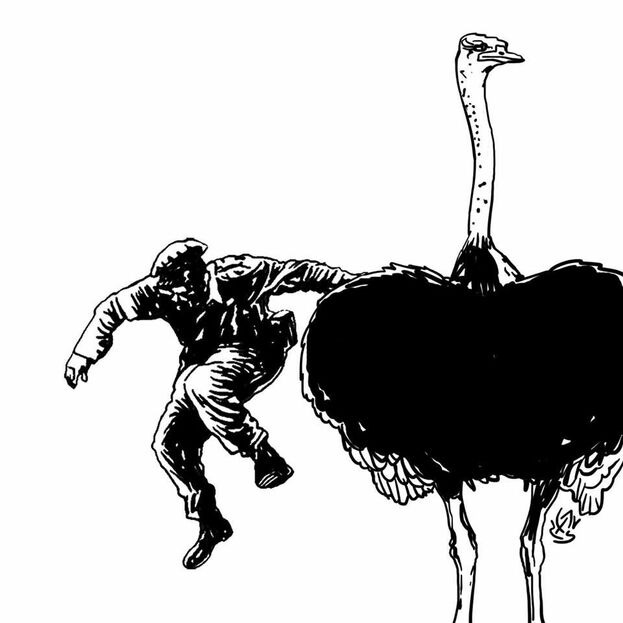
Some ‘memes’ rework the famous photo of Fidel Castro throwing himself from a tank, but in today’s version he is jumping off an ostrich. (Alen Lauzán)

The memes reach everyone, spark a smile and go viral many times over. The political power does not know how to deal with them: if they ignore them, they still generate laughter and reflections; if they mention and contest them, they consecrate them. The slogans can be infinitely parodied in these sparkling images and funny collages, while the sober ideological language of the billboards in the streets cannot adopt less formal codes to try to compete with such mockery.

The result is that the dissatisfaction and popular disapproval of the Executive’s management is coming to the fore in these collages. For example, the regime’s phrase, “In each block a committee” – referring to the Committees for the Defense of the Revolution, a national system of informants where all citizens are expected to monitor and report on each other’s revolutionary fidelity – is bowdlerized to “In each block an ostrich,” accompanied by a rework of the famous photo of Fidel Castro throwing himself from a tank, but in this version he is descending from one of those enormous African birds, a metaphor perhaps of a Revolution sustained more by improvisation than by military courage.

The Plaza of the Revolution has a problem. The irreverence of the meme has a greater impact on people than the solemnity of slogans because they are corrosive, familiar, catchy and make one think. The tendency of Cubans to look for the humor in things and to grab onto “anything to relax” turns out to be a very fertile breeding ground for these vignettes to deeply embed themselves in the collective imagination.

To mock the power is to begin to tear it down.

__________________________

The 14ymedio team is committed to serious journalism that reflects the reality of deep Cuba. Thank you for joining us on this long road. We invite you to continue supporting us, but this time by becoming a member of 14ymedio. Together we can continue to transform journalism in Cuba.
“We are the voices of those who can not speak”

The first march for animal rights is an unprecedented event in Cuba (14ymedio)

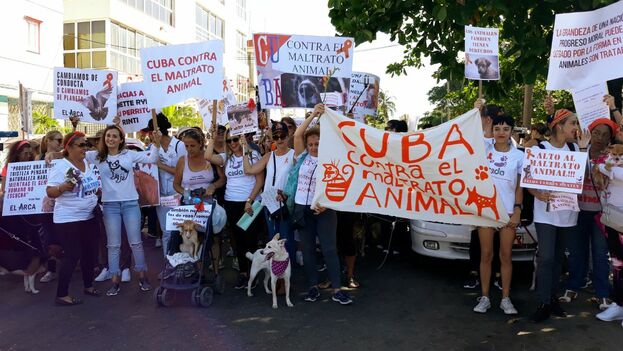
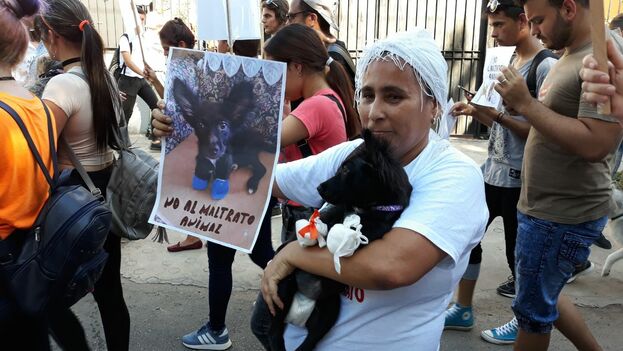
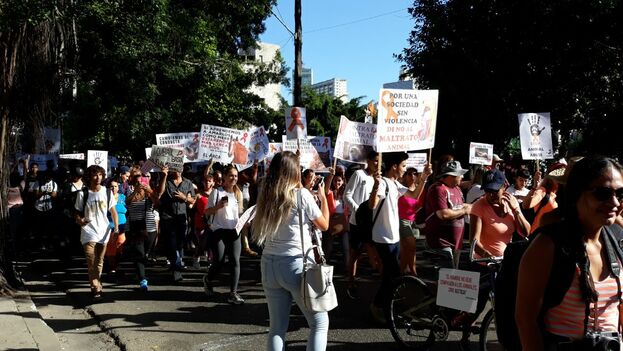
14ymedio bigger14ymedio, Luz Escobar, Havana, 7 April 2019 — Minutes before starting they were just a few, but more people were joining, coming by foot, by bike, and many of them with their pets. The unusual caravan brought together some 500 participants on Sunday who, in the streets of Havana, demanded an end the the violence against animals and the approval of an Animal Protection Law.

A crowd with banners, T-shirts with the symbol of an orange bow and with some participants who brought their dogs, marched this Sunday along 25th Street in Havana’s Vedado neighborhood, from Quijote Park to Colón Cemetery. The walk against animal abuse was the first independent march in the last half century where people were allowed to carry posters.

Initially, the pilgrimage called by animal protectors and lovers was going to cross 23rd street downtown, but at the last minute the organizers announced that they would use the parallel and less crowded 25th Street. continue reading

An activist carries a sign against animal abuse in Cuba. “If children are allowed to be cruel to their pets and other animals, they will easily learn to acquire the same pleasure from human misery.” (14ymedio)

A small group managed to repeat for a few minutes “Animal protection law now!” but immediately several people – carrying neither signs nor orange ribbons – called on them not to shout if they wanted to continue marching. Despite the warning on the road other participants kept repeating phrases such as “ meow meow meow, bow wow wow,” and the call, “No to animal abuse.”

Promoters of the gathering, along with uniformed National Revolutionary Police (PNR) stopped vehicle traffic to make way for the march, during which there was also the obvious presence of State Security personnel, dressed in civilian clothes, who had previously warned independent journalists and activists not to attend.

There were also people from other provinces and tourists who joined the walk that lasted just over an hour and traveled a mile. From some balconies and doorways, the neighbors of 25th Street also supported the marchers with words of encouragement and offered containers with water for the animals.

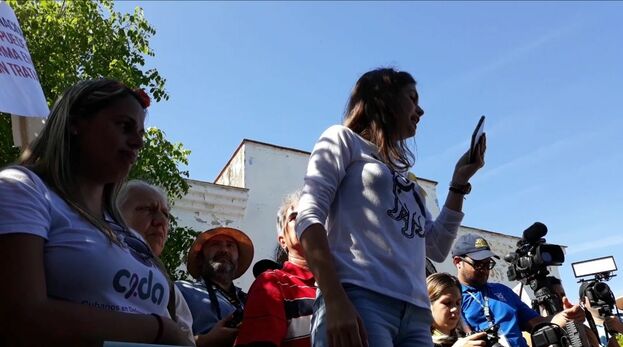
Beatriz Carmen Hidalgo-Gato Batista, one of the animal protectors who organized the march reading in front of the tomb of Jeannette Ryder in the Colón cemetery. (14ymedio)

Arriving at the Colón Cemetery, the crowd fell silent and stood in front of the tomb of Jeannette Ryder, an American philanthropist who resided on the island at the beginning of the last century and founded a humanitarian organization, the Protective Society for Children, Plants and Animals, known as Bando de Piedad (The Mercy Society).

Several of the protectors of the organizers of the walk made brief speeches around Ryder’s gravesite. Among them were Beatriz Carmen Hidalgo-Gato Batista, who expressed her emotion for “the magnitude” of the response to the call to march. The 21-year-old student of social communication has 16 dogs and 7 cats under her care.

Being a “protector of animals in Cuba is to confront daily the overpopulation of malnourished animals, the abuse, murder, sadism and torture suffered by strays and not strays (…) is to become a lawyer and demand legislation or a decree that protect them,” Hidalgo-Gato read.

To which she added that her activism in favor of these creatures leads her to “deal with the ignorant and not ignorant who have who have a little bit of power and that in less than you imagine or you disappear animals that you are protecting or call the dogcatcher.”

Milagro González, veteran of the cause against animal and protective mistreatment for two decades. (14ymedio)

At the end of the walk, in statements to 14ymedio , Hidalgo-Gato said she was happy about the outcome of the march and considered that this Sunday “will mark a before and after in the fight against animal abuse in Cuba” and possibly lead to the acceptance of an animal welfare law.

“We have already started here, it is the first authorized march with awareness posters, and in the process we are demanding that they approve an animal welfare law that educates and punishes people who commit crimes and abuse against them,” she added.

“I participated in last year’s march, it was called by Aniplant, starting from Coppelia to here but it was less than 20 or 30 people. Maybe people feel more identified when we do not divide by breeds or names and simply summon lovers and protectors of animals, and also social networks had an effect,” she said.

The call to the march was widely shared on Facebook and Twitter by those who were left with a bitter taste after animal protection was one of the topics proposed in the debates of the constitutional draft, but finally not included in the text submitted to a referendum this past February 24.

Five hundred people gathered in Havana to demand respect from the animals. (14ymedio)

Hidalgo-Gato believes that this year the social networks allowed “sharing in real time” what is happening because “information is power. “ She also believes that what happened today is important because it “opens doors” and maybe next year they can “celebrate with a law” of animal welfare and protection.

Another of the protectors that arrived at the walk was Milagro González, a veteran of the cause. “I am here to advocate for a law that stops animal abuse in our country which is greatly needed, because we see a lot of abuse here. We are holding this march so that these voices can be heard and heard throughout the world and that here in Cuba the law is approved.”

This animal protector was marching with Negrita, a puppy run over on Monte Street and abandoned by the driver who ran over her. “It’s a pity that the abuse goes unpunished in our country, I picked her up and after several surgeries she’s fine,” she said. For her “this activity is a step forward in the pursuit of animal protection” and she hopes that it “moves mountains.”

“We are not going to shut up, we are the voices of those who can not speak,” Milagros said.

_________________________

The 14ymedio team is committed to serious journalism that reflects the reality of deep Cuba. Thank you for joining us on this long road. We invite you to continue supporting us, but this time by becoming a member of 14ymedio. Together we can continue to transform journalism in Cuba.
Cuban Regime Continues to Choose "Low Intensity" Repression, According to CCDHRN

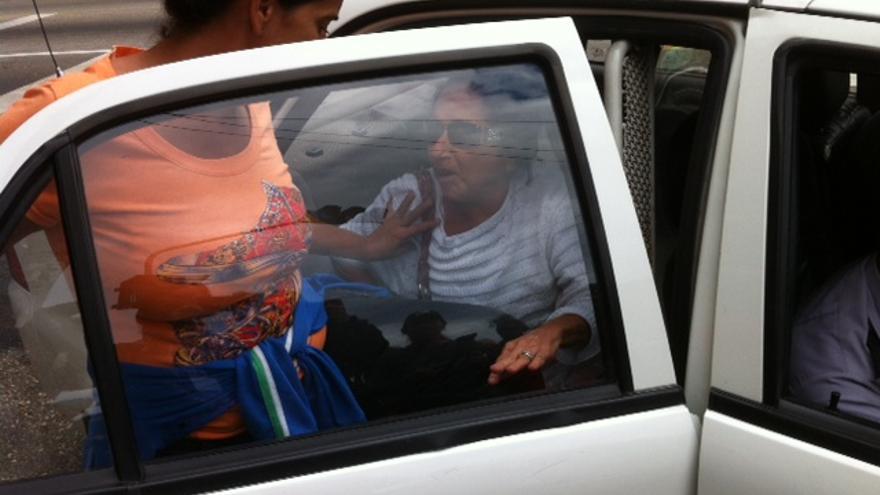
Ladies in White being put into police cars (14ymedio)

14ymedio bigger14ymedio, Havana, 9 April 2019 — The month of March ended with 185 arbitrary arrests of activists, according to the latest report of the Cuban Commission of Human Rights and National Reconciliation (CCDHRN), released Monday. The independent organization warns that “the regime continues to choose ‘low intensity’ political repression.”

The CCDHR reports that “there were 37 acts of harassment and at least one physical aggression, repressive actions that feed the atmosphere of intimidation that is part of daily life in Cuba.”

The document confirms the official pattern of “short-term arrests and other forms of repression in which the repressors of the powerful and ubiquitous secret political police (State Security) are experts.” continue reading

With regards to political prisoners, the CCDHRN denounces the imprisonment of José Antonio Pompa López, member of the Orlando Zapata Tamayo Civic Action Front, interned in Prison 1580 west of Havana.

“The current count of political prisoners puts the total number of prisoners between 130 and 140 prisoners,” the report details, noting that the organization will soon offer “a more accurate figure.”

The authorities frequently attribute common crimes, such as “assault” and “pre-criminal dangerousness,” to the activists, which makes it difficult to specify the number of inmates held for political reasons.

In 2018 there were 2,873 arbitrary arrests in Cuba, about 240 a month, according to the CCDHRN in its annual report. The independent entity denounced the harassment of activists who only “tried to exercise elementary civil and political rights.”

__________________

The 14ymedio team is committed to serious journalism that reflects the reality of deep Cuba. Thank you for joining us on this long road. We invite you to continue supporting us, but this time by becoming a member of 14ymedio. Together we can continue to transform journalism in Cuba.