A Crowd in Love With Celia Cruz Defies Censorship at a Tribute in Havana

“They have been fearing that voice for 60 years, terrified of its extraordinary power to draw a crowd”

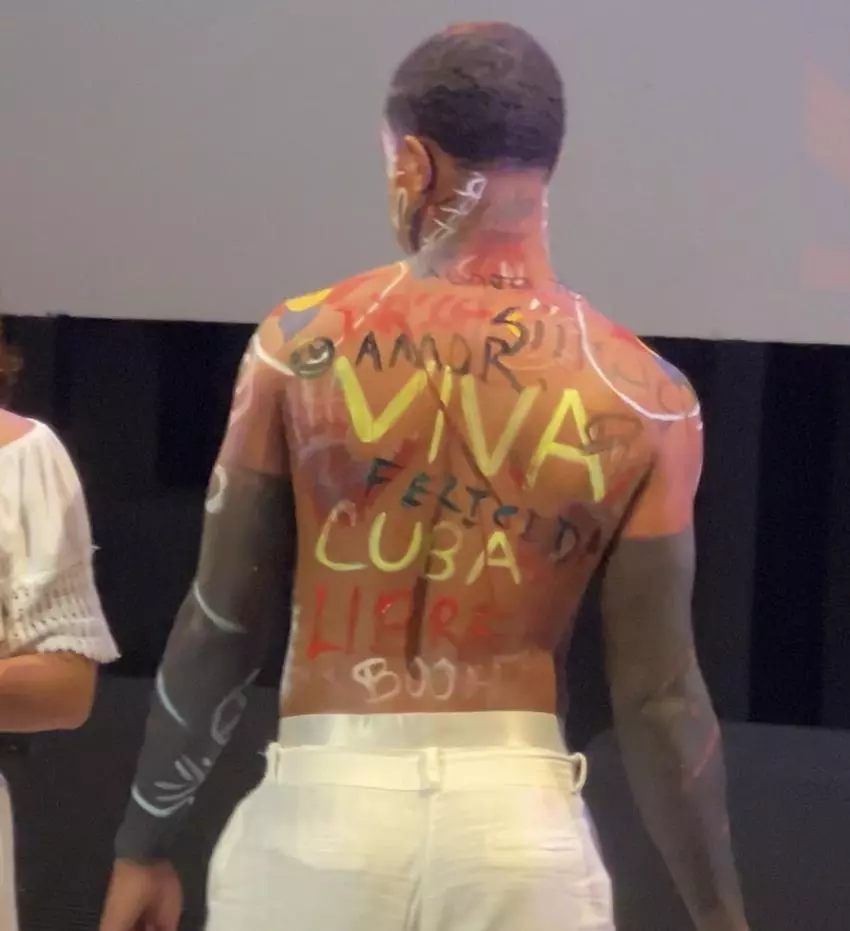
Few managed to stay seated during the parade of Celia Cruz’s songs. / 14ymedio

14ymedio bigger14ymedio, Reinaldo Escobar, Havana, 10 November 2025 —  Spectacular. There is no other word to describe the tribute paid to Celia Cruz this Sunday night at the El Cabildo cultural center, near the Almendares River in Havana. The gala, commemorating the centennial of the Queen of Salsa, had been previously censored when it attempted to be presented on Sunday, October 19, at the Fábrica de Arte Cubano (FAC).

With all the seast occupied, and dozens of people standing because they couldn’t get a seat, despite transportation problems and the arboviruses that continue to plague the population, the show organized by the El Público theater group began. The baritone, Ulises Aquino , founder of the Ópera de la Calle company and promoter of El Cabildo, took the microphone and thanked the theater company for their courage in finally presenting the play dedicated to the Queen of Salsa

During the night, there was dancing, applause, and enjoyment. Few managed to remain seated during the parade of musical themes, as infectious as they were representative of a woman who symbolizes the most optimistic, sensual, and festive part of the Cuban soul, so battered after decades of feigned severity and public discourse that glorifies resentment and hatred of those who are different. Artists including Roberto Romero, Estrellita, Freddy Maragoto, Lucho Calzadilla, Georbis Martínez, Daniel Triana, and the dancers Brian Ernesto Pérez and Chay Deivis shone, and made the show shine.

While the official discourse was gray and subdued, the songs that resonated this Sunday at El Cabildo were expansive and direct

The show was not only a moving tribute to Celia Cruz, but also the best possible response to the National Center for Popular Music, which, in a terse message that didn’t even mention the name of the Queen of Salsa, announced last October that the gala at the FAC would not take place. While the official statement was subdued and timid, the songs that resonated this Sunday at El Cabildo were expansive and direct.

With the direction of Carlos Díaz and with the dramaturgy of Norge Espinosa, the show “Celia” found a fitting venue at El Cabildo. Among the foliage of the area, the event had a certain air of rebellion, of something done even though the dogs of censorship were barking nearby, very nearby. “We’ll see what they publish tomorrow,” commented a woman, who danced all night, alluding to possible official attacks against El Público and El Cabildo for preparing and hosting the gala. continue reading

“Quimbara, cumbara, cumba quimbambá” blared from the loudspeakers of the cultural center, and hips, as if possessed by a spell, swayed and swayed without rest. Amid the somber times being experienced in Cuba, with the fear that a mosquito bite might end in fevers, swollen joints, or a funeral, what happened at El Cabildo was more than a balm; it was a true injection of life, hope, and enthusiasm

An enormous mouth, bright red and with teeth peeking out in festive laughter, appeared on the stage screen. Contagious laughter that defined the evening from the start as a time to have fun, enjoy oneself, and let loose, dance and be happy. Creating that kind of festive atmosphere is no small feat these days, but the tribute to Celia Cruz achieved it. It transported the audience to a state of boisterous celebration that lasted even after the stage lights had gone out and people began to leave the venue

“I’m still a little sore, but I couldn’t miss this,” commented a young man still recovering from chikungunya, who could barely sit still at the table he shared with a couple. “I found out through a WhatsApp group, and even though I live far away, I arranged with some friends to pay for a ride here. Of course, we came covered in insect repellent, just in case,” he joked.

El Cabildo stage, this Sunday, during the tribute to Celia Cruz for her centennial. / 14ymedio

There was no lack of glances toward the entrance of the place, fearing that at any moment some guayabera-clad bureaucrat with a stern face might burst in and order the microphones turned off. “I came for Celia, but also to make sure this show was really going to happen because after what happened at the Fábrica de Arte, I couldn’t believe it until I saw it with my own eyes,” commented Ana María, a Havana native born in 1960, the same year Celia Cruz left Cuba.

“In my house, we never stopped listening to her. My parents had their Communist Party [PCC] membership cards on one hand and their adoration of Celia Cruz on the other,” she told this newspaper. “When my mother died, she had long since left the PCC, but she never stopped being a fan of Celia. That was one of her lifelong dreams. The last New Year’s Eve we celebrated as a family before she died, she danced to ‘La Negra Tiene Tumbao‘.”

For some of those who attended Sunday’s tribute, it was the first time they had heard the Queen of Salsa in a space other than a private party or family gathering. Hearing her in a space packed with people, practically under the open sky, without subterfuge or hiding, proved to be a liberating experience. No musical closet can withstand a shout of “Azúuuucar!”

The affection for Celia Cruz and the joy of dancing to the rhythm of her voice acted as a magical connection among those attending the tribute. The atmosphere was very different from that of the attacks that, these days, government spokespeople are launching against the artist. If in the dark offices of ministries and institutions they decree to silence her, in El Cabildo she resonated powerfully; they could not muzzle her

Rosa Marquetti, a specialist in the life and work of the Queen of Salsa, had already warned that Cuban censors “have spent 60 years fearing that voice, trembling with fear at the mere mention or writing of her name, terrified by her extraordinary power to draw people in.” According to the expert, the songs popularized by Celia Cruz “are far more compelling and convincing than the bitterness and karmic negativity with which they impose orders, wield power, and threaten with the only thing they possess: the force of de facto power.”

That contrast between joy and anger, jubilation and resentment was more than evident at El Cabildo, transformed on Sunday night into a magical space where insults, hatred, and pessimism were banished. The gala’s closing couldn’t have been more in tune with that atmosphere of happiness. “I will live, I will be there/ As long as a comparsa passes by, I will sing my rumba,” was heard over the loudspeakers. “Oh, I want that to be the national anthem of Cuba,” a young woman said as she left, with tears and a smile on her face.

____________

COLLABORATE WITH OUR WORK: The 14ymedio team is committed to practicing serious journalism that reflects Cuba’s reality in all its depth. Thank you for joining us on this long journey. We invite you to continue supporting us by becoming a member of 14ymedio now. Together we can continue transforming journalism in Cuba.

After a Pause Caused by the Effects of Hurricane Melissa, in Cuba the Dollar Rises Again

Officialdom has failed in its attempt to disqualify the publication of informal exchange rates by El Toque

El Toque explains that its information is based on advertisements and publications in networks collected daily. / 14ymedio

14ymedio bigger14ymedio, Madrid, November 10, 2025 — As expected by the specialists, after a few days of truce in which its price began a rapid fall from 490 pesos to 410, the dollar is back up strongly on the informal market. The new war waged by the government against El Toque, which publishes daily sales rates in the streets, is of little use. If this Saturday the dollar had already started to rise to 415; the next day it cost 420 pesos and, this Monday, 430 pesos.

The independent media itself never tires of illustrating how it extracts the information it offers, most recently this Sunday. Far from operating as a denunciation of the regime, which accuses it of “speculative manipulation” serving the US as part of an “integral program of destabilization” and “usurping” the task of the Central Bank of Cuba, El Toque, without referring to this smear campaign, explains that its exchange rate is based on advertisements and publications in networks collected daily and from responses by users.

This is exemplified by the data collected on Saturday and Sunday. In the first graph they report the “histogram of published offers” and explain: “Most offers are concentrated between 410 and 430 CUP/USD, with an average point of 420 CUP,” which “indicates that the majority of participants in the market coincide in this price range.” The average, 421.81 pesos, is slightly above the median (420 CUP), which suggests that some providers are starting to request higher prices. This slight difference may indicate upward pressures; that is, an increase in the dollar rate.” continue reading

Towards the end of October, a change in trend is observed: requests for purchase (demand) increase, and sales offers decrease (offer)

In a second graph, they present supply and demand aggregates, showing the evolution of the number of people interested in buying or selling dollars over time. The figures, insists the media, “are based on amounts declared by users in their messages.” But they clarify: “Not all offers include precise amounts; therefore, the values presented constitute a sub-record of the actual movement; that is to say, the detectable minimum of transaction intentions. As a result, the total market volume is likely to be much larger.”

And they conclude: “During the month of October, the volume of transactions remained relatively stable. However, towards the end of the month a change in trend was observed. There was an increase in purchase requests (demand) and a decrease in sales offers (supply). This imbalance –more people willing to buy and fewer to sell — usually anticipates increases in the dollar price if the trend continues.”

The article recalls that economist Pavel Vidal, head of the Observatory of Currencies and Finance (OMFi), has also explained many times that movements in the informal exchange rate are given by the balance between supply and demand. “If the demand for dollars, euros or MLC (freely convertible currency) exceeds the supply — because many people or private enterprises seek foreign exchange to import, travel or protect their savings against inflation- the price of these currencies in Cuban pesos tends to rise. Conversely, if more people are willing to sell currencies than they are willing to buy — through increased remittances, tourism or a recent appreciation of the dollar- the rate may be lowered.” This is the basic law of supply and demand, which is practiced all over the world, except in Cuba, where the regime tries to ignore it without success.

It is also influenced by “expectations,” such as “rumors of new sanctions, announcements of regulatory changes for MSMEs, remittances or banking operations, as well as changes in monetary policy” and other factors, such as liquidity or financial regulations.

In the case of the drop that occurred last week, some experts associated with OMFi link it to the effects of Hurricane Melissa, specifically the sending of currency and donations to support the country and families.

In his report of last October, Pavel Vidal stated that the economic crisis on the island “has not yet hit rock bottom, and no possible exits are perceived in the short and medium term.” He ventured that the dollar could even exceed 500 pesos at the end of October, in an “extreme” scenario. Before the descent of the past days, it was close to reaching it.

Regardless of specific predictions, the scenario outlined by the Cuban economist, who resides in Colombia, for the unstoppable devaluation of the national currency remains valid. For example, there is the debacle of tourism, essential to foreign exchange earnings. Also, having cash is the only way to be able to buy in the dollarized stores, which are becoming more numerous. In addition, the energy crisis and the “very limited access” to inputs and financing negatively affect production, which increases the dependence on imports. “Mistrust in the future of the economy and the Government’s ability to face the crisis” causes capital flight and encourages the “accumulation of savings” in hard currencies.

Translated by Regina Anavy

____________

COLLABORATE WITH OUR WORK: The 14ymedio team is committed to practicing serious journalism that reflects Cuba’s reality in all its depth. Thank you for joining us on this long journey. We invite you to continue supporting us by becoming a member of 14ymedio now. Together we can continue transforming journalism in Cuba.

A Total of 27 People Injured in Another Major Crash on Cuba’s National Highway

The country’s main highway has seen fifty people injured and two killed in just 72 hours.

“At seven in the morning, the first ambulance still hadn’t arrived,” said a witness to the accident. / Facebook

14ymedio bigger14ymedio, Havana, November 10, 2025 — A bus collided with a cart in the early hours of Monday morning on the National Highway, leaving 27 people injured, four of them with life-threatening injuries. The crash occurred just three days after another massive crash at kilometre 183 of the same road. This time, the collision took place near the community of La Caoba, in the municipality of Venezuela, in Ciego de Ávila.

The official newspaper Invasor reported on its Facebook page that most of the injured were taken to the Antonio Luaces Iraola Provincial Teaching Hospital, and the rest to the local polyclinic. In the same publication a witness criticised the delay in help arriving: “At seven in the morning, the first ambulance had still not arrived,” he wrote. According to his testimony, the injured were rescued by “neighbours in carts as best they could”.

The crash involved a bus carrying workers from the El Fortín Credit and Trade Cooperative. Images posted on social media show the left side of the vehicle completely destroyed.

A fourth seriously ill patient, with a fractured pelvis, remained at the Venezuela municipal polyclinic.

Dr Inés Padrón González, a specialist in intensive care and emergencies, later reported that the hospital in Avila had received 20 patients, although “not all cases have arrived”. Of those admitted to the centre, three were in a life-threatening condition: two with severe head trauma and another with “abdominal trauma with free fluid in the cavity”, whose condition was being assessed for possible surgery. A fourth seriously injured patient, with a pelvic fracture, remained at the Venezuela polyclinic. The rest of the injured were reported to be stable, with minor injuries and orthopaedic trauma. continue reading

Last Friday, when a Yutong bus veered off the road at kilometre 183 of the National Highway, two women died: Mikenia Valenciano Godínez, 36, originally from Songo La Maya, Santiago de Cuba, but residing in Havana; and Dainé Rodríguez Hernández, 22, also from Santiago.

Of the more than 20 people injured in the crash, two remain in critical condition, connected to artificial ventilation in the intensive care unit of the provincial hospital in Cienfuegos. Two other patients are reported to be in serious condition, with hip fractures and post-traumatic hemorrhages.

In just three days, these two massive crashes on the National Highway have left nearly fifty people injured and have once again exposed the deplorable state of Cuba’s main road. The proximity of both crashes highlights the fact that Cuban roads have become increasingly lethal.

Translated by GH

____________

COLLABORATE WITH OUR WORK: The 14ymedio team is committed to practicing serious journalism that reflects Cuba’s reality in all its depth. Thank you for joining us on this long journey. We invite you to continue supporting us by becoming a member of 14ymedio now. Together we can continue transforming journalism in Cuba.

Independent Lawyer Wilfredo Vallín, Founder of the Cuban Legal Association, Dies in Havana

He was a tireless promoter of legal education for citizens in the face of repression.

In his work, Wilfredo Vallín always emphasized the need to denounce abuses of power. / 14ymedio

14ymedio bigger14ymedio, Havana, 8 November 2025 —  Independent lawyer and civil rights advocate Wilfredo Vallín Almeida passed away early Saturday morning in Havana at the age of 77, according to sources close to the family who confirmed the information to 14ymedio. The jurist leaves behind a profound legacy as the founder of the Cuban Legal Association (Ajudicuba) and a tireless promoter of legal education for citizens in the face of repression.

Originally from Havana, he graduated with a law degree from the University of Havana in 1992 and worked briefly as a lawyer within the state system before transitioning to independent legal practice. In 2008, he founded the Cuban Legal Association (Ajudicuba), with the aim of promoting legal education within Cuban society and providing free legal advice services.

One of the most difficult moments of his activism occurred in 2018, when his home was raided by State Security agents who seized numerous work tools and case files related to the cases the independent lawyers’ group was advising. This episode marked a turning point in his work, due to the intense threats he received from the political police during and after the raid.

Vallín was also a pioneer in the use of new technologies, blogs, Twitter accounts (now X), and social media as tools to disseminate legal analyses, advice, and reports of human rights violations. In his articles, he always emphasized the need to denounce abuses of power and reminded readers that “a Constitution is a living and practical law that cannot be built on continue reading

ideological elements.”

Under his leadership, Ajudicuba advised relatives of numerous political prisoners, documented cases of arbitrary detentions, and offered legal defense seminars.

Under his leadership, Ajudicuba advised the families of numerous political prisoners, documented cases of arbitrary detentions, and offered legal defense seminars in a context of increasing repression. In one of his reports, Vallín wrote: “All citizens who do not find justice in the government courts can come to us; our service is completely free.”

The independent lawyer also taught at the Blogger Academy (2008-2009), where his workshops on law, Cuban regulations, and defense strategies against repression were very well received. He became a role model for young lawyers, activists, and citizens seeking a basic understanding of citizenship, rights, and access to justice in Cuba.

A man of even judgment, willing to listen and with a great capacity to bridge the gap between other independent projects, he quickly became an indispensable figure in Cuban activism. His voice was heard in numerous international forums, and several of his investigations into human rights abuses ended up before the Inter-American Commission on Human Rights.

Vallín promoted the “Citizen Demand for Another Cuba,” urging the State to ratify the Covenants on Civil and Political Rights and on Economic, Social and Cultural Rights.

Vallín spearheaded the “Citizens’ Demand for Another Cuba,” urging the Cuban state to ratify the United Nations International Covenants on Civil and Political Rights and on Economic, Social and Cultural Rights, which Havana had signed but not fully implemented. The jurist’s commitment was to view the law not merely as written words, but as a genuine instrument of protection. As he himself maintained, “Knowledge of the law is the first step toward individual freedom.”

Wilfredo Vallín’s health deteriorated rapidly in recent days. His funeral will be held this afternoon in Havana.

____________

COLLABORATE WITH OUR WORK: The 14ymedio team is committed to practicing serious journalism that reflects Cuba’s reality in all its depth. Thank you for joining us on this long journey. We invite you to continue supporting us by becoming a member of 14ymedio now. Together we can continue transforming journalism in Cuba.

A Virus Strikes a Large Part of Cuba’s Alazanes Team and Forces the Suspension of the Game Against Mayabeque

Performances by the National Ballet of Cuba are cancelled due to the “unforeseen indisposition” of several artists

The three catchers from Granma, among other players, are sick, according to reports / Facebook

14ymedio bigger14ymedio/SwingCompleto, Havana, November 9, 2025 — Cuba’s National Baseball Series experienced another interruption to its schedule. This Saturday, the game between Granma and Mayabeque was suspended because one of the viruses circulating in the country affected a large part of the Alazanes’ roster.

The news was reported this Saturday by pro-government journalist Wilber Pastrana, although he avoided mentioning the cause of the illness. “There are no games today or tomorrow at Nelson Fernández Stadium. Several Granma athletes are sick, including the team’s three catchers. The games will be played at the end of the qualifying stage.”

The Alazanes de Granma lost their first three games of the subseries and it was supposed to continue this weekend, but physical discomfort took hold of a significant part of the team’s roster.

The Granma team had a visit to the Isle of Youth scheduled for next week, but now “it is being considered that Granma will return to its province.”

Pastrana also mentioned that the Granma team had a visit to the Isle of Youth scheduled for next week, but that now “they are considering returning to their province. If things remain this way, they will not make the trip to the Isle of Youth.” The reporter concluded his message with the phrase: “The athletes’ health will always come first.”

The 64th National Series has faced numerous challenges since its inception. For one, it was moved on the calendar for the first time, starting six months later than usual. Furthermore, several games have been postponed due to unforeseen issues with hotel capacity in cities like Las Tunas, transportation problems stemming from poor road conditions or fuel shortages, and nationwide power outages.

Regarding the impact of the various viruses on the island, the National Series is not the only event that has had to suspend its activities. The National Ballet of Cuba announced this Saturday the cancellation of its performances scheduled for this weekend, after confirming that several of its dancers are also ill “in the context of the current epidemiological continue reading

situation.” The company acknowledged that, despite readjusting casts to maintain the performances, the “unforeseen illness” of more artists forced them to suspend the shows.

Despite readjusting casts to maintain the performances, the “unforeseen indisposition” of more artists forced the cancellation of the shows.

The announcement published in Cubadebate points out that “the suspension underscores the ongoing challenges faced by cultural institutions and large groups in maintaining their live seasons in the face of unforeseen health issues affecting their casts.”

This week, health authorities acknowledged a significant increase in cases of chikungunya, dengue, and other arboviruses in the country. Deputy Minister of Public Health Carilda Peña García reported that more than 20,000 cases of chikungunya have been registered, with the highest incidence in Havana, Camagüey, Cienfuegos, Artemisa, and Villa Clara. The announcement came somewhat late, more than a month after the United States issued a travel alert for Cuba due to the surge in infections.

Similarly, it was clarified that “there are no reports of oropouche,” although until now it was one of the possible ailments of the population and, he assured, “surveillance is maintained on that disease.”

However, the number reported by the authorities could pale in comparison to the citizen complaints circulating daily on social media, where residents of different territories in the country claim that entire families remain ill.

____________

COLLABORATE WITH OUR WORK: The 14ymedio team is committed to practicing serious journalism that reflects Cuba’s reality in all its depth. Thank you for joining us on this long journey. We invite you to continue supporting us by becoming a member of 14ymedio now. Together we can continue transforming journalism in Cuba.

The Intense Activity of Funeral Homes Contradicts Cuba’s Official Narrative About Controlling the Virus.

The situation is particularly serious in Guantanamo, where there were 27 wakes in a single day

The hushed conversations repeat the same words and phrases: “gelatin,” “soup,” “fevers,” “he became dehydrated,” “the pain wouldn’t let up.” / 14ymedio

14ymedio bigger14ymedio, Dario Hernandez, Havana, November 9, 2025 — In recent weeks, while news programs have been repeating reassuring figures on arboviral cases and hospitals have been avoiding providing complete statistics, funeral homes tell a different story. This newspaper visited several funeral parlors in Havana and observed a pattern that doesn’t fit with the official narrative of “epidemiological control.”

In Guanabacoa, the Bertematti funeral home, located between Máximo Gómez and Maceo streets, had all its chapels occupied this Saturday, a rather unusual occurrence for the establishment. Outside, some families waited their turn to secure a space where they could say goodbye to their loved ones.

No one is saying for sure that the deceased were victims of a specific virus. But that is all anyone is talking about. The hushed conversations outside the hospital repeat the same words and phrases: “gelatin,” “soup,” “fevers,” “dehydrated,” “the pain wouldn’t let up.” These are symptoms without a written diagnosis, but the local population has already learned to recognize them immediately.

“Most people don’t go to the hospital. So how do you know how many sick people there are?” / 14ymedio

The same thing happened at the San Miguel del Padrón funeral home. Of the three rooms, two were in use at the time of 14ymedio‘s visit .

At the smaller funeral home in Regla, two rooms were also operating simultaneously this Saturday. In one of them, a doctor could be seen wearing a mask. Her presence there appeared to be part of a health protocol that hasn’t been reported in official media, but which points to a greater emergency than they are admitting.

“Most people don’t go to the hospital. So how do you know how many are sick?” commented the son of one of the deceased, leaning against the wall. Someone close to the family argued that even when a virus is what caused the patient’s fatal decline, it rarely appears as the cause on the death certificate. “If the person had diabetes, heart disease, or asthma, that’s what they put down, not the virus,” they said. continue reading

A doctor from Cotorro, consulted by 14ymedio, confirms this with a more technical nuance: “The virus can cause encephalitis and myocarditis, which are indeed listed as direct causes of death. Dengue can cause shock , which is also fatal. But epidemiological statistics are not kept in the emergency room. That is controlled—in theory—in primary care. In practice, the record-keeping is fragmented.”

Families perceive that the symptoms in children are more aggressive. / 14ymedio

At the Regla cemetery, a guard sums up the social climate with a phrase that serves as a collective diagnosis: “They see a dead body and immediately think it’s the virus.” This reaction, far from being a sign of epidemiological ignorance, is a fear based on the daily experience of entire neighborhoods being infected, and on the loss of credibility in health authorities.

There were no burials at the crematorium of the New Cemetery of Guanabacoa at the time of the visit, but the workers admit that “the movement has increased” in recent days.

Even those who recover from the viruses circulating unchecked throughout the country suffer long-term aftereffects. Yolanda, 22, fell ill a month ago and has yet to fully recover. “I still have dizziness, persistent pain, and exhaustion,” she tells this newspaper, adding that she still needs physical therapy and rheumatology appointments. “I thought I wouldn’t make it to dawn,” she says. She is the mother of a young child, and at the daycare center, she says there is “panic” because families perceive that the symptoms are more severe in children.

“The whole city is talking about it. People are scared.” / 14ymedio

In the La Jata neighborhood, the death of a child has shaken the community. It is the only death that residents attribute without a doubt to the virus. There has been no official statement, but the local memory remains.

In the eastern provinces, the situation is much worse than in Havana. A resident of Guantánamo confirmed that the local funeral home recorded 27 deaths in a single day. He didn’t offer an exact date, only the context: “After Tropical Storm Melissa, everything was turned upside down. Piles of garbage, lack of hygiene, a terrible environment.” The number, local sources say, far exceeded the ordinary perception of mortality. “The whole city is talking about it. People are scared,” he stated.

The situation in hospitals and funeral homes across the country is clear: unsanitary conditions, increased infections, distrust in health institutions, and reluctance to go to hospitals for fear of not being able to leave. The virus—whether dengue, chikungunya, hepatitis, or a mixed case—is a social trigger of panic.

____________

COLLABORATE WITH OUR WORK: The 14ymedio team is committed to practicing serious journalism that reflects Cuba’s reality in all its depth. Thank you for joining us on this long journey. We invite you to continue supporting us by becoming a member of 14ymedio now. Together we can continue transforming journalism in Cuba.

Germany’s President Believes Democracy Has Never Been As Threatened Since 1989

“A Russian aggressor has shattered our peace order,” warns Frank WalterSteinmeier

German President Frank-Walter Steinmeier commemorates the fall of the Berlin Wall

14ymedio biggerEFE (via 14ymedio), Berlin, November 9, 2025 — On Sunday German President Frank-Walter Steinmeier called for the defense of democracy, saying it faces the greatest threats it has experienced since the fall of the Berlin Wall in 1989.

He also invoked the darkest and brightest moments in German history during the ceremony to commemorate November 9, a date he described as “ambivalent” because of the various events with which it is associated.

“One hundred and seven years after November 9, 1918, the date of the proclamation of the first German republic, our liberal democracy is under pressure,” Steinmeier said.

“Populists and extremists mock our democratic institutions, poison our debates, and profit from fear,” he added.

“Populists and extremists mock our democratic institutions, poison our debates, and profit from fear.”

He went on to recall the pogroms of November 9, 1938, the so-called Kristallnacht, and said that 87 years later anti-Semitism has intensified since the Hamas attacks of October 7, 2023.

“And 36 years after November 9, 1989, the day the Berlin Wall fell? We feel above all how the distance between East and West is growing, and how the memory of the energy of the peaceful revolution is losing its power. It is not continue reading

easy for us to draw strength and confidence from those happy times,” he said.

Steinmeier asserted that everyone who knows him knows that he does not tend towards alarmism or describing apocalyptic scenarios, but he added that given the current situation, one must dare to look at the threats that exist.

“We cannot lend ourselves to a new fascination with authoritarianism and then fall into a lack of freedom, only to have everyone later say that they neither wanted it nor knew it was coming. Today, November 9th, I say it clearly: we can know it, and we do know it,” he stated.

According to Steinmeier, never before, since the reunification of Germany, have democracy and freedom been so threatened as they are now.

“Never before, since the reunification of Germany, have democracy and freedom been so threatened.”

“Threatened by a Russian aggressor who has shattered our peaceful order and against whom we must protect ourselves, and threatened by far-right forces that attack our democracy and gain support among the population,” he declared.

Simply waiting for the storm to pass is not, according to Steinmeier, a solution. “We have to act, and we can act. Our democracy is not doomed to surrender,” he emphasized.

“Our historical experience teaches us that the reckless attempt to tame anti-democrats by giving them power is something that failed not only in Weimar. Extremism, according to the American political scientist Daniel Ziblatt, never triumphs on its own. If it succeeds, it is because others allow it. That is the lesson of the Weimar Republic,” he remarked.

Therefore, Steinmeier called for maintaining the existing cordon sanitaire against the far-right Alternative for Germany (AfD), although without explicitly mentioning that party.

“There can be no political cooperation with extremists. Not in the government, nor in parliaments,” he emphasized.

____________

COLLABORATE WITH OUR WORK: The 14ymedio team is committed to practicing serious journalism that reflects Cuba’s reality in all its depth. Thank you for joining us on this long journey. We invite you to continue supporting us by becoming a member of 14ymedio now. Together we can continue transforming journalism in Cuba.

Cuba’s Sports Facilities in Artemisa, Havana and Pinar Del Río Are Dying

Several journalists criticise the neglect of the Jesús Suárez Gayol, Nicaragua Libre de Herradura and Pontón sports stadiums.

The sporting authorities’ lack of attention led to the ruin of the Jesús Suárez Gayol stadium. / DPorto Sports LLC

14ymedio bigger14ymedio, Havana, 5 November 2025 — The infrastructure of Cuban baseball is in intensive care. The ruins and neglect of the Jesús Suárez Gayol (Artemisa) and José María Pérez Capote sports complexes, known as Pontón, confirm this. The most recent case of neglect was reported by journalist Osbel Benítez Polo. The Nicaragua Libre stadium in Herradura, Pinar del Río, looks like “a pasture for grazing cattle”.

The journalist showed images of “the neglect, carelessness, misery and lack of compliance on the part of the management of the National Institute of Sport, Physical Education and Recreation (Inder) in the province”.

Benítez accused the provincial director of Inder, Daniellys Sánchez, of negligence for not replying to the request from the parents of the young athletes. “The answers have not yet arrived,” he said, adding that “no maintenance work has been carried out for four months.”

The journalist expressed his confidence that “for the sake of baseball, sooner rather than later, this space will flourish again for the good of the community.”

Last March, Inder Vice-President Omar Venegas Echemendía acknowledged that there were 1,325 sports facilities on the island that were “rated as fair to poor”. The initiative of the workers’ union in the context continue reading

of the last School Games made it possible to recover 227 properties, he said.

Venegas offered to “continue working” so that “there will be fewer and fewer venues” with poor ratings. However, the specialised media continue to complain.

Last September, DPorto Sports LLC complained that the lack of attention from sports authorities led to the ruin of the Jesús Suárez Gayol stadium. The colossus is falling to pieces. “The poor condition of the building was aggravated by the impact of saltpetre as it was near the sea,” said journalist Yasel Porto Gómez, adding that “it received its coup de grâce with

Cuban Ambassador Expelled From Peru After Being Accused of Political Activism

In addition to being a diplomat, Carlos Zamora has been singled out for his activities as a colonel in the Directorate of Intelligence

Miguel Díaz-Canel awarding a medal to ‘El Gallo Zamora’ in August 2025. / Social Media

14ymedio bigger14ymedio, Havana, 8 November 2025 — The departure of the Cuban ambassador to Peru, Carlos Rafael Zamora Rodríguez, announced in the final paragraph of an official statement from the Ministry of Foreign Affairs in Lima, comes after repeated accusations against him of political activism and espionage. On October 28, Peru’s Vice Foreign Minister Félix Denegri summoned the diplomat to “discuss the activities carried out during his tenure.” Two days later, Zamora packed his bags and flew back to Havana.

The Peruvian Foreign Ministry offered little explanation. But in the halls of Congress, in the opinion columns of Peru’s leading newspapers, and on conservative television programs, the unofficial version is unanimous: Zamora was not a mere diplomat, but a political agent of the Cuban intelligence apparatus operating with immunity on Peruvian soil.

The diplomatic career of El Gallo Zamora, as he is nicknamed, has always been linked to the work of “political analysis in complex scenarios.” His “diplomatic” journey included postings such as Ecuador, Brazil, and Bolivia, countries where Havana has maintained intense activism in building the Bolivarian axis since 2000.

In Quito, between 2013 and 2016, he maintained direct dialogue not only with the Ministry of Foreign Affairs, but also with movements aligned with Rafael Correa, especially unions and youth organizations. continue reading

Former Cuban officer Enrique García, exiled in the US, met Zamora personally at the Cuban Intelligence Directorate building, located at Línea and A, in El Vedado, Havana.

In 2019, the interim government of Jeanine Áñez in Bolivia accused Cuba and Venezuela of orchestrating the violence in the country in support of Evo Morales. The Minister of Communication, Roxana Lizárraga, stated that Zamora—then ambassador to Bolivia—was part of the Cuban intelligence network that intervened in conflicts in Nicaragua and Ecuador.

Former Cuban officer Enrique García, exiled in the US, also told the political news tabloid Perú21 that he personally met Zamora at the Cuban Intelligence Directorate building, located at Línea and A streets in Havana’s Vedado neighborhood. García further stated that both the ambassador and his wife, Maura Isabel Juampere Pérez, hold the rank of colonel within that institution.

Zamora presented his credentials in Peru in December 2021, just days after the inauguration of Pedro Castillo, the former president who was deposed and imprisoned following his failed self-coup in 2022. Various sectors of the Peruvian right have long been pressing for Zamora’s expulsion, demanding it as an act of democratic hygiene. Congresswoman Patricia Chirinos (Avanza País) accused him of “turning the Embassy into a center of ideological operations.” Retired Admiral Jorge Montoya, of Renovación Popular, went even further: “Cuba doesn’t send ambassadors, it sends G2 operatives.”

The offensive intensified when several news reports indicated meetings between the ambassador and leaders of the hardline wing of the teachers’ union SUTEP, with groups close to Perú Libre, and with student organizations that support Castillo. For the Lima right wing, Cuba was reactivating its old playbook of ideological export in Peru, this time taking advantage of a politically polarized country lacking strong institutional safeguards.

According to an investigation published by the newspaper Perú21 in early 2025, high-level sources within the Peruvian government claimed that Cuban counterintelligence agents were collaborating in the protection of Peruvian politician Vladimir Cerrón, a fugitive since October 2023 after he was sentenced to three and a half years in prison for corruption related to the irregular construction of an airfield.

Peruvian Foreign Minister Javier González-Olaechea told the press that, if the involvement of foreign agents in Cerrón’s escape were confirmed, Peru could escalate the diplomatic conflict to the point of severing relations with Cuba. The report indicated that the police identified Cuban citizens who met with members of the Perú Libre party to coordinate actions related to Cerrón; the possible involvement of Peruvian police officers as collaborators is also being investigated. Authorities say they came close to arresting him in January 2025, when a technical error temporarily revealed his whereabouts in an exclusive area south of Lima, information that matched data that the Police attributed to previously identified Cuban agents.

The departure of the Cuban ambassador from Lima comes at a time of redefinition of Peruvian foreign policy, also strained by the diplomatic clash with Mexico.

In Havana, the Foreign Ministry has not responded to Zamora’s dismissal or the accusations of espionage. There are also no reports in the official press or personal statements from the ambassador so far—a silence that, in the regime’s ritual, amounts to tacit confirmation.

The departure of the Cuban ambassador from Lima comes at a time of redefinition in Peruvian foreign policy, which is also strained by the diplomatic clash with Mexico. The document published by the Peruvian Ministry of Foreign Affairs states that they analyzed the Mexican government’s request to grant safe passage to Betssy Chávez—a former minister and former president of the Council of Ministers during the Castillo administration, currently being prosecuted for rebellion and conspiracy following the attempted self-coup—who sought asylum in the Mexican embassy.

Following internal consultations and consultations with international experts, the Ministry of Foreign Affairs has concluded that, in recent years, some countries have misused the 1954 Caracas Convention, granting asylum to individuals prosecuted for common crimes rather than for political persecution. Peru believes this practice undermines the purpose of asylum and rejects its use as a means of evading justice. Therefore, it will initiate a diplomatic process within the Organization of American States (OAS) to propose amendments to the Convention, with the aim of preventing abuses and ensuring respect for the rule of law in the region.

Peru’s relationship with the political axis that includes Mexico, Cuba, and other allies of so-called Latin American progressivism has entered a zone of open friction. The dismissal of the Cuban ambassador reinforced the perception that Peru is realigning its priorities, distancing itself from governments close to Havana and from the old diplomatic framework that, in previous decades, allowed the island to operate with few political checks and balances in the Andean countries. The crisis with Mexico and Zamora’s departure, viewed together, illustrate a diplomatic shift in which Lima has decided to demonstrate that it will not tolerate either automatic protections or ideological activism shielded by diplomatic immunities.

See also: Peruvian Fugitive Vladimir Cerron Escaped to Cuba With the Complicity of Havana

____________

COLLABORATE WITH OUR WORK: The 14ymedio team is committed to practicing serious journalism that reflects Cuba’s reality in all its depth. Thank you for joining us on this long journey. We invite you to continue supporting us by becoming a member of 14ymedio now. Together we can continue transforming journalism in Cuba.

Blackouts, Food Shortages and an Arboviral Epidemic Are Keeping Tourists Away From Cuba

From January to September, Cuba hosted 20.5% fewer visitors than the previous year, the worst result since the Covid-19 pandemic.

Foreign tourists on the streets of Havana, with plenty of rubbish / 14ymedio

14ymedio bigger14ymedio, Madrid, November 6, 2025 — On Wednesday, more than half a month late, Cuba’s National Office of Statistics and Information (ONEI) published tourism data for last September, confirming the collapse of the sector. In the first nine months of 2025, Cuba received a total of 1,366,720 international visitors, 20.5% fewer (340,486) than in the same period last year.

In September, 106,748 international travellers arrived on the island, a figure lower than those recorded in the same month in 2024 and 2023, and also lower than those reported in August (135,985) and July (142,131). Going by countries, there were fewer visitors from the United States, which fell to third place, and from Cubans abroad (19.6% and 20.7% respectively) while Russia moved up to second.

These figures mainly reflect Donald Trump’s tougher immigration measures. In recent months, many Cuban residents in the US have reported being grilled by the authorities when they returned from trips the island, which hadn’t happened before.

The Dominican Republic, a direct competitor of Cuba, is not only receiving more and more tourists, but also more and more Cubans.

On the other hand, Cuban families scattered throughout the island, and also abroad, are increasingly meeting up in the Dominican Republic. This Caribbean country, a direct tourist competitor of Cuba, continues to receive not only more and more tourists, but also more and continue reading

more Cubans. Between January and September 2025, a total of 6,575,073 international travellers entered the country. Of these, Cubans account for just 0.1% (6,153), but they did not even appear in the report for the same period last year, and their numbers have been going up in recent months: by August, there were 5,246.

What’s happening in the Dominican Republic is dramatic for Cuba, with its definitely unreachable annual target of 2.6 million visitors. Given the trend, it will hardly get to two million, even lower than the negative record for 2024 (2.2 million), the lowest figure in 17 years, excluding the two years most affected by the COVID-19 pandemic.

Apart from that, Canada continues to top the list of countries of origin, although it has also seen a drop (from 695,557 travellers between January and September 2024 to 559,715 in the same period this year, down 19.5%). Russia, which follows closely behind, has also suffered a sharp downturn, from 141,612 last year to 88,879 this year, a drop of 37.2%.

The biggest fall was among German visitors, from 47,323 to 26,735, down 43.5%, with Spain and France also seeing drops (27.1% and 23.8%, respectively). Of the top ten countries of origin, only Argentina increased the number of tourists so far this year (more than 7% year-on-year).

The systemic crisis that has got worse in recent years, with food shortages for visitors themselves, long power cuts and a fall in the quality of services, even in luxury tourism, has now been added to by an epidemic of various arboviruses spreading throughout the country. Last October, the United States issued a travel alert for Cuba due to the rise in chikungunya infections, and the island itself has already warned of various dengue outbreaks in almost all provinces.

See also: Cuban Regime Suggests That the US Is Behind the ‘Suspicious Coincidence of the Virus in Cuba’

Translated by GH

____________

COLLABORATE WITH OUR WORK: The 14ymedio team is committed to practicing serious journalism that reflects Cuba’s reality in all its depth. Thank you for joining us on this long journey. We invite you to continue supporting us by becoming a member of 14ymedio now. Together we can continue transforming journalism in Cuba.

“The Dollar Has Been Falling for a Week and Nobody Wants To Buy Any From Me” a Cuban Business Owner Complains

Private businesses lost money by buying things from private wholesale companies when the currency rose from 450 pesos to 490 pesos, before falling to 410 pesos.

“The speed of the fall was alarming and unusual. It’s not good for business right now.” / 14ymedio

14ymedio bigger14ymedio, Darío Hernández, Havana, 6 November 2025 — The sudden fall of the dollar on the Cuban black market has put several private businesses and resellers in a tight spot, forcing them to readjust prices and purchasing strategies. Until a few days ago, the US currency was hovering around 500 pesos, but 6 November saw it at 410, a collapse that few had expected.

Alain, 37, owner of a small market in Guanabacoa, Havana, says that in recent days “people have been coming to sell dollars non-stop”. “I do sell in that currency, because that’s how I pay wholesalers who only accept foreign currency. This week I bought a sack of powdered milk and several bales of rice that way, no problem. They sell and buy in dollars, they don’t care,” he explains.

Everyone knows it’s illegal to sell in dollars, and things are not priced in that currency, but in pesos. In small businesses in Guanabacoa, most transactions are made in CUP (Cuban pesos), but many customers also use the small businesses as Cadeca (exchange bureaux) for small amounts, usually 10-dollar bills.

The currency’s rapid fall has left small businesses in a very difficult position: “The speed of the fall is alarming and unusual. There is no business right now,” explains Alain.

In small businesses in Guanabacoa, most transactions are made in CUP, but many customers also use them as Cadeca. / 14ymedio

Yudith, who works for a foreign company, usually uses part of her salary in dollars to buy food in her neighbourhood. But this week, she says, it has been almost impossible to spend those dollar bills. “When the dollar drops a little, the buyers wait a few days for it to stabilise. But it’s been falling for a week and no one wants to buy them. If they accept them, it’s 15 or 20 pesos below what El Toque* publishes,” she complains. continue reading

Alain says that WhatsApp groups for suppliers and traders are full of messages against the independent media outlet that publishes daily currency exchange rates. “An image appeared with red letters saying ‘No to El Toque’, with the message: ‘share this, or we’ll all go bankrupt’. That was shared every day while the dollar rose to 490 pesos,” he says.

The shopkeeper recalls the anguish of that time: “I couldn’t buy oil, hot dogs, pasta or detergent because wholesalers were selling to me above the price cap. How was I supposed to resell that?”

It’s the same or worse with transfers: many suppliers simply don’t accept them. / 14ymedio

In a country where education has demonised market dynamics and the law of supply and demand for more than six decades, many people fall for the regime’s propaganda accusing El Toque of manipulating the exchange rate with its daily publications on the informal currency market. Several of those interviewed are calling for this type of information to stop being published, so that “the market can regulate itself and people can buy and sell without a reference point, so perhaps the dollar wouldn’t rise so much”.

Pedro, an independent trader with a shop near the traffic lights in Guanabacoa, is afraid he will lose thousands of pesos this week. “I buy on Mondays, just once. Everything I have, I bought when the dollar was at 450. I bought crates of beer at 200 pesos, and today the same suppliers have it at 180. Until I sell what I have, I can’t lower my prices. But customers don’t understand. It’s very difficult to run a business here. Every day something new happens and you have to run,” he complains.

To cut back his losses, Pedro decided to stop accepting payments in dollars, at least for now. “I don’t even want to see them this week,” he says with a sigh.

Meanwhile, MSMEs**  operating as wholesalers continue to stick with the dollar. “The people who sell you products in boxes and containers only work with foreign currency,” says Alain. “It’s the self-employed workers and retail shops who are no longer accepting dollars, because it no longer makes any business sense for them to pay in dollars for things that wholesalers sell in local currency. The same, or worse, happens with transfers: many suppliers simply do not accept them, and you are left stuck with your money, and you don’t know what to do.”

Translator’s notes:

*El Toque is anindependent Cuban online news outlet, that publishes real market exchange rates

**Literally, “Micro, Small, Medium Enterprise.” The expectation is that it is also privately managed, but in Cuba this may include owners/managers who are connected to the government.

Translated by GH

____________

COLLABORATE WITH OUR WORK: The 14ymedio team is committed to practicing serious journalism that reflects Cuba’s reality in all its depth. Thank you for joining us on this long journey. We invite you to continue supporting us by becoming a member of 14ymedio now. Together we can continue transforming journalism in Cuba.

Sick Doctors and Overcrowded Hospitals: The “Virus” Spreads Throughout Cuba

After months of inaction, Cuban health authorities are warning of an “exponential” rise in chikungunya and dengue.

Hurricane Melissa not only left behind broken roofs, flooding, and endless power outages, but also worsened Cuba’s health situation that was already dire before the storm. / Girón

14ymedio bigger14ymedio, Havana, November 7, 2025 — “At my workplace, 14 doctors, nurses, and staff members are recovering from the new viruses,” a worker at the Doctor Cosme Ordóñez Carceller polyclinic in Havana’s Plaza de la Revolución municipality told this newspaper. “Most of my colleagues are sick,” she added, confessing to feeling “overwhelmed” by the number of daily cases she must attend to at the medical center.

Tamara Alonso, who lives in Lawton, writes to us: “Here, every family has had at least one person with the disease, at the very least. On my block, everyone had it and some are still getting it. There are three of us at home, and all three of us had it. I also have a friend who went to Vedado four days ago, and he was telling me that on 23rd Avenue, almost everyone was walking around like robots. It’s horrible during and after.”

The health crisis has the entire country on edge. The José Martí Pérez Pediatric Teaching Hospital in Sancti Spíritus has increased its capacity in response to the rise in arboviral infections in the province. They have added 20 beds to the 152 they already had, according to their general director, Ramón Aquino Lorenzo, who spoke with Escambray. The emergency room and nursing areas have also been reinforced. The doctor is urging the population “not to stay home” and “to see a doctor as soon as possible to prevent potential complications that can arise from these types of illnesses,” something Cubans are often reluctant to do, mainly due to the shortage of supplies and reagents in health centers.

The news, published this Friday in the provincial newspaper, and other reports in official media about the health emergency, reflect the authorities’ sudden concern after months of ignoring it. Adelante warned this Thursday of an “exponential” increase in Camagüey in illnesses transmitted by the Aedes aegypti mosquito, especially chikungunya and dengue. In the continue reading

provincial capital, there is “a daily average of 450 people with feverish symptoms and a cumulative infestation rate of 2.16.”

The scene she describes seems straight out of the dystopian film ‘Juan of the Dead’

Clinical trials of the drug Juzvinza, intended to treat the “inflammatory joint manifestations that persist in many patients after overcoming the chikungunya infection,” also began this Thursday. Dr. Perla María Trujillo Pedroza , a specialist in Comprehensive General Medicine at the Manuel Piti Fajardo Polyclinic in Santo Domingo (Villa Clara), who had been highly critical of the authorities’ inaction in the face of the epidemic, welcomed the announcement of the trials – “Late? Yes, but something is better than nothing,” she wrote on her Facebook page – although she urged continued efforts in prevention, on which very little has been done.

Many Cubans in exile are distressed by the situation of their relatives in Cuba. “Some of my uncles in Cruces, Cienfuegos, are all bedridden,” a Cuban woman living in the US told this newspaper. “They are very elderly, 89, 91, and 94 years old. The only one still able to walk was a 69-year-old daughter, and she fell ill this week.” The scene she describes seems straight out of the dystopian film Juan of the Dead, by Cuban director Alejandro Brugués: “During the day, in the part of town where they live, there isn’t a soul in the streets. Everyone is recovering. And at night, without electricity as usual, all you hear are moans. In the silence, you can hear people lamenting their pains.”

Hurricane Melissa not only left behind broken roofs, flooding, and endless power outages, but also worsened a health situation that was already dire before the storm. Arboviruses—dengue, Zika, chikungunya, the more recent oropouche, and others not yet recognized—are no longer seasonal occurrences, but rather part of daily life in neighborhoods where water stagnates without reaching household storage tanks, garbage piles up even as the government poses for photos at “volunteer work” events, and sanitation depends more on community resourcefulness than on the management of the authorities.

The mother of Duannis León Taboada —a political prisoner from the 2021 11th  July protests— reported that her son has been ill since Wednesday and has yet to receive medical attention. “My greatest fear has come true. My son is unjustly imprisoned and has been infected by this damned virus. He has a fever, is vomiting, and is in a lot of pain,” Jenni Taboada wrote. Her message conveys uncertainty and desperation: “What do they want, for him to die? I am extremely worried about my son’s life,” she concluded.

Opacity in Cuba is part of the political model. For decades, the island was a regional leader in epidemiological surveillance. Today, they talk about “outbreak control” but not about incidence rates. They claim that “reagents are available,” while patients and doctors quietly confirm that diagnoses depend on luck or on one’s connections within the healthcare system.

Arboviruses find fertile ground in a population without defenses or minimum hygiene conditions

Tamara Moisés, a resident of Santiago de Cuba, posted extensively on social media about the critical deterioration of living conditions after the hurricane, with a direct impact on the proliferation of arboviruses. According to her account, the city has been without sanitation for more than nine days, with accumulated garbage and branches, clogged sewers, and an explosion of mosquitoes and gnats. On her street, which has few houses, 17 cases of chikungunya have already been reported.

Moisés attributes the spread and severity of these diseases not only to the unsanitary environment, but also to a widespread weakening of immune systems caused by malnutrition, which she describes as “famine.” She also points to the critical shortages of food, medicine, and drinking water, as well as the endless power outages, the lack of gas for boiling water, and pharmacies without basic medications.

The testimony warns of a possible worsening of the health crisis with risks of multiple outbreaks, an increase in tuberculosis and diseases associated with malnutrition, in a context that the woman from Santiago describes as a “failed” and “inhumane” state, where arboviruses find fertile ground in a population without defenses or minimum hygiene conditions.

State media speak of “vector control battles,” “community mobilizations,” and “the people’s struggle alongside the authorities.” But these reports never include the essential details: How many people are sick? In how many municipalities? How fast are infections spreading? How many deaths are actually attributed to complications from arboviruses, and how many are simply categorized under generic clinical categories?

____________

COLLABORATE WITH OUR WORK: The 14ymedio team is committed to practicing serious journalism that reflects Cuba’s reality in all its depth. Thank you for joining us on this long journey. We invite you to continue supporting us by becoming a member of 14ymedio now. Together we can continue transforming journalism in Cuba.

Bacteria and Viruses Thriving in Cuban Prisons

Prisoners Defenders records a total of 1,179 political prisoners on the island in October

Soldiers guarding two prisoners in a prison in Havana (Cuba). / EFE/Archive/Alejandro Ernesto

14ymedio bigger14ymedio, Madrid, 6 November 2025 — Prisons have not been spared from the health emergency caused by several arboviruses spreading throughout the country. Absolutely not. According to the latest report by Prisoners Defenders (PD), published on Thursday, the epidemics, together with the effects of the recent Hurricane Melissa, have made the situation of Cuban prisoners, who were already suffering from torture and overcrowding, even worse.

In forced labour camps in Guantánamo, the organisation says, there have been reports of dengue, oropouche and chikungunya affecting “dozens of inmates”, while in Quivicán prison in Mayabeque there have been outbreaks of hepatitis and influenza. From the Combinado del Sur in Matanzas, there have also been reports of cases of chikungunya, dengue fever “and many other diseases”.

“The situation of political prisoners in Cuba is going through one of its most critical moments in recent years,” says the Madrid-based organisation,reporting that “Cuban prisons continue to be hotbeds for the spread of these infectious diseases due to the lack of medical care, the deterioration of facilities, widespread unsanitary conditions and the absence of fumigation and disinfection processes, which allows the growth of vectors of contagion.”

In its October report, the NGO identifies 463 people with “serious medical conditions”.

They add that between 2024 and 2025, they have learned of the deaths of dozens of ordinary prisoners from tuberculosis in prisons across the country. In its October report, the NGO identifies 463 people with “serious medical conditions” and 40 with mental health problems, all of whom are “without adequate medical or psychiatric treatment”. continue reading

Altogether, there are 1,179 political prisoners on the island, 11 of whom are new. Another 17 people were released from prison, according to Prisoners Defenders, “most of them for having served their full sentences”.

What’s more, there are 35 minors – the minimum age of criminal responsibility in Cuba is 16 – who remain on the list, of whom 29 are serving sentences and six are being prosecuted with “precautionary measures without any judicial supervision”. Among them, 15 “have already been convicted of sedition”, with an average sentence of five years’ imprisonment.

And, according to PD, 221 people have been convicted of this crime, all of whom participated in peaceful protests, “with an average of ten years’ imprisonment each”.

Among the new political prisoners added to the organisation’s list are four protesters from Manicaragua, Villa Clara, sentenced to up to six years in prison for “public disorder”: Raymond Martínez Colina, Carlos Hurtado Rodríguez, Osvaldo Agüero Gutiérrez and Yoan Pérez Gómez.

The PD monthly report also mentions José Daniel Ferrer and Luis Robles Elizastigui, the “young man with the placard”, exiled in the United States and Spain respectively. The NGO recalls that the leader of the Patriotic Union of Cuba (UNPACU), Ferrer, was released and exiled on 13 October, “after serving a full four years and six months sentence for “political reasons”, ending 24 August of this year, although he remained in prison after that, until he was exiled in October. It emphasises that: “His departure from the island was not voluntary, but rather a forced expatriation carried out by the Cuban regime as a condition imposed on him in order to regain his physical freedom.”

Regarding Robles, who arrived in Madrid on the same day with his mother, Yindra Elizastigui, and his seven-year-old son, they reproduced his testimony about Cuban prisons, which he has defined as “extermination centres” where prisoners are mistreated, deprived of food and medical care, and where torture “is normal and silence is imposed”.

Translated by GH

____________

COLLABORATE WITH OUR WORK: The 14ymedio team is committed to practicing serious journalism that reflects Cuba’s reality in all its depth. Thank you for joining us on this long journey. We invite you to continue supporting us by becoming a member of 14ymedio now. Together we can continue transforming journalism in Cuba.

The Cuban Government Owes Beekeepers Approximately $20 Million for Honey Exports

In 2024, sales in foreign currency are estimated to have reached $45 million for more than 8,000 tonnes.

Producers point to Apicuba as the cause of the constant delays in their payments. / 14ymedio

14ymedio bigger14ymedio, Mercedes García, Sancti Spíritus, 25 July 2025 — “Climbing the walls” is how Normando, a beekeeper from the municipality of Manicaragua in Villa Clara, describes his situation. The state has not paid him for the honey he delivered in 2024, which was sold on the international market. With the non-payments from previous years, producers estimate the debt at around 20 million in one of the few exportable items that continues to yield juicy dividends.

“Not only do they owe me honey, I delivered wax and royal jelly, but they still haven’t paid me what they owe me in foreign currency” complains the man from Villaclara. “They owe money to all the beekeepers in this province and they keep putting us off every time we ask about it. We’ve been waiting for more than half a year and nothing.”

Over the last decade, Cuba has maintained a steady volume of honey exports, considered one of the island’s most valued agricultural products on the international market due to its low level of contaminants. However, the sector is facing a serious crisis of liquidity, fuel and supplies, which directly affects beekeepers. continue reading

“I have to buy wood to repair beehives, fuel to get around, not to mention that my family has to eat.” 

I have to buy wood to repair some hives, fuel to get around, and I have to make other investments, not to mention that my family has to eat, clothe themselves, and buy shoes too,” Normando tells 14ymedio. “But my bees won’t wait.”

According to industry sources, the state charges around US$4,000 or more per tonne of honey exported and gives 20% to beekeepers: between 35,000 and 40,000 pesos, plus 600 MLC. The same sources estimate that in 2024 honey exports exceeded 8,000 tonnes and, given the rise in prices (an average of $5,500 per tonne), the state’s revenues reached $45 million.

Cuban honey, categorised as “organic” and with low residue levels, is particularly popular in Germany and other EU countries, where it fetches much higher prices than ordinary honey.

At the most recent session of the ANPP, it became clear that the beekeeping sector had declined in the first half of 2025.

However, at the most recent session of the National Assembly of People’s Power, it became clear that the beekeeping sector had declined in the first half of 2025. The Minister of Economy and Planning, Joaquín Alonso, acknowledged that exports of tobacco, lobster and fishery products “were not sufficient to offset the decline in volumes of nickel and other mining products, honey, coal, farmed and wild shrimp, and biopharmaceutical products”.

Producers point to the Cuban Beekeeping Company (Apicuba), the state monopoly that controls the sector, as responsible for the constant delays in their payments. Farmers can deliver their honey to the entity, but only when the entire shipment is sent abroad and sold do they receive their payment, at least in theory, because in reality it can take several months after that date before they are able to collect.

Many beekeepers also complain about the bureaucracy they have to deal with before they get their money. As well as the red tape is the fact that the banks dont have any cash, a problem that affects the entire country and is having a very negative impact on the Cuban countryside, where many services, labour and resources are still paid for directly with paper money.

They cannot even access loans to maintain their hives or repair equipment.

In the province of Sancti Spíritus, the situation is the same. Beekeepers complain that the authorities have failed to meet the agreed payment deadlines and that they cannot even access loans to maintain their hives or repair equipment. “Last year was the last time I fell into that trap. This year, I’m going to get out of the honey business, at least on paper. I’m going to keep a few hives to sell directly to private customers and nothing else,” a Sancti Spíritus producer owned up to this newspaper.

“We have to buy everything in foreign currency or at very high prices because Apicuba doesn’t guarantee anything. Boxes, centrifuges, spatulas, blades, buckets, gloves, veils, frames, wires, lids, bottoms, sheets and biological controllers, all of that has to be paid for in hard currency, but as our payments aren’t coming in we have to postpone those purchases and production suffers,” he explains.

There is still no public, specific timetable for settling debts with producers. Despite complaints, the authorities have not offered a clear public response regarding the non-payments, limiting themselves to acknowledging “delays in the payment chain” during recent meetings with the agricultural sector. The Ministry of Agriculture has promised to review the contracts, but there is still no public, specific timetable for settling debts with producers.

“The last time I asked, they told me that in the second half of this year they were going to pay for 2024, but I don’t believe them anymore,” says the producer. “My son, who is also a beekeeper but lives in Najasa, Camagüey, is in the same situation, so this is a national problem.”

Translated by GH
____________

COLLABORATE WITH OUR WORK: The 14ymedio team is committed to practicing serious journalism that reflects Cuba’s reality in all its depth. Thank you for joining us on this long journey. We invite you to continue supporting us by becoming a member of 14ymedio now. Together we can continue transforming journalism in Cuba.

San José De Las Lajas, a Cuban City Condemned To Live Without Electricity

Every night, the neighbors gather around a small business with a halo of light and a glimmer of internet thanks to a generator.

Burger joint on the boulevard in San José de las Lajas (Mayabeque). / 14ymedio

14ymedio bigger14ymedio, Julio César Contreras, San José de las Lajas (Mayabeque, Cuba), November 6, 2025 — The clock strikes eight and San José de las Lajas has been swallowed by the night. Since the time change, with the blackouts that last more than ten hours at a time, the town sinks into a darkness so dense that even the dogs fall silent. Only a faint glow, that of the hamburger stand on the boulevard, breaks the blackness. The establishment’s generator, rented from a private individual, hums like a tired heart, powering two light bulbs and a small freezer.

“When I was coming here on my bike, I hit a pothole in front of the Cultural Plaza. I almost fell, but when there’s no electricity, this is the only place I can contact my daughter,” says David, a 58-year-old resident trying unsuccessfully to send a WhatsApp message. “The Etecsa tower is nearby, but the connection is terrible. They imposed the tarifazo [massive price hike], and we’re still having the same problems,” he laments.

The scene repeats itself every night: groups of people approach, seeking light, internet, or company. Some arrive with phones in hand, others simply weary from the day. The gloom thickens outside the illuminated circle. No one sits by the dry fountain, from which a sour smell rises. “On those dark benches, there might be a couple kissing or a mountain of garbage,” says David, gazing into the shadows. continue reading

The sign says ‘Hamburger Stand,’ but there’s no bread or hamburger. All they sell is Mayabe beer, cola, and some cookies.

An elderly man crosses the threshold between light and darkness, asking for twenty pesos for food. A woman teaches the multiplication tables to a little girl, taking advantage of the dim light that allows her to do her homework. In the background, the employees of the establishment move about leisurely. “This doesn’t look like a business, it looks like a refuge,” comments Samuel, a young man who arrived with two friends. “The sign says ‘Hamburger Stand,’ but there’s no bread or hamburger. The only things they sell are Mayabe beer, cola, and some cookies.”

Samuel shrugs his shoulders and smiles resignedly. “Inefficiency is everywhere, in the government and among private individuals too. They don’t know how to take advantage of the fact that people spend part of the blackout here. They could sell anything they wanted, and they don’t.” His criticism, somewhere between bitter and mocking, elicits nods of agreement from those around him. No one argues.

The employee listens from behind the counter. “The generator barely has enough power for the freezer and two light bulbs,” she explains. “At least this way we can see each other, even if it’s just within these five or six meters. Everything else in town is dark.” She’s been working all day, and even so, she prefers not to go home alone: ​​”My husband can’t come pick me up, and I’m afraid to walk in this darkness. Once, someone followed me to the corner.”

As she speaks, the murmur of the crowd grows. Some argue about the dollar’s exchange rate on the black market, others check their mobile phone balances. Someone mentions that the blackout began at eight in the morning. “And there’s still no sign that the power will be restored,” he adds. Statistics from the last month confirm this: according to data from the National Electric Union, the generation deficit has exceeded 1,500 megawatts per day. In Mayabeque, the outages often last up to 12 continuous hours.

Beyond the small illuminated circle, the night returns to a deep gloom in San José de las Lajas.

The province is no exception to the national pattern: blackouts, paralyzed domestic life, and a negative impact on businesses. In municipalities like Güines and San Nicolás, business owners report that generators are insufficient to keep food refrigerated.

On the Lajero boulevard, the scene confirms this diagnosis. A group of young people gather around a makeshift table. “People come here more for the light than the beer,” says a young man who looks to be no more than twenty, laughing. The dim glow illuminates sweaty faces, phones with barely a sliver of battery left, and plastic cups. The mosquitoes do their part: “If you stay home, they’ll devour you,” another one sums up.

Beyond the small illuminated circle, the night returns to a deep gloom. The bicycle taxi stand, across from 40th Avenue, begins to empty. “This looks like the mouth of a wolf,” a man murmurs as he turns on his flashlight to cross the street.

No one knows when the power will return or which circuit will be “benefitted” first. The electric company only issues vague statements in its Telegram group. “They say it’s due to a lack of fuel, but the problem is that this has become the norm,” says the employee as she pours a room-temperature soft drink. At home, another task awaits: washing her son’s school uniform. “Let’s hope they restore some power before tomorrow.”

Around eleven o’clock, the generator’s sound fades. A thick silence spreads through the town. “The generator’s gone,” someone says, and darkness envelops everything. The few remaining residents get up slowly. In the shadows, San José de las Lajas disappears completely.
____________

COLLABORATE WITH OUR WORK: The 14ymedio team is committed to practicing serious journalism that reflects Cuba’s reality in all its depth. Thank you for joining us on this long journey. We invite you to continue supporting us by becoming a member of 14ymedio now. Together we can continue transforming journalism in Cuba.