The director of the hospital treating most of the thirty injured patients said that one is in critical condition and three others are in serious condition.
Most patients will remain under observation at least until tonight. / Manuel Ascunce Teaching Surgical Hospital
14ymedio, Madrid, 8 January 2026 — At least two people have died in a traffic crash that occurred on Wednesday at around 7 p.m., when a bus coming from Holguín and carrying workers from the Mariel Special Development Zone veered off the road in Jimaguayú, Camagüey. The area, at kilometer 595, is known as the Ignacio curve.
At least 38 people were traveling in the vehicle, two of whom died immediately: an elderly man and a seven-year-old child. In addition, the Manuel Ascunce Domenech Provincial Clinical Surgical Teaching Hospital, which is treating most of the injured, has been providing regular updates on the situation. In one of its latest reports, at around 2:30 a.m., it indicated that two patients were undergoing surgery and another 25 were receiving medical attention.
Dr. Rodolfo Emilio Domínguez Rosabal, director of the center, explained that of all the injured people they received, one was in critical condition and three others were in serious condition. The rest of those affected will remain in minimal care for at least the first 24 hours, during which they will be under observation, and a decision will then be made on how to proceed in each case.
The rest of the injured were distributed among other centers: two are at the Eduardo Agramonte Piña Pediatric Hospital, three at the Octavio de la Concepción y de la Pedraja Military Hospital, and two at the Amalia Simoni Surgical Clinical Hospital, all of whom are out of danger. continue reading
Authorities arrived at the scene of the accident or at the hospital, including Walter Simón Noris, first secretary of the Provincial Committee of the Communist Party of Cuba, and Jorge Enrique Sutil Sarabia, governor of Camagüey.
This is the first major crash since the beginning of 2026, and the total number of victims from the previous year is still unknown. The latest global data was released in October, at which time there was an increase in traffic crash deaths, with 502 fatalities between January and August of this year.
The National Road Safety Commission said at the time that the figure was equivalent to 80% of the total number of deaths throughout 2024, confirming an upward trend.
Translated by GH
____________
COLLABORATE WITH OUR WORK: The 14ymedio team is committed to practicing serious journalism that reflects Cuba’s reality in all its depth. Thank you for joining us on this long journey. We invite you to continue supporting us by becoming a member of 14ymedio now. Together we can continue transforming journalism in Cuba.
Beijing denounces U.S. “intimidation” in asking Caracas to break with China
Beijing denounces U.S. “intimidation” in asking Caracas to break with China
EFE (via 14ymedio), Beijing, January 7, 2026 — The administration of U.S. President Donald Trump has informed Venezuela’s interim president, Delcy Rodríguez, that the country must comply with ending relations with Cuba, China, Russia, and Iran as part of a series of demands before extracting and marketing its oil, according to officials cited by The ABC network.
According to one of the officials quoted by the network, Secretary of State Marco Rubio said in a private briefing with lawmakers that the U.S. believes it can pressure Caracas because its oil tankers are full, and warned that Venezuela would have only a couple of weeks before falling into financial insolvency if it fails to sell its reserves.
In an interview with ABC News, Senator Roger Wicker confirmed that the plan is based on control of Venezuelan oil and said it does not contemplate the deployment of U.S. troops.
So far, Venezuela, provisionally led by Rodríguez, has not issued any official statement regarding the demand put forward by Trump. continue reading
Delcy Rodríguez has not issued any official statement regarding the demand put forward by Trump.
In response on Wednesday, from Beijing, China denounced what it described as “intimidation” by the U.S. in demanding that Venezuela break its economic relations with Beijing, and affirmed that the South American country is a sovereign state with full control over its natural resources.
Chinese Foreign Ministry spokeswoman Mao Ning said at a press conference that Venezuela “is a sovereign country and enjoys full and permanent sovereignty over its natural resources and all economic activities within its territory,” when asked about reports published by the U.S. network ABC News regarding alleged demands from Washington to Caracas.
She described the alleged pressure as a “blatant use of force” and maintained that the attempt to have Venezuela dispose of its energy
resources according to a “United States first” approach constitutes “a typical case of intimidation” that “seriously violates international law, gravely infringes Venezuela’s sovereignty,” and “harms the rights of the Venezuelan people.”
“It seriously infringes Venezuela’s sovereignty” and “harms the rights of the Venezuelan people.”
“China firmly condemns this behavior,” the spokeswoman emphasized, adding that “it must be stressed that the legitimate rights and interests of China and of other countries in Venezuela must be protected.”
The spokeswoman also reiterated Beijing’s position in defense of economic cooperation among sovereign states and stressed that China “has always carried out exchanges and cooperation with other countries on the basis of mutual respect, equality, and mutual benefit.”
Her remarks come amid growing international tension following the capture of Venezuelan President Nicolás Maduro by the U.S. and in the midst of an intense diplomatic debate over the legality of the use of force and the management of Venezuelan energy resources.
Translated by Regina Anavy
____________
COLLABORATE WITH OUR WORK: The 14ymedio team is committed to practicing serious journalism that reflects Cuba’s reality in all its depth. Thank you for joining us on this long journey. We invite you to continue supporting us by becoming a member of 14ymedio now. Together we can continue transforming journalism in Cuba.
The president appoints as the new head of the Honor Guard and of military counterintelligence, a former director of Sebin
González López was minister of the Interior and Justice between 2015 and 2016, and director of the Bolivarian National Intelligence Service (Sebin) between April 2019 and October 2024. / EFE
EFE (via 14ymedio), Caracas, 7 January 2026 — Three days after the U.S. military operation to capture Nicolás Maduro and his wife, Cilia Flores, Chavismo has closed ranks around Venezuela’s acting president, Delcy Rodríguez, who said that “no external agent” governs the country.
Rodríguez, who was sworn in pursuant to an order from the Constitutional Chamber of the Supreme Court of Justice, faces the dilemma of keeping Chavismo united in its defiant stance toward Washington, while Donald Trump has demanded that she comply with his demands, under the threat that she will pay a price “higher than Maduro’s.”
“We are here governing alongside the people; the Government of Venezuela governs our country, no one else. There is no external agent governing Venezuela,” the official said Tuesday at an official event, where she said she has “grown spiritually to face the challenges, the aggressions, the threats.”
“On a personal level,” she added without elaborating, “to those who threaten me, I say this: my destiny is decided by no one but God. That is my answer.”
One of her first decisions was to appoint General Gustavo González López as commander of the Presidential Honor Guard and head of the General continue reading
Directorate of Military Counterintelligence (DGCIM).
The appointment was announced in a Telegram message by Communications Minister Freddy Ñáñez, who said that González López replaces Major General Javier Marcano Tábata as head of the Honor Guard.
In this regard, he stated that Rodríguez “expressed her recognition” to the officer for “the dedication and loyalty demonstrated during the exercise of his duties.”
Likewise, the minister said, the acting president reaffirmed her confidence in the “career and vocation for service” of González López, who served as minister of the Interior and Justice between 2015 and 2016, and as director of the Bolivarian National Intelligence Service (Sebin) between April 2019 and October 2024.
“These appointments are part of a dynamic of strengthening and institutional continuity, aimed at guaranteeing peace, the security of the people, and the full force of the Constitution of the Republic,” Ñáñez added.
“These appointments are part of a dynamic of strengthening and institutional continuity, aimed at guaranteeing peace, the security of the people, and the full force of the Constitution of the Republic”
Since the Supreme Court’s decision to entrust the Executive Branch to the then executive vice president, the Chavista leadership has shown unity and rallied around the now acting president, who was sworn in before her brother, Jorge Rodríguez, the speaker of the Parliament.
The ceremony took place one day after the military high command, led by Defense Minister Vladimir Padrino López, backed the high court’s decision and guaranteed the country’s governability.
On Tuesday, it was the turn of thousands of Chavista women who marched in Caracas in support of the acting president, while also joining the campaign to demand the release of Maduro and Flores.
“We tell our acting president that she is not alone; here she has an army of women who will accompany her in continuing to work so that our people feel cared for,” said Caracas Mayor Carmen Meléndez, who led the demonstration alongside the minister of the Interior and number two figure of Chavismo, Diosdado Cabello.
And it is that, after twelve years of Maduro’s government, the sudden capture of the president opens a new chapter of uncertainty about the future of the Bolivarian revolution, which has now been in power for 26 years.
Rodríguez, one of the best-known faces of Chavismo, has led key institutions, such as the ministries of Communication and Information, Foreign Affairs, Finance, and until recently, Hydrocarbons.
However, she has not been a popular leader nor held elected office, with the exception of serving as a deputy as part of the National Constituent Assembly, a body installed in 2017 after elections in which only Chavismo participated and whose disaggregated results were never made public.
Along with her brother, she has been sanctioned since 2018 by the U.S. Treasury Department, which accuses her of helping Maduro “maintain power and consolidate his authoritarian government,” as well as by the European Union.
Now, with no clear horizon as to how long her acting status will last, Rodríguez’s greatest challenge is to keep at bay a Trump administration determined to control Venezuela.
Now, with no clear horizon as to how long her acting status will last, Rodríguez’s greatest challenge is to keep at bay a Trump administration determined to control Venezuela
“What we need (from Delcy Rodríguez) is total access—total access to oil and other things in the country that allow us to rebuild it,” the Republican leader said, adding that new attacks are not ruled out. “If they don’t behave, we’ll launch a second attack,” the president warned on Sunday, one day after the surprise bombardment he ordered over areas of Caracas and three neighboring states.
In her first statement as acting president, Rodríguez extended an invitation to the United States to work on a joint “agenda of cooperation.” But this gesture has alternated with defiant speeches and messages from the acting president herself, as well as from other Chavista leaders, who insist they will seek the release of Maduro and Flores so that they can return to Venezuela.
During her swearing-in, Rodríguez described Maduro and Flores as “hostages” of the United States.
As one of her first acts after taking office, she visited the tomb of the late Hugo Chávez at the Cuartel de la Montaña, that of former Chavista minister Aristóbulo Istúriz, and that of her father, leftist leader Jorge Antonio Rodríguez, who was killed in 1973 during an interrogation over the kidnapping of a U.S. citizen in which he was implicated.
Rodríguez thus begins a new phase of the “revolution,” marked by the tension between the symbolic weight of Chávez’s legacy and the threat posed by an administration that maintains the largest air and naval deployment in the Caribbean and that carried out an unprecedented attack on Venezuelan soil.
Translated by Regina Anavy
____________
COLLABORATE WITH OUR WORK: The 14ymedio team is committed to practicing serious journalism that reflects Cuba’s reality in all its depth. Thank you for joining us on this long journey. We invite you to continue supporting us by becoming a member of 14ymedio now. Together we can continue transforming journalism in Cuba.
Up to $15,000 must be deposited to apply for entry into the U.S., and the visa is not guaranteed.
The change will take effect starting January 21st / 14ymedio
EFE (via 14ymedio), January 7, 2026 — The U.S. government has added Venezuela and Cuba to a list of 25 new countries whose citizens must post bond of up to $15,000 in order to apply for entry into the U.S. the State Department specified this week.
The change will take effect on January 21; the expanded list includes Algeria, Angola, Gabon, Nepal, Senegal, Zimbabwe, and Uganda.
Any citizen or person traveling with a passport issued by one of those countries who is eligible for a B1 or B2 visa must post a bond of $5,000, $10,000, or $15,000. The amount will be determined at the time of the applicant’s interview.
The B1 visa allows travel for business purposes, and the B2 authorizes entry for tourism, personal, or medical reasons. In total, the list now includes 38 countries, most of them in Africa.
Paying without consular instruction will not be refunded
The State Department specified on Tuesday that the bond does not guarantee the issuance of a visa and warned that if someone pays the fee without being instructed to do so by a consular officer, the money will not be refunded.
As a condition of the bond, those who have posted it must continue reading
enter and leave the country through Washington Dulles International Airport, New York’s John F. Kennedy Airport, or Boston’s Logan Airport.
Failure to meet that requirement, it is warned, could result in denial of entry or cause the departure not to be properly recorded.
The digital outlet Axios notes that the State Department has not specified whether Venezuela’s inclusion is related to the military operation that resulted in the capture of Nicolás Maduro.
The arrest of the ousted Venezuelan leader, who is now being held in a New York prison, took place on January 3 in Caracas, along with the arrest his wife, Cilia Flores.
The formal indictment charges Maduro, among other offenses, with conspiracy to commit narco-terrorism
The formal indictment charges Maduro, among other offenses, with conspiracy to commit narco-terrorism and conspiracy to import cocaine, charges to which he has pleaded not guilty.
Following the operation that led to his capture, U.S. President Donald Trump stated that Cuba “has always survived thanks to Venezuela” and emphasized that the island is now “about to fall.”
The U.S. administration has not justified the inclusion of any of the newly added countries.
Last week, Washington added seven countries to the list of nations whose passport holders must post a bond: Bhutan, Botswana, the Central African Republic, Guinea, Guinea-Bissau, Namibia, and Turkmenistan. Before this announcement, 13 countries had been affected.
Translated by Regina Anavy
____________
COLLABORATE WITH OUR WORK: The 14ymedio team is committed to practicing serious journalism that reflects Cuba’s reality in all its depth. Thank you for joining us on this long journey. We invite you to continue supporting us by becoming a member of 14ymedio now. Together we can continue transforming journalism in Cuba.
“The few that are operational will not be able to carry out all of the planned trips,” authorities say.
Minibus GAZelle in Habana, in an archive photo / 14ymedio
14ymedio, Havana, 7 January 2025 — Almost all GAZelle minibuses operating in Havana are currently out of service due to a lack of fuel. This was announced on Wednesday by local authorities in a Facebook post, in which they explained that “only a small number” of GAZelle minibuses are currently operating and “the few that are operational will not be able to complete all of their scheduled trips.”
They will operate, the brief report continues, “as long as fuel supplies allow.” The government in Havana has pledged to keep the population informed, offering “sincere apologies for the inconvenience caused” and rhetorically assuring that it is “working hard to keep them updated as quickly as possible.”
The post was immediately flooded with angry comments. “And where do they get the fuel and resources they are spending on the famous freedom caravan?” asks Jorge Suárez, referring to the demonstrations organized by the ruling party to mark the anniversary of the triumph of the Castro revolution. “Every year, that same caravan wastes the people’s resources, and no one pays attention to these things anymore. How long are they going to force us to live with unpleasant memories of the past?”
Another user, Luis Armando Piloto Pérez, says: “Let’s hope that when the oil comes in, things will return to normal, because since August we know that in the municipality of Cotorro there are 27 gas stations and only 9 or 10 of them are working.” And he continues: “Recently, the oil has been coming in and nothing has gotten better.” continue reading
Sorry, but those are gargoyles, because they only come out at night. If they come out during the day, they turn to stone.
Some make jokes when complaining about the gazelle service, such as Carlos Blet: “Sorry, but those are gargoyles, because they only come out at night; if they come out during the day, they turn to stone.” But most people are angry. “They’re shameless. I travel every day on
routes 22 and 11, which go to Havana, and during the day there are hardly ever any buses because of the fuel problem. At night, route 22 appears as if by magic and charges between 400 and 500 pesos,” complains Gledis Soler Serrano, showing that the problem is not new.
A year ago, in fact, the Minister of Transportation himself, Eduardo Rodríguez Dávila, revealed that there was only enough fuel for just over 60% of the total number of buses in service, 435 at that time. Breakdowns have also reduced the number of these vehicles, rendering these routes useless.
To help with these problems and replace the old Russian GAZelle vehicles, Cuba imported a hundred Chinese Foton minibuses in the middle of the year, which are not mentioned at all in Wednesday’s publication. In any case, these also had numerous faults as soon as they were put into service.
Today’s announcement coincides, however, with growing fears on the island that oil will become even scarcer, following the arrest of Nicolás Maduro in Venezuela and the United States’ attempts to control fuel supplies to the Cuban regime’s main ally.
Translated by GH
____________
COLLABORATE WITH OUR WORK: The 14ymedio team is committed to practicing serious journalism that reflects Cuba’s reality in all its depth. Thank you for joining us on this long journey. We invite you to continue supporting us by becoming a member of 14ymedio now. Together we can continue transforming journalism in Cuba.
Epidemics, diplomatic warnings, and military operations in the Caribbean are driving away traditional travelers.
The strong military presence in the Caribbean and the unpredictability of the political scene are increasing the perception of risk. / 14ymedio
14ymedio, Havana, 7 January 2026 — The closure of the Havanatur office in France on January 1st serves as a clear picture of the collapse Cuba is undergoing. The main state-owned tourism company ceased operations after being unable to pay the mandatory insurance that allowed it to operate in the French market, a basic failure that led it to declare insolvency. From the outside, it is a shuttered business; from the inside, it is confirmation that the Cuban tourism model has run out of steam.
This comes at a particularly delicate moment. The high season is progressing with figures in the red, confirming that tourism is continuing to lose ground. Cuba closed 2025 with around 1.9 million visitors, well below the modest 2.6 million forecast by the government.
This setback was compounded in 2025 by a decisive factor: the widespread epidemic of chikungunya and dengue viruses throughout the country, in addition to COVID-19. The deterioration of sanitary conditions—marked by the accumulation of garbage, shortages of drinking water, and prolonged power outages—has exacerbated an already critical health situation and once again exposed a health system lacking medicines, supplies, and sufficient personnel.
The international response came quickly. On December 12, Spain updated its health alert and recommended not going to the island without prior vaccination against the dreaded chikungunya virus, in addition to warning about the precarious state of medical facilities. Other diplomatic advisories recommended extreme caution, carrying complete first-aid kits, and purchasing comprehensive medical insurance, warnings that for many travelers serve as the final straw in the decision-making process.
The situation has affected Canada, the main source of international travelers to Cuba, which sent 20% fewer tourists continue reading
to the island in 2025. The regional outlook has created a perception among Canadians that it is not a good time to visit this part of the Caribbean.
Canada, the main source of travelers, sent 20% fewer tourists to the island in 2025.
The recent military escalation in Venezuela and the capture of Nicolás Maduro by US forces introduced a new concerning factor in the region. Although official warnings focused on Venezuelan territory, airlines such as Air Canada are offering facilities to modify itineraries to several nearby destinations, and agencies reported travelers rethinking their plans in the face of uncertainty. Regional security experts agree that the strong military presence in the Caribbean and the unpredictability of the political scenario increase the perception of risk, even in areas traditionally considered safe.
Compared to Cuba, places such as the Riviera Maya in Mexico or Punta Cana in the Dominican Republic appear to be safer options. The appeal is no longer just the beach, but the certainty that vacations will not be disrupted by power outages, shortages, or health alerts.
This is how Catalina and Nicolás Méndez, a Mexican couple who spent New Year’s Eve at a hotel in Punta Cana, explained it. Talking to 14ymedio, they said that they considered traveling to Cuba but ruled out the idea. “We checked the prices because we thought it would be cheaper than the Dominican Republic, but it wasn’t. That’s why we decided to come here, because we are a little scared about Cuba, and even more so with all the chaos in Venezuela,” they said.
While neighboring destinations report high occupancy rates and expansion of air routes, in Cuba luxury hotels coexist with cities without a stable water supply, mountains of garbage, and hospitals without resources.
Translated by GH
____________
COLLABORATE WITH OUR WORK: The 14ymedio team is committed to practicing serious journalism that reflects Cuba’s reality in all its depth. Thank you for joining us on this long journey. We invite you to continue supporting us by becoming a member of 14ymedio now. Together we can continue transforming journalism in Cuba.
The Cuban opposition platform considers it to be the “expression of citizen sovereignty”
The Venezuelan diaspora has taken to the streets to celebrate the arrest of Nicolás Maduro in various parts of the world / EFE [Text: “Nicolas Maduro fell. The time has come for Freedom.”]14ymedio/EFE, Havana, 5 January 2026 — The Council for Democratic Transition in Cuba (CTDC), one of the main platforms for organizing the opposition on the island, called this Sunday for a peaceful transition to democracy in Venezuela, following the US operation in Caracas and the arrest of Nicolás Maduro.
“We recognize that the origin of this situation lies in the profound national and international illegitimacy of the government of Nicolás Maduro, allied with groups and countries recognized as terrorists and immersed in drug trafficking,” the opposition platform on the island said in a statement.
The CTDC stressed that sovereignty “cannot be invoked by regimes that have violated the basic principle of democratic legitimacy” and cited the island as an example. “Beyond their impact on Venezuela, a country with which we share a common history and which we consider a brother, these events have direct implications for Cuba ,” it added.
“These events have direct implications for Cuba”
It also stated that the fall of “an authoritarian figure and the likely collapse of a power structure based on repression, international crime and illegitimacy highlight an inescapable reality.”
Furthermore, the CTDC considered that Maduro “ignored the popular will expressed in the elections of July 28, 2024, where Edmundo González was elected, supported as president by the majority of the people and the Venezuelan democratic opposition,” and he affirmed that “as an expression of citizen sovereignty, he supports without reservation.”
However, for the United States, as stated by Secretary of State Marco Rubio, who is leading this process, the elections continue reading
in which Edmundo González participated were “illegitimate,” affirming this Sunday on NBC that the process lacked “democratic validity.”
The Venezuelan opposition has regained strength and has begun to mobilize around the world
Following Maduro’s capture, the Venezuelan opposition has regained strength and begun mobilizing worldwide. One example of this is the conversation between Canadian Prime Minister Mark Carney and María Corina Machado , in which he expressed his country’s support for a “peaceful, negotiated, and Venezuelan-led” transition process, in contrast to recent statements by the Trump administration.
The head of government’s office said in a statement that Carney conveyed to Machado his “unwavering support” and that the transition process must be anchored in the “sovereign right of the Venezuelan people to decide and build their own future in a peaceful and democratic society.”
Both the Canadian Prime Minister and Machado stated that it is “important to seize this opportunity for freedom, democracy, peace and prosperity in Venezuela.”
The European Commission expressed a similar sentiment on Monday, calling for a democratic transition in Venezuela that includes María Corina Machado and Edmundo González, through its spokesperson Anitta Hipper at the commission’s daily press conference.
The European Commission called for a democratic transition in Venezuela that includes María Corina Machado and Edmundo González.
While the steps Venezuela will take following Maduro’s capture are being outlined, the Venezuelan diaspora around the world continues to celebrate. In Miami, for example, the festivities continued this Sunday with the hope that Machado or Edmundo González—considered the winner of the 2024 elections—will eventually assume the presidency.
“They started with the stupidest one (referring to Maduro), but the transition has already begun and we are tremendously happy,” Adán Acosta, a young Venezuelan who participated in the demonstration called in Miami by Machado’s party, Vente Venezuela, told EFE.
Hundreds of Venezuelan compatriots gathered near the El Arepazo restaurant, one of the most emblematic places in the city of Doral, where a large part of the Venezuelans live – the largest community in the US – in the Miami metropolitan area.
“If you’re not Venezuelan, you can’t understand what it feels like. I’ve been waiting for this moment for 26 years.”
Many of them said they hadn’t slept since early Saturday morning, when they learned of the US attacks on Venezuela, but described it as a “happy insomnia.” Others were thrilled at the thought of reuniting with their families: “If you’re not Venezuelan, you can’t understand what it feels like. I’ve been waiting 26 years for this moment,” said Elías Benasayag.
As for Edmundo González Urrutia, the man under intense scrutiny, it was reported this Sunday that his X account was hacked. The Democratic Unitary Platform (PUD), Venezuela’s largest opposition coalition, reported the incident hours after the opposition leader posted a video calling for the release of political prisoners to normalize the country.
“We are informing you that President Edmundo González Urrutia’s account, X, was hacked after a video was posted today (Sunday) at 5 pm,” the coalition stated in a brief message posted on that social network. They added that the recovery of his account will be announced “in due course.”
Edmundo González Urrutia’s X account was hacked after a video was posted.
Shortly afterward, a message was posted on González Urrutia’s account, which was later deleted. The post addressed the freedom and sovereignty of Venezuelans following the US military attack on Caracas and other parts of Venezuela, which resulted in the capture of President Nicolás Maduro and his wife, Cilia Flores.
At the end of the message, $LIBRA was promoted, a cryptocurrency token that operates on blockchain, which was promoted last year by the Argentine president, Javier Milei, and from which he later distanced himself after learning about a possible link of this token with virtual scams.
Earlier, the former presidential candidate stated in a video on X that what happened in Venezuela after the capture of Maduro by the United States “constitutes an important step, but not enough,” and that “the real normalization of the country will only be possible when all Venezuelans deprived of their freedom for political reasons are released.”
____________
COLLABORATE WITH OUR WORK: The 14ymedio team is committed to practicing serious journalism that reflects Cuba’s reality in all its depth. Thank you for joining us on this long journey. We invite you to continue supporting us by becoming a member of 14ymedio now. Together we can continue transforming journalism in Cuba.
Testimonies gathered by ’14ymedio’ indicate that partial repatriation will begin before January 16, but there is a shortage of planes.
The presence of Cuban healthcare personnel in Venezuela has been key to the political relationship between the two governments. / Caracas Chronicles
14ymedio, Havana, January 6, 2026 — From the early hours of Saturday, when the capture of Nicolás Maduro by US troops was confirmed, one question began to be repeated insistently in Cuba: what will happen to the thousands of doctors and healthcare professionals who remain on official missions in Venezuela? More than three days after the event, the answer remains unclear, while uncertainty grows among the aid workers and their families.
In Caracas, the activities of the Cuban medical brigades are practically paralyzed. “Everything is at a standstill here. We’re not working or treating patients. We’re waiting for a decision from Havana,” a doctor on assignment in the Venezuelan capital, who prefers to remain anonymous, explained to 14ymedio. According to his testimony, the word circulating among the aid workers is that the repatriation of those who have completed their mandatory mission period will begin before the 16th. “But I have a friend in a state near the Colombian border who was told they’re waiting for orders to return to work. There’s a lot of confusion,” he added.
Other testimonies point to a phased evacuation. A source close to Public Health officials deployed in Caracas confirms that the instruction is “to get all personnel out as soon as possible.” According to this version, the plan would begin with those who have been on the mission the longest and haven’t been able to return due to a lack of flights. “Then the rest of us will leave, because the idea is to evacuate as quickly as possible,” says the doctor, who emphasizes that the pace will depend on flight availability. “Right now, Cubana practically has no planes, and that’s delaying everything.”
The situation is especially tense for those who had already completed their mission and were remaining in Venezuela awaiting transport.
The situation is especially tense for those who had already completed their mission and were remaining in Venezuela awaiting transport. “We’re confined to our stations; we can’t move from where we are because we’ve been told we have to leave at any moment,” recounts a young doctor whose contract ended last August and who hasn’t been able to return to the island. “We’re not working, just waiting to be told the day and time to leave.” The doctor acknowledges that the fear is widespread. “Everything is very confusing; nobody knows continue reading
what’s going to happen.”
This nervousness contrasts sharply with the message conveyed by the Ministry of Public Health, which on Saturday asserted on social media that Cuban collaborators in Venezuela are “protected” following the US intervention. The Minister, José Ángel Portal, merely stated that the professionals are safe, without offering details about evacuation plans, relocation, or the continuation of their missions.
Beyond the official reassuring tone, the testimonies collected by this newspaper paint a different picture. A doctor stationed in Caracas recounted that, although her coordinators insist that “everything is fine” and that they must await instructions from Havana, the tension is evident. “The bosses are very nervous. Right now, we’re all waiting to hear what Trump says,” she explained in a phone conversation. “I’m about to finish my mission, and I’ve already bought my children’s clothes. Imagine if they move us and I can’t take anything with me.”
In other regions of the country, the situation seems less clear. From the state of Zulia, a Cuban collaborator commented that “yesterday they were telling us one thing, and today they’re telling us another,” although he acknowledges that there are sectors of the Venezuelan population who celebrated the fall of Chavismo on Saturday. “Whether it’s a yes or no, I already have everything ready to leave.”
The unease has also spread to Cuba. “My son called me saying they had taken Maduro away, and right then I started frantically calling my daughter who lives there,” explains a retired woman living in Alamar. “I was finally able to speak to her about three hours later because the phone lines were jammed, and she told me they were gathering them in one place.”
Following the news of the deaths of 32 Cubans during the operation to capture Maduro, the families of the doctors have expressed numerous expressions of concern.
Following the news of the deaths of 32 Cubans during the operation to capture Maduro, the doctors’ families have voiced numerous expressions of concern. “They aren’t soldiers; they deserve to be with their families,” one internet user wrote on the Ministry of Health’s Facebook page. Others questioned the lack of transparency: “Now they have the families going crazy here, and they aren’t giving us any information.”
A potential interruption of medical programs in Venezuela would have a direct impact on Cuba’s already fragile economy. For over two decades, these health missions have been the state’s main source of foreign currency, through bilateral agreements that generate billions of dollars annually. In a context of runaway inflation, food shortages, and prolonged blackouts, the loss of this revenue stream would exacerbate the internal crisis.
The presence of Cuban healthcare personnel in Venezuela, which began in the early 2000s, has been key both to the political relationship between the two governments and to the island’s financial support. However, independent organizations have been denouncing the working conditions of these missions for years: the withholding of salaries, political surveillance, restrictions on movement, and forced separation from families.
In a context marked by military intervention and regional uncertainty, these allegations take on an even more critical dimension. While Havana remains silent about concrete plans, thousands of Cuban doctors and nurses remain confined, awaiting a call that will tell them whether they can return home or if they will have to put their scrubs back on in a country whose immediate future remains unpredictable.
____________
COLLABORATE WITH OUR WORK: The 14ymedio team is committed to practicing serious journalism that reflects Cuba’s reality in all its depth. Thank you for joining us on this long journey. We invite you to continue supporting us by becoming a member of 14ymedio now. Together we can continue transforming journalism in Cuba.
Grenada, Angola, Ukraine and now Venezuela reveal a sustained policy of denial, euphemisms and silence regarding military presence in foreign conflicts.
It wasn’t until the late 1980s that a list of 2,016 deaths in Angola was acknowledged, a figure later adjusted to 2,077. / Granma
14ymedio, Havana, January 5, 2026 — For over six decades, the Cuban regime has developed a recognizable pattern for managing—and narrating—the presence of its troops outside its national territory. This is not merely a military strategy, but a political and communications method that combines denial, concealment, euphemisms, and, when all else fails, a belated epic designed to reconstruct the official narrative. Grenada, Angola, Ukraine, and now Venezuela allow us to follow this thread with unsettling clarity.
The script usually begins with denial. In 2019, when Washington once again focused on Cuban influence in Caracas, Johana Tablada, then Deputy Director General for the United States at the Ministry of Foreign Affairs, was emphatic: “There are no Cuban troops in Venezuela.” She concluded with a phrase that now resonates like a piece of propaganda history: “You can’t withdraw troops from Venezuela that don’t exist.” According to her, Cuba only maintained civilian collaborators in the country, primarily in the health sector, within the framework of legitimate bilateral agreements.
Troops don’t exist until they die. And when they die, they exist only as symbols.
Tablada’s phrase sums up better than any editorial the logic of Cuban power when it comes to its adventures around the world . The troops don’t exist until they die. And when they die, they exist only as symbols, never as proof of an interventionist policy that the regime refuses to openly acknowledge.
Seven years after those emphatic declarations, the Cuban government itself decreed national mourning for the deaths of 32 Cubans “in combat actions” during the U.S. operation to capture Nicolás Maduro. The official statement spoke of missions carried out “at the request of counterpart bodies in the South American country,” acknowledging that the deceased belonged to the Revolutionary Armed Forces and the Ministry of the Interior, and describing their actions as “heroic.” What had been denied for years was suddenly honored with flags at half-mast and slogans of “honor and glory.”
This abrupt shift from nonexistence to glorification is not new. In October 1983, when the United States invaded Grenada, the official Cuban narrative claimed continue reading
that the Cubans present were simply civilian construction workers building an airport for tourism. However, these “workers” turned out to be trained and armed military engineers, some of whom resisted the U.S. troops. The propaganda then spoke of hundreds of dead and of sacrificed fighters clinging to the flag. The reality, revealed days later, was quite different: around 24 Cubans died, while the rest disobeyed orders to fight to the end. The regime decreed national mourning, repatriated the bodies , and buried the true version of events alongside them.
Angola represents the most elaborate case of historical justification. For 16 years, between 1975 and 1991, Cuba maintained a massive military presence in that African country under the pretext of “paying its historical debt to Africa” and combating apartheid. The official narrative spoke of internationalism, solidarity, and epic struggle. The death toll, however, was treated with extreme secrecy. It wasn’t until the late 1980s that a list of 2,016 deaths in Angola was acknowledged, a figure later adjusted to 2,077 by Raúl Castro himself. Even today, doubts persist about the accuracy of these numbers, fueled by mass burials, lists lacking details, and decades of official silence. Heroism was extolled; the human cost, minimized.
Faced with reports that thousands of Cubans were fighting alongside Russian forces, Havana opted for a middle ground.
In Ukraine, the pattern mutates again, but it doesn’t disappear. Faced with reports that thousands of Cubans were fighting alongside Russian forces, Havana opted for a middle ground: admitting the presence of Cuban nationals in the conflict, but completely disassociating itself from them. According to the Foreign Ministry, Cuba “is not participating” in the war, and the Cubans involved had been recruited by organizations with no ties to the state or were acting “on their own.” A policy of “zero tolerance for mercenaries” was invoked, while acknowledging that many of those detained for attempting to travel to Russia had military training and links to the Armed Forces. Once again, the state washed its hands of the matter when the narrative of noble cooperation no longer held any credibility.
Venezuela completes the circle and exposes the contradiction in its starkest form. For years, the Cuban regime denied any military role in protecting Chavismo. Now, after Maduro’s capture, it acknowledges deaths, security missions, and direct combat, but avoids specifying roles, hierarchies, or responsibilities. The official version speaks of US “state terrorism” and heroic sacrifice, while US President Donald Trump describes a lightning operation with little effective resistance. The contrast between these two accounts is not only striking but also reveals Cuba’s military ineffectiveness in the face of Washington’s military and technological might.
In all these scenarios, the same sequence repeats itself. First, denial. Then, a disguising of the military presence under functional labels—construction workers, collaborators, technicians, or even doctors. Later, if the facts become clear, a disassociation from those involved or an envelopment in a defensive narrative that dilutes political responsibility. Mourning, tributes, and slogans come later, when it is no longer possible to maintain the initial fiction.
Many family members of those killed in foreign conflicts have chosen silence over these past six decades. Some out of conviction and affinity with the official narrative of self-immolation and sacrifice, others out of fear. However, with the deaths in Venezuela, the situation is very different from that surrounding the combatants in Angola or the “construction workers” in Grenada. Social media is now the channel through which names, photos, and other biographical details of the deceased are beginning to circulate.
What has changed is not the official method, but the internal context and the international reaction. In Angola, the Cold War offered a robust ideological alibi. In Grenada, the Caribbean was still a terrain of direct confrontation between blocs. In Ukraine and Venezuela, the world is different, more interconnected, more skeptical, and less willing to accept versions without evidence. But Havana insists on speaking to the present with the language of the past.
____________
COLLABORATE WITH OUR WORK: The 14ymedio team is committed to practicing serious journalism that reflects Cuba’s reality in all its depth. Thank you for joining us on this long journey. We invite you to continue supporting us by becoming a member of 14ymedio now. Together we can continue transforming journalism in Cuba.
Nicolás Maduro and his wife, Celia Flores, as they are transferred to a New York court / EFE
EFE (via 14ymedio), Geneva, January 5, 2026 — The Swiss government announced this Monday that it has frozen the assets of Nicolás Maduro and his associates in the country with immediate effect “as a precautionary measure” and in view of the “volatile situation” created after the arrest of the Venezuelan leader by U.S. armed forces.
Swiss authorities stated in a communiqué that the asset freeze will not affect any member of the current Venezuelan government.
With this decision, which will remain in effect for four years, the government sought to ensure that no assets that may have been acquired illicitly are transferred out of Switzerland under the current circumstances.
The government sought to ensure that no assets have been acquired illicitly
Swiss authorities clarified that the reasons behind Maduro’s fall, or the question of whether it constituted a violation of international law, did not play a decisive role in the decision to block the funds.
“The decisive factor is that a collapse of power has occurred and that it is now possible for the country of origin to initiate judicial proceedings in relation to assets acquired illicitly,” the authorities continue reading
explained.
Switzerland invoked a federal law that provides for the freezing of assets belonging to “politically exposed” foreigners when there are reasons to assume they were acquired through corruption, criminal mismanagement, or other serious crimes.
Switzerland invoked a federal law that provides for the freezing of assets belonging to “politically exposed” foreigners.
If the latter is confirmed in future judicial proceedings, “Switzerland will strive to ensure that they benefit the Venezuelan people.”
Switzerland recalled that, following Maduro’s arrest, it has called for de-escalation, restraint, and compliance with international law, “including the prohibition on the use of force and the principle of respect for territorial integrity.”
The country has “repeatedly” offered its good offices to all parties to help find a peaceful solution to the political crisis in Venezuela, it noted.
Translated by Regina Anavy
____________
COLLABORATE WITH OUR WORK: The 14ymedio team is committed to practicing serious journalism that reflects Cuba’s reality in all its depth. Thank you for joining us on this long journey. We invite you to continue supporting us by becoming a member of 14ymedio now. Together we can continue transforming journalism in Cuba.
They will arrive at the ports of José and Bajo Grande to load crude oil, two more than in December
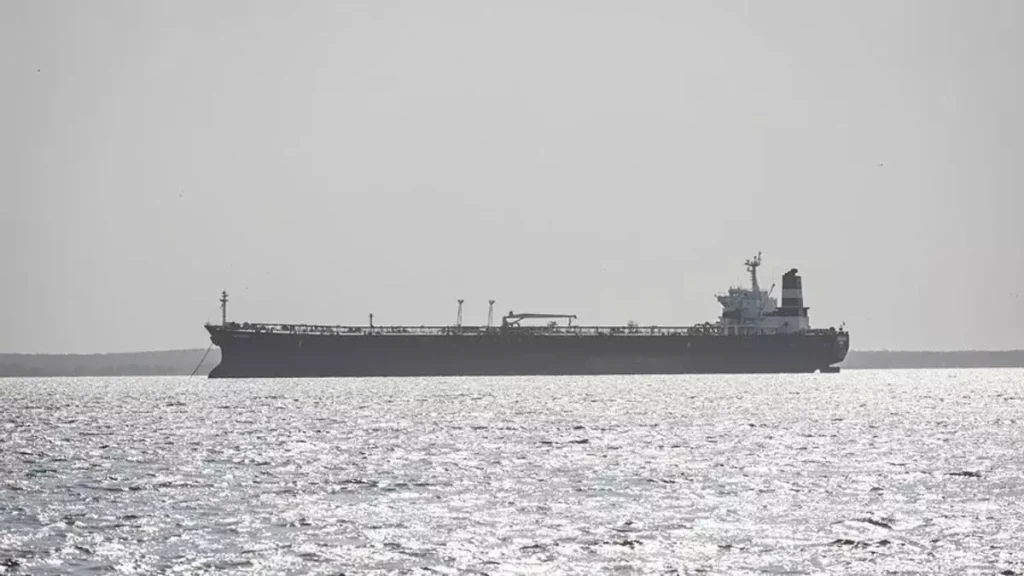
An oil tanker in Lake Maracaibo / EFE
EFE (via 14ymedio), New York, January 6, 2026 — Chevron has sent at least 11 oil tankers to Venezuela and they are expected to arrive at two ports controlled by the Caribbean country’s government amid changes following the arrest of Nicolás Maduro by the United States, Bloomberg reported on Tuesday.
The ships, two more than in December, have been chartered by Chevron, the only oil company with an export license despite US sanctions on the Venezuelan industry. They will arrive at the ports of José and Bajo Grande to load crude, Bloomburg reports, using its own preliminary data.
“Chevron remains focused on the safety and well-being of our employees, as well as the integrity of our assets. We continue to operate in full compliance with all applicable laws and regulations,” a spokesperson told EFE when asked about the matter, declining to comment on commercial issues.
“We continue to operate in full compliance with all relevant laws and regulations.”
According to Bloomberg, at least 12 oil tankers bound for Venezuela have had to turn back due to the US military presence in the Caribbean Sea.
Venezuelan crude exports fell to their lowest level in 17 months in December, amid the blockade imposed by US President Donald Trump on tankers carrying Venezuelan crude, Bloomberg added.
President Trump has said that the United States will “control” Venezuela until there is “a safe transition,” and that they will recover oil assets for US companies. President Trump has also threatened new attacks if the new government of Delcy Rodríguez “does not behave well.”
____________
COLLABORATE WITH OUR WORK: The 14ymedio team is committed to practicing serious journalism that reflects Cuba’s reality in all its depth. Thank you for joining us on this long journey. We invite you to continue supporting us by becoming a member of 14ymedio now. Together we can continue transforming journalism in Cuba.
Marco Rubio, Pete Hegseth and Stephen Miller will be in charge of Venezuela
The US president rules out a quick call for free elections in the South American country
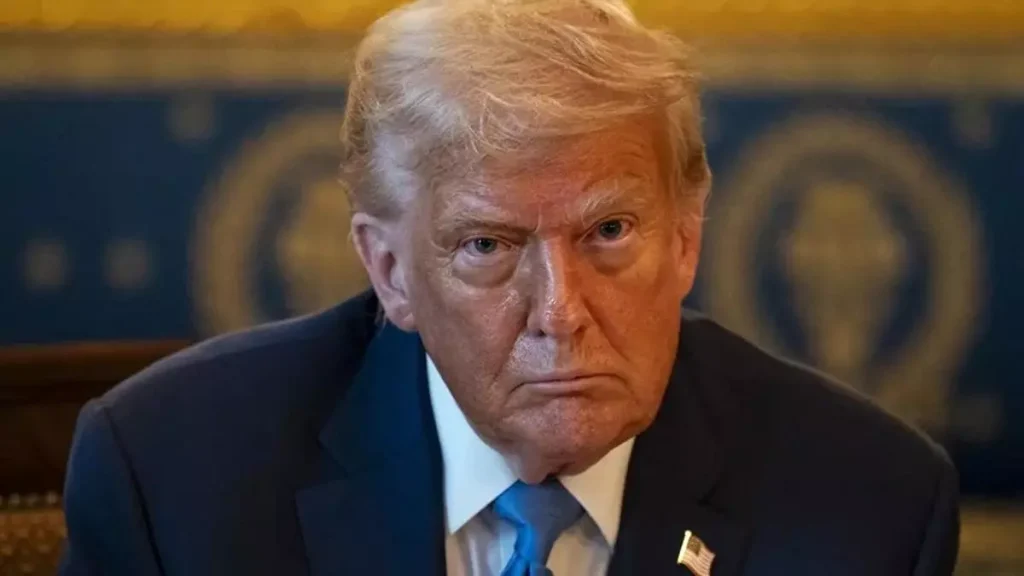
US President Donald Trump in a file photo. / EFE/EPA/Will Oliver/Pool
EFE (via 14ymedio), Washington, January 6, 2026 – US President Donald Trump said on Monday that Secretary of State Marco Rubio and Secretary of War Pete Hegseth, and the National Security and Migration Advisor Stephen Miller, will be in charge of coordinating the transition in Venezuela, while assuring that the country’s interim president, Delcy Rodríguez, is “cooperating.”
“I have a feeling that she’s cooperating. They need help. And I have a feeling that (Rodriguez) loves her country and wants her country to survive,” Trump said in a phone interview with NBC News about the woman who was Nicolás Maduro’s vice president before his capture on January 3 by U.S. forces.
The president added that there was no contact from Washington with Rodríguez before the military operation that arrested Maduro and his wife, Cilia Flores, at their residence in Caracas, where several locations in Venezuelan territory were also bombed. Rodríguez was sworn in as acting president of Venezuela on Monday before her brother, the Chavista Jorge Rodríguez, president of the National Assembly (Parliament), which also inaugurated a new legislative session dominated by el oficialismo that same day.
Trump also included his vice president, JD Vance, on the team in charge of Venezuela.
In the same interview with NBC, Trump also included his vice president, JD Vance, on the team in charge of Venezuela, although he has remained in the background since Saturday continue reading
when a large military and special operations deployment stormed Caracas to capture Venezuelan President Nicolás Maduro and his wife, Cilia Flores.
When asked who in that group would be primarily responsible for making decisions about Venezuela, Trump simply stated that he would have the final say. “It is a group of everyone. They’re all experts in different fields,” the president asserted in the phone interview.
The Washington Post reported on Sunday night that the White House was considering Miller, the architect of the Trump Administration’s anti-immigrant policy, for “a higher role” in managing Venezuela.
Secretary of State Marco Rubio explained on Sunday that U.S. officials in charge of leading the transition in Venezuela will do so from a “policy” perspective and that it will be a “national security effort.”
Trump outlined a longer-term transition in Venezuela and reiterated that the priority is repairing infrastructure.
On Saturday, Trump said the US would govern Venezuela, and yesterday he asserted that “we are in charge” of the country, while warning Rodríguez, who has gone from Maduro’s vice president to acting president of the country, that she faces a future worse than Maduro’s if she does not “do the right thing.”
In an interview with NBC, the US president ruled out holding elections in Venezuela within the next 30 days, until the country “recovers its health.” Trump outlined a longer-term transition in Venezuela and reiterated that the priority is repairing the country’s infrastructure.
“First we have to fix the country. There can’t be elections. There’s no way people can vote,” Trump said when asked about the possibility of elections within a month. “No, it will take some time. We have to help the country recover,” he concluded.
He also seemed to rule out the possibility of holding elections in Venezuela anytime soon. “I think we’re focusing more on fixing it, on preparing it first, because it’s a disaster. The country is a disaster,” he said.
____________________
COLLABORATE WITH OUR WORK: The 14ymedio team is committed to practicing serious journalism that reflects Cuba’s reality in all its depth. Thank you for joining us on this long journey. We invite you to continue supporting us by becoming a member of 14ymedio now. Together we can continue transforming journalism in Cuba.
The opposition leader says she would facilitate the return of Venezuelans who fled the country during Maduro’s government.
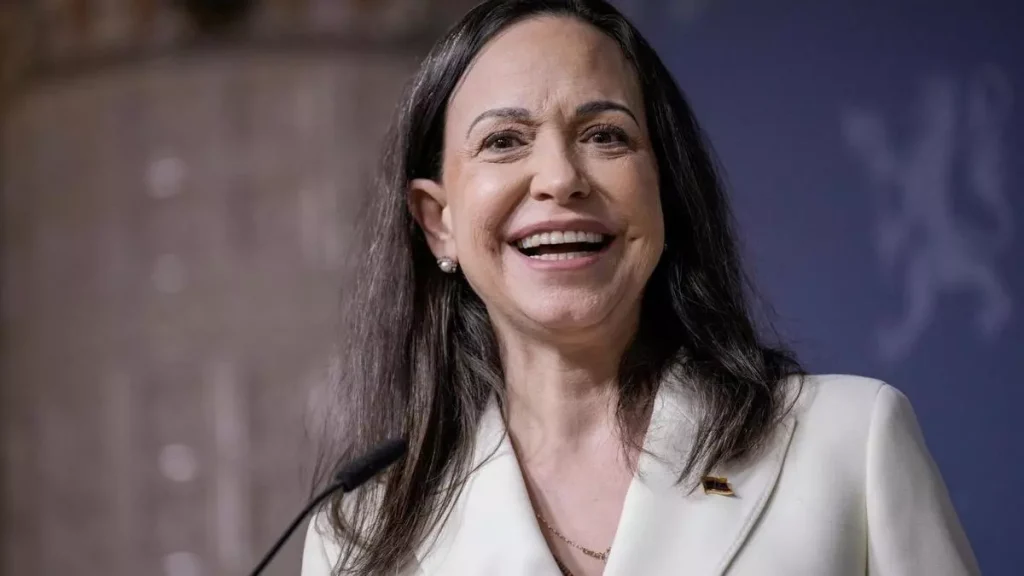
María Corina Machado, winner of the 2025 Nobel Peace Prize / EFE
14ymedio/EFE, Washington DC, January 6, 2026 — Venezuelan opposition leader Maria Corina Machado, winner of last year’s Nobel Peace Prize, told Fox News on Monday that she wishes to share the award with US President Donald Trump and thank him personally for Washington’s military intervention in Venezuela, which ended with the capture of Nicolás Maduro last Saturday.
“I would certainly love to be able to tell him personally that we, the Venezuelan people, believe—because this is an award of the Venezuelan people—we certainly want to give it to him and share it with him,” Machado said during the interview with host Sean Hannity.
She recalled that when she won the Nobel Prize, she dedicated it to Trump. “If I thought he deserved it in October, imagine now. I think he has shown the world what it means,” she added. Regarding this, she said, “January 3rd will go down in history as the day justice defeated tyranny. It is a milestone, and not only is it enormous for Venezuelans, it is a great step for humanity, freedom, and dignity.”
“If I thought he deserved it in October, imagine now. I think he has shown the world what it means.”
In the same interview, the opposition leader said she plans to return to Venezuela as soon as possible and specified that she has not spoken with Trump since Maduro’s capture by the United States.
Furthermore, Machado maintained that the opposition she leads would transform Venezuela into an energy hub for the Americas, restore the rule of law to guarantee the security of foreign investment, and facilitate the return of Venezuelans who, she said, fled the country during Maduro’s administration. It is estimated that, since 2014, 7.7 million Venezuelans, approximately 20% of the population, have left the country.
The opposition leader claimed her movement would win “more than 90% of the vote” in a free and fair election. However, Trump has publicly refused to endorse her and has ruled out calling for new elections in the near future. continue reading
Machado had signaled, through a message on social media, that “the freedom of Venezuela is near”
Hours earlier, Machado had signaled, through a message on social media, that “the freedom of Venezuela is near” and that “soon” its citizens, including those who are abroad, will “celebrate” in their own country.
The former congresswoman indicated in the message that the Venezuelan people “took to the streets in 30 countries and 130 cities around the world to celebrate a huge step that marks the inevitability and imminence of the transition” in the South American country.
“We are going to shout, pray and hug each other as a family, because our children will return home,” said Machado, who shared a video of some of these mobilizations in various countries along with the message.
“Let’s shout, pray, and hug each other as a family, because our children will return home.”
In addition, she stated that Venezuela “will be the United States’ main ally in matters of security, energy, democracy and human rights.”
However, Trump has questioned whether the opposition leader, who left Venezuela last December to receive the Nobel Prize in Oslo after nearly a year in hiding, has the capacity to govern, stating that she “does not have enough respect or support” in Venezuela.
____________
COLLABORATE WITH OUR WORK: The 14ymedio team is committed to practicing serious journalism that reflects Cuba’s reality in all its depth. Thank you for joining us on this long journey. We invite you to continue supporting us by becoming a member of 14ymedio now. Together we can continue transforming journalism in Cuba.
The White House says the number of Cuban deaths reported by the regime is likely lower than the actual number.
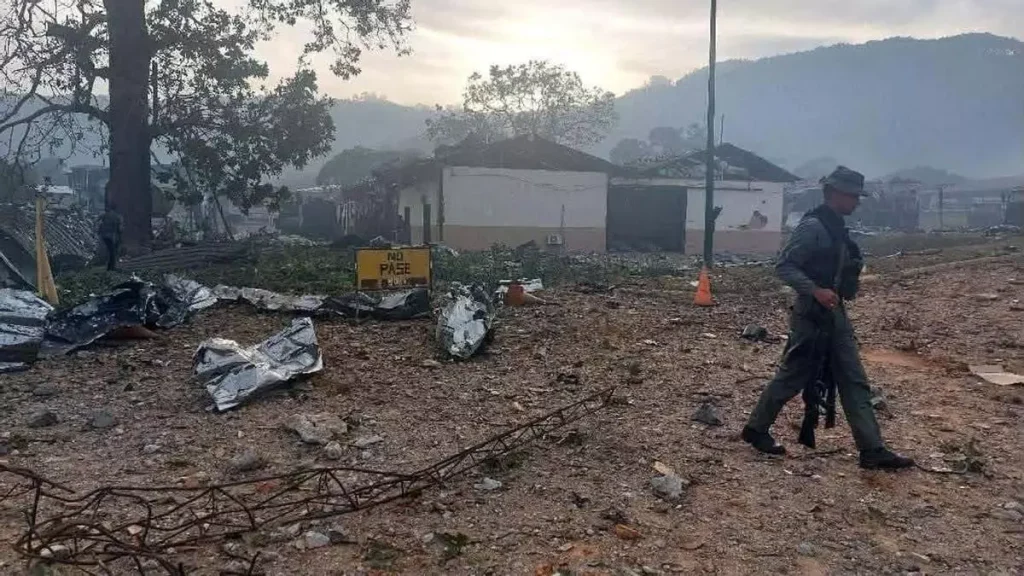
Image of one of the attacks carried out by the United States in Venezuela on Saturday. / Courtesy
14ymedio, Madrid, 6 January 2025 — On Tuesday, three days after the US intervention in Venezuela that resulted in the capture of Nicolás Maduro, the Cuban regime revealed the names of the 20 agents of the Ministry of the Interior and the 12 members of the Revolutionary Armed Forces (FAR) who died in the operation. “Victims of a new criminal act of aggression and state terrorism, perpetrated against the sister Bolivarian Republic of Venezuela by the United States,” states the official newspaper Granma, adding that the 32 deceased “lost their lives in combat and after fierce resistance.”
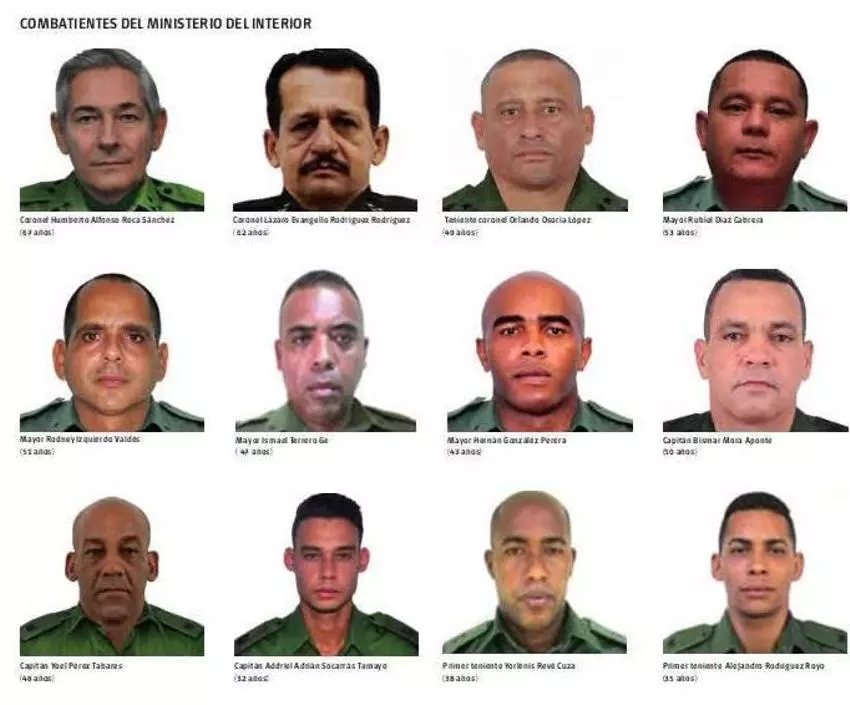
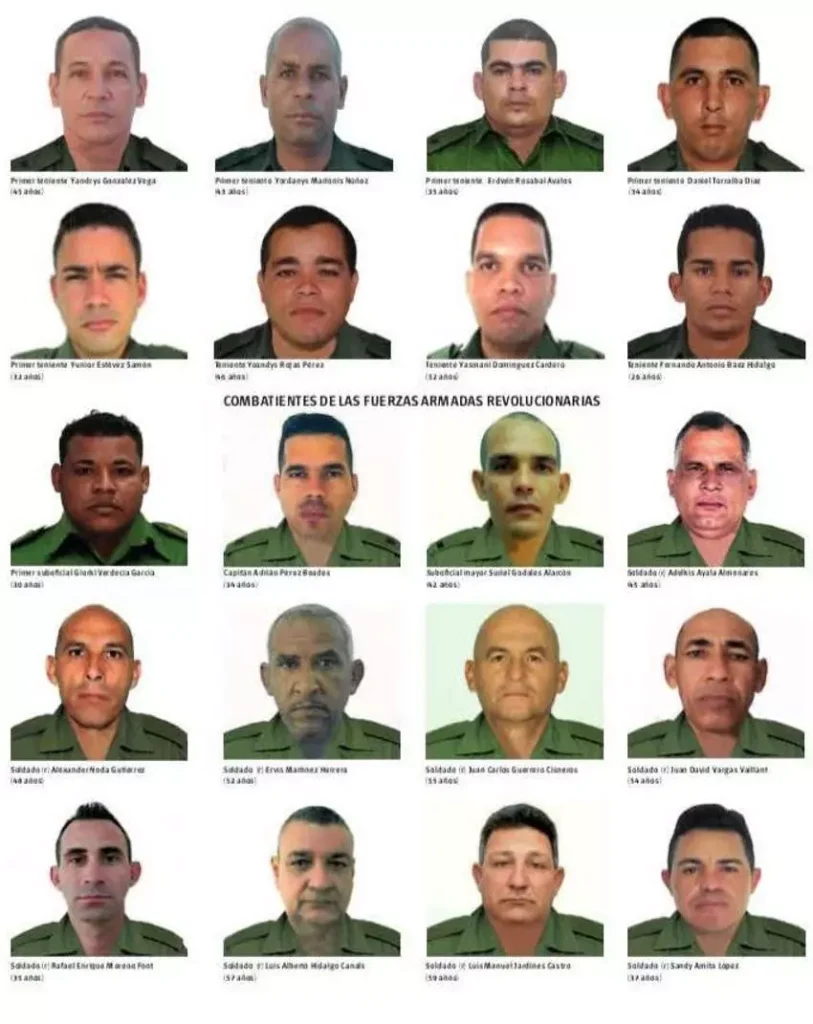
The agents, they claim, “were carrying out missions on behalf of the Revolutionary Armed Forces and the Ministry of the Interior, at the request of their counterparts in the South American country.” Among the deceased from the Ministry of the Interior are two colonels (Humberto Alfonso Roca Sánchez, 67, and Lázaro Evangelio Rodríguez Rodríguez, 62), a lieutenant colonel (Orlando Osoria López, 53), four majors (Rodney Izquierdo Valdés, 51; Ismael Terrero Ge, 49; Rubiel Díaz Cabrera,53; and Hernán González Perera, 43), and three captains (Yoel Pérez Tabares, 48; Adriel Adrián Socarrás Tamayo, 32; and Bismar Mora Aponte, 50). The FAR, for its part, lost only one commander: Captain Adrián Pérez Beades, 34 years old, and all the others were troops and a non-commissioned officer.
Of Roca Sánchez, the most senior and first on the published list, there is not a single detail about his studies, professional career, or missions, which suggests a high level within the intelligence apparatus. Something similar occurs with the second, Rodríguez Rodríguez, and the third, Osoria López. It is noteworthy that, of the 20 deceased from the Ministry of the Interior, 19 were officers.
It is noteworthy that, of the 20 deceased from the Ministry of the Interior, 19 were officers. / Granma
The rest of the deceased, according to the Ministry of the Interior, are: Yorlenis Revé Cuza (38 years old), Alejandro Rodríguez Royo (35), Erwin Rosabal Ávalos (35), Daniel Torralba Díaz (34), Yasmani Domínguez Cardero (33), Fernando Antonio Báez Hidalgo (26), Yandrys González Vega (45), Yordanys Marlonis Núñez (43), Yunior Estévez Samón (32), Yoandys Rojas Pérez (46), Giorki Verdecia García (30). From the FAR, the following fell: Chief Warrant Officer Suriel Godales Alarcón, (42 years old), and the privates Adelkis Ayala Almenares (45), Alexander Noda Gutiérrez (48), Ervis Martínez Herrera (52), Juan Carlos Guerrero Cisneros (55), Juan David Vargas Vaillant (54), Rafael Enrique Moreno Font (35), Luis Alberto Hidalgo Canals (57), Luis Manuel Jardines Castro (59) and Sandy Amita López (37).
Some of those names had already surfaced through posts by family members on social media. This is the case of Alejandro Rodríguez Royo, a resident of the Boniato neighborhood in Santiago de Cuba, as reported by independent journalist Yosmany Mayeta Labrada. According to testimonies gathered by the reporter, the family received conflicting accounts continue reading
from authorities regarding the location and transfer of the body. A family member recounted that they were first told the body was missing, then that it had been located and that they would be notified. According to this source, both Rodríguez Royo and his brother were allegedly linked to State Security structures.
Fernando Báez Hidalgo, a native of Río Cauto (Granma Province), linked to the Personal Security Directorate of the Ministry of the Interior and identified as Maduro’s direct bodyguard, was mentioned in several concurring publications. The First Secretary of the Communist Party in Granma, Yudelkis Ortiz Barceló, herself acknowledged that six of the deceased were officers from that province, although she did not specify their identities.
Similarly, Yunior Estévez, listed as “Yunio” by La Joven Cuba, is also mentioned. He was born in Palenquito Gil, a rural hamlet in Yateras, Guantánamo. However, the publication removed the initial post , which stated that the young man was a father of three and a cryptography specialist, “at the family’s request.”
Some of the names of the deceased had already been revealed through posts by family members on social media. / Granma
The deaths of Rubiel Díaz Cabrera, from Cauto Cristo, and Luis Manuel Jardines Castro, known as Jardinito , from Cueto, Holguín, who worked as a driver, have also been confirmed.
Other deaths had been reported under different names. For example, Erwin Rosabal Ávalos, from La Rinconada, Granma province, was referred to as “Erduin” in messages and publications as a member of the Venezuelan president’s inner circle of security. The same occurred with Orlando Osoria López, “Landy,” from Baire, Contramaestre, in Santiago de Cuba province, who was repeatedly described as a member of Cuban State Security and part of the team deployed in Caracas. Several publications place him among the deceased, even citing family addresses.
According to the US official, the assault in Caracas was a “furious gun battle” and the Cubans “suffered a massive number of casualties.”
Yorlenis Revé Cuza was also identified from Santiago as “Yordenis Marlonis.” According to various publications, he was part of the direct security detail for the Venezuelan president and his wife. He was the son of parents from the town of Dos Caminos and left behind his wife and young daughter in Cuba. Sources cited by La Tijera indicate that before his assignment in Venezuela, he had been a bodyguard for the former First Secretary of the Party in that province, Lázaro Expósito Canto, a fact that reinforces his affiliation with high-level security forces. Officials from the Ministry of the Interior reportedly informed his family of his death, although without providing specific details.
An agent who had been referred to as “Yandri” is likely Yandrys González Vega, whose death was announced by his cousin Moraima Rodríguez on social media. In her post, she expressed pride in his “duty fulfilled” protecting Maduro, a statement that, regardless of its tone, confirms the deceased’s role as a bodyguard.
Captain Yoel Pérez Tabares had been mistakenly identified on social media as “Caraballo.” A native of Consolación del Sur (Pinar del Río), his death was reportedly officially confirmed to his daughter by the Personal Security Directorate of the same ministry. His case was notable for being one of the few in which a direct and formal notification to a family member was mentioned.
On Monday, Stephen Miller, White House Deputy Chief of Staff, said in an interview with CNN that the number of Cubans killed as publicly reported by the regime is likely lower than the actual number. According to the US official, the assault in Caracas was a “furious gun battle” and the Cubans “suffered massive casualties.”
____________
COLLABORATE WITH OUR WORK: The 14ymedio team is committed to practicing serious journalism that reflects Cuba’s reality in all its depth. Thank you for joining us on this long journey. We invite you to continue supporting us by becoming a member of 14ymedio now. Together we can continue transforming journalism in Cuba.
To replace the crude oil given away by its ally, Havana would have to pay one million dollars a day in cash on the international market.
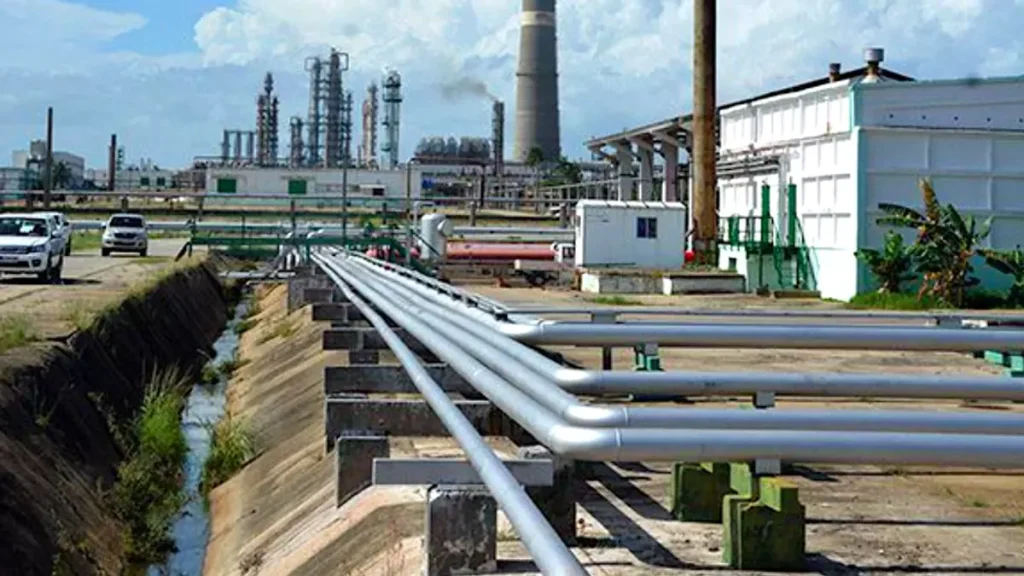
The Cienfuegos refinery, where some of Venezuelan crude oil is processed. / ACN
14ymedio, Madrid, 5 January 2025 — Is an operation similar to the one in Venezuela planned for Cuba? Asked this question from the press aboard Air Force One, which was taking him back to Washington from Florida, Donald Trump replied: “I don’t think we need to take any action,” because the Havana regime is going to fall on its own.
“Cuba looks like it’s about to collapse. I don’t know how they’re going to be able to stay afloat; they have no income. They received all their income from Venezuela, from Venezuelan oil,” the US president asserted. “Many Cuban-Americans are going to be very happy with us,” he added.
The potential damage to the Plaza of the Revolution caused by a possible oil shortage is evident, although the question remains whether alternatives will be found. The island’s oil needs are around 110,000 barrels per day (bpd), of which 40,000 are domestically produced, primarily for the thermoelectric and industrial sectors, according to Jorge Piñón, an expert from the University of Texas who reminded this newspaper.
The island’s oil needs are about 110,000 barrels per day (bpd), of which 40,000 are domestic production, mostly for the thermoelectric and industrial sector.
The specialist breaks down the demand using data from the National Office of Statistics and Information (ONEI) for 2023, although there may be changes during the next two years. According to these figures continue reading
, 67% of the needs (around 74,000 bpd) are for crude oil and fuel oil, and 18% (20,000 bpd) for diesel. In addition, 5,000 bpd of gasoline and another 5% of liquefied petroleum gas (LPG) are needed—5% of each—and 6,000 bpd of “other” fuels, bringing the total to 100%.
“We currently estimate a deficit of approximately 50,000 to 70,000 barrels per day,” explains Piñón, referring to 2025. “Diesel and LPG are the two critical fuels, not only because of their economic impact but also their social and political implications,” explains the specialist, specifying the uses of each. Diesel directly impacts distributed generation, transportation, agriculture, and hydroelectric power; while LPG is primarily used for cooking.
According to Piñón’s information, Venezuela sent approximately 35,000 barrels per day (bpd) to Cuba in the last quarter of 2025, compared to 5,500 bpd from Mexico and 7,500 bpd from Russia: for a total of 48,000 bpd. This amount forces Havana to purchase between 10,000 and 15,000 bpd of diesel and LPG from abroad, with the added burden of having to pay in cash and in advance, at a rate of one million dollars per day at current prices (87 dollars per barrel of diesel and 27 dollars per barrel of LPG).
Much more emphatically, Piñón told The New York Times: “It is a death sentence if Venezuela cuts off Cuba’s oil supply tomorrow.”
The Times consulted with other specialists about what might happen to Cuba under these circumstances. “There is a belief among Republicans such as [Secretary of State Marco] Rubio that once the supply of Venezuelan oil is cut off, the Cuban economy will collapse and trigger a popular uprising,” says Ricardo Zúñiga, a former U.S. official who played a key role in the thaw and who also worked with the Trump Administration, who questions this theory. “What we have seen in Cuba is that there seems to be no limit to the severity of the situation, as long as there isn’t an uprising.”
Another Times source, Michael Bustamante, doubts that action will be taken against Cuba for two reasons: it has no economic interest for the US, and its geographical proximity would lead thousands of people to enter the United Sttes in the event of a crisis. “If Rubio or others pursue a ‘Cuba is next’ approach, it will be more difficult for them to convince Trump,” he believes. Furthermore, and Piñón agrees, Washington may be too preoccupied with Venezuela to concern itself with Cuba, and there is no viable interlocutor on the island like there was in Caracas—referring to Delcy Rodríguez. “Cuba is much more of a one-party state, something Venezuela never was,” Bustamante emphasizes.
It is possible that Washington has too much work to do in Venezuela to concern itself with Cuba, and there isn’t a possible interlocutor on the island like there was in Caracas – referring to Delcy Rodríguez.
Carlos Alzugaray, a government critic, adds another point. “We don’t like being intimidated, and we don’t like it coming from people like Rubio. Most people here want change, but they want it here, not imposed from the outside,” said the former diplomat, who nevertheless hopes the regime will take note and “reform itself.”
The Argentine news channel Tele Noticias also spoke with Raudiel Peña, a lawyer with Cubalex, who warned of an “immediate impact” from Maduro’s fall: “It will be the loss of an ally.” “But we will have to see how the situation develops from now on. Maduro’s departure is one thing, the fall of the regime is another. The latter would indeed be a hard blow for Cuba in terms of losing an economic and political ally in the region. But Chavismo is still there, for now,” he said, adding that he believes Cuba will not be a “military” target.
Another player entering the fray is China, which received 90% of Venezuelan crude oil exports, including those from Cuba. Trump also addressed this. “We’re in the oil business. We’re going to sell it to them. We’re not going to say we won’t give it to them. (…) We’ll sell large quantities of oil to other countries, many of which are already using it,” he said yesterday.
Marco Rubio clarified that Washington does not want to allow “Venezuela’s oil industry to be controlled by adversaries of the United States” such as China, Russia, and Iran.
According to official data, direct purchases from PDVSA totaled approximately $729 million in 2024, compared to $94 million between January and November 2025. However, “Venezuelan oil accounts for less than 5% of China’s total imports,” notes Lin Boqiang, head of the Energy Policy Institute at Xiamen University, in statements reported by the Hong Kong-based South China Morning Post.
Those barrels are mostly destined for independent refineries in the eastern province of Shandong that import the heavy crude at discounted prices due to sanctions, and process it for applications such as asphalting.
“We do not believe that the events of this weekend will materially alter global oil markets and, consequently, global economic forecasts.”
Several experts consulted by the EFE news agency assert that Beijing had already anticipated eventualities like those that occurred and will not suffer if it is unable to import from Venezuela. “We do not believe that the events of this weekend will materially alter global oil markets and, consequently, will not effect global economic forecasts,” they point out.
The political level is different, since in Beijing it may not go down well that one of its biggest allies in Latin America is getting closer to the US, but experts refer to Chinese pragmatism.
“Beijing will condemn the US actions. But I doubt China will do much more than that,” predicts Bonnie Glaser, vice president of the US think tank German Marshall Fund of the United States, in statements to local media. “Venezuela is not among China’s priority interests, and there are far more drawbacks than advantages to taking actions that complicate Trump’s ability to secure a victory,” the analyst emphasizes.
____________
COLLABORATE WITH OUR WORK: The 14ymedio team is committed to practicing serious journalism that reflects Cuba’s reality in all its depth. Thank you for joining us on this long journey. We invite you to continue supporting us by becoming a member of 14ymedio now. Together we can continue transforming journalism in Cuba.

 14ymedio, Madrid, 8 January 2026 — At least two people have died in a traffic crash that occurred on Wednesday at around 7 p.m., when a bus coming from Holguín and carrying workers from the Mariel Special Development Zone veered off the road in Jimaguayú, Camagüey. The area, at kilometer 595, is known as the Ignacio curve.