The Oil Tanker ‘Ocean Mariner’ Arrived in Cuba With 100,000 Barrels of Mexican Fuel

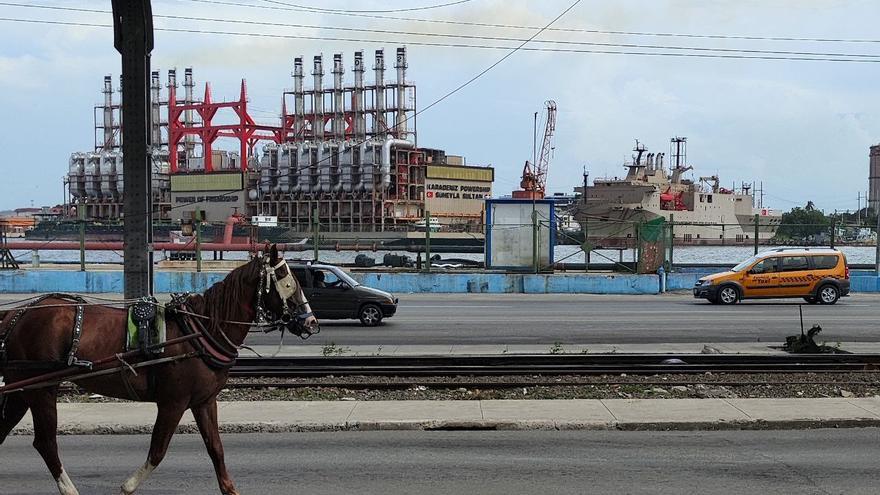
A pilot boat guided the ship through the bay to the Ñico López refinery, where it cast anchor. (14ymedio)

14ymedio bigger14ymedio, Havana, 26 August 2023 — The oil tanker Ocean Mariner, which sails with the flag of Liberia, arrived this Friday in the bay of Havana from the Mexican port of Pajaritos, in Veracruz. Although the petrochemical complex from which the tanker sailed denied having data about the cargo, one of its workers told 14ymedio that it is traveling with 100,000 barrels of fuel to be delivered to the Island.

This newspaper was present in the port of Havana during the arrival of the ship, at 7:30 p.m. this Friday. A pilot boat guided the ship through the bay to the Ñico López refinery, where it anchored.

“The ship carries less than a third of what was sent in the Delsa,” said the Pajaritos operator, alluding to the Cuban-flagged tanker that unloaded 350,000 barrels of crude oil last June in the Cuban capital, an operation that was denounced as “fraudulent” by Mexican journalist Gerardo Aburto. The cargo of the Ocean Mariner is “diesel or gasoline,” according to the worker.

The information about the shipments of the state monopoly Pemex to the Island, he concludes, is strictly controlled by the Secretariat of the Navy, which responds directly to the Government of the Mexican president, Andrés Manuel López Obrador. As already happened with the Delsa’s trip, the Mexican authorities have kept secret any information about the route or the contents of the tanker. continue reading

On June 17, Aburto accused the Mexican Executive of “giving crude oil to the oppressive government of Cuba” and diverting state resources. Two months later, in August, the British Reuters agency revealed that López Obrador had sent up to two million barrels of oil to Havana – 13,000 barrels per day (bpd) – in the last four months, a figure that places the Aztec country in second place on Havana’s list of oil partners, between Venezuela and Russia.

Mexico usually supplies Olmeca light crude oil, according to Reuters, a variety that “adapts to Cuba’s ancient refineries better than Venezuela’s heavy oil.” Most of the shipments arrive on the Vilma and Delsa ships, both with the Cuban flag and not sanctioned by the Office of Foreign Assets Control (OFAC) of the United States Department of the Treasury.

Since July, according to Reuters, the Vilma, previously used to transport Venezuelan crude oil to the Island, has made two trips from the Pajaritos terminal, in Veracruz, to the Cienfuegos and Havana refineries. From the same port of Veracruz and also to Cienfuegos, the Delsa arrived with oil in June, before continuing on to Venezuela, where, according to the British agency, it also took on crude oil.

The article mentions that other Cuban ships have been repaired or inspected in recent years at a shipyard in Veracruz, like the Esperanza, currently there and included on the U.S. blacklist. In summary, as the Reuters text headlines, the Island’s oil tankers are “regular visitors” to Mexican ports.

Translated by Regina Anavy 

____________

COLLABORATE WITH OUR WORKThe 14ymedio team is committed to practicing serious journalism that reflects Cuba’s reality in all its depth. Thank you for joining us on this long journey. We invite you to continue supporting us by becoming a member of 14ymedio now. Together we can continue transforming journalism in Cuba.

Keys to Cuban President Diaz-Canel’s Speech at the BRICS Summit

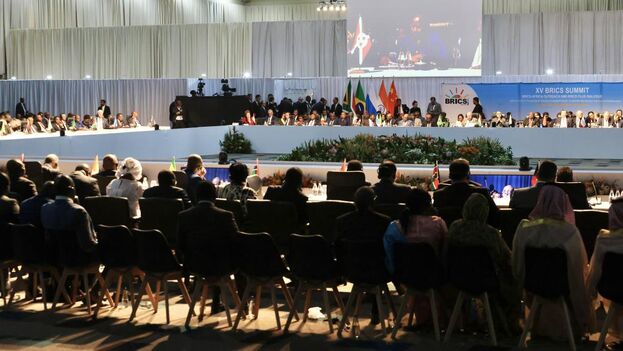
One of the sessions of the XV BRICS Summit in Johannesburg, South Africa. (Cuba Presidency/Twitter)

14ymedio bigger14ymedio, Elías Amor Bravo, Economist, 25 August 2023 — There was expectation about Díaz-Canel’s speech before the G77 and the BRICS gathered in Pretoria during the XV Summit of these countries. A missed opportunity to correct mistakes and and set things straight. Unfortunately, this is not present in the Cuban regime and, therefore, this speech can be classified as another missed opportunity. The Cuban state press has a long experience in reproducing these official speeches since the time of Fidel Castro. Then, a shorthand version could occupy five or six pages, given the annoying length of Castro’s speeches. Now, in the case of Díaz-Canel, his words are collected with the same professionalism, but the space needed is incredibly smaller. We have won something.

The Cuban communist began with reference to the fact that “to achieve a more just and sustainable future, the time for collective action is not tomorrow, it is now,” undoubtedly thinking about the situation of every man for himself for his failed experiments, the last one being the so-called bancarización* (banking reform).

According to Díaz-Canel, the BRICS summit “is an integration mechanism that, due to its novelty and diversity, opens expectations and hopes on the path of strengthening multilateralism, which today is as urgent as it is essential for the very destiny of humanity.”

And the truth is that by betting on this organization, the Cuban leader leaves the path of most of the West and democratic countries of the world, where freedoms and the rule of law open the way, and instead integrates countries of very diverse profile in which it is difficult to establish a level of comparison.

Then he made use of Castro’s populism to celebrate that the event is taking place in African lands, “the cradle of a part of our ancestors that fundamentally feeds the very essence of Cuban identity.” Demagoguery, because Díaz-Canel’s ancestors are in a different place, and even the reference to the satisfaction of being in South Africa has little to do with the history of Cuba in the region. continue reading

There was reference to the 400,000 Cubans who, according to Díaz-Canel, “contributed to the fight against apartheid in African lands and the 2,289 of our Cuban internationalist fighters who fell heroically, writing with their sacrifice one of the most beautiful pages in the history of solidarity between peoples.”

These references in which anything can fit led him to say, about the relations between South Africa and Cuba, that there are “solid and indelible imprints like the memory of the historic leaders of both nations. We can never forget the embrace of Nelson Mandela and Fidel Castro when they met here and asked to meet again, as only happens between very loving brothers.” Fidel Castro always appears as a salesman’s business card to open a cold door to get a customer. We’ll see how long it lasts.

At the presentation, Díaz-Canel justified his presence there as president of the Group of 77 and China, the largest and most diverse group of developing nations, in case anyone didn’t know or have any doubt about it. And then he dedicated himself to selling the characteristics of the organization, and the 134 countries, two-thirds of the members of the United Nations, that make it up.

In a clear allusion to the absence of an embargo or blockade on the Island, Díaz-Canel reaffirmed that in the countries of the organization, “almost 80% of the planet’s population lives facing the colossal challenges of an increasingly unequal world, in which exclusion and poverty have multiplied after two years of pandemic followed by dramatic conflicts.” A diagnosis that seemed to have been taken from United Nations documents on these issues.

And that’s when he addressed the crucial issue of debt. With great skill he turned a specific problem of Cuba into a global phenomenon, pointing out that “in the last ten years the nations of the South have seen their external debt double, now largely repaid.” The truth is that, as was seen in the London trial, the Cuban debt is more than 40 years old, and despite the generous pardons, it has never been reduced. This speech seemed taken from previous ones, but it was far from the incendiary messages of Fidel Castro.

Combining the debt with the deterioration of ecosystems, when no one understands the relationship between the two, Díaz-Canel said that “if we do not act immediately, we will bequeath to our children and grandchildren a planet not only unrecognizable to those of us  from the previous century, but also sadly condemned to become uninhabitable.”

This was the link that led him to talk about the Sustainable Development Goals of the 2030 Agenda and denounce that “half of the 169 agreed goals are far from being met. More than 30% of them have not experienced any progress or, what is worse, show regression compared to 2015, according to the most recent United Nations report.”

The typical recount of measures and compliance with the Castro alphabet that, however, does not contemplate Cuba’s widespread non-compliance with the Sustainable Development Goals and the permanent famine in the country, issues on which Díaz-Canel was inexplicably silent. He went on to condemn “the developed countries of the West and the large transnational corporations for designing an international order that does not take into account the progress of the nations of the South and is only effective for small minorities.”

And saying this kind of thing in international forums, Díaz-Canel still believes that someone may be interested in investing in Cuba. Of course, not even the clumsiest would have screwed up in this way in a place where everyone is watching.

But let no one have the slightest fear. Díaz-Canel wants the Group of 77 and China and the BRICS to be responsible for creating a change in that unjust world order, and he does not consider that an option: it is the only alternative. The Cuban communist leader has rejected international companies from developed countries as transforming agents of the world economy and has turned his gaze, desperate, to the BRICS, which do not have the same concept of focusing on the field of international investments.

For all these reasons, Díaz-Canel’s demand that the BRICS and the Group of 77 undertake a real transformation of the deeply unjust, anachronistic and dysfunctional international financial architecture, will be left as just one more demand without content or meaning, in a global world in which the Castro regime, the last dictatorship of the cold war, does not feel comfortable or even safe.

Díaz-Canel took the opportunity to praise the New Development Bank created by the BRICS as an alternative to the current financial institutions, in an exercise of soliciting aid that says very little about someone who lacks international solvency. The policies of this new bank will not be very different from those adopted by other organizations, no matter how much someone like Dilma Rousseff and her knowledge of the functioning of the financial system is at the head of that entity. I hope they don’t have to regret even greater evils.

The Cuban communist leader also described as laudable the BRICS initiative to create a broad-based foreign currency reserve mechanism that guarantees certainty and stability to the South. To think, like Díaz-Canel, that the extension of that mechanism to other countries would contribute to alleviating the imbalances of the current monetary system is still a chimera, as well as establishing mutual lines of credit in local currencies by the banks of the BRICS countries and the possibility of creating a single currency for their operations.

Díaz-Canel seems very interested and willing to participate in all these organizational plans, because, as he said, “they are also initiatives that could be applied in relations with other developing countries, to reduce the abusive monopoly of the US currency that reinforces and guarantees a harmful hegemony for the rest of the world.” Incredible.

The rest of the speech was aimed at reclaiming the agricultural production of the BRICS countries. In terms of climate change, he highlighted the strategic value of effective coordination between the BRICS and the Group of 77, to safeguard the principle of common but differentiated responsibilities in the implementation of the Framework Programme and the Paris Agreement. He also talked about strategic coordination between countries and scientific-technical development, among other things.

And, how could it be otherwise: he announced the next Summit to be held in Havana between September 15 and 16.

Fidel Castro would have made a different speech.

Translated by Regina Anavy

*Translator’s note: “Bancarización” is term used in Cuba and other Latin American countries that refers to government efforts to reduce the role of cash through a greater reliance on banks’ digital payment options. The term does not seem to have a counterpart in English so the Spanish term is used throughout this translation.

_________________

COLLABORATE WITH OUR WORKThe 14ymedio team is committed to practicing serious journalism that reflects Cuba’s reality in all its depth. Thank you for joining us on this long journey. We invite you to continue supporting us by becoming a member of 14ymedio now. Together we can continue transforming journalism in Cuba.

Cuba: Opposition and Opponents

Demonstrators in the Plaza de Cibeles, in Madrid, during the “March for Cuba” held in August 2021. (Screen capture)

14ymedio bigger14ymedio, Pedro Corzo, Miami, August 26, 2023 — Developing an effective political opposition in a democratic society is a complex and delicate matter, but when a dictatorship is challenged, the situation worsens drastically, since the purpose of autocrats is the permanent conservation of power and, for that, they must destroy the opponents before they become a force capable of dethroning them.

Reflecting on this motivated the former political prisoner Amado Rodríguez, 23 years behind bars, to say: “In Cuba there are many opponents, many brave ones, but it has not yet been possible in these more than 60 years to articulate an efficient opposition because the dictatorship prevents it, with its frequent raids, plus the iron social control it exercises over the population.” One of the first requirements of absolutism is to impose severe control over the citizenry through systematic, continuous, and brutal repression.

Another factor is the economic poverty of the opponents, particularly when the dictatorship acts within the framework of a totalitarian system.

Elections, even in democracy, are difficult and complex, so it is not difficult to imagine under dictatorships such as those of Cuba, Venezuela, Nicaragua and Bolivia, how false elections are called, particularly after the experiences of the autocrats Rafael Correa and Daniel Ortega, who called for elections without properly securing the fraud.

On the other hand, since public management is a monopoly of the State-Government, the political operation of  opponents is extremely complicated, a factor that does not prevent the appearance of opponents, although it does not cease to be extremely dangerous to develop and articulate an efficient opposition that can successfully challenge the government. continue reading

In order to bring together a viable opposition, it is essential to involve, with total commitment, a percentage of people similar to the sector that makes up the hard core of power. Let’s say that any of our despots has 35 percent of the electoral mass identified with their program; if so, the opponent must have a similar support if they want to compete with chances of success, and that is with the assumption that the elections are not rigged.

One factor that fully plays in favor of these rulers is the proliferation of candidates. When there are many challengers, even if it is in the primaries, the opposition force is divided, unless the candidates and their supporters have an absolute desire for change, regardless of who leads it.

In addition, there is a situation, despite how often it has been repeated, which has not served as a lesson to opposition leaders, and that is that the regime, being aware of the electoral farce that it promotes, does not make concessions regarding to the electoral power, knowing that the opponents, due to their democratic discourse, are obliged to participate in a certain way, even though there are not sufficient guarantees for the elections.

Facing a dictatorship, particularly the populist ones of any sign, demands great moral solvency and a lot of courage. Autocrats, politicians, or simple criminals, do not respect differences and resort to crime without contemplation, also, they have plenty of guard dogs, who, believing, that they interpret the will of their masters who are almost never wrong, tear enemies to pieces.

In addition, it is important to highlight that one of the fundamental characteristics of these regimes is the high level of political participation of the population. It is difficult to find indifference. One is against or in favor, the most notable being anger, irascibility and intolerance, which makes an appearance in discussions related to public affairs a situation that invariably ends in favor of the authority.

It should not be ignored, I consider it the basis of this column, that political predators, be they Castro-Chavistas, Marxists or Fascists, do not consider those who oppose them as mere rivals or adversaries; for them, those who reject them are enemies to be destroyed physically and morally. Consequently, those who do not agree that their living conditions should reflect the decisions of others, and whose opinions are censored, must prepare to face deadly enemies, who seek our destruction.

____________

COLLABORATE WITH OUR WORKThe 14ymedio team is committed to practicing serious journalism that reflects Cuba’s reality in all its depth. Thank you for joining us on this long journey. We invite you to continue supporting us by becoming a member of 14ymedio now. Together we can continue transforming journalism in Cuba.

The Expansion of the BRICS: The Dawn of a New World Order?

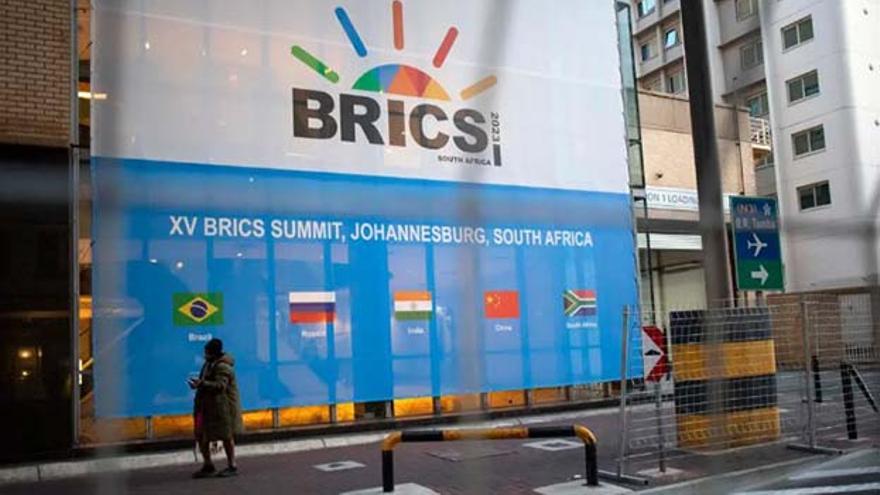
Poster of the BRICS summit in South Africa. (EFE)

14ymedio biggerEFE (via 14ymedio), Johannesburg, 26 August 2023 — BRICS, the group of emerging economies (Brazil, Russia, India, China and South Africa), enjoyed the spotlight this week when announcing in Johannesburg the accession to the bloc of six countries, including Argentina, and left an unknown in the air: will that expansion mark the beginning of a new world order?

In the midst of enormous anticipation, the president of South Africa, Cyril Ramaphosa, broke the news last Thursday to hundreds of journalists who crowded into a room at the Sandton Convention Center, in Johannesburg’s financial district, where the last day of the group’s XV Summit of Heads of State and Government took place.

The leaders of the bloc had approved access to the club of Argentina, Saudi Arabia, Egypt, Ethiopia, the United Arab Emirates and Iran, which will become “full members” beginning on January 1, 2024, the president revealed.

Without clarifying the accession criteria, Ramaphosa specified that there is “a consensus on the first phase of this expansion process, and other phases will follow.”

Some forty countries had expressed the desire to join the bloc, according to South Africa, which this year holds the rotating presidency of the bloc, with formal requests received from 23 nations, including Argentina, Bolivia, Cuba, Honduras and Venezuela. continue reading

Brazil, Russia, India and China created the BRICS in 2006, an informal club that was joined by South Africa (the S of the acronym) in 2010.

These countries represent more than 42% of the world’s population and 30% of the planet’s territory, as well as 23% of gross domestic product (GDP) and 18% of world trade.

Since then, the group, a champion of the Global South and  scourge of the western global hegemony, had not opened its doors to anyone due to disagreements among its members.

China, the second global economy, bet very strongly on expanding the BRICS – which are eager for more weight in international institutions, dominated by the United States and Europe – because Beijing is looking for more geopolitical muscle against Washington, the world’s first economy.

The Chinese president, Xi Jinping, could not contain his euphoria and called the expansion “historic,” and his colleagues in the bloc joined in, although with more temperate assessments.

The president of Brazil, Luiz Inácio Lula da Silva, who bid for the entry of neighboring Argentina, welcomed the new members and said that “the BRICS will continue to be the engine of a more just world order.”

But, EFE asked, what does the expansion mean for that world order? “This is a historic moment (…) that can completely change the relationship of what we saw so far; that is, a unipolar world is passing very quickly to a multipolar world,” replied the famous Uruguayan journalist Jorge Gestoso, who has interviewed numerous international leaders in his long career.

Gestoso believes that the planet is heading towards a new international order but warns that the “unipolar world” is not going “to stand idly by (…), and we might see bumps in the road ahead.”

An expert in international policy, Sanusha Naidu, of the Institute for Global Dialogue of South Africa, was more cautious in statements to EFE.  She does not necessarily see a new world order but does admit that the expansion of the BRICS alters “the dynamics of that world order by breaking down barriers.”

Although there is no doubt that the enlargement offers the bloc greater economic and political influence, it could also provoke new tensions between the members and the West, given the inclusion, for example, of Iran, a staunch enemy of the United States.

It should be remembered in this regard that Russia and Iran share a common cause in their fight against sanctions and the diplomatic isolation against them led by Washington, and that they deepened their economic ties after Moscow’s invasion of Ukraine.

The entry of Argentina, in addition, could generate problems in the group “because there is still the possibility of a change of government” in the country, Brazilian analyst Gustavo de Carvalho, of the South African Institute of International Affairs, told EFE.

The presidential candidate of the opposition coalition Juntos por el Cambio [Together for Change], Patricia Bullrich, expressed on Thursday her “opposition position” to the entry of Argentina.

“Argentina, under our government, will not be in the BRICS,” Bullrich warned in a speech, referring to the general elections on October 22.

On the economic and commercial terrain, Gestoso pointed out that the expansion, which includes three major oil producers (Saudi Arabia, Iran and the United Arab Emirates), could lead to a “tectonic movement” in the development of “a new financial architecture that can change the rules of the world’s game.”

In fact, this is where the BRICS have achieved their greatest success so far: the establishment of the New Development Bank, an organization inspired by the World Bank to finance infrastructure projects.

While the West digests the expansion of the BRICS, UN Secretary General António Guterres recalled on Thursday at the bloc summit that “today’s global governance structures reflect yesterday’s world,” and, therefore, “they must be reformed to reflect the  current power and economic realities.”

Translated by Regina Anavy
_______________________

COLLABORATE WITH OUR WORKThe 14ymedio team is committed to practicing serious journalism that reflects Cuba’s reality in all its depth. Thank you for joining us on this long journey. We invite you to continue supporting us by becoming a member of 14ymedio now. Together we can continue transforming journalism in Cuba.

The Increase in Products Available in Private Markets in Cuba Contributed to Moderating Inflation in July

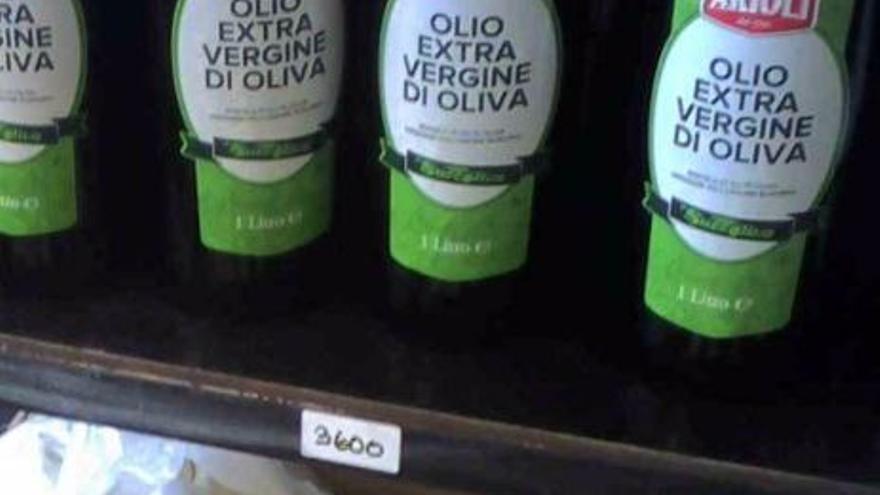
Olive oil, along with beer and chicken, is one of the foods most imported by MSMEs [micro, small and medium sized enterprises] (14ymedio)
14ymedio bigger14ymedio, Madrid, 21 August 2023 — Inflation continues to rise in Cuba according to official data, although its rise is moderate. In July, the consumer price index (CPI) increased by 1.06%, less than half of the previous month (2.46%) and the year-on-year variation was 41.7%, compared to 45% in June. In addition, for the first time in a long time, the increase in the price of food and non-alcoholic beverages is less than 1%.

Although many Cubans have claimed recently that the increase in MSME [micro, small and medium sized enterprises] offers was noticeable in containing prices, the data say a lot about the divorce between the official figures and the reality of citizens, who live permanently by resorting to an informal market in which food gets more expensive every day.

The rise in the price of beans is one of the most significant in July, with +7.2% for black beans and +8.4% for red. Along with malanga (4.9%) and eggs (1.8%), they are three foods whose prices are increasing, which is contained on this occasion (0.6%) thanks to the fall in the cost of white cheese (-4.5%) and pork (-0.5%). Poultry meat decreased by 3.8%, as did oil (-2.3%) and spaghetti (-1.8%).

Transport, in a vacation month, was once again one of the most expensive of the items that make up the statistical basket of goods and services. It rose by 3%, slightly less than in June (3.7%), but the price of intercity trips in various vehicles grows by more than 5%, followed by urban taxis and bicitaxis and intercity taxis with +4.9% and +3.8% respectively. Urban transport (by truck, jeep, cart or car) and buses also became more expensive, although less so, with an average of +2.7%. continue reading

Another area that has usually registered large increases is that of hotels and restaurants. In June, that sector increased its prices by 4.20%, but this July the increase is 1.8%, which still supposes a greater effort.

Sodas and snacks, at +2.4%, are the two products in that section that increased the most, while lunch and food increased 1.7% and takeout food a modest 0.7%. Beer attracts attention here, because it is the only food product that depreciates, by -0.6%. These figures make it clear that the most expensive foods are the national ones, while those imported by the MSMEs have lower prices.

Alcoholic beverages and tobacco repeat as the only sector in which prices have been constantly falling for months. The fall of 1.7% in July is one more that results in a year-on-year decrease of 20.7% in the prices of these products, highlighting cigarettes, which have lost a lot of value this year. In the month of July alone, the price was reduced by 2.56%, but the loss for previous months is 7%.

In the rest of the sectors, whose contribution to the CPI is less influential for Cubans, the increases in various goods and services (1.2%) and housing services (0.73%) stand out, as do recreation and culture (0.77%) and clothing and footwear (0.39%). While health (0.09%) and communications (0.04%) do not reach 0.1%, they are still increasing in price.

Official statistics show a current trend to contain the dizzying increases that Cubans have been suffering, especially in the last year when the year-on-year variation in food prices reached figures of more than 70%. Despite this, the collapse of the products offered in the legal market also explains why that sphere is becoming less and less useful for measuring the evolution of prices.

The American economist Steve Hanke, who calculates inflation with information from the informal market, placed Cuba’s annual rise in the CPI at 102% in his last balance sheet, at the beginning of August, much more than double the 44% reported by the Cuban government with the official data. In addition, the peso is, according to this specialist, the fourth worst currency in the world in terms of loss of purchasing power, behind only Zimbabwe, Venezuela and Syria. In his latest assessment, the professor of Applied Economics at Johns Hopkins University indicated that it has fallen more than 70% since January 1, 2022.

Translated by Regina Anavy

____________

COLLABORATE WITH OUR WORKThe 14ymedio team is committed to practicing serious journalism that reflects Cuba’s reality in all its depth. Thank you for joining us on this long journey. We invite you to continue supporting us by becoming a member of 14ymedio now. Together we can continue transforming journalism in Cuba.

Sales by Cuba’s Private Businesses Tripled in the First Half of the Year

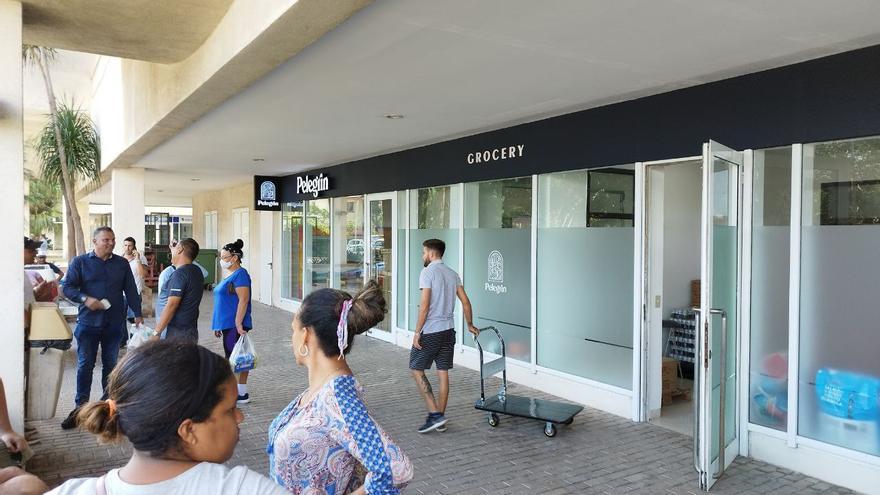
Small private Cuban companies specializing in the sale of imported food items have made their presence felt in recent months. (14ymedio)

14ymedio biggerEFE (via 14ymedio), Havana, August 25, 2023 — Sales of goods and services by Cuba’s micro, small and medium-sized private businesses (MSMEs) tripled in the first half of 2023 compared to the same period last year according to a report issued by Cuba’s National Statistics and Information Office (ONEI) on Friday.

However, the total sales volume of these businesses, which have only been in operation for two years, accounted for only slightly more than 4% of the total sales of goods and services in the first six months of the year. The rest were sales by state-owned companies.

According to the ONEI report, “Sale of Retail Goods and Services, January-June 2023,” the figure came in at 132.6 billion Cuban pesos (or 5.5 billion dollars at the official exchange rate), 26% more than in the same period last year.

Of this, the state sector had sales totalling slightly over 127 billion pesos (95.90%) with the private sector coming in at just under 5.5 billion pesos (4.10%).

Sales of goods climbed to 57.6 billion pesos, a 14.4% increase, while services rose 23.7% to 45.7 billion pesos. The food service sector rebounded 63.5% to 29.3 billion pesos.

State-owned companies, the Cuban government’s top priority, sold 22.9% more than in the comparable period. Meanwhile, MSMEs increased their sales volume 206.8% in part due to the approval in recent months of hundreds of new private business licenses.

What stood out in the ONEI report was the performance by the food service sector, which increased sales substantially in the year-on-year comparison. Figures for state-owned businesses increased 51.6% while privately owned ones grew in 615.8%. continue reading

Food services accounted for  49.69% of all MSMEs’ sales volume in that period compared to 20.90% in the public sector. Combined, the sector is responsible for 22.08% of total sales.

In the state-run sector, retail businesses had the largest share of sales volume (43.45%), followed by service-oriented businesses (34.47%), with restaurants and food services making up the rest.

In the private sector, by contrast, food services made up 49.69% of sales volume, compared to 45.06% for retail and 5.25% for service-related businesses such as basic supplies, communications and transportation, in which by law the state has a near total monopoly.

The surge in the number of MSMEs, which were banned for fifty-five years, began in the fall of 2021 after reform measures were adopted to deal with a severe economic crisis. Though there are currently about 8,000 of them in Cuba, they remain a subject of controversy.

Some applaud their role in helping to alleviate the severe shortage of basic consumer goods that the country has experienced for more than two years and believe they represent the beginning of greater economic opportunity in Cuba.

Among their chief critics are pro-government factions who blame them for fueling high inflation. There are government critics, however, who claim these new businesses are controlled by the country’s political and military elite and do not represent real change.

____________

COLLABORATE WITH OUR WORKThe 14ymedio team is committed to practicing serious journalism that reflects Cuba’s reality in all its depth. Thank you for joining us on this long journey. We invite you to continue supporting us by becoming a member of 14ymedio now. Together we can continue transforming journalism in Cuba.

Moscow Is Involved in the Digitization of Fiscal Control for Private Businesses in Cuba

The experts of the Stolypin center accompanied Titov during his meeting with Cuban President Miguel Díaz-Canel last January. (Twitter/Presidency Cuba)

14ymedio bigger14ymedio, Havana, 26 August 2023 — In the midst of the process of bancarización* [banking reform] of transactions in Cuba, a group of Russian experts advises the Cuban Minister of Foreign Trade and Foreign Investment, Ricardo Cabrisas, on issues of “digitalization of fiscal control and electronic banking.” His proposal: the foundation of a Business Development Bank “in collaboration” with Moscow.

The Stolypin Institute of Growth Economics, a thought center based in Moscow, offered the Island authorities details about the “Russian experience” on the subject, as reported to the RIA Novosti agency by Boris Titov, president of the Business Council between the two countries.

The new bank will function as a “specialized financial institution,” which will be supervised by a Russian banking entity, to “maintain records of commercial entities, provide online registration, open accounts for them, maintain settlement and cash services, transfer taxes as a tax agent and transfer data in automated format to the tax authority of the Republic of Cuba.”

The Business Development Bank will have the responsibility of supplying the Island with the payment terminals and boxes indispensable for its own activity. In addition, Moscow proposes to unify in the same virtual platform the banking processes carried out by micro, medium and small companies (MSMEs), such as registration, tax payment, account opening and cash management. continue reading

Antón Sviridenko, director of the Stolypin center, pointed out for his part that the Island’s regime “is thinking about the transition from strict state regulation to the development of private competition” and that for this, a greater digitization of fiscal control processes is indispensable.

The initiative responds to the strategy recently enunciated by the Cuban Government, since it proposes to “drastically reduce the circulation of cash,” in the words of Sviridenko, who also promised that if the Business Development Bank is used, it will help the “de-dollarization of the Cuban economy” and promote greater price control.

The experts of the Stolypin center accompanied Titov during his meeting with Miguel Díaz-Canel last January, in which they agreed to take relations between Cuba and Russia to a “higher moment.” During the meeting they also agreed to the foundation of an “Economic Transformation Center” that Cubans have just learned about.

At that time, Titov assured that Cuba would have Russia’s advice for the creation of “digital systems for companies” such as those that his country has implemented “successfully.”

The initiative of the Stolypin center is similar to the one approved by the Cuban government, last July, for the conversion of the Spanish company Alto Cedro, present on the Island since 2020, into a corporate bank. The company can open accounts and provide financing to Cuban companies, but not to MSMEs, a ban that will not apply to, it seems, the Russian Business Development Bank. The objective of the restriction, according to a source close to the Alto Cedro directive who was interviewed by 14ymedio, is “to benefit the state authorities and the MSMEs that they authorize.”

Even under the strict supervision of the Central Bank of Cuba, Alto Cedro – led by the Spanish tycoon Javier Botín, linked to the Santander bank – has the power to “monitor its debtors” and receive and grant loans.

Despite the dizzying rapprochement of Havana and Moscow, relations between the two regimes have not been exempt from tensions. According to the Russian press, the Ural vehicle factory, located in the town of Miass, will sue the Cuban State Import and Export Company of Technical Products (Tecnoimport) and the International Trade Bank, for 23.4 million euros.

The factory is asking for 22 million euros for losses caused by companies on the Island and another 1.4 million for the “use of other people’s funds” for several years. As part of a cooperation process, the company sent parts to assemble 120 GAZ vehicles and 500 Ural trucks that had to be assembled in Cuba with Russian advice, through audiovisual material.

“The Cuban side found reasons not to pay. They explained that the vehicles do not circulate and it is impossible to assemble them. However, in the photographs of a military parade it was clear that the vehicles were in motion and were being actively used,” explained the Ural workers, alluding to the exhibition of the Armed Forces during the “Freedom Caravan” organized at the beginning of last January. The trial of the Island’s two entities will take place in Moscow in mid-September.

Translated by Regina Anavy 

*Translator’s note: “Bancarización” is term used in Cuba and other Latin American countries that refers to government efforts to reduce the role of cash through a greater reliance on banks’ digital payment options. The term does not seem to have a counterpart in English so the Spanish term is used throughout this translation.

____________

COLLABORATE WITH OUR WORKThe 14ymedio team is committed to practicing serious journalism that reflects Cuba’s reality in all its depth. Thank you for joining us on this long journey. We invite you to continue supporting us by becoming a member of 14ymedio now. Together we can continue transforming journalism in Cuba.

A Hazardous Walk through the Stinking Puddles and Public Toilets on Boulevard de La Habana

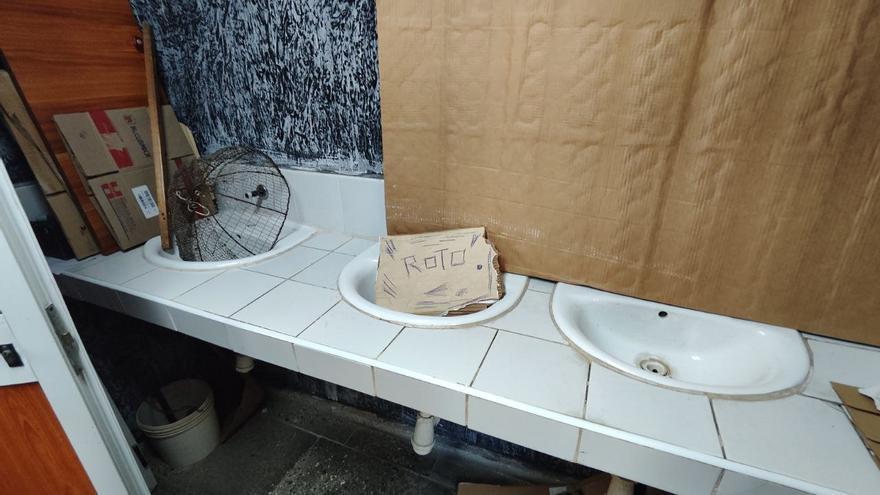
On a piece of cardboard, crude letters display that it’s “broken”.(14ymedio)

14ymedio bigger14ymedio, Juan Diego Rodríguez, Havana, 23 August 2023 – The umpteenth renovation of Boulevard de La Habana is beginning to show its wrinkles. The make-up of triumphalism with which many bars were reopened on this pedestrian precinct on Calle San Rafael has been fading with the passage of months. The blockages in the plumbing, which became the hallmark of the place for years, have returned in a number of shops and businesses, and in the public toilets – the only ones available in the area.

“It’s like a curse, they fix them, make them nice and then they all get destroyed again”, laments Evaristo, a pensioner who was born here and has spent his life on the corner of San Rafael and Águila. From his balcony he can view the whole street, which is daily one of the busiest in the whole country. Evaristo has watched the Boulevard deteriorate for decades, later seeing it fill up with potholes then the arrival of construction teams for the fifth centenary celebrations of Havana in 2019, and now he feels the impact of the current crisis on its infrastructure and its people.

Although the painted facades are “enduring”, another resident tells 14ymedio, the cafeterias, which began the post pandemic period with vigour, have reduced their range or have been dragged down by the wave of inflation which has made many products prohibitive. The advertising screens which at one time generated some surprise there on the pavements are now all switched off and the previous smell from the drains has come back to permeate the area once again.

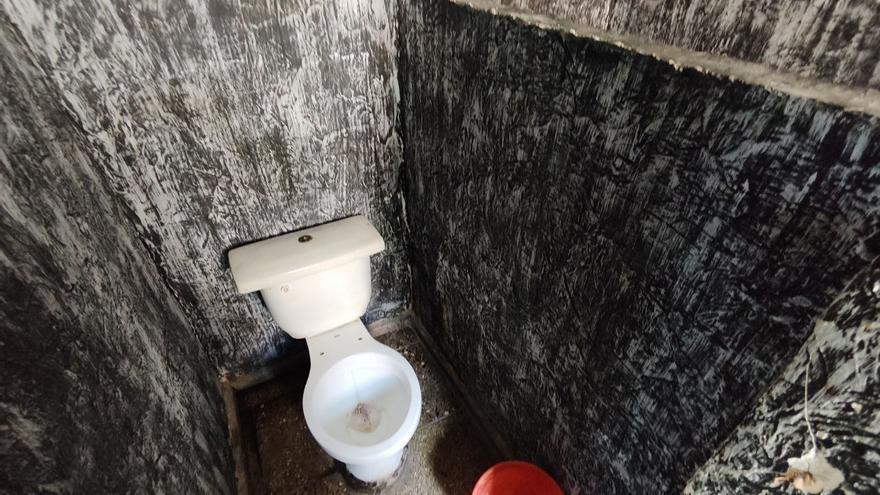
The toilet cubicles smell bad, the toilet-bowls have no water and the walls have been painted in a way that resembles the inside of a prison cell. (14ymedio)

The worst deterioration can be found if you decide to go into the public toilets situated on the street linking Calle Galiano with Paseo del Prado. After paying 5 pesos, you’ll find that the hand basins in the gents don’t work and that there’s a piece of card with crude letters saying that it’s “broken”. The toilets smell bad, the toilet-bowls have no water and the walls have been painted in a way that resembles the inside of a prison cell.

On leaving the narrow and stinking toilets, the poor pedestrian would hope for something better outside. But no. There he will have to navigate: the greenish and stinking puddles that spring up in the corners of the boulevard, the balconies, painted but still in danger of collapse, and the stench of rubbish coming from the old shop End of the Century, closed down years ago. During this little journey he’ll have to watch his pockets and speed up his step to get out of the place. From his vantage point, Evaristo will follow him with his gaze until he disappears down some side street.

Translated by Ricardo Recluso

____________

COLLABORATE WITH OUR WORKThe 14ymedio team is committed to practicing serious journalism that reflects Cuba’s reality in all its depth. Thank you for joining us on this long journey. We invite you to continue supporting us by becoming a member of 14ymedio now. Together we can continue transforming journalism in Cuba.

A Coach From the Cuban Team Participating in the Little League Escapes in Pennsylvania

José Pérez abandoned the Cuban delegation in Williamsport. (@YordiMLB)

14ymedio bigger14ymedio, Havana, 21 August 2023 — José Pérez, one of the coaches of the Bayamo team that competed in the Little League World Series, escaped on Saturday. According to a report by North Central PA, he left the International Grove complex in Pennsylvania, where the Island’s team is housed, “in the dark.”

The digital media Café Fuerte confirmed that Pérez decided to stay in the United States and has requested asylum.

Little League International spokesman Kevin Fountain corroborated Pérez’s escape. “We will ensure that the Bayamo team continues to have the best support and experience while in Williamsport,” he said.

The coach was no longer present at the game last Sunday, in which the Bayameses were defeated 3-2 by Panama at Volunteers Stadium.

Nothing was reported about Pérez’ abandonment in the official media Jit. “On Saturday, U.S. sports authorities and the Cuban Baseball Federation signed an agreement that ratifies the commitment to the development of the Little League in Cuba,” the digital portal reported. The creation of softball leagues was also incorporated into the plan. continue reading

Pérez’s escape takes place in the same week as the departure from the Island of the players Santiago Torres, Carlos Rodríguez and José Wilmer Durruthy, all with experience in the National Series.

According to journalist Francys Romero, Torres and Rodríguez are in Mexico waiting for the procedures to reach the United States legally.

“Torres, 28, was in the Caribbean Cup held in Curaçao during 2021 and also signed for a brief period in Panama’s winter baseball,” the reporter said. While Rodríguez was part of the Cuba Under-23 teams, he joined the representative of the Island in the Pan American tournament in Aguascalientes, which took place last year, and he also participated in the World Cup in that category that was played in Taiwan. In April 2023, he participated in the Alba Games that took place in Venezuela.

Translated by Regina Anavy 

____________

COLLABORATE WITH OUR WORKThe 14ymedio team is committed to practicing serious journalism that reflects Cuba’s reality in all its depth. Thank you for joining us on this long journey. We invite you to continue supporting us by becoming a member of 14ymedio now. Together we can continue transforming journalism in Cuba.

Goodbye, Hemingway; Goodbye, Floridita

Vines and ferns grow between every balcony while a skeleton of pipes and rebars barely manages to hold the structure in place. (14ymedio)

14ymedio bigger14ymedio, Juan Diego Rodriguez, Havana, 25 August 2023 — Like the Hotel Ambos Mundos or the Finca Vigía, the iconic salmon-colored façade of Havana’s El Floridita, serves as a shrine to the memory of Ernest Hemingway. Anyone walking along Obispo Street, or crossing Central Park looking for the famous restaurant, founded in 1812, will find it. However, what they will see flanking it are dilapidated buildings whose potential collapse threatens not only the “birthplace of the daiquiri” but also the hundreds of Havana residents who ponder the possibility of the buildings’ demise every day .

Havana’s historic heart is falling apart and many buildings, abandoned or on the verge of being abandoned, are like grotesque doll houses. Vines and ferns grow between every balcony while a skeleton of pipes and rebars barely manage to hold the structure in place.

Sweaty and in a hurry are the few tourists who come here. Before entering Floridita, they take note of the flimsy balconies overhead. What is most surprising, however, is that the buildings next door are still inhabited, housing many Havana residents who live there on the cusp of poverty. Meanwhile, the awning of the bar-restaurant still tries to lure customers with promises it hasn’t kept for awhile: “Speciality: fish and shellfish” and “European Quality Award”.

A group of people wait for the bus and try to avoid the puddle of stagnant rainwater encroaching on the sidewalk.

A few blocks away, on the same Monserrate street, the leap from tourist Havana to the real Havana is drastic. A group of people try to avoid a puddle of stagnant rainwater encroaching onto the sidewalk. The liquid accumulates around the public benches and, as the days go by, it turns black. To make matters worse, the flooded walkway has begun filling with plastic bags, cans, food scraps and all manner of filth.

Accustomed to the sordidness of this bus stop, people waiting there choose to look across the street. (14ymedio)

Accustomed to the sordidness of this bus stop, people waiting there choose to look across the street or, more often, at their cell phones, where a video of Dubai or Paris, or the voice of an emigré family member helps them forget, if only for a moment, the ditch and the rubble. continue reading

In their faded clothes and with sadness in their eyes — more defeated than destroyed — any one of them could be a character out of a novel by the old American writer, whose bronze statue now welcomes tourists to the Floridita bar as if the radiant Havana of 60 years ago years had never said goodbye.

____________

COLLABORATE WITH OUR WORKThe 14ymedio team is committed to practicing serious journalism that reflects Cuba’s reality in all its depth. Thank you for joining us on this long journey. We invite you to continue supporting us by becoming a member of 14ymedio now. Together we can continue transforming journalism in Cuba.

To Maintain Its Control, the Regime Promotes the Departure of Cubans From the Country

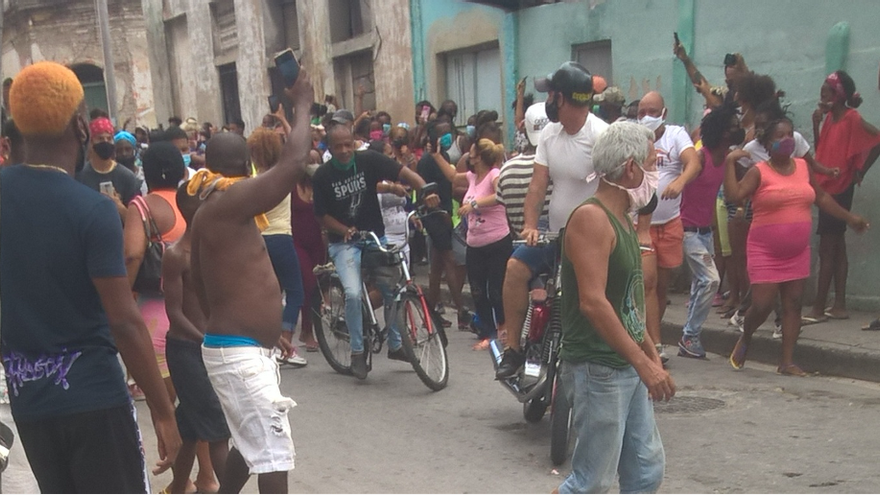
Protests in Santiago de Cuba on July 11, 2021. (14ymedio)

14ymedio bigger14ymedio, Frank Calzón, Miami, August 25, 2023 — The only hope is to get out. This phrase, on the lips of many of those who wait under the tropical sun for the water pipe that does not arrive, for the electricity interrupted hours ago or in line with the ration card in hand is repeated in conversations on the Island, in newspapers, and in exile radio and television programs.

But it’s not true.

It’s not true that the only hope is to leave. The idea that the only option is to emigrate to escape hunger and repression is promoted by the regime itself to maintain its control, and is repeated by thousands of desperate people who have been suffering from ignominy and discouragement for six decades. It’s an idea that ignores the terminal phase in which the regime finds itself, its lack of responses to the national crisis, its discredit before international public opinion and its own people, who once believed in its promises and risked their lives to achieve them.

Hope is before our eyes, because, as in Eastern Europe after the fall of the Berlin Wall, the once acclaimed Revolution is in its terminal phase.

The regime needs the opposition to leave, when those who should be the ones leaving are the leaders, who are responsible for the deaths of thousands of Cubans and the disaster that is today’s Cuba.

State Security also wants to convince us that there is no viable opposition in Cuba, that the exiles are mercenaries, that the future is the continuity of what exists and that the streets belong to the revolutionaries.

But no one believes them anymore. continue reading

On the island there are leaders such as José Daniel Ferrer, who was offered release when he was serving four and a half years in prison, on the condition of going into exile with his family, permanent exile, without the right to return.

In 2020, under international pressure, he was placed under house arrest and remained in Cuba leading the Cuban Patriotic Union (UNPACU).

During the massive protests of July 2021, he was again arrested and sentenced in a trial without the slightest procedural guarantees, to four years in prison, for his non-violent opposition to the arbitrariness that occurs in the country, and for believing in the ideas of peaceful resistance of Martin Luther King, Mahatma Gandhi and Vaclav Havel. And, like Martí, he believes in working for a Cuba with all and for the good of all.

But continuity barely exists in the world, and all those who bet on paralysis and inequity always end up on the garbage heap of history.

The more than a thousand political prisoners and the demonstrations of discontent that continue are proof of that “subterranean force” of which Marti spoke, in response to those who proclaimed that Cuba would continue to be Spanish and that separatism no longer had the strength to win.

State Security also says that we are alone, that no one is interested in Cubans. That’s not true either.

There are international organizations, democratic governments and press media around the world that demand the freedom of prisoners, denounce human rights violations in Cuba and look for ways to put pressure on the regime. In the European Union, some deputies denounce the fact that Havana has not fulfilled its commitments and ask for the suspension of the agreement that represents billions of dollars annually.

But the most important hope, which will liberate the Island, is within Cuba. Political prisoners must be the first priority of Cubans with honor, and we must help them.

There is hope is in the miracle of a generation that was born and grew up under Castroism and that, despite censorship and indoctrination, rejects it, protests in the streets, suffers in prison, refuses to participate in any project promoted by the Government and does not leave or shut up.

Political prisoners, their families and the activists who support them are our heroes. The exile community will never turn its back on them. They deserve to be free, like all Cubans.

There is also hope in the rebirth of the Church and in the courage of the parish priests who oppose one Cuban raising his hand against another Cuban, and in the organizations and leaders of exile that in Miami, Brussels, Madrid, Geneva, Warsaw, Washington and in other capitals work tirelessly for the United Nations to expel the regime from the Human Rights Council, as they did with Putin, despite the strong opposition of China, Iran and Cuba; and for the United States to fulfill President Joe Biden’s promise to give free Internet to the Cuban people and to put conditions on remittances so they don’t end up in the pockets of “the oppressors.”

The Biden Administration has responded negatively to Havana’s the campaign and its lobbyists in Washington to remove Cuba from the list of countries that don’t cooperate against terrorism, unless the regime hands over to the United States the terrorists who live on the Island and who murdered Americans and are wanted by the FBI. The United States has also condemned the sending of Cuban mercenaries to fight under Putin’s orders in his criminal aggression against Ukraine.

The hope should not be to “leave Cuba.” Those who must leave are the criminals who misgovern the Island.

Widespread pessimism and distrust among opponents are part of the regime’s strategy. Ours is to live in the truth and maintain solidarity with the the opposition forces and the rest of the Cubans, to advocate for a non-violent struggle and non-participation in the regime’s initiatives. We are all the resistance, and the night will not be eternal. Patria y Vida. Homeland and Life.

Translated by Regina Anavy

____________

COLLABORATE WITH OUR WORKThe 14ymedio team is committed to practicing serious journalism that reflects Cuba’s reality in all its depth. Thank you for joining us on this long journey. We invite you to continue supporting us by becoming a member of 14ymedio now. Together we can continue transforming journalism in Cuba.

Black Market Alternatives and a Nationwide Cash Shortage Force Cuba’s Currency Exchange Bureaus to Close

A former currency exchange office is now a private business. (14ymedio)

14ymedio bigger14ymedio, Juan Diego Rodriguez, Havana, August 24, 2023 — A few years ago, its windows displayed the exchange rates of various foreign currencies. Those signs have since been replaced with drawings of children’s faces welcoming customers to what had been the Cadeca currency exchange bureau on the corner of Obispo and Compostela streets in Old Havana. Euros and dollars are no longer for sale here, much less the defunct convertible peso (CUC). The space has since been leased to a small private company, Ekopeque, that sells board games and other entertainment for children.

“There was always a ton of people at that Cadeca. By the time they shut it down, there was no electricity and it needed to be fumigated. It was a tragedy for this whole area,” recalls Mauro, a 32-year-old resident who lives nearby. “There were always people around, buying and selling hard currency. During the CUC era, it went on non-stop. But after currency unification [in January 2019], people stopped coming. Why is that if the convertible peso is already dead?

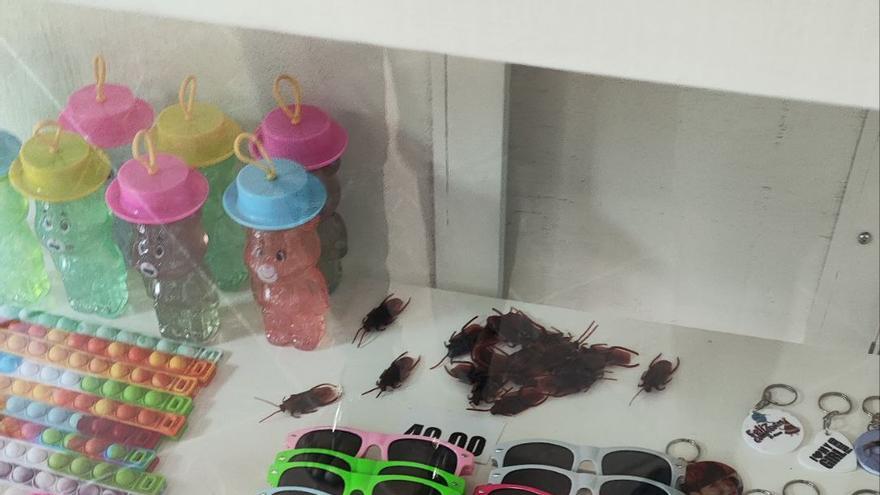
Among the items Ekopeque has for sale are children’s sunglasses for 500 pesos apiece, party hats that range from 150 to 200 pesos and checkers sets. What catches the eye of most customers, however, are the plastic cockroaches. “I bought four for 40 pesos each to scare my mom. I’m going to put them in her bed to see how she reacts,” said one mischievous young man who had stopped by the store for the first time on Thursday.

The items that catch the eye of most customers are the plastic cockroaches, which sell for 40 pesos apiece. (14ymedio)

“I didn’t even know this was a mipyme*,” admits the boy, who is duly impressed with the powerful air conditioning and overall cleanliness of the place. “The man who seems to be the owner is very professional,” he observes. “You Immediately realize this is not a state-run store. Before, when it was a Cadeca, the employees always had long faces and it was like the security guard at the door was barking instead of talking.” continue reading

The only remaining currency exchange still located in this tourist hub in Havana’s historic city center is at 257 Obispo Street. Housed in an impressive building that for years was the most iconic Cadeca on the island, it was designed to impress foreign travelers. It even features several ATMs. But the current cash shortage and customers’ reluctance to exchange their hard currency at the official rate have left it largely empty.

Meanwhile, exchange rates for the euro and dollar on the black market are at record highs, a fact that is as frightening as Ekopeque’s plastic cockroaches.

Translator’s note: Spanish-language abbreviation for “micro, small and medium-sized enterprise” (MSME).

____________

COLLABORATE WITH OUR WORKThe 14ymedio team is committed to practicing serious journalism that reflects Cuba’s reality in all its depth. Thank you for joining us on this long journey. We invite you to continue supporting us by becoming a member of 14ymedio now. Together we can continue transforming journalism in Cuba.

Cuba Has Spent More Than 100 Million Dollars on Turkish ‘Patanas’, a Secret Investment

14ymedio has verified that the Belgin Sultan and the Suheyla Sultan are in Havana. (14ymedio)

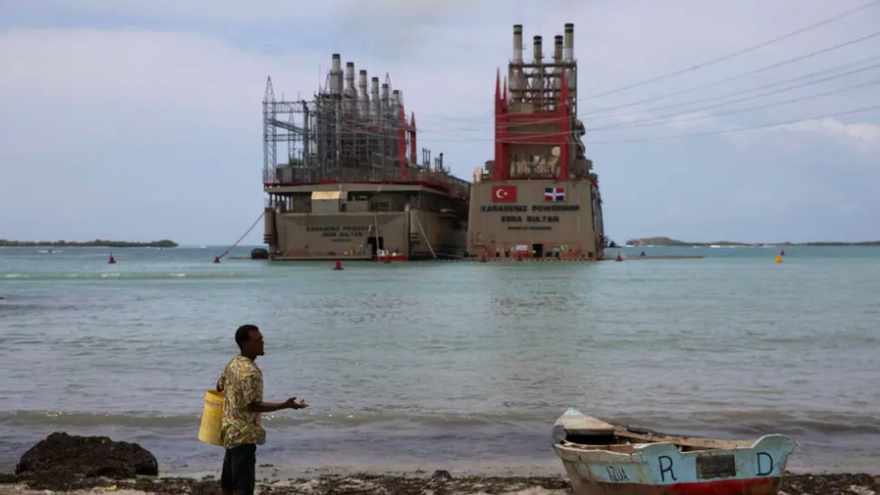
14ymedio bigger14ymedio, Juan Izquierdo, Havana, 23 August 2023 — One of the best kept secrets of the Cuban authorities is the cost of the Turkish patanas [floating power plants] that, since 2019, contribute to alleviating blackouts on the Island. Faced with the silence of those responsible, 14ymedio went to look for information in the Dominican Republic, which has contracted for two floating power plants (180 MW in total), for which it pays 40 million dollars for a duration of 42 months. If the same calculation is applied to Cuba, where there were seven patanas and now only five, with a capacity of 490 megawatts (MW), the cost would be 109 million dollars for the same period, or about 31 million a year.

However, both the Cuban authorities and the directors of the Turkish company have been anything but transparent about the agreements. Maritime tracking applications do not offer up-to-date information on the position of the patanas, and it has been necessary for 14ymedio to send its reporters to the ports to visually check their presence.

Karpowership’s most recent promotional video, published on August 17, boasts of its presence in multiple countries in Africa, Asia and Latin America, including the Dominican Republic. Although Cuba does not appear on the map of the company’s partners in the region, the images show the most powerful patana hired by the Island – the Suheyla Sultan, 240 MW and connected to the Tallapiedra thermoelectric plant in Havana – but locates it in the Dominican port of Pueblo Viejo.

It is likely that this is due to the fact that Havana, unlike Santo Domingo, has not signed long-term contracts with Karpowership, only specific agreements. Another symptom of the instability of the Island’s patanas has been the intermittency of the supply of fuel oil for their operation.

In his report on Monday, the technical director of the Electric Union, Lázaro Guerra, assured that, after weeks of shortage, there was enough “fuel availability” now to start the patanas installed in Mariel, which were stopped by the oil deficit. The manager explained that other floating plants had suffered the same problem but guaranteed that the situation “has been improving.” continue reading

As 14ymedio was able to verify on Tuesday, the Belgin Sultan (15 MW) and the Suheyla Sultan (240 MW) are anchored in the port of Havana, while the Erin Sultan (130 MW) is connected to the Antonio Maceo thermoelectric plant on the Renté peninsula, at the entrance to the bay of Santiago de Cuba. The situation in Mariel could not be visually confirmed, since public access is restricted, but the images taken by Google Earth document the presence of two Turkish power plants, the Baris Bay (40 MW) and the Ela Sultan (65 MW).

Last July, during the sessions of the Parliament, the Minister of Energy and Mines, Vicente de la O Levy, reported that two patanas had left the Island after having “fulfilled their contracts,” which represented 170 MW less for the National Electricity System (SEN). The academic and specialist of the University of Texas, Jorge Piñón, points out that “the Turkish plants have been a lifeline for the SEN with a contribution of 2,591 GWh, 14.2% of the gross generation in 2022.”

The departure from circulation of both plants led to a controversy about a possible withdrawal of the Turkish ships, and the Cuban authorities are even more secretive about their management.

The minister then limited himself to insisting on the information he had offered to Parliament and said that six floating power plants were still operating on the Island. However, it is possible that he was counting the Karadeniz One, which is actually a tender, which returned to Havana on August 5 to replace a Turkish tugboat, the Gultekin Bey.

The power plants are part of an energy project called Powership Azua, authorized by the National Energy Commission. (EFE)

For their part, the Irem Sultan – which left Santiago de Cuba last April – and the Esra Sultan are in the Dominican Republic, whose government signed a contract with Karpowership last June to install them in a “definitive” way, after numerous discussions about the environmental damage they cause, in the coastal municipality of Pueblo Viejo de Azua, about 120 kilometers west of the capital, Santo Domingo.

The power plants are part of an energy project called Powership Azua, authorized by the National Energy Commission and managed by the Dominican subsidiary of Karpowership. Both run on fuel oil and have on board, according to government documents, “electric alternators, a substation, drinking water tanks, wastewater and sediments, liquid fuel storage tanks, offices and workshops.”

In addition, the project has a dock, a barge to store fuel and auxiliary facilities, which, added to the maintenance cost of the plant, total 42.8 million dollars. As for Cuba, floating power plants need similar conditions for optimal operation. Unlike the patanas in the Dominican Republic, the Cuban ones are directly connected to thermoelectric plants in Mariel, Havana and Santiago.

The patanas continue to be “the best deal” for Cuba in terms of energy, according to De la O Levy in February. The minister, who has referred on numerous occasions to floating power plants as a “great investment” that raises “concerns” in the population, has only gave a clear number: 17, the number of years that it will take Cuba to pay – through a monthly fee – a cost that the Government has not revealed.

Translated by Regina Anavy

____________

COLLABORATE WITH OUR WORKThe 14ymedio team is committed to practicing serious journalism that reflects Cuba’s reality in all its depth. Thank you for joining us on this long journey. We invite you to continue supporting us by becoming a member of 14ymedio now. Together we can continue transforming journalism in Cuba.

The Italian Company That Scammed the Cuban Baseball Federation Promises Free Balls

Since 2018, the Italian company TeamMate has been the official supplier of baseballs. (Periódico 26)

14ymedio bigger14ymedio, Havana, 23 August 2023 — The Italian company TeamMate offered compensation to the Cuban Baseball Federation (FCB) after sending it more than 2,000 defective balls during the last National Series. Its directors blamed the “error” on a factory in China where they make their products and promised the Cuban authorities to supply next season’s balls free of charge.

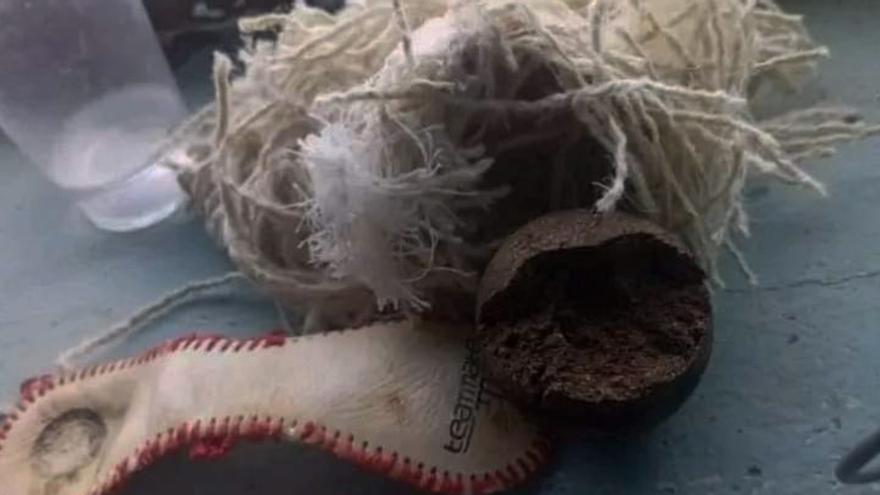
The television program Bola Viva explained that, due to a “confusion” of the Asian manufacturer, “included in the shipment were several boxes of the balls that are used for training,” the 150 and 120 models, instead of the 190 model that is used for professional games.

The collaborator of the Cuban Baseball portal, Yirsandy Rodríguez, said at the time that the use of TeamMate’s 120 ball in the Elite Baseball League favored pitchers over batters, since it is a lighter ball, and this compromised the results of the games in which it was used.

After several Cuban teams complained about the “irregular bounce” of the Chinese balls, the FCB began to complain to the company about the defective equipment and the delay in sending equipment. In October 2022, TeamMate had only sent half of the balls promised for that season, so the Federation had to buy balls from a supplier, whose name was not revealed, to get the Batos brand, a state company belonging to the Ministry of Industries. continue reading

According to figures offered by Bola Viva, since 2018, TeamMate has been the official supplier of baseballs to the Island, which so far has received 136,500 balls for training, the National Series and the Elite League, paying 12 dollars for each ball, a price that exceeds the value that these products have in the international market.

The Cuban Baseball Federation verified the poor quality of the TeamMate balls. (Facebook/Alejandro Díaz Álvarez)

Due to the inability of the Cuban industry to manufacture the equipment, the country has been dependent on the “sponsorship” of the Italian company for five years. Because of the “lack of leather for the ball, the lack of thread and the right glue,” they did not comply in 2018 with the delivery of the 100,000 balls (70,000 synthetic and 30,000 leather) promised annually to meet the needs of 16 teams of the National Series and 8 other categories in 547 sports centers, said the treasurer of FCB, Luis Daniel del Risco.

The Italian company is linked to Riccardo Fraccari, president of the World Confederation of Baseball and Softball (WBSC), who in 2021, according to columnist Jorge Morejón, was investigated for alleged money laundering. An article from the portal Libertas.sm revealed that the sports federation of Panama also complained about the price of the balls provided by the Confederation.

The Panamanian prosecutor’s office, which investigated the case, concluded that “the money paid for the balls was much higher than the real market value,” reported the Libertas.sm portal. As a result, “2,000,000 euros were seized at the WBSC headquarters in Lausanne, Switzerland.” Later the penalty was revoked, and the amount was reduced to 258,000 euros. The Confederation was also accused of laundering money.

TeamMate remains the stone in the shoe for Cuba. Prior to the scam of the baseballs, the Italian company had already been criticized for the delay in the delivery of the uniforms for the Cuban teams that played in the Elite League.

Translated by Regina Anavy

____________

COLLABORATE WITH OUR WORKThe 14ymedio team is committed to practicing serious journalism that reflects Cuba’s reality in all its depth. Thank you for joining us on this long journey. We invite you to continue supporting us by becoming a member of 14ymedio now. Together we can continue transforming journalism in Cuba.

The Coach of the Havana Soccer Team Resigns Due His Athletes’ Poor Nutrition

Jainé Colomé denounced the lack of attention from Havana’s federations. (Facebook/Fútbolxdentro)

14ymedio bigger14ymedio, Havana, 24 August 2023 — Cuban coach Jaine Colomé resigned from his position as technical director of the Havana soccer team on Tuesday, according to Play-Off Magazine. The former athlete and champion of the Caribbean Cup in 2012, denounced the poor diet and the lack of salaries for the soccer players, as well as the delivery, often incomplete, of equipment for official games and training.

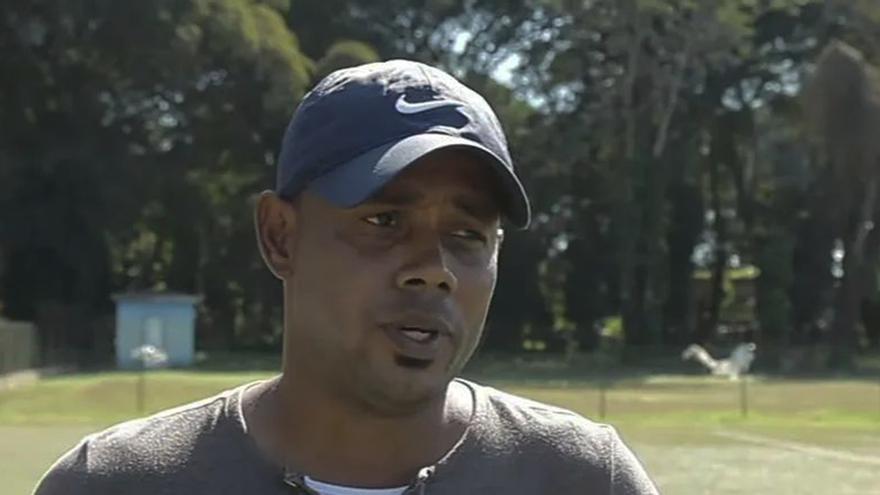
“When I decided to be a coach, I always said that my responsibility and commitment was with the athletes, not with the managers: I didn’t want my athletes to suffer the same as I did,” he told the sports media. “I have been against several decisions of the officials, and I have let them know that.”

Colomé, who took the Havana team to third place in the National Soccer League, pointed out that during the first season in which he led the athletes, they were “barely fed,” which forced them to lower the training load to 50% at the request of methodologists. Otherwise, the health of the athletes would have been at risk due to an inadequate diet.

The coach, one of the candidates proposed to lead the National Team in place of Pablo Elier Sánchez, regretted that the support offered by the managers remained as “promises.” “Many of my players had families and did not receive a salary for playing soccer.” continue reading

The limitations suffered by the soccer players were exposed by Colomé to the leaders of the sport in Havana and before the Provincial Commission, but he only obtained more promises that “everything was going to be resolved, but in the end we never got any attention.”

The former coach recognizes that the situation on the Island is terrible, but “there are things that go beyond that and have to do with the leaders, who ignore those who really suffer and sacrifice themselves”: the soccer players. He says that no official showed up on the ground of La Polar, where they trained, to ask how they were and much less accompanied the team in the games. “They don’t even go to the Havana stadium to watch the team play.”

Marcel Hernández, captain of the Cuban national team, was also mentioned by Colomé, who highlighted that the athlete refused to continue playing on the Island because of the “deplorable” conditions in which his team was existing. The former coach thanked the workers of the La Polar factory, who were the only ones who supported the players by offering them ice and water. “They did more than many whose job it was to do it; in fact, the director (of sports) of the province spoke to the team only once in two years.”

Colomé concluded by saying that Cuban soccer is not going through a good time in terms of infrastructure, conditions and results. It requires “investment and betting on development, but here they don’t see it that way, and that is the cause of the bad times that this sport is experiencing.”

Translated by Regina Anavy

____________

COLLABORATE WITH OUR WORKThe 14ymedio team is committed to practicing serious journalism that reflects Cuba’s reality in all its depth. Thank you for joining us on this long journey. We invite you to continue supporting us by becoming a member of 14ymedio now. Together we can continue transforming journalism in Cuba.