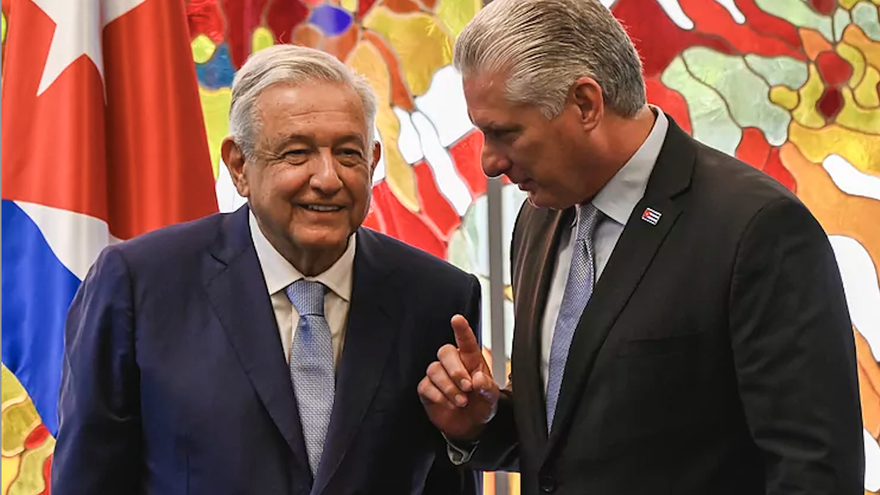
Diaz-Canel Will Be at the Summit in Mexico To Talk About the Cuban Migrants in Tapachula

In addition to the Cuban president, the leaders of Colombia, Honduras, Haiti and Venezuela will be present. (EFE)

14ymedio biggerEFE (via 14ymedio), Mexico City, October 18, 2023 — The Mexican president, Andrés Manuel López Obrador, confirmed on Wednesday the attendance of the leaders of Cuba, Colombia, Honduras, Haiti, Venezuela, Ecuador and Guatemala at the summit on migration next Sunday in Chiapas, a state on the southern border of Mexico.

“Attending will be the presidents of Central America, the Caribbean, president (Miguel) Díaz-Canel of Cuba, president (Gustavo) Petro (of Colombia), president Xiomara (Castro) of Honduras, the prime minister of Haiti (Ariel Henry), and president (Nicolás) Maduro (of Venezuela),” he revealed in his morning conference.

“The president of Ecuador (Guillermo Lasso) and the president of Guatemala (Alejandro Giammattei) are also coming; so far nothing more; I don’t know of others. They will be represented, in the event that a president can’t come, by a vice president or a chancellor. We are going to meet on Sunday,” he added.

According to what was stated by the president last week, the presidents of El Salvador, Belize, Costa Rica and Panama have yet to be confirmed. At the meeting in Palenque, López Obrador will look for a common proposal from the region on migration and then present it in November to the President of the United States, Joe Biden. continue reading

“We can do a lot if we help each other. The meeting is called “For a Fraternal Neighborhood and in Search of Well-being,” so let’s see what we can do together, how we can help each other,” he said.

The meeting will take place while Mexico and Central America face an “unprecedented” migratory flow, as the International Organization for Migration (IOM) warned last month, with up to 16,000 migrants arriving at the Mexican borders every day, according to López Obrador.

“(The meeting) is very important because it’s a problem that can get worse. It is already worrying, because the number of migrants is growing and we have to attend to it,” said the Mexican president. López Obrador will insist on “attending to the causes, going to the bottom of things, not just holding back or thinking about militarizing the borders or building walls, which don’t solve the problem.”

Questioned about whether he will ask Latin American countries to detain migrants before arriving in Mexico, the president said that all governments should do everything possible to address migration. “In all cases there is interest in helping migrants, in all cases, but many countries are going through difficult economic situations. They don’t have a budget or there are conflicts, either due to political confrontations or due to the blockade in the case of Cuba, which is inhumane,” he said.

Translated by Regina Anavy

____________

COLLABORATE WITH OUR WORKThe 14ymedio team is committed to practicing serious journalism that reflects Cuba’s reality in all its depth. Thank you for joining us on this long journey. We invite you to continue supporting us by becoming a member of 14ymedio now. Together we can continue transforming journalism in Cuba.
‘We Give Priority to the Basic Basket,’ Says a Cuban Minister With Black Humor

The minister said that powdered milk had to be prioritized for the engines of fishing boats. (Escambray)

14ymedio bigger14ymedio, Madrid, October 18, 2023 — Everything is bad in Cuba, but it could be worse. This is basically what Manuel Sobrino Martínez, Minister of Food Industry, said this Tuesday in a brilliant appearance on State TV’s Roundtable program, where he reviewed in detail the systematic sinking of the forecasts for this year and ended up encouraging those who listened. “We would have to take into account how we were if the Government had not taken the number of actions it has been undertaking in recent years,” he said.

Sobrino Martínez has uttered some of the most memorable phrases so far this year, now accumulating in October. The most meritorious was the one that attributed the fall in tourism to the priority given to Cubans at lunchtime. “Today there is an important group of resources that, if tourism had them, would provide a better service and have more tourists; and the Government’s decision has been to give priority to the basic basket and social consumption.”

Presumably fearing the impact of his words, he rushed to clarify that this does not mean that there is “total satisfaction,” but that prioritizing is prioritized. And that only what is left over, if it is left over, goes to other sectors. “Virtually all the food that arrives in the country goes to the basic basket,” he said.

Presumably fearing the impact of his words, he rushed to clarify that that does not mean that there is “total satisfaction

The data show a series of catastrophic misdeeds. Much less food is processed now than in 2021 and 2022, he said, just before attributing it to the “flare-up of blockade measures,” although the sanctions come mostly from previous years. For products, only 67% of the planned wheat has been purchased, because its price went from $280 per ton in 2019 to $410 in 2023. continue reading

Milk, which four years ago cost $3,150 a ton, now costs $4,508. Only 21% of what was scheduled has been purchased. Oil doubled its price in that same period, from $880 to $1,606, which means 55% of the projection has been acquired. He didn’t even mention soy and corn; he only talked about their rise in price to $226 and $163, respectively.

So the triumphant data with which he began his presentation, all of it about the enormous food processing capacity that the country has, remained worthless in the face of the absolute impossibility of importing and, much less, producing.

The jackpot was won by fishing – “we are not doing well in 2023, we are not complying, with only 58% of what was planned and with 23% less than what was achieved in 2022” – a living example of the resounding failure of the 63 measures to boost the agricultural sector that, precisely, he came to defend.

The minister, who had initially explained that there are more than 60 boats without an engine because it can cost between $25,000 and $40,000, and those who have them don’t want to sell or demand an advance payment that cannot be made – “we have had to decide whether to buy powdered milk, wheat, or engines” – ended up explaining that the approval of Resolution 52, with which fishing was made more flexible, has led to an increase in the licenses of non-state boats by 4,302, almost double that of the previous year. Did that translate into more fish? The answer is no.

Sobrimo touched on the situation of other staple foods, with a scarce attachment to reality. “In Cuba, more than a million children receive milk every day,” he surprised everyone by saying. Of these, 645,000 have the fluid, produced on the Island, and 365,000 have the powder, imported. If they were charged at a “neoliberal” price, he added, the liter would be sold at 125 pesos. Then he explained the poor hiring, the non-compliance, the drought, the lack of inputs… and it was understood that, as the population reports, milk arrives half the time.

Sobrino continued the task undertaken this Tuesday by his boss to convince the population of the benefits of the ’MSMEs’

The same situation occurs with meat, to which he also dedicated a section, saying that of the 110,000 producers visited, only 36,000 have contracted with the industry, certifying the resounding success of the measures.

Thus, Sobrino continued the task undertaken on Tuesday by his boss to convince the population – disenchanted – of the benefits of the MSMEs — small and medium private businesses. “Not all those companies are giving what was aspired to; there are some that have taken a distorted path, and they are being reviewed. But it would also be necessary to know if those 844 were not impacting industrial food production, what the situation would be.” Again, poor but grateful.

The minister insisted that the private sector is expected to work together with the State to lower costs and contribute to shortages on a small scale, something that, he explained, is already being done with the bakeries. “The State has to buy 700 tons of wheat per day for the rationed bread, while a form of non-state management buys a container that is 25 tons and organizes the production for a month; they are volumes at different scales.”

In that way, working with the many bakeries that have been approved, the product has been delivered, he said. “The vast majority today are linked with non-state forms of management. The bakeries are not being privatized; they are linked. Prices are discussed and negotiated.” Of the 844 MSMEs that are dedicated to food production, 195 focus on bread and pastries; 195 on meat; 188 on fruits and vegetables; 93 on dairy; 30 on soft drinks and beverages, and 24 on fishing.

Near the end of the program, Sobrino still had time to leave one more amazing statement. “We have a favorable situation with coffee,” he said, the same day it was known that the small amount and poor coffee that remains in Cuba increased its price by more than 10% in September, and neither tastes nor smells as it should. But let’s not let the mood decline. “The best answer is in the history of the country and in the spirit of resistance and confidence of the people,” he concluded.

Translated by Regina Anavy

____________

COLLABORATE WITH OUR WORKThe 14ymedio team is committed to practicing serious journalism that reflects Cuba’s reality in all its depth. Thank you for joining us on this long journey. We invite you to continue supporting us by becoming a member of 14ymedio now. Together we can continue transforming journalism in Cuba.

Diaz-Canel Again Receives Titov To ‘Deepen’ Cuba’s Relations With Russia

Russian adviser Boris Titov with Cuban President Miguel Díaz-Canel, this Thursday. (X/@DiazCanelB)

14ymedio biggerEFE/14ymedio, Havana, 19 October 2023 — Kremlin business consultant Boris Titov is back in Havana, five months after his last visit. President Miguel Díaz-Canel met this Thursday with the official, who holds the position of president of the Cuba-Russia Business Council.

“It’s the will of both governments to deepen our economic and commercial relations,” Díaz-Canel wrote on his account on the social network X (formerly Twitter). The Cuban president did not offer more details of the meeting with the Russian politician and businessman, who was in Cuba last May to attend a bilateral business forum attended by more than 150 representatives of companies from Russia and Cuba.

On that occasion, they offered the Russians the right to hold land in usufruct for a period of 30 years, a concession unprecedented in the history of the revolutionary regime.

The Cubans expect capital to arrive from Moscow in the areas of transport, logistics, agriculture, sugar, tourism, construction and industry, according to the Cuban government.

In response, Havana will provide Russia with “facilities to encourage” its “presence.” Among them, according to Titov himself, is the import of tax-free products from the Eurasian country, the presence of Russian banks and financial facilities for exchange with their respective currencies (the ruble and the peso). continue reading

The Cuban president did not offer more details of the meeting with the Russian politician and businessman

So far in 2023, the Foreign Minister of Russia, Sergey Lavrov; the president of the State Duma, Vyacheslav Volodin; the economic adviser of the Presidency, Maksim Oreshkin, and other important political figures of Vladimir Putin’s government have traveled to the Island.

Despite their political ties, in 2022 the bilateral trade exchange was only 451 million dollars, a figure that the Russian representation hoped to improve.

A few days ago, the meeting at the Meliá Cohiba hotel of 100 professors and students from the Moscow State University Rosbiotech showed that the alliance between the two countries involved the teaching of Russian.

Similarly, last September, Russia and Cuba addressed the construction of new generating capacities for power plants on the Island, but without further details. Russia is still, in any case, one of the main fuel suppliers to Cuba, behind Venezuela and Mexico.

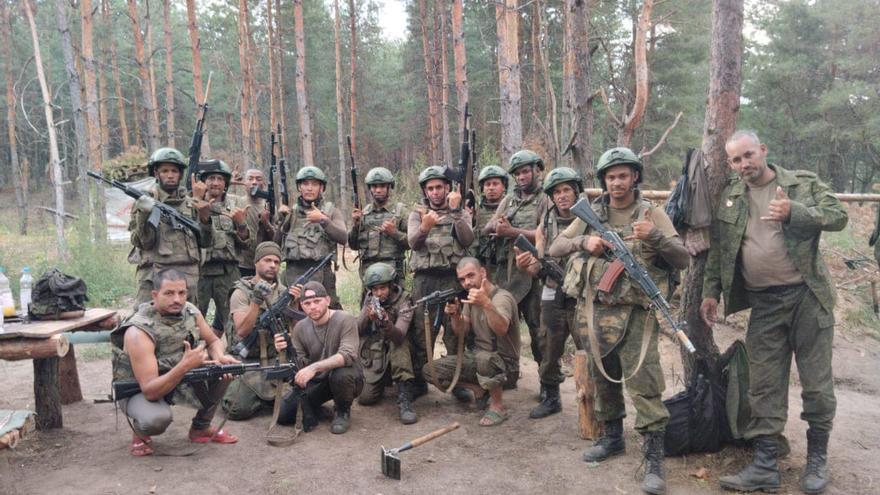
Relations between Havana and Moscow, which have been going at full speed since May, have advanced more cautiously since several international media reported the presence of Cuban soldiers in the Russian invasion of Ukraine. Titov’s visit, however, shows that the projects are not stopping.

Translated by Regina Anavy

____________

COLLABORATE WITH OUR WORKThe 14ymedio team is committed to practicing serious journalism that reflects Cuba’s reality in all its depth. Thank you for joining us on this long journey. We invite you to continue supporting us by becoming a member of 14ymedio now. Together we can continue transforming journalism in Cuba.

More Oil Arrives in Cuba, but the Refinery Is Shut Down and Gas Stations Lack Fuel

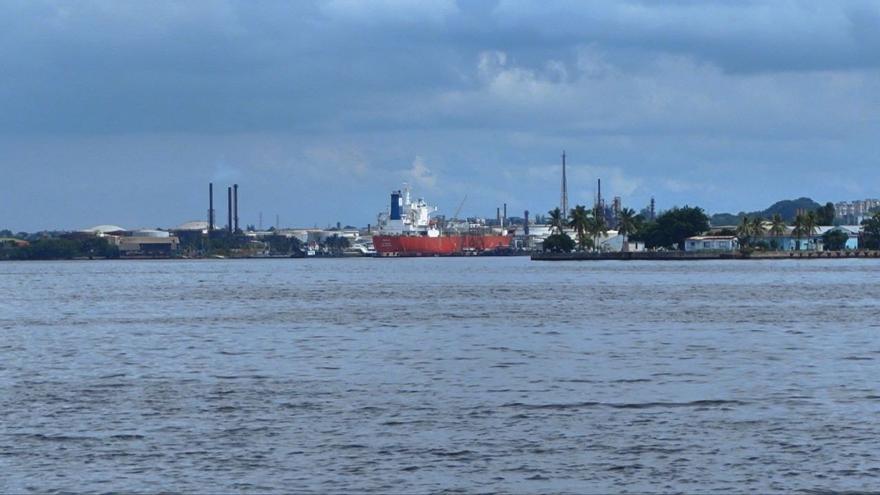
The LPG tanker Emilia was anchored this Thursday at the Ñico López refinery of Havana. (14ymedio)

14ymedio bigger14ymedio, Havana, 19 October 2023 — On 23rd Avenue, the most fast-paced in Havana, no vehicle was circulating on Thursday morning. In several corners, a crowd of Cubans wait for the arrival of the bus, which doesn’t come. Concerts are even canceled “for energy savings.” Signs of the crisis are everywhere.

In the port, the Turkish patana [floating power plant] emits a sparse fog, instead of its formidable – and harmful – column of smoke. On the other side of the bay, the refinery is shut down. However, oil tankers continue to arrive on the coasts of the Island, and in a higher number than usual. Of course, they disconnect their radar when entering territorial waters, but maritime tracking applications and the observations of experts do not lie: Cuba continues to receive oil, and in significant quantities, from Venezuela, Mexico, Russia and other allies. What does the regime do with that fuel, and why is the country immersed in the energy debacle? No authority so far has explained this contradiction.

Attentive to the flow of oil tankers, the University of Texas expert Jorge Piñón points out to 14ymedio the coordinates of the ships heading to the Island. “From the Mexican port of Pajaritos – which has been in the spotlight after the controversy about a millionaire credit that the state-owned Pemex negotiated with the U.S. Import and Export Bank – the Delsa left at 11:00 pm this Wednesday, carrying approximately 385,000 barrels of crude oil,” says Piñón. In October alone, the Government of Andrés Manuel López Obrador has sent 800,000 barrels to the Island.

In the port of Matanzas there are four tankers: the Marianna V.V. (flag of Liberia), the Sandino (Cuba), the Aquila (Panama) and the Primula (), while in Mariel there is the Caribbean Alliance, with a Panamanian flag. In Moa, Holguín, the Prairie Tulip, registered in Madeira, is anchored. continue reading

In October alone, the Government of Andrés Manuel López Obrador has sent 800,000 barrels to the Island

For its part, the Alicia – with a Cuban flag – left the Venezuelan port of José with an estimated 290,000 barrels of crude oil, while the Lourdes, also Cuban, is waiting to receive a shipment to return to the Island. The Petion ship is anchored, with the same objective, in the port of La Cruz, also in Venezuela, where the Sandino was, one of the ships with a Cuban flag that most often travels to the terminal of José.

With these data, it is inconceivable that the Havana refinery is not processing the 22,000 barrels per day (bpd) that it would under normal conditions, says Piñón. A reporter from 14ymedio found that Ñico López’s torch light was off this Thursday, although it has a tanker anchored next to it, the LPG Emilia, with a Cuban flag.

“Venezuela will have a respite in its oil production thanks to the elimination, for six months, of the sanctions imposed by the United States,” the expert adds. “It is possible that by the end of the year it will reach a production of one million barrels a day. At the moment, its level is 800,000 bpd,” which will guarantee – and even be able to increase – Venezuela’s shipments to Cuba, which are on average 57,000 bpd.

Regarding Venezuela, the expert also estimates that it will take advantage of the increase in production to increase sales and oxygenate its income. The price of a barrel of crude oil currently reaches $90.

Meanwhile, Cubans continue to suffer one of the worst moments of the supply crisis in which the government estimates the causes of the paralysis of the country. In the few gas stations that provide services, a few state vehicles line up to fill their tanks with the meager amount that is given to them. For the others, they have to walk to their work centers or push themselves – as a crowd of passengers did this Thursday – on the red buses of Transmetro, the last lifeline for those who want to go anywhere in Havana.

Translated by Regina Anavy

____________

COLLABORATE WITH OUR WORKThe 14ymedio team is committed to practicing serious journalism that reflects Cuba’s reality in all its depth. Thank you for joining us on this long journey. We invite you to continue supporting us by becoming a member of 14ymedio now. Together we can continue transforming journalism in Cuba.

Cuban Business Owner Does in Months What the State Didn’t Do for Years

Local residents say the business has reinvigorated the neighborhood. (14ymedio)

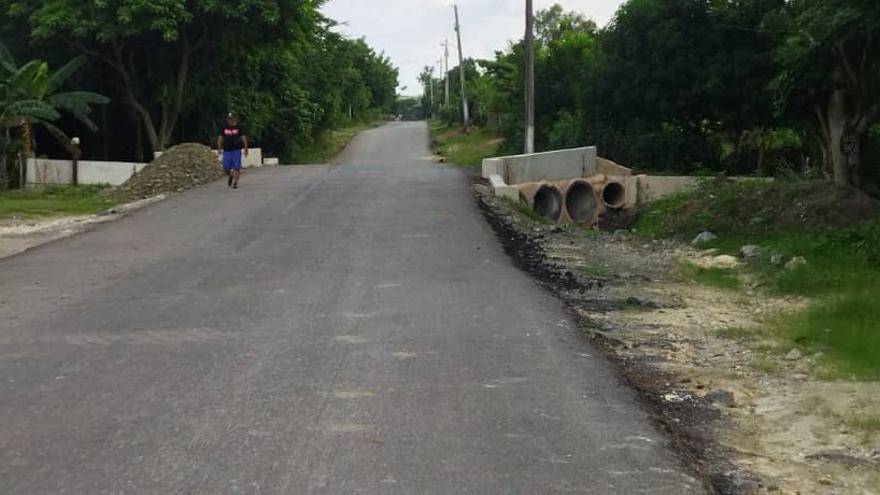
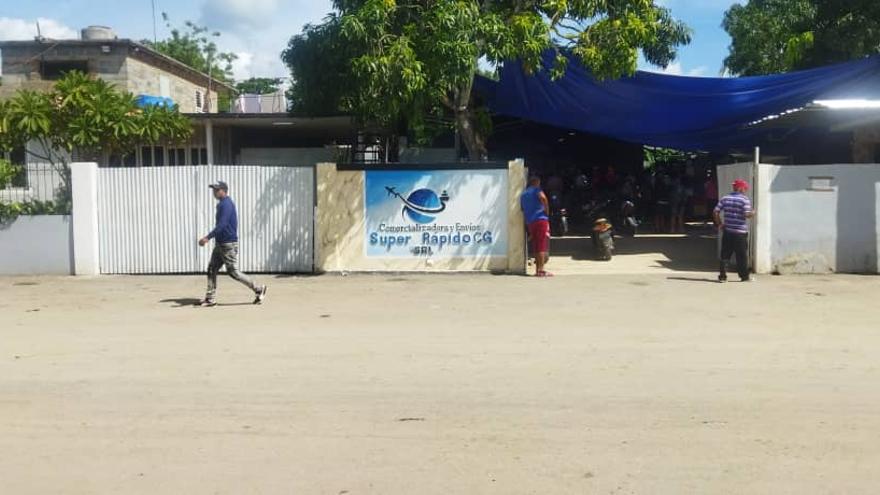
14ymedio bigger14ymedio, Miguel García, Holguín, October 18, 2023 — A motorcycle zips by as a horse-drawn carriage makes its way on the other side of road. The sunlight glistens off the asphalt which is, quite surprinsingly, flawless, without a pothole or a crack. The owner of the nearby privately owned company, Super Rapido CG, invested in repairs to the street in front of his business so that it would not pose a danger to motorists. The money to restore more than a kilometer of roadway in the San Rafael section of Holguín came out of his own pocket.

“The man has revived the neighborhood,” says Georgina, a 76-year-old housewife who for decades watched the area around her deteriorate. Now hopeful, she closely follows the efforts of Amauris Gonzalez Parra, owner of the Super Rapido CG, who is changing the face of the neighborhood. “Not only did he fix the road here but several new businesses have opened thanks to this. The place is always full of customers.”

She points to a wide patio covered with a blue tarp where Gonzalez Parra, his two children and his employees wait on customers coming to pick up the shipments that relatives overseas have bought for them on the company website. On Monday, the place was bustling as workers behind the counter hurriedly fetched merchandise. continue reading

On Monday, the place was bustling as workers behind the counter hurriedly fetched merchandise

“Every month my brother buys me a supply of food, soap, cooking oil and detergent. It’s convenient for me come here to come here to pick it so we don’t need home delivery,” says 30-year-old Luis Angel, one of the dozens of people in the store at noon. Three coolers display soft drinks, beers and juices of different types and sizes.

“Amauris has helped his congregation a lot. He’s a Jehovah’s Witness and this is close to Kingdom Hall, the temple his family attends, says Luis Angel. “He has a very big heart. If a ’brother of faith’ gets sick, he provides food and other types of support. He has also given jobs to many of them.”

Although official resentment of Jehovah’s Witnesses has decreased significantly in recent years, it is still difficult for them to find work in strategically important sectors such as tourism. The prejudices that led to decades-long workplace discrimination have not been completely erased, which is why Gonzalez Parra’s gesture is so greatly appreciated by his community.

Luis Angel points out the the residents of San Rafael still find it odd that a private citizen had to pay to fix the road. It leads to two facilities — a slaughterhouse and an egg warehouse — belonging to Holguín Poultry Company. It also leads to Frutas Selectas, a division of the Silo Company, as well as to the main provincial warehouse of the all-powerful Cimex corporation, a business conglomerate run by the Cuban military.

To repair the road, Gozalez Parra hired a state-owned firm, Engineering Construction Company No. 17, from Holguín. (14ymedio)

“The highway was torn to pieces during all that time but none of those state companies lifted a finger or donated any resources so that delivery trucks didn’t have to constantly dodge potholes,” says Luis Angel. “With all the money they make, they didn’t invest a single peso to prevent accidents or improve the safety of their employees going to and from work. This businessman did in a few months what the state failed to do for years.”

To repair the road, Gozalez Parra hired a state-owned firm, Engineering Construction Company No. 17, from Holguín. Although the terms of the contract were not made public, many in San Rafael claim he paid seven million pesos for the repair work. They also claim he insisted on being onsite to insure the work was being done properly and with the required amount of asphalt.

In October of 2022, 50-year-old Octavio Almaguer Ricardo lost his life along the same stretch of highway when the motorcyle he was riding hit a pothole, throwing him off the vehicle. He suffered severe head trauma and multiple fractures in one leg.

“Holguín and Cuba are full of potholes like this, some even worse than this. What is the point of the license plate tax, the tax we pay to use the roads in Cuba? How many more lives will be lost due to the poor condition of Cuban roads?” asks an outraged cousin of the deceased on social media.

That bleak scenario has changed. Not only has the roadway in front of Super Rapido CG been repaired but stalls selling prepared food have popped up. Drivers also prowl the street looking for customers who want to be ferried with their purchases to a nearby town. And there is no shortage of vendors selling everything from freshly brewed coffee to cold beer.

The Super Rapido CG website points out that the company’s online operation is based in Hialeah, Florida. It provides both U.S and Cuban telephone numbers which customers can call if they any questions. Business at the Holguín location has been growing so rapidly that Gonzalez Parra decided to buy the house next door in order to expand.

A bit over a hundred yards away, the family has a farm at which it is installing walk-in coolers to store merchandise. They will also be opening an ice cream parlor on their property as well as a store with a bakery and sweet shop. Customers will be able to move effortlessly between the current property and the new operations as “if they were in another country because this road is like glass,” jokes a neighbor.

Super Rapido CG has been growing so quickly that Gonzalez Parra decided to buy the house next door in order to expand. (14ymedio)

Local residents can also buy directly from the store. One woman with a small child in her arms is trying to decide whether or not to get some bars of soap. “The prices are high,” she says,” but no other privately owned store in Holguín is as well-stocked or has such a wide variety. Several containers of merchandise get delivered here every week so you can buy with confidence. It never fails.”

Using three vehicles from a fleet of two late-model Peugeots and three electric tricycles, the company delivers purchases by Cuban emigrés to their families in Holguín. Super Rapido also carries footwear, clothing, household goods and home appliances. A WhatsApp group keeps customers up to date on the latest offerings and announces special combos and sales.

Even state-run media has been enthsiastic about the privately owned company. In September, local televesion broadcaster Telecristal praised Super Rapido, describing it as “today’s undisputed leader in the import of essential products in the eastern part of the country.”

The broadcaster detailed the contents of various shipments delivered to the store in late August: “assorted chicken parts, ground meat, detergent, cooking oil, jam and other products.” The report described the entrepreneur’s work as “effective business management with nations such as the United States, Panama, Spain and Poland as well as with companies from other countries with whom he maintains commercial ties.”

Telecristal also commended the fact that the privately owned business counted among its clients state-owed companies such as nickel industry subsidiaries, hotel chains, retail and food-service establishments, and even the Cimex corporation, the same conglomerate that for years did not spend one centavo to repair the San Rafael highway, the one that now seamlessly runs past Gonzalez Parra’s operation.

____________

COLLABORATE WITH OUR WORKThe 14ymedio team is committed to practicing serious journalism that reflects Cuba’s reality in all its depth. Thank you for joining us on this long journey. We invite you to continue supporting us by becoming a member of 14ymedio now. Together we can continue transforming journalism in Cuba.

It Wasn’t a Missile That Demolished the Lebredo, ‘The Best Maternity Hospital in Cuba’

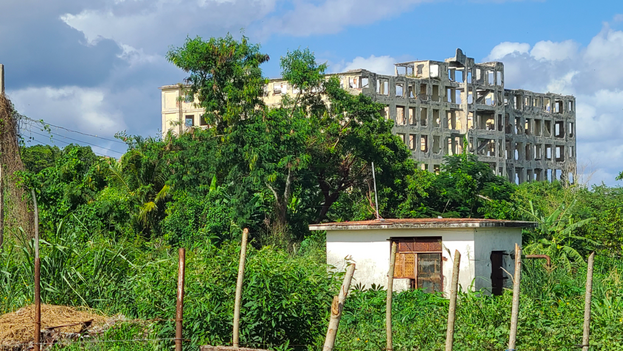
El Lebredo is nothing reminiscent of the brand new hospital for tuberculosis patients it was in the 1930s. (14ymedio)

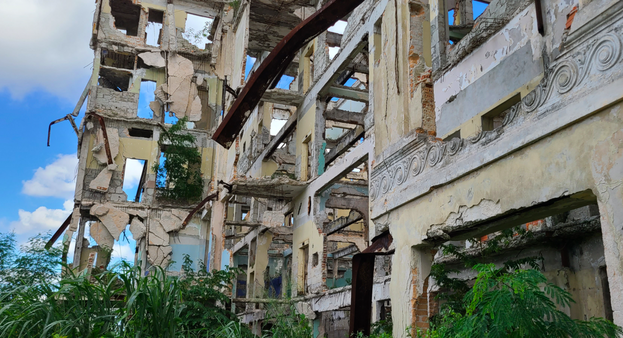
14ymedio bigger14ymedio, Nelson García, Havana, October 19, 2023 — Cuba’s ruins have one thing in common: slogans with large letters painted on pieces of walls. In the case of the old Lebredo maternity hospital, located in the Havana municipality of Arroyo Naranjo, the message – a dig at former U.S. President George Bush – ends with irony: “There is no aggression that Cuba cannot stand.”

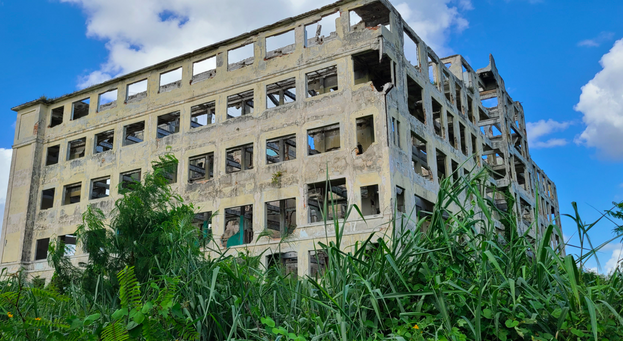
What did keep standing, the neighbors say, is the solid structure of the building, founded in 1936, which today recalls a gigantic multi-storey hive surrounded by grasslands. “The Government came a few years ago with a crane, and no matter how much effort they put in to knock it down, it still resisted,”Tomás, 67, tells this newspaper. “In the end they gave up.”

“The idea was to demolish the hospital and build a retirement villa for the military,” says Julián, age 42 and the son of Tomás. Both live near the Lebredo and have witnessed its decline since 2000, when Public Health vacated the facilities. “All the equipment and machines of the former hospital were taken to Julio Trigo, who lives not far from here,” he adds.

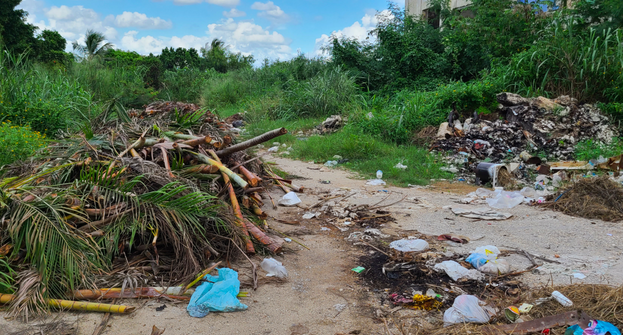
After twenty years, the place is desolate. The perimeter of the building is full of debris and garbage. “It’s the landfill of Havana,” says Tomás, who explains that because it is on the outskirts of the city, the space is an ideal place to unload large amounts of trash and waste without anyone being interested in the hygiene of the area or the dangers of the ruin. continue reading

What did hold up, neighbors say, is the solid structure of the building, founded in 1936. (14ymedio)

“The Lebredo is still an area of collapse,” he warns, pointing to a fragment of a wall on which someone wrote, with triumphant blue characters: “Long live May 1: Everyone to the Plaza!”

A statement from the activist Agustín Figueroa – who worked as a doctor in the Lebredo during the Special Period – points out that, after the fall of the Soviet Union, the hospital had reached a phase of “almost total destruction.” The flight of the doctors, the theft of materials and the laziness of the authorities accelerated its decline.

For Figueroa, the Lebredo looks like “something out of a horror movie” and is nothing reminiscent of the brand new hospital of the 1930s, first used as a tuberculous sanatorium, to which the revolutionary government of 1959 added two additional wings and converted into a maternity hospital. After its abandonment, the little that was left – doors, pipes and salvageable materials – was stolen by thieves or by the neighbors of Arroyo Naranjo themselves.

Another document that attests to the ancient splendor of the building appeared in the magazine Arquitectura, in the November 1937 issue, a few months after its inauguration. The hospital, an initiative of the Cuban Anti-Tuberculosis League, had the capacity to house 400 patients.

The perimeter of the building is full of rubble and garbage: “It is Havana’s landfill,” say the neighbors. (14ymedio)

The good condition of the roads – an avenue had been built to facilitate the journey from Havana – and the breadth of the works, commissioned by the architect Luis Echevarría, surprised several delegations of foreign doctors visiting the Island.

The description of the facilities leaves little doubt that the Lebredo came to be one of the best hospitals in the region: “It has an operating room, X-ray department, fluoroscopy, pharmacy, clinical laboratory. Complete refrigeration service, with departments for meats, food, fish, milk, medicines, and a morgue with capacity for twelve corpses, together with the autopsy room. It has magnificent kitchens and a crematorium; in the basement there is the laundry, laundry disinfection department, heating, pump station, transformer plant, boilers, garages, etc.”

There is nothing left of that inventory in the Lebredo, except the ruin and the slogans. “To think that Fidel Castro came here to say that this was the best maternity hospital in Cuba,” Tomás concludes.

Today the Lebredo is reminiscent of a gigantic beehive of several plants surrounded by grasslands. (14ymedio)

Translated by Regina Anavy 

____________

COLLABORATE WITH OUR WORKThe 14ymedio team is committed to practicing serious journalism that reflects Cuba’s reality in all its depth. Thank you for joining us on this long journey. We invite you to continue supporting us by becoming a member of 14ymedio now. Together we can continue transforming journalism in Cuba.

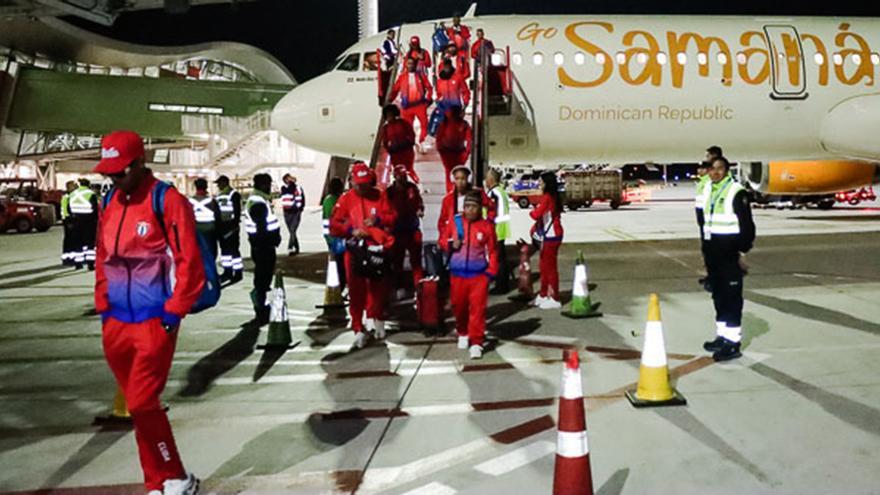
Burdened by the Escapes of Athletes, the Cuban Delegation Travels to Chile for the Pan American Games

Arrival of the Cuban delegation in Santiago de Chile. (Jit)

14ymedio bigger14ymedio, Havana, October 18, 2023 — The delegation of 382 Cubans who arrived in Santiago de Chile this Tuesday to compete in the Pan American Games will have to pluck up their courage to be successful in the National Institute of Sports, Physical Education and Recreation (INDER) competition. Marked by the escapes of high-caliber athletes and with few representative figures, the sports authorities do not dare to set the bar too high. At the moment, they barely aspire to between 18 and 22 gold medals, 12 silver and more than 35 bronze medals.

“We would like to be able to talk about many more, but it would not be objective or sincere,” Ariel Sainz, vice president of INDER, admitted in statements to the official media Jit on October 2. According to the director, the desertions are reflected in the performance of each delegation during the competitions. “There are athletes who asked for leave and left the country with permission,” he added in an attempt to justify the bad situation of the sport on the Island.

“The desertions have hurt us a lot,” boxing coach Rolando Acebal told the AFP agency (AFP). “We have had many athletes of great quality who have left; it’s a reality.”

In terms of figures, the crisis is even more worrying. The same director acknowledged that, between January 2022 and October of this year, about 192 athletes left official delegations, and 34 of them “had commitments” with one of the 425 categories of the Santiago de Chile program. continue reading

We would like to be able to talk about many more medals, but it would not be objective or sincere

The hopes of achieving gold medals for the Island are reduced to the participation of Julio César la Cruz, Arlen López and Lázaro Álvarez in boxing; Luis Orta and Gabriel Rosillo in Greco-Roman wrestling; Yarislidis Cirilo in kayaking; Idalys Ortiz in judo; Leuris Pupo in shooting and Lázaro Martínez in athletics. They have all been Olympic or world champion medalists.

At age 34, Julio César La Cruz, in the 198-pound category, will book a ticket for Paris 2024 for a third gold in the Olympic Games, after obtaining gold in Tokyo 2020 and Rio de Janeiro 2016.

The Island, which authorized women’s boxing just at the end of last year, will also have three boxers for Chile: Legnis Calá (126 lbs), Arianne Imbert Lamote (146 lbs) and Yakelín Estornell (165 lbs). They all won titles at the Central American and Caribbean Games in San Salvador 2023.

In the past Pan American Games (Lima 2019), boxing won eight gold medals. However, since the abandonment of Andy Cruz after a frustrated escape attempt, the Island’s flagship sport suffered a hard knockout. The results at the Central American and Caribbean Games were also a disappointment, with only two golds added to the national medal table.

Cuba’s flagship sport, baseball, will face the failures of recent years in Santiago de Chile. The escapes of players have been a constant and have hit hard: slugger Osday Silva and pitchers Franky Quintana and Yeudis Reyes fled just a few days ago when the team played in the Caribbean Cup in Puerto Rico.

The isolation in the poor local league system of selectable players, in times when international tournaments open the doors to professionals, has been a determining factor, explained Roberto González Echeverría, professor at Yale University and author of the book The Pride of Havana: A History of Cuban Baseball (1999), in an interview with AFP.

The Cuban delegation suffered another blow with the absence of the four-time Olympic and Pan-American champion and five-time world champion in the Greco-Roman style, Mijaín López, who decided not to compete in the Pan American Games, recognizing that his preparation was not as successful as he would have wanted, and “he had to lose a lot of weight.”

López, 41, will focus on the Olympic Games in Paris 2024, in which he still aspires to win a fifth medal in the 287-pounds category.

To this loss is added the escape of the gold medalist at the XXIV Central American and Caribbean Games, Hangelen Llanes, who left the team’s training in Paris on September 20 before traveling to Serbia. Currently, the medal options are reduced to Luis Orta (148 lbs) and Gabriel Rosillo (213.9 lbs).

In judo, the Island reports the escapes and abandonments of nine athletes in the last three months. The most recent exit, during the last week of September, was that of Kaliema Antomarchi, bronze medalist at the Budapest World Judo Championships (2017).

The loss of Antomarchi coincided with the escape in Canada of the judokas Samarys Gregorio, Odelin García and Yurisleydis Hernández, who left the team that won second place in the Pan American and Oceania Judo Championship, held in Calgary. And before them, in May, Vanesa Godinez (105.8 lb), Mellisa Hurtado (114.6 lbs), Santa Virgen Romero (172 lbs), Blanca Elena Torres (114.6 lbs) and Lutmary García (138.9 lbs) defected during their stay in France.

Mijaín López decided not to compete in the Pan American Games, recognizing that his preparation was not as successful as he would have wanted, and “he had to lose a lot of weight”

Faced with the escape of the judokas, Idalys Ortiz, age 34 and one step away from retirement, is the central figure to obtain a medal. “It won’t be easy, but the challenges are really those that make human beings great,” the four-time Olympic medalist told  AFP.

The list of absences also includes the two-time world taekwondo champion Rafael Alba (injured) and the Olympic long jump bronze medal winner Maykel Massó (recently had surgery).

Other notable casualties are those of the Olympic champion and two-time world wrestling champion Ismael Borrero, who escaped in Mexico; Juan Miguel Echavarría, who is in Portugal; the Olympic medalist and world discus champion, Yaimé Pérez, who in July last year abandoned her team in the United States; the first Olympic medalist in kayaking, Fernando Dayán, who defected in Mexico in March 2022; Serguei Torres (kayaking), and Manrique Larduet (gymnastics).

Translated by Regina Anavy

____________

COLLABORATE WITH OUR WORKThe 14ymedio team is committed to practicing serious journalism that reflects Cuba’s reality in all its depth. Thank you for joining us on this long journey. We invite you to continue supporting us by becoming a member of 14ymedio now. Together we can continue transforming journalism in Cuba.

September Rumors in Cuba: Soldiers in Russia, Splurges for the G-77, Punishment for Small Private Businesses

Mercenaries, according to the alleged contracts with the Kremlin, are offered Russian nationality and an initial payment of $2,000. (Mario Vallejo/Facebook)

14ymedio bigger14ymedio/Yucabyte, Havana, 18 October 2023 — In a context of maximum international tension, the news that there were Cuban soldiers fighting in the service of Russia during the invasion of Ukraine generated countless rumors. Meanwhile, on the Island, the leaders did not give an official explanation, and soon – after the arrival in Havana of the leaders for the summit of the Group of 77 and the subsequent announcement of a new season of blackouts – the matter was forgotten. However, as 14ymedio and Yucabyte noted, users maintained the discussion on these issues throughout the month of September, and the debate remains red-hot.

Rumors about the participation of Cuban soldiers on the Russian side against Ukraine multiplied last month with the recording of two teenagers from the Island, allegedly recruited under deception to travel to Russia. Since then, a large amount of material on this subject – videos, photographs, direct transmissions and text messages – have occupied social networks.

Some activists claimed that dozens of Cubans were fighting in Ukraine as mercenaries

Some activists claimed that dozens of Cubans were fighting in Ukraine as mercenaries or as support personnel for Russian militias. According to several documents and alleged contracts signed by nationals of the Island, they were promised Russian nationality, a salary of up to $2,000 and benefits that, according to some complaints, “were never met.” continue reading

Other videos, allegedly recorded by the Ukrainian Army, showed the capture of Cuban prisoners, gagged and about to be transported in a truck. The Kiev military itself transmitted a message urging Cubans to return to their country and not support Vladimir Putin, since the Island had already made a “mistake” by allying with Russia.

When the regime offered its official version of the presence of Cubans at the front, users pointed out that it contradicted the statements of other propaganda media related to the Government, such as the pro-government troll Guerrero Cubano. Although it is not known how many Cubans are participating in the invasion, rumors have indicated that the figures range from 400 to 20,000 people.

The regime disengaged from the issue in the face of the imminence of the summit of the Group of 77 plus China, held in Havana on September 15 and 16. The event was an important logistical challenge for the Government, and many users pointed out that what was scarce in the Island’s stores – food, coffee, cigars and beverages – would be offered in abundance to visiting leaders and heads of state.

After the event, described by many as an unnecessary “waste” of resources, the blackouts of more than eight hours suddenly returned

After the event, described by many as an unnecessary “waste” of resources, the blackouts of more than eight hours – absent during the course of the summit – suddenly returned, according to netizens. The Government did not devote so much attention, users also added, to the recovery of Pinar del Río after the scourge of Hurricane Idalia. Building collapses, leaks and destroyed crops have remained in the same condition, they insisted.

A group of rumors speculates that, as a result of the rise of privately operated micro, medium and small enterprises (MSMEs), the Government is sending subtle messages for owners to respect their “limits.” Expropriations, warnings and news about the bankruptcy of several businesses would serve, according to users, to keep the MSMEs at bay that are not managed by owners related to the regime. Rumors also indicate that, allegedly, several senior officials of the regime – such as the former spy Gerardo Hernández – have begun to get directly involved with private businesses or that they plan to privatize state rapidos (gas stations) and other establishments.

Other rumors indicate that, for refusing to deposit the company’s money in cash in the bank, a MSME was expropriated in Havana. Allegedly, three vehicles from Trasval – the company in charge of transporting and supplying cash to stores, offices and banks — raided the premises and confiscated all the money they found. Meanwhile, the circulation of high-end cars continues to be attributed to business owners related to the leadership of the regime. This September, the networks were filled with photographs of a red Ferrari that allegedly cruised through the Havana municipality of Marianao.

Translated by Regina Anavy

____________

COLLABORATE WITH OUR WORKThe 14ymedio team is committed to practicing serious journalism that reflects Cuba’s reality in all its depth. Thank you for joining us on this long journey. We invite you to continue supporting us by becoming a member of 14ymedio now. Together we can continue transforming journalism in Cuba.

The UN and the Fragile Confidence in International Organizations

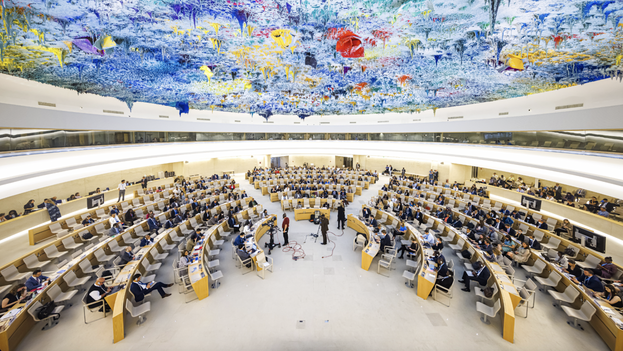
United Nations Human Rights Council. (EFE)

14ymedio bigger

14ymedio, Yoani Sánchez, Generation Y, Havana, 19 October 2023 — A few days apart, two pieces of news showed the most hopeful and the most disappointing side of the United Nations (UN). At the beginning of October, the Security Council of this international organization approved sending more than a thousand police officers to Haiti, under the direction of Kenya. The arrival of these uniformed officers seeks to stop the spiral of insecurity and violence that has overwhelmed that Caribbean country. Many Haitians hope that the mission will make the armed gangs that control large territories lose ground, although the shadow of doubt already hangs over the effectiveness and moral integrity of the Kenyan police.

Beyond the controversy surrounding the mission in Haiti, there seems to be a consensus on the urgency of taking action. However, that same UN that feeds the expectations of improvement in more than 11 million people has, this same month, once again disappointed another part of the planet’s inhabitants after the results of the votes to join the Human Rights Council. The presence among its members of regimes that openly prey on civil and political liberties, such as China and Cuba, is a bucket of cold water thrown in the faces of activists, human rights defenders and organizations that have reported the repressive excesses committed in both countries.

The UN, which sows confidence that international organizations can save lives and guide nations on the verge of social disintegration, stands as its own nemesis by leaving the impression of being more of a conclave in which dark interests and authoritarian lobbies prevail as they please. In its spacious halls, both Beijing and Havana show great ability to pull the strings of economic and diplomatic blackmail, at their convenience. If one does it, for the most part, based on economic pressures – made possible thanks to China’s extensive investment network on several continents – the other uses its medical missions and ideological camaraderie to gain support. continue reading

Like grains of sand falling in a clock, every second – in some corner of this world – an individual loses faith in what the United Nations can do to improve their lives and those of their loved ones. There is no return from that distrust. Those who no longer believe in the UN are very unlikely to do so again. But no one can be blamed for so much suspicion and rejection towards an entity gripped by bureaucracy, clumsy in the face of the challenges imposed by the times we live in, and permeated by rivalries and alliances more focused on the confrontation between political blocks than on the search for well-being of citizens.

With two wars currently underway, the UN has not even been able to fulfill its founders’ dream of preventing new wars. Does that failure in its main reason for existing mean that it is time to create a new conclave? Better not to jump too quickly to conclusions. The forces to put an end to the United Nations have also intensified in recent years and an international scenario without this organization would benefit authoritarianism and armed confrontations even more. What to do then? Expand the work of the organization in peace missions and humanitarian work; stop the advance within it of dictatorships and nepotism. Is there time left to achieve it? Little, very little.

________________________

Editor’s Note: This article was originally published in Deutsche Welle in Spanish.

____________

COLLABORATE WITH OUR WORKThe 14ymedio team is committed to practicing serious journalism that reflects Cuba’s reality in all its depth. Thank you for joining us on this long journey. We invite you to continue supporting us by becoming a member of 14ymedio now. Together we can continue transforming journalism in Cuba.

The Bad Cuban Harvests Put an End to a Million-Dollar Investment in Las Tunas

The industry has the capacity to process one ton of fruits per hour. (Periódico 26)

14ymedio bigger14ymedio, Havana, 6 October 2023 — The workers of the Jobabo fruit and vegetable processing factory in Las Tunas are, frankly, disappointed. After a million-dollar investment to renew the industry, the tiny volume of crops forces production to stop frequently, directly affecting their salaries.

The workers tell the official newspaper Periódico 26 that the factory is plummeting, just three months after starting to operate, due to the “bad manners” of the leaders. According to the media, the municipality had not received an investment of that magnitude in the agricultural sector for a decade, but the lack of raw material forces the factory to work intermittently.

In the month of August, for example, the municipality reported the collection of 3.9 tons of mango, 9.5 tons of guava and 13.8 of papaya for the production of jams, sweets and pulp. In an industry with a processing capacity of eight tons per day, the raw material barely lasted three and a half days. continue reading

In an industry with a processing capacity of eight tons per day, the raw material barely lasted three and a half days

The employees, who understand that “if they don’t produce they don’t earn,” are not satisfied with the factory’s management and demand more transparency with the company’s accounts, which decide, in short, how much they earn.

“When we have the raw material we try very hard. We come to work at 7:00 in the morning and leave at any time in the night. We sell to the countryside, Zabalo, Palo Seco, all with the aim of meeting the required income, but when it comes to our salaries, we don’t get what we think we should,” said Maribel Contreras, one of the workers, who complains that only one of the three paychecks she has received so far has been complete. The rest, she says, don’t exceed the minimum pay.

According to the calculations of the workers themselves, who report that they are not informed of how much they must produce and sell to ensure at least the basic pay, the industry should generate 400,000 pesos to cover all expenses. That amount was exactly what was achieved in August, but even so the workers saw their salaries reduced.

When they went to the managers, they alleged fuel expenses, transportation, partners who had not yet paid and a miscalculation on the part of the workers who, completely uninformed, thought the necessary profits for the industry were about 100,000 or 200,000 pesos below what is estimated to be a satisfactory performance.

“If [the factory] works in a stable way, the daily income would be from about 350,000 to 400,000 pesos, and the salary would be met without difficulty. Some will even earn around 10,000 pesos,” calculates another employee.

The problems of the industry, to which is added that the boiler consumes between 8 and 9.3 gallons of oil per hour in the midst of the fuel crisis, could be alleviated if the management listened to some of the workers’ proposals to increase production and reduce spending. Unfortunately, according to Periódico 26, there is no “appropriate climate” in the company to solve the demands.

We have to make more arrangements to bring cucumber, onion, chili peppers… all that is pickled and sold quickly.  It would give very good profits

“We have to make more arrangements to bring cucumber, onion, chili peppers… all that is pickled and sold quickly. It would make very good profits. It’s a way to generate income, but not enough is done to implement it,” said Armando Santoya, one of the workers, who insists that the factory look for alternatives but receives no response from the bosses.

A similar situation occurred in Granma, where the Porcino company is late in payments to more than 1,000 producers. The news came after one of the province’s pig farmers filed a public complaint against the state in the newspaper Juventud Rebelde on June 14. As of October 2, three months later, the company has not yet formulated its response.

A farmer, Alejandro Sosa, explained that last February he had signed a contract with the provincial company for the sale of a certain amount of animals in exchange for 1,526 MLC (freely convertible currency). The document clearly stipulated that the payment should be made within 90 days, he says, but eight months later there is no news of the money, and the breeder’s pocket has begun to suffer the consequences.

In several meetings, the company’s directors assured him that, although with delays, the debt would eventually be paid off. However, the state-owned company has barely covered the November 2022 contracts. They also offered him to pay him in kind, giving him a ton of feed in exchange for the har currency, for the difference of which he should deliver about 79,200 pesos. The farmer refused, and after several inquiries, he discovered that the line for those who waited for food was just as long as those who waited for hard currency.

“Informally I learned that the director of Porcino in Granma and several other cadres (…) have requested leave from their positions. If it’s true and happens without the payments being resolved, the solution will take even longer,” Sosa told the media. “On the other hand, they have authorized foreign exchange payments to producers who delivered meat long after me, which I consider a lack of seriousness and honesty.”

Translated by Regina Anavy

____________

COLLABORATE WITH OUR WORKThe 14ymedio team is committed to practicing serious journalism that reflects Cuba’s reality in all its depth. Thank you for joining us on this long journey. We invite you to continue supporting us by becoming a member of 14ymedio now. Together we can continue transforming journalism in Cuba.

Cuba Rises From Tenth to Fifth Place Among Those Seeking Asylum in Spain

The increase in asylum applications has caused the website for managing previous appointments to collapse in Spain. (Government of Spain)

14ymedio bigger14ymedio, Havana, October 17, 2023 — Some 2,430 Cubans have applied for asylum in Spain so far this year, according to data presented by the Ministry of the Interior of that country. The Island exceeded the 2022 statistics by 1,038 cases, when 1,392 applications were submitted, going from tenth place on the list to fifth.

However, the number of Cubans who have been granted protection has been extremely low: just 10 at the end of the third quarter of the year.

The data also reveal that about 622 applications from Cubans have been rejected so far, and in no case has asylum been granted for humanitarian reasons, a process from which Venezuelans have benefited, with 38,179 cases approved so far this year.

Another 3,619 files of migrants from the Island are pending approval by the Office of Asylum and Refuge of Spain.

With Cuba in fifth place by the number of applications submitted, the list is headed by Venezuela, with 46,585 cases, followed by Colombia (41,769), Peru (11,116) and Honduras (2,957). continue reading

The list is headed by Venezuela, with 46,585 cases, followed by Colombia, Peru and Honduras

Months ago, in March of this year, this newspaper documented the collapse of the Spanish Government’s website that grants appointments for the Immigration offices, where asylum is requested, among other procedures.

Interviewed by 14ymedio, Irene, a Cuban who has been trying to access the system for weeks, said that she had contacted the Spanish authorities due to the malfunction of the page. The answer left her stunned: “The system is overwhelmed because Cubans themselves ask for an appointment and then sell their turn to other migrants.”

The officer then commented that the collapse of the system has been taking place for a long time, with the avalanche of Cubans and Venezuelans going to Spain. In addition, Russia’s invasion of Ukraine caused hundreds of thousands of citizens of that country to flee the conflict for countries of the European Union, including Spain.

For the young woman, it was a surprise to learn that Cubans had managed to export their “scams” to Europe. “It makes it worse for Cubans,” the Foreign Ministry officer then said, in an angry tone, “because they are the ones most harmed by those who make a business out of this.” According to the agent, the “resellers” have managed to grab the appointments as soon as they are posted, usually on a Monday, and in a few minutes they have grabbed all the requests.

Last August, the Ministry of Inclusion, Social Security and Migration told EFE that Cubans occupy eighth place on the list of migrants in an irregular situation who have been granted residency by establishing themselves in Spain in the last twelve months, and they take, on average, only two years to achieve it. This is considered quite short compared to the average for other Latin Americans, which is around three and a half years.

Translated by Regina Anavy

____________

COLLABORATE WITH OUR WORKThe 14ymedio team is committed to practicing serious journalism that reflects Cuba’s reality in all its depth. Thank you for joining us on this long journey. We invite you to continue supporting us by becoming a member of 14ymedio now. Together we can continue transforming journalism in Cuba.

Bribes and Robberies, the Complaints of Cubans Against Mexican Migration Officials Multiply

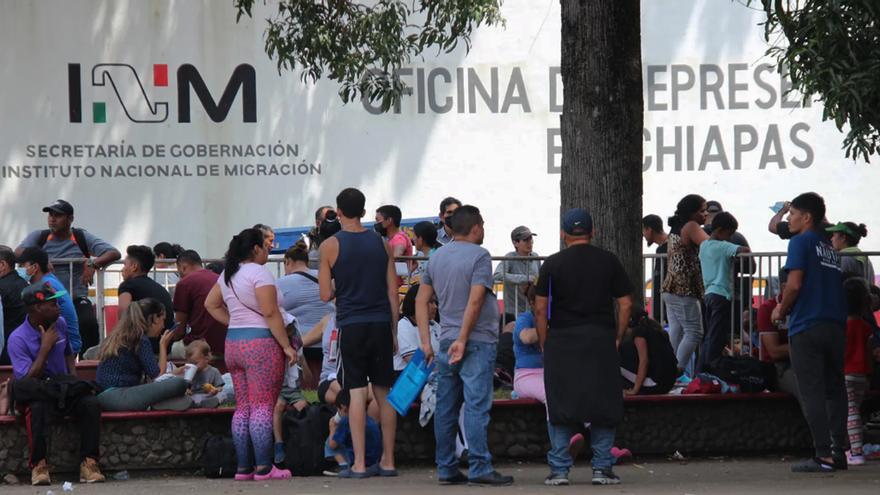
Migrants, including several Cubans, in the Tapachula ecological park waiting for immigration procedures. (EFE)

14ymedio bigger14ymedio, Havana, 17 October 2023 — Complaints from migrants and activists against Mexican Migration officials are multiplying. To the complaints on Monday that the Mexican Commission for Aid to Refugees (COMAR) gives erroneous information to Cubans about the documents they have to request, leading them to run the risk of being deported, are added several testimonies this Tuesday that prove corruption and even robberies.

Carlos Álvarez, from Havana, said that the agents of the Siglo XXI immigration station, in Tapachula, in Chiapas, “took 120 dollars, a watch and a chain” from him while he was detained and held incommunicado there for 20 days.

The young man tells 14ymedio how he was threatened by an officer nicknamed El Comander on September 27, when he complained about the belongings he was missing when he left the place. “They only gave me my cell phone and a backpack with clothes. ’What more do you want if you’re already free? Get out of here or you’ll be deported,” the Comander told me.

Álvarez complains that “no one protects the migrant in that prison. The lawyers who are inside ask you for a deposit of $600 to a phone number so that they can collect it at the Oxxo (a 24-hour store). When they have it, they tell you that they are going to process the protection order so that they don’t deport you, but I never saw anyone leave until they came to tell us that we had to  vacate.” continue reading

Activist and lawyer José Luis Pérez said that the problem is that Migration “continues to have carte blanche to arrest migrants, intimidate them with deportation and extort them”

Another complaint was made to Diario del Sur by Enrique Vidal, coordinator of processes of the Human Rights Center Fray Matías de Córdoba (Veracruz). The activist says that Migration agents “take 200 dollars from Cubans” to not arrest them. That amount has to be “delivered to the migration agents who are deployed at the 11 checkpoints between Tapachula and Arriaga” (Chiapas), Vidal continues, in addition to another located in Suchiate (Chiapas).

Cubans who cross from Guatemala over the southern border of Mexico pay thousands of dollars to reach the state of Oaxaca, from where they travel to the center of the country and continue their journey to the United States. The agents’ extortion is “a systematic practice that is covered up by the senior officials of the National Institute of Migration (INM), and it hasn’t been eradicated,” the activist adds.

Vidal said that there is total impunity. Despite the fact that there is evidence and the National Human Rights Commission has the information, the authorities “have pretended not to know about the migrants.”

According to official figures from the Mexican Commission for Refugee Assistance, 113,000 migrants applied for asylum in Mexico between January and September of this year. The figure represents an increase of 30% compared to the same period of the previous year. Among these are 12,777 Cubans.

Activist and lawyer José Luis Pérez said that migrants are “hooked by coyotes to advance to the border with the United States.” For the lawyer, the problem is that Migration “continues to have carte blanche to arrest migrants, intimidate them with deportation and extort them.”

Without money, Carlos Álvarez says that the same morning he left the Siglo XXI station he went to the ecological park, located in Los Cerritos, where the Cubans who were there supported him with money. “I did the paperwork for refuge at the COMAR because everything is hot in Tapachula. The deportations have already begun, and with this I was no longer stopped by Migration when they reviewed my documents this Monday.”

Translated by Regina Anavy

____________

COLLABORATE WITH OUR WORKThe 14ymedio team is committed to practicing serious journalism that reflects Cuba’s reality in all its depth. Thank you for joining us on this long journey. We invite you to continue supporting us by becoming a member of 14ymedio now. Together we can continue transforming journalism in Cuba.

Political Curators in the Cuban Regime Rehabilitate Italo Calvino on his Centenary

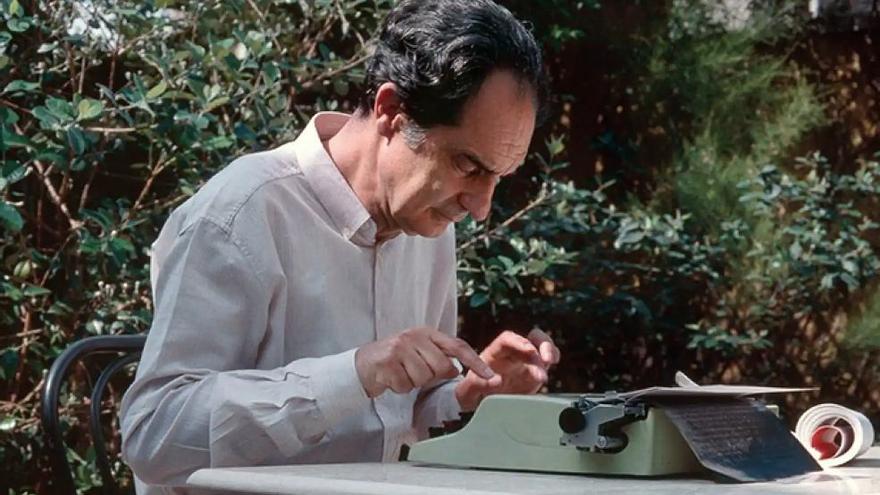
Calvino can only be a Cuban ’by force’, which is bad news for Havana and for its friends in the Italian Embassy. (Goodreads)

14ymedio bigger14ymedio, Xavier Carbonell, Salamanca, 15 October 2023 – No one would have guessed that publishing Italo Calvino in Cuba – where an ’absolute freeze’ on his books was declared in 1971 – was going to become a coin of diplomatic currency between Rome and Havana. Scholars and ambassadors, aficionados and bureaucrats, teachers, critics and drowsy leaders are getting together at the moment to celebrate the centenary of the writer – who perhaps would be amused to see just how elastic is memory for the censor, over there in the tropics.

This ’witches coven’ is anything but harmless. Culture – or that which the regime thinks is culture, through much filtering and editing – is one of the ways it tries to convince Europe that some civility remains on the island, and that the Italian embassy’s money can be used to print books, although in microscopic print runs – books which were prohibited in earlier times. To rehabilitate the author, those who once buried him alive – for having defended Herberto Padilla after his arrest by State Security – are now insisting on his origins. Born in Santiago de las Vegas (Havana) in 1923 and married in Havana in 1964 to the Argentinian Esther Singer, Calvino couldn’t be anything else – they argue – than a lost Cuban destiny, or just an Italian by mistake.

Italo’s parents, Mario Calvino and Eva Mameli, moved to the island in 1917, during the period of the Mario García Menocal government. Their house – where their son was born – is today the headquarters of the Institute of Fundamental Investigation into Tropical Agriculture and it keeps a small, almost unspoilt, archive of the family, for the studious.

Calvino’s birthplace in Havana, currently the headquarters of the Institute of Fundamental Investigation into Tropical Agriculture. (Facebook)

Occasionally Menocal and Mario Calvino exchanged letters: “This tree, which is in such poor condition and is little appreciated by those who wait for it to bear fruit – I’d like to see whether you can manage to help it get its vitality back and produce what the country rightly expects it to. Here, they give you a hatchet to do the job. Please know that you can do it properly. You continue reading

have the chance to do something good for Cuba”. The tree – which appears to be a disagreeable metaphor for the country – was saved by the agricultural expert, not without complaining that “there were people who didn’t want it to prosper”.

An article published a few years ago in Opus Habana, the Historian’s Office magazine, praised Eva Mameli for a suspiciously patriotic gesture: swapping the old Cuban flag on the then Special Agronomic Station, where the couple lived, for a new one. Mameli gave birth to Italo in 1923 and two years later they returned to Sanremo in Liguria, Italy.

The very young age of Italo when the Calvinos returned to Italy contributed to how he was brought up as a European without any memory of being creole  

The very young age of Italo when the Calvinos returned to Italy contributed to how he was brought up as a European without any memory of being creole. Calvino could only be Cuban by force – to use Cabrera Infante’s expression – which is bad news for Havana and its friends at the Italian Embassy.

Calvino visited Cuba in 1964; he went to see his parents’ old house, and he married Singer. The Mexican writer Jorge Ibargüengoita well remembers the dull soporific climate of Havana in his chronicle Revolution in the Garden. Calvino – who had awarded one of Ibargüengoita’s novels, as a juror at Casa de la Americas – and his wife and the other invitees had to support a dissertation by Lisandro Otero on Merendero of the Sharks, a corner of the Havana coast where the swimmers who dared to swim ended up devoured.

Commemorative plaque of Calvino’s birthplace in Santiago de las Vegas, unveiled by his daughter Giovanna in 1996. (Cubaperiodistas)

Four years later, thousands of copies of The Cloven Viscount – written by Calvino in 1952 – arrived in the Cuban bookshops, under the banner of Cocuyo, the same publisher as Salinger’s, Faulkner’s and other essential writers. The honeymoon didn’t last long: after Padilla’s detention the memory of the Ligurian born in the tropics fell into disgrace.

This Saturday an official journalist wrote that Cuba was a country from which Calvino “never severed his ties”. He wasn’t wrong: it wasn’t him, it was Cuba, its agents and its cultural investigators – the same ones who today award and publish him with the Italian Embassy’s money – who erased the author of Cosmicomics from their catalogue.

Now, the directors of the Writer’s Union are being photographed with the recently published trilogy, Our Ancestors. The fact that these three elegies to freedom, disention and criticism are being published on the island makes one sigh with relief: the censors will not be reading anything for a thousand years. Neither have the people who paid for these published copies – in a country with a context of absolute editorial debacle – told us whether they will be sold freely rather than to a select group of people – as has occurred with Calvino’s other titles.

Perhaps it’s only in this aching country where one can make sense of Marco Polo’s well-known saying to Kubla Khan in Invisible Cities: “in the middle of hell, it’s not hell” – and where this reading of Calvino is indeed for the Cubans.

Translated by Ricardo Recluso

____________

COLLABORATE WITH OUR WORKThe 14ymedio team is committed to practicing serious journalism that reflects Cuba’s reality in all its depth. Thank you for joining us on this long journey. We invite you to continue supporting us by becoming a member of 14ymedio now. Together we can continue transforming journalism in Cuba.

Mexico Resumes Deportation Flights and Returns 138 Cubans to the Island

The Viva Aerobus flight with 138 Cubans arrived at Havana airport this Saturday from Mexico. (Minint)

14ymedio bigger14ymedio/EFE, Havana, 15 October 2023 — Mexico resumed, this Saturday, the deportation flights of Cubans with the return by air of 138 people who illegally entered the Aztec country. The return came a day after Mexican President Andrés Manuel López Obrador confirmed the meeting with 10 leaders, including Miguel Díaz-Canel, on October 22, in Palenque (Chiapas) to define a strategy to stop the migratory flow.

The last week of September, U.S. media reported a meeting in Ciudad Juárez between the National Institute of Migration (INM) and the United States, where it determined to “deport” migrants who are in the cities bordering El Paso, San Diego and Eagle Pass.

“We are supporting people, trying to order the flow of people.” However, a government source told 14ymedio that “there are regions such as Tapachula (Chiapas) and the border with the U.S., which urgently need to be addressed, after insisting that migrants will not be deported. Two weeks later, deportation flights between Mexico and Cuba resumed. continue reading

In a statement this Saturday, the Ministry of the Interior of Cuba detailed the arrival on the Island of 95 men and 43 women on a Viva Aerobus flight that arrived at the José Martí International Airport in Havana at 11:55 am. Counting this group, there are now 922 Cubans who were returned by Mexico on 12 flights this year.

The Ministry of the Interior specified this Saturday the arrival on the Island of 95 men and 43 women on a Viva Aerobus flight that arrived at the José Martí International Airport in Havana

The official press indicated that with this operation “returns from the Aztec nation to the Island resume, which have not been carried out since March 3,” when Mexico deported 107 Cuban irregular migrants, including the remains of the Cuban Anet Patricia Aguilera Canto, Anyelina Rodríguez Aguilera and another native of the Island who died in a traffic accident in Veracruz.

Cuba also has a deportation agreement with the United States, in force since last November.

The return of “inadmissible” people was agreed in 2017, but was suspended with the outbreak of COVID-19 and the cooling of bilateral relations after the period of “thaw” promoted by the then leaders of the United States, Barack Obama, and of Cuba, Raúl Castro.

The first flight with deportees from the U.S. arrived in Havana on April 24 with 123 people. That group was followed by another 66 and 36 returnees, respectively, who traveled by plane on May 10 and June 22.

The fourth flight arrived on July 21 with 33 irregular migrants, coinciding with the return of other Cubans by sea, and the fifth took place on August 17.

Last September, the United States returned 35 Cubans who tried to enter irregularly. It was the sixth flight of deportations of nationals of the Island so far this year

The agreement to return the so-called ” inadmissibles ” was added to the current one that allows the return of all Cubans who arrive in the U.S. by sea.

Translated by Regina Anavy

____________

COLLABORATE WITH OUR WORKThe 14ymedio team is committed to practicing serious journalism that reflects Cuba’s reality in all its depth. Thank you for joining us on this long journey. We invite you to continue supporting us by becoming a member of 14ymedio now. Together we can continue transforming journalism in Cuba.

Mexico Calls the Deportation of Cubans to the Island ‘Assisted Returns’

The 138 Cubans deported from Mexico on Saturday were detained at the Siglo XXI Migration Station. (EFE)

14ymedio bigger14ymedio, Havana, 16 October 2023 — The Mexican Commission for Refugee Assistance (COMAR) is misinforming Cubans who go to the headquarters located in the Tláhuac shelter, in Mexico City. The authorities “assure that no permit is needed” to prevent migrants from being detained and deported, a Cuban woman tells 14ymedio. In case the police stop her, just stating that “she is waiting for the CBP One appointment” will be enough to avoid arrest, COMAR officials told her.

This woman, who came to process a safe-conduct pass, was assured that she “could even stay in Mexico City,” as long as she did not move to any other state. In addition, they warned her that if she requests asylum, they will deny her the CBP One appointment.

There are already many Cubans and Venezuelans in Mexico City, mainly in neighborhoods where rent is lower and there aren’t as many requirements to rent. “They are seen a lot in the stores of neighborhoods and in the supermarkets such as Bodega Aurrera and Soriana, buying food,” says a resident of the Mexican capital.

Yunior, a 25-year-old habanero who arrived in Mexico City just a week ago from Tapachula, tells this newspaper that, although his goal is to continue to the U.S. through CBP One, an appointment for which he signed up along with 10 other Cubans, he intends to find a job in the city and raise all the money he can. The young man was part of the thousands of migrants who were waiting in Tapachula for an appointment to apply for asylum with the U.S. authorities and had to move to the Mexican capital after the Government of Andrés Manuel López Obrador reported that no more flight continue reading

permits were going to be processed for foreigners admitted to CBP One in that city, and that this procedure should be done in Mexico City.

At the moment, Yunior, although he is living with three other compatriots in a small room, wants to find cheaper rent and is constantly checking Marketplace, on Facebook, where rentals are published.

But not everyone has had the same luck as the habanero, who was able to avoid the Migration checkpoints and reach Mexico City. Reinier Martínez, one of the 138 Cubans deported by Mexico on a flight last Saturday, denounced the irregularities committed daily by immigration agents and the Government.

Reinier Martínez, one of the 138 Cubans deported by Mexico on a flight last Saturday, denounced the irregularities committed daily by immigration agents and the Government

“You have to sign to be able to leave,” an agent at the Siglo XXI Migration Station told him. Without knowing what it was about, the man reported in a live broadcast through Facebook from Havana, that they took his fingerprints and passed several papers to him. “Some I didn’t sign because I didn’t understand what they were about,” he said.

“It doesn’t matter if you have the COMAR (procedure before the Mexican Commission for Refugee Aid) or papers. I was deported,” said this Cuban in a video he recorded from terminal 3 of Havana’s José Martí International Airport. “This is a testimony that I hope will serve those who have relatives in Mexico. Take care, don’t believe everything the Mexican authorities tell you.”

Mexico has justified the deportations of nationals of the Island and calls them “assisted returns,” activist and migrant defender José Luis Pérez Jiménez tells 14ymedio. Martínez was illegally detained. He was not found with “false documentation,” nor did he have an order to leave the country, which are cause for arrest.

Martínez was arrested three days before the deportation. The taxi in which he was traveling from Puerto Madero to Tapachula was intercepted by Migration agents, who locked him in a room with at least 60 other Cubans, in addition to some women with small children. Among this group were those who had been approved for the CBP One appointment, others with a humanitarian visa and others with the safe-conduct. “We ate at the time they wanted, and we only saw the sun when we went out for breakfast,” he says.

In three days of captivity, Martínez was bombarded with the promise of the delivery of a safe-conduct. Alleged lawyers told him that they needed his authorization to represent him

This Cuban evidenced the excesses of the agents and the violation of the human rights of migrants. According to the Migration Law, minors must be transferred to children’s rooms; it is forbidden to keep them in immigration stations.

In three days of captivity, Martínez was bombarded with the promise of the delivery of a safe-conduct. Alleged lawyers told him that they needed his authorization to represent him. The same speech was received by the rest of the Cubans who, in the hope of being free, signed several documents.

Hours later, the agents said they would give them a transit permit to get to the U.S. border, but in reality they were preparing them for deportation. “They handed us over to people armed with pistols and machine guns, who were hooded, with bulletproof vests and pistols,” Martínez said, and warned us that “if we didn’t hurry, it would be worse.”

They tied their hands with cable ties and taped their mouths. These hooded men were the ones who took them to Tapachula airport to board the flight to Cuba.

Carlos Álvarez, a habanero who processed the request for refuge with COMAR, tells 14ymedio that he was imprisoned for 20 days at the Siglo XXI Migration Station. “All day there was the noise of people working. We, seven Cubans and  about 45 Venezuelans, Haitians and Hondurans were held in rooms.”

Álvarez says that “the place is like a prison. You sleep on the floor, without a bed, and I won’t even talk about the food.” They were taken out on September 26 because “there was an important visit,” he explains. That day, the commissioner of the National Institute of Migration (INM), Francisco Garduño Yáñez, supervised the remodeling of the station.

Activist José Luis Pérez Jiménez said that COMAR in Tapachula “is not attending the eligibility interviews” nor hearing “the migrants’ requests for refuge”

Activist José Luis Pérez Jiménez, denounced that COMAR in Tapachula “is not attending the eligibility interviews” nor hearing “the migrants’ requests for refuge.” People have begun to process amparos, protection orders, to prevent deportation.

The lawyer warned that with COMAR being overtaken by the migratory flow, the procedure has been extended to six months.

Carlos Álvarez was given a sheet with a number and told that he had to wait for an email to be sent to him. The procedure would supposedly not take more than 20 days, but there are people who have been waiting for more than a month and still don’t have a resolution.

“When I came, they said that this is for shelter and that those who wanted to continue to the U.S. should go to Migration. Days later they told the Cubans that they could continue without any  problem, and that those with CBP One could travel freely. But it’s a lie; they are stopping them when they leave on the bus,” says Álvarez.

Pérez Jiménez says that the immigration authorities are misinforming migrants. Alonso, a Cuban who is in Mexico City, confirms to this newspaper the deception of the authorities. “They assure us that those who are with CBP One do not need to do anything else, that they are not going to stop us or deport us.”

Translated by Regina Anavy

____________

COLLABORATE WITH OUR WORKThe 14ymedio team is committed to practicing serious journalism that reflects Cuba’s reality in all its depth. Thank you for joining us on this long journey. We invite you to continue supporting us by becoming a member of 14ymedio now. Together we can continue transforming journalism in Cuba.