Airbnb Is Sued in the United States for Renting a Property Confiscated by the Cuban Revolution

The property subject to the lawsuit is a six-unit building located at number 1212 on 33rd Avenue, in Miramar.

14ymedio bigger14ymedio, Havana, 6 March 2024 — An American doctor, Javier García-Bengochea, has sued the Airbnb platform for renting a property in Havana confiscated by Fidel Castro in 1960. According to the Nuevo Herald, the lawsuit was filed on Monday in the court of the central district of Florida, based in Orlando.
The property subject to the lawsuit is a six-unit building — defined in the Airbnb ad as “magnificent” and “elegant” — located at number 1212 on 33rd Avenue, in Miramar, built in 1939 by the Parreño family. One of its members, Alberto Parreño, died in 1972, and the plaintiff’s cousin inherited the property from him.

In 1970, explains the Herald, the Foreign Claims Resolution Commission of the Department of Justice certified the claim of Alberto Parreño, then a US citizen, to a third of the land and the building, valuing his loss at $66,666 in the 1960s (equivalent to almost $700,000 today).

The complaint brought by Javier García-Bengochea, family estate administrator, alleges that Airbnb “continued to advertise the property between August 2019 and May 2022,” after being notified that it was subject to a claim, and that it had “trafficked the property consciously, voluntarily, intentionally and continuously,” at least since 2017. continue reading

The doctor, a neurosurgery specialist and resident of Jacksonville, sued the State Department in 2009 for renting a penthouse in another building owned by his family to house American diplomats.

It’s not the first time that the doctor, a specialist in neurosurgery and resident of Jacksonville, has filed a claim based on Title III of the Helms-Burton Act

It’s not the first time that the doctor, a specialist in neurosurgery and resident of Jacksonville, has filed a lawsuit based on Title III of the Helms-Burton Act, activated by Donald Trump’s Administration in 2019.

In 2019, he filed complaints against several shipping companies for using the lands that house the port of Santiago de Cuba, inherited by García-Bengochea in 2000 from his cousin Desiderio Parreño, and this in turn from his brother Alberto. The lawsuit was settled, on that occasion, in favor of the cruise companies.

This did not happen in a similar case, that of Mickael Behn, who sued Carnival, Royal Caribbean, Norwegian Cruise Line and MSC Cruises for using the facilities in the port of Havana, originally owned by his family. The judges ordered the shipping companies to pay more than 400 million dollars in compensation.

At the beginning of 2022, Airbnb faced another type of problem related to the Island when it was sued for violations of the embargo on Cuba and was forced to pay $91,172.29 to the US Government. In addition, it had to commit to addressing “deficiencies in compliance with sanctions” and introducing “additional commitments designed to minimize the risk of recurrence of similar behavior in the future.”

Airbnb was ordered to block the granting of permits to people located in Cuba who were acting as hosts on the platform, and to collect information about the country of residence and the payment instrument of the users, to determine if they are “nationals or residents” of the Island and ensure that the hosts certify that they are private entrepreneurs and not “officials of the Cuban Government or members of the Communist Party.”

Since then, Airbnb – strongly defended by the Island’s regime – has continued to operate normally and currently has announced on its website more than 1,000 rentals in Havana. But not, however, the apartments that are the subject of Javier García-Bengochea’s lawsuit.

In its conditions, Airbnb dumps on the ’host’ – as Airbnb calls the individual renting the property – the whole burden of complying with the legislation in force in the country or city of the property and presents itself as a mere digital space for ads, without any responsibility for the properties that are promoted on its page. However, Airbnb is profiting from that property, since it charges a commission.

Translated by Regina Anavy

____________

COLLABORATE WITH OUR WORKThe 14ymedio team is committed to practicing serious journalism that reflects Cuba’s reality in all its depth. Thank you for joining us on this long journey. We invite you to continue supporting us by becoming a member of 14ymedio now. Together we can continue transforming journalism in Cuba.

Cuban Activist Rosa Maria Paya Is Invited to Biden’s Annual State of the Union Speech to Congress

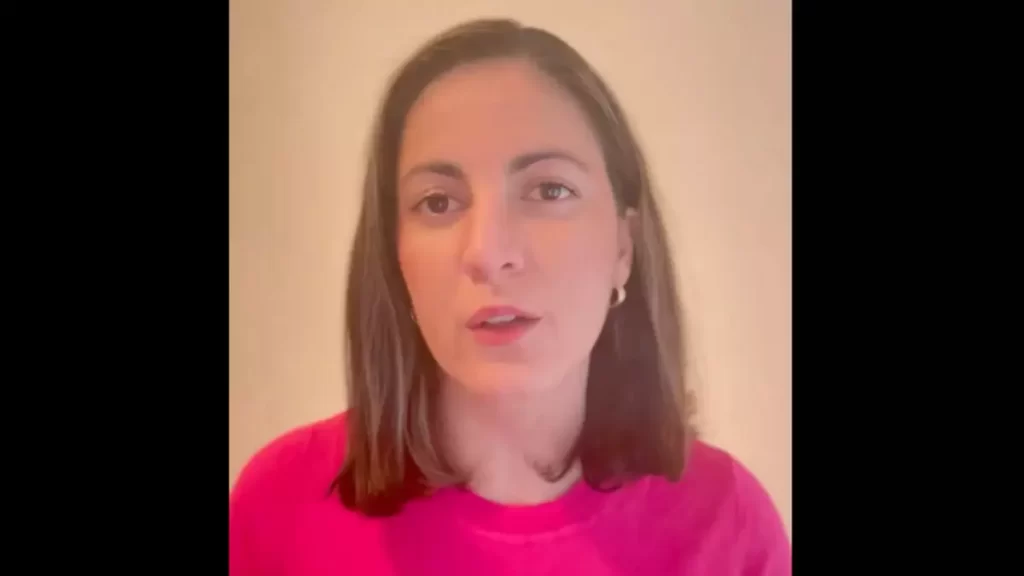
Rosa María Payá in her video thanking Congressman Giménez for the invitation / Screen Capture

14ymedio biggerEFE (via 14ymedio), Washington, D.C., March 7, 2024 — Cuban activist Rosa María Payá has been invited by Congressman Carlos Giménez to witness the annual State of the Union speech that the President of the United States, Joe Biden, will deliver this Thursday at the Capitol, the Republican legislator reported on Wednesday.

The representative of an electoral district comprising Miami-Dade County and the Florida keys pointed out that with the presence of Payá, daughter of the late Cuban opposition leader Oswaldo Payá, he seeks to “continue denouncing the evils of the regime.”

In a video published on social network X, Giménez said that Rosa María Payá will join him during the speech “to denounce the current brutality of Cuba, demand freedom for all political prisoners and hold the regime responsible for its crimes against humanity.” continue reading

He warned that “Cuban communism poses a direct threat to the security of the United States and the stability of the western hemisphere,” and he criticized the recent trip to Havana of his colleagues, alluding to the visit that Democratic legislators Pramila Jayapal and Ilhan Omar made in February to the Cuban capital.

The congressman emphasized that Rosa María is a champion in the defense of human rights and “a tireless fighter for the liberation of Cuba from communism.”

He alluded to the lawsuit for death by negligence that the Payá family filed last week in Miami against former U.S. Ambassador Víctor Manuel Rocha, who is detained and is expected to plead guilty to conspiring to act as an agent of a foreign government.

In the lawsuit, Oswaldo Payá’s widow, Ofelia Acevedo, accuses Rocha of having been “an accomplice” in the “murder” of her husband.

“My family seeks what we have always sought, justice, the truth, and an end to the impunity of the Cuban regime and its accomplices.”

Payá “was assassinated by the Castro regime in 2012, a period during which Rocha was collaborating with Cuba while advising U.S. national security officials and had access to the most sensitive intelligence information,” stated the organization Cuba Decide, founded by Rosa María Payá.

“My family is looking for what we have always sought – justice, the truth, and ending the impunity of the Cuban regime and its accomplices, as we have done since the murder of my father in 2012,” Rosa María Payá said in her statement from the congressman’s office.

Translated by Regina Anavy

____________

COLLABORATE WITH OUR WORKThe 14ymedio team is committed to practicing serious journalism that reflects Cuba’s reality in all its depth. Thank you for joining us on this long journey. We invite you to continue supporting us by becoming a member of 14ymedio now. Together we can continue transforming journalism in Cuba.

Cuba Needs 10 Billion Dollars and Ten Years To Rebuild Its Thermoelectric Plants

Image of the Antonio Guiteras thermoelectric plant. / Cubadebate

14ymedio bigger14ymedio, Madrid, 6 March 2024 — The repair of Cuba’s obsolete infrastructure to produce electricity would take between six and ten years, in addition to a colossal investment: 10 billion dollars. It is one of the devastating figures included in a report from Cuba Siglo 21 signed by Emilio Morales and made public this Wednesday.

Titled Cuba Collapses and Also Turns Off the Light, the text analyzes the dramatic energy situation of the Island, “after decades of negligence in maintenance,” a few days after the entry into force of the so-called economic package, with an increase in the price of fuel of more than 400%.

The Electric Union has a generation availability of 2,097 megawatts (MW) and a maximum demand of 3,000 MW

The Electric Union (UNE) has a generation availability of 2,097 megawatts (MW) and a maximum demand of 3,000 MW, the report notes, which implies a deficit of 903 MW, a third of what it would need to meet the demand. A figure, it is also noted, that may grow in the coming weeks. continue reading

Morales indicates that “the energy challenges facing Cuba do not have an immediate solution,” since the country “lacks domestic resources of oil or natural gas to meet the demand for electricity production, which forces it to depend on imports.”

The analyst also deals with the promised production of electricity with alternative sources, of which he says that “it is not a magic wand and takes time to develop them.”

Even more, he asserts that the goal to reach 37% of renewable energies by 2030 crowed about by the ruling party “is a fantasy of the Cuban Government.” And he lists: “Investments in renewable energies have been insufficient and poorly planned. In 2013, the installed capacity for electricity generation in the country based on renewable sources was just 4.3%. Ten years after defining those goals, the generation capacity in renewable energies grew only 0.96%. Projects such as the biomass plant at the Ciro Redondo Sugar Plant have failed due to the decrease in sugar cane production. Wind energy has also faced difficulties in materializing.”

With this panorama, the price increase that came into force on March 1 “will not solve the energy crisis”

With this panorama, the price increase that came into force on March 1, Morales insists, “will not solve the energy crisis.” This, he continues, “will only increase inflation, distort the prices of products and services in the market, increase the distortion of wages and will not contribute to a stabilization of the economy.”

There is only one solution, according to the consultant: “Eliminate the model of nationalized (totalitarian) centralization of the economy and go to a free market economy.”

Translated by Regina Anavy

____________

COLLABORATE WITH OUR WORKThe 14ymedio team is committed to practicing serious journalism that reflects Cuba’s reality in all its depth. Thank you for joining us on this long journey. We invite you to continue supporting us by becoming a member of 14ymedio now. Together we can continue transforming journalism in Cuba.

Independent journalist Carlos Michel Morales, ’11J’ Political Prisoner in Cuba, Is Released

Activist Guillermo del Sol and independent journalist Carlos Michel Morales outside the El Pre prison in Villa Clara

14ymedio bigger14ymedio, Havana, 6 March 2024 — Independent journalist Carlos Michel Morales Rodríguez was released from prison this Wednesday after serving the sentence of two years and ten months of deprivation of liberty that he received for demonstrating in Caibarién, Villa Clara, during the popular protests of 11 July 2021 (commonly referred to as ’11J’), according to confirmed activist Guillermo del Sol.

“I am here outside El Pre prison, I arrived at six in the morning waiting for Carlos Michel to be released,” Del Sol explained in an audio that he sent via WhatsApp to other activists and independent journalists. “They are delaying and delaying the release but they have to release him today,” added the dissident.

Hours later, the photo of both men together confirmed the reporter’s release. In the image, Morales Rodríguez, extremely thin, makes the victory sign with his fingers. According to reports from close friends, the activist of the Cuba Decide platform has serious health problems derived from malnutrition and the hunger strikes that he carried out while he was behind bars.

The mistreatment received in prison has also taken its toll on the body of the independent journalist, contributor to spaces such as Cubanet and Cubita Now, especially a beating he received at the hands of prison guards in mid-2022 for demanding respect for the rights of the prisoners.

“I’m here on the outskirts of El Pre prison, I arrived at six in the morning waiting for Carlos Michel to be released”

“The family of another prisoner who is in the same prison informed me that Carlos Michael was beaten by the guards for demanding the right of all prisoners to watch television, that happened in his detachment, and there many prisoners intervened so that he would not be hit more,” Javier Delgado Torna, also convicted of 11J, reported to Martí Noticias at the time.

Among the health problems suffered by Morales Rodríguez is ulcerative gastritis that has brought him multiple relapses, he was even admitted to the maximum rigor prison hospital in Guamajal due to his health condition and the strong cramps derived from his pathology.

Morales Rodríguez was also imprisoned in the Alambradas de Manacas prison in Villa Clara and during the trial against him he was accused of leading a group of people who shouted anti-government slogans during the 11J protests and of inciting other neighbors to join the protest.

In January, political prisoner Yusmely Moreno González was also released, having been sentenced to three years in prison for also participating in the 11J demonstrations, in her case in the town of Surgidero de Batabanó, in the province of Mayabeque.

“Freedom through compliance,” read the brief document that Moreno González received upon leaving the Villa Delicia work camp in Havana, where she was recently transferred after spending most of her sentence in the Mujeres de Occidente prison. also known as El Guatao.

Cuba closed the year with six more political prisoners than in 2022 , as the list grew from 1,057 to 1,063. Throughout the 12 months, 1,251 people arrested or imprisoned for political issues have passed through its list and 188 have fully served their sentences during the year, according to a report by the organization Prisoners Defenders (PD), based in Madrid.

____________

COLLABORATE WITH OUR WORKThe 14ymedio team is committed to practicing serious journalism that reflects Cuba’s reality in all its depth. Thank you for joining us on this long journey. We invite you to continue supporting us by becoming a member of 14ymedio now. Together we can continue transforming journalism in Cuba.

The Cuban Regime Trips Over Itself in Justifying Its Request for Milk to the UN

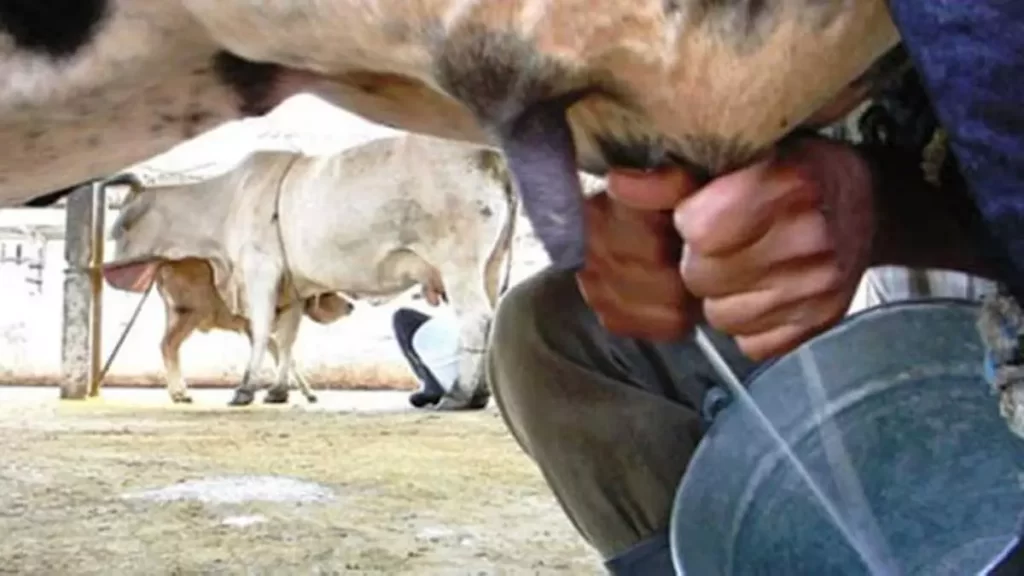
Some 24% of Camagüey producers did not deliver a single drop of milk to the State. (Invasor)

14ymedio bigger14ymedio, Madrid, 4 March 2024 — The Cuban Government has waited five days to respond to the revelation that, for the first time in history, it has had to resort to an urgent request for aid to the United Nations World Food Program (WFP) in the face of milk shortages. The regime tries to tone down the uproar with a long article published in the official press, stating that the request was made as a function of the bilateral relationship, the long-standing cooperation, and the Strategic Plan for Cuba in 2024.

The Government considers the request normal and suggests that the independent press is exaggerating, but the truth is that the WFP itself pointed out how exceptional the request is, despite the fact that it has maintained collaboration programs on the Island for years: “It was the first time that Cuba requested help by issuing an official communication at the highest level of government.”

The WFP told the Spanish press agency EFE that it was aware of the situation from two different sources in Cuban ministries and that there was an “urgent need,” stressing “the importance of this request” in the context of “the deep economic crisis facing Cuba.” The request was made in December by letter, and the WFP has delivered “144 tons of skim milk powder.” But it added that there was no “time frame,” and the aid will be extended without a planned end-date, leading the agency to “mobilize additional resources” from “traditional and non-traditional donors.” continue reading

According to the report from Cubadebate, signed by Óscar Figueredo, deputy director of IdeaGoMedia – the regime’s media propaganda conglomerate – the ship that arrived from Brazil with 375 tons of powdered milk is the result of the collaboration, which, he emphasizes, had to be resorted to because of the “resurgence of the blockade.” He adds that 500 tons of the product were purchased from the United States, highlighting the standard payment conditions required: cash and in advance.

He adds that 500 tons of the product were purchased from the United States, highlighting the standard payment conditions required: cash and in advance

In more than a dozen paragraphs, the importance of the aid is minimized, arguing that the exchange is common and that Cuba is not only a recipient but also a donor. “An example of this is the annual donation of 2,500 tons of sugar since 1996, which has made it possible to help different countries in the world such as the Dominican Republic, Jamaica, Honduras, Haiti, Ethiopia and Angola, among others,” says the article, without adding that this cooperation came to an end at least 15 years ago.

“The total value of the contributions made by Cuba to the World Food Program as a sugar donor amounted to more than 8 million dollars s of 2009,” it states. It inferred that the contribution ended because the Island has had a series of catastrophic harvests for years and has even ceased to have enough sugar for export and domestic consumption.

The report also outlines some of the projects that are developed in Cuba through collaboration with the WFP – which is said to support 120 countries, normalizing the situation – ranging from the planning and implementation of planting initiatives to training in the face of emergencies in events such as hurricanes and floods, among others.

“In a complex economic context as a result of the combined effects of the COVID-19 pandemic, the impacts of adverse weather events and, mainly, the resurgence of the U.S. economic, commercial and financial blockade, the country faces great challenges to access international markets and financial sources, which has been aggravated by the unfair and arbitrary inclusion of Cuba on the List of States that Sponsor Terrorism,” thereby justifying the request.

It is inferred that the contribution ended because the Island has had a series of catastrophic harvests for years and has ceased to have enough sugar for export and domestic consumption

The text also highlights the effort to clarify that the Government controls what food is delivered, as it should. The statements seem to be aimed at controlling the rumors about the appearance in the markets, on different occasions, of food donated by the WFP, as was the case of Russian oil in 2021, or the coal and mattresses delivered after Hurricane Irma in 2017, when some citizens had to pay the State for these items.

Several paragraphs at the end are dedicated to noting Cuba’s historical achievements in life expectancy, maternal and child health and low infant mortality, which have been constant since 1959, especially thanks to the Russian subsidy, and which have allowed the country to maintain good data in the regional context, but whose deterioration in recent years has become evident. In addition, it once again claims the right of the population to food and criticizes the “hostility” of the United States towards the Havana regime, which “impedes normal access to international resources and global banking relations.”

However, at the same time, the authorities are recognizing that there is a lack of milk, and the problem is not only the shortage of money to import it from abroad. The Government has been unable to guarantee the product by stimulating  milk production. This weekend, an article from the provincial media of Camagüey, formerly a dairy power, delved into the alarming situation of the sector.

The beginning cannot be more forceful: “In January, the delivery of milk to the industry began badly, and February followed the same path,” summarizes the report, in which it is made explicit that many producers (24%) have not sent “a single liter to the factories.” In 2023, barely half of what was planned was delivered, less than 42 million liters, compared to the 81.4 million liters expected. The number of farmers contracted by the State has gone down, from 8,581 in 2022 to 7,671 in 2023 and 7,448 this year.

“For this, a logical explanation must be found,” the newspaper claims, as if it were a secret that theft, disease and malnutrition, non-payments and arrears, deaths and low birth rates were not the perfect framework for no one to want to deliver milk to the Government.

The article states that non-payments will no longer occur, since the money is insured, say the dairy managers, who are hard to believe after years of non-compliance. The farmers themselves, interviewed for the article, assume the blame for the situation, which led nine municipalities to lower the amount delivered.

“It’s a management problem that depends a lot on us, to make sure that the cows have water, mineral salt, conditions of shade and tranquility before they are subjected to milking. The use of protein plants in the feeding of the livestock has been a constant,” says Isidro Saavedra Salazar, one of the farmers who traveled to Havana “on the Government’s instructions to acquire knowledge in that field.” His example is seen as a sign that “with effort” they can comply with the deliveries, which will allow children and the sick to eat, in addition to the existence of other products such as butter, yogurt and cheese.

But reality didn’t escape the many readers who commented on the article. The country’s food does not depend on the individual effort of the farmers but on the policies of the State. “It’s impossible that at 20 pesos per liter (.26 gallons) someone wants to produce milk; aren’t there any economists who dare to tell the truth?”

Translated by Regina Anavy

____________

COLLABORATE WITH OUR WORKThe 14ymedio team is committed to practicing serious journalism that reflects Cuba’s reality in all its depth. Thank you for joining us on this long journey. We invite you to continue supporting us by becoming a member of 14ymedio now. Together we can continue transforming journalism in Cuba.

Venzuela Cancels DW Cable Channel for Denouncing Attack on Press Freedom

Screen capture of the DW program dedicated to corruption in Latin America / DW

14ymedio biggerEFE (via 14ymedio), Berlin, 5 March 2024 — The German television channel DW denounced, this Tuesday, Venezuela’s cancellation of its Spanish-language programming on cable television, a measure it considered an “attack on freedom of the press,” and demanded the restoration of the signal.

“We make a vehement call to the Venezuelan Government to restore the distribution of the DW TV channel in Spanish as soon as possible. The cancellation of DW distribution is a severe attack on the freedom of people in Venezuela to obtain independent information,” Peter Limbourg, DW general director said in a statement.

Limbourg condemned this “attack on press freedom” and noted that Venezuelan President Nicolás Maduro called DW a “Nazi station” in reaction to some of its contents.

The cancellation of DW’s Spanish channel by the Venezuelan authorities, according to DW, comes as a result of a video from the new DW format How It Affects You, which addresses corruption in different Latin American countries – including Venezuela – and the links between politicians and organized crime. continue reading

In a social media post about a segment of the video, “it is clearly established that it is not known to what extent Maduro himself is informed or involved”

The broadcast has Amnesty International (AI) and Insight Crime as its main sources. In a social media post about a segment of the video, “it is clearly established that it is not known to what extent Maduro himself is informed or involved,” DW added.

While Maduro called DW a “Nazi station,” Venezuela’s Minister of Communication, Freddy Ñáñez, spoke of the media spreading “hatred against Venezuela” and defaming that country, according to the German media, which strongly rejected these allegations.

“Millions of people have fled Venezuela during the Maduro regime. Freedom of the press practically does not exist. That it reacts with absurd comparisons to criticism supported by facts is something that fits this profile,” said Limbourg.

He added that “defamation, censorship, internet blocks and the spread of false information about DW and its reporting work is something we are facing in more and more countries. We will continue to do everything in our power to reach people who live under authoritarian regimes,” he stressed.

In DW’s information offering, Spanish is the second foreign language with the highest content consumption after English. The content of its service in Spanish reaches 46 million user every week, according to the media.

____________

COLLABORATE WITH OUR WORKThe 14ymedio team is committed to practicing serious journalism that reflects Cuba’s reality in all its depth. Thank you for joining us on this long journey. We invite you to continue supporting us by becoming a member of 14ymedio now. Together we can continue transforming journalism in Cuba.

A Cuban Woman Dies of a Diabetic Coma While Waiting for Her CBP One Appointment in Mexico

Asin Estévez had planned to arrive in Yuma County, Arizona (USA) / Faustino Betancourt Asin/Facebook

14ymedio bigger14ymedio, Mexico City, 5 March 2024 — Yaileisy Asin Estévez died last Friday of a diabetic coma while waiting for a response to the CBP One appointment to fulfill the American dream. The information was spread by the influencer Niover Licea, who also mentioned the farewell letter that Faustino Betancourt Asin, the migrant’s brother, published on Facebook.

Asin Estévez, according to comments on her brother’s publication, had planned to arrive in Yuma County, Arizona. No details are provided of where she was in Mexico or whether her body will be repatriated.

The case of Asin Estévez joins that of several Cubans who have died during their time in Mexico. Yoan Marlon Díaz Escalona, ​​23, entered the country last September. This Havana native was also waiting for the CBP One appointment. The young man began to feel bad, he was admitted to a hospital, but his health worsened and he remained in a coma due to a brain infection. continue reading

The presenter Indira Solís confirmed on February 25 the death of Díaz Escalona, ​​in addition to the family’s request for help to repatriate the body. His wife and his young son remained on the island.

Last December, the Cuban Yarioski Meriño also died in Mexico due to a heart attack. This man from Guantanamo, who had been hired to work in a store, had arrived in the country a month earlier. The relatives paid $5,000 to transport the body that arrived on the island on the first day of February.

Luis Enrique Méndez died last November at the Siglo XXI immigration station, located in Tapachula, where he had gone days earlier to ask for help because he wasn’t feeling well. According to the director of the NGO, Center for Human Dignification, Luis García Villagrán, this migrant from the Island “died in the Immigration facilities and not in the hospital” as was then stated in the official version.

The rafters, whose identity was not made known, “requested asylum and their request is being evaluated by the immigration authorities,” confirmed an Isla Mujeres official

However, the National Migration Institute indicated in a statement that the Cuban migrant “voluntarily requested return” to the Island. As part of the procedure, a medical evaluation was carried out. Méndez, the report reads, “did not present data on any illness,” in addition to the fact that he “reported not having chronic illnesses.”

On the other hand, this Monday, Government sources informed this newspaper that seven Cuban rafters who were rescued on February 27 12 nautical miles northeast of Isla Mujeres (Quintana Roo) by sailors from Mexico, were handed over to the National Institute of Migration.

The rafters, whose identity was not made known, “requested asylum and their request is being evaluated by the immigration authorities,” confirmed an Isla Mujeres official.

At the beginning of February, the Navy intercepted a rustic raft with 16 Cubans, including four women and 12 men, almost seven miles from Isla Contoy (Quintana Roo). The Cubans informed the sailors that “the hunger experienced in Cuba” forced them to risk their lives in search of a better life for themselves and their families.

According to official figures, the state of Quintana Roo has recorded the arrival of 24 rafters to the protected area of ​​Isla Contoy this year. The first group disembarked the first week of January. Between 2014 and 2021, almost 700 Cubans were found on Isla Mujeres. In the last half of last year, maritime authorities reported the presence of 13 vessels, but the official number of people detained has not been given.

____________

COLLABORATE WITH OUR WORKThe 14ymedio team is committed to practicing serious journalism that reflects Cuba’s reality in all its depth. Thank you for joining us on this long journey. We invite you to continue supporting us by becoming a member of 14ymedio now. Together we can continue transforming journalism in Cuba.

A Single Meal a Day for the 76,175 Vulnerable Cubans Cared for by the State

Dining room of the Family Care System (SAF), La Guantanamera, on Miró Street between Agramonte and Morales Lemus in the city of Holguín

14ymedio bigger14ymedio, Miguel García, Holguín, 25 February 2024– This Friday, Tomás, 81 years old, felt lucky. “Today they did offer a strong course, a boiled egg, and there was pea soup that I brought home. With this cold weather, the body is asking for something like that,” he lists the food he bought at the dining room of the Family Care System (SAF) from the Pueblo Nuevo neighborhood in the city of Holguín. A subsidized trade network especially hit by the economic crisis that Cuba is going through.

“Normally, at the end of the month, there is always a shortage of protein and it is a miracle that there are still eggs”, explains Tomás to 14ymedio. For the price of 2.60 pesos per egg, the old man bought a boiled egg and also added a portion of white rice for 2.65 pesos, a portion of boiled cassava for 14.00 and a thin pea soup for 1.65. To accompany the menu, he added a soft drink, made with syrup, for 5.00 pesos.

“I don’t like to eat there, I prefer to bring food home and decide at what time to eat what,” he explains. In his humble kitchen, Tomás places the pots with the food he has bought at the SAF and decides what will be served for lunch and what he will save for dinner. He knows that he won’t have anything else to put in his mouth during the day, so he tries to organize himself.

Portion of food from a SAF canteen in Holguín this Friday: boiled egg, pea stew, boiled cassava and soft drink / 14ymedio

“Sometimes there is no protein, although in my dining room the workers are quite combative and they fight with the people of the municipality to send them supplies, but one can see that it is becoming more and more difficult for them to achieve this each time”. This month, Tomás has eaten an egg and a sausage similar to blood sausage as a main course. Fruits or vegetables haven’t arrived “for years”, he says. continue reading

“The workers make an effort, they buy the spices, many times out of their own pockets, so that it has some flavor”, adds Tomás, who has been eating at the SAF since 1996, when they began to operate. A physical disability, added to aging, has made him dependent for almost three decades on a mechanism that he prides himself on being the “founder” of, and being familiar with every detail of it: its best moments and its current deterioration.

In the entire province of Holguín there are more than 6,400 people who, like Tomás, receive a food ration through the SAF canteens, according to data published by the official press at the end of 2021, but the number may have grown significantly to the same extent that inflation and shortages increase. In Holguín’s capital, the number currently exceeds 3,500 registered people, distributed through 13 dining rooms.

“A few years ago, they gave us breakfast, lunch and dinner”, recalls the retiree, who has a pension of 1,543 pesos per month (a little more than five dollars at the informal exchange rate) and spends an average of between 20 and 25 pesos a day at the SAF. “They even used to sell snacks in that place, but all that changed when Raúl Castro took power in 2008. They began to slash what was deemed as ‘unnecessary expenses’ and we lost snacks and breakfast, leaving us with only one meal a day”.

Inés, 79 years old, does not remember those first moments of abundance in the SAF, because she only became a user of those canteens about four years ago, with the arrival of the pandemic. “My husband died and my pension is not enough for my meals. Just to get the rice, the oil and the seasonings, all the money would disappear and I would have nothing left for protein”, she says.

A social worker from Holguín noticed Inés’s vulnerability after several reports from neighbors. “They came and filled out a form that is in my file.  The form reached the Municipal Administration Council, where they approved me, but it took time. It took almost three months. They enrolled me in the Villanueva dining room, which is where I still am now”.

Inés had to prove that she did not have culinary implements to cook. Only then did she manage to benefit from the SAF canteens.  / 14ymedio

The 76,175 people registered in the SAF who attend 445 soup kitchens of this type in Cuba have had to go through this process, with greater or lesser speed. A service that is frequently criticized for the poor quality of its food preparation, which often lacks spices, oil or fats. The deterioration of the dishes is not only due to official shortages, but also to the looting of products carried out by the employees themselves, as this newspaper has echoed in previous reports.

“Everyone has to live, so, amid deliveries of ever-diminishing supplies and the need for employees to have some income, what reaches the plates is less and less,” Inés acknowledges. “I eat it because I don’t have anything else, but the food is not good, I don’t want to eat it, sometimes I even hold my breath while I chew it to avoid tasting it”.

“One requisite to be accepted in the SAF is not having cooking utensils: stove, pots, pans or anything like that. No gas stove or electric stove, you have to show that you cannot prepare the food you are going to consume”, explains the old woman. “You have to prove that you are a critical case, that you cannot work, nor do you have a family to take care of you.”

“Since I started eating there, I have lost almost 30 pounds, because what they sell is very little for each person and, of course, you can only buy one serving. It’s not that I can say ‘give me two eggs’ and I take them home, I get one and that’s what it is”, she points out. “The prices are still cheap, and the fear that other old people and I have is that they are about to raise everything”.

This week, fear has spread among people like Inés and Tomás, because the deepening of the economic crisis and the lack of foreign currency to purchase food abroad are pushing the SAF to the limit. “There was a meeting with an official from the provincial Gastronomy Company to talk about the future of the SAF,” says the woman.

“Since I started eating there, I have lost almost 30 pounds, because what they sell is very little for each person”

The manager warned the canteen employees that the import situation is critical, and the producers’ commitment to deliver food to serve vulnerable people is not being fulfilled. “We are studying other ways through the Committees for the Defense of the Revolution (CDR) to collect food for the elderly in the area”, she said.

The allusion to involve the CDR’s in the collection of food, grains and other products to guarantee food in the SAF has generated deep concern. “At the moment they are working poorly, but at least they are there, I can’t imagine waking up without being guaranteed at least some watery peas and a little rice”, Inés fears.

“What they sell us now is not even enough for a cat, imagine for a person, but it’s something”, she concludes.

Translated by Norma Whiting

____________

COLLABORATE WITH OUR WORKThe 14ymedio team is committed to practicing serious journalism that reflects Cuba’s reality in all its depth. Thank you for joining us on this long journey. We invite you to continue supporting us by becoming a member of 14ymedio now. Together we can continue transforming journalism in Cuba.

Russia Intensifies Its Interest in Cuba: After Patrushev and Lavrov, Titov Arrives

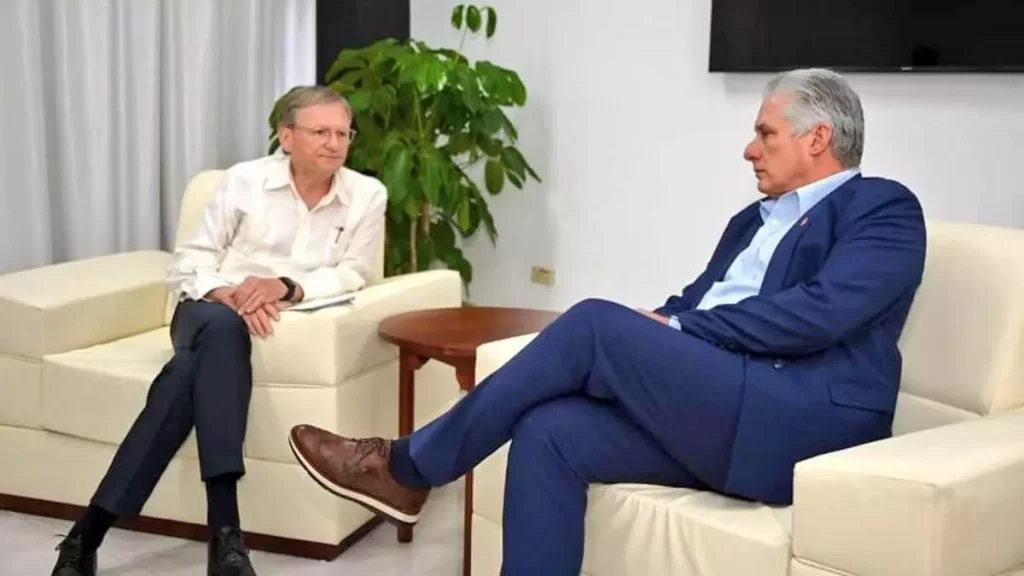
Boris Titov and Miguel Díaz-Canel during a meeting in July 2023 in Havana / @DiazCanelB/Twitter

14ymedio bigger

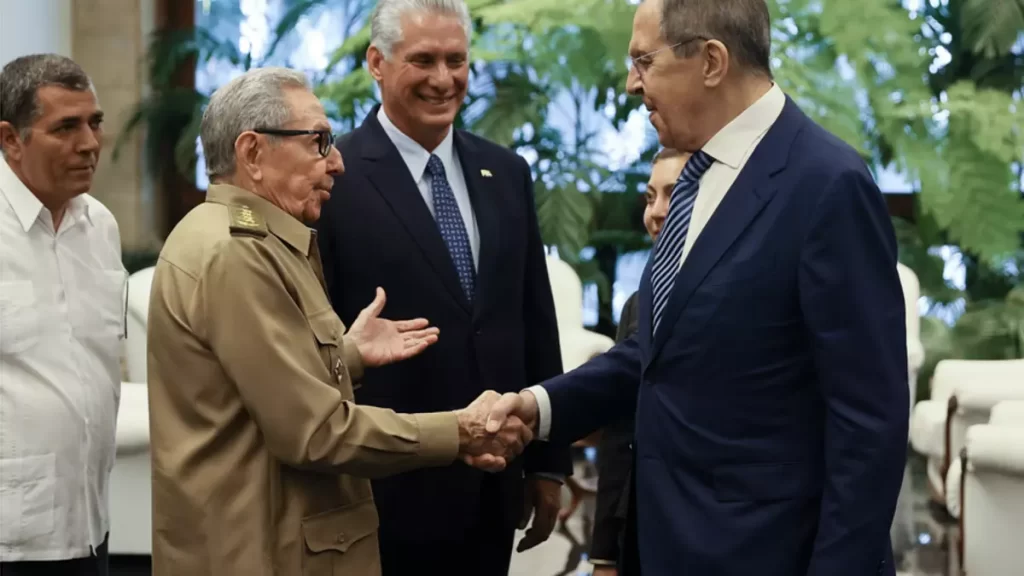
14ymedio, Madrid, 28 February 2024 — Boris Titov, head of the Russia-Cuba Business Council and one of the Kremlin’s strong men, will return to the Island this Thursday, this time, for a considerable time for an official trip of this type: until March 7, a whole week. This is Moscow’s third high-level visit in ten days. On February 19, the Russian Foreign Minister, Sergei Lavrov, arrived in Havana and met with President Miguel Díaz-Canel. A week later, so did Security Council Secretary Nikolai Patrushev, who met with Raúl Castro.

This time, Titov, according to the brief note published this Thursday by Prensa Latina, based on a cable from the Russian agency Sputnik, will make a “business visit” to “address different aspects of bilateral relations.” In the meetings scheduled on the agenda, the official agency continues, “the perspectives of business cooperation between the two countries will be examined.”

Last November, Moscow and Havana signed a trade and economic cooperation plan to run until 2030 that plans to promote the growth of bilateral trade and increased investments. continue reading

Titov, according to the brief note published this Thursday by Prensa Latina, will carry out a “business visit” to “address different aspects of bilateral relations”

Since last year, in addition to two visits by Chancellor Lavrov and the representative of Russian businessmen Boris Titov, the president of the State Duma Viacheslav Volodin has traveled to Cuba, as have presidential advisor Maxim Oreshkin and Deputy Prime Minister Dmitry Chernyshenko.

Russia’s mistrust towards Cuba in recent decades because of the non-payment of its debts changed completely following Putin’s invasion of Ukraine in February 2022. A few days before, Moscow announced an extension of payments on Russian debts granted to Havana until 2027.

Since the war began, bilateral meetings have been taking place that specified symbiotic needs: that of Russia to have allies on the planet, after the majority rejection of its actions in Ukraine, and that of Cuba to try to breathe life into its devastated economy.

In addition, the Russian Army recruits volunteers on the Island to fight on Ukrainian territory. Last October, the Cuban regime detained 17 people for belonging to a “human trafficking network”, thus trying to disassociate itself from the recruitment of nationals to fight on the Russian side in the war in Ukraine.

A group of hackers has been leaking, through the InformNapalm page, the data of more than 250 Cuban combatants in Ukraine, who supposedly received salaries exceeding $2,000 and all kinds of advantages for the soldier and his family members.

____________

COLLABORATE WITH OUR WORKThe 14ymedio team is committed to practicing serious journalism that reflects Cuba’s reality in all its depth. Thank you for joining us on this long journey. We invite you to continue supporting us by becoming a member of 14ymedio now. Together we can continue transforming journalism in Cuba.

The Youth Club in Cuba Ends a Project That Was More About Politics Than About Computers

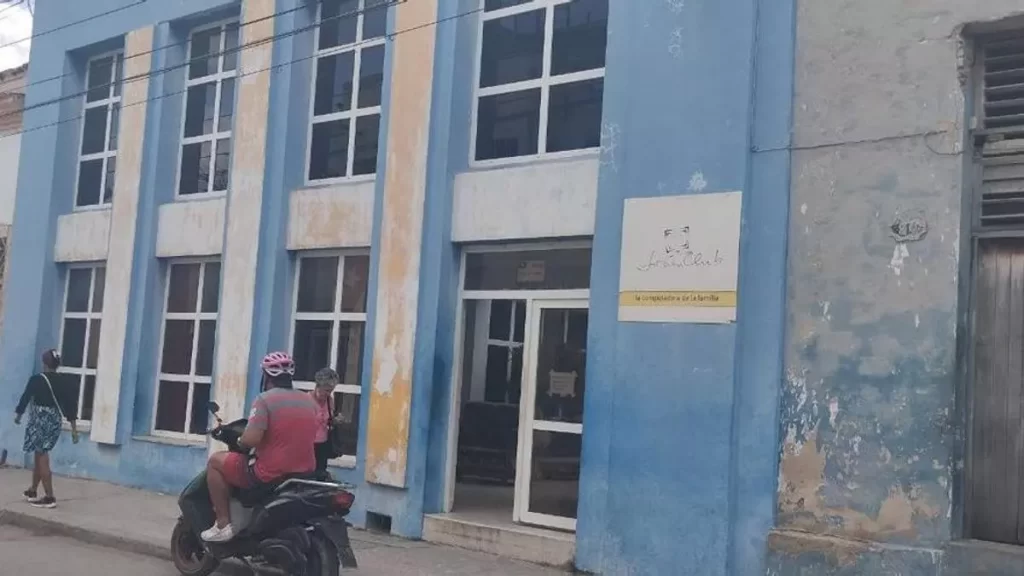
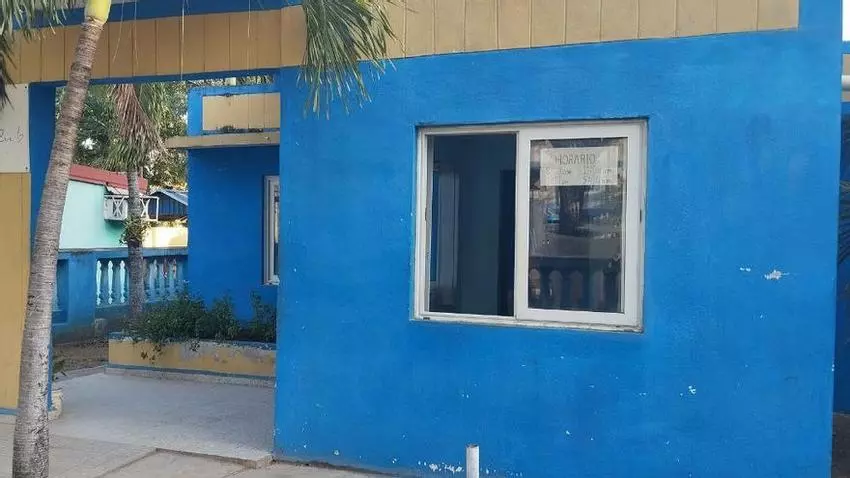
In the neighborhood of Pueblo Nuevo in the city of Holguín, another Youth Club is experiencing deterioration and no longer provides services to the public. / 14ymedio

14ymedio bigger14ymedio, Havana / Holguín, Lucía Oliveira and Miguel García, 3 March 2024 — Where before there were tables with screens and keyboards, now there are boxes of vegetable oil, piles of spaghetti packages and bags of powdered milk piled up. Two of the most important buildings of the Youth Computer and Electronics Club in Holguín have been leased as warehouses to small private companies in the city. The initiative, originally created in 1987 to be the computer spearhead of the Cuban regime, has been in frank deterioration for years.

The economic crisis has hit the Youth Club network hard, because it needs frequent investments in computer equipment. “The machines are now very old, and  we piled up some of them in a corner because they don’t even turn on,” an employee of the Lenin neighborhood premises in this eastern Cuban city tells 14ymedio.

“It’s been months since we became a warehouse for the products of private businesses in the area,” the worker admits. “The management of the Holguín Youth Club must collect eight million pesos per month for services, but since we provide fewer and fewer of our own services to the population, we have to make money in a different way.”

Previously, the money was obtained from customers who paid for “machine time” by renting a computer for a few hours, which teenagers and children from nearby neighborhoods used mainly to play video games. But most of the money came from the State budget, which thought of this initiative as the “apple of their eye.” continue reading

“Any little kid now has a mobile phone that is much better than the computers we had here”

“We also offered antivirus updates, a copy of the Ecured encyclopedia and La Mochila* (an official alternative to the ‘weekly packet’ [a collection of TV shows, music and digital material, much of it from abroad]). In recent years we didn’t have much, especially after people were able to connect to Wi-Fi networks and the internet,” he emphasizes.

The arrival, in December 2018, of the web browsing service through mobile telephony seems to have struck a mortal blow to a Youth Club network that was initially designed to centralize the use of new technologies. “Any little kid now has a mobile phone that is much better than the computers we had here. If they don’t have one, they ask their parents or a friend and can download and play whatever they want.”

Despite its loss of social importance, the Youth Club for Computation and Electronics continues to be defined on its digital site as “a network of technological centers, with computer solutions” at the fingertips of any Cuban. It adds that it has “a wide portfolio of products and services,” but a tour of its Holguin center points in another direction.

The entity’s office in the Pueblo Nuevo neighborhood is closed. “We don’t have a reopening date at the moment,” a custodian tells this newspaper. “Perhaps when we reopen  there will be a store here because that’s what is being done with the others,” he says. Outside, the unpainted facade and a sign with faded colors are far from the impeccable presence that the Youth Club once had.

“All this fell out of favor with the departure of Fidel Castro from the leadership of the country, because everyone knows that this was a project of his”

“All this fell out of favor with the departure of Fidel Castro from the leadership of the country, because everyone knows that this was a project of his,” María Victoria Contreras, a worker for two decades at the Havana Youth Club, tells this newspaper. “I was among the founders, and I can say that here the resources were endless. Unlike other sectors, we lacked nothing.”

Contreras says that at first they had a lot of demand, “even a line outside, because almost no one had a computer at home, and the kids wanted to sit in front of a screen, touch a mouse. I saw many children play with a keyboard for the first time when I worked at the Club;  there are things you never forget.”

“The first Youth Club that was inaugurated was the one on N Street, between 21st and 23rd next to the Cuban Pavilion in Havana,” recalls the retiree. “The technology we had at that time was keyboards with monochrome screens, which was a success for us.” However, “now investments are needed to build this network, and the money no longer arrives as before.”

Yordanis, a teenager in the 80s, discovered his passion in those places after spending several hours in line to gain access. Now a graduate of computer engineering, he recognizes the importance of the Youth Club in his life but considers that the project “was not updated at the same pace as the technologies.” For this professional, “the infrastructure has not been modernized, internet access is poor,  and the user experience leaves a lot to be desired.”

The Youth Club of the Lenin neighborhood in Holguín has been converted into a merchandise warehouse for private businesses/ 14ymedio

“You can’t start a state-of-the-art video game on a computer where the mouse doesn’t work well, the keyboard lacks letters or the screen can’t support the definition of graphics for the current interfaces. It’s frustrating and, in addition, people don’t want others to be looking over their shoulder at what they’re doing,” he adds.

The Central Palace of Computing and Electronics, located at the intersection of Amistad and Reina streets in front of  Fraternidad Park, in Central Havana, is the largest installation of this type in the whole country. The property has undergone all kinds of transformations and different uses throughout its more than six decades of existence.

First, the colossal building was the headquarters of the American Sears chain in Havana. Nationalized after the coming to power of Fidel Castro in 1959, the place spent years closed to the public and converted into bureaucratic offices. In the 1980s it was inaugurated as the Centro market, a free trade experiment that lasted a short time and fell out of favor during the process of Rectification of Errors and Negative Tendencies of 1986.

The old Sears building experienced another period of closure until 1991, when it reopened its doors as a Computer Palace. “Its huge rooms and many floors were always too complicated for this new function because it has always seemed more like a large store than a place to go to use a computer,” acknowledges a founding worker of the place.

“As he did with other emblematic buildings of Havana, he decided that the old Sears was not going to be dedicated to consumption nor was it going to give one more peso to anyone”

“But Fidel wanted to teach a lesson to all those people who were going to stand in line at the Centro market in the early hours of the morning to buy and resell the jams, beers and tins of cumin on the black market,” he says. “As he did with other emblematic buildings in Havana, he decided that the old Sears was not going to be dedicated to consumption nor was it going to give one more peso to anyone.”

“In those days we also gave courses to learn how to use programs and other tools, we even had a Geroclub for older people who wanted to approach a computer for the first time, but that is no longer done,” the former employee tells 14ymedio. “This was a political project rather than a computer project. It was designed to create the “New Man” in computing, and that objective was lost.”

The former worker of the Youth Club believes that the extension of new technologies “changed everything.” Cubans “prefer to enjoy a movie, a game or a videoconference at home with some friends or sitting in a park, but those facilities are more and more abused every day and don’t even make you want to sit in one.”

“Now there are other priorities,” the employee summarizes. In the list of preferences, the new forms of economic management are winning over the old official programs, marked by massiveness and bulky budgets. The city of Holguín is going at full speed in that reconversion; where before it was about getting online to play games or program, now it’s about buying rice and liquid detergent.

*Translator’s note: *La Mochila (Backpack) contains official State content as opposed to El Paquete (the Weekly Packet), which contains non-political content and is bought on the black market.

Translated by Regina Anavy

____________

COLLABORATE WITH OUR WORKThe 14ymedio team is committed to practicing serious journalism that reflects Cuba’s reality in all its depth. Thank you for joining us on this long journey. We invite you to continue supporting us by becoming a member of 14ymedio now. Together we can continue transforming journalism in Cuba.

The Cuban ‘Paquetazo’ Moves to the Rhythm of Russian Demands

It does not seem a coincidence that, after the postponement of the start of the ‘package’, we had the visit of the Russian Foreign Minister, Sergei Lavrov / Russian Foreign Ministry

14ymedio bigger14ymedio, Yoani Sánchez, Generation Y, Havana, 29 February 2024 — Lavrov, Patrushev and Titov. We Cubans get lost among so many surnames of high-ranking Russian officials who arrive in Cuba. The procession, which has grown in number and frequency in recent months, coincides with official announcements of economic measures. It is very difficult to remove the Kremlin from the national equation when Vladimir Putin’s envoys arrive on the island and, shortly after, tariff adjustments are published in the Official Gazette or new prices are made effective at gas stations and electricity bills.

This Thursday, the head of the Russia-Cuba Business Council, Boris Titov, arrives in Havana, and will stay on the Island until March 7. A long visit that, in advance, has all the traces of a review, of a meticulous inspection to verify where the vague promises that Cuban officials must have made to the ears of the Russians, to extract investments and support, have played out. A dance of seduction that has worked with others but is now being performed before “clients” who know very well the false tricks of Castroism.

It does not seem a coincidence that after the postponement of the start of the paquetazo*, which raised the prices of fuel and electricity, we had the visit of the Russian Foreign Minister, Sergei Lavrov, and, later, the secretary of the Russian Security Council, Nikolai Patrushev. Both in the second half of February, the month initially chosen to begin measures that will make life on the Island more expensive and generate great social unrest. After his departure, the application of the new prices to take effect on March 1 has finally been announced. continue reading

It seems that Miguel Díaz-Canel has been showered with scoldings from Moscow. For Putin, it is not enough to agree, we must comply. His men have come to demand accountability in Havana and the clumsy officials of the Cuban Communist Party have only managed to do what they know best. Initially they have chosen to stretch the times and negotiate new deadlines, only to end up giving in to the powerful patron of the day.

It seems that Miguel Díaz-Canel has been showered with scoldings from Moscow. For Putin, it is not enough to agree, we must comply.

In front of the eyes of the citizens, the Russians seem to be sneaking into every crevice of national life. The intergovernmental commission led by Titov examines and makes agreements in areas as diverse as the economic, financial, energy, transportation, agriculture, communications, health, education and tourism. Even though not recognized by either regime, the presence of Cuban mercenaries fighting for the Russian side in the invasion of Ukraine also makes the link between Castroism and Putinism closer.

The official press of the Island has adopted the script that the Kremlin imposes on its national media. Both there and here, Russian defeats on the battlefield are not published, Volodymyr Zelensky’s name must always be accompanied by the worst adjectives, and the invasion is only a “special operation” for the Russian homeland to recover what belongs to it, what was once taken from it. Every day, the publications of Sputnik and Granma become more similar. There are hardly any differences between RIA Nóvosti and Prensa Latina when it comes to news about Europe and the United States.

Both regimes have been synchronizing speeches in recent years, aligning their political narrative at various points and strengthening ties, some visible and others under the cloak of secrecy. But Cuba is a small country, an island with hardly any natural resources and an economy destroyed by inefficiency and mismanagement. Getting too close to Moscow’s voracity is a very dangerous move because Russia asks its allies for much more than handshakes and formal visits.

Within this obedient delivery is the act of serving as a springboard for disinformation campaigns and acting as a bridge with Latin America so that Putin can wash his image and undermine solidarity with Kiev. The Kremlin does not give support without asking for anything in return and these are times of direct requests and excessive demands.

When Moscow lands it does so with everything. Sometimes destroying the treads of their tanks, other times crushing with their misinformation and adjustments.

*Translator’s note: ‘Paquete’ means ‘package’, while the ‘azo’ added to the end implies a ‘forceful blow’.

____________

COLLABORATE WITH OUR WORKThe 14ymedio team is committed to practicing serious journalism that reflects Cuba’s reality in all its depth. Thank you for joining us on this long journey. We invite you to continue supporting us by becoming a member of 14ymedio now. Together we can continue transforming journalism in Cuba.

The Fear In the Eyes of Cuba’s Regime

An old sign that was located in front of the United States Embassy in Havana / Cubanamera

14ymedio biggerYunior García Aguilera, Madrid, 29 February 29 —  On February 21, an article appeared in El Ciudadano , under the long and boring title The network of interference against Cuba, which goes from the United States to Spain, passing through Mexico. Although the Chilean media declares itself committed to human rights and democracy, it had no qualms about offering its space for a publication conceived from the very headquarters of the Cuban State Security, enforcer and guardian of authoritarianism on the Island.

Neither quick nor lazy, GranmaCubadebate and their entire queue of replicating media echoed a soap opera loaded with conspiracy intrigues, data manipulated to avoid burning their sources, typical phrases from the Cuban propaganda and repressive repertoire, a lot of misogyny and overwhelming lies. They have turned the presentation of a book in Madrid into a whole plot of CIA operations, coups d’état and violent actions.

If it had been a script, Netflix would have rejected it immediately, for being bland and lacking in drama

If it had been a script, Netflix would have rejected it immediately, as bland and lacking in drama, but the network at the service of totalitarianism is running out of content and needs to generate noise. The orders come from Cuba, Venezuela provides the money and the person in charge of signing the pamphlet is a well-known Castro-Chavism operator, the pro-ETA Katu Arkonada.

The publication would be laughable if it weren’t for the fact that it exposes women who live in Cuba, a country with more than 1,000 political prisoners. The article could serve as a prelude to new arbitrary arrests, more continue reading

repression, prohibitions on entering or leaving the country, as well as years in prison for the simple crime of daring to think differently from what the single party dictates.

The comments at the bottom of the post are even worse. In Granma , a user named Enrique Rodríguez suggests that “those worms (…) not be allowed to return to Cuba.” In Cubadebate, another reader named Rafa says that they can count on him for “total war, inside and outside the country,” and closes with a threat: “Don’t let a worm get in my way here in Spain.”

The article in question also mentions me in one of its paragraphs, describing me as “one of the most strident and violent Cuban dissidents.” It seems that, in the eyes of the regime, a simple white rose has more uranium and plutonium than weapons of mass destruction.

But, ultimately, who is Katu, the individual who puts his signature on the article? His real name is Israel Arconada Gómez, a Basque born in 1978. Although his communist parents encouraged him to study Economic Sciences, what fascinated the boy was politics, and he became at 16 a kind of “little Nicolás” of the ultra-left.  He was arrested in 1998 for his links with groups involved in vandalism and terrorist acts. So, at just 19 years of age, he managed to leave for Cuba. It was then, presumably, that Cuban intelligence began using him. The young man stopped using his real name, assuming Katu as an alias, and changing the “c” to a “k” in his last name.

In 2003 he was sent, obviously, to Venezuela. From there he became coordinator of the World Social Forum in Brazil. In 2009 he made the leap to Bolivia, where he became nationalized and held high positions as a whisperer to Evo Morales. But Israel or, rather, Katu, found enemies even within its own nationalist ranks. He then went to Mexico, seeking new sponsors, until he got as close as he could to the ear of López Obrador.

Several women, like the Mexican journalist Karina Velasco, reported having been victims of this character

His blatant interference in Mexican internal affairs generated the collection of more than 1,500 signatures to request his expulsion from the country. Furthermore, the Castro-Chavista operator was implicated in several scandals for believing himself unpunishable and showing his other side of: that of a sexual harasser. Several women, like the Mexican journalist Karina Velasco, reported having been victims of this character.

That is why I am not surprised that a misogynist like Katu Arkonada exudes so much hatred in his article, especially against Cuban women. Nor is it surprising to me that a guy with a record so close to the ETA members accuses me of being “violent.” Anyone even remotely informed about my activism would laugh at Katu’s ignorance or audacity. Furthermore, how dare a guy with such an interventionist history talk about interference?

We already know that Cuban intelligence dedicated itself to forming and planting “katus” everywhere. But what do they want with this insubstantial article? What does Katu demonstrate, beyond the fear in the eyes of a dying regime?

____________

COLLABORATE WITH OUR WORKThe 14ymedio team is committed to practicing serious journalism that reflects Cuba’s reality in all its depth. Thank you for joining us on this long journey. We invite you to continue supporting us by becoming a member of 14ymedio now. Together we can continue transforming journalism in Cuba.

Cuba Buys 500 Tons of Powdered Milk From the United States

The authorities talked about how expensive milk powder is in the international market / Escambray

14ymedio bigger14ymedio, Madrid, 1 March 2024 — It has been two days since the Spanish agency EFE released the news that Cuba had asked, for the first time in history, for help from the United Nations World Food Program in the face of the milk shortage, but the Government still does not say a single word. This Thursday, the Minister of the Food Industry, Alberto López Díaz, gave a press conference to reassure the population that children up to to seven years old are guaranteed powdered milk in the coming days, although the explanations were confusing.

The arrival of a Brazilian ship with 375 metric tons of the product “guarantees the distribution” for that group for an unspecified number of days. The minister also cited several contracts that add up, if the figures are correct, to 1,750 tons of powdered milk. He added that, since the country consumes 2,000 tons per month for children, medical diets, pregnant women and “social consumption,” these imports “guarantee stability in the distribution for March and April.”

The figures weren’t released immediately, but it was striking to begin with that, among the imported products, are 500 tons coming from the United States, “by virtue of the exceptions established by that Government to sell certain products to the Island, through immediate payment and in cash.” Although the authorities have recognized that they are allowed to buy certain products from the U.S., denouncing at the same time that the conditions are anomalous in international trade, they rarely refer to a specific acquisition through the exemptions from the embargo, in force since 2001. continue reading

He added that, since the country consumes 2,000 tons per month for children, medical diets, pregnant women and “social consumption,” these imports “guarantee stability in the distribution for March and April.”

The other contracts cited by the minister and disclosed by the official press consist of another 500 tons from Brazil, 245 tons from Canada and 600 tons from “other suppliers.”

López Díaz said that the problem is being progressively solved thanks to the “interest of the country’s top management in such a sensitive issue,” and stressed that powdered milk is marketed at high prices in the international market. Residents of Villa Clara, Sancti Spíritus and Camagüey were more fortunate, he said, since there were no “affects” in these territories because they have fresh milk available.

The shortage of milk became more pressing last year, when almost all the provinces had to adjust their quotas, reduce the number of prioritized groups or replace the milk with products that were sometimes only remotely similar. The farmers complained about the “ordering task”* of January 2021 and the high inflation, which has devastated what was left of the Cuban economy.

Most say that the State does not compensate them or even cover the expenses generated by raising livestock, and they are paid little, late and poorly. Added to this are the consequences of non-compliance with the contracts for reasons beyond their control. The Government can impose fines and sanctions if the agreed-upon quota is not delivered, which is sometimes impossible due to the malnutrition of livestock from the lack of feed and the shortage of fuel for transport. There is also the general economic insecurity, which has caused an increase in the theft of animals.

“If you paid the farmers more and on time, you would see better results, but hey, they work and aren’t paid, and you can see the results today,” a user on social networks responded to the ministry’s note.

In mid-February, complaints from the population about problems with milk powder reached Cuban television. The Minister of Internal Trade, Betsy Díaz Velázquez, explained that most of the product is acquired in “distant markets, which makes the price more expensive and the delivery delayed.” The current distribution of this product to children up to seven years old comes from the country’s reserves, “the valuable contributions of the World Food Program (WFP) with donations, and loans from economic actors (private companies).”

The minister made a reference that at that time went unnoticed, since the WFP’s collaboration with Cuba – as with all countries with food needs – is historic. However, what had never happened and what the Government continues to avoid talking about is the request for urgent help.

“We confirm that the WFP has received an official communication from the (Cuban) Government requesting support to continue the monthly delivery of one kilogram (2.2 pounds) of milk for children under the age of seven throughout the country,” the delegation on the Island told EFE, which had access to the information through its sources.

The agency added that “it is the first time that Cuba has requested support by issuing an official communication at the highest level of WFP management” and did so, according to the agency, by sending a letter from the Ministry of Foreign Trade and Foreign Investment to the executive management of the WFP in Rome at the end of last year. Thanks to that, “144 tons of skimmed milk powder were sent, benefiting almost 48,000 children between seven months and three years old in Pinar del Río and Havana,” 6% of the minors that the Government wants to reach.

This Thursday, BBC World tried to obtain a statement from the Cuban Government, which so far will not discuss the issue.

In his press conference this Thursday, Minister Alberto López Díaz also mentioned the situation of the rationed bread, which is scarce if not absent “in the face of the unavailability of flour,” although, “according to the productions of each territory, the local authorities have been making determinations.”

Flour is abundant in Cuba, as 14ymedio reported yesterday, thanks to imports from private companies, some of which are linked to the State itself. With milk, the situation is the same. The private and informal wholesalers dominate the social networks, but to obtain the products you have to be able to pay for them, exposing the increasingly visible gap between the social classes that the Revolution supposedly abolished.

*Translator’s note: The Ordering Task that came into effect in 2021 eliminated the Cuban Convertible Peso (CUC), leaving the Cuban peso (CUP) as the only national currency. It raised the prices of basic goods and services, generating inflation, and created stores that take payment only in hard currency, which must be in the form of specially issued pre-paid debit cards. Other measures targeted different elements of the economy.

Translated by Regina Anavy

____________

COLLABORATE WITH OUR WORKThe 14ymedio team is committed to practicing serious journalism that reflects Cuba’s reality in all its depth. Thank you for joining us on this long journey. We invite you to continue supporting us by becoming a member of 14ymedio now. Together we can continue transforming journalism in Cuba.

The Cuban Regime Prevents Martha Beatriz Roque From Receiving an Award in the United States

Cuban dissident Martha Beatriz Roque in an archive image / 14ymedio

14ymedio bigger

14ymedio, Havana, 1 March 2024 — Cuban dissident  Martha Beatriz Roque, director of the Cuban Center for Human Rights (CCDH) and former prisoner of the Black Spring, has been one of the winners of the 2024 International Prize for Women of Courage, awarded by the United States Government . But she will not be able to go to the awards ceremony next Monday.

In conversation this Friday with 14ymedio, the historic dissident says that the news was communicated to her last January. “They told me that the prize consisted of 15 days of vacation in Los Angeles, 15 days in Washington and then the awarding of the prize.” Roque, who is regulated — the regime’s euphemism for not being allowed to travel — went to the Emigration offices in Havana, where State Security agents were waiting for her.

There they told her to return in 15 days to resolve her case. She hoped that, as has happened recently with other opponents, such as Julio Ferrer and María Cristina Labrada, the ban on leaving the country would be lifted. However, when she returned two weeks later, the response was blunt: “You are still regulated, period.” That time, she says, “the treatment was completely different, I can say that they treated me badly.”

“I think ‘they’ prefer the empty chair to my words. So, well, there will be my empty chair. The hatred they have for me is terrible”

And she says: “I imagine that the United States Embassy, ​​at the request of the Government, has asked to let me travel, but I think ‘they’ prefer the empty chair to my words. So, well, there will be my empty chair. The hatred they have for me is terrible.” continue reading

Roque’s case has been similar to that of Yoani Sánchez, director of this newspaper, who was prevented by the regime from leaving the Island when she was also awarded the Women of Courage Award, in her case in 2011.

This year, in its eighteenth edition, the prize awarded to the Cuban opposition figure is shared with the Ecuadorian Fátima Corozo, a high school teacher, community leader and youth defender in Esmeraldas, the most violent city in her country.

Similarly, the nine women who were part of the group of 222 Nicaraguan political prisoners who were released from prison and exiled to the United States last year, for their part, have been honored with the Madeleine Albright Honorary Group Award.

The award ceremony will take place at the White House in the presence of the first lady of the United States, Jill Biden, and the Secretary of State, Antony Blinken.

The prize awarded to the Cuban opposition member is shared with the Ecuadorian Fátima Corozo, a high school teacher and community activist

According to the US State Department in a statement collected by the Efe agency, this award, which is in its eighteenth edition, recognizes “women from around the world who have demonstrated exceptional courage, strength and leadership in promoting peace, justice, human rights, equality and empowerment.”

In 1997, Martha Beatriz Roque signed, together with Félix Bonne Carcassés, René Gómez Manzano and Vladimiro Roca, the document* La patria es de todos, The Homeland Belongs to Us All*, which criticized the management of the Castro regime and called for an opening. The four were sentenced to sentences of between three and five years in prison for the alleged crimes of “actions against the national security of the Cuban State” and “sedition.” Amnesty International considered them prisoners of conscience, and Roque was released in May 2000.

The dissident was arrested again in 2003, during the so-called Black Spring, in which 75 opponents and independent journalists were arrested and prosecuted. On that occasion she received a sentence of 20 years in prison. After receiving an extra-penal license releasing her for health reasons, Roque is still subject to a travel ban outside the country and surveillance by State Security.

*See here for an English version on this site

____________

COLLABORATE WITH OUR WORKThe 14ymedio team is committed to practicing serious journalism that reflects Cuba’s reality in all its depth. Thank you for joining us on this long journey. We invite you to continue supporting us by becoming a member of 14ymedio now. Together we can continue transforming journalism in Cuba.

THE HOMELAND BELONGS TO US ALL – Cuban Dissidence Task Group 1997 – Historic Document

THE HOMELAND BELONGS TO US ALL 

Cuban Dissidence Task Group
Havana City, June 27, 1997

INTRODUCTION

I – HISTORICAL INTERPRETATION
II- IN THE NAME OF UNITY
III- THE MAIN OBJECTIVE
IV – THE PLAN FOR SOLVING THE CRISIS
V – CONCLUSIONS
VI – RECOMMENDATIONS

Original in Spanish here

Authors: Felix Antonio Bonne Carcasses, Rene Gomez Manzano, Vladimiro Roca Antunez, Martha Beatriz Roque Cabello

Translated for CubaNet by Jose J. Valdes


INTRODUCTION

When you finish reading this document, you will be able to support us if we can agree on this initial assertion:

Man cannot live from history, which is the same as living from stories. There is a need for material goods and for satisfying his spirituality, as well as to be able to look to the future with expectations. But there is also a need for that openness that we all know as freedom.

The Cuban government ignores the word “opposition.” Those of us who do not share its political stance, or who just simply don’t support it, are considered enemies and any number of other scornful designations that it chooses to proclaim. Thus, they have also sought to give a new meaning to the word “Homeland” that is distortedly linked to Revolution, Socialism and Nation. They attempt to ignore the fact that “Homeland,” by definition, is the country in which one is born.

All of this aside, our Task Group has examined the Project Document prepared for the V Congress of the Cuban Communist Party, scheduled to be submitted for approval during this event. Because it is impossible for us to make public our viewpoints here [in Cuba] (given that the [Cuban] news media is in the hands of the state), we have decided to set them down in the hope that they will somehow be made known to Cubans inside and outside the island. By this mean we seek to defend our right to express our opinion, because we are convinced that THE HOMELAND BELONGS TO US ALL.

I – HISTORICAL INTERPRETATION

Of the 11,080 words that the document contains, grouped into 260 paragraphs, more than 80% are dedicated to interpreting history. They wish to convince those that read the document that:

    • There has been only one revolution [in Cuba] since 1868; and
    • The U.S. has tried to seize Cuba ever since the 19th century.

To try to strengthen these assertions, they invoke the name of [the father of Cuban independence, Jose] Marti.

Thereby they persist in the old and absurd argument that the existence of a single political party is based on Marti’s ideas, as only one party was founded by him. There is no known political leader that has created various continue reading

political parties simultaneously. Nevertheless, many distinguished freedom fighters in their respective countries, once independence was achieved, have respected the multi-party system of government. Washington, Mahatma Ghandi and General DeGaulle were among them.

There is no reason to think that Marti, had he survived the War of Independence, would not have done the same given his very positive views on democracy. Point V of the Tenets of the Cuban Revolutionary Party (1892) states: “It is not the goal of the Cuban Revolutionary Party to bring to Cuba a victorious group that will consider the island as its prey and dominion. It is, instead, to prepare, by as many efficacious means as freedom in exile permits, the war which is to be fought for the honor and welfare of all Cubans, and to deliver to the whole country a free homeland.”

Following the war, no patriot argued for the need to have a single party. On the contrary, many actively participated in politics with different affiliations and all respected the multi-party system.

Even though they wish to portray the democratic republic as a series of interrupted failures and treasons, they have to contend with the socioeconomic achievements obtained between 1902 and 1958 which placed our country among the three most advanced nations of Latin America. In some areas, in fact, Cuba was ahead of even major Old World countries such as Spain and Italy. This undeniable reality speaks volumes for the industriousness of Cuban workers and the enterprising spirit of our businessmen— especially as all these true accomplishments took place following a major cataclysm (our glorious War of Independence) and in spite of the terrible socioeconomic crisis of the 1930s. In addition, there are the political successes, such as the revocation of the infamous Platt Amendment in 1934 which the political propaganda does not mention, though its imposition in 1901 is well-remembered.

This twisting of information is also present in the document. If the pre-1959 statistics are consulted, it can be seen that the illiteracy rate among the Cuban population at the time amounted to 16% and not 40% as proclaimed. The statistics are also manipulated when it is stated that 7% of the population voted in the elections at the turn of the century. This implies that the remaining 93% included non-voting women (51%), children, and the great number of foreigners that lived here, as is to be expected in a country that had recently ceased to be a colony.

Regarding the application of due process in the trials held for members of the Batista regime, Castroites have their own interpretation. But it must not be forgotten that—as the document recognizes—those principally implicated fled the country on January 1st, on which date the mass executions commenced. Those that were shot by the firing squads were arrested, accused, judged and executed in less than 24 hours. The rise to power of the current government was sealed by a vicious settling of accounts. The so-called “revolutionary trials” bore no relation whatsoever to due process nor to a true right to a defense. A notorious example was the trial of the pilots sentenced after having been absolved, an event which led to the suicide of Captain Felix Pena.

Every year, by an ever-growing number of votes, the General Assembly of the United Nations demands that the so-called [U.S.] “blockade” be ended. This statement is true, but what goes unsaid is that, with the same frequency, the Cuban government is sanctioned for its systematic violations of human rights.

The October [1962] “[Missile] Crisis” is mentioned, while omitting the fact that the Cuban leadership urged Moscow to deliver the first strike without waiting for the “Yankees” to take the initiative. This is acknowledged by history. A nuclear attack against the United States would have meant a terrible catastrophe for all humanity, but, undoubtedly, Cuba would have been swept from the map. That solution to the crisis was offered by the same party members that are now worried—according to them—that their departure from power would mean the disappearance of Cuba as a nation.

But can we forget the autocratic way in which nuclear weapons and foreign troops were brought into the country? The people learned of the matter only after the problem arose.

As the document well states: “Everything began to change on July 26, 1953.” We should not fail to mention that—in effect—on that date, for the first time in many years, much Cuban blood was spilled. Up to that time, the deaths in the political struggle which occurred under the Batista government could be counted on the fingers of one hand. To find in Cuban history as mournful and fratricidal a day as this, we would have to go back to decades long past. Despite its being such a sad day, it has been made into a holiday and celebrated as such. This, we suppose, meets with the disapproval of even the fallen martyr’s own relatives.

These are but a few examples of the way in which the Communists have sought to INTERPRET HISTORY.

II – IN THE NAME OF UNITY

The party insists on unity but forgets that, for that unity to be valid and real (and not a mere parody), it is necessary for a consensus freely reached by the citizenry to emerge. The opposite would amount to a brutish imposition that would be a unity in name only. We the members of the opposition are here to show that in our country there is no consensus.

The text asserts that: “Only the unity of revolutionaries can lead to the unity of the people.” This argument, just like every other perspective on this matter, suffers from what is known in logic as “circular reasoning,” whereby that which is sought to be demonstrated is taken as a starting premise.

The party, declaring itself the representative of the people, prepared the document that warns the citizenry to participate in the meetings to support it. The people, subjected to the pressures of totalitarian power, attend [these meetings], and the fact is portrayed to the world as a plebiscite on Cuban society. This is declared the most evident and irrefutable proof that the party represents all of the people. It is precisely the same premise that was used as a starting point. Although there is talk of plebiscite, the people have felt what it is like to be trampled upon. A latent popular will still exists, just as when General Arnaldo Ochoa and his comrades were sentenced to execution by firing squad. Even though the vast majority did not agree with this sentence, it was officially declared as necessary and the opinions of the masses ignored.

If, as its leaders assert, the citizenry in general supports the Communist Party, there is no reason not to hold internationally-supervised, free elections, which would serve to silence all the detractors of the system.

In the name of unity, the Fist Party Congress considered it legitimate to bestow upon itself constituent powers and approve the final version of the 1976 Magna Carta. This includes Article 5, which proclaims the [Cuban Communist] Party as “a guiding force superior to society and the state.”

We are aware that there are historical precedents for this concept of unity. The Cuban Communist Party, in imposing a single party system, places itself in the unenviable company of Stalin, Mussolini, Hitler, Franco, Trujillo, Pol Pot and Sadam Hussein, among others.

Having called the ranks to order on the matter of unity, the party saw it fit to declare that “the Cuban people have decided to have a single party.” But, in the name of unity, under the concept of shared-guilt for mistakes, we have seen many things that have left their mark on history for having contributed to create chaos and instability in the country. It will suffice to cite a few examples:

  • The attempt to drain the Cienaga de Zapata wetlands;
  • The creation of an “agricultural belt” around Havana;
  • The collectivization of agriculture;
  • The genetic alteration of livestock, in particular of cattle;
  • The authoring of a plan for food rationing and the mass production of “micro jet” bananas;
  • The dismantling of the sugar industry and the attempts to alter cane varieties;
  • The imposition of ideas that entail disastrous investments, such as the Paso Seco Dam, which is a monument to that which should not be undertaken.

Likewise, in the name of unity, a sugar mill was given as a gift to Nicaragua, an airport was built in Granada and, under the mantle of so-called “Proletarian Internationalism,” troops were sent off to kill and die in different countries. To be sure, this was something that was never done under what they call the “subjugated republic,” whose various governments refused to send troops to fight in either of the two world wars or the Korean war. This despite the fact that the “Yankee imperialists” did so. In this, our northern neighbor truly set itself apart from the Soviet Union, which—not practicing what it preached—enabled and financed the sending of Cuban troops to a whole series of countries.

The document, by the way, makes only a passing reference to these “missions” so as to avoid having to explain just what was achieved through that useless effort. Its only significance for the [Cuban] people was the breakup of families, mourning, pain and exotic diseases, among other things. Angola and Ethiopia—to cite only two such countries—exacted a high death toll among our fellow Cubans. At present, over in those strange lands, Angola seeks a national solution with the participation of UNITA and the genocidal general Mengistu Haile-Marian, decorated here in Cuba with the Order of Jose Marti, fled ignominiously from Ethiopia. In addition, when it was considered convenient, unity was invoked to welcome our exiled brothers as representatives of the “Cuban community overseas.” This after families had been keep apart and their mail hindered to avoid any kind of affectionate exchanges.

Because of what it represented for the tattered finances of the country, party members were told that they could welcome into their homes those same people that had been reviled as “traitors” and “worms;” those that had had to endure the egg-throwing and blows of the renowned “popular dignity demonstrations.” The latter subsequently gave rise to the Rapid Response Brigades and the detestable “acts of repudiation.”

In the name of unity, the “captive villages” were created, religious people were persecuted, and churches were practically left without priests. The document points out that: “The Congress approved the admission into the party of revolutionaries with religious beliefs.” This implies that they take pride in a decision that bridles the shame of more than 30 years of persecuting those who profess religious ideas. If we look back, all of this came about, in good measure, due to opportunistic motives, as some members had turned religious just to be let go from the party.

The unity to which the party refers is not about ideas, but about the aim that the people rally around the party leadership.

For the rest, we cannot accept that a government which has dedicated itself to dividing the country can speak IN THE NAME OF UNITY.

III – THE MAIN OBJECTIVE

The philosophy of the government is not to serve the people but to be their dictator. It is not its main objective to guarantee the citizenry a quality of life which has a minimum of decorum. Power, exercised through totalitarian control, is the end that is being pursued with this political ploy. No longer is anyone fooled by the much-touted call to social justice. The wage rates combined with the stagnation of other economic factors makes the situation of the populace more difficult each day. And the more they deteriorate, the more the economic activities are politicized and militarized.

Something which is truly deserving of a triple-X rating in the meaning assigned to what is termed the Socialist Civil Society. The document’s authors wish to ignore the fact that a civil society is made up of elements outside the control of the state and therefor cannot be socialist or, what amounts to the same thing, “sovietist.”

IV – THE PLAN FOR SOLVING THE CRISIS

In a paragraph detailing some of the accomplishments of the government, the following statement appears: “Our country became covered with highways and roads, as well as with waterworks for productive uses. Milking machinery and aerial spraying, previously unknown technologies in rural communities, were put in place.”

However, reality confronts us with the fact that there are no means of transportation on the highways and roads, and that there is insufficient water available to supply the major cities. In particular, there are heavily populated neighborhoods in the city of Havana where there are serious shortages of the precious liquid, and whole provinces—Santiago de Cuba being the prime example—are experiencing irrigation problems.

The cattle population has declined. In 1955 it reached a per capita level of 0.82 heads per inhabitant. Forty years later it was 0.38. The milk that was distributed in the 1980s originated from trade with the former German Democratic Republic. As there are practically no cows left to milk, the automated milking machinery has turned into scrap heaps from lack of care and maintenance. In the long term, far from serving to increase agricultural food production, all of the methods that were indiscriminately and inefficiently introduced have only hindered its development. The old methods at least yielded reliable results and allowed the needs of the population to be met.

Further on, the document asserts that more than three million hectares were handed over to the Basic Units for Cooperative Production (BUCP). The pretense here was to make it seem that this was an innovative production method which would pull agriculture out of its presently critical situation. However, more than three years have passed since their establishment and no results can be seen. The government itself, through its official spokespersons, has declared that only 7% of the BUCPs are even marginally cost-effective. To this we can add that more than 60% of the state organizations have been recently deemed unreliable. It has also been recognized that the sugar mills are not grinding cane in a cost-effective manner but that, as cane production cannot be curtailed, nothing can be done about it.

Allusions are made, in speaking of the changes and the things accomplished up to the time of the Special [Economic] Period, to how the food production program could have been successfully developed. This implies that at present this program is no longer viable. But no alternative is presented; not even the slightest suggestion that could put an end to the severe rationing that has lasted now 35 years—a world record.

After considering the ensuing paragraphs, one may also conclude that there is also no plan for solving the country’s economic and social crisis. For Cuba to partake in the global economy without renouncing its totalitarian ways, the challenge is more than difficult. The stagnation that has characterized the Cuban government’s policies continue to increase its alienation from financial institutions, the assistance of multinational consortiums such as the European Union, and even from the possibility of entering into any bilateral agreements. The foreign financing situation is dismal and it is not possible to continue to pay short-term loans with interest rates of 17 or 18%. However, loans that offer at least low initial rates are difficult to obtain.

What does the Communist Party offer the people? “We will have only that which we are capable of creating,” it tells them. More than a promise, it seems a mournful threat about the proverbial inefficiency of the production system and about the usual limitations which it imposes on the citizenry. The list of problems is enormous. Nevertheless, only material problems are addressed and no mention is made of the spiritual needs of our people, much less about the lack of all sorts of freedoms. For the party, the concrete tasks ahead are clear, but it does not identify for the populace the solutions to the problems, the timetables involved, or the differing view points. It is as if, suddenly, the future were synthesized into that one slogan. Faced with our harsh reality, there is only room for the patriotic and revolutionary code-of-conduct of working more and better.

That past that is portrayed as something so brilliant should not have given rise to the present crisis, as all of those accomplishments and conquests have been touted about since the 1960s. Accepting what the communists allege, it can only mean that they have given nothing to the people in the last 30 years. It is a case, then, of a regime anchored in the past and which lives in the past—and quite a remote past at that.

V – CONCLUSIONS

When on January 28th the U.S. government published its Plan in Support of a Transition [in Cuba], there was no alternative response by the Cuban government regarding the responsibilities identified in the plan to support a transition process. The document issued by the Communist Party is not such an alternative because it offers nothing concrete to the Cuban people. The following matters are still without explanation:

  • the way in which the catastrophic economic situation will be solved;
  • a solution for the ideological vacuum that the current political crisis has created, one result of which has been the use of foreign flags by young people in their attire;
  • what is going to be done to maintain at least the levels of service once attained in public health, education and social security, so as not to increase the painful situation of the population;
  • what the Cuban government will agree to do in order to solve international disagreements and to try to adopt global economic standards;
  • the measures it will take to eliminate the embargo; the means to be used to recover those parts of the Cuban territory occupied by foreign military bases: Guantanamo [Bay], Lourdes and Cienfuegos;
  • ways in which to address the growing number of people that express their opposition to the official political position and to stop the treatment of Cuban citizens as third class people in their own country.

It is no secret that Cuba had the worst performance in the region during the five-year period between ’91 and ’95, and that even though it is said that an economic recovery occurred in 1996, the populace never experienced it. Upon the termination of Soviet-block aid, the inefficiency of the system increased and foreign commerce diminished.

There is no doubt that the socioeconomic policies need to be reformed and redesigned so as to achieve better results. The use of the society and the economy to exert controls has to cease.

Cuba needs a recovery based on high rates of sustainable growth to bring itself back into the realm of intense international competition and dynamic technological change. What the party has set forth is not this. It is merely an attempt to maintain the status quo of obsolete totalitarianism; to entrap us in social and economic backwardness amidst a dynamic and competitive world.

No one wishes a return to the negative aspects of the 1950s, as the government argues. The realities of the world have change and those of our country too. The transition toward democracy that we wish to achieve is based on the fundamental principles of the 1940 Constitution, which establishes social rights that have nothing to do with the influx of neo-liberalism. The current situation whereby foreign companies hire their workers through a state intermediary could be termed neo-totalitarian. Through such an arrangement, the state exploits the workers without even offering them stable employment.

The document does not offer the possibility of establishing a true constitutional state, nor an independent and impartial legal system that would protect the liberties and rights of the individual and the practice of political pluralism.

The government, given its current position, has no chance of stabilizing the economy quickly and without a recession, and this is a necessary pre-condition to effectively achieve an economic recovery and consolidation.

VI  – RECOMMENDATIONS

The document states that economic liberalization is linked to the creation of joint-ventures and other forms of business arrangements with foreign companies. But this has not been enough, and is far less than what is needed. What is needed is a process of true economic liberalization, which would entail the democratization of the country. The Cuban community overseas—amounting to a million and a half people—could undoubtedly contribute to a sustained economic recovery. Currently, in fact, the financial assistance that [the exiles] send to their relatives on the island accounts for a substantial portion of the country’s import-purchasing power. This is demonstrated by the fact that the government has gone so far as to as to impose taxes on the receipt of this money.

The Cubans on the island have demonstrated what they are capable of accomplishing if given even a small degree of economic freedom. The self-employed—whom the system has tried to drown because of what they represent from a political perspective—manage to turn any small business they undertake into models of efficiency. In this regard, the Revolution stimulates the creativity of the masses in all fields of endeavor. Innumerable innovations have been introduced to production and service activities. If there is a true desire to stimulate the creativity of the masses in all areas, then they must be allowed to enter the economic arena. Cubans must be allowed to invest, just as foreigners are allowed to. Moreover, to be consistent, this type of stimulus should be extended to the political realm.

It is said that the party demands each and everyone of its members to think with his own head and to express himself freely within the bosom of the party organizations. This means that there are 770,000 persons in the country who are allowed to think and speak freely, while the rest of the population—the ones without a party; the ones that constitute the majority—have no opportunity to express themselves freely. They too need breathing space.

You may find this a curious assertion: “Our electoral system is above political games, fraud, and the buying-selling of votes.” And is this not what is to be expected? It would, after all, be truly mind-boggling for the party to engage in and condone vices to benefit candidates that already follow the party line. It is also stated that: “The party does not nominate, reelect or impeach.” Clearly, it has no need to do so. The entire leadership of the mass organizations belongs to the party. It is enough that these leaders participate in the whole-scale nomination process of the so-called “Candidacy Commissions.” Despite all this, people are compelled to go vote. For something truly novel, they should allow the opposition to form part of the electoral process itself; to be able to rally its own parties, nominate its own candidates and engage in political campaigning—all under the supervision of international observers.

The document does speak of a constitutional state. However, not one of the traits that would characterize as such is discernible. There is no respect for the law, as demonstrated by Decree 217, which violates provisions of the Constitution and the General Housing Law. There is also the case of the systematic disregard of the Law Governing Associations, under which different independent organizations should—as they have repeatedly requested— be made legal.

The state is not at the service of the citizens. Between them there is not even an egalitarian relationship of reciprocal rights and obligations. Instead, the citizen is at the service of the state.

The laws do not respect the rights inherent upon human beings, as demonstrated by innumerable denunciations of the violations of these rights as well as repeated sanctions against Cuba in the United Nations over this issue.

The government should resolve problems such as the matter of the right of Cubans to freely enter and leave the national territory and allowing the United Nations Special Rapporteur for Human Rights, and his team, into the country. It must also be noted that there is no legal protection in the country, as it has been shown that the laws, and even the Constitution, can be modified overnight. Thus, if other ideologies besides that advocated by the Communist Party were recognized, a Constituent Assembly should be convened with the main goal of modifying the existing constitution. The Constitution of 1940 could be used as a basis for the revisions, with the subsequent aim of holding multi-party elections.

Measures such as this are what the Communist Party should propose to try to avoid a spontaneous outbreak in the near future of incidents of social violence.

It is impossible to continue leading the nation to its ruin without expecting an uncontrolled awakening of the populace in search of a rightful space within a civil society with democratic institutions. That which no one desires could well occur, and thus it is better to discuss solutions now than to plunge our homeland into mourning tomorrow.

Havana City, June 27, 1997

Felix Antonio Bonne Carcasses
Rene Gomez Manzano
Vladimiro Roca Antunez
Martha Beatriz Roque Cabello


Document distributed by Ruth Montaner of the Cuban Dissidence Task Group.

Translated for CubaNet by Jose J. Valdes

Spanish version here