The U.S. Bans the Use of Cuban State Banks To Export Fuel to the Private Sector on the Island

The suspension does not apply to transactions that use banks in third countries or “other payment systems.”


The fuel would mainly be imported to the Island in isotanks. / CC

14ymedio bigger14ymedio, Havana, March 5, 2026 – The United States Department of Commerce, through its Bureau of Industry and Security (BIS), determined that the possibility of using the Support for the Cuban People (SCP) license exception is suspended for operations linked to exports or reexports to Cuba when they involve depositing foreign funds in a state-owned bank.

The measure affects how payments are collected and processed in sales of gas and petroleum products intended for the private sector on the Island and came into force yesterday, Wednesday, March 4.

In its official publication, BIS argues that there are “prolonged and documented problems” of diversion and commission charges associated with Cuban banking, and it emphasizes that several of these banks are on the Cuba Restricted List due to their links with military, intelligence, or security institutions.

The document specifies that the suspension does not apply to exports, reexports, or transfers that do not involve Cuban banks, for example transactions that use banks in third countries or “other payment systems” that do not involve depositing foreign funds in Cuban banks. continue reading

The document also includes a transitional clause: the suspension does not apply to exports or reexports that were already en route before March 4, 2026, to a port of export or reexport, provided that the operation was based on real orders and is completed no later than April 3, 2026.

Allowing deposits of funds in Cuban state banks can generate revenue or contribute to the functioning of the state apparatus, something that, according to BIS, is contrary to the objective of the SCP, designed to support “independent” economic activity in Cuba.

The BIS message sets clear limits on the financial mechanism so that payments are made through channels that do not pass through Cuban state banking.

U.S. regulations contemplate two possible avenues within the SCP license to authorize the export of gas and petroleum products to Cuba.

The first allows exports intended for the Cuban private sector for economic activities of the private sector itself, including those that respond to humanitarian needs. To apply this exception, the products must be directed to the private sector and used in independent economic activities. However, the license is not valid if the operation mainly generates revenue for the State or contributes to the functioning of the state apparatus, for example through projects related to public infrastructure.

The second avenue contemplates exports of these products sold directly to Cuban citizens for their personal use or that of their immediate family. Although the shipments do not have to be made directly to individuals, the final destination must be their personal consumption. This authorization is excluded if the products end up in the hands of officials of the Cuban Government, employees of the Ministries of Defense or Interior, or other entities linked to the State, including those listed on the Cuba Restricted List.

The document also reminds exporters that they are responsible for verifying that the operation complies with all the conditions of the SCP license; otherwise, they must request a specific individual license from U.S. authorities.

The BIS message sets clear limits on the financial mechanism so that payments are made through channels that do not pass through Cuban state banking. Eric Martin, spokesperson for the U.S. Department of State, emphasized that banking institutions in third countries (for example, Spain and Panama) remain authorized for these purposes.

Translated by Regina Anavy

______________________

COLLABORATE WITH OUR WORK: The 14ymedio team is committed to practicing serious journalism that reflects Cuba’s reality in all its depth. Thank you for joining us on this long journey. We invite you to continue supporting us by becoming a member of 14ymedio now. Together we can continue transforming journalism in Cuba.

Juan Pablo Guanipa: “My Struggle is to Restore Democracy” in Venezuela

The opposition leader considers the presence of the U.S. “fundamental until the country’s definitive democratic stabilization is achieved.”

Former congressman Juan Pablo Guanipa, during his interview with the EFE agency this Tuesday in Maracaibo (Venezuela) / EFE/Henry Chirinos

14ymedio bigger14ymedio (EFE), Caracas, Henry Chirinos, March 4, 2026 – Nearly two weeks after regaining his full freedom, former congressman Juan Pablo Guanipa told EFE that he is fighting for the restoration of democracy in Venezuela, which he believes is going through a transition process following the U.S. military attack of January 3 that should lead the country to elections.

From his hometown of Maracaibo, the capital of Zulia state (western Venezuela), Guanipa says he sees three “fundamental actors” in the new scenario: opposition unity, made up of the Democratic Unitary Platform (PUD) and other parties that support a process of change, the leadership of María Corina Machado and Edmundo González Urrutia, and the United States.

“Today the United States has presented a project that is based on those three stages of recovery, stabilization, and transition that will end in an electoral process,” said the leader, who considers Washington’s presence “fundamental until the country’s definitive democratic stabilization is achieved.”

In his opinion, this process began in October 2023, when Machado was chosen as the opposition candidate for the July 2024 elections, in which González Urrutia ultimately ran after the future Nobel Peace Prize laureate was disqualified, and in which Nicolás Maduro was proclaimed the winner despite allegations of fraud.

“I always said that this is going to bring consequences,” added Guanipa, who sees the electoral fraud as the origin of “the January 3 events.”

“I always said that this is going to bring consequences,” Guanipa added, noting that those events were the origin of “the January 3 events.”

For this leader, Venezuela is ready for a political alternative after having gone through “many very unpleasant things over these 27 years.”

“The entire process of economic and social impoverishment that the country has experienced, this whole process of dismantling institutions, of destroying the rules, of eliminating the separation of powers, of eliminating the rule of law—all of this has to change,” he stated.

In that sense, he said he notices the people are “hopeful” as they feel they are moving “toward a path of freedom,” but also “desperate.”

“It seems as if we would like everything to happen at once, that two months feels like too long and that we already want the change to materialize,” Guanipa warned, inviting people “to wait a little.” continue reading

It is “fair, necessary, and appropriate, not only the return of María Corina but also of everyone who is in exile.”

Referring to the opposition, he drew a distinction between those who “truly agree and are willing to work to achieve a definitive political change in Venezuela,” and those who believe that acting president Delcy Rodríguez should remain in power, since they assume she “brings more stability to the country.”

“We do not believe it is necessary to unite with them, because the objective of each side is completely different. And I believe that if we interpret the aspirations of the Venezuelan people at this moment, the vast majority want political change and also recognize María Corina as the leader of that democratic alternative,” he said.

Regarding the possibility of Machado’s return to the country, he said it is “fair, necessary, and appropriate, not only the return of María Corina but also of everyone who is in exile.”

“If you want to reconcile, as you say, a country, you have to ensure that everyone returns and that all political prisoners are freed,” he argued.

Guanipa believes that the amnesty law—after whose approval he was released despite the fact that, according to Parliament Speaker Jorge Rodríguez, it did not apply to him—“was not necessary” and also “cannot be exclusionary.”

“They themselves have said that without an amnesty law they released 800 or 900 people,” the opposition leader argued, saying that “what is needed is political will.”

“At first I didn’t know what I was going to face. Secondly, there is the fear of what might happen to you in prison, and, thirdly, there is the issue of when I might get out.”

Regarding his detention from May 23, 2025 until February 8 of this year, when he was released but hours later placed under house arrest after leading a caravan, he recalled his first 21 days as “extremely harsh,” “unpleasant,” and “inadequate.”

“At first I didn’t know what I was going to face. Secondly, there is the fear of what might happen to you in prison and, thirdly, there is the issue of when I might get out of here,” he recalled.

During that initial stage, he said he slept on a mat, in the cold and without blankets. He also wore a uniform that he was able to change 21 days later.

Guanipa, who on the 30th day of his confinement gained access to a book, admits he found refuge in prayer and reading, having read 154 books and 62,000 pages in eight months.

“I was free in prison,” he concluded, clinging to the hope of seeing his children again and of the country emerging “from this situation.”

Translated by Regina Anavy

______________________

COLLABORATE WITH OUR WORK: The 14ymedio team is committed to practicing serious journalism that reflects Cuba’s reality in all its depth. Thank you for joining us on this long journey. We invite you to continue supporting us by becoming a member of 14ymedio now. Together we can continue transforming journalism in Cuba.
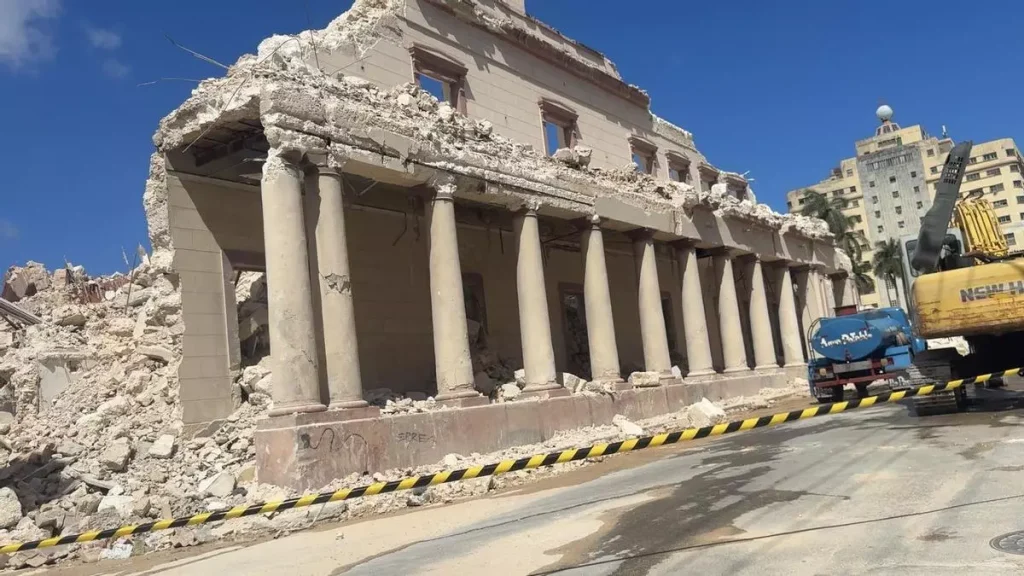
The Demolition of Havana’s Historic ISDi Building Fills Neighbors’ Homes with Dust

Onlookers crowd together to watch the spectacle, and some take advantage of the situation to carry off rebar and other materials.

Main façade of what used to be the Higher Institute of Industrial Design (ISDi), on Belascoaín Street, Central Havana / 14ymedio

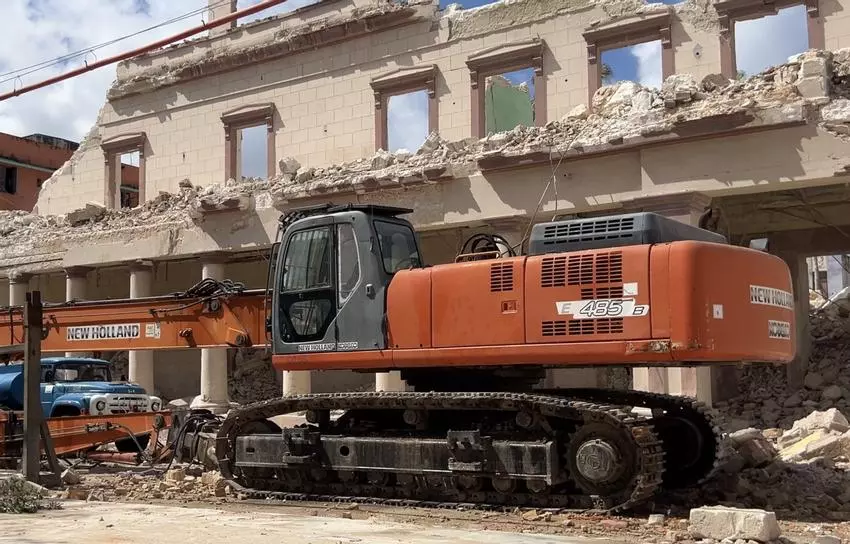
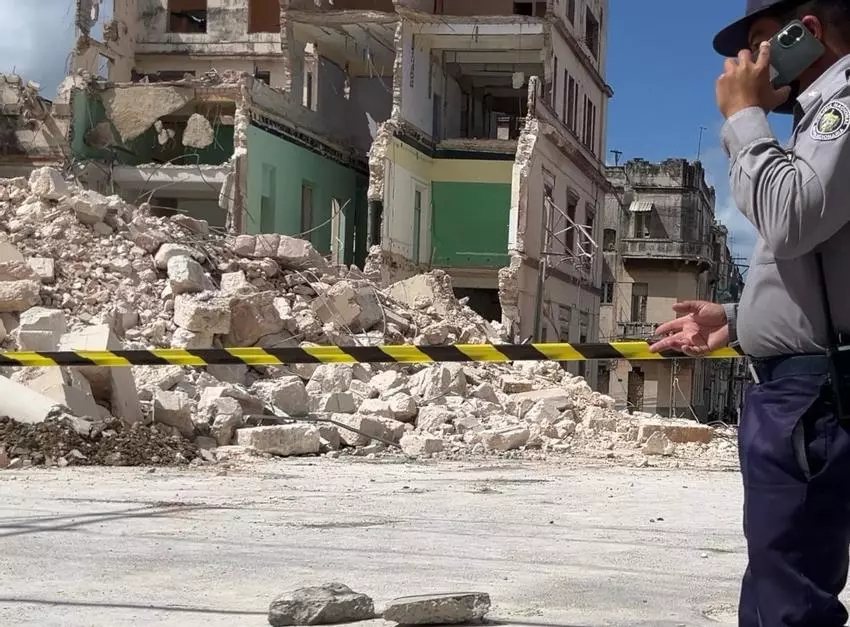
14ymedio bigger14ymedio, Havana, Darío Hernández, March 4, 2026 – The official demolition of the Higher Institute of Industrial Design (ISDi), now taking place, is in reality the final sigh of a very, very slow death. What the excavators of the Construction Materials Business Group (Geicon) are destroying at number 710 Belascoaín Street, in Central Havana, is barely what remains of the building after four years of closure, partial collapses, looting, and absolute institutional neglect.

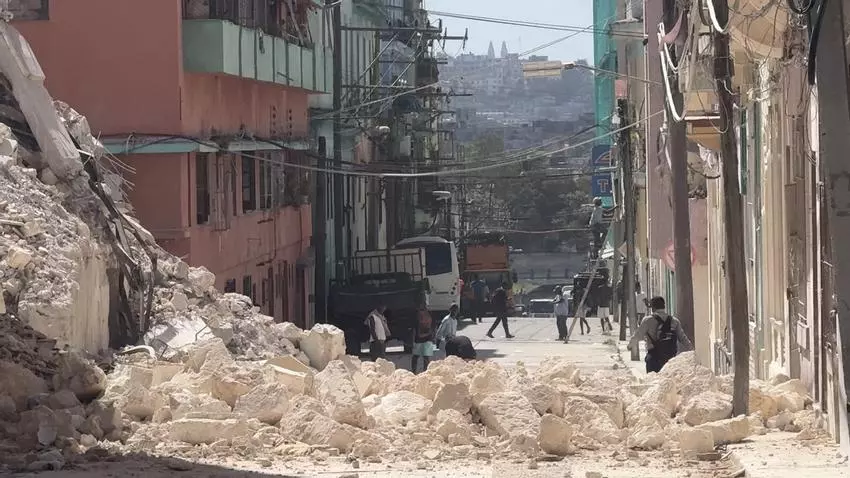
This Tuesday, the site, very close to the busy Carlos III Avenue, was packed with people. Workers, police officers, and onlookers crowded into Carlos J. Finlay Park, which faces the building’s façade, or walked around its sides along Enrique Barnet, Maloja, and San Carlos streets. Several, as 14ymedio confirmed, were carrying away rebar under the impassive gaze of the officers guarding the site.

The motionless excavators show that the demolition work is being carried out at a leisurely pace. / 14ymedio

Unlike similar situations in which the police cordon off the area, even prohibiting the use of cell phones, on this occasion people approached, took photos, and recorded videos without being discreet. There were also people inside, ignoring the mandatory safety measures in such cases.

The motionless presence of two excavators, one orange and one yellow, parked in front of what used to be the ISDi, shows that the demolition work is proceeding at a leisurely pace. Many sections still remain to be torn down.

At the back, along San Carlos Street, the rubble reaches the opposite sidewalk, filling the houses across the street with dust and debris. One neighbor complained to this newspaper: “It’s clearly a poorly done job, and we don’t know how long it will last.”

Workers, police officers, and onlookers crowded into Carlos J. Finlay Park, which faces the building’s façade, or walked around its sides. / 14ymedio

Residents have been enduring the deterioration of the ISDi ruins since March 2022, when the building was closed after an “architectural flaw” was detected that endangered students and staff. Without the State taking action to resolve those “flaws,” part of the interior façade collapsed in July 2024, and half a year later, in January 2025, another partial collapse left an elderly woman injured and four families without access to their homes.

In October of last year, authorities had to assign guards after graphic designer Esteban Aquino, a former student of the Institute, reported on social media, illustrating his message with photos, that numerous institutional documents, including theses, books, and catalogs, were scattered in nearby Carlos J. Finlay Park. Not only papers were stolen from the old school but also doors and windows, as neighbors told 14ymedio at the time.

One neighbor complained to this newspaper: “It’s clearly a poorly done job, and we don’t know how long it will last.” / 14ymedio

That its empty spaces were being used as bathrooms and dumping grounds, with the resulting health consequences for the neighborhood amid an arbovirus epidemic, was the most recent episode in its agony. However, the building’s final expiration has yet to arrive. In 1982, it was converted into the headquarters of the Polytechnic Institute of Industrial Design, the precursor to ISDi. Originally, it had been a military hotel and officers club for the Spanish Army. It later served as the Cadet School (1874–1878), an Asylum for Widows and Orphans, the General Staff headquarters during the first U.S. Occupation, and even the Ministry of Public Health before the Revolution. Even the official demolition is unfolding in slow motion.

Translated by Regina Anavy

______________________

COLLABORATE WITH OUR WORK: The 14ymedio team is committed to practicing serious journalism that reflects Cuba’s reality in all its depth. Thank you for joining us on this long journey. We invite you to continue supporting us by becoming a member of 14ymedio now. Together we can continue transforming journalism in Cuba.
Cuba Now Allows Private Entities to Manage Nursing Homes and Homes for People with Disabilities

The measure is due to the country’s urgent need to expand the reach of social care services, the Government says.

More than 25% of Cubans are 60 years old or older. / 14ymedio

14ymedio bigger14ymedio, Havana, March 4, 2026 – Excess demand and a limited supply of qualified personnel are the main obstacles facing Cuba’s elder care sector. A Cuban woman living in Spain told 14ymedio that she had to travel to Havana precisely to find someone to take care of the only elderly relative she has left on the Island.

“There is no one who wants to dedicate themselves to that kind of work, and those who do offer a dance of prices,” laments the woman, who says the problem is not only that “they only accept foreign currency,” but also the “fear of those of us living abroad about bringing a stranger into the home of an elderly person.”

In fact, she will have to extend her stay in the Cuban capital, originally planned for two weeks, to continue searching for staff.

Meanwhile, amid the crisis in residential facilities for the care of older adults or people with disabilities in the country, where thousands of elderly people have been left neglected, the Government has issued a new regulation allowing private companies to manage this type of establishment.

Published in the Official Gazette on February 26, the measure follows up on the decree published in 2024, known as the National System for the Comprehensive Care of Life, which aimed to help ensure that care responsibilities “are redistributed among different social and economic actors, and within families, without discrimination of any kind, and to promote people’s autonomy and well-being,” although a legal framework for its operation had not yet been developed. continue reading

The document establishes that these services will operate as a complement to the state network, such as day centers for seniors and nursing homes.

It also requires new providers to reserve “at least 10%” of their capacity for vulnerable individuals considered “of social interest,” with rates equal to those of certified state institutions and the possibility that Social Assistance will assume payments when proven insolvency exists.

The new regulation establishes three service modalities: daytime care residences, permanent residences, and mixed centers that combine both options. These spaces will be intended for older adults or citizens with disabilities who require specialized care, medical supervision, or assistance with basic daily activities.

Those interested in creating these centers must obtain approval from the general director of the Ministry of Public Health in each municipality. The Ministry of Finance and Prices will evaluate tax incentives and define economic benefits to encourage the development of these services, while governors, mayors, and municipal administrations are tasked with promoting them, identifying properties, and facilitating supplies.

The measure also provides for an exemption from paying rent on the state-owned premises where the service will be provided for two years

The measure also provides for an exemption from paying rent on the state-owned premises where the service will be provided for two years, extendable to three. After that period, authorities will evaluate whether to grant the property in usufruct.

A key point left open in the agreement is that of rates. The document states that the Ministry of Finance and Prices will determine the amounts. Given the battered finances of Cubans, the measure, which is aimed at “expanding the reach of social care services to older adults or people with disabilities,” could face obstacles if prices turn out to be high.

There is already an example of this with the small private company TaTamanía. Founded in 2023 and describing itself on its website as the “first private agency in Cuba dedicated to care,” it offers services for mobile individuals at a cost of $1.10 per hour; for people with reduced mobility, $1.35; while hospital care is charged at $1.50. The minimum requirement to request service is 40 hours per week for one month. The cheapest plan costs $176, about 89,760 pesos at today’s informal exchange rate.

The new regulations, the text says, are due to the “accelerated aging process of the Cuban population.”

The new regulations,  the text says. are due  to the “accelerated aging process of the Cuban population, which demands an increase in services” and to “the need to expand the reach of social care services to older adults or people with disabilities,” whose care on the Island has traditionally been the exclusive responsibility of family members or state entities.

The massive exodus of young Cubans has left thousands of elderly people alone, without family support networks for basic care. This has led to nursing homes having a large population that does not even have the most basic services guaranteed, such as food. One example is the 13 de Marzo Home in Guanabacoa, Havana, where it is common to see residents begging for bread or money through the bars separating the facility from the street.

However, this lack of access to food has not remained confined to these centers. According to the Eighth Study on the State of Social Rights in Cuba by the Cuban Observatory of Human Rights (OCDH), eight out of ten Cubans over the age of 61 had to skip breakfast, lunch, or dinner last year due to lack of money or food shortages.

The problem is enormous considering that one in four Cubans is 60 or older. The high degree of aging on the Island makes the country the most aged in Latin America and the Caribbean, a trend that has been rising since the early 2000s.

Translated by Regina Anavy

______________________

COLLABORATE WITH OUR WORK: The 14ymedio team is committed to practicing serious journalism that reflects Cuba’s reality in all its depth. Thank you for joining us on this long journey. We invite you to continue supporting us by becoming a member of 14ymedio now. Together we can continue transforming journalism in Cuba.
A New Power Outage Has Left More Than Half of Cuba, Including Havana, Without Electricity

Cuba’s National Electric System (SEN) collapsed from Camagüey to Pinar del Río due to the shutdown of the Antonio Guiteras power plant, the largest in the country

Workers at the Antonio Guiteras thermoelectric power plant in Matanzas, in an archive photo. / Girón

14ymedio bigger14ymedio, Havana, 4 March 2026 — An unexpected breakdown at the Antonio Guiteras power plant in Matanzas has caused a blackout across more than half of the country, from Camagüey to Pinar del Río, on Wednesday. All of Havana is currently without power.

According to a brief statement from the National Electric Union (UNE), the Guiteras hydroelectric plant tripped around 12:41 pm due to a leak in the boiler. The state-owned company assured that “all protocols for restoring the National Electric System (SEN) are already in place.”

La Guiteras is the largest and most important generating unit in the country and its shutdown from the system usually causes far-reaching effects due to the structural fragility of the SEN, which operates with a chronic generation deficit, frequent breakdowns in thermoelectric plants and limitations in fuel supply.

This is the first time this year that the system has collapsed, something that occurred several times in previous years. Between late 2024 and early 2025 , several nationwide or regional outages were recorded, some caused by failures in key units and others by extreme generation deficits, which forced the shutdown of entire blocks to prevent further damage. On several occasions, the total failure of the National Electric System (SEN) left the country in darkness for hours, with slow and phased restoration processes by microsystems.

The prolonged disruptions have impacted economic activity, transportation, telecommunications and water supply, in addition to exacerbating citizen discontent amid daily blackouts that, in some provinces, exceed 20 hours.

So far, the UNE has not specified how long it will take to fully restore service to the affected areas, which comes at a time of extreme crisis, exacerbated by the US oil blockade established after the intervention in Caracas on January 3.

______________________

COLLABORATE WITH OUR WORK: The 14ymedio team is committed to practicing serious journalism that reflects Cuba’s reality in all its depth. Thank you for joining us on this long journey. We invite you to continue supporting us by becoming a member of 14ymedio now. Together we can continue transforming journalism in Cuba.
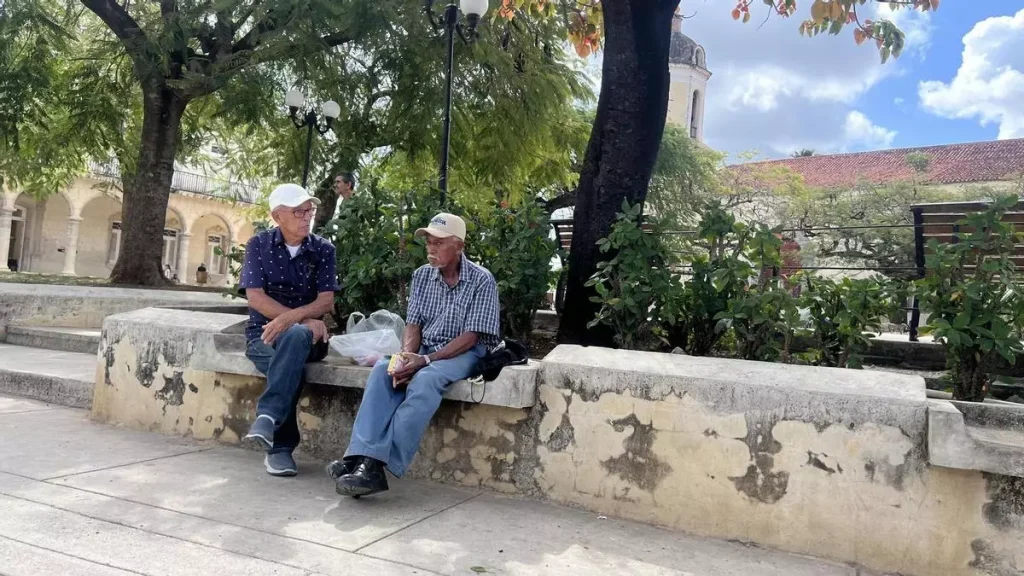
With the Legalization in Cuba of Mixed Companies Between the Private Sector and the State, the Regime Aims to Capture Efficiency

The new rule sparks skepticism among experts, and some fear it’s about “locking in state subordination of the private business sector.”

Some economists see this as a chance for mipymes (small and medium private businesses) to scale up. / 14ymedio

14ymedio bigger14ymedio, Madrid, 4 March 2026 — “With the new rule on mixed mercantile companies, imported fuel sold by the private sector might finally have an outlet.” That’s the take from Daniel Torralba, economist and analyst at the consulting firm Auge, after Tuesday’s approval of the new decrees regulating partnerships between state and private companies in Cuba. The announcement opens up a bunch of possibilities—with their ups and downs—but distrust toward the government’s intentions dominates the chatter.

Decree-Law 114/2025 essentially allows two types of association: mixed Limited Liability Companies (S.R.L.) and economic association contracts. It also covers acquisitions—of private shares by the state—and absorptions. Companies must submit a feasibility study proving they can self-finance and generate profits, plus align with the corresponding territorial development strategy.

If the Ministry of Economy and Planning gives the green light, the company gets autonomy to manage its assets, import and export directly, set its own prices, and decide its structure and workforce. Unlike mipymes [MSMEs] and self-employment, all activities are permitted—except Health, Education, and the Armed Forces (except for some purely business-related activities in those areas).

“The private sector could invest in all kinds of markets that were restricted until now, as long as it is done jointly with the Cuban State. One of those markets would be fuel sales,”

“The private sector could invest in all kinds of markets that were restricted until now, as long as it is done jointly with the Cuban State. One of those markets would be fuel sales,” Torralba points out in a Facebook post he titled ¿Cupets mixtos? (“Mixed Cupets?”). “While a private mipyme or cooperative can’t sell gasoline or diesel on its own, the sales could go through if done via a mixed limited liability company. For example, a (or several) hypothetical mixed companies between Cupet and private mipymes,” he reasons.

The economist—who lives in London—admits it is not clear if the US, which has authorized sales to private entities, would allow it if the company is mixed. But he figures “the key thing is the internal barrier gets removed. continue reading

We would need to confirm if the Cuban State would actually agree to mixed investment in that part of the energy sector, but in principle the decree-law allows it.”

Torralba adds that a deeper analysis is needed and tons of questions remain, but several commenters agree with him that the loophole is open—and since it won’t go unnoticed by the Trump administration, it is fair to wonder if the measure was even weighed in some never-confirmed negotiations with Washington.

Teresita López Joy, also from Auge, analyzed the pros and cons on the firm’s blog. She calls it an opportunity “but one that is conditioned.” The economist warns that “the key to success in 2026 won’t be who partners up fastest, but who manages to structure alliances that protect the private business’s autonomy while tapping into the state’s capabilities.” She advises that before jumping into these deals, you have to consider “not just whether the law allows it, but whether the current economic and geopolitical environment recommends it.”

López Joy breaks down the two types. A Mixed Limited Liability Company (SRL) is like a “legal marriage”: two personalities and assets merge to create a third one that inherits existing rights and obligations. The union is stronger and complex to dissolve.

An Economic Association Contract is “a much more agile figure that doesn’t create a new legal entity. The parties keep their legal independence but join forces for a common purpose for a set time”

An Economic Association Contract is “a much more agile figure that doesn’t create a new legal entity. The parties keep their legal independence but join forces for a common purpose for a set time,” possibly even managing a shared fund without issuing capital. Her takeaway: the flexibility of this one “could paradoxically be the most solid way to build a sustainable private sector in today’s Cuba.”

One big downside she flags is the bureaucracy. Timelines are long (up to 110 days, though theoretically 40 days should resolve it), and the approval adds “an extra political-administrative filter.” On the plus side, for entrepreneurs is access to direct import/export and previously banned sectors; for the state sector, “the interest seems to be capturing efficiency” and agility.

“No analysis of this rule in 2026 would be complete without addressing the elephant in the room: the blockade and its recent tightening,” she warns, echoing her colleague Torralba. While a mixed company “inherits the ‘state characteristic,’” an Economic Association Contract “offers relative shielding.” “Since it doesn’t create a new legal person, the private company keeps its separate legal identity, which could make it easier to argue to international partners that certain operations don’t involve a direct link to the Cuban state sector,” she says.

Yulieta Hernández Díaz, president of Grupo de Construcciones Pilares, is more skeptical. She sees hints of an Asian-style economic transformation, but worries political changes might get left behind. The entrepreneur, based in Havana, thinks Miguel Díaz-Canel is finally taking economic reforms seriously, but she doesn’t see “the structural transformations that are really needed.”

The entrepreneur, based in Havana, thinks Miguel Díaz-Canel is finally taking economic reforms seriously, but she doesn’t see “the structural transformations that are really needed.”

“I’m worried that the reforms being pushed today—both by sectors of the US administration (which focus their rhetoric on economic openings) and by Cuba’s own leadership—get interpreted as real structural change when, deep down, they might not mean any significant opening,” she says, and calls for steps toward democratization, starting with releasing political prisoners.

Economist Pedro Monreal dropped three short messages on his X account after “a quick read.” “From a model perspective, it’s a ‘domesticated’ destatization mechanism that combines ‘satellization’ of parts of the state sector with an ‘oblique graduation’ of private mipymes,” he notes. The expert believes the new rule lets parts of state companies break free to “take advantage of advantageous synergies with national private capital to reinforce state subordination of the private business sector.” He warns about the risks of state control but points out a positive: “Applied to a private business sector forced into the mipyme format with no option to become a large company, the new rule offers an alternative for ‘oblique graduation’ toward greater scale.”

Translated by GH

______________________

COLLABORATE WITH OUR WORK: The 14ymedio team is committed to practicing serious journalism that reflects Cuba’s reality in all its depth. Thank you for joining us on this long journey. We invite you to continue supporting us by becoming a member of 14ymedio now. Together we can continue transforming journalism in Cuba.
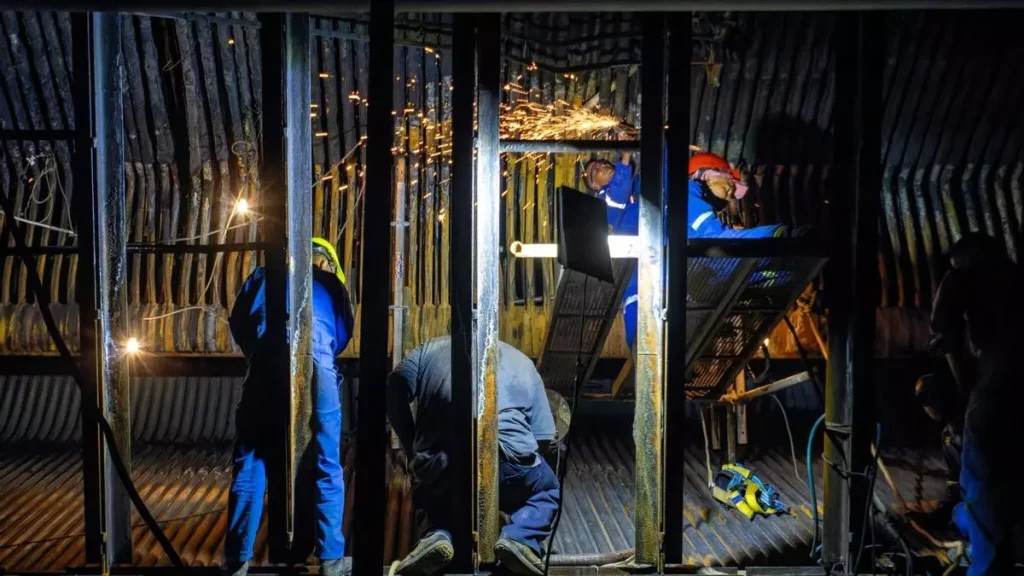
Lula Defends Cuba Against the US: “They’re Going Hungry” Because of the “Blockade”

The Brazilian president spoke about the island during the opening of the 39th FAO Regional Conference for Latin America and the Caribbean

14ymedio biggerEFE (via 14ymedio), Brasilia, 4 March 2026 — Brazilian President Luiz Inácio Lula da Silva defended Cuba this Wednesday and said its people “are going hungry because they don’t want them to have access” to the basics, right in the middle of the US government’s oil blockade against the island.

“Cuba isn’t going hungry because they don’t know how to produce or don’t know how to build their own energy. Cuba is going hungry because they don’t want them to have access to the things everyone should have a right to,” the so-called “progressive” leader said at the opening of the 39th FAO Regional Conference for Latin America and the Caribbean, in Brasília.

He used Cuba and Haiti as examples while slamming world leaders for not making the fight against hunger a priority and instead pumping more money into defense budgets.

“Suppose we don’t help Cuba because of ideological persecution: ‘We’re not helping Cuba because it’s a communist country’; then at least help Haiti, which is devastated, going through as much hunger as Cuba and being run by gangs,” Lula told representatives continue reading

from Latin American and Caribbean governments.

“Suppose we don’t help Cuba because of ideological persecution: ‘We’re not helping Cuba because it’s a communist country’; then at least help Haiti, which is devastated”

Cuba is in the middle of a serious fuel shortage crisis, made way worse by pressure from US President Donald Trump’s government after the intervention in Venezuela on January 3, which ended with Nicolás Maduro’s capture. Right after that, the US announced it was cutting off Venezuela’s oil supply to the island.

A few weeks later, on January 29, he signed an executive order threatening tariffs on any country that supplied oil to Cuba, claiming the island was a national security threat to the US. Trump then urged Havana to negotiate “before it’s too late.”

In this context, Lula called on Latin American and Caribbean countries to “wake up” and say they’re not accepting “submission” anymore — that they want, sovereignly, food for their people.

“We’re the only zone of peace in the world. Brazil chose not to have nuclear weapons and it’s right there in our Constitution. That saying ‘if you want peace, prepare for war’ is for people who want to make war,” he said.

He stressed that Latin America is a “rich” region that “basically has everything nature can offer,” but a lot of those resources end up being exploited by “people who aren’t from here” to make weapons.

“If we can’t wipe out hunger on the planet, it’s not because there’s too much rain or too much sun — it’s because of too much irresponsibility and lack of commitment (…) Hunger has to be treated as a top priority” and “we’re only going to end it when there’s real political will,” he insisted.

Translated by GH

______________________

COLLABORATE WITH OUR WORK: The 14ymedio team is committed to practicing serious journalism that reflects Cuba’s reality in all its depth. Thank you for joining us on this long journey. We invite you to continue supporting us by becoming a member of 14ymedio now. Together we can continue transforming journalism in Cuba.
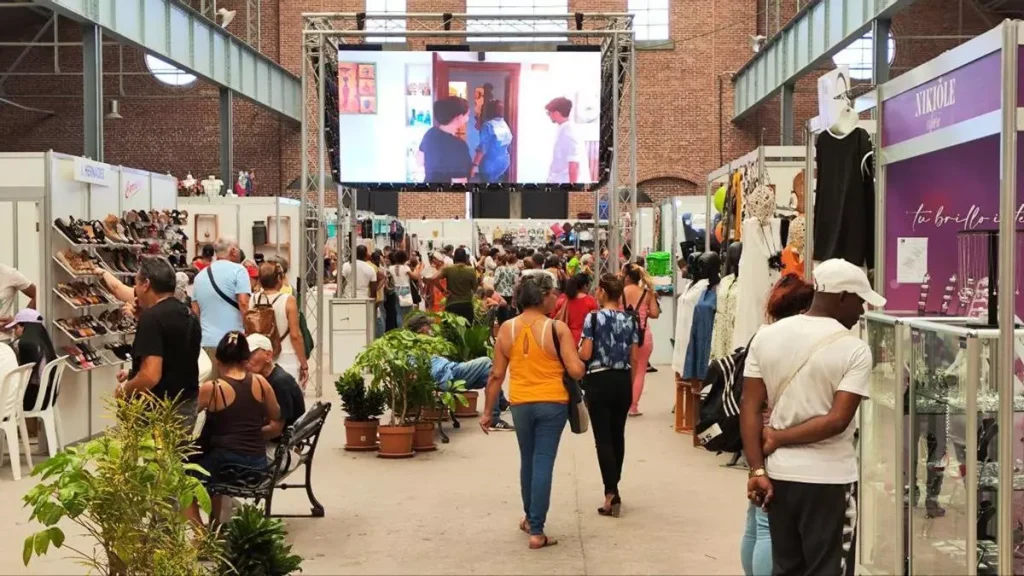
Honduras Spent More Than Three and a Half Million Dollars on Housing, Transportation, and Luggage for the Cuban Healthcare Workers

The vice president of health says they paid $1,600 for electricians who in Honduras earn less than $500.

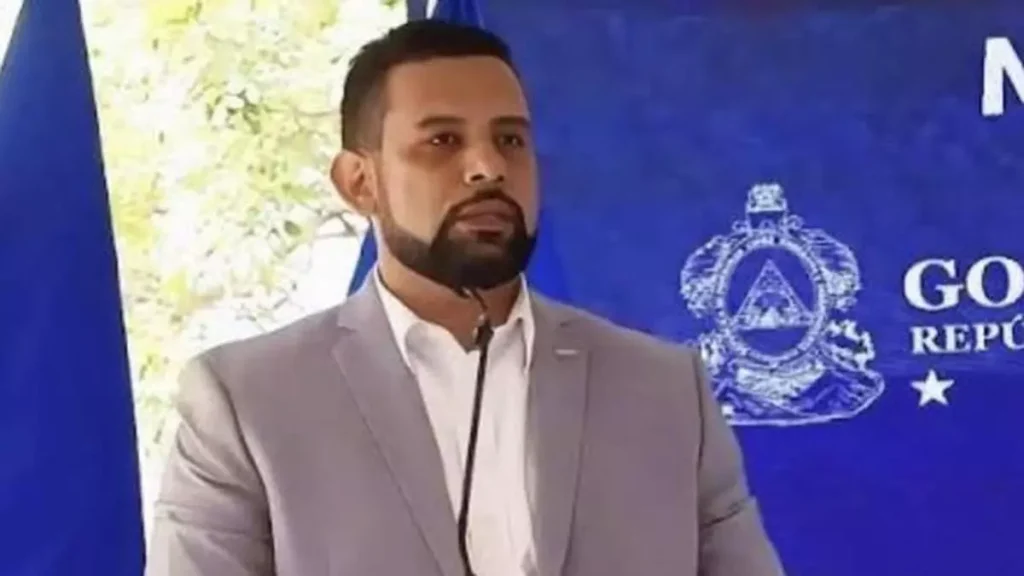
The Deputy Minister of Health, Ángel Eduardo Midence. / Contexto HN

14ymedio bigger14ymedio, Havana, March 4, 2026 — As promised, the Honduran government continues its investigation into the Cuban medical missions brought in by the administration of President Xiomara Castro, an ally of Havana. This Sunday, Deputy Health Minister Ángel Eduardo Midence revealed that, in addition to the $6,604,800 the country paid for 178 Cuban healthcare workers, another $3,654,817 was disbursed from the coffers of the “Secretariat of Strategic Planning” to cover housing, transportation, and baggage expenses.

In an interview for the program Tu Nota, the official detailed that renting a house in Honduras ranges from 15,000 to 20,000 lempiras, airfare from 800 to 1,000 dollars, and excess baggage costs 50 dollars.

Midence confirmed that the outgoing government made two agreements, one in 2024 and another last year. “It started with an agreement for 88 collaborators and was extended; we ended up with approximately 169 to 178,” so the island received $1,600 monthly for each of these people.

The deputy minister clarified that the information revealed was provided by the Cuban Embassy. As the data from the Cuban servers was cross-referenced, it was found that, in addition to electricians, telecommunications technicians, and an economist, the medical brigade also included cutting and assembly technicians and administrators.

“Yes, there were specialist doctors, that’s true, but the stipend should have been calculated based on the function” they performed, he stressed.

Honduras paid Cuban electricians $1,600, while the salary for this trade in the country is 12,316 lempiras ($464) per month. A nursing technician receives a salary of 17,238 lempiras ($650).

“How many Honduran electricians and nursing technicians could have been paid with the Cubans’ salaries?” Midence asked. “They would gladly go continue reading

to the places where the medical brigade personnel were,” especially if “they were paid for housing, airfare, and their travel expenses.”

The Honduran government of Xiomara Castro made two agreements, one in 2024 and another last year. / El Yoro Newspaper

The official does not know which hospital the technicians, administrators, accountants and telecommunications technicians were located because they appear as “in process,” that is, “they did not have a permanent location.”

The doctor also explained the vast difference between what the Cubans received and what he experienced during his social service at the Santa Bárbara Integrated Hospital. “There were only two of us doctors for the entire place back then,” he said, explaining that they divided the surgical, emergency, and gynecological services. “The hardest part was the on-call shifts.”

Midence explained that he managed on a scholarship of 5,500 lempiras (US$18). “We lived in a single room, the two of us.” At that time, he said, “the mayor got us a loan for lunch.” Transportation was financed through donations from his parents’ friends.

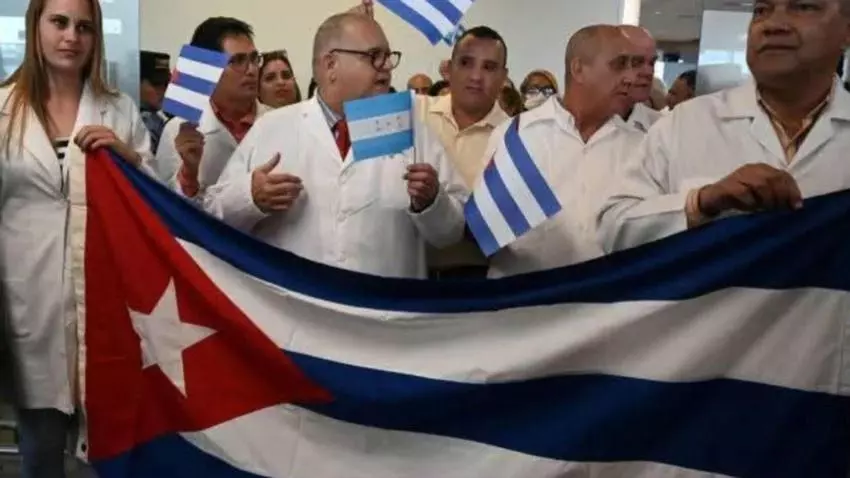
With the end of its agreement with Cuba, Honduras follows in the footsteps of Guatemala and Antigua and Barbuda, as well as Guyana and Saint Vincent and the Grenadines, which terminated their medical cooperation projects with the island after pressure from Washington. Last June, the US announced the revocation of visas for Honduran officials from the Ministry of Health (Sesal) and the Ministry of Strategic Planning.

______________________

COLLABORATE WITH OUR WORK: The 14ymedio team is committed to practicing serious journalism that reflects Cuba’s reality in all its depth. Thank you for joining us on this long journey. We invite you to continue supporting us by becoming a member of 14ymedio now. Together we can continue transforming journalism in Cuba.
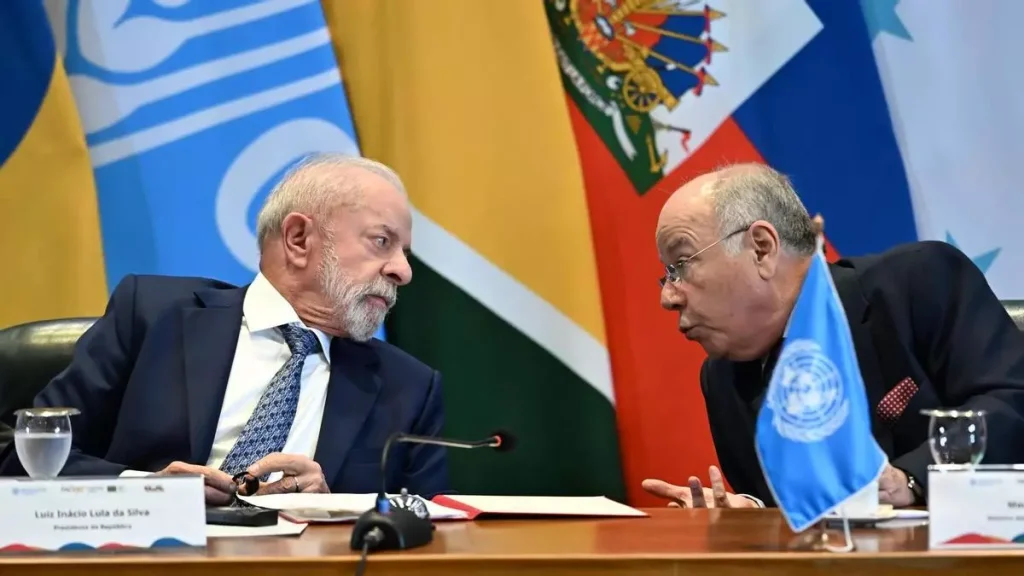
Dominica and Cuba Agree on Changes to the Doctor Recruitment Program

A report by ‘El Pais’ in Calabria reveals that Cuban healthcare workers in the region have, for years, received their full salary and then sent “a portion” back to the Island.

Arrival in Dominica of a group of Cuban doctors in 2024 / Cuban Foreign Ministry

14ymedio bigger14ymedio, Madrid, March 3, 2026 – Dominica confirmed this Monday that it is joining the list of countries modifying the terms of its agreement with Cuba for the recruitment of doctors from the Island, although the regime may have found a way to circumvent Washington’s main argument against these programs.

“We recognize that we must introduce some changes to the medical workers program, and we appreciate that the Government of Cuba has kindly agreed to cooperate with us in our effort to comply with the new requirements for Cuban healthcare workers,” said this Monday Vince Henderson, Foreign Minister of the Caribbean island.

At present, Henderson said, 65 Cuban doctors are providing services in the country, including physicians, specialists, nurses, and technicians, but the collaboration has lasted for decades. “I want to take this opportunity to thank Cuba for more than 30 years of support to the Government and people of the Commonwealth of Dominica through the sending of medical workers,” the foreign minister added.

“We will always be grateful to Cuba. They have been true friends in good times and bad,” he continued, while praising the Island’s role in training Dominican healthcare professionals who graduated in Cuba, as well as Havana’s assistance in establishing the country’s first intensive care unit and diagnostic center. continue reading

“We will always be grateful to Cuba. They have been true friends in good times and bad.”

The information formalizes what Henderson himself had already hinted at during the Caricom summit on February 24, when he first mentioned the issue, saying his Government planned to “make changes to the Cuban healthcare workers program” and that if there had to be an exit, it would be as gradual as possible to avoid affecting the population. However, Monday’s remarks do not suggest a withdrawal but rather a reform of the agreements, a path several countries have chosen, although the new method has not been disclosed.

The key, already pointed out by the Bahamas and Jamaica, appears to lie in direct payment to healthcare workers, something that has reportedly been done for a long time in Calabria, according to Tuesday’s report by El País. The Spanish newspaper traveled to the John Paul II Hospital in Lamezia Terme, in southern Italy, and spoke with members of the Cuban team, as well as with Calabria’s president, Roberto Occhiuto, just days after his meeting with the U.S. chargé d’affaires in Cuba, Mike Hammer.

“I frankly explained that the Cuban doctors currently present are indispensable to keep hospitals and emergency services operational,” Occhiuto said. “I clarified that our healthcare system is open to professionals of all nationalities.” According to the politician, from the conservative party Forza Italia, “the U.S. State Department has expressed its willingness to provide concrete assistance in the process of recruiting doctors,” although he did not specify how. However, those currently there will not leave at least until 2027. “They would have to close all the hospitals,” he admitted.

Calabrian authorities insist, as they had already stated after their meeting with Hammer, that by 2026 they expected to reach 1,000 Cuban doctors, although they have now opened the option to professionals of any nationality. “It is inappropriate to speak of U.S. pressure on Calabria to end its collaboration with Cuban doctors. The U.S. Administration, even during the presidency of Joe Biden, has never hidden its lack of enthusiasm for this initiative, but it cannot be considered interference or imposition,” Occhiuto tempered.

At the Lamezia hospital, General Antonio Battistini, former head of medical services for the Italian army, serves as commissioner and describes the Cubans as a relief. “In a region that still lacks a specialization school in emergency medicine, being able to rely on trained doctors represents a resource that is hard to replace,” he said. He commands 20 doctors in a province that has had 48, although three defected — five in the entire region.

“I was skeptical at first because the system is very complex. However, after a natural adaptation period, their contribution has been noticeable not only quantitatively but qualitatively.”

“Initially, the agreement provided that from the gross salary of 4,700 euros, about 1,200 would go directly to the doctors and the rest to the agency dependent on the Cuban Government. But it was changed two months later and the amount is transferred in a single payment to the doctors, who then send a portion to the Island,” the report states. Until now, the only known version regarding payment was the one given by the Italian press when the agreement was signed, but the new information reveals a method that would allow the regime to evade accusations that it keeps up to 90% of the salary. Archivo Cuba had already denounced last year that this could be a solution for Havana, as it could disguise the salary transfer as a voluntary contribution.

The Italians, according to the report, are more than satisfied with the work of their Cuban counterparts. “I was skeptical at first because the system is very complex. However, after a natural adaptation period, their contribution has been noticeable not only quantitatively but qualitatively,” said Gerardo Mancuso, head of Internal Medicine at the center, emphasizing that the doctors from the Island never miss work or request days off.

Battistini, who points out the similarities between the healthcare systems of Italy and Cuba, also highlights the Cubans’ “clinical competence.” “Without them we could not keep the Emergency Department open. It could not continue to exist,” added a doctor from the same hospital.

Within the contingent, whose members have learned the local language, there are those who have previously worked in other countries such as Venezuela and Panama, and they also say they feel satisfied with their work: “I think we have helped ease the workload in the Emergency Department, since admissions number in the thousands. Calabrians are very similar to Latins. With our Italian colleagues, we have managed to coordinate in a job that is not easy.”

Translated by Regina Anavy

______________________

COLLABORATE WITH OUR WORK: The 14ymedio team is committed to practicing serious journalism that reflects Cuba’s reality in all its depth. Thank you for joining us on this long journey. We invite you to continue supporting us by becoming a member of 14ymedio now. Together we can continue transforming journalism in Cuba.
Cuba Loses to Uruguay and Seals Its Elimination from the Basketball World Cup

The Island is the second worst team in the standings in the Americas, ahead of only Nicaragua.

After the loss to Uruguay, the Island will head into its next commitment stuck at the bottom of the group, with a 0–4 record / FIBA

14ymedio bigger14ymedio, Havana, March 3, 2026 – Cuba lost again this Monday on the fourth matchday of the qualifying round for the 2027 Basketball World Cup in Qatar. The defeat against the Uruguayan national team, by a 26-point margin, placed the Island as the second worst team in the Americas qualifiers, surpassed only by Nicaragua, and left it on the verge of early elimination from the World Cup.

The game, played at the Arena Roberto Durán against the South Americans, showed a team that traveled with an inexperienced roster, as players such as Jasiel Rivero, Howard Saint-Roos, Yoenki Mencía, and Karel Guzmán did not attend due to injuries or personal reasons. The good impressions left by the team in the previous match against Panama last Friday — a game they lost 84–81 — faded against Uruguay.

In the second half, the team coached by Osmel Planas ran out of steam and was outscored by double the points in the final two quarters, leaving the scoreboard at 88–62. Uruguay’s Emiliano Serres was the game’s top scorer, putting up 25 points, more than a quarter of his team’s total. On the Cuban side, Pedro Bombino stood out with 14 points and nine rebounds. Reynaldo García also reached double digits with 12 points, along with seven rebounds and one block.

On the Cuban side, Pedro Bombino was the standout, with 14 points and nine rebounds.

After the loss to Uruguay, the Island will enter its next matchup at the bottom of the group with a 0–4 record. In the previous three games, it suffered two losses to Argentina and one to Panama. In addition, the defeats — many by wide margins, including a loss by more than 50 points to Argentina last December — leave Cuba with a point differential of -97, ahead of only Nicaragua, which stands at -117. continue reading

The result against Uruguay highlights a crisis in Cuban basketball. The previous meeting between the two teams dated back to 1999. On that occasion, the South Americans won 87–84 as part of the FIBA Americas Championship. Before that game, played in Puerto Rico, Cuba had dominated the matchup, winning five of the six games played between them.

Cuba had hoped for better results from this game window. Originally, the matches against Panama and Uruguay were to be played at the Coliseo de la Ciudad Deportiva, but the venue was changed due to a lack of proper conditions amid the worst energy crisis the Island has experienced in decades. “The current conditions the country is facing, as a result of the tightening of the United States embargo, make it difficult to organize this event with the quality it demands, which is why we are forced to take this measure,” explained Dalia Henry, president of the Cuban Basketball Federation, on February 12.

Originally, the matches against Panama and Uruguay were to be played at the Coliseo de la Ciudad Deportiva in Havana.

The former athlete also thanked the International Basketball Federation “not only for its understanding, but for all the help provided so that we can travel and play the games in Panama.”

For the Island, play will resume on July 2, the date set for the second matchup with Panama, which will also be held at the Arena Roberto Durán. Three days later, Cuba will travel to Uruguay to face the hosts in the final matchday of the qualifiers, in what will be a last chance to try to at least secure third place in the group and hope to advance to the next round.

Cuba has not qualified for a Basketball World Cup since 1994. On that occasion, it finished second to last (15th), ahead of only Angola. Far behind remains the golden generation of Cuban basketball in the 1970s, which at the 1974 World Cup in Puerto Rico achieved fourth place, finishing behind only powerhouses such as the Soviet Union, Yugoslavia, and the United States. At the Olympic level, Cuba won the bronze medal at Munich 1972, surpassed only by the USSR and the United States.

Translated by Regina Anavy
______________________

COLLABORATE WITH OUR WORK: The 14ymedio team is committed to practicing serious journalism that reflects Cuba’s reality in all its depth. Thank you for joining us on this long journey. We invite you to continue supporting us by becoming a member of 14ymedio now. Together we can continue transforming journalism in Cuba.
The FAO Warns of the ‘Serious’ Effect of Cuba’s Fuel Crisis on Agriculture

The organization is promoting a transition to renewable energy sources to reduce “dependence” on hydrocarbons.

The shortage is further taking over markets, which had already been undersupplied for several years. / 14ymedio

14ymedio bigger14ymedio / EFE, São Paulo, March 3, 2026 – The impact of the fuel crisis in Cuba is already being felt in its agricultural sector and the effect is “serious,” warned EFE in an interview with the regional representative of the United Nations Food and Agriculture Organization (FAO), René Orellana.

The head of the FAO for Latin America and the Caribbean stated that the lack of fuel, caused by actions taken by the government of the U.S. president Donald Trump, “is limiting” farmers’ use of machinery to carry out the harvest.

“Several crops are at risk of not being harvested properly,” he warned. As a consequence of this situation, Orellana said that the Island’s population “will not be able to access those foods.”

“Several crops are at risk of not being harvested properly.”

In this context, the FAO and other UN agencies are promoting a transition to renewable energy sources to reduce “dependence” on hydrocarbons, the agency official explained. continue reading

Among the options being promoted are the installation of new irrigation systems, as well as small-scale photovoltaic and hydroelectric plants.

“They are accessible energy sources that we must work on to support small family production,” Orellana said.

Since U.S. President Donald Trump imposed a blockade on oil shipments to Cuba, extreme fuel rationing measures have restricted the transport of agricultural products to markets.

Translated by Regina Anavy

______________________

COLLABORATE WITH OUR WORK: The 14ymedio team is committed to practicing serious journalism that reflects Cuba’s reality in all its depth. Thank you for joining us on this long journey. We invite you to continue supporting us by becoming a member of 14ymedio now. Together we can continue transforming journalism in Cuba.

Díaz-Canel Insists on Improving a Failed Economic Model Instead of Adopting Another One

Under another name, the regime offers the same recipes that have led the country to an unprecedented crisis.

Díaz-Canel at the Council of Ministers meeting to evaluate the economic program. / Revolution Studies

14ymedio bigger14ymedio, Havana, 3 March 2026 — The lessons of the past have not sunk in at the top of the Cuban power structure, which continues to stumble, time and again, over the same stone in its failed attempts to save “the economic and social model.” After the 2021 ‘Ordering Task‘, which plunged the country into misery, Miguel Díaz-Canel is now asking his ministers to focus “immediately on implementing the most urgent and necessary transformations,” this without touching the current socialist model.

The Associated Press (AP) echoed the Cuban president’s demand, and countless newspapers— including the Washington Post—have reprinted a story that, beyond the headline, contains nothing new: “to implement the urgent, most necessary transformations that must be made to the economic and social model.”

The president’s words generated widespread anticipation, not only within the US news agency, which emphasized the context in which they occurred—the oil embargo—but also among other sectors critical of the government, like the economist Pedro Monreal, based in Spain. However, Monreal was initially disappointed by the original information published in the State newspaper Granma. “What the press release describes doesn’t suggest that the government has a robust plan for transforming Cuba’s economic model. It would be necessary to go beyond the 10 aspects mentioned,” he said.

Hours later, the economist offered a harsher analysis. “The current economic model cannot be improved by replacing obsolete parts. The current model is exhausted, but it maintains an internal coherence that must be dismantled and replaced by another, also internally coherent, but discordant with the previous one,” he stated on his X account. Monreal pointed out that “the structural crisis expresses the nature of an economic impasse that cannot be overcome within the model” and that if the word reform is not to be used, it is at least imperative to call it “structural transformation.” continue reading

The current model is exhausted, but it maintains an internal coherence that must be dismantled and replaced by another, also internally coherent, but discordant with the previous one,” he stated on his X account.

In any case, the expert believes that the document called  ‘Conceptualization,’ which defined “centralized socialist planning as a ‘central component’ of the model and ‘ownership by all the people’ as the basis of the economic system,” are “precisely two crucial aspects to modify in a structural reform.” Monreal believes it is imperative to involve all of society to reach an agreement on the necessary changes and accuses the government of perpetuating a “casting error” by “entrusting the transformations to the same team (…) that designed and implemented the programmatic folly of the ‘Reorganization,’ the ineffective patches that followed, and the bureaucratic contraption they call a ‘Government program.'”

What was discussed at the Council of Ministers was widely reported by the official press, making it clear that no changes have been announced. The mere list Díaz-Canel presented of these transformations demonstrates this: “They are fundamentally related to business autonomy, municipal autonomy, the resizing of the state apparatus, the government, and institutions; national food production, municipal budgets, the shift in the energy matrix, which includes not only renewable sources but also everything related to domestic crude oil; exports, linking them to the flexibilities approved for foreign direct investment; leveraging economic partnerships between the state and private sectors, especially at the municipal level; and promoting business with Cubans residing abroad,” he said. Each and every one of these was approved long ago.

The meeting focused on the role of municipalities and the importance of them taking control of decisions that were placed in their hands years ago. Prime Minister Manuel Marrero emphasized this idea, which is hardly original. For at least two years, the government has repeatedly invoked the concept of municipal decentralization, which, while potentially offering advantages—decisions being made locally and with a better understanding of each area’s needs—ultimately served more as a mechanism for diluting responsibility. Since mid-2024, for example, the approval of micro, small, and medium-sized enterprises (MSMEs) has been a municipal power, so Marrero’s words didn’t signify any real change.

“The municipalities have to manage foreign direct investment; municipalities have to manage their own closed schemes in foreign currency; municipalities have to manage economic partnerships between the state and non-state sectors; municipalities have to design and propose their local production systems; and they have to manage investments with Cubans residing abroad,” he said.

It is true that the approval of the decree on the Decentralization of Powers and Transfer of Resources to the Territories, at the end of December 2025, is recent. But in its resistance to relinquishing control, the Government reserved for itself “the final power to approve everything, as well as the ability to add further exclusions to decentralization, concentrating the power of veto and redefinition of the process at the central level,” as criticized, among others, by the official publication La Joven Cuba, which also acknowledged the lack of training and capacity in municipalities to suddenly make decisions. “Decree 140/2025 is more of a declaration of intent than a true decentralizing public policy,” it concluded.

What emerged from the Council of Ministers, as if it were the big thing, was the renaming of the “Government Program to correct distortions and revitalize the economy”, which will now be called the “Government Economic and Social Program for 2026”

The Council of Ministers announced, as if it were the big thing, the renaming of the “Government Program to Correct Distortions and Revitalize the Economy,” which will now be called the “Government Economic and Social Program for 2026.” However, the state of the economy remains largely unchanged. The Minister of Health, Joaquín Alonso Vázquez, stated that “generally, goods exports are falling short,” with the exception of honey, tobacco, lobster, rum, and pharmaceuticals. Sales of services are currently performing better, although the outlook is bleak. Tourism reached only 85% of projections, but February is expected to bring even worse conditions, following the cancellation of countless flights due to fuel shortages. Health sector exports are nearly at 100% of their targets, officials affirmed, although announcements of the suspension of agreements to contract out Cuban doctors for overseas missions are happening daily.

Regarding agricultural production, there is very bad news, all attributed to “the hostile US policy,” which means that despite the effort, “they still do not meet the demands of the population, they are insufficient and do not cover the deficits of imported food foreseen in the plan.”

The Minister of Energy and Mines, Vicente de la O Levy, also spoke about the energy transition – with no new developments, on that part. “Progress has been made, but concrete actions are needed in each of the provinces and municipalities to make them more energy sovereign,” he said.

There was no clear data on debts and defaults, although Marrero warned that the actions taken to address the debts are numerous but “insufficient,” leaving behind an unknown that no one wants to discuss. “The Council of Ministers reviewed the results of the Development and Business Program and  Mariel Special Development Zone for the end of 2025, an important economic enclave for the nation which, despite the tense situation in Cuba, confirms its strategic value for attracting national and foreign investment.” No figures were presented to assess the current state of this free trade zone, which was expected to generate some $2.5 billion annually but had barely reached that amount in its first decade.
______________________

COLLABORATE WITH OUR WORK: The 14ymedio team is committed to practicing serious journalism that reflects Cuba’s reality in all its depth. Thank you for joining us on this long journey. We invite you to continue supporting us by becoming a member of 14ymedio now. Together we can continue transforming journalism in Cuba.

Cuban State Sells Solar Panel Kits at Prices Impossible for the Population

With a record deficit of 2,025 MW expected this Monday, the supply of photovoltaic energy is not reducing nighttime blackouts

Even some of the “chosen ones” haven’t been able to enjoy the privilege, because they can’t afford it. / UNE

14ymedio bigger14ymedio, Havana, March 2, 2026 — A new record for blackouts is expected this Monday in Cuba. The outage will again exceed 2,000 megawatts (MW), according to the report published by the National Electric Union (UNE), reaching 2,025 MW during peak hours. Given that only 1,185 MW will be available for a demand of 3,180 MW, this represents an unprecedented deficit of 64%.

In the midst of constant power outages, which exceed 20 hours a day in some parts of the Island, the National Union of Educators (UNE) has announced the sale of 800W solar panels for 75,000 pesos. The offer is only for “outstanding workers,” even though that price is more than 20 times the average salary of a state employee.

In a message posted on its official profile, the National Union of Educators (UNE) proudly announced the installation of an 800W photovoltaic module at the home of a retired Heroine of Labor (a 2003 recipient) in Artemisa. “The kit, priced at 75,200 pesos payable through various methods, includes six meters of cable and one connector; another connector and a double-edged blade will be purchased according to supply and demand,” the post detailed. Payment options included cash or card, as well as the possibility of “family support.”

The comments on the post reveal indignation laced with dark humor: “She won’t have enough time in her lifetime to pay for it.” Others point out that some of the “chosen ones” haven’t even been able to enjoy the privilege because they can’t afford it.

Even more outrageous is the advertisement from the Postal Service in Sancti Spíritus , which is selling solar kits to both individuals and businesses. According to a post on their social media, the most “basic” 5-kilowatt (kW) model costs 2,530,000 Cuban pesos, and the 12 kW model is nearly 4,895,000. Payment must be made entirely in Cuban pesos, either electronically or in cash. continue reading

State prices for these modules are three times higher than what can be purchased for similar systems on the informal market.

State prices for these modules are three times higher than what can be purchased for similar systems in the informal market, where, moreover, sales are not reserved for select groups within the population.

In Granma province, the program is already facing setbacks. An article in the official newspaper La Demajagua reports panels installed without available batteries, equipment with technical limitations, and cases of breakdowns for which the customer is ultimately held responsible: some beneficiaries are forced to continue paying fees exceeding ten times their monthly salary due to the installation of systems that don’t work.

Meanwhile, the official newspaper Granma celebrates the installation of 5,000 2 kW photovoltaic systems donated by China to “protect what is essential.” According to Elena Maidelín Ortiz Fernández, the head of the project installing the donated modules, 2,671 of these systems were allocated to “vital centers in every municipality in the country.” The purpose, she noted, “is not total self-sufficiency,” but rather “to guarantee the energy survival of these centers, which in turn contributes to the vitality of the municipality and the province.” The National Union of Electricity Workers (UNE) proudly highlights these installations on its social media profile, prompting protests from users about the repeated power outages in their areas.

Because of system installations that don’t work, some beneficiaries have to continue paying fees that exceed ten times their monthly salary.

Ortiz Fernández also emphasizes that this benefit will reach rural areas that have never had electricity. “If you install a 2 kW system for these people there, allowing them to have a refrigerator, a fan, a television, their lives will be completely transformed, and we will prevent them from having to leave their communities.”

The deployment of solar panels is officially presented as part of the energy transition in the face of the crisis and deterioration of the national electricity system; but access to domestic systems depends on an impossible ability to pay in a context of extremely low wages and constant blackouts.

Furthermore, the installation of solar parks, announced with Chinese contracts for 92 projects across the island, will not solve the energy shortage either. The limited output of completed projects suggests that the energy these facilities provide to the island will remain insufficient and restricted to the hours of sunlight.

While the official press boasts about donations and “energy resilience,” millions of Cubans continue to suffer basic needs as a luxury that costs more than they will earn in years.

______________________

COLLABORATE WITH OUR WORK: The 14ymedio team is committed to practicing serious journalism that reflects Cuba’s reality in all its depth. Thank you for joining us on this long journey. We invite you to continue supporting us by becoming a member of 14ymedio now. Together we can continue transforming journalism in Cuba.

The Death Throes of ‘Granma’, the Mouthpiece of a Regime Cornered by Crisis

The print version of the Communist Party newspaper will be published only once a week

On Ayestarán Street, a closed and rusty newsstand has lost the stickers that advertised the magazines that were sold there a few years ago. / 14ymedio

14ymedio bigger14ymedio, Yoani Sánchez, Havana, 2 March 2026 — I leave my house and come across a woman placing food for a stray cat on a page of the Granma newspaper, a scene that will soon disappear in a country where the official organ of the Communist Party is now printed only once a week. With its few pages and triumphalist headlines, the Cuban regime’s main propaganda outlet is the latest victim of the energy crisis hitting the island. But its reduction, more than a loss of information, is a sign of the end of a model of indoctrination

I leave Rancho Boyeros Avenue behind and approach the Havana Printing Plant, one of the main printing facilities for periodicals in Cuba. Several windows are missing from the upper floor, and neglect seems to pervade a place that was once the heart of the country’s information policy. The facade is dirty here and there, and from inside, the sounds of the machines where paper and ink once combined to give shape to official statements, lengthy speeches, and calls to resistance are gone.

For a system that has based its control primarily on repression and propaganda, the current state of its official media represents a rapid loss of social influence. My curiosity leads me to walk around the building, and I don’t see a soul entering or leaving. The nearby institutional parking lot is filled with broken-down cars. Some vehicles have been sitting out in the open for years, never driven on the streets of Havana. The nearby headquarters of the newspaper Juventud Rebelde, which resembles a fish stall, also shows no signs of activity. continue reading

In a few months, the enthusiasm faded, the presses stopped, and the fuel to carry the dogma of the Central Workers’ Union of Cuba to every proletarian ran out.

The faded poster for Bohemia magazine catches my eye. The entrance is dark, and a nearby garbage dump has begun to encroach on the building’s access ramp. A fence in the vicinity has lost its color, and others have simply vanished, leaving only the metal scaffolding from which, until a few years ago, we were bombarded with slogans. I’m just a few meters from Revolution Square, where ideological propaganda should be more prevalent, but what I find are a few neglected and outdated posters.

At a nearby bus stop, across from the Ministry of Communications, a homeless man has improvised a place to sleep. He has some blankets and pages from the newspaper Trabajadores. I manage to read a few headlines printed on its pages. They are phrases that sound like they came from a distant land, where plans were made and victories were celebrated. But, in just a few months, the enthusiasm faded, the presses stopped, and the fuel to carry the dogma of the Cuban Workers’ Federation to every proletarian on the island ran out.

On Ayestarán Street, a closed and rusty newsstand has lost the stickers that once advertised the magazines sold there a few years ago. Further down the street, another newsstand has been handed over to a private vendor who, instead of official publications, offers small tubes of instant glue, colored pencils, and school supplies, all imported. Along the way, I don’t encounter a single newspaper vendor, a nearly extinct occupation in Havana.

A herbalist wraps a sprig of basil for me in a page of Tribuna de La Habana. The printed version of the official newspapers will also be missed in home repairs, where they were used to avoid getting paint on the floor, and in toilets throughout the country, where they replaced toilet paper. Now, with their reduction, what’s lost is not just a news source, but a practical resource for cleaning windows or picking up dog waste.

Provincial media outlets, with few exceptions, copy and paste the articles written in Havana.

A friend’s son is about to graduate with a degree in Journalism, but classes at his faculty have been suspended due to the power outage. The young man began his studies full of passion, eager to become a reporter, investigating stories, gathering testimonies, and compiling sources. Along the way, however, he lost hope of practicing his profession in Cuba and now only wants to obtain his diploma and emigrate. While waiting for in-person classes to resume, he writes for an independent newspaper that pays him in foreign currency.

The worst situation is that of the older journalists. In my neighborhood, a photographer for an official magazine complains that he’s no longer given gasoline to ride his motorcycle out to take photographs of events. Coverage on-the-ground is at a minimum in media that, until a few decades ago, enjoyed abundant resources and priority in receiving perks. Credentials to attend festivals, welcome cocktails at exhibitions, and even the occasional “little gift” upon completing a report on an industry with foreign investors were part of the profession’s allure. However, being a state reporter today brings more headaches than benefits.

My neighbor complains that his newsroom is empty. “The last few times I’ve been there, I’ve only seen the security guard,” he tells me. Provincial media outlets, with few exceptions, simply copy and paste the articles written in Havana. Some news headlines go days without updating, while others survive by rehashing posts from social media where a resident reports a water leak or thanks a bus driver for stopping at the bus stop. Instead of those powerful, tireless voices, publications controlled by the Cuban regime have become clumsy digital spreadsheets with hardly any well-known bylines, in-depth reports, or news.

Next to me in line for the elevator, a neighbor is looking at the front page of a Miami-based newspaper on her phone. The headline that catches her eye speaks of “economic collapse” in Cuba, and the photo shows the gaunt and sad face of an elderly man. Granma has not only lost the battle for print media, it was defeated long ago in its attempts to monopolize the Cuban audience. The elderly woman neither informs nor persuades, and from now on, she’s no longer of any use in Cuban bathrooms.

Chronicles:

The Anxiety of the Disconnected Cuban

One Mella, Three Mellas, Life in Cuba Is Measured in Thousands of Pesos

It Is Forbidden To Leave Home in Cuba Today Because It Is a “Counter-Revolutionary Day”

Vedado, the Heart of Havana’s Nightlife, Is Now Converted Into a Desert

Havana, in Critical Condition

______________________

COLLABORATE WITH OUR WORK: The 14ymedio team is committed to practicing serious journalism that reflects Cuba’s reality in all its depth. Thank you for joining us on this long journey. We invite you to continue supporting us by becoming a member of 14ymedio now. Together we can continue transforming journalism in Cuba.

Donald Trump Will Not Be Able To Destroy American Democracy

The good news for the United States and the world is that democratic institutions will outlive the current president.

Donald Trump, of course, in denouncing the Supreme Court’s decision, has been particularly rude to the two justices he appointed. / EFE

14ymedio bigger14ymedio, Federico Hernández Aguilar, San Salvador, 27 February 2026 — In April 2025, in this same opinion column, we shared our astonishment at the US president’s threat to impose barriers to free trade on much of the world. Calling it “inexplicable,” we warned that the “reasons” given by the White House to justify its tariff offensive were, in reality, mere excuses, because neither the logic of bravado as a tool of intimidation nor the hypothetical desire to lower interest rates on US debt through recession made sense. The potential benefits of these measures would not outweigh the risks involved.

The three outcomes we predicted came to pass exactly as predicted: increased bilateral trade responses; new alliances centered around development hubs alternative to the United States; and an inflationary wave that has devastated the stability of thousands of American households. Trump’s argument regarding supposed “trade balances” was untenable, aberrant, and illiberal. That is why its effects are hurting the president in the polls and creating unnecessary holes in his country’s image as a reliable partner.

Trump’s argument regarding supposed “trade balances” was untenable, aberrant, and anti-liberal.

However, the icing on the cake was still missing. Was the Supreme Court going to rule against Trump’s economic agenda, overturning his tariff strategy? Because the truth was that no president before him, at least in the last half-century, had gone so far in challenging judicial independence. Just last September, we recalled that the courts were flooded with executive orders and that, of twenty-one cases brought before the Supreme Court, only in three had the Court not ruled in favor of granting the president greater leeway at the expense of the lower court’s decisions.

While none of the above yet constituted a flagrant violation of the Constitution, it was clear that Trump was undermining the system. In his second term, therefore, only the bulwark of the rule of law could prevent him from abusing his power, in the manner of autocrats in South America or sub-Saharan Africa. continue reading

On February 20, finally, with a majority of six to three, the justices of the highest court did their job, reminding Donald Trump that the independence of the branches of government is a pillar of American democracy and that his executive powers cannot exceed the legal framework in which those powers originate.

At the end of his concurring opinion, Justice Neil Gorsuch, alluding to the need for Trump to abide by constitutional procedures, wrote: “Yes, legislating can be hard and take time. And, yes, it can be tempting to bypass Congress when some pressing problem arises. But the deliberative nature of the legislative process was the whole point of its design. Through that process, the Nation can tap the combined wisdom of the people’s elected representatives, not just that of one faction or man. There, deliberation tempers impulse, and compromise hammers disagreements into workable solutions. And because laws must earn such broad support to survive the legislative process, they tend to endure, allowing ordinary people to plan their lives in ways they cannot when the rules shift from day to day.”

Three justices whom the American press calls “conservatives”—John Roberts, Amy Coney Barrett, and Gorsuch—have offered the world proof of what makes the United States great: its institutional strength. And they did so, not out of animosity toward President Trump or a desire to give more power to Congress, but because they understand that posterity will judge them harshly for their decisions, decisions that must be grounded in the Constitution and the tradition of great liberal values.

Aside from sending a message to members of Congress (mostly Republicans) to understand and defend their legislative power, the Supreme Court was consistent in respecting the letter of the law.

Joining the majority of the Court’s justices, Justice Ketanji B. Jackson emphasized that U.S. legislative history provides clear evidence of what Congress intended when it enacted the International Emergency Economic Powers Act (IEEPA), on which Trump sought to base his tariff offensive. Jackson added, “Given that evidence, we need not speculate or, worse, step into Congress’s shoes and formulate our own views about what powers would be best to delegate to the President for use during an emergency.”

In other words, aside from sending a message to members of Congress (mostly Republicans) to understand and defend their legislative power, the Supreme Court was consistent in respecting the letter of the law and avoiding encroaching on the constitutional powers of the Capitol, which would have been a huge inconsistency.

Donald Trump, of course, in denouncing the Supreme Court’s decision, has been particularly rude to the two justices he appointed: Barrett and Gorsuch. As is typical of his rhetoric, he targets the reputations of those he cannot defeat with arguments. But his furious diatribe is also aimed at members of his own party in Congress, who will now have to provide the president with a legal recourse just months before they themselves are up for reelection in November.

Whatever happens, the good news for the United States and the world is that American democratic institutions will survive Donald Trump.

______________________

COLLABORATE WITH OUR WORK: The 14ymedio team is committed to practicing serious journalism that reflects Cuba’s reality in all its depth. Thank you for joining us on this long journey. We invite you to continue supporting us by becoming a member of 14ymedio now. Together we can continue transforming journalism in Cuba.