The measure is due to the country’s urgent need to expand the reach of social care services, the Government says.
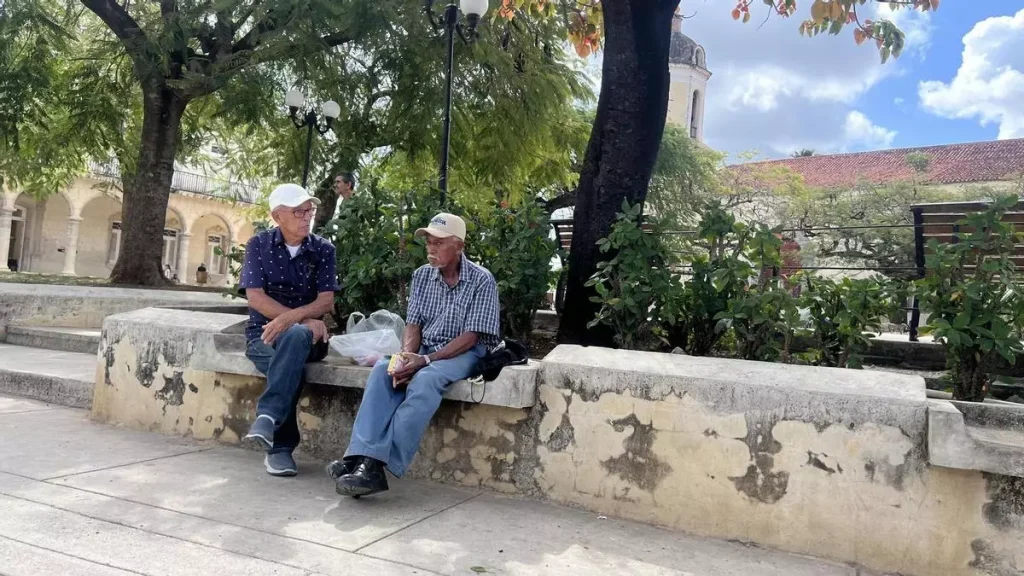
 14ymedio, Havana, March 4, 2026 – Excess demand and a limited supply of qualified personnel are the main obstacles facing Cuba’s elder care sector. A Cuban woman living in Spain told 14ymedio that she had to travel to Havana precisely to find someone to take care of the only elderly relative she has left on the Island.
“There is no one who wants to dedicate themselves to that kind of work, and those who do offer a dance of prices,” laments the woman, who says the problem is not only that “they only accept foreign currency,” but also the “fear of those of us living abroad about bringing a stranger into the home of an elderly person.”
In fact, she will have to extend her stay in the Cuban capital, originally planned for two weeks, to continue searching for staff.
Meanwhile, amid the crisis in residential facilities for the care of older adults or people with disabilities in the country, where thousands of elderly people have been left neglected, the Government has issued a new regulation allowing private companies to manage this type of establishment.
Published in the Official Gazette on February 26, the measure follows up on the decree published in 2024, known as the National System for the Comprehensive Care of Life, which aimed to help ensure that care responsibilities “are redistributed among different social and economic actors, and within families, without discrimination of any kind, and to promote people’s autonomy and well-being,” although a legal framework for its operation had not yet been developed.
The document establishes that these services will operate as a complement to the state network, such as day centers for seniors and nursing homes.
It also requires new providers to reserve “at least 10%” of their capacity for vulnerable individuals considered “of social interest,” with rates equal to those of certified state institutions and the possibility that Social Assistance will assume payments when proven insolvency exists.
The new regulation establishes three service modalities: daytime care residences, permanent residences, and mixed centers that combine both options. These spaces will be intended for older adults or citizens with disabilities who require specialized care, medical supervision, or assistance with basic daily activities.
Those interested in creating these centers must obtain approval from the general director of the Ministry of Public Health in each municipality. The Ministry of Finance and Prices will evaluate tax incentives and define economic benefits to encourage the development of these services, while governors, mayors, and municipal administrations are tasked with promoting them, identifying properties, and facilitating supplies.
The measure also provides for an exemption from paying rent on the state-owned premises where the service will be provided for two years
The measure also provides for an exemption from paying rent on the state-owned premises where the service will be provided for two years, extendable to three. After that period, authorities will evaluate whether to grant the property in usufruct.
A key point left open in the agreement is that of rates. The document states that the Ministry of Finance and Prices will determine the amounts. Given the battered finances of Cubans, the measure, which is aimed at “expanding the reach of social care services to older adults or people with disabilities,” could face obstacles if prices turn out to be high.
There is already an example of this with the small private company TaTamanía. Founded in 2023 and describing itself on its website as the “first private agency in Cuba dedicated to care,” it offers services for mobile individuals at a cost of $1.10 per hour; for people with reduced mobility, $1.35; while hospital care is charged at $1.50. The minimum requirement to request service is 40 hours per week for one month. The cheapest plan costs $176, about 89,760 pesos at today’s informal exchange rate.
The new regulations, the text says, are due to the “accelerated aging process of the Cuban population.”
The new regulations, the text says. are due to the “accelerated aging process of the Cuban population, which demands an increase in services” and to “the need to expand the reach of social care services to older adults or people with disabilities,” whose care on the Island has traditionally been the exclusive responsibility of family members or state entities.
The massive exodus of young Cubans has left thousands of elderly people alone, without family support networks for basic care. This has led to nursing homes having a large population that does not even have the most basic services guaranteed, such as food. One example is the 13 de Marzo Home in Guanabacoa, Havana, where it is common to see residents begging for bread or money through the bars separating the facility from the street.
However, this lack of access to food has not remained confined to these centers. According to the Eighth Study on the State of Social Rights in Cuba by the Cuban Observatory of Human Rights (OCDH), eight out of ten Cubans over the age of 61 had to skip breakfast, lunch, or dinner last year due to lack of money or food shortages.
The problem is enormous considering that one in four Cubans is 60 or older. The high degree of aging on the Island makes the country the most aged in Latin America and the Caribbean, a trend that has been rising since the early 2000s.
Translated by Regina Anavy
______________________
COLLABORATE WITH OUR WORK: The 14ymedio team is committed to practicing serious journalism that reflects Cuba’s reality in all its depth. Thank you for joining us on this long journey. We invite you to continue supporting us by becoming a member of 14ymedio now. Together we can continue transforming journalism in Cuba.