So far in 2024, the Island has invested more than $31 million in the import of vehicles of all kinds / 14ymedio
14ymedio, Havana, 9 August 2024 — Cuba imported agricultural products and food from the United States in the month of June for a value of $34.9 million, 31% more than in May, when the amount was $26.4 million. On the other hand, compared to June 2023, the figure decreased by 5.8%. The data were published this Thursday by the US-Cuba Trade and Economic Council (CubaTrade), which also offered the figures for the first half of 2024.
This year, purchases amounted to $210.6 million, 31.4% more than in the first six months of 2023. Among the highlighted items is the import of vehicles of all kinds – including electric vehicles for passenger transport, for $37,000 – in which the Island invested more than $31 million. Of this figure, about $26 million corresponds to used cars, largely acquired by individuals.
This year, purchases amounted to $210.6 million, 31.4% more than in the first six months of 2023
This business has gained popularity on the Island since the United States approved its first licenses for export, and it is increasingly common to come across “diplomatic” cars, as they are popularly known. Cuba also purchased combustion motorcycles for $30,000 and aircraft parts for $18,000, in addition to using $4,484 in leaded gasoline, a highly polluting substance whose use has been banned in several countries. continue reading
Among the appliances, air conditioners were imported for a value of $166,960, refrigerators and ice boxes for $122,794, televisions for more than $200,000 and portable lamps for $39,600.
As for food, as usual, chicken takes most of the budget of the entire semester – about $150 million according to the recent report of the
U.S. Department of Agriculture. The largest slice corresponds to the hindquarters, with a cost of $45.6 million (30%); followed by the thighs for $21.8 million (14.4%), the offal for $16.6 million (11%) and whole chicken for $939,414 dollars (0.5%). According to official data, the purchase of chicken for this semester fell by 8.6% compared to the same period in 2023.
According to official data, the purchase of chicken for this semester fell by 8.6% compared to the same period in 2023
The Island also imported cane and beet sugar for $834,480, a figure that, in a sugar cane country, represents more than any other figure the poor state of the sugar industry and confirms the failures of the last harvests, admitted even by the official press and the regime itself.
Also, $12 million were allocated to the purchase of milk powder, $589,000 to vegetable oils, $668,000 to sausages and $156,000 to pasta. These products are some of those, along with chicken and detergent, whose prices were capped last July on the Island. Another $10,099 was used in the acquisition of chewing gum.
Pork and its derivatives, another of the productions that used to be favored on the Island, cost the State almost $10 million, $1.5 million less than what it spent on the same products in all of 2023, $8.5 million.
Other products that stand out in this semester’s exports are coffee ($4,688,000); chicken wings ($73,800); eggs ($4,101,913); soy ($2,853,680); cheese ($334,000); rice ($743,000); yogurt; ($593,000); butter ($178,400); and personal hygiene products ($618,000).
In total, the value of exports since December 2001, when the U.S. Treasury Department authorized the sales of some products under special payment terms – in cash and in advance – amounts to $7,456,961,818.
Translated by Regina Anavy
____________
COLLABORATE WITH OUR WORK: The 14ymedio team is committed to practicing serious journalism that reflects Cuba’s reality in all its depth. Thank you for joining us on this long journey. We invite you to continue supporting us by becoming a member of 14ymedio now. Together we can continue transforming journalism in Cuba.
A public health alert goes out for domperidone, a counterfeit drug against pain and inflammation]
14ymedio, Havana, 9 August 2024 — At least three counterfeit drugs circulate in Cuba without health control, the Island’s authorities have warned. The 20-milligram Domperidone tablets and two other anti-arthritis products – which caused alarm in 2018 and 2023 in Colombia – are on the blacklist of the Center for the State Control of Medicines, Equipment and Medical Devices (CECMED).
The Domperidone tablets, from the Canadian company Apotex Inc., advertised as “analgesic and anti-inflammatory,” circulate illegally. They have been detected on the Island because they are not listed in the Canadian health system, where they supposedly originated. The complaint was made based on “photographic evidence,” thanks to which CECMED concluded on July 6 that the DIN code 01940309 that is on the Domperidone package “does not exist.”
“It is a counterfeit drug, so its quality, safety and efficacy cannot be guaranteed,” stressed the Cuban agency.
The 10 mg S-ARTRIT Plus and DolorEnd 10 mg pills are also sold without authorization. Both products are attributed to Homeopathic Natural Laboratories of Cuba. However, CECMED warned on July 24 that these “drugs” against arthritis are not registered in their database, in addition to the fact that “there is no pharmaceutical laboratory with that name” on the packaging. continue reading
In 2018, the National Institute of Drug and Food Surveillance (INVIMA) of Colombia denounced the fraudulent commercialization of that same drug in the country, under the name of DolorEnd Forte.
dolorlinnk-https://www.cecmed.cu/vigilancia/alertas/comunicacion-riesgo-0718-alerta-producto-falsificado-dolor-end-forte
Data on the box of the 10 mg DolorEnd for arthritis, which disproves the claim that it is made domestically/ Facebook/CECMED
The same occurs with the S-ARTRIT Plus anti-arthritis product. Invima warned on August 1, 2023 about the illegal marketing of Sin Artrit Forte – formerly Artrit LX – a product “without health records,” whose “active principle is procaine hydrochloride,” which is not recognized for use in Colombia. It arrived in Cuba with the name of S-ARTRIT Plus.
The sale of fake medicines and alternative products once again show the shortage of drugs that plagues the Island. The black market has become the main unlicensed supplier of Cubans, and now even virtual stores that supply Cubans with products purchased in the United States in dollars, offer medications. Some even request a prescription issued on the Island to deliver the products, not because they are admitted in that country, but to avoid of the risks of selling powerful drugs like antibiotics without a prescription.
Last July, the Ministry of Public Health admitted that, due to obstacles in the import of raw materials and already prepared medicines, the country lacks 70% of the basic medications needed by Cuban patients. The figure is imprecise: of the 651 products that should be sold in pharmacies, only 292 are available, and intermittently at that.
The pharmaceutical company 8 de Marzo resumed the production of oral antibiotics. / Granma
The regime, which has one of its main foreign exchange inflows in the medical-pharmaceutical industry, has sought help abroad to revive the sector, which was battered after dedicating all its funds to the development of vaccines against COVID-19. Last Thursday, the Government of India delivered 10,000,000 euros to Cuba, which were destined for the purchase of “active pharmaceutical ingredients.”
This Friday, the ‘March 8’ pharmaceutical company resumed the production of oral antibiotics and increased the capacity for injectables, reported director Xenia Madrazo Sagre. With the restart of those operations, “amoxicillin, cephalexin and cefixime will be produced, the latter in capsules and in suspension, and the injectables ceftriaxone, cefuroxime and ceftazidime,” the director confirmed. However, the first delivery will take 45 days, since the raw materials must go through a physical, chemical and microbiological analysis and then enter production, the official stressed.
The production of these drugs will cover the demand of the National Health System for six to 12 months, depending on the assortment.
14ymedio has documented that, due to the lack of drugs, Cubans constantly turn to the black market in search of antidepressants, tranquilizers and analgesics in improvised pharmacies on all kinds of premises. In these places, which range from a restaurant to a clothing store, the cost per blister pack can reach 1,000 pesos.
Translated by Regina Anavy
____________
COLLABORATE WITH OUR WORK: The 14ymedio team is committed to practicing serious journalism that reflects Cuba’s reality in all its depth. Thank you for joining us on this long journey. We invite you to continue supporting us by becoming a member of 14ymedio now. Together we can continue transforming journalism in Cuba.
Many teenagers choose to work after spending only one year in Military Service
Some students do not enter university even if they have passed the entrance exams / Periódico 26
14ymedio, Havana, August 8, 2024 — “In hard times, the croquette is put before the brain.” The diagnosis, coined by a university professor from Las Tunas, synthesizes the problem of entry into higher education on the Island, which is most critical in that eastern province. At the provincial university, for example, of the 7,000 students whose enrollment was planned for next year, only 6,320 were registered, and more losses are expected.
“Our team spoke with young people who revealed (with the recorder turned off and demanding discretion) that they would choose any degree program to spend just one year in Military Service, even though they do not plan to study it,” admits Periódico 26 in a report published this Thursday. Where are they going? The local newspaper of the Communist Party responds with a euphemism: “Their life projects are in other latitudes.” Meanwhile, they focus on “making money” in the private sector for their trip.
The future doesn’t look good for Cuban universities. The problem – according to the newspaper – is that it is no longer profitable to “burn the midnight oil” because a degree demands an excessive expenditure of money (travel, food, clothes), and a recent graduate’s salary is ridiculous, taking into account the cost of living in Cuba. “It’s better to sell on Revolico,” the buying and selling website, confesses one of the interviewees. continue reading
Among the pre-university students of Las Tunas, about 800 students took the entrance exams
Among the pre-university students of Las Tunas, about 800 students took the entrance exams, a figure slightly lower than that of 2023, but catastrophic compared to 2022 – when it was 1,000 – and even more of a catastrophe if compared with 2021, when more than 2,000 presented themselves. This year, only 72% passed Mathematics and 27% History. The best result was for Spanish, with 99% approved.
But that doesn’t guarantee anything. The “curve” in which almost all approved students are “lost” is when it comes to choosing their career. According to the professors of the University of Las Tunas, it is very difficult to convince students to choose careers that, traditionally, were the most demanded, such as Medicine. The solution,” explains a university professor, “has been to tell young people that at the university level “they are endorsed equally for the state and private sectors.”
Joel Borrero Alarcón, Vice Rector of the university, explains to Periódico 26 that the “high percentage of school dropouts are not just in the first or second year of the course. Even in the fourth year, about to graduate, there are now cases.”
Once they receive notice of a trip abroad – the “reunification of families” to which the professor alludes, with another euphemism – no one waits to leave. Others, also prepared in case they get the U.S. humanitarian parole or find another way of escape, “create their own businesses in the middle of the educational program and ask to be discharged.”
“And there are students who, after earning their degrees, do not join their job positions, but those are fewer than the greater number who choose to join the new forms of business, which offer better salaries and get the most valuable graduates in many specialties,” says Borrero Alarcón. “They leave to assume positions far from what they studied, and territorial urgencies are forgotten.”
Others do not even enter the university, even though they have passed the entrance exams. The “current social transformations are to blame,” laments one of the teachers interviewed. “What happens in a classroom is a reflection of society, not vice versa.” Young people need the money, and many families can’t pay for everything a degree demands from their own pockets.
The testimony of Mirtha – a mother who stated her situation to the newspaper – is eloquent in this regard. Her daughter, a university student in the neighboring province of Camagüey, can hardly travel from home to school. Each ticket, says the woman, “costs 39 pesos” on a state bus, but if the trip is canceled or she doesn’t get a ticket, it’s “time to give” 700 pesos to a private carrier. The young woman has spent two years traveling between Camagüey and Las Tunas, and Mirtha doesn’t know how much longer she can pay.
“I buy flour, bread and sausages so that she has something to snack on at school. When you add it up, my month’s salary goes to her”
In addition, it’s not only the transport but also the food and “a little spending money. I buy flour, bread and sausages so that she has something to snack on at school. When you add it up, my month’s salary goes to her, not to mention the cost of clothes, shoes and phone recharges so she can study,” she says.
According to Periódico 26, the study of medicine still arouses some interest, but only for “the fact that it can be exercised in any latitude and circumstance.” Those who choose the career think about how to revalidate their degrees outside Cuba, and if they have to finish the teaching process before the trip arrives, they don’t want to waste time. However, it’s usual to choose “short-cycle” disciplines, which allow one to obtain a degree in two years and in the province itself. Under that concept, there are young people “with astronomical qualifications who choose to graduate in Computer Science here and leave aside the opportunity to graduate from the University of Computer Sciences in Havana,” says the newspaper.
In summary, there are “very good students who don’t want to go to university,” a fact that would have been inconceivable ten or twenty years ago, say the university directors. Mirtha’s conclusion about her daughter’s future, after graduating, reflects this: “As I see it, a degree might give her a bit more than 4000 pesos a month, which is not enough for her to live on.”
Translated by Regina Anavy
____________
COLLABORATE WITH OUR WORK: The 14ymedio team is committed to practicing serious journalism that reflects Cuba’s reality in all its depth. Thank you for joining us on this long journey. We invite you to continue supporting us by becoming a member of 14ymedio now. Together we can continue transforming journalism in Cuba.
Better access to food must be guaranteed amid the “complex” situation in Cuba, it was admitted / Presidency
14ymedio, Havana, 7 July 2024 — Cuban President Miguel Díaz-Canel acknowledged this Saturday, at the end of the VIII plenary session of the Central Committee of the Communist Party of Cuba, that it is necessary to guarantee better access to food in the midst of the “complex” situation on the island. He indicated that “food production and self-sufficiency are tasks of the first order in which the entire population must participate,” according to a report on state television about the meeting where the results achieved in food production and the implementation of the Law on Food Sovereignty and Food and Nutrition Security were analyzed.
“There can never be an irrigation machine without a planting program, and the Party is also responsible for ensuring that every good experience becomes widespread. We are in better conditions, but there is still much to do,” said the Secretary of Organization, Roberto Morales Ojeda.
“The causes that have an adverse impact on food production have been identified and proposals have been made to find solutions that will allow us to transform the problems and move forward in the current scenario,” said the head of the Agri-Food Department, José Ramón Monteagudo Ruiz. continue reading
Raúl Castro did not participate in the meeting where the results achieved in food production were analyzed
The Communist Party meeting took place in the Plenary Hall of the Palace of the Revolution in Havana behind closed doors without any appearances before the media and also served to analyze the economic situation of the country, mired in a serious crisis for four years. Raúl Castro did not participate in the meeting that took place a few days before the session of the National Assembly.
President Miguel Díaz-Canel called for “fighting for a healthy and efficient economy that guarantees social justice and the highest possible level of well-being for the population.” “The people demand results, and we owe it to the people,” he said. In March, the president stated in a meeting with officials from the Ministry of the Food Industry that Cuban families spend “more than 70%” of their income on buying food. This rate reflects, among other elements, the sharp rise in the price of food in recent years in Cuba, due to the fall in national production and the depreciation of the national currency in the informal market.
According to the United Nations, Cuba imports 80% of what it consumes. The government has also indicated that it spends more than 2 billion euros a year to import from abroad the products that are included in the ration book, which are heavily subsidized.
Food production and the fight against corruption were the main topics of the agenda of the 8th plenary session held half a year after the announcement of the first major adjustment plan – which included 400% increases in fuel prices and increases in public services such as water and electricity – and shortly before the presentation of the second major package, which includes budget cuts.
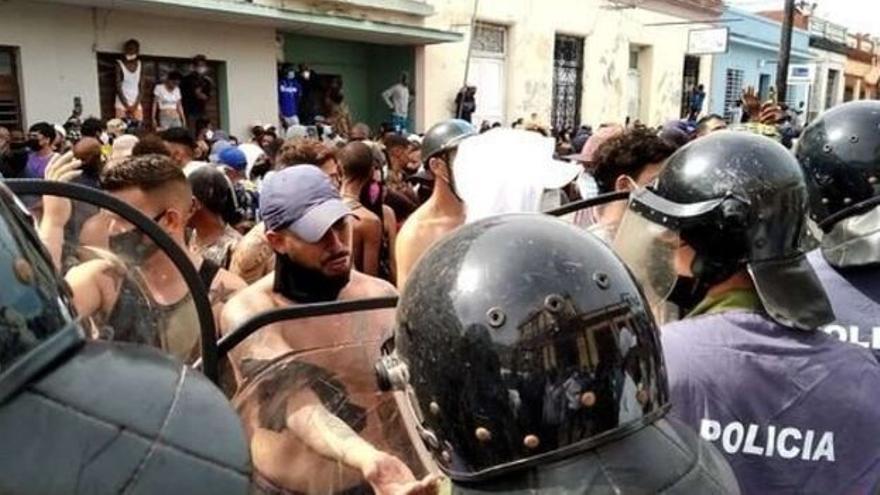
The pandemic, the tightening of US sanctions, and failed economic and monetary policies have aggravated the structural problems of the Cuban economy over the past four years. The crisis is reflected in the streets in shortages of basic goods (food, medicine, and fuel), prolonged daily power outages, rampant inflation, lack of cash, and increasing dollarization. The subsequent social discontent has been evident in some protests – among them those of 11 July 2021, known as ’11J’ – and an unprecedented wave of migration.
____________
COLLABORATE WITH OUR WORK: The 14ymedio team is committed to practicing serious journalism that reflects Cuba’s reality in all its depth. Thank you for joining us on this long journey. We invite you to continue supporting us by becoming a member of 14ymedio now. Together we can continue transforming journalism in Cuba.
Some 29% of drivers involved in accidents did not have a driving license / 14ymedio
14ymedio, Havana, 2 July 2024 — The massive movement of travelers to beaches and vacation destinations in summer has kept the island’s traffic authorities on edge, who fear that the current economic crisis could influence the accident rate. This was acknowledged on the official Roundtable TV program by Roberto Rodríguez, the head of the Specialized Traffic Body of the Ministry of the Interior, who also admitted that the entity has not been able to “stop the deterioration of the roads and the signage.”
The military officer was pleased that the first half of this year had better indicators than the same period in 2023. According to him, there were 543 fewer accidents – a 13% drop – the number of deaths fell by 23% and the number of injuries by 5%. Likewise, the number of victims between 21 and 35 years old – 35% of those who died in accidents are in this age range – also fell, although Rodríguez did not offer specific figures in this case.
Rodriguez did not elaborate on the cause of the decrease in accidents, although it is possible that reduced vehicle traffic due to a lack of fuel is an important factor. continue reading
Among the main infractions, the military officer pointed out that 29% of the drivers involved in accidents did not have a driving license. “5,572 driving licenses have been revoked due to accumulation of points, debts, failure to update medical checks; 3,647 licenses were suspended and 422 were cancelled. For alcohol consumption, 633 licenses were suspended, 58 were cancelled due to repeat offenses and 88 police reports were filed for drunk driving,” he added.
The most notable factors are disrespect for the right of way, not keeping distance, not respecting pedestrian rights and other indisciplines.”
“The most notable factors are disrespect for the right of way, not keeping distance, not respecting pedestrian rights and other indisciplines. In the case of motorcycles and mopeds, their incidence in accidents decreases, however, the lack of attention to vehicle control and disrespect for the right of way are responsible for 59% of the accidents, and for 52% of the deaths and 56% of the injuries,” the list continued.
According to Rodríguez, almost a third of the total number of deaths – which he did not provide – were pedestrians, and the provinces with the highest number of accidents were Havana, Matanzas, Villa Clara and Holguín. “Saturdays are when the highest number of victims are reported, especially between three and six in the afternoon,” he explained.
Another aspect mentioned was the repair and purchase of traffic lights, many of which are in poor condition or no longer working, which is not easy for the country, said the military officer. Their price on the international market – between 12,000 and 14,000 dollars – is too high for the state budget, although Rodriguez insisted that the country is “working” to acquire them. The power outages that keep these devices out of service for hours – and that have caused several accidents – were not mentioned in the program.
Despite the “positive” figures, the colonel admitted that the poor condition of the roads, traffic signs and the state and private vehicle fleet are factors that lead to crashes, especially in summer, when people travel en masse for the holidays. However, these factors are not usually taken into account when providing statistics on the causes of crashes, the weight of which falls on drivers. According to Rodriguez, drivers are responsible for 52% of crashes, 75% of deaths and 55% of injuries.
Added to this is the fuel shortage and the inability of transport companies to cope with the number of travellers, which often results in vehicles with excess passengers. To avoid these violations, Teresa Albentosa, secretary of the National Road Safety Commission, explained that a monitoring of transporters is carried out throughout the country, especially private ones, which she considers more likely to be involved in these cases.
Actions include supervising drivers assigned to mass transportation to vacation destinations
The actions include supervising drivers assigned to mass transportation to vacation destinations, regulating the schedules of these trips and taking into account the distance and speed allowed on the road, checking licenses, as well as avoiding assigning drivers who have accumulated fines for dangerous driving or a history of suspended licenses.
“No vehicle is exempt from these provisions, whether they belong to state or private actors or whether they are dedicated to short distance or interprovincial travel,” clarified Albentosa, who explained that priority is also given to repairing signs and roads leading to summer destinations. As for those that remain in poor condition, he added, it is recommended to reduce speeds.
However, the authorities did not mention an important detail, which is that in many cities on the island, private companies transport more than half of the passengers, who must adhere to their prices and travel with overloaded vehicles if the driver deems it necessary.
____________
COLLABORATE WITH OUR WORK: The 14ymedio team is committed to practicing serious journalism that reflects Cuba’s reality in all its depth. Thank you for joining us on this long journey. We invite you to continue supporting us by becoming a member of 14ymedio now. Together we can continue transforming journalism in Cuba.
These poor people, without a safe roof, without electricity or running water, find no other way to revolt than to make the bang on pots and pans in the middle of a blackout.
Protests with cacerolazos [banging on pots and pans] against the blackouts in Cuba. / Screen Capture14ymedio, Reinaldo Escobar, Havana, 2 July 2024 –When in the 1970s, and even in the 1980s, communist ideologues explained to us that the high cost of living in capitalist countries was due to what they called the anarchy of production, they concluded that this would not occur under socialism because the fundamental means of production were social property (under the tutelage of the State, which in turn was under the tutelage of the Party) and that the planned economy of socialism would make the cyclical crises that overwhelmed the capitalists impossible.
No inflation, no stagflation, nothing of the sort. Everything would flow smoothly, which would allow compliance with the Fundamental Law of Socialism, which stated that “the point is to produce to satisfy the ever-increasing needs of the population and not, as in capitalism, to produce only for the purpose of making a profit.”
“It is about producing to satisfy the ever-increasing needs of the population and not, as in capitalism, where production is only for the purpose of making a profit.”
Don’t tell me any stories. I learned it by heart and, so that others could learn it, I even gave courses on the Political Economy of Socialism, sponsored by the Union of Cuban Journalists.
The dispute between Trotsky and Stalin, ignoring each other’s desire for prominence, was based, among other theoretical questions, on the discussion of whether or not it was possible to implement socialism in a single country. continue reading
A century later, those who consider themselves Cuban Stalinists maintain that it is possible to build a socialist utopia without the support of the bloc of the same name, which has now disappeared, and also ignoring the fact that the system that governs the world is capitalism and that the country that leads it, the United States of America, the official enemy of the nation, has no interest in contributing to the fulfillment of Cuba’s five-year plans, which are no longer even formulated.
No one can deny that life has become expensive in Cuba. It has become unaffordable, just as the foreign debt of developing countries was declared unaffordable at the end of the 1980s when Fidel Castro proposed a consensual disobedience to force debtors to forgive their debts.
No one can deny that life has become expensive in Cuba. It has become unaffordable, just as the foreign debt of developing countries was declared unaffordable.
If social justice fundamentalists were consistent with their discourse, they should be advocating disobedience that would entail the immediate confiscation of all MSMEs [small private businesses] and “non-state forms of production,” which are indirect causes of the social differences existing in the country. They do not dare to do so because they already know the results of the Revolutionary Offensive of 1968 and because, however fundamentalist they are or appear to be, they remain obedient.
The people, these poor people without a solid roof, without electricity or running water, find no other way to revolt than to bang their kettles in the middle of a blackout lasting more than 12 hours or to block a street or a highway with their rickety buckets to protest the lack of water. These people do not believe in fundamentalists.
To the fundamentalists this perhaps sounds and smells like a counterrevolution and they may even suspect that behind it all there is financing from imperialism because they do not see, because they do not want to see that this discontent coincides with that of the opposition.
Perhaps social justice is just a myth, a propaganda trick of the left to compete for power or to have a pretext to usurp it, but the high cost of living in Cuba is an undeniable fact after 65 years of a project disguised as social justice that should have made such high cost impossible.
____________
COLLABORATE WITH OUR WORK: The 14ymedio team is committed to practicing serious journalism that reflects Cuba’s reality in all its depth. Thank you for joining us on this long journey. We invite you to continue supporting us by becoming a member of 14ymedio now. Together we can continue transforming journalism in Cuba.
In the event of any health incident that a child with autism may suffer, “our work teams are professionals with extensive training and great empathy” / Medical Services Marketing Company
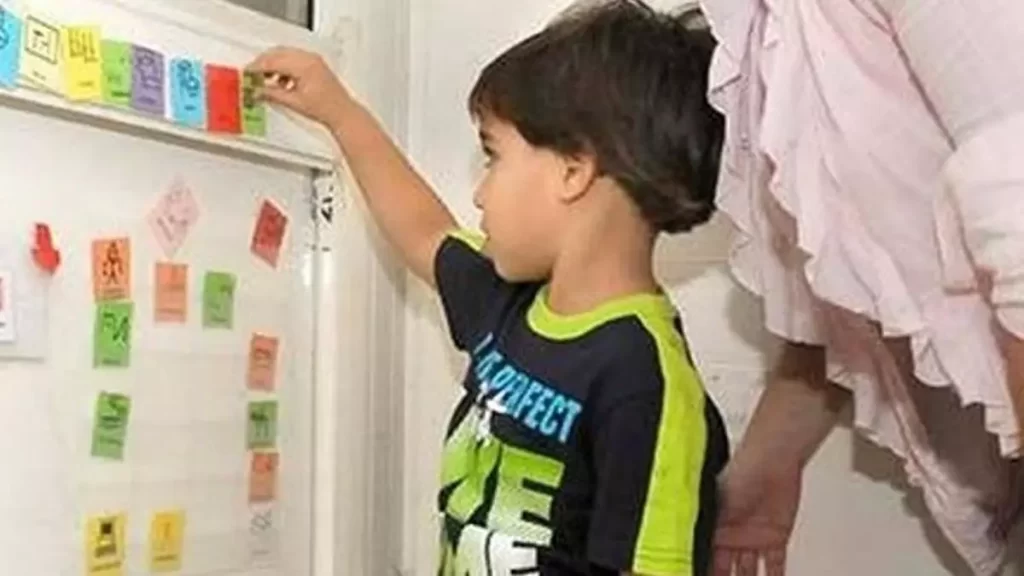
14ymedio, Miguel García, Holguín, 27 June 2024 — During Pedrín’s most recent visit to the dentist, three people were needed to hold him down, in addition to the stomatologist. With an autism spectrum disorder (ASD), any medical treatment that the 15-year-old teenager, who lives in the city of Holguín, needs becomes an ordeal for his parents due to the lack of protocols and resources for these cases in Cuban hospitals.
“We spent days waiting to get an appointment with the only dentist in the entire province who treats children with autism and other neurodevelopmental disorders,” Gabriel, age 44 and the father of the child, told 14ymedio. “The consulting room is in a very narrow space in the Pediatric Hospital and from the moment my son entered he became very upset, because he doesn’t like closed spaces,” he explains.
“I almost had to lie down on top of my child to immobilize him. My wife held his arms and my brother-in-law held his legs. There was no mechanism in place to keep him from getting up from the chair and Pedrín is strong because he weighs about 130 pounds.” Gabriel laments that “the place does not seem at all prepared to treat this type of case. More space and better conditions are needed.” continue reading
“There are practically no clinics in any speciality that are prepared to care for autistic children in this area”
“There is no amalgam for fillings in Holguín, so they had to put in a resin that is not very long-lasting.” The ephemeral nature of the material forces the family to go through the same ordeal again or accept the doctor’s advice: “Next time we’ll take him up to the room and give him general anesthesia,” a difficult decision for his parents to make, who fear that the sedative will aggravate the teenager’s health problems.
“There are practically no clinics in any speciality that are prepared to care for autistic children in this area when they have a health problem. I have to go and speak to the doctors beforehand and explain to them that he cannot be in a cramped space, that he cannot sit and wait for hours in a corridor for the doctor to call him. There is a great lack of understanding on the part of the staff at these centers.”
As Gabriel sees it, the island’s health system “is not prepared to manage the health situations that autistic children and their families face.” Most of the time, doctors “who have training in this type of patient are very scarce and in Holguín they are only in the provincial capital, so you have to travel long distances sometimes to do simple things like a dental check-up or to treat a small wound.”
Since my daughter began to show the first signs of autism, my husband and I have not been able to go on vacation anywhere
The testimony of Pedrín’s father contrasts with the recent announcement made by the Cuban Medical Services Marketing Company (CSMC) that it will offer foreign visitors arriving on the island a program for the care of children with autism spectrum disorders in the hotels of the northern keys in Ciego de Ávila.
Dr. Agnerys Cruz, director of the CSMC in that province, told Prensa Latina that the project will focus on the tourist destination Jardines del Rey. There, clients will be able to opt for “animal therapies in the dolphinariums of Cayos Coco and Cayos Guillermo,” in addition to specialized medical care to improve the well-being and quality of life of these children.
The initiative is the result of a collaboration between CSMC and the Canadian hotel chain Blue Diamond Resorts and also includes health tourism packages aimed at adults with social problems. “Interaction with aquatic mammals will be directed by specialized medical personnel and highly qualified trainers,” reads the announcement, which has not left a good impression on many Cuban families.
“It shows a lack of respect, because that’s what we, the parents of autistic children here in Holguín, have been asking for for years, that there be recreational options for our families who live with a lot of burden on their shoulders every day,” says Gabriel after learning the details of the new offerings for travelers. “I find it insulting that they offer those who don’t live here what they don’t offer us.” His discomfort is shared by other parents in a similar situation.
“Since my daughter began to show the first signs of autism, my husband and I have not been able to go on vacation anywhere,” laments Yaquelín, 32, mother of Rosslyn, 12. “When we have wanted to stay in one of those summer packages they sell to Cubans and we ask if the accommodation has some kind of protocol and comfort for children with this type of condition, they only give us evasive answers.”
“I can’t go and spend a couple of nights in a place where they don’t even offer the minimum for these cases”
“I can’t go and spend a couple of nights in a place where they don’t even offer the minimum for these cases: bathrooms for people with reduced mobility, as is the case with Rosslyn, who is in a wheelchair, or safety equipment around the pool. Some of these hotels don’t even have a first aid kit.”
For Yaquelín, a burning issue is food. “My daughter has become fixated on certain foods and doesn’t want to eat anything else. I have to give her fruit compote, beans or chicken every day, but she doesn’t accept eggs or rice, for example. She also refuses milk and some fruits.” Complying with this narrow eating pattern is a headache for the entire family with little income, given that the mother does not have a job and the father works in a department of the Ministry of Agriculture with a salary of around 5,000 pesos.
“In August of last year, the allocation of chicken for autistic children in the province of Holguín, which is three kilograms per month, was interrupted and was not reestablished until this May.” Achieving the return of the subsidized sale of the longed-for protein was not an easy task either: “Parents of autistic children had to complain to all the authorities, write on Facebook, send messages to [President] Miguel Díaz-Canel and to the National Assembly.”
Although the prices for the tourist package for families with autistic children have not yet been published on the Cuban Medical Services Marketing Agency’s website, an employee responded via social media with some details about the offer. “We want families to feel safe, comfortable and to enjoy themselves with their children without worries. Our staff is highly qualified and the facilities are comfortable and safe.”
“We want families to feel safe, comfortable and to enjoy themselves with their children without worries.”
In the event of any health incident that a child may suffer, “our work teams are professionals with extensive training and great empathy,” concluded the employee, who invited families to “come to Cuba to regain their smile, their peace of mind and to leave the care of the most precious thing in life, children, in the hands of first-class personnel.” Along with the luxury of the accommodations, the program promises to help these children develop skills and alleviate their isolation “caused by communication difficulties.”
Just over 300 kilometers from the northern keys of Ciego de Ávila, Pedrín’s family is preparing for the next visit to the dentist and is considering whether, on this occasion, they will have to rely on more arms to immobilize the teenager in the dental chair or, instead, accept the application of general anesthesia with the risks that it entails.
In Gabriel’s daydreams, he defines himself as “a lion” when it comes to fighting for his son’s quality of life, when that day comes he hopes to find a bright and spacious room, decorated with children’s motifs, a dentist, several smiling assistants and a professional and respectful protocol with the patient. In those dreams, there is all the necessary amalgam to close the gap in his little boy’s tooth, without having to buy a tourist package or pretend to be a foreigner.
____________
COLLABORATE WITH OUR WORK: The 14ymedio team is committed to practicing serious journalism that reflects Cuba’s reality in all its depth. Thank you for joining us on this long journey. We invite you to continue supporting us by becoming a member of 14ymedio now. Together we can continue transforming journalism in Cuba.
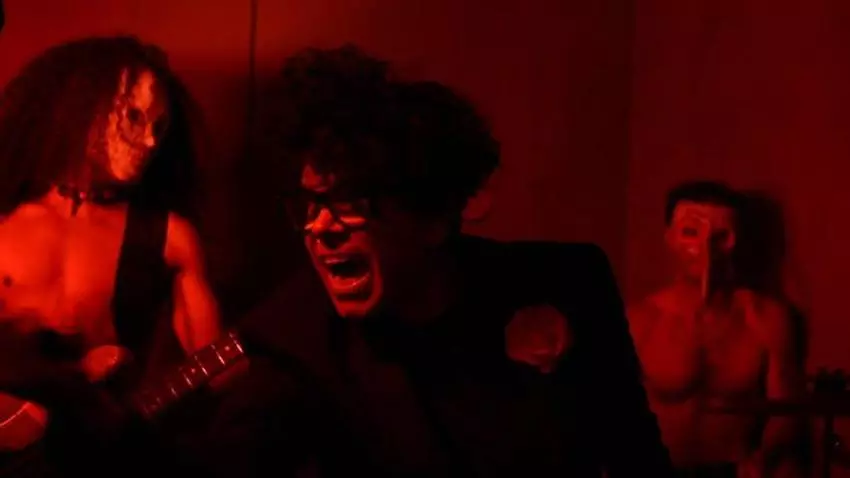
’14ymedio’ interviews the musician Gorki Águila in a place in Mexico that we are hiding for his safety
“My plans were in Cuba, where I have my artistic project”
“I am in a dreadful loneliness; I have a growing resentment towards the communist regime every day”
“I want to overthrow the Castros, I don’t want to f’ing reform communism at all”
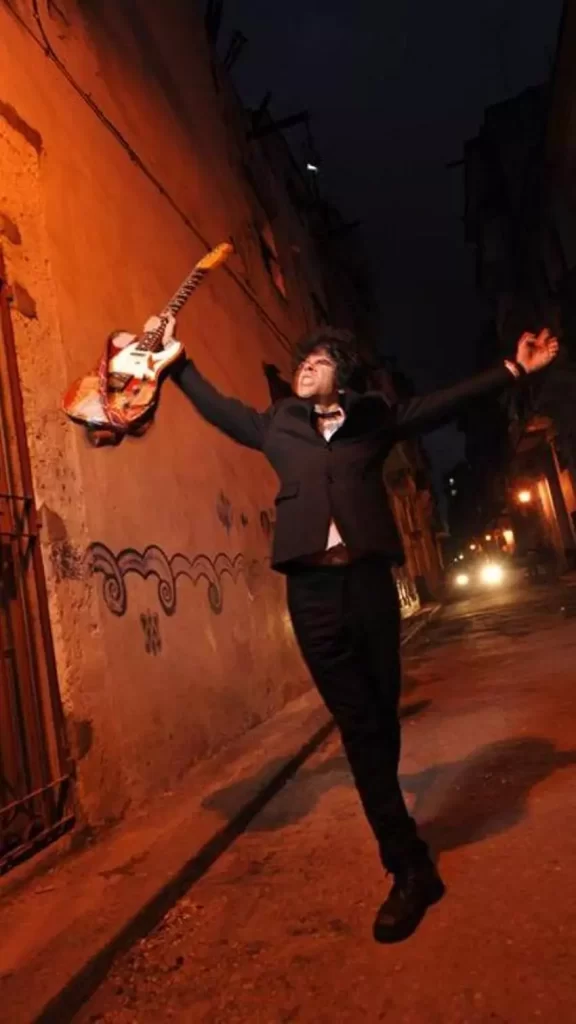
The leader of Porno Para Ricardo works in a musical instrument store in Mexico / Courtesy Gorki Águila
14ymedio, Adyr Corral, Mexico, 15 July 2024
MEXICO/Scene 1
Gorki Águila waits impatiently on a park bench located in a part of Mexico that he expressly asked not to be revealed, for security reasons. The 55-year-old musician left Cuba in mid-May, after being threatened by the regime with serving a sentence of at least four years for contempt. Months after the incident, he is still afraid of what could happen to him, and he does not allow photographs either, as that would make it easier for political police agents to find his location.
While he suspiciously puffs on a cigarette, the musician reveals to 14ymedio that he has received threats from State Security since his first day here: “They wrote to my WhatsApp. As soon as I set foot in Mexico, they asked me, as if they were my friends: ‘Is everything okay, were you able to talk to your family?’ They know where my family lives,” he says, while showing his phone screen with the conversations.
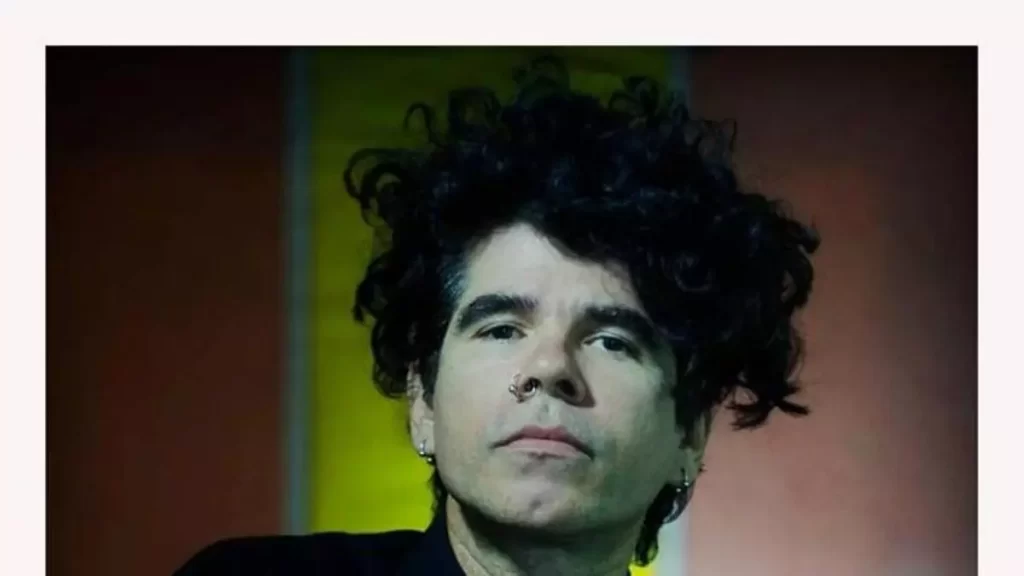
The leader of the Cuban punk band Porno Para Ricardo now works in a musical instrument store to support himself. He arrives at the appointment wearing black pants and a jacket with a white shirt. Mexicans who pass by, sense from his aura, without really knowing who he is, that they are in the presence of a rock star and they direct phrases at him in the form of compliments such as “Long live rock, Robert Smith”, in reference to his resemblance to the singer of The Cure, the English post- punk band, who wears a haircut similar to his.
“They humiliated me and lowered me to a level… I spent almost 15 days crying and not being able to speak. “I arrived with a deep post-traumatic stress”
His new fans also do not imagine that, at the beginning of May, the political police prevented him from boarding a plane that would bring him to Mexico in his first attempt to leave Cuba after receiving an ultimatum, under the argument that it was regulated. Or that, on that very occasion, State Security agents detained him at José Martí International Airport in Havana and later imprisoned him in their barracks to intimidate him.
“They humiliated me and lowered me to a level… I spent almost 15 days crying and without being able to speak. I arrived with deep post-traumatic stress. The protocol for you to go in there is that when you enter, you lower your head against the floor of the patrol car, and it made me extremely dizzy, because the patrol car started spinning, fffff! fffff! So that you don’t know where you’re coming in”, he says about his stay at Villa Marista [a pre-Castro private Catholic school turned into a high security prison].
14ymedio. Why did you come to Mexico?
Gorki. I didn’t choose to come. No, no, I came because I had my residency, so I didn’t need to get a visa, but State Security wanted me to leave. They spoke to me: “Either we’ll put you in prison or you’ll leave”. It’s not just me, they have done it to many opponents.
14ymedio. They told you: you are going to jail or you are leaving Cuba and you preferred…
Gorki. Prefer? No, I did not prefer, I am here under state coercion. I would be in Cuba, you understand? When I went to the airport, they told me, you’re not going to leave and I’ll explain why, because they wanted me to tell them when I left… They knew I was going to Mexico, but they wanted to know what day I was leaving, to carry out an operation and record me on video.
14ymedio. Like a kind of political victory?
Gorki. Yes, and also take those images to later perhaps, perhaps, discredit me. Because I go out with them at the airport, just like that, talking and them making jokes with me, as if they were my family: “Heh-heh. Gorki, you screwed that little girl.” They were making stupid jokes and obviously I didn’t pay attention to them, though I may have laughed at times, I don’t know. And that is filmed by airport cameras. They’re going to use that, obviously.
The rock star has challenged the Castro Regime with his strident and explicit music / Courtesy Gorki Águila
Scene 2
Gorki rummages through the school-style backpack, black with striking orange stripes on the sides, that he has with him. After searching through his belongings with his hand, he takes out a cigarette and lights it while he recounts part of the interrogation he had when he was detained in Villa Marista. “The guy sits next to me and tells me: ‘Look, we’re going to help you, you have a crime of contempt that has a penalty of at least four, five or ten years. But we’re going to help you. We’re going to give you a chance,” he says in a fake voice, as if to give more theatricality to the anecdote.
He takes a couple of drags on the cigarette and the smoke makes his eyes narrow as he continues with his story. “They said something so clownish, so ridiculous, with a conviction: ‘We are going to help you within socialist legality’. At that moment, I should have said, seriously… Seriously? I have a more or less minimal IQ, the southern hemisphere of my brain works….” At that moment, a young boy who must not be older than 17 interrupts him and the interview is abruptly suspended. continue reading
“Excuse me brother, I heard that you are a guitarist. I would like to give you this drawing. I hope you like it” – says the little boy, extending to the musician a sheet with a fairly abstract sketch drawn freehand with a pencil and that from the corner of his eye looks like the portrait of a humanoid figure with reptilian features.
– How cute, huh.
– Thank you for accepting it, the kid responds and then the novice cartoonist threatens to walk away but Gorki prevents him from doing so.
– Hey man, come. Let’s see if I have ten pesos, he says as he digs through his backpack again, this time looking for some change.
14ymedio. What was your routine like in Cuba and how has it changed in Mexico?
Gorki. I’ll be honest with you, the difference for the better is that I have guaranteed coffee, that I have a little bit, that is, condensed milk to add to my coffee and I have bread, guaranteed. It’s so easy to eat here, it even surprises me. Everyday life in Cuba was “what the “f” am I going to eat?” Sometimes, I didn’t have coffee and getting up without coffee is like not getting up. Sometimes, I didn’t have food in Cuba and I would say: “I’m going to stay here in bed longer.” And also, I have medicines, for example, I can go to any pharmacy… they are expensive, but there are options. My head was hurting – I suffer from epilepsy – and I didn’t have a f’ing aspirin in Cuba, man, and here I have it at hand.
Sometimes in Cuba I didn’t have food to eat, and I would say ‘I’m going to stay here in bed a bit longer
14ymedio. What is your life like here?
Gorki. I can describe it to you in three words: loneliness, rootlessness and a lot of resentment, a lot of hatred towards the Castro regime, towards the communists. I have no plans in Mexico, I had plans in Cuba, they plucked me from my land under duress and threw me here. My plans were in Cuba. I have my artistic project, I have my recording studio project, that’s where I come up with the songs, where I come up with my posters (some of them are for sale). Those are my plans. Now, what I have to do is make them up here, what I am is in pure loneliness here, in a rootlessness that you don’t even know at what level. An increasing sadness and resentment towards the communist regime every day, I hate it much more, every day, every minute, every second that passes. I hate it a lot. I have to remake myself.
His creations are mostly inspired by the aesthetics of the golden era of the political poster, the predominant means of communication in public, educational / Gorki Águila
14ymedio. Here, haven’t you been able to?
Gorki. No. I live in a makeshift room in a living room, how do I move a studio there?
14ymedio. Is it a matter of time?
Gorki. I imagine, I suppose. I will never give up my creative side, but that bothers, humiliates, offends, degrades. I’m telling you, every day I hate communism and, in particular, the Castro regime more so.
14ymedio. Do you feel free in Mexico?
Gorki. You have to define freedom, you see, how do you feel free? You feel free within your context. You feel free when you obey your will. How can I feel free, if I am living uprooted? I am in a context that is not mine.
14ymedio. How are you doing with that?
Gorki. I lived in Cuba in my house. Now, I have to live on a mattress in a living room, imagine! I don’t know if you have habits like that, in that way, attached, but for a 55-year-old man the worst thing you can do is tell him, come on, let’s go to a nursing home! I want to die in Cuba. Every day there are fewer people, there are fewer Cubans in Cuba. Cuba, now, is no longer Cuba. Let’s think about that. It’s a crime against humanity, what the Castros are doing in that place. Their hands are not going to shake when they shoot, like in Belarus, no, no, they are going to shoot and kill. 11J happened, they killed two or three people with total impunity. I am an opponent. I want to overthrow the Castros, I don’t want to reform communism at all. I am here because I believed in those plans, and at a specific moment, those plans fell apart in my head. I felt like I was totally alone immersed in a whole broth of demagoguery and corruption on the part of people who say they are our friends and that they are helping us. There is no opposition in Cuba today, I tell you categorically. With all propriety. There is no opposition in Cuba. There are people who send phone recharges, crumbs, and who dictate a road map, that is not opposition.
What the Castros are doing in that place is a crime against humanity. Their hands are not going to shake when shooting, like in Belarus, no, no, they are going to shoot and they’re going to kill.
14ymedio. What is needed for there to be opposition in Cuba?
Gorki. Create a real, raw debate to locate what our problems are. When you want to be cured, you have to know that you are sick, if you don’t know that you are sick, you will never be cured, that is the first step. And after accepting that you are sick, you have to diagnose yourself, there has to be a diagnosis. So, to recognize the disease, we are still in the step, we do not recognize that the Castros are not our only enemies, but everything that surrounds that. In other words, there are people who are living off the Cuba issue, the “freedom in Cuba” issue.
Look, when you are a flat tire fixer and in front of you, on the road, there is a pothole full of glass, do you want that pothole to be fixed? If you live by the fact that every car that gets a flat tire comes and has you fix the flat, your business is fixing flats, you get it? When (or why) are you going to tell the driver: “Oh, that pothole is bad!”? So it never gets fixed, because you’re f’ing living off that pothole, your dough comes from there, and then, that’s what’s happening. In no road map of any NGO [Non-Governmental Organization] that exists, in any other country, or in Miami, does it say: “Cuba is going to be liberated in 2050. I am going to stop making money and living off this NGO and stop living this way.” None! No NGO tells you “in such a year I will stop receiving money for doing this job that for me is onerous and infamous, because I am receiving money from living off the issue of freedom in Cuba and in addition, I get applause from the international community.”
14ymedio. Previously, it was thought that if Fidel died, the Castro Regime would fall….
Gorki. That’s what I thought when I was a kid. And who has to die next? Until when, people? The only ones who are going to overthrow the regime are the Cubans who are inside Cuba, we are not going to overthrow it from beyond, opposing it with air conditioning.
14ymedio. How does art influence all this?
Gorki. For me, art is super important, why do you think that politicians always join artists in campaigns, because they know that art is a super immediate, super powerful vehicle. Pop music is super powerful when it comes to transmitting, much faster than a pamphlet and a speech. A pop artist’s audience members are voters. A pop artist utters any stupidity and those people are going to believe it.
14ymedio. Is Porno for Ricardo still alive?
Gorki. Yes, when you see I’m dead is when you will be able to say “Porno para Ricardo ceased to exist.” It will exist as long as I live.
14ymedio. In the past, you said that Porno para Ricardo was a rock band that wanted to have fun, have they had fun? Are you still having fun?
Gorki. Yes, we have had our revenge. Look, always, in creation, you suffer the creative process…
“Pop music is super powerful when it comes to transmitting, much faster than a pamphlet and a speech” / Courtesy Gorki Águila
Scene 3
Gorki is interrupted again. This time it’s an old lady who goes around the park in her wheelchair begging for alms. “They don’t give me a coin. Whatever you like to support me with, young people. Thank you, young people, for helping me,” she says, without any remorse for cutting off the singer’s story about his creative process.
The backpack was left open since the last rummage, so it is not difficult for Gorki to take out a coin and give it to the woman who, before extending her hand to receive it, had already started her wheelchair by giving the right wheel a strong push. “Also, if you give it to everyone you will run out of money, man! And I feel sorry for them, but sometimes they are also scammers. Anyway,” says the rocker before resuming the conversation.
14ymedio. What price have you had to pay for having fun?
Gorki. The price we have had to pay, for example, is to give up our audience. We did it conscientiously. We knew that if we took the step of getting directly involved with the regime, we were going to disappear, that is, they were going to give us a magical pass like Harry Potter, with the wand, tiki, tiki. You don’t exist anymore.
I really dreamed that I could influence, that is, influence in the sense of my crumb. That, at one moment I could experience the fall of the Castro Regime. I have no hope anymore, the way things are
14ymedio. When you woke up, the tyrant, the tyrannosaurus, was it still there?
Gorki. Yes, exactly. I made a parody of it, I even put it on Facebook once: “When I woke up, the regime was still there.” You could say, because I really dreamed that I could influence, that is, influence the meaning of my crumb. That at one moment I could experience the fall of the Castro regime. I’m no longer hopeful, the way things are.
14ymedio. Do you think you won’t live to see it?
Gorki. Now I’m not sure. I have lost faith in that sense, something that depresses me. My mom died and she didn’t see it, it seems I will too. It’s kind of sad… Don’t you want a beer? I know a place where we could smoke.
14ymedio. What’s next for Gorki in Mexico? What are his plans?
Gorki. What I am sure I can tell you, in the present, is that I am going to continue being anti-Castro and I am going to continue being libertarian and I am always going to bet on freedom and I am going to be consistent and coherent with what I have said. Now, not in the future. I don’t know what’s coming in the future. I’m telling you a punk motto, and that’s it. The Sex Pistols motto. But I don’t know what’s going to come with me. I have total uncertainty. I just tell you, part of my hatred is based on that. They have put me in a place where I do not want to be. I would like to come visit, and go to my place, to my Motherland. I don’t know what awaits me, I would like to make music, join bands here to play on stage, to experiment and give that message that Cuba is not what they sold you, that theorem that they have sold you. I would love to do that.
“They have positioned me in a place where I do not want to be. I would like to come visit, and go to my place, to my Motherland” / Courtesy Gorki Águila
Scene 4
Someone else approaches Gorki and this time completely steals his attention. She is a brunette woman in her 20’s. The pretext for interfering in the interview is to collect some money to cover the expenses of an animal shelter.
-Hello, sorry. Sorry for the inconvenience, I come from a shelter that is dedicated to rescuing dogs. At the moment, we have 300 dogs and 50 cats, I don’t know if you would like to support us, says the girl.
– I am a fan of dogs, Gorki answers.
–Look, there are two there– says the activist while pointing to her companions, who have a Great Dane and a Golden Retriever doing convincing work, based on their mere presence, with the passers-by from whom they also ask for support to pay for their food and that of the other animals.
At that moment, Gorki ends the interview and gets up to go meet the dogs.
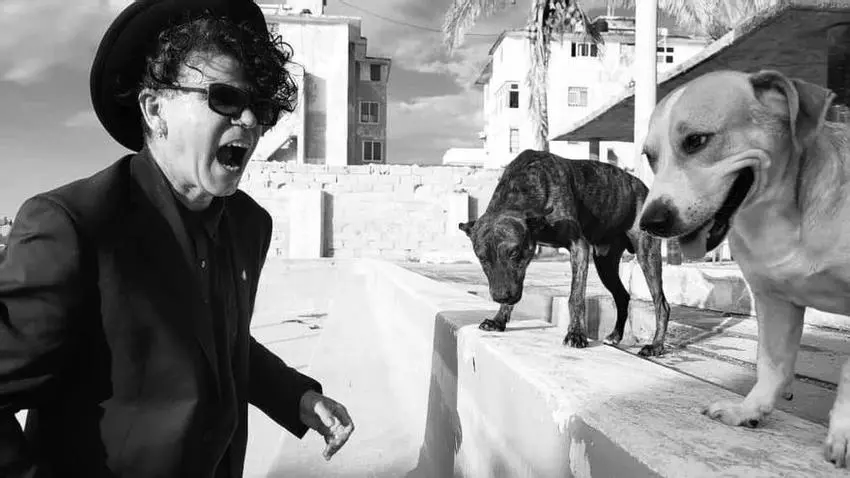
Gorki has always been a dog lover / Courtesy Gorki Águila
Translated by Norma Whiting
____________
COLLABORATE WITH OUR WORK: The 14ymedio team is committed to practicing serious journalism that reflects Cuba’s reality in all its depth. Thank you for joining us on this long journey. We invite you to continue supporting us by becoming a member of 14ymedio now. Together we can continue transforming journalism in Cuba.
The regime has taken advantage of our anger to present us as “haters” and to feed the fear of change
The supposed “unity” of the regime is not based on the hope that one day things will get better / EFE Archive, 1980 [Text of sign: Out With the Scum]14ymedio, Yunior García Aguilera, Madrid, August 7, 2024 — “Libertad sin ira,” “freedom without anger” [lyrics] is one of the most representative songs of the Spanish transition to democracy. In its lyrics it speaks of a Spain personified by the old authoritarianism and another embodied in a generation that sought to be free, without bloodshed. At that uncertain moment, after the death of dictator Franco, the song of the Jarcha group became a hymn for many. In our Cuba of 2024, the frustration of a people who fail to dismantle a desperately long-lived dictatorship often leads us to anger. I don’t deny that there are a thousand reasons that can support it. However, I wrap my brain around this question: is resentment useful? Will we be able to achieve a freedom without anger or will we perpetually writhe in anger without freedom?
The Cuban regime has taken advantage of that rage to adorn its narrative. While they, supposedly, are the ones who “love and build,” we are the “haters.” Such cynicism only increases the fury on the opposition side, justifying it equally with concepts from José Martí, such as invincible hatred and eternal resentment. But I haven’t come here to talk to you about poetry. I want to talk about strategy.
Martí has been used by Cubans with almost the same intensity as those who quote Christ to shore up their creeds. That’s why I would like to put the emphasis, rather than on his words, on his actions. The man Cubans call ‘the apostle’ was able to forgive even the henchman who tried to poison him. And not only did he offer them his forgiveness, but he also managed to persuade them to join the independence ranks. The story reveals to us how young Valentín ended up fighting on the Mambí side, reaching the rank of commander and becoming a convinced devotee of Martí for the rest of his life. continue reading
Martí has been used by Cubans with almost the same intensity as those who quote Christ to shore up their creeds
I know, it’s always easier to have a repertoire of Martí quotations on the lips than to imitate his behavior. Others will say that we leave the dead alone, that we live in another century, that we should stop waving the apostle as if he were a carnival flag. And maybe they are right. But what we call values, principles or ethics is always a convention based on references. It is useless to give up Martí. In the next century, if there is any Cuban left alive, we will continue to name him.
During these days, there have been heated controversies on social networks about the victory in Paris of the Greco-Roman fighter Mijaín López. Those who congratulate him are right; his sporting feat is undeniable. And those who point to him as a furious defender of Castroism, protagonist of repressive episodes, are right. Others have chosen to celebrate Yasmani Acosta, also Cuban, for his meritorious silver medal representing Chile. Although there is also no shortage of those who have lashed out against him, for his “warm” statements about the dictatorship.
Some European friends write to me without understanding not even one word. You Cubans, they tell me, will never be able to agree. And I’m not saying I’m free of blame. In my case, I limited myself to recognizing the triumph of Mijaín López, with nothing more to add, receiving my corresponding downpour of insults.
In this fight of ours, the most common thing is to entrench ourselves on one side, incessantly lobbing verbal grenades towards the opposite ditch, although it is also common for us to attack ourselves inside our own trench. At this rate, if we achieve freedom one day, we will all be so emotionally mutilated that the reconstruction of the country and national reconciliation will continue to be postponed.
At this rate, if we achieve freedom one day, we will all be so emotionally mutilated that the reconstruction of the country and national reconciliation will continue to be postponed
We have a lot to learn from our Venezuelan brothers. Regardless of how everything ends, the opposition has already managed to concentrate all its arrows against the dictatorship. They have unmasked the tyrant;
they have managed to add the vast majority of the people, and they have captured the attention of the whole world. Their speech is firm: there will be no impunity, but they extend their hand to anyone, military or civilian, who takes the right side.
In his book “The Art of War,” Sun Tzu recommended always leaving an escape route to the enemy. At the same time, he recommended putting your army in a dead-end position, to motivate them to fight to death, without ever considering withdrawal. The Cuban regime has read the manuals very well. For decades they have suggested to their supporters that, in the face of an eventual change, they expect they would all be hung in the public square. There are ordinary people convinced that the enemy will go house by house to look for them to settle scores for having been in the FMC [Federation of Cuban Women] or the CDR [Committee for the Defense of the Revolution]. The supposed “unity” of the regime is not based on the hope that one day things will improve, but on the fear that one day things will change. And sometimes we ourselves contribute to that mentality.
In order for this battle not to be eternal or useless, it will be necessary to dismantle many myths and change strategies. The possibility of joinig together must always be left open. We must be able to differentiate between justice and revenge. We will have to know how to convince as many Cubans as possible that the future will not be a simple change of flags in the barracks of hatred, exclusion and insult, but finally, freedom without anger.
Translated by Regina Anavy
____________
COLLABORATE WITH OUR WORK: The 14ymedio team is committed to practicing serious journalism that reflects Cuba’s reality in all its depth. Thank you for joining us on this long journey. We invite you to continue supporting us by becoming a member of 14ymedio now. Together we can continue transforming journalism in Cuba.
María Corina Machado says that Maduro has the support only of Venezuela’s high military command, “very reduced”
Fidel Castro and Hugo Chávez, in an archive image / Cubadebate
14ymedio, Madrid, August 8, 2024 — The Cuban ruling press remains committed to supporting the position of Nicolás Maduro’s regime regarding the result of the elections in Venezuela, criticized by a large part of the international community, including the moderate left. A note published on Tuesday by the State newspaper Granma calls, indirectly, for the Venezuelan president to stay in power, remembering Fidel Castro’s reaction after the coup d’état against Hugo Chávez in 2002. “Don’t resign! Don’t give up!” Castro told Chávez in the early morning of April 12 of that year, when he was able to contact him “after hours of unsuccessful attempts.”
Granma alludes to this alleged conversation, citing Chávez’s own story: “’Don’t go immolate yourself,’ he told me. ’Save your people and save yourself as much as you can; this doesn’t end here.’ And in the end he told me: ‘Here your people are waiting for you, here I am waiting for you. Save yourself, save yourself. I’ll wait for you here.'”
At that time, not mentioned by Granma, it was two years since the signing of the first bilateral agreement between the two countries, which guaranteed Cuba a constant supply of oil, vital for leaving the Special Period behind. This opened the door to the incursion of Cubans into the Government of Venezuela. In fact, after the failed 2002 coup d’état, according to the authors of “The Consented Invasion” (Debate, 2019), Chávez “decided to entrust the Cubans with intelligence tasks to shield him against future military conspiracies.” continue reading
Granma puts “the sanctimonious Latin American progressives and the media of the right” in the same bag
Granma argues that the then Venezuelan president “represented that ’bad example’ that the far right and the empire attack in the region,” and that “Fidel’s constant support and infallible advice in those dark times allowed Chávez to reset and prevent the formula they had tested against Allende from being fruitful in Venezuela.”
Nicolás Maduro placed the current Chilean president, Gabriel Boric, with those who overthrew Salvador Allende* and referred to him as a “pinochetista and coup leader.” Shortly before, Boric had declared at a press conference that he had no doubt that the Maduro regime “has attempted to commit fraud.”
Far from approaching Boric’s leftist position and following the line of Caracas, another note from Granma puts “the sanctimonious Latin American progressives and the media of the right” in the same bag. Because their focus is on the presidential elections of Venezuela, they are ignoring “the genocide in Gaza, the catastrophic collapse of Ukraine, the danger of a Third World War and the climate catastrophe.”
María Corina Machado, during her interview with several independent media / Screen Capture / Tal Cual
Another leftist, the special adviser to the Brazilian Presidency for international relations, Celso Amorim, made statements on Wednesday that also question Maduro’s position of not disclosing the voting records. “I think he understands that there will be a moment when people are fed up, which is not good for him. And if there is fatigue, there is a risk that Venezuela will end up with two presidents, or none,” said the former Brazilian Foreign Minister in an interview with the Globonews television channel as quoted by the EFE agency. The special advisor to President Luiz Inácio Lula da Silva said that he considers it “very regrettable that the electoral records” have not appeared and that he communicated that position to Maduro in the long conversation, of almost an hour, they had the day after the July 28 presidential elections in Venezuela.
He also said that he does not understand why Maduro decided to hand over the records to the Supreme Court of Justice instead of disclosing them: “I have to confess my ignorance because I don’t quite understand what Justice has to do with the records.”
Amorim expressed his fear about a worsening of the situation in Venezuela due to the deep division that the country is experiencing. Nevertheless, he clarified that he prefers not to use the expression “civil war” because it frightens him. “The worst case scenario is that we stay in this situation of condemning one or condemning the other. I’m very afraid that there may be a serious conflict. I don’t want to use the expression ’civil war,’ but I’m very afraid,” were his words.
“I’m very afraid that there may be a serious conflict. I don’t want to use the expression ’civil war,’ but I’m very afraid”
According to Amorim, Brazil, Colombia and Mexico came together to help Venezuela find a solution to the crisis; “because of the deep division that exists in the Caribbean country,” mediation will be necessary for the Government and the opposition to dialogue.
Opposition leader María Corina Machado was asked about this initiative on Wednesday, in a joint interview with several Venezuelan and Colombian independent media. “Unquestionably they have a channel of communication that others do not have with the regime, and I think they have remained in a prudent enough position to be able to maintain this dialogue,” says Machado, who does not rule out that facilitators from other countries may join.
However, regarding the leaks by sources published in some media, such as the Spanish newspaper El País, that allude to a possible pact between the authorities of the regime and the opposition but excluding her from it, Machado says that it is “pure speculation.” She added, “I have not heard that nor was it even insinuated by any of the people with whom I have spoken inside and outside the country. In the end, the leaders of the Venezuelans are chosen by Venezuelans; they are not chosen by the international community.”
The opposition leader also stated, in response to the questions of local journalists, that Maduro must understand that “his best option” is to “enter into a negotiation” with the anti-chavista majority, which insists on the victory of its standard-bearer, Edmundo González Urrutia.
Machado asked Amorim to “help them think” about new diplomatic initiatives to increase the pressure on the Government
In the opinion of Machado, González Urrutia’s main supporter, that dialogue process has to be based on “respect for the popular sovereignty exercised on July 28,” and although there is “still” no negotiation, there is “absolute willingness” on the part of the majority opposition, grouped under the Democratic Unitary Platform (PUD).
She also said that, in those conversations, “guarantees and incentives would be offered so that, effectively, the transition flows in an orderly and stable way.” Although the call for a negotiation is not new, Machado reiterated it when the PUD denounced a “fraud” by the National Electoral Council (CNE). The CNE proclaimed Maduro as president-elect with 51.95% of the votes, and reported that González Urrutia obtained 43.18%, which the anti-chavista sector rejects, claiming to have 83.5% of the votes that demonstrate the victory of its standard-bearer.
Shortly before the interview, in a conversation with the president of Costa Rica, Rodrigo Chaves, Machado affirmed that Maduro has the support only of the military high command, and that “they are not many.” “The only thing he has left is a very small number of military personnel from the high command. Even in our armed forces, our police forces, the PSUV [the ruling party], they are not with him, because they don’t want violence and they don’t want a lie,” said the former deputy.
Machado asked Amorim to “help them think” of new diplomatic initiatives to increase pressure on the Government, which, in view of the protests against the announced electoral result, ordered maximum police and military control to face what they consider “a cyber coup d’état.”
*Translator’s note: Salvador Allende, the democratically-elected leftist president of Chile, was overthrown in 1973 by a military coup led by General Augusto Pinochet.
Translated by Regina Anavy
____________
COLLABORATE WITH OUR WORK: The 14ymedio team is committed to practicing serious journalism that reflects Cuba’s reality in all its depth. Thank you for joining us on this long journey. We invite you to continue supporting us by becoming a member of 14ymedio now. Together we can continue transforming journalism in Cuba.
The lifeless body of Ana Elis Gázquez Vargas was found on the coast of the town of Cortés, belonging to the municipality of Sandino / Facebook / Ana Elis Gazquez Vargas
14ymedio, Havana, August 7, 2024 — Amaury Miguel Suárez Torres and his stepfather were the only survivors of the shipwreck of a raft in which, along with nine other Cubans, they sailed on July 14 from La Coloma beach, in Pinar del Río, heading to the United States. Rescued by the Cuban authorities, both have third-degree burns and are receiving medical attention in a hospital in the province, influencer Niover Licea reported on social networks. The raft, according to Licea, “began to take on water” in the middle of the journey, but the crew members, mostly residents of the Alonso Rojas People’s Council, decided to continue. In the early hours of the same day, the boat crashed into a reef and the rafters fell into the sea.
Suárez Torres was traveling with his 20-year-old girlfriend Ana Elis Gázquez Vargas, whose lifeless body was found on July 30 on the coast of the town of Cortés, belonging to the municipality of Sandino. The young woman, originally from Consolación del Sur, died from dehydration. According to the forensic report, when they found her body she had already been dead for a week and was identified by her relatives thanks to her tattoos.
Gázquez’s mother had asked her not to make the journey, but the young woman, tired of the situation on the Island, the economic crisis, the constant blackouts, decided to “set sail,” explains the influencer. Gázquez’s brother also shared on his social networks his regret for the young woman’s death, but did not offer more details. continue reading
The raft on which Amaury Miguel Suárez Torres and Ana Elis Gázquez Vargas were trying to leave the Island was shipwrecked / Facebook / Amaury Miguel Suárez Torres
Nothing is known about the other crew members except that several were carrying cash from the sale of their properties to pay for the travel expenses from Mexico, where they were probably going to land, to the United States. There are other records of irregular departures through La Coloma. In September 2022, two U.S. residents who had arrived at the beach in a speedboat to allegedly pick up several Cubans were arrested.
The Border Guards waited for the rafters, “camouflaged in the grass,” and confronted them, leaving several wounded, according to data from Cubans around the World.
The Ministry of the Interior also reported the discovery last July of a non-motorized boat on the beach of the Villa LindaMar Hotel, in Cayo Largo del Sur, and a Zodiac, also without an engine, in the Juan Claro canal, in the municipality of Martí, which belongs to the province of Matanzas.
According to a recent report by the U.S. Customs and Border Protection Office (CBP), 17,563 Cubans arrived in the United States in June across all borders, the smallest monthly number in the current fiscal year 2024 that began last October.
Last Wednesday, Cuba received 32 rafters deported by the U.S. Coast Guard and, with them, 899 have been deported to the Island from different countries in 56 returns so far in 2024, official media reported.
Translated by Regina Anavy
____________
COLLABORATE WITH OUR WORK: The 14ymedio team is committed to practicing serious journalism that reflects Cuba’s reality in all its depth. Thank you for joining us on this long journey. We invite you to continue supporting us by becoming a member of 14ymedio now. Together we can continue transforming journalism in Cuba.
The United States does not yet recognize González Urrutia as president of Venezuela, but it does recognize him as the winner of the elections
Archive photograph of the president of the National Electoral Council of Venezuela, Elvis Amoroso/ EFE/Ronald Peña R.]
14ymedio/EFE, Madrid/Caracas, 6 August 2024 — The Venezuelan Prosecutor’s Office announced on Monday that it will open a criminal investigation against María Corina Machado and the opposition presidential candidate, Edmundo González Urrutia, for “instigation to insurrection,” after both called on the police and military to stop the “repression” ordered by the president, Nicolás Maduro.
The accusation has been quickly seconded by the Cuban regime, which calls the demonstrations in the Venezuelan streets a “reissue of an attempted coup d’état using Guaidó’s formula in 2019.”
It is no coincidence that, in the same vein, the official newspaper Granma published the statements of Vladimir Padrino, Minister of Defense, reaffirming “the most absolute loyalty and unconditional support for Nicolás Maduro,” whom he considers “legitimately re-elected by the people and proclaimed by the electoral power.” It is vital for the Venezuelan regime to guarantee the support of the military, and thus the president announced promotions of officers this Sunday. “There will be peace in this country,” says Granma, quoting Vladimir Padrino.
Padrino is, precisely, one of the military figures that Nicolás Maduro distrusts, according to a note published by El Nuevo Herald. “They have him corralled; they are watching him everywhere,” Maduro’s former head of intelligence, Manuel Christopher Figuera, who worked closely with Padrino before going into exile, told a Miami newspaper. continue reading
“Padrino is the one who is in a position to act; he has the highest authority over the monopoly of the nation’s weapons”
According to this source, the Venezuelan president has resorted to Cuban agents in order to control members of the Army who could “have doubts. Padrino is the one who is in a position to act, he has the highest authority over the monopoly of the nation’s weapons, but he is also the only one who could independently negotiate a way out, so he won’t be killed,” Figuera said.
In a statement, the Attorney General, Tarek William Saab, indicated that investigations will begin in the face of this “open incitement” to the uniformed to “disobey the laws,” given that the opposition leaders asked them to “respect” the results of the July 28 elections that, they say, result in González Urrutia being the winner and not Maduro, though the latter was announced by the National Electoral Council (CNE).
“The aforementioned pronouncement evidences the alleged commission of the crimes of usurpation of functions, dissemination of false information to cause anxiety, instigation to the disobedience of the laws, instigation to insurrection, criminal association and conspiracy,” says the brief, published on X by the prosecutor.
According to the regime, Machado and González Urrutia act “outside the Constitution and the Law” when talking about a winner other than Maduro in the elections in this “irritating document.”
The letter from the opposition, published on Monday, reiterates the complaint of electoral fraud by the Government and denounces the repression unleashed in response to the protests against Maduro’s proclamation, which has also been questioned by a large part of the international community.
“We are in close contact with our partners in the region, especially Brazil, Mexico and Colombia, to find a way forward”
In this regard, the United States clarified on Monday that, although it has recognized Edmundo González Urrutia as the winner of the elections, it still does not recognize him as president of the country.
“We are not at that point yet. We are in close contact with our partners in the region, especially Brazil, Mexico and Colombia, to find a way forward,” explained State Department spokesman Matthew Miller in a statement. Miller also urged the ruling party and the opposition to “start discussions for a peaceful transition back to democracy.”
The spokesman reiterated the call for the CNE, which proclaimed the victory of President Nicolás Maduro in the elections of July 28 without providing any evidence, to immediately publish the tally sheets with the results.
The president of the CNE, Elvis Amoroso, handed over the alleged records of scrutiny of the presidential elections to the Supreme Court of Justice (TSJ) on Monday. The president of the highest court, Caryslia Rodríguez, a chavista, indicated that they will begin the “process of expert opinion of the recorded material” for a period of up to 15 days, which can be extendable.
She also said that the presidential candidates, as well as representatives of the political parties, will be summoned to record all the “electoral instruments” that are in their hands, as well as to respond to an interrogation.
Among those cited are President Maduro, as well as the opposition leader González Urrutia. In addition, the representative of the opposition Bureau of Democratic Unity (now Democratic Unity Platform, PUD), José Luis Cartaya; the general secretary of the Movement for Venezuela (MPV), Simón Calzadilla; the governor of the state of Zulia (west), Manuel Rosales; and the candidate Enrique Márquez were summoned. Also included are the Chavistas Diosdado Cabello, Hipólito Abreu, Ilenia Medina, Ricardo Sánchez and Didalco Bolívar.
The spokesman for the U.S. State Department stressed that any evidence presented by the CNE will require “a thorough scrutiny”
She also requested “all the elements” that prove “the reported cyber attack against the computer system” of the institution, which represented an “impediment for the timely transmission of electoral results.”
The spokesman for the U.S. State Department stressed that any evidence presented by the CNE will require “a thorough scrutiny” due to the “potential for alteration and manipulation” a week after the elections took place.
U.S. Secretary of State Antony Blinken recognized González Urrutia’s electoral victory on August 1, giving veracity to the voting records obtained by the opposition platform that would give an overwhelming victory to its candidate.
The presidents of the largest left-wing powers of the region, Luiz Inácio Lula da Silva of Brazil, Gustavo Petro of Colombia and Andrés Manuel López Obrador of Mexico asked the CNE in a joint statement to make the records public and that there be a verification of the results. However, their position may hide, according to some analysts, the intention to annul the elections and help Maduro in a negotiated exit.
Meanwhile, at least 91 teenagers have been arrested in Venezuela in the last week. Foro Penal, an association of lawyers in defense of political prisoners in Venezuela, said on X that these arrests have been verified and are part of the total of 1,010 people behind bars for demonstrating, in almost all regions of the country, in rejection of Maduro’s proclamation.
In this regard, the general coordinator of the NGO Cecodap, Carlos Trapani, explained to EFE that these arrests have shown patterns contrary to legal regulations. The detention centers are police commands or military headquarters instead of specialized spaces for the care of minors.
Likewise, he continued, another feature that is repeated is the violation of the periods established in terms of the appearance in court of minors, which should be carried out no more than 24 hours from the time of arrest. Some minors have been detained up to six days without being able to know the accusations against them.
The relatives of the minors have claimed, according to Trapani, that the arrests occurred with excessive physical and psychological violence and that the detainees have not been allowed to communicate with their families or defense attorneys.
According to the Network for Human Rights of Children and Adolescents of Venezuela, a 15-year-old teenager died due to the “excessive use of force” / Voice of America
The lawyer said that, according to Venezuelan legislation, a person under the age of 14 cannot be charged, and he drew attention to a case of a 13-year-old boy who, according to human rights organizations, is among those apprehended. According to the Network for the Human Rights of Children and Adolescents of Venezuela, a 15-year-old teenager died due to the “excessive use of force by the officials who contained the demonstration” in which he participated, in the state of Zulia, on the border with Colombia.
Voice of America also reported that on Monday, at the Simón Bolívar de Maiquetía international airport in Caracas, “multiple forced disappearances of Venezuelans and expulsions of foreigners” have occurred.
At least 14 journalists were deported from Venezuela between July 25 and August 2, as reported on X by the National Union of Press Workers. Most of the journalists were not allowed to enter in Maiquetía and were returned to their countries of origin. Others were arrested by security forces even in their hotels, and at police and military checkpoints. They were taken to the airport and expelled according to their testimonies, press accounts and reports from the governments of their respective countries.
In total, there have been at least 1,010 arrests and 11 deaths from the repression during the post-election crisis in Venezuela, according to reports from Foro Penal.
Translated by Regina Anavy
____________
COLLABORATE WITH OUR WORK: The 14ymedio team is committed to practicing serious journalism that reflects Cuba’s reality in all its depth. Thank you for joining us on this long journey. We invite you to continue supporting us by becoming a member of 14ymedio now. Together we can continue transforming journalism in Cuba.
A formal complaint to the Prosecutor’s Office and two ministries ask to review the case of the theft of $19,000 from the Llansó Masonic Foundation
In the center, José Ramón Viñas Alonso, who presides over the Llansó Asylum Trust and accused Mario Urquía Carreño after the theft of money / Supreme Council of Degree 33 for the Republic of Cuba
14ymedio, Juan Izquierdo, Havana, August 6, 2024 — The Mason master Hermes Fernández – one of those who participated in the protest of July 23 in the Gran Logia in Havana – addressed a formal complaint to the Cuban Prosecutor’s Office and the Ministries of the Interior and Justice for the little attention of the authorities to the fact that triggered the current crisis of Freemasonry on the Island: the theft of $19,000 from the office of Grand Master Mario Urquía Carreño.
The document, which has circulated among the Freemasons of the country and to which 14ymedio had access, presents a chronology of the crisis from last January, when the theft occurred, until the recent meeting of the members of the brotherhood with Caridad Diego, head of the Office of Religious Affairs of the Communist Party.
Fernández assumes that the text will contradict Diego, who – he says – reprimanded the Freemasons for protesting against Urquía Carreño: “Far from recognizing that (the authorities) have no right to interfere in matters between Freemasons, once again they make use of the irrationality and illegality of their acts by asking us not to demonstrate and that we let them work.” continue reading
“No Masonic legal solutions are offered in the ’complaint,’ but, once again, they seek the intervention of the Castro authorities”
For the writer and exiled Mason, Gustavo Pardo, Fernández’s claim sends a wrong message about the state of the brotherhood, since, while denouncing the interference of the regime, they turn to the regime to resolve the crisis. “No Masonic legal solutions are offered in the complaint,’ but, once again, they seek the intervention of the Castro authorities,” he argues. Turning to the State as a “great guru” to resolve their internal affairs is a strategic mistake, says Pardo.
The evidence of this submission is the very header of the letter: “Year 66 of the Revolution,” an unnecessary formula in a document issued by a Freemason, which seems aimed at ingratiating itself with its recipients. Fernández first appeals to the Constitution – whose articles he cites – to support his right to complain and the duty of the institutions to respond to it.
The center of his argument is that the money remains missing and that Urquía Carreño committed himself, not only to the Freemasons but also to the Police, to return it. It is the coffers of the Masonic National Foundation – the source of the funds – that has suffered the most, and that shortfall cannot go unanswered, explains Fernández.
The money remains missing and Urquía Carreño is committed, not only to the Freemasons but also to the Police, to return it
Urquía Carreño’s commitment is in writing, in a document that Fernández attaches to his request. This is the Act of Conciliatory Agreement, signed at the Picota police station on April 1 by the Grand Master and Captain Leidys Villaurrutia Díaz. This text gave an account of the conclusion of the investigators of the Ministry of the Interior after visiting the crime scene: the door of the Grand Master’s office had not been violated.
It did not consider, however, that there was sufficient evidence against Urquía Carreño, who pleaded “responsible” – but not guilty – for the theft, and as such promised to return the lost amount within three months. “This period has already expired, so it is also perjury,” Fernández emphasizes.
The Freemasons themselves carried out “unsuccessful searches” for the money, and Urquía Carreño was recalled for his “delay” in taking measures and admitting the occurrence of the theft. This delay, Fernández argues, was one of the reasons for the decision to “report the loss” to the Police, a fact that – at the Masonic level – meant opening the door of the brotherhood to the authorities.
The intervention of the Ministry of Justice to defend Urquía Carreño was an “anti-legal” act by the brotherhood
From there, scandals have followed, in particular about the authority of Urquía Carreño, several times expelled and rehabilitated in his position of Grand Master. Fernández believes that the Masonic legislation is “very extensive, nourished and strengthened,” so the intervention of the Ministry of Justice to defend Urquía Carreño was an “anti-judicial” act by the brotherhood.
With all this, Urquía Carreño put the spotlight on the Supreme Council of Degree 33 – the second most important Cuban Masonic body after the Grand Lodge – says Fernández, and intended to turn it into “an irregular Masonic power with an undeniable prestige.” Urquía Carreño’s behavior brought the attention of the international press, because they wanted that action “not to be misinterpreted.”
Convening a meeting with Diego, in which another senior official was present – Miriam García Mariño, from the Registry of Associations – was the “reaction” of the Government to the protest. Fernández concludes the document with the request that “an in-depth investigation and the corresponding tax verifications be carried out,” because, in his opinion, “there is no other way to resolve this matter” if it is not the Prosecutor’s Office.
The Cuban Freemasons have scheduled an extraordinary session for next September 21 at the Great Masonic National Temple. On the agenda, under the “motions outside the agenda” section, the situation of Urquía Carreño and his future inside the brotherhood can be discussed once again.
Translated by Regina Anavy
____________
COLLABORATE WITH OUR WORK: The 14ymedio team is committed to practicing serious journalism that reflects Cuba’s reality in all its depth. Thank you for joining us on this long journey. We invite you to continue supporting us by becoming a member of 14ymedio now. Together we can continue transforming journalism in Cuba.
Protests in Cárdenas, Matanzas, on July 11, 2021. (Girón)
14ymedio, Havana, 9 February 2024 — At least 382 Cubans were victims of police violence between 2018 and 2023. Of these, 95 people died as a result of confrontations with the authorities, denial of medical care or excessive use of force, according to a report published Friday by the Cuban Observatory for Human Rights (OCDH) and the independent media El Toque, which denounce the “whitewashing” of these crimes by the state.
The typology used by these platforms summarises a total of seven “forms of physical violence” used by the police: sexual abuse, violent arrests, extrajudicial execution, denial of medical assistance – including lack of adequate care or delay in providing it – and unjustified use of firearms and death in custody. In the last case, alleged suicides of prisoners or detainees are also reported, although the “lack of transparency of the regime” prevents the real causes from being known or investigations from being carried out.
The platforms warn that psychological, economic or verbal violence, as well as discrimination, were not taken into account in the register, as these situations are difficult to verify. continue reading
A third of the registered cases, 129, correspond to people who were victims of police violence during the mass protests of 11 July 2021
A third of the registered cases, 129, correspond to people who were victims of police violence during the mass protests of 11 July 2021. Likewise, with 167 and 54 incidents respectively, Havana and Camagüey – where the Nuevitas protests took place in August 2022 – are the provinces at the top of the list. In most cases, the violence was politically motivated.
The report indicates that “Of the 95 Cubans who died in the last five years as a result of police excesses, 76 were in state custody at the time of their deaths. From information provided by government representatives to various relatives, we have recorded that 33 died due to a medical condition; 28 died from suicides or presumed suicides; and another 12 from hunger strikes, beatings or accidents. The cause of death of three others is unknown”.
The denial of medical care, as well as prison violence, are two of the most controversial points in the report. Although they have been denounced on numerous occasions by political prisoners or their families, the lack of physical records to prove the violation of human rights is an important factor.
One of the cases mentioned is that of Yosvany Aróstegui, who died in the Amalia Simoni hospital in Camagüey on 7 August 2020, after holding a hunger strike for weeks. The authorities, however, evaded responsibility for the prisoner’s death.
One of the cases mentioned is that of Yosvany Aróstegui, who died in the Amalia Simoni hospital, in Camagüey, on 7 August 2020, after holding a hunger strike for weeks.
Regarding the excessive use of force or firearms, the platforms recall the death of Zinédine Zidane Batista Álvarez in July 2022 in Santa Clara, after an officer shot him three times in a confrontation in the street, the last time in the chest, while the young man was handcuffed on the ground. Both Batista’s family and several organisations have denounced this police excess, claiming the officer unnecessarily used a lethal weapon against an 18 year old minor.
Extrajudicial killings, where people have been killed by the authorities without a court verdict, also have a representative case: the incident in Bahia Honda on 29 October 2022, when the police “deliberately” sank a boat carrying 26 people who were trying to leave the country. Some eight people, including a two-year-old girl, died during the incident.
“The protection of the image of the forces of law and order, the manipulation of events and the lack of transparency mean that many violent acts go unrecorded,” which allows those responsible to go unpunished, says the report. Only two cases are known, it adds, in which two policemen were punished for sexually abusing two teenagers in April 2020 in the Havana municipality of Marianao. However, both the identities of those involved and the sentences were never revealed by the authorities.
The report states that “there is an attempt by those in power to whitewash the image of the police through social networks or in the independent media when violent acts occur”, , and concludes that, for this reason, “it is likely that the real number of people violated, as well as the number of violent incidents in the last five years is much higher”.
Translated by GH
____________
COLLABORATE WITH OUR WORK: The 14ymedio team is committed to practicing serious journalism that reflects Cuba’s reality in all its depth. Thank you for joining us on this long journey. We invite you to continue supporting us by becoming a member of 14ymedio now. Together we can continue transforming journalism in Cuba.
With the support of some left-wing governments, Chavismo is looking for alternatives to preserve power
Rescheduling the elections would give Chavismo time to calm the demonstrations in the country / EFE
14ymedio, Havana, August 5, 2024 — Cornered by international discredit and the civic advance of the opposition, the next move of Chavismo to guarantee its survival is the subject of dozens of theories, opinions and rumors. The approach to the possible annulment of the electoral results by the regime is – in the words of the former president of Colombia, Iván Duque – one of the most widespread and “dangerous” hypotheses.
“There is talk that the Supreme Court of Venezuela is considering the possibility of declaring the elections null and void, given that the data could have been corrupted due to the ’cyber attack’ that Maduro uses as a smokescreen,” the Colombian politician said on Monday on X. The alleged hacking of the database of the National Electoral Committee (CNE), he said, could be a pretext for Maduro to seek an advantage.
The theory is not only “possible” but also “strategic” for the regime of Nicolás Maduro, says Duque, who describes step by step the possible development of this plan to stay in power.
First, the Supreme Court would set the scene by asking the CNE for evidence of the cyber attack, and it would get the evidence by paying companies specializing in digital security, the former president theorizes. “Money buys almost everything,” so “getting a forensic technical report on cybersecurity from a company like this would not be difficult for them.” continue reading
First, the Supreme Court would set the scene by asking the CNE for evidence of the cyber attack
With the evidence in hand, the Court could declare the voting records corrupt and “disavow” Maduro as president, creating at the same time an alibi for the CNE authorities, who declared the dictator president-elect by relying on manipulated and false information.
This will allow Maduro to come out of his corner and reorganize his forces. They will have a period of four months to correct all the flaws, shield the system and guarantee his triumph in December,” explains Duque, who adds that the regime could amplify its margin of victory by ordering the release of the detainees during last week’s protests – “which would give a social relief” – and by promising guarantees to the opposition.
“Freezing ” the situation, as the Colombian calls this strategy, would also eliminate the “reasons to protest” and clear the image of the dictatorship before part of the international community by converting “fraud” into “error.”
Duque also pointed out that his successor in the presidency of Colombia, Gustavo Petro, could be the one who negotiates – “to help Maduro” – the annulment of the elections in Venezuela, supported by other allies in the region. “Mexico and Brazil are being sought to do the same,” he said.
“Freezing” the situation, as the Colombian calls this strategy, would also eliminate the “reasons to protest”
According to an interview in El Tiempo newspaper with a source in the Colombian government, “Petro is aware that Maduro lost the election and that what Chavismo did delegitimizes it. Therefore, Colombia wants to give them a way out and generate confidence for a peaceful transition.” The official also denied that Colombia supports a cancellation of the elections: “There has been talk of even repeating the elections, but Colombia does not entirely agree because they will lose again, and that would encourage a greater escalation of the conflict.”
Other possible scenarios, based on the alliances of Chavismo in the region, include the removal of repression to avoid more complaints and let the storm pass, an escalation of violence or a dictatorship without Maduro – a “fraudulent change” – that could facilitate both Havana and the Puebla Group.*
According to the information from more than 24,000 tally sheets with 80% of the votes counted, published by the coalition of opposition parties on its website, Edmundo González Urrutia from the Democratic United Platform (PUD) won with 67% of the votes, and Maduro remained at 30%.
The data have been validated by several governments and dozens of independent and foreign media. Some experts, such as the Spaniard Kiko Llaneras, have published graphs and maps showing the forceful victory of the opposition in all the states of the country from the voting records, which include the signatures of witnesses and poll workers, among other data that support the veracity of the documentation.
Graph of votes by state published by ’El País’ / El País
*Translator’s note: The Puebla Group was founded in 2019 to unite left-leaning parties and leaders from Latin America and the Caribbean. It denounces U.S. “imperialism” and sanctions and calls for “de-dollarizing” the economy.
Translated by Regina Anavy
____________
COLLABORATE WITH OUR WORK: The 14ymedio team is committed to practicing serious journalism that reflects Cuba’s reality in all its depth. Thank you for joining us on this long journey. We invite you to continue supporting us by becoming a member of 14ymedio now. Together we can continue transforming journalism in Cuba.

 14ymedio, Havana, 9 August 2024 — Cuba imported agricultural products and food from the United States in the month of June for a value of $34.9 million, 31% more than in May, when the amount was $26.4 million. On the other hand, compared to June 2023, the figure decreased by 5.8%. The data were published this Thursday by the US-Cuba Trade and Economic Council (CubaTrade), which also offered the figures for the first half of 2024.