The Cuban Revolution Has Never Been About Emancipation, But Rather Domination

It has been possible because the citizens themselves supported the regime’s arbitrary policies


Domination in Cuba has also been possible thanks to the participation of the citizens themselves / 14ymedio

14ymedio bigger14ymedio, Karel J. Leyva, Montreal, 4 August 2024 — Domination manifests itself when an agent – whether a person, an institution or the State – has the ability to arbitrarily intervene in the decisions and actions of another, without taking into account their interests and without the latter being able to question or counteract said intervention. Power is considered arbitrary when it acts according to the capricious will or idiosyncratic judgment of those who exercise it.

Domination refers not only to active intervention but also to the mere possibility of such intervention. A commonly cited case to illustrate the subtle forms of domination is the dynamic between a master and a slave. Domination exists both when a master constantly intervenes to regulate every aspect of his slave’s life, and when he is benevolent towards the latter, allowing him to do as he pleases. The underlying idea is that, even when the master acts benevolently, the mere possibility of depriving the slave at any time of the benefits he bestows upon him, qualifies the relationship as one of domination.

Let us consider the Cuban context. In theory, an outside observer might think that citizens of Cuba have the freedom to leave and enter their own country (leaving aside the insurmountable inequalities between them; even overlooking the fact that such “freedom” depends largely on how much one is willing to sacrifice, from the most intimate and sacred properties and ties, to one’s own life in many cases). However, the stark reality is that the Cuban government maintains intact the ability to put an end to this supposed freedom. When it prevents a dissident from leaving the country, or when it capriciously forces him into exile, it is exercising domination. Even when it does not intervene, it finds itself in the same position as the benevolent master, who allows the slave to come and go, as long as the master pleases. continue reading

Domination refers not only to active intervention but also to the mere possibility of such intervention. 

From the beginning, the Cuban revolutionary project was designed as a project of domination. The policies that led to the nationalization of companies and private property are an integral part of this project. The arbitrary intervention of the state in private property and its absolute control over the economy soon resulted in dispossessing citizens of their economic autonomy. Cubans were left submissive, dependent on the arbitrary decisions of the Government regarding the production, distribution and consumption of goods.

Those who have dared to challenge the power of the state have faced imprisonment, exile, or social isolation. The fact that the revolutionary regime establishes that only what the Government approves can be publicly expressed, that the citizen’s fate is determined by his degree of submission, and that any defiance is cruelly punished, is the very manifestation of domination.

From the beginning, the Cuban revolutionary project was designed as a project of domination. 

Domination in Cuba has also been possible thanks to the participation of the citizens themselves. If, initially, many supported the regime’s arbitrary policies by accepting in return the promise of a radiant future, soon the support turned into action. Encouraged and supported by the Government, many denounced, attacked, intimidated and stigmatized those who dared to raise their voices against the dictatorship. It was not enough for them that a military state monopolized violence, the control over weapons, ideas, communication, food or transport; they also joined its plans and gave away the powerful weapon of social approval. And, no matter where communism takes root, it always reconfigures social norms, subordinating them to the capricious will of the tyrant.

The whole history of the “revolution” is one of domination. Is that not the case of the Committees for the Defense of the Revolution (CDR), based on the immoral premise of surveillance, denunciation and stigmatization? Was that not the case of the exit permits (white cards), arbitrarily approved for decades? And what about laws that criminalize freedom of expression and association under the premise of protecting the security of the State? Is there anything more arbitrary than the recent threats to revoke the Cuban citizenship of whomever they consider? Is it not the case of all the public policies, applied no matter how much damage they cause to Cuban families? Doesn’t the lack of free and fair elections deprive citizens of a voice in the processes that regulate their lives? Doesn’t the absence of judicial autonomy and the repression of civil society consolidate the Communist regime’s structure of domination?

Encouraged and supported by the Government, many people denounced, attacked, intimidated and stigmatized those who dared to raise their voices against the dictatorship.

The Russian dissident Joseph Brodsky, winner of the Nobel Prize in Literature, used to say that, to be effective, the devil never presents himself as such. Like a good devil, the Cuban revolution has always presented itself as a project of social justice, one of “full equality and freedom.” But the so-called Cuban revolution is not, and never has been, about emancipation.

From ancient times when the concept of a republic was forged, the foundations were laid to unequivocally determine when we are in the presence of tyranny, even when the oppressor presents himself as an ally. As much as the regime dresses up as a republic, in communist Cuba the “revolution” is nothing more than a euphemism for domination.

Translated by LAR

____________

COLLABORATE WITH OUR WORKThe 14ymedio team is committed to practicing serious journalism that reflects Cuba’s reality in all its depth. Thank you for joining us on this long journey. We invite you to continue supporting us by becoming a member of 14ymedio now. Together we can continue transforming journalism in Cuba.

Trinidad is Cuba’s Heritage ‘Trap’ To Attract Chinese Tourists

Travelers from Beijing are looking for destinations more associated with shopping or city tourism

Cuba is looking to replace European tourism, which has been declining since the pandemic / Resumen Latinoamericano

14ymedio bigger14ymedio, Havana, 5 August 2024 — Cuba’s many sun and beach destinations may be a benefit for most of the tourists who come to the island, but when it comes to travelers from China, the authorities have had to come up with ways to create attractive offers. Not only do the Chinese not seek out this type of vacation, but they prefer offers linked to nature or heritage tourism and shopping. In this sense, the town of Trinidad, in Sancti Spíritus, has become the perfect destination to sell to these travelers.

“Trinidad is a very special city,” museologist and historian Victor Echenagusia told the Chinese state news agency Xinhua, noting that many travelers from that country come to the town for its historical appeal. “Trinidad is a heritage site in that sense and holds the category of Artisanal City of the World and Creative City,” he emphasized.

Echenagusía explained that the city is almost a must-see destination and of “the highest” value for Chinese tourists

Echenagusía explained that the city is almost a must-see destination and of “the highest” value for Chinese tourists, who are looking for more social and cultural experiences when choosing their vacation destinations. The colonial buildings, the cobblestone streets and the number of handicrafts sold in the town – especially the “typical” local textiles mentioned by the historian, despite the fact that they are made all over the island – are attractive to Chinese tourists.

The museum expert also romanticizes the city and its “well-preserved” architecture, despite the fact that Trinidad’s old buildings have been neglected for decades by the authorities, who pass off layers of paint as “repairs.”

As for tourist numbers and concrete results, Echenagusía did not mention any, although he insists that Chinese tourism in Trinidad is included in the government’s plans – until now delayed – to reach 3.5 million travelers this year. Work is being done “to recover the leisure industry in the country through the promotion of its historical and traditional attractions,” adds Xinhua.

Havana, falling to pieces, and Trinidad, in similar conditions, are perhaps the last real bastions of heritage tourism on the island, even though Echenagusía insists that Cuba still maintains its “variety and the perfect conservation of its heritage cities.” Trying to sell them as a “must-see” is nothing more than the latest of the desperate measures that the regime has taken in recent months to attract Chinese tourists.

Changes were implemented in hotels – the arrangement of rooms according to Asian standards, the variety in diet, among others – and promotion agreements were established between tour operators of both countries, with the increase in Chinese tourism to the Island included in the bilateral agenda of both Beijing and Havana.

Air China, which had not flown to Cuba for years, inaugurated a route between the capitals of both countries, with a stopover in Madrid

More recently, Air China , which had not flown to Cuba for years, launched a route between the capitals of both countries, with a stopover in Madrid. The connection, however, seems to be used more for its sections than for its final destination. In other words, many of the travelers who fly from Beijing end up staying in the Spanish capital, and a good part of the flight to Havana carries Cubans and Europeans.

Cuba also announced last May that it would exempt Chinese tourists from visa requirements, a policy that was not reciprocated by China. The day after the measure was taken, searches for holiday packages to the island increased by 40% on the platforms of the eastern giant. This, however, has not been enough for the Cuban regime, which is trying at all costs – through its allies, such as Russia or China itself – to replace the European tourism that has been in free fall since the Covid-19 pandemic.

____________

COLLABORATE WITH OUR WORKThe 14ymedio team is committed to practicing serious journalism that reflects Cuba’s reality in all its depth. Thank you for joining us on this long journey. We invite you to continue supporting us by becoming a member of 14ymedio now. Together we can continue transforming journalism in Cuba.

The ‘Friends of the Cigar’ and the Cuban Regime Make Millions of Dollars With the Cigar Business

Five distributors, chosen by Fidel Castro himself, monopolize the world market. They organize auctions with the promise of sending the money to the dilapidated Public Health system of the Island.

In the center of the photo are Jemma Freeman, manager of Hunters & Frankau, and Luis Sánchez-Harguindey, co-president of Habanos S.A.

14ymedio bigger14ymedio, Xavier Carbonell, Salamanca, 4 August 2024 — Escorted by two British red coats and surrounded by millionaires from all over the world, the managers of the Hunters & Frankau house had some news: last month during the cigar auction to promote the Trinidad Cabildos, whose organization had been invited by the Havana regime, 5,150,000 euros were collected in a single night. The president of the cigar company, Jemma Freeman, promised to send the money – most would be missing – to the dilapidated “Cuban Public Health system.”

Hunters & Frankau, the exclusive distributor of the Cuban monopoly Habanos S.A. in the United Kingdom, thus closed the first face-to-face edition of World Cigar Days. Similar – but much more luxurious – at the Cigar Festival of Cuba, the event was hosted by the Victoria & Albert Museum in London. Between Rafael’s Renaissance canvases and a humidor signed by Fidel Castro in 2002 – which was not for sale – the aficionados bid on limited editions and numbered boxes of Trinidad, a brand that turns 55 and is “loaded with symbolism” for being the favorite of the Cuban dictator.

It is enough to explore the official website of Habanos S.A. to verify that premium cigars continue to give great benefits to the regime. The news section attests to the luxurious network of Cuban cigars internationally and its distribution partners. From Russia to Beirut, from Madrid to Geneva, from Havana to Qatar, the “friends of the cigar” network has been consolidating its power with millionaire sales for decades. A Cuban tobacco planter would need a lot of mental effort to process that a single cigar made by his hands is auctioned for thousands of dollars in the great capitals of the world.

Luis Sánchez-Harguindey, co-president of Habanos S.A. and head of the Cuban cigar empire / Cigar Aficionado

Habanos S.A. would be nothing without Spain. The ethnologist Fernando Ortiz wrote that whoever rules in Cuba rules over the cigar. That phrase is illustrated like no one else by Luis Sánchez-Harguindey, co-president of the monopoly since 2012, although on his social networks he describes himself simply as a president and an expert in “international business management.”

Premium cigars continue to give great benefits to the regime

It is Sánchez-Harguindey who calls the shots for Habanos S.A. and who presents his results annually during the Cuban Cigar Festival. His counterpart in Spain is Fernando Domínguez, president of Tabacalera S.A., which distributes Cuban cigars to every tobacconist in Spain. Sánchez-Harguindey and Domínguez’s dream was to take the American market by storm, but Cuban cigars were banished. In 2015, in the midst of the thaw in diplomatic relations between Havana and Washington, both businessmen salivated over a commercial opportunity that never came.

Heinrich Villiger, director of 5th Avenue Products Trading, exclusive distributor of Habanos S.A. in Germany, Austria and Poland / Cigar Aficionado]

Habanos S.A. soon recovered from its disappointment and strengthened its sales in Europe. The key man of that expansion was Heinrich Villiger, director of 5th Avenue Products Trading, who is in charge of the distribution of Cuban cigars in Germany, Austria and Poland.

At the age of 94, Villiger, a member of one of the most prominent families in Switzerland – his brother Kaspar was president of the country – opened factories in Nicaragua and Brazil this year. He boasts of directing his “empire” – he employs 1,700 people – based on letters that come out of his typewriter. As a young man, Villiger traveled to the United States and then to Cuba, Santo Domingo and Puerto Rico to gain experience. When the Cuban cigar business collapsed in the United States after the Missile Crisis – before which, supposedly, President J.F. Kennedy bought all the cigars available – Villiger took the opportunity and approached Castro.

One of the least known sales niches of Habanos S.A. in Europe is Andorra. One company – Maori Tabacs – takes advantage of the tax exemptions offered by that country, advertises as a paradise for “luxury hunters.” José María Cases and his son Ricardo, who preside over Maori, know it well. Cases is famous for initiating the practice of wrapping cigars in cellophane so that, in the absence of tropical humidity, they survive the European climate.

Mohamed Zeidan, president of Phoenicia Trading and partner of Habanos S.A. for distribution in the Middle East, Africa and part of Europe / Beirut Duty Free

Using that “trick,” José L. Piedra began to import cigars and developed his business. In 1975 he opened an office in Cuba and, after the fall of the Soviet Union, he began to help Castro by sending him products that the country requested, not necessarily linked to the world of cigars. He befriended Villiger and Nicholas Freeman – father of the current manager of Hunters & Frankau – who were already close to the dictator.

Millionaire and decadent, Cases has a collection of 400 humidors and imports more than 200 cigar bands from the Island. In addition, he is a cigar cop: Maori Tabacs’ monopoly prevents counterfeit cigars from entering Andorra and France, where he is also in charge of the market.

On the American continent, Max Gutmann has been selling Cuban cigars in Mexico for almost 40 years

Castro met the Lebanese Mohamed Zeidan, president of Phoenicia Trading and partner of Habanos S.A., in the Middle East, Africa and part of Europe, in 1999 during a Havana Festival. Castro “became fond of him” after the auction of a signed humidor for which he gave $230,000. Zeidan, whom he nicknamed “the Phoenician,” re-auctioned the humidor on the spot to win over the dictator even more: the money was used to pay the lawyers who represented Havana in the dispute over the custody of Elián González.

On the American continent, Max Gutmann, president of Importer and Exporter of Cigars and Tobacco, has been selling Cuban cigars in Mexico for almost 40 years. Of Austrian origin, Gutmann bought the first humidor signed by Castro and opened the first Casa del Habano in Cancún in 1990.

When a group of businessmen with no connection to Cuba opened a store of the same name in Paris, Gutmann received a call from the president of Cubatabaco – the name of the Cuban state monopoly at the time. They asked him to give the Cuban regime the “Casa del Habano” brand completely free of charge. In return, they would give him the exclusive rights to distribute cigars in Mexico.

Max Gutmann, in the center, with two of his partners at the Casa del Habano de México / Cigar Aficionado

Gutmann accepted. Castro admitted him into his circle, and he managed to be one of the 200 guests at the first cigar gala dinner – there were still no festivals – in 1995. He returned to his country with a humidor signed by the caudillo and the writer Gabriel García Márquez for which he paid $5,000. Gutmann believes that his company also captures the U.S. market, which cannot negotiate with Habanos S.A. That Americans and Canadians travel to Mexico to buy Cuban cigars, he says, was the idea of Castro, who allied with Gutmann “knowing that they would surely end up there,” he said in an interview.

Domínguez, Villiger, Freeman, Cases and Gutmann, considered the pentarchy of the Cuban cigar worldwide, were summoned by Fidel Castro during the Special Period to stir up their clientele before the first Cigar Festival.

Called to the international cigar event par excellence, the millionaires who meet in Havana once a year – and also personalities such as Jeremy Irons, Paris Hilton and Tom Jones – also travel to the “twin” events that the five houses hold around the world, and which have been joined by other potential tycoons from Russia, the United Arab Emirates and – the client of the future – China.

Each dinner is more exclusive than the last, and more and more expensive and extravagant cigars are being sold. As an afterthought that, for any Cuban, is more than ironic, the millions collected are promised to Cuban Health. Without the slightest modesty, Habanos S.A. publishes the photos of each event.

At the end of the night, the “friends of the Cuban cigar” are photographed with the humble Cuban farmers, and they give a toast – cigar in hand and dressed in a tuxedo – for the dictator who made their businesses prosper.

Translated by Regina Anavy

____________

COLLABORATE WITH OUR WORKThe 14ymedio team is committed to practicing serious journalism that reflects Cuba’s reality in all its depth. Thank you for joining us on this long journey. We invite you to continue supporting us by becoming a member of 14ymedio now. Together we can continue transforming journalism in Cuba.

The European Union Allocates 500,000 Euros in Aid for Public Health in Cuba

Russian and Cuban experts are studying the Oropouche virus in Havana

Since 1994, the EU has spent more than 107.5 million euros on humanitarian projects for Cuba / 14ymedio

14ymedio biggerEFE (via 14ymedio), Havana, 6 August 2024 — The European Union (EU) has allocated 500,000 euros of humanitarian aid to Cuba to finance the most urgent health needs of children, adolescents and women of reproductive age, the Department of Civil Protection and Humanitarian Aid of the European Commission (ECHO) reported on Monday in Havana. “With these funds we intend to support the local capacity to provide health services and improve access to medications and medical equipment that help meet essential needs,” said the EU ambassador to Cuba, Isabel Brilhante Pedrosa.

Humanitarian aid will benefit almost 30,000 people, including high-risk newborns, children, adolescents, pregnant women and women of reproductive age, according to an ECHO statement. The Maternal and Child Program (PAMI) is going through a bad time: so far this year, the infant mortality rate stands at 7.4 per thousand, the results for the 34,648 live births and 258 deaths for the year up to July 11.

In theory, the European funds will make it possible to acquire medications, supplies and medical equipment, and improve access to essential sexual and reproductive health services. The statement also specifies that this funding will be given to the provinces of Havana, Sancti Spíritus and Holguin, and will be implemented by the Pan American Health Organization (PAHO), the United Nations Children’s Fund (UNICEF) and the United Nations Population Fund (UNFPA). continue reading

Since 1994, the EU has financed more than 107.5 million euros in humanitarian projects for Cuba to respond to emergencies and catastrophes, as well as to strengthen the preparation of the most vulnerable communities and their institutions for new contingencies.

Cuban Healthcare has hit rock bottom and makes use of all the international aid offered

Cuban Healthcare has hit rock bottom and makes use of all the international aid offered. Specialists from Russia working with several Cubans are conducting updated studies on tropical diseases this week, including Oropouche fever, which this summer has spread to the 15 provinces of the Island, state media reported on Monday.

The visit to Havana by experts of the Federal Service for the Supervision of Consumer Protection and Welfare of Russia will last until August 8, in the context of bilateral cooperation in “guaranteeing the health and epidemiological well being of the population.” Its objective will be to “update the research on tropical infections” and carry out “a series of studies of similar infections” that are recorded in the Caribbean, according to Prensa Latina.

For the research, high-tech testing systems developed by Russian specialists will be used. These joint studies take place at a time when the cases of Oropouche, which is transmitted through the mosquito bite of the culicidae and culicoid species (or jején, as it is popularly known), circulate for the first time in the country.

This illness is characterized by fever, headaches, muscle and joint pains; sometimes vomiting and diarrhea are also reported. The first cases were confirmed at the end of May in two municipalities in the eastern province of Santiago de Cuba. Two months later it had been detected in all 15 provinces.

Translated by Regina Anavy

____________

COLLABORATE WITH OUR WORKThe 14ymedio team is committed to practicing serious journalism that reflects Cuba’s reality in all its depth. Thank you for joining us on this long journey. We invite you to continue supporting us by becoming a member of 14ymedio now. Together we can continue transforming journalism in Cuba.

Cuba Has Imported Less Chicken From the United States This Year, but Paid More For It

The Island bought 127,000 tons of chicken in the first half of 2024 for a value of 150.9 million dollars

Chicken is one of the main sources of protein for Cubans / 14ymedio

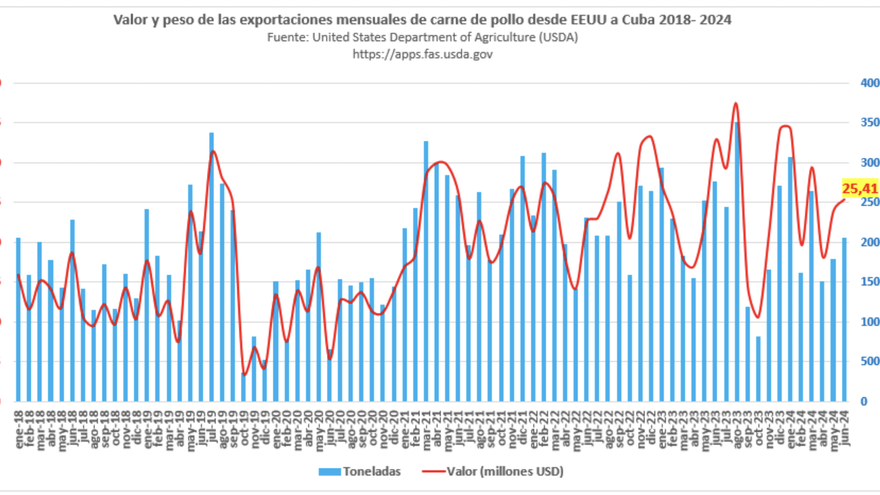
14ymedio bigger14ymedio, Havana, 8 August 2024 — The export of chicken from the United States to Cuba in the first half of this year reached 127,000 tons, 8.6% less than what the Island bought in the same period of 2023 (139,000 tons). However, due to the increase in its price, spending increased by 7% in the same period: from 141 million dollars in 2023 to 150.9 million this year.

In summary, the Island is receiving much less chicken than in the first half of 2023, but the cost is greater. A kilo of poultry meat, which this month is at $1.23, fell by almost 9% compared to May, when it cost 1.34.

As for the monthly data, this June, Cuba bought 20,000 tons of chicken, which represents a decrease of 25.9% compared to June 2023, though an increase of 15% compared to last May.

However, if the data for this June are equated with those of January of this year, when the Island imported more than 30,000 tons of chicken – the highest figure this semester – the amount of meat for the sixth month of the year drops by a scandalous 30%. continue reading

This June, Cuba bought about 20,000 tons of chicken, which represents a 25.9% drop compared to June 2023 / USDA

According to the Cuban economist Pedro Monreal, these numbers are nothing more than a clear representation of “the usual oscillating trajectory of monthly exports of chicken meat from the United States to Cuba,” he explained on the social network X.

The professor also noted that chicken imported from the United States is “the most consumed source of animal protein in Cuba and compensates for the acute national agricultural crisis.”

Chicken is one of the six “essential” foods whose price the Government set last July at 680 pesos per kilo. The popular response, especially on private platforms and SMsEs, was to make the product vanish. According to 14ymedio at the time, many merchants preferred to lose the merchandise or sell it “on the left” to lose money.

Although, in addition to chicken, the Government also exempted powdered milk, vegetable oil, pasta, detergent and sausages from import taxes, spirits did not calm down. On July 6, in some markets in Sancti Spíritus and Havana, a kilo of poultry meat – in packages of thighs – exceeded 850 pesos, according to this newspaper.

Likewise, a report made a few days ago in Cienfuegos revealed that chicken, milk and oil, the most essential and expensive among regulated foods, were still missing from the stalls and SMSEs. “Some sellers still have the old prices on the signs, or products that they sold regularly have simply disappeared. It is likely that many have decided to sell on the informal market and recover the investment,” said a cienfueguero at the time.

The authorities have started a campaign against the “unscrupulous” who continue to sell at abusive prices

For their part, the authorities have started a campaign against the “unscrupulous” who continue to sell at abusive prices. However, the reports of millions of pesos in fines, the deployment of an army of inspectors and threats to remove licenses and close businesses have not managed to change the landscape.

According to Monreal, these “problematic” measures for the Island’s economy – in frank crisis – are based on the “official assumption” that it is possible to “stabilize low prices” in the domestic market by exerting pressure, without considering the low supply.

As always happens, when chicken imports decrease, the entry into the country of portions such as thighs and drumsticks, cheaper in the international market, is privileged. Other parts of the bird, like the breast or even whole chickens, are relegated because they are more expensive. There is less internal demand for them, though private restaurants like them for their versatility

The cooks must then become real surgeons, as happened this week in the El Biky restaurant branch on the outskirts of terminal 3 of Havana International Airport. For 2,600 Cuban pesos, the customer receives a dish with rice, a small portion of potatoes and a surprising chicken thigh turned, due to the crisis, into steak.

Translated by Regina Anavy

____________

COLLABORATE WITH OUR WORKThe 14ymedio team is committed to practicing serious journalism that reflects Cuba’s reality in all its depth. Thank you for joining us on this long journey. We invite you to continue supporting us by becoming a member of 14ymedio now. Together we can continue transforming journalism in Cuba.

In Sancti Spíritus, Cuba, the Order To Combat ‘MSMEs’ Has Been Given

Authorities investigate state-owned companies that pay “millions” to the private sector

The Achilles heel of the measure is that there is no way to avoid an under-the-table agreement between the heads of state companies and the owners of the ’SMSEs’ / Comercio Sancti Spíritus/Facebook

14ymedio bigger14ymedio, Havana, 8 August 2024 — The leaders of Sancti Spíritus, Cuba, aspire to become the elite squad in the government’s crusade against MSMEs. President Miguel Díaz-Canel had asked, during a session in Parliament last month, to liquidate the “excessive payments from the state sector to the non-state sector,” a statement that was endorsed by Prime Minister Manuel Marrero, who accused the private sector of tax evasion and announced that measures would be taken.

The Sancti Spiritus branch of the Ministry of Finance and Prices echoes the “combat order” that the president issued at the time: “We know that there are leaders who, without having gone through the collegiate management mechanisms, have made the decision to establish contracts without looking at the prices that are being proposed to solve a problem, taking money from the budget and spending it excessively.”

With the 2024 ministerial resolution 209 in hand, the leaders warn that they will put a “stop” to the excessive payments that the Government has “detected.” These are nebulous “economic relations” between both sectors, whose accounts are not clear. “Today any state company or any budgeted unit hires a service or acquires a product from a non-state management form and pays million-dollar figures, so to speak, without pain to the disbursement of its state entity,” Miskel Acosta Paredes, director of Finance and Prices in Sancti Spíritus stated in an interview with Escambray, the local newspaper.

With 2024 ministerial resolution 209 in hand, leaders warn that they will put a stop to excessive payments

Acosta predicts radical control for “the economic contracting process with non-state forms of management for the acquisition of goods and services.” The confusion over “prices and rates” is over, he claims. With the new regulations, the profits that SMSEs benefit from cannot exceed 30% of the total costs and expenses.

The Achilles heel of the measure is that there is no way to avoid –in Acosta’s opinion– an under-the-table agreement between the heads of state companies and the owners of the contracted SMSEs, so that they approve one set of numbers and “in reality another figure is set” on paper.

The plan of the Finance and Prices department is to force state leaders to clarify their documents through a “list of attendance,” a kind of agenda where all meetings and negotiations with private companies will be set out. In this way, inspectors will be able to review the process step by step.

Acosta sees his colleagues in Finance and Prices as champions of the “protection of the company and the budgeted sector.” “They have money, a plan, a financial capacity and they have to defend it, they have to negotiate, they have to haggle, just as we Cubans do in our daily lives,” he asserts.

“Money without pain” – a phrase repeated by the leader – is proof of corruption, which “generates profits for some representatives of the state sector as well.” For Acosta, this situation will have to stop if the regulation is respected. “When we have reviewed reports from the Comptroller General of the Republic, a large number of alleged criminal acts related to contracting actions between non-state actors and the state sector have been detected,” he reveals.

State corruption also takes the form of “favoritism with certain non-state actors.” In fact, he says, “enrichment of people has been detected through the contracting of products and services.” The inspectors under his command, he says, will attack the accounting books of both sectors to guarantee what he considers to be their mission: the “tranquility and transparency” of the socialist economy.

State corruption also takes the form of “favoritism with certain non-state actors.” 

Marrero and Díaz-Canel – in various speeches and parliamentary announcements – promised dark times for the private sector, to which the prime minister attributed the evasion of 50 billion pesos, “a third of the fiscal deficit” of the country. Something did not add up in the numbers –that same day it had been reported that the deficit did not reach 100 billion – but the message against the MSMEs was given.

“It is not clear how the emerging non-state sector would have been able to defraud the omnipresent Cuban government to the tune of 50 billion pesos,” economist Pedro Monreal commented at the time in X. “If that were the case, we would be facing a case of colossal governmental incompetence.”

The official economist Iliana Díaz had complained that same week about the “little battle” against the private sector. After diagnosing the “exhaustion” of the Cuban economic model in front of the cameras of Cuban Television, Díaz demanded a truce in the face of the numbers revealed to Parliament: 1,831 fines to the non-state sector, 115 regulations to small business owners who wanted to travel, 127 requests for temporary withdrawal and 24 for permanent withdrawal of the license to engage in economic activity.

The solution is not to ambush MSMEs with administrative measures, Díaz summarized, but to encourage their development and to not assume that the state sector – which has “functioned poorly ” for decades – is the cornerstone of the Cuban economy.

____________

COLLABORATE WITH OUR WORKThe 14ymedio team is committed to practicing serious journalism that reflects Cuba’s reality in all its depth. Thank you for joining us on this long journey. We invite you to continue supporting us by becoming a member of 14ymedio now. Together we can continue transforming journalism in Cuba.

Venezuela: Revolution Without People

The evidence of Maduro’s defeat is there, coming from the very technological womb of the “best electoral system in the world”

Now Venezuelans are seeking the definitive victory: the recognition of popular sovereignty expressed in the elections / María Corina Machado/X

14ymedio bigger14ymedio, Gregorio Salazar, Caracas, 6 August 2024 — At 61 years of age, after more than 25 years as a member of the political cast that came to power with Hugo Chávez and 12 of those years at the head of the regime that today subjugates Venezuela, Nicolás Maduro has attempted the most reckless of his political adventures: to remain in power another six years against the will of the Venezuelan people.

Since July 29, the day after the presidential elections, doubts about the true result of the vote began to clear up. And the first and only bulletin of the National Electoral Council (CNE) remained nothing more than an implausible pretext, a strange justification for a move that ended up placing Maduro and his inner circle outside the constitutional framework.

The “official” CNE bulletin — for what it has said and for what it has omitted, and for its haste and its inconsistencies — will go down in history as evidence of one of the most crude political moves, though not its unpredictable consequences — with which a political group has tried to seize power in Venezuela. And, as they shamelessly proclaim, definitively.

Maduro’s hasty proclamation tried to convince (and demoralize) the population with the boast of a fait accompli

Maduro’s hasty proclamation – without completing the vote counts – tried to convince (and demoralize) the population with the boast of a fait accompli. But the evidence is there, coming from the highly technological womb of the “best electoral system in the world.”

Irrefutable, uncontestable, with the meticulous forcefulness of what happened, since they constitute the same input and use the same guarantee that the CNE’s automated platform provides: invulnerable digital codes and protocols.

With more than 80% of the votes collected so far, the result is overwhelmingly devastating. Edmundo González has more than 7 million votes, 67% of the total, giving him a large lead of 37% over Maduro. That figure and percentage, unprecedented in any election in our region, will be revealed according to the trend, to be much higher when the 100% of the votes are consolidated.

The polls revealed a wide lead for Edmundo González, the softening of the Chavista base, and the avalanche of migration against the government in recent days, but the result exceeds all expectations. With a figure of less than 30% of the electorate and the rejection that his rebellion against the sovereign expression of Venezuelans has aroused, Maduro begins another flight forward to enter a more totalitarian and repressive phase of the “revolution,” but this time from the lowest level of his popular support and with an unconquerable economic, political and social crisis.

At the same time, as soon as discontent spontaneously erupted in the most populated areas of Caracas and other regions of the country, Maduro began to make good on his promised threat — “a bloodbath” — which frightened Brazilian President Lula Da Silva, who now, together with the presidents of Colombia and Mexico, continues to insist on a detailed and transparent counting of the votes. The OAS, as if that were not enough, announced another international criminal action for crimes against humanity.

As if that were not enough, the Organization of American States (OAS), announced another international criminal action for crimes against humanity.

This clamor for the truth is spreading throughout Venezuela and the world and will grow with the passing of days, it will come from every representative body in the country and from the most varied actors. Fundamentally because the atrocious moves of the regime leave no room for half measures, for nuancing ambiguous positions: one is either with the truth or with fraud, with the possibility of a return to democracy or the entry into the sinister stage of a dictatorship that takes refuge in fierce repression – which has already claimed 20 lives in just two days of protests! – threats and persecution of media and journalists and in devices such as those sought at the Supreme Court [TSJ] level, the latest botched job that is obviously doomed to failure.

Maduro and the leadership are deepening the division of a country by stirring up hatred. They seek to degrade their own militants, those who have followed them in good faith, but who today can see how their leaders have crossed the threshold to total unscrupulousness. The truth wants to be twisted, stifled, unknown, by setting in motion a delirious, crudely woven narrative. The country wants peace, unity and reunion, not the prolongation of an autocratic regime.

What the (mis)governing elite does not want to understand or assimilate internally is that the political process that began with greater intensity in the months prior to the primary elections won by María Corina Machado will not stop.

The acts of vandalism and the persecution against María Corina will only continue to endow her with an epic, a national protagonism that has facilitated victories for the population such as the one achieved on July 28. Now Venezuelans seek the definitive victory: the recognition of the popular sovereignty expressed in the elections and the removal from power of Nicolás Maduro before he begins a new mandate without any legitimacy of origin.

Editor’s Note: This article was originally published in the Venezuelan media outlet Tal Cual.

____________

COLLABORATE WITH OUR WORKThe 14ymedio team is committed to practicing serious journalism that reflects Cuba’s reality in all its depth. Thank you for joining us on this long journey. We invite you to continue supporting us by becoming a member of 14ymedio now. Together we can continue transforming journalism in Cuba.

Cuban Migrants Are Anxiously Waiting in Chiapas To Request Their CBP One Appointments

Migrants line up outside the offices of the Mexican Refugee Assistance Commission in Tapachula, waiting to resolve their immigration situation / EFE

14ymedio bigger14ymedio, Ángel Salinas, Mexico City, 8 August 2024 — Last Friday, in the company of his sister and uncle, the Cuban Yeison Cedeño López went to the offices of the Mexican Refugee Assistance Commission (COMAR) of Tapachulas, in the state of Chiapas, to apply for asylum from the Mexican Government. The officials, however, warned him that they would only let him do so it if his intention was to “stay in Mexico,” since the application to apply for asylum to the United States from that state – recently announced by the authorities – is not yet available.

Cedeño and his family have been in the state bordering Guatemala for almost three months, and during that time they have made several requests to allow them to stay in Mexican territory and prevent them from being deported, but dealing with the institutions has not been easy. To begin with, Cedeño had to protect himself from being arrested and deported. Each amparo (protection order) cost 1,350 Mexican pesos (71 dollars), and the money is due on August 17.

“They had us waiting for three hours and when we entered we filled out a few sheets. They gave us a copy and asked us to return in three months,” Cedeño tells 14ymedio.

Cedeño’s goal is to reach the United States. “I have a sister in Utah. She is helping us, and with the work we’re doing here and her help, we have continue reading

enough to eat and can cover accommodation,” he says. He recently learned that the U.S. Government’s CBP One application will soon be available in Chiapas and Tabasco.

Between June and July, more than 1,000 Cubans filled out asylum applications in Mexico / EFE

As he explains, despite the fact that he will apply for refuge in the United States as soon as the application is approved, he decided to do so also in Mexico in case he has to “redo the CBP One. We’re not going back to Cuba; anywhere else is better,” he says. At the door of the Refugee Assistance Commission there is a sign indicating that from August 12, the delivery of appointments will begin again, explains Cedeño.

An official confirmed to this newspaper that these appointments are the ones corresponding to the month of May, so those who submitted their applications in June and July “will have to continue with their weekly signature – the process requires that they go to the office every week to sign the documents – and continue waiting for their turn.”

The official also confirmed that in recent weeks there has been an increase in the transit of migrants through the state, especially of small groups of migrants, which is called “ant migration.”

Likewise, the state authorities have identified several groups that began the crossing in San Pedro Sula in the direction of the municipality of Ciudad Hidalgo, where they met. The group was concentrated in the municipality of Suchiate. “The departure of the caravan is scheduled for August 11 or 12, while other groups of between 15 and 20 people who are arriving from San Pedro Sula are organized and waiting,” the official said.

Cubans are the second largest group of migrants who arrive at the COMAR, with 19,803 recorded, only behind Honduras. Cuba is followed by Haiti, 4,022 applications; El Salvador, with 3,842 and Guatemala, with 2,671. Unlike other years, only 2,549 Venezuelans have passed through this institution.

According to the figures offered by the Government of Mexico, so far this year about 9,914 Cubans have gone to one of the eight offices that the agency has in Baja California, Palenque, Tapachula, Jalisco, Nuevo León, Saltillo, Tabasco and Veracruz, because in Mexico City the procedures have been paused by a change of headquarters. Just between June and July, more than 1,000 applicants from the Island were counted.

Translated by Regina Anavy

____________

COLLABORATE WITH OUR WORKThe 14ymedio team is committed to practicing serious journalism that reflects Cuba’s reality in all its depth. Thank you for joining us on this long journey. We invite you to continue supporting us by becoming a member of 14ymedio now. Together we can continue transforming journalism in Cuba.

The Ten Peso “Generalísimo” Banknotes Lose Their Validity in Cuba

Banks make retirement payments with mountains of worn-out bills that the shops reject

Just by seeing the image printed on a rectangle of paper, merchants know that the ten-peso bill has little value and many associated complications / 14ymedio

14ymedio bigger14ymedio, Natalia López Moya, Havana, 8 August 8, 2024 — “We don’t accept ten-peso bills,” warns a merchant on Galiano Street, in Havana, to a customer who extends 30 ten-peso banknotes to pay for a container of descaling liquid for bathrooms. “Later we can’t use them; that’s why we only take 100 pesos and up,” the seller concludes with a gesture of displeasure. The face on the paper that the buyer waves is no small thing, no more and no less than one of the patricians of national independence, Máximo Gómez. With a controversial past in his native Dominican Republic, the warrior ended up becoming one of the main faces of Cuba in arms against Spain, and he earned the designation of “Generalísimo.”

Now, just by seeing his image printed on a banknote, merchants know that the ten-peso bill has little value and many associated complications. “Do you see anything here that costs ten pesos?” asks an entrepreneur in a didactic tone, indicating his stock of pizzas, beers and cookies on Ayestarán Street. The merchant argues with a customer who wants to give him 20 Máximo Gómez bills for a purchase.

If in the past the one or five cent coins were considered small change destined for religious offerings and children’s piggy banks, now the bar has risen

“It’s just that those bills are very mistreated and they all stick together,” argues the merchant, barricaded behind bars that surround the entire portal of an old house converted into a passing bar and cafeteria. Even without a place to sit, the cafeteria takes in thousands of pesos every hour. Located in an area of confluence between two municipalities, it has “the cheapest prices in Havana for beer, soft drinks and juices,” boasts the man behind the counter. continue reading

Precisely because he isn’t short of customers, the proprietor can afford certain rules when it comes to paying. “Bills in good condition; we don’t accept anything under 50 pesos, and before electronic payment, it’s better to have cash in hand,” says the seller, aware that these restrictions limit his clientele. He doesn’t seem to care very much, because for hundreds of meters around there is no other cafeteria with an offer that matches his, not even close.

Other sellers have been more transparent and have left a message on the facades of their premises, as a warning about which bills they don’t accept / 14ymedio

For their part, banks seem to contradict the orders of private businesses. In the branch of the Metropolitan Bank on Conill and Tulipán Street, in Plaza de la Revolución, ATMs have not been working for days, and the only possibility of withdrawing money is at the window. Of course, “you can only get 5,000 pesos and only in ten-peso bills,” warns the custodian of the premises.

Joaquín, 77, was waiting this Tuesday to withdraw two-months of his pension, which had accumulated due to the problems of the ATMs and the long lines at the bank. Although his eldest son, a resident of Germany, recently sent him a few euros “to survive,” the former employee of the state-owned Taxis Cuba planted himself in the front to collect his retirement.

Two hours in line and a lot of patience ended with a bag full of ten-peso bills that, stacked on the outer wall of the bank branch, looked like an insurmountable mountain. “I don’t know if it’s better to jump over them or turn them around because either way, all these bills take up a lot of space,” he said ironically.

[[The deterioration of paper money also influences the rejection of low-denomination banknotes]]

A few meters further on, Joaquín set out to spend part of those bills, all with the face of the grim Dominican, who, in Cuba, is a symbol of the utmost political stubbornness. He held out a pile of deteriorated banknotes, used over and over again, where one barely could see the image of a man with round eyeglasses and a goatee.

“Oh, old man, we’re not accepting small bills; from 50 up if anything!” the saleswoman stopped in her tracks when she saw the package that was extended to her for three beers. Next to him, another client was even worse off, because he was carrying a package with more than a hundred bills with the image of Antonio Maceo that was immediately rejected. “No, not that,” the woman exclaimed about the five-peso banknotes.

Others have been more transparent and have put it in writing: “We do not accept purchases over 200 CUP with five- and ten-peso bills,” reads a sign on the facade of a business managed by a mipyme in Central Havana. If before the one or five cent coins were considered small change, destined for religious offerings and children’s piggy banks, now the bar has risen, and the banknotes with the heroes of Cuban independence are no longer welcome in shops.

The deterioration of paper money also influences the rejection. “It’s not that they are worth little; it’s that it disgusts me to have to touch one of those bills: they are old, greasy, and you can hardly read what they say,” argues a young employee of another MSME, this time located in El Vedado. “Here the customer is measured by the bills he brings; the best thing is hard currency, but if they are pesos, it’s only worth it if he starts taking out 200-peso notes and up.”

“The counting machine doesn’t read them well because they are old,” justifies the waitress of a private restaurant on San Lázaro Street. “Every bill of five, ten or twenty that we accept is money that stays here, that no one wants it.”

Translated by Regina Anavy

____________

COLLABORATE WITH OUR WORKThe 14ymedio team is committed to practicing serious journalism that reflects Cuba’s reality in all its depth. Thank you for joining us on this long journey. We invite you to continue supporting us by becoming a member of 14ymedio now. Together we can continue transforming journalism in Cuba.
Mexico-Based NGO Records 130 Violations of Prisoners’ Rights in Cuban Prisons in July

Archive image of a Cuban prison / EFE

14ymedio biggerEFE (via 14ymedio), Mexico City, 9 August 2024 — The Center of Documentation of Cuban Prisons recorded 130 complaints of repressive acts against 94 inmates in Cuban prisons in July, according to a report released Thursday by the independent platform.

The NGO, based in Mexico, said that of the total number of complaints from 40 Cuban prisons, “108 involve some form of harassment or intimidation of inmates, 42 relate to health issues and poor medical care, and 15 to criminal and administrative proceedings.”

In addition, it recorded 11 complaints of beatings and physical torture, 11 transfers within penitentiary establishments or other prisons, plus 27 other types of violations of prisoners’ rights, sanctioned in international instruments.

 The cases of four political prisoners were cited as “victims of the largest number of harassment actions

Specifically, the Center cited the case of four political prisoners as “victims of the greatest number of acts of harassment,” and said that of the 94 prisoners whose rights were violated, eight are women and 86 are men. continue reading

The provinces with the highest number of reports were Havana (30) and Mayabeque (14), in the west of the island, and Camagüey (21) in the center-east.

The penitentiary centers that appear in the report with the highest number of violations are the Havana Combinado del Este prison (18), the Guanajay prison (8) in the Artemisa province (west), as well as the prison in the eastern province of Las Tunas and the prison in the Quivicán municipality, in Mayabeque (both with 7).

The report detailed that the violations of prisoners’ rights were committed by “22 prison officials, six judges, five State Security officials, two police officers who acted as witnesses in a political trial, and one inmate who harasses political prisoners under orders from the authorities.”

The organization also reported the cases of 27 inmates who have in common the lack of medication and medical care.

The NGO’s monthly report stated that health problems in prisons are aggravated by “poor food” and the proliferation of diseases such as Oropouche and Dengue Fevers (both transmitted by mosquito bites), tuberculosis, diarrhea, insect infestations, contaminated water and poor structural conditions.”

____________

COLLABORATE WITH OUR WORKThe 14ymedio team is committed to practicing serious journalism that reflects Cuba’s reality in all its depth. Thank you for joining us on this long journey. We invite you to continue supporting us by becoming a member of 14ymedio now. Together we can continue transforming journalism in Cuba.
Built in 1912 by an Italian Architect, the Ten Cent Building in Cienfuegos, Cuba, is Wobbling

The structure is an original work by the Italian architect Alfredo Fontana Giugni / 14ymedio

14ymedio bigger14ymedio, Julio César Contreras, Cienfuegos, 10 August 10, 2024 — Each city on the Island with a certain economic accommodation had a Ten Cent store during Cuba’s Republican years. Built many times to order, designed by foreign architects and managed by American chains, those retail stores used to be the center of boulevards and shopping avenues. What has become of them after 1959 would horrify their former owners.

The Ten Cent of Cienfuegos is no exception. Two floors in an eclectic style and with monochrome stained glass windows, the old shop, located on the city’s boulevard – formerly San Fernando Street – is now a danger for pedestrians who pass by. The store, which has gone through several names, from Variedade Cienfuegos to the current Variedades Cimex, has been surrounded for months by a metal fence that prevents people from approaching the building, which is in danger of collapse.

Built in 1912, the former Ten Cent was owned by the American company F. W. Woolworth Company, dedicated to the sale of retail items. Since its nationalization after the coming to power of Fidel Castro, the centenary building has undergone very little, if any, maintenance. When the facade began to lose pieces and the humidity was already eating away the walls, Cimex tried to carry out a repair in 2017, with a view to the city’s bicentennial, and invested two million pesos. continue reading

The old Ten Cent was owned by the American F.W. Woolworth Company, dedicated to the sale of retail items at a low price

“That great restoration they promised came to nothing. The little they did was of poor quality, either because the resources were stolen, or because the materials were not good enough, or both. Everything is very beautiful in theory, but when they put it into practice, they ruin it,” complains Ramón, a resident of the area who remembers the years when his father, a textile worker, bought him candy for 20 centavos at the store.

Since its nationalization after the coming to power of Fidel Castro, the centennial building has not received maintenance / 14ymedio

Ramón recalls that around 2000, the building devised by the Italian architect Alfredo Fontana Giugni was the victim of another “restoration.” “They spent a long time working in the Ten Cent, and in the end they were only able to restore a part of the ground floor,” he says. When walking on the boulevard, many pedestrians move away from the ruinous structure. Although the facade seems firm, the windows reveal holes in the ceilings and some destroyed areas. The ornaments or a piece of wall that fell have brought more than one scare to the Cienfuegueros. “They waited too long to pay attention to it and now, if there’s not a lot of money, there’s no remedy. I hope they don’t lose it completely, like so many other buildings of that period,” Ramón says, wistfully.

What has become of the Ten Cent stores after 1959 would horrify their former owners

Nor does he expect a future repair to bring the building back to its old glory. “If they were to restore it, everyone knows that they won’t have access to most of the products, because of how expensive everything is. Then we’ll start calling it the ’Ten Dollar,’” he mocks.

The store remains surrounded by a metal fence, to avoid possible accidents in the face of the danger of collapse / 14ymedio

At 78 years old, Ramón is able to remember the majesty of the republican buildings that adorned the city in his adolescence. “The most elegant mansions, the shops with the best style, all were capitalistic,” he says. The Revolution soon got rid of the “smell of Yankees,” of “capitalism. Now there are only mansions converted into leaders’ homes, convents transformed into schools and some fragments of that time that people don’t even recognize,” he says. The Ten Cent, at least the ones that are still standing and have not become MSMEs, are the last to survive that “dispossession.”

Translated by Regina Anavy

____________

COLLABORATE WITH OUR WORKThe 14ymedio team is committed to practicing serious journalism that reflects Cuba’s reality in all its depth. Thank you for joining us on this long journey. We invite you to continue supporting us by becoming a member of 14ymedio now. Together we can continue transforming journalism in Cuba.

Before Deserting and To Survive, the North Korean Diplomat Trafficked Cigars With China

The former diplomat resided in Cuba from 2011 to 2016, and then, in a second period, between 2019 and 2023 / BBC

14ymedio bigger14ymedio, Havana, 9 August 2024 — With a salary of 500 dollars and being the second man of the North Korean Embassy in Havana, Ri Il-gyu – who escaped from his country last November – managed to smuggle Cuban cigars into China. The business, with which he financially supported his family during his mission on the Island, was one of the most picturesque pieces of information that the former diplomat revealed this Friday to the British network BBC, about his highs and lows in reaching Seoul, where he now resides. Ri was considered part of the 1% of the population of North Korea that can be considered “rich.” However, he stated, his standard of living was still below that of a middle-class family in the South. Hence, he did what was necessary – including the sale of cigars – to improve the lives of his family.

He lived in Cuba from 2011 to 2016, and then, in a second period, between 2019 and 2023. The Island became a strategic ally for North Korea because of its geographical proximity to the United States, and Kim Jong-un recognized Cuba’s place in the tensions between the two countries.

With cigar smuggling he was able to support his family during their time on the Island

On the issue of nuclear weapons, for example – a common subject when discussing North Korea – Ri considers that Kim “will never give up his nuclear weapons” no matter how much he seems to be in favor of Donald Trump, who could once again be the leading voice in Washington. continue reading

He admits, however, that Pyongyang could reactivate the negotiations, paused in 2019, to freeze its nuclear program in exchange for the lifting of the U.S. sanctions that weigh it down. The North Korean regime “will not negotiate in good faith,” stressed Ri, who warned against the “tricks ” and “100% deceptions” that Kim could be plotting.

About Russia, another variable in the international equation, Ri believes that its invasion of Ukraine is “a blessing for Pyongyang,” because the North Korean regime has been able to sell millions of dollars worth of ammunition to Moscow to support its incursion. In return, North Korea has received all kinds of basic necessities such as food and fuel, which are scarce throughout the country, in addition to Russian military technology.

He also explained that Russia created a “legal vacuum” through the agreement it signed with Pyongyang, which allows North Korea to “freely develop its nuclear weapons and missiles” with the intention of strengthening its military defenses, without having to “ask the United States” to reconsider the sanctions.

“North Korea understands that the only way to survive, eliminate the threat of invasion and develop its economy is to normalize relations with the United States,” said the former diplomat.

“He will not negotiate in good faith,” stressed Ri, who warned against the “tricks” and “100% deceptions” that Kim Jong-un could be plotting

Ri personally knows Kim, with whom he met seven times face to face, “trembling and nervous.” He remembers him as a “normal and ordinary person” in his dealings with others. He is interested in “guaranteeing his survival, at all costs,” says Ri. “He could have been a good person and a good father. But they molded him into a monster. The myth turned him into a monster,” he says.

Ri said last July that his desertion occurred after he was frustrated by the corruption and repression in his country. After the coronavirus pandemic, he had been summoned, like the rest of the officials abroad, to return home carrying in his luggage all kinds of second-hand items from used toothbrushes to spoons, to be able to cope with the shortages that persists inside their borders.

Eight months after turning his back on Pyongyang, the former diplomat lives all the time accompanied by a group of bodyguards assigned to him by the South Korean police and two intelligence agents, who protect him and his family from possible reprisals from the North Korean regime.

“Kim Jong-un knows very well that people’s loyalty is decreasing and that people are changing, which is why he has intensified his reign of terror,” Ki said after reflecting on the cultural war that is being waged between the north and the south with the smuggling of movies, television series and music that cause, little by little, his compatriots to ask a radical question: “Why do southerners live the life of a first world country and we live in poverty?”

Translated by Regina Anavy

____________

COLLABORATE WITH OUR WORKThe 14ymedio team is committed to practicing serious journalism that reflects Cuba’s reality in all its depth. Thank you for joining us on this long journey. We invite you to continue supporting us by becoming a member of 14ymedio now. Together we can continue transforming journalism in Cuba.

Counter-Insurgency Tactics Are Applied in Santiago De Cuba To Investigate Farmers

The Police and State Security detected 1,644 undeclared calves and 4,463 “disappeared” animals

They searched for “fingerprints, the smell of burnt palm trees, footwear and textile fibers,” and they found “possible suspects” / Sierra Maestra

14ymedio bigger14ymedio, Havana, 10 August 2024 — The official press spared no detail this Saturday to describe, with the tone of a detective novel and warnings from the Ministry of the Interior, the situation of theft and slaughter of livestock in Santiago de Cuba. After numerous raids, it was discovered that in the province there are 1,644 calves whose births were not declared, 818 illegal sales of cows, 200 unmarked, 719 animals killed without notifying the authorities and 4,463 “disappeared,” whose owners did not report the loss.

The Police have released – literally – their dogs in the pastures of Santiago so that they can find the remains of slaughtered cows, and they have opened files on the farmers who violated the law, to fine them or impose any “other accessory sanction” that corresponds. In total, the authorities say that the province has 110,448 animals, whose owners have their papers in order.

Sierra Maestra interviewed an anonymous farmer – he did not want to reveal his name “for fear of becoming an enemy with some of my acquaintances” – who shed light for the agents on the most common method of Santiago farmers and their complicit “clients”: “You introduce yourself to them with a sack of pesos, and they will let you sacrifice a cow from their herd, making it look like a theft of which they had no knowledge. There are not just a few who are in that business. Here everyone has to take care of their own and is responsible for what they have.” continue reading

The police have released their dogs in the pastures of Santiago so that they can find the remains of slaughtered cows

The Ministry of the Interior wasted no time. Invoking article 410.1 of the Criminal Code – on theft – and other similar laws, the agents said that “some farmers want greater speed on the part of the agencies and their effective cooperation to catch those responsible,” and have begun several investigations on their own.

The police computers – says Sierra Maestra – began by registering the “narration” of each farmer, and immediately, “the operational guard acted.” Insisting on the efficiency that, in the opinion of the newspaper, the agents showed, the text describes that the head of each sector, the Criminalistics experts and the detectives of the Technical and Investigative Directorate were added to each case. They searched for “fingerprints, the smell of burnt palm trees, footwear and textile fibers,” and they found “possible suspects.”

In difficult cases, they used dogs, “to follow the traces of those involved” and any other evidence of slaughter on the ground. They even used – underlines Sierra Maestra – agents of State Security.

Such a deployment was necessary, the newspaper alleges, because of the economic situation that the Island is experiencing, which elevates all minor theft to the level of a major crime. It is a “national exercise” prioritized by the Government, they say, over the 16,689 ranchers in the province, visited one by one since last March.

“Since the first months of the year, the Provincial Prosecutor’s Office, in general, declared to this media that an increase in events had been generated against livestock in the territory,” says the newspaper. “There have been a high number of breaches of the provisions of the Livestock Promotion Law.”

There were “unreceptive attitudes” and “doubts about the seriousness of the task,” admits Sierra Maestra when describing that many farmers refused to collaborate with the investigation. They were punished with 496 fines that collected seven million pesos. About 787 farmers will be “analyzed” by Agriculture in the province, and another 246 received accusations for “breach of the duty to report.”

The lesson: “Respect and comply, and there will be no measures,” an Agriculture official interviewed by the newspaper says clearly.

Several farmers refused to collaborate with the investigation in which even State Security agents participated

To illustrate the moral, Sierra Maestra describes the life of the one who, in his opinion, is the perfect farmer: Hermis Isaac Ferrer, of the Gustavo Moll Credit and Services Cooperative, located in the municipality of San Luis. Ferrer “does wonders” on his Nueva Arena estate and shows that “when you want, you can” be legal.

Ferrer has organized a group of guards whom he calls the “farmer patrol,” to whom the cooperative “provided telephones to communicate in the event of any problem, fact or suspicion.” Predictably, the guards are armed with machetes, but this is not said by Ferrer, who says that when the “patrollers” detect a crime, they call the head of the sector.

But no one is perfect. “In the month of July, as part of the national livestock exercise, several cases were identified for lack of animals, or for not having enough protection for them, which facilitates their theft,” Ferrer confessed.

The farmer is also described as a charitable soul of the area: “He delivers milk to Public Health, in the nursing home, to mothers and the hospital. The big cattle are interspersed, with 10 breeders, six small females and two bulls, in addition to their horses. They collaborate with the neighbors and vice versa, and together they send productions to the market and the fairs.”

This is Ferrer’s “paradise,” concludes Sierra Maestra, free from the “lack of control and negligence” that characterize the province. His slogan, which has the obvious sympathies of the Police, is that “nothing escapes from those who watch.”

Translated by Regina Anavy

____________

COLLABORATE WITH OUR WORKThe 14ymedio team is committed to practicing serious journalism that reflects Cuba’s reality in all its depth. Thank you for joining us on this long journey. We invite you to continue supporting us by becoming a member of 14ymedio now. Together we can continue transforming journalism in Cuba.

A Catalan NGO Collaborates in the Indoctrination of Cuban Children at the Fidel Castro Center

The craft workshop financed by Alkaria is attended by 50 children every day / Fidel Castro Center

14ymedio bigger14ymedio, Juan Izquierdo, Havana, 9 August 2024 — “Fidel has done many things for Cuba, but the most important has been to save us.” This phrase – closer to religious catechism than to historiography – was expressed this Friday by one of the 39 children that the Fidel Castro Center has chosen for a special summer course. The objective of the program, for which the Spanish left-wing organization Alkaria, based in Catalonia, has contributed money, is for children to “immerse themselves” in the life and miracles of the caudillo. Since last July 8, the children have been instructed to serve as guides for the museum that houses the center. In images published by Televisión Cubana they are seen offering explanations about the type of weapons, military vehicles and historical episodes in which Castro was involved.

A girl under the age of ten explains to visitors that they are in the Room of the Word, where multiple screens – surrounded by verses of Castro’s speeches – show “Our Commander” haranguing a crowd. Another infant explains who “Fidel’s journalists” are and how they contributed to spreading his image around the world.

One child has the job of showing the K-69 jeep, the dictator’s favorite, and another gives details about the Granma yacht. In addition, they have to stop at images that border on the disturbing, such as the one that shows Castro lying in a blood donation chamber, with doctors and devices around him. continue reading

The head of the “squad” is Elianet Espinosa Chávez, a specialist from the center who is the group’s instructor

The head of the “squad” is Elianet Espinosa Chávez, a specialist from the center who is the instructor of the group, comprised of children between 6 and 14 years old. “They are very small, some have not even been given the History of Cuba,” she admits. Their mission has been to help them discover “how they feel Fidel” in every aspect of their lives.

A craft workshop – also impregnated with Fidelismo – is funded by Alkaria as an adjunct project. In addition to the 39 “guides,” there are 50 children each day. Xavier Barreda, director of Alkaria, personally supervises the development of the workshops, for which he dedicates – he says – “at least 20% of his annual budget.”

Alkaria defines itself as an organization of “developmental cooperation.” It belongs to the myriad of foreign institutions that “help” the Havana regime, not always in a transparent way. In fact, on the Alkaria website there is not a single word about the indoctrination of Cuban children, and the only project they admit to having destined for Havana is aid – in the form of medical donations – to the nursing home of San Miguel del Padrón.

According to his X profile, Barreda brought with him from Spain 660 pounds of sanitary, educational and sports material

According to his X profile, Barreda brought with him from Spain 660 pounds of sanitary, educational and sports material, a donation that he gathered with the help of the City Council of the Spanish municipality of Santa Perpètua de Mogoda, led by the Unified Socialist Party of Catalonia.

Since the beginning of the summer, the Fidel Castro Center has put the children of the capital in its sights. Workshops, courses, films and conversations with retired soldiers have formed a detailed program of indoctrination in the “values” of Castroism. “I want to learn what Fidel did,” the children registered in the program repeat, one after another. On July 10, Ramiro Valdés in person went to give a children’s conference on Castro and “his teachings,” with the declared objective of having the children “continue his revolutionary work.”

Directed by historians René González Barrios and Elier Ramírez, the Center has become the mecca of Castro scholars, and its staff has been scrupulously selected. This has not prevented desertions, as told to 14ymedio by Miriam, a former employee of the Center.

“When the center opened, the workers were satisfied, because they sold us a box of subsidized frozen chicken”

“When the center opened, the workers were satisfied, because they sold us a box of subsidized frozen chicken,” she explains. However, a few months ago she left her job. Not only had they taken away “many stimuli,” including the chicken, but the “persistent” pressure exerted by the Center on its employees had reached its peak.

As August 13 – the anniversary of Castro’s birth – approaches, texts begin to proliferate in the official press that aren’t afraid of falling back on the idolatry. The figure of the dictator is approached with a romantic prose, which exaggerates his traits and idealizes his life.

This Friday, an article from Sierra Maestra alluded to Birán – the batey [sugar worker’s town] of Holguín where Castro was raised – as an idyllic place, where the “sweetness of the reeds and the bellowing of the cattle” cradled the birth of the dictator. The journalist then developed a disconcerting argument to demonstrate the “influence of the environment”: if Castro had come to power it was because Birán was impregnated with a revolutionary spirit from the Taino era – for the exploits of a bloody cacique [tribal chief] who decimated the region – until an alleged mambisa post was established in the area.

The reporter admits that Ángel Castro, the dictator’s father, arrived in Cuba – “paradoxically” – as part of the peninsular troops willing to destroy the mambises. The Galician soldier became rich and owned everything important in the batey, from the post office to the private school. Fidel and Raúl, who were born outside Castro’s marriage, grew up on the fringes of the house that now is presented as his family home .

Ángel Castro maintained his farm with cheap labor from Haiti, eastern Cuba and even his native Galicia

The semi-savage life that both boys led – to which Castro’s interviews attest, veiledly – is summarized by the journalist in several paragraphs. Those who met Castro as a young man say that “he would go with the other youngsters to the El Jobo pond, where they bathed, came back and cooked near the house.” Another explains that Fidel was a “friend of the Haitians.” “There were about 60 or 70 here. Almost all the workers here were Haitians,” explains a neighbor, without clarifying that Ángel Castro maintained his finca [estate] with cheap labor from Haiti, eastern Cuba and even his native Galicia.

Dozens of pages about Fidel Castro and his “imprint” will not be missing this August 13. They are written by the self-styled “privileged of the time,” the journalists whom the dictator once admitted to his press conferences and private parties. They themselves testified in a kind of collective hagiography. They plan to sell the book internationally, and the profits from the sale – they promise – will be donated to the “children of Cuba.”

Translated by Regina Anavy

____________

COLLABORATE WITH OUR WORKThe 14ymedio team is committed to practicing serious journalism that reflects Cuba’s reality in all its depth. Thank you for joining us on this long journey. We invite you to continue supporting us by becoming a member of 14ymedio now. Together we can continue transforming journalism in Cuba.

Maduro Leads a “Narco-State” and It Is Difficult for Him To Surrender Power, According to Nobel Peace Prize Winner Óscar Arias

Panama reiterates that it is willing to give asylum to Maduro to solve the crisis

Arias regrets that dictators like Maduro are not willing to give up power / EFE

14ymedio bigger EFE (via 14ymedio), Douglas Marín, San José / Panama City, 9 August 2024 — Nicolás Maduro “leads a narco-state,” a “dictatorship,” and it is difficult for him to surrender power, the former president of Costa Rica and Nobel Peace Prize winner Óscar Arias declared this Friday . According to the politician, interviewed by EFE, what happened in Venezuela is something that does not surprise him. “Dictators don’t know how to get out of the presidential chair,” he stated.

The 1987 Nobelist said that the elections of July 28 were “a farce” in which Maduro “stole” the triumph. “The Venezuelan people deserve the Government to be handed over to the winner but, unfortunately, I am very skeptical. It is not easy for a narco-state, knowing that they are going to rot in a dungeon, to hand over power,” Arias said.

“Unfortunately, what is going to happen with six more years of Maduro is that those people, already miserable, suffering from hunger, are going to become more and more impoverished. It is impossible, given the chavista ideology, for that country to move forward, to consider foreign or domestic investment, to diversify the economy and end inflation,” he said.

Arias, who is 83, regretted that Mexico, Colombia and Brazil have not been emphatic when referring to the Venezuelan elections, although he clarified that it may be understandable if their intention is to be mediators. “I believed that Mexico, Colombia and Brazil were going to tell Maduro: ’your choice was a robbery, you stole the election of the Venezuelan people and disrespected the will of that people expressed at the polls, you committed a fraud that cannot be hidden’, but I was wrong, they didn’t do that. I understand that if their role is to mediate, they can’t be that blunt,” he said. continue reading

Arias stated that all the exit polls gave the opponent Edmundo González Urrutia as the winner, supported by the leader María Corina Machado, in a context in which there is “a very great discontent” with the Maduro Government and with chavismo in general. “The rulers of Venezuela (Hugo) Chávez and Maduro, have done a lot of damage. In Venezuela, killing a person is called homicide, but starving an entire people is called chavismo, and that’s what has happened. The best proof is that more than 7 million Venezuelans have left (emigrated),” he said.

Arias stated that all the exit polls showed the opponent Edmundo González Urrutia as the winner

The Government of Venezuela, for its part, continues to attack the Democratic United Platform (PUD) on several fronts, trying to discredit it. The Executive insisted again this Thursday in front of several ambassadors that the electoral records released by the opposition are false and intend to “ignore the results” of the presidential elections.

In addition, the Venezuelan Prosecutor’s Office has initiated criminal proceedings against the opposition leaders for disseminating, on its website, the results demonstrating that it was González Urrutia who won in the presidential elections.

The international community has also tried by various means to negotiate a way out for Maduro. In addition to the talks held with Venezuela by Colombia, Mexico and Brazil, and the guarantees offered by the United States, the president of Panama, José Raúl Mulino, reiterated this Friday that he would be willing to give political asylum to Maduro.

“If that is the quota of cooperation that Panama must make to get out of all this, offering our own country [as a place] for this man (Maduro) and his family to leave Venezuela, Panama would do it, without any doubt,” Mulino said in an interview with CNN, in which he maintained his position of offering Maduro asylum in order to facilitate the resolution of the crisis.

Nor did the president rule out the option of offering political asylum to other members of chavismo, if necessary. “In any way Panama can cooperate (it will). And if that is the quota of cooperation (extending asylum) that we have to do, I would do it,” added the Panamanian president, who has been a strong critic of the Venezuelan elections.

Mulino “transmitted” to the president of Brazil, Luiz Inácio Lula da Silva, through the Foreign Ministry, Panama’s willingness “to be the bridge” to a third country

Mulino “transmitted” to the president of Brazil, Luiz Inácio Lula da Silva, through the Foreign Ministry, Panama’s willingness “to be the bridge” to a third country, because, he added, he does not believe “that (Maduro) can stay in Panama,” since that “would be hard to sell to the population, but it is not the first time that Panama has helped in a crisis of this nature.”

Mulino pointed out several times during the interview that “this is not the first time that Panama has faced this type of problem with politicians on the run” and that “there have been other leaders who have landed here, with the idea of Panama contributing to a solution to internal political problems.”

The head of state recalled the cases of former Argentine president Juan Domingo Perón in 1956, Guatemalan Jorge Serrano Elías (1990-1993) and former Haitian coup general Raoul Cedrás (1991-1994), to whom the country granted asylum.

Panama was one of the countries that recognized Edmundo González as the president-elect of Venezuela, after considering the elections fraudulent. Both countries have suspended diplomatic relations and closed their airspace.

Translated by Regina Anavy

____________

COLLABORATE WITH OUR WORKThe 14ymedio team is committed to practicing serious journalism that reflects Cuba’s reality in all its depth. Thank you for joining us on this long journey. We invite you to continue supporting us by becoming a member of 14ymedio now. Together we can continue transforming journalism in Cuba.