EFE (via 14ymedio), Mexico City, 9 August 2024 — The Center of Documentation of Cuban Prisons recorded 130 complaints of repressive acts against 94 inmates in Cuban prisons in July, according to a report released Thursday by the independent platform.
The NGO, based in Mexico, said that of the total number of complaints from 40 Cuban prisons, “108 involve some form of harassment or intimidation of inmates, 42 relate to health issues and poor medical care, and 15 to criminal and administrative proceedings.”
In addition, it recorded 11 complaints of beatings and physical torture, 11 transfers within penitentiary establishments or other prisons, plus 27 other types of violations of prisoners’ rights, sanctioned in international instruments.
The cases of four political prisoners were cited as “victims of the largest number of harassment actions
Specifically, the Center cited the case of four political prisoners as “victims of the greatest number of acts of harassment,” and said that of the 94 prisoners whose rights were violated, eight are women and 86 are men. continue reading
The provinces with the highest number of reports were Havana (30) and Mayabeque (14), in the west of the island, and Camagüey (21) in the center-east.
The penitentiary centers that appear in the report with the highest number of violations are the Havana Combinado del Este prison (18), the Guanajay prison (8) in the Artemisa province (west), as well as the prison in the eastern province of Las Tunas and the prison in the Quivicán municipality, in Mayabeque (both with 7).
The report detailed that the violations of prisoners’ rights were committed by “22 prison officials, six judges, five State Security officials, two police officers who acted as witnesses in a political trial, and one inmate who harasses political prisoners under orders from the authorities.”
The organization also reported the cases of 27 inmates who have in common the lack of medication and medical care.
The NGO’s monthly report stated that health problems in prisons are aggravated by “poor food” and the proliferation of diseases such as Oropouche and Dengue Fevers (both transmitted by mosquito bites), tuberculosis, diarrhea, insect infestations, contaminated water and poor structural conditions.”
____________
COLLABORATE WITH OUR WORK: The 14ymedio team is committed to practicing serious journalism that reflects Cuba’s reality in all its depth. Thank you for joining us on this long journey. We invite you to continue supporting us by becoming a member of 14ymedio now. Together we can continue transforming journalism in Cuba.
The structure is an original work by the Italian architect Alfredo Fontana Giugni / 14ymedio
14ymedio, Julio César Contreras, Cienfuegos, 10 August 10, 2024 — Each city on the Island with a certain economic accommodation had a Ten Cent store during Cuba’s Republican years. Built many times to order, designed by foreign architects and managed by American chains, those retail stores used to be the center of boulevards and shopping avenues. What has become of them after 1959 would horrify their former owners.
The Ten Cent of Cienfuegos is no exception. Two floors in an eclectic style and with monochrome stained glass windows, the old shop, located on the city’s boulevard – formerly San Fernando Street – is now a danger for pedestrians who pass by. The store, which has gone through several names, from Variedade Cienfuegos to the current Variedades Cimex, has been surrounded for months by a metal fence that prevents people from approaching the building, which is in danger of collapse.
Built in 1912, the former Ten Cent was owned by the American company F. W. Woolworth Company, dedicated to the sale of retail items. Since its nationalization after the coming to power of Fidel Castro, the centenary building has undergone very little, if any, maintenance. When the facade began to lose pieces and the humidity was already eating away the walls, Cimex tried to carry out a repair in 2017, with a view to the city’s bicentennial, and invested two million pesos. continue reading
The old Ten Cent was owned by the American F.W. Woolworth Company, dedicated to the sale of retail items at a low price
“That great restoration they promised came to nothing. The little they did was of poor quality, either because the resources were stolen, or because the materials were not good enough, or both. Everything is very beautiful in theory, but when they put it into practice, they ruin it,” complains Ramón, a resident of the area who remembers the years when his father, a textile worker, bought him candy for 20 centavos at the store.
Since its nationalization after the coming to power of Fidel Castro, the centennial building has not received maintenance / 14ymedio
Ramón recalls that around 2000, the building devised by the Italian architect Alfredo Fontana Giugni was the victim of another “restoration.” “They spent a long time working in the Ten Cent, and in the end they were only able to restore a part of the ground floor,” he says. When walking on the boulevard, many pedestrians move away from the ruinous structure. Although the facade seems firm, the windows reveal holes in the ceilings and some destroyed areas. The ornaments or a piece of wall that fell have brought more than one scare to the Cienfuegueros. “They waited too long to pay attention to it and now, if there’s not a lot of money, there’s no remedy. I hope they don’t lose it completely, like so many other buildings of that period,” Ramón says, wistfully.
What has become of the Ten Cent stores after 1959 would horrify their former owners
Nor does he expect a future repair to bring the building back to its old glory. “If they were to restore it, everyone knows that they won’t have access to most of the products, because of how expensive everything is. Then we’ll start calling it the ’Ten Dollar,’” he mocks.
The store remains surrounded by a metal fence, to avoid possible accidents in the face of the danger of collapse / 14ymedio
At 78 years old, Ramón is able to remember the majesty of the republican buildings that adorned the city in his adolescence. “The most elegant mansions, the shops with the best style, all were capitalistic,” he says. The Revolution soon got rid of the “smell of Yankees,” of “capitalism. Now there are only mansions converted into leaders’ homes, convents transformed into schools and some fragments of that time that people don’t even recognize,” he says. The Ten Cent, at least the ones that are still standing and have not become MSMEs, are the last to survive that “dispossession.”
Translated by Regina Anavy
____________
COLLABORATE WITH OUR WORK: The 14ymedio team is committed to practicing serious journalism that reflects Cuba’s reality in all its depth. Thank you for joining us on this long journey. We invite you to continue supporting us by becoming a member of 14ymedio now. Together we can continue transforming journalism in Cuba.
The former diplomat resided in Cuba from 2011 to 2016, and then, in a second period, between 2019 and 2023 / BBC
14ymedio, Havana, 9 August 2024 — With a salary of 500 dollars and being the second man of the North Korean Embassy in Havana, Ri Il-gyu – who escaped from his country last November – managed to smuggle Cuban cigars into China. The business, with which he financially supported his family during his mission on the Island, was one of the most picturesque pieces of information that the former diplomat revealed this Friday to the British network BBC, about his highs and lows in reaching Seoul, where he now resides. Ri was considered part of the 1% of the population of North Korea that can be considered “rich.” However, he stated, his standard of living was still below that of a middle-class family in the South. Hence, he did what was necessary – including the sale of cigars – to improve the lives of his family.
He lived in Cuba from 2011 to 2016, and then, in a second period, between 2019 and 2023. The Island became a strategic ally for North Korea because of its geographical proximity to the United States, and Kim Jong-un recognized Cuba’s place in the tensions between the two countries.
With cigar smuggling he was able to support his family during their time on the Island
On the issue of nuclear weapons, for example – a common subject when discussing North Korea – Ri considers that Kim “will never give up his nuclear weapons” no matter how much he seems to be in favor of Donald Trump, who could once again be the leading voice in Washington. continue reading
He admits, however, that Pyongyang could reactivate the negotiations, paused in 2019, to freeze its nuclear program in exchange for the lifting of the U.S. sanctions that weigh it down. The North Korean regime “will not negotiate in good faith,” stressed Ri, who warned against the “tricks ” and “100% deceptions” that Kim could be plotting.
About Russia, another variable in the international equation, Ri believes that its invasion of Ukraine is “a blessing for Pyongyang,” because the North Korean regime has been able to sell millions of dollars worth of ammunition to Moscow to support its incursion. In return, North Korea has received all kinds of basic necessities such as food and fuel, which are scarce throughout the country, in addition to Russian military technology.
He also explained that Russia created a “legal vacuum” through the agreement it signed with Pyongyang, which allows North Korea to “freely develop its nuclear weapons and missiles” with the intention of strengthening its military defenses, without having to “ask the United States” to reconsider the sanctions.
“North Korea understands that the only way to survive, eliminate the threat of invasion and develop its economy is to normalize relations with the United States,” said the former diplomat.
“He will not negotiate in good faith,” stressed Ri, who warned against the “tricks” and “100% deceptions” that Kim Jong-un could be plotting
Ri personally knows Kim, with whom he met seven times face to face, “trembling and nervous.” He remembers him as a “normal and ordinary person” in his dealings with others. He is interested in “guaranteeing his survival, at all costs,” says Ri. “He could have been a good person and a good father. But they molded him into a monster. The myth turned him into a monster,” he says.
Ri said last July that his desertion occurred after he was frustrated by the corruption and repression in his country. After the coronavirus pandemic, he had been summoned, like the rest of the officials abroad, to return home carrying in his luggage all kinds of second-hand items from used toothbrushes to spoons, to be able to cope with the shortages that persists inside their borders.
Eight months after turning his back on Pyongyang, the former diplomat lives all the time accompanied by a group of bodyguards assigned to him by the South Korean police and two intelligence agents, who protect him and his family from possible reprisals from the North Korean regime.
“Kim Jong-un knows very well that people’s loyalty is decreasing and that people are changing, which is why he has intensified his reign of terror,” Ki said after reflecting on the cultural war that is being waged between the north and the south with the smuggling of movies, television series and music that cause, little by little, his compatriots to ask a radical question: “Why do southerners live the life of a first world country and we live in poverty?”
Translated by Regina Anavy
____________
COLLABORATE WITH OUR WORK: The 14ymedio team is committed to practicing serious journalism that reflects Cuba’s reality in all its depth. Thank you for joining us on this long journey. We invite you to continue supporting us by becoming a member of 14ymedio now. Together we can continue transforming journalism in Cuba.
The Police and State Security detected 1,644 undeclared calves and 4,463 “disappeared” animals
They searched for “fingerprints, the smell of burnt palm trees, footwear and textile fibers,” and they found “possible suspects” / Sierra Maestra
14ymedio, Havana, 10 August 2024 — The official press spared no detail this Saturday to describe, with the tone of a detective novel and warnings from the Ministry of the Interior, the situation of theft and slaughter of livestock in Santiago de Cuba. After numerous raids, it was discovered that in the province there are 1,644 calves whose births were not declared, 818 illegal sales of cows, 200 unmarked, 719 animals killed without notifying the authorities and 4,463 “disappeared,” whose owners did not report the loss.
The Police have released – literally – their dogs in the pastures of Santiago so that they can find the remains of slaughtered cows, and they have opened files on the farmers who violated the law, to fine them or impose any “other accessory sanction” that corresponds. In total, the authorities say that the province has 110,448 animals, whose owners have their papers in order.
Sierra Maestrainterviewed an anonymous farmer – he did not want to reveal his name “for fear of becoming an enemy with some of my acquaintances” – who shed light for the agents on the most common method of Santiago farmers and their complicit “clients”: “You introduce yourself to them with a sack of pesos, and they will let you sacrifice a cow from their herd, making it look like a theft of which they had no knowledge. There are not just a few who are in that business. Here everyone has to take care of their own and is responsible for what they have.” continue reading
The police have released their dogs in the pastures of Santiago so that they can find the remains of slaughtered cows
The Ministry of the Interior wasted no time. Invoking article 410.1 of the Criminal Code – on theft – and other similar laws, the agents said that “some farmers want greater speed on the part of the agencies and their effective cooperation to catch those responsible,” and have begun several investigations on their own.
The police computers – says Sierra Maestra – began by registering the “narration” of each farmer, and immediately, “the operational guard acted.” Insisting on the efficiency that, in the opinion of the newspaper, the agents showed, the text describes that the head of each sector, the Criminalistics experts and the detectives of the Technical and Investigative Directorate were added to each case. They searched for “fingerprints, the smell of burnt palm trees, footwear and textile fibers,” and they found “possible suspects.”
In difficult cases, they used dogs, “to follow the traces of those involved” and any other evidence of slaughter on the ground. They even used – underlines Sierra Maestra – agents of State Security.
Such a deployment was necessary, the newspaper alleges, because of the economic situation that the Island is experiencing, which elevates all minor theft to the level of a major crime. It is a “national exercise” prioritized by the Government, they say, over the 16,689 ranchers in the province, visited one by one since last March.
“Since the first months of the year, the Provincial Prosecutor’s Office, in general, declared to this media that an increase in events had been generated against livestock in the territory,” says the newspaper. “There have been a high number of breaches of the provisions of the Livestock Promotion Law.”
There were “unreceptive attitudes” and “doubts about the seriousness of the task,” admits Sierra Maestra when describing that many farmers refused to collaborate with the investigation. They were punished with 496 fines that collected seven million pesos. About 787 farmers will be “analyzed” by Agriculture in the province, and another 246 received accusations for “breach of the duty to report.”
The lesson: “Respect and comply, and there will be no measures,” an Agriculture official interviewed by the newspaper says clearly.
Several farmers refused to collaborate with the investigation in which even State Security agents participated
To illustrate the moral, Sierra Maestra describes the life of the one who, in his opinion, is the perfect farmer: Hermis Isaac Ferrer, of the Gustavo Moll Credit and Services Cooperative, located in the municipality of San Luis. Ferrer “does wonders” on his Nueva Arena estate and shows that “when you want, you can” be legal.
Ferrer has organized a group of guards whom he calls the “farmer patrol,” to whom the cooperative “provided telephones to communicate in the event of any problem, fact or suspicion.” Predictably, the guards are armed with machetes, but this is not said by Ferrer, who says that when the “patrollers” detect a crime, they call the head of the sector.
But no one is perfect. “In the month of July, as part of the national livestock exercise, several cases were identified for lack of animals, or for not having enough protection for them, which facilitates their theft,” Ferrer confessed.
The farmer is also described as a charitable soul of the area: “He delivers milk to Public Health, in the nursing home, to mothers and the hospital. The big cattle are interspersed, with 10 breeders, six small females and two bulls, in addition to their horses. They collaborate with the neighbors and vice versa, and together they send productions to the market and the fairs.”
This is Ferrer’s “paradise,” concludes Sierra Maestra, free from the “lack of control and negligence” that characterize the province. His slogan, which has the obvious sympathies of the Police, is that “nothing escapes from those who watch.”
Translated by Regina Anavy
____________
COLLABORATE WITH OUR WORK: The 14ymedio team is committed to practicing serious journalism that reflects Cuba’s reality in all its depth. Thank you for joining us on this long journey. We invite you to continue supporting us by becoming a member of 14ymedio now. Together we can continue transforming journalism in Cuba.
The craft workshop financed by Alkaria is attended by 50 children every day / Fidel Castro Center
14ymedio, Juan Izquierdo, Havana, 9 August 2024 — “Fidel has done many things for Cuba, but the most important has been to save us.” This phrase – closer to religious catechism than to historiography – was expressed this Friday by one of the 39 children that the Fidel Castro Center has chosen for a special summer course. The objective of the program, for which the Spanish left-wing organization Alkaria, based in Catalonia, has contributed money, is for children to “immerse themselves” in the life and miracles of the caudillo. Since last July 8, the children have been instructed to serve as guides for the museum that houses the center. In images published by Televisión Cubana they are seen offering explanations about the type of weapons, military vehicles and historical episodes in which Castro was involved.
A girl under the age of ten explains to visitors that they are in the Room of the Word, where multiple screens – surrounded by verses of Castro’s speeches – show “Our Commander” haranguing a crowd. Another infant explains who “Fidel’s journalists” are and how they contributed to spreading his image around the world.
One child has the job of showing the K-69 jeep, the dictator’s favorite, and another gives details about the Granma yacht. In addition, they have to stop at images that border on the disturbing, such as the one that shows Castro lying in a blood donation chamber, with doctors and devices around him. continue reading
The head of the “squad” is Elianet Espinosa Chávez, a specialist from the center who is the group’s instructor
The head of the “squad” is Elianet Espinosa Chávez, a specialist from the center who is the instructor of the group, comprised of children between 6 and 14 years old. “They are very small, some have not even been given the History of Cuba,” she admits. Their mission has been to help them discover “how they feel Fidel” in every aspect of their lives.
A craft workshop – also impregnated with Fidelismo – is funded by Alkaria as an adjunct project. In addition to the 39 “guides,” there are 50 children each day. Xavier Barreda, director of Alkaria, personally supervises the development of the workshops, for which he dedicates – he says – “at least 20% of his annual budget.”
Alkaria defines itself as an organization of “developmental cooperation.” It belongs to the myriad of foreign institutions that “help” the Havana regime, not always in a transparent way. In fact, on the Alkaria website there is not a single word about the indoctrination of Cuban children, and the only project they admit to having destined for Havana is aid – in the form of medical donations – to the nursing home of San Miguel del Padrón.
According to his X profile, Barreda brought with him from Spain 660 pounds of sanitary, educational and sports material
According to his X profile, Barreda brought with him from Spain 660 pounds of sanitary, educational and sports material, a donation that he gathered with the help of the City Council of the Spanish municipality of Santa Perpètua de Mogoda, led by the Unified Socialist Party of Catalonia.
Since the beginning of the summer, the Fidel Castro Center has put the children of the capital in its sights. Workshops, courses, films and conversations with retired soldiers have formed a detailed program of indoctrination in the “values” of Castroism. “I want to learn what Fidel did,” the children registered in the program repeat, one after another. On July 10, Ramiro Valdés in person went to give a children’s conference on Castro and “his teachings,” with the declared objective of having the children “continue his revolutionary work.”
Directed by historians René González Barrios and Elier Ramírez, the Center has become the mecca of Castro scholars, and its staff has been scrupulously selected. This has not prevented desertions, as told to 14ymedio by Miriam, a former employee of the Center.
“When the center opened, the workers were satisfied, because they sold us a box of subsidized frozen chicken”
“When the center opened, the workers were satisfied, because they sold us a box of subsidized frozen chicken,” she explains. However, a few months ago she left her job. Not only had they taken away “many stimuli,” including the chicken, but the “persistent” pressure exerted by the Center on its employees had reached its peak.
As August 13 – the anniversary of Castro’s birth – approaches, texts begin to proliferate in the official press that aren’t afraid of falling back on the idolatry. The figure of the dictator is approached with a romantic prose, which exaggerates his traits and idealizes his life.
This Friday, an article from Sierra Maestra alluded to Birán – the batey [sugar worker’s town] of Holguín where Castro was raised – as an idyllic place, where the “sweetness of the reeds and the bellowing of the cattle” cradled the birth of the dictator. The journalist then developed a disconcerting argument to demonstrate the “influence of the environment”: if Castro had come to power it was because Birán was impregnated with a revolutionary spirit from the Taino era – for the exploits of a bloody cacique [tribal chief] who decimated the region – until an alleged mambisa post was established in the area.
The reporter admits that Ángel Castro, the dictator’s father, arrived in Cuba – “paradoxically” – as part of the peninsular troops willing to destroy the mambises. The Galician soldier became rich and owned everything important in the batey, from the post office to the private school. Fidel and Raúl, who were born outside Castro’s marriage, grew up on the fringes of the house that now is presented as his family home .
Ángel Castro maintained his farm with cheap labor from Haiti, eastern Cuba and even his native Galicia
The semi-savage life that both boys led – to which Castro’s interviews attest, veiledly – is summarized by the journalist in several paragraphs. Those who met Castro as a young man say that “he would go with the other youngsters to the El Jobo pond, where they bathed, came back and cooked near the house.” Another explains that Fidel was a “friend of the Haitians.” “There were about 60 or 70 here. Almost all the workers here were Haitians,” explains a neighbor, without clarifying that Ángel Castro maintained his finca [estate] with cheap labor from Haiti, eastern Cuba and even his native Galicia.
Dozens of pages about Fidel Castro and his “imprint” will not be missing this August 13. They are written by the self-styled “privileged of the time,” the journalists whom the dictator once admitted to his press conferences and private parties. They themselves testified in a kind of collective hagiography. They plan to sell the book internationally, and the profits from the sale – they promise – will be donated to the “children of Cuba.”
Translated by Regina Anavy
____________
COLLABORATE WITH OUR WORK: The 14ymedio team is committed to practicing serious journalism that reflects Cuba’s reality in all its depth. Thank you for joining us on this long journey. We invite you to continue supporting us by becoming a member of 14ymedio now. Together we can continue transforming journalism in Cuba.
Panama reiterates that it is willing to give asylum to Maduro to solve the crisis
Arias regrets that dictators like Maduro are not willing to give up power / EFE
EFE (via 14ymedio), Douglas Marín, San José / Panama City, 9 August 2024 — Nicolás Maduro “leads a narco-state,” a “dictatorship,” and it is difficult for him to surrender power, the former president of Costa Rica and Nobel Peace Prize winner Óscar Arias declared this Friday . According to the politician, interviewed by EFE, what happened in Venezuela is something that does not surprise him. “Dictators don’t know how to get out of the presidential chair,” he stated.
The 1987 Nobelist said that the elections of July 28 were “a farce” in which Maduro “stole” the triumph. “The Venezuelan people deserve the Government to be handed over to the winner but, unfortunately, I am very skeptical. It is not easy for a narco-state, knowing that they are going to rot in a dungeon, to hand over power,” Arias said.
“Unfortunately, what is going to happen with six more years of Maduro is that those people, already miserable, suffering from hunger, are going to become more and more impoverished. It is impossible, given the chavista ideology, for that country to move forward, to consider foreign or domestic investment, to diversify the economy and end inflation,” he said.
Arias, who is 83, regretted that Mexico, Colombia and Brazil have not been emphatic when referring to the Venezuelan elections, although he clarified that it may be understandable if their intention is to be mediators. “I believed that Mexico, Colombia and Brazil were going to tell Maduro: ’your choice was a robbery, you stole the election of the Venezuelan people and disrespected the will of that people expressed at the polls, you committed a fraud that cannot be hidden’, but I was wrong, they didn’t do that. I understand that if their role is to mediate, they can’t be that blunt,” he said. continue reading
Arias stated that all the exit polls gave the opponent Edmundo González Urrutia as the winner, supported by the leader María Corina Machado, in a context in which there is “a very great discontent” with the Maduro Government and with chavismo in general. “The rulers of Venezuela (Hugo) Chávez and Maduro, have done a lot of damage. In Venezuela, killing a person is called homicide, but starving an entire people is called chavismo, and that’s what has happened. The best proof is that more than 7 million Venezuelans have left (emigrated),” he said.
Arias stated that all the exit polls showed the opponent Edmundo González Urrutia as the winner
The Government of Venezuela, for its part, continues to attack the Democratic United Platform (PUD) on several fronts, trying to discredit it. The Executive insisted again this Thursday in front of several ambassadors that the electoral records released by the opposition are false and intend to “ignore the results” of the presidential elections.
In addition, the Venezuelan Prosecutor’s Office has initiated criminal proceedings against the opposition leaders for disseminating, on its website, the results demonstrating that it was González Urrutia who won in the presidential elections.
The international community has also tried by various means to negotiate a way out for Maduro. In addition to the talks held with Venezuela by Colombia, Mexico and Brazil, and the guarantees offered by the United States, the president of Panama, José Raúl Mulino, reiterated this Friday that he would be willing to give political asylum to Maduro.
“If that is the quota of cooperation that Panama must make to get out of all this, offering our own country [as a place] for this man (Maduro) and his family to leave Venezuela, Panama would do it, without any doubt,” Mulino said in an interview with CNN, in which he maintained his position of offering Maduro asylum in order to facilitate the resolution of the crisis.
Nor did the president rule out the option of offering political asylum to other members of chavismo, if necessary. “In any way Panama can cooperate (it will). And if that is the quota of cooperation (extending asylum) that we have to do, I would do it,” added the Panamanian president, who has been a strong critic of the Venezuelan elections.
Mulino “transmitted” to the president of Brazil, Luiz Inácio Lula da Silva, through the Foreign Ministry, Panama’s willingness “to be the bridge” to a third country
Mulino “transmitted” to the president of Brazil, Luiz Inácio Lula da Silva, through the Foreign Ministry, Panama’s willingness “to be the bridge” to a third country, because, he added, he does not believe “that (Maduro) can stay in Panama,” since that “would be hard to sell to the population, but it is not the first time that Panama has helped in a crisis of this nature.”
Mulino pointed out several times during the interview that “this is not the first time that Panama has faced this type of problem with politicians on the run” and that “there have been other leaders who have landed here, with the idea of Panama contributing to a solution to internal political problems.”
The head of state recalled the cases of former Argentine president Juan Domingo Perón in 1956, Guatemalan Jorge Serrano Elías (1990-1993) and former Haitian coup general Raoul Cedrás (1991-1994), to whom the country granted asylum.
Panama was one of the countries that recognized Edmundo González as the president-elect of Venezuela, after considering the elections fraudulent. Both countries have suspended diplomatic relations and closed their airspace.
Translated by Regina Anavy
____________
COLLABORATE WITH OUR WORK: The 14ymedio team is committed to practicing serious journalism that reflects Cuba’s reality in all its depth. Thank you for joining us on this long journey. We invite you to continue supporting us by becoming a member of 14ymedio now. Together we can continue transforming journalism in Cuba.
So far in 2024, the Island has invested more than $31 million in the import of vehicles of all kinds / 14ymedio
14ymedio, Havana, 9 August 2024 — Cuba imported agricultural products and food from the United States in the month of June for a value of $34.9 million, 31% more than in May, when the amount was $26.4 million. On the other hand, compared to June 2023, the figure decreased by 5.8%. The data were published this Thursday by the US-Cuba Trade and Economic Council (CubaTrade), which also offered the figures for the first half of 2024.
This year, purchases amounted to $210.6 million, 31.4% more than in the first six months of 2023. Among the highlighted items is the import of vehicles of all kinds – including electric vehicles for passenger transport, for $37,000 – in which the Island invested more than $31 million. Of this figure, about $26 million corresponds to used cars, largely acquired by individuals.
This year, purchases amounted to $210.6 million, 31.4% more than in the first six months of 2023
This business has gained popularity on the Island since the United States approved its first licenses for export, and it is increasingly common to come across “diplomatic” cars, as they are popularly known. Cuba also purchased combustion motorcycles for $30,000 and aircraft parts for $18,000, in addition to using $4,484 in leaded gasoline, a highly polluting substance whose use has been banned in several countries. continue reading
Among the appliances, air conditioners were imported for a value of $166,960, refrigerators and ice boxes for $122,794, televisions for more than $200,000 and portable lamps for $39,600.
As for food, as usual, chicken takes most of the budget of the entire semester – about $150 million according to the recent report of the
U.S. Department of Agriculture. The largest slice corresponds to the hindquarters, with a cost of $45.6 million (30%); followed by the thighs for $21.8 million (14.4%), the offal for $16.6 million (11%) and whole chicken for $939,414 dollars (0.5%). According to official data, the purchase of chicken for this semester fell by 8.6% compared to the same period in 2023.
According to official data, the purchase of chicken for this semester fell by 8.6% compared to the same period in 2023
The Island also imported cane and beet sugar for $834,480, a figure that, in a sugar cane country, represents more than any other figure the poor state of the sugar industry and confirms the failures of the last harvests, admitted even by the official press and the regime itself.
Also, $12 million were allocated to the purchase of milk powder, $589,000 to vegetable oils, $668,000 to sausages and $156,000 to pasta. These products are some of those, along with chicken and detergent, whose prices were capped last July on the Island. Another $10,099 was used in the acquisition of chewing gum.
Pork and its derivatives, another of the productions that used to be favored on the Island, cost the State almost $10 million, $1.5 million less than what it spent on the same products in all of 2023, $8.5 million.
Other products that stand out in this semester’s exports are coffee ($4,688,000); chicken wings ($73,800); eggs ($4,101,913); soy ($2,853,680); cheese ($334,000); rice ($743,000); yogurt; ($593,000); butter ($178,400); and personal hygiene products ($618,000).
In total, the value of exports since December 2001, when the U.S. Treasury Department authorized the sales of some products under special payment terms – in cash and in advance – amounts to $7,456,961,818.
Translated by Regina Anavy
____________
COLLABORATE WITH OUR WORK: The 14ymedio team is committed to practicing serious journalism that reflects Cuba’s reality in all its depth. Thank you for joining us on this long journey. We invite you to continue supporting us by becoming a member of 14ymedio now. Together we can continue transforming journalism in Cuba.
A public health alert goes out for domperidone, a counterfeit drug against pain and inflammation]
14ymedio, Havana, 9 August 2024 — At least three counterfeit drugs circulate in Cuba without health control, the Island’s authorities have warned. The 20-milligram Domperidone tablets and two other anti-arthritis products – which caused alarm in 2018 and 2023 in Colombia – are on the blacklist of the Center for the State Control of Medicines, Equipment and Medical Devices (CECMED).
The Domperidone tablets, from the Canadian company Apotex Inc., advertised as “analgesic and anti-inflammatory,” circulate illegally. They have been detected on the Island because they are not listed in the Canadian health system, where they supposedly originated. The complaint was made based on “photographic evidence,” thanks to which CECMED concluded on July 6 that the DIN code 01940309 that is on the Domperidone package “does not exist.”
“It is a counterfeit drug, so its quality, safety and efficacy cannot be guaranteed,” stressed the Cuban agency.
The 10 mg S-ARTRIT Plus and DolorEnd 10 mg pills are also sold without authorization. Both products are attributed to Homeopathic Natural Laboratories of Cuba. However, CECMED warned on July 24 that these “drugs” against arthritis are not registered in their database, in addition to the fact that “there is no pharmaceutical laboratory with that name” on the packaging. continue reading
In 2018, the National Institute of Drug and Food Surveillance (INVIMA) of Colombia denounced the fraudulent commercialization of that same drug in the country, under the name of DolorEnd Forte.
dolorlinnk-https://www.cecmed.cu/vigilancia/alertas/comunicacion-riesgo-0718-alerta-producto-falsificado-dolor-end-forte
Data on the box of the 10 mg DolorEnd for arthritis, which disproves the claim that it is made domestically/ Facebook/CECMED
The same occurs with the S-ARTRIT Plus anti-arthritis product. Invima warned on August 1, 2023 about the illegal marketing of Sin Artrit Forte – formerly Artrit LX – a product “without health records,” whose “active principle is procaine hydrochloride,” which is not recognized for use in Colombia. It arrived in Cuba with the name of S-ARTRIT Plus.
The sale of fake medicines and alternative products once again show the shortage of drugs that plagues the Island. The black market has become the main unlicensed supplier of Cubans, and now even virtual stores that supply Cubans with products purchased in the United States in dollars, offer medications. Some even request a prescription issued on the Island to deliver the products, not because they are admitted in that country, but to avoid of the risks of selling powerful drugs like antibiotics without a prescription.
Last July, the Ministry of Public Health admitted that, due to obstacles in the import of raw materials and already prepared medicines, the country lacks 70% of the basic medications needed by Cuban patients. The figure is imprecise: of the 651 products that should be sold in pharmacies, only 292 are available, and intermittently at that.
The pharmaceutical company 8 de Marzo resumed the production of oral antibiotics. / Granma
The regime, which has one of its main foreign exchange inflows in the medical-pharmaceutical industry, has sought help abroad to revive the sector, which was battered after dedicating all its funds to the development of vaccines against COVID-19. Last Thursday, the Government of India delivered 10,000,000 euros to Cuba, which were destined for the purchase of “active pharmaceutical ingredients.”
This Friday, the ‘March 8’ pharmaceutical company resumed the production of oral antibiotics and increased the capacity for injectables, reported director Xenia Madrazo Sagre. With the restart of those operations, “amoxicillin, cephalexin and cefixime will be produced, the latter in capsules and in suspension, and the injectables ceftriaxone, cefuroxime and ceftazidime,” the director confirmed. However, the first delivery will take 45 days, since the raw materials must go through a physical, chemical and microbiological analysis and then enter production, the official stressed.
The production of these drugs will cover the demand of the National Health System for six to 12 months, depending on the assortment.
14ymedio has documented that, due to the lack of drugs, Cubans constantly turn to the black market in search of antidepressants, tranquilizers and analgesics in improvised pharmacies on all kinds of premises. In these places, which range from a restaurant to a clothing store, the cost per blister pack can reach 1,000 pesos.
Translated by Regina Anavy
____________
COLLABORATE WITH OUR WORK: The 14ymedio team is committed to practicing serious journalism that reflects Cuba’s reality in all its depth. Thank you for joining us on this long journey. We invite you to continue supporting us by becoming a member of 14ymedio now. Together we can continue transforming journalism in Cuba.
Many teenagers choose to work after spending only one year in Military Service
Some students do not enter university even if they have passed the entrance exams / Periódico 26
14ymedio, Havana, August 8, 2024 — “In hard times, the croquette is put before the brain.” The diagnosis, coined by a university professor from Las Tunas, synthesizes the problem of entry into higher education on the Island, which is most critical in that eastern province. At the provincial university, for example, of the 7,000 students whose enrollment was planned for next year, only 6,320 were registered, and more losses are expected.
“Our team spoke with young people who revealed (with the recorder turned off and demanding discretion) that they would choose any degree program to spend just one year in Military Service, even though they do not plan to study it,” admits Periódico 26 in a report published this Thursday. Where are they going? The local newspaper of the Communist Party responds with a euphemism: “Their life projects are in other latitudes.” Meanwhile, they focus on “making money” in the private sector for their trip.
The future doesn’t look good for Cuban universities. The problem – according to the newspaper – is that it is no longer profitable to “burn the midnight oil” because a degree demands an excessive expenditure of money (travel, food, clothes), and a recent graduate’s salary is ridiculous, taking into account the cost of living in Cuba. “It’s better to sell on Revolico,” the buying and selling website, confesses one of the interviewees. continue reading
Among the pre-university students of Las Tunas, about 800 students took the entrance exams
Among the pre-university students of Las Tunas, about 800 students took the entrance exams, a figure slightly lower than that of 2023, but catastrophic compared to 2022 – when it was 1,000 – and even more of a catastrophe if compared with 2021, when more than 2,000 presented themselves. This year, only 72% passed Mathematics and 27% History. The best result was for Spanish, with 99% approved.
But that doesn’t guarantee anything. The “curve” in which almost all approved students are “lost” is when it comes to choosing their career. According to the professors of the University of Las Tunas, it is very difficult to convince students to choose careers that, traditionally, were the most demanded, such as Medicine. The solution,” explains a university professor, “has been to tell young people that at the university level “they are endorsed equally for the state and private sectors.”
Joel Borrero Alarcón, Vice Rector of the university, explains to Periódico 26 that the “high percentage of school dropouts are not just in the first or second year of the course. Even in the fourth year, about to graduate, there are now cases.”
Once they receive notice of a trip abroad – the “reunification of families” to which the professor alludes, with another euphemism – no one waits to leave. Others, also prepared in case they get the U.S. humanitarian parole or find another way of escape, “create their own businesses in the middle of the educational program and ask to be discharged.”
“And there are students who, after earning their degrees, do not join their job positions, but those are fewer than the greater number who choose to join the new forms of business, which offer better salaries and get the most valuable graduates in many specialties,” says Borrero Alarcón. “They leave to assume positions far from what they studied, and territorial urgencies are forgotten.”
Others do not even enter the university, even though they have passed the entrance exams. The “current social transformations are to blame,” laments one of the teachers interviewed. “What happens in a classroom is a reflection of society, not vice versa.” Young people need the money, and many families can’t pay for everything a degree demands from their own pockets.
The testimony of Mirtha – a mother who stated her situation to the newspaper – is eloquent in this regard. Her daughter, a university student in the neighboring province of Camagüey, can hardly travel from home to school. Each ticket, says the woman, “costs 39 pesos” on a state bus, but if the trip is canceled or she doesn’t get a ticket, it’s “time to give” 700 pesos to a private carrier. The young woman has spent two years traveling between Camagüey and Las Tunas, and Mirtha doesn’t know how much longer she can pay.
“I buy flour, bread and sausages so that she has something to snack on at school. When you add it up, my month’s salary goes to her”
In addition, it’s not only the transport but also the food and “a little spending money. I buy flour, bread and sausages so that she has something to snack on at school. When you add it up, my month’s salary goes to her, not to mention the cost of clothes, shoes and phone recharges so she can study,” she says.
According to Periódico 26, the study of medicine still arouses some interest, but only for “the fact that it can be exercised in any latitude and circumstance.” Those who choose the career think about how to revalidate their degrees outside Cuba, and if they have to finish the teaching process before the trip arrives, they don’t want to waste time. However, it’s usual to choose “short-cycle” disciplines, which allow one to obtain a degree in two years and in the province itself. Under that concept, there are young people “with astronomical qualifications who choose to graduate in Computer Science here and leave aside the opportunity to graduate from the University of Computer Sciences in Havana,” says the newspaper.
In summary, there are “very good students who don’t want to go to university,” a fact that would have been inconceivable ten or twenty years ago, say the university directors. Mirtha’s conclusion about her daughter’s future, after graduating, reflects this: “As I see it, a degree might give her a bit more than 4000 pesos a month, which is not enough for her to live on.”
Translated by Regina Anavy
____________
COLLABORATE WITH OUR WORK: The 14ymedio team is committed to practicing serious journalism that reflects Cuba’s reality in all its depth. Thank you for joining us on this long journey. We invite you to continue supporting us by becoming a member of 14ymedio now. Together we can continue transforming journalism in Cuba.
Better access to food must be guaranteed amid the “complex” situation in Cuba, it was admitted / Presidency
14ymedio, Havana, 7 July 2024 — Cuban President Miguel Díaz-Canel acknowledged this Saturday, at the end of the VIII plenary session of the Central Committee of the Communist Party of Cuba, that it is necessary to guarantee better access to food in the midst of the “complex” situation on the island. He indicated that “food production and self-sufficiency are tasks of the first order in which the entire population must participate,” according to a report on state television about the meeting where the results achieved in food production and the implementation of the Law on Food Sovereignty and Food and Nutrition Security were analyzed.
“There can never be an irrigation machine without a planting program, and the Party is also responsible for ensuring that every good experience becomes widespread. We are in better conditions, but there is still much to do,” said the Secretary of Organization, Roberto Morales Ojeda.
“The causes that have an adverse impact on food production have been identified and proposals have been made to find solutions that will allow us to transform the problems and move forward in the current scenario,” said the head of the Agri-Food Department, José Ramón Monteagudo Ruiz. continue reading
Raúl Castro did not participate in the meeting where the results achieved in food production were analyzed
The Communist Party meeting took place in the Plenary Hall of the Palace of the Revolution in Havana behind closed doors without any appearances before the media and also served to analyze the economic situation of the country, mired in a serious crisis for four years. Raúl Castro did not participate in the meeting that took place a few days before the session of the National Assembly.
President Miguel Díaz-Canel called for “fighting for a healthy and efficient economy that guarantees social justice and the highest possible level of well-being for the population.” “The people demand results, and we owe it to the people,” he said. In March, the president stated in a meeting with officials from the Ministry of the Food Industry that Cuban families spend “more than 70%” of their income on buying food. This rate reflects, among other elements, the sharp rise in the price of food in recent years in Cuba, due to the fall in national production and the depreciation of the national currency in the informal market.
According to the United Nations, Cuba imports 80% of what it consumes. The government has also indicated that it spends more than 2 billion euros a year to import from abroad the products that are included in the ration book, which are heavily subsidized.
Food production and the fight against corruption were the main topics of the agenda of the 8th plenary session held half a year after the announcement of the first major adjustment plan – which included 400% increases in fuel prices and increases in public services such as water and electricity – and shortly before the presentation of the second major package, which includes budget cuts.
The pandemic, the tightening of US sanctions, and failed economic and monetary policies have aggravated the structural problems of the Cuban economy over the past four years. The crisis is reflected in the streets in shortages of basic goods (food, medicine, and fuel), prolonged daily power outages, rampant inflation, lack of cash, and increasing dollarization. The subsequent social discontent has been evident in some protests – among them those of 11 July 2021, known as ’11J’ – and an unprecedented wave of migration.
____________
COLLABORATE WITH OUR WORK: The 14ymedio team is committed to practicing serious journalism that reflects Cuba’s reality in all its depth. Thank you for joining us on this long journey. We invite you to continue supporting us by becoming a member of 14ymedio now. Together we can continue transforming journalism in Cuba.
Some 29% of drivers involved in accidents did not have a driving license / 14ymedio
14ymedio, Havana, 2 July 2024 — The massive movement of travelers to beaches and vacation destinations in summer has kept the island’s traffic authorities on edge, who fear that the current economic crisis could influence the accident rate. This was acknowledged on the official Roundtable TV program by Roberto Rodríguez, the head of the Specialized Traffic Body of the Ministry of the Interior, who also admitted that the entity has not been able to “stop the deterioration of the roads and the signage.”
The military officer was pleased that the first half of this year had better indicators than the same period in 2023. According to him, there were 543 fewer accidents – a 13% drop – the number of deaths fell by 23% and the number of injuries by 5%. Likewise, the number of victims between 21 and 35 years old – 35% of those who died in accidents are in this age range – also fell, although Rodríguez did not offer specific figures in this case.
Rodriguez did not elaborate on the cause of the decrease in accidents, although it is possible that reduced vehicle traffic due to a lack of fuel is an important factor. continue reading
Among the main infractions, the military officer pointed out that 29% of the drivers involved in accidents did not have a driving license. “5,572 driving licenses have been revoked due to accumulation of points, debts, failure to update medical checks; 3,647 licenses were suspended and 422 were cancelled. For alcohol consumption, 633 licenses were suspended, 58 were cancelled due to repeat offenses and 88 police reports were filed for drunk driving,” he added.
The most notable factors are disrespect for the right of way, not keeping distance, not respecting pedestrian rights and other indisciplines.”
“The most notable factors are disrespect for the right of way, not keeping distance, not respecting pedestrian rights and other indisciplines. In the case of motorcycles and mopeds, their incidence in accidents decreases, however, the lack of attention to vehicle control and disrespect for the right of way are responsible for 59% of the accidents, and for 52% of the deaths and 56% of the injuries,” the list continued.
According to Rodríguez, almost a third of the total number of deaths – which he did not provide – were pedestrians, and the provinces with the highest number of accidents were Havana, Matanzas, Villa Clara and Holguín. “Saturdays are when the highest number of victims are reported, especially between three and six in the afternoon,” he explained.
Another aspect mentioned was the repair and purchase of traffic lights, many of which are in poor condition or no longer working, which is not easy for the country, said the military officer. Their price on the international market – between 12,000 and 14,000 dollars – is too high for the state budget, although Rodriguez insisted that the country is “working” to acquire them. The power outages that keep these devices out of service for hours – and that have caused several accidents – were not mentioned in the program.
Despite the “positive” figures, the colonel admitted that the poor condition of the roads, traffic signs and the state and private vehicle fleet are factors that lead to crashes, especially in summer, when people travel en masse for the holidays. However, these factors are not usually taken into account when providing statistics on the causes of crashes, the weight of which falls on drivers. According to Rodriguez, drivers are responsible for 52% of crashes, 75% of deaths and 55% of injuries.
Added to this is the fuel shortage and the inability of transport companies to cope with the number of travellers, which often results in vehicles with excess passengers. To avoid these violations, Teresa Albentosa, secretary of the National Road Safety Commission, explained that a monitoring of transporters is carried out throughout the country, especially private ones, which she considers more likely to be involved in these cases.
Actions include supervising drivers assigned to mass transportation to vacation destinations
The actions include supervising drivers assigned to mass transportation to vacation destinations, regulating the schedules of these trips and taking into account the distance and speed allowed on the road, checking licenses, as well as avoiding assigning drivers who have accumulated fines for dangerous driving or a history of suspended licenses.
“No vehicle is exempt from these provisions, whether they belong to state or private actors or whether they are dedicated to short distance or interprovincial travel,” clarified Albentosa, who explained that priority is also given to repairing signs and roads leading to summer destinations. As for those that remain in poor condition, he added, it is recommended to reduce speeds.
However, the authorities did not mention an important detail, which is that in many cities on the island, private companies transport more than half of the passengers, who must adhere to their prices and travel with overloaded vehicles if the driver deems it necessary.
____________
COLLABORATE WITH OUR WORK: The 14ymedio team is committed to practicing serious journalism that reflects Cuba’s reality in all its depth. Thank you for joining us on this long journey. We invite you to continue supporting us by becoming a member of 14ymedio now. Together we can continue transforming journalism in Cuba.
These poor people, without a safe roof, without electricity or running water, find no other way to revolt than to make the bang on pots and pans in the middle of a blackout.
Protests with cacerolazos [banging on pots and pans] against the blackouts in Cuba. / Screen Capture14ymedio, Reinaldo Escobar, Havana, 2 July 2024 –When in the 1970s, and even in the 1980s, communist ideologues explained to us that the high cost of living in capitalist countries was due to what they called the anarchy of production, they concluded that this would not occur under socialism because the fundamental means of production were social property (under the tutelage of the State, which in turn was under the tutelage of the Party) and that the planned economy of socialism would make the cyclical crises that overwhelmed the capitalists impossible.
No inflation, no stagflation, nothing of the sort. Everything would flow smoothly, which would allow compliance with the Fundamental Law of Socialism, which stated that “the point is to produce to satisfy the ever-increasing needs of the population and not, as in capitalism, to produce only for the purpose of making a profit.”
“It is about producing to satisfy the ever-increasing needs of the population and not, as in capitalism, where production is only for the purpose of making a profit.”
Don’t tell me any stories. I learned it by heart and, so that others could learn it, I even gave courses on the Political Economy of Socialism, sponsored by the Union of Cuban Journalists.
The dispute between Trotsky and Stalin, ignoring each other’s desire for prominence, was based, among other theoretical questions, on the discussion of whether or not it was possible to implement socialism in a single country. continue reading
A century later, those who consider themselves Cuban Stalinists maintain that it is possible to build a socialist utopia without the support of the bloc of the same name, which has now disappeared, and also ignoring the fact that the system that governs the world is capitalism and that the country that leads it, the United States of America, the official enemy of the nation, has no interest in contributing to the fulfillment of Cuba’s five-year plans, which are no longer even formulated.
No one can deny that life has become expensive in Cuba. It has become unaffordable, just as the foreign debt of developing countries was declared unaffordable at the end of the 1980s when Fidel Castro proposed a consensual disobedience to force debtors to forgive their debts.
No one can deny that life has become expensive in Cuba. It has become unaffordable, just as the foreign debt of developing countries was declared unaffordable.
If social justice fundamentalists were consistent with their discourse, they should be advocating disobedience that would entail the immediate confiscation of all MSMEs [small private businesses] and “non-state forms of production,” which are indirect causes of the social differences existing in the country. They do not dare to do so because they already know the results of the Revolutionary Offensive of 1968 and because, however fundamentalist they are or appear to be, they remain obedient.
The people, these poor people without a solid roof, without electricity or running water, find no other way to revolt than to bang their kettles in the middle of a blackout lasting more than 12 hours or to block a street or a highway with their rickety buckets to protest the lack of water. These people do not believe in fundamentalists.
To the fundamentalists this perhaps sounds and smells like a counterrevolution and they may even suspect that behind it all there is financing from imperialism because they do not see, because they do not want to see that this discontent coincides with that of the opposition.
Perhaps social justice is just a myth, a propaganda trick of the left to compete for power or to have a pretext to usurp it, but the high cost of living in Cuba is an undeniable fact after 65 years of a project disguised as social justice that should have made such high cost impossible.
____________
COLLABORATE WITH OUR WORK: The 14ymedio team is committed to practicing serious journalism that reflects Cuba’s reality in all its depth. Thank you for joining us on this long journey. We invite you to continue supporting us by becoming a member of 14ymedio now. Together we can continue transforming journalism in Cuba.
In the event of any health incident that a child with autism may suffer, “our work teams are professionals with extensive training and great empathy” / Medical Services Marketing Company
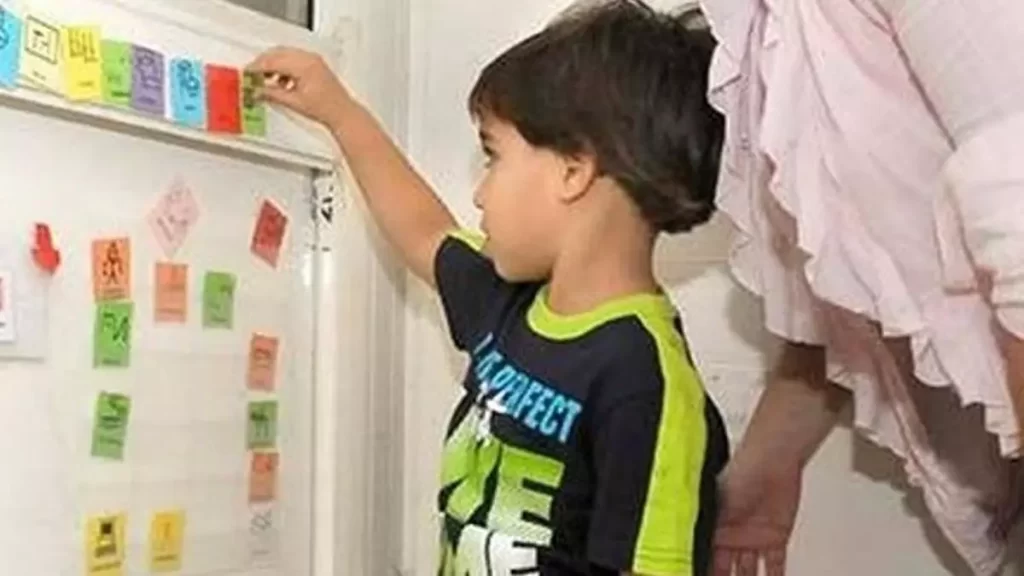
14ymedio, Miguel García, Holguín, 27 June 2024 — During Pedrín’s most recent visit to the dentist, three people were needed to hold him down, in addition to the stomatologist. With an autism spectrum disorder (ASD), any medical treatment that the 15-year-old teenager, who lives in the city of Holguín, needs becomes an ordeal for his parents due to the lack of protocols and resources for these cases in Cuban hospitals.
“We spent days waiting to get an appointment with the only dentist in the entire province who treats children with autism and other neurodevelopmental disorders,” Gabriel, age 44 and the father of the child, told 14ymedio. “The consulting room is in a very narrow space in the Pediatric Hospital and from the moment my son entered he became very upset, because he doesn’t like closed spaces,” he explains.
“I almost had to lie down on top of my child to immobilize him. My wife held his arms and my brother-in-law held his legs. There was no mechanism in place to keep him from getting up from the chair and Pedrín is strong because he weighs about 130 pounds.” Gabriel laments that “the place does not seem at all prepared to treat this type of case. More space and better conditions are needed.” continue reading
“There are practically no clinics in any speciality that are prepared to care for autistic children in this area”
“There is no amalgam for fillings in Holguín, so they had to put in a resin that is not very long-lasting.” The ephemeral nature of the material forces the family to go through the same ordeal again or accept the doctor’s advice: “Next time we’ll take him up to the room and give him general anesthesia,” a difficult decision for his parents to make, who fear that the sedative will aggravate the teenager’s health problems.
“There are practically no clinics in any speciality that are prepared to care for autistic children in this area when they have a health problem. I have to go and speak to the doctors beforehand and explain to them that he cannot be in a cramped space, that he cannot sit and wait for hours in a corridor for the doctor to call him. There is a great lack of understanding on the part of the staff at these centers.”
As Gabriel sees it, the island’s health system “is not prepared to manage the health situations that autistic children and their families face.” Most of the time, doctors “who have training in this type of patient are very scarce and in Holguín they are only in the provincial capital, so you have to travel long distances sometimes to do simple things like a dental check-up or to treat a small wound.”
Since my daughter began to show the first signs of autism, my husband and I have not been able to go on vacation anywhere
The testimony of Pedrín’s father contrasts with the recent announcement made by the Cuban Medical Services Marketing Company (CSMC) that it will offer foreign visitors arriving on the island a program for the care of children with autism spectrum disorders in the hotels of the northern keys in Ciego de Ávila.
Dr. Agnerys Cruz, director of the CSMC in that province, told Prensa Latina that the project will focus on the tourist destination Jardines del Rey. There, clients will be able to opt for “animal therapies in the dolphinariums of Cayos Coco and Cayos Guillermo,” in addition to specialized medical care to improve the well-being and quality of life of these children.
The initiative is the result of a collaboration between CSMC and the Canadian hotel chain Blue Diamond Resorts and also includes health tourism packages aimed at adults with social problems. “Interaction with aquatic mammals will be directed by specialized medical personnel and highly qualified trainers,” reads the announcement, which has not left a good impression on many Cuban families.
“It shows a lack of respect, because that’s what we, the parents of autistic children here in Holguín, have been asking for for years, that there be recreational options for our families who live with a lot of burden on their shoulders every day,” says Gabriel after learning the details of the new offerings for travelers. “I find it insulting that they offer those who don’t live here what they don’t offer us.” His discomfort is shared by other parents in a similar situation.
“Since my daughter began to show the first signs of autism, my husband and I have not been able to go on vacation anywhere,” laments Yaquelín, 32, mother of Rosslyn, 12. “When we have wanted to stay in one of those summer packages they sell to Cubans and we ask if the accommodation has some kind of protocol and comfort for children with this type of condition, they only give us evasive answers.”
“I can’t go and spend a couple of nights in a place where they don’t even offer the minimum for these cases”
“I can’t go and spend a couple of nights in a place where they don’t even offer the minimum for these cases: bathrooms for people with reduced mobility, as is the case with Rosslyn, who is in a wheelchair, or safety equipment around the pool. Some of these hotels don’t even have a first aid kit.”
For Yaquelín, a burning issue is food. “My daughter has become fixated on certain foods and doesn’t want to eat anything else. I have to give her fruit compote, beans or chicken every day, but she doesn’t accept eggs or rice, for example. She also refuses milk and some fruits.” Complying with this narrow eating pattern is a headache for the entire family with little income, given that the mother does not have a job and the father works in a department of the Ministry of Agriculture with a salary of around 5,000 pesos.
“In August of last year, the allocation of chicken for autistic children in the province of Holguín, which is three kilograms per month, was interrupted and was not reestablished until this May.” Achieving the return of the subsidized sale of the longed-for protein was not an easy task either: “Parents of autistic children had to complain to all the authorities, write on Facebook, send messages to [President] Miguel Díaz-Canel and to the National Assembly.”
Although the prices for the tourist package for families with autistic children have not yet been published on the Cuban Medical Services Marketing Agency’s website, an employee responded via social media with some details about the offer. “We want families to feel safe, comfortable and to enjoy themselves with their children without worries. Our staff is highly qualified and the facilities are comfortable and safe.”
“We want families to feel safe, comfortable and to enjoy themselves with their children without worries.”
In the event of any health incident that a child may suffer, “our work teams are professionals with extensive training and great empathy,” concluded the employee, who invited families to “come to Cuba to regain their smile, their peace of mind and to leave the care of the most precious thing in life, children, in the hands of first-class personnel.” Along with the luxury of the accommodations, the program promises to help these children develop skills and alleviate their isolation “caused by communication difficulties.”
Just over 300 kilometers from the northern keys of Ciego de Ávila, Pedrín’s family is preparing for the next visit to the dentist and is considering whether, on this occasion, they will have to rely on more arms to immobilize the teenager in the dental chair or, instead, accept the application of general anesthesia with the risks that it entails.
In Gabriel’s daydreams, he defines himself as “a lion” when it comes to fighting for his son’s quality of life, when that day comes he hopes to find a bright and spacious room, decorated with children’s motifs, a dentist, several smiling assistants and a professional and respectful protocol with the patient. In those dreams, there is all the necessary amalgam to close the gap in his little boy’s tooth, without having to buy a tourist package or pretend to be a foreigner.
____________
COLLABORATE WITH OUR WORK: The 14ymedio team is committed to practicing serious journalism that reflects Cuba’s reality in all its depth. Thank you for joining us on this long journey. We invite you to continue supporting us by becoming a member of 14ymedio now. Together we can continue transforming journalism in Cuba.
’14ymedio’ interviews the musician Gorki Águila in a place in Mexico that we are hiding for his safety
“My plans were in Cuba, where I have my artistic project”
“I am in a dreadful loneliness; I have a growing resentment towards the communist regime every day”
“I want to overthrow the Castros, I don’t want to f’ing reform communism at all”
The leader of Porno Para Ricardo works in a musical instrument store in Mexico / Courtesy Gorki Águila
14ymedio, Adyr Corral, Mexico, 15 July 2024
MEXICO/Scene 1
Gorki Águila waits impatiently on a park bench located in a part of Mexico that he expressly asked not to be revealed, for security reasons. The 55-year-old musician left Cuba in mid-May, after being threatened by the regime with serving a sentence of at least four years for contempt. Months after the incident, he is still afraid of what could happen to him, and he does not allow photographs either, as that would make it easier for political police agents to find his location.
While he suspiciously puffs on a cigarette, the musician reveals to 14ymedio that he has received threats from State Security since his first day here: “They wrote to my WhatsApp. As soon as I set foot in Mexico, they asked me, as if they were my friends: ‘Is everything okay, were you able to talk to your family?’ They know where my family lives,” he says, while showing his phone screen with the conversations.
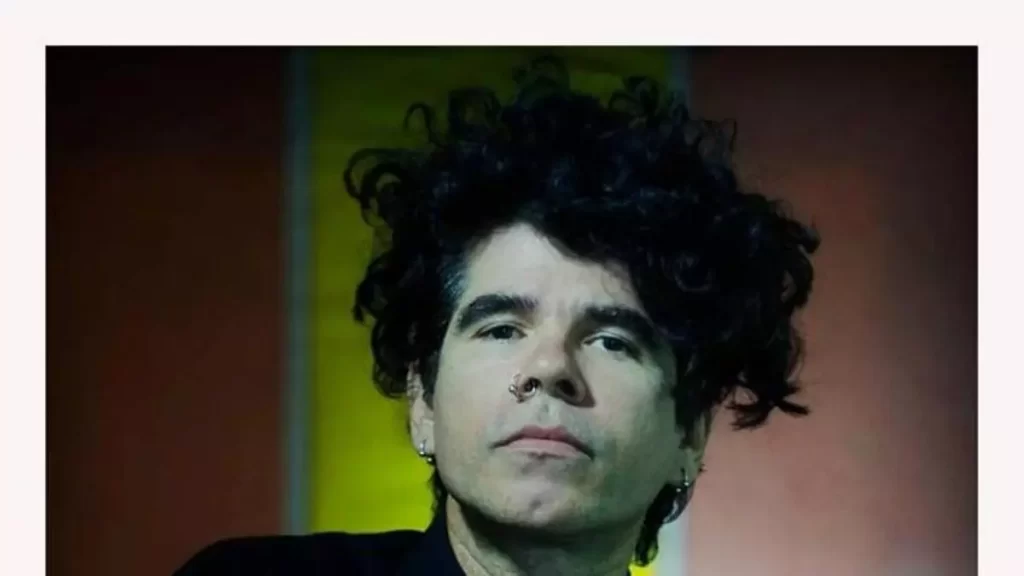
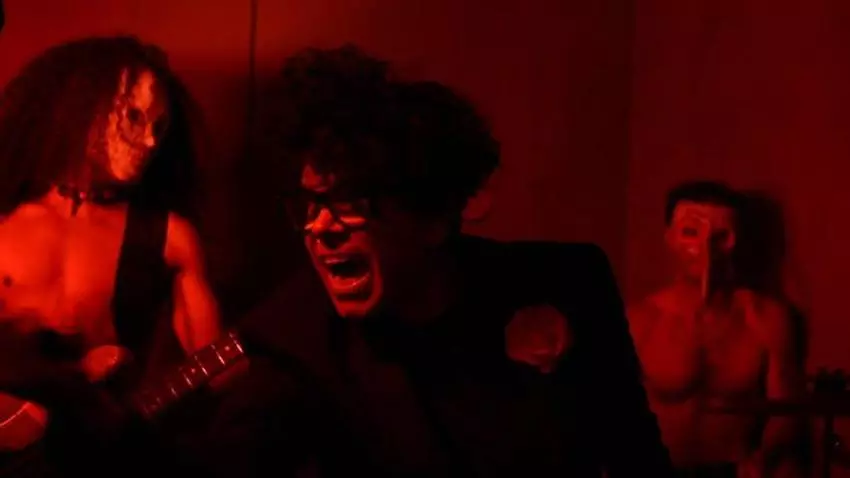
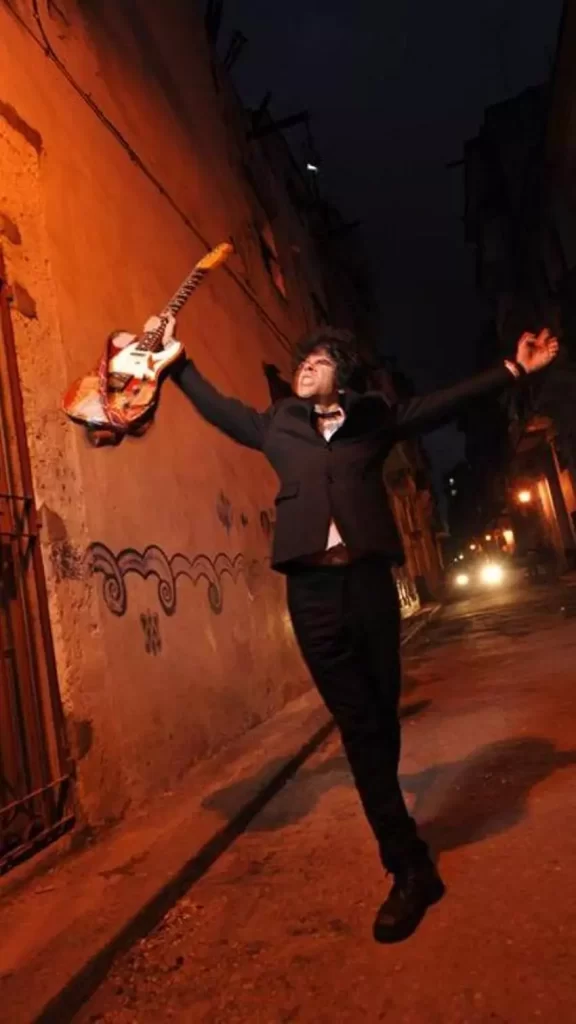
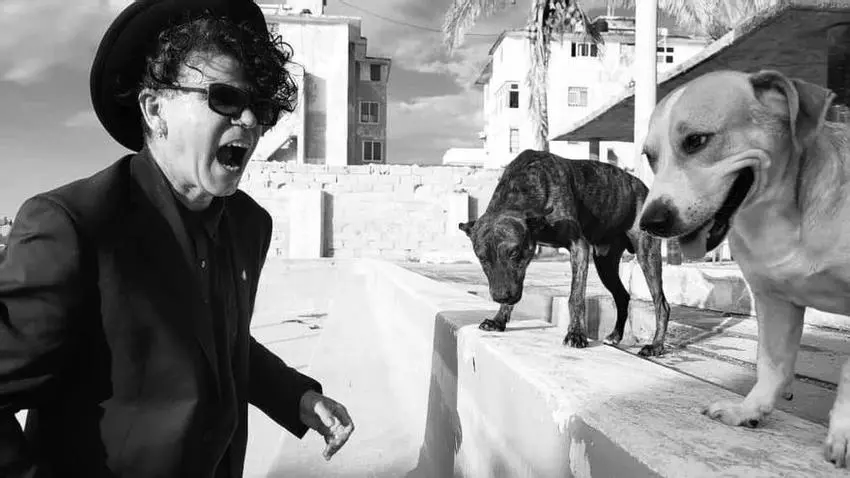
The leader of the Cuban punk band Porno Para Ricardo now works in a musical instrument store to support himself. He arrives at the appointment wearing black pants and a jacket with a white shirt. Mexicans who pass by, sense from his aura, without really knowing who he is, that they are in the presence of a rock star and they direct phrases at him in the form of compliments such as “Long live rock, Robert Smith”, in reference to his resemblance to the singer of The Cure, the English post- punk band, who wears a haircut similar to his.
“They humiliated me and lowered me to a level… I spent almost 15 days crying and not being able to speak. “I arrived with a deep post-traumatic stress”
His new fans also do not imagine that, at the beginning of May, the political police prevented him from boarding a plane that would bring him to Mexico in his first attempt to leave Cuba after receiving an ultimatum, under the argument that it was regulated. Or that, on that very occasion, State Security agents detained him at José Martí International Airport in Havana and later imprisoned him in their barracks to intimidate him.
“They humiliated me and lowered me to a level… I spent almost 15 days crying and without being able to speak. I arrived with deep post-traumatic stress. The protocol for you to go in there is that when you enter, you lower your head against the floor of the patrol car, and it made me extremely dizzy, because the patrol car started spinning, fffff! fffff! So that you don’t know where you’re coming in”, he says about his stay at Villa Marista [a pre-Castro private Catholic school turned into a high security prison].
14ymedio. Why did you come to Mexico?
Gorki. I didn’t choose to come. No, no, I came because I had my residency, so I didn’t need to get a visa, but State Security wanted me to leave. They spoke to me: “Either we’ll put you in prison or you’ll leave”. It’s not just me, they have done it to many opponents.
14ymedio. They told you: you are going to jail or you are leaving Cuba and you preferred…
Gorki. Prefer? No, I did not prefer, I am here under state coercion. I would be in Cuba, you understand? When I went to the airport, they told me, you’re not going to leave and I’ll explain why, because they wanted me to tell them when I left… They knew I was going to Mexico, but they wanted to know what day I was leaving, to carry out an operation and record me on video.
14ymedio. Like a kind of political victory?
Gorki. Yes, and also take those images to later perhaps, perhaps, discredit me. Because I go out with them at the airport, just like that, talking and them making jokes with me, as if they were my family: “Heh-heh. Gorki, you screwed that little girl.” They were making stupid jokes and obviously I didn’t pay attention to them, though I may have laughed at times, I don’t know. And that is filmed by airport cameras. They’re going to use that, obviously.
The rock star has challenged the Castro Regime with his strident and explicit music / Courtesy Gorki Águila
Scene 2
Gorki rummages through the school-style backpack, black with striking orange stripes on the sides, that he has with him. After searching through his belongings with his hand, he takes out a cigarette and lights it while he recounts part of the interrogation he had when he was detained in Villa Marista. “The guy sits next to me and tells me: ‘Look, we’re going to help you, you have a crime of contempt that has a penalty of at least four, five or ten years. But we’re going to help you. We’re going to give you a chance,” he says in a fake voice, as if to give more theatricality to the anecdote.
He takes a couple of drags on the cigarette and the smoke makes his eyes narrow as he continues with his story. “They said something so clownish, so ridiculous, with a conviction: ‘We are going to help you within socialist legality’. At that moment, I should have said, seriously… Seriously? I have a more or less minimal IQ, the southern hemisphere of my brain works….” At that moment, a young boy who must not be older than 17 interrupts him and the interview is abruptly suspended. continue reading
“Excuse me brother, I heard that you are a guitarist. I would like to give you this drawing. I hope you like it” – says the little boy, extending to the musician a sheet with a fairly abstract sketch drawn freehand with a pencil and that from the corner of his eye looks like the portrait of a humanoid figure with reptilian features.
– How cute, huh.
– Thank you for accepting it, the kid responds and then the novice cartoonist threatens to walk away but Gorki prevents him from doing so.
– Hey man, come. Let’s see if I have ten pesos, he says as he digs through his backpack again, this time looking for some change.
14ymedio. What was your routine like in Cuba and how has it changed in Mexico?
Gorki. I’ll be honest with you, the difference for the better is that I have guaranteed coffee, that I have a little bit, that is, condensed milk to add to my coffee and I have bread, guaranteed. It’s so easy to eat here, it even surprises me. Everyday life in Cuba was “what the “f” am I going to eat?” Sometimes, I didn’t have coffee and getting up without coffee is like not getting up. Sometimes, I didn’t have food in Cuba and I would say: “I’m going to stay here in bed longer.” And also, I have medicines, for example, I can go to any pharmacy… they are expensive, but there are options. My head was hurting – I suffer from epilepsy – and I didn’t have a f’ing aspirin in Cuba, man, and here I have it at hand.
Sometimes in Cuba I didn’t have food to eat, and I would say ‘I’m going to stay here in bed a bit longer
14ymedio. What is your life like here?
Gorki. I can describe it to you in three words: loneliness, rootlessness and a lot of resentment, a lot of hatred towards the Castro regime, towards the communists. I have no plans in Mexico, I had plans in Cuba, they plucked me from my land under duress and threw me here. My plans were in Cuba. I have my artistic project, I have my recording studio project, that’s where I come up with the songs, where I come up with my posters (some of them are for sale). Those are my plans. Now, what I have to do is make them up here, what I am is in pure loneliness here, in a rootlessness that you don’t even know at what level. An increasing sadness and resentment towards the communist regime every day, I hate it much more, every day, every minute, every second that passes. I hate it a lot. I have to remake myself.
His creations are mostly inspired by the aesthetics of the golden era of the political poster, the predominant means of communication in public, educational / Gorki Águila
14ymedio. Here, haven’t you been able to?
Gorki. No. I live in a makeshift room in a living room, how do I move a studio there?
14ymedio. Is it a matter of time?
Gorki. I imagine, I suppose. I will never give up my creative side, but that bothers, humiliates, offends, degrades. I’m telling you, every day I hate communism and, in particular, the Castro regime more so.
14ymedio. Do you feel free in Mexico?
Gorki. You have to define freedom, you see, how do you feel free? You feel free within your context. You feel free when you obey your will. How can I feel free, if I am living uprooted? I am in a context that is not mine.
14ymedio. How are you doing with that?
Gorki. I lived in Cuba in my house. Now, I have to live on a mattress in a living room, imagine! I don’t know if you have habits like that, in that way, attached, but for a 55-year-old man the worst thing you can do is tell him, come on, let’s go to a nursing home! I want to die in Cuba. Every day there are fewer people, there are fewer Cubans in Cuba. Cuba, now, is no longer Cuba. Let’s think about that. It’s a crime against humanity, what the Castros are doing in that place. Their hands are not going to shake when they shoot, like in Belarus, no, no, they are going to shoot and kill. 11J happened, they killed two or three people with total impunity. I am an opponent. I want to overthrow the Castros, I don’t want to reform communism at all. I am here because I believed in those plans, and at a specific moment, those plans fell apart in my head. I felt like I was totally alone immersed in a whole broth of demagoguery and corruption on the part of people who say they are our friends and that they are helping us. There is no opposition in Cuba today, I tell you categorically. With all propriety. There is no opposition in Cuba. There are people who send phone recharges, crumbs, and who dictate a road map, that is not opposition.
What the Castros are doing in that place is a crime against humanity. Their hands are not going to shake when shooting, like in Belarus, no, no, they are going to shoot and they’re going to kill.
14ymedio. What is needed for there to be opposition in Cuba?
Gorki. Create a real, raw debate to locate what our problems are. When you want to be cured, you have to know that you are sick, if you don’t know that you are sick, you will never be cured, that is the first step. And after accepting that you are sick, you have to diagnose yourself, there has to be a diagnosis. So, to recognize the disease, we are still in the step, we do not recognize that the Castros are not our only enemies, but everything that surrounds that. In other words, there are people who are living off the Cuba issue, the “freedom in Cuba” issue.
Look, when you are a flat tire fixer and in front of you, on the road, there is a pothole full of glass, do you want that pothole to be fixed? If you live by the fact that every car that gets a flat tire comes and has you fix the flat, your business is fixing flats, you get it? When (or why) are you going to tell the driver: “Oh, that pothole is bad!”? So it never gets fixed, because you’re f’ing living off that pothole, your dough comes from there, and then, that’s what’s happening. In no road map of any NGO [Non-Governmental Organization] that exists, in any other country, or in Miami, does it say: “Cuba is going to be liberated in 2050. I am going to stop making money and living off this NGO and stop living this way.” None! No NGO tells you “in such a year I will stop receiving money for doing this job that for me is onerous and infamous, because I am receiving money from living off the issue of freedom in Cuba and in addition, I get applause from the international community.”
14ymedio. Previously, it was thought that if Fidel died, the Castro Regime would fall….
Gorki. That’s what I thought when I was a kid. And who has to die next? Until when, people? The only ones who are going to overthrow the regime are the Cubans who are inside Cuba, we are not going to overthrow it from beyond, opposing it with air conditioning.
14ymedio. How does art influence all this?
Gorki. For me, art is super important, why do you think that politicians always join artists in campaigns, because they know that art is a super immediate, super powerful vehicle. Pop music is super powerful when it comes to transmitting, much faster than a pamphlet and a speech. A pop artist’s audience members are voters. A pop artist utters any stupidity and those people are going to believe it.
14ymedio. Is Porno for Ricardo still alive?
Gorki. Yes, when you see I’m dead is when you will be able to say “Porno para Ricardo ceased to exist.” It will exist as long as I live.
14ymedio. In the past, you said that Porno para Ricardo was a rock band that wanted to have fun, have they had fun? Are you still having fun?
Gorki. Yes, we have had our revenge. Look, always, in creation, you suffer the creative process…
“Pop music is super powerful when it comes to transmitting, much faster than a pamphlet and a speech” / Courtesy Gorki Águila
Scene 3
Gorki is interrupted again. This time it’s an old lady who goes around the park in her wheelchair begging for alms. “They don’t give me a coin. Whatever you like to support me with, young people. Thank you, young people, for helping me,” she says, without any remorse for cutting off the singer’s story about his creative process.
The backpack was left open since the last rummage, so it is not difficult for Gorki to take out a coin and give it to the woman who, before extending her hand to receive it, had already started her wheelchair by giving the right wheel a strong push. “Also, if you give it to everyone you will run out of money, man! And I feel sorry for them, but sometimes they are also scammers. Anyway,” says the rocker before resuming the conversation.
14ymedio. What price have you had to pay for having fun?
Gorki. The price we have had to pay, for example, is to give up our audience. We did it conscientiously. We knew that if we took the step of getting directly involved with the regime, we were going to disappear, that is, they were going to give us a magical pass like Harry Potter, with the wand, tiki, tiki. You don’t exist anymore.
I really dreamed that I could influence, that is, influence in the sense of my crumb. That, at one moment I could experience the fall of the Castro Regime. I have no hope anymore, the way things are
14ymedio. When you woke up, the tyrant, the tyrannosaurus, was it still there?
Gorki. Yes, exactly. I made a parody of it, I even put it on Facebook once: “When I woke up, the regime was still there.” You could say, because I really dreamed that I could influence, that is, influence the meaning of my crumb. That at one moment I could experience the fall of the Castro regime. I’m no longer hopeful, the way things are.
14ymedio. Do you think you won’t live to see it?
Gorki. Now I’m not sure. I have lost faith in that sense, something that depresses me. My mom died and she didn’t see it, it seems I will too. It’s kind of sad… Don’t you want a beer? I know a place where we could smoke.
14ymedio. What’s next for Gorki in Mexico? What are his plans?
Gorki. What I am sure I can tell you, in the present, is that I am going to continue being anti-Castro and I am going to continue being libertarian and I am always going to bet on freedom and I am going to be consistent and coherent with what I have said. Now, not in the future. I don’t know what’s coming in the future. I’m telling you a punk motto, and that’s it. The Sex Pistols motto. But I don’t know what’s going to come with me. I have total uncertainty. I just tell you, part of my hatred is based on that. They have put me in a place where I do not want to be. I would like to come visit, and go to my place, to my Motherland. I don’t know what awaits me, I would like to make music, join bands here to play on stage, to experiment and give that message that Cuba is not what they sold you, that theorem that they have sold you. I would love to do that.
“They have positioned me in a place where I do not want to be. I would like to come visit, and go to my place, to my Motherland” / Courtesy Gorki Águila
Scene 4
Someone else approaches Gorki and this time completely steals his attention. She is a brunette woman in her 20’s. The pretext for interfering in the interview is to collect some money to cover the expenses of an animal shelter.
-Hello, sorry. Sorry for the inconvenience, I come from a shelter that is dedicated to rescuing dogs. At the moment, we have 300 dogs and 50 cats, I don’t know if you would like to support us, says the girl.
– I am a fan of dogs, Gorki answers.
–Look, there are two there– says the activist while pointing to her companions, who have a Great Dane and a Golden Retriever doing convincing work, based on their mere presence, with the passers-by from whom they also ask for support to pay for their food and that of the other animals.
At that moment, Gorki ends the interview and gets up to go meet the dogs.
Gorki has always been a dog lover / Courtesy Gorki Águila
Translated by Norma Whiting
____________
COLLABORATE WITH OUR WORK: The 14ymedio team is committed to practicing serious journalism that reflects Cuba’s reality in all its depth. Thank you for joining us on this long journey. We invite you to continue supporting us by becoming a member of 14ymedio now. Together we can continue transforming journalism in Cuba.
The regime has taken advantage of our anger to present us as “haters” and to feed the fear of change
The supposed “unity” of the regime is not based on the hope that one day things will get better / EFE Archive, 1980 [Text of sign: Out With the Scum]14ymedio, Yunior García Aguilera, Madrid, August 7, 2024 — “Libertad sin ira,” “freedom without anger” [lyrics] is one of the most representative songs of the Spanish transition to democracy. In its lyrics it speaks of a Spain personified by the old authoritarianism and another embodied in a generation that sought to be free, without bloodshed. At that uncertain moment, after the death of dictator Franco, the song of the Jarcha group became a hymn for many. In our Cuba of 2024, the frustration of a people who fail to dismantle a desperately long-lived dictatorship often leads us to anger. I don’t deny that there are a thousand reasons that can support it. However, I wrap my brain around this question: is resentment useful? Will we be able to achieve a freedom without anger or will we perpetually writhe in anger without freedom?
The Cuban regime has taken advantage of that rage to adorn its narrative. While they, supposedly, are the ones who “love and build,” we are the “haters.” Such cynicism only increases the fury on the opposition side, justifying it equally with concepts from José Martí, such as invincible hatred and eternal resentment. But I haven’t come here to talk to you about poetry. I want to talk about strategy.
Martí has been used by Cubans with almost the same intensity as those who quote Christ to shore up their creeds. That’s why I would like to put the emphasis, rather than on his words, on his actions. The man Cubans call ‘the apostle’ was able to forgive even the henchman who tried to poison him. And not only did he offer them his forgiveness, but he also managed to persuade them to join the independence ranks. The story reveals to us how young Valentín ended up fighting on the Mambí side, reaching the rank of commander and becoming a convinced devotee of Martí for the rest of his life. continue reading
Martí has been used by Cubans with almost the same intensity as those who quote Christ to shore up their creeds
I know, it’s always easier to have a repertoire of Martí quotations on the lips than to imitate his behavior. Others will say that we leave the dead alone, that we live in another century, that we should stop waving the apostle as if he were a carnival flag. And maybe they are right. But what we call values, principles or ethics is always a convention based on references. It is useless to give up Martí. In the next century, if there is any Cuban left alive, we will continue to name him.
During these days, there have been heated controversies on social networks about the victory in Paris of the Greco-Roman fighter Mijaín López. Those who congratulate him are right; his sporting feat is undeniable. And those who point to him as a furious defender of Castroism, protagonist of repressive episodes, are right. Others have chosen to celebrate Yasmani Acosta, also Cuban, for his meritorious silver medal representing Chile. Although there is also no shortage of those who have lashed out against him, for his “warm” statements about the dictatorship.
Some European friends write to me without understanding not even one word. You Cubans, they tell me, will never be able to agree. And I’m not saying I’m free of blame. In my case, I limited myself to recognizing the triumph of Mijaín López, with nothing more to add, receiving my corresponding downpour of insults.
In this fight of ours, the most common thing is to entrench ourselves on one side, incessantly lobbing verbal grenades towards the opposite ditch, although it is also common for us to attack ourselves inside our own trench. At this rate, if we achieve freedom one day, we will all be so emotionally mutilated that the reconstruction of the country and national reconciliation will continue to be postponed.
At this rate, if we achieve freedom one day, we will all be so emotionally mutilated that the reconstruction of the country and national reconciliation will continue to be postponed
We have a lot to learn from our Venezuelan brothers. Regardless of how everything ends, the opposition has already managed to concentrate all its arrows against the dictatorship. They have unmasked the tyrant;
they have managed to add the vast majority of the people, and they have captured the attention of the whole world. Their speech is firm: there will be no impunity, but they extend their hand to anyone, military or civilian, who takes the right side.
In his book “The Art of War,” Sun Tzu recommended always leaving an escape route to the enemy. At the same time, he recommended putting your army in a dead-end position, to motivate them to fight to death, without ever considering withdrawal. The Cuban regime has read the manuals very well. For decades they have suggested to their supporters that, in the face of an eventual change, they expect they would all be hung in the public square. There are ordinary people convinced that the enemy will go house by house to look for them to settle scores for having been in the FMC [Federation of Cuban Women] or the CDR [Committee for the Defense of the Revolution]. The supposed “unity” of the regime is not based on the hope that one day things will improve, but on the fear that one day things will change. And sometimes we ourselves contribute to that mentality.
In order for this battle not to be eternal or useless, it will be necessary to dismantle many myths and change strategies. The possibility of joinig together must always be left open. We must be able to differentiate between justice and revenge. We will have to know how to convince as many Cubans as possible that the future will not be a simple change of flags in the barracks of hatred, exclusion and insult, but finally, freedom without anger.
Translated by Regina Anavy
____________
COLLABORATE WITH OUR WORK: The 14ymedio team is committed to practicing serious journalism that reflects Cuba’s reality in all its depth. Thank you for joining us on this long journey. We invite you to continue supporting us by becoming a member of 14ymedio now. Together we can continue transforming journalism in Cuba.

 EFE (via 14ymedio), Mexico City, 9 August 2024 — The Center of Documentation of Cuban Prisons recorded 130 complaints of repressive acts against 94 inmates in Cuban prisons in July, according to a report released Thursday by the independent platform.