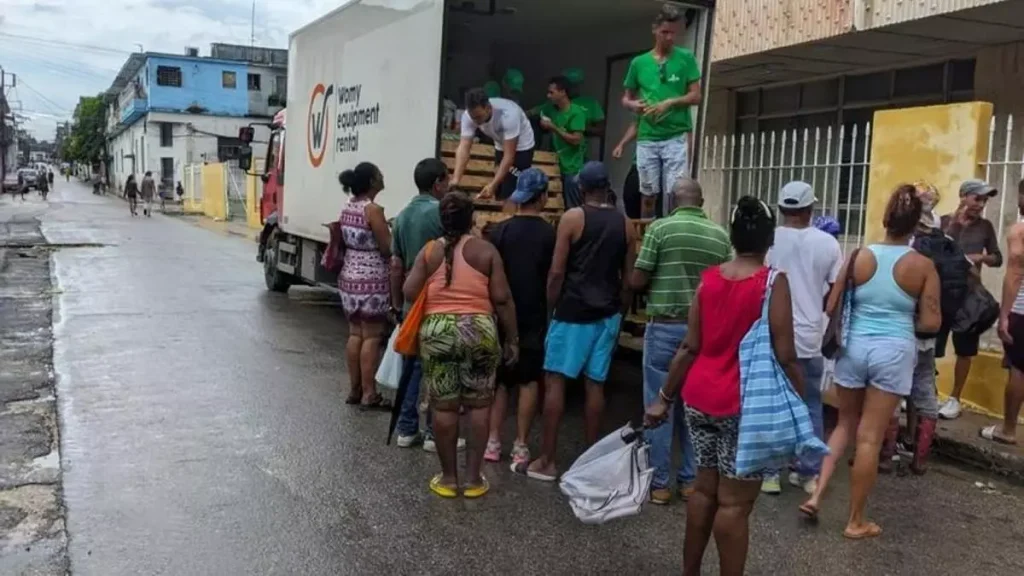
What can a patient who suffers from all possible diseases die from?
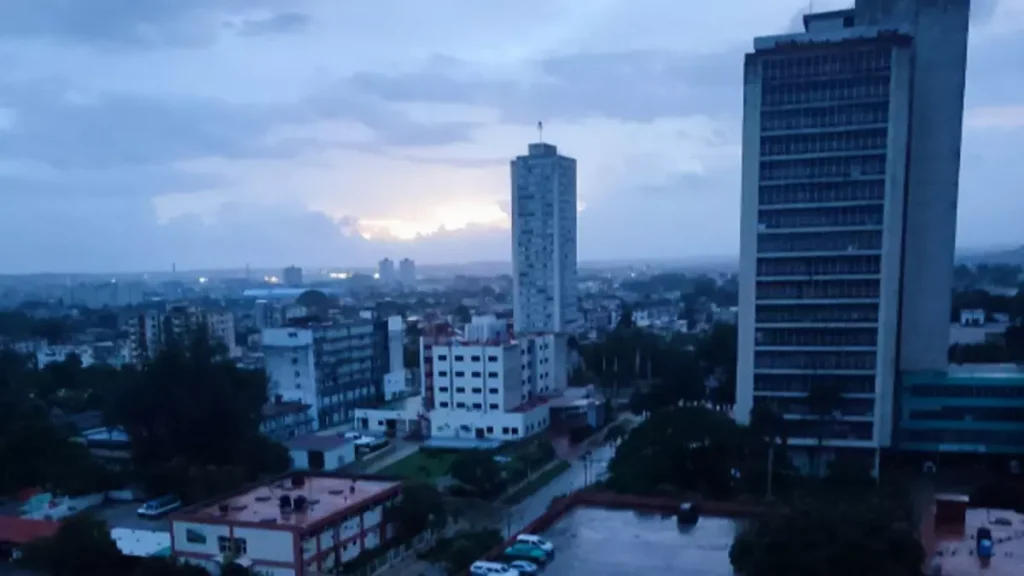
Sancti Spíritus street in darkness. / 14ymedio
14ymedio, Reinaldo Escobar, Desde Aquí, Havana, 22 October 2024 — No foreign power has invaded Cuba in October 2024; there has been no earthquake; no devastating hurricane has crossed the island; there is no civil war nor has an epidemic broken out. Parliament has not declared itself in rebellion, disapproving the laws sent to it by the Government for consideration, the military remains in its barracks, there have been no social explosions like those that occurred in July 2021, nor has there even been a disagreement in the ranks of the Communist Party. No forest fires, no plagues, no tornadoes, but nevertheless, the consensus is growing that the current situation is the unequivocal sign of a terminal crisis.
The “current situation” refers to the collapse of the National Electric System (SEN) which in less than 72 hours has left most of the population in a state of calamity accompanied by the uncertainty of not knowing, or even imagining, how and when solutions will appear.
The voices from within and outside the country demanding that the Government resign do so mostly from peaceful positions, basing their claim on the evident ineptitude of the leaders who remain in their positions for the simple reason that there is no legal way to remove them from their posts. continue reading
A poorly tightened nut on a thermoelectric plant can cause another similar collapse at any time.
Those in power in Cuba have no intention of standing down. In their absolute lack of self-criticism, they do not even review the past (i.e., Fidel Castro’s legacy) and instead the furthest they go is to acknowledge that they have not been capable of being worthy of that legacy. They blame all the ills on the United States government, which does not want to lift the embargo and persists in keeping Cuba on the list of countries that cooperate with terrorism or that do not fight it adequately.
Those who cross the red lines of denying legitimacy to the leaders of the single party, pointing out the unviability of the socialist system or denouncing the repressive actions of State Security run the risk of ending up in prison.
The collapse of the National Electrical System is a sign of the country’s fragility, and this fragility is nothing new. A poorly tightened nut on a thermoelectric plant can cause another similar collapse at any time. But it is not the only fragility. If Nicolás Maduro were forced to leave power in Venezuela, if something happens to Vladimir Putin in Russia, if the Chinese opt for another path, if President Lula slips in the bathtub again in Brazil, if the Paris Club does not want to forgive the debts again, if Cuba’s ousted Economy Minister Alejandro Gil escapes his detention and tells everything he knows…
Terminal crisis? More like multisystem or multiorgan fragility. What can a patient with every possible disease die of? You never know, maybe they get struck by lightning or hit by a train.
____________
COLLABORATE WITH OUR WORK: The 14ymedio team is committed to practicing serious journalism that reflects Cuba’s reality in all its depth. Thank you for joining us on this long journey. We invite you to continue supporting us by becoming a member of 14ymedio now. Together we can continue transforming journalism in Cuba.
Instead, Cuba’s Minister of Foreign Affairs, Bruno Rodríguez, will attend
The Cuban president with his Russian counterpart, Vladimir Putin, in a 2022 photograph / Granma
14ymedio, Havana, 21 October 2024 — Miguel Díaz-Canel will not attend the XVI BRICS summit, which will be held in Kazan, Russia, between Tuesday and Thursday, due to the collapse of the electrical system on the Island. It was not the Cuban president or any authority on the Island who reported it, but the advisor for international affairs of the Russian presidency, Yuri Ushakov.
The official told the press on Monday that Díaz-Canel canceled his trip due to “unforeseen circumstances.” That is, “the problems of the energy supply in Cuba,” which “are forcing the Cuban president to stay in Havana these days.”
The Minister of Foreign Affairs, Bruno Rodríguez, will take his place. Unlike what happened last August, Cuba hopes to concretize its incorporation as a partner country. continue reading
Another leader who canceled his visit to the summit is Luis Inácio ’Lula’ da Silva, for “medical guidance” after suffering a “domestic accident”
Another leader who canceled his visit to the summit is Luis Inácio ’Lula’ da Silva, for “medical guidance” after suffering a “domestic accident” in which he hit his head, government and hospital sources reported.
The Brazilian Presidency said in a statement this Sunday that it decided to cancel the trip due to a “temporary impediment to long-term flights,” but that Lula will participate by videoconference in the meeting.
The president, who is 78 years old, injured the back of his head on Saturday and was admitted to the Sírio-Libanês Hospital in Brasilia, according to a brief medical report.
Ushakov said that the first meeting, in which the Russian president will meet with the director of the New BRICS Development Bank, former Brazilian President Dilma Rousseff, will take place this Tuesday.
Another country that seeks to join the bloc is Venezuela, although, according to a report published by the Brazilian newspaper O’Globo this Monday, Lula da Silva wants to avoid it
“Rousseff will be followed by the Prime Minister of India, Narendra Modi. We had planned a meeting with the president of Brazil, Lula da Silva, but it is clear that he will not come, so we will meet with the president of South Africa, Cyril Ramaphosa,” he said.
It is expected that during the sessions of the XVI Brics Summit one of the central themes will be the admission of Cuba to the group. Russia, Brazil, India, China and South Africa are the group’s founding members, and Egypt, the Arab Emirates, Ethiopia and Iran have recently been added.
Another country that seeks to join the bloc is Venezuela, although, according to a note published by the Brazilian newspaper O’Globo this Monday, Lula da Silva wants to avoid this. He considers that the Chavista regime, led by Nicolás Maduro, violated international agreements by disputing clean and auditable elections.
Translated by Regina Anavy
____________
COLLABORATE WITH OUR WORK: The 14ymedio team is committed to practicing serious journalism that reflects Cuba’s reality in all its depth. Thank you for joining us on this long journey. We invite you to continue supporting us by becoming a member of 14ymedio now. Together we can continue transforming journalism in Cuba.
The effects of the hurricane will delay the recovery of electricity in Guantánamo province
A street in the city of Baracoa, in Guantánamo province, after Oscar’s passage / Radio Guantánamo
EFE/14ymedio, Havana, 21 October 2024 — Hurricane Oscar, weakened and downgraded to a tropical storm as it passed through the eastern region of Cuba, left at least six dead in the municipality of San Antonio del Sur, Guantánamo, the authorities reported on Monday. The storm continues slowly along its path, with heavy rain and winds that have caused material damage and the evacuation of thousands of people.
“At the moment there are forces from the Ministry of the Interior, the Armed Forces and the Red Cross participating in salvage and rescue actions” in San Antonio del Sur, said Colonel Argenis Perales Pérez, head of the Operations Department of the National Staff of Civil Defense, speaking on the Mesa Redonda program. He pointed out that the number of deaths is considered “preliminary data.”
The first hurricane of the current season in the Atlantic that has directly affected Cuban territory, Oscar entered on Sunday afternoon through a point near the city of Baracoa, in the province of Guantánamo, where the greatest effects are recorded, according to official media.
“Greenhouses, homes, work centers, electrical lines and crops have suffered damage caused by the heavy rains and winds of Oscar,” reported Radio Guantánamo, illustrating its publication on networks with images of the city of Baracoa after the passage of the storm.
According to preliminary reports, both in Baracoa and the municipalities of Imías and Maisí, there are effects of varying magnitude in more than 1,000 homes, and large floods have forced the evacuation of several thousand people. continue reading
Oscar continues to weaken over the eastern region, and its maximum sustained winds are up to 37 miles per hour
Regarding the effects of the hurricane, state television has reported accumulations of rain up to 12 inches, overflowing rivers and flooding, washed-out roads and the loss of roofs due to the force of the winds.
The most recent hurricane warning from the Institute of Meteorology (Insmet) has indicated that Oscar continues to weaken over the eastern region, and its maximum sustained winds are up to 37 miles per hour, with higher gusts.
The heaviest rainfall has spread to the province of Holguín and remains over Guantánamo and its adjacent seas, while the storm moves slowly to the west-northwest at only four miles per hour, adds Insmet.
It also warns, for the next few hours, of heavy and locally intense rains, showers and thunderstorms in much of the eastern region, and high tides on the north coast of the provinces of Guantánamo, Holguín and Las Tunas.
According to forecasts, Oscar will remain in eastern Cuba for more than 24 hours and is expected to break from a point north of Holguín province on Monday night.
The effects of the system will delay the recovery of electricity in that territory of the Island, according to information from the authorities, on the fourth day that the country suffers from the collapse of the national energy system.
Oscar is the fifteenth hurricane of the current season, although the US National Hurricane Center has described it as “small.”
The meteorological services of the United States and Cuba warned months ago that this hurricane season in the Atlantic, which runs from June 1 to November 30, was going to be especially active.
The last time a major hurricane hit Cuba was in September 2017, when Irma advanced parallel to the north coast of the Island and caused ten deaths and material losses officially valued at 13,185 million dollars.
Translated by Regina Anavy
____________
COLLABORATE WITH OUR WORK: The 14ymedio team is committed to practicing serious journalism that reflects Cuba’s reality in all its depth. Thank you for joining us on this long journey. We invite you to continue supporting us by becoming a member of 14ymedio now. Together we can continue transforming journalism in Cuba.
White House spokeswoman Karine Jean-Pierre explained that the Administration is “closely monitoring” the energy situation on the Island
The blackout on the Island lasted four consecutive days beginning this Monday / 14ymedio
14ymedio/EFE, Havana/Washington, 21 October 2024 — The White House said on Monday that it is closely following the blackouts that Cuba has suffered in recent days and does not rule out providing aid to the Island, although it specified that the Cuban Executive has not requested assistance.
In a press conference requested by the EFE news agency, the White House spokeswoman, Karine Jean-Pierre, explained that the Administration is “closely monitoring” the energy situation on the Island.
“We are concerned about the possible humanitarian impact on the Cuban people. As we have seen in recent years, the economic conditions of Cuba, derived from a prolonged mismanagement of policies and resources, have undoubtedly increased the difficulties of the Cuban population,” she said.
“We are concerned about the possible humanitarian impact on the Cuban people,” said a White House spokeswoman
Jean-Pierre also emphasized that the United States “is not responsible” for blackouts or the general energy situation in Cuba, contradicting the Cuban continue reading
authorities, who have blamed the commercial “blockade” that Washington has maintained on the Island for more than six decades.
The spokeswoman explained that the Cuban government “has not requested any help so far,” although she did not rule out providing it in the future if they do. In the event of such a request, she explained, the US Administration would “evaluate the next most appropriate steps.”
At the beginning of the general blackout, on October 18, the US Embassy issued a warning: “All US citizens in Cuba or who plan to travel to Cuba must be aware of and plan according to this situation.”
Translated by Regina Anavy
____________
COLLABORATE WITH OUR WORK: The 14ymedio team is committed to practicing serious journalism that reflects Cuba’s reality in all its depth. Thank you for joining us on this long journey. We invite you to continue supporting us by becoming a member of 14ymedio now. Together we can continue transforming journalism in Cuba.
Nicolás Maduro says that the crisis on the Island is due to the US embargo
Caracas has significantly decreased oil shipments to Havana in the last year / EFE
14ymedio/EFE, Havana/Caracas, 19 October 2024 — The Government of Venezuela called on the international community on Friday to mobilize in support of Cuba, in view of the national blackout that the Island is experiencing, a situation for which Caracas holds the United States and its policy of economic sanctions responsible. Venezuela “expresses its absolute solidarity and unconditional support to the sister republic of Cuba, while facing the cyclical energy contingency, the product of the cruel intensification of the economic war and financial and energy persecution by the US Government,” Nicolás Maduro’s Executive said in a statement.
In his opinion, the “illegal blockade against the Cuban people” seeks “the application of a collective punishment, which represents a crime against humanity.” “Venezuela supports all the efforts heroically made by the people of Cuba as well as its president, Miguel Díaz-Canel, to mitigate the impacts of the criminal unilateral coercive measures,” the letter reiterates.
In this sense, Caracas ratified that Cuba “has the full support” of the Venezuelan Government to face this situation and overcome it, while calling on other countries to support the island nation at this time. “Venezuela urges the international community, especially the Latin American and Caribbean, to mobilize in support of Cuba and absolutely condemn the infamous unilateral list of countries that supposedly support terrorism, facts that are undoubtedly the main cause of the effects Cuba suffers today,” the statement concludes.
Havana’s historical ally did not make a single mention of the regular oil shipments it sends to the Island as part of the agreements signed between Hugo Chávez and Fidel Castro. In September, the latest available data, Caracas sent about 22,000 barrels of oil per day (bpd) to Cuba, a considerable drop compared to 33,700 bpd in June and even 28,000 bpd in April. continue reading
The historical ally of Havana did not make a single mention of the regular oil shipments it sends to the Island
At that time, Maduro accused “an account called Anonymous” of “the extreme right, anti-Venezuelan,” which “works directly with the CIA,” of having sabotaged the national electricity system. The president did not offer details of the “attack,” but a few days later, a major power cut occurred in the country again. That, along with breakdowns suffered by the equipment, explains Reuters, forced them to postpone improvements for several more days, which ended up having an impact on fuel shipments.
The fall in the supply of Venezuelan crude oil coincides with the worsening of the energy crisis in Cuba, an argument supported by the expert of the University of Texas, Jorge Piñón, as he explained this Friday to Martí Noticias. “I know, from my sources, that Venezuela told Cuba that it would prioritize oil shipments to (the Spanish) Repsol and (the American) Chevron, which pay in cash, and that is what they need. […] They told Cuba to stand in line,” he explains. As for the aid from Russia and Mexico to Havana, the first has not quite materialized, and the second has decreased, says Piñón.
This Friday, after hours of “zero national energy coverage,” the Cuban Government announced that the National Energy System had a second “total disconnection,” making it clear that Cubans will spend more hours without electricity.
Translated by Regina Anavy
____________
COLLABORATE WITH OUR WORK: The 14ymedio team is committed to practicing serious journalism that reflects Cuba’s reality in all its depth. Thank you for joining us on this long journey. We invite you to continue supporting us by becoming a member of 14ymedio now. Together we can continue transforming journalism in Cuba.
Residents know that the meager pound of protein doesn’t go far, but the temptation to make a soup or fry some thighs is greater than their disappointment at the small amount.
Local residents lined up early to buy meat from the neighborhood butcher shop. / 14ymedio
14ymedio, Juan Diego Rodríguez, Havana, 15 October 2024 — “You take some skin, some bones and a little ice and suddenly you’ve got a pound.” That is the exact amount of chicken that the ration book, which governs food distribution on the island with an iron fist, says each Cuban is supposed to get. Families in Havana’s Luyanó district have not received the allotted amount for months. Even so, government officials claim that the hindquarters that were delivered Monday night to the Sagrado Corazón de Jesús (Sacred Heart of Jesus) butcher shop under a persistent drizzle were October’s supply.
“For a long time, you could only buy chicken for children or the elderly. Now, finally, pregnant women and everyone else can get it. But they say it’s only for October. It’s best not to count on getting the last two months’ quota,” says Rosario, a resigned local resident. Nevertheless, she and twenty or so neighbors lined up early to buy what they could.
The news that thighs and drumsticks had arrived spread quickly through Luyanó. “Even the local representative mentioned it on the WhatsApp group where she posts information. And every now and then you could hear someone shout, ‘The chicken has arrived,’” says Rosario.
The news that thighs and drumsticks had arrived spread quickly through Luyanó
Everyone here knows the meager protein ration does not go very far but the temptation to make a soup out of it or fry up some thighs is stronger than the disappointment at the small amount. “Besides the fact that it is almost never available, the rationed chicken is not enough for anything. I myself continue reading
always have to buy it on the black market because it’s the easiest and cheapest meat to get. I never rely on the butcher shop to have it. But if it does, I’ll buy it because it only costs 20 pesos,” adds Rosario.
Sagrado Corazón — it is still known by its original name rather than La Esquina (The Corner), the one given it after the revolution — opened unusually early on Monday. As soon as the chicken arrived at its doorstep at around six in the morning, the meat market began serving the first customers who showed up looking for their pound of poultry.
The shop with the two-word name also serves a dual purpose. After an employee at a nearby store fell from grace and the roof collapsed at Sagrado Corazón’s original location, the business ended up taking on two roles. “Government officials wanted to make it a combination grocery store and butcher shop. And since that suited the grocery store manager, who would have more products to sell, he didn’t complain. Also, the manager of one of the stores was a drunkard and people were lining up at the other to look at the sky through the hole in the roof,” says Rosario.
The shop with the two-word name also serves a dual purpose
“It was the manager of Sagrado Corazón himself who renovated the store, painted it and, I think, even pays the security guards who work outside. From time to time, products that you can’t buy with the ration book show up on the sales counter and no one knows where they came from. The guy with the know-how always finds a way to do business,” Rosario says.
On Tuesday, a street vendor has set up a stall outside El Sagrado Corazón to take shelter from the rain. “I’m going to buy a handful of his plantains, make a “fufu”* with them and have it with the chicken,” says Rosario in a rapacious tone. By noon, neighborhood residents were still to gathering at the entrance, ignoring the store’s posted closing time. “We have to take advantage of this opportunity while we can. After this batch, there might not be any more chicken till next year.”
*Translator’s note: A dish of boiled, mashed plantains
____________
COLLABORATE WITH OUR WORK: The 14ymedio team is committed to practicing serious journalism that reflects Cuba’s reality in all its depth. Thank you for joining us on this long journey. We invite you to continue supporting us by becoming a member of 14ymedio now. Together we can continue transforming journalism in Cuba.
Shortly before 8:00 AM Cuba still remained in the darkness. / 14ymedio
14ymedio, Havana, October 19, 2024 — By Saturday it will be 24 hours since a massive power outage gripped Cuba on Friday morning. Meanwhile, getting the nation’s power grid back up and running seems to be moving slowly. 14ymedio was able to confirm that electricity was restored to a few isolated facilities in Havana such as hospitals. However, the Cuban Electric Union (UNE) reported that, as of 6:15 AM, the entire power grid in the west of the country was down again. Of the 650 megawatts that were restored by early morning, 350 were later lost to a system malfunction.
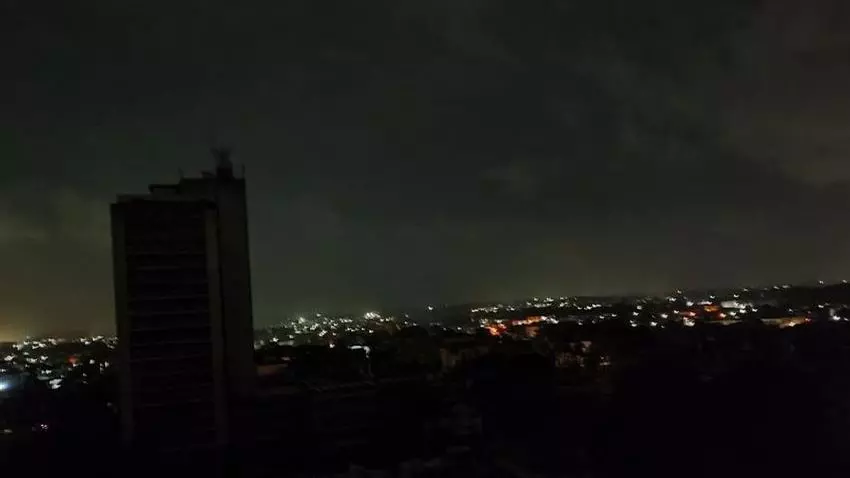
The sound of the canon being fired from the San Carlos de La Cabaña Fortress at 9:00 PM marked the beginning of another dark night in the capital. At no point in the day could smoke be seen rising from the giant fuel-powered Turkish generator floating in the harbor, an unequivocal sign that there would be no electricity anytime soon. Not everyone was in the dark, however. Some private businesses remained open thanks to backup generators. Yet as hospitals were struggling to get by, several government offices were wasting energy.
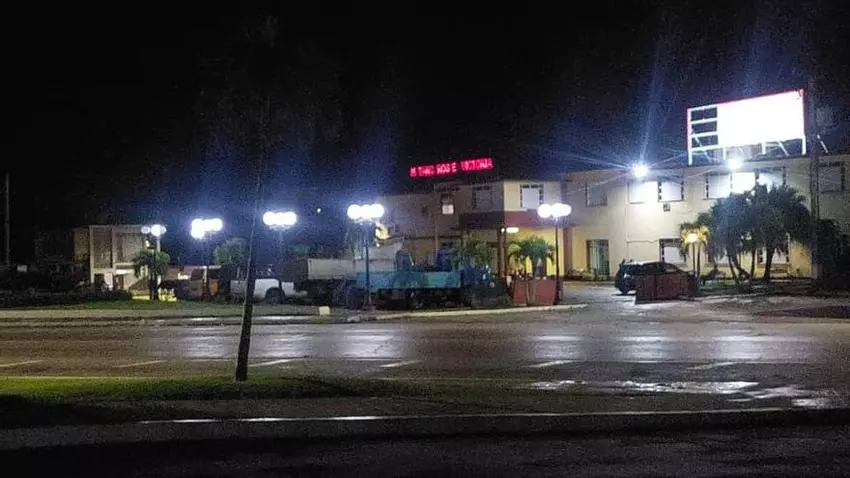
Such was the case with the local Communist Party headquarters on the night of October 18 in Versalles, a town in Matanzas province, which managed to keep its outdoor lighting, illuminated sign and nearby street lamps turned on. continue reading
By dawn, power had been restored to areas near Old Havana and the bay but they quickly lost it again. / 14ymedio
After a quiet night at 14ymedio’s editorial offices in Nuevo Vedado, there was still no electricity in the morning. By dawn, it was clear that power had temporarily been restored to some areas near Old Havana and the bay but, shortly thereafter, they lost it again. As it turned out, the cold front that has caused heavy rains and flooding in recent days did bring some relief from the heat to Havana’s residents, who were unable to turn on their fans or air conditioners. In fact, several residents decided to heed the warnings of their more experienced neighbors and unplugged all their home appliances to prevent them from catching fire in the event of a sudden power surge.
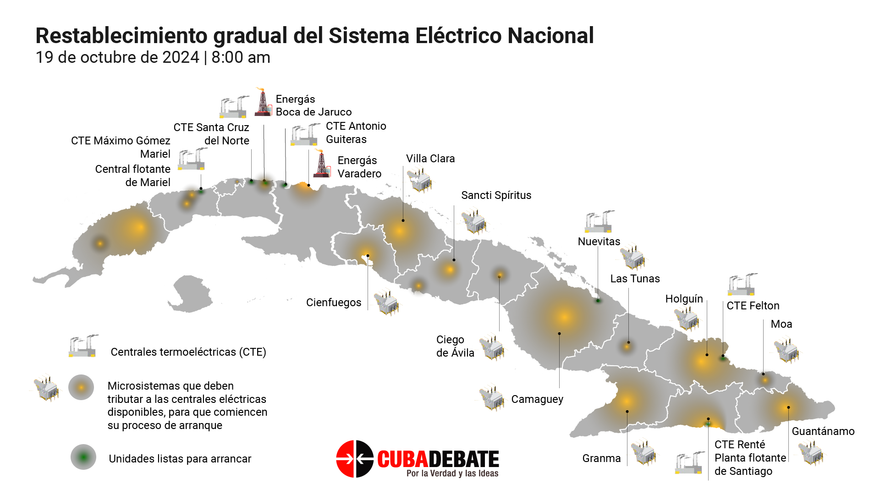
In a morning news update on Cuban television, which continues broadcasting even though few can watch it, officials explained that every province, except Artemisa, have managed to restart generating stations and isolated power plants in order to provide electricity to nearby diesel-powered electrical plants, which need at least some energy to start up again. The Energás plants in Boca de Jaruco and Puerto Escondido, which supply Varadero and parts of the capital, had been operating since the afternoon. One unit of the Santa Cruz del Norte plant in Mayabeque and three units of the Mariel plant in Artemisa were scheduled to be restarted at dawn.
Lights as the local Communist Party headquarters in Versalles, a town in Matanzas province, managed to keep its outdoor lighting, illuminated sign and nearby streetlamp turned on all night. / 14ymedio
The floating Turkish generator managed to get power to Renté plant in Santiago de Cuba, though officials have not yet confirmed if it is working or not. The Felton plant in Holguín and the Tenth of October plant in Camagüey were also expecting a partial restoration by late evening. Only two Moa units are operating.
When asked about the massive power outage, Lázaro Guerra, director of the Ministry of Energy and Mines, said he could not guarantee that the electrical grid would be fully operational by Sunday but hoped that “important advances” could be made on Saturday.
Currently, only three Havana hospitals — Calixto García, Central Havana Pediatric and Enrique Cabrera (National) — have electricity. Power has also been partially restored to some neighborhoods such as Altahabana in the Boyeros district (5,100 customers) and Cojímar and others in the Regla district (3,700 and 3,000 respectively).
A journalist for state media, Lázaro Manuel, also reported that, in Pinar del Río, power had been restored to city hospitals and central commercial areas of Mantua, Sandino and Palacios.
Except for Artemisa, every province has managed to provide some of the energy needed to restart diesel-fueled power plants. / Cubadebate
As for the Antonio Guiteras thermoelectric plant in Matanzas, whose sudden failure caused the collapse of the country’s entire power grid, officials have only said that repairs there have been completed and that they are trying to restart it. One day before the “total disconnection,” UNE officials warned that, after operating all summer, the plant needed to be shut down for maintenance. All indications are that the plant failed before that could happen.
Faced with the uncertainty that has gripped the entire country, government leaders are resorting to the usual appeals for people to pitch in and promises that everything will return to normal, though without indicating exactly when that might happen. “I repeat — and this is what you [the electrical workers] are proposing — no one will rest until we fully restore the system. And we will work with all the precision, with all the dedication and with all the perseverance [needed] to do so,” said Cuban president Miguel Díaz-Canel yesterday afternoon to senior officials from the Cuban Communist Party and the Ministry of Energy and Mines, who met in a room that had both power an air conditioning.
As expected, the president blamed the U.S. embargo for the situation, stating that the blackout is “yet another demonstration of all the problems that the blockade is causing us.” Claiming that he was not trying to give a long, tedious answer, he added, “Sometimes people say, no, that it is due to inefficiency, that they want to annoy people.” Scattered among the president’s complaints were clues about the current energy situation. “First, we do not have the fuel we need. Also, we have not been able to conduct the needed repairs. And all of that is due to the [hard] currency situation, currency that we do not have because of financial persecution, and the fuel that we do not have because of the energy persecution. It is the blockade. It is because of the intensified blockade of these times,” he concluded.
He asked the public for the usual “understanding of the situation, of the complexity of the moment we are experiencing.” Without going into too much detail about the magnitude of his words, he also said, “Even when we get out of this situation, of the total ’disconnection’ that we had, we will still be in this emergency [situation], which will vary depending on the results of a series of efforts that we have made [to secure] financing and available fuel.”
Díaz-Canel explained that, even after the island’s power grid is restored, Cuba will still face power cuts, for which he tried to avoid taking responsibility. “It is a tense, complex situation that is not solely dependent on the wishes being expressed or the desire to resolve this situation,” he said. “It also has to do with objective problems of fuel availability, financing availability and availability of electrical generating capacity at this time.”
“It’s a tense, complex situation that is not solely dependent on the wishes being expressed”
With regard to transport, the minister of that portfolio, Eduardo Rodríguez Dávila, reported that airports are operational thanks to their generators but there have been problems in maintaining the movement of inter-provincial trains and buses due to the fuel shortage. In the capital, where the situation is less uncertain than in other provinces, 125 micro-buses will be running on Saturday out of the 243 normally in operation, along with 74 of the 150 electric tricycles, said Rodríguez Dávila.
An employee at Havana’s José Martí International Airport told 14ymedio that, although the air terminal has, so far, been able to rely on its own generator, airport officials believe they will run out of fuel by 11:00 AM on Sunday. “If they don’t give us the go-ahead [to refuel the generators] now, we will have to close the place down,” he said. He also noted that Cubana de Aviación has scheduled a Saturday flight for the presidential IL96 aircraft. While he dares not speculate as to why, one idea seems tempting to him. “I hope they take off and leave all this behind. If they do abandon the country, it will happen like this, in the middle of a massive blackout, so that no one finds out.”
Even the U.S. Embassy in Havana issued a statement asking its citizens on the island to take extreme precautions. “Today, Cuba’s entire power grid was shut down due to the failure of one of the country’s main power plants. It is not yet known when power will be restored. Emergency services are expected to continue to operate but U.S. citizens in Cuba, or those planning to travel there, should take precautions. Internet and cell phone service outages are also reported,” the embassy posted on X.
According to a Havana airport employee, the air terminal only has enough fuel to last till Sunday morning
Cubans have known something is going on since Prime Minister Manuel Marrero appeared on Cuban television Thursday night. In his speech, which lasted less than an hour, he announced that the government had decided to “paralyze the economy in order to guarantee a minimum level of electrical service.”
The information had been previously released by the UNE, which issued a statement indicating that “non-vital services that generate energy costs” would be suspended. These include educational activities at all levels from Friday to Sunday. Additionally, cultural activities, discos, recreation centers and “other activities that generate high concentrations of people” would be suspended, both in state and private sectors.
Only vital facilities such as hospitals and food production operations will remain while essential workers will remain at their jobs.
Meanwhile, the director of the country’s state owned oil company, CUPET, explained that a ship loaded with fuel oil, “which the country purchased with extraordinary effort, arrived on the 9th [of October]. However, this coincided with the arrival of bad weather and it was not able to dock in Matanzas until the 14th.” The ship in question, which the director did not name, is the Equality, a vessel registered in Tanzania. It is one of the ships the country uses to transport cargo, in this case fuel, between between Cuban ports.
References to the construction of solar-energy farms and plans to eliminate fossil fuel dependency fell on deaf ears now that Cubans find themselves in complete darkness and without a viable short-term solution.
____________
COLLABORATE WITH OUR WORK: The 14ymedio team is committed to practicing serious journalism that reflects Cuba’s reality in all its depth. Thank you for joining us on this long journey. We invite you to continue supporting us by becoming a member of 14ymedio now. Together we can continue transforming journalism in Cuba.
The minister explained the causes of the debacle in the sector: “lack of tires, batteries, parts and spare parts, lubricants, oil and special liquids”
s of August, not even half of the planned number of passengers had been transported in Santiago de Cuba
14ymedio, Havana, 20 October 2024 — It was just a matter of time before Eduardo Rodríguez Dávila, the “Minister of Facebook,” reported on how the total blackout in which the Island is immersed has fatally injured Cuban transport. The “contingency of the electricity system” – the usual euphemism with which the official press insists on describing the massive energy debacle – has been disastrous for the whole country, but especially, the official reported, for the eastern provinces.
The train and bus routes that connect Santiago de Cuba, Holguín, Bayamo, Manzanillo and Guantánamo with Havana – a transport network that has been showing signs of exhaustion for at least eight months – have been severely affected by the lack of fuel. Therefore, in the face of the most recent blackout, they face “complex conditions due to various operational aspects, related to fuel supply,” according to Rodríguez himself, but this is only the icing on the cake.
The situation within the provinces is even worse. In Santiago de Cuba, the provincial transport company, since the first half of the year, has fulfilled only 45.7% of its plan for the period, which translates into less than half of the passengers it had planned to transport.
Rodríguez ventured to explain the causes of the debacle in the sector: “the lack of tires, batteries, parts and spare parts, lubricants, oil and special liquids for the sustainability of the fleets. On the other hand, only 56.1% of the fuel planned for the first eight months of the year has been available. The above aggravates the working conditions, organization and quality of services.” continue reading
“The figures from Granma province are even more serious than those of Santiago de Cuba,” the minister also said on his social networks
“The figures from Granma province are even more serious than those of Santiago de Cuba,” the minister also said on his social networks. The numbers support that sad panorama in the province, where the company failed to comply with the provincial plan by 76.4% and operates only 7.7% of the bus fleet, which received only 21.9% of the fuel that corresponded to it in that period.
The “alternative” vehicles, such as electric tricycles – allegedly prepared to overcome the fuel shortage – have not been an efficient solution in Granma province either. Despite the fact that the authorities, including Rodríguez Dávila himself, have promoted them as the solution to all the mobility problems of the Island, the service is not well organized. It is insufficient, of low quality and unable to help the Island recover from the general blackout.
The situation resembles those of other eastern provinces such as Holguín, where at the end of August, only 37.7% of the trips originally scheduled had been made.
The data show a compliance of 17.3% in the case of urban buses, 56.9% for interurban buses, 30.9% for public transport and 45.1% for rural buses. “The province has assets of just over 50% its buses, which have less than a third of the fuel planned for the eight months of the year,” the minister said.
In Guantánamo, the data are almost identical to those of the other provinces. Less than half of the passengers were carried, only 44% of the vehicles are still in operation, and the fuel allocation was barely one-fifth of what was needed.
Rodríguez Dávila introduces in his reports phrases such as, “Behind the complex situation of transport in each territory there are very sharp financial and resource limitations”; “It is not something that can be solved in only one visit”; and, “It is possible to reverse all this” – hoping to appease public opinion. However, it is becoming increasingly difficult to explain to Cubans why, in the midst of a general blackout, only planes continue to operate, flying in and out of in the country.
Translated by Regina Anavy
____________
COLLABORATE WITH OUR WORK: The 14ymedio team is committed to practicing serious journalism that reflects Cuba’s reality in all its depth. Thank you for joining us on this long journey. We invite you to continue supporting us by becoming a member of 14ymedio now. Together we can continue transforming journalism in Cuba.
Taken in Camajuaní in 2023, published in El Estornuso in April 2023
Iván García, 22 August 2024 — At half past two in the morning, the blackout. Luciano opened the last drawer of the wardrobe, took a piece of cardboard and went to the room where his 8-year-old son was sleeping. His wife was already cooling him with a fan. The mosquitoes buzzed like aeroplanes in his ears. An hour later, the boy burst into tears because of the heat. She brought him water and started to tell him children’s stories in an attempt to calm him down.
Luciano, his mother, his wife and his son live in a dilapidated building in the municipality of Sandino, some 220 kilometres west of Havana. They live a hard life, like most Cubans. They have no relatives abroad to send them dollars. Luciano’s family comes from a village in the mountainous Escambray region of the former Las Villas province.
“My parents owned a small farm where, in addition to growing coffee, they kept pigs, sheep and chickens. The authorities accused my father of helping guerrilla groups fighting against the government and sentenced him to twelve years in prison. They confiscated everything from him and forcibly transferred my mother, alone, to a captive village in the municipality of Sandino. My father was released from prison after serving half of his sentence, he died twenty years ago,” says Luciano, who was born in Pinar del Río.
“I remember my mother working as a tobacco picker and collector. She is 86 now and suffers from osteoarthritis and urinary incontinence. I earn my living as a day labourer growing rice and crops. In the good months my salary is 8,000 to 10,000 pesos, but that money isn’t enough to feed four people. That’s why I go fishing in the lagoon, where there are plenty of trout, some I take home, the others I sell”, says Luciano and explains that the problem is not only food, but also the shortage of drinking water, which only comes every forty days. continue reading
“Every two days I have to carry dozens of buckets of water from a turbine two kilometres away to the third floor of the building where we live. Several neighbours go in a cart and make two or three trips. A miserable life. In their free time, the men pass the time with cockfighting or a group of friends drinking a couple of bottles of rum and relieving their frustrations. In these villages there is no future. The younger people go off to the city or they emigrate. We are left, the oldest assholes, who never try to do anything to change our destiny.”
His flat is in urgent need of a lick of paint. There are dark patches on some parts of the ceiling due to damp caused by leaks from broken pipes. The termites have shattered the Miami-style windows. The most valuable object is an old Haier refrigerator, that the dictator Fidel Castro bought for a knock-down price in China when he implemented the so-called ’energy revolution’ in 2006, which was supposed to save the country’s electricity. Eighteen years later, the fridge is hardly working. The gaskets of the equipment have come loose and Luciano’s solution was to screw a crude metal clip on the door that allows the fridge to be opened and shut.
The furniture in the flat is ancient. The television set, with a 21-inch screen, has cathode ray tubes. In the kitchen hang two slotted spoons, two cast-iron pans, and a rice cooker that has lost its enamel. The three beds in the two rooms need to be replaced, as do the mattresses. “When the old woman urinates, as we don’t have disposable pads, we have to carry the mattress up to the roof of the building to dry it out in the sun. And when the water crisis hits, we relieve ourselves in nylon bags, which we then dump in the fields.
Luciano believes that in 2014 they were still eating well, by Cuban nutritional standards. “We had bread with tortillas and coffee with milk for breakfast and what was left over from dinner for lunch. We ate pork frequently, fish, chicken and sometimes beef, which I bought under the counter and a pound cost 25 or 30 pesos. Nowadays, a pound of beef is not less than 1,200 pesos. We couldn’t go to a hotel in Varadero, but we had breakfast, lunch and dinner seven days a week. Now we can only eat once a day.
According to a study carried out last July by the Cuban Observatory for Human Rights, extreme poverty on the island is close to 90 percent of the population. According to surveys by the Food Monitor Program, Cuban families currently spend almost all of their income on food, whether they have a low or a good income, whether they receive dollars or not. Nutrient deficits, lack of food hygiene, and the stress associated with food insecurity are “is having adverse consequences for the health of Cubans,” the organisation says.
Likewise, the “phenomenon of hidden hunger”, used by the FAO to describe prolonged undernourishment, is “very common in Cuban society”, which consumes more carbohydrates and sugars while going without fresh fruit and vegetables, as well as meat and dairy products, which has led to high rates of diabetes, high blood pressure and gastritis, among other ailments, said Food Monitor.
But it is not only food that is missing in Cuba. Basic services such as electricity, liquefied gas and public transport hardly work. Blackouts outside Havana often last eight to ten hours a day, or more. The shortage of medicines is more than 65 percent. Rubbish piles up for days in the streets, especially in the capital, which is dirtier and more abandoned than cities in other provinces. Due to breaks in the aqueduct, 50 per cent of the drinking water that is distributed does not reach homes or is lost through leaks. Hospitals are a mess. Patients must bring disposable syringes and cotton wool, among other supplies. And if you want good care, you need to give money or gifts to the doctors and nurses.
“The water supply cycles in the neighbourhoods of Holguín exceed 55 days,” says Yoss from Holguín. From Santiago de Cuba, Rudy says that in several areas of that city they have been without drinking water for more than 60 days. “The houses are full of containers. Those who have dollars build huge cisterns. For lack of water, despite the tremendous heat, there are people who bathe every two days. It’s as if they were in a war.
Many Cubans see no way out of the country’s structural crisis. For Luciano, from Pinar del Río, there are three options: “Emigrate, continue to put up with it or take to the streets to protest. Either we put on our trousers, like the Venezuelans, or this government starves us to death”.
In Holguín, hospitals are in the dark, and anguish is growing before the arrival of Hurricane Oscar
There are mile-long lines to buy propane to cook food before it rots in the refrigerators
The situation has escaped the hands of the authorities / 14ymedio
14ymedio, Mercedes García/Miguel García, Sancti Spíritus/Holguín, 20 October 2024 — When Olimpia saw last Friday that her entire neighborhood in Sancti Spíritus was in a blackout, she thought that the episode was just one more of the many they have been having for weeks, when the daily deficit of the Electric Union did not fall below 1,000 megawatts. It was not until a neighbor uttered the words “total disconnection” that her concern skyrocketed. In the last two days, her block only recovered service once, this Sunday morning, only to lose it again soon after.
“The whole night all of Sancti Spíritus was in the dark,” explains the woman, who has seen the city transform into a ghost town in a few hours. “People only go out to buy food, but there is not even that. Many have lost all the food they had because without a refrigerator it begins to rot. The bread that is mainly supplied by private bakeries also suddenly disappeared,” she says.
Olimpia explains that the bread from the bodega (ration store) continues to arrive, but – she highlights – those places have not been spared from the consequences of the general blackout. “Since there is no current, they are selling all the rationed chicken that came in for the ration quota until it runs out in all the bodegas. It’s one small piece of chicken thigh, but people buy it even if they have to cook it right away so it doesn’t spoil.”
Olimpia, like other Cubans, saw her parents and grandparents “resolve” with what they could to overcome any situation. The inventiveness she received by inheritance, however, did not prepare her for a situation like the present one, she says. “People are going crazy watching what they eat, how they cook. Gas lines have become impossible. They suspended the tickets in the on-line application because, since there is no connection, there is no way to know if it was your turn. Only the physical line works. I signed up and have a number close to 700,” she says. continue reading
The bodegas have started selling the rationed chicken to prevent it from spoiling / 14ymedio
The alternatives in these days of uncertainty, she says, are few: “In several places they sold some broth for eight pesos.” In practice, Cubans have had to manage as they can. “This morning I was able to charge my generator and am using it only for the fridge, so that my meat doesn’t spoil. Otherwise, I stay in the dark,” she states.
Olimpia has been able to communicate very little with her family, which she finds – as she explains – as uninformed as she is. “The radio works occasionally. This morning I was able to listen to it for three or four hours, but the news gave little information, and the only useful thing they said is that in this area, at least until Wednesday, there will be no electricty.” The internet connection, she continues, has also been “terrible” these days. “The cell phone continues to show 3G or 4G, but in reality you can’t send messages or make calls. The information that people have is what they hear from the neighbor, who in turn heard it from someone else.”
The movement of the authorities also does not give any indication that there will be changes soon. “There is an orientation for workplaces that they cannot turn on the generators, and those who turn them on out of necessity cannot turn on air conditioners or computers. Only the essentials. The transport is not working either. There is only one bus going around in the mornings, but there are almost no people on the streets.”
One thing, however, has caught Olympia’s attention these last few days: “The military is running around like crazy ants.” “There are policemen and agents everywhere, especially those in green uniforms that say Operational Guard. I don’t know what they are doing, but they are mobilized,” explains the woman, who saw an army vehicle pick up two neighbors from her block. “The wife of one of them told me that she has not yet heard from him,” she adds.
In Holguín, Manuel has seen the same symptoms of the crisis. Refrigerators full of spoiled meals, the stench of garbage accumulated for days, the scarcity of water that begins to hit families and, to top it off, the arrival of Hurricane Oscar this Sunday that keeps the people distressed by the scarce resources they have and the little information they receive.
Many people have spent up to 12 hours in line to buy something / 14ymedio
“I had to go out to a field on the outskirts of the city to be able to contact my family. I got as close as I could to an antenna, and although the connection was bad, I was able to call. However, all the numbers I dialed were off or out of the coverage area,” Manuel explains .
The situation in the provincial capital, he summarizes, is “as everywhere”: dark. “I talked to my 70-year-old grandmother, who lives in the San Rafael neighborhood, and she told me that she had to cook with wood,” says Manuel, who explains that in recent hours the residents in the city have bought out the propane tanks to stock up before the effects of Oscar are felt in the province. “The lines are miles-long, with hundreds of customers waiting to buy. There are people who got in line at two or three in the morning, and after 12 hours they are still there,” he says.
A visit with his sick mother in the Lucía Iñiguez Surgical Clinical Hospital allowed him to see a side of the crisis that he would never have imagined. “Everywhere they say that electricity has been prioritized to hospitals, but when I entered all the doctors were giving consultations in the dark,” he recalls.
The tension, he explains, could be felt in the corridors, where even the doctors and nurses openly expressed their discontent. “I passed by a consultation and listened to a doctor, very frustrated because there is no staff even to perform operations. At the moment they are only attending to emergencies, but the situation worsens as the cases accumulate,” says Manuel, who heard the health worker complain about the lack of resources. “He said that he recently had to give a patient a list of everything he had to get to have an operation, from syringes and catheters to antibiotics and topical anesthesia,” he adds.
I also heard two nurses complain that Public Health does not give them time off because many people have left. There is a lack of staff in the internal pharmacy, in the operating rooms, in the specialist consultations,” he lists, saying that, at first glance, you can see that “the hospital is almost empty.”
The situation has escaped the hands of the authorities, who do not even efficiently reach the population to explain the collapse of the SEN or the arrival of Hurricane Oscar. And the confluence of the two worries Cubans. “Since they reported this disaster at the national level, people are very upset,” reflects Olimpia, who soon abandons the theme and returns to reality: “What are we going to do? Where are we going to go?”
Translated by Regina Anavy
____________
COLLABORATE WITH OUR WORK: The 14ymedio team is committed to practicing serious journalism that reflects Cuba’s reality in all its depth. Thank you for joining us on this long journey. We invite you to continue supporting us by becoming a member of 14ymedio now. Together we can continue transforming journalism in Cuba.
Deodorant, toothpaste and other basic necessities are available only in private stores and shops that take foreign currency
Sellers increase their prices and “take advantage of the problem” with toiletries / 14ymedio
14ymedio, Julio César Contreras, Cienfuegos, 19 October 2024 — Anyone who wishes to purchase personal hygiene products in Cienfuegos at a reasonable price will have to travel the whole city without the guarantee of obtaining what they are looking for. Deodorant, toothpaste and other basic necessities have disappeared from state establishments. When they are found, they are displayed on private business tables and shelves at prices unattainable for the majority of the population. Wearing perfume, therefore, has become a luxury that few allow themselves.
“Buying a deodorant in a store in MLC (freely convertible currency) is simply impossible,” complains Irene, a Cienfueguera in her 40s. “The few times they put it out, it’s quickly monopolized by merchants who then resell it at a minimum price of 800 pesos.” This Monday morning, she says, she walked all over the Paseo del Prado and saw them priced at up to 2,500 pesos. “In my house there are four people, and between my husband and me we earn only 7,000 pesos per month. I get like the Cockroach Martina,* with the difference that with that money we can’t buy anything,” she adds.
According to this mother – she has two sons – the shortage of this type of article is more pressing in rural areas. There, she says, private merchants raise prices more and “take advantage of the problem. While in the city of Cienfuegos a common soap costs 160 pesos, in Palmira it can be worth 200 or 250, depending on the seller. The saddest thing is that this is our only option. Whoever depends on the ’basic family basket’ [from the rationing system] in Cienfuegos cannot bathe.”
Michel, owner of a restaurant, says that he allocates no less than 5,000 pesos a month just for toiletries
For his part, Michel, owner of a restaurant, says that he allocates no less than 5,000 pesos a month just for toiletries. “I’ve always liked to put on cologne after bathing. Touring the points of sale on the boulevard, the cheapest price is around 1,500 pesos, and in the Eureka store, for example, continue reading
the most affordable is 7 MLC,” he says. “I wonder how people who don’t receive financial aid from abroad and those who receive the miserable salary that the Cuban government pays to its workers can buy these things.”
This self-employed person says, however, that some time ago it was relatively easy to buy soap and detergent at private businesses, to name just two products. However, with the most recent government measures, these items have also been lost from these establishments. “Along the Calzada de Dolores you could find what was necessary, and there was even variety. Today it is a tremendous headache to get the essentials to keep the house clean and, in my case, also the business,” emphasizes Michel.
In the private shops on San Carlos Street, toothpaste costs between 1,300 and 2,000 pesos / 14ymedio
In the private shops that are located along San Carlos Street, toothpaste can be found for a price between 1,300 and 2,000 pesos, depending on the brand and the quality of the product. “I don’t buy a tube of toothpaste every month, but the mere purchase is almost a family sacrifice,” says Annia, who just bought the item in a private store. “There is no alternative but to save as much as possible, because it is not an optional product: it directly affects health.”
This Cienfuguera confesses that she must juggle to keep her clothes well washed, and having shampoo and hair conditioner is practically a whim: “We have been plunged into horrifying misery. People, in addition to being hungry, are neglected and dirty, experiencing extreme needs that threaten the quality of life and existence itself. Misery has even crept into our skin, and it will be very difficult to eliminate it.”
*Translator’s note: A story told to children about a cockroach that finds a penny and doesn’t know where to spend it.
Translated by Regina Anavy
____________
COLLABORATE WITH OUR WORK: The 14ymedio team is committed to practicing serious journalism that reflects Cuba’s reality in all its depth. Thank you for joining us on this long journey. We invite you to continue supporting us by becoming a member of 14ymedio now. Together we can continue transforming journalism in Cuba.
Ferrer (left) and Navarro (right), were imprisoned during Cuba’s Black Spring in 2003. / 14ymedio
14ymedio, Peter Corzo, Miami, 20 October 2024 — The prison systems of the Castro-Chavez regimes are particularly cruel and merciless. They establish such miserable conditions of survival that people subsist thanks to unbending moral values and the unbreakable brotherhood generated by perpetually lurking death.
Food is precarious, medical care is non-existent and, even worse, selective. The sick are treated based on instructions given by an official who is governed by political patrons, not by the health of the patient. Overcrowding is the rule, never the exception, and family visits are subject to the whims of a henchman, who arbitrarily suspends them, in addition to the innumerable difficulties for the family to provide goods or visit the inmate.
In these countries there are prisons that epitomize the extreme evil of the regime, without the rest of the dungeons being five-star hotels.
Food is precarious, medical care is non-existent and, even worse, selective
In Nicaragua, the Chipote fortress is by far the most frightening; in Venezuela this miserable honor corresponds to the Helicoide; Bolivia is not far behind with colonial prisons; and in Cuba there continue reading
are many incarceration centers that can be considered antechambers of hell, in addition to being perhaps the country with the most prisons and political prisoners in the world, relative to its size and population.
In the prisons of each and every one of these countries there are prisoners who symbolize the cause that brought them to prison. People of absolute dedication and unfading courage, always ready for extreme sacrifice, like Armando Sosa Fortuny, who died in prison after having served 43 years in two stages, a death that looms over other patriots like Ernesto Borges, who served 26 years in prison last July, and Miguel Diaz Bouza, who completed his 30-year prison sentence on October 15 and remains behind bars.
In these 65 years of Castroism, more than half a million prisoners have passed through Cuban prisons, and have been behind bars for between one day and 30 years. In addition, many prisons have been distinguished as the most cruel and sadistic, among them the Castillo de San Severino, La Cabaña, Puerto Boniato, Guanajay, the National Prison on the Isle of Pines, Siete y Medio and Kilo Siete, while some prisoners have been examples of resistance and capacity for sacrifice, among others, Cari Roque, Pedro Luis Boitel, Mario Chanes de Armas, Roberto Martin Pérez and Amado Rodríguez.
There are currently at least two political prisoners, among a host of men and women in prison, who in my opinion symbolize everyone’s commitment to freedom and civil rights.
In Cuba, there are many prisons that can be considered antechambers of hell
José Daniel Ferrer and Félix Navarro, two opponents of totalitarianism who were imprisoned during the Cuban Black Spring in 2003 and released in 2011, refused to go into exile, despite being aware that they would return to prison because they would never give up on their efforts to free Cuba and Cubans from totalitarianism.
Ferrer, who was last arrested on 11 July 2021, tried to take part in the civic protests that took place across the island, and has since suffered continued ill-treatment by the regime. His family denounces the abuses he suffers, in particular the extreme isolation to which he is systematically subjected as part of Raúl Castro and Miguel Diaz-Canel’s plan to “bury him alive.” Again, in recent days, his wife was prevented from visiting him with their children.
Félix Navarro is in the gloomy prison of Agüica, in the province of Matanzas, a prison that has had a very bad reputation since the 1970s, due to the abusive henchmen and the diabolical conditions of its facilities.
Navarro, leader of the Pedro Luis Boitel Party for Democracy and vice president of the Council for Democratic Transition in Cuba, was also sentenced to nine years in prison for the 2021 national protests. Since last June, he has not received medication for the chronic illness he suffers from, a common practice of Castro’s henchmen working in the prison system.
Navarro and Ferrer should not be forgotten. To paraphrase a song by Albita Rodríguez: “They have the honor of having been born in Cuba and loving the freedom crushed by the Castros and their hitmen.”
____________
COLLABORATE WITH OUR WORK: The 14ymedio team is committed to practicing serious journalism that reflects Cuba’s reality in all its depth. Thank you for joining us on this long journey. We invite you to continue supporting us by becoming a member of 14ymedio now. Together we can continue transforming journalism in Cuba.
Despair is growing after almost 30 hours without electricity, which could last much longer
A truck parked this Saturday morning in front of the Miguel Enríquez hospital, in Havana, sells candles and cookies at exorbitant prices / 14ymedio
14ymedio, Juan Izquierdo, Havana, 19 October 2024 — The prelude to the total blackout was, for Magaly, very similar to a horror movie. The TV screen lost intensity, the fans began to move the blades in slow motion, and the refrigerator’s surge protector – whose red light turns on the alarm of any Cuban home – went off. The woman, retired in Santa Clara and a veteran of the Special Period, launched her “protocol” to save food.
Months of intense blackouts have prepared her for any scenario. Without wasting time, she took half a dozen bottles – real “blocks” of ice – from the freezer and placed them in the main compartment. “This keeps the cold in a little, but even if the door isn’t opened, the food will eventually spoil,” she explains.
The first to succumb are the vegetables and fruits. The meat lasts a little longer, but after several days it follows the same path. Cooked beans and stews do not survive very well. “I lost a papaya, in addition to a couple of jars of beans and cucumbers pickled in vinegar. Now I have to start sorting and throwing things away,” she says.
Classifying means arranging food in chronological order, according to its expiration date
Classifying means arranging the food in chronological order, according to its expiration date. Throwing it away means losing resources and money in a country where food, in itself expensive, borders on the prohibitive in times of disaster. And, for Magaly, the “total disconnection” announced this Friday by the Ministry of Energy and Mines is a national catastrophe, like a hurricane.
In fact, the atmosphere on the streets of the city is similar to when a hurricane is expected: a swarm of people in front of each food stall, huge lines in front of stores, prices that go up as the hours go by. “The bag of cookies that cost you 250 pesos yesterday costs 270 today,” says a woman. “Not everyone can afford it. In the private stores that sell food, this Friday, because of the blackout, neither ham nor croquettes could be delivered. There is a lack of supply for everything and a lot of demand.” continue reading
The WhatsApp groups for the bodegas (ration stores) have become fashionable, where the administrator alerts people when “two little pounds of rice” or “anything” has arrived.” At midnight a message appeared in the chat: “Please, the milk for children has just arrived. Be considerate.” Magalys translates: the bodega wants them to go as quickly as possible because the milk was about to spoil. At two in the morning, other bodegas in Santa Clara sent similar messages to their customers.
The early morning was hard. Children were crying in every neighborhood; telephones – the only source of escape for many – couldn’t be charged; and flashlights ran out of battery. “It’s hopeless,” says Magaly. “At least the night was cool.”
“People who have a freezer with food are trying not to open it to see if it can keep cold”
With almost 30 hours of blackout in the municipality of Colón, Jorge, a teacher at a local high school, sees that the food in his refrigerator is on its last legs. “We had to cook everything,” he says. “We lit a charcoal burner in the doorway – it’s raining on the patio – and we threw on a piece of liver. It was the only thing left and it wasn’t going to last much longer.” In the absence of gas and electricity, the old wood stoves have shown that, unfortunately, they are not objects of the past.
Jorge has not had electricity since Friday morning; Susana, a resident of Remedios, Villa Clara, has been in a blackout since Thursday night. “People who have a freezer with food are trying not to open it to see if it can keep cold,” he says, “but those of us who only have a refrigerator already had to eat what we had left.”
This Friday, Susana and her family dismantled a package of chicken whose “shelf life” they planned to extend for a longer time. They took the pieces and cooked them on charcoal. “We invited the neighbors next door, who also had to finish off some tamales. They do spoil very quickly.”
In Camajuaní, a few kilometers from Remedios, Carmen, a housewife, could not save the milk or the little rice she had reserved. “Everything I had frozen was lost a while ago. Anything with bones – like chicken – I made yesterday; I’ll cook the rest today. At this rate, everything will have to be cooked.”
Wood fires are flaring up throughout Cuba, not only to save food but to have some light and a place to crowd around and talk. Without phones or radios to inform themselves, people are feeling uncomfortable and given to venting. An increasingly accentuated anger has filled the place. This Friday, Magalys was afraid that “something big” could happen.
The Government has announced some measures so that people “have food and some vital products”
The Government has announced some measures so that people “have food and some vital products.” In Cienfuegos, says the State newspaper Granma, a “comprehensive agricultural fair” is being prepared for all municipalities.
Meanwhile, in Havana, a truck parked this Saturday morning in front of the Miguel Enríquez hospital. The line did not take long to form, but the “reinforcements” to weather the storm are minimal: cookies at 1,300 pesos and a package of candles – made in Cuba – at 750. A woman’s reaction to the anti-blackout kit says it all: “Is this what they send us? What am I going to pay for it with?”
Checking the local news pages, such as the CMHW in Villa Clara or the bulletins of the Electric Union itself, provides a good inventory of curses to hurl at the regime. The complaints range from personal insults to Cuban President Miguel Díaz-Canel and requests for his resignation to jokes: “We should send a letter to the Space Station,” says a reader, “explaining to them that they are not going to see Cuba at night in the next few days.”
Translated by Regina Anavy
____________
COLLABORATE WITH OUR WORK: The 14ymedio team is committed to practicing serious journalism that reflects Cuba’s reality in all its depth. Thank you for joining us on this long journey. We invite you to continue supporting us by becoming a member of 14ymedio now. Together we can continue transforming journalism in Cuba.
’Cubadebate’ mentions without further details the “mistakes made” by Jaime Ernesto Chiang
In the center, Chiang Vega, and on the right, Cruz Reyes, in a photo with Manuel Pérez Gallego, member of the Central Committee / Trabajadores
14ymedio, Havana, October 19, 2024 — Jaime Ernesto Chiang Vega, the man who told Parliament in 2023 that Las Tunas – the province under his command – was “ungovernable,” was dismissed this Saturday by Cuban President Miguel Díaz-Canel, in the middle of the energy debacle. With him went his deputy governor, Ernesto Cruz, who sent the president a “resignation request” after “incurring violations in the exercise of his responsibilities.”
While the whole country suffers a second day without electricity, Cubadebate reserved a place on its front page to report that Díaz-Canel, “making use of the powers conferred on him,” dismissed both politicians and informed the Provincial Council.
The statement alludes to the “mistakes made” by Chiang that caused his removal, but Cubadebate does not say a word about the failures attributed to him. In the case of his deputy governor, the “process of revocation of office” came “from above.” Chiang is replaced by Eduardo Walter Cuelí, current coordinator of Programs and Objectives of the provincial government, the next on the promotion ladder in Las Tunas.
The lack of transparency and the strange circumstances in which both dismissals occurred have been noticed by users on Cubadebate’s Facebook page – not just on its website. “Why did they replace him? Where’s the Communication Law that says you have to tell the truth about everything and not censor?” complained user Rogelio Loyola. continue reading
“We are still waiting to hear about the mistakes of the Minister of Economy”
Another, knowing that the Government rarely gives information about the “mistakes” of its officials, said: “We are still waiting to hear about the mistakes of the Minister of Economy,” referring to Alejandro Gil, whose whereabouts are still unknown.
Last April, the governor of Cienfuegos, Alexandre Corona, also “resigned” from his position after “recognizing mistakes” committed during his four years of administration. These exits are added to the unusual number of changes of political figures in Cuba, both at the regional level within the Communist Party and in several ministries of the country.
A year ago, all the governors were voted in for five-year terms, but for various reasons these provinces have had to seek replacements in advance. In these cases, the delegates vote on the governors proposed made by the country’s president, and so far there have only been majority ratifications. Thus, the so-called “movements of the cadres” accumulate on the Island, ranging from the dismissal of the first provincial secretaries of the Party to ministers.
In December 2023, Chiang appeared before the National Assembly to account for the situation in Las Tunas, one of the provinces that had done the worst that year. His speech, which he delivered with a serious face and a thick report in his hand, ended up summarizing the “situation of ungovernability and disobedience in the population,” which he attributed to the “enemies of the Revolution.”
Chiang intended to exonerate his administration from the alarming figures that he himself provided: 34 entities that did not comply with their plans due to “lack of demand, rigor and responsibility on the part of some cadres”; 1,481 million pesos missing from his total net sales plan; “deficient collection management”; “chains of nonpayments”; “insufficient economic and financial administration”; and, in short, an expenditure of 185 million pesos more than the state budget allowed, 3.511 billion.
“Between El Chino and El Gallego they went from bad to worse for the working people”
Their solution to obtain money was to use force. Their “confronting crime” campaign, which resulted in some 8,488 “control actions” to collect overdue fines and detect irregularities, gave the State 15,531 million pesos. Judging by this Saturday’s announcement, it was not enough.
Among the people of Las Tunas, neither Chiang nor his deputy governor – nicknamed El Gallego (the Spaniard) and El Millonario (the Millionaire) – had a good reputation. A resident of the provincial capital tells this newspaper that both politicians ignored government management and concentrated on protecting several owners of private businesses that had “monopolized the sale of food.” “Chiang is just a scapegoat,” he adds, “but it’s true that between El Chino and El Gallego they went from bad to worse for the working people.”
Translated by Regina Anavy
____________
COLLABORATE WITH OUR WORK: The 14ymedio team is committed to practicing serious journalism that reflects Cuba’s reality in all its depth. Thank you for joining us on this long journey. We invite you to continue supporting us by becoming a member of 14ymedio now. Together we can continue transforming journalism in Cuba.
The opponent thus denied the statement of the Government of Nicolás Maduro, who had said shortly before that the former deputy “fled the country to Spain”
Venezuela’s opposition leader, María Corina Machado / Facebook
EFE (14ymedio), Caracas, 17 October 2024 — María Corina Machado denied the statements of the President of Venezuela, Nicolás Maduro, who said on Wednesday that the opposition leader had fled the country to Spain. “Venezuelans know that I’m here in Venezuela. The people know it and Nicolás Maduro also knows it. Maduro’s government is desperate to know where I am, and I’m not going to give them that pleasure,” the opponent said in an interview with the EVTV channel.
The Venezuelan government had said that Machado “fled the country to Spain,” where the standard-bearer of the opposition coalition, Edmundo González Urrutia, considered the winner of the last presidential elections on July 28 by the Spanish Congress of Deputies, is exiled.
In a televised event, Maduro – proclaimed re-elected by the Venezuelan National Electoral Council – said that “la sayona” – as he usually refers in a derogatory way to Machado – “also left” the country and “fled” to “a very good bar in Spain.”
“I’m here with the Venezuelans, here, obviously protecting myself and taking care of myself because I’m not going to give them the pleasure of knowing where I am,” Machado told EVTV without specifying if she was guarded in a diplomatic headquarters within the country. continue reading
Although Nicolás Maduro did not mention the name of the opponent in his statements, the Minister of Communication, Freddy Ñáñez, said on Telegram that, according to the president, “María Corina Machado fled the country to Spain.”
Specifically, Maduro said: “I have a secret for you, but I don’t know, do you know how to keep a secret? (…) Who likes gossip? (…) It turns out that the old man [in reference to González Urrutia] left a month ago, (…) and the “La Sayona” also left, fled, fled, (…) finally left, to a very good bar there in Spain, (…) she went there. Please don’t tell this to anyone.”
“I’m here with the Venezuelans, here, obviously protecting myself and taking care of myself because I’m not going to give them the pleasure of knowing where I am”
La Sayona is a woman who, according to Venezuelan legend, appears in the form of a ghost and punishes unfaithful men.
Last Monday, Maduro, without giving names or direct references, said that “she” had left the country, despite the fact that she has been banned from leaving the national territory since June 2014.
“Don’t tell anyone, she left the country, my sources tell me that she fled (…) they are cowards, they are good at sending messages of hatred and intolerance, but she left, she took her Gucci suitcases and left,” he said again, without pronouncing her name.
González Urrutia, leader of the main opposition coalition, the Democratic United Platform, arrived in Madrid on September 8, after requesting asylum due to the political and judicial “persecution” that he suffered in his country after the elections.
After the opponent’s departure, Machado, who claims to be in “hiding” for fear of her “life” and “freedom,” reiterated that she will continue to fight from Venezuela, while González Urrutia will do so “from outside.”
Also, on September 30, the former deputy, in her speech of thanks by videoconference after having won the Václav Havel Human Rights Award, reiterated that she will “continue to fight alongside the Venezuelan people.”
The vice president of Venezuela, Delcy Rodríguez, called Machado a “fraud” and a “whore” for requesting sanctions from Venezuela’s enemies and at the same time speaking in favor of wage increases for workers, who have been, according to Rodríguez, “severely affected” by foreign sanctions.
Machado expressed her “deep admiration and affection” for the educators, who, despite “hunger wages,” have “remained at the forefront of this struggle, with an infinite dedication
“Who has asked for the blockade against Venezuela? Leopoldo López, Julio Borges, Juan Guaidó and María Corina Machado, who causes tremendous damage to Venezuela and asks for still more sanctions … She then, every day, makes videos (saying): ’Dear workers, I am with you, and now we are going to fight for Venezuela and improve your working conditions,’” Rodríguez said.
She insisted that Machado, “whoring for the United States Government, calls for sanctions and a blockade against Venezuela.” The also Minister of Oil called the former deputy and other opponents “tremendous fakes.”
Rodríguez also said that the workers have been in the “vanguard” of the “active resistance against the criminal blockade imposed by Washington with the support of Western countries” and “the call made by the extremists and fascists in Venezuela,” referring to anti-Chavista leaders.
The vice president charged against Machado a few days after the opponent expressed her “deep admiration and affection” for the educators, who, despite “hunger wages,” have “remained at the forefront of this struggle, with an infinite dedication,” according to the former deputy.
Translated by Regina Anavy
____________
COLLABORATE WITH OUR WORK: The 14ymedio team is committed to practicing serious journalism that reflects Cuba’s reality in all its depth. Thank you for joining us on this long journey. We invite you to continue supporting us by becoming a member of 14ymedio now. Together we can continue transforming journalism in Cuba.

 14ymedio, Reinaldo Escobar, Desde Aquí, Havana, 22 October 2024 — No foreign power has invaded Cuba in October 2024; there has been no earthquake; no devastating hurricane has crossed the island; there is no civil war nor has an epidemic broken out. Parliament has not declared itself in rebellion, disapproving the laws sent to it by the Government for consideration, the military remains in its barracks, there have been no social explosions like those that occurred in July 2021, nor has there even been a disagreement in the ranks of the Communist Party. No forest fires, no plagues, no tornadoes, but nevertheless, the consensus is growing that the current situation is the unequivocal sign of a terminal crisis.